PACKET LOSS RECOVERY SCHEMES
By:
Chinmaya Mahadev M N
Ece Sec-2, CIT
Problem: Packet loss
• Loss is in a broader sense:
Packet never arrives or arrives later than its scheduled playout time.
• Since retransmission is inappropriate for Real Time applications, FEC or
Interleaving are used to reduce loss impact.
Recovering From Packet Loss
Forward Error Correction
• Send redundant encoded chunk every n chunks (XOR original n chunks)
 If 1 packet in this group lost, can reconstruct
 If > I packets lost, cannot recover
• Disadvantages
 The smaller the group size, the larger the overhead
 Playout delay increased
Tradeoff:
 Increase n, less bandwidth waste
 Increase n, longer playout delay
 Increase n, higher probability that 2 or more chunks
will be lost.
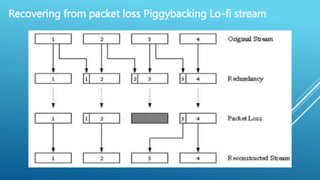
2nd FEC scheme “Piggyback Lower Quality Stream”
 Send lower resolution audio stream as redundant information
e.g., nominal stream PCM at 64 kbps and redundant stream GSM at
13 kbps.
 Whenever there is non-consecutive loss, receiver can conceal the
loss.
 With one redundant low quality chunk per chunk, scheme can
recover from single packet losses.
Recovering from packet loss Piggybacking Lo-fi stream
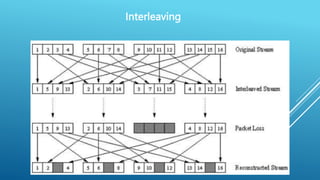
Recovering From Packet Loss Interleaving
• Divide 20 msec of audio data into smaller units of 5 msec
each and interleave.
• Upon loss, have a set of partially filled chunks.
• If packet lost, still have most of every chunk
• No redundancy overhead, but increases playout delay
Interleaving
Recovering From Packet Loss Receiver-based Repair
• The simplest form : Packet Repetition
 Replaces lost packets with copies of the packets that arrived immediately
before the loss.
• A more computationally intensive form: Interpolation.
 Uses Audio before and after the loss to interpolate a suitable packet to
cover the loss.
THANK YOU

Packet Loss Recovery Schemes

  • 1.
    PACKET LOSS RECOVERYSCHEMES By: Chinmaya Mahadev M N Ece Sec-2, CIT
  • 2.
    Problem: Packet loss •Loss is in a broader sense: Packet never arrives or arrives later than its scheduled playout time. • Since retransmission is inappropriate for Real Time applications, FEC or Interleaving are used to reduce loss impact.
  • 3.
    Recovering From PacketLoss Forward Error Correction • Send redundant encoded chunk every n chunks (XOR original n chunks)  If 1 packet in this group lost, can reconstruct  If > I packets lost, cannot recover • Disadvantages  The smaller the group size, the larger the overhead  Playout delay increased
  • 4.
    Tradeoff:  Increase n,less bandwidth waste  Increase n, longer playout delay  Increase n, higher probability that 2 or more chunks will be lost.
  • 5.
    2nd FEC scheme“Piggyback Lower Quality Stream”  Send lower resolution audio stream as redundant information e.g., nominal stream PCM at 64 kbps and redundant stream GSM at 13 kbps.  Whenever there is non-consecutive loss, receiver can conceal the loss.  With one redundant low quality chunk per chunk, scheme can recover from single packet losses.
  • 6.
    Recovering from packetloss Piggybacking Lo-fi stream
  • 7.
    Recovering From PacketLoss Interleaving • Divide 20 msec of audio data into smaller units of 5 msec each and interleave. • Upon loss, have a set of partially filled chunks. • If packet lost, still have most of every chunk • No redundancy overhead, but increases playout delay
  • 8.
  • 9.
    Recovering From PacketLoss Receiver-based Repair • The simplest form : Packet Repetition  Replaces lost packets with copies of the packets that arrived immediately before the loss. • A more computationally intensive form: Interpolation.  Uses Audio before and after the loss to interpolate a suitable packet to cover the loss.
  • 10.