1
Human Memory
Don’t ask too much of
mere mortals
Material mainly from Dix et al chapter 1
2
3
4
Learning outcomes
• Describe the major categories of human
memory
• Describe the major organization
structures of long term memory
• How are these organization structures
reflected in UI design
5
Memory
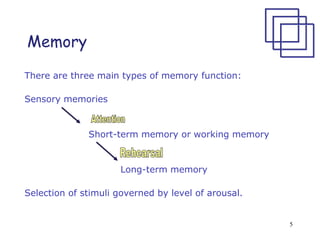
There are three main types of memory function:
Sensory memories
Short-term memory or working memory
Long-term memory
Selection of stimuli governed by level of arousal.
Think about
• What this means for HCI
– ?
– ?
– ?
– ?
– We will come back to this at the end of the
lecture
6
7
Sensory memory
• Buffers for stimuli received through
senses
– iconic memory: visual stimuli
– echoic memory: aural stimuli
– haptic memory: tactile stimuli
• Examples
– “sparkler” trail
– stereo sound
• Continuously overwritten
8
Short-term memory (STM)
• Scratch-pad for temporary recall
– rapid access ~ 70ms
– rapid decay ~ 200ms
– limited capacity - 7± 2 chunks
• Some research suggests that
programmers have better short-term
memory than ‘average’ people
– This means you will have better short-term
memory than your users!
9
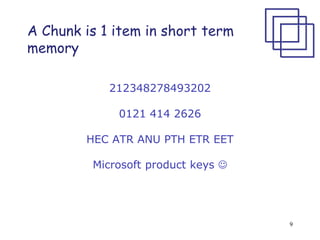
A Chunk is 1 item in short term
memory
212348278493202
0121 414 2626
HEC ATR ANU PTH ETR EET
Microsoft product keys 
10
Long-term memory (LTM)
• Repository for all our knowledge
– slow access ~ 1/10 second
– slow decay, if any
– huge or unlimited capacity
• Two dominant types of access structure
– episodic – serial memory of events
– semantic – structured memory of facts, concepts, skills
semantic LTM derived from episodic LTM
11
Interesting trivia
• Mega memory techniques
– Combine episodic and semantic
• Experienced programmers
– Use chunked techniques that they have
used before to solve problems
– They decompose the problem into bigger
chunks than a novice programmer
– Then apply known solution to each chunk
– Takes about 10 years to build up repertoire
12
Long-term memory (cont.)
• Semantic memory structure
– provides access to information
– represents relationships between bits of information
– supports inference
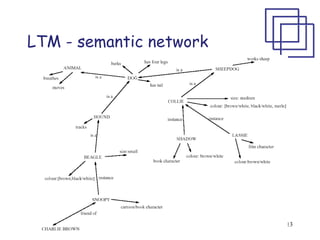
• Model: semantic network
– inheritance – child nodes inherit properties of parent
nodes
– relationships between bits of information explicit
– supports inference through inheritance
the human 2 of 3 13
LTM - semantic network
14
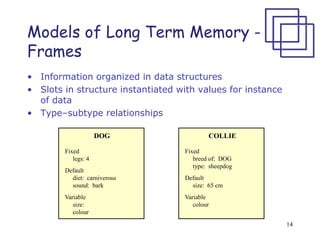
Models of Long Term Memory -
Frames
• Information organized in data structures
• Slots in structure instantiated with values for instance
of data
• Type–subtype relationships
DOG
Fixed
legs: 4
Default
diet: carniverous
sound: bark
Variable
size:
colour
COLLIE
Fixed
breed of: DOG
type: sheepdog
Default
size: 65 cm
Variable
colour
the human 2 of 3 15
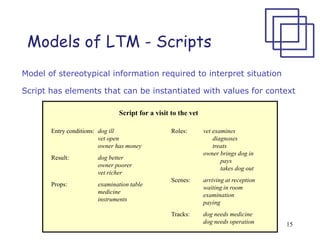
Models of LTM - Scripts
Model of stereotypical information required to interpret situation
Script has elements that can be instantiated with values for context
Script for a visit to the vet
Entry conditions: dog ill
vet open
owner has money
Result: dog better
owner poorer
vet richer
Props: examination table
medicine
instruments
Roles: vet examines
diagnoses
treats
owner brings dog in
pays
takes dog out
Scenes: arriving at reception
waiting in room
examination
paying
Tracks: dog needs medicine
dog needs operation
the human 2 of 3 16
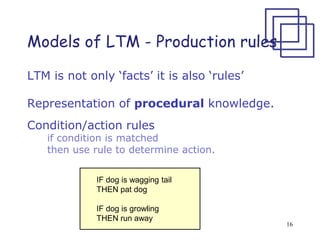
Models of LTM - Production rules
LTM is not only ‘facts’ it is also ‘rules’
Representation of procedural knowledge.
Condition/action rules
if condition is matched
then use rule to determine action.
IF dog is wagging tail
THEN pat dog
IF dog is growling
THEN run away
17
LTM - Storage of information
• rehearsal
– information moves from STM to LTM
• total time hypothesis
– amount retained proportional to rehearsal time
• distribution of practice effect
– optimized by spreading learning over time
• structure, meaning and familiarity
– information easier to remember
18
LTM - Forgetting
decay
– information is lost gradually but very slowly
interference
– new information replaces old: retroactive
interference
– old may interfere with new: proactive inhibition
so may not forget at all, memory is selective …
… affected by emotion – can subconsciously `choose' to
forget
19
LTM - retrieval
recall
– information reproduced from memory can be
assisted by cues, e.g. categories, imagery
recognition
– information gives knowledge that it has been seen
before
– less complex than recall - information is cue
spatial
– Strong memory of where things are relative to other
things
20
Applying this to your learning
• Mind maps
• Pre-read
• Take notes
• Revise
• Look for connections between subjects
What does this means for HCI
• Have you learnt anything new today?
• What does this mean for hci?
– ?
– ?
– ?
– ?
21
22
Learning outcomes
• Describe the major categories of human
memory
• Describe the major organization
structures of long term memory
• Describe how UI designs can make
remembering easier

P2.9_HumanMemory.ppt

  • 1.
    1 Human Memory Don’t asktoo much of mere mortals Material mainly from Dix et al chapter 1
  • 2.
  • 3.
  • 4.
    4 Learning outcomes • Describethe major categories of human memory • Describe the major organization structures of long term memory • How are these organization structures reflected in UI design
  • 5.
    5 Memory There are threemain types of memory function: Sensory memories Short-term memory or working memory Long-term memory Selection of stimuli governed by level of arousal.
  • 6.
    Think about • Whatthis means for HCI – ? – ? – ? – ? – We will come back to this at the end of the lecture 6
  • 7.
    7 Sensory memory • Buffersfor stimuli received through senses – iconic memory: visual stimuli – echoic memory: aural stimuli – haptic memory: tactile stimuli • Examples – “sparkler” trail – stereo sound • Continuously overwritten
  • 8.
    8 Short-term memory (STM) •Scratch-pad for temporary recall – rapid access ~ 70ms – rapid decay ~ 200ms – limited capacity - 7± 2 chunks • Some research suggests that programmers have better short-term memory than ‘average’ people – This means you will have better short-term memory than your users!
  • 9.
    9 A Chunk is1 item in short term memory 212348278493202 0121 414 2626 HEC ATR ANU PTH ETR EET Microsoft product keys 
  • 10.
    10 Long-term memory (LTM) •Repository for all our knowledge – slow access ~ 1/10 second – slow decay, if any – huge or unlimited capacity • Two dominant types of access structure – episodic – serial memory of events – semantic – structured memory of facts, concepts, skills semantic LTM derived from episodic LTM
  • 11.
    11 Interesting trivia • Megamemory techniques – Combine episodic and semantic • Experienced programmers – Use chunked techniques that they have used before to solve problems – They decompose the problem into bigger chunks than a novice programmer – Then apply known solution to each chunk – Takes about 10 years to build up repertoire
  • 12.
    12 Long-term memory (cont.) •Semantic memory structure – provides access to information – represents relationships between bits of information – supports inference • Model: semantic network – inheritance – child nodes inherit properties of parent nodes – relationships between bits of information explicit – supports inference through inheritance
  • 13.
    the human 2of 3 13 LTM - semantic network
  • 14.
    14 Models of LongTerm Memory - Frames • Information organized in data structures • Slots in structure instantiated with values for instance of data • Type–subtype relationships DOG Fixed legs: 4 Default diet: carniverous sound: bark Variable size: colour COLLIE Fixed breed of: DOG type: sheepdog Default size: 65 cm Variable colour
  • 15.
    the human 2of 3 15 Models of LTM - Scripts Model of stereotypical information required to interpret situation Script has elements that can be instantiated with values for context Script for a visit to the vet Entry conditions: dog ill vet open owner has money Result: dog better owner poorer vet richer Props: examination table medicine instruments Roles: vet examines diagnoses treats owner brings dog in pays takes dog out Scenes: arriving at reception waiting in room examination paying Tracks: dog needs medicine dog needs operation
  • 16.
    the human 2of 3 16 Models of LTM - Production rules LTM is not only ‘facts’ it is also ‘rules’ Representation of procedural knowledge. Condition/action rules if condition is matched then use rule to determine action. IF dog is wagging tail THEN pat dog IF dog is growling THEN run away
  • 17.
    17 LTM - Storageof information • rehearsal – information moves from STM to LTM • total time hypothesis – amount retained proportional to rehearsal time • distribution of practice effect – optimized by spreading learning over time • structure, meaning and familiarity – information easier to remember
  • 18.
    18 LTM - Forgetting decay –information is lost gradually but very slowly interference – new information replaces old: retroactive interference – old may interfere with new: proactive inhibition so may not forget at all, memory is selective … … affected by emotion – can subconsciously `choose' to forget
  • 19.
    19 LTM - retrieval recall –information reproduced from memory can be assisted by cues, e.g. categories, imagery recognition – information gives knowledge that it has been seen before – less complex than recall - information is cue spatial – Strong memory of where things are relative to other things
  • 20.
    20 Applying this toyour learning • Mind maps • Pre-read • Take notes • Revise • Look for connections between subjects
  • 21.
    What does thismeans for HCI • Have you learnt anything new today? • What does this mean for hci? – ? – ? – ? – ? 21
  • 22.
    22 Learning outcomes • Describethe major categories of human memory • Describe the major organization structures of long term memory • Describe how UI designs can make remembering easier