ANALYSIS
• Death Be Not Proud is one of Donne's Holy Sonnets (10) or Divine
Poems, written probably in 1609/10 and published two years after
his death in 1633.
• Death Be Not Proud is a Petrarchan style sonnet, 14 lines in total,
the first eight lines concentrating on the role that Death plays, the
last six lines detailing how Death is subject to other controls, such
as fate, chance and governmental systems.
• Throughout the poem Death is personified - given human
attributes - and addressed direct by the speaker. There's no easy
ride for Death in this poem, in fact Death is consistently belittled
and does not come out alive
Dr. Vandana Singh P.G Dept. of English,Maharaja College,Ara 3
Lines 1 - 4
• The direct address signifies immediately that the speaker is 'talking' to Death, here
personified. Death is being treated as a human, capable of pride, interestingly the
most serious of the seven deadly sins.
• Death's reputation has gone down in human history no doubt, many considering it a
fearful thing, to be feared. But the speaker is having none of it. Reputations count
for little as the speaker denounces Death and states that on the contrary, Death is
not 'mighty and dreadful' at all.
• The superior tone continues. Death may think he overthrows victims but that's not
the end of affairs. People do not die...and just for fun the speaker introduces his own
immunity and says he cannot be killed either. Death is being treated rather
shamefully, the speaker in a rather mocking kind of way suggesting that Death does
not realise this...poor Death...as if pity is being shown. These opening lines make it
crystal clear that Death has no real power over humanity - the human body might
perish but according to Christian theology, this is not the end.
Dr. Vandana Singh P.G Dept. of English,Maharaja College,Ara 4
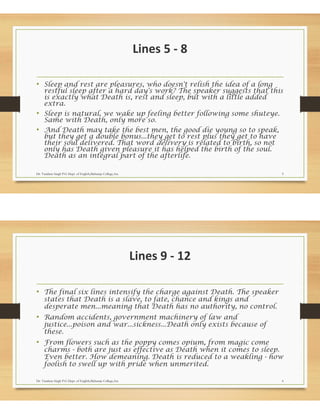
Lines 5 - 8
• Sleep and rest are pleasures, who doesn't relish the idea of a long
restful sleep after a hard day's work? The speaker suggests that this
is exactly what Death is, rest and sleep, but with a little added
extra.
• Sleep is natural, we wake up feeling better following some shuteye.
Same with Death, only more so.
• And Death may take the best men, the good die young so to speak,
but they get a double bonus...they get to rest plus they get to have
their soul delivered. That word delivery is related to birth, so not
only has Death given pleasure it has helped the birth of the soul.
Death as an integral part of the afterlife.
Dr. Vandana Singh P.G Dept. of English,Maharaja College,Ara 5
Lines 9 - 12
• The final six lines intensify the charge against Death. The speaker
states that Death is a slave, to fate, chance and kings and
desperate men...meaning that Death has no authority, no control.
• Random accidents, government machinery of law and
justice...poison and war...sickness...Death only exists because of
these.
• From flowers such as the poppy comes opium, from magic come
charms - both are just as effective as Death when it comes to sleep.
Even better. How demeaning. Death is reduced to a weakling - how
foolish to swell up with pride when unmerited.
Dr. Vandana Singh P.G Dept. of English,Maharaja College,Ara 6
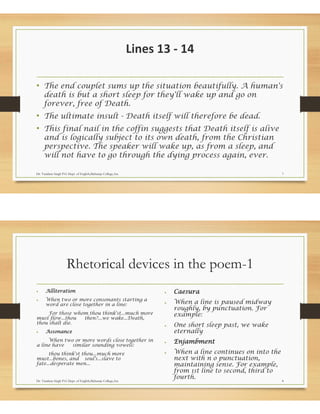
Lines 13 - 14
• The end couplet sums up the situation beautifully. A human's
death is but a short sleep for they'll wake up and go on
forever, free of Death.
• The ultimate insult - Death itself will therefore be dead.
• This final nail in the coffin suggests that Death itself is alive
and is logically subject to its own death, from the Christian
perspective. The speaker will wake up, as from a sleep, and
will not have to go through the dying process again, ever.
Dr. Vandana Singh P.G Dept. of English,Maharaja College,Ara 7
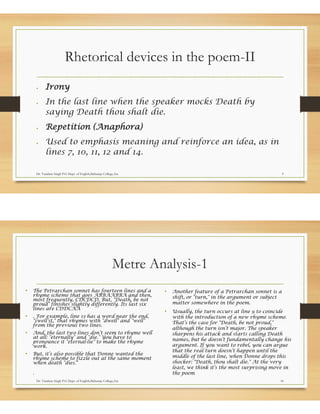
Rhetorical devices in the poem-1
• Alliteration
• When two or more consonants starting a
word are close together in a line:
For those whom thou think'st...much more
must flow...thou then?...we wake...Death,
thou shalt die.
• Assonance
When two or more words close together in
a line have similar sounding vowels:
thou think'st thou...much more
must...bones, and soul's...slave to
fate...desperate men...
• Caesura
• When a line is paused midway
roughly, by punctuation. For
example:
• One short sleep past, we wake
eternally
• Enjambment
• When a line continues on into the
next with n o punctuation,
maintaining sense. For example,
from 1st line to second, third to
fourth.
Dr. Vandana Singh P.G Dept. of English,Maharaja College,Ara 8
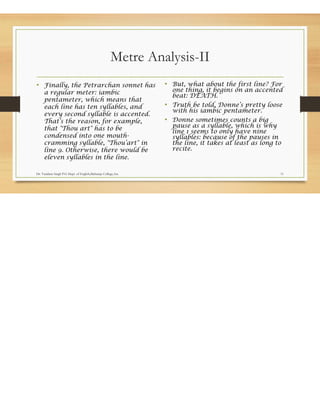
Rhetorical devices in the poem-II
• Irony
• In the last line when the speaker mocks Death by
saying Death thou shalt die.
• Repetition (Anaphora)
• Used to emphasis meaning and reinforce an idea, as in
lines 7, 10, 11, 12 and 14.
Dr. Vandana Singh P.G Dept. of English,Maharaja College,Ara 9
Metre Analysis-1
• The Petrarchan sonnet has fourteen lines and a
rhyme scheme that goes ABBAABBA and then,
most frequently, CDCDCD. But, "Death, be not
proud" finishes slightly differently. Its last six
lines are CDDCAA
• . For example, line 13 has a word near the end,
"swell’st," that rhymes with "dwell" and "well"
from the previous two lines.
• And, the last two lines don’t seem to rhyme well
at all: "eternally" and "die." You have to
pronounce it "eternal-lie" to make the rhyme
work.
• But, it’s also possible that Donne wanted the
rhyme scheme to fizzle out at the same moment
when death "dies."
.
• Another feature of a Petrarchan sonnet is a
shift, or "turn," in the argument or subject
matter somewhere in the poem.
• Usually, the turn occurs at line 9 to coincide
with the introduction of a new rhyme scheme.
That’s the case for "Death, be not proud,"
although the turn isn’t major. The speaker
sharpens his attack and starts calling Death
names, but he doesn’t fundamentally change his
argument. If you want to rebel, you can argue
that the real turn doesn’t happen until the
middle of the last line, when Donne drops this
shocker: "Death, thou shalt die." At the very
least, we think it’s the most surprising move in
the poem
Dr. Vandana Singh P.G Dept. of English,Maharaja College,Ara 10
Metre Analysis-II
• Finally, the Petrarchan sonnet has
a regular meter: iambic
pentameter, which means that
each line has ten syllables, and
every second syllable is accented.
That’s the reason, for example,
that "Thou art" has to be
condensed into one mouth-
cramming syllable, "Thou’art" in
line 9. Otherwise, there would be
eleven syllables in the line.
• But, what about the first line? For
one thing, it begins on an accented
beat: DEATH.
• Truth be told, Donne’s pretty loose
with his iambic pentameter.
• Donne sometimes counts a big
pause as a syllable, which is why
line 1 seems to only have nine
syllables: because of the pauses in
the line, it takes at least as long to
recite.
Dr. Vandana Singh P.G Dept. of English,Maharaja College,Ara 11

p1.pdf

  • 1.
    ANALYSIS • Death BeNot Proud is one of Donne's Holy Sonnets (10) or Divine Poems, written probably in 1609/10 and published two years after his death in 1633. • Death Be Not Proud is a Petrarchan style sonnet, 14 lines in total, the first eight lines concentrating on the role that Death plays, the last six lines detailing how Death is subject to other controls, such as fate, chance and governmental systems. • Throughout the poem Death is personified - given human attributes - and addressed direct by the speaker. There's no easy ride for Death in this poem, in fact Death is consistently belittled and does not come out alive Dr. Vandana Singh P.G Dept. of English,Maharaja College,Ara 3 Lines 1 - 4 • The direct address signifies immediately that the speaker is 'talking' to Death, here personified. Death is being treated as a human, capable of pride, interestingly the most serious of the seven deadly sins. • Death's reputation has gone down in human history no doubt, many considering it a fearful thing, to be feared. But the speaker is having none of it. Reputations count for little as the speaker denounces Death and states that on the contrary, Death is not 'mighty and dreadful' at all. • The superior tone continues. Death may think he overthrows victims but that's not the end of affairs. People do not die...and just for fun the speaker introduces his own immunity and says he cannot be killed either. Death is being treated rather shamefully, the speaker in a rather mocking kind of way suggesting that Death does not realise this...poor Death...as if pity is being shown. These opening lines make it crystal clear that Death has no real power over humanity - the human body might perish but according to Christian theology, this is not the end. Dr. Vandana Singh P.G Dept. of English,Maharaja College,Ara 4
  • 2.
    Lines 5 -8 • Sleep and rest are pleasures, who doesn't relish the idea of a long restful sleep after a hard day's work? The speaker suggests that this is exactly what Death is, rest and sleep, but with a little added extra. • Sleep is natural, we wake up feeling better following some shuteye. Same with Death, only more so. • And Death may take the best men, the good die young so to speak, but they get a double bonus...they get to rest plus they get to have their soul delivered. That word delivery is related to birth, so not only has Death given pleasure it has helped the birth of the soul. Death as an integral part of the afterlife. Dr. Vandana Singh P.G Dept. of English,Maharaja College,Ara 5 Lines 9 - 12 • The final six lines intensify the charge against Death. The speaker states that Death is a slave, to fate, chance and kings and desperate men...meaning that Death has no authority, no control. • Random accidents, government machinery of law and justice...poison and war...sickness...Death only exists because of these. • From flowers such as the poppy comes opium, from magic come charms - both are just as effective as Death when it comes to sleep. Even better. How demeaning. Death is reduced to a weakling - how foolish to swell up with pride when unmerited. Dr. Vandana Singh P.G Dept. of English,Maharaja College,Ara 6
  • 3.
    Lines 13 -14 • The end couplet sums up the situation beautifully. A human's death is but a short sleep for they'll wake up and go on forever, free of Death. • The ultimate insult - Death itself will therefore be dead. • This final nail in the coffin suggests that Death itself is alive and is logically subject to its own death, from the Christian perspective. The speaker will wake up, as from a sleep, and will not have to go through the dying process again, ever. Dr. Vandana Singh P.G Dept. of English,Maharaja College,Ara 7 Rhetorical devices in the poem-1 • Alliteration • When two or more consonants starting a word are close together in a line: For those whom thou think'st...much more must flow...thou then?...we wake...Death, thou shalt die. • Assonance When two or more words close together in a line have similar sounding vowels: thou think'st thou...much more must...bones, and soul's...slave to fate...desperate men... • Caesura • When a line is paused midway roughly, by punctuation. For example: • One short sleep past, we wake eternally • Enjambment • When a line continues on into the next with n o punctuation, maintaining sense. For example, from 1st line to second, third to fourth. Dr. Vandana Singh P.G Dept. of English,Maharaja College,Ara 8
  • 4.
    Rhetorical devices inthe poem-II • Irony • In the last line when the speaker mocks Death by saying Death thou shalt die. • Repetition (Anaphora) • Used to emphasis meaning and reinforce an idea, as in lines 7, 10, 11, 12 and 14. Dr. Vandana Singh P.G Dept. of English,Maharaja College,Ara 9 Metre Analysis-1 • The Petrarchan sonnet has fourteen lines and a rhyme scheme that goes ABBAABBA and then, most frequently, CDCDCD. But, "Death, be not proud" finishes slightly differently. Its last six lines are CDDCAA • . For example, line 13 has a word near the end, "swell’st," that rhymes with "dwell" and "well" from the previous two lines. • And, the last two lines don’t seem to rhyme well at all: "eternally" and "die." You have to pronounce it "eternal-lie" to make the rhyme work. • But, it’s also possible that Donne wanted the rhyme scheme to fizzle out at the same moment when death "dies." . • Another feature of a Petrarchan sonnet is a shift, or "turn," in the argument or subject matter somewhere in the poem. • Usually, the turn occurs at line 9 to coincide with the introduction of a new rhyme scheme. That’s the case for "Death, be not proud," although the turn isn’t major. The speaker sharpens his attack and starts calling Death names, but he doesn’t fundamentally change his argument. If you want to rebel, you can argue that the real turn doesn’t happen until the middle of the last line, when Donne drops this shocker: "Death, thou shalt die." At the very least, we think it’s the most surprising move in the poem Dr. Vandana Singh P.G Dept. of English,Maharaja College,Ara 10
  • 5.
    Metre Analysis-II • Finally,the Petrarchan sonnet has a regular meter: iambic pentameter, which means that each line has ten syllables, and every second syllable is accented. That’s the reason, for example, that "Thou art" has to be condensed into one mouth- cramming syllable, "Thou’art" in line 9. Otherwise, there would be eleven syllables in the line. • But, what about the first line? For one thing, it begins on an accented beat: DEATH. • Truth be told, Donne’s pretty loose with his iambic pentameter. • Donne sometimes counts a big pause as a syllable, which is why line 1 seems to only have nine syllables: because of the pauses in the line, it takes at least as long to recite. Dr. Vandana Singh P.G Dept. of English,Maharaja College,Ara 11