A QUARTERLY JOURNAL FOR DEBATING ENERGY ISSUES AND POLICIES contents
Issue 93 August 2013 East Mediterranean
Gas: opportunities and
challenges
Trevor Sikorski.................. 4
Laura El-Katiri................... 5
Joseph Paritzky and
Bill Farren-Price................ 7
Leigh Elston and
Peter Stewart................... 9
Matthew J. Bryza............ 10
Ayla Gürel....................... 13
Charles Ellinas................ 15
Anastasios Giamouridis....17
Dimitris Manolis and
Elsa Loverdos................. 19
Gerald Butt..................... 22
Bassam Fattouh and
Laura El-Katiri................. 24
Carole Nakhle................. 26
Walid Khadduri................ 28
Bill Farren-Price.............. 30
Asinus Muses................. 32
This edition of Forum explores
the complex web of geopolitics
and energy policy that provides
the backdrop to the new gas
province emerging in the East
Mediterranean.
Dedicated to this single topic, the
issue starts with Trevor Sikorski’s
detailed overview of the changing
face of the global LNG market, the
health of which will be a critical
factor in the decision to sanction
the development of any export-
focused East Mediterranean gas
projects. Sikorski points out that
when these projects come on-stream
in 7–10 years, the LNG market
will be very different from today,
with Qatar losing its pre-eminent
position as the global LNG leader
and Australia and the USA making
major inroads. He argues that
project timing will dictate the
tightness of global LNG markets,
with regas capacity investment
running at a different speed to that
of liquefaction. He projects greater
competition among LNG sellers and
higher volumes sold spot, improving
price transparency with the desire
by currently premium-paying Asian
buyers to move away from oil-
indexed pricing. Russia’s response to
these developments will be key to the
state of the European LNG market,
where East Mediterranean cargoes
are likely to end up, he argues.
Laura El-Katiri offers the regional
context for the East Mediterranean
gas revolution. Acknowledging
that much of the focus for global
markets will be on gas exports from
the region, the author also points
to the significant economic benefits
that will accrue to new producer
countries in terms of domestic gas
supply and the ability to reduce
reliance on more expensive oil-fired
power, especially given the growth
in domestic power demand in recent
years. The author looks beyond
the political issues that have so far
prevented substantial cross-border
energy flows, to consider the
potential benefits for the growing
number of regional energy-deficit
countries, while acknowledging that
geostrategic interests will ultimately
condition these outcomes.
As the leading gas producing
country in the East Mediterranean
to date, Israel is a natural first
country focus. Joseph Paritzky and
Bill Farren-Price discuss the impact
that gas is having and will have on
the country’s historic dependence
on energy imports and the hurdles
that stand in the way of gas exports,
either pipeline or LNG. Domestic
political opposition and technical
page 2  |  OXFORD ENERGY FORUM  |  AUGUST 2013
and security challenges will need to be overcome
if Israeli oil companies are to secure the finance
needed for major resource development. Whether
Cyprus can agree a liquefaction agreement with
Israeli companies or opts for an offshore export
pipeline to Turkey are among the choices that
need to be made; but the various issues
surrounding these and other options are likely
to remain keenly argued.
Leigh Elston and Peter Stewart delve deeper into the
Israeli government’s decision to cap exports from
major gas discoveries at 40 per cent of the proven
resource, a policy decision aimed at giving a boost
to gas development while keeping sufficient gas for
the growing domestic market. The authors discuss
the various monetization options for Israeli resource
holders and the intricacies of Israeli political
objections to the gas export decision.
Matthew J. Bryza argues the case for an Israel–
Turkey gas pipeline as the most commercially
efficient export option for Israeli gas and points to
the positive impact that such a project could have
on regional stability. Improved diplomatic relations
between the two countries make such an option
easier to reach, although private participation
would be essential, he writes. While the author
makes a compelling case – through comparing
the CAPEX projections for alternative Israeli gas
export options – he acknowledges that further
political work, not least between Cyprus and
Turkey, is needed before such a pipeline could
be realized.
Switching, next, to Cyprus and Turkey, Ayla Gürel
investigates the obstacles posed by the Cyprus
problem to regional energy integration. Specifically,
options for a pipeline carrying gas from Cyprus,
and potentially from other producers, to Turkey
and onwards to other south-eastern European
buyers are discussed. The author explores the
positions of Turkey, Cyprus, and the international
community to offshore gas development as well
as the issue of resource sovereignty.
The Cypriot perspective itself is provided by
Charles Ellinas, who outlines the country’s gas
export strategy, projects future demand for
Cypriot gas in Europe, and explains why Nicosia
has opted for LNG as its primary gas export option.
He makes the case for Cyprus as a liquefaction hub
for Israeli and Lebanese gas but also acknowledges
the economic and competitive risks looming
in terms of shale gas and the uncertain global
economic outlook.
Anastasios Giamouridis looks at the intersection
of Cyprus’s new-found hydrocarbon prospects and
its banking and fiscal crisis, examining the extent
to which gas revenue could dig the country out of
its economic recession. He stresses the importance
of economies of scale and points out that the
economics of Cypriot gas development will be
better understood only once appraisal drilling
and fresh exploration are undertaken.
DEPA’s proposed East Med pipeline project,
running from the offshore fields to Cyprus and
onwards to Crete and Greece, is the subject of the
next article, by Dimitris Manolis and Elsa Loverdos.
The authors point out that such a project would
help meet the EU’s strategy of diversifying energy
import sources while increasing competition
among producers. They point to some of the
drawbacks of LNG, not least cost, and suggest
that taking the LNG route would place Cyprus
in competition with other lower-cost producers
feeding the Asian market.
Gerald Butt looks at Turkish energy policy and
sees diversity at its heart – a strategy that for now
will favour oil and gas from northern Iraq over
prospective supply from the East Mediterranean.
He is sceptical about prospects for the resolution
of Eastern Mediterranean political entanglements
and instead argues that Ankara will persist with
its political and capital investments in Iraqi
Kurdistan.
Turning to Lebanon, Bassam Fattouh and
Laura El-Katiri analyse the country’s slow
progress towards its inaugural offshore bid round,
one of a series of steps aimed at helping the country
join the club of regional energy exporters. Strong
international interest in the bid round has been
shown despite political complications that include
the absence of a full-time government, and the
AUGUST 2013  |  OXFORD ENERGY FORUM  |  page 3
Contributors to this issue
MATTHEW J. BRYZA is Board
Member, Turcas Enerji Holding;
Senior Fellow, Atlantic Council;
Director, International Centre for
Defence Studies in Tallinn
GERALD BUTT is Analyst,
Petroleum Policy Intelligence
CHARLES ELLINAS is Executive
President, Cyprus National
Hydrocarbons Company
LEIGH ELSTON is Senior Analyst,
Natural Gas Daily
BILL FARREN-PRICE is Founder
and CEO, Petroleum Policy Intelligence
BASSAM FATTOUH is Deputy
Director, Oxford Institute for Energy
Studies and Director of the Oil and
the Middle East Programme, OIES
ANASTASIOS GIAMOURIDIS
is Senior Consultant, Pöyry
Management Consulting
AYLA GÜREL is Senior Research
Consultant at the Peace Research
Institute Oslo (PRIO) Cyprus
Centre
LAURA EL-KATIRI is Research
Fellow at the Oxford Institute for
Energy Studies and Teaching Fellow
in the Department of Financial and
Management Studies at the School
of Oriental African Studies,
University of London
WALID KHADDURI is Consultant,
Middle East Economic Survey
ELSA LOVERDOS is a DEPA
Associate
DIMITRIS MANOLIS is Director,
International Activities, International
Projects Monitoring, DEPA (Public
Gas Corporation) SA
CAROLE NAKHLE is Associate
Lecturer in Energy Economics,
University of Surrey
JOSEPH PARITZKY is the former
Israeli Minister of Energy and National
Infrastructure, and current energy
businessman
TREVOR SIKORSKI is Head of
Natural Gas, Carbon and Coal
Research at Energy Aspects
PETER STEWART is Chief Energy
Analyst, Interfax Global Gas Analytics
sectarian divisions that make consistent policy
formation so difficult. Carole Nakhle, meanwhile,
assesses the legal implications of the country’s
upstream hybrid fiscal regime and suggests that the
government will need to go further to build out its
technical and administrative capacity for managing
the nascent hydrocarbon sector.
Walid Khadduri looks at the challenges facing
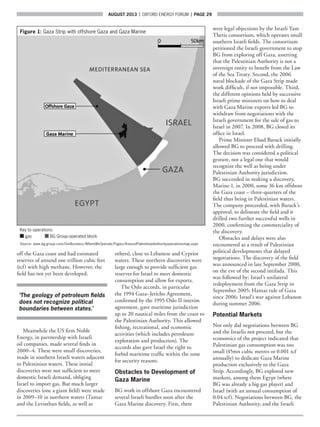
potential developers in Gaza’s small offshore sector
by assessing the history of BG’s failed attempts to
monetize its offshore discovery in Gazan waters.
Finally, Bill Farren-Price looks at the important
lessons presented by the recent history of Egypt’s
gas industry.
New OIES Publications
Recent Working Papers
Why Europe’s Energy and Climate
Policies are Coming Apart (SP 28)
by David Buchan, July 2013
Iran’s Gas Exports: can past failure
become future success? (NG 78)
by David Ramin Jalilvand, June 2013
Natural Gas in Pakistan and
Bangladesh: current issues and trends
(NG 77)
by Ieda Gomes, June 2013
The Italian Gas Market – Challenges
and Opportunities (NG 76)
by Anouk Honoré, June 2013
Quantity Performance Payment by
Results – Operationalizing Enhanced
Direct Access for Mitigation at the Green
Climate Fund (EV 59)
by Benito Müller, Maya Forstater, and
Samuel Fankhauser, July 2013
The Oxford Approach –
Operationalizing the UNFCCC
Principle of ‘Respective Capabilities’
(EV 58)
by Benito Müller and Lavan
Mahadeva, February 2013
Recent Energy Comments
Diesel Pricing Reforms in India –
a Perspective on Demand
by Bassam Fattouh, Amrita Sen, and
Anupama Sen, August 2013
Summer Again – The Swing in Oil
Demand in Saudi Arabia
by Bassam Fattouh, July 2013
President Obama’s Climate Action Plan
by David Robinson, July 2013
UK Shale Gas – Hype, Reality and
Difficult Questions
by Howard Rogers, July 2013
page 4  |  OXFORD ENERGY FORUM  |  AUGUST 2013
Eastern Mediterranean LNG: a different global gas market
TREVOR SIKORSKI
While developments relating to Eastern
Mediterranean gas exports around
2020 point to a boost for the economies
that will be involved, the global market
into which those exports will be sold
will be very different from the market
existing today.
Post-Fukushima Shift Towards
Asian Deliveries
After a rapid expansion of liquefaction
capacity in the 2005–8 period, which
saw Qatari trains coming into the market
and pushing that country into the role of
dominant global supplier (around 33 per
cent of supply in 2012), there have been
few additions to change the global
supply picture. The demand for LNG,
though, has seen dynamic changes with
the post-Fukushima demand centres in
Asia rapidly expanding, so that the region
now accounts for around 75 per cent of
global LNG demand (up from 60 per cent
pre-Fukushima).
‘Fast forward seven to ten years
and the LNG markets will be a
different place.’
The market has balanced itself by
increasingly attracting volumes away from
demand areas well served by pipeline
gas. Europe and North America have
both seen significant reductions in LNG
imports, with those volumes heading
instead to Asia. While the market still
largely functions on long-term contracts,
spot trade has increasingly developed to
ensure volumes go where their value is
highest. However, the spot market is still
nascent and a forward curve for, say,
delivery into north-east Asia, is just
beginning to develop.
Potential Supply Boom
Fast forward seven to ten years and the
LNG markets will be a different place.
The current moratorium on investment
in new capacity in Qatar means that the
country’s share of global LNG supply
will begin to wane, and other countries
will come forward.
The first of these will be Australia,
which currently has some 62 mtpa of
liquefaction capacity under construction
and scheduled for operations in the
period between 2014 and 2018. Another
36 mtpa is planned, although few of
those projects are likely to go ahead
before the end of this decade.
Second, the USA has issued full export
licences for the export of 26 mtpa and
has another 200+ mtpa of applications
for shale gas exports pending. While not
all of these will go ahead, the US DoE
is coming under increasing pressure
to make decisions on the outstanding
applications. By 2020 we certainly think
that exports of around 73 mtpa are likely
(this only covers the top six applications
out of 27 different projects).
The list of Canadian export projects
is not as long (six so far, with export
capacity of 62 mtpa), but Canada seems
to have fewer concerns about granting
export licences. If Canada adds another
20 mtpa or so, then North American
exports could be as high as 95 mtpa
by 2020. North American supply is
particularly important for the market as
a whole, as most of it is based on a model
that does not involve direct indexation
of gas to oil prices.
Aside from Australia and North
America, there are further proposals for
additional liquefaction in other countries,
with construction underway to add
some 27 mtpa of capacity. There are also
plans for another 71 mtpa of capacity in
regions including Russia, East Africa and
Cyprus. Summing the likely increments
from Australia and North America,
together with a contribution from the
rest of the world of another 55 mtpa
or so, suggests that global LNG supply
should be higher by some 220 mtpa.
To put this in context, supply in the
last two years was around the 240 mtpa
level, so the global market in seven years
could be almost double the size it is now.
Regasification
Alas, supply is only ever half the
story, and while money is pouring
into liquefaction it is also pouring into
regasification. There is over 100 mtpa
of regas capacity under construction,
with Asia boasting almost half of this
(50 mtpa), Latin America (29 mtpa),
and Europe (23 mtpa). The market
appears more balanced when you look at
proposed regas plants, which would add
another 180 mtpa of demand, although
a number of those proposed look very
speculative and will not proceed.
Having said that, regas plants can
usually be completed faster than the
more complex liquefaction projects and
this is particularly the case when
projects involve floating storage and
regasification (FSRU), a technology which
is increasing in popularity (most of the
Latin American projects involve FSRU).
As such, there is certainly still time for
more regas projects to be announced,
constructed, and brought on stream
by 2020.
How tight (or loose) the LNG
market gets from here will be down
to project timing. However, at an
overall level, the ratio of global regas
to liquefaction is around a factor of
2:1. Surplus regas capacity provides the
holders of liquefaction capacity with
greater destination optionality. By 2020,
however, the increments in capacity look
to favour liquefaction additions, and
these will likely outstrip increments in
regas. This state of affairs should help
loosen the overall physical market –
making more LNG volumes available for
the residual LNG market that is Europe.
This has implications both for the
commercial terms of the global LNG
market and for the direction of regional
flows. In commercial terms, a looser
global LNG market will create greater
competition between sellers to place
volumes, and this should begin to reduce
prices and stimulate demand, particularly
in the power sector, as LNG-fired plants
tend to operate at the high-cost end of
the mid-merit power order.
Gas Trading Mechanisms
The greater levels of spot trade will help
establish more transparent pricing and
the old certainty of selling gas linked to
AUGUST 2013  |  OXFORD ENERGY FORUM  |  page 5
oil will begin to come under pressure.
Key in this move will be the US exports
that are all largely being sold into the
market under contracts with direct
exposure to the US Henry Hub gas
price, either under a tolling agreement
or under a gas-linked long-term supply
contract. The one thing that is becoming
abundantly clear from developments in
North America is the extent to which
Asian buyers of LNG find it attractive
to secure gas on contracts which are not
linked to some form of oil. The two US
projects that have been awarded full
export licences have agreed long-term
supply contracts with Gail (India),
Osaka Gas, Chubu Electric (Japan),
and KOGAS (South Korea). The lure of
low-priced gas is real and very powerful.
If spot LNG prices become
structurally lower-priced than contract
gas prices, pressure will build to
renegotiate those contracts and to
replace them with some form of gas
price indexation. This is the dynamic
witnessed in Europe over the last two
years and this will be increasingly
seen going forward in the global LNG
market. Whether the next seven years
is a long enough period to see a full
abandonment of oil-indexed pricing
structures is a moot point, but if we do
get something like 70 mtpa of hub-
linked gas spilling into the global market
from the USA by 2020, such strictures
that serve to keep gas as a premium fuel
are likely to be fully on their way out.
In terms of directional flows, the
evolving pattern of trade will mean
that north-east Asian buyers will
be increasingly served with, first,
Australian/south-east Asian LNG and
then with North American gas. Qatar
will come under increasing pressure to
put volumes into that market and will
need to see more of its volumes swing
back into Near-East Asian, Middle
Eastern and European markets. The
same will be true for African volumes
(north, west, and east) although Algeria,
Nigeria, and Angola will all be able to
compete for the growing Latin American
market, as will US volumes.
And What About Eastern
Mediterranean Gas?
This leaves Eastern Mediterranean
volumes, which will be coming online
in the midst of this potential global
supply boom and will probably need to
look to Europe as a primary destination,
given its geographical proximity. Europe
has a number of LNG facilities planned,
so there will be some capacity to sell
into, although this is definitely a market
where hub-gas pricing is on the up
and up and where hub exposure will
be an important risk for the project to
manage. However, where those long-
term hub prices go is really a function
of how Russia reacts to an increasingly
competitive landscape. The importance
of Gazprom’s gas marketing decision-
making cannot be underplayed, as by
2020 it will have the 63 bcm/year South
Stream pipeline to fill up, as well as
the already functioning 55 bcm/year
Nord Stream. If it decides to go for
market share, those gas prices could be
very modest.
‘… the old certainty of selling
gas linked to oil will begin to
come under pressure.’
What is clear is that while EU policy
is clearly aimed first at minimizing the
use of coal, providing a niche for gas to
be a bridging fuel in that period, the
competitive landscape for gas supply in
the period around 2020 could well be
very different from today. ■
The Eastern Mediterranean: the Middle East’s final gas frontier
LAURA EL-KATIRI
The Eastern Mediterranean is in the
midst of a significant energy revolution.
Sizeable discoveries of over 35 trillion
cubic feet (tcf) of natural gas offshore
Israel and Cyprus have, since 2009,
transformed the region’s fate as a
long-term energy importer reliant
on neighbouring Arab and Russian
suppliers, into that of a prospective
net exporter.
US Geological Survey estimates
suggest that a further 85 tcf could yet be
discovered within the Levant basin (the
stretch of land and sea that ranges from
Syria and Lebanon in the north, down
to the coast of Israel and the Palestinian
territories in the south). The Eastern
Mediterranean gas discoveries, therefore,
mark not only the emergence of a new
regional gas province, they also signify
the fall of one of the last hydrocarbon
frontiers in the Middle East.
The significance of these gas
discoveries extends beyond their use
in the domestic energy sectors of Israel
and Cyprus, for their export value
gains them the attention of a range
of interested potential stakeholders,
including markets (such as those in
neighbouring Europe) that could benefit
from importing Eastern Mediterranean
gas. However, the real value of Eastern
Mediterranean gas, both in economic
and in wider geostrategic terms, lies in its
regional use. Israel and Cyprus lie close
to a region defined as much by long-
standing political conflict as by economic
difficulty, in which low-cost, regional gas
supplies could well play an important
strategic role. Eastern Mediterranean gas
offers a rare opportunity for the region
to re-engage in mutually beneficial
trade relations that could underpin both
greater economic and political stability
in one of the world’s most politically
volatile regions.
Exploration Success with Some
Future Prospects
The Eastern Mediterranean gas
discoveries made since 2009 were,
indeed, not the first exploratory successes
in the offshore Levant basin. Gas was
discovered in 1999 and 2000 at Israel’s
offshore Noa and Mari-B fields, as well
as in offshore Gaza, although these first
discoveries were small, triggering little
of the notable attention the region has
received more recently. The region’s
page 6  |  OXFORD ENERGY FORUM  |  AUGUST 2013
first offshore discoveries were as much
the result of economic stubbornness as
of politically conceived economic need;
Israel’s historic political and economic
isolation amongst its Arab neighbours
having motivated the country’s on- and
offshore exploration efforts for decades,
with the strategic aim of reducing its
import dependence for energy reaching
back to the 1970s.
While Mari-B provided Israel with
small volumes of domestically produced
gas for a limited period of time,
subsequent years saw disappointing
exploration results, reinforcing
expectations in both Israel and the
wider region of remaining reliant on
energy imports for the foreseeable
future. Eventually, new gas discoveries
were made in 2009, again in Israeli
waters, and this time they were large –
amounting to some 10 tcf mostly
located in Tamar, and then came
the landmark discovery of the giant
Leviathan field in 2010, with up to
20 tcf. Israel’s offshore success was
subsequently mirrored by Cypriot
discoveries of up to 7 tcf of offshore gas
resources in its south-east located block
12, in the Aphrodite play close to Israel’s
Leviathan discovery. Further exploration
work is underway, with Cyprus having
tendered out five more blocks adjacent to
the Aphrodite play in the hope of raising
the island state’s recoverable resource
estimates further.
‘Natural gas has the
unprecedented potential to
change the energy landscape
in the Eastern Mediterranean
forever.’
With proven reserves of some 9.4 tcf
by the end of 2012 and an estimate of up
to 40 tcf of currently known offshore gas
resources, Israel now holds resources large
enough to supply its domestic market for
several decades and to allow for exports.
The small domestic market of Cyprus
similarly allows for surplus gas to be
exported, opening up the opportunity
of post-2020 gas export revenues, in
addition to savings made by the domestic
use of its offshore gas resources in place
of oil in the power sector. Israel’s
offshore reserves put the country in the
ironic position of overtaking all its direct
Arab neighbours, including Syria, in the
size of its natural gas reserves, and
currently offering the Levant region’s
only immediately available potential
export volumes of natural gas.
Lebanon and Syria, too, offer
promising prospects for offshore
hydrocarbon deposits, following initial
seismic work, and hold high-end interest
in developing and future offshore
discoveries. The complicated domestic
political scenes in both countries
– characterized by quasi-permanent
parliamentary stalemate in Lebanon and
the civil war in Syria which has escalated
since 2011 – have pre-empted plans by the
two Arab neighbours for the exploration of
their share of the Eastern Mediterranean
sea. And while Lebanon now seems set to
move ahead with a first offshore licensing
round this year, the chaos in Syria will
likely keep its offshore off the regional
hydrocarbon map for longer.
Economically Well-timed
Discoveries
The Eastern Mediterranean discoveries
since 2009 have arguably come at
exactly the right time. The Middle
East and North Africa as a region
has experienced tremendous growth
in domestic energy demand over the
past decade, a rising share of which
is supplied by diminishing natural
gas supplies. Regional gas reserves are
highly concentrated in a few large gas
producers, principally Iran, Qatar, and
to a lesser extent Saudi Arabia. Of these,
only Qatar is currently a stable gas
exporter, albeit primarily in the form of
flexible yet expensive LNG.
The Levantine economies, generally
less well-endowed in hydrocarbon
wealth than the oil-rich Gulf states
and parts of North Africa, have for
most of their histories been dependent
on imports for the majority of their
energy needs. Excluding Syria, this has
been true not only for Israel, Lebanon,
and Cyprus, but also for Jordan and,
most recently, Egypt. Egypt’s case
dramatically illustrates what has gone
decisively wrong in the region for most
of the past 20 years or more – surging
domestic demand. This has been
driven by population growth, rising
living standards, energy-intensive
industrialization policies, and a domestic
energy price environment which
endemically undervalues energy down
to a fraction of average energy costs
prevailing anywhere else in the world.
This has crippled Egypt’s gas export
capacity over the last few years.
‘Israel now holds resources
large enough to supply its
domestic market for several
decades and to allow for
exports.’
Having famously cancelled its
existing gas supply contract with Israel
in April 2012, the Egyptian government
has since struggled to fulfil its gas supply
contract with Jordan – this has been
recurrently interrupted by political
turmoil and sabotage. Both Jordan,
whose power sector is more than 80 per
cent dependent on Egyptian gas, and
Lebanon, which is forced to rely on oil
for power generation, are arguably in
a gas crisis. So is Egypt, whose current
domestic situation is not only shaped
by continued political turmoil and
dysfunctional governing institutions,
but also by insurmountable budgetary
pressure, and continued fuel shortages
and electricity blackouts.
… But it’s the Politics, Stupid
The domestic predicament facing Syria
and Lebanon regarding their lagging
exploration progress, and Egypt’s current
gas crisis, give us a taste of the sort of
dynamics which are likely to drive the
direction of Eastern Mediterranean gas
development. Eastern Mediterranean
gas could play an economically sound
and mutually beneficial role in the
Levant’s current energy-related economic
predicament: Israeli gas, perhaps also
gas from Cyprus, could supply gas-
short neighbours through existing and
expanded gas pipeline infrastructure.
Israel’s most immediate neighbours, the
Palestinians, are already set to benefit
from gas, albeit supplied from Israeli
offshore fields. The current turmoil in
Egypt – which has idle LNG facilities
and unfulfilled export contracts, but
has been opposed deeply to trade with
AUGUST 2013  |  OXFORD ENERGY FORUM  |  page 7
Israel on ideological grounds – finds
the country’s economy in disarray, with
continuing negotiations for IMF loans
to keep the economy from hitting the
buffers. It could, commercially speaking,
benefit significantly from an Israel–
Egypt gas-linked entente.
Cyprus, which is divided between
Greek and Turkish communities, faces
controversy centred around its gas
development plans. Territorial water
delimitations claimed by the Turkish
Republic of Northern Cyprus (TRNC)
overlap with offshore blocks of the
Republic of Cyprus. Turkish claims
also overlap with Cyprus’s Exclusive
Economic Zone located in the south-
west of the island, a factor which
has been blamed for the continued
negotiations over Cypriot blocks 5 and 6
for which bids have been received.
In spite of these political barriers,
Turkey could yet offer a geographically
close and economically logical export
market for Cypriot gas, which would
diminish Turkey’s need for higher-cost
Russian gas imports and the political
controversy associated with Turkish
alternatives to Russian gas which include
Iranian gas, and Kurdish gas from northern
Iraq. This could potentially contribute to
Turkey’s intended role as energy hub for
Eastern, not Russia-based gas deliveries
towards Europe. However, the absence of a
settlement of the Cyprus problem renders
this option highly unlikely in the near
future, at the cost also of the northern
Cypriot community, which would
significantly benefit from a reconciliation
with the Greek Cypriots in the south.
Turkish claims to defend northern
Cypriot interests in the offshore
Mediterranean have been met by yet
more sabre-rattling on the other side
of the coastline, between Israel and
Lebanon which also share disputed land
and maritime boundaries. Egypt, too,
is looking to reassess its offshore claims
towards the east, towards what would
be Palestinian waters, albeit under de
facto Israeli administration. Palestinian
interests in the offshore Mediterranean
have perhaps been the most overlooked
in recent years. Offshore Gaza offers
two known plays sizeable enough for
commercial development, yet deadlock
between the Israeli government – keen
to prevent any direct gas development
revenue stream to Hamas – and
shareholders has kept the discoveries
from being developed.
Uncertain Outcome
Geostrategic interests in the Eastern
Mediterranean are yet to shape the
direction that gas development will take.
Beyond impacting current development
and future gas export volumes – which
remain a separate domestic policy issue
in both Israel and Cyprus – regional
politics will most likely prove critical
in determining both the extent to
which Eastern Mediterranean gas will
benefit the region as a whole (or only
its immediate resource holders) and
the eventual destination of Eastern
Mediterranean gas flows. While regional
options are attractive, both economically
and politically, for Israel and Cyprus,
political barriers to greater regional gas
trade leave both countries looking at
other export options.
Cyprus, with limited pipeline options,
has already decided to prioritize LNG
exports. The expected size of initial
Cypriot exports – with some estimated
5 million tons per annum – makes the
country an unlikely second Mozambique
or Tanzania, but will eventually generate
badly needed funds for the country,
whose public finances are struggling
under the terms of a multilateral
bail-out. By contrast Israel, an island
politically if not geographically, offers
feasible regional options. In June, Israel
removed the last remaining hurdle for
gas exports, by approving the export
of 20 bcm of Israeli gas. Still, Israel’s
domestic battles have not yet all been
fought, and it may eventually agree
to a joint LNG project in Cyprus, a
pragmatic option in a region so deeply
divided by politics.
Regardless of the many other
challenges involved in bringing the
region’s gas to market (including the
not yet fully resolved question of the
size and nature of exports, the fiscal and
regulatory regimes that are a work-in-
progress, and the eventual confirmation
of technically recoverable reserves),
the offshore gas discoveries made since
2009 have had a tremendous effect on
the regional energy power balance in
the Eastern Mediterranean. Being the
latest – and possibly last – gas frontier
in the Middle East, the area is of no less
consequence for world gas markets than
East Africa and the Caspian. Natural
gas has the unprecedented potential
to change the energy landscape in the
Eastern Mediterranean forever. ■
The author recently published a study
co-authored with Bassam Fattouh and
Hakim Darbouche under the title
‘East Mediterranean Gas: What Kind
of Game-Changer?’, available on the
OIES website.
Israel Gas: the export conundrum
JOSEPH PARITZKY and BILL FARREN-PRICE
Israel’s discovery of significant volumes
of offshore natural gas in the past few
years will, over time, remove what
has been a strategic handicap for the
country: reliance on energy imported
from abroad.
The fact that Israel now has sufficient
gas to remove its historic reliance on oil
and coal-fired power and, potentially,
to allow it to address options for the
gasification or electrification of the
transport fleet at some point in the
future, is no mean achievement for a
country that has found itself in a state
of war or, at best, cold peace with its
energy-rich Middle East neighbours for
decades. Delays in building a secondary
north–south gas trunk line in Israel may
delay domestic and industrial uptake of
the increasing domestic gas supplies, but
the size of the resource so far discovered
means the medium- to long-term
outlook for domestic gas use is strong.
But the export of gas, rather than its
page 8  |  OXFORD ENERGY FORUM  |  AUGUST 2013
domestic use, is the inevitable driver
for the development of the approximate
19 tcf offshore Leviathan field, and for
potential future medium- to large-scale
gas additional discoveries. While the
Israeli government has finally made a
ruling permitting the export of 40 per
cent of the country’s proven gas resource
base, parliamentary opposition parties
have already challenged the move and
are seeking a judicial review of the
decision in the Supreme Court, with the
aim of requiring parliament’s approval
for this and any future gas export deal.
Whether the government wins the
right to approve gas exports without
the oversight of MPs or not, the dispute
highlights one of the challenges faced by
the Israeli gas industry, as it looks to line
up buyers for future gas exports.
‘The priority in all discussions
will be to identify a politically
durable option that will be
bankable.’
Israeli explorers and their international
partners know that without an export
market it will be difficult to finance
fresh exploration, and near impossible to
secure funds for full field development.
In the long term this will, paradoxically,
also limit the volume of gas available to
the domestic market. Israel’s very public
debate on hydrocarbon policy is
overshadowed by the instinctive distrust
felt by significant segments of the public
(particularly on the left) of those industry
leaders whose companies made the
discoveries in the first place. Safeguarding
a national strategic asset from those who
would export and profit from it has
become the political narrative for the
opposition led by the Labour Party.
Moreover the government’s green
light to exporters does not, of itself,
solve a raft of other problems facing
Israel’s upstream shareholders. The first
issue for exporters is whether to opt for
an expensive LNG project or a cheaper
pipeline export system.
Exports as LNG
The immediate problem in this, one of
the region’s smallest countries, is to find
an appropriate site for an LNG project.
Such a site will need to be close to the
coast, sufficiently large, and not subject
to security threats. The prospect of
fighting a long-drawn-out legal battle
to win permitting rights in a heavily
congested coastal strip means that a
site near the city of Ashkelon, where
developers believe there is sufficient land
for a two-train LNG operation, is the
only real possibility, if indeed there is
any option at all.
Alternative proposals to build a plant
in the southern port of Eilat are not
consistent with that city’s limited land
availability and heavy investment in
tourism infrastructure. An Eilat LNG
plant would, however, mean that Israeli
cargoes heading to Asian markets would
sail directly from the Red Sea and would
not need to transit the Suez Canal –
another potential security black spot for
Israeli shipping, as well as that of other
countries. Neighbouring Aqaba has space
for a plant and Jordan would itself be
a logical market for Israeli gas, but the
status of regional and Palestinian politics
means that it is not a realistic option for
now. Floating LNG may well solve the
land issue, although security concerns,
cost, and the long lead time will probably
keep that option off the table.
Exports via Pipeline
Piping Israeli gas to the planned LNG
plant at Vasilikos on the southern coast
of Cyprus is another potential solution,
and one which Leviathan’s partners
are discussing with their Cypriot
counterparts. But there are influential
voices within the Israeli debate which
argue against that option on the grounds
that sending gas to Cyprus would simply
extend security vulnerabilities, while
putting a national strategic asset in the
hands of a third-party country.
In terms of pipeline exports, regional
geopolitics (again) rule out (at least for
now) logical options such as gas sales
to Egypt, which is facing its own gas
supply crisis and has idled most of the
capacity at its two LNG plants on the
Mediterranean coast; and to gas-short
Jordan. However, the prospect of a
subsea pipeline to Turkey (mirroring
an ENI pipeline proposal made over
a decade ago) is more realistic, given
the warmer diplomatic relations seen
recently between the two countries.
Turkey would not only offer a long-term,
assured market for Israeli gas exports,
but could also serve as a conduit for
onward gas transport to other south-east
European markets through its existing
hub connections. The same could be
said of Greece, although the increased
length of the pipeline required would
add substantially to the cost of that
option.
Decisions for the Future
The immediate challenge for prospective
developers of the Leviathan field is to start
a meaningful process aimed at signing a
gas sales and purchase agreement, so that
that the final investment decision for
the field’s development can be made.
However, the legal challenge to the
government’s approval for gas exports is
likely to prevent progress on this front
in the near term. Developers will
consequently be unable to guarantee gas
supplies to potential buyers until the
issue is resolved. The complicated
challenge of how to establish liquefaction
facilities for Israeli gas will also probably
mean protracted negotiations on most of
the options.
Cyprus has declared that it will
proceed with a minimum single-train
development for its initial Aphrodite
discovery, but it will be eager to
improve the economics of the project by
signing up another supplier such as the
Leviathan consortium. Whether that
can be achieved in the near term will
depend upon Israel’s discussions with
Turkey (in which Russia’s Gazprom is
involved) and on the need to negotiate
an acceptable route for such a pipeline,
a complex task given the geopolitical
rivalries and maritime boundaries in the
Eastern Mediterranean.
‘The first issue for exporters is
whether to opt for an expensive
LNG project or a cheaper
pipeline export system.’
The priority in all discussions will be
to identify a politically durable option
that will be bankable. The Middle East’s
worsening geopolitical situation makes
this a difficult task. But the restart of
Israel–Palestine peace talks is proof that
AUGUST 2013  |  OXFORD ENERGY FORUM  |  page 9
Israel recognizes the greater regional
economic integration that gas exports
– whether LNG or pipeline – would
represent. However, such a move would
need to progress hand-in-hand with a
broader political settlement – one, in
particular, that deals with the tough
status issues between Israel and the
Palestinians.
Israel’s gas dividend has the potential
to bring both strategic and economic
benefits, but there are several thorny
questions that will need to be answered
before gas exports can get closer to
becoming a reality. ■
Israel’s Cap on Gas Exports: what will it mean for Leviathan?
LEIGH ELSTON and PETER STEWART
The Israeli government’s decision to cap
gas exports at 40 per cent, or 320 bcm –
13 per cent lower than the export limit
recommended by the interministerial
Tzemach committee last year – was
naturally met with disappointment by
drillers in the Levant basin. However,
on second glance, the government’s slide
to a more conservative gas policy will not
necessarily restrict export options from
the giant Leviathan field.
Not only will the Israeli government
allow the Leviathan partners to swap gas
export credits with smaller fields, but
investors are hopeful that the gas reserve
pie – now estimated at 920 bcm – from
which the 40 per cent export slice will
be cut will only grow bigger as further
exploration gets underway. Neverthe-
less news of the 40 per cent export cap
raised questions over whether Woodside
Energy will withdraw from its $1.3 bn
deal to take a 30 per cent stake in the
Leviathan field.
The Australian LNG player
agreed to farm into Leviathan on the
understanding that at least 50 per cent
of the field’s reserves could be exported
as LNG. The new policy has led to
speculation that the partners may no
longer proceed with a two-train, 10 mtpa
Israeli-based export project as originally
envisaged. Woodside has remained
tight-lipped on whether it will proceed
with its investment, stating only that the
company looks ‘forward to considering
the detail of the gas export policy’.
But it looks unlikely Woodside will
pull out of the project. The 40 per cent
cap applies to the total gas reserves
within Israel’s Exclusive Economic Zone
(EEZ), not to any one field in particular.
As the Leviathan partners have the
option to swap export credits with
developers of smaller fields – which may
only be looking to supply the domestic
market anyway – it could still potentially
be allowed to export up to 75 per cent of
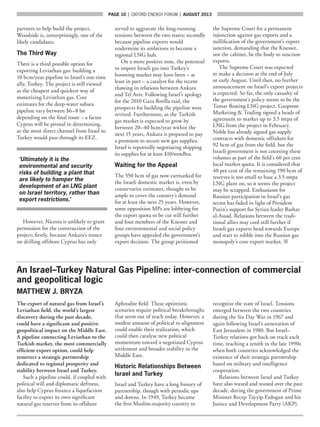
Leviathan gas (see the table ‘Israel’s gas
export policy’).
Ultimately it is the environmental and
security risks of building a plant that
are likely to hamper the development
of an LNG plant on Israel territory,
rather than export restrictions. Any
major infrastructure facility will meet
fierce opposition from environmentalists
and residents along Israel’s small but
beautiful coastline, and these protests
are likely to stall an already cumbersome
licensing process. With Lebanon and
Israel still technically in a state of
war – and no agreement reached on
the maritime border between the two
countries – Hezbollah is viewed as a
serious threat to the safe development
of Israel’s offshore gas industry.
With these complications in mind,
the simplest option to export LNG from
Leviathan could be to pipe Israeli gas to
Cyprus and liquefy it through an LNG
facility there. The Cypriot government,
which sees gas exports as a lifeline for
hauling it out of its economic crisis,
has been quick to promote the island
as a potential Eastern Mediterranean
LNG export hub, and to that end has
already cleared a site with the potential
to accommodate an initial three 5 mtpa
trains at the port of Vasilikos.
‘The Cypriot government … has
been quick to promote the
island as a potential Eastern
Mediterranean LNG export hub.’
In the meantime, Nicosia is pushing
to start exports from its own block 12
gas reserves as early as 2020. Noble
Energy, the operator of the licence,
is carrying out appraisal drilling at
the block now and should announce
before the end of 2013 whether there
are enough reserves to justify an LNG
development.
The Texan explorer, along with
block 12 partners Delek Drilling and
Avner Oil, signed an MoU with the
Cypriot government in June agreeing
to make a decision on whether to
proceed with the 5 mtpa project by the
end of 2013. Although Woodside was
not party to the MoU, the Australian
company is reported to be interested
in joining its Leviathan partners in the
project. None of the block 12 partners
have any liquefaction experience, and as
Noble draws up a shortlist of strategic
Table 1: Israel’s gas export policy
Total gas exports 380 bcm
Maximum exports for fields less than 25 bcm 0%
Maximum exports for fields of 25–100 bcm 25%
Maximum exports for fields of 100–200 bcm 40%
Maximum exports for fields of 200 bcm or more 40%
Maximum exports from any one field (using export credits*) 75%
Israel’s expected gas demand over the next 29 years 540 bcm
Israel’s total reserves 920 bcm
*The government sanctioned a scheme to allow export credit trading between companies,
allowing producers to export beyond the limit imposed on their field.
page 10  |  OXFORD ENERGY FORUM  |  AUGUST 2013
partners to help build the project,
Woodside is, unsurprisingly, one of the
likely candidates.
The Third Way
There is a third possible option for
exporting Leviathan gas: building a
10 bcm/year pipeline to Israel’s one-time
ally, Turkey. The project is still viewed
as the cheapest and quickest way of
monetizing Leviathan gas. Cost
estimates for the deep-water subsea
pipeline vary between $6–8 bn
depending on the final route – a factor
Cyprus will be pivotal in determining,
as the most direct channel from Israel to
Turkey would pass through its EEZ.
‘Ultimately it is the
environmental and security
risks of building a plant that
are likely to hamper the
development of an LNG plant
on Israel territory, rather than
export restrictions.’
However, Nicosia is unlikely to grant
permission for the construction of the
project; firstly, because Ankara’s stance
on drilling offshore Cyprus has only
served to aggravate the long-running
tensions between the two states; secondly
because pipeline exports would
undermine its ambitions to become a
regional LNG hub.
On a more positive note, the potential
to import Israeli gas into Turkey’s
booming market may have been – at
least in part – a catalyst for the recent
thawing in relations between Ankara
and Tel Aviv. Following Israel’s apology
for the 2010 Gaza flotilla raid, the
prospects for building the pipeline were
revived. Furthermore, as the Turkish
gas market is expected to grow by
between 20–40 bcm/year within the
next 15 years, Ankara is prepared to pay
a premium to secure new gas supplies.
Israel is reportedly negotiating shipping
its supplies for at least $10/mmBtu.
Waiting for the Appeal
The 550 bcm of gas now earmarked for
the Israeli domestic market is, even by
conservative estimates, thought to be
ample to cover the country’s demand
for at least the next 25 years. However,
some opposition MPs are lobbying for
the export quota to be cut still further
and four members of the Knesset and
four environmental and social policy
groups have appealed the government’s
export decision. The group petitioned
the Supreme Court for a permanent
injunction against gas exports and a
nullification of the government’s export
sanction, demanding that the Knesset,
not the cabinet, be the body to sanction
exports.
The Supreme Court was expected
to make a decision at the end of July
or early August. Until then, no further
announcement on Israel’s export projects
is expected. So far, the only casualty of
the government’s policy seems to be the
Tamar floating LNG project. Gazprom
Marketing  Trading signed a heads of
agreement to market up to 3.5 mtpa of
LNG from the project in February.
Noble has already signed gas supply
contracts with domestic offtakers for
92 bcm of gas from the field, but the
Israeli government is not counting these
volumes as part of the field’s 60 per cent
local market quota. It is considered that
40 per cent of the remaining 190 bcm of
reserves is too small to base a 3.5 mtpa
LNG plant on, so it seems the project
may be scrapped. Enthusiasm for
Russian participation in Israel’s gas
sector has faded in light of President
Putin’s support for Syrian leader Bashar
al-Assad. Relations between the tradi-
tional allies may cool still further if
Israeli gas exports head towards Europe
and start to nibble into the Russian gas
monopoly’s core export market. ■
An Israel–Turkey Natural Gas Pipeline: inter-connection of commercial
and geopolitical logic
MATTHEW J. BRYZA
The export of natural gas from Israel’s
Leviathan field, the world’s largest
discovery during the past decade,
could have a significant and positive
geopolitical impact on the Middle East.
A pipeline connecting Leviathan to the
Turkish market, the most commercially
efficient export option, could help
resurrect a strategic partnership
dedicated to regional prosperity and
stability between Israel and Turkey.
Such a pipeline could, if coupled with
political will and diplomatic deftness,
also help Cyprus finance a liquefaction
facility to export its own significant
natural gas reserves from its offshore
Aphrodite field. These optimistic
scenarios require political breakthroughs
that seem out of reach today. However, a
modest amount of political re-alignment
could enable their realization, which
could then catalyse new political
momentum toward a negotiated Cyprus
settlement and broader stability in the
Middle East.
Historic Relationships Between
Israel and Turkey
Israel and Turkey have a long history of
partnership, though with periodic ups
and downs. In 1949, Turkey became
the first Muslim-majority country to
recognize the state of Israel. Tensions
emerged between the two countries
during the Six Day War in 1967 and
again following Israel’s annexation of
East Jerusalem in 1980. But Israel–
Turkey relations got back on track each
time, reaching a zenith in the late 1990s
when both countries acknowledged the
existence of their strategic partnership
based on military and intelligence
cooperation.
Relations between Israel and Turkey
have also waxed and waned over the past
decade, during the government of Prime
Minister Recep Tayyip Erdogan and his
Justice and Development Party (AKP).
AUGUST 2013  |  OXFORD ENERGY FORUM  |  page 11
Initially, Erdogan pursued a pragmatic
approach toward Israel. On a visit to
Jerusalem in 2005, Erdogan laid a
wreath at the Yad Vashem Holocaust
memorial, called anti-Semitism ‘a crime
against humanity’, and dubbed Iran’s
nuclear ambitions ‘a threat to (the) entire
world’. In 2006, Turkey led efforts to
establish a Palestine–Israel industrial
park, while Israel’s President Shimon
Peres visited Turkey (and did so again
the following year). Israel–Turkey
relations began to deteriorate in late
2008, when Israel moved troops into
Gaza at the very moment Ankara
believed it was on the verge of
negotiating a breakthrough in Israel–
Syria relations. Feeling diplomatically
betrayed, Erdogan erupted in anger
before a packed audience at the World
Economic Forum in Davos in January
2009, accusing Peres of being a ‘killer’,
and then storming off the stage.
‘… the most promising export
options for East Mediterranean
gas are an Israel–Turkey
pipeline (the cheapest route)
and a liquefaction facility on
Cyprus (which provides the
greatest marketing flexibility).’
The Mavi Marmora Incident
Relations continued to sour into
2010 when, on 31 May, a flotilla of
boats carrying protestors from several
countries, led by a Turkish passenger
ferry the Mavi Marmara, decided
to break through what they termed
Israel’s blockade of Gaza. Israeli
commandos intercepted and boarded
the Mavi Marmara, leading to an armed
struggle in which nine passengers were
killed, eight of whom were Turkish
citizens. The Mavi Marmara incident
resulted in the breakdown of Israel–
Turkey relations, with each country
withdrawing its ambassador.
More recently, both countries have
hinted at their willingness to put the
Mavi Marmara incident behind them.
On 22 March 2013, Israel’s Prime
Minister Netanyahu apologized for the
deaths of the Mavi Marmara passengers
during a phone call with Prime Minister
Erdogan (brokered by US President
Obama). Two rounds of official
negotiations on compensation followed
in April and May. The normalization
process appeared stalled as of July 2013;
tension increased with statements by
some senior Turkish politicians attacking
Israel (as well as the international Jewish
community) for Palestinian deprivation
in Gaza and for provoking major
protests across Turkey in June 2013 over
government plans to replace Istanbul’s
Gezi Park with a shopping mall.
Still, senior officials in both countries
continued privately to signal their desire
to reinvigorate bilateral relations, with
a natural gas pipeline potentially at the
centre of the process.
Hope for the Future: Israel–
Turkey Pipeline
If Ankara and Jerusalem can weather
this latest political storm and finalize
their diplomatic normalization,
an Israel–Turkey pipeline would
provide a critical tool to deepen this
reconciliation into a renewed strategic
partnership. Israel has already taken a
major conciliatory step in Netanyahu’s
apology for the Mavi Marmara deaths.
Ankara’s two remaining criteria for
normalizing relations are compensation
for the families of those killed on the
Mavi Marmara and the end of Israel’s
‘blockade’ of Gaza. If diplomats
from both countries can negotiate
understandings on these two issues,
their top political leaders will likely
embrace an Israel–Turkey gas pipeline
as a way to turn words into concrete
elements of a new strategic partnership.
The geopolitical significance of such a
partnership – between the Middle East’s
only Muslim-majority country with a
secular democracy and the world’s only
Jewish state – would be enormous.
Regardless of geopolitical benefits,
an Israel–Turkey natural gas pipeline
will be realized only if private companies
decide to invest in it. Private investors
will indeed probably favour such a
pipeline, since it would provide the most
commercially competitive way to export
Israel’s gas from Leviathan. According
to feasibility studies conducted by the
Turkish energy company Turcas Enerji
Holding (on whose board the author
serves), capital expenditures (CAPEX)
of $2.5bn would be required to construct
a 470 km subsea pipeline from Israel to
Turkey. The pipeline would consist of
twin 24-inch lines, each pumping up to
8 bcm of gas per annum, for a total of
16 bcm. The twin pipelines would run
from the Leviathan field through Israeli
waters, then across Cyprus’s continental
shelf into Turkish territorial waters,
landing onshore at either Ceyhan or
Mersin on Turkey’s eastern Mediter-
ranean coast. An additional $83 million
would be required to build a 40 km
pipeline on land to connect the landfall
at Ceyhan to the Turkish national gas grid.
More ambitious plans to integrate
Leviathan gas into the EU-supported
Southern Corridor project (which
will initially connect Azerbaijan with
markets in Turkey and the EU), would
require either: $647mn for a 470 km
connection from Ceyhan to the Trans
Anatolian Natural Gas Pipeline Project
(TANAP); or $1.93bn for a 1,215 km
pipeline from Ceyhan to the start of
the Trans-Adriatic Pipeline (TAP) on
the Turkey–Greece border, for a total of
$4.4bn to connect Leviathan gas directly
with the EU.
Other Options for Exports of
Leviathan Gas
The CAPEX estimate for even this
maximalist export of 16 bcm from Israel
to the EU is considerably lower than
estimates for the three other options
that are under serious consideration by
the Israeli government and the private
companies leading development of the
Leviathan field – Israel’s Delek and the
US company Noble Energy.
Floating LNG in Israeli waters: in
favour – provides maximal marketing
flexibility, allowing Leviathan gas to
reach Asia’s higher priced markets; allows
Israeli government to maintain physical
control over export facility; avoids
politically contentious permits for a land-
based liquefaction terminal in Israel.
against – no floating liquefaction
facility has yet been deployed, with the
world’s first example, Shell’s Prelude
project, now under development for
Western Australia; both CAPEX (see
below) and operational expenses (OPEX)
are estimated at more than three times
those of an Israel–Turkey pipeline.
Estimated CAPEX: $7 bn to $9 bn.
page 12  |  OXFORD ENERGY FORUM  |  AUGUST 2013
LNG onshore in Cyprus: in favour –
provides the same maximal marketing
flexibility and avoidance of contentious
permitting as does floating LNG.
against – denies Israeli government
physical control over gas export facility;
will require a decade or longer to develop;
difficult to finance without revenue from
early gas exports, (which an Israel–
Turkey pipeline would generate).
Estimated CAPEX: $4.5 bn to $6 bn.
Pipeline to Cyprus, Crete, and
mainland Greece: in favour: provides
direct access to EU market; avoids
potentially contentious Turkey–Cyprus
debate over access to the Cypriot
continental shelf (see below in relation
to Israel–Turkey pipeline).
against – prohibitively expensive.
Estimated CAPEX: $11 bn to $14 bn.
In theory, onshore LNG terminals
in Israel and Egypt could provide
additional export options for Leviathan
gas. In practice, however, liquefaction
facilities onshore in Israel, either on the
Mediterranean Sea or at Eilat on the Red
Sea, are unlikely to secure governmental
permits due to environmental and
security concerns. As for Egypt, it is
politically inconceivable that the Israeli
government would allow the country’s
gas export facilities to be located in an
Arab state, particularly since the turmoil
in Jerusalem’s relations with Cairo
following the ouster of former Egyptian
President Mubarak.
Israel–Turkey Pipeline Plans
In light of the full range of political and
commercial factors discussed above,
the most promising export options for
East Mediterranean gas are an Israel–
Turkey pipeline (the cheapest route)
and a liquefaction facility on Cyprus
(which provides the greatest marketing
flexibility). The government of the
Republic of Cyprus is indeed intent
on constructing an LNG terminal on
the island, regardless of the economic
risks posed by the relatively low level of
gas reserves proven thus far in Cypriot
waters: Aphrodite’s proven reserves
are now only one third of Leviathan’s
900 bcm, (which equates roughly with
Azerbaijan’s total proven reserves, a
volume that is necessary to launch
the EU-supported Southern Corridor
but not sufficient on its own to have a
major geopolitical impact). The Cypriot
government is confident that additional
exploration will significantly expand the
country’s proven reserves, which could
be complemented by gas from Israel and
(a decade later) Lebanon. But, securing
financing under such conditions of
uncertainty would be considerably easier
if backed by revenues from exports
of Israeli natural gas via a more easily
financeable Israel–Turkey pipeline.
‘… realization of an Israel–
Turkey pipeline is currently
blocked by the lack of political
alignment among the parties.’
The government of Cyprus,
however, may hold a significant trump
card with regard to an Israel–Turkey
pipeline. According to the United
Nations Convention on the Law of the
Sea (UNCLOS), while no country can
prohibit an international pipeline from
being laid across its continental shelf,
any county can impose conditions on its
construction. While UNCLOS is thus
ambiguous on whether Nicosia could
block construction of the Israel–Turkey
pipeline along its continental shelf,
the Cypriot government may be able
to argue its case with sufficient skill to
secure political support among its EU
allies, which in turn could raise the
financing costs of such a project.
A Cypriot attempt to block construction
of an Israel–Turkey pipeline would carry
significant risks for all parties, perhaps
most of all for those who favour a
negotiated settlement of the Cyprus
question. The United Nations is leading
a diplomatic process to negotiate a
political agreement between Cyprus and
Turkey, which aims to reunify the island
into a bi-zonal, bi-communal federation.
That process has stalled since 2009. But
the election of Cypriot President Nicos
Anastasiades in February 2013 renewed
hope for progress towards a settlement,
given Anastasiades’s strong public support
in early 2003 for the Cyprus settlement
plan proposed by former UN Secretary-
General Kofi Annan. During the first
half of 2013, such hope seems to have
prompted the Turkish government to
signal its readiness to re-energize its
approach to political settlement
negotiations with Cyprus.
Understandably, President Anastasiades
has focused most of his energy on the
Cypriot banking crisis during his initial
months in office. But with some renewed
progress in UN negotiations over a Cyprus
settlement, political conditions could
emerge to allow a collaborative approach
between Nicosia and Ankara, as well as
Jerusalem. A consequence of such an
approach could see revenues from an
Israel–Turkey pipeline facilitating the
financing of an LNG terminal on Cyprus.
This could involve early monetization of
Aphrodite gas through its export via an
Israel–Turkey pipeline, during the decade
required to develop and construct the
considerably more complex LNG
terminal on the island.
The Way Forward?
Unfortunately, realization of an Israel–
Turkey pipeline is currently blocked by
the lack of political alignment among the
parties. Normalization of Israel–Turkey
relations remains stalled; and Cyprus
and Turkey have treated future East
Mediterranean natural gas exports as a
reason to harden their positions on the
Cyprus Question rather than to generate
new momentum towards a negotiated
settlement. These developments
underscore the fact that major economic
projects – such as hydrocarbon pipelines
– cannot on their own generate political
reconciliation. Rather, political conditions
must first align sufficiently to allow two
states to conceive of an economic project
that can carry their political
reconciliation further.
An Israel–Turkey pipeline will
therefore never be realized as a ‘peace
pipeline’. Rather, it will emerge as the
most commercially attractive export
option for Israeli gas, after Israel and
Turkey have normalized their political
relations. Such a pipeline may then prove
to be a key financial enabler of an LNG
terminal on Cyprus. If the governments
and private companies exploring these
two projects proceed this far, they will
generate further political momentum
that could catalyse historic political
breakthroughs regarding Cyprus,
together with broader geopolitical issues
in the Eastern Mediterranean. ■
AUGUST 2013  |  OXFORD ENERGY FORUM  |  page 13
The Cyprus Problem as an Obstacle to Regional Energy Cooperation
AYLA GÜREL
The discovery of natural gas, together
with the prospect of further hydrocarbon
finds offshore Cyprus, carries a promise
of prosperity for the island. Most experts
agree that rapid realization of this
promise, with maximum benefits for
all stakeholders, is possible if there is
cooperation between Cyprus and
Turkey. Specifically, this refers to a
project which involves export of Cypriot
gas via a pipeline to Turkey, where it
could be consumed in the latter’s
consistently growing domestic market
or be transported to European markets
(via the planned TANAP plus TAP
pipelines).
Naturally such a project requires an
understanding between the Greek Cypriots
(who are at the helm of the Republic of
Cyprus – RoC), the Turkish Cypriots
(who have, in the northern part of the
island, their separate de facto state, the
Turkish Republic of Northern Cyprus
– TRNC), and Turkey (which, while not
recognizing the RoC, is the only country
that recognizes the TRNC).
More generally, analysts do not
dispute that optimal solutions (both
economic and political) for monetizing
Eastern Mediterranean gas call for
regional cooperation, e.g., involving
Turkey, Israel, and Cyprus.
However, Cyprus–Turkey cooperation
over gas appears to be difficult, if not
impossible, without a political settlement
in Cyprus or, at least, some loosening
of the involved parties’ positions vis-à-
vis the Cyprus problem. The political
impasse between the Greek Cypriots on
the one hand, and the Turkish Cypriots
and Turkey on the other, also creates
difficulties for other possible regional
cooperation projects. For example, an
Israel–Turkey subsea gas pipeline is
being mooted by the two governments
and promoted by various companies
from both sides. Such a pipeline cannot,
for obvious reasons, go through the
Exclusive Economic Zones (EEZs) of
Lebanon and Syria, and will have to
go through the EEZ of Cyprus, which
means Turkey and Israel will require
Greek Cypriot consent.
Such cooperation proposals are mired
in difficulties. These arise generally from
the Cyprus problem and, more specifically,
from the fact that the positions of the
two Cypriot sides and Turkey, in respect
of the issue of hydrocarbons, are informed
by their perceptions of what is politically
at stake in Cyprus.
Greek Cypriot Position
The Greek Cypriots argue that their
actions are compatible with international
law because under the present
circumstances their government, as
accepted by the international community,
is the legitimate government of the RoC
– the recognized state which formally
encompasses both Greek and Turkish
Cypriots. As such, the RoC is entitled to
an EEZ, can sign delimitation agreements
with other states, and enjoys exclusive
sovereign rights to explore for and
exploit the natural resources in its EEZ.
There is agreement between the two
Cypriot sides (in the context of UN-
sponsored negotiations between them)
that in the event of a settlement natural
resources will be a federal competence,
to be jointly exercised by Greek Cypriots
and Turkish Cypriots. However, the
Greek Cypriots say that pending such
a settlement, the RoC’s sovereign right
to explore and extract hydrocarbons
lying in its EEZ is ‘inalienable and
non-negotiable’ and is not conditional
on a Cyprus solution. More specifically,
the exercise of this right is not a bi-
communal issue for negotiation with the
Turkish Cypriots at present – i.e. before
a settlement.
‘However, Cyprus–Turkey
cooperation over gas appears
to be difficult, if not impossible,
without a political settlement in
Cyprus.’
It is universally accepted that the
island’s offshore natural resources belong
to all Cypriots, Turkish as well as Greek.
Yet, as regards sharing of revenues from
these resources, the Greek Cypriots
say that will come after a solution, i.e.
the Turkish Cypriots, as citizens of
the Republic, will enjoy the benefits of
any natural resource wealth within the
framework of a united Cyprus.
Position of the International
Community
The Greek Cypriot position that
(pending a solution of the Cyprus
problem) their government represents
the RoC and therefore has the right to
explore for natural resources in Cyprus’s
EEZ, has the strong backing of the
international community (including the
EU and the five permanent members of
the UN Security Council). On the issue
of revenue sharing, however, the position
of the international community is
somewhat unclear. For example, in his
Cyprus reports to the UN Security
Council in June 2012 and January 2013,
the UN Secretary-General noted: ‘It is
important to ensure that any new-found
wealth, which belongs to all Cypriots,
will benefit both communities’ (emphases
added). It will not be too far-fetched to
interpret this statement as an implicit
recognition that the Greek Cypriot
approach – that there can be no revenue
sharing before a settlement – is a problem.
Nevertheless, this Greek Cypriot approach
has not been questioned by either the
EU or by the permanent members of the
UN Security Council, with the recent
exception of Russia, whose foreign
minister Sergei Lavrov stated in April
2013: ‘In respect of Cyprus [hydrocarbons]
… any prospecting for natural resources
must envisage an agreement that each
and all Cypriots gain from it.’ It must be
said, however, that this statement is at
odds with the interest shown by Russian
energy companies – e.g. Novatek and
Gazprom Bank (a subsidiary of state-
owned Gazprom) – in participating
in the RoC’s emerging hydrocarbons
industry.
Positions of Turkish Cypriots
and Turkey
The Turkish Cypriots, together with
Turkey, dispute the perception (held by
page 14  |  OXFORD ENERGY FORUM  |  AUGUST 2013
the Greek Cypriots and the international
community) of the present political
status quo in Cyprus. Their fundamental
contention is that the Greek Cypriots
alone cannot legitimately represent the
RoC, as this would be contrary to the
1959–60 Cyprus Accords and
Constitution. In their view, since the
1963 breakdown of the bi-communal
power-sharing structures of the
Republic, no single authority,
constitutionally competent to represent
Cyprus as a whole (i.e. Greek Cypriots
and Turkish Cypriots together) has
existed on the island. On this basis,
they object to all RoC actions relating
to EEZs and offshore hydrocarbons
development. The Turkish Cypriots,
together with Turkey, regard such
actions as involving the exercise of
sovereign rights at the international level,
which, they maintain, Turkish Cypriots
and Greek Cypriots possess jointly,
by virtue of their being the equal
constituent communities of the 1960
Republic. For the same reason, Greek
Cypriots and Turkish Cypriots are
co-owners of the island’s natural
resources and should both benefit from
any exploitation of such resources. From
this perspective, any RoC action in this
field now – at a point where the Cyprus
problem is still unsolved – amounts to
ignoring the legitimate rights and
interests of the Turkish Cypriots.
With Greek Cypriots determined to
continue exploring for hydrocarbons
on their own, the Turkish Cypriots
and Turkey collaborated in restoring
the political balance, as they saw it,
by taking ‘reciprocal steps of equal
significance’: an agreement was signed
demarcating the continental shelf
between the island’s northern coast and
Turkey. The Turkish Cypriot authorities
also granted hydrocarbons exploration
licences for sea areas in the north, east,
and south of Cyprus (with some areas
in the south and east partly overlapping
the Republic’s exploration blocks) to the
Turkish national oil company TPAO.
These ‘reciprocal steps’ amount to a
claim by the Turkish Cypriots to what
they consider to be their equal share with
the Greek Cypriots in rights concerning
maritime jurisdiction and hydrocarbon
exploration, notwithstanding the lack of
a negotiated settlement.
Alongside counter-plans for their own
hydrocarbon exploration, the Turkish
Cypriots also invited the Greek Cypriots
to cooperate over hydrocarbons. They
did this through the UN Secretary-
General to whom they submitted two
proposals, in September 2011 and
September 2012. Both proposals were
rejected by the Greek Cypriots without
consideration. The latter proposal, called
‘Hydrocarbons plan regarding exploration
activities (north and south)’, related to
establishing a bi- communal technical
committee which would be mandated to:
(a) obtain the mutual consent of both
sides on agreements concluded and
licenses issued unilaterally by either side;
(b) determine each side’s share of revenues
from hydrocarbons offshore Cyprus;
and (c) manage the total revenue of
hydrocarbons.
Turkey itself has another reason for
opposing the Greek Cypriot pursuit of
hydrocarbons: its claimed continental
shelf in the Eastern Mediterranean
covers almost all of the EEZ proclaimed
by RoC in the island’s west and partially
overlaps RoC exploration blocks 1, 4,
5, 6, and 7 in the south-west. This is
a maritime delimitation issue which,
Turkey says, can be settled only after a
solution in Cyprus.
Security Implications
As regards action it is likely to take
against RoC exploration, Turkey seems
to be making a definite distinction
between how it would react (a) to
exploration in parts of blocks 1, 4, 5, 6,
and 7 which it claims to be part of its
continental shelf; and (b) to exploration
in blocks which are licensed by the
TRNC to TPAO and which overlap
with RoC blocks 1, 2, 3, 8, 9, 12, and 13.
In the case of (a), Turkey has made
it clear that it would step in to halt
any activity in the overlapping areas,
implying that it would, if necessary, even
take military action. An incident which
took place in November 2008 indicates
what might happen: two foreign-flagged
exploratory ships conducting surveys on
RoC’s behalf in the relevant areas were
intercepted by a Turkish warship and
‘forced … to cease their operations and
withdraw within the territorial waters
of the RoC’. It is worth noting that the
RoC has not, to date, licensed blocks 1,
4, 5, 6, and 7.
For case (b), Turkey seems to have
settled on using its navy to monitor
activities without intervening – as
happened during Noble’s first drilling in
Aphrodite in 2011 and again recently
with Noble’s seismic surveys in block 12
– and, of course, on the policy of
reciprocal steps. The latter entails
Turkey’s continued support to the
Turkish Cypriots in their ‘activities to
protect their … rights over the [island’s
offshore] natural resources’ including the
provision of ‘necessary assistance for the
completion of seismic researches and
proceeding with drilling … within the
license areas granted to … TPAO by
the TRNC in the south of the Island’
(Turkish MFA statement of 14 June 2013).
Hydrocarbons and the
Sovereignty Issue
Pending a solution of the Cyprus
problem, the hydrocarbons controversy
appears to have fuelled the more
fundamental disagreements between
the two sides regarding (a) where
sovereignty lies in Cyprus and (b) the
related question of how ‘a new state of
affairs would come into being’ under a
political settlement.
‘The hydrocarbons controversy
is perceived by both sides as
yet another episode in the
fundamental conflict of
principle between them.’
According to the Greek Cypriot
view, a new state of affairs in Cyprus
will be created by the writing of a
new constitution for the existing,
internationally recognized, and continuing
RoC, which will be transformed into a
bi-communal, bi-zonal federation, the
Turkish Cypriot community essentially
being reintegrated into that state.
The Turkish Cypriots, on the
other hand, maintain that a new state
of affairs in Cyprus will be established
through the founding of a new state
by the two pre-existing sovereign
states or entities (i.e., the two separate
administrations that now exist on the
island). These entities will devolve some
of their sovereignty to the new state but
AUGUST 2013  |  OXFORD ENERGY FORUM  |  page 15
will otherwise retain their sovereignty.
Turkey, of course, supports the Turkish
Cypriots on this.
The presumptions that the two sides
use to defend these entrenched positions
are essentially the same as those that
inform their stances vis-à-vis the
hydrocarbons issue.
Hence the Turkish Cypriot proposal
– calling for cooperation between the
two sides on hydrocarbons, pending
a Cyprus settlement – appears to the
Greek Cypriot side as being aimed
at nothing but strengthening the
hand of the Turkish Cypriot side at
the negotiations. It is perceived as an
attempt to challenge ‘the sovereignty
of the existing RoC’ and to put ‘on an
equal par the unrecognized TRNC with
the legitimate state, the RoC, which is
internationally recognized’.
Conversely, the Turkish Cypriots
perceive the determination of the Greek
Cypriots to continue in their unilateral
exploration for hydrocarbons as being
linked: (a) with the Greek Cypriot desire
for further confirmation that the status
of the present – i.e. solely Greek Cypriot-
run – RoC as a sovereign independent
state is unproblematic (as happened
when the RoC was allowed to join the
EU in 2004); and (b) with the Greek
Cypriot position that the RoC should
be preserved under a settlement.
Conclusion
The hydrocarbons controversy is
perceived by both sides as yet another
episode in the fundamental conflict
of principle between them. It has thus
turned into a ‘zero-sum game’, ruling
out possibilities of inter-communal
or regional cooperation. Given the
accelerated political unrest in much of
the Eastern Mediterranean region at the
moment, one can only hope that the
international community will be able to
persuade the two Cypriot sides that now
is a time for compromise rather than
for any further aggravation of their own
traditional animosities. ■
Cyprus LNG: optimizing the export options
CHARLES ELLINAS
The advantageous geographic location
of Cyprus – at the crossroads of major
international energy routes to Europe
and the Far East through the Suez Canal
– makes the island a natural regional
energy hub in the Eastern Mediterranean
and the natural location to develop a
liquefied natural gas (LNG) plant.
The Growing Importance of Gas
The new Eastern Mediterranean gas
discoveries have happened in a period
when global demand for gas is increasing.
ExxonMobil’s The Outlook for Energy
2013 predicts that global energy demand
will grow by 35 per cent, even with
significant efficiency gains, as the world’s
population expands from 7 billion today
to nearly 9 billion by 2040, led by
growth in Africa and India. Energy
demand in developing nations (non-
OECD countries) will rise 65 per cent by
2040 compared to 2010. The fuels used
to meet the world’s growing demand for
energy are changing. Oil will remain the
number one global fuel, while natural
gas will overtake coal for the number
two spot. Also, over the same period,
global gas demand is expected to grow at
about 1.6 per cent per year – more than
twice the rate of oil. Within that, LNG
demand growth is expected to be even
stronger. Between now and 2020,
average annual growth is expected to be
5 per cent, decreasing to about 2 per cent
per year after that as demand shifts to
the more price-sensitive markets of
China and India who have other energy
sources of their own.
Gas will see strong growth and will
constitute nearly a third of fuel inputs
for electricity generation by 2040. In
OECD countries, ExxonMobil sees
an ongoing transition from coal to gas
in the following 15 years. Today, coal
is a very competitive economic option
for generating electricity. However,
as costs arising from greenhouse gas
policies are considered, natural gas
becomes increasingly competitive, due
to the fact that it emits 60 per cent less
carbon dioxide than coal in electricity
generation. Thus, gas demand will grow
faster than any other major fuel source,
rising 65 per cent by 2040. In Europe,
despite the effects of the economic crisis,
gas demand will remain fairly stable or
slightly increase in the coming years, to
reach 550–600 bcm/year by 2020.
For the next 10 to 20 years, Europe
will require substantial growth in both
oil and gas imports, because indigenous
production of gas in the EU is decreasing
rapidly. As a result, by 2025 the EU will
require an increase of about 100 bcm
in gas imports per year, in comparison
to 2010. Over the same period China
will need another 140 bcm/year of new
gas, despite increasing production of
shale gas. China is actively securing
long-term gas supplies, both by pipeline
from central Asia and as LNG imports.
However, shale gas is expected to change
China’s energy landscape significantly
after 2020. Driven by China and India,
global gas imports are expected to
increase by 450 bcm/year by 2025.
Eastern Mediterranean Gas and
Energy Security in Europe
Europe is heavily dependent on Russia
for its energy supplies and is currently
the largest market for Russian energy
exports, with about 35 per cent of the
EU’s gas coming from Russia. The
EU has made it clear that in order to
satisfy current and future demands,
it wants to diversify its imports away
from Russia and inflexible long-term
contracts indexed to oil, towards
alternative reliable gas suppliers. This
diversification is also supported by the
USA. A report by the US Congressional
Research Service on Europe’s energy
security in 2012 states that successive
US administrations and Congresses have
viewed European energy security as a
US national interest. This has included
promoting diversification of Europe’s
natural gas supplies, especially in recent
years, through the development of a
Southern European Corridor, as an
alternative to Russian natural gas.
page 16  |  OXFORD ENERGY FORUM  |  AUGUST 2013
For Europe, Eastern Mediterranean gas
has a strategic value as an alternative to
Russian and North African imports.
But Russia’s ability to adapt and protect
its markets, even by reconsidering the
pricing of gas if required, should not be
underestimated.
‘For Europe, Eastern
Mediterranean gas has a
strategic value as an alternative
to Russian and North African
imports.’
With potential gas reserves exceeding
1.1 tcm in the six leased blocks and a
very small domestic gas demand (of
the order of 1 bcm/year), Cyprus is
developing an export strategy. Of the
possible export options, LNG provides
the flexibility to serve several markets
and customers, providing the strategic
advantages that Cyprus needs. Pipelines
do not offer flexibility in the selection
of markets. Also, the water depth in
the eastern Mediterranean (2000 m+)
limits the size of pipeline, and thus
throughput. Given the amount of gas
that Cyprus expects to be exporting by
2025, pipelines do not offer a practical
solution. The decision to build an
LNG plant in the south of the island
at Vasilikos was reconfirmed by the
President of the government of Cyprus,
Mr Anastasiades, in April 2013. The
land has been secured initially for three
trains with 15 mtpa of LNG export
capacity, possibly expanding up to a
total of eight trains in the future.
Cyprus as Regional LNG Hub
With the timely establishment of
an LNG plant, Israel and Lebanon
should also be able to bring their gas
to Cyprus for liquefaction, making it
possible to create a world class LNG
hub at Vasilikos. However, Israel
still has other options, which include
Floating Liquefied Natural Gas (FLNG);
geopolitics, cost, and time will be key
factors in the final choice. By 2025
Cyprus could be in a position to export
25 million tonnes LNG (35 bcm) per
year, starting with 5 million tonnes
(7 bcm) by 2020. This could rise to
35 million tonnes (50 bcm) per year if
Vasilikos becomes an LNG hub for the
region.
Even with only 50 per cent of this gas
going to Europe, by 2025 Cyprus and the
Levantine Basin could supply 25 per cent
of the additional gas needs of the EU,
which is far more than the 10 bcm of gas
currently planned for the Trans Anatolian
Natural Gas Pipeline Project (TANAP)
per year, making the Eastern Mediterranean
a much larger potential gas supply
source. Cyprus’s membership of the EU
also offers the added incentive of fiscal
and regulatory oversight. It also satisfies
the EU Commission’s intent to promote
development of new onshore and
offshore indigenous sources of energy.
The East Med Gas Corridor could
form a new independent and secure
supply of LNG which could contribute
substantially to the EU’s future energy
security. This is in line with the
European Council’s May decision to
intensify the diversification of Europe’s
energy supply and develop indigenous
energy resources to ensure security of
supply, reduce the EU’s external energy
dependency, and stimulate economic
growth. Furthermore, a Cyprus-based
LNG plant would give access to the
attractive markets of Asia, especially
those of the Far East, where demand for
gas supplies keeps growing and LNG
prices are particularly high – and are
expected to remain so in the 2020s.
Alternative Global Supplies and
Risks
Over the long term, Cyprus offshore gas
will have to compete with production
from lower-cost supplies from East
Africa and unconventional gas sources
such as shale gas from North America.
In addition to the above, there is a wave
of large projects coming to fruition from
2014 onwards in Australia. These will
expand LNG supply from 25 mmtpa to
88 mmtpa and Australia is expected to
become the largest LNG supplier in the
world by 2018.
Global LNG demand is expected to
continue increasing and by 2025 an
additional 160 mmtpa will be needed.
Even allowing for new projects currently
under planning, the LNG supply gap is
expected to be about 70 mmtpa.
However, over 25 countries are
proposing a number of new projects
which, by 2020, could amount to about
a third of world LNG demand. A key
factor in their realization will be their
ability to attract investment in what are
currently uncertain times, which will
limit the number reaching a Final
Investment Decision (FID). This may
also lead to shortages of skilled contractors
and labour, which may lead to higher
project costs.
New pipelines and interconnectors,
both to Europe and the Far East, will
compete with LNG. Examples are
the TANAP pipeline – expected to
transport 10 bcm/year to Europe – and
Turkmenistan to China pipelines which
will carry up to 60 bcm/year.
New unconventional gas
developments are also having an impact
on global energy prospects. Currently,
only the USA, Canada, and Australia are
exploiting their unconventional gas
(particularly shale gas) resources. In
Europe, shale gas development may take
much longer and is unlikely to become a
game changer. The same applies to India.
However, China is making progress with
its own developments and should benefit
from these increasingly from 2020
onwards. Unconventional recoverable gas
resources (mostly shale gas) have now
grown to over 44 per cent of the 752 tcm
world total and are bound to capture
some of the world’s gas demand, in
competition with LNG. When shale gas
is included in the global total reserve base
Cyprus’s estimated 1.1 tcm recoverable
reserves are put into context – at only
0.16 per cent of the world total.
‘… the World Bank expects
gas prices in Europe and the
Far East to drop by more than
10 per cent by 2020, in
comparison to current prices.’
Another major risk for LNG
demand is the erratic state of the world
economy. Economic growth is uneven
and uncertain – particularly in the
developed world – impacting other world
markets, with concomitant effects and
uncertainties on future energy demand
growth. Ineffective fiscal, legal, and
regulatory systems may also slow LNG
project development.
AUGUST 2013  |  OXFORD ENERGY FORUM  |  page 17
Gas Pricing Structures
In the recent EIA Outlook, the USA
is seen as being a net gas exporter by
2020. Even though actual US net export
volumes, even by 2025, are expected
to be relatively low (around 40 bcm),
Henry Hub pricing is influencing other
gas markets and, especially in the Far
East, is contributing to the pressure
on gas pricing to move away from oil
price indexation. For example, a recent
LNG supply contract between BG
and CNOOC is based on a blending
of oil-linkage and gas-on-gas market
pricing. Going forward, LNG sellers will
eventually have to face pricing reality to
remain competitive, but equally, LNG
prices will have to reflect construction
costs. However, with the number and
volume of projects proposed post-2020,
buyers will have more choice and sellers
will need to be competitive.
Many of the currently planned LNG
projects would find it difficult to achieve
FID if they are forced to sell at hub
pricing. Even though such a shift is a
few years away, LNG buyers, especially
those in Europe (which has to compete
with very low US gas prices), will focus
on cost-competitive supplies with as
low a level of oil price indexation as
possible. This may be assisted by future
US hub-priced LNG exports to Europe,
as part of its policy to play a bigger role
in European energy security and global
natural gas markets.
A number of Japanese, Chinese, and
Korean companies have already signed
contracts to purchase LNG from the
USA and Canada at gas market-related
prices. They have also begun to invest in
upstream and midstream assets to enable
their LNG supply, something which is
of interest to Cyprus given the need for
investment in its LNG plant.
Another major factor is that pricing
in Asia and the Far East is expected
to be influenced by the upcoming
cost-competitive North American and
East African LNG projects, especially
for post-2020 LNG supplies. An
ever-increasing number of projects is
targeting this market, seeking long-term
sales contracts post-2020. In addition
to Australia, North America and East
Africa may be supplying an additional
60 mmtpa to the Asian LNG markets
by 2025. As a result, those projects
which are delayed, or are unable to find
buyers soon, may face increasing pricing
risks with time. Cost-competitiveness is
the other major factor.
As a result, it is expected that Henry
Hub, shale gas in China, and East
African LNG project economics will set
pricing levels both in Europe and in Asia
for post-2020 LNG supplies. Bearing
in mind the above developments,
competition, and global demand in the
years to come, the World Bank expects
gas prices in Europe and the Far East
to drop by more than 10 per cent by
2020, in comparison to current prices.
Predictions for 2020 are: $13.7/mmBtu
for Japan, $10.5 for the EU, and $5.7
for Henry Hub.
Potential for LNG from Cyprus
Thus, with Cyprus planning to start
exporting in 2020 the Far East, as well
as the EU, remains an attractive market.
The main competition will be projects
in North America and East Africa,
which are expected to start exporting
LNG at about the same time, but they
could have an advantage cost-wise. As a
result, controlling costs and completing
the Vasilikos LNG plant as early as
possible will be key factors in its success.
There have been many unsettling
announcements of cost escalations and
project development delays over the last
few years.
With the large capital investment
required to support new liquefaction
projects, it is important to secure attractive
long-term commercial arrangements to
underpin project returns and financing
sooner in the planning process rather
than later. LNG projects can also be
selective – by selling to those who can
assist in securing finance to underpin
project development. This also applies
to Cyprus.
In view of the above, the key driver
for Cyprus should be the acceleration
of the LNG project in order to be in a
position to start construction as early as
possible – hopefully early in 2016 – and
to begin exports by early 2020. This
should then enable Cyprus to benefit
from the window of opportunity it
now has to negotiate long-term LNG
sales contracts at favourable prices to
underpin its project development. ■
Fast Forward for Cypriot Gas
ANASTASIOS GIAMOURIDIS
Until recently, few people considered
offshore Cyprus or Israel to be areas
of significant prospectivity. However,
through a process that was neither
easy nor one that should be considered
complete, the picture has changed very
dramatically for both countries over the
course of the past decade.
In the case of Cyprus, the first steps
to that end were taken in the early
2000s when the Cypriot government
hired Petroleum Geo-Services (PGS) to
proceed with a preliminary assessment of
the country’s offshore potential through
seismic surveys. PGS’s results were
largely favourable, and on the basis of
this the government attempted to award
exploration and production licences for
11 offshore blocks in the Cypriot EEZ in
February 2007. However, it was able to
attract only three bids, with no interest
from some of the larger IOCs.
The government accordingly awarded
only one licence (block 12) in October
2008, to Noble Energy, a medium-sized
EP company from the USA, which
already had strong interests in the
region (Israel). Following considerable
preparatory work, which included
rather more detailed seismic data
assessment, Noble Energy moved
forward with drilling its first exploratory
well in block 12 in September 2011.
This indicated a 5–8 trillion cubic feet
(tcf) natural gas deposit in deep water of
about 1700 metres, with an intermediary
estimate of 7 tcf.
The confirmation of Cyprus’s gas
potential in 2011, together with growing
page 18  |  OXFORD ENERGY FORUM  |  AUGUST 2013
interest from industry, prompted the
country to push forward quickly with
a second licensing round in 2012. This
round, in sharp contrast to the first,
saw good participation from IOCs,
upstream independents, gas buyers, gas
and LNG traders, and smaller regional
players seeking to benefit from potential
synergies and market positioning.
Licences were awarded for a total of
five offshore blocks out of 12 on offer
(of which nine received bids) in 1Q
2013. This was earlier than previously
anticipated and took place before
the presidential election of February
2013. Offshore blocks 2, 3, and 9 were
awarded to a consortium led by Italian
major ENI and the world’s largest LNG
buyer KOGAS from Korea; while blocks
10 and 11 were awarded to French
supermajor Total. A bid for block 9 by a
consortium which was led by Total and
included Novatek and Gazprom Bank
of Russia was initially favoured, but was
later dropped in favour of the ENI-
KOGAS consortium bid.
‘The challenge for Cyprus and
its partners is to develop its
hydrocarbons potential as fast
as possible, while at the same
time ensuring that they
maximize economic benefits …’
This news gave birth to great
expectations of economic and, potentially,
geopolitical gains in Cyprus. Indeed,
even without any further additions from
new gas discoveries to this estimated
resource basis, Aphrodite (the name
given to Noble’s offshore field) is large
enough to allow Cyprus to surpass the
(proved) reserve basis of some relatively
established gas producers in the EU
such as Poland, Romania, and even the
UK – albeit in certain cases this would
largely be a result of field depletion.
Moreover, if the more speculative figure
of 60 tcf – which Cypriot authorities
believe its EEZ probably contains
(roughly 40 tcf of this figure being in
the new contract areas) – were to be
confirmed, Cyprus’s reserve levels would
approach those of Norway – a major
European gas producer and exporter.
Importantly, this excludes potential
oil prospectivity, which is likely to be
assessed by Noble, ENI-KOGAS, and
Total in their respective licences and
could dramatically improve profitability.
The Intersection with the
Economy
But the good news on the hydrocarbons
front was soon overshadowed by
problems in the economy. By March
2013, Cyprus was faced with the spectre
of uncontrolled default including
Eurozone exit, with potentially far-
reaching negative consequences for the
country’s economy, and even politics.
Against this background, the new
centre-right administration of Nicos
Anastasiades, which had taken over only
a few weeks earlier from the nominally
communist administration of Demetris
Christofias, accepted a rescue loan from
the European Union (EU) and the
International Monetary Fund (IMF).
The EU/IMF loan to Cyprus amounted
to €10bn and was offered on strict
conditionality, including a requirement
to more than halve the size of the
Cypriot banking sector, a major source
of income for the country, by 2018.
This challenging economic
environment has raised the stakes for
successful hydrocarbons exploitation,
as a means of both offsetting some of
the short-term recessionary pressures,
as well as facilitating the restructuring
(and diversification) of the Cypriot
economy away from its current
focus on banking. The challenge for
Cyprus and its partners is to develop
its hydrocarbons potential as fast as
possible, while at the same time ensuring
that they maximize economic benefits on
each level of the value chain. Cyprus and
Noble Energy are targeting early 2016
for agreeing a final investment decision
(FID) on a 5 mmtpa liquefaction
facility, which could kick-start gas
infrastructure development and total
investment by a figure upwards of $10bn
in a $23bn economy. Additionally,
cheaper indigenous gas could substitute
for expensive oil imports, and export
revenue could start benefitting Cyprus’s
national accounts some three to five
years later.
This timeframe is possible but not
a given, and is largely conditional on
Aphrodite being a commercial discovery.
Uncertainties (still perfectly normal at
this stage) that have yet to be determined
include: the specific resource basis in
Aphrodite and more broadly in block
12; production costs and gas quality at
Aphrodite; and the potential existence of
liquids credits (condensate or deep oil)
to support upstream economics. Indeed,
under such a scenario, gas recovery costs
can decline dramatically – and even turn
negative – as the extraction of natural
gas becomes a technical necessity of (the
more profitable) oil recovery.
The Value of Economies of
Scale
If the economics at Aphrodite alone do
not work, then Cyprus will need to seek
wider economies of scale, with the aim
of driving unit costs down to support the
viability of such a capital-intensive project.
However, economies of scale should be
pursued irrespective of whether Aphrodite
is viable or not, as a means of boosting
project profitability and, by implication,
also revenues for the government
(operational efficiency, financing terms,
and market skill being some other key
profitability drivers; these will be directly
linked to Noble’s ability to deliver them,
alone or with a suitable partner).
‘… calls to make the
development of Cypriot
hydrocarbons conditional on
a prior solution to the Cyprus
dispute, a problem which has
failed to make any real
breakthrough over the past
40 years …
The potential source of such
economies of scale for Cyprus include
further prospectivity in block 12, new
gas discoveries by Total and the ENI-
KOGAS consortium in the five blocks
awarded to them, and joint monetization
under which Israel and/or others liquefy
their gas in an onshore plant in Cyprus.
Cooperation with Israel could also
include unitization agreements – an
established industry practice which
optimizes production across contract
areas and thus helps reduce upstream
production costs.
AUGUST 2013  |  OXFORD ENERGY FORUM  |  page 19
All the above options are theoretically
feasible, but still need to overcome some
important obstacles. For example, the
confirmation of further prospectivity
beyond Aphrodite in block 12 and/or in
the new licences awarded in 2013 under
Cyprus’s second licensing round, require
further seismic surveying and drilling.
By the same token, achieving economies
of scale by means of joint LNG
monetization with Israel presupposes
success in overcoming the serious legal,
commercial, and political complications
which could emerge in relevant
negotiations, in a successful and timely
manner. These complications could in
fact be aggravated by a lack of prior
experience – this will be the first
arrangement in the world whereby gas
from one country is transported for
liquefaction to another, and is then
jointly exported from that latter country
(although not directly applicable to the
Eastern Mediterranean, problems
between Timor Leste and Australia,
in relation to the Sunrise LNG project,
are a case in point).
It is thus possible that, if results
from Noble Energy’s ongoing appraisal
drilling (expected end-2013) fail to
indicate a sufficient level of prospectivity
that would allow development on the
basis of Aphrodite alone, then there will
be delays in taking a FID until such
economies of scale have been successfully
achieved. Still, if Total and ENI
proceed, as they have suggested, with
an aggressive exploration programme
in offshore Cyprus over and above
their contractual obligations – and
prove successful in firming up new
prospectivity – then a FID could still
be taken reasonably close to the present
target of 2016. This would thus allow
gas exports to start at some time in the
early 2020s (and domestic use one to
two years earlier).
Politics and Gas
Besides normal commercial uncertainties
and relevant challenges that may delay
progress, development can sometimes be
inhibited by extraneous non-commercial
factors, including political risk. This
includes calls to make the development
of Cypriot hydrocarbons conditional on
a prior solution to the Cyprus dispute,
a problem which has failed to make any
real breakthrough over the past 40 years,
and which could prevent project
implementation whilst these complex
political negotiations lasted.
Similarly, calls for Cypriot exports
via a subsea pipeline to Turkey are
based on the (false) premise that this
is necessarily a commercially superior
monetization option compared to a
liquefaction plant; and that development
of such a Cyprus–Turkey link could thus
help both solve the Cyprus dispute and
allow the Cypriot authorities and other
stakeholders to maximize economic
returns. On the contrary, Noble has
already indicated its interest in LNG
as being able to capture premium
Asian markets, while Total, ENI, and
KOGAS have similarly shown interest
and have positions in the global market.
These players may therefore be unwilling
to commit to the inherently more
limited pipeline monetization options
(to Turkey or elsewhere), which could
accordingly lead to further, unnecessary
project delays.
Meanwhile, a number of
objections which relate directly to the
aforementioned Cyprus dispute – put
forward by Turkey with reference to
hydrocarbons exploration and
production operations in Cyprus –
seem to have been ignored both by the
government of the Republic of Cyprus
and key IOCs. The significant capacities
brought by these IOCs (Total and the
ENI-KOGAS JV) to Cyprus suggest
that there will probably be adequate
levels of technical and commercial
expertise in the coming years for the
country to realize its maximum
hydrocarbons potential across
exploration, production, and
monetization. However, the speed with
which Cyprus will move towards
capturing the much-needed economic
benefits from its hydrocarbons potential
will depend on the favourable
clarification of a number of relevant
factors. These include: various technical
variables impacting gas commerciality;
the ability to achieve efficiencies and
favourable arrangements such as
midstream economies of scale; and the
ability to move forward with licensing,
exploration operations, and
monetization decisions free from
political interference and constraints
which undermine profitability – or
outright viability. ■
The East Med Pipeline
DIMITRIS MANOLIS and ELSA LOVERDOS
This article focuses on the Eastern
Mediterranean pipeline project
proposed by DEPA (Greece’s public
gas corporation), which is one option
for the export of Eastern Mediterranean
gas to Europe.
The political factors which influence
investment decisions are beyond this
article’s scope, which is based on the
premise that sufficient gas for exports to
Europe will be available. (The US
Geological Survey has estimated a mean
of 122 trillion cubic feet (tcf) of
recoverable gas in the Levantine basin
and although the Israeli government’s
decision – limiting export quantities to
40 per cent of the country’s projected
reserves – is higher than the Tzemach
recommendations and the size of the
resource base isn’t constant, it still
provides about 540 bcm for export.)
We shall argue that Europe needs this
gas and is a window for gas sellers, and
that the pipeline: creates an additional
gas corridor in conformity with the
EU’s external energy strategy, is eligible
for development within the EU’s
infrastructure framework, is technically
and financially viable, and is competitive
with other export options.
Outline of the East Med Project
This project consists of a reverse-flow
26-inch pipeline, initially carrying
8 bcm but scalable, and consisting of
page 20  |  OXFORD ENERGY FORUM  |  AUGUST 2013
three sections: (a) a pipeline from the
fields to Cyprus, (b) a pipeline
connecting Cyprus to Crete, and (c) a
pipeline from Crete to mainland Greece
with compressor stations at Cyprus and
Crete. There are two routing options for
section (c): a 1,700 km pipeline (1,200
km offshore and 500 km onshore) to the
Greek Adriatic coast, which could then
connect to Italy via the IGI Poseidon,
the 210 km, 10 bcm offshore pipeline
between the Greek Adriatic coast
(Thesprotia) and Italy (Otranto); or a
1,550 km pipeline (1,530 km offshore
and 20 km onshore) to the gas network
in northern Greece, which could connect
to Bulgaria via the IGB (Interconnector
Greece–Bulgaria, the 180 km, 5 bcm
interconnector between Komotini in
north-eastern Greece and Stara Zagora
in Bulgaria).
The EU’s Natural Gas
Requirements: a significant
window for gas sellers
Europe continues to be a valid market.
The historically low rates of gas
consumption – which, according to the
European Commission’s Directorate-
General for energy, dipped by 4 per
cent in 2012 registering a 14 per cent
decrease relative to 2010 – fell with the
contraction of GDP, raising doubts
about the market’s enduring attraction
to sellers of gas.
‘… a pipeline delivering gas
from the Eastern
Mediterranean would be
well-placed to tap into both
the SEE’s markets and those
further afield in Europe.’
However, according to European
Commission staff, trends have shown
marked growth overall and import
dependency rose from 43.5 per cent in
1995 to 62.4 per cent in 2010. Moreover,
although previous projections have
had to be revised downwards, forecasts
commissioned by the EU to take into
account the flagging economy indicate
that the share of gas among fossil fuels
is still expected to increase up to 2030.
For, as the ‘cleanest’ fossil fuel, gas
is integral to the EU’s Low-Carbon
strategy, constituting an essential backup
supply to balance the increasing use
of variable renewables. This, coupled
with dwindling conventional reserves
and uncertainty regarding the extent of
shale production in Europe, indicates
that Europe’s reliance on imports will
increase to 80 per cent, according to
EU figures.
The adverse impact of the Eurozone’s
recession on foreign direct investment
and external demand in the south-east
European (SEE) economy has also raised
doubts about this regional market’s
potential. However, a recent report from
the World Bank notes an emerging
recovery, with projected growth of
1.7 per cent, ending the double-dip
recession and the Commission estimates
an increase in gas demand during
2012–25. For example, projected
demand (in bcm/year) in Romania is
expected to increase from 13.67 to
16.79 (while its production declines
from 10.33 to 6.22) and in Bulgaria
from 2.75 to 4.99; Serbia’s consumption
is expected to increase from 2.30 to 4.07,
FYROM’s from 0.43 to 0.88 and
Bosnia-Herzegovina’s from 0.33 to 0.95.
Apart from economic ills, pricing
and regulatory uncertainties have
also triggered doubts about the SEE’s
attraction as a destination market.
However, while reforms are certainly
necessary, the region’s states – as
Energy Community members – are
legally obliged to establish the EU’s
legal/regulatory framework. This, and
aspirations for EU membership, bodes
well for the Commission’s efforts to
improve implementation of the EU’s
acquis and consolidates the SEE’s
attraction as a destination market by
virtue of it being the closest to the new
sources of gas, and in urgent need for
resources to diversify its supplies.
Moreover, the selection of the
Trans-Adriatic Pipeline (TAP) by the
SDII Consortium is excellent news
for the development of the region’s gas
market, potentially triggering further
investments – a prerequisite for market
growth – in various interconnectors
including the IAP (Ionian Adriatic
Pipeline) and those between: Bulgaria–
Romania (1.5 bcm, 25 km) and
Bulgaria–Serbia (1.8 bcm, 150 km).
The Objectives of the EU’s
External Energy Security
Strategy for Natural Gas:
diversification
Supplies from the Levant would
contribute to the EU’s energy goals:
Europe’s major gas imports are from
Russia (34 per cent), Norway (31 per
cent), and Algeria (14 per cent), with
extensive single-source dependency in
northern and eastern Europe, while
90 per cent of Russian exports transit
Ukraine or Belarus. With its increasing
reliance on imports for the energy
it consumes, the EU’s priority is to
overcome dependency and minimize the
risks associated with reliance on a small
number of suppliers/routes, through
diversification. Apart from ensuring
uninterrupted supplies, this goal is
pursued in order to increase competition
which, with gas costing European
industry four times more than its US
competitors, is increasingly urgent.
‘… where there are precedents
for cross-border pipelines, a new
commercial framework needs
to be devised for an LNG
project sourcing from more
than one country.’
The Southern Gas Corridor (SGC)
has been the EU’s strategy cornerstone,
and the selection of TAP constitutes
a milestone. However, the 10 bcm
associated with the SDII consortium
represents only 2 per cent of the
EU’s consumption and, according to
European Commissioner for Energy
Günther Oettinger, is just the start of
Europe’s diversification process.
But Where From?
Europe’s options are limited. Despite
hopes for the Trans-Caspian Pipeline,
Turkmen gas will not be available in
the near future, due to disputes over
the Caspian Sea. Iranian gas is another
hostage of politics and Iraq’s will initially
be allocated domestically. Additional
supplies from existing North African
suppliers seem doubtful. Apart from
the ramifications of the Arab Spring,
AUGUST 2013  |  OXFORD ENERGY FORUM  |  page 21
this is due to factors including: ageing
infrastructure and delays in bringing
new upstream volumes online (Algeria);
technological challenges facing new
discoveries (Libya); and supplies being
focused on the domestic market (Egypt).
Mediterranean gas is therefore
attractive and a pipeline delivering gas
from the Eastern Mediterranean would
be well-placed to tap into both the
SEE’s markets and those further afield
in Europe. According to Commissioner
Oettinger ‘For the EU, this region [the
Eastern Mediterranean] could become a
potential plank of energy security’.
EU’s Infrastructure Policy
Europe’s resolve to diversify is reflected
in its new infrastructure strategy for
2020 and beyond. This emphasizes
the need for transit infrastructure to
link up with new suppliers, as well as
cross border interconnections to ensure
delivery. The Commission estimates a
30 per cent increase in the volume of
transmission capacity is required.
The Eastern Mediterranean has
already been integrated into the
EU’s strategy. Regulation 347/2013
incorporates it within the SGC and cites
it as a source for diversifying central
eastern, and south-eastern Europe’s
supplies. Priority corridors have been
designed with the integration of SEE
markets in mind.
Work is underway to establish the
list of PCIs by the end of 2013 and
Commissioner Oettinger has stated
recently that ‘we take a particular
interest in proposals for transporting
East Mediterranean gas into the EU’.
Apart from the proposed East Med
pipeline a similar project, the TransMed
a 1,400 km (approximately) pipeline
from Cyprus to the Greek mainland
(near Athens) via Crete, has been
proposed by Cyprus. While the ultimate
objective foresees their merger, currently
both projects have been scoring well in
the evaluation process and seem set to be
labelled PCIs.
The East Med pipeline meets a
series of EU criteria: it contributes to
competition inter alia by facilitating
access to sources of supply taking into
account diversification of sources,
counterparts, and routes; it promotes
market integration and interoperability
by enabling the connection of Cyprus
to the EU mainland; and it potentially
impacts security of supply beyond
Cyprus and Greece to Italy, Bulgaria,
and the SEE. It establishes a new route,
in addition to the one via Turkey, for
Caspian gas, thus satisfying Europe’s
quest for alternative routes. Memories
of the 2009 Russia–Ukraine crisis
(which also disrupted supplies coming
through Turkey) serve to underline
the significance of this. Moreover as a
reverse-flow infrastructure, the East Med
could also provide supplies from Italy
and North Africa towards the south-east.
The East Med’s Technical
Feasibility
Studies show that the project is
technically feasible. While the
maximum water depth (2,873 m) is
challenging, the engineering required is
similar to projects – such as the planned
Galsi and Medgaz – already completed.
Even the approach to Crete, complex due
to a rough sea bed, does not represent
insurmountable difficulties and a marine
survey scope has been defined.
The East Med’s Economic
Viability
Major energy infrastructure is expensive.
The EU estimates that to cover gas
needs from 2010 to 2020, investments
of €70bn are required; this sum includes
import pipelines, interconnectors,
reverse flow, storage, and LNG. It is not
surprising, therefore, that one of the
criteria for PCI status is for the project’s
overall benefits to outweigh its costs.
The costs for creating a new corridor
from the Eastern Mediterranean to
Europe will be high whether considering
LNG or a pipeline. The East Med’s costs
(from source to Italy) are estimated at
€6bn and would be realized with project
financing probably consisting of 70 per
cent debt and 30 per cent equity.
As potential sources for facilitating
financing, European institutions have
increasingly focused on energy, with the
European Bank for Reconstruction and
Development having contributed around
€8bn since 1991 and the European
Investment Bank more than €55bn since
2000 (27 per cent on gas).
Moreover, as a PCI the East Med’s
development would be facilitated by
the provisions of Regulation 347/2013
which – by addressing obstacles related
to granting of permits, regulatory
issues, and financing – was designed
largely to attract investments. To boost
investment, it provides a series of
advantages: preferential treatment for
PCIs, streamlined permit procedures, a
clear regulatory framework, long-term
incentives for investments including
the obligation on national regulatory
authorities to grant risk-related
incentives through tariffs (anticipatory
investments, early recognition of costs
incurred, additional return, etc.), and
appropriate cost allocation to enable
investments with cross-border impact.
Furthermore as a PCI the East Med
would potentially be eligible for financial
support (grants for studies and financial
instruments from the new Connecting
Europe Facility, CEF). Although the
Commission’s original proposal of
€41.2bn for CEF has been slashed to
almost €30bn (€5,126 million to the
energy sector), its instruments will assist
projects to leverage additional private
investments.
Of particular relevance for investors,
however, is the analysis showing that the
East Med would offer competitive tariffs
– lower than those of an LNG plant
– rendering this project less prohibitive
than has been suggested. For example,
regarding exports to Italy and SEE, the
pipeline’s average transportation tariffs
would be about a third of the costs
associated with LNG. Whereas the tariff
of LNG to Italy and SEE would range
between 54 per cent and 100 per cent,
the corresponding pipeline tariff to Italy
via Greece would be between 43 per cent
and 51 per cent. Indeed, this is comparable
to the case of gas from the Caspian to
Europe via Turkey and Greece, where
the tariffs range from 31 per cent to
68 per cent.
Pipeline versus LNG
There is no denying the advantages
inherent in a liquefaction facility, as
proposed for the Vasilikos area for gas
from Leviathan, Tamar, and block
12. This would be the first in the EU
and the world’s second cross-border
facility, and an MOU regarding its
development was recently signed
between Cyprus and the Noble, Delek,
page 22  |  OXFORD ENERGY FORUM  |  AUGUST 2013
and Avner companies. LNG is more
flexible, offering greater opportunities
for expansion, export orientation
versatility, volume adaptation, and client
base diversification. By eliminating the
physical connectivity of pipelines, LNG
may reduce supply risks for Europe –
which imports 80 per cent of its gas via
pipeline – constituting an alternative
energy route.
The drawbacks of LNG are well-
known; it is susceptible, as are pipelines,
to physical (both technical and
political) threats, and it require larges
coastal sites, leading to resistance from
environmentalists. However, the most
important variable determining the
choice between pipeline and liquefaction
for the monetization of gas is the cost
of LNG facilities. Liquefaction costs
from greenfield projects have increased
dramatically: according to estimates,
the case for LNG depends on containing
costs at $1,050/ton – difficult in light
of cost inflation and the cost overruns
from which projects sanctioned in recent
years have suffered. Higher liquefaction
costs render LNG less attractive than gas
delivered via pipeline – even assuming
a pipeline cost that is 25 per cent higher
relative to the base. With energy prices
increasingly being a critical political
issue, the end price for consumers, and
price affordability, will be key factors in
the decision for a liquefaction plant.
Moreover, where there are precedents
for cross-border pipelines, a new
commercial framework needs to be
devised for an LNG project sourcing
from more than one country. This could
cause delays.
Commercially, pipelines offer more
competitive tariffs. Furthermore,
experience shows that European
companies hesitate to commit to
long-term LNG, potentially rendering
a project dependent chiefly on Asian
buyers for sanctioning, whereas a
pipeline option would be more likely
to secure the participation of European
buyers through long-term contracts,
bolstering the investment’s viability.
Moreover, the Asian market experiences
intense competition from alternative
suppliers. By 2025 these will include new
sources in Mozambique and Tanzania,
capitalizing on their proximity to this
target market which by that time may
be balanced, if not over-supplied.
However for DEPA, on the premise
that sufficient gas is available, LNG
together with a pipeline working in
parallel would provide a win–win
situation. Ultimately, although political
factors are not in the scope of this
article, national security concerns and
security risks resulting in a higher risk
premium will be decisive factors for the
choice of market and infrastructure.
Indeed the ultimate investment decisions
will disclose the extent to which these
resources constitute a vehicle for
international cooperation, regional
integration, and for greater energy
security in Europe. ■
Northern Iraq Eclipses the Eastern Mediterranean in Turkey’s Energy
Diversity Plan
GERALD BUTT
One word encapsulates Turkey’s core
energy strategy: diversity. To meet
the demands of a rapidly expanding
economy and a growing population,
Ankara needs not only to build out its
energy imports, but also to diversify
the sources of those imports.
‘Turkey decided to focus on
this region for the simple
reason that it offers the nearest
and cheapest source of oil and
gas and has significant sub-
surface resources …’
At present Turkey is uncomfortably
reliant on Russia, Iran, and Iraq, all
of which have agendas on the Syrian
conflict and other issues that are at
variance with Ankara’s views. Up to the
middle of 2012 (when sanctions were
imposed on Tehran), Iran was Turkey’s
main oil supplier (51 per cent of the
total), followed by Iraq (17 per cent).
Since then, imports from Iran have
fallen sharply, while those from Iraq
have risen accordingly, leaving these
two countries accounting for more than
half of Turkey’s oil requirements. Russia
remains the chief provider of natural
gas (57 per cent), followed by Iran
(18 per cent).
While Turkey will target the
expansion of current domestic energy
sources – such as coal – and the
development of new ones – like shale gas
and nuclear power – it will still need to
increase imports of oil and gas to meet
the rise in domestic demand. Enjoying a
long Mediterranean coastline, Turkey
might seem best-placed to benefit from
the arrival of offshore gas in the Eastern
Mediterranean. However, the tangle of
geopolitical disputes in that region
means that a windfall from this
direction is unlikely in the near future.
The controversy over the divided island
of Cyprus, in particular, shows no signs
of being resolved, thus eliminating the
simplest and cheapest way of taking
Eastern Mediterranean gas via pipeline
to Turkey and onwards to Europe.
Improving relations between Turkey
and Israel are giving greater credibility
to talk of a subsea pipeline connection
under the Mediterranean. But a number
of diplomatic and technical hurdles
need to be crossed before this project
can proceed.
Over the coming five years, Turkey
will seek to increase natural gas imports
from Russia, and widen its search for
new suppliers of LNG, to meet the
expected growth in domestic demand.
In 2018, the Trans Anatolian Natural
Gas Pipeline Project (TANAP) will
deliver 16 bcm of Azerbaijani gas to
Turkey; 6 bcm of this will be consumed
domestically, with the remainder being
destined for Europe. Looking further
ahead, Turkey is hoping that natural gas
from Turkmenistan can be fed into the
AUGUST 2013  |  OXFORD ENERGY FORUM  |  page 23
TANAP venture. In June 2013 Turkey
and Turkmenistan signed a cooperation
framework agreement on Turkmen gas
supplies.
Economic/Political Ties with
Irbil
But for now, with Eastern
Mediterranean gas being off limits,
Ankara’s sights are set on another region
much closer to home as a new and
expanding source of oil and natural gas:
northern Iraq. A strategic decision was
taken by the Turkish government in
2008 to develop economic and political
relations with Irbil, with a view to the
area of Iraq governed by the Kurdish
Regional government (KRG) providing
an increasing share of Turkey’s energy
requirements. Senior energy officials in
Ankara believe that Turkish firms failed
to exploit energy openings in Azerbaijan
and Kazakhstan and were determined
not to make the same mistake in
northern Iraq, when the potential
there became clear. Today, some 1,200
Turkish companies of all kinds are
operating in northern Iraq.
Turkey decided to focus on this
region for the simple reason that it offers
the nearest and cheapest source of oil
and gas and has significant sub-surface
resources: the KRG aims to produce
1mn b/d of oil by the end of 2015 and
2mn b/d by 2020. At present, Turkey is
importing 60,000 b/d by truck.
There is, of course, a tricky and
sensitive political dimension to Ankara’s
focus on the KRG region. The Baghdad
government deems the export of oil
from northern Iraq to Turkey in the
absence of supervision by the state
marketing firm, SOMO, as illegal and
unconstitutional. This is one of several
issues that have led to strained relations
between Ankara and Baghdad.
For its part, the Turkish government
is keenly aware of the sensibilities, but
insists that it is proceeding in a legal and
ethical way, and without any desire to
become a party to the disputes between
Irbil and Baghdad over oil and territorial
claims. How successful Turkey has
been in persuading Baghdad of its case
could become clear in 2014 after the
completion of a pipeline from Khurmala
Dome in the KRG region to Fishkabur
near the Turkey–Iraq border. From here,
there are plans for a new pipeline to
carry KRG-produced oil across Turkey
to the D’órtyol Oil Terminal, east of
Ceyhan, for onward shipping to Turkish
refiners or other buyers.
Pipeline Awaits Political
Decision
The option exists to inject KRG crude
into the Ceyhan pipeline, but the KRG
authorities are only prepared to take
this step if all the operating costs of
the international oil companies (IOCs)
involved are met by Baghdad – which
is the subject of an ongoing dispute
between Irbil and Baghdad. Also,
capacity constraints at Ceyhan terminal
mean that a new D’órtyol pipeline is the
preferred long-term plan for KRG crude.
No decision has been made yet on this
pipeline, but government officials are
confident that construction will start
within 12 months. The KRG and the
IOCs operating in the region are await-
ing word from Turkey’s Energy Market
Regulatory Authority (EMRA) on
whether work can start on a new direct
export pipeline.
The decision will be a political one
which the Turkish government will take
when it feels it has presented the best
possible case to Baghdad, explaining
why it feels justified in proceeding with
the deal. The following are key elements
in Turkey’s justification:
• The application for the licence for
the export pipeline has been made
by a private Turkish firm. So this is
not a Turkish government venture
– which might have implied
recognition of the KRG region as an
independent country. Turkey also
has effective control of the line.
• IOCs operating in the KRG region
would become partners in the
pipeline, which would be built on a
Build-Operate-Own (BOO) basis.
• The revenue from the oil would
be split according to the Iraqi
Constitution, with 83 per cent
going to Baghdad and 17 per cent
to Irbil, after deduction of the
IOCs’ production costs. Therefore
the central Iraqi government stands
to benefit from the proposed
scheme.
Despite the political sensitivities and
the delays that might arise (a final
decision is unlikely before the 2014
Iraqi parliamentary elections), one can
expect KRG-produced oil to be flowing
into Turkey by end-2014 or early 2015.
If the new pipeline project receives a
green light, construction will take
six months.
Turkey has further underlined its
commitment to energy ties with the
KRG through the acquisition by a state
company of six blocks in the region.
Two (Jabal Kand and Pulkhan) straddle
areas disputed by both Irbil and
Baghdad. When asked if this was not a
sign of Turkey taking the KRG’s side in
the territorial dispute, senior government
officials were clear that the border issue
was an internal Iraqi matter, and until
they resolved it, Ankara saw no harm in
exploring for oil and gas in those areas.
Domestic Diversification
Even as Turkey’s diplomats concentrate
on finessing the proposed KRG pipeline
project, its energy officials are seeing
what further potential lies inside the
country itself to help meet rising fuel
demand. To help cope with an annual
rise of 7–8 per cent in electricity
demand, more and more coal/lignite
is being mined and burned, with the
intention that this will account for
30 per cent of power generation by
2023. At the same time a Russian firm
is to construct a 4,800 MW nuclear
power plant at Akkuyu, near Mersin
on the Mediterranean coast on a BOO
basis, with commissioning scheduled to
begin in 2020 – although critics say this
will only increase Turkey’s reliance on
Russia as an energy partner. A second
nuclear plant is planned for Sinop on
the Black Sea, with a third option
being studied.
‘Potentially the brightest light
on Turkey’s domestic energy
horizon is shale gas.’
Potentially the brightest light on
Turkey’s domestic energy horizon is
shale gas. Energy Minister Taner Yildiz
said in 2013 that ‘there is huge potential
of shale gas reserves’, especially close to
page 24  |  OXFORD ENERGY FORUM  |  AUGUST 2013
the Central Anatolian cities of Ankara,
Konya, and Nevşehir, and in the Thrace
Basin in the west of the country. Shell
and Turkish Petroleum Corporation
(TPAO) began exploration work close to
Diyarbakir in the east towards the end
of 2012. By the point at which shale gas
becomes a key player on Turkey’s energy
stage, it is hoped in Ankara that the
political problems blocking the country’s
access to the Eastern Mediterranean gas
bonanza will have been cleared. ■
Lebanon: The Next Eastern Mediterranean Gas Province?
BASSAM FATTOUH and LAURA EL-KATIRI
Lebanon is the Levant’s most recent
candidate to launch an offshore bidding
round, the first in the country’s drive
to become yet another gas province in
the Eastern Mediterranean. Lebanon’s
waters are believed to hold significant
hydrocarbon potential, for both natural
gas and oil, making offshore Lebanon
a potentially attractive location for gas
explorers.
‘If the discoveries are large
enough, there will be plenty of
gas to meet both domestic and
export requirements by the
middle of the next decade.’
A long-term energy importer,
Lebanon’s faltering economy could
benefit tremendously from hydrocarbon
wealth. Current plans are to import
short-term LNG to replace oil in
power generation, but the successful
development of Lebanon’s offshore
resources could reverse this trend within
less than a decade, turning Lebanon into
a self-sufficient producer and a potential
exporter of natural gas.
The development of gas projects
across the Eastern Mediterranean
faces a large number of geopolitical,
regulatory, and commercial challenges
which, if unresolved, would undermine
the development of these resources
altogether, let alone the export
projects. Most of the Western media’s
focus has been on the geopolitical
landscape surrounding the development
of Lebanon’s reserves. This is not
surprising. The inter-state conflicts
and rivalries that have for so long
formed part of the region’s geopolitical
landscape have been revived, and in
some cases intensified, by these recent
exploration developments. However,
we believe that Lebanon’s complex
geopolitical landscape is likely to play a
secondary role in the development of the
country’s natural gas resources. Instead,
the pace of the development of gas
reserves will be mainly driven by local
political dynamics and energy policies.
Delayed Take-off
Lebanon’s history as a potential
hydrocarbon province has been a
relatively short one. While the first
offshore studies were conducted back
in 2006, the most likely impetus for
Lebanese offshore plans can be linked
to neighbouring Israel’s offshore
discovery of its 9 tcf Tamar field in
2009, followed by subsequent large
discoveries amounting to some 35 tcf in
Israeli and Cypriot waters. With some
Israeli discoveries lying in immediate
proximity to Lebanese waters, the
prospects for Lebanon’s own offshore
resources suddenly seemed glaringly
obvious. With no history of domestic oil
and gas production, Lebanon has, since
then, been very much at the beginning
of its own industrial hydrocarbon
development, which has yet to produce
the country’s own share in the Eastern
Mediterranean’s regional gas revolution.
Initial policy hurdles were overcome
in August 2010 with the passing of
Lebanon’s long-awaited hydrocarbon
law, which provides the basis for the
establishment of a hydrocarbon industry
and its institutional framework. After
months of political infighting, the
government eventually appointed
Lebanon’s Petroleum Administration
(PA), a key committee constituted by the
Offshore Hydrocarbons Law, in December
2012. The appointment of the PA paved
the way for a prequalification round at the
beginning of 2013, followed by the launch
of Lebanon’s first bidding round, for up
to four offshore blocks, in May 2013.
Lebanon’s prequalification round in
early 2013 underlined the commercial
attractiveness of the Lebanese offshore
for international investors: some 50
international companies, including
many of the region’s sought-after IOCs,
registered interest and 46 companies
have now been qualified, including
12 operators. After lukewarm IOC
interest in neighbouring offshore Israel
and Cyprus – primarily attributed
to their political sensitivity – this is
positive news and, if initial interest
is followed up by investment bids, it
may help the prospective hydrocarbon
producer monetize its yet unconfirmed
hydrocarbon resources relatively rapidly.
Elephant in the Room
Despite this year’s successful
prequalification round, the Lebanese
timeline for the finalization of a fiscal
system to guide investment into its
hydrocarbon sector, and for the award
of its first offshore blocks, is ambitious.
With bidding expected to close in
November, the government will need
to issue a final investment framework
(including a Model Exploration and
Production Agreement and the Tender
Protocol) binding on all parties no later
than September this year. The decision
on what terms to offer companies for
their long-term investments is unlikely
to be an easy task. A draft proposed
scheme, reportedly combining production-
sharing contracts with royalties paid to
central government, was presented for
consultation with bidding companies in
May. Consultation will be followed by
what is likely to be a painstaking task of
responding to and discussing fiscal
amendments, and obtaining approval by
the different ministries involved. Before
the Lebanese government issues a final
binding decree, it also needs to approve
the draft decree on block delineation,
AUGUST 2013  |  OXFORD ENERGY FORUM  |  page 25
which was submitted to the council of
ministers before its resignation earlier in
March this year.
Lebanon’s political situation may yet
complicate the next steps in the schedule
considerably. The country’s deep political
and sectarian divisions, together with
the fragility of the political system, have
prevented successive governments from
formulating a clear energy policy. The
sectarian nature of Lebanon’s political
system has already delayed the formation
of the PA, and hence the country’s first
bidding round, by more than a year.
The six-member PA, now in charge of
managing the country’s emerging
hydrocarbon sector, is composed of
members of different religious groups
– the result of a one-year drama around
names and sectarian affiliations –
reflecting the secondary role played by
economic objectives behind Lebanese
institutional appointments. While the
formation of the Petroleum
Administration last year was a welcome
development, and the resignation of the
government has not affected the PA’s
work so far, the highly uncertain and
volatile political environment could
delay the bidding round as all the laws
and decrees require cabinet approval.
More fundamentally, the underlying
political and institutional dynamics that
delayed the bidding round in the first
place are still in full swing: sectarian
tensions, which have led to outright
violence, have indeed intensified over
recent months, partly in response to
neighbouring Syria’s gradual descent into
sectarian civil war, with repercussions on
its next-door neighbour Lebanon. With
parliamentary elections now postponed
from June this year until the end of
2014 due to rising security concerns, it
remains unclear if Lebanon will have a
functioning government and cabinet in
place in time to review fiscal proposals
and to issue the much-awaited fiscal law
that will guide hydrocarbon exploration,
by this September.
Yet another elephant in the room is
Lebanon’s historically plagued relations
with neighbouring Israel, as part of the
long-standing Arab–Israeli conflict. Of
most immediate concern are overlapping
Lebanese and Israeli maritime claims
over a territory of some 854 square
kilometres along the working line that
has become the de facto border between
the two countries since the 1980s.
Negotiations over the territory are
unlikely any time soon given the
continued status of de facto war with
each other. Neither of the two parties
has yet announced any suspected
resource discovery that straddles the
territory in question, a factor that has
likely contributed to both sides’ apparent
lack of interest in an escalation of conflict
over the issue, apart from occasional
rhetorical attacks on both sides.
However, the as yet unresolved issue has
kept Lebanon from agreeing its maritime
borders with third party Cyprus, which
borders both Israel and Lebanon; and is
likely to complicate future exploration
and exploitation efforts of the disputed
area, while rendering potential
cooperation over infrastructure and
trading routes between the two
neighbouring states out of the question.
Furthermore, although there have been
various attempts to demarcate the
maritime borders with Syria, very little
has been achieved on that front.
Lebanese Long-term Options
A key issue likely to face Lebanon in the
future (post 2020) is whether it should
pursue an aggressive export policy to
monetize its potential gas reserves. Care
needs to be taken, for the current debate
surrounding Lebanese reserves-to-be is
based on no confirmed numbers. Although
not a single well has been drilled so far
in Lebanon’s EEZ, this has not prevented
some politicians from throwing around
some big numbers about the potential
size of Lebanon’s hydrocarbon resources.
Caretaker Minister of Energy and Water,
Jibran Basil, put Lebanese estimated
reserves in May 2013 at 30 tcf of natural
gas (around 850 bcm) and 660 million
barrels of oil in its EEZ, hypothesizing
that exports could begin in as little as
four years. In August 2012 Spectrum,
the Norwegian company in charge of
Lebanon’s first 3D seismic survey,
estimated recoverable dry gas reserves for
Phase I of its survey at 11.6 tcf, with an
initial estimate of 25.4 tcf for both
phases covering Lebanon’s EEZ.
The basis upon which these estimates
have been derived is not clear, and
Spectrum has since been criticized for
what some observers have called highly
speculative estimates for Lebanon’s
offshore reserves. More can be said
about the credibility of the numbers
suggested by Lebanon’s Ministry of
Energy and Water, though perhaps the
extent to which the ministries’ own
reserve estimates reflect reality does not
matter in a country where there is low
trust in politicians’ statements anyway.
Statements such as that by Jibran Basil,
however, reveal the extent of the hype in
this resource-poor country and the desire
to be part of the ‘small gas revolution’
currently being experienced in Israel and
Cyprus, the two Eastern Mediterranean
countries with the most advanced plans
in offshore gas exploration.
‘The road towards Lebanon
becoming a gas producer is
very long and it is still very
early for the government and
politicians to start planning on
how to spend the gas revenues.’
If and when offshore work confirms
commercially recoverable offshore resources
in Lebanon, the balance between the use
of gas to meet domestic demand and for
export purposes will ultimately determine
the companies’ profitability, together with
their incentive to develop the reserve base.
Meeting domestic demand, especially in
the power sector, should assume top
priority in government policy. But this
requires that Lebanon has a clear policy
regarding the pricing of gas for the
domestic market, which is potentially
a contentious issue in negotiations
between government and companies.
Furthermore, since gas demand is
strongly interlinked with the evolution
of electricity demand, it is essential that
the government embark on the reform
of the power sector and electricity prices.
The challenge is grave. Électricité du
Liban (EdL) suffers from huge financial
and operating losses, which constitute
between 20 per cent and 25 per cent of
the government’s primary expenditure.
EdL also suffers from chronic
underinvestment, which has so far
prevented it from modernizing its grid
and expanding power generation
capacity. In addition, increasing the
penetration of gas in the power mix
requires heavy investment in the gas
page 26  |  OXFORD ENERGY FORUM  |  AUGUST 2013
grid, including the planned project to
build a coastal gas pipeline from the
north to the south of the country. This
project has faced many hurdles in the
past, and there is always the risk that
gas could start flowing from offshore
fields without the government putting in
place the necessary infrastructure to
move it around onshore.
The most likely outcome for Lebanon
is the adoption of a balanced approach
between meeting domestic demand and
allowing companies to export. Gas demand
is estimated to reach 2.6 bcm in 2020,
increasing to almost 4 bcm by 2030.
If the discoveries are large enough,
there will be plenty of gas to meet both
domestic and export requirements by the
middle of the next decade. But this raises
another set of questions: Should
Lebanon aim at directing its exports
towards regional markets by pipelines,
or should it invest in the more expensive
liquefaction facilities? Ultimately, the
complex geopolitical landscape will
impact Lebanon’s choices over possible
monetization options and hence will be
pivotal in determining the future
direction of gas trade flows. The long-
term border conflicts across the region
serve as impediments to the realization
of synergies and the optimization of
resource development. However,
Lebanon is in a better position than its
neighbours as it has more options – such
as pipeline gas exports either to Turkey
through Syria or to Jordan and Egypt
through the Arab Gas Pipeline – to
monetize its reserves in the long term.
It is important to stress that while
there is much hype about Lebanon’s gas
potential, the country is not expected
to produce any natural gas by 2020 and
thus it will have to import all of its gas
requirements in the short to medium
term if it is to achieve its ambitious
objective of increasing the share of
natural gas in power generation. Due
to rising demand in their own markets
and limited potential to expand supply,
pipeline gas from Syria and Egypt is
unlikely to be forthcoming any time
soon, at least not in large quantities.
Recently, Iran and Lebanon agreed to
build a gas pipeline through Iraq and
Syria to supply Iranian gas for Lebanon’s
power plants. This project, however, is
unlikely to materialize due to a number
of factors, which include: instability in
Syria, sharp political divisions within
Lebanon regarding the role of Iran in the
country, the financial sanctions on Iran
that limit the options for financing the
project, and the limited availability of
Iranian gas for export.
Thus, Lebanon faces little choice
over the short term but to rely on LNG
imports. The question then is: should
Lebanon wait until gas reserves are
brought on stream, and in the meantime
continue to rely on expensive liquids to
fuel its power sector, or should it pursue
the LNG option? While LNG imports
are likely to be less costly than liquids,
especially at currently high international
oil prices, the infrastructure cost of
switching fuels could be high.
An Uneasy Road Ahead
The road towards Lebanon becoming
a gas producer is very long and it is
still very early for the government and
politicians to start planning on how to
spend the gas revenues. In the next few
years, the government will be confronted
with many complex decisions. Like
other countries, Lebanon will realize
sooner rather than later that the key
challenges to be faced in developing its
hydrocarbon reserve base will probably
not be found underground, in the
form of resource and technological
constraints, but above ground, in
formulation of a gas promoting national
legislative and fiscal policy, appropriate
and effective institutional structures,
and the management of gas revenues.
In the current context of political
polarization, the regulatory environment is
likely to be highly volatile and key policy
decisions (and their implementation) are
likely to be subject to constant delays.
The Energy Ministry has promised ‘full
transparency in the evaluation process
through the bidding round’, but given
the weak institutions, the lack of a clear
governance structure, and the absence of
accountability, it is doubtful whether
such transparency will ever be achieved,
especially in an industry where the size
of the rents can be very large and the
competition for rents fierce. Also, if
Lebanon is to meet its ambitious target
of joining the family of gas producing
countries soon, it has to overhaul its
general business practices – including
the processes of obtaining permits and
customs and security clearance. These
measures are essential to shelter the gas
industry from the corruption and red
tape that currently characterize
Lebanon’s business environment.
The way Lebanon deals with these
above ground challenges will determine
whether the promised ‘gas revolution’ will
ever materialize and whether it will prove
to be a revolution for the country as a
whole or just for the privileged few. ■
Lebanon Oil and Gas: what is on offer?
CAROLE NAKHLE
It has been said many times that
Lebanon is at a crossroads. This
has never been truer than now.
The Lebanese economy is often
associated with banking and tourism.
But this perception could dramatically
change if Lebanon succeeds in
unlocking its oil and gas potential
and, more importantly, increases
its commitment to transparent and
efficient management of the sector.
International Interest
The Ministry of Energy and Water
(MoEW) officially launched Lebanon’s
first ever offshore licensing round in
April 2012.
Around 52 international oil companies
submitted prequalification applications
and 46 companies were shortlisted.
These included major oil companies
such as Shell and ExxonMobil, which
satisfied the country’s relatively strict
financial and technical prequalification
requirements. However, there is a
difference between companies that
AUGUST 2013  |  OXFORD ENERGY FORUM  |  page 27
prequalified; those that will actually bid;
and the number of contracts awarded
– the numbers will shrink as
we move towards the latter category.
While such a high level of international
interest is surely a positive development,
it is also not unusual. Oil and gas
companies are constantly looking for
new opportunities. Lebanon’s key target,
however, has to be to capitalize on these
expressions of interest, in other words,
to lock in foreign capital in a way that
maximizes the benefits to the whole nation.
Uncertain Plan
According to the Ministry’s original
plan, bidding was supposed to start in
May 2013 and was expected to continue
for six months. Various bid evaluations
would then take place between
November 2013 and January 2014, with
the first exploration and production
agreement (EPA) scheduled to be signed
in February 2014.
However, the resignation of the
Mikati government in March 2013
took many by surprise and left the future
of the round in doubt. At the time of
writing, no new government has been
formed. If the issue is not resolved by
September, it is likely that the round will
be postponed.
‘While such a high level of
international interest is surely
a positive development, it is
also not unusual. Oil and gas
companies are constantly
looking for new opportunities.’
The problem is that, prior to the
government’s resignation, two important
decrees still had to be approved by the
Council of Ministers, as required by the
Lebanese Offshore Petroleum Law: first,
the model EPA which includes the fiscal
terms (which have not been defined in
the law); second, the delineation of the
10 offshore blocks in question (out of
which four are likely to be offered in the
first bid round).
In principle, a caretaker government
does not approve such decrees. However,
the MoEW has repeatedly said that,
under special circumstances, an exception
could be made. The robustness of such
an option is a question for the legal
community to decide – except that it is
doubtful whether, in a country where
political rivalries are so vibrant, a lasting
legal settlement can be achieved.
The late Lady Thatcher once said
‘always expect the unexpected and be
prepared for it’; her wisdom is particularly
pertinent in Lebanon’s context.
Fiscal Regime
Meanwhile, the Petroleum
Administration (PA) shared the draft
EPA with the shortlisted oil companies
as part of a closed consultation
workshop, and received around 1,500
comments, some of which were
incorporated in the preparation of a
new draft EPA. The terms are yet to be
disclosed to the wider community.
The fiscal regime includes various tax
and non-tax instruments that affect both
government take and investor return.
Getting the regime right is central for
Lebanon.
The volatility of oil and gas prices, the
large development and operating costs,
the high level of uncertainty associated
with petroleum geology, the specific
characteristics of individual oil/gas fields,
and the long-time horizons, all add to
the challenge of designing and
implementing an appropriate petroleum
tax system that can achieve a balance
between the interests of both government
and industry. This challenging task
should not be underestimated.
Striking the right balance is the
critical factor. If the government take
is too high, it can lead to sub-optimal
investment and, therefore, to less tax
revenue in the long run. If it is too low,
then too much of the nation’s resources
are given away to the investor. Part
of the problem, however, is that the
right balance keeps shifting, driven by
many factors including price volatility,
knowledge of the geology, technological
advances, and competitive behaviour.
According to Lebanese officials, the
country has adopted a hybrid arrangement
which combines a tax and royalty
(concessionary) scheme and a production
sharing mechanism (contractual).
However, it is common to find the former
in production sharing arrangements
(PSA) where contractors often pay a
royalty (as a percentage of revenue or
production) in addition to income tax
on their share of profit petroleum.
Such a model is widespread in
developing countries.
The type of regime, whether
concessionary or contractual, is not a
central issue from an economic point
of view since, for a given oil or gas
price, the government take can be made
equivalent for the different types of
regime. Furthermore, judging a fiscal
regime from its ‘headline tax’ rates is
very simplistic – the devil surely lurks in
the detail and a meticulous assessment of
various terms is therefore required.
According to the PA, the royalty
will apply at a flat rate on gas (around
4 per cent) and in the case of oil, on a
sliding scale (between 5 and 12 per cent),
mainly varying with daily production.
The attractions of a royalty scheme from
a government perspective are that it is
relatively simple to administer (especially
for oil), predictable (as it varies with
production, not profits), and it provides
an early revenue stream (as soon as
production starts).
However, because a royalty is imposed
irrespective of cost (and therefore of
underlying project profitability), it has
the effect of a regressive tax – one which
imposes a heavier burden on the least
profitable fields, even if it is imposed
on a sliding scale. A sliding scale simply
strips royalty of one of its advantages:
its simplicity.
A sliding scale royalty scheme
also fails to address the fundamental
limitation that it is imposed irrespective
of cost, knowing that in oil and gas
projects, significant cost variations
among individual projects do exist.
An additional problem with any sliding
scale scheme is how to determine the
scale. Furthermore, a higher royalty
rate reduces the amount of petroleum
available for cost recovery, which in turn
lengthens the cost recovery period.
Another instrument that a
government can use to achieve early
returns is one of putting a ceiling on cost
recovery. If the ceiling is, say, 70 per cent
in any given year, contractors can recover
70 but not 100 per cent of their costs;
the rest is carried forward to the
following year.
Just like a royalty, a cost recovery
ceiling also has a regressive impact.
The definition of which costs are
page 28  |  OXFORD ENERGY FORUM  |  AUGUST 2013
recoverable can vary across countries,
hence the need to have a clear
understanding of recoverable costs.
According to the PA, the cost recovery
ceiling will be one of the biddable
parameters. Profit sharing will be another,
and it will be on a sliding scale related to
profitability (R factor). The latter should
make the regime more progressive,
but the final outcome will depend on
the rates and interaction of different
instruments, especially if, for instance,
in future rounds, the government
decides to enact the state participation
option which is provided in the law.
Good Practice
While at first sight, there is nothing
peculiar about the above terms, one
area of concern is the fact that two
important instruments that will shape the
government take – cost recovery ceiling
and profit sharing – are biddable.
According to international good
practice, biddable items should be
limited. Typically, they include the
work programme and signature bonus.
The latter does not apply in Lebanon,
although if the potential of the country
is proven and international interest is
high, this could be an option in the
longer term.
When cost recovery or profit sharing is
used as a biddable item, it is recommended
that the government pre-set by law the
range within which bids can be placed.
The Lebanese government can also
consider fixing the lower band of its share
of profit petroleum and allow companies
to bid for two more upper tiers.
‘The fiscal regime includes
various tax and non-tax
instruments that affect both
government take and investor
return. Getting the regime right
is central for Lebanon.’
The advantage of this more prudent
approach is that it allows the government
to achieve a greater predictability
of potential rewards. This in turn
helps more generally with budget
planning – minimizing discrimination
among investors and reducing the
administrative burden of managing
different fiscal structures – especially
important in a country like Lebanon
where administrative capacity is very
limited.
Furthermore, some companies
may offer very generous terms to the
government – for instance a higher
share for the government from profit
petroleum when the R factor exceeds a
certain limit. However, cost overruns
(very common in the oil and gas industry)
would of course imply that the higher
tier would never be triggered.
A legislative, contractual, and
fiscal framework that is robust and
clear remains the main device on which
the government should focus to ensure
a sustainable development of its oil and
gas sector. Building in-house expertise
and administrative capacity to manage
the sector is essential. Progress has been
‘so far, so good’, but the remaining
to-do list is long and requires close
collaboration between various ministries
– mainly the MoEW, Ministry of Finance,
and Ministry of Environment. The real
test will be in the implementation. The
coming years will tell whether Lebanon
is able to give itself a good deal. ■
Gaza Gas: challenges versus opportunities
WALID KHADDURI
The discovery of natural gas in the
Eastern Mediterranean presents
opportunities to exploit a clean
domestic energy resource and to reduce
imports. However, it also resurrects
chronic regional political conflicts.
In the case of the Gaza Strip, the
problem is that of Israeli occupation of
Palestinian territory, and the attempt
to maintain influence and pressure over
the occupied Palestinian entity.
The geology of petroleum fields
does not recognize political boundaries
between states. Under normal political
conditions, diplomacy prevails to resolve
these conflicts. This is not the case
throughout the new petroleum province
of the Eastern Mediterranean, which has
seen the Israeli occupation of the Gaza
Strip, followed by the Israeli marine
blockade on Gaza. There have also been
the legal and financial demands by Israel
that, so far, have made it impossible to
develop Gaza gas resources.
Further north lies the disputed
territory between Lebanon and Israel.
This represents a dispute that cannot be
negotiated bilaterally, because the two
countries are still technically at war, and
therefore fields straddling the border
cannot be unitized.
Finally, Turkey has used its
occupation of northern Cyprus to
assert its interests in Cypriot waters,
demanding petroleum royalties on
behalf of the Turkish community in the
occupied Cypriot territory, and requiring
the resolution of the Cyprus conflict
in accordance with its own terms.
Accordingly, Eastern Mediterranean
petroleum discoveries, while offering
new economic opportunities, are
creating new conflicts and exacerbating
old ones.
Discovery of Gaza Marine
This article focuses on Palestinian
attempt to develop a gas field, Gaza
Marine, discovered offshore Gaza.
In 1999, the president of the Palestinian
Authority, Yasser Arafat, signed a 25 year
exploration licence covering the entire
marine area offshore the Gaza Strip with
the British Gas Group (BG) – which
formed a consortium, acting as operator
in which it held 90 per cent equity.
This figure was reduced to 60 per cent
as the Athens-based Consolidated
Contractors Company (originally a
10 per cent partner) and the Palestinian
Investment Fund exercised their options
at development sanction. In 2002, an
outline Development Plan was approved
by the Palestinian Authority.
BG discovered the Gaza Marine gas
field in 2000; it was 17–21 nautical miles
AUGUST 2013  |  OXFORD ENERGY FORUM  |  page 29
off the Gaza coast and had estimated
reserves of around one trillion cubic feet
(tcf) with high methane. However, the
field has not yet been developed.
‘The geology of petroleum fields
does not recognize political
boundaries between states.’
Meanwhile the US firm Noble
Energy, in partnership with Israeli
oil companies, made several finds in
2000–4. These were small discoveries,
made in southern Israeli waters adjacent
to Palestinian waters. These initial
discoveries were not sufficient to meet
domestic Israeli demand, obliging
Israel to import gas. But much larger
discoveries (one a giant field) were made
in 2009–10 in northern waters (Tamar
and the Leviathan fields, as well as
others), close to Lebanese and Cypriot
waters. These northern discoveries were
large enough to provide sufficient gas
reserves for Israel to meet domestic
consumption and allow for exports.
The Oslo accords, in particular
the 1994 Gaza–Jericho Agreement,
confirmed by the 1995 Oslo II interim
agreement, gave maritime jurisdiction
up to 20 nautical miles from the coast to
the Palestinian Authority. This allowed
fishing, recreational, and economic
activities (which includes petroleum
exploration and production). The
accords also gave Israel the right to
forbid maritime traffic within the zone
for security reasons.
Obstacles to Development of
Gaza Marine
BG work in offshore Gaza encountered
several Israeli hurdles soon after the
Gaza Marine discovery. First, there
were legal objections by the Israeli Yam
Thetis consortium, which operates small
southern Israeli fields. The consortium
petitioned the Israeli government to stop
BG from exploring off Gaza, asserting
that the Palestinian Authority is not a
sovereign entity to benefit from the Law
of the Sea Treaty. Second, the 2006
naval blockade of the Gaza Strip made
work difficult, if not impossible. Third,
the different opinions held by successive
Israeli prime ministers on how to deal
with Gaza Marine exports led BG to
withdraw from negotiations with the
Israeli government for the sale of gas to
Israel in 2007. In 2008, BG closed its
office in Israel.
Prime Minister Ehud Barack initially
allowed BG to proceed with drilling.
The decision was considered a political
gesture, not a legal one that would
recognize the well as being under
Palestinian Authority jurisdiction.
BG succeeded in making a discovery,
Marine-1, in 2000, some 36 km offshore
the Gaza coast – three-quarters of the
field thus being in Palestinian waters.
The company proceeded, with Barack’s
approval, to delineate the field and it
drilled two further successful wells in
2000, confirming the commerciality of
the discovery.
Obstacles and delays were also
encountered as a result of Palestinian
political developments that delayed
negotiations. The discovery of the field
was announced in late September 2000,
on the eve of the second intifada. This
was followed by: Israel’s unilateral
redeployment from the Gaza Strip in
September 2005; Hamas rule of Gaza
since 2006; Israel’s war against Lebanon
during summer 2006.
Potential Markets
Not only did negotiations between BG
and the Israelis not proceed, but the
economics of the project indicated that
Palestinian gas consumption was too
small (45mn cubic metres or 0.001 tcf
annually) to dedicate Gaza Marine
production exclusively to the Gaza
Strip. Accordingly, BG explored new
markets, among them Egypt (where
BG was already a big gas player) and
Israel (with an annual consumption of
0.04 tcf). Negotiations between BG, the
Palestinian Authority, and the Israeli
Figure 1:Gaza Strip with offshore Gaza and Gaza Marine
Key to operations
■ gas   ■ BG Group-operated block
Source: www.bg-group.com/OurBusiness/WhereWeOperate/Pages/AreasofPalestinianAuthorityoperationsmap.aspx
page 30  |  OXFORD ENERGY FORUM  |  AUGUST 2013
government started as early as 2000. The
terms of reference for the talks were the
Oslo Accords, with the recognition that
Israel needed to import gas, while BG
and the Palestinian Authority were
seeking a larger market for Gaza Marine
gas. In the course of the negotiations,
BG offered a larger package, combining
gas supplies from Gaza Marine and gas it
produces in Egypt, together with gas
from an Israeli field near Ashkelon. The
gas was to be sold to the state-owned
Israeli Electric Corporation (IEC).
However, the proposal encountered
several challenges, including one from the
Yam Thetis consortium (three Israeli firms
with the US Samedan Oil Corporation)
which was also proposing a long-term
supply contract to Israel. The second was
from East Mediterranean Gas (EMG),
owned by the Israeli firm Merhav, the
Egyptian General Petroleum Corporation
(EGPC), and the Egyptian businessman
Hussain Salem. The arguments against
BG were: BG had no right to drill in
Palestinian waters as the Palestinian
Authority is not a state and cannot grant
such a right to drill in offshore Gaza.
Second, BG cannot have a monopoly
supply deal with the state-owned IEC.
The Israeli government had its reservations
about exporting gas directly to the Gaza
Strip. It wanted to have control over the
money that would be at the disposal of the
Hamas-led government in Gaza in order
‘not to fund the terrorists’.
‘Eastern Mediterranean
petroleum discoveries, while
offering new economic
opportunities, are creating
new conflicts and exacerbating
old ones.’
Israel demanded that the pipeline
from the Gaza Marine field had to land
at Ashkelon before proceeding to Gaza
and that Israel would have the right to
lift as much gas as it required. The gas
had to be offered at a discounted price
– less than that for gas imported by
Europe. BG and its partners refused
these demands. What has transpired
since is that EMG carried influence with
the former president of Egypt, Hosni
Mubarak, and his family. EMG was
able to secure Egyptian gas exports to
Israel at a considerably reduced price.
There was a furore in both the Egyptian
parliament and the local media against
the low-price formula during the
Mubarak regime. Former President
Mubarak and his two sons are now
being tried because of this deal and
other accusations. EMG’s Hussain Salem
is a fugitive. Since the overthrow of
Mubarak, the export pipeline from
al-‘Arish has been bombed several times.
Gas exports to Israel ceased as of 2012.
A Possible Future?
While development of Gaza Marine
ceased over a decade ago, the Israeli
economic publication Globes reported
in March 2013 that development talks
between BG and the Israeli authorities
– but without the participation of
Palestinian representatives – had been
taking place for several months.
Nonetheless, the field remains shut
down and BG has not resumed
operations. Meanwhile, the Gaza Strip
continues to receive sporadic fuel
supplies either from Egypt (smuggled
through the Rafah tunnels) or from
Israel. ■
Egypt’s Gas Industry: the urgent need for planning
BILL FARREN-PRICE
Egypt’s political crisis has exposed a
weakening Egyptian pound, a balance
of payments problem, and a sliding
economy hit by reduced tourist
numbers and collapsing foreign direct
investment (FDI) flows. The state has
relied upon treasury transfers from
Gulf states and has also announced
several energy bailouts. But it is
important not to confuse cause with
effect: the political crisis has simply
crystallized some of the systemic
problems that would have been faced
by the Mubarak government, or any
other, in due course. One of the most
urgent problems has been domestic
energy – in particular the gas and
power sector.
The past 20 years have seen Egypt’s
natural gas sector boom and bust,
presenting an object lesson in why
strategic planning is critical to long-term
management of gas supply and use.
Despite a surge in gas exploration and
development in the 1990s, Egypt has
not been able to simultaneously meet its
overseas gas commitments and its fast-
growing domestic demand for gas since
2007, forcing the curtailment of pipeline
exports and the progressive slowdown in
LNG exports as the domestic sector is
prioritized.
Domestic Demand
The country’s increasingly gas-reliant
economy – driven in equal part by
gas-burning power generation and gas as
an industrial feedstock for petrochemical
and energy-intensive industries such as
cement – has been driven by artificially
low gas prices. Government attempts at
reform have been piecemeal at best and
have targeted specific industrial sectors,
while some adjustments have been
made to the prices paid to IOCs for gas
produced from more expensive and
challenging deep-water fields.
‘The past 20 years have seen
Egypt’s natural gas sector
boom and bust, presenting an
object lesson in why strategic
planning is critical to long-term
management of gas supply
and use.’
During the first decade of the century,
and following on from the rash of
successful Nile Delta gas discoveries in
the 1990s, Egypt established a basic
three-way split for its gas allocation
policy: one third would be devoted to
AUGUST 2013  |  OXFORD ENERGY FORUM  |  page 31
exports; one third to the domestic sector;
and the final third kept in the ground
for the benefit of future generations.
In principle, this appeared to be a
conservative and sound policy that
safeguarded domestic consumption at
heavily subsidized rates, while allowing
the export projects that would ultimately
drive further upstream spending by
IOCs. But it was not based on any
serious economic forecasting of domestic
demand growth which, at the time the
policy was formed, was only moderate.
‘The immediate challenge will
be to reform the pricing of gas,
power, and transport fuels to
reflect import prices and to
moderate demand growth.’
Even as new gas discoveries were
being developed and brought on stream,
Egypt faced an emerging two-fold
problem: the growth in proven gas
reserves slowed dramatically; while the
growth in domestic gas consumption
accelerated. Initially, Egyptian policy-
makers from within the oil ministry
and state-owned gas company EGAS
responded to the challenge by borrowing
gas allocated to future generations and
reallocating it to domestic demand, on
the expectation that fresh success with
the drill bit would allow that gas to be
‘paid back’ and those blurred lines
allocating reserves to be redrawn more
sharply. Unfortunately, upstream success
became even more patchy in the key
production areas (offshore the Nile Delta
and the Western Desert) and never
again emulated the successes achieved
in the 1990s.
All the while, the country’s power
demand continued to surge higher as
Egyptians increasingly adopted air
conditioning, and electrification spread
to remote areas. Government schemes
to create town gas networks around the
main urban centres spread throughout
the country as far as Upper Egypt. In
fact, Egypt has been a regional leader in
putting gas at the heart of its economic
growth, with town gas and compressed
natural gas (CNG) having been adopted
in parts of the transport sector.
The Need for Imports
Cairo’s policy commitment to building
an economy on cheap, gas-fired power
came unstuck when it became clear that
the country did not have the gas reserves
to underpin the strategy. Like several
Gulf countries, Egypt now faces the
prospect of becoming an importer of LNG
in order to meet peak seasonal gas demand
(the country saw a similar transition in
the oil sector after production peaked at
900,000 b/d in the 1990s, becoming a
net oil importer in 2008).
Responding to the need for additional
gas, Cairo launched LNG import tenders
in late 2012 with the aim of drawing
3–5 bcm/year of gas via a floating regas
and storage vessel, but problems over
financial guarantees and import
infrastructure have delayed progress.
As part of an aid package, Qatar has
agreed to supply five LNG cargoes as part
of an aid deal that would see Qatari LNG
meet some of the export obligations of
Egypt’s sole functional LNG project at
Idku, with gas feedstock normally used
by the plant being diverted into the
domestic sector. But whether this
agreement will survive the ousting of
President Morsi – or indeed the
leadership changes in Qatar – is unclear.
Until LNG can be imported, Egypt
will have to rely upon imported fuel oil
and diesel to meet its power needs which,
with oil prices still hovering above
$100/bbl, will put further strain on an
already huge energy trade deficit, which
accounts for around 20 per cent of the
fiscal budget. But even when new supplies
of gas are made available, unless prices
can be liberalized – and there has been
no enthusiasm for that course of action
since President Mubarak was toppled
– additional gas supply will simply release
more pent-up demand. Consumption
data shows that gas and power
consumption are rising at an even faster
rate since the start of the Egyptian political
crisis in 2011, despite a weaker economy.
The Search for Gas
BG’s experience in Egypt – as a gas explorer
and producer of a third of the country’s gas
– highlights the supply-side challenge in
Egypt. The company played a major role in
exploring the offshore Nile Delta and
produces gas and liquids from two core
areas: the Rosetta concession and the West
Deep Delta Marine concession, both of
which feed the domestic market and the
Idku LNG plant. Despite new phases of
development on these assets BG, like other
major gas producers in Egypt, has seen gas
production fall over the last few years.
Energy Subsidies and Price
Reform
Annual gas demand growth, meanwhile,
has risen from a rate of around 6 per cent
in the years since 2007, to over 12 per
cent in the past year. Power demand
accounts for 60 per cent of Egyptian gas
consumption, with most of the
remainder being used in industry. Power
demand in the industrial sector has risen
by nearly 40 per cent in the period
2005–12, while overall power generation
has risen from 101 billion kWh to
157 billion kWh in the same period.
The essential problem is the gap between
the subsidized prices for gas paid by
power generators, industry, and household
consumers and the price paid for imported
LNG, once imports start. Talks between
potential LNG sellers and the government
have focused on prices in the $8–10/
mmBtu region, in contrast to domestic
wholesale tariffs of $3/mmBtu for major
industrial users and $1.25/mmBtu for
household consumers.
Pressure for the rolling back of energy
subsidies, which account for some 20 per
cent of the state budget, has come from
the IMF as part of its discussions on a
standby facility; but there was no
movement by the Morsi government to
address this issue and the interim military-
led government is unlikely to risk rocking
the boat further by liberalizing energy
prices at such a politically delicate time.
Egypt now boasts two under-utilized
LNG plants with a combined capacity of
12 mtpa, a pipeline export system to the
Levant that is barely seeing throughput
reach 50 million cubic feet/day, and an
exploration sector that has failed to draw
serious participation in recent bid rounds.
The immediate challenge will be to reform
the pricing of gas, power, and transport
fuels to reflect import prices and to
moderate demand growth. Longer-term
efforts will require a more investor-friendly
upstream regime and special consideration
for existing IOCs, particularly in the
resolution of payment arrears now
estimated at a total of $5bn. ■
page 32  |  OXFORD ENERGY FORUM  |  AUGUST 2013
Oxford Energy Forum. ISSN 0959-7727. Published by Oxford Institute for Energy Studies, 57 Woodstock Road, Oxford OX2 6FA,
United Kingdom. Registered Charity 286084.
Tel: (0)1865 311377. Fax: (0)1865 310527. E-Mail: forum@oxfordenergy.org
EDITOR: Bassam Fattouh CO-EDITOR: Bill Farren-Price
Annual Subscription (four issues) £45/$85/€65.
© Oxford Institute for Energy Studies, 2013.
Indexing/Abstracting: The Oxford Energy Forum is indexed and/or abstracted in PAIS International, ABI/INFORM, Fuel and
Energy Abstracts, Environment Abstracts, ETDE and CSA Human Population and the Environment.
Asinus Muses
Stone axe or dodo?
Peak Oilism has been declared dead,
slain by rising oil output in the USA.
But since no industry dies without a
fight, a flurry of outraged rejoinders have
sprung up on the internet to denounce
these pronouncements, some claiming
that global oil production has already
plateaued. But the concept ‘oil’ is, well,
slippery. We have a variety of volatile
fossil fuel-based liquids, on a sliding
scale from something that would not
look out of place in a wine glass next
to your chateaubriand, proceeding by
gradual degrees of gloopiness to stuff you
could walk on, stickily. Conventional oil
production may no longer be on the up,
but when you include unconventional
oil we have a way to go yet.
Our own Robert Mabro, in a previous
edition of this very publication, has
cleared up some of the confusion,
pointing out that there is no
disagreement over the proposition that
oil will run out eventually. That, after all,
is why it is called an exhaustible resource.
Mabro is also known for the quip (which
he attributes to an oil executive) that
‘the stone age didn’t end because we
ran out of stones, and the oil age won’t
end because we run out of oil’. For this
reason, Peak Oilism is not the obvious
proposition that oil is finite and will
some day run out: it is the proposition
that its end is nigh, with the corollary
that there will, lo, be much weeping
and gnashing of teeth.
So is oil like the stone axe? Or is it,
rather, on the dodo track? On Asinus’s
reading, neither. While oil production
continues to rise, high prices tell us that
it is not rising faster than oil demand.
Since such a grand topic deserves more
than one metaphor, let us also state
that oil is neither going gentle into that
good night, nor does it rage, rage against
the dying of the light. It will, indeed,
make its way out not with a bang but
with a whimper.
Asinus would like to be clear that
Peak Oil Is Bogus: those who claim oil’s
end is imminent have been wrong for
decades, and continue to be wrong. But
that does not mean that oil presents no
problem. As one blogger put it, we are
not transiting to something better than
conventional oil, as from the stone axe
to the iron axe. We are, instead,
transiting to something worse than
conventional oil, in the form of dirty,
polluting, and expensive unconventional
oil. We are poorer for it, the atmosphere
will heat up quicker for it, and pictures
of the lakes of sludge created by the
Canadian tar sands industry have in the
past put Asinus off his dinner. Yuck, yes.
But Mad Max it ain’t.
Druids and Barons
Key to these developments is the fact
that nowadays any old fracker can get
hydrocarbons out of the ground. That
is, unless the druids stop you. Such was
the (temporary) fate of fracking company
Cuadrilla in Balcombe village in West
Sussex, whose path to their drilling
ground was blocked by locals dressed
in traditional shamanic garb. Given the
success of Nimby-ist opposition to wind
farms, one might imagine that people
power in this affluent and Tory-voting
rural idyll would win the day. But with
Chancellor of the Exchequer George
Osborne giving special tax breaks to the
shale gas industry, and establishment
stalwart Edmund John Philip Browne,
Baron of Madingley, former CEO of BP,
in position as chairman of the board of
said frackers, one fears that arguments
against polluting our drinking water
(and the occasional minor earth tremor,
as Asinus has previously reported) are
less likely to win the day than complaints
about unsightly wind turbines in fields.
Asinus, whose grazing grounds are not
so far from Balcombe, will be sipping
bottled water while enjoying the
uncluttered view.
Representatives and representativeness
Shale gas is also Obama’s ‘transition fuel’
of choice as he ponderously gears up
US efforts to reduce carbon emissions.
The president’s perennial problem is the
pro-fossil fuel fossils who occupy so
many seats in Congress. His great wheeze
is to bypass Congress altogether by
instructing the Environmental Protection
Agency to curb carbon emissions by
power plants.
Confirming his credentials as a climate
science-hater, John Boehner, Republican
Speaker of the House of Representatives,
described the plan as ‘absolutely crazy’.
But according to a new ‘bipartisan poll’
of voters under 35, 37 per cent of these
youths described climate change deniers
as ‘ignorant’ and 29 per cent as ‘out
of touch’. Throwing Boehner’s epithet
right back at him, 7 per cent said they
were simply ‘crazy’. Asinus, who is not
totally ignorant of statistics, is puzzled
by this poll: he naïvely thought that a
representative sample was a representative
sample, and was not aware that there
was such a thing as a ‘bipartisan poll’.
But then Asinus expects to never fully
understand either the science or the
politics of a country where views on
evolution correlate strongly with views
on social security taxes.

Oxford energy forum

  • 1.
    A QUARTERLY JOURNALFOR DEBATING ENERGY ISSUES AND POLICIES contents Issue 93 August 2013 East Mediterranean Gas: opportunities and challenges Trevor Sikorski.................. 4 Laura El-Katiri................... 5 Joseph Paritzky and Bill Farren-Price................ 7 Leigh Elston and Peter Stewart................... 9 Matthew J. Bryza............ 10 Ayla Gürel....................... 13 Charles Ellinas................ 15 Anastasios Giamouridis....17 Dimitris Manolis and Elsa Loverdos................. 19 Gerald Butt..................... 22 Bassam Fattouh and Laura El-Katiri................. 24 Carole Nakhle................. 26 Walid Khadduri................ 28 Bill Farren-Price.............. 30 Asinus Muses................. 32 This edition of Forum explores the complex web of geopolitics and energy policy that provides the backdrop to the new gas province emerging in the East Mediterranean. Dedicated to this single topic, the issue starts with Trevor Sikorski’s detailed overview of the changing face of the global LNG market, the health of which will be a critical factor in the decision to sanction the development of any export- focused East Mediterranean gas projects. Sikorski points out that when these projects come on-stream in 7–10 years, the LNG market will be very different from today, with Qatar losing its pre-eminent position as the global LNG leader and Australia and the USA making major inroads. He argues that project timing will dictate the tightness of global LNG markets, with regas capacity investment running at a different speed to that of liquefaction. He projects greater competition among LNG sellers and higher volumes sold spot, improving price transparency with the desire by currently premium-paying Asian buyers to move away from oil- indexed pricing. Russia’s response to these developments will be key to the state of the European LNG market, where East Mediterranean cargoes are likely to end up, he argues. Laura El-Katiri offers the regional context for the East Mediterranean gas revolution. Acknowledging that much of the focus for global markets will be on gas exports from the region, the author also points to the significant economic benefits that will accrue to new producer countries in terms of domestic gas supply and the ability to reduce reliance on more expensive oil-fired power, especially given the growth in domestic power demand in recent years. The author looks beyond the political issues that have so far prevented substantial cross-border energy flows, to consider the potential benefits for the growing number of regional energy-deficit countries, while acknowledging that geostrategic interests will ultimately condition these outcomes. As the leading gas producing country in the East Mediterranean to date, Israel is a natural first country focus. Joseph Paritzky and Bill Farren-Price discuss the impact that gas is having and will have on the country’s historic dependence on energy imports and the hurdles that stand in the way of gas exports, either pipeline or LNG. Domestic political opposition and technical
  • 2.
    page 2  | OXFORD ENERGY FORUM  |  AUGUST 2013 and security challenges will need to be overcome if Israeli oil companies are to secure the finance needed for major resource development. Whether Cyprus can agree a liquefaction agreement with Israeli companies or opts for an offshore export pipeline to Turkey are among the choices that need to be made; but the various issues surrounding these and other options are likely to remain keenly argued. Leigh Elston and Peter Stewart delve deeper into the Israeli government’s decision to cap exports from major gas discoveries at 40 per cent of the proven resource, a policy decision aimed at giving a boost to gas development while keeping sufficient gas for the growing domestic market. The authors discuss the various monetization options for Israeli resource holders and the intricacies of Israeli political objections to the gas export decision. Matthew J. Bryza argues the case for an Israel– Turkey gas pipeline as the most commercially efficient export option for Israeli gas and points to the positive impact that such a project could have on regional stability. Improved diplomatic relations between the two countries make such an option easier to reach, although private participation would be essential, he writes. While the author makes a compelling case – through comparing the CAPEX projections for alternative Israeli gas export options – he acknowledges that further political work, not least between Cyprus and Turkey, is needed before such a pipeline could be realized. Switching, next, to Cyprus and Turkey, Ayla Gürel investigates the obstacles posed by the Cyprus problem to regional energy integration. Specifically, options for a pipeline carrying gas from Cyprus, and potentially from other producers, to Turkey and onwards to other south-eastern European buyers are discussed. The author explores the positions of Turkey, Cyprus, and the international community to offshore gas development as well as the issue of resource sovereignty. The Cypriot perspective itself is provided by Charles Ellinas, who outlines the country’s gas export strategy, projects future demand for Cypriot gas in Europe, and explains why Nicosia has opted for LNG as its primary gas export option. He makes the case for Cyprus as a liquefaction hub for Israeli and Lebanese gas but also acknowledges the economic and competitive risks looming in terms of shale gas and the uncertain global economic outlook. Anastasios Giamouridis looks at the intersection of Cyprus’s new-found hydrocarbon prospects and its banking and fiscal crisis, examining the extent to which gas revenue could dig the country out of its economic recession. He stresses the importance of economies of scale and points out that the economics of Cypriot gas development will be better understood only once appraisal drilling and fresh exploration are undertaken. DEPA’s proposed East Med pipeline project, running from the offshore fields to Cyprus and onwards to Crete and Greece, is the subject of the next article, by Dimitris Manolis and Elsa Loverdos. The authors point out that such a project would help meet the EU’s strategy of diversifying energy import sources while increasing competition among producers. They point to some of the drawbacks of LNG, not least cost, and suggest that taking the LNG route would place Cyprus in competition with other lower-cost producers feeding the Asian market. Gerald Butt looks at Turkish energy policy and sees diversity at its heart – a strategy that for now will favour oil and gas from northern Iraq over prospective supply from the East Mediterranean. He is sceptical about prospects for the resolution of Eastern Mediterranean political entanglements and instead argues that Ankara will persist with its political and capital investments in Iraqi Kurdistan. Turning to Lebanon, Bassam Fattouh and Laura El-Katiri analyse the country’s slow progress towards its inaugural offshore bid round, one of a series of steps aimed at helping the country join the club of regional energy exporters. Strong international interest in the bid round has been shown despite political complications that include the absence of a full-time government, and the
  • 3.
    AUGUST 2013  | OXFORD ENERGY FORUM  |  page 3 Contributors to this issue MATTHEW J. BRYZA is Board Member, Turcas Enerji Holding; Senior Fellow, Atlantic Council; Director, International Centre for Defence Studies in Tallinn GERALD BUTT is Analyst, Petroleum Policy Intelligence CHARLES ELLINAS is Executive President, Cyprus National Hydrocarbons Company LEIGH ELSTON is Senior Analyst, Natural Gas Daily BILL FARREN-PRICE is Founder and CEO, Petroleum Policy Intelligence BASSAM FATTOUH is Deputy Director, Oxford Institute for Energy Studies and Director of the Oil and the Middle East Programme, OIES ANASTASIOS GIAMOURIDIS is Senior Consultant, Pöyry Management Consulting AYLA GÜREL is Senior Research Consultant at the Peace Research Institute Oslo (PRIO) Cyprus Centre LAURA EL-KATIRI is Research Fellow at the Oxford Institute for Energy Studies and Teaching Fellow in the Department of Financial and Management Studies at the School of Oriental African Studies, University of London WALID KHADDURI is Consultant, Middle East Economic Survey ELSA LOVERDOS is a DEPA Associate DIMITRIS MANOLIS is Director, International Activities, International Projects Monitoring, DEPA (Public Gas Corporation) SA CAROLE NAKHLE is Associate Lecturer in Energy Economics, University of Surrey JOSEPH PARITZKY is the former Israeli Minister of Energy and National Infrastructure, and current energy businessman TREVOR SIKORSKI is Head of Natural Gas, Carbon and Coal Research at Energy Aspects PETER STEWART is Chief Energy Analyst, Interfax Global Gas Analytics sectarian divisions that make consistent policy formation so difficult. Carole Nakhle, meanwhile, assesses the legal implications of the country’s upstream hybrid fiscal regime and suggests that the government will need to go further to build out its technical and administrative capacity for managing the nascent hydrocarbon sector. Walid Khadduri looks at the challenges facing potential developers in Gaza’s small offshore sector by assessing the history of BG’s failed attempts to monetize its offshore discovery in Gazan waters. Finally, Bill Farren-Price looks at the important lessons presented by the recent history of Egypt’s gas industry. New OIES Publications Recent Working Papers Why Europe’s Energy and Climate Policies are Coming Apart (SP 28) by David Buchan, July 2013 Iran’s Gas Exports: can past failure become future success? (NG 78) by David Ramin Jalilvand, June 2013 Natural Gas in Pakistan and Bangladesh: current issues and trends (NG 77) by Ieda Gomes, June 2013 The Italian Gas Market – Challenges and Opportunities (NG 76) by Anouk Honoré, June 2013 Quantity Performance Payment by Results – Operationalizing Enhanced Direct Access for Mitigation at the Green Climate Fund (EV 59) by Benito Müller, Maya Forstater, and Samuel Fankhauser, July 2013 The Oxford Approach – Operationalizing the UNFCCC Principle of ‘Respective Capabilities’ (EV 58) by Benito Müller and Lavan Mahadeva, February 2013 Recent Energy Comments Diesel Pricing Reforms in India – a Perspective on Demand by Bassam Fattouh, Amrita Sen, and Anupama Sen, August 2013 Summer Again – The Swing in Oil Demand in Saudi Arabia by Bassam Fattouh, July 2013 President Obama’s Climate Action Plan by David Robinson, July 2013 UK Shale Gas – Hype, Reality and Difficult Questions by Howard Rogers, July 2013
  • 4.
    page 4  | OXFORD ENERGY FORUM  |  AUGUST 2013 Eastern Mediterranean LNG: a different global gas market TREVOR SIKORSKI While developments relating to Eastern Mediterranean gas exports around 2020 point to a boost for the economies that will be involved, the global market into which those exports will be sold will be very different from the market existing today. Post-Fukushima Shift Towards Asian Deliveries After a rapid expansion of liquefaction capacity in the 2005–8 period, which saw Qatari trains coming into the market and pushing that country into the role of dominant global supplier (around 33 per cent of supply in 2012), there have been few additions to change the global supply picture. The demand for LNG, though, has seen dynamic changes with the post-Fukushima demand centres in Asia rapidly expanding, so that the region now accounts for around 75 per cent of global LNG demand (up from 60 per cent pre-Fukushima). ‘Fast forward seven to ten years and the LNG markets will be a different place.’ The market has balanced itself by increasingly attracting volumes away from demand areas well served by pipeline gas. Europe and North America have both seen significant reductions in LNG imports, with those volumes heading instead to Asia. While the market still largely functions on long-term contracts, spot trade has increasingly developed to ensure volumes go where their value is highest. However, the spot market is still nascent and a forward curve for, say, delivery into north-east Asia, is just beginning to develop. Potential Supply Boom Fast forward seven to ten years and the LNG markets will be a different place. The current moratorium on investment in new capacity in Qatar means that the country’s share of global LNG supply will begin to wane, and other countries will come forward. The first of these will be Australia, which currently has some 62 mtpa of liquefaction capacity under construction and scheduled for operations in the period between 2014 and 2018. Another 36 mtpa is planned, although few of those projects are likely to go ahead before the end of this decade. Second, the USA has issued full export licences for the export of 26 mtpa and has another 200+ mtpa of applications for shale gas exports pending. While not all of these will go ahead, the US DoE is coming under increasing pressure to make decisions on the outstanding applications. By 2020 we certainly think that exports of around 73 mtpa are likely (this only covers the top six applications out of 27 different projects). The list of Canadian export projects is not as long (six so far, with export capacity of 62 mtpa), but Canada seems to have fewer concerns about granting export licences. If Canada adds another 20 mtpa or so, then North American exports could be as high as 95 mtpa by 2020. North American supply is particularly important for the market as a whole, as most of it is based on a model that does not involve direct indexation of gas to oil prices. Aside from Australia and North America, there are further proposals for additional liquefaction in other countries, with construction underway to add some 27 mtpa of capacity. There are also plans for another 71 mtpa of capacity in regions including Russia, East Africa and Cyprus. Summing the likely increments from Australia and North America, together with a contribution from the rest of the world of another 55 mtpa or so, suggests that global LNG supply should be higher by some 220 mtpa. To put this in context, supply in the last two years was around the 240 mtpa level, so the global market in seven years could be almost double the size it is now. Regasification Alas, supply is only ever half the story, and while money is pouring into liquefaction it is also pouring into regasification. There is over 100 mtpa of regas capacity under construction, with Asia boasting almost half of this (50 mtpa), Latin America (29 mtpa), and Europe (23 mtpa). The market appears more balanced when you look at proposed regas plants, which would add another 180 mtpa of demand, although a number of those proposed look very speculative and will not proceed. Having said that, regas plants can usually be completed faster than the more complex liquefaction projects and this is particularly the case when projects involve floating storage and regasification (FSRU), a technology which is increasing in popularity (most of the Latin American projects involve FSRU). As such, there is certainly still time for more regas projects to be announced, constructed, and brought on stream by 2020. How tight (or loose) the LNG market gets from here will be down to project timing. However, at an overall level, the ratio of global regas to liquefaction is around a factor of 2:1. Surplus regas capacity provides the holders of liquefaction capacity with greater destination optionality. By 2020, however, the increments in capacity look to favour liquefaction additions, and these will likely outstrip increments in regas. This state of affairs should help loosen the overall physical market – making more LNG volumes available for the residual LNG market that is Europe. This has implications both for the commercial terms of the global LNG market and for the direction of regional flows. In commercial terms, a looser global LNG market will create greater competition between sellers to place volumes, and this should begin to reduce prices and stimulate demand, particularly in the power sector, as LNG-fired plants tend to operate at the high-cost end of the mid-merit power order. Gas Trading Mechanisms The greater levels of spot trade will help establish more transparent pricing and the old certainty of selling gas linked to
  • 5.
    AUGUST 2013  | OXFORD ENERGY FORUM  |  page 5 oil will begin to come under pressure. Key in this move will be the US exports that are all largely being sold into the market under contracts with direct exposure to the US Henry Hub gas price, either under a tolling agreement or under a gas-linked long-term supply contract. The one thing that is becoming abundantly clear from developments in North America is the extent to which Asian buyers of LNG find it attractive to secure gas on contracts which are not linked to some form of oil. The two US projects that have been awarded full export licences have agreed long-term supply contracts with Gail (India), Osaka Gas, Chubu Electric (Japan), and KOGAS (South Korea). The lure of low-priced gas is real and very powerful. If spot LNG prices become structurally lower-priced than contract gas prices, pressure will build to renegotiate those contracts and to replace them with some form of gas price indexation. This is the dynamic witnessed in Europe over the last two years and this will be increasingly seen going forward in the global LNG market. Whether the next seven years is a long enough period to see a full abandonment of oil-indexed pricing structures is a moot point, but if we do get something like 70 mtpa of hub- linked gas spilling into the global market from the USA by 2020, such strictures that serve to keep gas as a premium fuel are likely to be fully on their way out. In terms of directional flows, the evolving pattern of trade will mean that north-east Asian buyers will be increasingly served with, first, Australian/south-east Asian LNG and then with North American gas. Qatar will come under increasing pressure to put volumes into that market and will need to see more of its volumes swing back into Near-East Asian, Middle Eastern and European markets. The same will be true for African volumes (north, west, and east) although Algeria, Nigeria, and Angola will all be able to compete for the growing Latin American market, as will US volumes. And What About Eastern Mediterranean Gas? This leaves Eastern Mediterranean volumes, which will be coming online in the midst of this potential global supply boom and will probably need to look to Europe as a primary destination, given its geographical proximity. Europe has a number of LNG facilities planned, so there will be some capacity to sell into, although this is definitely a market where hub-gas pricing is on the up and up and where hub exposure will be an important risk for the project to manage. However, where those long- term hub prices go is really a function of how Russia reacts to an increasingly competitive landscape. The importance of Gazprom’s gas marketing decision- making cannot be underplayed, as by 2020 it will have the 63 bcm/year South Stream pipeline to fill up, as well as the already functioning 55 bcm/year Nord Stream. If it decides to go for market share, those gas prices could be very modest. ‘… the old certainty of selling gas linked to oil will begin to come under pressure.’ What is clear is that while EU policy is clearly aimed first at minimizing the use of coal, providing a niche for gas to be a bridging fuel in that period, the competitive landscape for gas supply in the period around 2020 could well be very different from today. ■ The Eastern Mediterranean: the Middle East’s final gas frontier LAURA EL-KATIRI The Eastern Mediterranean is in the midst of a significant energy revolution. Sizeable discoveries of over 35 trillion cubic feet (tcf) of natural gas offshore Israel and Cyprus have, since 2009, transformed the region’s fate as a long-term energy importer reliant on neighbouring Arab and Russian suppliers, into that of a prospective net exporter. US Geological Survey estimates suggest that a further 85 tcf could yet be discovered within the Levant basin (the stretch of land and sea that ranges from Syria and Lebanon in the north, down to the coast of Israel and the Palestinian territories in the south). The Eastern Mediterranean gas discoveries, therefore, mark not only the emergence of a new regional gas province, they also signify the fall of one of the last hydrocarbon frontiers in the Middle East. The significance of these gas discoveries extends beyond their use in the domestic energy sectors of Israel and Cyprus, for their export value gains them the attention of a range of interested potential stakeholders, including markets (such as those in neighbouring Europe) that could benefit from importing Eastern Mediterranean gas. However, the real value of Eastern Mediterranean gas, both in economic and in wider geostrategic terms, lies in its regional use. Israel and Cyprus lie close to a region defined as much by long- standing political conflict as by economic difficulty, in which low-cost, regional gas supplies could well play an important strategic role. Eastern Mediterranean gas offers a rare opportunity for the region to re-engage in mutually beneficial trade relations that could underpin both greater economic and political stability in one of the world’s most politically volatile regions. Exploration Success with Some Future Prospects The Eastern Mediterranean gas discoveries made since 2009 were, indeed, not the first exploratory successes in the offshore Levant basin. Gas was discovered in 1999 and 2000 at Israel’s offshore Noa and Mari-B fields, as well as in offshore Gaza, although these first discoveries were small, triggering little of the notable attention the region has received more recently. The region’s
  • 6.
    page 6  | OXFORD ENERGY FORUM  |  AUGUST 2013 first offshore discoveries were as much the result of economic stubbornness as of politically conceived economic need; Israel’s historic political and economic isolation amongst its Arab neighbours having motivated the country’s on- and offshore exploration efforts for decades, with the strategic aim of reducing its import dependence for energy reaching back to the 1970s. While Mari-B provided Israel with small volumes of domestically produced gas for a limited period of time, subsequent years saw disappointing exploration results, reinforcing expectations in both Israel and the wider region of remaining reliant on energy imports for the foreseeable future. Eventually, new gas discoveries were made in 2009, again in Israeli waters, and this time they were large – amounting to some 10 tcf mostly located in Tamar, and then came the landmark discovery of the giant Leviathan field in 2010, with up to 20 tcf. Israel’s offshore success was subsequently mirrored by Cypriot discoveries of up to 7 tcf of offshore gas resources in its south-east located block 12, in the Aphrodite play close to Israel’s Leviathan discovery. Further exploration work is underway, with Cyprus having tendered out five more blocks adjacent to the Aphrodite play in the hope of raising the island state’s recoverable resource estimates further. ‘Natural gas has the unprecedented potential to change the energy landscape in the Eastern Mediterranean forever.’ With proven reserves of some 9.4 tcf by the end of 2012 and an estimate of up to 40 tcf of currently known offshore gas resources, Israel now holds resources large enough to supply its domestic market for several decades and to allow for exports. The small domestic market of Cyprus similarly allows for surplus gas to be exported, opening up the opportunity of post-2020 gas export revenues, in addition to savings made by the domestic use of its offshore gas resources in place of oil in the power sector. Israel’s offshore reserves put the country in the ironic position of overtaking all its direct Arab neighbours, including Syria, in the size of its natural gas reserves, and currently offering the Levant region’s only immediately available potential export volumes of natural gas. Lebanon and Syria, too, offer promising prospects for offshore hydrocarbon deposits, following initial seismic work, and hold high-end interest in developing and future offshore discoveries. The complicated domestic political scenes in both countries – characterized by quasi-permanent parliamentary stalemate in Lebanon and the civil war in Syria which has escalated since 2011 – have pre-empted plans by the two Arab neighbours for the exploration of their share of the Eastern Mediterranean sea. And while Lebanon now seems set to move ahead with a first offshore licensing round this year, the chaos in Syria will likely keep its offshore off the regional hydrocarbon map for longer. Economically Well-timed Discoveries The Eastern Mediterranean discoveries since 2009 have arguably come at exactly the right time. The Middle East and North Africa as a region has experienced tremendous growth in domestic energy demand over the past decade, a rising share of which is supplied by diminishing natural gas supplies. Regional gas reserves are highly concentrated in a few large gas producers, principally Iran, Qatar, and to a lesser extent Saudi Arabia. Of these, only Qatar is currently a stable gas exporter, albeit primarily in the form of flexible yet expensive LNG. The Levantine economies, generally less well-endowed in hydrocarbon wealth than the oil-rich Gulf states and parts of North Africa, have for most of their histories been dependent on imports for the majority of their energy needs. Excluding Syria, this has been true not only for Israel, Lebanon, and Cyprus, but also for Jordan and, most recently, Egypt. Egypt’s case dramatically illustrates what has gone decisively wrong in the region for most of the past 20 years or more – surging domestic demand. This has been driven by population growth, rising living standards, energy-intensive industrialization policies, and a domestic energy price environment which endemically undervalues energy down to a fraction of average energy costs prevailing anywhere else in the world. This has crippled Egypt’s gas export capacity over the last few years. ‘Israel now holds resources large enough to supply its domestic market for several decades and to allow for exports.’ Having famously cancelled its existing gas supply contract with Israel in April 2012, the Egyptian government has since struggled to fulfil its gas supply contract with Jordan – this has been recurrently interrupted by political turmoil and sabotage. Both Jordan, whose power sector is more than 80 per cent dependent on Egyptian gas, and Lebanon, which is forced to rely on oil for power generation, are arguably in a gas crisis. So is Egypt, whose current domestic situation is not only shaped by continued political turmoil and dysfunctional governing institutions, but also by insurmountable budgetary pressure, and continued fuel shortages and electricity blackouts. … But it’s the Politics, Stupid The domestic predicament facing Syria and Lebanon regarding their lagging exploration progress, and Egypt’s current gas crisis, give us a taste of the sort of dynamics which are likely to drive the direction of Eastern Mediterranean gas development. Eastern Mediterranean gas could play an economically sound and mutually beneficial role in the Levant’s current energy-related economic predicament: Israeli gas, perhaps also gas from Cyprus, could supply gas- short neighbours through existing and expanded gas pipeline infrastructure. Israel’s most immediate neighbours, the Palestinians, are already set to benefit from gas, albeit supplied from Israeli offshore fields. The current turmoil in Egypt – which has idle LNG facilities and unfulfilled export contracts, but has been opposed deeply to trade with
  • 7.
    AUGUST 2013  | OXFORD ENERGY FORUM  |  page 7 Israel on ideological grounds – finds the country’s economy in disarray, with continuing negotiations for IMF loans to keep the economy from hitting the buffers. It could, commercially speaking, benefit significantly from an Israel– Egypt gas-linked entente. Cyprus, which is divided between Greek and Turkish communities, faces controversy centred around its gas development plans. Territorial water delimitations claimed by the Turkish Republic of Northern Cyprus (TRNC) overlap with offshore blocks of the Republic of Cyprus. Turkish claims also overlap with Cyprus’s Exclusive Economic Zone located in the south- west of the island, a factor which has been blamed for the continued negotiations over Cypriot blocks 5 and 6 for which bids have been received. In spite of these political barriers, Turkey could yet offer a geographically close and economically logical export market for Cypriot gas, which would diminish Turkey’s need for higher-cost Russian gas imports and the political controversy associated with Turkish alternatives to Russian gas which include Iranian gas, and Kurdish gas from northern Iraq. This could potentially contribute to Turkey’s intended role as energy hub for Eastern, not Russia-based gas deliveries towards Europe. However, the absence of a settlement of the Cyprus problem renders this option highly unlikely in the near future, at the cost also of the northern Cypriot community, which would significantly benefit from a reconciliation with the Greek Cypriots in the south. Turkish claims to defend northern Cypriot interests in the offshore Mediterranean have been met by yet more sabre-rattling on the other side of the coastline, between Israel and Lebanon which also share disputed land and maritime boundaries. Egypt, too, is looking to reassess its offshore claims towards the east, towards what would be Palestinian waters, albeit under de facto Israeli administration. Palestinian interests in the offshore Mediterranean have perhaps been the most overlooked in recent years. Offshore Gaza offers two known plays sizeable enough for commercial development, yet deadlock between the Israeli government – keen to prevent any direct gas development revenue stream to Hamas – and shareholders has kept the discoveries from being developed. Uncertain Outcome Geostrategic interests in the Eastern Mediterranean are yet to shape the direction that gas development will take. Beyond impacting current development and future gas export volumes – which remain a separate domestic policy issue in both Israel and Cyprus – regional politics will most likely prove critical in determining both the extent to which Eastern Mediterranean gas will benefit the region as a whole (or only its immediate resource holders) and the eventual destination of Eastern Mediterranean gas flows. While regional options are attractive, both economically and politically, for Israel and Cyprus, political barriers to greater regional gas trade leave both countries looking at other export options. Cyprus, with limited pipeline options, has already decided to prioritize LNG exports. The expected size of initial Cypriot exports – with some estimated 5 million tons per annum – makes the country an unlikely second Mozambique or Tanzania, but will eventually generate badly needed funds for the country, whose public finances are struggling under the terms of a multilateral bail-out. By contrast Israel, an island politically if not geographically, offers feasible regional options. In June, Israel removed the last remaining hurdle for gas exports, by approving the export of 20 bcm of Israeli gas. Still, Israel’s domestic battles have not yet all been fought, and it may eventually agree to a joint LNG project in Cyprus, a pragmatic option in a region so deeply divided by politics. Regardless of the many other challenges involved in bringing the region’s gas to market (including the not yet fully resolved question of the size and nature of exports, the fiscal and regulatory regimes that are a work-in- progress, and the eventual confirmation of technically recoverable reserves), the offshore gas discoveries made since 2009 have had a tremendous effect on the regional energy power balance in the Eastern Mediterranean. Being the latest – and possibly last – gas frontier in the Middle East, the area is of no less consequence for world gas markets than East Africa and the Caspian. Natural gas has the unprecedented potential to change the energy landscape in the Eastern Mediterranean forever. ■ The author recently published a study co-authored with Bassam Fattouh and Hakim Darbouche under the title ‘East Mediterranean Gas: What Kind of Game-Changer?’, available on the OIES website. Israel Gas: the export conundrum JOSEPH PARITZKY and BILL FARREN-PRICE Israel’s discovery of significant volumes of offshore natural gas in the past few years will, over time, remove what has been a strategic handicap for the country: reliance on energy imported from abroad. The fact that Israel now has sufficient gas to remove its historic reliance on oil and coal-fired power and, potentially, to allow it to address options for the gasification or electrification of the transport fleet at some point in the future, is no mean achievement for a country that has found itself in a state of war or, at best, cold peace with its energy-rich Middle East neighbours for decades. Delays in building a secondary north–south gas trunk line in Israel may delay domestic and industrial uptake of the increasing domestic gas supplies, but the size of the resource so far discovered means the medium- to long-term outlook for domestic gas use is strong. But the export of gas, rather than its
  • 8.
    page 8  | OXFORD ENERGY FORUM  |  AUGUST 2013 domestic use, is the inevitable driver for the development of the approximate 19 tcf offshore Leviathan field, and for potential future medium- to large-scale gas additional discoveries. While the Israeli government has finally made a ruling permitting the export of 40 per cent of the country’s proven gas resource base, parliamentary opposition parties have already challenged the move and are seeking a judicial review of the decision in the Supreme Court, with the aim of requiring parliament’s approval for this and any future gas export deal. Whether the government wins the right to approve gas exports without the oversight of MPs or not, the dispute highlights one of the challenges faced by the Israeli gas industry, as it looks to line up buyers for future gas exports. ‘The priority in all discussions will be to identify a politically durable option that will be bankable.’ Israeli explorers and their international partners know that without an export market it will be difficult to finance fresh exploration, and near impossible to secure funds for full field development. In the long term this will, paradoxically, also limit the volume of gas available to the domestic market. Israel’s very public debate on hydrocarbon policy is overshadowed by the instinctive distrust felt by significant segments of the public (particularly on the left) of those industry leaders whose companies made the discoveries in the first place. Safeguarding a national strategic asset from those who would export and profit from it has become the political narrative for the opposition led by the Labour Party. Moreover the government’s green light to exporters does not, of itself, solve a raft of other problems facing Israel’s upstream shareholders. The first issue for exporters is whether to opt for an expensive LNG project or a cheaper pipeline export system. Exports as LNG The immediate problem in this, one of the region’s smallest countries, is to find an appropriate site for an LNG project. Such a site will need to be close to the coast, sufficiently large, and not subject to security threats. The prospect of fighting a long-drawn-out legal battle to win permitting rights in a heavily congested coastal strip means that a site near the city of Ashkelon, where developers believe there is sufficient land for a two-train LNG operation, is the only real possibility, if indeed there is any option at all. Alternative proposals to build a plant in the southern port of Eilat are not consistent with that city’s limited land availability and heavy investment in tourism infrastructure. An Eilat LNG plant would, however, mean that Israeli cargoes heading to Asian markets would sail directly from the Red Sea and would not need to transit the Suez Canal – another potential security black spot for Israeli shipping, as well as that of other countries. Neighbouring Aqaba has space for a plant and Jordan would itself be a logical market for Israeli gas, but the status of regional and Palestinian politics means that it is not a realistic option for now. Floating LNG may well solve the land issue, although security concerns, cost, and the long lead time will probably keep that option off the table. Exports via Pipeline Piping Israeli gas to the planned LNG plant at Vasilikos on the southern coast of Cyprus is another potential solution, and one which Leviathan’s partners are discussing with their Cypriot counterparts. But there are influential voices within the Israeli debate which argue against that option on the grounds that sending gas to Cyprus would simply extend security vulnerabilities, while putting a national strategic asset in the hands of a third-party country. In terms of pipeline exports, regional geopolitics (again) rule out (at least for now) logical options such as gas sales to Egypt, which is facing its own gas supply crisis and has idled most of the capacity at its two LNG plants on the Mediterranean coast; and to gas-short Jordan. However, the prospect of a subsea pipeline to Turkey (mirroring an ENI pipeline proposal made over a decade ago) is more realistic, given the warmer diplomatic relations seen recently between the two countries. Turkey would not only offer a long-term, assured market for Israeli gas exports, but could also serve as a conduit for onward gas transport to other south-east European markets through its existing hub connections. The same could be said of Greece, although the increased length of the pipeline required would add substantially to the cost of that option. Decisions for the Future The immediate challenge for prospective developers of the Leviathan field is to start a meaningful process aimed at signing a gas sales and purchase agreement, so that that the final investment decision for the field’s development can be made. However, the legal challenge to the government’s approval for gas exports is likely to prevent progress on this front in the near term. Developers will consequently be unable to guarantee gas supplies to potential buyers until the issue is resolved. The complicated challenge of how to establish liquefaction facilities for Israeli gas will also probably mean protracted negotiations on most of the options. Cyprus has declared that it will proceed with a minimum single-train development for its initial Aphrodite discovery, but it will be eager to improve the economics of the project by signing up another supplier such as the Leviathan consortium. Whether that can be achieved in the near term will depend upon Israel’s discussions with Turkey (in which Russia’s Gazprom is involved) and on the need to negotiate an acceptable route for such a pipeline, a complex task given the geopolitical rivalries and maritime boundaries in the Eastern Mediterranean. ‘The first issue for exporters is whether to opt for an expensive LNG project or a cheaper pipeline export system.’ The priority in all discussions will be to identify a politically durable option that will be bankable. The Middle East’s worsening geopolitical situation makes this a difficult task. But the restart of Israel–Palestine peace talks is proof that
  • 9.
    AUGUST 2013  | OXFORD ENERGY FORUM  |  page 9 Israel recognizes the greater regional economic integration that gas exports – whether LNG or pipeline – would represent. However, such a move would need to progress hand-in-hand with a broader political settlement – one, in particular, that deals with the tough status issues between Israel and the Palestinians. Israel’s gas dividend has the potential to bring both strategic and economic benefits, but there are several thorny questions that will need to be answered before gas exports can get closer to becoming a reality. ■ Israel’s Cap on Gas Exports: what will it mean for Leviathan? LEIGH ELSTON and PETER STEWART The Israeli government’s decision to cap gas exports at 40 per cent, or 320 bcm – 13 per cent lower than the export limit recommended by the interministerial Tzemach committee last year – was naturally met with disappointment by drillers in the Levant basin. However, on second glance, the government’s slide to a more conservative gas policy will not necessarily restrict export options from the giant Leviathan field. Not only will the Israeli government allow the Leviathan partners to swap gas export credits with smaller fields, but investors are hopeful that the gas reserve pie – now estimated at 920 bcm – from which the 40 per cent export slice will be cut will only grow bigger as further exploration gets underway. Neverthe- less news of the 40 per cent export cap raised questions over whether Woodside Energy will withdraw from its $1.3 bn deal to take a 30 per cent stake in the Leviathan field. The Australian LNG player agreed to farm into Leviathan on the understanding that at least 50 per cent of the field’s reserves could be exported as LNG. The new policy has led to speculation that the partners may no longer proceed with a two-train, 10 mtpa Israeli-based export project as originally envisaged. Woodside has remained tight-lipped on whether it will proceed with its investment, stating only that the company looks ‘forward to considering the detail of the gas export policy’. But it looks unlikely Woodside will pull out of the project. The 40 per cent cap applies to the total gas reserves within Israel’s Exclusive Economic Zone (EEZ), not to any one field in particular. As the Leviathan partners have the option to swap export credits with developers of smaller fields – which may only be looking to supply the domestic market anyway – it could still potentially be allowed to export up to 75 per cent of Leviathan gas (see the table ‘Israel’s gas export policy’). Ultimately it is the environmental and security risks of building a plant that are likely to hamper the development of an LNG plant on Israel territory, rather than export restrictions. Any major infrastructure facility will meet fierce opposition from environmentalists and residents along Israel’s small but beautiful coastline, and these protests are likely to stall an already cumbersome licensing process. With Lebanon and Israel still technically in a state of war – and no agreement reached on the maritime border between the two countries – Hezbollah is viewed as a serious threat to the safe development of Israel’s offshore gas industry. With these complications in mind, the simplest option to export LNG from Leviathan could be to pipe Israeli gas to Cyprus and liquefy it through an LNG facility there. The Cypriot government, which sees gas exports as a lifeline for hauling it out of its economic crisis, has been quick to promote the island as a potential Eastern Mediterranean LNG export hub, and to that end has already cleared a site with the potential to accommodate an initial three 5 mtpa trains at the port of Vasilikos. ‘The Cypriot government … has been quick to promote the island as a potential Eastern Mediterranean LNG export hub.’ In the meantime, Nicosia is pushing to start exports from its own block 12 gas reserves as early as 2020. Noble Energy, the operator of the licence, is carrying out appraisal drilling at the block now and should announce before the end of 2013 whether there are enough reserves to justify an LNG development. The Texan explorer, along with block 12 partners Delek Drilling and Avner Oil, signed an MoU with the Cypriot government in June agreeing to make a decision on whether to proceed with the 5 mtpa project by the end of 2013. Although Woodside was not party to the MoU, the Australian company is reported to be interested in joining its Leviathan partners in the project. None of the block 12 partners have any liquefaction experience, and as Noble draws up a shortlist of strategic Table 1: Israel’s gas export policy Total gas exports 380 bcm Maximum exports for fields less than 25 bcm 0% Maximum exports for fields of 25–100 bcm 25% Maximum exports for fields of 100–200 bcm 40% Maximum exports for fields of 200 bcm or more 40% Maximum exports from any one field (using export credits*) 75% Israel’s expected gas demand over the next 29 years 540 bcm Israel’s total reserves 920 bcm *The government sanctioned a scheme to allow export credit trading between companies, allowing producers to export beyond the limit imposed on their field.
  • 10.
    page 10  | OXFORD ENERGY FORUM  |  AUGUST 2013 partners to help build the project, Woodside is, unsurprisingly, one of the likely candidates. The Third Way There is a third possible option for exporting Leviathan gas: building a 10 bcm/year pipeline to Israel’s one-time ally, Turkey. The project is still viewed as the cheapest and quickest way of monetizing Leviathan gas. Cost estimates for the deep-water subsea pipeline vary between $6–8 bn depending on the final route – a factor Cyprus will be pivotal in determining, as the most direct channel from Israel to Turkey would pass through its EEZ. ‘Ultimately it is the environmental and security risks of building a plant that are likely to hamper the development of an LNG plant on Israel territory, rather than export restrictions.’ However, Nicosia is unlikely to grant permission for the construction of the project; firstly, because Ankara’s stance on drilling offshore Cyprus has only served to aggravate the long-running tensions between the two states; secondly because pipeline exports would undermine its ambitions to become a regional LNG hub. On a more positive note, the potential to import Israeli gas into Turkey’s booming market may have been – at least in part – a catalyst for the recent thawing in relations between Ankara and Tel Aviv. Following Israel’s apology for the 2010 Gaza flotilla raid, the prospects for building the pipeline were revived. Furthermore, as the Turkish gas market is expected to grow by between 20–40 bcm/year within the next 15 years, Ankara is prepared to pay a premium to secure new gas supplies. Israel is reportedly negotiating shipping its supplies for at least $10/mmBtu. Waiting for the Appeal The 550 bcm of gas now earmarked for the Israeli domestic market is, even by conservative estimates, thought to be ample to cover the country’s demand for at least the next 25 years. However, some opposition MPs are lobbying for the export quota to be cut still further and four members of the Knesset and four environmental and social policy groups have appealed the government’s export decision. The group petitioned the Supreme Court for a permanent injunction against gas exports and a nullification of the government’s export sanction, demanding that the Knesset, not the cabinet, be the body to sanction exports. The Supreme Court was expected to make a decision at the end of July or early August. Until then, no further announcement on Israel’s export projects is expected. So far, the only casualty of the government’s policy seems to be the Tamar floating LNG project. Gazprom Marketing Trading signed a heads of agreement to market up to 3.5 mtpa of LNG from the project in February. Noble has already signed gas supply contracts with domestic offtakers for 92 bcm of gas from the field, but the Israeli government is not counting these volumes as part of the field’s 60 per cent local market quota. It is considered that 40 per cent of the remaining 190 bcm of reserves is too small to base a 3.5 mtpa LNG plant on, so it seems the project may be scrapped. Enthusiasm for Russian participation in Israel’s gas sector has faded in light of President Putin’s support for Syrian leader Bashar al-Assad. Relations between the tradi- tional allies may cool still further if Israeli gas exports head towards Europe and start to nibble into the Russian gas monopoly’s core export market. ■ An Israel–Turkey Natural Gas Pipeline: inter-connection of commercial and geopolitical logic MATTHEW J. BRYZA The export of natural gas from Israel’s Leviathan field, the world’s largest discovery during the past decade, could have a significant and positive geopolitical impact on the Middle East. A pipeline connecting Leviathan to the Turkish market, the most commercially efficient export option, could help resurrect a strategic partnership dedicated to regional prosperity and stability between Israel and Turkey. Such a pipeline could, if coupled with political will and diplomatic deftness, also help Cyprus finance a liquefaction facility to export its own significant natural gas reserves from its offshore Aphrodite field. These optimistic scenarios require political breakthroughs that seem out of reach today. However, a modest amount of political re-alignment could enable their realization, which could then catalyse new political momentum toward a negotiated Cyprus settlement and broader stability in the Middle East. Historic Relationships Between Israel and Turkey Israel and Turkey have a long history of partnership, though with periodic ups and downs. In 1949, Turkey became the first Muslim-majority country to recognize the state of Israel. Tensions emerged between the two countries during the Six Day War in 1967 and again following Israel’s annexation of East Jerusalem in 1980. But Israel– Turkey relations got back on track each time, reaching a zenith in the late 1990s when both countries acknowledged the existence of their strategic partnership based on military and intelligence cooperation. Relations between Israel and Turkey have also waxed and waned over the past decade, during the government of Prime Minister Recep Tayyip Erdogan and his Justice and Development Party (AKP).
  • 11.
    AUGUST 2013  | OXFORD ENERGY FORUM  |  page 11 Initially, Erdogan pursued a pragmatic approach toward Israel. On a visit to Jerusalem in 2005, Erdogan laid a wreath at the Yad Vashem Holocaust memorial, called anti-Semitism ‘a crime against humanity’, and dubbed Iran’s nuclear ambitions ‘a threat to (the) entire world’. In 2006, Turkey led efforts to establish a Palestine–Israel industrial park, while Israel’s President Shimon Peres visited Turkey (and did so again the following year). Israel–Turkey relations began to deteriorate in late 2008, when Israel moved troops into Gaza at the very moment Ankara believed it was on the verge of negotiating a breakthrough in Israel– Syria relations. Feeling diplomatically betrayed, Erdogan erupted in anger before a packed audience at the World Economic Forum in Davos in January 2009, accusing Peres of being a ‘killer’, and then storming off the stage. ‘… the most promising export options for East Mediterranean gas are an Israel–Turkey pipeline (the cheapest route) and a liquefaction facility on Cyprus (which provides the greatest marketing flexibility).’ The Mavi Marmora Incident Relations continued to sour into 2010 when, on 31 May, a flotilla of boats carrying protestors from several countries, led by a Turkish passenger ferry the Mavi Marmara, decided to break through what they termed Israel’s blockade of Gaza. Israeli commandos intercepted and boarded the Mavi Marmara, leading to an armed struggle in which nine passengers were killed, eight of whom were Turkish citizens. The Mavi Marmara incident resulted in the breakdown of Israel– Turkey relations, with each country withdrawing its ambassador. More recently, both countries have hinted at their willingness to put the Mavi Marmara incident behind them. On 22 March 2013, Israel’s Prime Minister Netanyahu apologized for the deaths of the Mavi Marmara passengers during a phone call with Prime Minister Erdogan (brokered by US President Obama). Two rounds of official negotiations on compensation followed in April and May. The normalization process appeared stalled as of July 2013; tension increased with statements by some senior Turkish politicians attacking Israel (as well as the international Jewish community) for Palestinian deprivation in Gaza and for provoking major protests across Turkey in June 2013 over government plans to replace Istanbul’s Gezi Park with a shopping mall. Still, senior officials in both countries continued privately to signal their desire to reinvigorate bilateral relations, with a natural gas pipeline potentially at the centre of the process. Hope for the Future: Israel– Turkey Pipeline If Ankara and Jerusalem can weather this latest political storm and finalize their diplomatic normalization, an Israel–Turkey pipeline would provide a critical tool to deepen this reconciliation into a renewed strategic partnership. Israel has already taken a major conciliatory step in Netanyahu’s apology for the Mavi Marmara deaths. Ankara’s two remaining criteria for normalizing relations are compensation for the families of those killed on the Mavi Marmara and the end of Israel’s ‘blockade’ of Gaza. If diplomats from both countries can negotiate understandings on these two issues, their top political leaders will likely embrace an Israel–Turkey gas pipeline as a way to turn words into concrete elements of a new strategic partnership. The geopolitical significance of such a partnership – between the Middle East’s only Muslim-majority country with a secular democracy and the world’s only Jewish state – would be enormous. Regardless of geopolitical benefits, an Israel–Turkey natural gas pipeline will be realized only if private companies decide to invest in it. Private investors will indeed probably favour such a pipeline, since it would provide the most commercially competitive way to export Israel’s gas from Leviathan. According to feasibility studies conducted by the Turkish energy company Turcas Enerji Holding (on whose board the author serves), capital expenditures (CAPEX) of $2.5bn would be required to construct a 470 km subsea pipeline from Israel to Turkey. The pipeline would consist of twin 24-inch lines, each pumping up to 8 bcm of gas per annum, for a total of 16 bcm. The twin pipelines would run from the Leviathan field through Israeli waters, then across Cyprus’s continental shelf into Turkish territorial waters, landing onshore at either Ceyhan or Mersin on Turkey’s eastern Mediter- ranean coast. An additional $83 million would be required to build a 40 km pipeline on land to connect the landfall at Ceyhan to the Turkish national gas grid. More ambitious plans to integrate Leviathan gas into the EU-supported Southern Corridor project (which will initially connect Azerbaijan with markets in Turkey and the EU), would require either: $647mn for a 470 km connection from Ceyhan to the Trans Anatolian Natural Gas Pipeline Project (TANAP); or $1.93bn for a 1,215 km pipeline from Ceyhan to the start of the Trans-Adriatic Pipeline (TAP) on the Turkey–Greece border, for a total of $4.4bn to connect Leviathan gas directly with the EU. Other Options for Exports of Leviathan Gas The CAPEX estimate for even this maximalist export of 16 bcm from Israel to the EU is considerably lower than estimates for the three other options that are under serious consideration by the Israeli government and the private companies leading development of the Leviathan field – Israel’s Delek and the US company Noble Energy. Floating LNG in Israeli waters: in favour – provides maximal marketing flexibility, allowing Leviathan gas to reach Asia’s higher priced markets; allows Israeli government to maintain physical control over export facility; avoids politically contentious permits for a land- based liquefaction terminal in Israel. against – no floating liquefaction facility has yet been deployed, with the world’s first example, Shell’s Prelude project, now under development for Western Australia; both CAPEX (see below) and operational expenses (OPEX) are estimated at more than three times those of an Israel–Turkey pipeline. Estimated CAPEX: $7 bn to $9 bn.
  • 12.
    page 12  | OXFORD ENERGY FORUM  |  AUGUST 2013 LNG onshore in Cyprus: in favour – provides the same maximal marketing flexibility and avoidance of contentious permitting as does floating LNG. against – denies Israeli government physical control over gas export facility; will require a decade or longer to develop; difficult to finance without revenue from early gas exports, (which an Israel– Turkey pipeline would generate). Estimated CAPEX: $4.5 bn to $6 bn. Pipeline to Cyprus, Crete, and mainland Greece: in favour: provides direct access to EU market; avoids potentially contentious Turkey–Cyprus debate over access to the Cypriot continental shelf (see below in relation to Israel–Turkey pipeline). against – prohibitively expensive. Estimated CAPEX: $11 bn to $14 bn. In theory, onshore LNG terminals in Israel and Egypt could provide additional export options for Leviathan gas. In practice, however, liquefaction facilities onshore in Israel, either on the Mediterranean Sea or at Eilat on the Red Sea, are unlikely to secure governmental permits due to environmental and security concerns. As for Egypt, it is politically inconceivable that the Israeli government would allow the country’s gas export facilities to be located in an Arab state, particularly since the turmoil in Jerusalem’s relations with Cairo following the ouster of former Egyptian President Mubarak. Israel–Turkey Pipeline Plans In light of the full range of political and commercial factors discussed above, the most promising export options for East Mediterranean gas are an Israel– Turkey pipeline (the cheapest route) and a liquefaction facility on Cyprus (which provides the greatest marketing flexibility). The government of the Republic of Cyprus is indeed intent on constructing an LNG terminal on the island, regardless of the economic risks posed by the relatively low level of gas reserves proven thus far in Cypriot waters: Aphrodite’s proven reserves are now only one third of Leviathan’s 900 bcm, (which equates roughly with Azerbaijan’s total proven reserves, a volume that is necessary to launch the EU-supported Southern Corridor but not sufficient on its own to have a major geopolitical impact). The Cypriot government is confident that additional exploration will significantly expand the country’s proven reserves, which could be complemented by gas from Israel and (a decade later) Lebanon. But, securing financing under such conditions of uncertainty would be considerably easier if backed by revenues from exports of Israeli natural gas via a more easily financeable Israel–Turkey pipeline. ‘… realization of an Israel– Turkey pipeline is currently blocked by the lack of political alignment among the parties.’ The government of Cyprus, however, may hold a significant trump card with regard to an Israel–Turkey pipeline. According to the United Nations Convention on the Law of the Sea (UNCLOS), while no country can prohibit an international pipeline from being laid across its continental shelf, any county can impose conditions on its construction. While UNCLOS is thus ambiguous on whether Nicosia could block construction of the Israel–Turkey pipeline along its continental shelf, the Cypriot government may be able to argue its case with sufficient skill to secure political support among its EU allies, which in turn could raise the financing costs of such a project. A Cypriot attempt to block construction of an Israel–Turkey pipeline would carry significant risks for all parties, perhaps most of all for those who favour a negotiated settlement of the Cyprus question. The United Nations is leading a diplomatic process to negotiate a political agreement between Cyprus and Turkey, which aims to reunify the island into a bi-zonal, bi-communal federation. That process has stalled since 2009. But the election of Cypriot President Nicos Anastasiades in February 2013 renewed hope for progress towards a settlement, given Anastasiades’s strong public support in early 2003 for the Cyprus settlement plan proposed by former UN Secretary- General Kofi Annan. During the first half of 2013, such hope seems to have prompted the Turkish government to signal its readiness to re-energize its approach to political settlement negotiations with Cyprus. Understandably, President Anastasiades has focused most of his energy on the Cypriot banking crisis during his initial months in office. But with some renewed progress in UN negotiations over a Cyprus settlement, political conditions could emerge to allow a collaborative approach between Nicosia and Ankara, as well as Jerusalem. A consequence of such an approach could see revenues from an Israel–Turkey pipeline facilitating the financing of an LNG terminal on Cyprus. This could involve early monetization of Aphrodite gas through its export via an Israel–Turkey pipeline, during the decade required to develop and construct the considerably more complex LNG terminal on the island. The Way Forward? Unfortunately, realization of an Israel– Turkey pipeline is currently blocked by the lack of political alignment among the parties. Normalization of Israel–Turkey relations remains stalled; and Cyprus and Turkey have treated future East Mediterranean natural gas exports as a reason to harden their positions on the Cyprus Question rather than to generate new momentum towards a negotiated settlement. These developments underscore the fact that major economic projects – such as hydrocarbon pipelines – cannot on their own generate political reconciliation. Rather, political conditions must first align sufficiently to allow two states to conceive of an economic project that can carry their political reconciliation further. An Israel–Turkey pipeline will therefore never be realized as a ‘peace pipeline’. Rather, it will emerge as the most commercially attractive export option for Israeli gas, after Israel and Turkey have normalized their political relations. Such a pipeline may then prove to be a key financial enabler of an LNG terminal on Cyprus. If the governments and private companies exploring these two projects proceed this far, they will generate further political momentum that could catalyse historic political breakthroughs regarding Cyprus, together with broader geopolitical issues in the Eastern Mediterranean. ■
  • 13.
    AUGUST 2013  | OXFORD ENERGY FORUM  |  page 13 The Cyprus Problem as an Obstacle to Regional Energy Cooperation AYLA GÜREL The discovery of natural gas, together with the prospect of further hydrocarbon finds offshore Cyprus, carries a promise of prosperity for the island. Most experts agree that rapid realization of this promise, with maximum benefits for all stakeholders, is possible if there is cooperation between Cyprus and Turkey. Specifically, this refers to a project which involves export of Cypriot gas via a pipeline to Turkey, where it could be consumed in the latter’s consistently growing domestic market or be transported to European markets (via the planned TANAP plus TAP pipelines). Naturally such a project requires an understanding between the Greek Cypriots (who are at the helm of the Republic of Cyprus – RoC), the Turkish Cypriots (who have, in the northern part of the island, their separate de facto state, the Turkish Republic of Northern Cyprus – TRNC), and Turkey (which, while not recognizing the RoC, is the only country that recognizes the TRNC). More generally, analysts do not dispute that optimal solutions (both economic and political) for monetizing Eastern Mediterranean gas call for regional cooperation, e.g., involving Turkey, Israel, and Cyprus. However, Cyprus–Turkey cooperation over gas appears to be difficult, if not impossible, without a political settlement in Cyprus or, at least, some loosening of the involved parties’ positions vis-à- vis the Cyprus problem. The political impasse between the Greek Cypriots on the one hand, and the Turkish Cypriots and Turkey on the other, also creates difficulties for other possible regional cooperation projects. For example, an Israel–Turkey subsea gas pipeline is being mooted by the two governments and promoted by various companies from both sides. Such a pipeline cannot, for obvious reasons, go through the Exclusive Economic Zones (EEZs) of Lebanon and Syria, and will have to go through the EEZ of Cyprus, which means Turkey and Israel will require Greek Cypriot consent. Such cooperation proposals are mired in difficulties. These arise generally from the Cyprus problem and, more specifically, from the fact that the positions of the two Cypriot sides and Turkey, in respect of the issue of hydrocarbons, are informed by their perceptions of what is politically at stake in Cyprus. Greek Cypriot Position The Greek Cypriots argue that their actions are compatible with international law because under the present circumstances their government, as accepted by the international community, is the legitimate government of the RoC – the recognized state which formally encompasses both Greek and Turkish Cypriots. As such, the RoC is entitled to an EEZ, can sign delimitation agreements with other states, and enjoys exclusive sovereign rights to explore for and exploit the natural resources in its EEZ. There is agreement between the two Cypriot sides (in the context of UN- sponsored negotiations between them) that in the event of a settlement natural resources will be a federal competence, to be jointly exercised by Greek Cypriots and Turkish Cypriots. However, the Greek Cypriots say that pending such a settlement, the RoC’s sovereign right to explore and extract hydrocarbons lying in its EEZ is ‘inalienable and non-negotiable’ and is not conditional on a Cyprus solution. More specifically, the exercise of this right is not a bi- communal issue for negotiation with the Turkish Cypriots at present – i.e. before a settlement. ‘However, Cyprus–Turkey cooperation over gas appears to be difficult, if not impossible, without a political settlement in Cyprus.’ It is universally accepted that the island’s offshore natural resources belong to all Cypriots, Turkish as well as Greek. Yet, as regards sharing of revenues from these resources, the Greek Cypriots say that will come after a solution, i.e. the Turkish Cypriots, as citizens of the Republic, will enjoy the benefits of any natural resource wealth within the framework of a united Cyprus. Position of the International Community The Greek Cypriot position that (pending a solution of the Cyprus problem) their government represents the RoC and therefore has the right to explore for natural resources in Cyprus’s EEZ, has the strong backing of the international community (including the EU and the five permanent members of the UN Security Council). On the issue of revenue sharing, however, the position of the international community is somewhat unclear. For example, in his Cyprus reports to the UN Security Council in June 2012 and January 2013, the UN Secretary-General noted: ‘It is important to ensure that any new-found wealth, which belongs to all Cypriots, will benefit both communities’ (emphases added). It will not be too far-fetched to interpret this statement as an implicit recognition that the Greek Cypriot approach – that there can be no revenue sharing before a settlement – is a problem. Nevertheless, this Greek Cypriot approach has not been questioned by either the EU or by the permanent members of the UN Security Council, with the recent exception of Russia, whose foreign minister Sergei Lavrov stated in April 2013: ‘In respect of Cyprus [hydrocarbons] … any prospecting for natural resources must envisage an agreement that each and all Cypriots gain from it.’ It must be said, however, that this statement is at odds with the interest shown by Russian energy companies – e.g. Novatek and Gazprom Bank (a subsidiary of state- owned Gazprom) – in participating in the RoC’s emerging hydrocarbons industry. Positions of Turkish Cypriots and Turkey The Turkish Cypriots, together with Turkey, dispute the perception (held by
  • 14.
    page 14  | OXFORD ENERGY FORUM  |  AUGUST 2013 the Greek Cypriots and the international community) of the present political status quo in Cyprus. Their fundamental contention is that the Greek Cypriots alone cannot legitimately represent the RoC, as this would be contrary to the 1959–60 Cyprus Accords and Constitution. In their view, since the 1963 breakdown of the bi-communal power-sharing structures of the Republic, no single authority, constitutionally competent to represent Cyprus as a whole (i.e. Greek Cypriots and Turkish Cypriots together) has existed on the island. On this basis, they object to all RoC actions relating to EEZs and offshore hydrocarbons development. The Turkish Cypriots, together with Turkey, regard such actions as involving the exercise of sovereign rights at the international level, which, they maintain, Turkish Cypriots and Greek Cypriots possess jointly, by virtue of their being the equal constituent communities of the 1960 Republic. For the same reason, Greek Cypriots and Turkish Cypriots are co-owners of the island’s natural resources and should both benefit from any exploitation of such resources. From this perspective, any RoC action in this field now – at a point where the Cyprus problem is still unsolved – amounts to ignoring the legitimate rights and interests of the Turkish Cypriots. With Greek Cypriots determined to continue exploring for hydrocarbons on their own, the Turkish Cypriots and Turkey collaborated in restoring the political balance, as they saw it, by taking ‘reciprocal steps of equal significance’: an agreement was signed demarcating the continental shelf between the island’s northern coast and Turkey. The Turkish Cypriot authorities also granted hydrocarbons exploration licences for sea areas in the north, east, and south of Cyprus (with some areas in the south and east partly overlapping the Republic’s exploration blocks) to the Turkish national oil company TPAO. These ‘reciprocal steps’ amount to a claim by the Turkish Cypriots to what they consider to be their equal share with the Greek Cypriots in rights concerning maritime jurisdiction and hydrocarbon exploration, notwithstanding the lack of a negotiated settlement. Alongside counter-plans for their own hydrocarbon exploration, the Turkish Cypriots also invited the Greek Cypriots to cooperate over hydrocarbons. They did this through the UN Secretary- General to whom they submitted two proposals, in September 2011 and September 2012. Both proposals were rejected by the Greek Cypriots without consideration. The latter proposal, called ‘Hydrocarbons plan regarding exploration activities (north and south)’, related to establishing a bi- communal technical committee which would be mandated to: (a) obtain the mutual consent of both sides on agreements concluded and licenses issued unilaterally by either side; (b) determine each side’s share of revenues from hydrocarbons offshore Cyprus; and (c) manage the total revenue of hydrocarbons. Turkey itself has another reason for opposing the Greek Cypriot pursuit of hydrocarbons: its claimed continental shelf in the Eastern Mediterranean covers almost all of the EEZ proclaimed by RoC in the island’s west and partially overlaps RoC exploration blocks 1, 4, 5, 6, and 7 in the south-west. This is a maritime delimitation issue which, Turkey says, can be settled only after a solution in Cyprus. Security Implications As regards action it is likely to take against RoC exploration, Turkey seems to be making a definite distinction between how it would react (a) to exploration in parts of blocks 1, 4, 5, 6, and 7 which it claims to be part of its continental shelf; and (b) to exploration in blocks which are licensed by the TRNC to TPAO and which overlap with RoC blocks 1, 2, 3, 8, 9, 12, and 13. In the case of (a), Turkey has made it clear that it would step in to halt any activity in the overlapping areas, implying that it would, if necessary, even take military action. An incident which took place in November 2008 indicates what might happen: two foreign-flagged exploratory ships conducting surveys on RoC’s behalf in the relevant areas were intercepted by a Turkish warship and ‘forced … to cease their operations and withdraw within the territorial waters of the RoC’. It is worth noting that the RoC has not, to date, licensed blocks 1, 4, 5, 6, and 7. For case (b), Turkey seems to have settled on using its navy to monitor activities without intervening – as happened during Noble’s first drilling in Aphrodite in 2011 and again recently with Noble’s seismic surveys in block 12 – and, of course, on the policy of reciprocal steps. The latter entails Turkey’s continued support to the Turkish Cypriots in their ‘activities to protect their … rights over the [island’s offshore] natural resources’ including the provision of ‘necessary assistance for the completion of seismic researches and proceeding with drilling … within the license areas granted to … TPAO by the TRNC in the south of the Island’ (Turkish MFA statement of 14 June 2013). Hydrocarbons and the Sovereignty Issue Pending a solution of the Cyprus problem, the hydrocarbons controversy appears to have fuelled the more fundamental disagreements between the two sides regarding (a) where sovereignty lies in Cyprus and (b) the related question of how ‘a new state of affairs would come into being’ under a political settlement. ‘The hydrocarbons controversy is perceived by both sides as yet another episode in the fundamental conflict of principle between them.’ According to the Greek Cypriot view, a new state of affairs in Cyprus will be created by the writing of a new constitution for the existing, internationally recognized, and continuing RoC, which will be transformed into a bi-communal, bi-zonal federation, the Turkish Cypriot community essentially being reintegrated into that state. The Turkish Cypriots, on the other hand, maintain that a new state of affairs in Cyprus will be established through the founding of a new state by the two pre-existing sovereign states or entities (i.e., the two separate administrations that now exist on the island). These entities will devolve some of their sovereignty to the new state but
  • 15.
    AUGUST 2013  | OXFORD ENERGY FORUM  |  page 15 will otherwise retain their sovereignty. Turkey, of course, supports the Turkish Cypriots on this. The presumptions that the two sides use to defend these entrenched positions are essentially the same as those that inform their stances vis-à-vis the hydrocarbons issue. Hence the Turkish Cypriot proposal – calling for cooperation between the two sides on hydrocarbons, pending a Cyprus settlement – appears to the Greek Cypriot side as being aimed at nothing but strengthening the hand of the Turkish Cypriot side at the negotiations. It is perceived as an attempt to challenge ‘the sovereignty of the existing RoC’ and to put ‘on an equal par the unrecognized TRNC with the legitimate state, the RoC, which is internationally recognized’. Conversely, the Turkish Cypriots perceive the determination of the Greek Cypriots to continue in their unilateral exploration for hydrocarbons as being linked: (a) with the Greek Cypriot desire for further confirmation that the status of the present – i.e. solely Greek Cypriot- run – RoC as a sovereign independent state is unproblematic (as happened when the RoC was allowed to join the EU in 2004); and (b) with the Greek Cypriot position that the RoC should be preserved under a settlement. Conclusion The hydrocarbons controversy is perceived by both sides as yet another episode in the fundamental conflict of principle between them. It has thus turned into a ‘zero-sum game’, ruling out possibilities of inter-communal or regional cooperation. Given the accelerated political unrest in much of the Eastern Mediterranean region at the moment, one can only hope that the international community will be able to persuade the two Cypriot sides that now is a time for compromise rather than for any further aggravation of their own traditional animosities. ■ Cyprus LNG: optimizing the export options CHARLES ELLINAS The advantageous geographic location of Cyprus – at the crossroads of major international energy routes to Europe and the Far East through the Suez Canal – makes the island a natural regional energy hub in the Eastern Mediterranean and the natural location to develop a liquefied natural gas (LNG) plant. The Growing Importance of Gas The new Eastern Mediterranean gas discoveries have happened in a period when global demand for gas is increasing. ExxonMobil’s The Outlook for Energy 2013 predicts that global energy demand will grow by 35 per cent, even with significant efficiency gains, as the world’s population expands from 7 billion today to nearly 9 billion by 2040, led by growth in Africa and India. Energy demand in developing nations (non- OECD countries) will rise 65 per cent by 2040 compared to 2010. The fuels used to meet the world’s growing demand for energy are changing. Oil will remain the number one global fuel, while natural gas will overtake coal for the number two spot. Also, over the same period, global gas demand is expected to grow at about 1.6 per cent per year – more than twice the rate of oil. Within that, LNG demand growth is expected to be even stronger. Between now and 2020, average annual growth is expected to be 5 per cent, decreasing to about 2 per cent per year after that as demand shifts to the more price-sensitive markets of China and India who have other energy sources of their own. Gas will see strong growth and will constitute nearly a third of fuel inputs for electricity generation by 2040. In OECD countries, ExxonMobil sees an ongoing transition from coal to gas in the following 15 years. Today, coal is a very competitive economic option for generating electricity. However, as costs arising from greenhouse gas policies are considered, natural gas becomes increasingly competitive, due to the fact that it emits 60 per cent less carbon dioxide than coal in electricity generation. Thus, gas demand will grow faster than any other major fuel source, rising 65 per cent by 2040. In Europe, despite the effects of the economic crisis, gas demand will remain fairly stable or slightly increase in the coming years, to reach 550–600 bcm/year by 2020. For the next 10 to 20 years, Europe will require substantial growth in both oil and gas imports, because indigenous production of gas in the EU is decreasing rapidly. As a result, by 2025 the EU will require an increase of about 100 bcm in gas imports per year, in comparison to 2010. Over the same period China will need another 140 bcm/year of new gas, despite increasing production of shale gas. China is actively securing long-term gas supplies, both by pipeline from central Asia and as LNG imports. However, shale gas is expected to change China’s energy landscape significantly after 2020. Driven by China and India, global gas imports are expected to increase by 450 bcm/year by 2025. Eastern Mediterranean Gas and Energy Security in Europe Europe is heavily dependent on Russia for its energy supplies and is currently the largest market for Russian energy exports, with about 35 per cent of the EU’s gas coming from Russia. The EU has made it clear that in order to satisfy current and future demands, it wants to diversify its imports away from Russia and inflexible long-term contracts indexed to oil, towards alternative reliable gas suppliers. This diversification is also supported by the USA. A report by the US Congressional Research Service on Europe’s energy security in 2012 states that successive US administrations and Congresses have viewed European energy security as a US national interest. This has included promoting diversification of Europe’s natural gas supplies, especially in recent years, through the development of a Southern European Corridor, as an alternative to Russian natural gas.
  • 16.
    page 16  | OXFORD ENERGY FORUM  |  AUGUST 2013 For Europe, Eastern Mediterranean gas has a strategic value as an alternative to Russian and North African imports. But Russia’s ability to adapt and protect its markets, even by reconsidering the pricing of gas if required, should not be underestimated. ‘For Europe, Eastern Mediterranean gas has a strategic value as an alternative to Russian and North African imports.’ With potential gas reserves exceeding 1.1 tcm in the six leased blocks and a very small domestic gas demand (of the order of 1 bcm/year), Cyprus is developing an export strategy. Of the possible export options, LNG provides the flexibility to serve several markets and customers, providing the strategic advantages that Cyprus needs. Pipelines do not offer flexibility in the selection of markets. Also, the water depth in the eastern Mediterranean (2000 m+) limits the size of pipeline, and thus throughput. Given the amount of gas that Cyprus expects to be exporting by 2025, pipelines do not offer a practical solution. The decision to build an LNG plant in the south of the island at Vasilikos was reconfirmed by the President of the government of Cyprus, Mr Anastasiades, in April 2013. The land has been secured initially for three trains with 15 mtpa of LNG export capacity, possibly expanding up to a total of eight trains in the future. Cyprus as Regional LNG Hub With the timely establishment of an LNG plant, Israel and Lebanon should also be able to bring their gas to Cyprus for liquefaction, making it possible to create a world class LNG hub at Vasilikos. However, Israel still has other options, which include Floating Liquefied Natural Gas (FLNG); geopolitics, cost, and time will be key factors in the final choice. By 2025 Cyprus could be in a position to export 25 million tonnes LNG (35 bcm) per year, starting with 5 million tonnes (7 bcm) by 2020. This could rise to 35 million tonnes (50 bcm) per year if Vasilikos becomes an LNG hub for the region. Even with only 50 per cent of this gas going to Europe, by 2025 Cyprus and the Levantine Basin could supply 25 per cent of the additional gas needs of the EU, which is far more than the 10 bcm of gas currently planned for the Trans Anatolian Natural Gas Pipeline Project (TANAP) per year, making the Eastern Mediterranean a much larger potential gas supply source. Cyprus’s membership of the EU also offers the added incentive of fiscal and regulatory oversight. It also satisfies the EU Commission’s intent to promote development of new onshore and offshore indigenous sources of energy. The East Med Gas Corridor could form a new independent and secure supply of LNG which could contribute substantially to the EU’s future energy security. This is in line with the European Council’s May decision to intensify the diversification of Europe’s energy supply and develop indigenous energy resources to ensure security of supply, reduce the EU’s external energy dependency, and stimulate economic growth. Furthermore, a Cyprus-based LNG plant would give access to the attractive markets of Asia, especially those of the Far East, where demand for gas supplies keeps growing and LNG prices are particularly high – and are expected to remain so in the 2020s. Alternative Global Supplies and Risks Over the long term, Cyprus offshore gas will have to compete with production from lower-cost supplies from East Africa and unconventional gas sources such as shale gas from North America. In addition to the above, there is a wave of large projects coming to fruition from 2014 onwards in Australia. These will expand LNG supply from 25 mmtpa to 88 mmtpa and Australia is expected to become the largest LNG supplier in the world by 2018. Global LNG demand is expected to continue increasing and by 2025 an additional 160 mmtpa will be needed. Even allowing for new projects currently under planning, the LNG supply gap is expected to be about 70 mmtpa. However, over 25 countries are proposing a number of new projects which, by 2020, could amount to about a third of world LNG demand. A key factor in their realization will be their ability to attract investment in what are currently uncertain times, which will limit the number reaching a Final Investment Decision (FID). This may also lead to shortages of skilled contractors and labour, which may lead to higher project costs. New pipelines and interconnectors, both to Europe and the Far East, will compete with LNG. Examples are the TANAP pipeline – expected to transport 10 bcm/year to Europe – and Turkmenistan to China pipelines which will carry up to 60 bcm/year. New unconventional gas developments are also having an impact on global energy prospects. Currently, only the USA, Canada, and Australia are exploiting their unconventional gas (particularly shale gas) resources. In Europe, shale gas development may take much longer and is unlikely to become a game changer. The same applies to India. However, China is making progress with its own developments and should benefit from these increasingly from 2020 onwards. Unconventional recoverable gas resources (mostly shale gas) have now grown to over 44 per cent of the 752 tcm world total and are bound to capture some of the world’s gas demand, in competition with LNG. When shale gas is included in the global total reserve base Cyprus’s estimated 1.1 tcm recoverable reserves are put into context – at only 0.16 per cent of the world total. ‘… the World Bank expects gas prices in Europe and the Far East to drop by more than 10 per cent by 2020, in comparison to current prices.’ Another major risk for LNG demand is the erratic state of the world economy. Economic growth is uneven and uncertain – particularly in the developed world – impacting other world markets, with concomitant effects and uncertainties on future energy demand growth. Ineffective fiscal, legal, and regulatory systems may also slow LNG project development.
  • 17.
    AUGUST 2013  | OXFORD ENERGY FORUM  |  page 17 Gas Pricing Structures In the recent EIA Outlook, the USA is seen as being a net gas exporter by 2020. Even though actual US net export volumes, even by 2025, are expected to be relatively low (around 40 bcm), Henry Hub pricing is influencing other gas markets and, especially in the Far East, is contributing to the pressure on gas pricing to move away from oil price indexation. For example, a recent LNG supply contract between BG and CNOOC is based on a blending of oil-linkage and gas-on-gas market pricing. Going forward, LNG sellers will eventually have to face pricing reality to remain competitive, but equally, LNG prices will have to reflect construction costs. However, with the number and volume of projects proposed post-2020, buyers will have more choice and sellers will need to be competitive. Many of the currently planned LNG projects would find it difficult to achieve FID if they are forced to sell at hub pricing. Even though such a shift is a few years away, LNG buyers, especially those in Europe (which has to compete with very low US gas prices), will focus on cost-competitive supplies with as low a level of oil price indexation as possible. This may be assisted by future US hub-priced LNG exports to Europe, as part of its policy to play a bigger role in European energy security and global natural gas markets. A number of Japanese, Chinese, and Korean companies have already signed contracts to purchase LNG from the USA and Canada at gas market-related prices. They have also begun to invest in upstream and midstream assets to enable their LNG supply, something which is of interest to Cyprus given the need for investment in its LNG plant. Another major factor is that pricing in Asia and the Far East is expected to be influenced by the upcoming cost-competitive North American and East African LNG projects, especially for post-2020 LNG supplies. An ever-increasing number of projects is targeting this market, seeking long-term sales contracts post-2020. In addition to Australia, North America and East Africa may be supplying an additional 60 mmtpa to the Asian LNG markets by 2025. As a result, those projects which are delayed, or are unable to find buyers soon, may face increasing pricing risks with time. Cost-competitiveness is the other major factor. As a result, it is expected that Henry Hub, shale gas in China, and East African LNG project economics will set pricing levels both in Europe and in Asia for post-2020 LNG supplies. Bearing in mind the above developments, competition, and global demand in the years to come, the World Bank expects gas prices in Europe and the Far East to drop by more than 10 per cent by 2020, in comparison to current prices. Predictions for 2020 are: $13.7/mmBtu for Japan, $10.5 for the EU, and $5.7 for Henry Hub. Potential for LNG from Cyprus Thus, with Cyprus planning to start exporting in 2020 the Far East, as well as the EU, remains an attractive market. The main competition will be projects in North America and East Africa, which are expected to start exporting LNG at about the same time, but they could have an advantage cost-wise. As a result, controlling costs and completing the Vasilikos LNG plant as early as possible will be key factors in its success. There have been many unsettling announcements of cost escalations and project development delays over the last few years. With the large capital investment required to support new liquefaction projects, it is important to secure attractive long-term commercial arrangements to underpin project returns and financing sooner in the planning process rather than later. LNG projects can also be selective – by selling to those who can assist in securing finance to underpin project development. This also applies to Cyprus. In view of the above, the key driver for Cyprus should be the acceleration of the LNG project in order to be in a position to start construction as early as possible – hopefully early in 2016 – and to begin exports by early 2020. This should then enable Cyprus to benefit from the window of opportunity it now has to negotiate long-term LNG sales contracts at favourable prices to underpin its project development. ■ Fast Forward for Cypriot Gas ANASTASIOS GIAMOURIDIS Until recently, few people considered offshore Cyprus or Israel to be areas of significant prospectivity. However, through a process that was neither easy nor one that should be considered complete, the picture has changed very dramatically for both countries over the course of the past decade. In the case of Cyprus, the first steps to that end were taken in the early 2000s when the Cypriot government hired Petroleum Geo-Services (PGS) to proceed with a preliminary assessment of the country’s offshore potential through seismic surveys. PGS’s results were largely favourable, and on the basis of this the government attempted to award exploration and production licences for 11 offshore blocks in the Cypriot EEZ in February 2007. However, it was able to attract only three bids, with no interest from some of the larger IOCs. The government accordingly awarded only one licence (block 12) in October 2008, to Noble Energy, a medium-sized EP company from the USA, which already had strong interests in the region (Israel). Following considerable preparatory work, which included rather more detailed seismic data assessment, Noble Energy moved forward with drilling its first exploratory well in block 12 in September 2011. This indicated a 5–8 trillion cubic feet (tcf) natural gas deposit in deep water of about 1700 metres, with an intermediary estimate of 7 tcf. The confirmation of Cyprus’s gas potential in 2011, together with growing
  • 18.
    page 18  | OXFORD ENERGY FORUM  |  AUGUST 2013 interest from industry, prompted the country to push forward quickly with a second licensing round in 2012. This round, in sharp contrast to the first, saw good participation from IOCs, upstream independents, gas buyers, gas and LNG traders, and smaller regional players seeking to benefit from potential synergies and market positioning. Licences were awarded for a total of five offshore blocks out of 12 on offer (of which nine received bids) in 1Q 2013. This was earlier than previously anticipated and took place before the presidential election of February 2013. Offshore blocks 2, 3, and 9 were awarded to a consortium led by Italian major ENI and the world’s largest LNG buyer KOGAS from Korea; while blocks 10 and 11 were awarded to French supermajor Total. A bid for block 9 by a consortium which was led by Total and included Novatek and Gazprom Bank of Russia was initially favoured, but was later dropped in favour of the ENI- KOGAS consortium bid. ‘The challenge for Cyprus and its partners is to develop its hydrocarbons potential as fast as possible, while at the same time ensuring that they maximize economic benefits …’ This news gave birth to great expectations of economic and, potentially, geopolitical gains in Cyprus. Indeed, even without any further additions from new gas discoveries to this estimated resource basis, Aphrodite (the name given to Noble’s offshore field) is large enough to allow Cyprus to surpass the (proved) reserve basis of some relatively established gas producers in the EU such as Poland, Romania, and even the UK – albeit in certain cases this would largely be a result of field depletion. Moreover, if the more speculative figure of 60 tcf – which Cypriot authorities believe its EEZ probably contains (roughly 40 tcf of this figure being in the new contract areas) – were to be confirmed, Cyprus’s reserve levels would approach those of Norway – a major European gas producer and exporter. Importantly, this excludes potential oil prospectivity, which is likely to be assessed by Noble, ENI-KOGAS, and Total in their respective licences and could dramatically improve profitability. The Intersection with the Economy But the good news on the hydrocarbons front was soon overshadowed by problems in the economy. By March 2013, Cyprus was faced with the spectre of uncontrolled default including Eurozone exit, with potentially far- reaching negative consequences for the country’s economy, and even politics. Against this background, the new centre-right administration of Nicos Anastasiades, which had taken over only a few weeks earlier from the nominally communist administration of Demetris Christofias, accepted a rescue loan from the European Union (EU) and the International Monetary Fund (IMF). The EU/IMF loan to Cyprus amounted to €10bn and was offered on strict conditionality, including a requirement to more than halve the size of the Cypriot banking sector, a major source of income for the country, by 2018. This challenging economic environment has raised the stakes for successful hydrocarbons exploitation, as a means of both offsetting some of the short-term recessionary pressures, as well as facilitating the restructuring (and diversification) of the Cypriot economy away from its current focus on banking. The challenge for Cyprus and its partners is to develop its hydrocarbons potential as fast as possible, while at the same time ensuring that they maximize economic benefits on each level of the value chain. Cyprus and Noble Energy are targeting early 2016 for agreeing a final investment decision (FID) on a 5 mmtpa liquefaction facility, which could kick-start gas infrastructure development and total investment by a figure upwards of $10bn in a $23bn economy. Additionally, cheaper indigenous gas could substitute for expensive oil imports, and export revenue could start benefitting Cyprus’s national accounts some three to five years later. This timeframe is possible but not a given, and is largely conditional on Aphrodite being a commercial discovery. Uncertainties (still perfectly normal at this stage) that have yet to be determined include: the specific resource basis in Aphrodite and more broadly in block 12; production costs and gas quality at Aphrodite; and the potential existence of liquids credits (condensate or deep oil) to support upstream economics. Indeed, under such a scenario, gas recovery costs can decline dramatically – and even turn negative – as the extraction of natural gas becomes a technical necessity of (the more profitable) oil recovery. The Value of Economies of Scale If the economics at Aphrodite alone do not work, then Cyprus will need to seek wider economies of scale, with the aim of driving unit costs down to support the viability of such a capital-intensive project. However, economies of scale should be pursued irrespective of whether Aphrodite is viable or not, as a means of boosting project profitability and, by implication, also revenues for the government (operational efficiency, financing terms, and market skill being some other key profitability drivers; these will be directly linked to Noble’s ability to deliver them, alone or with a suitable partner). ‘… calls to make the development of Cypriot hydrocarbons conditional on a prior solution to the Cyprus dispute, a problem which has failed to make any real breakthrough over the past 40 years … The potential source of such economies of scale for Cyprus include further prospectivity in block 12, new gas discoveries by Total and the ENI- KOGAS consortium in the five blocks awarded to them, and joint monetization under which Israel and/or others liquefy their gas in an onshore plant in Cyprus. Cooperation with Israel could also include unitization agreements – an established industry practice which optimizes production across contract areas and thus helps reduce upstream production costs.
  • 19.
    AUGUST 2013  | OXFORD ENERGY FORUM  |  page 19 All the above options are theoretically feasible, but still need to overcome some important obstacles. For example, the confirmation of further prospectivity beyond Aphrodite in block 12 and/or in the new licences awarded in 2013 under Cyprus’s second licensing round, require further seismic surveying and drilling. By the same token, achieving economies of scale by means of joint LNG monetization with Israel presupposes success in overcoming the serious legal, commercial, and political complications which could emerge in relevant negotiations, in a successful and timely manner. These complications could in fact be aggravated by a lack of prior experience – this will be the first arrangement in the world whereby gas from one country is transported for liquefaction to another, and is then jointly exported from that latter country (although not directly applicable to the Eastern Mediterranean, problems between Timor Leste and Australia, in relation to the Sunrise LNG project, are a case in point). It is thus possible that, if results from Noble Energy’s ongoing appraisal drilling (expected end-2013) fail to indicate a sufficient level of prospectivity that would allow development on the basis of Aphrodite alone, then there will be delays in taking a FID until such economies of scale have been successfully achieved. Still, if Total and ENI proceed, as they have suggested, with an aggressive exploration programme in offshore Cyprus over and above their contractual obligations – and prove successful in firming up new prospectivity – then a FID could still be taken reasonably close to the present target of 2016. This would thus allow gas exports to start at some time in the early 2020s (and domestic use one to two years earlier). Politics and Gas Besides normal commercial uncertainties and relevant challenges that may delay progress, development can sometimes be inhibited by extraneous non-commercial factors, including political risk. This includes calls to make the development of Cypriot hydrocarbons conditional on a prior solution to the Cyprus dispute, a problem which has failed to make any real breakthrough over the past 40 years, and which could prevent project implementation whilst these complex political negotiations lasted. Similarly, calls for Cypriot exports via a subsea pipeline to Turkey are based on the (false) premise that this is necessarily a commercially superior monetization option compared to a liquefaction plant; and that development of such a Cyprus–Turkey link could thus help both solve the Cyprus dispute and allow the Cypriot authorities and other stakeholders to maximize economic returns. On the contrary, Noble has already indicated its interest in LNG as being able to capture premium Asian markets, while Total, ENI, and KOGAS have similarly shown interest and have positions in the global market. These players may therefore be unwilling to commit to the inherently more limited pipeline monetization options (to Turkey or elsewhere), which could accordingly lead to further, unnecessary project delays. Meanwhile, a number of objections which relate directly to the aforementioned Cyprus dispute – put forward by Turkey with reference to hydrocarbons exploration and production operations in Cyprus – seem to have been ignored both by the government of the Republic of Cyprus and key IOCs. The significant capacities brought by these IOCs (Total and the ENI-KOGAS JV) to Cyprus suggest that there will probably be adequate levels of technical and commercial expertise in the coming years for the country to realize its maximum hydrocarbons potential across exploration, production, and monetization. However, the speed with which Cyprus will move towards capturing the much-needed economic benefits from its hydrocarbons potential will depend on the favourable clarification of a number of relevant factors. These include: various technical variables impacting gas commerciality; the ability to achieve efficiencies and favourable arrangements such as midstream economies of scale; and the ability to move forward with licensing, exploration operations, and monetization decisions free from political interference and constraints which undermine profitability – or outright viability. ■ The East Med Pipeline DIMITRIS MANOLIS and ELSA LOVERDOS This article focuses on the Eastern Mediterranean pipeline project proposed by DEPA (Greece’s public gas corporation), which is one option for the export of Eastern Mediterranean gas to Europe. The political factors which influence investment decisions are beyond this article’s scope, which is based on the premise that sufficient gas for exports to Europe will be available. (The US Geological Survey has estimated a mean of 122 trillion cubic feet (tcf) of recoverable gas in the Levantine basin and although the Israeli government’s decision – limiting export quantities to 40 per cent of the country’s projected reserves – is higher than the Tzemach recommendations and the size of the resource base isn’t constant, it still provides about 540 bcm for export.) We shall argue that Europe needs this gas and is a window for gas sellers, and that the pipeline: creates an additional gas corridor in conformity with the EU’s external energy strategy, is eligible for development within the EU’s infrastructure framework, is technically and financially viable, and is competitive with other export options. Outline of the East Med Project This project consists of a reverse-flow 26-inch pipeline, initially carrying 8 bcm but scalable, and consisting of
  • 20.
    page 20  | OXFORD ENERGY FORUM  |  AUGUST 2013 three sections: (a) a pipeline from the fields to Cyprus, (b) a pipeline connecting Cyprus to Crete, and (c) a pipeline from Crete to mainland Greece with compressor stations at Cyprus and Crete. There are two routing options for section (c): a 1,700 km pipeline (1,200 km offshore and 500 km onshore) to the Greek Adriatic coast, which could then connect to Italy via the IGI Poseidon, the 210 km, 10 bcm offshore pipeline between the Greek Adriatic coast (Thesprotia) and Italy (Otranto); or a 1,550 km pipeline (1,530 km offshore and 20 km onshore) to the gas network in northern Greece, which could connect to Bulgaria via the IGB (Interconnector Greece–Bulgaria, the 180 km, 5 bcm interconnector between Komotini in north-eastern Greece and Stara Zagora in Bulgaria). The EU’s Natural Gas Requirements: a significant window for gas sellers Europe continues to be a valid market. The historically low rates of gas consumption – which, according to the European Commission’s Directorate- General for energy, dipped by 4 per cent in 2012 registering a 14 per cent decrease relative to 2010 – fell with the contraction of GDP, raising doubts about the market’s enduring attraction to sellers of gas. ‘… a pipeline delivering gas from the Eastern Mediterranean would be well-placed to tap into both the SEE’s markets and those further afield in Europe.’ However, according to European Commission staff, trends have shown marked growth overall and import dependency rose from 43.5 per cent in 1995 to 62.4 per cent in 2010. Moreover, although previous projections have had to be revised downwards, forecasts commissioned by the EU to take into account the flagging economy indicate that the share of gas among fossil fuels is still expected to increase up to 2030. For, as the ‘cleanest’ fossil fuel, gas is integral to the EU’s Low-Carbon strategy, constituting an essential backup supply to balance the increasing use of variable renewables. This, coupled with dwindling conventional reserves and uncertainty regarding the extent of shale production in Europe, indicates that Europe’s reliance on imports will increase to 80 per cent, according to EU figures. The adverse impact of the Eurozone’s recession on foreign direct investment and external demand in the south-east European (SEE) economy has also raised doubts about this regional market’s potential. However, a recent report from the World Bank notes an emerging recovery, with projected growth of 1.7 per cent, ending the double-dip recession and the Commission estimates an increase in gas demand during 2012–25. For example, projected demand (in bcm/year) in Romania is expected to increase from 13.67 to 16.79 (while its production declines from 10.33 to 6.22) and in Bulgaria from 2.75 to 4.99; Serbia’s consumption is expected to increase from 2.30 to 4.07, FYROM’s from 0.43 to 0.88 and Bosnia-Herzegovina’s from 0.33 to 0.95. Apart from economic ills, pricing and regulatory uncertainties have also triggered doubts about the SEE’s attraction as a destination market. However, while reforms are certainly necessary, the region’s states – as Energy Community members – are legally obliged to establish the EU’s legal/regulatory framework. This, and aspirations for EU membership, bodes well for the Commission’s efforts to improve implementation of the EU’s acquis and consolidates the SEE’s attraction as a destination market by virtue of it being the closest to the new sources of gas, and in urgent need for resources to diversify its supplies. Moreover, the selection of the Trans-Adriatic Pipeline (TAP) by the SDII Consortium is excellent news for the development of the region’s gas market, potentially triggering further investments – a prerequisite for market growth – in various interconnectors including the IAP (Ionian Adriatic Pipeline) and those between: Bulgaria– Romania (1.5 bcm, 25 km) and Bulgaria–Serbia (1.8 bcm, 150 km). The Objectives of the EU’s External Energy Security Strategy for Natural Gas: diversification Supplies from the Levant would contribute to the EU’s energy goals: Europe’s major gas imports are from Russia (34 per cent), Norway (31 per cent), and Algeria (14 per cent), with extensive single-source dependency in northern and eastern Europe, while 90 per cent of Russian exports transit Ukraine or Belarus. With its increasing reliance on imports for the energy it consumes, the EU’s priority is to overcome dependency and minimize the risks associated with reliance on a small number of suppliers/routes, through diversification. Apart from ensuring uninterrupted supplies, this goal is pursued in order to increase competition which, with gas costing European industry four times more than its US competitors, is increasingly urgent. ‘… where there are precedents for cross-border pipelines, a new commercial framework needs to be devised for an LNG project sourcing from more than one country.’ The Southern Gas Corridor (SGC) has been the EU’s strategy cornerstone, and the selection of TAP constitutes a milestone. However, the 10 bcm associated with the SDII consortium represents only 2 per cent of the EU’s consumption and, according to European Commissioner for Energy Günther Oettinger, is just the start of Europe’s diversification process. But Where From? Europe’s options are limited. Despite hopes for the Trans-Caspian Pipeline, Turkmen gas will not be available in the near future, due to disputes over the Caspian Sea. Iranian gas is another hostage of politics and Iraq’s will initially be allocated domestically. Additional supplies from existing North African suppliers seem doubtful. Apart from the ramifications of the Arab Spring,
  • 21.
    AUGUST 2013  | OXFORD ENERGY FORUM  |  page 21 this is due to factors including: ageing infrastructure and delays in bringing new upstream volumes online (Algeria); technological challenges facing new discoveries (Libya); and supplies being focused on the domestic market (Egypt). Mediterranean gas is therefore attractive and a pipeline delivering gas from the Eastern Mediterranean would be well-placed to tap into both the SEE’s markets and those further afield in Europe. According to Commissioner Oettinger ‘For the EU, this region [the Eastern Mediterranean] could become a potential plank of energy security’. EU’s Infrastructure Policy Europe’s resolve to diversify is reflected in its new infrastructure strategy for 2020 and beyond. This emphasizes the need for transit infrastructure to link up with new suppliers, as well as cross border interconnections to ensure delivery. The Commission estimates a 30 per cent increase in the volume of transmission capacity is required. The Eastern Mediterranean has already been integrated into the EU’s strategy. Regulation 347/2013 incorporates it within the SGC and cites it as a source for diversifying central eastern, and south-eastern Europe’s supplies. Priority corridors have been designed with the integration of SEE markets in mind. Work is underway to establish the list of PCIs by the end of 2013 and Commissioner Oettinger has stated recently that ‘we take a particular interest in proposals for transporting East Mediterranean gas into the EU’. Apart from the proposed East Med pipeline a similar project, the TransMed a 1,400 km (approximately) pipeline from Cyprus to the Greek mainland (near Athens) via Crete, has been proposed by Cyprus. While the ultimate objective foresees their merger, currently both projects have been scoring well in the evaluation process and seem set to be labelled PCIs. The East Med pipeline meets a series of EU criteria: it contributes to competition inter alia by facilitating access to sources of supply taking into account diversification of sources, counterparts, and routes; it promotes market integration and interoperability by enabling the connection of Cyprus to the EU mainland; and it potentially impacts security of supply beyond Cyprus and Greece to Italy, Bulgaria, and the SEE. It establishes a new route, in addition to the one via Turkey, for Caspian gas, thus satisfying Europe’s quest for alternative routes. Memories of the 2009 Russia–Ukraine crisis (which also disrupted supplies coming through Turkey) serve to underline the significance of this. Moreover as a reverse-flow infrastructure, the East Med could also provide supplies from Italy and North Africa towards the south-east. The East Med’s Technical Feasibility Studies show that the project is technically feasible. While the maximum water depth (2,873 m) is challenging, the engineering required is similar to projects – such as the planned Galsi and Medgaz – already completed. Even the approach to Crete, complex due to a rough sea bed, does not represent insurmountable difficulties and a marine survey scope has been defined. The East Med’s Economic Viability Major energy infrastructure is expensive. The EU estimates that to cover gas needs from 2010 to 2020, investments of €70bn are required; this sum includes import pipelines, interconnectors, reverse flow, storage, and LNG. It is not surprising, therefore, that one of the criteria for PCI status is for the project’s overall benefits to outweigh its costs. The costs for creating a new corridor from the Eastern Mediterranean to Europe will be high whether considering LNG or a pipeline. The East Med’s costs (from source to Italy) are estimated at €6bn and would be realized with project financing probably consisting of 70 per cent debt and 30 per cent equity. As potential sources for facilitating financing, European institutions have increasingly focused on energy, with the European Bank for Reconstruction and Development having contributed around €8bn since 1991 and the European Investment Bank more than €55bn since 2000 (27 per cent on gas). Moreover, as a PCI the East Med’s development would be facilitated by the provisions of Regulation 347/2013 which – by addressing obstacles related to granting of permits, regulatory issues, and financing – was designed largely to attract investments. To boost investment, it provides a series of advantages: preferential treatment for PCIs, streamlined permit procedures, a clear regulatory framework, long-term incentives for investments including the obligation on national regulatory authorities to grant risk-related incentives through tariffs (anticipatory investments, early recognition of costs incurred, additional return, etc.), and appropriate cost allocation to enable investments with cross-border impact. Furthermore as a PCI the East Med would potentially be eligible for financial support (grants for studies and financial instruments from the new Connecting Europe Facility, CEF). Although the Commission’s original proposal of €41.2bn for CEF has been slashed to almost €30bn (€5,126 million to the energy sector), its instruments will assist projects to leverage additional private investments. Of particular relevance for investors, however, is the analysis showing that the East Med would offer competitive tariffs – lower than those of an LNG plant – rendering this project less prohibitive than has been suggested. For example, regarding exports to Italy and SEE, the pipeline’s average transportation tariffs would be about a third of the costs associated with LNG. Whereas the tariff of LNG to Italy and SEE would range between 54 per cent and 100 per cent, the corresponding pipeline tariff to Italy via Greece would be between 43 per cent and 51 per cent. Indeed, this is comparable to the case of gas from the Caspian to Europe via Turkey and Greece, where the tariffs range from 31 per cent to 68 per cent. Pipeline versus LNG There is no denying the advantages inherent in a liquefaction facility, as proposed for the Vasilikos area for gas from Leviathan, Tamar, and block 12. This would be the first in the EU and the world’s second cross-border facility, and an MOU regarding its development was recently signed between Cyprus and the Noble, Delek,
  • 22.
    page 22  | OXFORD ENERGY FORUM  |  AUGUST 2013 and Avner companies. LNG is more flexible, offering greater opportunities for expansion, export orientation versatility, volume adaptation, and client base diversification. By eliminating the physical connectivity of pipelines, LNG may reduce supply risks for Europe – which imports 80 per cent of its gas via pipeline – constituting an alternative energy route. The drawbacks of LNG are well- known; it is susceptible, as are pipelines, to physical (both technical and political) threats, and it require larges coastal sites, leading to resistance from environmentalists. However, the most important variable determining the choice between pipeline and liquefaction for the monetization of gas is the cost of LNG facilities. Liquefaction costs from greenfield projects have increased dramatically: according to estimates, the case for LNG depends on containing costs at $1,050/ton – difficult in light of cost inflation and the cost overruns from which projects sanctioned in recent years have suffered. Higher liquefaction costs render LNG less attractive than gas delivered via pipeline – even assuming a pipeline cost that is 25 per cent higher relative to the base. With energy prices increasingly being a critical political issue, the end price for consumers, and price affordability, will be key factors in the decision for a liquefaction plant. Moreover, where there are precedents for cross-border pipelines, a new commercial framework needs to be devised for an LNG project sourcing from more than one country. This could cause delays. Commercially, pipelines offer more competitive tariffs. Furthermore, experience shows that European companies hesitate to commit to long-term LNG, potentially rendering a project dependent chiefly on Asian buyers for sanctioning, whereas a pipeline option would be more likely to secure the participation of European buyers through long-term contracts, bolstering the investment’s viability. Moreover, the Asian market experiences intense competition from alternative suppliers. By 2025 these will include new sources in Mozambique and Tanzania, capitalizing on their proximity to this target market which by that time may be balanced, if not over-supplied. However for DEPA, on the premise that sufficient gas is available, LNG together with a pipeline working in parallel would provide a win–win situation. Ultimately, although political factors are not in the scope of this article, national security concerns and security risks resulting in a higher risk premium will be decisive factors for the choice of market and infrastructure. Indeed the ultimate investment decisions will disclose the extent to which these resources constitute a vehicle for international cooperation, regional integration, and for greater energy security in Europe. ■ Northern Iraq Eclipses the Eastern Mediterranean in Turkey’s Energy Diversity Plan GERALD BUTT One word encapsulates Turkey’s core energy strategy: diversity. To meet the demands of a rapidly expanding economy and a growing population, Ankara needs not only to build out its energy imports, but also to diversify the sources of those imports. ‘Turkey decided to focus on this region for the simple reason that it offers the nearest and cheapest source of oil and gas and has significant sub- surface resources …’ At present Turkey is uncomfortably reliant on Russia, Iran, and Iraq, all of which have agendas on the Syrian conflict and other issues that are at variance with Ankara’s views. Up to the middle of 2012 (when sanctions were imposed on Tehran), Iran was Turkey’s main oil supplier (51 per cent of the total), followed by Iraq (17 per cent). Since then, imports from Iran have fallen sharply, while those from Iraq have risen accordingly, leaving these two countries accounting for more than half of Turkey’s oil requirements. Russia remains the chief provider of natural gas (57 per cent), followed by Iran (18 per cent). While Turkey will target the expansion of current domestic energy sources – such as coal – and the development of new ones – like shale gas and nuclear power – it will still need to increase imports of oil and gas to meet the rise in domestic demand. Enjoying a long Mediterranean coastline, Turkey might seem best-placed to benefit from the arrival of offshore gas in the Eastern Mediterranean. However, the tangle of geopolitical disputes in that region means that a windfall from this direction is unlikely in the near future. The controversy over the divided island of Cyprus, in particular, shows no signs of being resolved, thus eliminating the simplest and cheapest way of taking Eastern Mediterranean gas via pipeline to Turkey and onwards to Europe. Improving relations between Turkey and Israel are giving greater credibility to talk of a subsea pipeline connection under the Mediterranean. But a number of diplomatic and technical hurdles need to be crossed before this project can proceed. Over the coming five years, Turkey will seek to increase natural gas imports from Russia, and widen its search for new suppliers of LNG, to meet the expected growth in domestic demand. In 2018, the Trans Anatolian Natural Gas Pipeline Project (TANAP) will deliver 16 bcm of Azerbaijani gas to Turkey; 6 bcm of this will be consumed domestically, with the remainder being destined for Europe. Looking further ahead, Turkey is hoping that natural gas from Turkmenistan can be fed into the
  • 23.
    AUGUST 2013  | OXFORD ENERGY FORUM  |  page 23 TANAP venture. In June 2013 Turkey and Turkmenistan signed a cooperation framework agreement on Turkmen gas supplies. Economic/Political Ties with Irbil But for now, with Eastern Mediterranean gas being off limits, Ankara’s sights are set on another region much closer to home as a new and expanding source of oil and natural gas: northern Iraq. A strategic decision was taken by the Turkish government in 2008 to develop economic and political relations with Irbil, with a view to the area of Iraq governed by the Kurdish Regional government (KRG) providing an increasing share of Turkey’s energy requirements. Senior energy officials in Ankara believe that Turkish firms failed to exploit energy openings in Azerbaijan and Kazakhstan and were determined not to make the same mistake in northern Iraq, when the potential there became clear. Today, some 1,200 Turkish companies of all kinds are operating in northern Iraq. Turkey decided to focus on this region for the simple reason that it offers the nearest and cheapest source of oil and gas and has significant sub-surface resources: the KRG aims to produce 1mn b/d of oil by the end of 2015 and 2mn b/d by 2020. At present, Turkey is importing 60,000 b/d by truck. There is, of course, a tricky and sensitive political dimension to Ankara’s focus on the KRG region. The Baghdad government deems the export of oil from northern Iraq to Turkey in the absence of supervision by the state marketing firm, SOMO, as illegal and unconstitutional. This is one of several issues that have led to strained relations between Ankara and Baghdad. For its part, the Turkish government is keenly aware of the sensibilities, but insists that it is proceeding in a legal and ethical way, and without any desire to become a party to the disputes between Irbil and Baghdad over oil and territorial claims. How successful Turkey has been in persuading Baghdad of its case could become clear in 2014 after the completion of a pipeline from Khurmala Dome in the KRG region to Fishkabur near the Turkey–Iraq border. From here, there are plans for a new pipeline to carry KRG-produced oil across Turkey to the D’órtyol Oil Terminal, east of Ceyhan, for onward shipping to Turkish refiners or other buyers. Pipeline Awaits Political Decision The option exists to inject KRG crude into the Ceyhan pipeline, but the KRG authorities are only prepared to take this step if all the operating costs of the international oil companies (IOCs) involved are met by Baghdad – which is the subject of an ongoing dispute between Irbil and Baghdad. Also, capacity constraints at Ceyhan terminal mean that a new D’órtyol pipeline is the preferred long-term plan for KRG crude. No decision has been made yet on this pipeline, but government officials are confident that construction will start within 12 months. The KRG and the IOCs operating in the region are await- ing word from Turkey’s Energy Market Regulatory Authority (EMRA) on whether work can start on a new direct export pipeline. The decision will be a political one which the Turkish government will take when it feels it has presented the best possible case to Baghdad, explaining why it feels justified in proceeding with the deal. The following are key elements in Turkey’s justification: • The application for the licence for the export pipeline has been made by a private Turkish firm. So this is not a Turkish government venture – which might have implied recognition of the KRG region as an independent country. Turkey also has effective control of the line. • IOCs operating in the KRG region would become partners in the pipeline, which would be built on a Build-Operate-Own (BOO) basis. • The revenue from the oil would be split according to the Iraqi Constitution, with 83 per cent going to Baghdad and 17 per cent to Irbil, after deduction of the IOCs’ production costs. Therefore the central Iraqi government stands to benefit from the proposed scheme. Despite the political sensitivities and the delays that might arise (a final decision is unlikely before the 2014 Iraqi parliamentary elections), one can expect KRG-produced oil to be flowing into Turkey by end-2014 or early 2015. If the new pipeline project receives a green light, construction will take six months. Turkey has further underlined its commitment to energy ties with the KRG through the acquisition by a state company of six blocks in the region. Two (Jabal Kand and Pulkhan) straddle areas disputed by both Irbil and Baghdad. When asked if this was not a sign of Turkey taking the KRG’s side in the territorial dispute, senior government officials were clear that the border issue was an internal Iraqi matter, and until they resolved it, Ankara saw no harm in exploring for oil and gas in those areas. Domestic Diversification Even as Turkey’s diplomats concentrate on finessing the proposed KRG pipeline project, its energy officials are seeing what further potential lies inside the country itself to help meet rising fuel demand. To help cope with an annual rise of 7–8 per cent in electricity demand, more and more coal/lignite is being mined and burned, with the intention that this will account for 30 per cent of power generation by 2023. At the same time a Russian firm is to construct a 4,800 MW nuclear power plant at Akkuyu, near Mersin on the Mediterranean coast on a BOO basis, with commissioning scheduled to begin in 2020 – although critics say this will only increase Turkey’s reliance on Russia as an energy partner. A second nuclear plant is planned for Sinop on the Black Sea, with a third option being studied. ‘Potentially the brightest light on Turkey’s domestic energy horizon is shale gas.’ Potentially the brightest light on Turkey’s domestic energy horizon is shale gas. Energy Minister Taner Yildiz said in 2013 that ‘there is huge potential of shale gas reserves’, especially close to
  • 24.
    page 24  | OXFORD ENERGY FORUM  |  AUGUST 2013 the Central Anatolian cities of Ankara, Konya, and Nevşehir, and in the Thrace Basin in the west of the country. Shell and Turkish Petroleum Corporation (TPAO) began exploration work close to Diyarbakir in the east towards the end of 2012. By the point at which shale gas becomes a key player on Turkey’s energy stage, it is hoped in Ankara that the political problems blocking the country’s access to the Eastern Mediterranean gas bonanza will have been cleared. ■ Lebanon: The Next Eastern Mediterranean Gas Province? BASSAM FATTOUH and LAURA EL-KATIRI Lebanon is the Levant’s most recent candidate to launch an offshore bidding round, the first in the country’s drive to become yet another gas province in the Eastern Mediterranean. Lebanon’s waters are believed to hold significant hydrocarbon potential, for both natural gas and oil, making offshore Lebanon a potentially attractive location for gas explorers. ‘If the discoveries are large enough, there will be plenty of gas to meet both domestic and export requirements by the middle of the next decade.’ A long-term energy importer, Lebanon’s faltering economy could benefit tremendously from hydrocarbon wealth. Current plans are to import short-term LNG to replace oil in power generation, but the successful development of Lebanon’s offshore resources could reverse this trend within less than a decade, turning Lebanon into a self-sufficient producer and a potential exporter of natural gas. The development of gas projects across the Eastern Mediterranean faces a large number of geopolitical, regulatory, and commercial challenges which, if unresolved, would undermine the development of these resources altogether, let alone the export projects. Most of the Western media’s focus has been on the geopolitical landscape surrounding the development of Lebanon’s reserves. This is not surprising. The inter-state conflicts and rivalries that have for so long formed part of the region’s geopolitical landscape have been revived, and in some cases intensified, by these recent exploration developments. However, we believe that Lebanon’s complex geopolitical landscape is likely to play a secondary role in the development of the country’s natural gas resources. Instead, the pace of the development of gas reserves will be mainly driven by local political dynamics and energy policies. Delayed Take-off Lebanon’s history as a potential hydrocarbon province has been a relatively short one. While the first offshore studies were conducted back in 2006, the most likely impetus for Lebanese offshore plans can be linked to neighbouring Israel’s offshore discovery of its 9 tcf Tamar field in 2009, followed by subsequent large discoveries amounting to some 35 tcf in Israeli and Cypriot waters. With some Israeli discoveries lying in immediate proximity to Lebanese waters, the prospects for Lebanon’s own offshore resources suddenly seemed glaringly obvious. With no history of domestic oil and gas production, Lebanon has, since then, been very much at the beginning of its own industrial hydrocarbon development, which has yet to produce the country’s own share in the Eastern Mediterranean’s regional gas revolution. Initial policy hurdles were overcome in August 2010 with the passing of Lebanon’s long-awaited hydrocarbon law, which provides the basis for the establishment of a hydrocarbon industry and its institutional framework. After months of political infighting, the government eventually appointed Lebanon’s Petroleum Administration (PA), a key committee constituted by the Offshore Hydrocarbons Law, in December 2012. The appointment of the PA paved the way for a prequalification round at the beginning of 2013, followed by the launch of Lebanon’s first bidding round, for up to four offshore blocks, in May 2013. Lebanon’s prequalification round in early 2013 underlined the commercial attractiveness of the Lebanese offshore for international investors: some 50 international companies, including many of the region’s sought-after IOCs, registered interest and 46 companies have now been qualified, including 12 operators. After lukewarm IOC interest in neighbouring offshore Israel and Cyprus – primarily attributed to their political sensitivity – this is positive news and, if initial interest is followed up by investment bids, it may help the prospective hydrocarbon producer monetize its yet unconfirmed hydrocarbon resources relatively rapidly. Elephant in the Room Despite this year’s successful prequalification round, the Lebanese timeline for the finalization of a fiscal system to guide investment into its hydrocarbon sector, and for the award of its first offshore blocks, is ambitious. With bidding expected to close in November, the government will need to issue a final investment framework (including a Model Exploration and Production Agreement and the Tender Protocol) binding on all parties no later than September this year. The decision on what terms to offer companies for their long-term investments is unlikely to be an easy task. A draft proposed scheme, reportedly combining production- sharing contracts with royalties paid to central government, was presented for consultation with bidding companies in May. Consultation will be followed by what is likely to be a painstaking task of responding to and discussing fiscal amendments, and obtaining approval by the different ministries involved. Before the Lebanese government issues a final binding decree, it also needs to approve the draft decree on block delineation,
  • 25.
    AUGUST 2013  | OXFORD ENERGY FORUM  |  page 25 which was submitted to the council of ministers before its resignation earlier in March this year. Lebanon’s political situation may yet complicate the next steps in the schedule considerably. The country’s deep political and sectarian divisions, together with the fragility of the political system, have prevented successive governments from formulating a clear energy policy. The sectarian nature of Lebanon’s political system has already delayed the formation of the PA, and hence the country’s first bidding round, by more than a year. The six-member PA, now in charge of managing the country’s emerging hydrocarbon sector, is composed of members of different religious groups – the result of a one-year drama around names and sectarian affiliations – reflecting the secondary role played by economic objectives behind Lebanese institutional appointments. While the formation of the Petroleum Administration last year was a welcome development, and the resignation of the government has not affected the PA’s work so far, the highly uncertain and volatile political environment could delay the bidding round as all the laws and decrees require cabinet approval. More fundamentally, the underlying political and institutional dynamics that delayed the bidding round in the first place are still in full swing: sectarian tensions, which have led to outright violence, have indeed intensified over recent months, partly in response to neighbouring Syria’s gradual descent into sectarian civil war, with repercussions on its next-door neighbour Lebanon. With parliamentary elections now postponed from June this year until the end of 2014 due to rising security concerns, it remains unclear if Lebanon will have a functioning government and cabinet in place in time to review fiscal proposals and to issue the much-awaited fiscal law that will guide hydrocarbon exploration, by this September. Yet another elephant in the room is Lebanon’s historically plagued relations with neighbouring Israel, as part of the long-standing Arab–Israeli conflict. Of most immediate concern are overlapping Lebanese and Israeli maritime claims over a territory of some 854 square kilometres along the working line that has become the de facto border between the two countries since the 1980s. Negotiations over the territory are unlikely any time soon given the continued status of de facto war with each other. Neither of the two parties has yet announced any suspected resource discovery that straddles the territory in question, a factor that has likely contributed to both sides’ apparent lack of interest in an escalation of conflict over the issue, apart from occasional rhetorical attacks on both sides. However, the as yet unresolved issue has kept Lebanon from agreeing its maritime borders with third party Cyprus, which borders both Israel and Lebanon; and is likely to complicate future exploration and exploitation efforts of the disputed area, while rendering potential cooperation over infrastructure and trading routes between the two neighbouring states out of the question. Furthermore, although there have been various attempts to demarcate the maritime borders with Syria, very little has been achieved on that front. Lebanese Long-term Options A key issue likely to face Lebanon in the future (post 2020) is whether it should pursue an aggressive export policy to monetize its potential gas reserves. Care needs to be taken, for the current debate surrounding Lebanese reserves-to-be is based on no confirmed numbers. Although not a single well has been drilled so far in Lebanon’s EEZ, this has not prevented some politicians from throwing around some big numbers about the potential size of Lebanon’s hydrocarbon resources. Caretaker Minister of Energy and Water, Jibran Basil, put Lebanese estimated reserves in May 2013 at 30 tcf of natural gas (around 850 bcm) and 660 million barrels of oil in its EEZ, hypothesizing that exports could begin in as little as four years. In August 2012 Spectrum, the Norwegian company in charge of Lebanon’s first 3D seismic survey, estimated recoverable dry gas reserves for Phase I of its survey at 11.6 tcf, with an initial estimate of 25.4 tcf for both phases covering Lebanon’s EEZ. The basis upon which these estimates have been derived is not clear, and Spectrum has since been criticized for what some observers have called highly speculative estimates for Lebanon’s offshore reserves. More can be said about the credibility of the numbers suggested by Lebanon’s Ministry of Energy and Water, though perhaps the extent to which the ministries’ own reserve estimates reflect reality does not matter in a country where there is low trust in politicians’ statements anyway. Statements such as that by Jibran Basil, however, reveal the extent of the hype in this resource-poor country and the desire to be part of the ‘small gas revolution’ currently being experienced in Israel and Cyprus, the two Eastern Mediterranean countries with the most advanced plans in offshore gas exploration. ‘The road towards Lebanon becoming a gas producer is very long and it is still very early for the government and politicians to start planning on how to spend the gas revenues.’ If and when offshore work confirms commercially recoverable offshore resources in Lebanon, the balance between the use of gas to meet domestic demand and for export purposes will ultimately determine the companies’ profitability, together with their incentive to develop the reserve base. Meeting domestic demand, especially in the power sector, should assume top priority in government policy. But this requires that Lebanon has a clear policy regarding the pricing of gas for the domestic market, which is potentially a contentious issue in negotiations between government and companies. Furthermore, since gas demand is strongly interlinked with the evolution of electricity demand, it is essential that the government embark on the reform of the power sector and electricity prices. The challenge is grave. Électricité du Liban (EdL) suffers from huge financial and operating losses, which constitute between 20 per cent and 25 per cent of the government’s primary expenditure. EdL also suffers from chronic underinvestment, which has so far prevented it from modernizing its grid and expanding power generation capacity. In addition, increasing the penetration of gas in the power mix requires heavy investment in the gas
  • 26.
    page 26  | OXFORD ENERGY FORUM  |  AUGUST 2013 grid, including the planned project to build a coastal gas pipeline from the north to the south of the country. This project has faced many hurdles in the past, and there is always the risk that gas could start flowing from offshore fields without the government putting in place the necessary infrastructure to move it around onshore. The most likely outcome for Lebanon is the adoption of a balanced approach between meeting domestic demand and allowing companies to export. Gas demand is estimated to reach 2.6 bcm in 2020, increasing to almost 4 bcm by 2030. If the discoveries are large enough, there will be plenty of gas to meet both domestic and export requirements by the middle of the next decade. But this raises another set of questions: Should Lebanon aim at directing its exports towards regional markets by pipelines, or should it invest in the more expensive liquefaction facilities? Ultimately, the complex geopolitical landscape will impact Lebanon’s choices over possible monetization options and hence will be pivotal in determining the future direction of gas trade flows. The long- term border conflicts across the region serve as impediments to the realization of synergies and the optimization of resource development. However, Lebanon is in a better position than its neighbours as it has more options – such as pipeline gas exports either to Turkey through Syria or to Jordan and Egypt through the Arab Gas Pipeline – to monetize its reserves in the long term. It is important to stress that while there is much hype about Lebanon’s gas potential, the country is not expected to produce any natural gas by 2020 and thus it will have to import all of its gas requirements in the short to medium term if it is to achieve its ambitious objective of increasing the share of natural gas in power generation. Due to rising demand in their own markets and limited potential to expand supply, pipeline gas from Syria and Egypt is unlikely to be forthcoming any time soon, at least not in large quantities. Recently, Iran and Lebanon agreed to build a gas pipeline through Iraq and Syria to supply Iranian gas for Lebanon’s power plants. This project, however, is unlikely to materialize due to a number of factors, which include: instability in Syria, sharp political divisions within Lebanon regarding the role of Iran in the country, the financial sanctions on Iran that limit the options for financing the project, and the limited availability of Iranian gas for export. Thus, Lebanon faces little choice over the short term but to rely on LNG imports. The question then is: should Lebanon wait until gas reserves are brought on stream, and in the meantime continue to rely on expensive liquids to fuel its power sector, or should it pursue the LNG option? While LNG imports are likely to be less costly than liquids, especially at currently high international oil prices, the infrastructure cost of switching fuels could be high. An Uneasy Road Ahead The road towards Lebanon becoming a gas producer is very long and it is still very early for the government and politicians to start planning on how to spend the gas revenues. In the next few years, the government will be confronted with many complex decisions. Like other countries, Lebanon will realize sooner rather than later that the key challenges to be faced in developing its hydrocarbon reserve base will probably not be found underground, in the form of resource and technological constraints, but above ground, in formulation of a gas promoting national legislative and fiscal policy, appropriate and effective institutional structures, and the management of gas revenues. In the current context of political polarization, the regulatory environment is likely to be highly volatile and key policy decisions (and their implementation) are likely to be subject to constant delays. The Energy Ministry has promised ‘full transparency in the evaluation process through the bidding round’, but given the weak institutions, the lack of a clear governance structure, and the absence of accountability, it is doubtful whether such transparency will ever be achieved, especially in an industry where the size of the rents can be very large and the competition for rents fierce. Also, if Lebanon is to meet its ambitious target of joining the family of gas producing countries soon, it has to overhaul its general business practices – including the processes of obtaining permits and customs and security clearance. These measures are essential to shelter the gas industry from the corruption and red tape that currently characterize Lebanon’s business environment. The way Lebanon deals with these above ground challenges will determine whether the promised ‘gas revolution’ will ever materialize and whether it will prove to be a revolution for the country as a whole or just for the privileged few. ■ Lebanon Oil and Gas: what is on offer? CAROLE NAKHLE It has been said many times that Lebanon is at a crossroads. This has never been truer than now. The Lebanese economy is often associated with banking and tourism. But this perception could dramatically change if Lebanon succeeds in unlocking its oil and gas potential and, more importantly, increases its commitment to transparent and efficient management of the sector. International Interest The Ministry of Energy and Water (MoEW) officially launched Lebanon’s first ever offshore licensing round in April 2012. Around 52 international oil companies submitted prequalification applications and 46 companies were shortlisted. These included major oil companies such as Shell and ExxonMobil, which satisfied the country’s relatively strict financial and technical prequalification requirements. However, there is a difference between companies that
  • 27.
    AUGUST 2013  | OXFORD ENERGY FORUM  |  page 27 prequalified; those that will actually bid; and the number of contracts awarded – the numbers will shrink as we move towards the latter category. While such a high level of international interest is surely a positive development, it is also not unusual. Oil and gas companies are constantly looking for new opportunities. Lebanon’s key target, however, has to be to capitalize on these expressions of interest, in other words, to lock in foreign capital in a way that maximizes the benefits to the whole nation. Uncertain Plan According to the Ministry’s original plan, bidding was supposed to start in May 2013 and was expected to continue for six months. Various bid evaluations would then take place between November 2013 and January 2014, with the first exploration and production agreement (EPA) scheduled to be signed in February 2014. However, the resignation of the Mikati government in March 2013 took many by surprise and left the future of the round in doubt. At the time of writing, no new government has been formed. If the issue is not resolved by September, it is likely that the round will be postponed. ‘While such a high level of international interest is surely a positive development, it is also not unusual. Oil and gas companies are constantly looking for new opportunities.’ The problem is that, prior to the government’s resignation, two important decrees still had to be approved by the Council of Ministers, as required by the Lebanese Offshore Petroleum Law: first, the model EPA which includes the fiscal terms (which have not been defined in the law); second, the delineation of the 10 offshore blocks in question (out of which four are likely to be offered in the first bid round). In principle, a caretaker government does not approve such decrees. However, the MoEW has repeatedly said that, under special circumstances, an exception could be made. The robustness of such an option is a question for the legal community to decide – except that it is doubtful whether, in a country where political rivalries are so vibrant, a lasting legal settlement can be achieved. The late Lady Thatcher once said ‘always expect the unexpected and be prepared for it’; her wisdom is particularly pertinent in Lebanon’s context. Fiscal Regime Meanwhile, the Petroleum Administration (PA) shared the draft EPA with the shortlisted oil companies as part of a closed consultation workshop, and received around 1,500 comments, some of which were incorporated in the preparation of a new draft EPA. The terms are yet to be disclosed to the wider community. The fiscal regime includes various tax and non-tax instruments that affect both government take and investor return. Getting the regime right is central for Lebanon. The volatility of oil and gas prices, the large development and operating costs, the high level of uncertainty associated with petroleum geology, the specific characteristics of individual oil/gas fields, and the long-time horizons, all add to the challenge of designing and implementing an appropriate petroleum tax system that can achieve a balance between the interests of both government and industry. This challenging task should not be underestimated. Striking the right balance is the critical factor. If the government take is too high, it can lead to sub-optimal investment and, therefore, to less tax revenue in the long run. If it is too low, then too much of the nation’s resources are given away to the investor. Part of the problem, however, is that the right balance keeps shifting, driven by many factors including price volatility, knowledge of the geology, technological advances, and competitive behaviour. According to Lebanese officials, the country has adopted a hybrid arrangement which combines a tax and royalty (concessionary) scheme and a production sharing mechanism (contractual). However, it is common to find the former in production sharing arrangements (PSA) where contractors often pay a royalty (as a percentage of revenue or production) in addition to income tax on their share of profit petroleum. Such a model is widespread in developing countries. The type of regime, whether concessionary or contractual, is not a central issue from an economic point of view since, for a given oil or gas price, the government take can be made equivalent for the different types of regime. Furthermore, judging a fiscal regime from its ‘headline tax’ rates is very simplistic – the devil surely lurks in the detail and a meticulous assessment of various terms is therefore required. According to the PA, the royalty will apply at a flat rate on gas (around 4 per cent) and in the case of oil, on a sliding scale (between 5 and 12 per cent), mainly varying with daily production. The attractions of a royalty scheme from a government perspective are that it is relatively simple to administer (especially for oil), predictable (as it varies with production, not profits), and it provides an early revenue stream (as soon as production starts). However, because a royalty is imposed irrespective of cost (and therefore of underlying project profitability), it has the effect of a regressive tax – one which imposes a heavier burden on the least profitable fields, even if it is imposed on a sliding scale. A sliding scale simply strips royalty of one of its advantages: its simplicity. A sliding scale royalty scheme also fails to address the fundamental limitation that it is imposed irrespective of cost, knowing that in oil and gas projects, significant cost variations among individual projects do exist. An additional problem with any sliding scale scheme is how to determine the scale. Furthermore, a higher royalty rate reduces the amount of petroleum available for cost recovery, which in turn lengthens the cost recovery period. Another instrument that a government can use to achieve early returns is one of putting a ceiling on cost recovery. If the ceiling is, say, 70 per cent in any given year, contractors can recover 70 but not 100 per cent of their costs; the rest is carried forward to the following year. Just like a royalty, a cost recovery ceiling also has a regressive impact. The definition of which costs are
  • 28.
    page 28  | OXFORD ENERGY FORUM  |  AUGUST 2013 recoverable can vary across countries, hence the need to have a clear understanding of recoverable costs. According to the PA, the cost recovery ceiling will be one of the biddable parameters. Profit sharing will be another, and it will be on a sliding scale related to profitability (R factor). The latter should make the regime more progressive, but the final outcome will depend on the rates and interaction of different instruments, especially if, for instance, in future rounds, the government decides to enact the state participation option which is provided in the law. Good Practice While at first sight, there is nothing peculiar about the above terms, one area of concern is the fact that two important instruments that will shape the government take – cost recovery ceiling and profit sharing – are biddable. According to international good practice, biddable items should be limited. Typically, they include the work programme and signature bonus. The latter does not apply in Lebanon, although if the potential of the country is proven and international interest is high, this could be an option in the longer term. When cost recovery or profit sharing is used as a biddable item, it is recommended that the government pre-set by law the range within which bids can be placed. The Lebanese government can also consider fixing the lower band of its share of profit petroleum and allow companies to bid for two more upper tiers. ‘The fiscal regime includes various tax and non-tax instruments that affect both government take and investor return. Getting the regime right is central for Lebanon.’ The advantage of this more prudent approach is that it allows the government to achieve a greater predictability of potential rewards. This in turn helps more generally with budget planning – minimizing discrimination among investors and reducing the administrative burden of managing different fiscal structures – especially important in a country like Lebanon where administrative capacity is very limited. Furthermore, some companies may offer very generous terms to the government – for instance a higher share for the government from profit petroleum when the R factor exceeds a certain limit. However, cost overruns (very common in the oil and gas industry) would of course imply that the higher tier would never be triggered. A legislative, contractual, and fiscal framework that is robust and clear remains the main device on which the government should focus to ensure a sustainable development of its oil and gas sector. Building in-house expertise and administrative capacity to manage the sector is essential. Progress has been ‘so far, so good’, but the remaining to-do list is long and requires close collaboration between various ministries – mainly the MoEW, Ministry of Finance, and Ministry of Environment. The real test will be in the implementation. The coming years will tell whether Lebanon is able to give itself a good deal. ■ Gaza Gas: challenges versus opportunities WALID KHADDURI The discovery of natural gas in the Eastern Mediterranean presents opportunities to exploit a clean domestic energy resource and to reduce imports. However, it also resurrects chronic regional political conflicts. In the case of the Gaza Strip, the problem is that of Israeli occupation of Palestinian territory, and the attempt to maintain influence and pressure over the occupied Palestinian entity. The geology of petroleum fields does not recognize political boundaries between states. Under normal political conditions, diplomacy prevails to resolve these conflicts. This is not the case throughout the new petroleum province of the Eastern Mediterranean, which has seen the Israeli occupation of the Gaza Strip, followed by the Israeli marine blockade on Gaza. There have also been the legal and financial demands by Israel that, so far, have made it impossible to develop Gaza gas resources. Further north lies the disputed territory between Lebanon and Israel. This represents a dispute that cannot be negotiated bilaterally, because the two countries are still technically at war, and therefore fields straddling the border cannot be unitized. Finally, Turkey has used its occupation of northern Cyprus to assert its interests in Cypriot waters, demanding petroleum royalties on behalf of the Turkish community in the occupied Cypriot territory, and requiring the resolution of the Cyprus conflict in accordance with its own terms. Accordingly, Eastern Mediterranean petroleum discoveries, while offering new economic opportunities, are creating new conflicts and exacerbating old ones. Discovery of Gaza Marine This article focuses on Palestinian attempt to develop a gas field, Gaza Marine, discovered offshore Gaza. In 1999, the president of the Palestinian Authority, Yasser Arafat, signed a 25 year exploration licence covering the entire marine area offshore the Gaza Strip with the British Gas Group (BG) – which formed a consortium, acting as operator in which it held 90 per cent equity. This figure was reduced to 60 per cent as the Athens-based Consolidated Contractors Company (originally a 10 per cent partner) and the Palestinian Investment Fund exercised their options at development sanction. In 2002, an outline Development Plan was approved by the Palestinian Authority. BG discovered the Gaza Marine gas field in 2000; it was 17–21 nautical miles
  • 29.
    AUGUST 2013  | OXFORD ENERGY FORUM  |  page 29 off the Gaza coast and had estimated reserves of around one trillion cubic feet (tcf) with high methane. However, the field has not yet been developed. ‘The geology of petroleum fields does not recognize political boundaries between states.’ Meanwhile the US firm Noble Energy, in partnership with Israeli oil companies, made several finds in 2000–4. These were small discoveries, made in southern Israeli waters adjacent to Palestinian waters. These initial discoveries were not sufficient to meet domestic Israeli demand, obliging Israel to import gas. But much larger discoveries (one a giant field) were made in 2009–10 in northern waters (Tamar and the Leviathan fields, as well as others), close to Lebanese and Cypriot waters. These northern discoveries were large enough to provide sufficient gas reserves for Israel to meet domestic consumption and allow for exports. The Oslo accords, in particular the 1994 Gaza–Jericho Agreement, confirmed by the 1995 Oslo II interim agreement, gave maritime jurisdiction up to 20 nautical miles from the coast to the Palestinian Authority. This allowed fishing, recreational, and economic activities (which includes petroleum exploration and production). The accords also gave Israel the right to forbid maritime traffic within the zone for security reasons. Obstacles to Development of Gaza Marine BG work in offshore Gaza encountered several Israeli hurdles soon after the Gaza Marine discovery. First, there were legal objections by the Israeli Yam Thetis consortium, which operates small southern Israeli fields. The consortium petitioned the Israeli government to stop BG from exploring off Gaza, asserting that the Palestinian Authority is not a sovereign entity to benefit from the Law of the Sea Treaty. Second, the 2006 naval blockade of the Gaza Strip made work difficult, if not impossible. Third, the different opinions held by successive Israeli prime ministers on how to deal with Gaza Marine exports led BG to withdraw from negotiations with the Israeli government for the sale of gas to Israel in 2007. In 2008, BG closed its office in Israel. Prime Minister Ehud Barack initially allowed BG to proceed with drilling. The decision was considered a political gesture, not a legal one that would recognize the well as being under Palestinian Authority jurisdiction. BG succeeded in making a discovery, Marine-1, in 2000, some 36 km offshore the Gaza coast – three-quarters of the field thus being in Palestinian waters. The company proceeded, with Barack’s approval, to delineate the field and it drilled two further successful wells in 2000, confirming the commerciality of the discovery. Obstacles and delays were also encountered as a result of Palestinian political developments that delayed negotiations. The discovery of the field was announced in late September 2000, on the eve of the second intifada. This was followed by: Israel’s unilateral redeployment from the Gaza Strip in September 2005; Hamas rule of Gaza since 2006; Israel’s war against Lebanon during summer 2006. Potential Markets Not only did negotiations between BG and the Israelis not proceed, but the economics of the project indicated that Palestinian gas consumption was too small (45mn cubic metres or 0.001 tcf annually) to dedicate Gaza Marine production exclusively to the Gaza Strip. Accordingly, BG explored new markets, among them Egypt (where BG was already a big gas player) and Israel (with an annual consumption of 0.04 tcf). Negotiations between BG, the Palestinian Authority, and the Israeli Figure 1:Gaza Strip with offshore Gaza and Gaza Marine Key to operations ■ gas   ■ BG Group-operated block Source: www.bg-group.com/OurBusiness/WhereWeOperate/Pages/AreasofPalestinianAuthorityoperationsmap.aspx
  • 30.
    page 30  | OXFORD ENERGY FORUM  |  AUGUST 2013 government started as early as 2000. The terms of reference for the talks were the Oslo Accords, with the recognition that Israel needed to import gas, while BG and the Palestinian Authority were seeking a larger market for Gaza Marine gas. In the course of the negotiations, BG offered a larger package, combining gas supplies from Gaza Marine and gas it produces in Egypt, together with gas from an Israeli field near Ashkelon. The gas was to be sold to the state-owned Israeli Electric Corporation (IEC). However, the proposal encountered several challenges, including one from the Yam Thetis consortium (three Israeli firms with the US Samedan Oil Corporation) which was also proposing a long-term supply contract to Israel. The second was from East Mediterranean Gas (EMG), owned by the Israeli firm Merhav, the Egyptian General Petroleum Corporation (EGPC), and the Egyptian businessman Hussain Salem. The arguments against BG were: BG had no right to drill in Palestinian waters as the Palestinian Authority is not a state and cannot grant such a right to drill in offshore Gaza. Second, BG cannot have a monopoly supply deal with the state-owned IEC. The Israeli government had its reservations about exporting gas directly to the Gaza Strip. It wanted to have control over the money that would be at the disposal of the Hamas-led government in Gaza in order ‘not to fund the terrorists’. ‘Eastern Mediterranean petroleum discoveries, while offering new economic opportunities, are creating new conflicts and exacerbating old ones.’ Israel demanded that the pipeline from the Gaza Marine field had to land at Ashkelon before proceeding to Gaza and that Israel would have the right to lift as much gas as it required. The gas had to be offered at a discounted price – less than that for gas imported by Europe. BG and its partners refused these demands. What has transpired since is that EMG carried influence with the former president of Egypt, Hosni Mubarak, and his family. EMG was able to secure Egyptian gas exports to Israel at a considerably reduced price. There was a furore in both the Egyptian parliament and the local media against the low-price formula during the Mubarak regime. Former President Mubarak and his two sons are now being tried because of this deal and other accusations. EMG’s Hussain Salem is a fugitive. Since the overthrow of Mubarak, the export pipeline from al-‘Arish has been bombed several times. Gas exports to Israel ceased as of 2012. A Possible Future? While development of Gaza Marine ceased over a decade ago, the Israeli economic publication Globes reported in March 2013 that development talks between BG and the Israeli authorities – but without the participation of Palestinian representatives – had been taking place for several months. Nonetheless, the field remains shut down and BG has not resumed operations. Meanwhile, the Gaza Strip continues to receive sporadic fuel supplies either from Egypt (smuggled through the Rafah tunnels) or from Israel. ■ Egypt’s Gas Industry: the urgent need for planning BILL FARREN-PRICE Egypt’s political crisis has exposed a weakening Egyptian pound, a balance of payments problem, and a sliding economy hit by reduced tourist numbers and collapsing foreign direct investment (FDI) flows. The state has relied upon treasury transfers from Gulf states and has also announced several energy bailouts. But it is important not to confuse cause with effect: the political crisis has simply crystallized some of the systemic problems that would have been faced by the Mubarak government, or any other, in due course. One of the most urgent problems has been domestic energy – in particular the gas and power sector. The past 20 years have seen Egypt’s natural gas sector boom and bust, presenting an object lesson in why strategic planning is critical to long-term management of gas supply and use. Despite a surge in gas exploration and development in the 1990s, Egypt has not been able to simultaneously meet its overseas gas commitments and its fast- growing domestic demand for gas since 2007, forcing the curtailment of pipeline exports and the progressive slowdown in LNG exports as the domestic sector is prioritized. Domestic Demand The country’s increasingly gas-reliant economy – driven in equal part by gas-burning power generation and gas as an industrial feedstock for petrochemical and energy-intensive industries such as cement – has been driven by artificially low gas prices. Government attempts at reform have been piecemeal at best and have targeted specific industrial sectors, while some adjustments have been made to the prices paid to IOCs for gas produced from more expensive and challenging deep-water fields. ‘The past 20 years have seen Egypt’s natural gas sector boom and bust, presenting an object lesson in why strategic planning is critical to long-term management of gas supply and use.’ During the first decade of the century, and following on from the rash of successful Nile Delta gas discoveries in the 1990s, Egypt established a basic three-way split for its gas allocation policy: one third would be devoted to
  • 31.
    AUGUST 2013  | OXFORD ENERGY FORUM  |  page 31 exports; one third to the domestic sector; and the final third kept in the ground for the benefit of future generations. In principle, this appeared to be a conservative and sound policy that safeguarded domestic consumption at heavily subsidized rates, while allowing the export projects that would ultimately drive further upstream spending by IOCs. But it was not based on any serious economic forecasting of domestic demand growth which, at the time the policy was formed, was only moderate. ‘The immediate challenge will be to reform the pricing of gas, power, and transport fuels to reflect import prices and to moderate demand growth.’ Even as new gas discoveries were being developed and brought on stream, Egypt faced an emerging two-fold problem: the growth in proven gas reserves slowed dramatically; while the growth in domestic gas consumption accelerated. Initially, Egyptian policy- makers from within the oil ministry and state-owned gas company EGAS responded to the challenge by borrowing gas allocated to future generations and reallocating it to domestic demand, on the expectation that fresh success with the drill bit would allow that gas to be ‘paid back’ and those blurred lines allocating reserves to be redrawn more sharply. Unfortunately, upstream success became even more patchy in the key production areas (offshore the Nile Delta and the Western Desert) and never again emulated the successes achieved in the 1990s. All the while, the country’s power demand continued to surge higher as Egyptians increasingly adopted air conditioning, and electrification spread to remote areas. Government schemes to create town gas networks around the main urban centres spread throughout the country as far as Upper Egypt. In fact, Egypt has been a regional leader in putting gas at the heart of its economic growth, with town gas and compressed natural gas (CNG) having been adopted in parts of the transport sector. The Need for Imports Cairo’s policy commitment to building an economy on cheap, gas-fired power came unstuck when it became clear that the country did not have the gas reserves to underpin the strategy. Like several Gulf countries, Egypt now faces the prospect of becoming an importer of LNG in order to meet peak seasonal gas demand (the country saw a similar transition in the oil sector after production peaked at 900,000 b/d in the 1990s, becoming a net oil importer in 2008). Responding to the need for additional gas, Cairo launched LNG import tenders in late 2012 with the aim of drawing 3–5 bcm/year of gas via a floating regas and storage vessel, but problems over financial guarantees and import infrastructure have delayed progress. As part of an aid package, Qatar has agreed to supply five LNG cargoes as part of an aid deal that would see Qatari LNG meet some of the export obligations of Egypt’s sole functional LNG project at Idku, with gas feedstock normally used by the plant being diverted into the domestic sector. But whether this agreement will survive the ousting of President Morsi – or indeed the leadership changes in Qatar – is unclear. Until LNG can be imported, Egypt will have to rely upon imported fuel oil and diesel to meet its power needs which, with oil prices still hovering above $100/bbl, will put further strain on an already huge energy trade deficit, which accounts for around 20 per cent of the fiscal budget. But even when new supplies of gas are made available, unless prices can be liberalized – and there has been no enthusiasm for that course of action since President Mubarak was toppled – additional gas supply will simply release more pent-up demand. Consumption data shows that gas and power consumption are rising at an even faster rate since the start of the Egyptian political crisis in 2011, despite a weaker economy. The Search for Gas BG’s experience in Egypt – as a gas explorer and producer of a third of the country’s gas – highlights the supply-side challenge in Egypt. The company played a major role in exploring the offshore Nile Delta and produces gas and liquids from two core areas: the Rosetta concession and the West Deep Delta Marine concession, both of which feed the domestic market and the Idku LNG plant. Despite new phases of development on these assets BG, like other major gas producers in Egypt, has seen gas production fall over the last few years. Energy Subsidies and Price Reform Annual gas demand growth, meanwhile, has risen from a rate of around 6 per cent in the years since 2007, to over 12 per cent in the past year. Power demand accounts for 60 per cent of Egyptian gas consumption, with most of the remainder being used in industry. Power demand in the industrial sector has risen by nearly 40 per cent in the period 2005–12, while overall power generation has risen from 101 billion kWh to 157 billion kWh in the same period. The essential problem is the gap between the subsidized prices for gas paid by power generators, industry, and household consumers and the price paid for imported LNG, once imports start. Talks between potential LNG sellers and the government have focused on prices in the $8–10/ mmBtu region, in contrast to domestic wholesale tariffs of $3/mmBtu for major industrial users and $1.25/mmBtu for household consumers. Pressure for the rolling back of energy subsidies, which account for some 20 per cent of the state budget, has come from the IMF as part of its discussions on a standby facility; but there was no movement by the Morsi government to address this issue and the interim military- led government is unlikely to risk rocking the boat further by liberalizing energy prices at such a politically delicate time. Egypt now boasts two under-utilized LNG plants with a combined capacity of 12 mtpa, a pipeline export system to the Levant that is barely seeing throughput reach 50 million cubic feet/day, and an exploration sector that has failed to draw serious participation in recent bid rounds. The immediate challenge will be to reform the pricing of gas, power, and transport fuels to reflect import prices and to moderate demand growth. Longer-term efforts will require a more investor-friendly upstream regime and special consideration for existing IOCs, particularly in the resolution of payment arrears now estimated at a total of $5bn. ■
  • 32.
    page 32  | OXFORD ENERGY FORUM  |  AUGUST 2013 Oxford Energy Forum. ISSN 0959-7727. Published by Oxford Institute for Energy Studies, 57 Woodstock Road, Oxford OX2 6FA, United Kingdom. Registered Charity 286084. Tel: (0)1865 311377. Fax: (0)1865 310527. E-Mail: forum@oxfordenergy.org EDITOR: Bassam Fattouh CO-EDITOR: Bill Farren-Price Annual Subscription (four issues) £45/$85/€65. © Oxford Institute for Energy Studies, 2013. Indexing/Abstracting: The Oxford Energy Forum is indexed and/or abstracted in PAIS International, ABI/INFORM, Fuel and Energy Abstracts, Environment Abstracts, ETDE and CSA Human Population and the Environment. Asinus Muses Stone axe or dodo? Peak Oilism has been declared dead, slain by rising oil output in the USA. But since no industry dies without a fight, a flurry of outraged rejoinders have sprung up on the internet to denounce these pronouncements, some claiming that global oil production has already plateaued. But the concept ‘oil’ is, well, slippery. We have a variety of volatile fossil fuel-based liquids, on a sliding scale from something that would not look out of place in a wine glass next to your chateaubriand, proceeding by gradual degrees of gloopiness to stuff you could walk on, stickily. Conventional oil production may no longer be on the up, but when you include unconventional oil we have a way to go yet. Our own Robert Mabro, in a previous edition of this very publication, has cleared up some of the confusion, pointing out that there is no disagreement over the proposition that oil will run out eventually. That, after all, is why it is called an exhaustible resource. Mabro is also known for the quip (which he attributes to an oil executive) that ‘the stone age didn’t end because we ran out of stones, and the oil age won’t end because we run out of oil’. For this reason, Peak Oilism is not the obvious proposition that oil is finite and will some day run out: it is the proposition that its end is nigh, with the corollary that there will, lo, be much weeping and gnashing of teeth. So is oil like the stone axe? Or is it, rather, on the dodo track? On Asinus’s reading, neither. While oil production continues to rise, high prices tell us that it is not rising faster than oil demand. Since such a grand topic deserves more than one metaphor, let us also state that oil is neither going gentle into that good night, nor does it rage, rage against the dying of the light. It will, indeed, make its way out not with a bang but with a whimper. Asinus would like to be clear that Peak Oil Is Bogus: those who claim oil’s end is imminent have been wrong for decades, and continue to be wrong. But that does not mean that oil presents no problem. As one blogger put it, we are not transiting to something better than conventional oil, as from the stone axe to the iron axe. We are, instead, transiting to something worse than conventional oil, in the form of dirty, polluting, and expensive unconventional oil. We are poorer for it, the atmosphere will heat up quicker for it, and pictures of the lakes of sludge created by the Canadian tar sands industry have in the past put Asinus off his dinner. Yuck, yes. But Mad Max it ain’t. Druids and Barons Key to these developments is the fact that nowadays any old fracker can get hydrocarbons out of the ground. That is, unless the druids stop you. Such was the (temporary) fate of fracking company Cuadrilla in Balcombe village in West Sussex, whose path to their drilling ground was blocked by locals dressed in traditional shamanic garb. Given the success of Nimby-ist opposition to wind farms, one might imagine that people power in this affluent and Tory-voting rural idyll would win the day. But with Chancellor of the Exchequer George Osborne giving special tax breaks to the shale gas industry, and establishment stalwart Edmund John Philip Browne, Baron of Madingley, former CEO of BP, in position as chairman of the board of said frackers, one fears that arguments against polluting our drinking water (and the occasional minor earth tremor, as Asinus has previously reported) are less likely to win the day than complaints about unsightly wind turbines in fields. Asinus, whose grazing grounds are not so far from Balcombe, will be sipping bottled water while enjoying the uncluttered view. Representatives and representativeness Shale gas is also Obama’s ‘transition fuel’ of choice as he ponderously gears up US efforts to reduce carbon emissions. The president’s perennial problem is the pro-fossil fuel fossils who occupy so many seats in Congress. His great wheeze is to bypass Congress altogether by instructing the Environmental Protection Agency to curb carbon emissions by power plants. Confirming his credentials as a climate science-hater, John Boehner, Republican Speaker of the House of Representatives, described the plan as ‘absolutely crazy’. But according to a new ‘bipartisan poll’ of voters under 35, 37 per cent of these youths described climate change deniers as ‘ignorant’ and 29 per cent as ‘out of touch’. Throwing Boehner’s epithet right back at him, 7 per cent said they were simply ‘crazy’. Asinus, who is not totally ignorant of statistics, is puzzled by this poll: he naïvely thought that a representative sample was a representative sample, and was not aware that there was such a thing as a ‘bipartisan poll’. But then Asinus expects to never fully understand either the science or the politics of a country where views on evolution correlate strongly with views on social security taxes.