Overview and evolution of password-
based authentication schemes
Ignat Korchagin
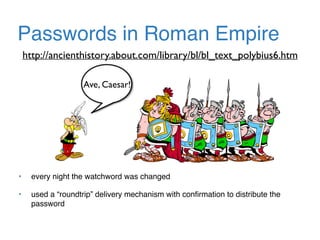
Passwords in Roman Empire
Ave, Caesar!
http://ancienthistory.about.com/library/bl/bl_text_polybius6.htm
• every night the watchword was changed
• used a “roundtrip” delivery mechanism with confirmation to distribute the
password
Passwords in modern world
create
password?
“hunter2”
hehe, no one
will ever guess
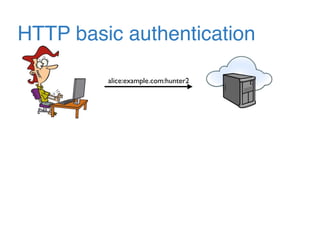
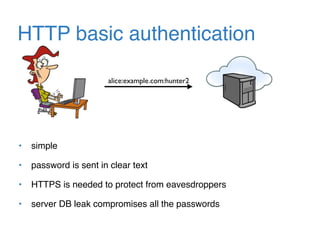
HTTP basic authentication
alice:example.com:hunter2
HTTP basic authentication
alice:example.com:hunter2
• simple
• password is sent in clear text
• HTTPS is needed to protect from eavesdroppers
• server DB leak compromises all the passwords
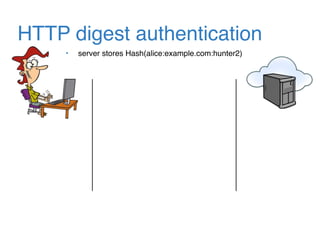
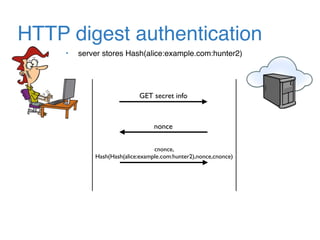
HTTP digest authentication
• server stores Hash(alice:example.com:hunter2)
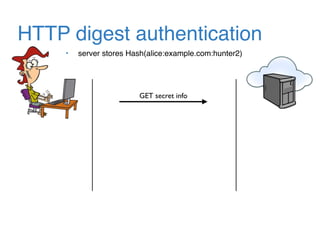
HTTP digest authentication
• server stores Hash(alice:example.com:hunter2)
GET secret info
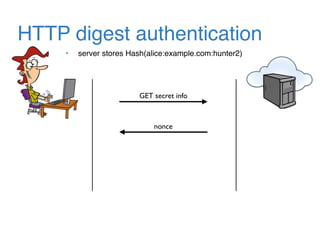
HTTP digest authentication
• server stores Hash(alice:example.com:hunter2)
GET secret info
nonce
HTTP digest authentication
• server stores Hash(alice:example.com:hunter2)
GET secret info
nonce
cnonce,
Hash(Hash(alice:example.com:hunter2),nonce,cnonce)
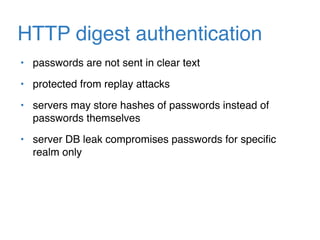
HTTP digest authentication
• passwords are not sent in clear text
• protected from replay attacks
• servers may store hashes of passwords instead of
passwords themselves
• server DB leak compromises passwords for specific
realm only
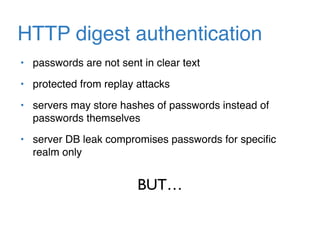
HTTP digest authentication
• passwords are not sent in clear text
• protected from replay attacks
• servers may store hashes of passwords instead of
passwords themselves
• server DB leak compromises passwords for specific
realm only
BUT…
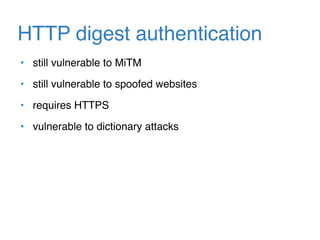
HTTP digest authentication
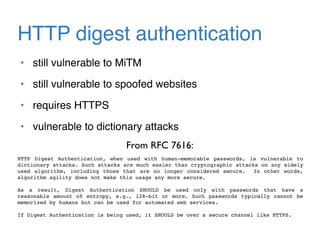
• still vulnerable to MiTM
• still vulnerable to spoofed websites
• requires HTTPS
• vulnerable to dictionary attacks
HTTP digest authentication
• still vulnerable to MiTM
• still vulnerable to spoofed websites
• requires HTTPS
• vulnerable to dictionary attacks
From RFC 7616:
HTTP Digest Authentication, when used with human-memorable passwords, is vulnerable to
dictionary attacks. Such attacks are much easier than cryptographic attacks on any widely
used algorithm, including those that are no longer considered secure. In other words,
algorithm agility does not make this usage any more secure.
As a result, Digest Authentication SHOULD be used only with passwords that have a
reasonable amount of entropy, e.g., 128-bit or more. Such passwords typically cannot be
memorized by humans but can be used for automated web services.
If Digest Authentication is being used, it SHOULD be over a secure channel like HTTPS.
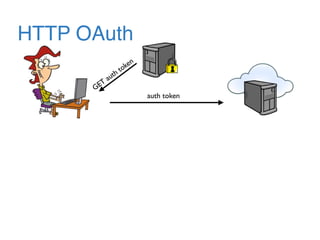
HTTP OAuth
auth token
GET
auth token
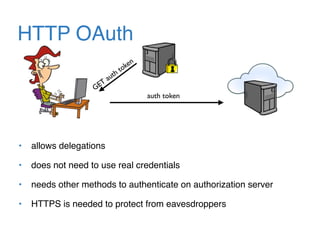
HTTP OAuth
auth token
GET
auth token
• allows delegations
• does not need to use real credentials
• needs other methods to authenticate on authorization server
• HTTPS is needed to protect from eavesdroppers
HTTPS is hard
HTTPS is hard
• problems with mixed content
• maybe fixed with implementing proper content security policy
HTTPS is hard
• problems with mixed content
• maybe fixed with implementing proper content security policy
• spoofed websites
• similar domain names, same look and feel
HTTPS is hard
• problems with mixed content
• maybe fixed with implementing proper content security policy
• spoofed websites
• similar domain names, same look and feel
• spoofed certificates
• https://thehackerblog.com/keeping-positive-obtaining-arbitrary-wildcard-ssl-
certicates-from-comodo-via-dangling-markup-injection/index.html
HTTPS is hard
• problems with mixed content
• maybe fixed with implementing proper content security policy
• spoofed websites
• similar domain names, same look and feel
• spoofed certificates
• https://thehackerblog.com/keeping-positive-obtaining-arbitrary-wildcard-ssl-
certicates-from-comodo-via-dangling-markup-injection/index.html
• compromised keys and certificates
• certificate revocation is hard
Can we do better?
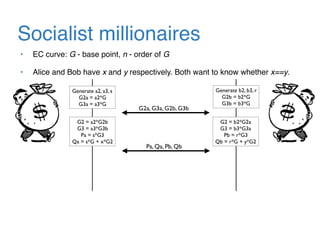
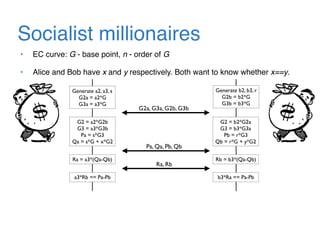
Socialist millionaires
• Socialist millionaire problem is a way for two
millionaires to check whether their wealth is equal
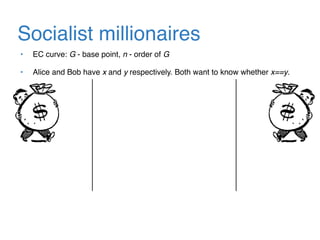
Socialist millionaires
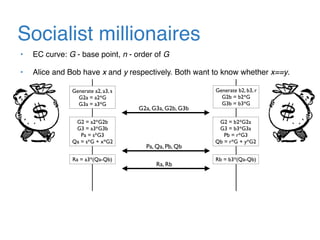
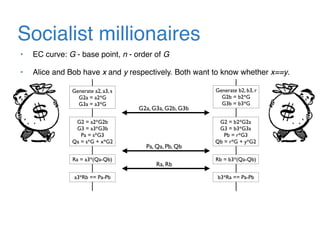
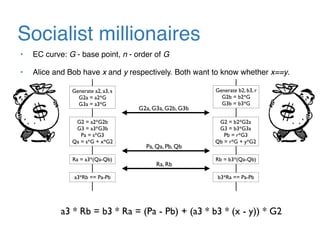
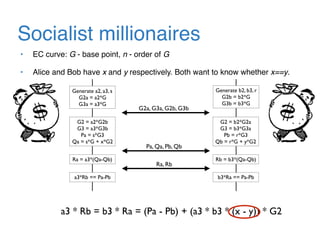
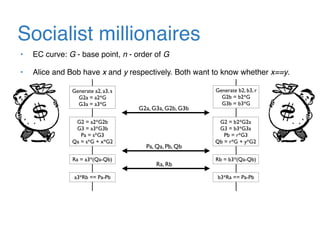
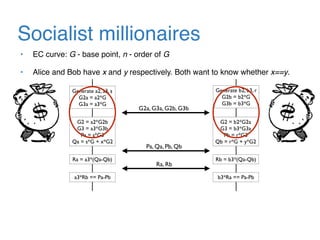
• EC curve: G - base point, n - order of G
• Alice and Bob have x and y respectively. Both want to know whether x==y.
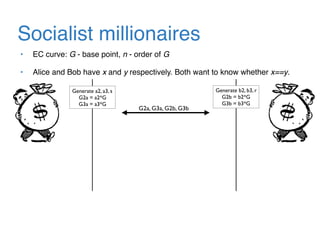
Socialist millionaires
• EC curve: G - base point, n - order of G
• Alice and Bob have x and y respectively. Both want to know whether x==y.
Generate a2, a3, s
G2a = a2*G
G3a = a3*G
Generate b2, b3, r
G2b = b2*G
G3b = b3*G
G2a, G3a, G2b, G3b
Socialist millionaires
• EC curve: G - base point, n - order of G
• Alice and Bob have x and y respectively. Both want to know whether x==y.
Generate a2, a3, s
G2a = a2*G
G3a = a3*G
Generate b2, b3, r
G2b = b2*G
G3b = b3*G
G2 = a2*G2b
G3 = a3*G3b
Pa = s*G3
Qa = s*G + x*G2
G2 = b2*G2a
G3 = b3*G3a
Pb = r*G3
Qb = r*G + y*G2
G2a, G3a, G2b, G3b
Pa, Qa, Pb, Qb
Socialist millionaires
• EC curve: G - base point, n - order of G
• Alice and Bob have x and y respectively. Both want to know whether x==y.
Generate a2, a3, s
G2a = a2*G
G3a = a3*G
Generate b2, b3, r
G2b = b2*G
G3b = b3*G
G2 = a2*G2b
G3 = a3*G3b
Pa = s*G3
Qa = s*G + x*G2
G2 = b2*G2a
G3 = b3*G3a
Pb = r*G3
Qb = r*G + y*G2
Ra = a3*(Qa-Qb) Rb = b3*(Qa-Qb)
G2a, G3a, G2b, G3b
Pa, Qa, Pb, Qb
Ra, Rb
Socialist millionaires
• EC curve: G - base point, n - order of G
• Alice and Bob have x and y respectively. Both want to know whether x==y.
Generate a2, a3, s
G2a = a2*G
G3a = a3*G
Generate b2, b3, r
G2b = b2*G
G3b = b3*G
G2 = a2*G2b
G3 = a3*G3b
Pa = s*G3
Qa = s*G + x*G2
G2 = b2*G2a
G3 = b3*G3a
Pb = r*G3
Qb = r*G + y*G2
Ra = a3*(Qa-Qb) Rb = b3*(Qa-Qb)
a3*Rb == Pa-Pb b3*Ra == Pa-Pb
G2a, G3a, G2b, G3b
Pa, Qa, Pb, Qb
Ra, Rb
Socialist millionaires
• EC curve: G - base point, n - order of G
• Alice and Bob have x and y respectively. Both want to know whether x==y.
Generate a2, a3, s
G2a = a2*G
G3a = a3*G
Generate b2, b3, r
G2b = b2*G
G3b = b3*G
G2 = a2*G2b
G3 = a3*G3b
Pa = s*G3
Qa = s*G + x*G2
G2 = b2*G2a
G3 = b3*G3a
Pb = r*G3
Qb = r*G + y*G2
Ra = a3*(Qa-Qb) Rb = b3*(Qa-Qb)
a3*Rb == Pa-Pb b3*Ra == Pa-Pb
G2a, G3a, G2b, G3b
Pa, Qa, Pb, Qb
Ra, Rb
a3 * Rb = b3 * Ra = (Pa - Pb) + (a3 * b3 * (x - y)) * G2
Socialist millionaires
• EC curve: G - base point, n - order of G
• Alice and Bob have x and y respectively. Both want to know whether x==y.
Generate a2, a3, s
G2a = a2*G
G3a = a3*G
Generate b2, b3, r
G2b = b2*G
G3b = b3*G
G2 = a2*G2b
G3 = a3*G3b
Pa = s*G3
Qa = s*G + x*G2
G2 = b2*G2a
G3 = b3*G3a
Pb = r*G3
Qb = r*G + y*G2
Ra = a3*(Qa-Qb) Rb = b3*(Qa-Qb)
a3*Rb == Pa-Pb b3*Ra == Pa-Pb
G2a, G3a, G2b, G3b
Pa, Qa, Pb, Qb
Ra, Rb
a3 * Rb = b3 * Ra = (Pa - Pb) + (a3 * b3 * (x - y)) * G2
Socialist millionaires
• Socialist millionaire problem is a way for two
millionaires to check whether their wealth is equal
• can be used to verify whether two parties posses the same secret
• a passive attacker learns nothing about the protocol and its outcome
• MiTM can do no better than passive attacker except disrupting the
communication channel
• even if one of the parties is dishonest, he learns nothing more that the
protocol outcome
• unlike most other zero-knowledge proofs requires O(1) protocol iterations
• is adopted and has good history
OTR SMP
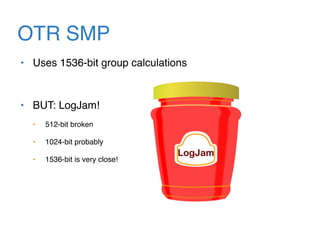
• Uses 1536-bit group calculations
OTR SMP
• Uses 1536-bit group calculations
• BUT: LogJam!
OTR SMP
• Uses 1536-bit group calculations
• BUT: LogJam!
• 512-bit broken
• 1024-bit probably
• 1536-bit is very close!
Themis SMP vs OTR SMP
• Improving SMP
• moved all cryptographic operations in ECC domain
• modern (boring) cryptography (ed25519)
• timing attacks protection
• fast and performant
• reduced memory footprint
• support for many high-level languages
• simple API
• GitHub: https://github.com/cossacklabs/themis
SPAKE2
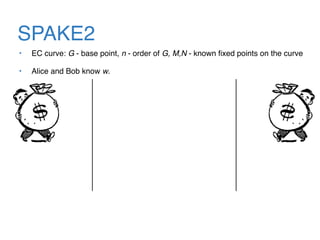
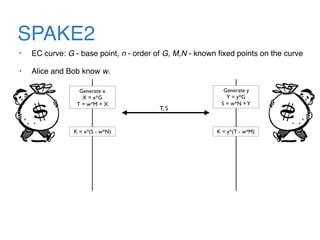
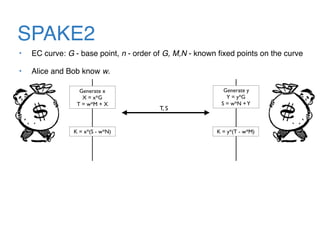
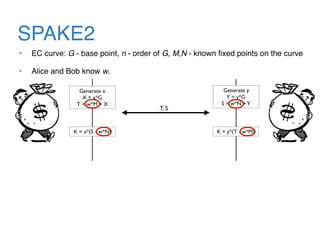
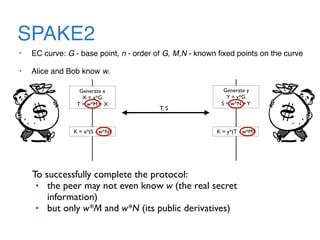
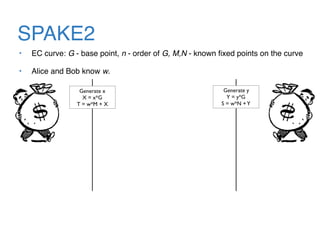
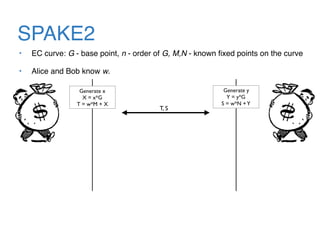
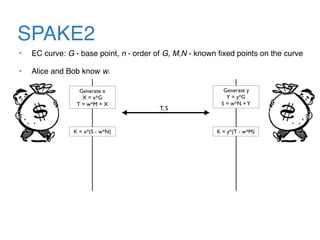
• EC curve: G - base point, n - order of G, M,N - known fixed points on the curve
• Alice and Bob know w.
SPAKE2
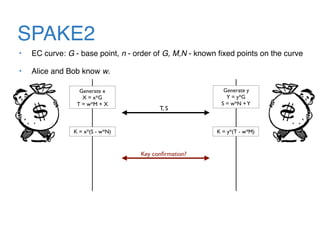
• EC curve: G - base point, n - order of G, M,N - known fixed points on the curve
• Alice and Bob know w.
Generate x
X = x*G
T = w*M + X
Generate y
Y = y*G
S = w*N +Y
SPAKE2
• EC curve: G - base point, n - order of G, M,N - known fixed points on the curve
• Alice and Bob know w.
Generate x
X = x*G
T = w*M + X
Generate y
Y = y*G
S = w*N +Y
T, S
SPAKE2
• EC curve: G - base point, n - order of G, M,N - known fixed points on the curve
• Alice and Bob know w.
Generate x
X = x*G
T = w*M + X
Generate y
Y = y*G
S = w*N +Y
K = x*(S - w*N) K = y*(T - w*M)
T, S
SPAKE2
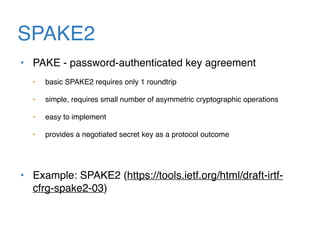
• PAKE - password-authenticated key agreement
• basic SPAKE2 requires only 1 roundtrip
• simple, requires small number of asymmetric cryptographic operations
• easy to implement
• provides a negotiated secret key as a protocol outcome
SPAKE2
• PAKE - password-authenticated key agreement
• basic SPAKE2 requires only 1 roundtrip
• simple, requires small number of asymmetric cryptographic operations
• easy to implement
• provides a negotiated secret key as a protocol outcome
• Example: SPAKE2 (https://tools.ietf.org/html/draft-irtf-
cfrg-spake2-03)
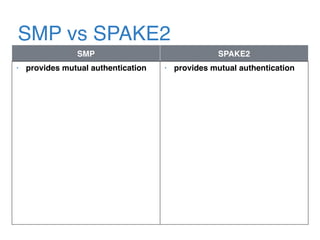
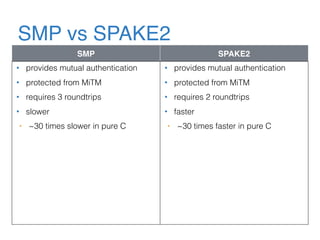
SMP vs SPAKE2
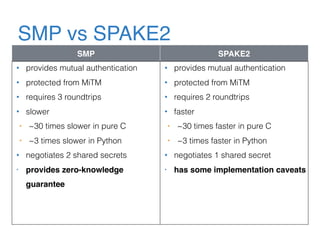
SMP SPAKE2
• provides mutual authentication • provides mutual authentication
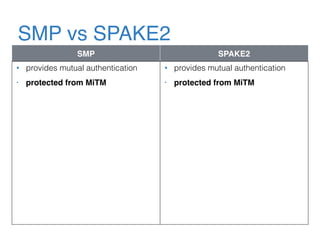
SMP vs SPAKE2
SMP SPAKE2
• provides mutual authentication
• protected from MiTM
• provides mutual authentication
• protected from MiTM
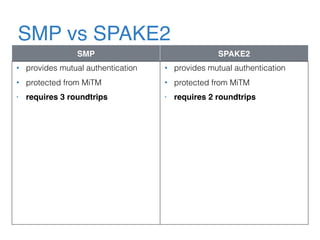
SMP vs SPAKE2
SMP SPAKE2
• provides mutual authentication
• protected from MiTM
• requires 3 roundtrips
• provides mutual authentication
• protected from MiTM
• requires 2 roundtrips
Socialist millionaires
• EC curve: G - base point, n - order of G
• Alice and Bob have x and y respectively. Both want to know whether x==y.
Generate a2, a3, s
G2a = a2*G
G3a = a3*G
Generate b2, b3, r
G2b = b2*G
G3b = b3*G
G2 = a2*G2b
G3 = a3*G3b
Pa = s*G3
Qa = s*G + x*G2
G2 = b2*G2a
G3 = b3*G3a
Pb = r*G3
Qb = r*G + y*G2
Ra = a3*(Qa-Qb) Rb = b3*(Qa-Qb)
a3*Rb == Pa-Pb b3*Ra == Pa-Pb
G2a, G3a, G2b, G3b
Pa, Qa, Pb, Qb
Ra, Rb
SPAKE2
• EC curve: G - base point, n - order of G, M,N - known fixed points on the curve
• Alice and Bob know w.
Generate x
X = x*G
T = w*M + X
Generate y
Y = y*G
S = w*N +Y
K = x*(S - w*N) K = y*(T - w*M)
T, S
SPAKE2
• EC curve: G - base point, n - order of G, M,N - known fixed points on the curve
• Alice and Bob know w.
Generate x
X = x*G
T = w*M + X
Generate y
Y = y*G
S = w*N +Y
K = x*(S - w*N) K = y*(T - w*M)
T, S
Key conrmation?
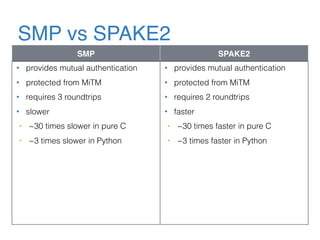
SMP vs SPAKE2
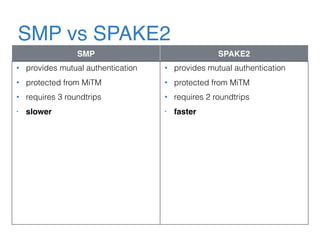
SMP SPAKE2
• provides mutual authentication
• protected from MiTM
• requires 3 roundtrips
• slower
• provides mutual authentication
• protected from MiTM
• requires 2 roundtrips
• faster
SMP vs SPAKE2
SMP SPAKE2
• provides mutual authentication
• protected from MiTM
• requires 3 roundtrips
• slower
• ~30 times slower in pure C
• provides mutual authentication
• protected from MiTM
• requires 2 roundtrips
• faster
• ~30 times faster in pure C
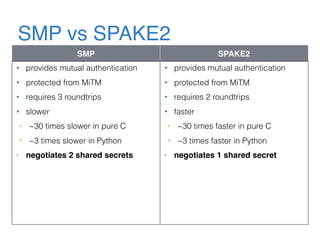
SMP vs SPAKE2
SMP SPAKE2
• provides mutual authentication
• protected from MiTM
• requires 3 roundtrips
• slower
• ~30 times slower in pure C
• ~3 times slower in Python
• provides mutual authentication
• protected from MiTM
• requires 2 roundtrips
• faster
• ~30 times faster in pure C
• ~3 times faster in Python
SMP vs SPAKE2
SMP SPAKE2
• provides mutual authentication
• protected from MiTM
• requires 3 roundtrips
• slower
• ~30 times slower in pure C
• ~3 times slower in Python
• negotiates 2 shared secrets
• provides mutual authentication
• protected from MiTM
• requires 2 roundtrips
• faster
• ~30 times faster in pure C
• ~3 times faster in Python
• negotiates 1 shared secret
Socialist millionaires
• EC curve: G - base point, n - order of G
• Alice and Bob have x and y respectively. Both want to know whether x==y.
Generate a2, a3, s
G2a = a2*G
G3a = a3*G
Generate b2, b3, r
G2b = b2*G
G3b = b3*G
G2 = a2*G2b
G3 = a3*G3b
Pa = s*G3
Qa = s*G + x*G2
G2 = b2*G2a
G3 = b3*G3a
Pb = r*G3
Qb = r*G + y*G2
Ra = a3*(Qa-Qb) Rb = b3*(Qa-Qb)
a3*Rb == Pa-Pb b3*Ra == Pa-Pb
G2a, G3a, G2b, G3b
Pa, Qa, Pb, Qb
Ra, Rb
Socialist millionaires
• EC curve: G - base point, n - order of G
• Alice and Bob have x and y respectively. Both want to know whether x==y.
Generate a2, a3, s
G2a = a2*G
G3a = a3*G
Generate b2, b3, r
G2b = b2*G
G3b = b3*G
G2 = a2*G2b
G3 = a3*G3b
Pa = s*G3
Qa = s*G + x*G2
G2 = b2*G2a
G3 = b3*G3a
Pb = r*G3
Qb = r*G + y*G2
Ra = a3*(Qa-Qb) Rb = b3*(Qa-Qb)
a3*Rb == Pa-Pb b3*Ra == Pa-Pb
G2a, G3a, G2b, G3b
Pa, Qa, Pb, Qb
Ra, Rb
SMP vs SPAKE2
SMP SPAKE2
• provides mutual authentication
• protected from MiTM
• requires 3 roundtrips
• slower
• ~30 times slower in pure C
• ~3 times slower in Python
• negotiates 2 shared secrets
• provides zero-knowledge
guarantee
• provides mutual authentication
• protected from MiTM
• requires 2 roundtrips
• faster
• ~30 times faster in pure C
• ~3 times faster in Python
• negotiates 1 shared secret
• has some implementation caveats
SPAKE2
• EC curve: G - base point, n - order of G, M,N - known fixed points on the curve
• Alice and Bob know w.
Generate x
X = x*G
T = w*M + X
Generate y
Y = y*G
S = w*N +Y
K = x*(S - w*N) K = y*(T - w*M)
T, S
SPAKE2
• EC curve: G - base point, n - order of G, M,N - known fixed points on the curve
• Alice and Bob know w.
Generate x
X = x*G
T = w*M + X
Generate y
Y = y*G
S = w*N +Y
K = x*(S - w*N) K = y*(T - w*M)
T, S
SPAKE2
• EC curve: G - base point, n - order of G, M,N - known fixed points on the curve
• Alice and Bob know w.
Generate x
X = x*G
T = w*M + X
Generate y
Y = y*G
S = w*N +Y
K = x*(S - w*N) K = y*(T - w*M)
T, S
To successfully complete the protocol:
• the peer may not even know w (the real secret
information)
• but only w*M and w*N (its public derivatives)
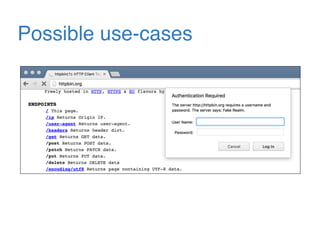
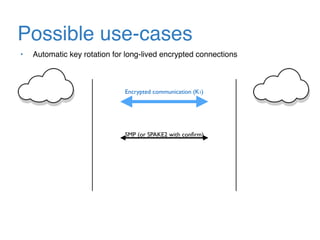
Possible use-cases
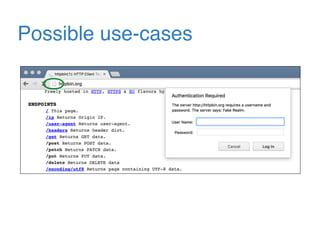
Possible use-cases
Possible use-cases
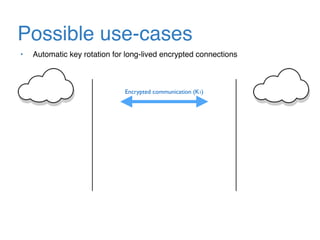
Encrypted communication (K1)
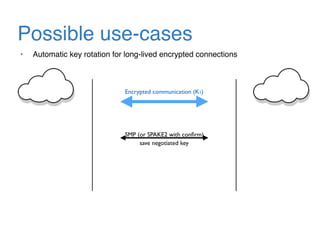
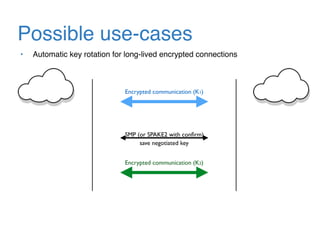
• Automatic key rotation for long-lived encrypted connections
Possible use-cases
SMP (or SPAKE2 with conrm)
Encrypted communication (K1)
• Automatic key rotation for long-lived encrypted connections
Possible use-cases
SMP (or SPAKE2 with conrm)
Encrypted communication (K1)
• Automatic key rotation for long-lived encrypted connections
save negotiated key
Possible use-cases
SMP (or SPAKE2 with conrm)
Encrypted communication (K1)
Encrypted communication (K2)
• Automatic key rotation for long-lived encrypted connections
save negotiated key
Conclusions
• Zero-knowledge protocols are useful building blocks for
enhanced security and privacy preserving protocols
• They can be useful in a scenario where one of the protocol participants may
be malicious
• You may use SPAKE2 for many real world tasks, but you
have to be aware of the caveats
• Socialist millionaire protocol provides more security
guarantees, although with some performance penalty
Links
• Paper: https://www.cossacklabs.com/files/secure-
comparator-paper-rev12.pdf
• SMP code: https://github.com/cossacklabs/themis
• SPAKE2 code: https://boringssl.googlesource.com/
boringssl/+/master/crypto/curve25519/spake25519.c
• sctest.c: https://gist.github.com/secumod/
d3a064ee93e3eda74aebd379e60ede66
• spake2test.c: https://gist.github.com/secumod/
5c35c067a4e25fbe038f09a2706b236b
Thank you!
Questions?

Overview and evolution of password-based authentication schemes

  • 1.
    Overview and evolutionof password- based authentication schemes Ignat Korchagin
  • 2.
    Passwords in RomanEmpire Ave, Caesar! http://ancienthistory.about.com/library/bl/bl_text_polybius6.htm • every night the watchword was changed • used a “roundtrip” delivery mechanism with confirmation to distribute the password
  • 3.
    Passwords in modernworld create password? “hunter2” hehe, no one will ever guess
  • 4.
  • 5.
    HTTP basic authentication alice:example.com:hunter2 •simple • password is sent in clear text • HTTPS is needed to protect from eavesdroppers • server DB leak compromises all the passwords
  • 6.
    HTTP digest authentication •server stores Hash(alice:example.com:hunter2)
  • 7.
    HTTP digest authentication •server stores Hash(alice:example.com:hunter2) GET secret info
  • 8.
    HTTP digest authentication •server stores Hash(alice:example.com:hunter2) GET secret info nonce
  • 9.
    HTTP digest authentication •server stores Hash(alice:example.com:hunter2) GET secret info nonce cnonce, Hash(Hash(alice:example.com:hunter2),nonce,cnonce)
  • 10.
    HTTP digest authentication •passwords are not sent in clear text • protected from replay attacks • servers may store hashes of passwords instead of passwords themselves • server DB leak compromises passwords for specific realm only
  • 11.
    HTTP digest authentication •passwords are not sent in clear text • protected from replay attacks • servers may store hashes of passwords instead of passwords themselves • server DB leak compromises passwords for specific realm only BUT…
  • 12.
    HTTP digest authentication •still vulnerable to MiTM • still vulnerable to spoofed websites • requires HTTPS • vulnerable to dictionary attacks
  • 13.
    HTTP digest authentication •still vulnerable to MiTM • still vulnerable to spoofed websites • requires HTTPS • vulnerable to dictionary attacks From RFC 7616: HTTP Digest Authentication, when used with human-memorable passwords, is vulnerable to dictionary attacks. Such attacks are much easier than cryptographic attacks on any widely used algorithm, including those that are no longer considered secure. In other words, algorithm agility does not make this usage any more secure. As a result, Digest Authentication SHOULD be used only with passwords that have a reasonable amount of entropy, e.g., 128-bit or more. Such passwords typically cannot be memorized by humans but can be used for automated web services. If Digest Authentication is being used, it SHOULD be over a secure channel like HTTPS.
  • 14.
  • 15.
    HTTP OAuth auth token GET authtoken • allows delegations • does not need to use real credentials • needs other methods to authenticate on authorization server • HTTPS is needed to protect from eavesdroppers
  • 16.
  • 17.
    HTTPS is hard •problems with mixed content • maybe fixed with implementing proper content security policy
  • 18.
    HTTPS is hard •problems with mixed content • maybe fixed with implementing proper content security policy • spoofed websites • similar domain names, same look and feel
  • 19.
    HTTPS is hard •problems with mixed content • maybe fixed with implementing proper content security policy • spoofed websites • similar domain names, same look and feel • spoofed certificates • https://thehackerblog.com/keeping-positive-obtaining-arbitrary-wildcard-ssl- certificates-from-comodo-via-dangling-markup-injection/index.html
  • 20.
    HTTPS is hard •problems with mixed content • maybe fixed with implementing proper content security policy • spoofed websites • similar domain names, same look and feel • spoofed certificates • https://thehackerblog.com/keeping-positive-obtaining-arbitrary-wildcard-ssl- certificates-from-comodo-via-dangling-markup-injection/index.html • compromised keys and certificates • certificate revocation is hard
  • 21.
    Can we dobetter?
  • 22.
    Socialist millionaires • Socialistmillionaire problem is a way for two millionaires to check whether their wealth is equal
  • 23.
    Socialist millionaires • ECcurve: G - base point, n - order of G • Alice and Bob have x and y respectively. Both want to know whether x==y.
  • 24.
    Socialist millionaires • ECcurve: G - base point, n - order of G • Alice and Bob have x and y respectively. Both want to know whether x==y. Generate a2, a3, s G2a = a2*G G3a = a3*G Generate b2, b3, r G2b = b2*G G3b = b3*G G2a, G3a, G2b, G3b
  • 25.
    Socialist millionaires • ECcurve: G - base point, n - order of G • Alice and Bob have x and y respectively. Both want to know whether x==y. Generate a2, a3, s G2a = a2*G G3a = a3*G Generate b2, b3, r G2b = b2*G G3b = b3*G G2 = a2*G2b G3 = a3*G3b Pa = s*G3 Qa = s*G + x*G2 G2 = b2*G2a G3 = b3*G3a Pb = r*G3 Qb = r*G + y*G2 G2a, G3a, G2b, G3b Pa, Qa, Pb, Qb
  • 26.
    Socialist millionaires • ECcurve: G - base point, n - order of G • Alice and Bob have x and y respectively. Both want to know whether x==y. Generate a2, a3, s G2a = a2*G G3a = a3*G Generate b2, b3, r G2b = b2*G G3b = b3*G G2 = a2*G2b G3 = a3*G3b Pa = s*G3 Qa = s*G + x*G2 G2 = b2*G2a G3 = b3*G3a Pb = r*G3 Qb = r*G + y*G2 Ra = a3*(Qa-Qb) Rb = b3*(Qa-Qb) G2a, G3a, G2b, G3b Pa, Qa, Pb, Qb Ra, Rb
  • 27.
    Socialist millionaires • ECcurve: G - base point, n - order of G • Alice and Bob have x and y respectively. Both want to know whether x==y. Generate a2, a3, s G2a = a2*G G3a = a3*G Generate b2, b3, r G2b = b2*G G3b = b3*G G2 = a2*G2b G3 = a3*G3b Pa = s*G3 Qa = s*G + x*G2 G2 = b2*G2a G3 = b3*G3a Pb = r*G3 Qb = r*G + y*G2 Ra = a3*(Qa-Qb) Rb = b3*(Qa-Qb) a3*Rb == Pa-Pb b3*Ra == Pa-Pb G2a, G3a, G2b, G3b Pa, Qa, Pb, Qb Ra, Rb
  • 28.
    Socialist millionaires • ECcurve: G - base point, n - order of G • Alice and Bob have x and y respectively. Both want to know whether x==y. Generate a2, a3, s G2a = a2*G G3a = a3*G Generate b2, b3, r G2b = b2*G G3b = b3*G G2 = a2*G2b G3 = a3*G3b Pa = s*G3 Qa = s*G + x*G2 G2 = b2*G2a G3 = b3*G3a Pb = r*G3 Qb = r*G + y*G2 Ra = a3*(Qa-Qb) Rb = b3*(Qa-Qb) a3*Rb == Pa-Pb b3*Ra == Pa-Pb G2a, G3a, G2b, G3b Pa, Qa, Pb, Qb Ra, Rb a3 * Rb = b3 * Ra = (Pa - Pb) + (a3 * b3 * (x - y)) * G2
  • 29.
    Socialist millionaires • ECcurve: G - base point, n - order of G • Alice and Bob have x and y respectively. Both want to know whether x==y. Generate a2, a3, s G2a = a2*G G3a = a3*G Generate b2, b3, r G2b = b2*G G3b = b3*G G2 = a2*G2b G3 = a3*G3b Pa = s*G3 Qa = s*G + x*G2 G2 = b2*G2a G3 = b3*G3a Pb = r*G3 Qb = r*G + y*G2 Ra = a3*(Qa-Qb) Rb = b3*(Qa-Qb) a3*Rb == Pa-Pb b3*Ra == Pa-Pb G2a, G3a, G2b, G3b Pa, Qa, Pb, Qb Ra, Rb a3 * Rb = b3 * Ra = (Pa - Pb) + (a3 * b3 * (x - y)) * G2
  • 30.
    Socialist millionaires • Socialistmillionaire problem is a way for two millionaires to check whether their wealth is equal • can be used to verify whether two parties posses the same secret • a passive attacker learns nothing about the protocol and its outcome • MiTM can do no better than passive attacker except disrupting the communication channel • even if one of the parties is dishonest, he learns nothing more that the protocol outcome • unlike most other zero-knowledge proofs requires O(1) protocol iterations • is adopted and has good history
  • 31.
    OTR SMP • Uses1536-bit group calculations
  • 32.
    OTR SMP • Uses1536-bit group calculations • BUT: LogJam!
  • 33.
    OTR SMP • Uses1536-bit group calculations • BUT: LogJam! • 512-bit broken • 1024-bit probably • 1536-bit is very close!
  • 34.
    Themis SMP vsOTR SMP • Improving SMP • moved all cryptographic operations in ECC domain • modern (boring) cryptography (ed25519) • timing attacks protection • fast and performant • reduced memory footprint • support for many high-level languages • simple API • GitHub: https://github.com/cossacklabs/themis
  • 35.
    SPAKE2 • EC curve:G - base point, n - order of G, M,N - known fixed points on the curve • Alice and Bob know w.
  • 36.
    SPAKE2 • EC curve:G - base point, n - order of G, M,N - known fixed points on the curve • Alice and Bob know w. Generate x X = x*G T = w*M + X Generate y Y = y*G S = w*N +Y
  • 37.
    SPAKE2 • EC curve:G - base point, n - order of G, M,N - known fixed points on the curve • Alice and Bob know w. Generate x X = x*G T = w*M + X Generate y Y = y*G S = w*N +Y T, S
  • 38.
    SPAKE2 • EC curve:G - base point, n - order of G, M,N - known fixed points on the curve • Alice and Bob know w. Generate x X = x*G T = w*M + X Generate y Y = y*G S = w*N +Y K = x*(S - w*N) K = y*(T - w*M) T, S
  • 39.
    SPAKE2 • PAKE -password-authenticated key agreement • basic SPAKE2 requires only 1 roundtrip • simple, requires small number of asymmetric cryptographic operations • easy to implement • provides a negotiated secret key as a protocol outcome
  • 40.
    SPAKE2 • PAKE -password-authenticated key agreement • basic SPAKE2 requires only 1 roundtrip • simple, requires small number of asymmetric cryptographic operations • easy to implement • provides a negotiated secret key as a protocol outcome • Example: SPAKE2 (https://tools.ietf.org/html/draft-irtf- cfrg-spake2-03)
  • 41.
    SMP vs SPAKE2 SMPSPAKE2 • provides mutual authentication • provides mutual authentication
  • 42.
    SMP vs SPAKE2 SMPSPAKE2 • provides mutual authentication • protected from MiTM • provides mutual authentication • protected from MiTM
  • 43.
    SMP vs SPAKE2 SMPSPAKE2 • provides mutual authentication • protected from MiTM • requires 3 roundtrips • provides mutual authentication • protected from MiTM • requires 2 roundtrips
  • 44.
    Socialist millionaires • ECcurve: G - base point, n - order of G • Alice and Bob have x and y respectively. Both want to know whether x==y. Generate a2, a3, s G2a = a2*G G3a = a3*G Generate b2, b3, r G2b = b2*G G3b = b3*G G2 = a2*G2b G3 = a3*G3b Pa = s*G3 Qa = s*G + x*G2 G2 = b2*G2a G3 = b3*G3a Pb = r*G3 Qb = r*G + y*G2 Ra = a3*(Qa-Qb) Rb = b3*(Qa-Qb) a3*Rb == Pa-Pb b3*Ra == Pa-Pb G2a, G3a, G2b, G3b Pa, Qa, Pb, Qb Ra, Rb
  • 45.
    SPAKE2 • EC curve:G - base point, n - order of G, M,N - known fixed points on the curve • Alice and Bob know w. Generate x X = x*G T = w*M + X Generate y Y = y*G S = w*N +Y K = x*(S - w*N) K = y*(T - w*M) T, S
  • 46.
    SPAKE2 • EC curve:G - base point, n - order of G, M,N - known fixed points on the curve • Alice and Bob know w. Generate x X = x*G T = w*M + X Generate y Y = y*G S = w*N +Y K = x*(S - w*N) K = y*(T - w*M) T, S Key confirmation?
  • 47.
    SMP vs SPAKE2 SMPSPAKE2 • provides mutual authentication • protected from MiTM • requires 3 roundtrips • slower • provides mutual authentication • protected from MiTM • requires 2 roundtrips • faster
  • 48.
    SMP vs SPAKE2 SMPSPAKE2 • provides mutual authentication • protected from MiTM • requires 3 roundtrips • slower • ~30 times slower in pure C • provides mutual authentication • protected from MiTM • requires 2 roundtrips • faster • ~30 times faster in pure C
  • 49.
    SMP vs SPAKE2 SMPSPAKE2 • provides mutual authentication • protected from MiTM • requires 3 roundtrips • slower • ~30 times slower in pure C • ~3 times slower in Python • provides mutual authentication • protected from MiTM • requires 2 roundtrips • faster • ~30 times faster in pure C • ~3 times faster in Python
  • 50.
    SMP vs SPAKE2 SMPSPAKE2 • provides mutual authentication • protected from MiTM • requires 3 roundtrips • slower • ~30 times slower in pure C • ~3 times slower in Python • negotiates 2 shared secrets • provides mutual authentication • protected from MiTM • requires 2 roundtrips • faster • ~30 times faster in pure C • ~3 times faster in Python • negotiates 1 shared secret
  • 51.
    Socialist millionaires • ECcurve: G - base point, n - order of G • Alice and Bob have x and y respectively. Both want to know whether x==y. Generate a2, a3, s G2a = a2*G G3a = a3*G Generate b2, b3, r G2b = b2*G G3b = b3*G G2 = a2*G2b G3 = a3*G3b Pa = s*G3 Qa = s*G + x*G2 G2 = b2*G2a G3 = b3*G3a Pb = r*G3 Qb = r*G + y*G2 Ra = a3*(Qa-Qb) Rb = b3*(Qa-Qb) a3*Rb == Pa-Pb b3*Ra == Pa-Pb G2a, G3a, G2b, G3b Pa, Qa, Pb, Qb Ra, Rb
  • 52.
    Socialist millionaires • ECcurve: G - base point, n - order of G • Alice and Bob have x and y respectively. Both want to know whether x==y. Generate a2, a3, s G2a = a2*G G3a = a3*G Generate b2, b3, r G2b = b2*G G3b = b3*G G2 = a2*G2b G3 = a3*G3b Pa = s*G3 Qa = s*G + x*G2 G2 = b2*G2a G3 = b3*G3a Pb = r*G3 Qb = r*G + y*G2 Ra = a3*(Qa-Qb) Rb = b3*(Qa-Qb) a3*Rb == Pa-Pb b3*Ra == Pa-Pb G2a, G3a, G2b, G3b Pa, Qa, Pb, Qb Ra, Rb
  • 53.
    SMP vs SPAKE2 SMPSPAKE2 • provides mutual authentication • protected from MiTM • requires 3 roundtrips • slower • ~30 times slower in pure C • ~3 times slower in Python • negotiates 2 shared secrets • provides zero-knowledge guarantee • provides mutual authentication • protected from MiTM • requires 2 roundtrips • faster • ~30 times faster in pure C • ~3 times faster in Python • negotiates 1 shared secret • has some implementation caveats
  • 54.
    SPAKE2 • EC curve:G - base point, n - order of G, M,N - known fixed points on the curve • Alice and Bob know w. Generate x X = x*G T = w*M + X Generate y Y = y*G S = w*N +Y K = x*(S - w*N) K = y*(T - w*M) T, S
  • 55.
    SPAKE2 • EC curve:G - base point, n - order of G, M,N - known fixed points on the curve • Alice and Bob know w. Generate x X = x*G T = w*M + X Generate y Y = y*G S = w*N +Y K = x*(S - w*N) K = y*(T - w*M) T, S
  • 56.
    SPAKE2 • EC curve:G - base point, n - order of G, M,N - known fixed points on the curve • Alice and Bob know w. Generate x X = x*G T = w*M + X Generate y Y = y*G S = w*N +Y K = x*(S - w*N) K = y*(T - w*M) T, S To successfully complete the protocol: • the peer may not even know w (the real secret information) • but only w*M and w*N (its public derivatives)
  • 57.
  • 58.
  • 59.
    Possible use-cases Encrypted communication(K1) • Automatic key rotation for long-lived encrypted connections
  • 60.
    Possible use-cases SMP (orSPAKE2 with confirm) Encrypted communication (K1) • Automatic key rotation for long-lived encrypted connections
  • 61.
    Possible use-cases SMP (orSPAKE2 with confirm) Encrypted communication (K1) • Automatic key rotation for long-lived encrypted connections save negotiated key
  • 62.
    Possible use-cases SMP (orSPAKE2 with confirm) Encrypted communication (K1) Encrypted communication (K2) • Automatic key rotation for long-lived encrypted connections save negotiated key
  • 63.
    Conclusions • Zero-knowledge protocolsare useful building blocks for enhanced security and privacy preserving protocols • They can be useful in a scenario where one of the protocol participants may be malicious • You may use SPAKE2 for many real world tasks, but you have to be aware of the caveats • Socialist millionaire protocol provides more security guarantees, although with some performance penalty
  • 64.
    Links • Paper: https://www.cossacklabs.com/files/secure- comparator-paper-rev12.pdf •SMP code: https://github.com/cossacklabs/themis • SPAKE2 code: https://boringssl.googlesource.com/ boringssl/+/master/crypto/curve25519/spake25519.c • sctest.c: https://gist.github.com/secumod/ d3a064ee93e3eda74aebd379e60ede66 • spake2test.c: https://gist.github.com/secumod/ 5c35c067a4e25fbe038f09a2706b236b
  • 65.