O
U
T
B
A
C
k
Text Wikipedia, slideshow by
Anders Dernback
Outback
Outback
Outback
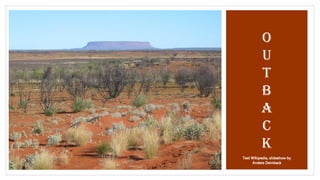
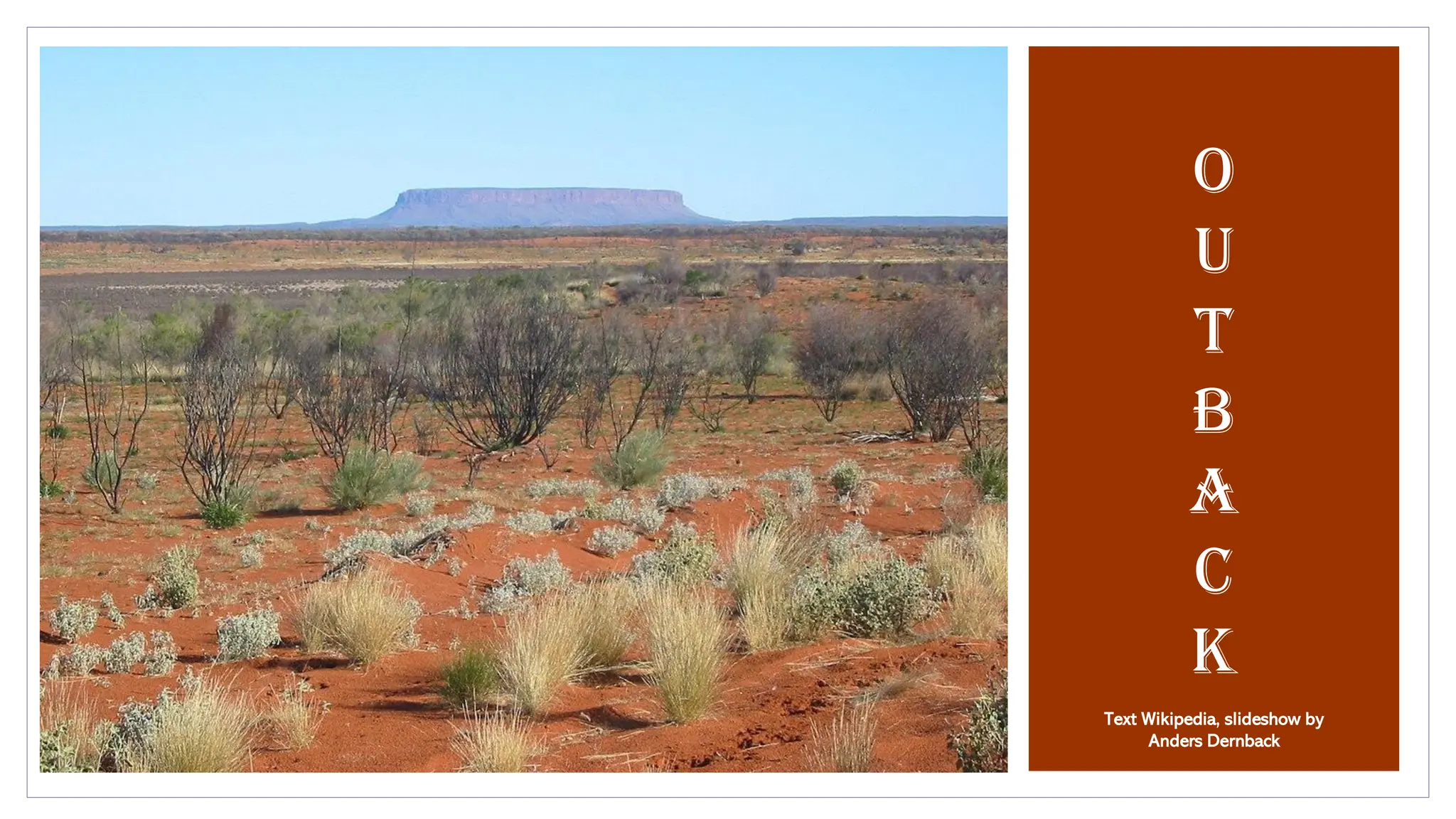
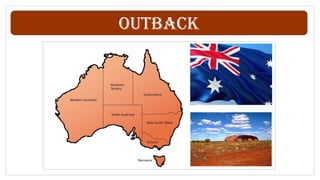
The Outback is a remote, vast, sparsely populated area of Australia. The Outback is more
remote than the bush. While often envisaged as being arid, the Outback regions extend from
the northern to southern Australian coastlines and encompass a number of climatic zones,
including tropical and monsoonal climates in northern areas, arid areas in the "red centre" and
semi-arid and temperate climates in southerly regions.
Geographically, the Outback is unified by a combination of factors, most notably a low human
population density, a largely intact natural environment and, in many places, low-intensity land
uses, such as pastoralism (livestock grazing) in which production is reliant on the natural
environment. The Outback is deeply ingrained in Australian heritage, history and folklore. In
Australian art the subject of the Outback has been vogue, particularly in the 1940s. In 2009,
as part of the Q150 celebrations, the Queensland Outback was announced as one of the
Q150 Icons of Queensland for its role as a "natural attraction"
Outback
Aboriginal peoples have lived in the Outback for at least 50,000 years and occupied all Outback
regions, including the driest deserts, when Europeans first entered central Australia in the 1800s.
Many Aboriginal Australians retain strong physical and cultural links to their traditional country and
are legally recognised as the Traditional Owners of large parts of the Outback under Commonwealth
Native Title legislation.
The Outback region offers a unique culinary experience with hearty, flavorful dishes, often featuring
bush tucker, barbecue culture, stocking up on supplies, local produce, and Indigenous food practices.
Indigenous communities have rich culinary traditions, relying on gathering native plants, hunting, and
fishing for sustenance. Roadhouses and pubs serve as important stops for travelers, offering meals,
snacks, and refreshments. Recreational hunting and fishing are also popular activities in some areas.
The availability of specific foods and dining experiences in the Outback depends on the region's
location and infrastructure.
Outback
Early European exploration of inland Australia was sporadic. More focus was on the more
accessible and fertile coastal areas. The first party to successfully cross the Blue Mountains
just outside Sydney was led by Gregory Blaxland in 1813, 25 years after the colony was
established. People, starting with John Oxley in 1817, 1818 and 1821, followed by Charles
Sturt in 1829–1830, attempted to follow the westward-flowing rivers to find an "inland sea",
but these were found to all flow into the Murray River and Darling River, which turn south.
From 1858 onwards, the so-called "Afghan" cameleers and their beasts played an
instrumental role in opening up the Outback and helping to build infrastructure.
Over the period 1858 to 1861, John McDouall Stuart led six expeditions north from Adelaide,
South Australia into the Outback, culminating in successfully reaching the north coast of
Australia and returning without the loss of any of the party's members' lives. This contrasts
with the ill-fated Burke and Wills expedition in 1860–61 which was much better funded, but
resulted in the deaths of three of the members of the transcontinental party.
Outback
The Overland Telegraph line was constructed in the 1870s[6] along the route identified by
Stuart.
In 1865, the surveyor George Goyder, using changes in vegetation patterns, mapped a line in
South Australia, north of which he considered rainfall to be too unreliable to support
agriculture.
Exploration of the Outback continued in the 1950s when Len Beadell explored, surveyed and
built many roads in support of the nuclear weapons tests at Emu Field and Maralinga and
rocket testing on the Woomera Prohibited Area. Mineral exploration continues as new
mineral deposits are identified and developed.
2002 was declared the Year of the Outback. While the early explorers used horses to cross
the Outback, the first woman to make the journey riding a horse was Anna Hingley, who
rode from Broome to Cairns in 2006.
Outback
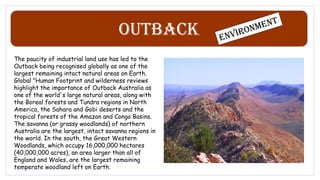
The paucity of industrial land use has led to the
Outback being recognised globally as one of the
largest remaining intact natural areas on Earth.
Global "Human Footprint and wilderness reviews
highlight the importance of Outback Australia as
one of the world's large natural areas, along with
the Boreal forests and Tundra regions in North
America, the Sahara and Gobi deserts and the
tropical forests of the Amazon and Congo Basins.
The savanna (or grassy woodlands) of northern
Australia are the largest, intact savanna regions in
the world. In the south, the Great Western
Woodlands, which occupy 16,000,000 hectares
(40,000,000 acres), an area larger than all of
England and Wales, are the largest remaining
temperate woodland left on Earth.
Outback Major ecosystems
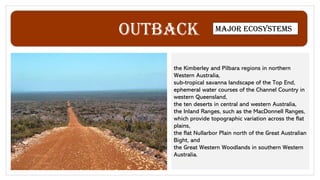
the Kimberley and Pilbara regions in northern
Western Australia,
sub-tropical savanna landscape of the Top End,
ephemeral water courses of the Channel Country in
western Queensland,
the ten deserts in central and western Australia,
the Inland Ranges, such as the MacDonnell Ranges,
which provide topographic variation across the flat
plains,
the flat Nullarbor Plain north of the Great Australian
Bight, and
the Great Western Woodlands in southern Western
Australia.
Outback
Wildlife
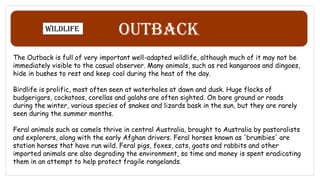
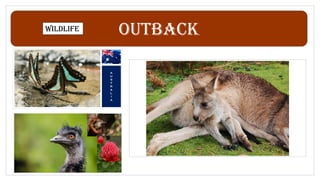
The Outback is full of very important well-adapted wildlife, although much of it may not be
immediately visible to the casual observer. Many animals, such as red kangaroos and dingoes,
hide in bushes to rest and keep cool during the heat of the day.
Birdlife is prolific, most often seen at waterholes at dawn and dusk. Huge flocks of
budgerigars, cockatoos, corellas and galahs are often sighted. On bare ground or roads
during the winter, various species of snakes and lizards bask in the sun, but they are rarely
seen during the summer months.
Feral animals such as camels thrive in central Australia, brought to Australia by pastoralists
and explorers, along with the early Afghan drivers. Feral horses known as 'brumbies' are
station horses that have run wild. Feral pigs, foxes, cats, goats and rabbits and other
imported animals are also degrading the environment, so time and money is spent eradicating
them in an attempt to help protect fragile rangelands.
Outback
Wildlife
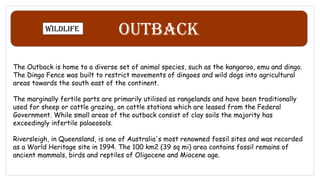
The Outback is home to a diverse set of animal species, such as the kangaroo, emu and dingo.
The Dingo Fence was built to restrict movements of dingoes and wild dogs into agricultural
areas towards the south east of the continent.
The marginally fertile parts are primarily utilised as rangelands and have been traditionally
used for sheep or cattle grazing, on cattle stations which are leased from the Federal
Government. While small areas of the outback consist of clay soils the majority has
exceedingly infertile palaeosols.
Riversleigh, in Queensland, is one of Australia's most renowned fossil sites and was recorded
as a World Heritage site in 1994. The 100 km2 (39 sq mi) area contains fossil remains of
ancient mammals, birds and reptiles of Oligocene and Miocene age.
Outback
Wildlife
Outback
Industry
The largest industry across the Outback, in terms of the area occupied, is pastoralism, in
which cattle, sheep, and sometimes goats are grazed in mostly intact, natural ecosystems.
Widespread use of bore water, obtained from underground aquifers, including the Great
Artesian Basin, has enabled livestock to be grazed across vast areas in which no permanent
surface water exists naturally.
Capitalising on the lack of pasture improvement and absence of fertiliser and pesticide use,
many Outback pastoral properties are certified as organic livestock producers. In 2014,
17,000,000 hectares (42,000,000 acres), most of which is in Outback Australia, was fully
certified as organic farm production, making Australia the largest certified organic
production area in the world.
Outback
Tourism
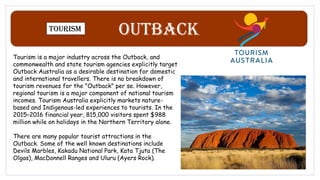
Tourism is a major industry across the Outback, and
commonwealth and state tourism agencies explicitly target
Outback Australia as a desirable destination for domestic
and international travellers. There is no breakdown of
tourism revenues for the "Outback" per se. However,
regional tourism is a major component of national tourism
incomes. Tourism Australia explicitly markets nature-
based and Indigenous-led experiences to tourists. In the
2015–2016 financial year, 815,000 visitors spent $988
million while on holidays in the Northern Territory alone.
There are many popular tourist attractions in the
Outback. Some of the well known destinations include
Devils Marbles, Kakadu National Park, Kata Tjuta (The
Olgas), MacDonnell Ranges and Uluru (Ayers Rock).
Outback
Outback
Mining
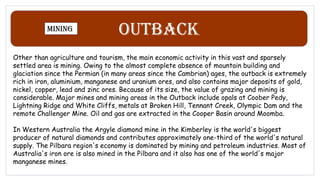
Other than agriculture and tourism, the main economic activity in this vast and sparsely
settled area is mining. Owing to the almost complete absence of mountain building and
glaciation since the Permian (in many areas since the Cambrian) ages, the outback is extremely
rich in iron, aluminium, manganese and uranium ores, and also contains major deposits of gold,
nickel, copper, lead and zinc ores. Because of its size, the value of grazing and mining is
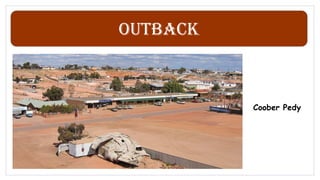
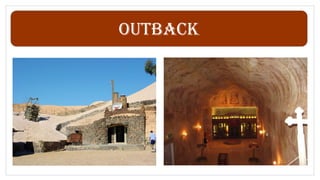
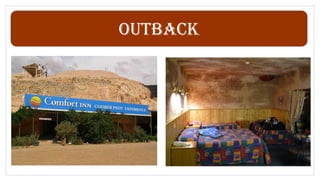
considerable. Major mines and mining areas in the Outback include opals at Coober Pedy,
Lightning Ridge and White Cliffs, metals at Broken Hill, Tennant Creek, Olympic Dam and the
remote Challenger Mine. Oil and gas are extracted in the Cooper Basin around Moomba.
In Western Australia the Argyle diamond mine in the Kimberley is the world's biggest
producer of natural diamonds and contributes approximately one-third of the world's natural
supply. The Pilbara region's economy is dominated by mining and petroleum industries. Most of
Australia's iron ore is also mined in the Pilbara and it also has one of the world's major
manganese mines.
Outback
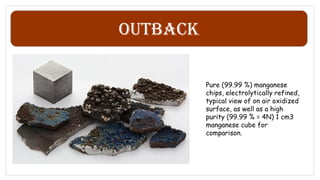
Pure (99.99 %) manganese
chips, electrolytically refined,
typical view of on air oxidized
surface, as well as a high
purity (99.99 % = 4N) 1 cm3
manganese cube for
comparison.
Outback
Coober Pedy
Outback
Outback
Outback
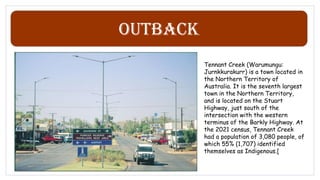
Tennant Creek (Warumungu:
Jurnkkurakurr) is a town located in
the Northern Territory of
Australia. It is the seventh largest
town in the Northern Territory,
and is located on the Stuart
Highway, just south of the
intersection with the western
terminus of the Barkly Highway. At
the 2021 census, Tennant Creek
had a population of 3,080 people, of
which 55% (1,707) identified
themselves as Indigenous.[
Outback
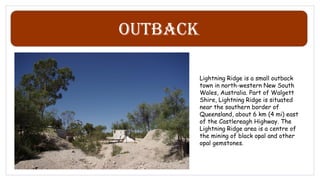
Lightning Ridge is a small outback
town in north-western New South
Wales, Australia. Part of Walgett
Shire, Lightning Ridge is situated
near the southern border of
Queensland, about 6 km (4 mi) east
of the Castlereagh Highway. The
Lightning Ridge area is a centre of
the mining of black opal and other
opal gemstones.
Outback
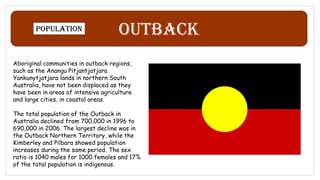
Population
Aboriginal communities in outback regions,
such as the Anangu Pitjantjatjara
Yankunytjatjara lands in northern South
Australia, have not been displaced as they
have been in areas of intensive agriculture
and large cities, in coastal areas.
The total population of the Outback in
Australia declined from 700,000 in 1996 to
690,000 in 2006. The largest decline was in
the Outback Northern Territory, while the
Kimberley and Pilbara showed population
increases during the same period. The sex
ratio is 1040 males for 1000 females and 17%
of the total population is indigenous.
Outback
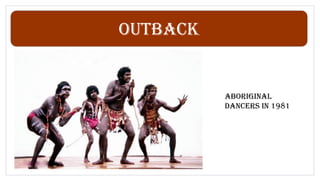
Aboriginal
dancers in 1981
Outback
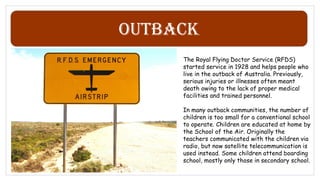
The Royal Flying Doctor Service (RFDS)
started service in 1928 and helps people who
live in the outback of Australia. Previously,
serious injuries or illnesses often meant
death owing to the lack of proper medical
facilities and trained personnel.
In many outback communities, the number of
children is too small for a conventional school
to operate. Children are educated at home by
the School of the Air. Originally the
teachers communicated with the children via
radio, but now satellite telecommunication is
used instead. Some children attend boarding
school, mostly only those in secondary school.
Outback
Terminology
The term "outback" derives from the adverbial phrase referring to the back yard of a house, and came
to be used meiotically in the late 1800s to describe the vast sparsely settled regions of Australia
behind the cities and towns. The earliest known use of the term in this context in print was in 1869,
when the writer clearly meant the area west of Wagga Wagga, New South Wales. Over time, the
adverbial use of the phrase was replaced with the present day noun form.
It is colloquially said that "the outback" is located "beyond the Black Stump". The location of the black
stump may be some hypothetical location or may vary depending on local custom and folklore. It has
been suggested that the term comes from the Black Stump Wine Saloon that once stood about 10
kilometres (6.2 mi) out of Coolah, New South Wales on the Gunnedah Road. It is claimed that the
saloon, named after the nearby Black Stump Run and Black Stump Creek, was an important staging post
for traffic to north-west New South Wales and it became a marker by which people gauged their
journeys.
Outback
"The Never-Never" is a term
referring to remoter parts of the
Outback. The Outback can also be
referred to as "back of beyond" or
"back o' Bourke", although these
terms are more frequently used
when referring to something a long
way from anywhere, or a long way
away. The well-watered north of
the continent is often called the
"Top End" and the arid interior
"The Red Centre", owing to its vast
amounts of red soil and sparse
greenery amongst its landscape.
The Never Never is the name of a vast,
remote area of the Australian Outback, as
described in Barcroft Boake's poem "Where
the Dead Men Lie":
Out on the wastes of the Never Never -
That's where the dead men lie!
There where the heat-waves dance forever -
That's where the dead men lie!
Outback
Transport
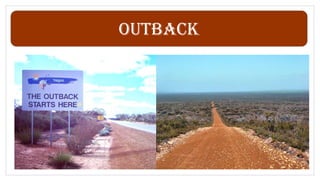
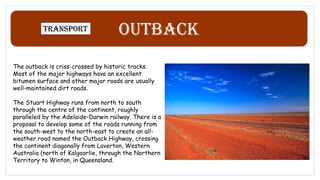
The outback is criss-crossed by historic tracks.
Most of the major highways have an excellent
bitumen surface and other major roads are usually
well-maintained dirt roads.
The Stuart Highway runs from north to south
through the centre of the continent, roughly
paralleled by the Adelaide–Darwin railway. There is a
proposal to develop some of the roads running from
the south-west to the north-east to create an all-
weather road named the Outback Highway, crossing
the continent diagonally from Laverton, Western
Australia (north of Kalgoorlie, through the Northern
Territory to Winton, in Queensland.
Outback
Outback
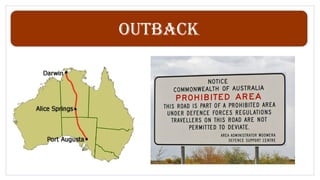
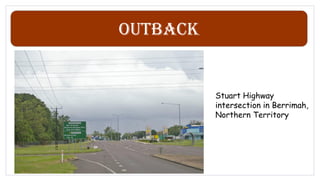
Stuart Highway
intersection in Berrimah,
Northern Territory
Outback
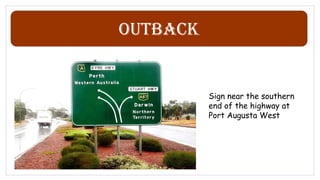
Sign near the southern
end of the highway at
Port Augusta West
Outback
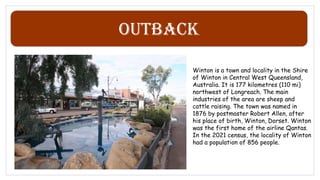
Winton is a town and locality in the Shire
of Winton in Central West Queensland,
Australia. It is 177 kilometres (110 mi)
northwest of Longreach. The main
industries of the area are sheep and
cattle raising. The town was named in
1876 by postmaster Robert Allen, after
his place of birth, Winton, Dorset. Winton
was the first home of the airline Qantas.
In the 2021 census, the locality of Winton
had a population of 856 people.
Outback
The traditional owners of the Winton area, the Koa people, consider Bladensburg National Park area
(near Winton) to be a special part of their traditional country, and the park is also important to the
Maiawali and Karuwali people.
Jirandali (also known as Yirandali, Warungu, Yirandhali) is an Australian Aboriginal language of North-
West Queensland, particularly the Hughenden area. The language region includes the local government
area of the Shire of Flinders, including Dutton River, Flinders River, Mount Sturgeon, Caledonia,
Richmond, Corfield, Winton, Torrens, Tower Hill, Landsborough Creek, Lammermoor Station,
Hughenden, and Tangorin.
Skull Hole, on Surprise Creek, at Bladensburg Station about 15 kilometres (9.3 mi) from Winton, was
the site of a massacre of Aboriginal people in 1877.
The Koa people have lodged an application to the Federal Court to have their native title legally
recognised. This application (or "claim") was registered on 28 September 2015, by the National Native
Title Tribunal.
Outback
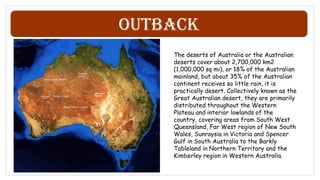
The deserts of Australia or the Australian
deserts cover about 2,700,000 km2
(1,000,000 sq mi), or 18% of the Australian
mainland, but about 35% of the Australian
continent receives so little rain, it is
practically desert. Collectively known as the
Great Australian desert, they are primarily
distributed throughout the Western
Plateau and interior lowlands of the
country, covering areas from South West
Queensland, Far West region of New South
Wales, Sunraysia in Victoria and Spencer
Gulf in South Australia to the Barkly
Tableland in Northern Territory and the
Kimberley region in Western Australia.
Outback
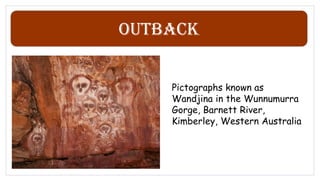
Pictographs known as
Wandjina in the Wunnumurra
Gorge, Barnett River,
Kimberley, Western Australia
Outback
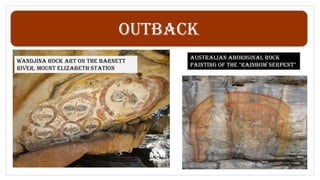
Wandjina rock art on the Barnett
River, Mount Elizabeth Station
Australian Aboriginal rock
painting of the "Rainbow Serpent"
Outback
Outback
Outback

Outback.pdf

  • 1.
  • 2.
  • 3.
  • 4.
    Outback The Outback isa remote, vast, sparsely populated area of Australia. The Outback is more remote than the bush. While often envisaged as being arid, the Outback regions extend from the northern to southern Australian coastlines and encompass a number of climatic zones, including tropical and monsoonal climates in northern areas, arid areas in the "red centre" and semi-arid and temperate climates in southerly regions. Geographically, the Outback is unified by a combination of factors, most notably a low human population density, a largely intact natural environment and, in many places, low-intensity land uses, such as pastoralism (livestock grazing) in which production is reliant on the natural environment. The Outback is deeply ingrained in Australian heritage, history and folklore. In Australian art the subject of the Outback has been vogue, particularly in the 1940s. In 2009, as part of the Q150 celebrations, the Queensland Outback was announced as one of the Q150 Icons of Queensland for its role as a "natural attraction"
  • 5.
    Outback Aboriginal peoples havelived in the Outback for at least 50,000 years and occupied all Outback regions, including the driest deserts, when Europeans first entered central Australia in the 1800s. Many Aboriginal Australians retain strong physical and cultural links to their traditional country and are legally recognised as the Traditional Owners of large parts of the Outback under Commonwealth Native Title legislation. The Outback region offers a unique culinary experience with hearty, flavorful dishes, often featuring bush tucker, barbecue culture, stocking up on supplies, local produce, and Indigenous food practices. Indigenous communities have rich culinary traditions, relying on gathering native plants, hunting, and fishing for sustenance. Roadhouses and pubs serve as important stops for travelers, offering meals, snacks, and refreshments. Recreational hunting and fishing are also popular activities in some areas. The availability of specific foods and dining experiences in the Outback depends on the region's location and infrastructure.
  • 6.
    Outback Early European explorationof inland Australia was sporadic. More focus was on the more accessible and fertile coastal areas. The first party to successfully cross the Blue Mountains just outside Sydney was led by Gregory Blaxland in 1813, 25 years after the colony was established. People, starting with John Oxley in 1817, 1818 and 1821, followed by Charles Sturt in 1829–1830, attempted to follow the westward-flowing rivers to find an "inland sea", but these were found to all flow into the Murray River and Darling River, which turn south. From 1858 onwards, the so-called "Afghan" cameleers and their beasts played an instrumental role in opening up the Outback and helping to build infrastructure. Over the period 1858 to 1861, John McDouall Stuart led six expeditions north from Adelaide, South Australia into the Outback, culminating in successfully reaching the north coast of Australia and returning without the loss of any of the party's members' lives. This contrasts with the ill-fated Burke and Wills expedition in 1860–61 which was much better funded, but resulted in the deaths of three of the members of the transcontinental party.
  • 7.
    Outback The Overland Telegraphline was constructed in the 1870s[6] along the route identified by Stuart. In 1865, the surveyor George Goyder, using changes in vegetation patterns, mapped a line in South Australia, north of which he considered rainfall to be too unreliable to support agriculture. Exploration of the Outback continued in the 1950s when Len Beadell explored, surveyed and built many roads in support of the nuclear weapons tests at Emu Field and Maralinga and rocket testing on the Woomera Prohibited Area. Mineral exploration continues as new mineral deposits are identified and developed. 2002 was declared the Year of the Outback. While the early explorers used horses to cross the Outback, the first woman to make the journey riding a horse was Anna Hingley, who rode from Broome to Cairns in 2006.
  • 8.
    Outback The paucity ofindustrial land use has led to the Outback being recognised globally as one of the largest remaining intact natural areas on Earth. Global "Human Footprint and wilderness reviews highlight the importance of Outback Australia as one of the world's large natural areas, along with the Boreal forests and Tundra regions in North America, the Sahara and Gobi deserts and the tropical forests of the Amazon and Congo Basins. The savanna (or grassy woodlands) of northern Australia are the largest, intact savanna regions in the world. In the south, the Great Western Woodlands, which occupy 16,000,000 hectares (40,000,000 acres), an area larger than all of England and Wales, are the largest remaining temperate woodland left on Earth.
  • 9.
    Outback Major ecosystems theKimberley and Pilbara regions in northern Western Australia, sub-tropical savanna landscape of the Top End, ephemeral water courses of the Channel Country in western Queensland, the ten deserts in central and western Australia, the Inland Ranges, such as the MacDonnell Ranges, which provide topographic variation across the flat plains, the flat Nullarbor Plain north of the Great Australian Bight, and the Great Western Woodlands in southern Western Australia.
  • 10.
    Outback Wildlife The Outback isfull of very important well-adapted wildlife, although much of it may not be immediately visible to the casual observer. Many animals, such as red kangaroos and dingoes, hide in bushes to rest and keep cool during the heat of the day. Birdlife is prolific, most often seen at waterholes at dawn and dusk. Huge flocks of budgerigars, cockatoos, corellas and galahs are often sighted. On bare ground or roads during the winter, various species of snakes and lizards bask in the sun, but they are rarely seen during the summer months. Feral animals such as camels thrive in central Australia, brought to Australia by pastoralists and explorers, along with the early Afghan drivers. Feral horses known as 'brumbies' are station horses that have run wild. Feral pigs, foxes, cats, goats and rabbits and other imported animals are also degrading the environment, so time and money is spent eradicating them in an attempt to help protect fragile rangelands.
  • 11.
    Outback Wildlife The Outback ishome to a diverse set of animal species, such as the kangaroo, emu and dingo. The Dingo Fence was built to restrict movements of dingoes and wild dogs into agricultural areas towards the south east of the continent. The marginally fertile parts are primarily utilised as rangelands and have been traditionally used for sheep or cattle grazing, on cattle stations which are leased from the Federal Government. While small areas of the outback consist of clay soils the majority has exceedingly infertile palaeosols. Riversleigh, in Queensland, is one of Australia's most renowned fossil sites and was recorded as a World Heritage site in 1994. The 100 km2 (39 sq mi) area contains fossil remains of ancient mammals, birds and reptiles of Oligocene and Miocene age.
  • 12.
  • 13.
    Outback Industry The largest industryacross the Outback, in terms of the area occupied, is pastoralism, in which cattle, sheep, and sometimes goats are grazed in mostly intact, natural ecosystems. Widespread use of bore water, obtained from underground aquifers, including the Great Artesian Basin, has enabled livestock to be grazed across vast areas in which no permanent surface water exists naturally. Capitalising on the lack of pasture improvement and absence of fertiliser and pesticide use, many Outback pastoral properties are certified as organic livestock producers. In 2014, 17,000,000 hectares (42,000,000 acres), most of which is in Outback Australia, was fully certified as organic farm production, making Australia the largest certified organic production area in the world.
  • 14.
    Outback Tourism Tourism is amajor industry across the Outback, and commonwealth and state tourism agencies explicitly target Outback Australia as a desirable destination for domestic and international travellers. There is no breakdown of tourism revenues for the "Outback" per se. However, regional tourism is a major component of national tourism incomes. Tourism Australia explicitly markets nature- based and Indigenous-led experiences to tourists. In the 2015–2016 financial year, 815,000 visitors spent $988 million while on holidays in the Northern Territory alone. There are many popular tourist attractions in the Outback. Some of the well known destinations include Devils Marbles, Kakadu National Park, Kata Tjuta (The Olgas), MacDonnell Ranges and Uluru (Ayers Rock).
  • 15.
  • 16.
    Outback Mining Other than agricultureand tourism, the main economic activity in this vast and sparsely settled area is mining. Owing to the almost complete absence of mountain building and glaciation since the Permian (in many areas since the Cambrian) ages, the outback is extremely rich in iron, aluminium, manganese and uranium ores, and also contains major deposits of gold, nickel, copper, lead and zinc ores. Because of its size, the value of grazing and mining is considerable. Major mines and mining areas in the Outback include opals at Coober Pedy, Lightning Ridge and White Cliffs, metals at Broken Hill, Tennant Creek, Olympic Dam and the remote Challenger Mine. Oil and gas are extracted in the Cooper Basin around Moomba. In Western Australia the Argyle diamond mine in the Kimberley is the world's biggest producer of natural diamonds and contributes approximately one-third of the world's natural supply. The Pilbara region's economy is dominated by mining and petroleum industries. Most of Australia's iron ore is also mined in the Pilbara and it also has one of the world's major manganese mines.
  • 17.
    Outback Pure (99.99 %)manganese chips, electrolytically refined, typical view of on air oxidized surface, as well as a high purity (99.99 % = 4N) 1 cm3 manganese cube for comparison.
  • 18.
  • 19.
  • 20.
  • 21.
    Outback Tennant Creek (Warumungu: Jurnkkurakurr)is a town located in the Northern Territory of Australia. It is the seventh largest town in the Northern Territory, and is located on the Stuart Highway, just south of the intersection with the western terminus of the Barkly Highway. At the 2021 census, Tennant Creek had a population of 3,080 people, of which 55% (1,707) identified themselves as Indigenous.[
  • 22.
    Outback Lightning Ridge isa small outback town in north-western New South Wales, Australia. Part of Walgett Shire, Lightning Ridge is situated near the southern border of Queensland, about 6 km (4 mi) east of the Castlereagh Highway. The Lightning Ridge area is a centre of the mining of black opal and other opal gemstones.
  • 23.
    Outback Population Aboriginal communities inoutback regions, such as the Anangu Pitjantjatjara Yankunytjatjara lands in northern South Australia, have not been displaced as they have been in areas of intensive agriculture and large cities, in coastal areas. The total population of the Outback in Australia declined from 700,000 in 1996 to 690,000 in 2006. The largest decline was in the Outback Northern Territory, while the Kimberley and Pilbara showed population increases during the same period. The sex ratio is 1040 males for 1000 females and 17% of the total population is indigenous.
  • 24.
  • 25.
    Outback The Royal FlyingDoctor Service (RFDS) started service in 1928 and helps people who live in the outback of Australia. Previously, serious injuries or illnesses often meant death owing to the lack of proper medical facilities and trained personnel. In many outback communities, the number of children is too small for a conventional school to operate. Children are educated at home by the School of the Air. Originally the teachers communicated with the children via radio, but now satellite telecommunication is used instead. Some children attend boarding school, mostly only those in secondary school.
  • 26.
    Outback Terminology The term "outback"derives from the adverbial phrase referring to the back yard of a house, and came to be used meiotically in the late 1800s to describe the vast sparsely settled regions of Australia behind the cities and towns. The earliest known use of the term in this context in print was in 1869, when the writer clearly meant the area west of Wagga Wagga, New South Wales. Over time, the adverbial use of the phrase was replaced with the present day noun form. It is colloquially said that "the outback" is located "beyond the Black Stump". The location of the black stump may be some hypothetical location or may vary depending on local custom and folklore. It has been suggested that the term comes from the Black Stump Wine Saloon that once stood about 10 kilometres (6.2 mi) out of Coolah, New South Wales on the Gunnedah Road. It is claimed that the saloon, named after the nearby Black Stump Run and Black Stump Creek, was an important staging post for traffic to north-west New South Wales and it became a marker by which people gauged their journeys.
  • 27.
    Outback "The Never-Never" isa term referring to remoter parts of the Outback. The Outback can also be referred to as "back of beyond" or "back o' Bourke", although these terms are more frequently used when referring to something a long way from anywhere, or a long way away. The well-watered north of the continent is often called the "Top End" and the arid interior "The Red Centre", owing to its vast amounts of red soil and sparse greenery amongst its landscape. The Never Never is the name of a vast, remote area of the Australian Outback, as described in Barcroft Boake's poem "Where the Dead Men Lie": Out on the wastes of the Never Never - That's where the dead men lie! There where the heat-waves dance forever - That's where the dead men lie!
  • 28.
    Outback Transport The outback iscriss-crossed by historic tracks. Most of the major highways have an excellent bitumen surface and other major roads are usually well-maintained dirt roads. The Stuart Highway runs from north to south through the centre of the continent, roughly paralleled by the Adelaide–Darwin railway. There is a proposal to develop some of the roads running from the south-west to the north-east to create an all- weather road named the Outback Highway, crossing the continent diagonally from Laverton, Western Australia (north of Kalgoorlie, through the Northern Territory to Winton, in Queensland.
  • 29.
  • 30.
    Outback Stuart Highway intersection inBerrimah, Northern Territory
  • 31.
    Outback Sign near thesouthern end of the highway at Port Augusta West
  • 32.
    Outback Winton is atown and locality in the Shire of Winton in Central West Queensland, Australia. It is 177 kilometres (110 mi) northwest of Longreach. The main industries of the area are sheep and cattle raising. The town was named in 1876 by postmaster Robert Allen, after his place of birth, Winton, Dorset. Winton was the first home of the airline Qantas. In the 2021 census, the locality of Winton had a population of 856 people.
  • 33.
    Outback The traditional ownersof the Winton area, the Koa people, consider Bladensburg National Park area (near Winton) to be a special part of their traditional country, and the park is also important to the Maiawali and Karuwali people. Jirandali (also known as Yirandali, Warungu, Yirandhali) is an Australian Aboriginal language of North- West Queensland, particularly the Hughenden area. The language region includes the local government area of the Shire of Flinders, including Dutton River, Flinders River, Mount Sturgeon, Caledonia, Richmond, Corfield, Winton, Torrens, Tower Hill, Landsborough Creek, Lammermoor Station, Hughenden, and Tangorin. Skull Hole, on Surprise Creek, at Bladensburg Station about 15 kilometres (9.3 mi) from Winton, was the site of a massacre of Aboriginal people in 1877. The Koa people have lodged an application to the Federal Court to have their native title legally recognised. This application (or "claim") was registered on 28 September 2015, by the National Native Title Tribunal.
  • 34.
    Outback The deserts ofAustralia or the Australian deserts cover about 2,700,000 km2 (1,000,000 sq mi), or 18% of the Australian mainland, but about 35% of the Australian continent receives so little rain, it is practically desert. Collectively known as the Great Australian desert, they are primarily distributed throughout the Western Plateau and interior lowlands of the country, covering areas from South West Queensland, Far West region of New South Wales, Sunraysia in Victoria and Spencer Gulf in South Australia to the Barkly Tableland in Northern Territory and the Kimberley region in Western Australia.
  • 35.
    Outback Pictographs known as Wandjinain the Wunnumurra Gorge, Barnett River, Kimberley, Western Australia
  • 36.
    Outback Wandjina rock arton the Barnett River, Mount Elizabeth Station Australian Aboriginal rock painting of the "Rainbow Serpent"
  • 37.
  • 38.
  • 39.