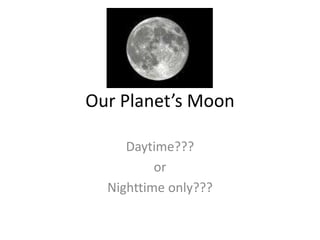
Our Planet’s MoonDaytime???orNighttime only???
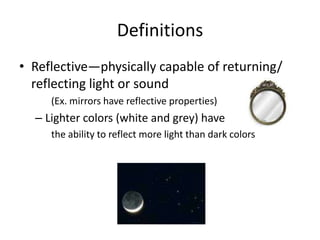
DefinitionsReflective—physically capable of returning/ reflecting light or sound(Ex. mirrors have reflective properties)Lighter colors (white and grey) havethe ability to reflect more light than dark colors
Introduction ActivityYou will need the round mirror, orange and red reflectors, and the flash light.You will do this activity with the room lights on and off.Purpose/GoalTo observe how reflection of light occurs.
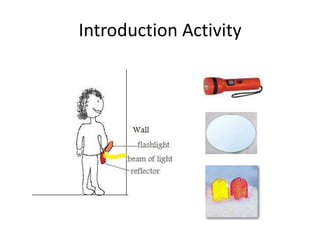
To determine which of the three items is the most reflective.Introduction ActivityProceduresStand facing a wall about 1 to 2 feet away from it with the lights off.Hold one of the 3 items (red reflector, orange reflector, or mirror) close to your body with the reflective side facing the wall.Hold the flash light away from your body pointing at the item.Observe the reflection and its brightness on the wall.Repeat for each of the three items.Now repeat the above 5 steps with the lights on.(See following slide for sketch if you have any questions regarding how to do this activity)
Introduction Activity
Introduction ActivityObservation AnalysisOn a sheet of paper write down what you observe.Which of the three items was the most reflective?Red Reflector	Orange Reflector	MirrorWhy do you think this is?
Was there a difference in reflections with the lights off versus the lights on?  Explain.Background InformationIn the following slides you will read about the moon.  This information should give you details about the moon that you will need to consider while performing the Main Activity.  It should also help you in forming your answers to the observation questions that you will answer at the end of both activities.
The moon’s ability to be seenThe moon is not a star with it’s own light source.Then why is it so bright?	The moon’s color has reflective properties that allow us to see light from the sun being reflectedWhen can we see the moon?It is easiest seen at night because the sky is so dark allowing the sun’s reflection to stand outIt can also be seen during the day depending on its position in relation to the sun and the Earth(Extension Activity:  Observe the moon over the period of one month and write down details about what you see and/or draw pictures on the Lunar Sighting worksheet included in the box.)
Reflective PropertiesLook at the pictures of these moon rocks and the surface of the moon.
Take note of their color.
The moon’s light color allows it to reflect light back so that we can see it.Main ActivityCan you see its reflection?GoalUsing the flash light and the styrofoam balls of the moon and Earth you will attempt to reflect light off of the moon onto the Earth’s surface.
You will need to do this with the lights in the room off and then again with the lights on.
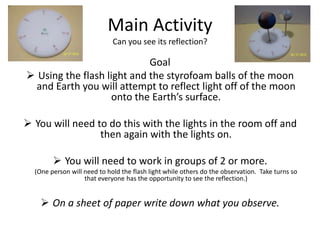
You will need to work in groups of 2 or more.	(One person will need to hold the flash light while others do the observation.  Take turns so that everyone has the opportunity to see the reflection.)On a sheet of paper write down what you observe.Main ActivityCan you see its reflection?Procedure/GuidelinesInsert the Earth and Moon into the styrofoam disc (in the marked holes, start the moon in #1) so that they stand on their own.2)	The person holding the flash light will stand closest to the Earth so that the beginning order is Sun, Earth, Moon.The flash light will be used as the Sun.Since this is not an exact replica of the solar system, it is okay to adjust the sun’s angle slightly to obtain the reflection of light from the Moon onto the Earth’s surface.  The person holding the sun (flash light) will stay in one placeThe moon’s mirror should always face the Earth.  This is because only one side of the Moon faces the Earth at all times.
Main ActivityCan you see its reflection?With the room lights off turn on the flash light (sun).Make observationsMove moon to #2 position.(remember mirror faces the Earth.) Make observationsContinue this process until you have observed the moon in all 7 positions.Do the above steps with the lights on now.
Main ActivityObservation AnalysisThinking about what you observed… Were you able to see the reflection at all times?
Was it easier to see the reflection with the lights on or with the lights off?
Explain why these results occurred.Final AssessmentCompare and contrast the difference between these two reflection images: Why can we see the moon better at night?Why can we sometimes see the moon during the day?
See a recording of the moon during the daytime.http://www.youtube.com/watch?v=ovLzyFeZJJE&NR=1		                    In the picture at right you can see the sun is just		                    beginning to rise over the water in the far right		                    of the picture.  The moon is what is seen already		                    in the sky to the far left.			                    In the picture at left you can see the sun			                    is full and low to the horizon.  The moon			                    is large and high in the sky.  The moon is			                    in its crescent shape.

Our Planet’S Moon

  • 1.
  • 2.
    DefinitionsReflective—physically capable ofreturning/ reflecting light or sound(Ex. mirrors have reflective properties)Lighter colors (white and grey) havethe ability to reflect more light than dark colors
  • 3.
    Introduction ActivityYou willneed the round mirror, orange and red reflectors, and the flash light.You will do this activity with the room lights on and off.Purpose/GoalTo observe how reflection of light occurs.
  • 4.
    To determine whichof the three items is the most reflective.Introduction ActivityProceduresStand facing a wall about 1 to 2 feet away from it with the lights off.Hold one of the 3 items (red reflector, orange reflector, or mirror) close to your body with the reflective side facing the wall.Hold the flash light away from your body pointing at the item.Observe the reflection and its brightness on the wall.Repeat for each of the three items.Now repeat the above 5 steps with the lights on.(See following slide for sketch if you have any questions regarding how to do this activity)
  • 5.
  • 6.
    Introduction ActivityObservation AnalysisOna sheet of paper write down what you observe.Which of the three items was the most reflective?Red Reflector Orange Reflector MirrorWhy do you think this is?
  • 7.
    Was there adifference in reflections with the lights off versus the lights on? Explain.Background InformationIn the following slides you will read about the moon. This information should give you details about the moon that you will need to consider while performing the Main Activity. It should also help you in forming your answers to the observation questions that you will answer at the end of both activities.
  • 8.
    The moon’s abilityto be seenThe moon is not a star with it’s own light source.Then why is it so bright? The moon’s color has reflective properties that allow us to see light from the sun being reflectedWhen can we see the moon?It is easiest seen at night because the sky is so dark allowing the sun’s reflection to stand outIt can also be seen during the day depending on its position in relation to the sun and the Earth(Extension Activity: Observe the moon over the period of one month and write down details about what you see and/or draw pictures on the Lunar Sighting worksheet included in the box.)
  • 9.
    Reflective PropertiesLook atthe pictures of these moon rocks and the surface of the moon.
  • 10.
    Take note oftheir color.
  • 11.
    The moon’s lightcolor allows it to reflect light back so that we can see it.Main ActivityCan you see its reflection?GoalUsing the flash light and the styrofoam balls of the moon and Earth you will attempt to reflect light off of the moon onto the Earth’s surface.
  • 12.
    You will needto do this with the lights in the room off and then again with the lights on.
  • 13.
    You will needto work in groups of 2 or more. (One person will need to hold the flash light while others do the observation. Take turns so that everyone has the opportunity to see the reflection.)On a sheet of paper write down what you observe.Main ActivityCan you see its reflection?Procedure/GuidelinesInsert the Earth and Moon into the styrofoam disc (in the marked holes, start the moon in #1) so that they stand on their own.2) The person holding the flash light will stand closest to the Earth so that the beginning order is Sun, Earth, Moon.The flash light will be used as the Sun.Since this is not an exact replica of the solar system, it is okay to adjust the sun’s angle slightly to obtain the reflection of light from the Moon onto the Earth’s surface. The person holding the sun (flash light) will stay in one placeThe moon’s mirror should always face the Earth. This is because only one side of the Moon faces the Earth at all times.
  • 14.
    Main ActivityCan yousee its reflection?With the room lights off turn on the flash light (sun).Make observationsMove moon to #2 position.(remember mirror faces the Earth.) Make observationsContinue this process until you have observed the moon in all 7 positions.Do the above steps with the lights on now.
  • 15.
    Main ActivityObservation AnalysisThinkingabout what you observed… Were you able to see the reflection at all times?
  • 16.
    Was it easierto see the reflection with the lights on or with the lights off?
  • 17.
    Explain why theseresults occurred.Final AssessmentCompare and contrast the difference between these two reflection images: Why can we see the moon better at night?Why can we sometimes see the moon during the day?
  • 18.
    See a recordingof the moon during the daytime.http://www.youtube.com/watch?v=ovLzyFeZJJE&NR=1 In the picture at right you can see the sun is just beginning to rise over the water in the far right of the picture. The moon is what is seen already in the sky to the far left. In the picture at left you can see the sun is full and low to the horizon. The moon is large and high in the sky. The moon is in its crescent shape.