Federal Democratic Republic of Ethiopia
Occupational Standard
Cleaning
National TVET-Qualification Framework (NTQF) Level -I
Presented by:
Tamirat Sulamo
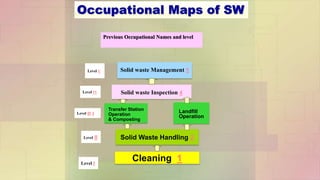
Solid waste Management 5
Cleaning 1
Solid Waste Handling 2
Transfer Station
Operation
& Composting
Landfill
Operation
Solid waste Inspection 4
Level I
Level II
Level III 3
Level IV
Level V
Occupational Maps of SW
Previous Occupational Names and level
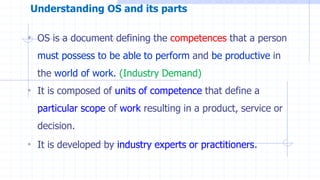
Understanding OS and its parts
• OS is a document defining the competences that a person
must possess to be able to perform and be productive in
the world of work. (Industry Demand)
• It is composed of units of competence that define a
particular scope of work resulting in a product, service or
decision.
• It is developed by industry experts or practitioners.
Dimensions Of Competence
1.Task Skills
• The requirement to perform tasks*
being competent means -
having the skills, knowledge and attitudes
to do the job
(e.g. preparing salad, troubleshooting an
engine)
understanding why the job should be done
in a certain way
(e.g. preparing a salad to complement a
seafood dish, troubleshooting an engine to
run a car)
DIMENSIONS OF COMPETENCE
2. Task management skills
• The requirement to manage a
number of different tasks*
being competent means –
being able to do
different tasks
at the same time
(e.g. preparing a salad while
watching another dish cook)
3.Contingency management skills
• The requirement to respond to
irregularities and breakdowns in
routine*
Ethiopian TVET Reform
MoE - ECBP
being competent means –
dealing with everyday problems as
they arise (e.g. what to do when materials
are not in stock or managing an upset client)
4. Job/role environment *
• The requirement to deal with the
responsibilities & expectations of
work environment
Ethiopian TVET Reform
MoE - ECBP
Being competent means -
understanding workplace policies and
procedures
(e.g. reporting to the right person, filling out
paperwork )
working with others in the workplace
(e.g. cooperating and communicating well with co-
workers, supervisors, managers and customers)
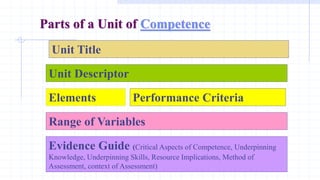
Parts of a Unit of Competence
Unit Title
Unit Descriptor
Elements Performance Criteria
Range of Variables
Evidence Guide (Critical Aspects of Competence, Underpinning
Knowledge, Underpinning Skills, Resource Implications, Method of
Assessment, context of Assessment)
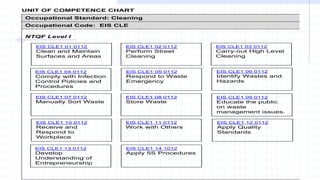
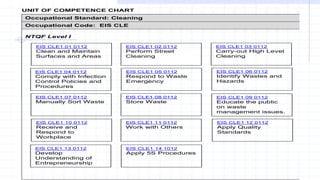
UNIT OF COMPETENCE CHART
Occupational Standard: Cleaning
Occupational Code: EIS CLE
NTQF Level I
EIS CLE1 03 0112
Carry-out High Level
Cleaning
EIS CLE1 01 0112
Clean and Maintain
Surfaces and Areas
EIS CLE1 12 0112
Apply Quality
Standards
EIS CLE1 07 0112
Manually Sort Waste
EIS CLE1 02 0112
Perform Street
Cleaning
EIS CLE1 06 0112
Identify Wastes and
Hazards
EIS CLE1 04 0112
Comply with Infection
Control Policies and
Procedures
EIS CLE1 05 0112
Respond to Waste
Emergency
EIS CLE1 13 0112
Develop
Understanding of
Entrepreneurship
EIS CLE1 10 0112
Receive and
Respond to
Workplace
Communication
EIS CLE1 11 0112
Work with Others
EIS CLE1 08 0112
Store Waste
EIS CLE1 09 0112
Educate the public
on waste
management issues.
EIS CLE1 14 1012
Apply 5S Procedures
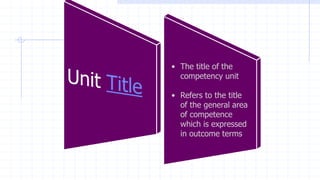
• The title of the
competency unit
• Refers to the title
of the general area
of competence
which is expressed
in outcome terms
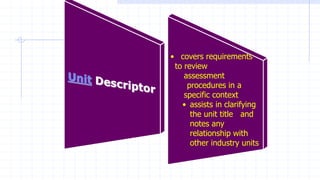
• covers requirements
to review
assessment
procedures in a
specific context
• assists in clarifying
the unit title and
notes any
relationship with
other industry units
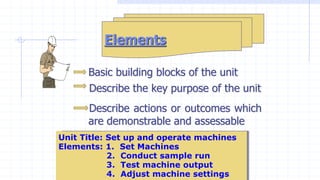
Basic building blocks of the unit
Describe the key purpose of the unit
Describe actions or outcomes which
are demonstrable and assessable
Elements
Unit Title: Set up and operate machines
Elements: 1. Set Machines
2. Conduct sample run
3. Test machine output
4. Adjust machine settings
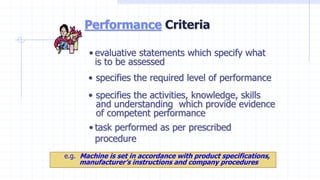
Performance Criteria
• evaluative statements which specify what
is to be assessed
• specifies the required level of performance
• specifies the activities, knowledge, skills
and understanding which provide evidence
of competent performance
• task performed as per prescribed
procedure
e.g. Machine is set in accordance with product specifications,
manufacturer’s instructions and company procedures
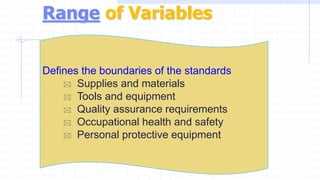
Range of Variables
Defines the boundaries of the standards
 Supplies and materials
 Tools and equipment
 Quality assurance requirements
 Occupational health and safety
 Personal protective equipment
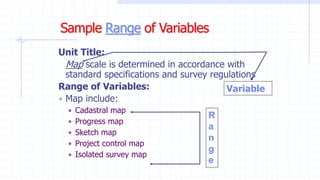
Unit Title:
Map scale is determined in accordance with
standard specifications and survey regulations
Range of Variables:
 Map include:
 Cadastral map
 Progress map
 Sketch map
 Project control map
 Isolated survey map
Variable
R
a
n
g
e
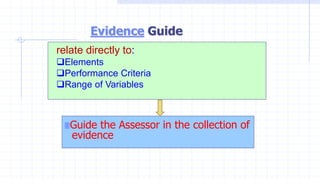
Evidence Guide
relate directly to:
Elements
Performance Criteria
Range of Variables
Guide the Assessor in the collection of
evidence
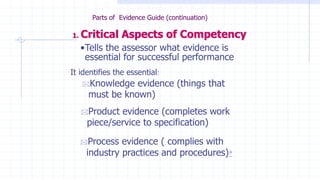
Parts of Evidence Guide (continuation)
1. Critical Aspects of Competency
•Tells the assessor what evidence is
essential for successful performance
It identifies the essential:
Product evidence (completes work
piece/service to specification)
Knowledge evidence (things that
must be known)
Process evidence ( complies with
industry practices and procedures)*
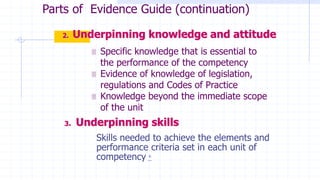
2. Underpinning knowledge and attitude
 Specific knowledge that is essential to
the performance of the competency
 Evidence of knowledge of legislation,
regulations and Codes of Practice
 Knowledge beyond the immediate scope
of the unit
Parts of Evidence Guide (continuation)
3. Underpinning skills
Skills needed to achieve the elements and
performance criteria set in each unit of
competency *
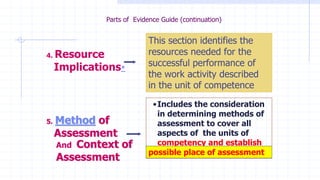
•Includes the consideration
in determining methods of
assessment to cover all
aspects of the units of
competency and establish
consistency in performance
5. Method of
Assessment
And Context of
Assessment
possible place of assessment
This section identifies the
resources needed for the
successful performance of
the work activity described
in the unit of competence
4. Resource
Implications*
Parts of Evidence Guide (continuation)
Definition of Assessment
Assessment -The means of determining if a candidate possesses
the required competencies of an occupational qualification as
stated in the Occupational Standard (OS).
It is a process of collecting evidence/s and making judgment on
whether competence has been achieved or not
Objective of Assessment
to confirm that an individual can perform a work as
expressed in the Occupational Standards (OSs)
What is competence?
It is the possession and application of knowledge, skills & attitude to
perform activities as per the standard
(Not only having but applying is important/Current competence)
In Technical and Vocational Education and Training (TVET),
people are considered to be competent when they are able to
consistently apply their knowledge and skills to the standard of
performance required in the workplace.
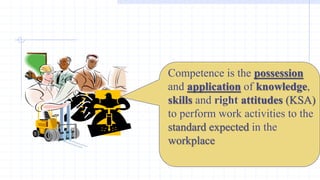
Competence is the possession
and application of knowledge,
skills and right attitudes (KSA)
to perform work activities to the
standard expected in the
workplace
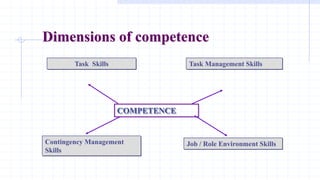
Task Skills
Job / Role Environment Skills
Contingency Management
Skills
Task Management Skills
COMPETENCE
Dimensions of competence
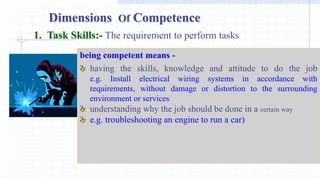
Dimensions Of Competence
1. Task Skills:- The requirement to perform tasks
being competent means -
having the skills, knowledge and attitude to do the job
e.g. Install electrical wiring systems in accordance with
requirements, without damage or distortion to the surrounding
environment or services
understanding why the job should be done in a certain way
e.g. troubleshooting an engine to run a car)
DIMENSIONS OF COMPETENCE
2. Task management skills:- The requirement to manage a
number of different tasks at a Time
being competent means –
being able to do different tasks at the same time
 preparing a salad while watching another dish cook.
3.Contingency management skills: The requirement to
respond to irregularities and breakdowns in routine
being competent means –
dealing with everyday problems as they arise
e.g. what to do when materials are not in stock or
managing an upset client
4. Job/role environment* The requirement to deal with the
responsibilities & expectations of work environment
Being competent means -
understanding workplace policies and
procedures
e.g. reporting to the right person, filling out
paperwork
working with others in the workplace
e.g. cooperating and communicating well with co-
workers, supervisors, managers and customers
Occupational Standard
Cleaning
UNIT OF COMPETENCE CHART
Occupational Standard: Cleaning
Occupational Code: EIS CLE
NTQF Level I
EIS CLE1 03 0112
Carry-out High Level
Cleaning
EIS CLE1 01 0112
Clean and Maintain
Surfaces and Areas
EIS CLE1 12 0112
Apply Quality
Standards
EIS CLE1 07 0112
Manually Sort Waste
EIS CLE1 02 0112
Perform Street
Cleaning
EIS CLE1 06 0112
Identify Wastes and
Hazards
EIS CLE1 04 0112
Comply with Infection
Control Policies and
Procedures
EIS CLE1 05 0112
Respond to Waste
Emergency
EIS CLE1 13 0112
Develop
Understanding of
Entrepreneurship
EIS CLE1 10 0112
Receive and
Respond to
Workplace
Communication
EIS CLE1 11 0112
Work with Others
EIS CLE1 08 0112
Store Waste
EIS CLE1 09 0112
Educate the public
on waste
management issues.
EIS CLE1 14 1012
Apply 5S Procedures
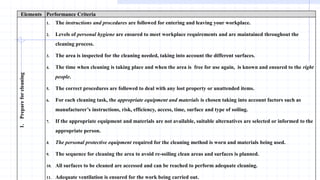
Elements Performance Criteria
1.
Prepare
for
cleaning 1. The instructions and procedures are followed for entering and leaving your workplace.
2. Levels of personal hygiene are ensured to meet workplace requirements and are maintained throughout the
cleaning process.
3. The area is inspected for the cleaning needed, taking into account the different surfaces.
4. The time when cleaning is taking place and when the area is free for use again, is known and ensured to the right
people.
5. The correct procedures are followed to deal with any lost property or unattended items.
6. For each cleaning task, the appropriate equipment and materials is chosen taking into account factors such as
manufacturer’s instructions, risk, efficiency, access, time, surface and type of soiling.
7. If the appropriate equipment and materials are not available, suitable alternatives are selected or informed to the
appropriate person.
8. The personal protective equipment required for the cleaning method is worn and materials being used.
9. The sequence for cleaning the area to avoid re-soiling clean areas and surfaces is planned.
10. All surfaces to be cleaned are accessed and can be reached to perform adequate cleaning.
11. Adequate ventilation is ensured for the work being carried out.
2.
Carry
out
your
cleaning
duties
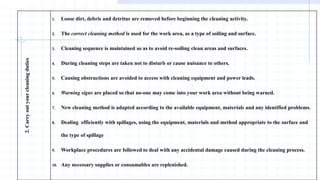
1. Loose dirt, debris and detritus are removed before beginning the cleaning activity.
2. The correct cleaning method is used for the work area, as a type of soiling and surface.
3. Cleaning sequence is maintained so as to avoid re-soiling clean areas and surfaces.
4. During cleaning steps are taken not to disturb or cause nuisance to others.
5. Causing obstructions are avoided to access with cleaning equipment and power leads.
6. Warning signs are placed so that no-one may come into your work area without being warned.
7. New cleaning method is adapted according to the available equipment, materials and any identified problems.
8. Dealing efficiently with spillages, using the equipment, materials and method appropriate to the surface and
the type of spillage
9. Workplace procedures are followed to deal with any accidental damage caused during the cleaning process.
10. Any necessary supplies or consumables are replenished.
3.
Documenting
and
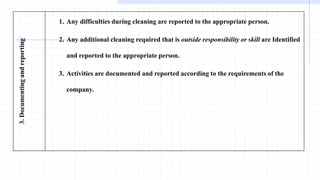
reporting 1. Any difficulties during cleaning are reported to the appropriate person.
2. Any additional cleaning required that is outside responsibility or skill are Identified
and reported to the appropriate person.
3. Activities are documented and reported according to the requirements of the
company.
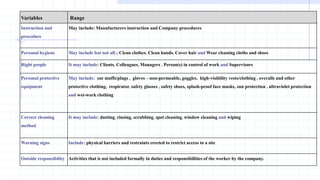
Variables Range
Instruction and
procedure
May include: Manufacturers instruction and Company procedures
Personal hygiene May include but not all:; Clean clothes, Clean hands, Cover hair and Wear cleaning cloths and shoes
Right people It may include: Clients, Colleagues, Managers , Person(s) in control of work and Supervisors
Personal protective
equipment
May include: ear muffs/plugs , gloves – non-permeable, goggles, high-visibility vests/clothing , overalls and other
protective clothing, respirator, safety glasses , safety shoes, splash-proof face masks, sun protection , ultraviolet protection
and wet-work clothing
Correct cleaning
method
It may include: dusting, rinsing, scrubbing, spot cleaning, window cleaning and wiping
Warning signs Include: physical barriers and restraints erected to restrict access to a site
Outside responsibility Activities that is not included formally in duties and responsibilities of the worker by the company.
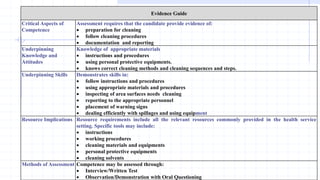
Evidence Guide
Critical Aspects of
Competence
Assessment requires that the candidate provide evidence of:
 preparation for cleaning
 follow cleaning procedures
 documentation and reporting
Underpinning
Knowledge and
Attitudes
Knowledge of appropriate materials
 instructions and procedures
 using personal protective equipments.
 knows correct cleaning methods and cleaning sequences and steps.
Underpinning Skills Demonstrates skills in:
 follow instructions and procedures
 using appropriate materials and procedures
 inspecting of area surfaces needs cleaning
 reporting to the appropriate personnel
 placement of warning signs
 dealing efficiently with spillages and using equipment
Resource Implications Resource requirements include all the relevant resources commonly provided in the health service
setting. Specific tools may include:
 instructions
 working procedures
 cleaning materials and equipments
 personal protective equipments
 cleaning solvents
Methods of Assessment Competence may be assessed through:
 Interview/Written Test
 Observation/Demonstration with Oral Questioning

OS Presentation level -1.pptx

  • 1.
    Federal Democratic Republicof Ethiopia Occupational Standard Cleaning National TVET-Qualification Framework (NTQF) Level -I Presented by: Tamirat Sulamo
  • 2.
    Solid waste Management5 Cleaning 1 Solid Waste Handling 2 Transfer Station Operation & Composting Landfill Operation Solid waste Inspection 4 Level I Level II Level III 3 Level IV Level V Occupational Maps of SW Previous Occupational Names and level
  • 3.
    Understanding OS andits parts • OS is a document defining the competences that a person must possess to be able to perform and be productive in the world of work. (Industry Demand) • It is composed of units of competence that define a particular scope of work resulting in a product, service or decision. • It is developed by industry experts or practitioners.
  • 4.
    Dimensions Of Competence 1.TaskSkills • The requirement to perform tasks* being competent means - having the skills, knowledge and attitudes to do the job (e.g. preparing salad, troubleshooting an engine) understanding why the job should be done in a certain way (e.g. preparing a salad to complement a seafood dish, troubleshooting an engine to run a car)
  • 5.
    DIMENSIONS OF COMPETENCE 2.Task management skills • The requirement to manage a number of different tasks* being competent means – being able to do different tasks at the same time (e.g. preparing a salad while watching another dish cook)
  • 6.
    3.Contingency management skills •The requirement to respond to irregularities and breakdowns in routine* Ethiopian TVET Reform MoE - ECBP being competent means – dealing with everyday problems as they arise (e.g. what to do when materials are not in stock or managing an upset client)
  • 7.
    4. Job/role environment* • The requirement to deal with the responsibilities & expectations of work environment Ethiopian TVET Reform MoE - ECBP Being competent means - understanding workplace policies and procedures (e.g. reporting to the right person, filling out paperwork ) working with others in the workplace (e.g. cooperating and communicating well with co- workers, supervisors, managers and customers)
  • 8.
    Parts of aUnit of Competence Unit Title Unit Descriptor Elements Performance Criteria Range of Variables Evidence Guide (Critical Aspects of Competence, Underpinning Knowledge, Underpinning Skills, Resource Implications, Method of Assessment, context of Assessment)
  • 9.
    UNIT OF COMPETENCECHART Occupational Standard: Cleaning Occupational Code: EIS CLE NTQF Level I EIS CLE1 03 0112 Carry-out High Level Cleaning EIS CLE1 01 0112 Clean and Maintain Surfaces and Areas EIS CLE1 12 0112 Apply Quality Standards EIS CLE1 07 0112 Manually Sort Waste EIS CLE1 02 0112 Perform Street Cleaning EIS CLE1 06 0112 Identify Wastes and Hazards EIS CLE1 04 0112 Comply with Infection Control Policies and Procedures EIS CLE1 05 0112 Respond to Waste Emergency EIS CLE1 13 0112 Develop Understanding of Entrepreneurship EIS CLE1 10 0112 Receive and Respond to Workplace Communication EIS CLE1 11 0112 Work with Others EIS CLE1 08 0112 Store Waste EIS CLE1 09 0112 Educate the public on waste management issues. EIS CLE1 14 1012 Apply 5S Procedures
  • 10.
    • The titleof the competency unit • Refers to the title of the general area of competence which is expressed in outcome terms
  • 11.
    • covers requirements toreview assessment procedures in a specific context • assists in clarifying the unit title and notes any relationship with other industry units
  • 12.
    Basic building blocksof the unit Describe the key purpose of the unit Describe actions or outcomes which are demonstrable and assessable Elements Unit Title: Set up and operate machines Elements: 1. Set Machines 2. Conduct sample run 3. Test machine output 4. Adjust machine settings
  • 13.
    Performance Criteria • evaluativestatements which specify what is to be assessed • specifies the required level of performance • specifies the activities, knowledge, skills and understanding which provide evidence of competent performance • task performed as per prescribed procedure e.g. Machine is set in accordance with product specifications, manufacturer’s instructions and company procedures
  • 14.
    Range of Variables Definesthe boundaries of the standards  Supplies and materials  Tools and equipment  Quality assurance requirements  Occupational health and safety  Personal protective equipment
  • 15.
    Unit Title: Map scaleis determined in accordance with standard specifications and survey regulations Range of Variables:  Map include:  Cadastral map  Progress map  Sketch map  Project control map  Isolated survey map Variable R a n g e
  • 16.
    Evidence Guide relate directlyto: Elements Performance Criteria Range of Variables Guide the Assessor in the collection of evidence
  • 17.
    Parts of EvidenceGuide (continuation) 1. Critical Aspects of Competency •Tells the assessor what evidence is essential for successful performance It identifies the essential: Product evidence (completes work piece/service to specification) Knowledge evidence (things that must be known) Process evidence ( complies with industry practices and procedures)*
  • 18.
    2. Underpinning knowledgeand attitude  Specific knowledge that is essential to the performance of the competency  Evidence of knowledge of legislation, regulations and Codes of Practice  Knowledge beyond the immediate scope of the unit Parts of Evidence Guide (continuation) 3. Underpinning skills Skills needed to achieve the elements and performance criteria set in each unit of competency *
  • 19.
    •Includes the consideration indetermining methods of assessment to cover all aspects of the units of competency and establish consistency in performance 5. Method of Assessment And Context of Assessment possible place of assessment This section identifies the resources needed for the successful performance of the work activity described in the unit of competence 4. Resource Implications* Parts of Evidence Guide (continuation)
  • 20.
    Definition of Assessment Assessment-The means of determining if a candidate possesses the required competencies of an occupational qualification as stated in the Occupational Standard (OS). It is a process of collecting evidence/s and making judgment on whether competence has been achieved or not
  • 21.
    Objective of Assessment toconfirm that an individual can perform a work as expressed in the Occupational Standards (OSs)
  • 22.
    What is competence? Itis the possession and application of knowledge, skills & attitude to perform activities as per the standard (Not only having but applying is important/Current competence) In Technical and Vocational Education and Training (TVET), people are considered to be competent when they are able to consistently apply their knowledge and skills to the standard of performance required in the workplace.
  • 23.
    Competence is thepossession and application of knowledge, skills and right attitudes (KSA) to perform work activities to the standard expected in the workplace
  • 24.
    Task Skills Job /Role Environment Skills Contingency Management Skills Task Management Skills COMPETENCE Dimensions of competence
  • 25.
    Dimensions Of Competence 1.Task Skills:- The requirement to perform tasks being competent means - having the skills, knowledge and attitude to do the job e.g. Install electrical wiring systems in accordance with requirements, without damage or distortion to the surrounding environment or services understanding why the job should be done in a certain way e.g. troubleshooting an engine to run a car)
  • 26.
    DIMENSIONS OF COMPETENCE 2.Task management skills:- The requirement to manage a number of different tasks at a Time being competent means – being able to do different tasks at the same time  preparing a salad while watching another dish cook.
  • 27.
    3.Contingency management skills:The requirement to respond to irregularities and breakdowns in routine being competent means – dealing with everyday problems as they arise e.g. what to do when materials are not in stock or managing an upset client
  • 28.
    4. Job/role environment*The requirement to deal with the responsibilities & expectations of work environment Being competent means - understanding workplace policies and procedures e.g. reporting to the right person, filling out paperwork working with others in the workplace e.g. cooperating and communicating well with co- workers, supervisors, managers and customers
  • 29.
  • 30.
    UNIT OF COMPETENCECHART Occupational Standard: Cleaning Occupational Code: EIS CLE NTQF Level I EIS CLE1 03 0112 Carry-out High Level Cleaning EIS CLE1 01 0112 Clean and Maintain Surfaces and Areas EIS CLE1 12 0112 Apply Quality Standards EIS CLE1 07 0112 Manually Sort Waste EIS CLE1 02 0112 Perform Street Cleaning EIS CLE1 06 0112 Identify Wastes and Hazards EIS CLE1 04 0112 Comply with Infection Control Policies and Procedures EIS CLE1 05 0112 Respond to Waste Emergency EIS CLE1 13 0112 Develop Understanding of Entrepreneurship EIS CLE1 10 0112 Receive and Respond to Workplace Communication EIS CLE1 11 0112 Work with Others EIS CLE1 08 0112 Store Waste EIS CLE1 09 0112 Educate the public on waste management issues. EIS CLE1 14 1012 Apply 5S Procedures
  • 31.
    Elements Performance Criteria 1. Prepare for cleaning1. The instructions and procedures are followed for entering and leaving your workplace. 2. Levels of personal hygiene are ensured to meet workplace requirements and are maintained throughout the cleaning process. 3. The area is inspected for the cleaning needed, taking into account the different surfaces. 4. The time when cleaning is taking place and when the area is free for use again, is known and ensured to the right people. 5. The correct procedures are followed to deal with any lost property or unattended items. 6. For each cleaning task, the appropriate equipment and materials is chosen taking into account factors such as manufacturer’s instructions, risk, efficiency, access, time, surface and type of soiling. 7. If the appropriate equipment and materials are not available, suitable alternatives are selected or informed to the appropriate person. 8. The personal protective equipment required for the cleaning method is worn and materials being used. 9. The sequence for cleaning the area to avoid re-soiling clean areas and surfaces is planned. 10. All surfaces to be cleaned are accessed and can be reached to perform adequate cleaning. 11. Adequate ventilation is ensured for the work being carried out.
  • 32.
    2. Carry out your cleaning duties 1. Loose dirt,debris and detritus are removed before beginning the cleaning activity. 2. The correct cleaning method is used for the work area, as a type of soiling and surface. 3. Cleaning sequence is maintained so as to avoid re-soiling clean areas and surfaces. 4. During cleaning steps are taken not to disturb or cause nuisance to others. 5. Causing obstructions are avoided to access with cleaning equipment and power leads. 6. Warning signs are placed so that no-one may come into your work area without being warned. 7. New cleaning method is adapted according to the available equipment, materials and any identified problems. 8. Dealing efficiently with spillages, using the equipment, materials and method appropriate to the surface and the type of spillage 9. Workplace procedures are followed to deal with any accidental damage caused during the cleaning process. 10. Any necessary supplies or consumables are replenished.
  • 33.
    3. Documenting and reporting 1. Anydifficulties during cleaning are reported to the appropriate person. 2. Any additional cleaning required that is outside responsibility or skill are Identified and reported to the appropriate person. 3. Activities are documented and reported according to the requirements of the company.
  • 34.
    Variables Range Instruction and procedure Mayinclude: Manufacturers instruction and Company procedures Personal hygiene May include but not all:; Clean clothes, Clean hands, Cover hair and Wear cleaning cloths and shoes Right people It may include: Clients, Colleagues, Managers , Person(s) in control of work and Supervisors Personal protective equipment May include: ear muffs/plugs , gloves – non-permeable, goggles, high-visibility vests/clothing , overalls and other protective clothing, respirator, safety glasses , safety shoes, splash-proof face masks, sun protection , ultraviolet protection and wet-work clothing Correct cleaning method It may include: dusting, rinsing, scrubbing, spot cleaning, window cleaning and wiping Warning signs Include: physical barriers and restraints erected to restrict access to a site Outside responsibility Activities that is not included formally in duties and responsibilities of the worker by the company.
  • 35.
    Evidence Guide Critical Aspectsof Competence Assessment requires that the candidate provide evidence of:  preparation for cleaning  follow cleaning procedures  documentation and reporting Underpinning Knowledge and Attitudes Knowledge of appropriate materials  instructions and procedures  using personal protective equipments.  knows correct cleaning methods and cleaning sequences and steps. Underpinning Skills Demonstrates skills in:  follow instructions and procedures  using appropriate materials and procedures  inspecting of area surfaces needs cleaning  reporting to the appropriate personnel  placement of warning signs  dealing efficiently with spillages and using equipment Resource Implications Resource requirements include all the relevant resources commonly provided in the health service setting. Specific tools may include:  instructions  working procedures  cleaning materials and equipments  personal protective equipments  cleaning solvents Methods of Assessment Competence may be assessed through:  Interview/Written Test  Observation/Demonstration with Oral Questioning