ORGANIZING NURSING SERVICES AND PATIENT
CARE
MANSI SAHU
M.SC (N) 2ND
YEAR
P.G. COLLEGE OF NURSING
*
INTRODUCTION
A hospital may be soundly organized, beautifully situated and well equipped,
but if the nursing care is not of high quality the hospital will fail in its
responsibility”. Organizing nursing services and patient care involves a
systemic approach for critical aspect of health care management that ensures
high quality and efficient delivery of care.
*
ORGANIZING
NURSING SERVICE
*
MEANING
• NURSNG SERVICE
It is the part of the health organization that meets the nursing needs of patients
and the community. Nurses work with the other disciplines like dietetics, social
services and pharmacy to provide comprehensive patient care in the hospital.
• NURSING SERVICE ADMINISTRATION
It is the organized management of nursing services to achieve the excellence in
care. It involves using personnel and material resources effectively so that
patient health is maintained, improved and supported.
*
DEFINITION:
Nursing services is the part of the total health organization which aims to
satisfy major objective of the nursing services is to provide prevention of
disease and promotion of health.
(According to WHO expert committee)
5
NURSINGSERVICE
*
1. Establish goals and objectives
2. Plan and allocate resources
- Human resources
- Financial resources
- Physical resources
3. Develop organizational structure
4. Staffing and scheduling
5. Define roles and responsibilities
6. Effective communication.
7. Policy and procedure development
8. Resource allocation
9. Quality Assurance and monitoring
10. Foster a supportive work environment.
11. Emergency preparedness
12. Patient- centred planning
6
OBJECTIVES
Patient Care
Education
Administration
and Organization
Research
Performance
appraisal
*
1. Build effective human relationships at all levels to accomplish responsibilities with a flexible
organizational design.
2. Ensure adequate staffing patterns for efficient nursing services.
3. Develop and maintain clear communication systems for policies, procedures, and knowledge
updates.
4. Implement evaluation and monitoring systems for proper utilization of personnel.
5. Define or revise job descriptions for all nursing personnel and units.
6. Share nursing information with other hospital disciplines. 7
PRINCIPLES
*
7. Assist hospital authorities in budget preparation.
8. Participate in interdepartmental and multidisciplinary programs to enhance hospital services.
9. Organize orientation and training programs for new employees in collaboration with authorities and other
disciplines.
10. Create a supportive environment for student learning.
11. Promote leadership programs to protect and manage nursing resources effectively.
12. Participate in research and data application activities.
13. Engage in community health programs associated with the hospital.
8
CONT…
*
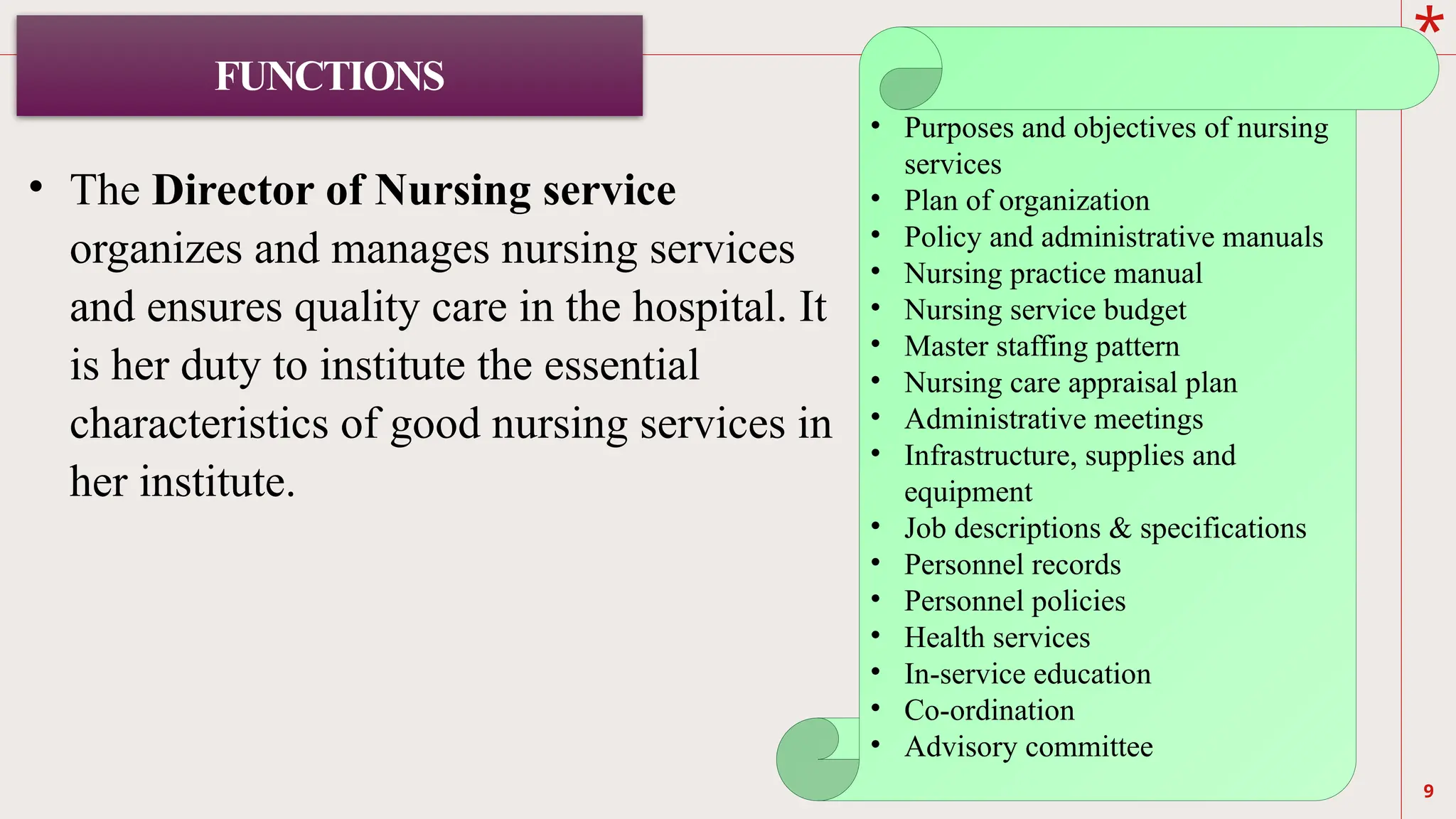
• The Director of Nursing service
organizes and manages nursing services
and ensures quality care in the hospital. It
is her duty to institute the essential
characteristics of good nursing services in
her institute.
9
FUNCTIONS
• Purposes and objectives of nursing
services
• Plan of organization
• Policy and administrative manuals
• Nursing practice manual
• Nursing service budget
• Master staffing pattern
• Nursing care appraisal plan
• Administrative meetings
• Infrastructure, supplies and
equipment
• Job descriptions & specifications
• Personnel records
• Personnel policies
• Health services
• In-service education
• Co-ordination
• Advisory committee
ORGANIZING
NURSING SERVICE
AT
VARIOUS LEVELS
ORGANIZATIONALSETUP
OF
NURSING SERVICE
AT
CENTRALLEVEL
KEYS
ADNS – Assistant Director Nursing
Services
DADNS – Deputy Assistant Director
Nursing Services
PHN – Primary Health Nurse
LHV – Lady Health Visitor
ANM – Auxiliary Nurse Midwives
ORGANIZATIONALSETUP
OF
NURSING SERVICE
AT
STATE LEVEL
KEYS
DMO – Director of Medical
Office
DNO – Director of Nursing
Office
DHO – Director of Health Office
ADNO – Assistant District
Nursing Officer
PHN – Primary Health Nurse
*
ROLE AND FUNCTION OF NURSE ADMINISTRATOR
1. Administration
• Organizes, directs, supervises nursing services day and night.
• Coordinates staff assignments and delegates responsibilities.
• Formulates policies, standing orders, and evaluates staff performance.
2. Discipline
• Maintains high standards of discipline and order in wards/departments.
• Conducts regular and unscheduled rounds.
• Reports neglect or misconduct (insubordination either by staff, patients, visitors or any un-
towards incident) to medical superintendent.
3. Public Relations
• Maintains good relations with hospital departments, community agencies, patients and families.
15
*
CONT…
4. Office Routine
• Reviews and submits reports and returns according to rules related to
nursing services.
5. Confidential Reports and Budgets
• Prepare confidential reports of nursing staff on time.
• Manages the nursing budget.
6. Education
• Organizes in-service training and update courses based on the needs for all
categories of health personnel and keeps the records of such trainings.
• Encourages participation in continuing education programme. 16
*
CONT…
7. Welfare
• Responsible for staff health and welfare.
• Ensures annual and periodical health checks and maintains health records.
8. Conferences
• Responsible for conducting staff meetings every three months.
• Discusses nursing care problems, policies, working hours and conditions etc.
9. Supervision
• Supervises nursing care and nursing activities in the nursing unit.
• Supervises work of paramedical staff.
10. Records and Reports
• Maintains duty rosters, leave plan, staff biodata, conferences file and training records. 17
*
PROBLEMS AND CHALLENGES FACED BY THE NURSE
ADMINISTRATOR
 Lack of adequate training.
 Problem of personnel management.
 Inadequate number of nursing staff.
 Shortage of trained manpower.
 Lack of motivation.
 No involvement in planning.
 No career mobility.
 Poor role model.
 No research scope.
 Professional risk/hazards
 No autonomy in nursing activities.
18
*
DAYTODAYPROBLEMINNURSINGSERVICES
 Shortage of nurses.
 Lack of motivation.
 Negative attitude.
 Lack of training.
 Lack of team approach.
 Inactive participation of program
 Lack of interpersonal relationship
 Less involvement in patients care by the
nursing supervisors.
 Lack of supervision.
19
*
ORGANIZING
PATIENTCARE
*
INTRODUCTION
The overall goal of nursing is to meet the patient nursing needs with the
available resources for providing smooth day and night 24 hrs quality care to
patients and to honour his rights.
To ensure that nursing care is provided to patients, the work must be organized.
A Nursing Care Delivery Model organizes patient needs and staff skills.
21
*
PATIENTCARE
DEFINITION:
The services rendered by members of the health professional and non-
professionals under their supervision for the benefit of the patient.
OR
The prevention, treatment and management of illness and the preservation of
mental and physical well-being through the services offered by the medical and
allied health professions.
22
*
PATIENTCLASSIFICATIONSYSTEM(PCS)
• The patient classification system (PCS) is a method used to measure how much and
what kind of nursing care patients need. It helps hospitals and nursing homes
determine the right number of nurses required to provide proper care. The main
purpose of PCS is to adjust quickly to the changing care needs of patients.
• Differentiate intensity of care required among patient groups.
• Matches nursing resources with patient needs.
• Relates to time and effort spent on care.
• Economical, convenient and easy to use.
• Clear, standardized and open to audit.
• Separates duties of registered nurses from other staff. 23
CHARACTERISTICS
*
PURPOSES
• The system uses time as a unit to decide how many and what type of staff are needed.
• Helps in planning the nursing budget and costs.
• Tracks changes in patient care needs so nurse managers can adjust services.
• Assists in calculating productivity.
• Helps ensure quality of care, as staffing can be matched with standard time requirements
(though managers may reduce time to cut costs) which can reduce the quality of care.
1st
- Method for grouping patients into categories.
2nd
- Set of guidelines explain how patients will be classified.
3rd
– The average time needed to care for each category of patient.
4th
– A method to calculate the total nursing care hours required.
24
COMPONENTS
*
S. No. Area of care Category I Category II Category III Category IV
1. Eating Feeds self Need some help in
preparing
Cannot feed self but is
able to chew and
swallowing
Cannot feed self any
may have difficulty
swallowing
2. Grooming Almost entirely
sells sufficient
Need some help in
bathing, oral hygiene
Unable to do much for
self
Completely
dependent
3. Excretion Up and to
bathroom alone
Need some help in
getting up to
bathroom / urinal
In bed, needs bedpan /
urinal placed;
Completely
dependent
4. Comfort Self sufficient Needs some help
with adjusting
position / bed
Cannot turn without
help, get drink, adjust
position of extremities
Completely
dependent
*
S. No. Area of care Category I Category II Category III Category IV
5. General health Good Mild symptoms Acute symptoms Critically ill
6. Treatment Simple –
supervised,
simple
dressing.
Any treatment more than
once per shift, foley
catheter care, I&O.
Any treatment more
than twice / shift
Any elaborate/ delicate
procedure requiring two
nurses, vital signs more
often than every two
hours.
7. Health
Education and
Teaching
Routine follow
up teaching.
Initial teaching of care of
ostomies; new diabetics;
patient with mild adverse
reaction to their illness.
More intensive
items; teaching of
apprehensive /
mildly resistive
patients.
Teaching of resistive
patients.
*
MODESOFORGANIZINGPATIENTCARE/METHODSOFPATIENT
ASSIGNMENT
1. TRADITIONAL METHOD
A. Case method or Total patient
care
B. Functional nursing
C. Team nursing
D. Modular or district nursing
E. Progressive patient care
F. Primary care nursing
2. ADVANCE METHOD
A. Case management
*
1.TRADITIONALMETHOD
 In this method, nurses assume total responsibility for meeting all the needs of assigned patients during their
time on duty. It involves assignment of one or more clients to a nurse for a specific period of time such as
shift.
 The patient has a different nurse each shift and no guarantee of having the same nurses the next day. Nurse's
responsibility includes complete care including treatments, medication and administration and planning of
nursing care.
Merits
• The nurse can attend to the total needs of clients due to the adequate time.
• Good client-nurse interaction and rapport can be developed.
• Nurse's accountability for their function is built-it.
Demerits
• The greater disadvantage occurs, when the nurse is inadequately trained or prepared to provide total care to
the patient.
• Nurse may feel overworked if most of her assigned patients are sick.
A. CASE METHOD / TOTAL PATIENT CARE
*
 This system started in the 1930s in the U.S. during World War II due to a severe nurse shortage. LPNs and nurse aides
were hired to make up for fewer RNs, who demanded higher pay. This system is task-focused.
 In this model, the tasks are divided with one nurse assuming responsibility for specific tasks.
 Example, one nurse does the hygiene and dressing changes, whereas another nurse assumes responsibility for medication
administration. Typically, a lead nurse responsible for a specific shift assigns available nursing staff members according
to their qualifications, their particular abilities, and tasks to be completed.
Merits
• Time saving.
• The best utilization can be made of a person's experience and
desires.
• Patient care can be delivered to a large number of patients by
mixing staff with a large number of unlicensed assistive personnel.
Demerits
• Client care may become impersonal and fragmented.
• The staff members are accountable for the task.
• Client may feel insecure and get confused as so many nurses
attend to them.
B. FUNCTIONAL NURSING
*
 Developed in 1950s because the functional method received criticism, a new system of nursing was
devised to improve patient satisfaction.
 Based on philosophy in which groups of professional and non-professional personnel work together to
identify, plan, implement and evaluate comprehensive client-centred care.
 In team nursing, an RN leads a team of RNs, LPNs/LVNs and nurse assistants or technicians. Together
they provide direct care to group of patients under the RN’s guidance. A typical team has 4 to 6 members
caring for 15-25 patients.
 A team conference is held at the start and end of each shift so members can share information and the
team leader can update or adjust nursing care plan as needed.
Merits
• Each team member is able to contribute his or her own special expertise or skills in caring for the patient.
• Division of labour allows members the opportunity to develop leadership skills.
• Barriers between professional and non-professional workers can be minimized, the group efforts prevail.
C. TEAM NURSING
*
Demerits
• Establishing a team concept takes time, effort and
constancy of personnel.
• It is expensive because of the increased number of
personnel needed.
• Nurses are not always assigned to the same patients
each day, which causes lack of continuity of care.
CONT…
*
 Modular nursing is a modification of team nursing, based on patient's geographic location.
 Concept – small team of 2-3 staff care for a smaller group of patients.
 The patient unit is divided into modules/districts and same team consistently cares for patients in that
area. Each location / module has an RN as team leader, assisted by LVN / LPN or UAP.
 The team leader is responsible for all patient care, providing leadership and creating a cooperative work
environment.
Merits
• The client is able to identify personnel who are responsible for his care.
• Continuity of care is improved when staff members are consistently assigned to the same module.
Demerits
• Costs may be increased to stock each module with the necessary patient care supplies.
• The team leader must have complex skills and knowledge.
D. MODULAR NURSING
*
 It is a method in which hospital area provides different levels of care based on patient’s
need. Focuses on better use of facilities, services and staff for better patient care.
 Here the patients are evaluated for the level (intensity) of care required. As the patient
improves, they are shifted to units matching their care needs.
 Involves collaboration among healthcare professionals for comprehensive and
coordinated care.
Principal elements:
i. Intensive care or critical care - Patients who require close monitoring and intensive
care round the clock.
ii. Intermediate care - Critically ill patients are shifted to intermediate care units when
their vital signs and general condition stabilizes.
iii. Convalescent and Self-Care - Although rehabilitation programme begins from acute
care setting, yet patients in these areas participate actively to achieve complete or partial
self-care status.
E. PROGRESSIVE PATIENT CARE
*
iv. Long-term care - Chronically ill, disabled and helpless patients are cared for in these units.
v. Home care - Some hospital have home care services. A hospital-based home care package
provides staff, equipment and supplies for care of patient at home.
vi. Ambulatory care - Ambulatory patients visit hospital for follow up, diagnostic, rehabilitative
and preventive services. These areas are opd, clinics, diagnostic centres, day care centres etc.
Merits
• Efficient use is made of personnel and equipment.
• Clients are in the best place to receive the care they require.
• Use of nursing skills and expertise are maximized.
• Clients are moved towards self-care; independence is fostered where indicated.
Demerits
• There may be discomfort to clients who are moved often.
• Continuity care is difficult.
• Long term nurse-client relationships are difficult to arrange.
CONT…
*
• This model, developed in the 1960s and popularized in the 1970s-80s, aimed to place RNs at the bedside and
improve the nurse-patient relationships.
• It is a system in which one nurse takes responsibility for all the needs of a patient from admission to
discharge. The primary nurse coordinates and implements the nursing care plan during her duty shift
(usually 8 or 12 hours) and remains accountable for the patient’s care 24 hours a day. If the primary nurse is
not available, an associate nurse provides care based on the original plan made by the primary nurse.
• In acute care, the primary nurse may be responsible for only one patient, while in intermediate care she may
care for three or more patients. This model is also applied in hospice and home care nursing.
Merits
• Primary Nursing Care System is good for long-term care (rehabilitation, geriatric, psychiatric, burn care
settings) where patients and family members can establish good rapport with the primary nurse.
• Primary nurses are in a position to care for the entire person.
• Promotes RN responsibility, authority, autonomy, accountability and courage.
F. PRIMARY CARE NURSING
*
Demerits
 More nurses are required for this method of care delivery and it is more expensive than other methods.
 Level of expertise and commitment may vary from nurse to nurse which may affect quality of patient
care.
 Associate nurse may find it difficult to follow the plans made by another if there is disagreement or when
patient's condition changes.
 Difficult hiring all RN staff.
E. PROGRESSIVE PATIENT CARE
*
2.ADVANCEMETHOD
 A case manager (RN or social worker with managerial skills) coordinates a patient’s care
from diagnosis through hospitalization, rehabilitation, and home care.
 Case management involves - critical paths, variation analysis; inter shift reports, case
consultations, team meetings, and quality assurance.
 Health care team meetings use an interdisciplinary approach. The case manager identifies up
to three priority goals and selects which professionals (physician, therapists, social workers,
etc.) should attend.
 The case manager arranges the meeting, states goals, leads discussion, documents plans, sets
deadlines, and evaluates differences between expected and actual outcomes for quality
assurance.
Responsibilities
 Assess clients, homes, and communities
 Coordinate and plan client care
A. CASE MANAGEMENT
*
 Collaborate with other health professionals
 Monitor client progress and outcomes
 Advocate for clients across services
 Act as liaison with third-party payers for care planning
Merits
• Improves outcomes and reduces stay.
• Efficient use of services
• Care for complex problems
• Patient, family, team involvement
Demerits
• Financial barrier and lack of administrative support
• Expensive
• Supports cost-effective care
• Needs expert knowledge and decision-making skills.
CONT…
*
• Many factors
influence determine
the number of nurses
required in a ward to
provide high-quality
patient care.
FACTORS INFLUENCING QUALITY PATIENT CARE
FACTORS
Total number of
patients
Severity of patient’s
illness (physical
dependency)
Type of service
(medical, surgical,
maternity etc.)
Patient’s overall
needs
Methods of nursing
care (individual,
team, functional)
Availability and
experience of
nurses and support
staff
Equipment,
supplies and
physical facilities
Patient turnover and
service acuity
Standards of nursing
care
*

Organizing nursing services and patient care updated.pptx

  • 1.
    ORGANIZING NURSING SERVICESAND PATIENT CARE MANSI SAHU M.SC (N) 2ND YEAR P.G. COLLEGE OF NURSING
  • 2.
    * INTRODUCTION A hospital maybe soundly organized, beautifully situated and well equipped, but if the nursing care is not of high quality the hospital will fail in its responsibility”. Organizing nursing services and patient care involves a systemic approach for critical aspect of health care management that ensures high quality and efficient delivery of care.
  • 3.
  • 4.
    * MEANING • NURSNG SERVICE Itis the part of the health organization that meets the nursing needs of patients and the community. Nurses work with the other disciplines like dietetics, social services and pharmacy to provide comprehensive patient care in the hospital. • NURSING SERVICE ADMINISTRATION It is the organized management of nursing services to achieve the excellence in care. It involves using personnel and material resources effectively so that patient health is maintained, improved and supported.
  • 5.
    * DEFINITION: Nursing services isthe part of the total health organization which aims to satisfy major objective of the nursing services is to provide prevention of disease and promotion of health. (According to WHO expert committee) 5 NURSINGSERVICE
  • 6.
    * 1. Establish goalsand objectives 2. Plan and allocate resources - Human resources - Financial resources - Physical resources 3. Develop organizational structure 4. Staffing and scheduling 5. Define roles and responsibilities 6. Effective communication. 7. Policy and procedure development 8. Resource allocation 9. Quality Assurance and monitoring 10. Foster a supportive work environment. 11. Emergency preparedness 12. Patient- centred planning 6 OBJECTIVES Patient Care Education Administration and Organization Research Performance appraisal
  • 7.
    * 1. Build effectivehuman relationships at all levels to accomplish responsibilities with a flexible organizational design. 2. Ensure adequate staffing patterns for efficient nursing services. 3. Develop and maintain clear communication systems for policies, procedures, and knowledge updates. 4. Implement evaluation and monitoring systems for proper utilization of personnel. 5. Define or revise job descriptions for all nursing personnel and units. 6. Share nursing information with other hospital disciplines. 7 PRINCIPLES
  • 8.
    * 7. Assist hospitalauthorities in budget preparation. 8. Participate in interdepartmental and multidisciplinary programs to enhance hospital services. 9. Organize orientation and training programs for new employees in collaboration with authorities and other disciplines. 10. Create a supportive environment for student learning. 11. Promote leadership programs to protect and manage nursing resources effectively. 12. Participate in research and data application activities. 13. Engage in community health programs associated with the hospital. 8 CONT…
  • 9.
    * • The Directorof Nursing service organizes and manages nursing services and ensures quality care in the hospital. It is her duty to institute the essential characteristics of good nursing services in her institute. 9 FUNCTIONS • Purposes and objectives of nursing services • Plan of organization • Policy and administrative manuals • Nursing practice manual • Nursing service budget • Master staffing pattern • Nursing care appraisal plan • Administrative meetings • Infrastructure, supplies and equipment • Job descriptions & specifications • Personnel records • Personnel policies • Health services • In-service education • Co-ordination • Advisory committee
  • 10.
  • 11.
  • 12.
    KEYS ADNS – AssistantDirector Nursing Services DADNS – Deputy Assistant Director Nursing Services PHN – Primary Health Nurse LHV – Lady Health Visitor ANM – Auxiliary Nurse Midwives
  • 13.
  • 14.
    KEYS DMO – Directorof Medical Office DNO – Director of Nursing Office DHO – Director of Health Office ADNO – Assistant District Nursing Officer PHN – Primary Health Nurse
  • 15.
    * ROLE AND FUNCTIONOF NURSE ADMINISTRATOR 1. Administration • Organizes, directs, supervises nursing services day and night. • Coordinates staff assignments and delegates responsibilities. • Formulates policies, standing orders, and evaluates staff performance. 2. Discipline • Maintains high standards of discipline and order in wards/departments. • Conducts regular and unscheduled rounds. • Reports neglect or misconduct (insubordination either by staff, patients, visitors or any un- towards incident) to medical superintendent. 3. Public Relations • Maintains good relations with hospital departments, community agencies, patients and families. 15
  • 16.
    * CONT… 4. Office Routine •Reviews and submits reports and returns according to rules related to nursing services. 5. Confidential Reports and Budgets • Prepare confidential reports of nursing staff on time. • Manages the nursing budget. 6. Education • Organizes in-service training and update courses based on the needs for all categories of health personnel and keeps the records of such trainings. • Encourages participation in continuing education programme. 16
  • 17.
    * CONT… 7. Welfare • Responsiblefor staff health and welfare. • Ensures annual and periodical health checks and maintains health records. 8. Conferences • Responsible for conducting staff meetings every three months. • Discusses nursing care problems, policies, working hours and conditions etc. 9. Supervision • Supervises nursing care and nursing activities in the nursing unit. • Supervises work of paramedical staff. 10. Records and Reports • Maintains duty rosters, leave plan, staff biodata, conferences file and training records. 17
  • 18.
    * PROBLEMS AND CHALLENGESFACED BY THE NURSE ADMINISTRATOR  Lack of adequate training.  Problem of personnel management.  Inadequate number of nursing staff.  Shortage of trained manpower.  Lack of motivation.  No involvement in planning.  No career mobility.  Poor role model.  No research scope.  Professional risk/hazards  No autonomy in nursing activities. 18
  • 19.
    * DAYTODAYPROBLEMINNURSINGSERVICES  Shortage ofnurses.  Lack of motivation.  Negative attitude.  Lack of training.  Lack of team approach.  Inactive participation of program  Lack of interpersonal relationship  Less involvement in patients care by the nursing supervisors.  Lack of supervision. 19
  • 20.
  • 21.
    * INTRODUCTION The overall goalof nursing is to meet the patient nursing needs with the available resources for providing smooth day and night 24 hrs quality care to patients and to honour his rights. To ensure that nursing care is provided to patients, the work must be organized. A Nursing Care Delivery Model organizes patient needs and staff skills. 21
  • 22.
    * PATIENTCARE DEFINITION: The services renderedby members of the health professional and non- professionals under their supervision for the benefit of the patient. OR The prevention, treatment and management of illness and the preservation of mental and physical well-being through the services offered by the medical and allied health professions. 22
  • 23.
    * PATIENTCLASSIFICATIONSYSTEM(PCS) • The patientclassification system (PCS) is a method used to measure how much and what kind of nursing care patients need. It helps hospitals and nursing homes determine the right number of nurses required to provide proper care. The main purpose of PCS is to adjust quickly to the changing care needs of patients. • Differentiate intensity of care required among patient groups. • Matches nursing resources with patient needs. • Relates to time and effort spent on care. • Economical, convenient and easy to use. • Clear, standardized and open to audit. • Separates duties of registered nurses from other staff. 23 CHARACTERISTICS
  • 24.
    * PURPOSES • The systemuses time as a unit to decide how many and what type of staff are needed. • Helps in planning the nursing budget and costs. • Tracks changes in patient care needs so nurse managers can adjust services. • Assists in calculating productivity. • Helps ensure quality of care, as staffing can be matched with standard time requirements (though managers may reduce time to cut costs) which can reduce the quality of care. 1st - Method for grouping patients into categories. 2nd - Set of guidelines explain how patients will be classified. 3rd – The average time needed to care for each category of patient. 4th – A method to calculate the total nursing care hours required. 24 COMPONENTS
  • 25.
    * S. No. Areaof care Category I Category II Category III Category IV 1. Eating Feeds self Need some help in preparing Cannot feed self but is able to chew and swallowing Cannot feed self any may have difficulty swallowing 2. Grooming Almost entirely sells sufficient Need some help in bathing, oral hygiene Unable to do much for self Completely dependent 3. Excretion Up and to bathroom alone Need some help in getting up to bathroom / urinal In bed, needs bedpan / urinal placed; Completely dependent 4. Comfort Self sufficient Needs some help with adjusting position / bed Cannot turn without help, get drink, adjust position of extremities Completely dependent
  • 26.
    * S. No. Areaof care Category I Category II Category III Category IV 5. General health Good Mild symptoms Acute symptoms Critically ill 6. Treatment Simple – supervised, simple dressing. Any treatment more than once per shift, foley catheter care, I&O. Any treatment more than twice / shift Any elaborate/ delicate procedure requiring two nurses, vital signs more often than every two hours. 7. Health Education and Teaching Routine follow up teaching. Initial teaching of care of ostomies; new diabetics; patient with mild adverse reaction to their illness. More intensive items; teaching of apprehensive / mildly resistive patients. Teaching of resistive patients.
  • 27.
    * MODESOFORGANIZINGPATIENTCARE/METHODSOFPATIENT ASSIGNMENT 1. TRADITIONAL METHOD A.Case method or Total patient care B. Functional nursing C. Team nursing D. Modular or district nursing E. Progressive patient care F. Primary care nursing 2. ADVANCE METHOD A. Case management
  • 28.
    * 1.TRADITIONALMETHOD  In thismethod, nurses assume total responsibility for meeting all the needs of assigned patients during their time on duty. It involves assignment of one or more clients to a nurse for a specific period of time such as shift.  The patient has a different nurse each shift and no guarantee of having the same nurses the next day. Nurse's responsibility includes complete care including treatments, medication and administration and planning of nursing care. Merits • The nurse can attend to the total needs of clients due to the adequate time. • Good client-nurse interaction and rapport can be developed. • Nurse's accountability for their function is built-it. Demerits • The greater disadvantage occurs, when the nurse is inadequately trained or prepared to provide total care to the patient. • Nurse may feel overworked if most of her assigned patients are sick. A. CASE METHOD / TOTAL PATIENT CARE
  • 29.
    *  This systemstarted in the 1930s in the U.S. during World War II due to a severe nurse shortage. LPNs and nurse aides were hired to make up for fewer RNs, who demanded higher pay. This system is task-focused.  In this model, the tasks are divided with one nurse assuming responsibility for specific tasks.  Example, one nurse does the hygiene and dressing changes, whereas another nurse assumes responsibility for medication administration. Typically, a lead nurse responsible for a specific shift assigns available nursing staff members according to their qualifications, their particular abilities, and tasks to be completed. Merits • Time saving. • The best utilization can be made of a person's experience and desires. • Patient care can be delivered to a large number of patients by mixing staff with a large number of unlicensed assistive personnel. Demerits • Client care may become impersonal and fragmented. • The staff members are accountable for the task. • Client may feel insecure and get confused as so many nurses attend to them. B. FUNCTIONAL NURSING
  • 30.
    *  Developed in1950s because the functional method received criticism, a new system of nursing was devised to improve patient satisfaction.  Based on philosophy in which groups of professional and non-professional personnel work together to identify, plan, implement and evaluate comprehensive client-centred care.  In team nursing, an RN leads a team of RNs, LPNs/LVNs and nurse assistants or technicians. Together they provide direct care to group of patients under the RN’s guidance. A typical team has 4 to 6 members caring for 15-25 patients.  A team conference is held at the start and end of each shift so members can share information and the team leader can update or adjust nursing care plan as needed. Merits • Each team member is able to contribute his or her own special expertise or skills in caring for the patient. • Division of labour allows members the opportunity to develop leadership skills. • Barriers between professional and non-professional workers can be minimized, the group efforts prevail. C. TEAM NURSING
  • 31.
    * Demerits • Establishing ateam concept takes time, effort and constancy of personnel. • It is expensive because of the increased number of personnel needed. • Nurses are not always assigned to the same patients each day, which causes lack of continuity of care. CONT…
  • 32.
    *  Modular nursingis a modification of team nursing, based on patient's geographic location.  Concept – small team of 2-3 staff care for a smaller group of patients.  The patient unit is divided into modules/districts and same team consistently cares for patients in that area. Each location / module has an RN as team leader, assisted by LVN / LPN or UAP.  The team leader is responsible for all patient care, providing leadership and creating a cooperative work environment. Merits • The client is able to identify personnel who are responsible for his care. • Continuity of care is improved when staff members are consistently assigned to the same module. Demerits • Costs may be increased to stock each module with the necessary patient care supplies. • The team leader must have complex skills and knowledge. D. MODULAR NURSING
  • 33.
    *  It isa method in which hospital area provides different levels of care based on patient’s need. Focuses on better use of facilities, services and staff for better patient care.  Here the patients are evaluated for the level (intensity) of care required. As the patient improves, they are shifted to units matching their care needs.  Involves collaboration among healthcare professionals for comprehensive and coordinated care. Principal elements: i. Intensive care or critical care - Patients who require close monitoring and intensive care round the clock. ii. Intermediate care - Critically ill patients are shifted to intermediate care units when their vital signs and general condition stabilizes. iii. Convalescent and Self-Care - Although rehabilitation programme begins from acute care setting, yet patients in these areas participate actively to achieve complete or partial self-care status. E. PROGRESSIVE PATIENT CARE
  • 34.
    * iv. Long-term care- Chronically ill, disabled and helpless patients are cared for in these units. v. Home care - Some hospital have home care services. A hospital-based home care package provides staff, equipment and supplies for care of patient at home. vi. Ambulatory care - Ambulatory patients visit hospital for follow up, diagnostic, rehabilitative and preventive services. These areas are opd, clinics, diagnostic centres, day care centres etc. Merits • Efficient use is made of personnel and equipment. • Clients are in the best place to receive the care they require. • Use of nursing skills and expertise are maximized. • Clients are moved towards self-care; independence is fostered where indicated. Demerits • There may be discomfort to clients who are moved often. • Continuity care is difficult. • Long term nurse-client relationships are difficult to arrange. CONT…
  • 35.
    * • This model,developed in the 1960s and popularized in the 1970s-80s, aimed to place RNs at the bedside and improve the nurse-patient relationships. • It is a system in which one nurse takes responsibility for all the needs of a patient from admission to discharge. The primary nurse coordinates and implements the nursing care plan during her duty shift (usually 8 or 12 hours) and remains accountable for the patient’s care 24 hours a day. If the primary nurse is not available, an associate nurse provides care based on the original plan made by the primary nurse. • In acute care, the primary nurse may be responsible for only one patient, while in intermediate care she may care for three or more patients. This model is also applied in hospice and home care nursing. Merits • Primary Nursing Care System is good for long-term care (rehabilitation, geriatric, psychiatric, burn care settings) where patients and family members can establish good rapport with the primary nurse. • Primary nurses are in a position to care for the entire person. • Promotes RN responsibility, authority, autonomy, accountability and courage. F. PRIMARY CARE NURSING
  • 36.
    * Demerits  More nursesare required for this method of care delivery and it is more expensive than other methods.  Level of expertise and commitment may vary from nurse to nurse which may affect quality of patient care.  Associate nurse may find it difficult to follow the plans made by another if there is disagreement or when patient's condition changes.  Difficult hiring all RN staff. E. PROGRESSIVE PATIENT CARE
  • 37.
    * 2.ADVANCEMETHOD  A casemanager (RN or social worker with managerial skills) coordinates a patient’s care from diagnosis through hospitalization, rehabilitation, and home care.  Case management involves - critical paths, variation analysis; inter shift reports, case consultations, team meetings, and quality assurance.  Health care team meetings use an interdisciplinary approach. The case manager identifies up to three priority goals and selects which professionals (physician, therapists, social workers, etc.) should attend.  The case manager arranges the meeting, states goals, leads discussion, documents plans, sets deadlines, and evaluates differences between expected and actual outcomes for quality assurance. Responsibilities  Assess clients, homes, and communities  Coordinate and plan client care A. CASE MANAGEMENT
  • 38.
    *  Collaborate withother health professionals  Monitor client progress and outcomes  Advocate for clients across services  Act as liaison with third-party payers for care planning Merits • Improves outcomes and reduces stay. • Efficient use of services • Care for complex problems • Patient, family, team involvement Demerits • Financial barrier and lack of administrative support • Expensive • Supports cost-effective care • Needs expert knowledge and decision-making skills. CONT…
  • 39.
    * • Many factors influencedetermine the number of nurses required in a ward to provide high-quality patient care. FACTORS INFLUENCING QUALITY PATIENT CARE FACTORS Total number of patients Severity of patient’s illness (physical dependency) Type of service (medical, surgical, maternity etc.) Patient’s overall needs Methods of nursing care (individual, team, functional) Availability and experience of nurses and support staff Equipment, supplies and physical facilities Patient turnover and service acuity Standards of nursing care
  • 40.