Urinary catheterization
oCatheterization ofthe urinary bladder is the insertion of a
hollow tube through the urethra into the bladder for
removing urine.
oIt is an aseptic procedure for which sterile equipment is
required.
oIs a procedure that involves putting a catheter in the
urethra up into the bladder to drain out the urine.
3.
Urinary Catheter
A urinarycatheter is a hollow, partially flexible
tube that collects urine from the bladder and leads
to a drainage bag.
They can be made of rubber, plastic (PVC) &
silicone
Catheters may be necessary in cases when the
patients can’t empty their bladder.
4.
Purposes of UrinaryCatheterization
• Relieve urinary retention
• Measure residual urine
• Empty the bladder before, during, or after surgery
• Allows accurate measurement of urine output
5.
Indication
Perioperative use inselected surgeries
Acute urinary retention or obstruction
comfort care/palliative care
Accurate measurement of urinary output in
critically ill patients
Required strict immobilization for trauma or
surgery
Assistance in healing of severe perineal and
sacral wounds in incontinent patients
6.
Urinary Catheter Sizes
TheFrench scale (Fr.) is used to denote the size of
catheters.
Each unit is roughly equivalent to 0.33 mm in
diameter (that is, 18 Fr. indicates a diameter of 6 mm).
The smaller the number, the smaller the catheter.
7.
Types of catheters
SIMPLERUBBER CATHETER
This catheter is made of India rubber
The tip is smooth and rounded and
there is an opening
at the side near the tip
8.
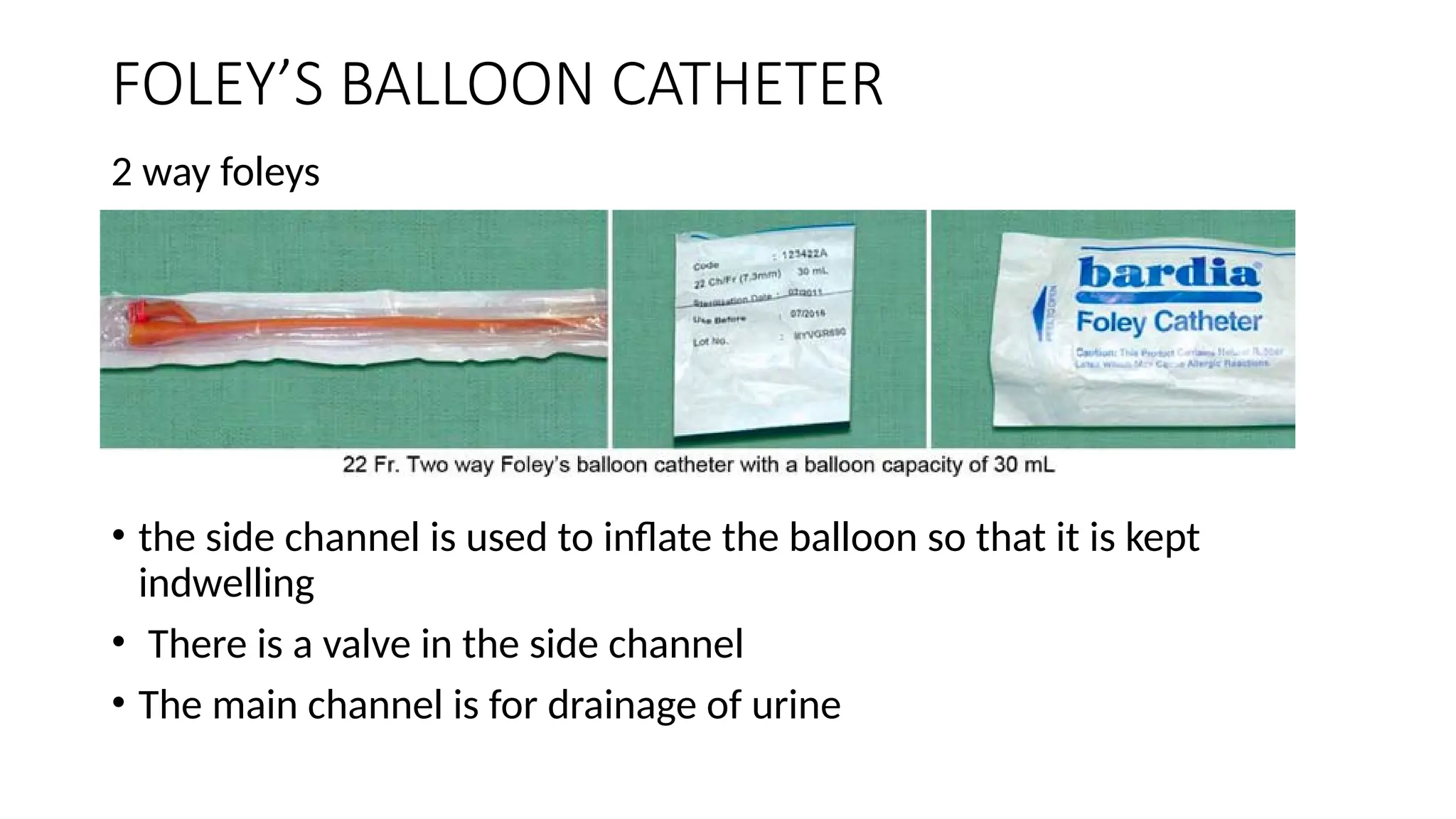
FOLEY’S BALLOON CATHETER
2way foleys
• the side channel is used to inflate the balloon so that it is kept
indwelling
• There is a valve in the side channel
• The main channel is for drainage of urine
MALECOT CATHETER
• typeof self retaining catheter
• it is retained after its introduction by its dilated winged end
• The dilated winged end made straight by introducing a Malaecot
catheter introducer or by inserting a hemostatic forceps into the
dilated end
URETHRAL CATHETERISATION
• procedureexplained with benefits, risks,
complications, and alternatives to the patient or the
patient's representative.
• patient positioned supine, in bed, and uncover the
genitalia.
• position the female patient in a dorsal recumbent
position with the knees flexed and the feet about
two feet apart.
• catheter tray opened and place in between the
patient’s legs
14.
URETHRAL CATHETERISATION
• Thoroughhand wash,
donning sterile gloves
• the nondominant
hand used to hold the
penis and the foreskin
retracted (if present)
• genitalia cleaned
using soapy antiseptic
15.
• Using asyringe with no needle, instill 10 mL of
lidocaine gel 2% into the urethra
• The jelly should be massaged posteriorly in an
attempt to anaesthetise the sphincter region
• Place a penile clamp for few minutes to ensure
that sufficient time is given to allow the
anaesthetic to work before the catheter is inserted
16.
URETHRAL CATHETERISATION
• Holdthe catheter with the sterile hand
• Apply a generous amount of the lubricant to the catheter
• Hold penis at approximately 90° to the bed and stretch upward to
straighten out the penile urethra
• Slowly and gently introduce the catheter into the urethra
• Continue to advance the catheter until the proximal Y-shaped ports
are at the meatus
17.
URETHRAL CATHETERISATION
• Waitfor urine to drain from the larger port to ensure that the distal
end of the catheter is in the urethra
• If no spontaneous return of urine occurs, try to aspirate urine using a
syringe
• If urine return is still not visible, withdraw the catheter and reattempt
the procedure
18.
URINARY CATHETERISATION
• Aftervisualization of urine return inflate the distal balloon by injecting
10-15 mL (or a/c to balloon capacity of the catheter)of 0.9% NaCl
(normal saline) through the cuff inflation port
• Gently withdraw the catheter from the urethra until resistance is met
• Secure the catheter to the patient's thigh with a wide tape
• If the patient is uncircumcised - reduce the foreskin as failure to do so
can cause paraphimosis
• connect the catheter with drainage bag
19.
Inserting the Foleycatheter in a Female patient
Cleanse the genital and perineal areas with antiseptic
Open the sterile catheterization kit, using sterile technique.
Put on the sterile gloves.
Open the sterile drape and place on the patient
Apply sterile lubricant liberally to the catheter tip. Lubricate at least six
inches of the catheter. Leave the lubricated catheter on the sterile field.
Place the thumb and forefinger of non-dominant hand between the
labia minora, spread and separate upward
Keeping the labia separated, cleanse each side of the meatus .
Insert the lubricated catheter into the urethral meatus
Angle the catheter upward as it is advanced. If the catheter will not
advance, instruct the patient to inhale and exhale slowly. This may relax
the sphincter muscle.
20.
URINARY CATHETERISATION
When urinestarts to flow, insert the catheter approximately one inch
further.
Inflate balloon, using correct amount of sterile liquid (usually 10 cc but
check actual balloon size)
Gently pull catheter until inflation balloon is snug against bladder neck.
Connect catheter to drainage system
Evaluate catheter function and amount, color, odor, and quality of urine.
21.
Complication
• Allergic rxnto material of catheter
• Infections- urethritis, cystitis, pyelonephritis
• paraphimosis caused by failure to reduce the foreskin after
catheterization
• Creation of false passages
• Urethral perforation
• Bleeding
• Bladder spasm, pain
22.
REFERENCE
• Bailey andLove Short Practice of Surgery Textbook
• Thomsen TW, Setnik GS. Videos in clinical medicine. Male urethral
catheterization. N Engl J Med. 2006 May 25. 354(21):e22
Editor's Notes
#8 a French scale of measurement. This indicates the circumference of the catheter in
millimeter. Diameter of the catheter in mm is calculated by = No. of catheter in French scale/3.