Organizational Planning
University of Hail
OBJECTIVES
• identify leadership and management function associated with
organization planning
• describe how tools such as SWOT analysis and balanced scorecards
can facilitate the strategic planning process
• describe the steps necessary for successful strategic planning
• discuss the relationship between an organizational mission
statement, philosophy, goals, objectives, policies, procedures, and
rules
• Identify characteristics of a true value.
• Without adequate planning, the management process fails and
organizational needs and objectives cannot be met.
• Planning may be defined as deciding in advance what to do; who is to
do it; and how, when, and where it is to be done. Therefore, all
planning involves choosing among alternatives.
• Therefore, all planning involves choosing among alternatives.
• In effective planning, the manager must identify short- and long-term
goals and changes needed to ensure that the unit will continue to
meet its goals.
• Likewise, planning requires flexibility and energy—two other
leadership characteristics.
• Yet, planning also requires management skills such as data gathering,
forecasting, and transforming ideas into action.
Proactive Planning
• Four planning modes: reactive planning, inactivism, preactivism, or
proactive planning.
• Reactive planning occurs after a problem exists.
• Frequently, in reactive planning, problems are dealt with separately without
integration with the whole organization.
• In addition, because it is done in response to a crisis, this type of planning can
lead to hasty decisions and mistakes.
• Inactivism is another type of conventional planning.
• Inactivists seek the status quo, and they spend their energy preventing
change and maintaining conformity.
• When changes do occur, they occur slowly and incrementally.
• A third planning mode is preactivism.
• Preactive planners utilize technology to accelerate change and are future
oriented.
• Unsatisfied with the past or present, preactivists do not value experience and
believe that the future is always preferable to the present.
• The last planning mode is interactive or proactive planning.
• Planners who fall into this category consider the past, present, and future and
attempt to plan the future of their organization rather than react to it.
• Because the organizational setting changes often, adaptability is a key
requirement for proactive planning.
• Proactive planning occurs, then, in anticipation of changing needs or to
promote growth within an organization and is required of all leader-managers
so that personal as well as organizational needs and objectives are met.
• Forecasting involves trying to estimate how a condition will be in the
future.
• Forecasting takes advantage of input from others, gives sequence in activity,
and protects an organization against undesirable changes.
Strategic Planning at the Organizational Level
• Planning also has many dimensions. Two of these dimensions are
time span and complexity or comprehensiveness.
• Generally, complex organizational plans that involve a long period
(usually 3 to 7 years) are referred to as long-range or strategic plans.
• However, strategic planning may be done once or twice a year in an
organization that changes rapidly.
• At the unit level, any planning that is at least 6 months in the future
may be considered long-range planning.
SWOT Analysis
• There are many effective tools that assist organizations in strategic
planning.
• One of the most commonly used in health-care organizations is SWOT
analysis (identification of strengths, weaknesses, opportunities, and
threats) (Display 7.2).
• SWOT analysis, also known as TOWS analysis, was developed by
Albert Humphrey at Stanford University in the 1960s and 1970s.
Simple Rules for SWOT Analysis
• Be realistic about the strengths and weaknesses of your organization
• Be clear about how the present organization differs from what might
be possible in the future.
• Be specific about what you want to accomplish.
• Always apply SWOT in relation to your competitors.
• Keep SWOT short and simple.
• Remember that SWOT is subjective.
Balanced Scorecard
• Strategic planners using a balanced scorecard develop metrics
(performance measurement indicators), collect data, and analyze that
data from four organizational perspectives: financial, customers,
internal business processes (or simply processes), and learning and
growth.
• These measures align individual, departmental, and organizational
goals and identify entirely new processes for meeting customer and
shareholder objectives.
• Balanced scorecards also allow organizations to align their strategic
activities with the strategic plan.
Strategic Planning as a Management Process
• Strategic planning as a management process generally includes the following
steps:
• 1. Clearly define the purpose of the organization.
• 2. Establish realistic goals and objectives consistent with the mission of the
organization.
• 3. Identify the organization’s external constituencies or stakeholders and then
determine their assessment of the organization’s purposes and operations.
• 4. Clearly communicate the goals and objectives to the organization’s constituents.
• 5. Develop a sense of ownership of the plan.
• 6. Develop strategies to achieve the goals.
• 7. Ensure that the most effective use is made of the organization’s resources.
• 8. Provide a base from which progress can be measured.
• 9. Provide a mechanism for informed change as needed.
• 10. Build a consensus about where the organization is going.
Who Should Be Involved in Strategic
Planning?
• Long-range planning for health-care organizations historically has
been accomplished by top-level managers and the board of directors,
with limited input from middle-level managers.
• To give the strategic plan meaning and to implement it successfully,
input from subordinates from all organizational levels may be
solicited.
• There is increasing recognition, however, of the importance of
subordinate input from all levels of the organization to give the
strategic plan meaning and to increase the likelihood of its successful
implementation.
• The first-level manager is generally more involved in long-range planning at
the unit level.
• However, because the organization’s strategic plans affect unit planning,
managers at all levels must be informed of organizational long-range plans
so that all planning is coordinated.
• All organizations should establish annual strategic planning conferences,
involving all departments and levels of the hierarchy; this action should
promote increased effectiveness of nursing staff; better communication
between all levels of personnel; a cooperative spirit relative to solving
problems; and a pervasive feeling that the departments are unified, goal
directed, and doing their part to help the organization accomplish its
mission.
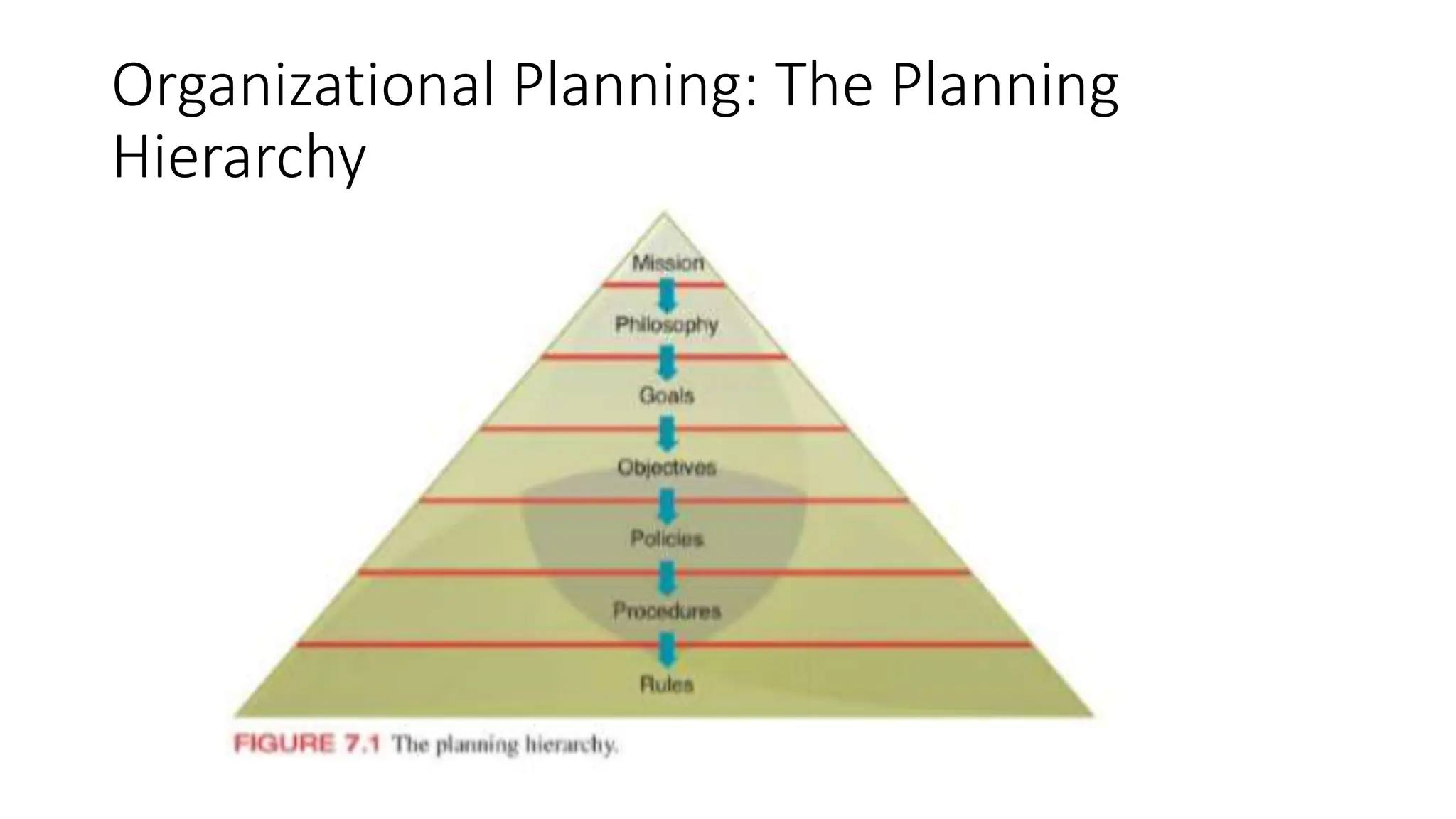
Organizational Planning: The Planning
Hierarchy
Vision and Mission Statements
• Vision statements are used to describe future goals or aims of an
organization.
• It is a description in words that conjures up a picture for all group members of
what they want to accomplish together.
• It is critical, then, that organization leaders recognize that the organization
will never be greater than the vision that guides it.
• An appropriate vision statement for a hospital is shown in Display 7.5.
• The purpose or mission statement is a brief statement (typically no
more than three or four sentences) identifying the reason that an
organization exists.
• The mission statement identifies the organization’s constituency and
addresses its position regarding ethics, principles, and standards of practice.
• The mission statement is of highest priority in the planning hierarchy
because it influences the development of an organization’s
philosophy, goals, objectives, policies, procedures, and rules.
• Mission statements then have value, only if they truly guide the
organization.
• Indeed, actions taken at all levels of the organization should be
congruent with the stated organization mission. This is why involving
individuals from all levels of the organization in crafting mission
statements is so important.
Organizational Philosophy
• The philosophy flows from the purpose or mission statement and
delineates the set of values and beliefs that guide all actions of the
organization.
• It is the basic foundation that directs all further planning toward that
mission.
• A statement of philosophy can usually be found in policy manuals at
the institution or is available upon request.
• A philosophy that might be generated from County Hospital’s mission
statement is shown in Display 7.7.
• The organizational philosophy provides the basis for developing
nursing philosophies at the unit level and for nursing service as a
whole.
• Written in conjunction with the organizational philosophy, the nursing
service philosophy should address fundamental beliefs about nursing
and nursing care; the quality, quantity, and scope of nursing services;
and how nursing specifically will meet organizational goals.
• Frequently, the nursing service philosophy draws on the concepts of
holistic care, education, and research.
• The unit philosophy,
adapted from the nursing
service philosophy,
specifies how nursing care
provided on the unit will
correspond with nursing
service and organizational
goals. This congruence in
philosophy, goals, and
objectives among the
organization, nursing
service, and unit is shown
in Figure 7.2.
Societal Philosophies and Values Related to
Health Care
• Societies and organizations have philosophies or sets of beliefs that
guide their behavior.
• These beliefs that guide behavior are called values.
• Values have an intrinsic worth for a society or an individual.
• Individual Philosophies and Values
• Four characteristics that determine a true value:
• 1. It must be freely chosen from among alternatives only after due reflection.
• 2. It must be prized and cherished.
• 3. It is consciously and consistently repeated (part of a pattern).
• 4. It is positively affirmed and enacted.
Goals and Objectives
• Goals and objectives are the ends toward which the organization is
working.
• All philosophies must be translated into specific goals and objectives
if they are to result in action.
• Thus, goals and objectives “operationalize” the philosophy.
• A goal may be defined as the desired result toward which effort is
directed; it is the aim of the philosophy.
• Although institutional goals are usually determined by the
organization’s highest administrative levels, there is increasing
emphasis on including workers in setting organizational goals.
• Goals, much like philosophies and values, change with time and
require periodic reevaluation and prioritization.
• Goals, although somewhat global in nature, should be measurable
and ambitious but realistic.
• Objectives are similar to goals in that they motivate people to a
specific end and are explicit, measurable, observable or retrievable,
and obtainable.
• Objectives, however, are more specific and measurable than goals
because they identify how and when the goal is to be accomplished.
• Goals usually have multiple objectives that are each accompanied by
a targeted completion date.
• Objectives can focus on either the desired process or the desired result.
• Process objectives are written in terms of the method to be used, whereas
result-focused objectives specify the desired outcome.
• An example of a process objective might be “100% of staff nurses will
orient new patients to the call-light system, within 30 minutes of their
admission, by first demonstrating its appropriate use and then asking the
patient to repeat said demonstration.”
• An example of a result-focused objective might be “95% postoperative
patients will perceive a decrease in their pain levels following the
administration of parenteral pain medication.”
• Writing good objectives requires time and practice.
Policies and Procedures
• Policies are plans reduced to statements or instructions that direct
organizations in their decision making.
• These comprehensive statements, derived from the organization’s
philosophy, goals, and objectives, explain how goals will be met and guide
the general course and scope of organizational activities.
• Thus, policies direct individual behavior toward the organization’s mission
and define broad limits and desired outcomes of commonly recurring
situations while leaving some discretion and initiative to those who must
carry out that policy.
• Although some policies are required by accrediting agencies, many policies
are specific to the individual institution, thus providing management with a
means of internal control.
• Implied policies, neither written nor expressed verbally, have usually
developed over time and follow a precedent.
• For example, a hospital may have an implied policy that employees
should be encouraged and supported in their activity in community,
regional, and national healthcare organizations.
• Another example might be that nurses who limit their maternity leave
to 3 months can return to their former jobs and shifts with no status
change.
• Expressed policies are delineated verbally or in writing.
• Most organizations have many written policies that are readily
available to all people and promote consistency of action.
• Expressed policies may include a formal dress code, policy for sick
leave or vacation time, and disciplinary procedures.
• In addition, policies and procedures should be evidence based.
• The addition of evidence to policies and procedures, however,
requires the development of a process that ensures consistency, rigor,
and safe nursing practice.
• Unfortunately, many policies continue to be driven by tradition or
regulatory requirements and inadequate evidence exists to guide best
practices in policy development.
• Procedures are plans that establish customary or acceptable ways of
accomplishing a specific task and delineate a sequence of steps of
required action.
• Established procedures save staff time, facilitate delegation, reduce
cost, increase productivity, and provide a means of control.
• Procedures identify the process or steps needed to implement a
policy and are generally found in manuals at the unit level of the
organization.
• Rules and regulations are plans that define specific action or
nonaction.
• Generally included as part of policy and procedure statements, rules
describe situations that allow only one choice of action.
• Rules are fairly inflexible, so the fewer rules, the better.
• Existing rules, however, should be enforced to keep morale from
breaking down and to allow organizational structure.
Integrating Leadership Roles and
Management Functions in Planning
• Planning requires managerial expertise in health-care economics,
human resource management, political and legislative issues affecting
health care, and planning theory.
• Planning also requires the leadership skills of being sensitive to the
environment, being able to appraise accurately the social and political
climate, and being willing to take risks.
• Clearly, the leader-manager must be skilled in determining,
implementing, documenting, and evaluating all types of planning in
the hierarchy because an organization’s leaders are integral to
realizing the mission of the organization.
• Managers then must draw on the philosophy and goals established at the
organizational and nursing service levels in implementing planning at the
unit level.
• Initially, managers must assess the unit’s constraints and assets and
determine its resources available for planning.
• The manager then draws on his or her leadership skills in creativity,
innovation, and futuristic thinking to problem solve how philosophies can
be translated into goals, goals into objectives, and so on down the planning
hierarchy.
• The wise manager will develop the interpersonal leadership skills needed
to inspire and involve subordinates in this planning hierarchy.
• The manager also must demonstrate the leadership skill of being
receptive to new and varied ideas.
• The final step in the process involves articulating identified goals and
objectives clearly; this learned management skill is critical to the
success of the planning.
• If the unit manager lacks management or leadership skills, the
planning hierarchy fails.
Reference
• Leadership Roles and Management Functions in Nursing, Theory and
Application, 9th Edition, Bessie L. Marquis and Carol Jorgensen
HustonCopyright © 2017 Wolters Kluwer.
Thank you!

Organizational Planning. function, steps

  • 1.
  • 2.
    OBJECTIVES • identify leadershipand management function associated with organization planning • describe how tools such as SWOT analysis and balanced scorecards can facilitate the strategic planning process • describe the steps necessary for successful strategic planning • discuss the relationship between an organizational mission statement, philosophy, goals, objectives, policies, procedures, and rules • Identify characteristics of a true value.
  • 3.
    • Without adequateplanning, the management process fails and organizational needs and objectives cannot be met. • Planning may be defined as deciding in advance what to do; who is to do it; and how, when, and where it is to be done. Therefore, all planning involves choosing among alternatives. • Therefore, all planning involves choosing among alternatives.
  • 4.
    • In effectiveplanning, the manager must identify short- and long-term goals and changes needed to ensure that the unit will continue to meet its goals. • Likewise, planning requires flexibility and energy—two other leadership characteristics. • Yet, planning also requires management skills such as data gathering, forecasting, and transforming ideas into action.
  • 7.
    Proactive Planning • Fourplanning modes: reactive planning, inactivism, preactivism, or proactive planning. • Reactive planning occurs after a problem exists. • Frequently, in reactive planning, problems are dealt with separately without integration with the whole organization. • In addition, because it is done in response to a crisis, this type of planning can lead to hasty decisions and mistakes.
  • 8.
    • Inactivism isanother type of conventional planning. • Inactivists seek the status quo, and they spend their energy preventing change and maintaining conformity. • When changes do occur, they occur slowly and incrementally. • A third planning mode is preactivism. • Preactive planners utilize technology to accelerate change and are future oriented. • Unsatisfied with the past or present, preactivists do not value experience and believe that the future is always preferable to the present.
  • 9.
    • The lastplanning mode is interactive or proactive planning. • Planners who fall into this category consider the past, present, and future and attempt to plan the future of their organization rather than react to it. • Because the organizational setting changes often, adaptability is a key requirement for proactive planning. • Proactive planning occurs, then, in anticipation of changing needs or to promote growth within an organization and is required of all leader-managers so that personal as well as organizational needs and objectives are met.
  • 10.
    • Forecasting involvestrying to estimate how a condition will be in the future. • Forecasting takes advantage of input from others, gives sequence in activity, and protects an organization against undesirable changes.
  • 11.
    Strategic Planning atthe Organizational Level • Planning also has many dimensions. Two of these dimensions are time span and complexity or comprehensiveness. • Generally, complex organizational plans that involve a long period (usually 3 to 7 years) are referred to as long-range or strategic plans. • However, strategic planning may be done once or twice a year in an organization that changes rapidly. • At the unit level, any planning that is at least 6 months in the future may be considered long-range planning.
  • 12.
    SWOT Analysis • Thereare many effective tools that assist organizations in strategic planning. • One of the most commonly used in health-care organizations is SWOT analysis (identification of strengths, weaknesses, opportunities, and threats) (Display 7.2). • SWOT analysis, also known as TOWS analysis, was developed by Albert Humphrey at Stanford University in the 1960s and 1970s.
  • 15.
    Simple Rules forSWOT Analysis • Be realistic about the strengths and weaknesses of your organization • Be clear about how the present organization differs from what might be possible in the future. • Be specific about what you want to accomplish. • Always apply SWOT in relation to your competitors. • Keep SWOT short and simple. • Remember that SWOT is subjective.
  • 16.
    Balanced Scorecard • Strategicplanners using a balanced scorecard develop metrics (performance measurement indicators), collect data, and analyze that data from four organizational perspectives: financial, customers, internal business processes (or simply processes), and learning and growth. • These measures align individual, departmental, and organizational goals and identify entirely new processes for meeting customer and shareholder objectives. • Balanced scorecards also allow organizations to align their strategic activities with the strategic plan.
  • 17.
    Strategic Planning asa Management Process • Strategic planning as a management process generally includes the following steps: • 1. Clearly define the purpose of the organization. • 2. Establish realistic goals and objectives consistent with the mission of the organization. • 3. Identify the organization’s external constituencies or stakeholders and then determine their assessment of the organization’s purposes and operations. • 4. Clearly communicate the goals and objectives to the organization’s constituents. • 5. Develop a sense of ownership of the plan. • 6. Develop strategies to achieve the goals. • 7. Ensure that the most effective use is made of the organization’s resources. • 8. Provide a base from which progress can be measured. • 9. Provide a mechanism for informed change as needed. • 10. Build a consensus about where the organization is going.
  • 18.
    Who Should BeInvolved in Strategic Planning? • Long-range planning for health-care organizations historically has been accomplished by top-level managers and the board of directors, with limited input from middle-level managers. • To give the strategic plan meaning and to implement it successfully, input from subordinates from all organizational levels may be solicited. • There is increasing recognition, however, of the importance of subordinate input from all levels of the organization to give the strategic plan meaning and to increase the likelihood of its successful implementation.
  • 19.
    • The first-levelmanager is generally more involved in long-range planning at the unit level. • However, because the organization’s strategic plans affect unit planning, managers at all levels must be informed of organizational long-range plans so that all planning is coordinated. • All organizations should establish annual strategic planning conferences, involving all departments and levels of the hierarchy; this action should promote increased effectiveness of nursing staff; better communication between all levels of personnel; a cooperative spirit relative to solving problems; and a pervasive feeling that the departments are unified, goal directed, and doing their part to help the organization accomplish its mission.
  • 20.
    Organizational Planning: ThePlanning Hierarchy
  • 21.
    Vision and MissionStatements • Vision statements are used to describe future goals or aims of an organization. • It is a description in words that conjures up a picture for all group members of what they want to accomplish together. • It is critical, then, that organization leaders recognize that the organization will never be greater than the vision that guides it. • An appropriate vision statement for a hospital is shown in Display 7.5.
  • 22.
    • The purposeor mission statement is a brief statement (typically no more than three or four sentences) identifying the reason that an organization exists. • The mission statement identifies the organization’s constituency and addresses its position regarding ethics, principles, and standards of practice.
  • 23.
    • The missionstatement is of highest priority in the planning hierarchy because it influences the development of an organization’s philosophy, goals, objectives, policies, procedures, and rules. • Mission statements then have value, only if they truly guide the organization. • Indeed, actions taken at all levels of the organization should be congruent with the stated organization mission. This is why involving individuals from all levels of the organization in crafting mission statements is so important.
  • 24.
    Organizational Philosophy • Thephilosophy flows from the purpose or mission statement and delineates the set of values and beliefs that guide all actions of the organization. • It is the basic foundation that directs all further planning toward that mission. • A statement of philosophy can usually be found in policy manuals at the institution or is available upon request. • A philosophy that might be generated from County Hospital’s mission statement is shown in Display 7.7.
  • 26.
    • The organizationalphilosophy provides the basis for developing nursing philosophies at the unit level and for nursing service as a whole. • Written in conjunction with the organizational philosophy, the nursing service philosophy should address fundamental beliefs about nursing and nursing care; the quality, quantity, and scope of nursing services; and how nursing specifically will meet organizational goals. • Frequently, the nursing service philosophy draws on the concepts of holistic care, education, and research.
  • 28.
    • The unitphilosophy, adapted from the nursing service philosophy, specifies how nursing care provided on the unit will correspond with nursing service and organizational goals. This congruence in philosophy, goals, and objectives among the organization, nursing service, and unit is shown in Figure 7.2.
  • 29.
    Societal Philosophies andValues Related to Health Care • Societies and organizations have philosophies or sets of beliefs that guide their behavior. • These beliefs that guide behavior are called values. • Values have an intrinsic worth for a society or an individual. • Individual Philosophies and Values • Four characteristics that determine a true value: • 1. It must be freely chosen from among alternatives only after due reflection. • 2. It must be prized and cherished. • 3. It is consciously and consistently repeated (part of a pattern). • 4. It is positively affirmed and enacted.
  • 30.
    Goals and Objectives •Goals and objectives are the ends toward which the organization is working. • All philosophies must be translated into specific goals and objectives if they are to result in action. • Thus, goals and objectives “operationalize” the philosophy.
  • 31.
    • A goalmay be defined as the desired result toward which effort is directed; it is the aim of the philosophy. • Although institutional goals are usually determined by the organization’s highest administrative levels, there is increasing emphasis on including workers in setting organizational goals. • Goals, much like philosophies and values, change with time and require periodic reevaluation and prioritization. • Goals, although somewhat global in nature, should be measurable and ambitious but realistic.
  • 33.
    • Objectives aresimilar to goals in that they motivate people to a specific end and are explicit, measurable, observable or retrievable, and obtainable. • Objectives, however, are more specific and measurable than goals because they identify how and when the goal is to be accomplished. • Goals usually have multiple objectives that are each accompanied by a targeted completion date.
  • 34.
    • Objectives canfocus on either the desired process or the desired result. • Process objectives are written in terms of the method to be used, whereas result-focused objectives specify the desired outcome. • An example of a process objective might be “100% of staff nurses will orient new patients to the call-light system, within 30 minutes of their admission, by first demonstrating its appropriate use and then asking the patient to repeat said demonstration.” • An example of a result-focused objective might be “95% postoperative patients will perceive a decrease in their pain levels following the administration of parenteral pain medication.” • Writing good objectives requires time and practice.
  • 35.
    Policies and Procedures •Policies are plans reduced to statements or instructions that direct organizations in their decision making. • These comprehensive statements, derived from the organization’s philosophy, goals, and objectives, explain how goals will be met and guide the general course and scope of organizational activities. • Thus, policies direct individual behavior toward the organization’s mission and define broad limits and desired outcomes of commonly recurring situations while leaving some discretion and initiative to those who must carry out that policy. • Although some policies are required by accrediting agencies, many policies are specific to the individual institution, thus providing management with a means of internal control.
  • 36.
    • Implied policies,neither written nor expressed verbally, have usually developed over time and follow a precedent. • For example, a hospital may have an implied policy that employees should be encouraged and supported in their activity in community, regional, and national healthcare organizations. • Another example might be that nurses who limit their maternity leave to 3 months can return to their former jobs and shifts with no status change.
  • 37.
    • Expressed policiesare delineated verbally or in writing. • Most organizations have many written policies that are readily available to all people and promote consistency of action. • Expressed policies may include a formal dress code, policy for sick leave or vacation time, and disciplinary procedures.
  • 38.
    • In addition,policies and procedures should be evidence based. • The addition of evidence to policies and procedures, however, requires the development of a process that ensures consistency, rigor, and safe nursing practice. • Unfortunately, many policies continue to be driven by tradition or regulatory requirements and inadequate evidence exists to guide best practices in policy development.
  • 39.
    • Procedures areplans that establish customary or acceptable ways of accomplishing a specific task and delineate a sequence of steps of required action. • Established procedures save staff time, facilitate delegation, reduce cost, increase productivity, and provide a means of control. • Procedures identify the process or steps needed to implement a policy and are generally found in manuals at the unit level of the organization.
  • 40.
    • Rules andregulations are plans that define specific action or nonaction. • Generally included as part of policy and procedure statements, rules describe situations that allow only one choice of action. • Rules are fairly inflexible, so the fewer rules, the better. • Existing rules, however, should be enforced to keep morale from breaking down and to allow organizational structure.
  • 41.
    Integrating Leadership Rolesand Management Functions in Planning • Planning requires managerial expertise in health-care economics, human resource management, political and legislative issues affecting health care, and planning theory. • Planning also requires the leadership skills of being sensitive to the environment, being able to appraise accurately the social and political climate, and being willing to take risks. • Clearly, the leader-manager must be skilled in determining, implementing, documenting, and evaluating all types of planning in the hierarchy because an organization’s leaders are integral to realizing the mission of the organization.
  • 42.
    • Managers thenmust draw on the philosophy and goals established at the organizational and nursing service levels in implementing planning at the unit level. • Initially, managers must assess the unit’s constraints and assets and determine its resources available for planning. • The manager then draws on his or her leadership skills in creativity, innovation, and futuristic thinking to problem solve how philosophies can be translated into goals, goals into objectives, and so on down the planning hierarchy. • The wise manager will develop the interpersonal leadership skills needed to inspire and involve subordinates in this planning hierarchy.
  • 43.
    • The manageralso must demonstrate the leadership skill of being receptive to new and varied ideas. • The final step in the process involves articulating identified goals and objectives clearly; this learned management skill is critical to the success of the planning. • If the unit manager lacks management or leadership skills, the planning hierarchy fails.
  • 44.
    Reference • Leadership Rolesand Management Functions in Nursing, Theory and Application, 9th Edition, Bessie L. Marquis and Carol Jorgensen HustonCopyright © 2017 Wolters Kluwer.
  • 45.