ASSIGNMENT
By Vishnu.k.r (MBA 1st
Year)
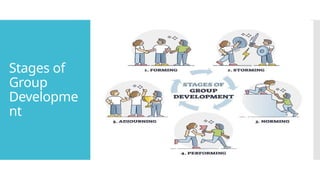
Stages of
Group
Developme
nt
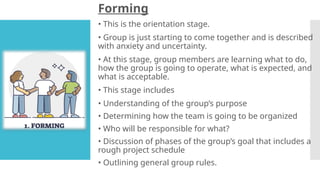
Forming
• This is the orientation stage.
• Group is just starting to come together and is described
with anxiety and uncertainty.
• At this stage, group members are learning what to do,
how the group is going to operate, what is expected, and
what is acceptable.
• This stage includes
• Understanding of the group’s purpose
• Determining how the team is going to be organized
• Who will be responsible for what?
• Discussion of phases of the group’s goal that includes a
rough project schedule
• Outlining general group rules.
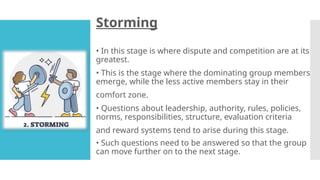
Storming
• In this stage is where dispute and competition are at its
greatest.
• This is the stage where the dominating group members
emerge, while the less active members stay in their
comfort zone.
• Questions about leadership, authority, rules, policies,
norms, responsibilities, structure, evaluation criteria
and reward systems tend to arise during this stage.
• Such questions need to be answered so that the group
can move further on to the next stage.
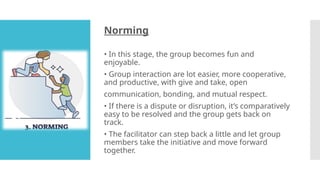
Norming
• In this stage, the group becomes fun and
enjoyable.
• Group interaction are lot easier, more cooperative,
and productive, with give and take, open
communication, bonding, and mutual respect.
• If there is a dispute or disruption, it’s comparatively
easy to be resolved and the group gets back on
track.
• The facilitator can step back a little and let group
members take the initiative and move forward
together.
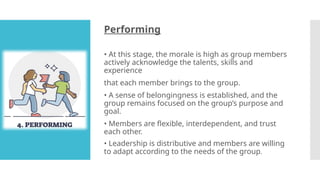
Performing
• At this stage, the morale is high as group members
actively acknowledge the talents, skills and
experience
that each member brings to the group.
• A sense of belongingness is established, and the
group remains focused on the group’s purpose and
goal.
• Members are flexible, interdependent, and trust
each other.
• Leadership is distributive and members are willing
to adapt according to the needs of the group.
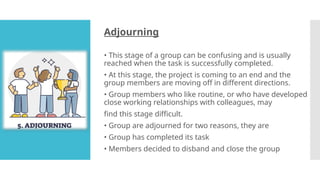
Adjourning
• This stage of a group can be confusing and is usually
reached when the task is successfully completed.
• At this stage, the project is coming to an end and the
group members are moving off in different directions.
• Group members who like routine, or who have developed
close working relationships with colleagues, may
find this stage difficult.
• Group are adjourned for two reasons, they are
• Group has completed its task
• Members decided to disband and close the group
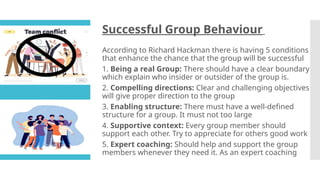
Successful Group Behaviour
According to Richard Hackman there is having 5 conditions
that enhance the chance that the group will be successful
1. Being a real Group: There should have a clear boundary
which explain who insider or outsider of the group is.
2. Compelling directions: Clear and challenging objectives
will give proper direction to the group
3. Enabling structure: There must have a well-defined
structure for a group. It must not too large
4. Supportive context: Every group member should
support each other. Try to appreciate for others good work
5. Expert coaching: Should help and support the group
members whenever they need it. As an expert coaching
Conclusio
n

organizational behaviour presentation .pptx

  • 1.
  • 2.
  • 3.
    Forming • This isthe orientation stage. • Group is just starting to come together and is described with anxiety and uncertainty. • At this stage, group members are learning what to do, how the group is going to operate, what is expected, and what is acceptable. • This stage includes • Understanding of the group’s purpose • Determining how the team is going to be organized • Who will be responsible for what? • Discussion of phases of the group’s goal that includes a rough project schedule • Outlining general group rules.
  • 4.
    Storming • In thisstage is where dispute and competition are at its greatest. • This is the stage where the dominating group members emerge, while the less active members stay in their comfort zone. • Questions about leadership, authority, rules, policies, norms, responsibilities, structure, evaluation criteria and reward systems tend to arise during this stage. • Such questions need to be answered so that the group can move further on to the next stage.
  • 5.
    Norming • In thisstage, the group becomes fun and enjoyable. • Group interaction are lot easier, more cooperative, and productive, with give and take, open communication, bonding, and mutual respect. • If there is a dispute or disruption, it’s comparatively easy to be resolved and the group gets back on track. • The facilitator can step back a little and let group members take the initiative and move forward together.
  • 6.
    Performing • At thisstage, the morale is high as group members actively acknowledge the talents, skills and experience that each member brings to the group. • A sense of belongingness is established, and the group remains focused on the group’s purpose and goal. • Members are flexible, interdependent, and trust each other. • Leadership is distributive and members are willing to adapt according to the needs of the group.
  • 7.
    Adjourning • This stageof a group can be confusing and is usually reached when the task is successfully completed. • At this stage, the project is coming to an end and the group members are moving off in different directions. • Group members who like routine, or who have developed close working relationships with colleagues, may find this stage difficult. • Group are adjourned for two reasons, they are • Group has completed its task • Members decided to disband and close the group
  • 8.
    Successful Group Behaviour Accordingto Richard Hackman there is having 5 conditions that enhance the chance that the group will be successful 1. Being a real Group: There should have a clear boundary which explain who insider or outsider of the group is. 2. Compelling directions: Clear and challenging objectives will give proper direction to the group 3. Enabling structure: There must have a well-defined structure for a group. It must not too large 4. Supportive context: Every group member should support each other. Try to appreciate for others good work 5. Expert coaching: Should help and support the group members whenever they need it. As an expert coaching
  • 9.