For use with MARTIN, ORGANIZATIONAL BEHAVIOUR AND MANAGEMENT 3e
ISBN 1-86152-948-1  Copyright © 2005 Cengage Learning 1
Lecture 1
ORGANIZATIONAL
BEHAVIOUR TODAY
For use with MARTIN, ORGANIZATIONAL BEHAVIOUR AND MANAGEMENT 3e
ISBN 1-86152-948-1  Copyright © 2005 Cengage Learning 2
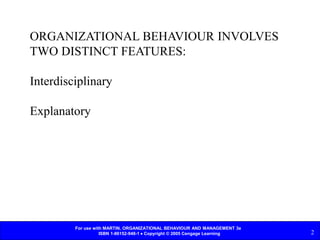
ORGANIZATIONAL BEHAVIOUR INVOLVES
TWO DISTINCT FEATURES:
Interdisciplinary
Explanatory
For use with MARTIN, ORGANIZATIONAL BEHAVIOUR AND MANAGEMENT 3e
ISBN 1-86152-948-1  Copyright © 2005 Cengage Learning 3
For use with MARTIN, ORGANIZATIONAL BEHAVIOUR AND MANAGEMENT 3e
ISBN 1-86152-948-1  Copyright © 2005 Cengage Learning 4
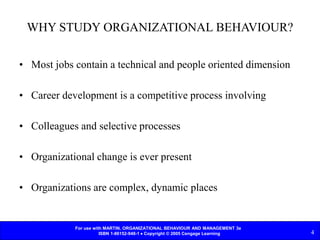
WHY STUDY ORGANIZATIONAL BEHAVIOUR?
• Most jobs contain a technical and people oriented dimension
• Career development is a competitive process involving
• Colleagues and selective processes
• Organizational change is ever present
• Organizations are complex, dynamic places
For use with MARTIN, ORGANIZATIONAL BEHAVIOUR AND MANAGEMENT 3e
ISBN 1-86152-948-1  Copyright © 2005 Cengage Learning 5
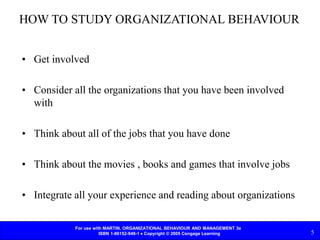
HOW TO STUDY ORGANIZATIONAL BEHAVIOUR
• Get involved
• Consider all the organizations that you have been involved
with
• Think about all of the jobs that you have done
• Think about the movies , books and games that involve jobs
• Integrate all your experience and reading about organizations
For use with MARTIN, ORGANIZATIONAL BEHAVIOUR AND MANAGEMENT 3e
ISBN 1-86152-948-1  Copyright © 2005 Cengage Learning 6
For use with MARTIN, ORGANIZATIONAL BEHAVIOUR AND MANAGEMENT 3e
ISBN 1-86152-948-1  Copyright © 2005 Cengage Learning 7
For use with MARTIN, ORGANIZATIONAL BEHAVIOUR AND MANAGEMENT 3e
ISBN 1-86152-948-1  Copyright © 2005 Cengage Learning 8
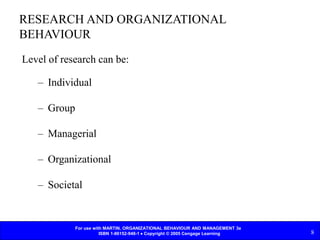
RESEARCH AND ORGANIZATIONAL
BEHAVIOUR
Level of research can be:
– Individual
– Group
– Managerial
– Organizational
– Societal
For use with MARTIN, ORGANIZATIONAL BEHAVIOUR AND MANAGEMENT 3e
ISBN 1-86152-948-1  Copyright © 2005 Cengage Learning 9
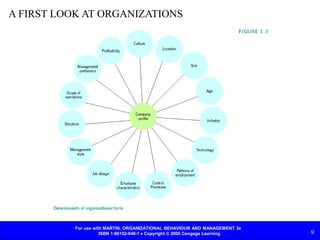
A FIRST LOOK AT ORGANIZATIONS
For use with MARTIN, ORGANIZATIONAL BEHAVIOUR AND MANAGEMENT 3e
ISBN 1-86152-948-1  Copyright © 2005 Cengage Learning 10
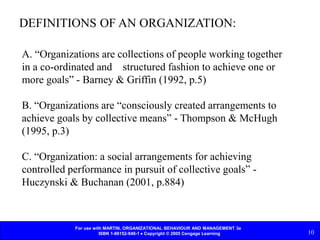
DEFINITIONS OF AN ORGANIZATION:
A. “Organizations are collections of people working together
in a co-ordinated and structured fashion to achieve one or
more goals” - Barney & Griffin (1992, p.5)
B. “Organizations are “consciously created arrangements to
achieve goals by collective means” - Thompson & McHugh
(1995, p.3)
C. “Organization: a social arrangements for achieving
controlled performance in pursuit of collective goals” -
Huczynski & Buchanan (2001, p.884)
For use with MARTIN, ORGANIZATIONAL BEHAVIOUR AND MANAGEMENT 3e
ISBN 1-86152-948-1  Copyright © 2005 Cengage Learning 11
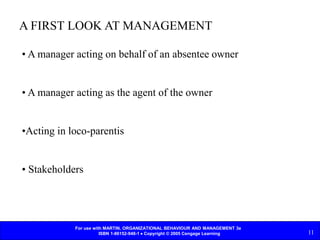
• A manager acting on behalf of an absentee owner
• A manager acting as the agent of the owner
•Acting in loco-parentis
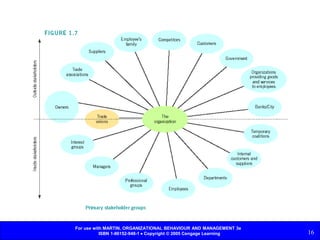
• Stakeholders
A FIRST LOOK AT MANAGEMENT
For use with MARTIN, ORGANIZATIONAL BEHAVIOUR AND MANAGEMENT 3e
ISBN 1-86152-948-1  Copyright © 2005 Cengage Learning 12
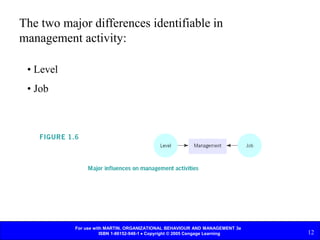
The two major differences identifiable in
management activity:
• Level
• Job
For use with MARTIN, ORGANIZATIONAL BEHAVIOUR AND MANAGEMENT 3e
ISBN 1-86152-948-1  Copyright © 2005 Cengage Learning 13
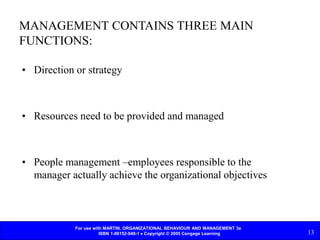
MANAGEMENT CONTAINS THREE MAIN
FUNCTIONS:
• Direction or strategy
• Resources need to be provided and managed
• People management –employees responsible to the
manager actually achieve the organizational objectives
For use with MARTIN, ORGANIZATIONAL BEHAVIOUR AND MANAGEMENT 3e
ISBN 1-86152-948-1  Copyright © 2005 Cengage Learning 14
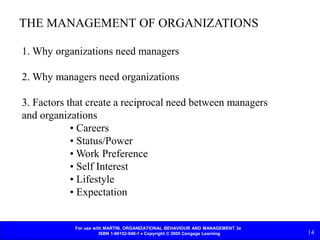
THE MANAGEMENT OF ORGANIZATIONS
1. Why organizations need managers
2. Why managers need organizations
3. Factors that create a reciprocal need between managers
and organizations
• Careers
• Status/Power
• Work Preference
• Self Interest
• Lifestyle
• Expectation
For use with MARTIN, ORGANIZATIONAL BEHAVIOUR AND MANAGEMENT 3e
ISBN 1-86152-948-1  Copyright © 2005 Cengage Learning 15
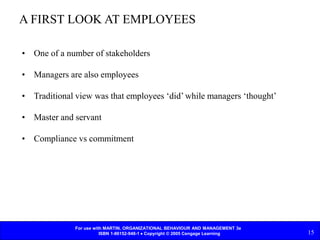
A FIRST LOOK AT EMPLOYEES
• One of a number of stakeholders
• Managers are also employees
• Traditional view was that employees ‘did’ while managers ‘thought’
• Master and servant
• Compliance vs commitment
For use with MARTIN, ORGANIZATIONAL BEHAVIOUR AND MANAGEMENT 3e
ISBN 1-86152-948-1  Copyright © 2005 Cengage Learning 16
For use with MARTIN, ORGANIZATIONAL BEHAVIOUR AND MANAGEMENT 3e
ISBN 1-86152-948-1  Copyright © 2005 Cengage Learning 17
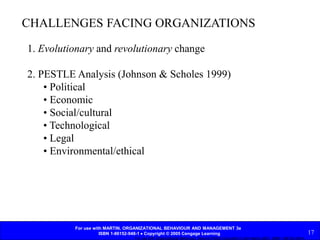
CHALLENGES FACING ORGANIZATIONS
1. Evolutionary and revolutionary change
2. PESTLE Analysis (Johnson & Scholes 1999)
• Political
• Economic
• Social/cultural
• Technological
• Legal
• Environmental/ethical
For use with Organizational Behaviour, Second Edition Copyright © John Martin 2001. ISBN 1-86152-583-4

Organizational behavior: modern organization

  • 1.
    For use withMARTIN, ORGANIZATIONAL BEHAVIOUR AND MANAGEMENT 3e ISBN 1-86152-948-1  Copyright © 2005 Cengage Learning 1 Lecture 1 ORGANIZATIONAL BEHAVIOUR TODAY
  • 2.
    For use withMARTIN, ORGANIZATIONAL BEHAVIOUR AND MANAGEMENT 3e ISBN 1-86152-948-1  Copyright © 2005 Cengage Learning 2 ORGANIZATIONAL BEHAVIOUR INVOLVES TWO DISTINCT FEATURES: Interdisciplinary Explanatory
  • 3.
    For use withMARTIN, ORGANIZATIONAL BEHAVIOUR AND MANAGEMENT 3e ISBN 1-86152-948-1  Copyright © 2005 Cengage Learning 3
  • 4.
    For use withMARTIN, ORGANIZATIONAL BEHAVIOUR AND MANAGEMENT 3e ISBN 1-86152-948-1  Copyright © 2005 Cengage Learning 4 WHY STUDY ORGANIZATIONAL BEHAVIOUR? • Most jobs contain a technical and people oriented dimension • Career development is a competitive process involving • Colleagues and selective processes • Organizational change is ever present • Organizations are complex, dynamic places
  • 5.
    For use withMARTIN, ORGANIZATIONAL BEHAVIOUR AND MANAGEMENT 3e ISBN 1-86152-948-1  Copyright © 2005 Cengage Learning 5 HOW TO STUDY ORGANIZATIONAL BEHAVIOUR • Get involved • Consider all the organizations that you have been involved with • Think about all of the jobs that you have done • Think about the movies , books and games that involve jobs • Integrate all your experience and reading about organizations
  • 6.
    For use withMARTIN, ORGANIZATIONAL BEHAVIOUR AND MANAGEMENT 3e ISBN 1-86152-948-1  Copyright © 2005 Cengage Learning 6
  • 7.
    For use withMARTIN, ORGANIZATIONAL BEHAVIOUR AND MANAGEMENT 3e ISBN 1-86152-948-1  Copyright © 2005 Cengage Learning 7
  • 8.
    For use withMARTIN, ORGANIZATIONAL BEHAVIOUR AND MANAGEMENT 3e ISBN 1-86152-948-1  Copyright © 2005 Cengage Learning 8 RESEARCH AND ORGANIZATIONAL BEHAVIOUR Level of research can be: – Individual – Group – Managerial – Organizational – Societal
  • 9.
    For use withMARTIN, ORGANIZATIONAL BEHAVIOUR AND MANAGEMENT 3e ISBN 1-86152-948-1  Copyright © 2005 Cengage Learning 9 A FIRST LOOK AT ORGANIZATIONS
  • 10.
    For use withMARTIN, ORGANIZATIONAL BEHAVIOUR AND MANAGEMENT 3e ISBN 1-86152-948-1  Copyright © 2005 Cengage Learning 10 DEFINITIONS OF AN ORGANIZATION: A. “Organizations are collections of people working together in a co-ordinated and structured fashion to achieve one or more goals” - Barney & Griffin (1992, p.5) B. “Organizations are “consciously created arrangements to achieve goals by collective means” - Thompson & McHugh (1995, p.3) C. “Organization: a social arrangements for achieving controlled performance in pursuit of collective goals” - Huczynski & Buchanan (2001, p.884)
  • 11.
    For use withMARTIN, ORGANIZATIONAL BEHAVIOUR AND MANAGEMENT 3e ISBN 1-86152-948-1  Copyright © 2005 Cengage Learning 11 • A manager acting on behalf of an absentee owner • A manager acting as the agent of the owner •Acting in loco-parentis • Stakeholders A FIRST LOOK AT MANAGEMENT
  • 12.
    For use withMARTIN, ORGANIZATIONAL BEHAVIOUR AND MANAGEMENT 3e ISBN 1-86152-948-1  Copyright © 2005 Cengage Learning 12 The two major differences identifiable in management activity: • Level • Job
  • 13.
    For use withMARTIN, ORGANIZATIONAL BEHAVIOUR AND MANAGEMENT 3e ISBN 1-86152-948-1  Copyright © 2005 Cengage Learning 13 MANAGEMENT CONTAINS THREE MAIN FUNCTIONS: • Direction or strategy • Resources need to be provided and managed • People management –employees responsible to the manager actually achieve the organizational objectives
  • 14.
    For use withMARTIN, ORGANIZATIONAL BEHAVIOUR AND MANAGEMENT 3e ISBN 1-86152-948-1  Copyright © 2005 Cengage Learning 14 THE MANAGEMENT OF ORGANIZATIONS 1. Why organizations need managers 2. Why managers need organizations 3. Factors that create a reciprocal need between managers and organizations • Careers • Status/Power • Work Preference • Self Interest • Lifestyle • Expectation
  • 15.
    For use withMARTIN, ORGANIZATIONAL BEHAVIOUR AND MANAGEMENT 3e ISBN 1-86152-948-1  Copyright © 2005 Cengage Learning 15 A FIRST LOOK AT EMPLOYEES • One of a number of stakeholders • Managers are also employees • Traditional view was that employees ‘did’ while managers ‘thought’ • Master and servant • Compliance vs commitment
  • 16.
    For use withMARTIN, ORGANIZATIONAL BEHAVIOUR AND MANAGEMENT 3e ISBN 1-86152-948-1  Copyright © 2005 Cengage Learning 16
  • 17.
    For use withMARTIN, ORGANIZATIONAL BEHAVIOUR AND MANAGEMENT 3e ISBN 1-86152-948-1  Copyright © 2005 Cengage Learning 17 CHALLENGES FACING ORGANIZATIONS 1. Evolutionary and revolutionary change 2. PESTLE Analysis (Johnson & Scholes 1999) • Political • Economic • Social/cultural • Technological • Legal • Environmental/ethical For use with Organizational Behaviour, Second Edition Copyright © John Martin 2001. ISBN 1-86152-583-4