
1
.Mr.CharakRay.
ASST.PROFESSOR(FINANCE)
MBA(BHU),ASSOCIATE((III),PGDHI(III)
BCM(BHSE),SENIOR(ST.JA)
2
.Mr.CharakRay.
ASST.PROFESSOR(FINANCE)
MBA(BHU),ASSOCIATE((III),PGDHI(III)
BCM(BHSE),SENIOR(ST.JA)
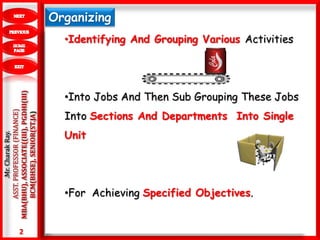
•Identifying And Grouping Various Activities
•Into Jobs And Then Sub Grouping These Jobs
Into Sections And Departments Into Single
Unit
•For Achieving Specified Objectives.
Organizing
3
.Mr.CharakRay.
ASST.PROFESSOR(FINANCE)
MBA(BHU),ASSOCIATE((III),PGDHI(III)
BCM(BHSE),SENIOR(ST.JA)
Identification
And Division Of
Work
Departmentaliz
ation
Assignment Of
Duties
Establishing
Reporting
Relationships
4
.Mr.CharakRay.
ASST.PROFESSOR(FINANCE)
MBA(BHU),ASSOCIATE((III),PGDHI(III)
BCM(BHSE),SENIOR(ST.JA)
•One individual cannot do the entire
work.
•Therefore Work is divided into small
parts called job
•And burden of work can be shared by
many workers
•Repetitiveness brings specialization
Sales
purchase
Production
5
.Mr.CharakRay.
ASST.PROFESSOR(FINANCE)
MBA(BHU),ASSOCIATE((III),PGDHI(III)
BCM(BHSE),SENIOR(ST.JA) •Similar nature activities are
•grouped together on the basis of their
interdependence called departmentalization
•Can be created like territories (north, south,
west etc.)
•Or products (appliances, clothes, cosmetics
etc).
Marketing
department
Advertisement
Sales
promotion
Personal
selling
6
.Mr.CharakRay.
ASST.PROFESSOR(FINANCE)
MBA(BHU),ASSOCIATE((III),PGDHI(III)
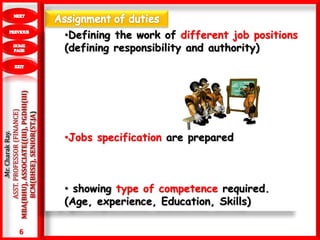
BCM(BHSE),SENIOR(ST.JA) •Defining the work of different job positions
(defining responsibility and authority)
•Jobs specification are prepared
• showing type of competence required.
(Age, experience, Education, Skills)
7
.Mr.CharakRay.
ASST.PROFESSOR(FINANCE)
MBA(BHU),ASSOCIATE((III),PGDHI(III)
BCM(BHSE),SENIOR(ST.JA)
Establishment Reporting Relationships means
•Who will work under whom
•Who will get order from whom
•Creation of superior-subordinate relationship
8
.Mr.CharakRay.
ASST.PROFESSOR(FINANCE)
MBA(BHU),ASSOCIATE((III),PGDHI(III)
BCM(BHSE),SENIOR(ST.JA)
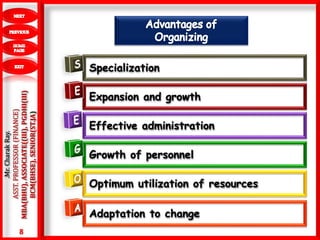
Specialization
Expansion and growth
Effective administration
Growth of personnel
Optimum utilization of resources
Adaptation to change
9
.Mr.CharakRay.
ASST.PROFESSOR(FINANCE)
MBA(BHU),ASSOCIATE((III),PGDHI(III)
BCM(BHSE),SENIOR(ST.JA)
•Every person performs a particular task.
•Repetitive performances of a particular task give
experience
•in that area and leads to specialization
10
.Mr.CharakRay.
ASST.PROFESSOR(FINANCE)
MBA(BHU),ASSOCIATE((III),PGDHI(III)
BCM(BHSE),SENIOR(ST.JA)
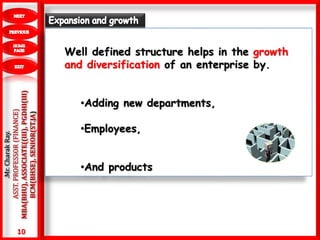
Well defined structure helps in the growth
and diversification of an enterprise by.
•Adding new departments,
•Employees,
•And products
11
.Mr.CharakRay.
ASST.PROFESSOR(FINANCE)
MBA(BHU),ASSOCIATE((III),PGDHI(III)
BCM(BHSE),SENIOR(ST.JA)
Provides a clear picture
of jobs and related duties.
Reduces
overlapping and confusion
And
brings effectiveness in administration
12
.Mr.CharakRay.
ASST.PROFESSOR(FINANCE)
MBA(BHU),ASSOCIATE((III),PGDHI(III)
BCM(BHSE),SENIOR(ST.JA)
Delegation
reduces the work load of managers by
assigning routine
jobs to their subordinates.
Managers can
concentrate on important task
13
.Mr.CharakRay.
ASST.PROFESSOR(FINANCE)
MBA(BHU),ASSOCIATE((III),PGDHI(III)
BCM(BHSE),SENIOR(ST.JA)
Well defined job helps
each employee to know
their role and duties
It reduces duplication of work and prevents
confusion
14
.Mr.CharakRay.
ASST.PROFESSOR(FINANCE)
MBA(BHU),ASSOCIATE((III),PGDHI(III)
BCM(BHSE),SENIOR(ST.JA)
When any employee
retires or quit
It is easy for a new employee
to adjust quickly because job profile are
clearly defined
15
.Mr.CharakRay.
ASST.PROFESSOR(FINANCE)
MBA(BHU),ASSOCIATE((III),PGDHI(III)
BCM(BHSE),SENIOR(ST.JA)
Types of
organization
Formal
organization
Functional
structure
Divisional
structure
Informal
organization
16
.Mr.CharakRay.
ASST.PROFESSOR(FINANCE)
MBA(BHU),ASSOCIATE((III),PGDHI(III)
BCM(BHSE),SENIOR(ST.JA)
17
.Mr.CharakRay.
ASST.PROFESSOR(FINANCE)
MBA(BHU),ASSOCIATE((III),PGDHI(III)
BCM(BHSE),SENIOR(ST.JA) Deliberately Planned
By The Top Management To Achieve The
Specified Objectives
Though The Network Of Authority
Responsibility Relationship
18
.Mr.CharakRay.
ASST.PROFESSOR(FINANCE)
MBA(BHU),ASSOCIATE((III),PGDHI(III)
BCM(BHSE),SENIOR(ST.JA)
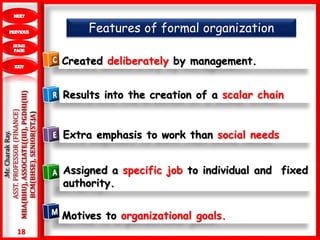
Created deliberately by management.
Results into the creation of a scalar chain
Extra emphasis to work than social needs
Assigned a specific job to individual and fixed
authority.
Motives to organizational goals.
Features of formal organization
19
.Mr.CharakRay.
ASST.PROFESSOR(FINANCE)
MBA(BHU),ASSOCIATE((III),PGDHI(III)
BCM(BHSE),SENIOR(ST.JA)
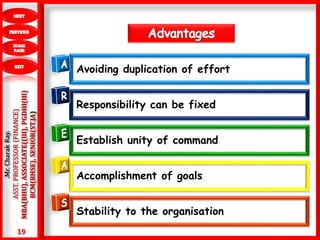
Avoiding duplication of effort
Responsibility can be fixed
Establish unity of command
Accomplishment of goals
Stability to the organisation
20
.Mr.CharakRay.
ASST.PROFESSOR(FINANCE)
MBA(BHU),ASSOCIATE((III),PGDHI(III)
BCM(BHSE),SENIOR(ST.JA)
Each member know their duties which are clearly
specified
Due to well establish authority responsibility
relationship
21
.Mr.CharakRay.
ASST.PROFESSOR(FINANCE)
MBA(BHU),ASSOCIATE((III),PGDHI(III)
BCM(BHSE),SENIOR(ST.JA)
Maintained through a chain of command
.
By providing a structure where each employee
knows their role
22
.Mr.CharakRay.
ASST.PROFESSOR(FINANCE)
MBA(BHU),ASSOCIATE((III),PGDHI(III)
BCM(BHSE),SENIOR(ST.JA)
By well defined job and ensure growth and survival
23
.Mr.CharakRay.
ASST.PROFESSOR(FINANCE)
MBA(BHU),ASSOCIATE((III),PGDHI(III)
BCM(BHSE),SENIOR(ST.JA)
Talent and creativity reduces
Rigid structure
Inter-personal relationship no scope
Procedural delays
24
.Mr.CharakRay.
ASST.PROFESSOR(FINANCE)
MBA(BHU),ASSOCIATE((III),PGDHI(III)
BCM(BHSE),SENIOR(ST.JA)
Of worker is reduced due to rigid policies
Do not allowed deviation due to fixed role assign
to employees
25
.Mr.CharakRay.
ASST.PROFESSOR(FINANCE)
MBA(BHU),ASSOCIATE((III),PGDHI(III)
BCM(BHSE),SENIOR(ST.JA)
Increase the time taken for urgent decision making
.
Leaves Gaps between persons
issuing orders and subordinates
following orders
26
.Mr.CharakRay.
ASST.PROFESSOR(FINANCE)
MBA(BHU),ASSOCIATE((III),PGDHI(III)
BCM(BHSE),SENIOR(ST.JA)
27
.Mr.CharakRay.
ASST.PROFESSOR(FINANCE)
MBA(BHU),ASSOCIATE((III),PGDHI(III)
BCM(BHSE),SENIOR(ST.JA) Complex network of
social relationships which emerges
unexpectedly to
fulfill social and human needs
28
.Mr.CharakRay.
ASST.PROFESSOR(FINANCE)
MBA(BHU),ASSOCIATE((III),PGDHI(III)
BCM(BHSE),SENIOR(ST.JA)
Created automatically without any purposeful
efforts by the management
Originates from within formal organization as a
result of personal interactions among employees
Does not follow any fixed path of authority
Employees behavior is based on convenience
with no definite structure
Features of Informal organization
29
.Mr.CharakRay.
ASST.PROFESSOR(FINANCE)
MBA(BHU),ASSOCIATE((III),PGDHI(III)
BCM(BHSE),SENIOR(ST.JA)
Fast
Add flexibility
Social needs
Timely feedback
30
.Mr.CharakRay.
ASST.PROFESSOR(FINANCE)
MBA(BHU),ASSOCIATE((III),PGDHI(III)
BCM(BHSE),SENIOR(ST.JA)
Information travels
very fast as there
is no procedural and language barrier
Serves the purpose not
fulfill by formal organization make it more
effective
31
.Mr.CharakRay.
ASST.PROFESSOR(FINANCE)
MBA(BHU),ASSOCIATE((III),PGDHI(III)
BCM(BHSE),SENIOR(ST.JA)
Prescribed lines of communication
are not followed and
quick feedback gets from informal channels
Of the members are
fulfill and gives them a
sense of belongingness in the organisation
32
.Mr.CharakRay.
ASST.PROFESSOR(FINANCE)
MBA(BHU),ASSOCIATE((III),PGDHI(III)
BCM(BHSE),SENIOR(ST.JA)
Opposition by members
Promotes groups
Spread rumors
33
.Mr.CharakRay.
ASST.PROFESSOR(FINANCE)
MBA(BHU),ASSOCIATE((III),PGDHI(III)
BCM(BHSE),SENIOR(ST.JA)
The management may
not be successful in implementing
changes
if the informal organisation opposes them.
34
.Mr.CharakRay.
ASST.PROFESSOR(FINANCE)
MBA(BHU),ASSOCIATE((III),PGDHI(III)
BCM(BHSE),SENIOR(ST.JA)
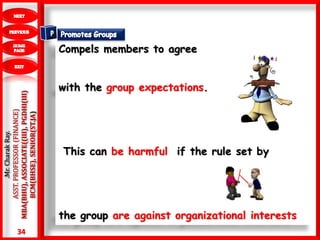
Compels members to agree
with the group expectations.
This can be harmful if the rule set by
the group are against organizational interests
35
.Mr.CharakRay.
ASST.PROFESSOR(FINANCE)
MBA(BHU),ASSOCIATE((III),PGDHI(III)
BCM(BHSE),SENIOR(ST.JA)
Due to fast flow
of information it
can spreads rumors which
may work against the goodwill of the formal
organisation.
36
.Mr.CharakRay.
ASST.PROFESSOR(FINANCE)
MBA(BHU),ASSOCIATE((III),PGDHI(III)
BCM(BHSE),SENIOR(ST.JA)
37
.Mr.CharakRay.
ASST.PROFESSOR(FINANCE)
MBA(BHU),ASSOCIATE((III),PGDHI(III)
BCM(BHSE),SENIOR(ST.JA)
38
.Mr.CharakRay.
ASST.PROFESSOR(FINANCE)
MBA(BHU),ASSOCIATE((III),PGDHI(III)
BCM(BHSE),SENIOR(ST.JA)
39
.Mr.CharakRay.
ASST.PROFESSOR(FINANCE)
MBA(BHU),ASSOCIATE((III),PGDHI(III)
BCM(BHSE),SENIOR(ST.JA)
40
.Mr.CharakRay.
ASST.PROFESSOR(FINANCE)
MBA(BHU),ASSOCIATE((III),PGDHI(III)
BCM(BHSE),SENIOR(ST.JA)
41
.Mr.CharakRay.
ASST.PROFESSOR(FINANCE)
MBA(BHU),ASSOCIATE((III),PGDHI(III)
BCM(BHSE),SENIOR(ST.JA)
42
.Mr.CharakRay.
ASST.PROFESSOR(FINANCE)
MBA(BHU),ASSOCIATE((III),PGDHI(III)
BCM(BHSE),SENIOR(ST.JA)
43
.Mr.CharakRay.
ASST.PROFESSOR(FINANCE)
MBA(BHU),ASSOCIATE((III),PGDHI(III)
BCM(BHSE),SENIOR(ST.JA)
44
.Mr.CharakRay.
ASST.PROFESSOR(FINANCE)
MBA(BHU),ASSOCIATE((III),PGDHI(III)
BCM(BHSE),SENIOR(ST.JA)
45
.Mr.CharakRay.
ASST.PROFESSOR(FINANCE)
MBA(BHU),ASSOCIATE((III),PGDHI(III)
BCM(BHSE),SENIOR(ST.JA)
46
.Mr.CharakRay.
ASST.PROFESSOR(FINANCE)
MBA(BHU),ASSOCIATE((III),PGDHI(III)
BCM(BHSE),SENIOR(ST.JA)
Basis Formal organization Informal organization
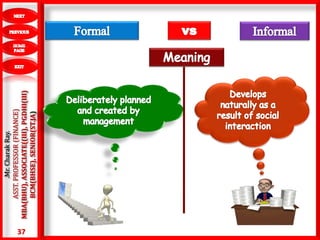
Meaning Deliberately planned
and created by
management
Emerges naturally as a
result of social
interaction among people
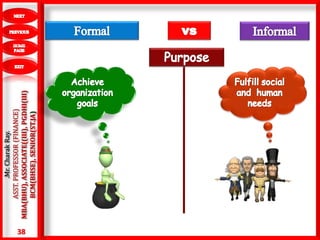
Purpose Achieve organization
goals
Fulfill social and human
needs
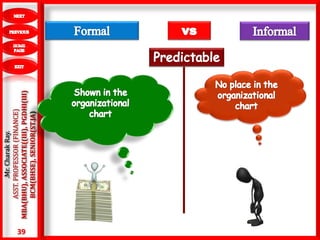
Shown in the
organizational chart
Authority
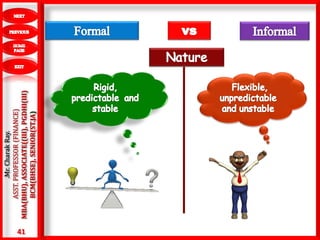
Nature Rigid, predictable and
stable
Flexible, unpredictable and
unstable
Rule, duties and
responsibilities are clearly
defined and written
generally oral and
traditional rules.
No place in the
organizational chart
Predictable
47
.Mr.CharakRay.
ASST.PROFESSOR(FINANCE)
MBA(BHU),ASSOCIATE((III),PGDHI(III)
BCM(BHSE),SENIOR(ST.JA)
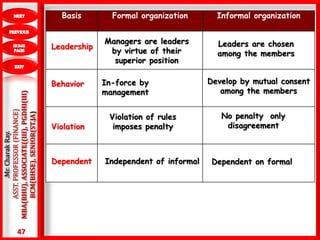
Basis Formal organization Informal organization
Leadership
Behavior
Violation
Dependent
Managers are leaders
by virtue of their
superior position
Leaders are chosen
among the members
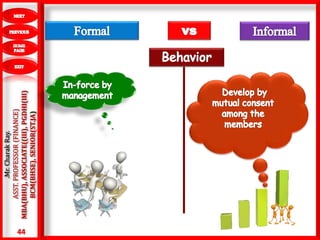
In-force by
management
Develop by mutual consent
among the members
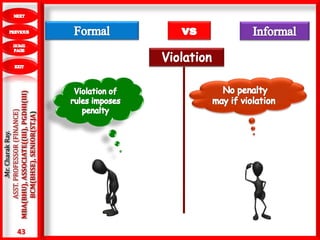
Violation of rules
imposes penalty
No penalty only
disagreement
Independent of informal Dependent on formal
48
.Mr.CharakRay.
ASST.PROFESSOR(FINANCE)
MBA(BHU),ASSOCIATE((III),PGDHI(III)
BCM(BHSE),SENIOR(ST.JA)
1. The employees of M ltd., A software company, have formed a
dramatic group for their recreation. Name the type of
organization so formed and state its three features.
2. Informal organisation is considered better than formal
organisation.” Do you agree with this statement? Give reasons.
3. Formal organisation is impersonal while informal organisation is
personal.” Clarify this statement.
4. Informal organization is dependent on formal organization
49
.Mr.CharakRay.
ASST.PROFESSOR(FINANCE)
MBA(BHU),ASSOCIATE((III),PGDHI(III)
BCM(BHSE),SENIOR(ST.JA)
Provides the framework which enables the
enterprise to coordinate the
responsibilities of individuals and
departments
Types
Functional
Structure
Divisional
Structure
50
.Mr.CharakRay.
ASST.PROFESSOR(FINANCE)
MBA(BHU),ASSOCIATE((III),PGDHI(III)
BCM(BHSE),SENIOR(ST.JA) Factor affecting organizational structure
Job design
Departmentation
Span of management
Delegation of authority
51
.Mr.CharakRay.
ASST.PROFESSOR(FINANCE)
MBA(BHU),ASSOCIATE((III),PGDHI(III)
BCM(BHSE),SENIOR(ST.JA)
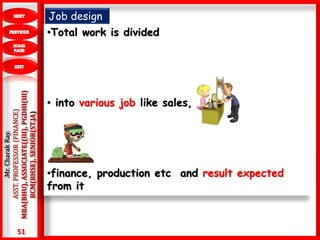
Job design
•Total work is divided
• into various job like sales,
•finance, production etc and result expected
from it
52
.Mr.CharakRay.
ASST.PROFESSOR(FINANCE)
MBA(BHU),ASSOCIATE((III),PGDHI(III)
BCM(BHSE),SENIOR(ST.JA)
Departmentation
•Jobs are group
•together to form departments
• on the basis of similar task like per unit cost,
quality control under purchase department
53
.Mr.CharakRay.
ASST.PROFESSOR(FINANCE)
MBA(BHU),ASSOCIATE((III),PGDHI(III)
BCM(BHSE),SENIOR(ST.JA)
Span of management
•No of employees that can be effectively
managed by superior
•Narrow span:- when the size of the organization
is large
•Wide span: - when the size of the organization
is small
54
.Mr.CharakRay.
ASST.PROFESSOR(FINANCE)
MBA(BHU),ASSOCIATE((III),PGDHI(III)
BCM(BHSE),SENIOR(ST.JA)
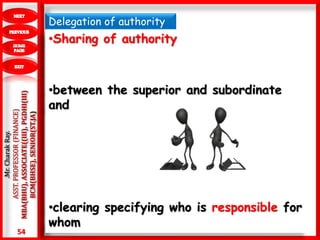
Delegation of authority
•Sharing of authority
•between the superior and subordinate
and
•clearing specifying who is responsible for
whom
55
.Mr.CharakRay.
ASST.PROFESSOR(FINANCE)
MBA(BHU),ASSOCIATE((III),PGDHI(III)
BCM(BHSE),SENIOR(ST.JA)
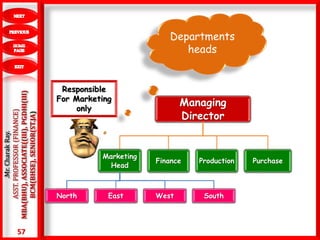
Managing
Director
Marketing
Head
North East West South
Finance Production Purchase
56
.Mr.CharakRay.
ASST.PROFESSOR(FINANCE)
MBA(BHU),ASSOCIATE((III),PGDHI(III)
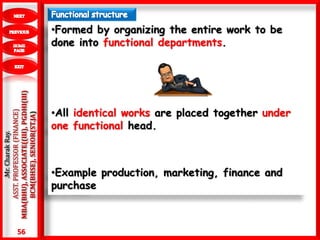
BCM(BHSE),SENIOR(ST.JA) •Formed by organizing the entire work to be
done into functional departments.
•All identical works are placed together under
one functional head.
•Example production, marketing, finance and
purchase
57
.Mr.CharakRay.
ASST.PROFESSOR(FINANCE)
MBA(BHU),ASSOCIATE((III),PGDHI(III)
BCM(BHSE),SENIOR(ST.JA)
Managing
Director
Marketing
Head
North East West South
Finance Production Purchase
Departments
heads
Responsible
For Marketing
only
58
.Mr.CharakRay.
ASST.PROFESSOR(FINANCE)
MBA(BHU),ASSOCIATE((III),PGDHI(III)
BCM(BHSE),SENIOR(ST.JA)
When size of organisation is large, operations
require a high degree of specialization. Example
59
.Mr.CharakRay.
ASST.PROFESSOR(FINANCE)
MBA(BHU),ASSOCIATE((III),PGDHI(III)
BCM(BHSE),SENIOR(ST.JA)
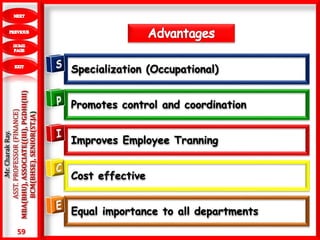
Specialization (Occupational)
Promotes control and coordination
Improves Employee Tranning
Cost effective
Equal importance to all departments
60
.Mr.CharakRay.
ASST.PROFESSOR(FINANCE)
MBA(BHU),ASSOCIATE((III),PGDHI(III)
BCM(BHSE),SENIOR(ST.JA)
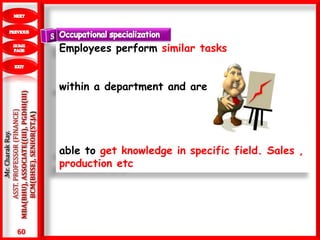
Employees perform similar tasks
within a department and are
able to get knowledge in specific field. Sales ,
production etc
61
.Mr.CharakRay.
ASST.PROFESSOR(FINANCE)
MBA(BHU),ASSOCIATE((III),PGDHI(III)
BCM(BHSE),SENIOR(ST.JA)
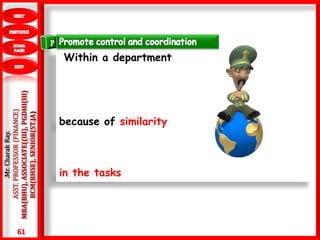
Within a department
because of similarity
in the tasks
62
.Mr.CharakRay.
ASST.PROFESSOR(FINANCE)
MBA(BHU),ASSOCIATE((III),PGDHI(III)
BCM(BHSE),SENIOR(ST.JA)
Training of employees
is easier as the focus is only
on a limited range of skills.
63
.Mr.CharakRay.
ASST.PROFESSOR(FINANCE)
MBA(BHU),ASSOCIATE((III),PGDHI(III)
BCM(BHSE),SENIOR(ST.JA)
Leads to
minimal duplication of effort
which results in economies of scale
64
.Mr.CharakRay.
ASST.PROFESSOR(FINANCE)
MBA(BHU),ASSOCIATE((III),PGDHI(III)
BCM(BHSE),SENIOR(ST.JA)
Provides
equal attention and
importance to different functions (department)
.
65
.Mr.CharakRay.
ASST.PROFESSOR(FINANCE)
MBA(BHU),ASSOCIATE((III),PGDHI(III)
BCM(BHSE),SENIOR(ST.JA)
Functional Empires
Limited Growth
Inter-departmental Conflicts
Problem Of Repsonsibility
66
.Mr.CharakRay.
ASST.PROFESSOR(FINANCE)
MBA(BHU),ASSOCIATE((III),PGDHI(III)
BCM(BHSE),SENIOR(ST.JA)
Less importance on
overall enterprise
objectives than the objectives follow by a
functional head
67
.Mr.CharakRay.
ASST.PROFESSOR(FINANCE)
MBA(BHU),ASSOCIATE((III),PGDHI(III)
BCM(BHSE),SENIOR(ST.JA)
Functional heads do
not get training for top management positions
because
they are unable to gather experience in diverse
areas.
68
.Mr.CharakRay.
ASST.PROFESSOR(FINANCE)
MBA(BHU),ASSOCIATE((III),PGDHI(III)
BCM(BHSE),SENIOR(ST.JA)
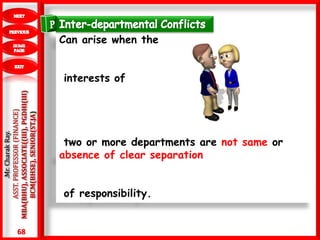
Can arise when the
interests of
two or more departments are not same or
absence of clear separation
of responsibility.
69
.Mr.CharakRay.
ASST.PROFESSOR(FINANCE)
MBA(BHU),ASSOCIATE((III),PGDHI(III)
BCM(BHSE),SENIOR(ST.JA)
Functional head are
responsible for a particulars function and if
some things go wrong
it become very difficult
to fix responsibility..
70
.Mr.CharakRay.
ASST.PROFESSOR(FINANCE)
MBA(BHU),ASSOCIATE((III),PGDHI(III)
BCM(BHSE),SENIOR(ST.JA)
Hotels Garments Food Product
71
.Mr.CharakRay.
ASST.PROFESSOR(FINANCE)
MBA(BHU),ASSOCIATE((III),PGDHI(III)
BCM(BHSE),SENIOR(ST.JA) •Organisation structure comprises of separate
business units or divisions.
•Each unit has a divisional manager responsible
for performance and who has authority over
the unit.
72
.Mr.CharakRay.
ASST.PROFESSOR(FINANCE)
MBA(BHU),ASSOCIATE((III),PGDHI(III)
BCM(BHSE),SENIOR(ST.JA)
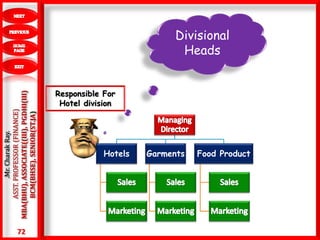
Divisional
Heads
Responsible For
Hotel division
Hotels Garments Food Product
73
.Mr.CharakRay.
ASST.PROFESSOR(FINANCE)
MBA(BHU),ASSOCIATE((III),PGDHI(III)
BCM(BHSE),SENIOR(ST.JA) Business enterprises where a large variety of
products are manufactured using different
productive resources. Example
74
.Mr.CharakRay.
ASST.PROFESSOR(FINANCE)
MBA(BHU),ASSOCIATE((III),PGDHI(III)
BCM(BHSE),SENIOR(ST.JA)
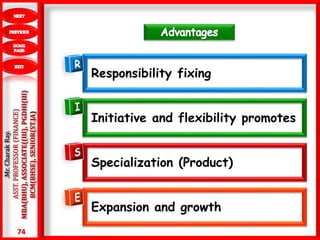
Responsibility fixing
Initiative and flexibility promotes
Specialization (Product)
Expansion and growth
75
.Mr.CharakRay.
ASST.PROFESSOR(FINANCE)
MBA(BHU),ASSOCIATE((III),PGDHI(III)
BCM(BHSE),SENIOR(ST.JA) Divisional heads are
accountable for profits,
Revenues and costs
related to different departments can be
easily identified.
76
.Mr.CharakRay.
ASST.PROFESSOR(FINANCE)
MBA(BHU),ASSOCIATE((III),PGDHI(III)
BCM(BHSE),SENIOR(ST.JA)
Because each
division functions as an
independent unit which
leads to faster decision making.
77
.Mr.CharakRay.
ASST.PROFESSOR(FINANCE)
MBA(BHU),ASSOCIATE((III),PGDHI(III)
BCM(BHSE),SENIOR(ST.JA) Helps in the development
of different skills in a
divisional head and
this prepares him for higher positions
78
.Mr.CharakRay.
ASST.PROFESSOR(FINANCE)
MBA(BHU),ASSOCIATE((III),PGDHI(III)
BCM(BHSE),SENIOR(ST.JA)
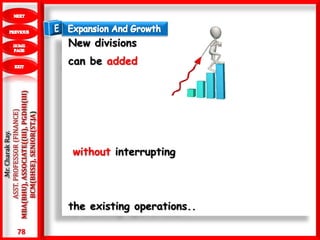
New divisions
can be added
without interrupting
the existing operations..
79
.Mr.CharakRay.
ASST.PROFESSOR(FINANCE)
MBA(BHU),ASSOCIATE((III),PGDHI(III)
BCM(BHSE),SENIOR(ST.JA)
Conflict
Add In Costs
Difficulty In Employee Training
80
.Mr.CharakRay.
ASST.PROFESSOR(FINANCE)
MBA(BHU),ASSOCIATE((III),PGDHI(III)
BCM(BHSE),SENIOR(ST.JA)
May arise among
different divisions
regarding allocation of funds
Since there
may be a duplication of
activities across products.
81
.Mr.CharakRay.
ASST.PROFESSOR(FINANCE)
MBA(BHU),ASSOCIATE((III),PGDHI(III)
BCM(BHSE),SENIOR(ST.JA)
.
Due to
diverse products
training of employees is quite difficult.
82
.Mr.CharakRay.
ASST.PROFESSOR(FINANCE)
MBA(BHU),ASSOCIATE((III),PGDHI(III)
BCM(BHSE),SENIOR(ST.JA)
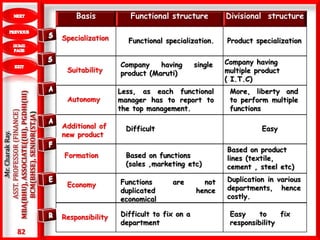
Basis Functional structure Divisional structure
Specialization
Suitability
Autonomy
Additional of
new product
Formation
Economy
Responsibility
Functional specialization.
Company having single
product (Maruti)
Less, as each functional
manager has to report to
the top management.
Difficult
Based on functions
(sales ,marketing etc)
Functions are not
duplicated hence
economical
Difficult to fix on a
department
Product specialization
Company having
multiple product
( I.T.C)
Easy to fix
responsibility
Duplication in various
departments, hence
costly.
Based on product
lines (textile,
cement , steel etc)
Easy
More, liberty and
to perform multiple
functions
83
.Mr.CharakRay.
ASST.PROFESSOR(FINANCE)
MBA(BHU),ASSOCIATE((III),PGDHI(III)
BCM(BHSE),SENIOR(ST.JA)
1. S Ltd. is manufacturing shirts and has production, marketing,
and personnel departments in the organisation. Name the type
of organisational structure Sahil Ltd. is following. State any
three advantages of this organisation structure.
2. In an electrical goods manufacturing company, there are four
main activities- production, marketing, finance and personel.
The general manager is planning to structure the organisation.
Which type of organisation structure should he adopt and
why? Give two reasons.
3. Rekha runs a shoe manufacturing factory. She wants to
expand her business. For expansion she thinks to enter into
the manufacturing of leather bags and western formal wear
apart from the running business of shoes. By doing this her
company will be able to provide many products to working
women under one roof.
84
.Mr.CharakRay.
ASST.PROFESSOR(FINANCE)
MBA(BHU),ASSOCIATE((III),PGDHI(III)
BCM(BHSE),SENIOR(ST.JA)
85
.Mr.CharakRay.
ASST.PROFESSOR(FINANCE)
MBA(BHU),ASSOCIATE((III),PGDHI(III)
BCM(BHSE),SENIOR(ST.JA)
So much work
load.
what should I
do.?????
86
.Mr.CharakRay.
ASST.PROFESSOR(FINANCE)
MBA(BHU),ASSOCIATE((III),PGDHI(III)
BCM(BHSE),SENIOR(ST.JA)
Boss why don’t
you give some of
your work to
your subordinate
Good
idea
87
.Mr.CharakRay.
ASST.PROFESSOR(FINANCE)
MBA(BHU),ASSOCIATE((III),PGDHI(III)
BCM(BHSE),SENIOR(ST.JA)
Mr khan you
will go for
meeting in
delhi
Mr bachan
you will look
after
finance part
Yess
boss
88
.Mr.CharakRay.
ASST.PROFESSOR(FINANCE)
MBA(BHU),ASSOCIATE((III),PGDHI(III)
BCM(BHSE),SENIOR(ST.JA)
It’s great.
Now I can
concentrate
on other
areas
89
.Mr.CharakRay.
ASST.PROFESSOR(FINANCE)
MBA(BHU),ASSOCIATE((III),PGDHI(III)
BCM(BHSE),SENIOR(ST.JA)
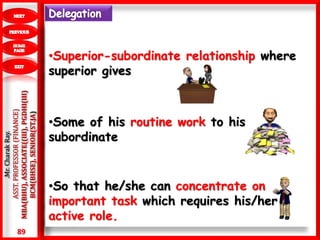
•Superior-subordinate relationship where
superior gives
•Some of his routine work to his
subordinate
•So that he/she can concentrate on
important task which requires his/her
active role.
90
.Mr.CharakRay.
ASST.PROFESSOR(FINANCE)
MBA(BHU),ASSOCIATE((III),PGDHI(III)
BCM(BHSE),SENIOR(ST.JA)
Elements of
delegation
Authority Responsibility Accountability
91
.Mr.CharakRay.
ASST.PROFESSOR(FINANCE)
MBA(BHU),ASSOCIATE((III),PGDHI(III)
BCM(BHSE),SENIOR(ST.JA)
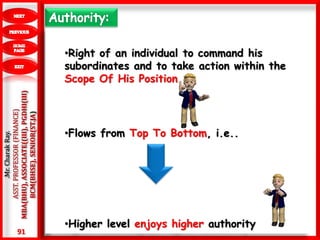
•Right of an individual to command his
subordinates and to take action within the
Scope Of His Position.
•Flows from Top To Bottom, i.e..
•Higher level enjoys higher authority
92
.Mr.CharakRay.
ASST.PROFESSOR(FINANCE)
MBA(BHU),ASSOCIATE((III),PGDHI(III)
BCM(BHSE),SENIOR(ST.JA)
•Obligation of a subordinate to perform the
assigned duty.
•Flows Upwards i.e., a subordinate will always
be responsible to his superior
•Arises from a Superior–subordinate
relationship
93
.Mr.CharakRay.
ASST.PROFESSOR(FINANCE)
MBA(BHU),ASSOCIATE((III),PGDHI(III)
BCM(BHSE),SENIOR(ST.JA)
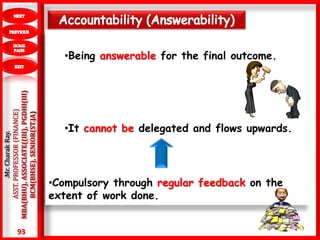
•Being answerable for the final outcome.
•It cannot be delegated and flows upwards.
•Compulsory through regular feedback on the
extent of work done.
94
.Mr.CharakRay.
ASST.PROFESSOR(FINANCE)
MBA(BHU),ASSOCIATE((III),PGDHI(III)
BCM(BHSE),SENIOR(ST.JA)
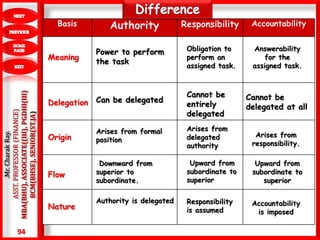
Basis Authority Responsibility Accountability
Meaning
Delegation
Origin
Flow
Power to perform
the task
Obligation to
perform an
assigned task.
Answerability
for the
assigned task.
Can be delegated
Cannot be
entirely
delegated
Cannot be
delegated at all
Arises from formal
position
Arises from
delegated
authority
Arises from
responsibility.
Downward from
superior to
subordinate.
Upward from
subordinate to
superior
Upward from
subordinate to
superior
Nature
Authority is delegated Accountability
is imposed
Responsibility
is assumed
95
.Mr.CharakRay.
ASST.PROFESSOR(FINANCE)
MBA(BHU),ASSOCIATE((III),PGDHI(III)
BCM(BHSE),SENIOR(ST.JA)
Basis Of Management Hierarchy
Effective Management
Coordination
Assist In Growth
Motivation Of Employees
Employee Development
96
.Mr.CharakRay.
ASST.PROFESSOR(FINANCE)
MBA(BHU),ASSOCIATE((III),PGDHI(III)
BCM(BHSE),SENIOR(ST.JA)
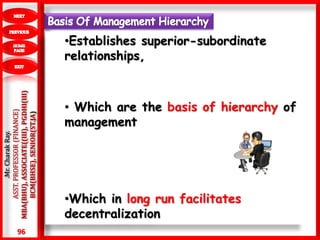
•Establishes superior-subordinate
relationships,
• Which are the basis of hierarchy of
management
•Which in long run facilitates
decentralization
97
.Mr.CharakRay.
ASST.PROFESSOR(FINANCE)
MBA(BHU),ASSOCIATE((III),PGDHI(III)
BCM(BHSE),SENIOR(ST.JA)
•By delegating
•Routine task manager
• Can concentrate on important task and
excel in new areas
98
.Mr.CharakRay.
ASST.PROFESSOR(FINANCE)
MBA(BHU),ASSOCIATE((III),PGDHI(III)
BCM(BHSE),SENIOR(ST.JA) Help to define
the powers, duties and answerability
related to the
various positions in an organisation
which reduces duplication of effort
99
.Mr.CharakRay.
ASST.PROFESSOR(FINANCE)
MBA(BHU),ASSOCIATE((III),PGDHI(III)
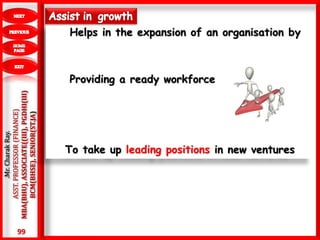
BCM(BHSE),SENIOR(ST.JA) Helps in the expansion of an organisation by
Providing a ready workforce
To take up leading positions in new ventures
10
0
.Mr.CharakRay.
ASST.PROFESSOR(FINANCE)
MBA(BHU),ASSOCIATE((III),PGDHI(III)
BCM(BHSE),SENIOR(ST.JA) Trust on the
part of superior and
commitment on the part of subordinate
motivate the subordinate to perform better
and improves his confidence
10
1
.Mr.CharakRay.
ASST.PROFESSOR(FINANCE)
MBA(BHU),ASSOCIATE((III),PGDHI(III)
BCM(BHSE),SENIOR(ST.JA) Employees gets
More opportunities use their skills,
gain experience
And develop them for higher positions
10
2
.Mr.CharakRay.
ASST.PROFESSOR(FINANCE)
MBA(BHU),ASSOCIATE((III),PGDHI(III)
BCM(BHSE),SENIOR(ST.JA)
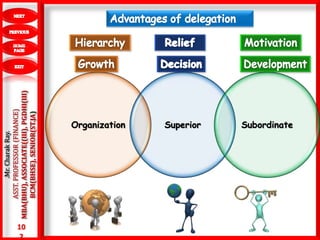
Organization Superior Subordinate
10
3
.Mr.CharakRay.
ASST.PROFESSOR(FINANCE)
MBA(BHU),ASSOCIATE((III),PGDHI(III)
BCM(BHSE),SENIOR(ST.JA)
Types Of Decision
Making
Centralization Decentralization
10
4
.Mr.CharakRay.
ASST.PROFESSOR(FINANCE)
MBA(BHU),ASSOCIATE((III),PGDHI(III)
BCM(BHSE),SENIOR(ST.JA)
•Decision-making authority is retained
by higher management levels
•Generally exists in smaller
organization
10
5
.Mr.CharakRay.
ASST.PROFESSOR(FINANCE)
MBA(BHU),ASSOCIATE((III),PGDHI(III)
BCM(BHSE),SENIOR(ST.JA)
•Process of giving authority at lowest
level of management to take decision
within their powers
•Managers enjoys more freedom of
action
•Suitable for large organization and
complex organizaiton
10
6
.Mr.CharakRay.
ASST.PROFESSOR(FINANCE)
MBA(BHU),ASSOCIATE((III),PGDHI(III)
BCM(BHSE),SENIOR(ST.JA)
Basis Centralization decentralization
Meaning
Suitable
Autonomy
Decision making power
at higher level Distributing of power
at the lowest level
Smaller firms Large firm
Managers have less
freedom of action
Managers enjoys more
freedom of action
10
7
.Mr.CharakRay.
ASST.PROFESSOR(FINANCE)
MBA(BHU),ASSOCIATE((III),PGDHI(III)
BCM(BHSE),SENIOR(ST.JA)
Decision making becomes fast
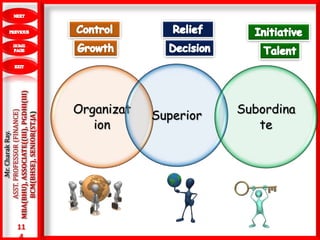
Relief to top management
Assist in growth
Enhance initiative among subordinates
Managerial talent for the future develops
Smooth control
10
8
.Mr.CharakRay.
ASST.PROFESSOR(FINANCE)
MBA(BHU),ASSOCIATE((III),PGDHI(III)
BCM(BHSE),SENIOR(ST.JA)
Decisions are taken to the nearest
points of action
And there is no requirement for
approval from many levels,
Information doesn’t have to go through
long channels
10
9
.Mr.CharakRay.
ASST.PROFESSOR(FINANCE)
MBA(BHU),ASSOCIATE((III),PGDHI(III)
BCM(BHSE),SENIOR(ST.JA)
Reduces direct super-vision by a
superior
Top management can concentrate
on major policy decisions rather
than day to day decisions.
11
0
.Mr.CharakRay.
ASST.PROFESSOR(FINANCE)
MBA(BHU),ASSOCIATE((III),PGDHI(III)
BCM(BHSE),SENIOR(ST.JA)
Promotes confidence among the
subordinates due to
freedom to take their own decisions
Brings more creativity and new ideas in
the organization.
11
1
.Mr.CharakRay.
ASST.PROFESSOR(FINANCE)
MBA(BHU),ASSOCIATE((III),PGDHI(III)
BCM(BHSE),SENIOR(ST.JA)
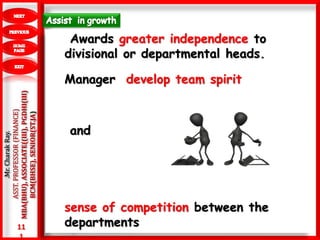
Awards greater independence to
divisional or departmental heads.
Manager develop team spirit
and
sense of competition between the
departments
11
2
.Mr.CharakRay.
ASST.PROFESSOR(FINANCE)
MBA(BHU),ASSOCIATE((III),PGDHI(III)
BCM(BHSE),SENIOR(ST.JA)
Gives employee chance to
prove their abilities to in their own
working
Helps to develop multi skills talents due
to greater autonomy
11
3
.Mr.CharakRay.
ASST.PROFESSOR(FINANCE)
MBA(BHU),ASSOCIATE((III),PGDHI(III)
BCM(BHSE),SENIOR(ST.JA)
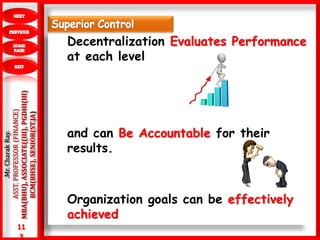
Decentralization Evaluates Performance
at each level
and can Be Accountable for their
results.
Organization goals can be effectively
achieved
11
4
.Mr.CharakRay.
ASST.PROFESSOR(FINANCE)
MBA(BHU),ASSOCIATE((III),PGDHI(III)
BCM(BHSE),SENIOR(ST.JA)
Organizat
ion
Superior
Subordina
te
11
5
.Mr.CharakRay.
ASST.PROFESSOR(FINANCE)
MBA(BHU),ASSOCIATE((III),PGDHI(III)
BCM(BHSE),SENIOR(ST.JA)
11
6
.Mr.CharakRay.
ASST.PROFESSOR(FINANCE)
MBA(BHU),ASSOCIATE((III),PGDHI(III)
BCM(BHSE),SENIOR(ST.JA)
11
7
.Mr.CharakRay.
ASST.PROFESSOR(FINANCE)
MBA(BHU),ASSOCIATE((III),PGDHI(III)
BCM(BHSE),SENIOR(ST.JA)
11
8
.Mr.CharakRay.
ASST.PROFESSOR(FINANCE)
MBA(BHU),ASSOCIATE((III),PGDHI(III)
BCM(BHSE),SENIOR(ST.JA)
11
9
.Mr.CharakRay.
ASST.PROFESSOR(FINANCE)
MBA(BHU),ASSOCIATE((III),PGDHI(III)
BCM(BHSE),SENIOR(ST.JA)
12
0
.Mr.CharakRay.
ASST.PROFESSOR(FINANCE)
MBA(BHU),ASSOCIATE((III),PGDHI(III)
BCM(BHSE),SENIOR(ST.JA)
12
1
.Mr.CharakRay.
ASST.PROFESSOR(FINANCE)
MBA(BHU),ASSOCIATE((III),PGDHI(III)
BCM(BHSE),SENIOR(ST.JA)
Basis Delegation Decentralization
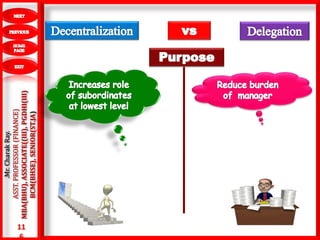
Purpose Reduce burden of the
manager.
Increases the role of
subordinates to lowest
level
Essential
Compulsory act because
no individual can perform
all tasks
Optional. Done at the
option of the top
management.
Autonomy
Of Action
Authority
withdrawn
Scope
Subordinates enjoy
less freedom
Subordinates enjoys
more freedom.
Authority can be
withdrawn by delegator
Cannot be easily
withdrawn
Narrow scope limited to
superior and his
immediate subordinate
Wide scope. Extension
of delegation to the
lowest level
12
2
.Mr.CharakRay.
ASST.PROFESSOR(FINANCE)
MBA(BHU),ASSOCIATE((III),PGDHI(III)
BCM(BHSE),SENIOR(ST.JA)
1. Delegation of authority is based on the elementary principle of
division of labor.” Explain this statement.
2. Authority can be delegated but accountability cannot.” Explain
this statement.
3. Can an overburdened manager take help from his subordinate?
How? Explain three important things which he should keep in
mind while taking such help.
4. Decentralization is an optional policy. Explain why an
organisation would choose to be decentralized?
5. If we delegate the authority, we multiply it by two, if we
decentralize it, we multiply it by many.” How? Give an
example.

ORGANISING

Editor's Notes