Order:
“Diptera”
Presented To:
“Dr Anjum Aqeel”
Presented By:
“Shahzaib Ali”
Roll No:
BAGF13E274 Sr# 03
ENT-504
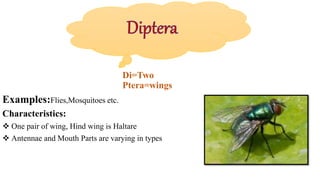
Di=Two
Ptera=wings
Examples:Flies,Mosquitoes etc.
Characteristics:
 One pair of wing, Hind wing is Haltare
 Antennae and Mouth Parts are varying in types
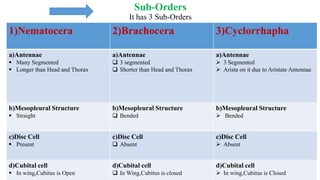
Sub-Orders
It has 3 Sub-Orders
1)Nematocera 2)Brachocera 3)Cyclorrhapha
a)Antennae
 Many Segmented
 Longer than Head and Thorax
a)Antennae
 3 segmented
 Shorter than Head and Thorax
a)Antennae
 3 Segmented
 Arista on it due to Aristate Antennae
b)Mesopleural Structure
 Straight
b)Mesopleural Structure
 Bended
b)Mesopleural Structure
 Bended
c)Disc Cell
 Present
c)Disc Cell
 Absent
c)Disc Cell
 Absent
d)Cubital cell
 In wing,Cubitus is Open
d)Cubital cell
 In Wing,Cubitus is closed
d)Cubital cell
 In wing,Cubitus is Closed
Families
A)Nematocera:
It has 6 Families
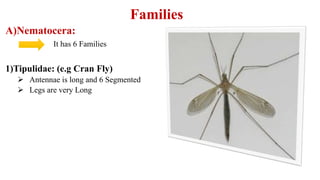
1)Tipulidae: (e.g Cran Fly)
 Antennae is long and 6 Segmented
 Legs are very Long
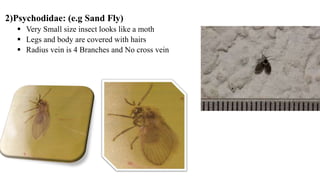
2)Psychodidae: (e.g Sand Fly)
 Very Small size insect looks like a moth
 Legs and body are covered with hairs
 Radius vein is 4 Branches and No cross vein
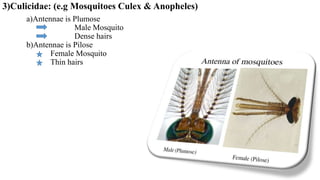
3)Culicidae: (e.g Mosquitoes Culex & Anopheles)
a)Antennae is Plumose
Male Mosquito
Dense hairs
b)Antennae is Pilose
Female Mosquito
Thin hairs
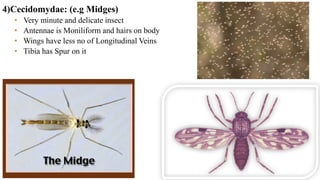
4)Cecidomydae: (e.g Midges)
• Very minute and delicate insect
• Antennae is Moniliform and hairs on body
• Wings have less no of Longitudinal Veins
• Tibia has Spur on it
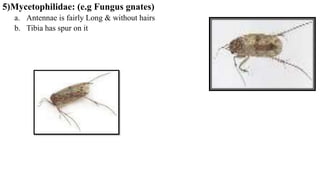
5)Mycetophilidae: (e.g Fungus gnates)
a. Antennae is fairly Long & without hairs
b. Tibia has spur on it
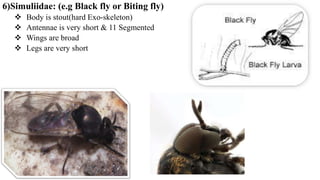
6)Simuliidae: (e.g Black fly or Biting fly)
 Body is stout(hard Exo-skeleton)
 Antennae is very short & 11 Segmented
 Wings are broad
 Legs are very short
B)Brachocera:
It has 3 Families
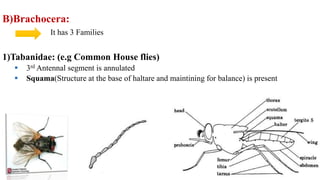
1)Tabanidae: (e.g Common House flies)
 3rd Antennal segment is annulated
 Squama(Structure at the base of haltare and maintining for balance) is present
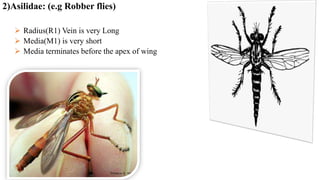
2)Asilidae: (e.g Robber flies)
 Radius(R1) Vein is very Long
 Media(M1) is very short
 Media terminates before the apex of wing
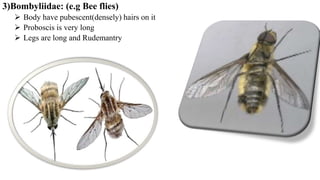
3)Bombyliidae: (e.g Bee flies)
 Body have pubescent(densely) hairs on it
 Proboscis is very long
 Legs are long and Rudemantry
C)Cyclorrhapha:
It has 7 Families
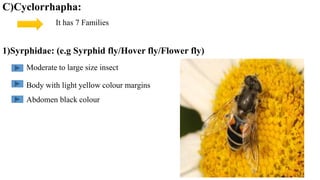
1)Syrphidae: (e.g Syrphid fly/Hover fly/Flower fly)
Moderate to large size insect
Body with light yellow colour margins
Abdomen black colour
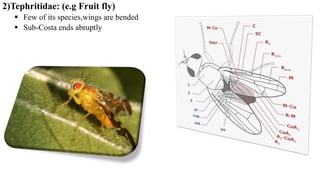
2)Tephritidae: (e.g Fruit fly)
 Few of its species,wings are bended
 Sub-Costa ends abruptly
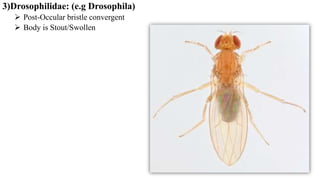
3)Drosophilidae: (e.g Drosophila)
 Post-Occular bristle convergent
 Body is Stout/Swollen
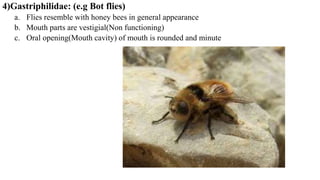
4)Gastriphilidae: (e.g Bot flies)
a. Flies resemble with honey bees in general appearance
b. Mouth parts are vestigial(Non functioning)
c. Oral opening(Mouth cavity) of mouth is rounded and minute
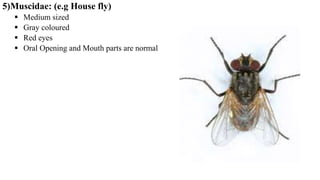
5)Muscidae: (e.g House fly)
 Medium sized
 Gray coloured
 Red eyes
 Oral Opening and Mouth parts are normal
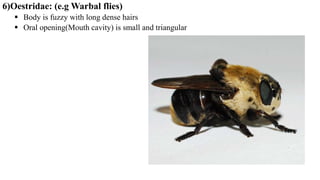
6)Oestridae: (e.g Warbal flies)
 Body is fuzzy with long dense hairs
 Oral opening(Mouth cavity) is small and triangular
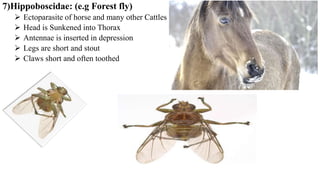
7)Hippoboscidae: (e.g Forest fly)
 Ectoparasite of horse and many other Cattles
 Head is Sunkened into Thorax
 Antennae is inserted in depression
 Legs are short and stout
 Claws short and often toothed
Order Diptera

Order Diptera

  • 2.
    Order: “Diptera” Presented To: “Dr AnjumAqeel” Presented By: “Shahzaib Ali” Roll No: BAGF13E274 Sr# 03 ENT-504
  • 3.
    Di=Two Ptera=wings Examples:Flies,Mosquitoes etc. Characteristics:  Onepair of wing, Hind wing is Haltare  Antennae and Mouth Parts are varying in types
  • 4.
    Sub-Orders It has 3Sub-Orders 1)Nematocera 2)Brachocera 3)Cyclorrhapha a)Antennae  Many Segmented  Longer than Head and Thorax a)Antennae  3 segmented  Shorter than Head and Thorax a)Antennae  3 Segmented  Arista on it due to Aristate Antennae b)Mesopleural Structure  Straight b)Mesopleural Structure  Bended b)Mesopleural Structure  Bended c)Disc Cell  Present c)Disc Cell  Absent c)Disc Cell  Absent d)Cubital cell  In wing,Cubitus is Open d)Cubital cell  In Wing,Cubitus is closed d)Cubital cell  In wing,Cubitus is Closed
  • 5.
    Families A)Nematocera: It has 6Families 1)Tipulidae: (e.g Cran Fly)  Antennae is long and 6 Segmented  Legs are very Long
  • 6.
    2)Psychodidae: (e.g SandFly)  Very Small size insect looks like a moth  Legs and body are covered with hairs  Radius vein is 4 Branches and No cross vein
  • 7.
    3)Culicidae: (e.g MosquitoesCulex & Anopheles) a)Antennae is Plumose Male Mosquito Dense hairs b)Antennae is Pilose Female Mosquito Thin hairs
  • 8.
    4)Cecidomydae: (e.g Midges) •Very minute and delicate insect • Antennae is Moniliform and hairs on body • Wings have less no of Longitudinal Veins • Tibia has Spur on it
  • 9.
    5)Mycetophilidae: (e.g Fungusgnates) a. Antennae is fairly Long & without hairs b. Tibia has spur on it
  • 10.
    6)Simuliidae: (e.g Blackfly or Biting fly)  Body is stout(hard Exo-skeleton)  Antennae is very short & 11 Segmented  Wings are broad  Legs are very short
  • 11.
    B)Brachocera: It has 3Families 1)Tabanidae: (e.g Common House flies)  3rd Antennal segment is annulated  Squama(Structure at the base of haltare and maintining for balance) is present
  • 12.
    2)Asilidae: (e.g Robberflies)  Radius(R1) Vein is very Long  Media(M1) is very short  Media terminates before the apex of wing
  • 13.
    3)Bombyliidae: (e.g Beeflies)  Body have pubescent(densely) hairs on it  Proboscis is very long  Legs are long and Rudemantry
  • 14.
    C)Cyclorrhapha: It has 7Families 1)Syrphidae: (e.g Syrphid fly/Hover fly/Flower fly) Moderate to large size insect Body with light yellow colour margins Abdomen black colour
  • 15.
    2)Tephritidae: (e.g Fruitfly)  Few of its species,wings are bended  Sub-Costa ends abruptly
  • 16.
    3)Drosophilidae: (e.g Drosophila) Post-Occular bristle convergent  Body is Stout/Swollen
  • 17.
    4)Gastriphilidae: (e.g Botflies) a. Flies resemble with honey bees in general appearance b. Mouth parts are vestigial(Non functioning) c. Oral opening(Mouth cavity) of mouth is rounded and minute
  • 18.
    5)Muscidae: (e.g Housefly)  Medium sized  Gray coloured  Red eyes  Oral Opening and Mouth parts are normal
  • 19.
    6)Oestridae: (e.g Warbalflies)  Body is fuzzy with long dense hairs  Oral opening(Mouth cavity) is small and triangular
  • 20.
    7)Hippoboscidae: (e.g Forestfly)  Ectoparasite of horse and many other Cattles  Head is Sunkened into Thorax  Antennae is inserted in depression  Legs are short and stout  Claws short and often toothed