Antennae of Insects
Structure and Classification
@Bhubanananda Adhikari
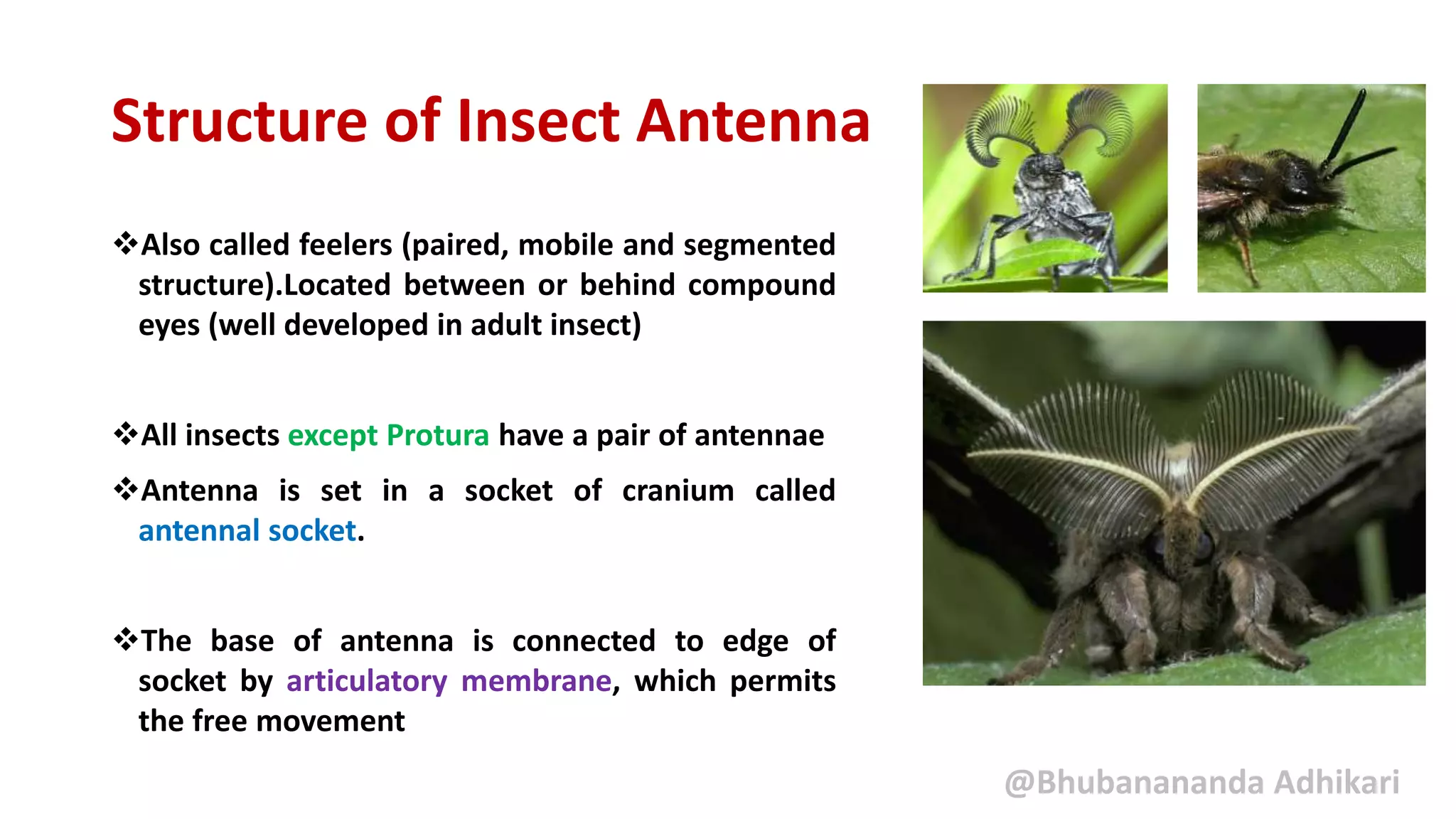
Also called feelers (paired, mobile and segmented
structure).Located between or behind compound
eyes (well developed in adult insect)
All insects except Protura have a pair of antennae
Antenna is set in a socket of cranium called
antennal socket.
The base of antenna is connected to edge of
socket by articulatory membrane, which permits
the free movement
@Bhubanananda Adhikari
Structure of Insect Antenna
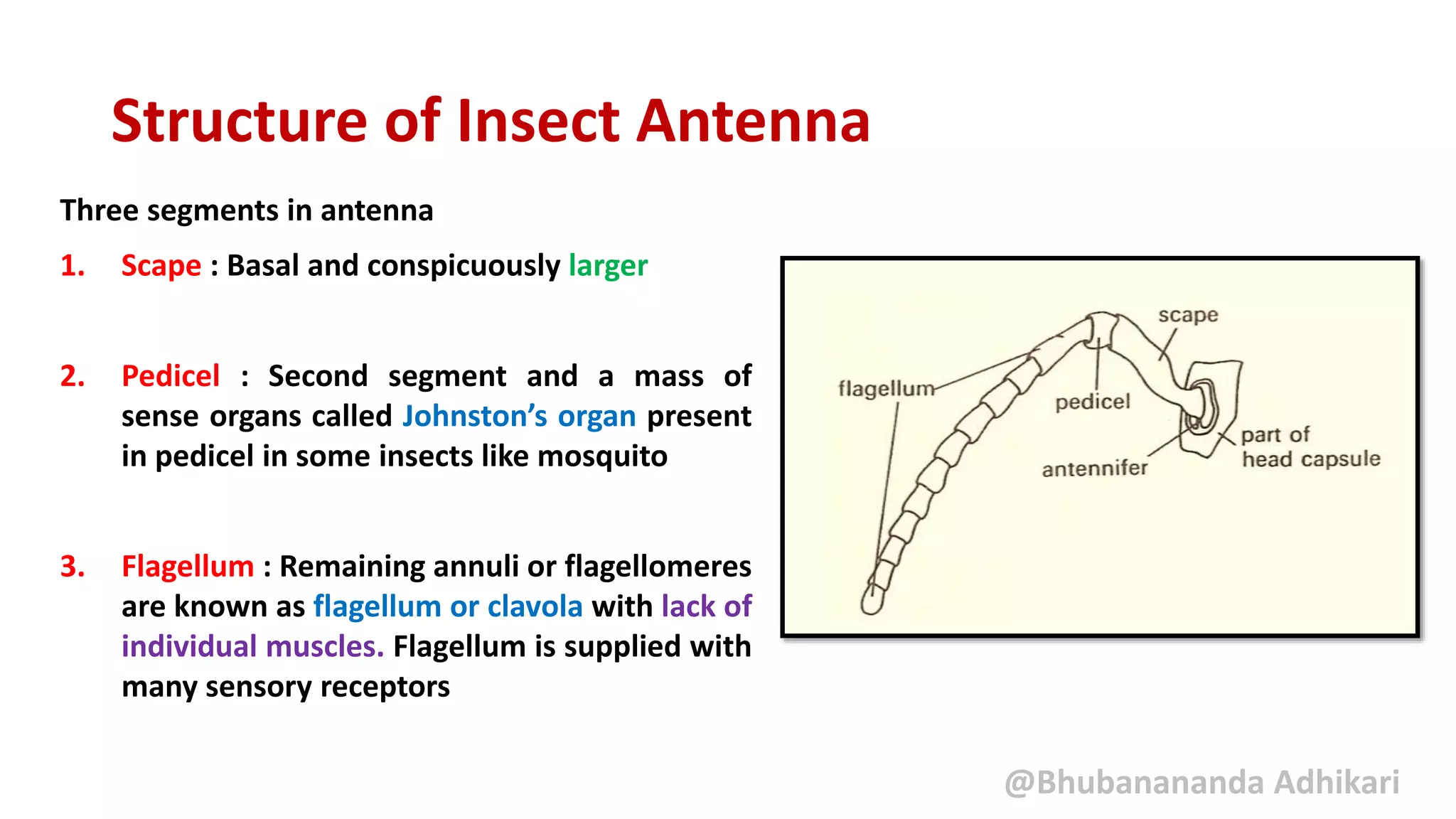
Three segments in antenna
1. Scape : Basal and conspicuously larger
2. Pedicel : Second segment and a mass of
sense organs called Johnston’s organ present
in pedicel in some insects like mosquito
3. Flagellum : Remaining annuli or flagellomeres
are known as flagellum or clavola with lack of
individual muscles. Flagellum is supplied with
many sensory receptors
@Bhubanananda Adhikari
Structure of Insect Antenna
• Detect chemicals including food and
pheromones
• Perceive smell, humidity changes, temperature
variation, vibration and wind velocity
• Perceive the forward environment detect
danger
• Hearing in mosquito
• Communication in ants
• Clasp the mate (Flea) and grasp the prey.
@Bhubanananda Adhikari
Function of Insect Antenna
1. Setaceous (Bristle like): Size of segments
decrease from base to apex. [Dragonfly,
Damselfly, leafhopper]
2. Filliform (Thread like): Segments are
cylindrical and thickness of segments remains
same throughout. [Grasshopper]
3. Monilliform (Beaded): Segments are globular
or spherical with prominent constriction
[Termite]
4. Serrate (Saw like): Segments have short
triangular projections one side [Longicorn
beetle]
@Bhubanananda Adhikari
Types of Insect Antenna
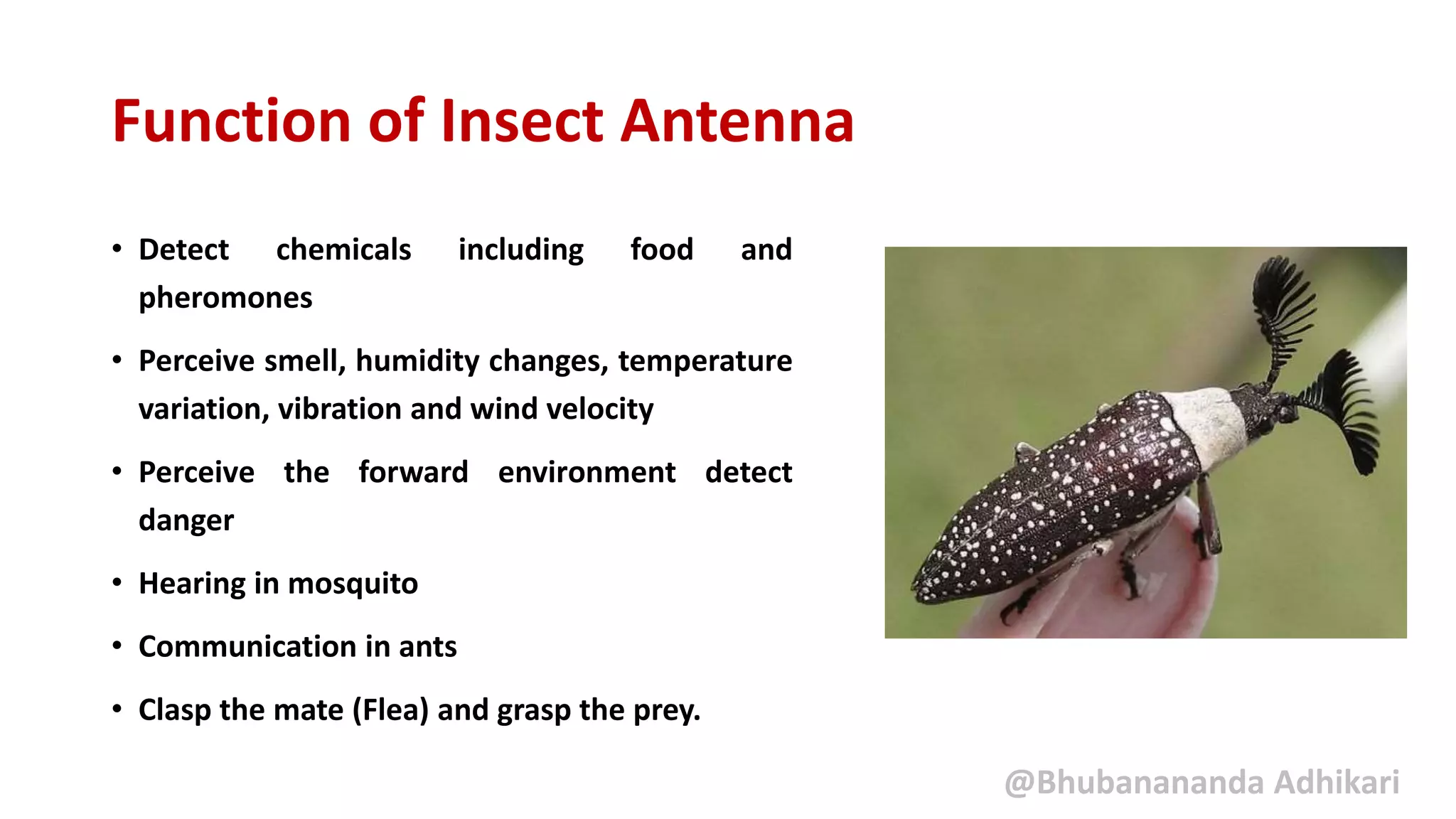
5. Unipectinate (Comb like): Long slender process
in segments on one side [Saw fly]
6. Bipectinate (Double comb like): Long slender
process in segments on both side [Silkworm
moth]
7. Clavate (Clubbed): Antenna enlarges gradually
towards tip [Blister beetle]
8. Capitate (Knobbed): Terminal segments
become enlarged suddenly [Butterfly]
@Bhubanananda Adhikari
Types of Insect Antenna
9. Lamellate (Plate like): Antennal tip is expanded
laterally on one side to form flat plate
[Lamellicorn beetle]
10. Aristate: Terminal segment is enlarged with
conspicuous dorsal bristle [Housefly]
11. Stylate: Terminal segment bear style like
process [Horsefly, Robberfly]
12. Geniculate (Elbowed): Scape is long. Remaining
segments are small and arranged at an angle to
first resembling an elbow [Ant, weevil,
honeybee]
@Bhubanananda Adhikari
Types of Insect Antenna
13. Flabellate (Fan like): Third and
subsequent segments with side
processes giving a fan like arrangements
[Cedar beetle, Strepsiptera]
14. Plumose (Feathery): Segments with long
whorls of hairs [Male mosquito]
15. Pilose (Hairy): Antenna is less feathery
with few hairs at junction of
flagellomeres [Female mosquito]
@Bhubanananda Adhikari
Types of Insect Antenna
Thank You…

Insect Antennae

  • 1.
    Antennae of Insects Structureand Classification @Bhubanananda Adhikari
  • 2.
    Also called feelers(paired, mobile and segmented structure).Located between or behind compound eyes (well developed in adult insect) All insects except Protura have a pair of antennae Antenna is set in a socket of cranium called antennal socket. The base of antenna is connected to edge of socket by articulatory membrane, which permits the free movement @Bhubanananda Adhikari Structure of Insect Antenna
  • 3.
    Three segments inantenna 1. Scape : Basal and conspicuously larger 2. Pedicel : Second segment and a mass of sense organs called Johnston’s organ present in pedicel in some insects like mosquito 3. Flagellum : Remaining annuli or flagellomeres are known as flagellum or clavola with lack of individual muscles. Flagellum is supplied with many sensory receptors @Bhubanananda Adhikari Structure of Insect Antenna
  • 4.
    • Detect chemicalsincluding food and pheromones • Perceive smell, humidity changes, temperature variation, vibration and wind velocity • Perceive the forward environment detect danger • Hearing in mosquito • Communication in ants • Clasp the mate (Flea) and grasp the prey. @Bhubanananda Adhikari Function of Insect Antenna
  • 5.
    1. Setaceous (Bristlelike): Size of segments decrease from base to apex. [Dragonfly, Damselfly, leafhopper] 2. Filliform (Thread like): Segments are cylindrical and thickness of segments remains same throughout. [Grasshopper] 3. Monilliform (Beaded): Segments are globular or spherical with prominent constriction [Termite] 4. Serrate (Saw like): Segments have short triangular projections one side [Longicorn beetle] @Bhubanananda Adhikari Types of Insect Antenna
  • 6.
    5. Unipectinate (Comblike): Long slender process in segments on one side [Saw fly] 6. Bipectinate (Double comb like): Long slender process in segments on both side [Silkworm moth] 7. Clavate (Clubbed): Antenna enlarges gradually towards tip [Blister beetle] 8. Capitate (Knobbed): Terminal segments become enlarged suddenly [Butterfly] @Bhubanananda Adhikari Types of Insect Antenna
  • 7.
    9. Lamellate (Platelike): Antennal tip is expanded laterally on one side to form flat plate [Lamellicorn beetle] 10. Aristate: Terminal segment is enlarged with conspicuous dorsal bristle [Housefly] 11. Stylate: Terminal segment bear style like process [Horsefly, Robberfly] 12. Geniculate (Elbowed): Scape is long. Remaining segments are small and arranged at an angle to first resembling an elbow [Ant, weevil, honeybee] @Bhubanananda Adhikari Types of Insect Antenna
  • 8.
    13. Flabellate (Fanlike): Third and subsequent segments with side processes giving a fan like arrangements [Cedar beetle, Strepsiptera] 14. Plumose (Feathery): Segments with long whorls of hairs [Male mosquito] 15. Pilose (Hairy): Antenna is less feathery with few hairs at junction of flagellomeres [Female mosquito] @Bhubanananda Adhikari Types of Insect Antenna
  • 9.