Models of
Communication
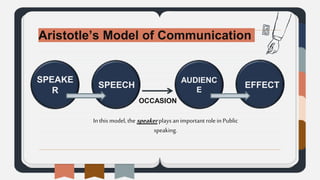
Aristotle’s Model of Communication
SPEAKE
R
SPEECH
AUDIENC
E
EFFECT
OCCASION
Inthis model, the speaker plays animportant role in Public
speaking.
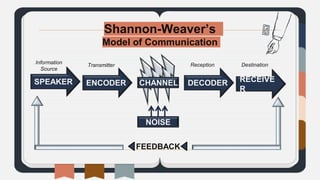
Shannon-Weaver’s
Model of Communication
SPEAKER ENCODER DECODER RECEIVE
R
CHANNEL
NOISE
FEEDBACK
Information
Source
Transmitter Reception Destination
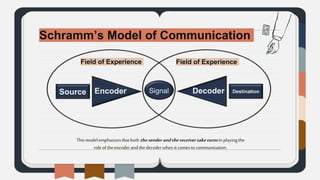
Schramm’s Model of Communication
SPEECH
AUDIENC
E
EFFECT
Thismodelemphasizesthatboth thesenderandthereceivertaketurnsinplayingthe
roleoftheencoderandthedecoderwhenitcomes tocommunication.
Field of Experience Field of Experience
Source Encoder Destination
Decoder
Signal
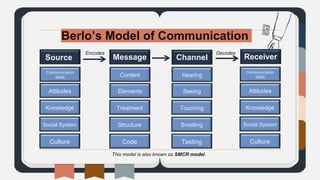
Berlo’s Model of Communication
SPEECH
Source
Destination
Signal
Message Channel Receiver
Communication
Skills
Attitudes
Knowledge
Social System
Culture
Communication
Skills
Attitudes
Knowledge
Social System
Culture
Content
Elements
Treatment
Structure
Code
Hearing
Seeing
Touching
Smelling
Tasting
Encodes Decodes
This model is also known as SMCR model.
Strategies in Avoiding
Communication
Breakdown
02
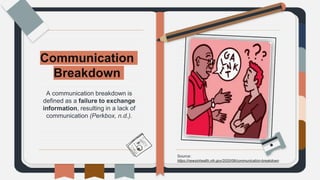
Communication
Breakdown
Listening enhances your ability to understand better and make
you a better communicator; it also makes the experience of
speaking to you more enjoyable to other people. Listening
means making a conscious effort not to just hear what people
are saying but to take it in, digest it and understand.
Strategies in Avoiding
Communication Breakdown
1. LISTEN.
Interrupting the person speaking may be interpreted as not
caring about what they are saying or that you think your
voice is more important. Let the speaker finish first and wait
for a natural break to say what you have in mind.
Strategies in Avoiding
Communication Breakdown
2. DO NOT INTERRUPT.
Distraction includes visual triggers, social interaction,
noise, phone messages and calls, etc. Your lack of
attention will lead you to lose focus which means that
information constantly has to be repeated, which is not
only arduous, but is also frustrating for the speaker.
Strategies in Avoiding
Communication Breakdown
3. GET RID OF DISTRACTIONS.
This will make the other person more motivated to
participate in the conversation, whether you are the
speaker or the listener. A boring speaker will bore
their listeners. Bored listeners will demotivate the
speaker.
Strategies in Avoiding
Communication Breakdown
4. SHOW INTEREST.
If you are confused about something, let them know
so that you will still be on the same page. This can
also prevent misunderstandings and alternate
interpretations of what has been said.
Strategies in Avoiding
Communication Breakdown
5. ASK QUESTIONS/CLARIFICATIONS.
Watching how the other person behaves can tell you if
they are paying attention or not, these should help you
adjust accordingly whether to
make your conversation more interesting or to bring it
to a conclusion.
Strategies in Avoiding
Communication Breakdown
6. PAY ATTENTION TO NON-VERBAL SIGNALS.
Being judgmental can cause us to create ideas
that are different from what the speaker is
planning to say, or worse, cause us not to listen
at all.
Strategies in Avoiding
Communication Breakdown
7. SET ASIDE
JUDGEMENTS.
If the other person has some points for
improvement when it comes to
communicating, share it with them so that
they can be better next time.
Strategies in Avoiding
Communication Breakdown
8. PROVIDE
FEEDBACK.
Prepare yourselves for a fun game prepared by
your teacher to gauge your understanding of the
previous lesson and prepare you for the
Evaluation that will take place later.
Prepare yourselves for a fun game prepared by
your teacher to gauge your understanding of the
previous lesson and prepare you for the
Evaluation that will take place later.
Prepare yourselves for a fun game prepared by
your teacher to gauge your understanding of the
previous lesson and prepare you for the
Evaluation that will take place later.
Prepare yourselves for a fun game prepared by
your teacher to gauge your understanding of the
previous lesson and prepare you for the
Evaluation that will take place later.
Prepare yourselves for a fun game prepared by
your teacher to gauge your understanding of the
previous lesson and prepare you for the
Evaluation that will take place later.
Prepare yourselves for a fun game prepared by
your teacher to gauge your understanding of the
previous lesson and prepare you for the
Evaluation that will take place later.
Prepare yourselves for a fun game prepared by
your teacher to gauge your understanding of the
previous lesson and prepare you for the
Evaluation that will take place later.
Strategies in Avoiding
Communication
Breakdown
02

Oral Communication

  • 2.
  • 3.
    Aristotle’s Model ofCommunication SPEAKE R SPEECH AUDIENC E EFFECT OCCASION Inthis model, the speaker plays animportant role in Public speaking.
  • 4.
    Shannon-Weaver’s Model of Communication SPEAKERENCODER DECODER RECEIVE R CHANNEL NOISE FEEDBACK Information Source Transmitter Reception Destination
  • 5.
    Schramm’s Model ofCommunication SPEECH AUDIENC E EFFECT Thismodelemphasizesthatboth thesenderandthereceivertaketurnsinplayingthe roleoftheencoderandthedecoderwhenitcomes tocommunication. Field of Experience Field of Experience Source Encoder Destination Decoder Signal
  • 6.
    Berlo’s Model ofCommunication SPEECH Source Destination Signal Message Channel Receiver Communication Skills Attitudes Knowledge Social System Culture Communication Skills Attitudes Knowledge Social System Culture Content Elements Treatment Structure Code Hearing Seeing Touching Smelling Tasting Encodes Decodes This model is also known as SMCR model.
  • 7.
  • 8.
  • 9.
    Listening enhances yourability to understand better and make you a better communicator; it also makes the experience of speaking to you more enjoyable to other people. Listening means making a conscious effort not to just hear what people are saying but to take it in, digest it and understand. Strategies in Avoiding Communication Breakdown 1. LISTEN.
  • 10.
    Interrupting the personspeaking may be interpreted as not caring about what they are saying or that you think your voice is more important. Let the speaker finish first and wait for a natural break to say what you have in mind. Strategies in Avoiding Communication Breakdown 2. DO NOT INTERRUPT.
  • 11.
    Distraction includes visualtriggers, social interaction, noise, phone messages and calls, etc. Your lack of attention will lead you to lose focus which means that information constantly has to be repeated, which is not only arduous, but is also frustrating for the speaker. Strategies in Avoiding Communication Breakdown 3. GET RID OF DISTRACTIONS.
  • 12.
    This will makethe other person more motivated to participate in the conversation, whether you are the speaker or the listener. A boring speaker will bore their listeners. Bored listeners will demotivate the speaker. Strategies in Avoiding Communication Breakdown 4. SHOW INTEREST.
  • 13.
    If you areconfused about something, let them know so that you will still be on the same page. This can also prevent misunderstandings and alternate interpretations of what has been said. Strategies in Avoiding Communication Breakdown 5. ASK QUESTIONS/CLARIFICATIONS.
  • 14.
    Watching how theother person behaves can tell you if they are paying attention or not, these should help you adjust accordingly whether to make your conversation more interesting or to bring it to a conclusion. Strategies in Avoiding Communication Breakdown 6. PAY ATTENTION TO NON-VERBAL SIGNALS.
  • 15.
    Being judgmental cancause us to create ideas that are different from what the speaker is planning to say, or worse, cause us not to listen at all. Strategies in Avoiding Communication Breakdown 7. SET ASIDE JUDGEMENTS.
  • 16.
    If the otherperson has some points for improvement when it comes to communicating, share it with them so that they can be better next time. Strategies in Avoiding Communication Breakdown 8. PROVIDE FEEDBACK.
  • 17.
    Prepare yourselves fora fun game prepared by your teacher to gauge your understanding of the previous lesson and prepare you for the Evaluation that will take place later.
  • 18.
    Prepare yourselves fora fun game prepared by your teacher to gauge your understanding of the previous lesson and prepare you for the Evaluation that will take place later.
  • 19.
    Prepare yourselves fora fun game prepared by your teacher to gauge your understanding of the previous lesson and prepare you for the Evaluation that will take place later.
  • 20.
    Prepare yourselves fora fun game prepared by your teacher to gauge your understanding of the previous lesson and prepare you for the Evaluation that will take place later.
  • 21.
    Prepare yourselves fora fun game prepared by your teacher to gauge your understanding of the previous lesson and prepare you for the Evaluation that will take place later.
  • 22.
    Prepare yourselves fora fun game prepared by your teacher to gauge your understanding of the previous lesson and prepare you for the Evaluation that will take place later.
  • 24.
    Prepare yourselves fora fun game prepared by your teacher to gauge your understanding of the previous lesson and prepare you for the Evaluation that will take place later.
  • 25.