Unit-1
Friend
Static
Container
Overloading
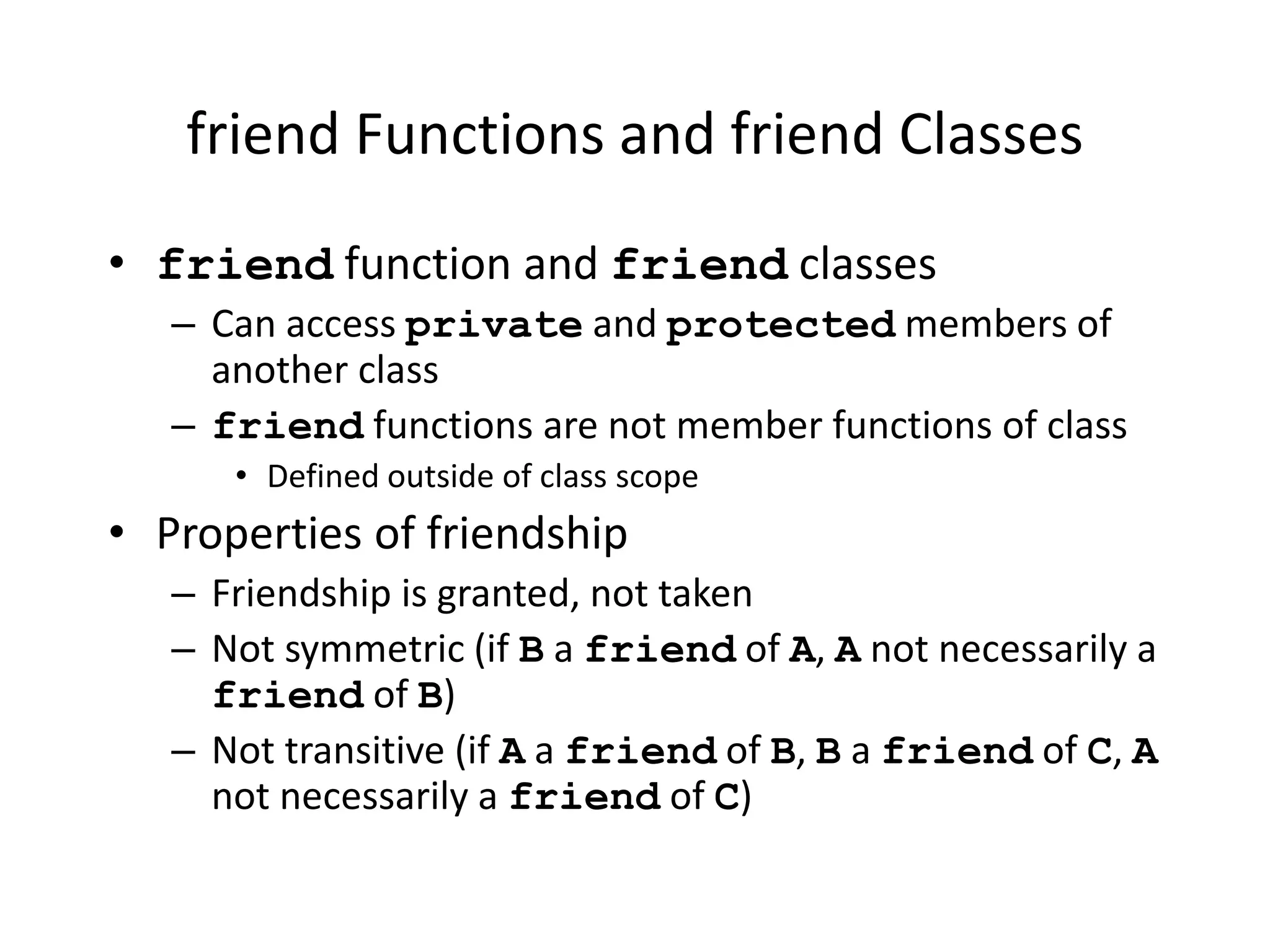
friend Functions and friend Classes
• friend function and friend classes
– Can access private and protected members of
another class
– friend functions are not member functions of class
• Defined outside of class scope
• Properties of friendship
– Friendship is granted, not taken
– Not symmetric (if B a friend of A, A not necessarily a
friend of B)
– Not transitive (if A a friend of B, B a friend of C, A
not necessarily a friend of C)
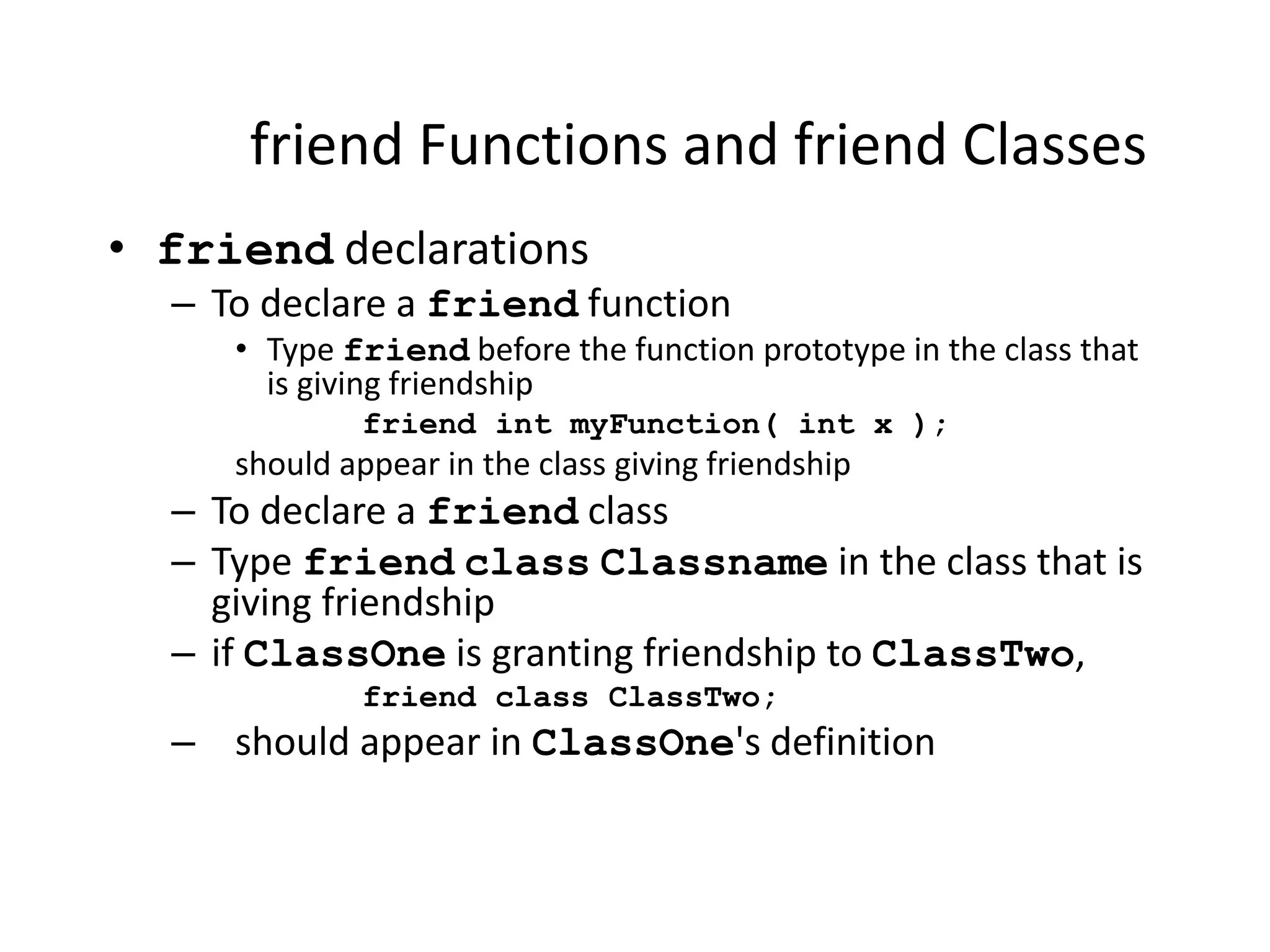
friend Functions and friend Classes
• friend declarations
– To declare a friend function
• Type friend before the function prototype in the class that
is giving friendship
friend int myFunction( int x );
should appear in the class giving friendship
– To declare a friend class
– Type friend class Classname in the class that is
giving friendship
– if ClassOne is granting friendship to ClassTwo,
friend class ClassTwo;
– should appear in ClassOne's definition
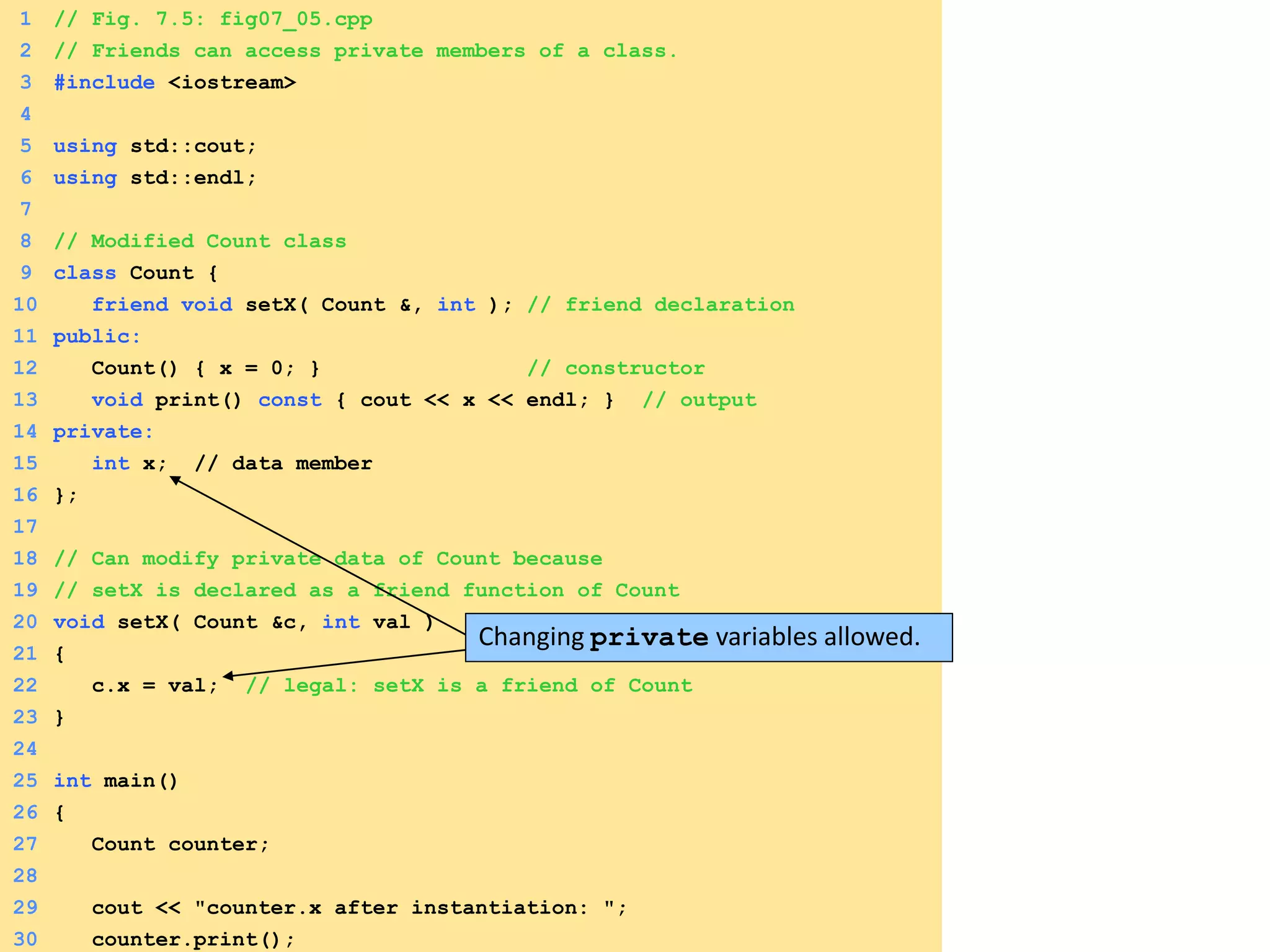
1 // Fig. 7.5: fig07_05.cpp
2 // Friends can access private members of a class.
3 #include <iostream>
4
5 using std::cout;
6 using std::endl;
7
8 // Modified Count class
9 class Count {
10 friend void setX( Count &, int ); // friend declaration
11 public:
12 Count() { x = 0; } // constructor
13 void print() const { cout << x << endl; } // output
14 private:
15 int x; // data member
16 };
17
18 // Can modify private data of Count because
19 // setX is declared as a friend function of Count
20 void setX( Count &c, int val )
21 {
22 c.x = val; // legal: setX is a friend of Count
23 }
24
25 int main()
26 {
27 Count counter;
28
29 cout << "counter.x after instantiation: ";
30 counter.print();
Changing private variables allowed.
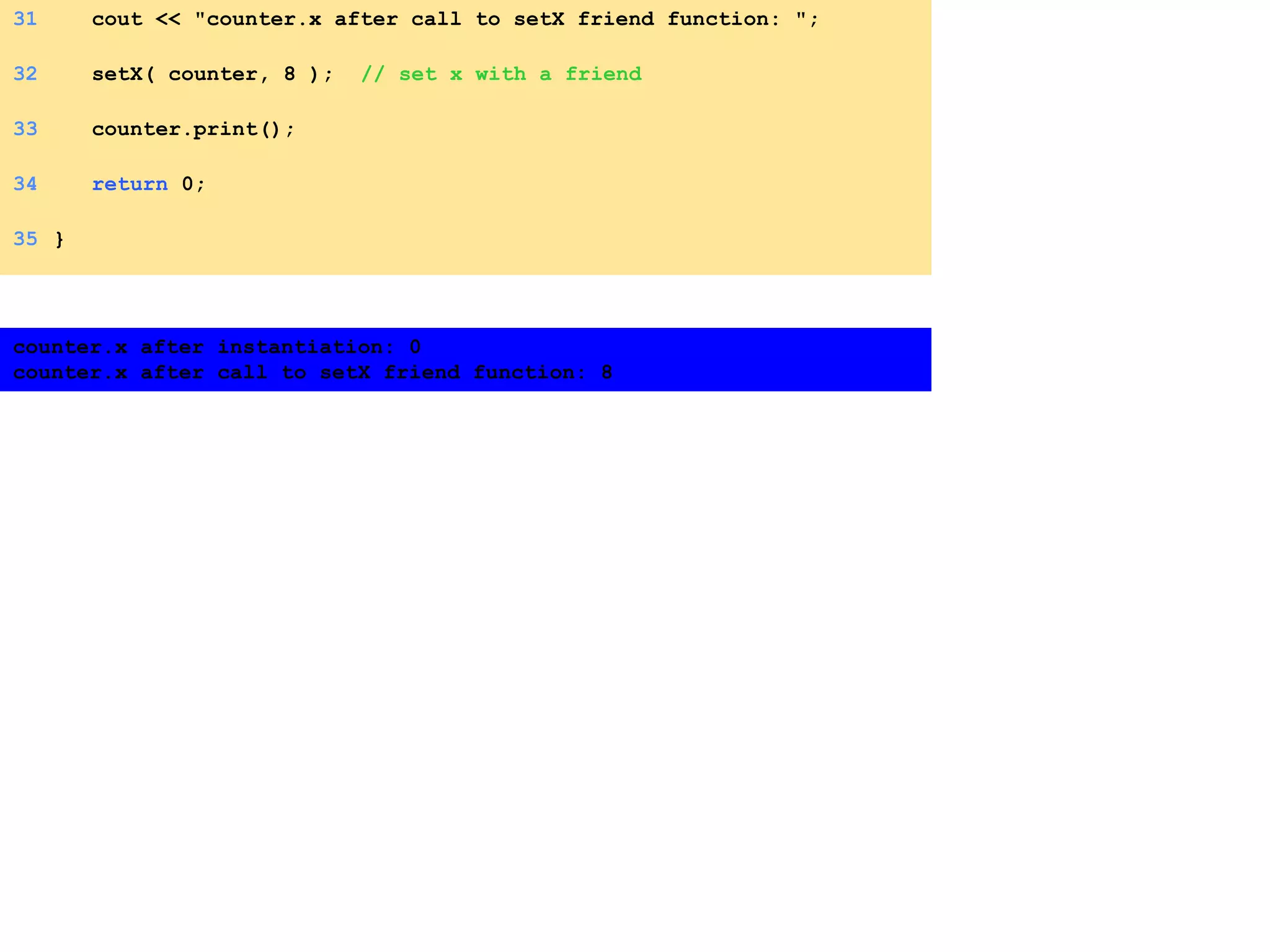
31 cout << "counter.x after call to setX friend function: ";
32 setX( counter, 8 ); // set x with a friend
33 counter.print();
34 return 0;
35 }
counter.x after instantiation: 0
counter.x after call to setX friend function: 8
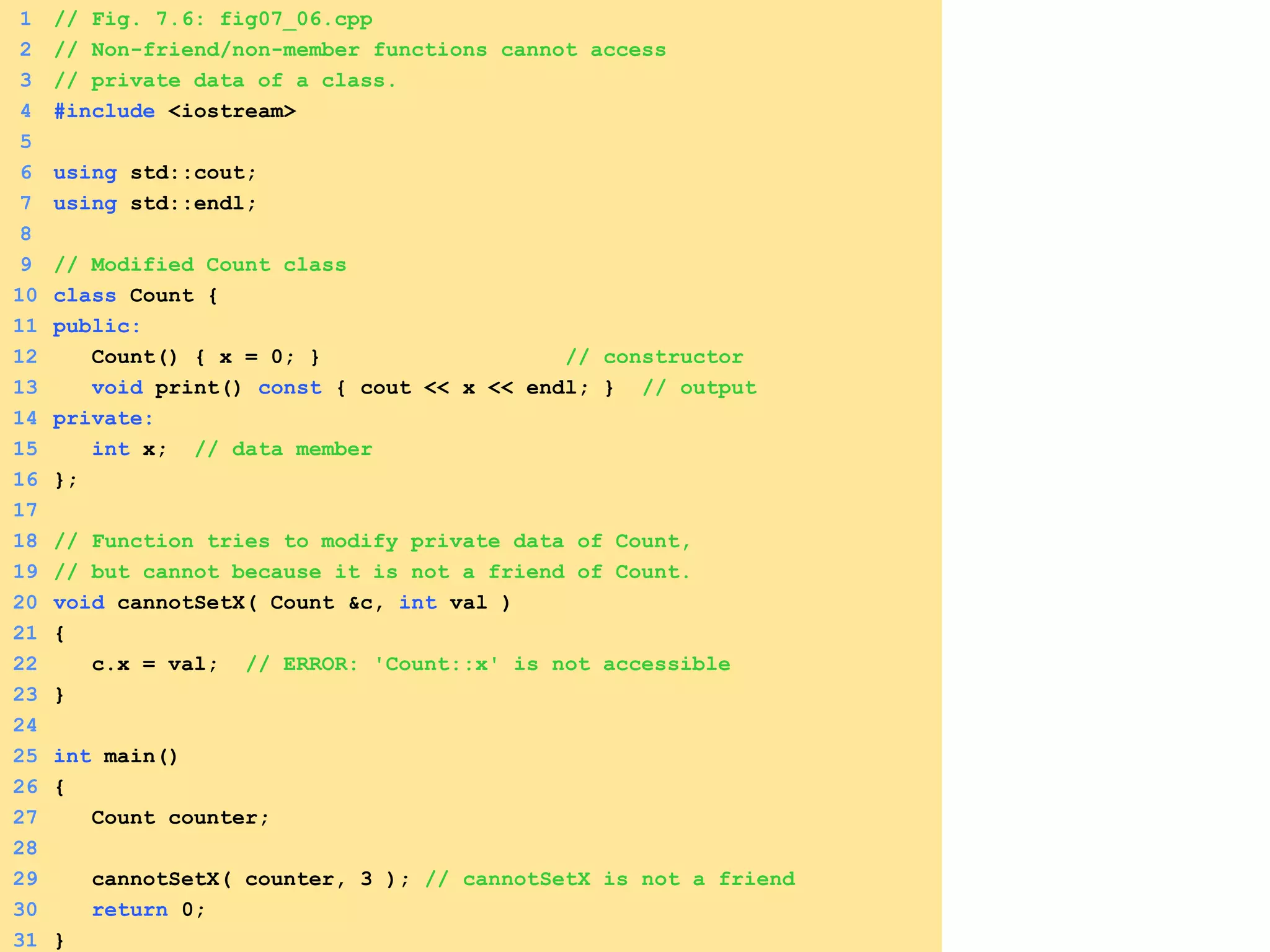
1 // Fig. 7.6: fig07_06.cpp
2 // Non-friend/non-member functions cannot access
3 // private data of a class.
4 #include <iostream>
5
6 using std::cout;
7 using std::endl;
8
9 // Modified Count class
10 class Count {
11 public:
12 Count() { x = 0; } // constructor
13 void print() const { cout << x << endl; } // output
14 private:
15 int x; // data member
16 };
17
18 // Function tries to modify private data of Count,
19 // but cannot because it is not a friend of Count.
20 void cannotSetX( Count &c, int val )
21 {
22 c.x = val; // ERROR: 'Count::x' is not accessible
23 }
24
25 int main()
26 {
27 Count counter;
28
29 cannotSetX( counter, 3 ); // cannotSetX is not a friend
30 return 0;
31 }
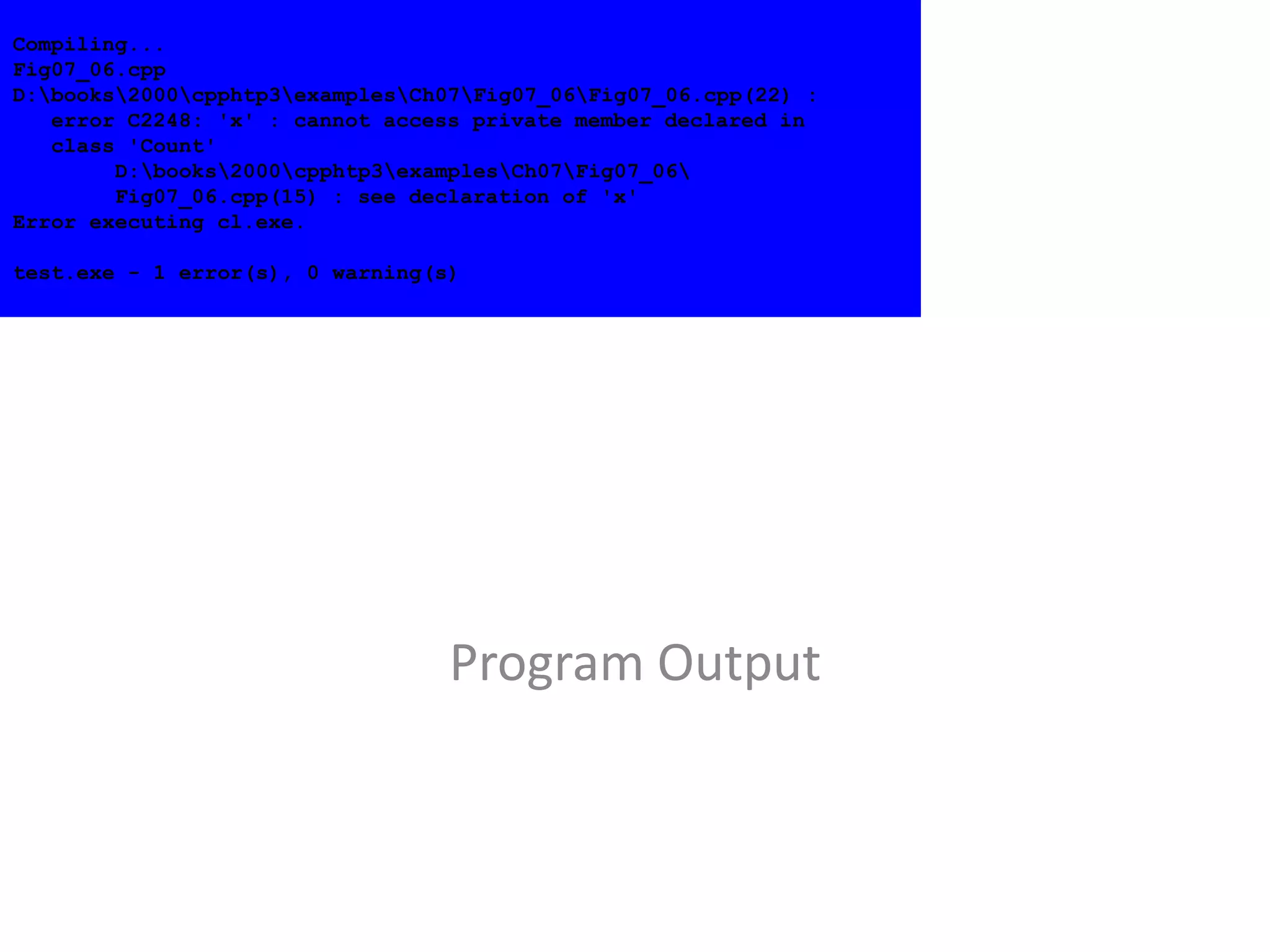
Program Output
Compiling...
Fig07_06.cpp
D:books2000cpphtp3examplesCh07Fig07_06Fig07_06.cpp(22) :
error C2248: 'x' : cannot access private member declared in
class 'Count'
D:books2000cpphtp3examplesCh07Fig07_06
Fig07_06.cpp(15) : see declaration of 'x'
Error executing cl.exe.
test.exe - 1 error(s), 0 warning(s)
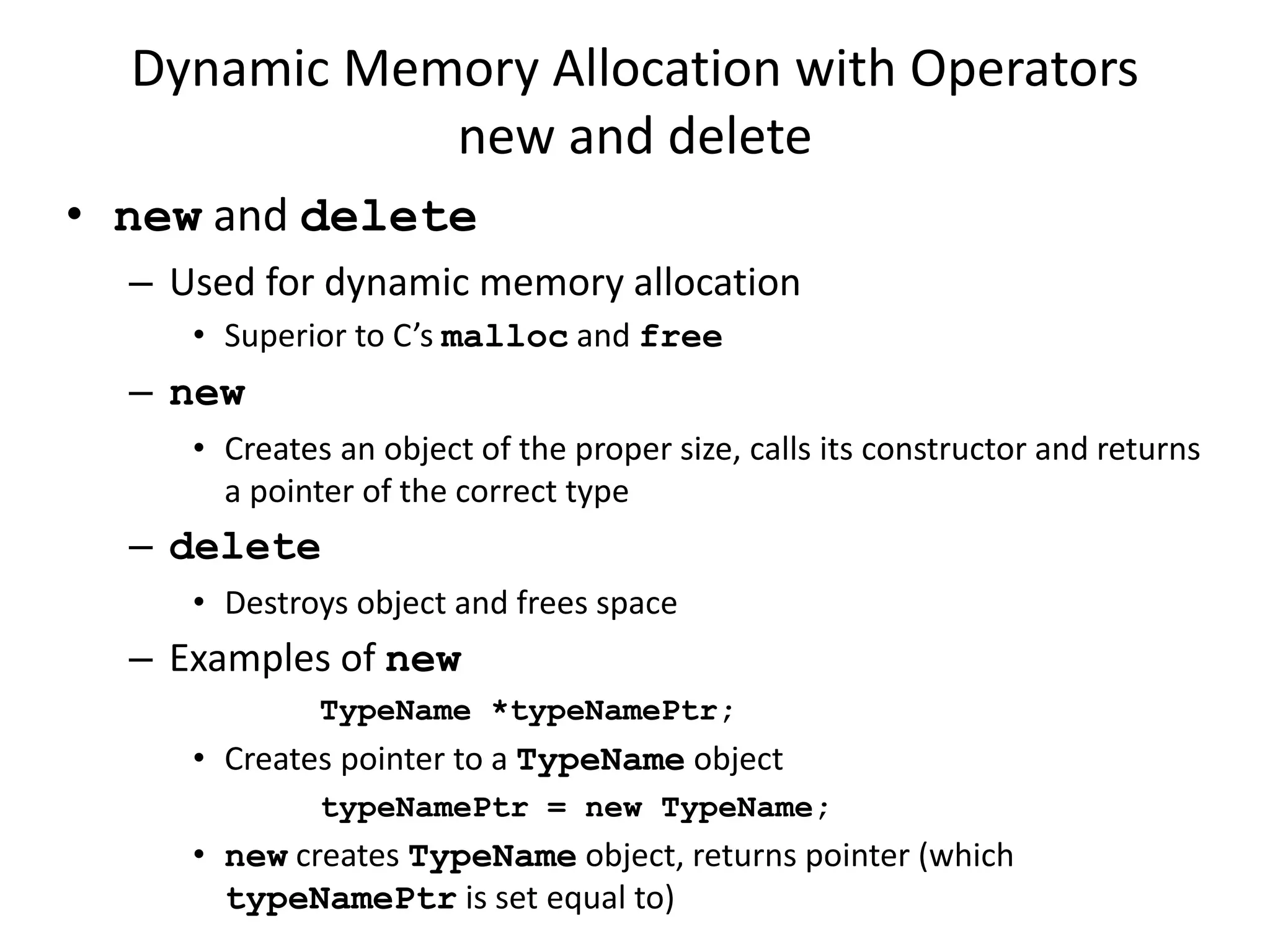
Dynamic Memory Allocation with Operators
new and delete
• new and delete
– Used for dynamic memory allocation
• Superior to C’s malloc and free
– new
• Creates an object of the proper size, calls its constructor and returns
a pointer of the correct type
– delete
• Destroys object and frees space
– Examples of new
TypeName *typeNamePtr;
• Creates pointer to a TypeName object
typeNamePtr = new TypeName;
• new creates TypeName object, returns pointer (which
typeNamePtr is set equal to)
Dynamic Memory Allocation with Operators
new and delete
– Examples of delete
delete typeNamePtr;
• Calls destructor for TypeName object and frees memory
Delete [] arrayPtr;
• Used to dynamically delete an array
• Initializing objects
double *thingPtr = new double( 3.14159 );
– Initializes object of type double to 3.14159
int *arrayPtr = new int[ 10 ];
– Creates a ten element int array and assigns it to
arrayPtr
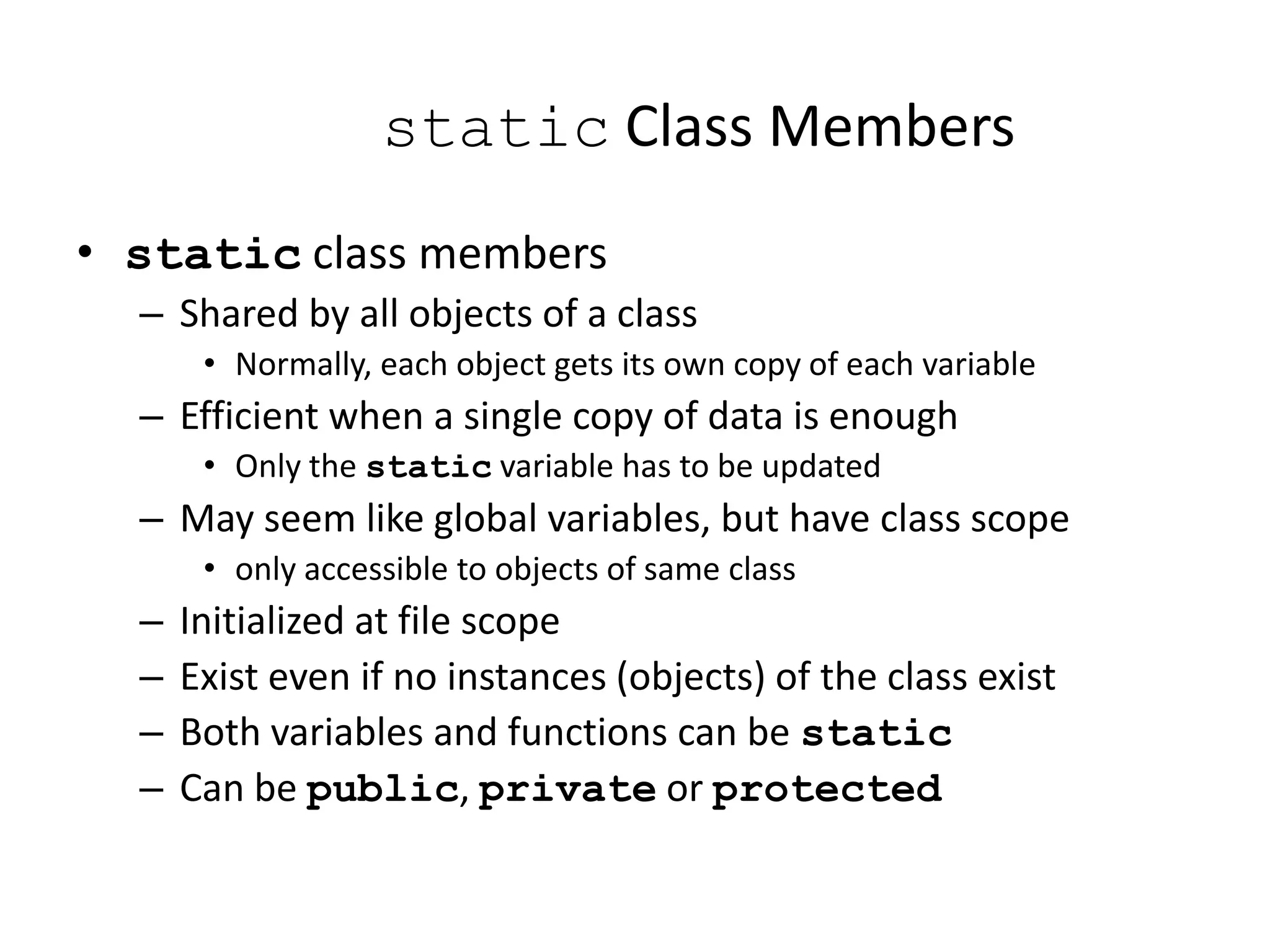
static Class Members
• static class members
– Shared by all objects of a class
• Normally, each object gets its own copy of each variable
– Efficient when a single copy of data is enough
• Only the static variable has to be updated
– May seem like global variables, but have class scope
• only accessible to objects of same class
– Initialized at file scope
– Exist even if no instances (objects) of the class exist
– Both variables and functions can be static
– Can be public, private or protected
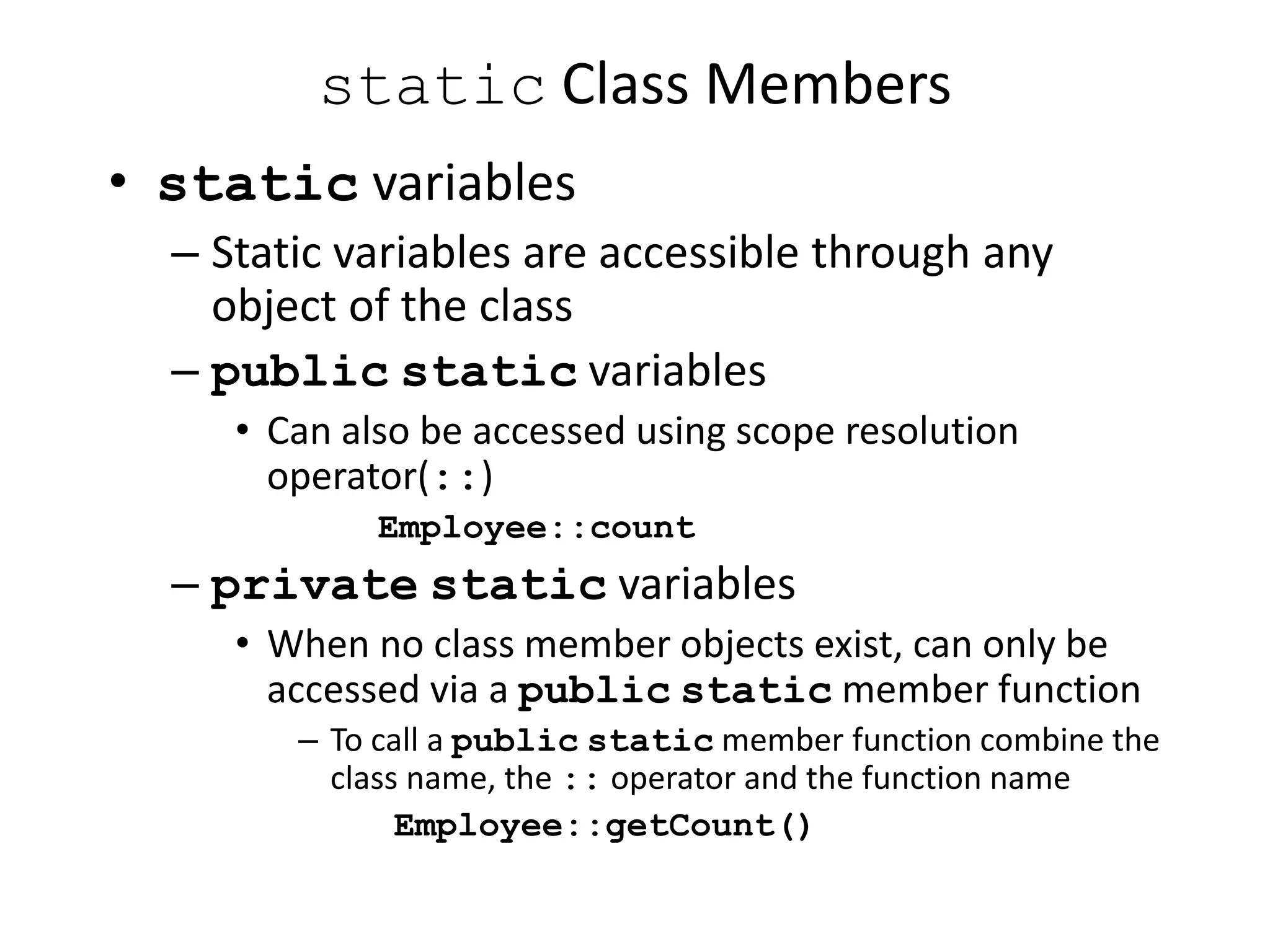
static Class Members
• static variables
– Static variables are accessible through any
object of the class
– public static variables
• Can also be accessed using scope resolution
operator(::)
Employee::count
– private static variables
• When no class member objects exist, can only be
accessed via a public static member function
– To call a public static member function combine the
class name, the :: operator and the function name
Employee::getCount()
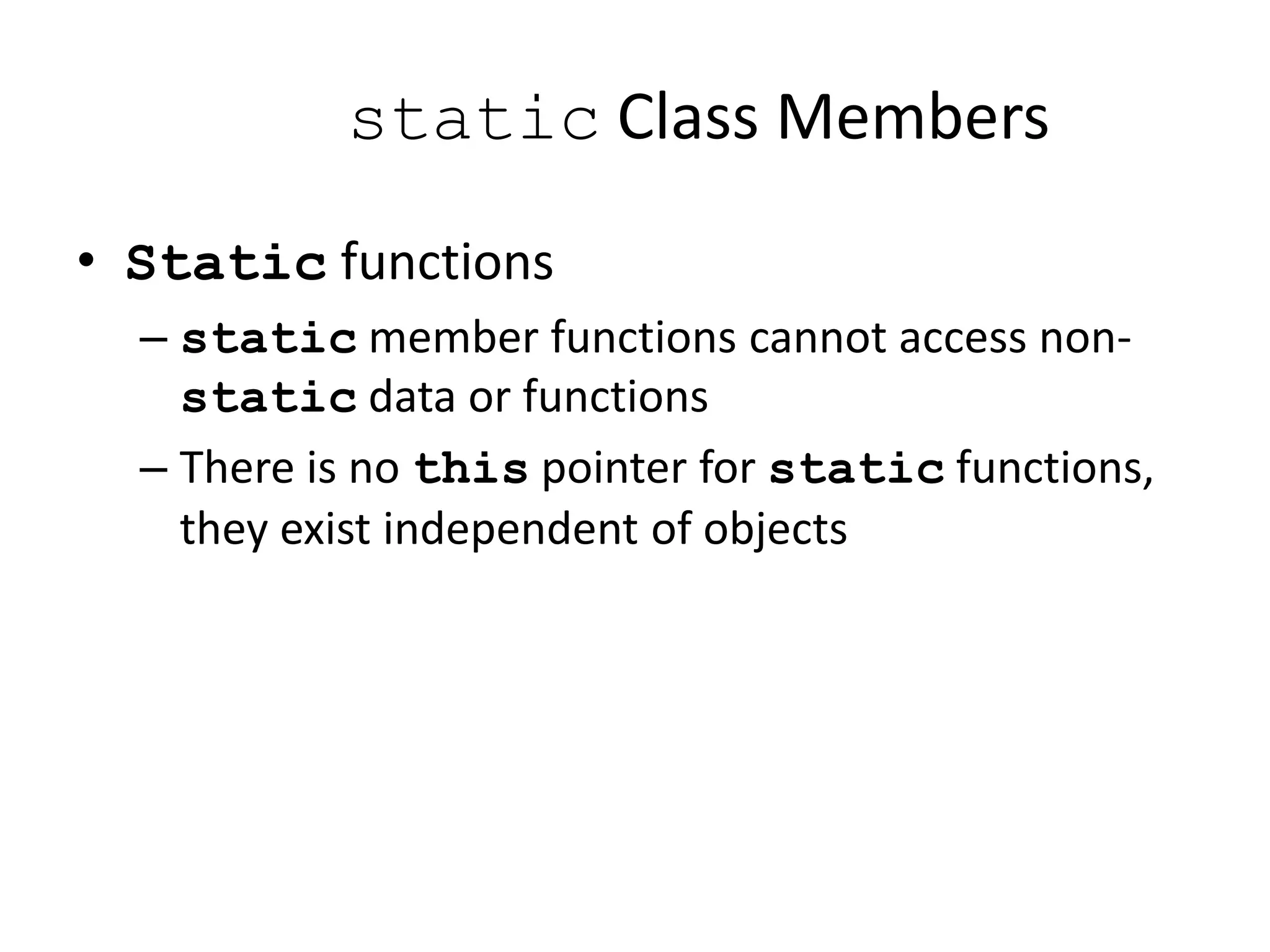
static Class Members
• Static functions
– static member functions cannot access non-
static data or functions
– There is no this pointer for static functions,
they exist independent of objects
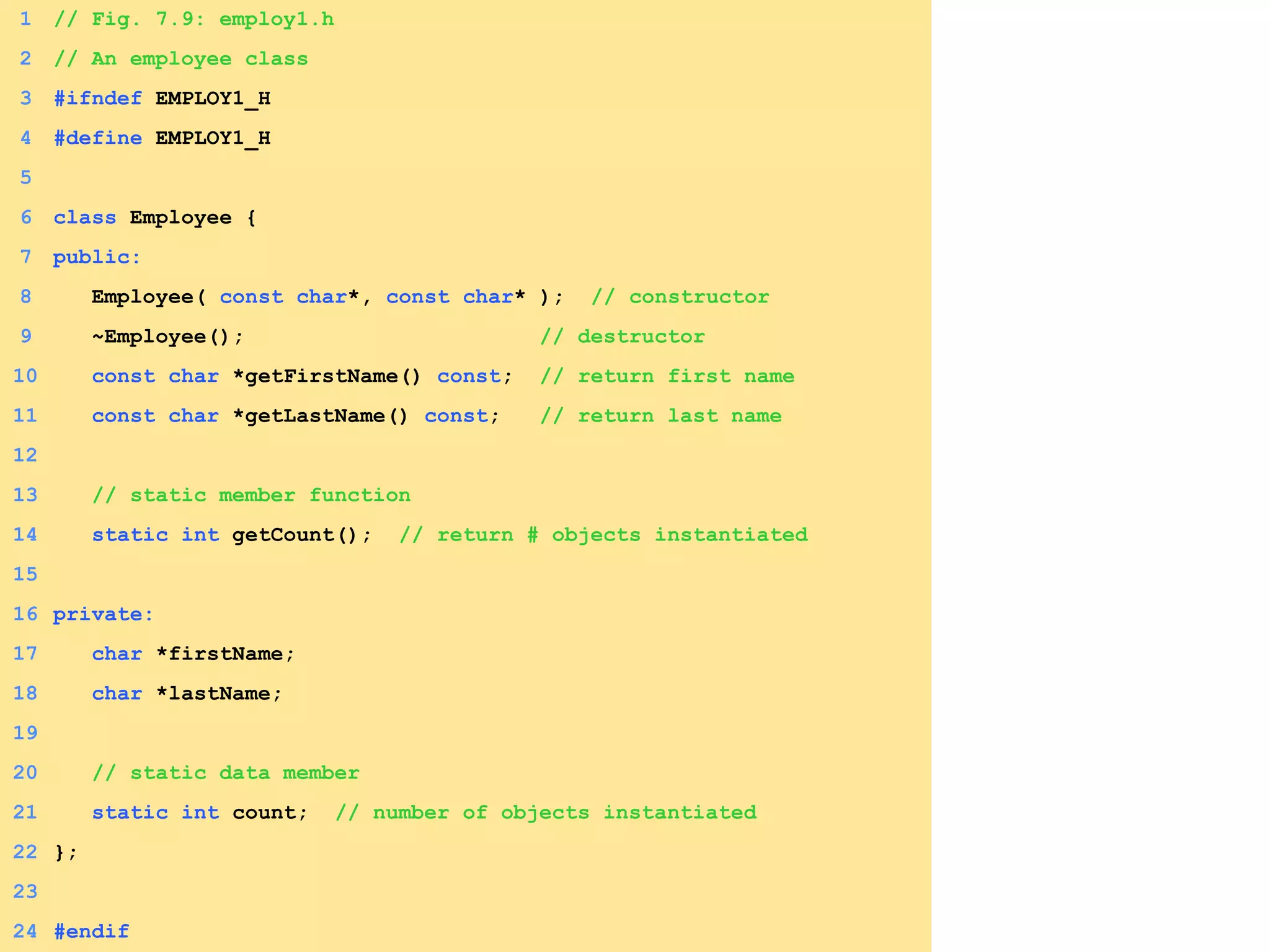
1 // Fig. 7.9: employ1.h
2 // An employee class
3 #ifndef EMPLOY1_H
4 #define EMPLOY1_H
5
6 class Employee {
7 public:
8 Employee( const char*, const char* ); // constructor
9 ~Employee(); // destructor
10 const char *getFirstName() const; // return first name
11 const char *getLastName() const; // return last name
12
13 // static member function
14 static int getCount(); // return # objects instantiated
15
16 private:
17 char *firstName;
18 char *lastName;
19
20 // static data member
21 static int count; // number of objects instantiated
22 };
23
24 #endif
25 // Fig. 7.9: employ1.cpp
26 // Member function definitions for class Employee
27 #include <iostream>
28
29 using std::cout;
30 using std::endl;
31
32 #include <cstring>
33 #include <cassert>
34 #include "employ1.h"
35
36 // Initialize the static data member
37 int Employee::count = 0;
38
39 // Define the static member function that
40 // returns the number of employee objects instantiated.
41 int Employee::getCount() { return count; }
42
43 // Constructor dynamically allocates space for the
44 // first and last name and uses strcpy to copy
45 // the first and last names into the object
46 Employee::Employee( const char *first, const char *last )
47 {
48 firstName = new char[ strlen( first ) + 1 ];
49 assert( firstName != 0 ); // ensure memory allocated
50 strcpy( firstName, first );
51
52 lastName = new char[ strlen( last ) + 1 ];
53 assert( lastName != 0 ); // ensure memory allocated
54 strcpy( lastName, last );
55
56 ++count; // increment static count of employees
static data member count
and function getCount( )
initialized at file scope (required).
static data member count
changed when a
constructor/destructor called.
57 cout << "Employee constructor for " << firstName
58 << ' ' << lastName << " called." << endl;
59 }
60
61 // Destructor deallocates dynamically allocated memory
62 Employee::~Employee()
63 {
64 cout << "~Employee() called for " << firstName
65 << ' ' << lastName << endl;
66 delete [] firstName; // recapture memory
67 delete [] lastName; // recapture memory
68 --count; // decrement static count of employees
69 }
70
71 // Return first name of employee
72 const char *Employee::getFirstName() const
73 {
74 // Const before return type prevents client from modifying
75 // private data. Client should copy returned string before
76 // destructor deletes storage to prevent undefined pointer.
77 return firstName;
78 }
79
80 // Return last name of employee
81 const char *Employee::getLastName() const
82 {
83 // Const before return type prevents client from modifying
84 // private data. Client should copy returned string before
85 // destructor deletes storage to prevent undefined pointer.
86 return lastName;
87 }
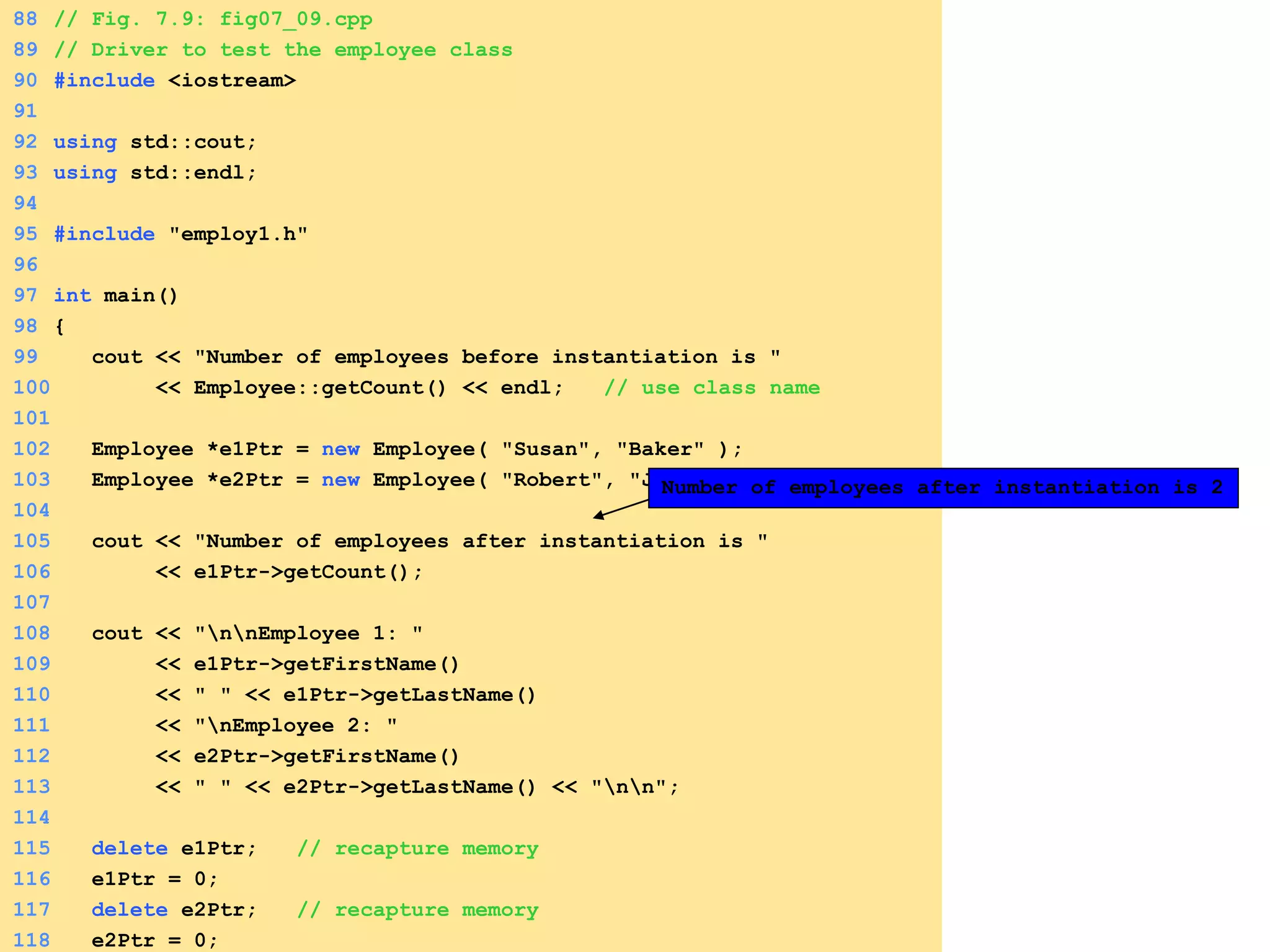
88 // Fig. 7.9: fig07_09.cpp
89 // Driver to test the employee class
90 #include <iostream>
91
92 using std::cout;
93 using std::endl;
94
95 #include "employ1.h"
96
97 int main()
98 {
99 cout << "Number of employees before instantiation is "
100 << Employee::getCount() << endl; // use class name
101
102 Employee *e1Ptr = new Employee( "Susan", "Baker" );
103 Employee *e2Ptr = new Employee( "Robert", "Jones" );
104
105 cout << "Number of employees after instantiation is "
106 << e1Ptr->getCount();
107
108 cout << "nnEmployee 1: "
109 << e1Ptr->getFirstName()
110 << " " << e1Ptr->getLastName()
111 << "nEmployee 2: "
112 << e2Ptr->getFirstName()
113 << " " << e2Ptr->getLastName() << "nn";
114
115 delete e1Ptr; // recapture memory
116 e1Ptr = 0;
117 delete e2Ptr; // recapture memory
118 e2Ptr = 0;
Number of employees after instantiation is 2
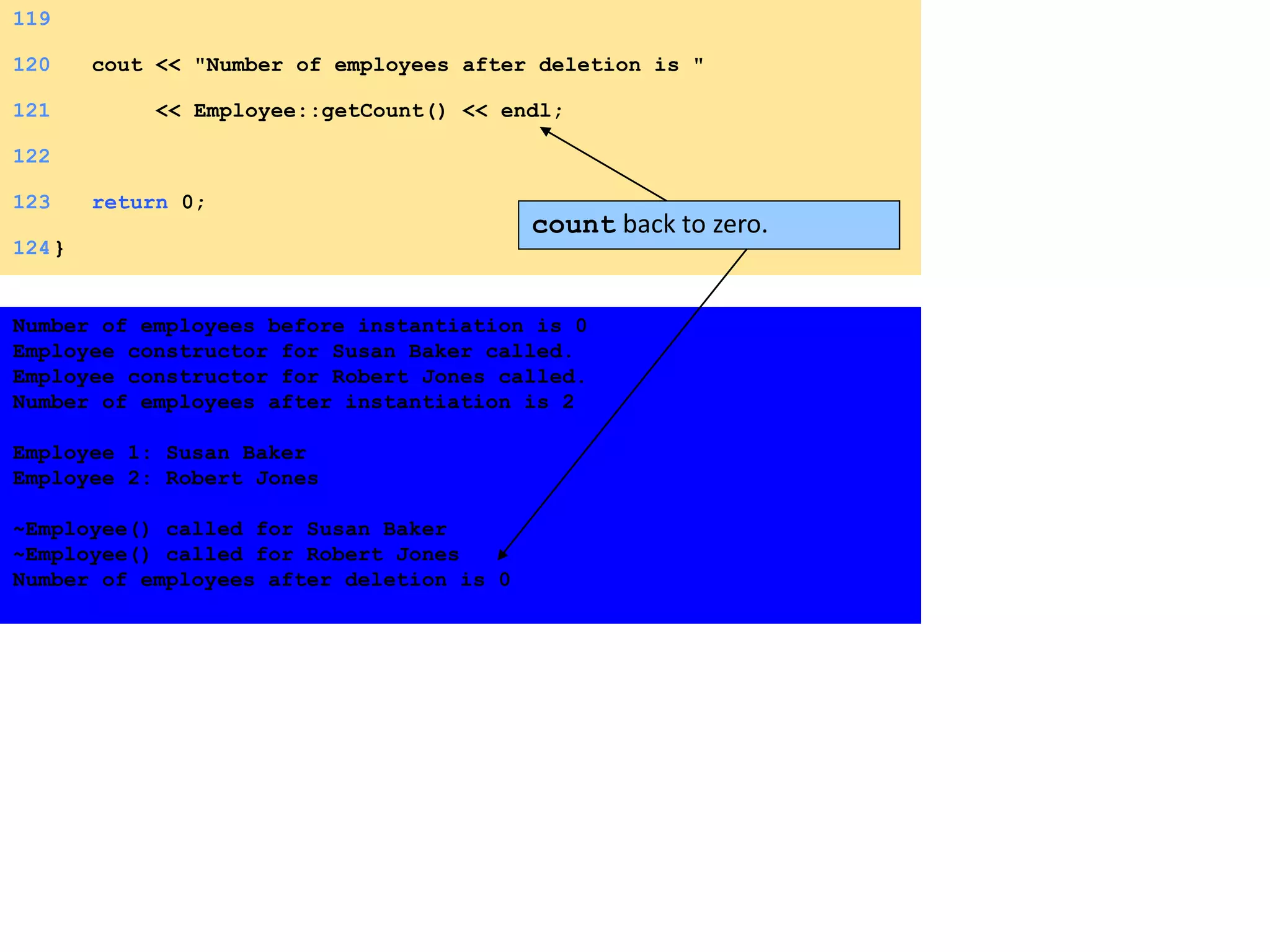
119
120 cout << "Number of employees after deletion is "
121 << Employee::getCount() << endl;
122
123 return 0;
124}
Number of employees before instantiation is 0
Employee constructor for Susan Baker called.
Employee constructor for Robert Jones called.
Number of employees after instantiation is 2
Employee 1: Susan Baker
Employee 2: Robert Jones
~Employee() called for Susan Baker
~Employee() called for Robert Jones
Number of employees after deletion is 0
count back to zero.
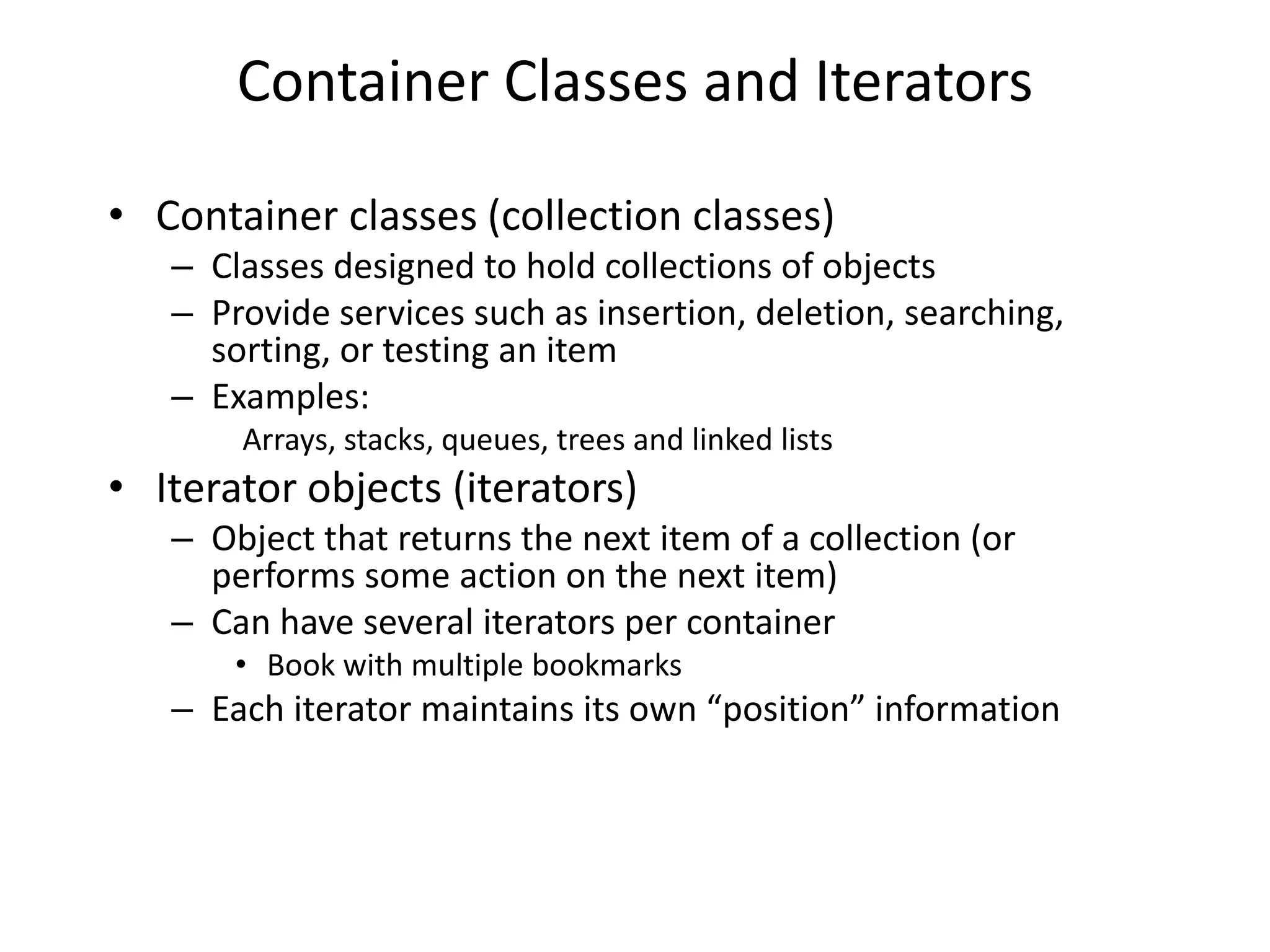
Container Classes and Iterators
• Container classes (collection classes)
– Classes designed to hold collections of objects
– Provide services such as insertion, deletion, searching,
sorting, or testing an item
– Examples:
Arrays, stacks, queues, trees and linked lists
• Iterator objects (iterators)
– Object that returns the next item of a collection (or
performs some action on the next item)
– Can have several iterators per container
• Book with multiple bookmarks
– Each iterator maintains its own “position” information
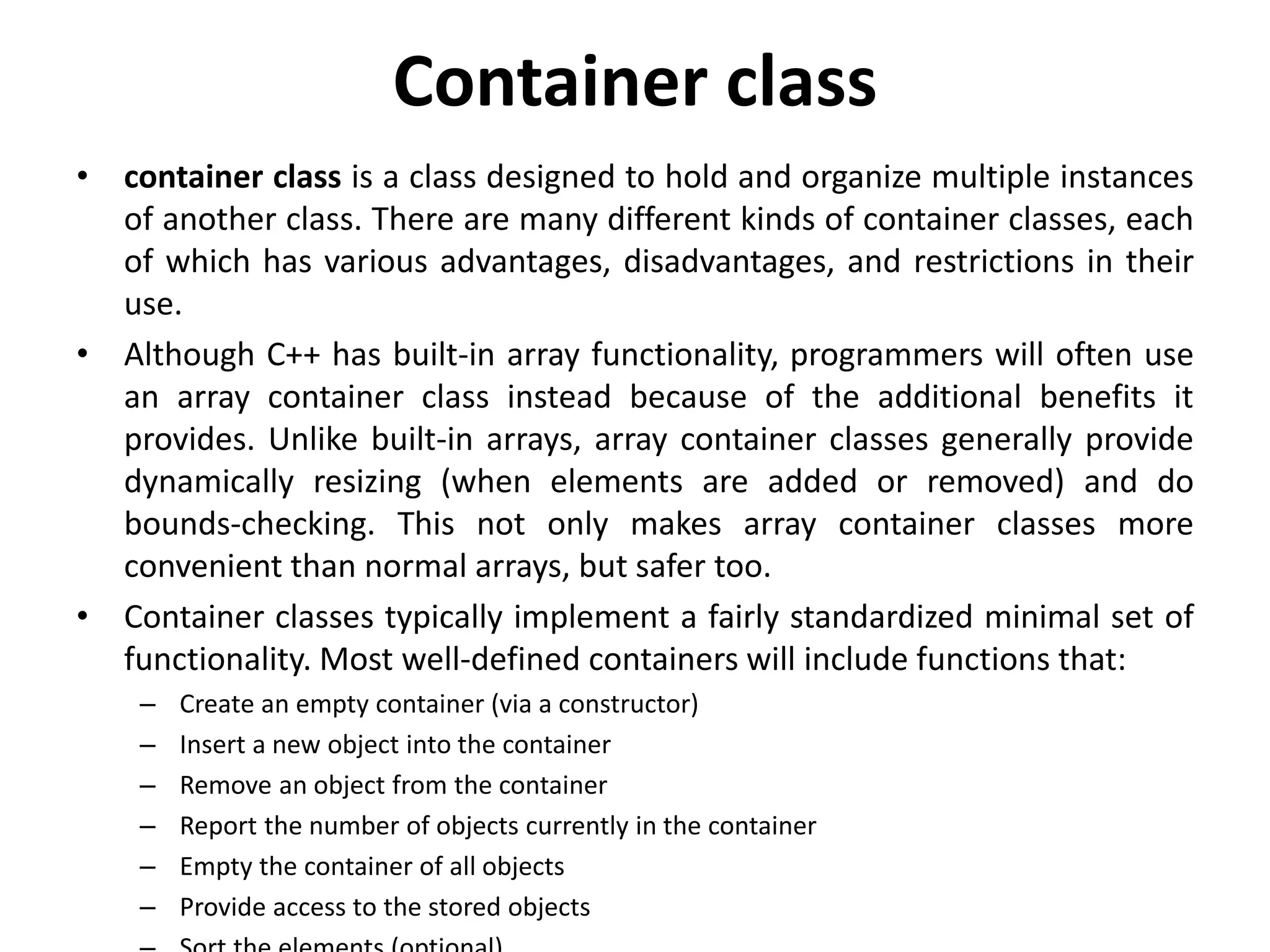
Container class
• container class is a class designed to hold and organize multiple instances
of another class. There are many different kinds of container classes, each
of which has various advantages, disadvantages, and restrictions in their
use.
• Although C++ has built-in array functionality, programmers will often use
an array container class instead because of the additional benefits it
provides. Unlike built-in arrays, array container classes generally provide
dynamically resizing (when elements are added or removed) and do
bounds-checking. This not only makes array container classes more
convenient than normal arrays, but safer too.
• Container classes typically implement a fairly standardized minimal set of
functionality. Most well-defined containers will include functions that:
– Create an empty container (via a constructor)
– Insert a new object into the container
– Remove an object from the container
– Report the number of objects currently in the container
– Empty the container of all objects
– Provide access to the stored objects
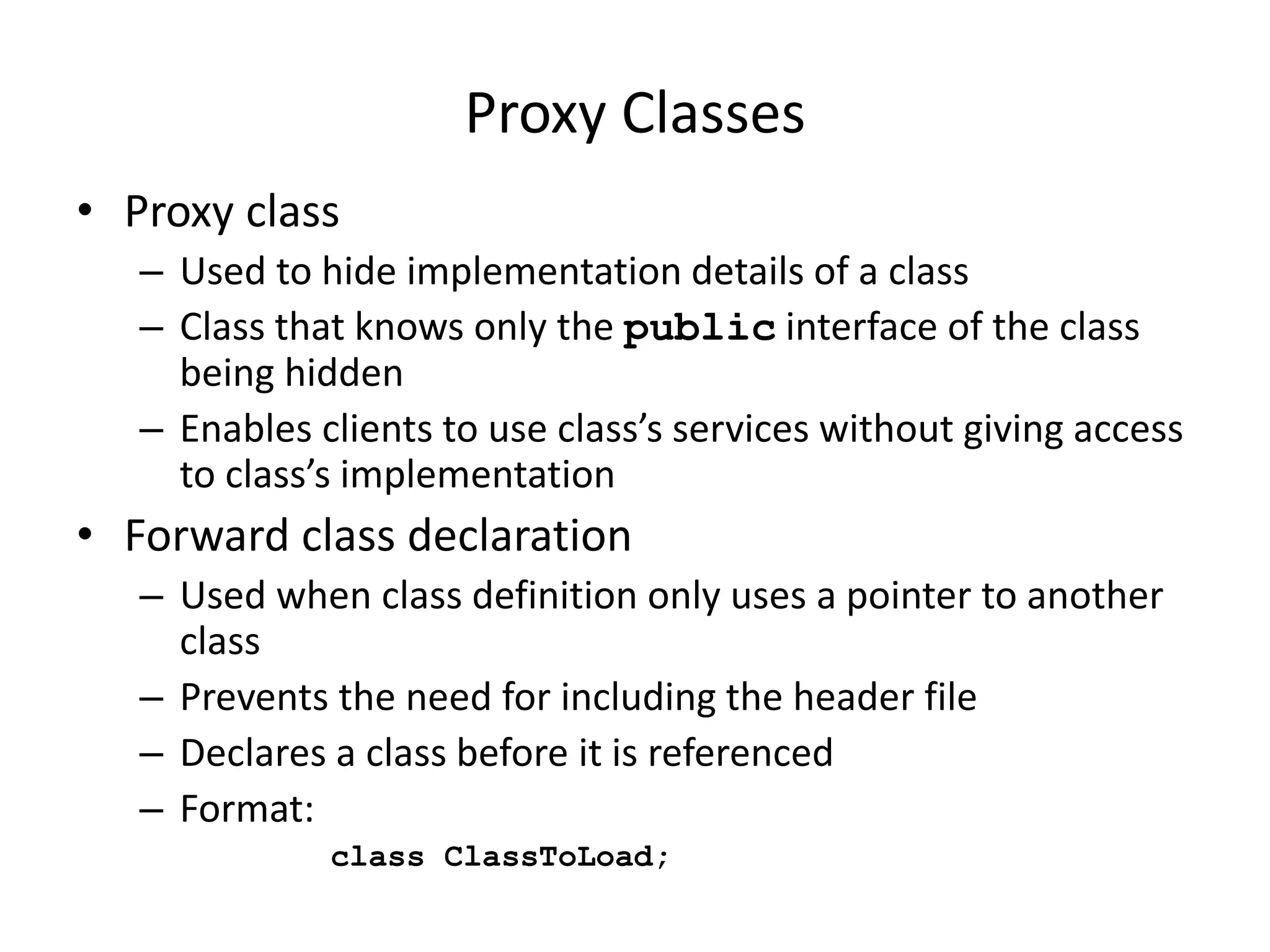
Proxy Classes
• Proxy class
– Used to hide implementation details of a class
– Class that knows only the public interface of the class
being hidden
– Enables clients to use class’s services without giving access
to class’s implementation
• Forward class declaration
– Used when class definition only uses a pointer to another
class
– Prevents the need for including the header file
– Declares a class before it is referenced
– Format:
class ClassToLoad;
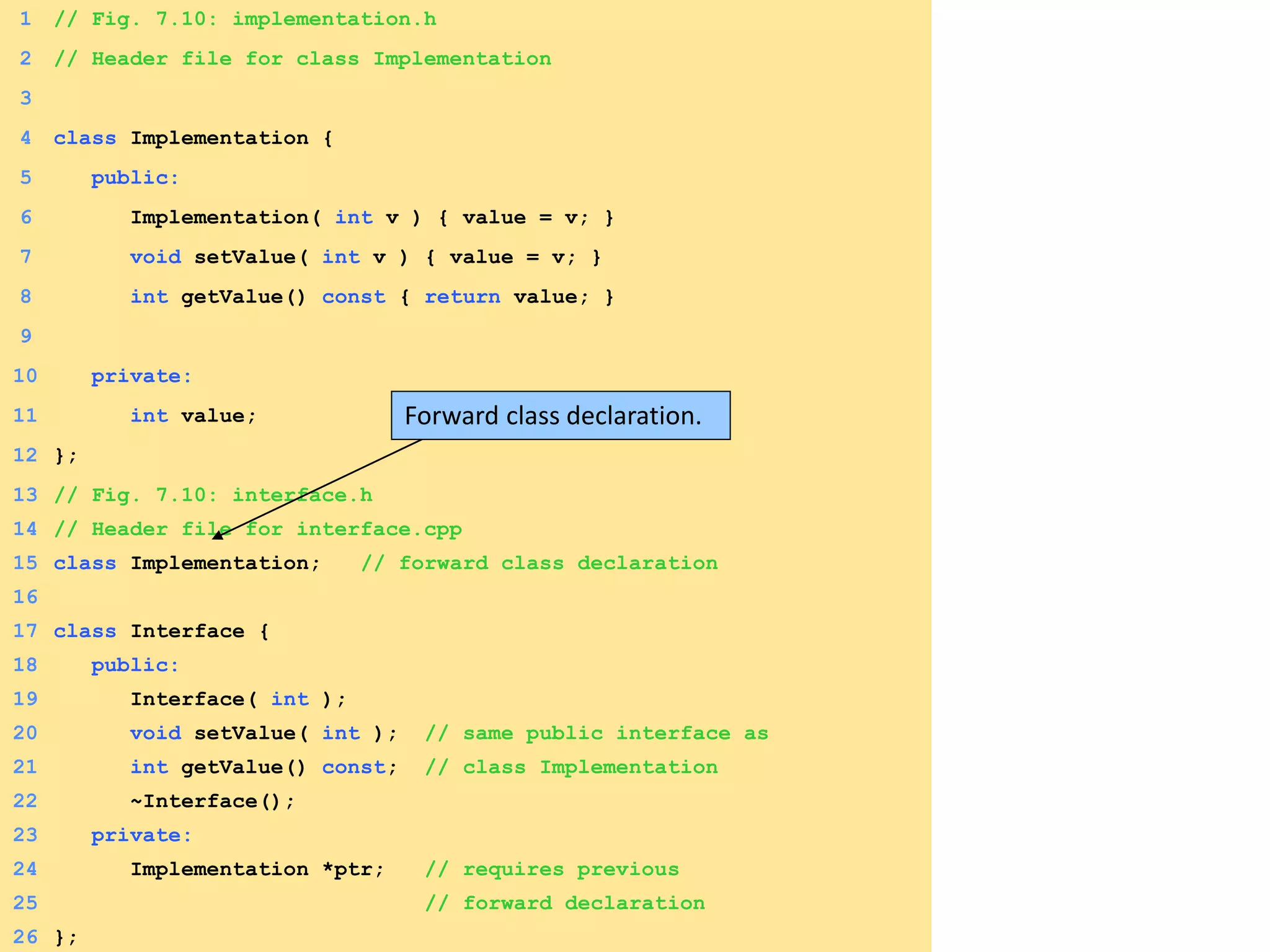
1 // Fig. 7.10: implementation.h
2 // Header file for class Implementation
3
4 class Implementation {
5 public:
6 Implementation( int v ) { value = v; }
7 void setValue( int v ) { value = v; }
8 int getValue() const { return value; }
9
10 private:
11 int value;
12 };
13 // Fig. 7.10: interface.h
14 // Header file for interface.cpp
15 class Implementation; // forward class declaration
16
17 class Interface {
18 public:
19 Interface( int );
20 void setValue( int ); // same public interface as
21 int getValue() const; // class Implementation
22 ~Interface();
23 private:
24 Implementation *ptr; // requires previous
25 // forward declaration
26 };
Forward class declaration.
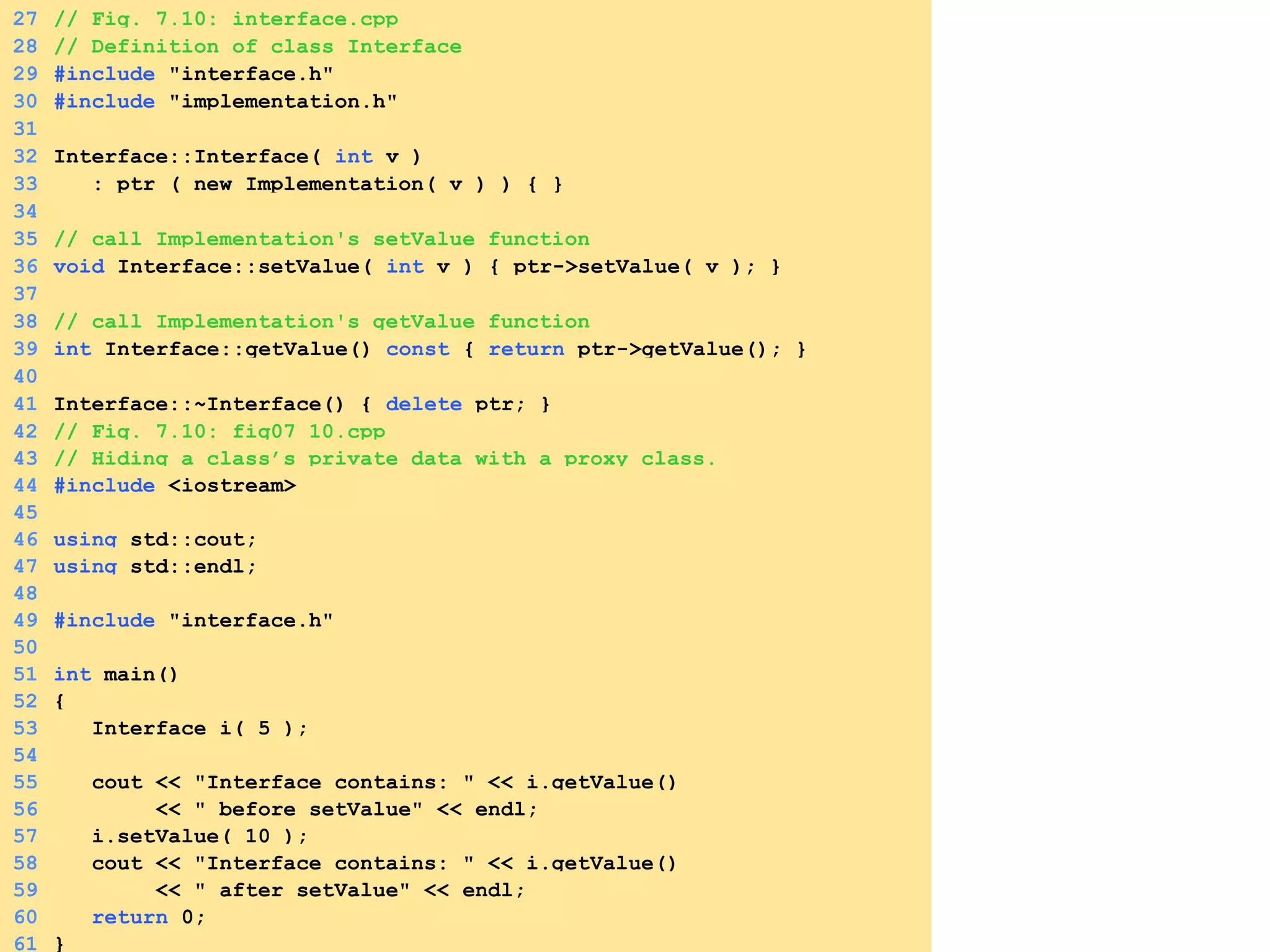
27 // Fig. 7.10: interface.cpp
28 // Definition of class Interface
29 #include "interface.h"
30 #include "implementation.h"
31
32 Interface::Interface( int v )
33 : ptr ( new Implementation( v ) ) { }
34
35 // call Implementation's setValue function
36 void Interface::setValue( int v ) { ptr->setValue( v ); }
37
38 // call Implementation's getValue function
39 int Interface::getValue() const { return ptr->getValue(); }
40
41 Interface::~Interface() { delete ptr; }
42 // Fig. 7.10: fig07_10.cpp
43 // Hiding a class’s private data with a proxy class.
44 #include <iostream>
45
46 using std::cout;
47 using std::endl;
48
49 #include "interface.h"
50
51 int main()
52 {
53 Interface i( 5 );
54
55 cout << "Interface contains: " << i.getValue()
56 << " before setValue" << endl;
57 i.setValue( 10 );
58 cout << "Interface contains: " << i.getValue()
59 << " after setValue" << endl;
60 return 0;
61 }
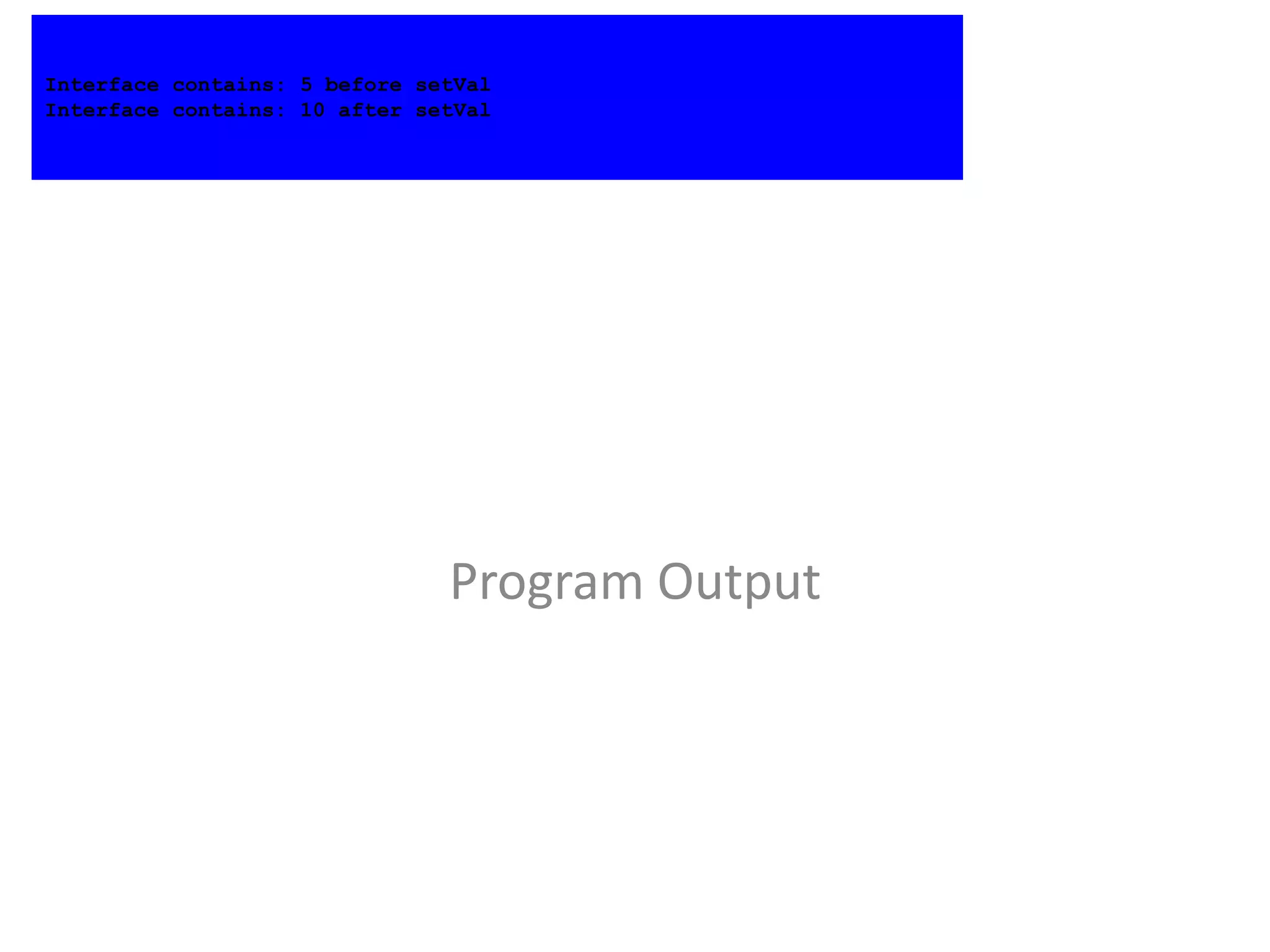
Program Output
Interface contains: 5 before setVal
Interface contains: 10 after setVal
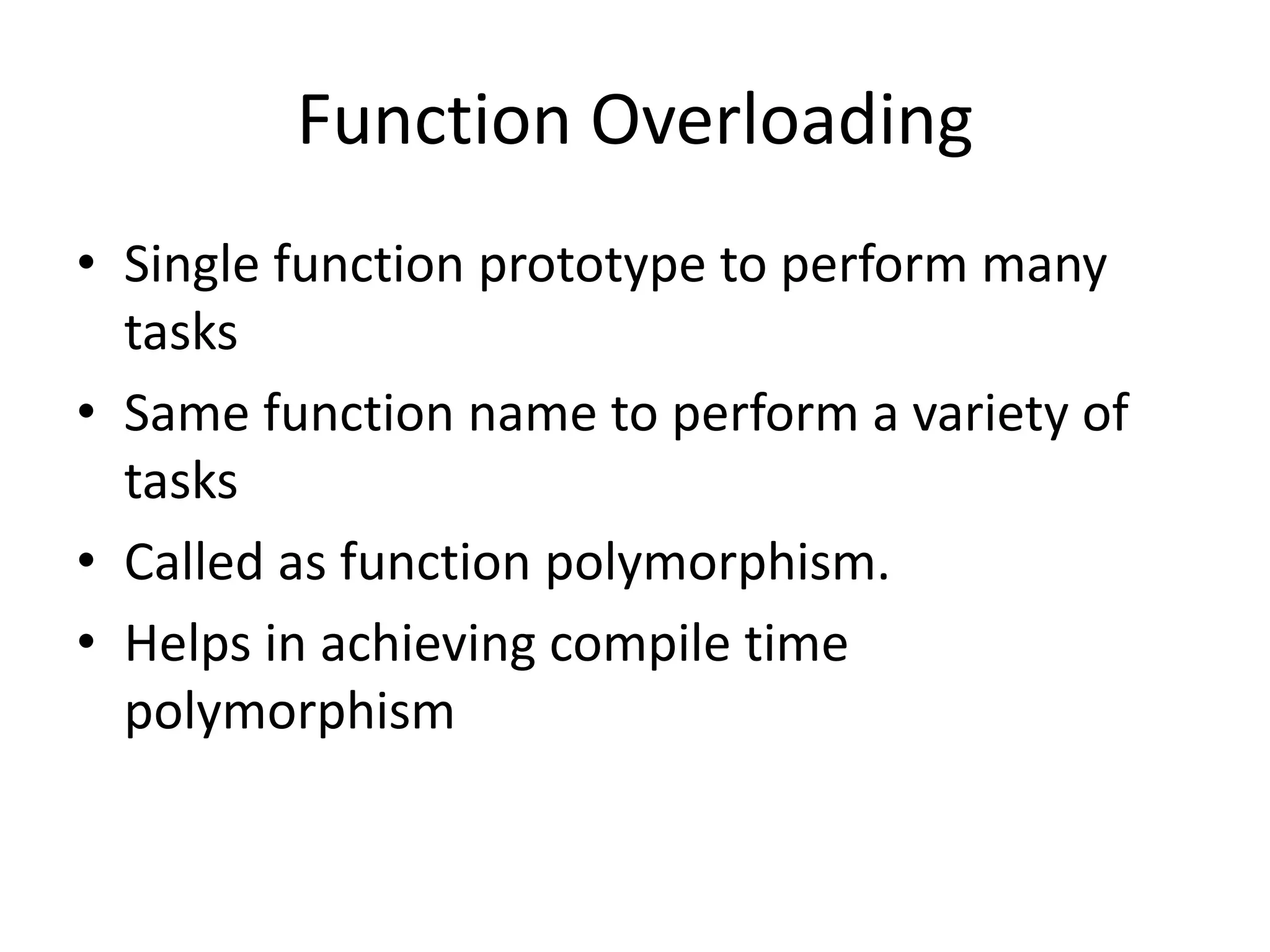
Function Overloading
• Single function prototype to perform many
tasks
• Same function name to perform a variety of
tasks
• Called as function polymorphism.
• Helps in achieving compile time
polymorphism
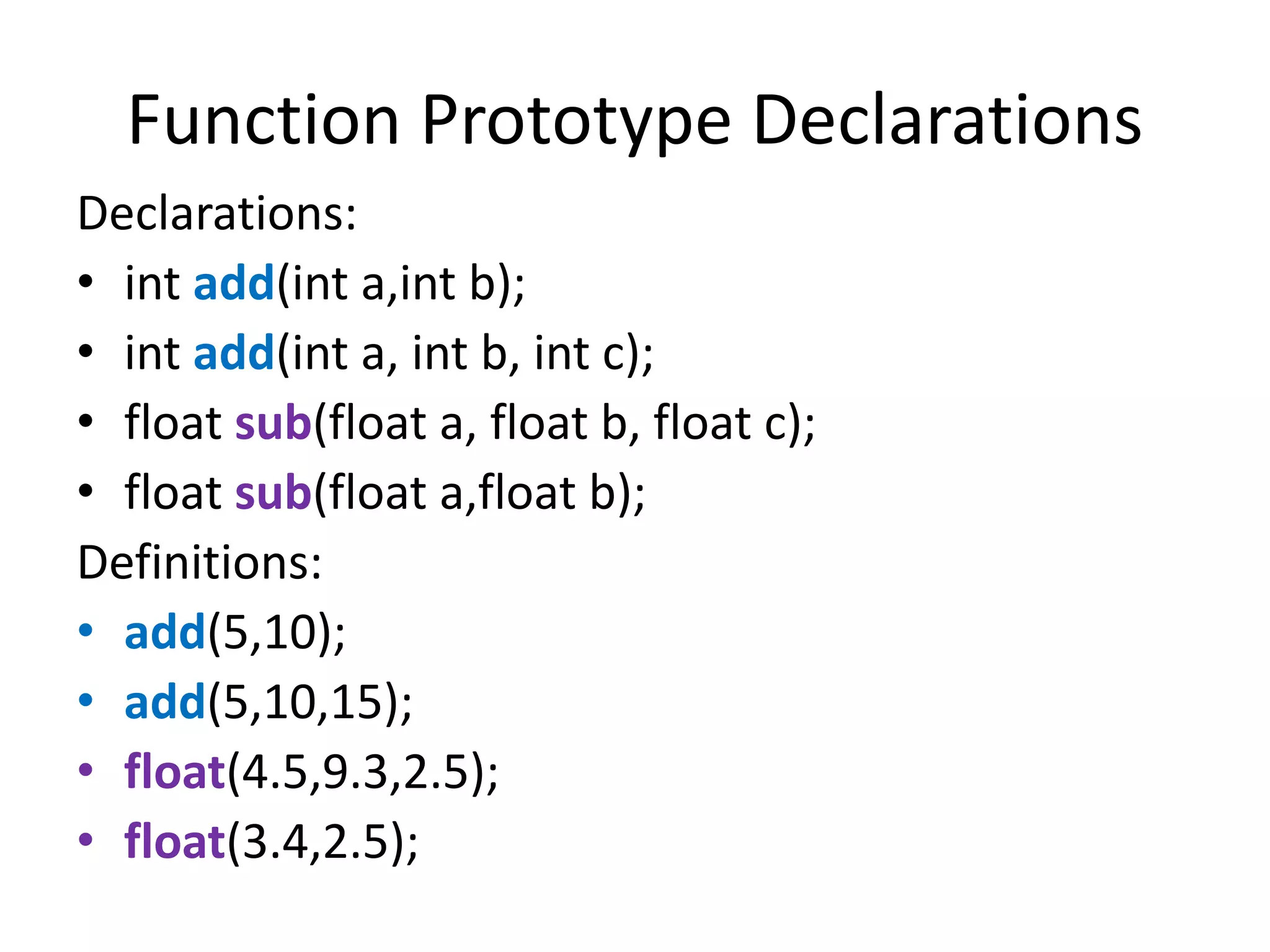
Function Prototype Declarations
Declarations:
• int add(int a,int b);
• int add(int a, int b, int c);
• float sub(float a, float b, float c);
• float sub(float a,float b);
Definitions:
• add(5,10);
• add(5,10,15);
• float(4.5,9.3,2.5);
• float(3.4,2.5);
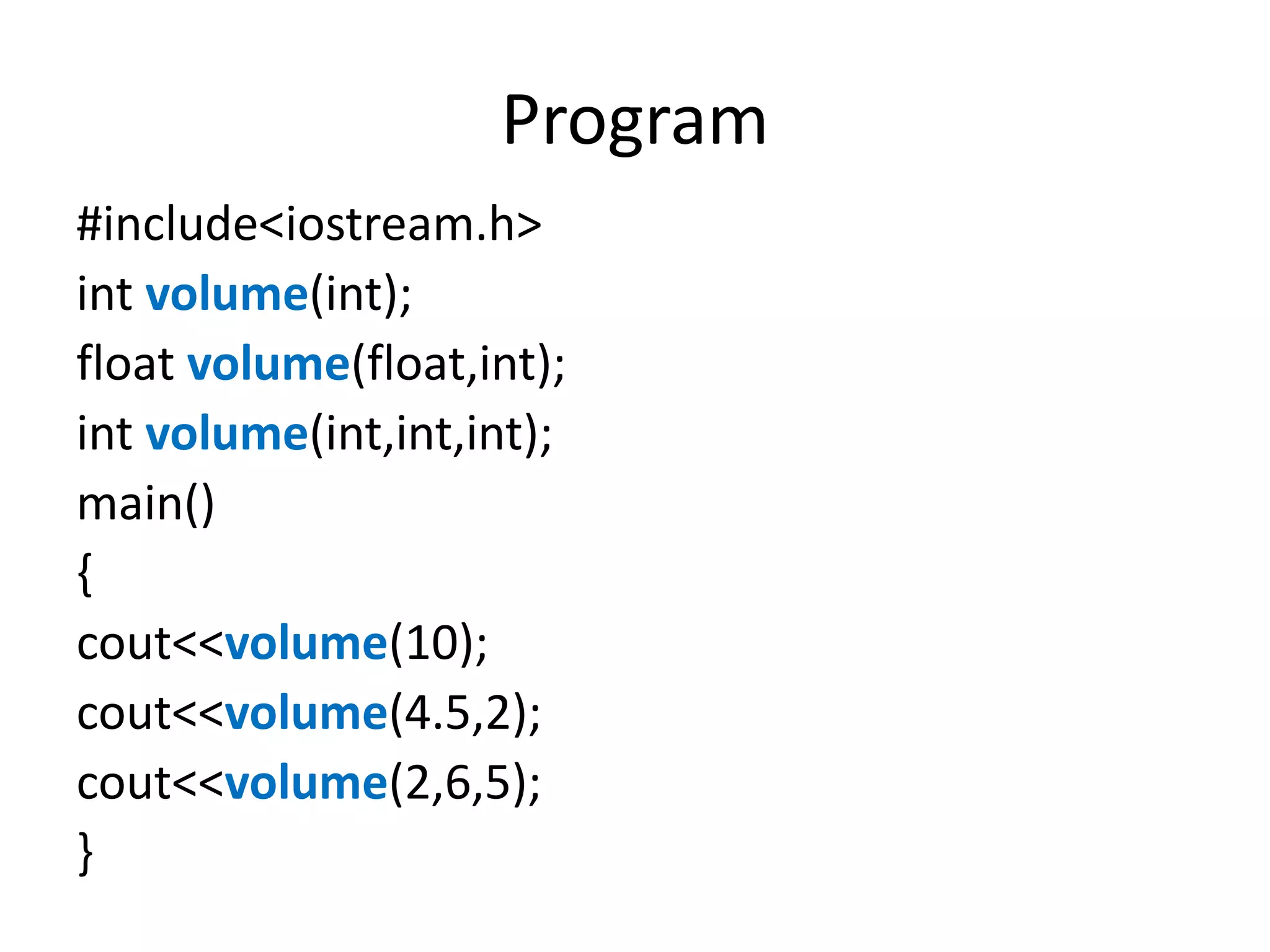
Program
#include<iostream.h>
int volume(int);
float volume(float,int);
int volume(int,int,int);
main()
{
cout<<volume(10);
cout<<volume(4.5,2);
cout<<volume(2,6,5);
}
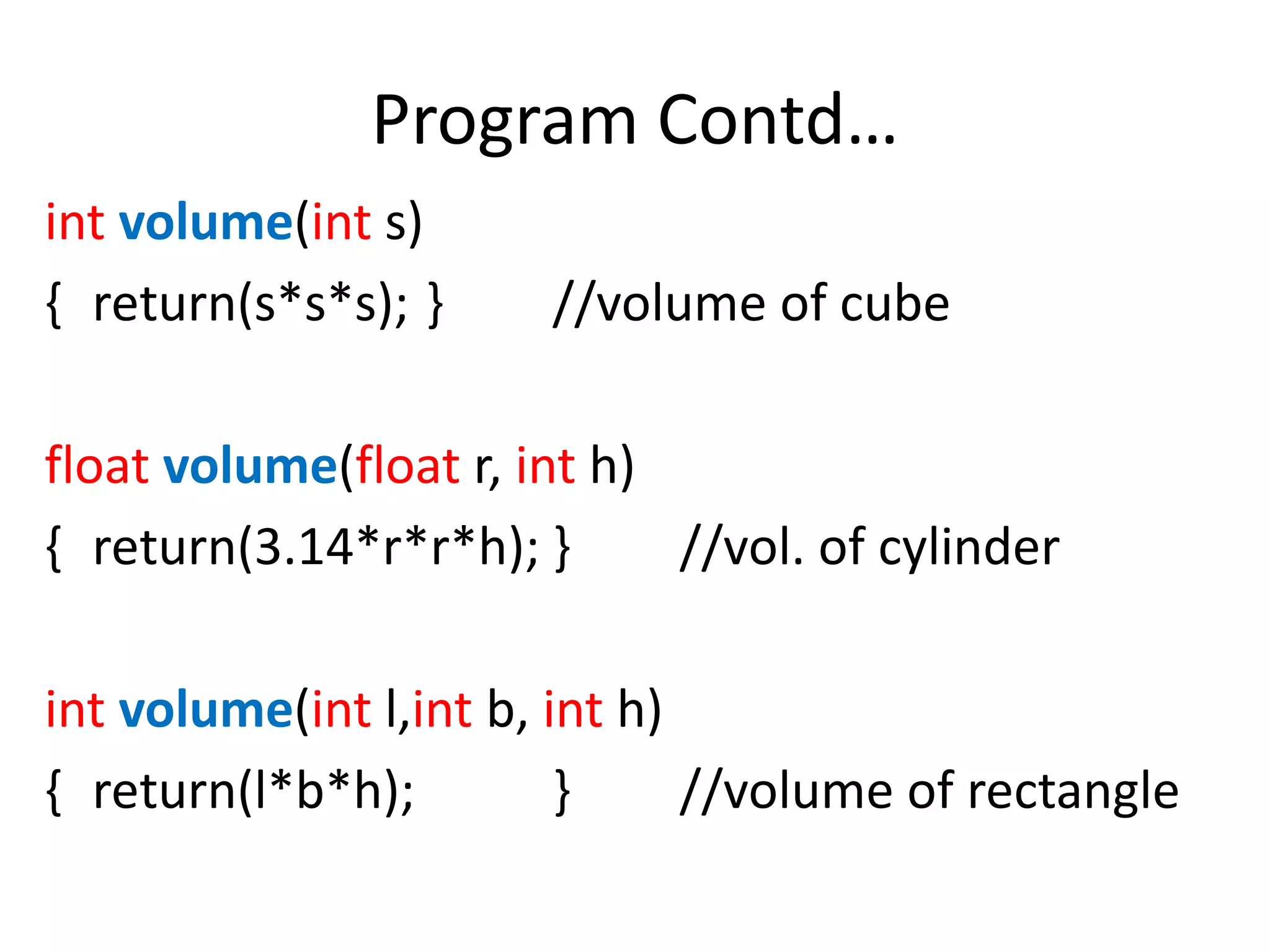
Program Contd…
int volume(int s)
{ return(s*s*s); } //volume of cube
float volume(float r, int h)
{ return(3.14*r*r*h); } //vol. of cylinder
int volume(int l,int b, int h)
{ return(l*b*h); } //volume of rectangle
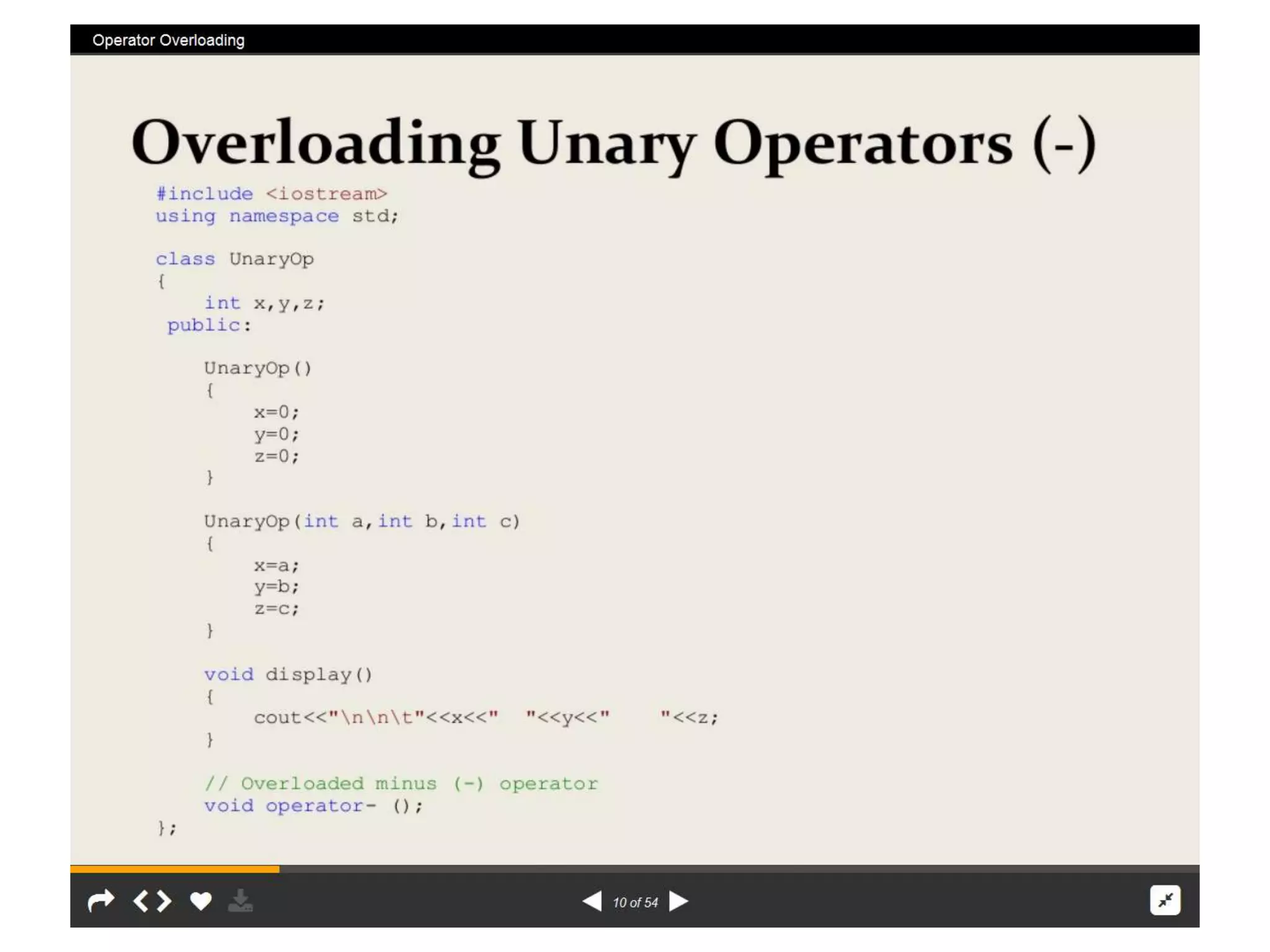
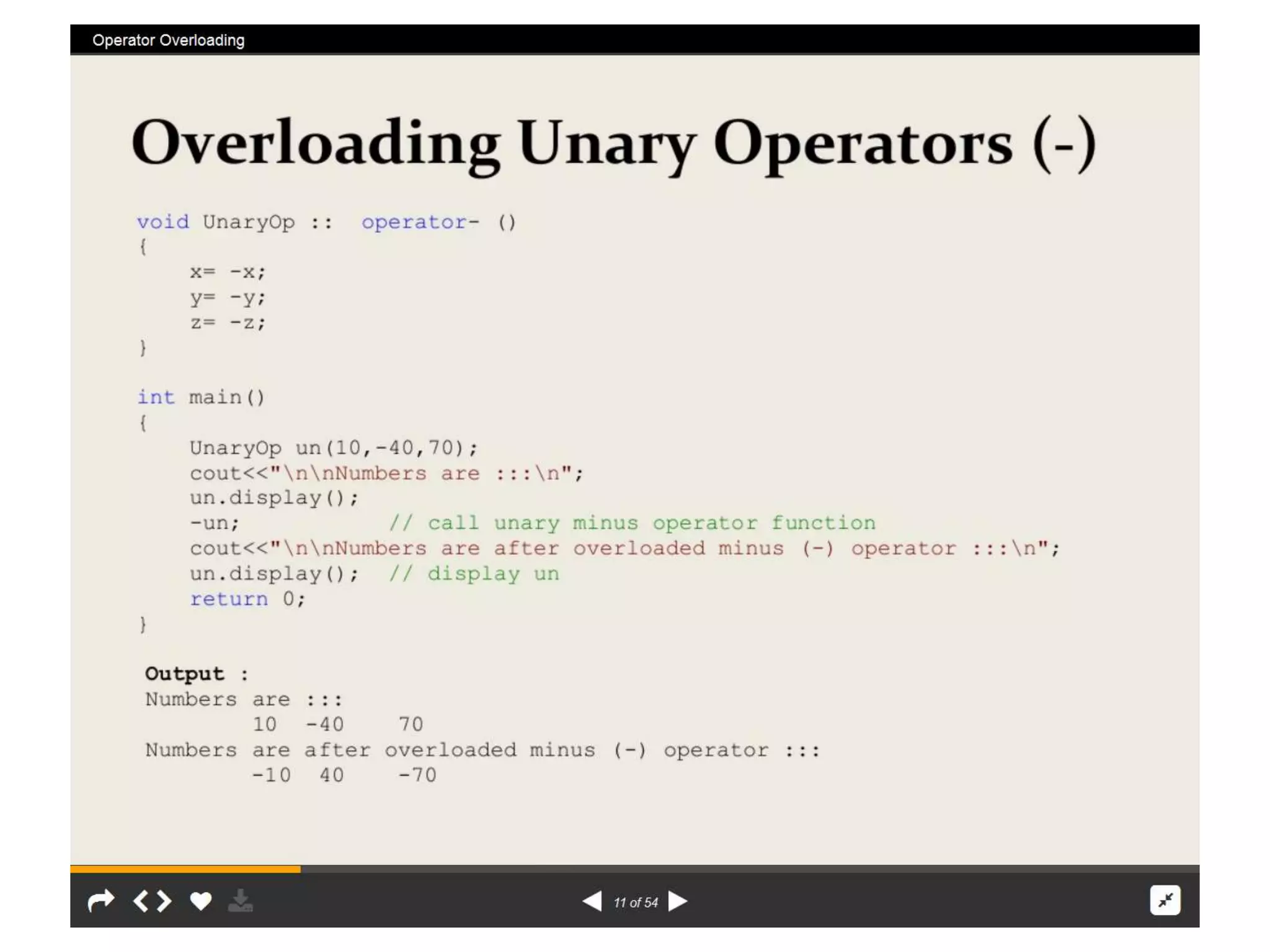
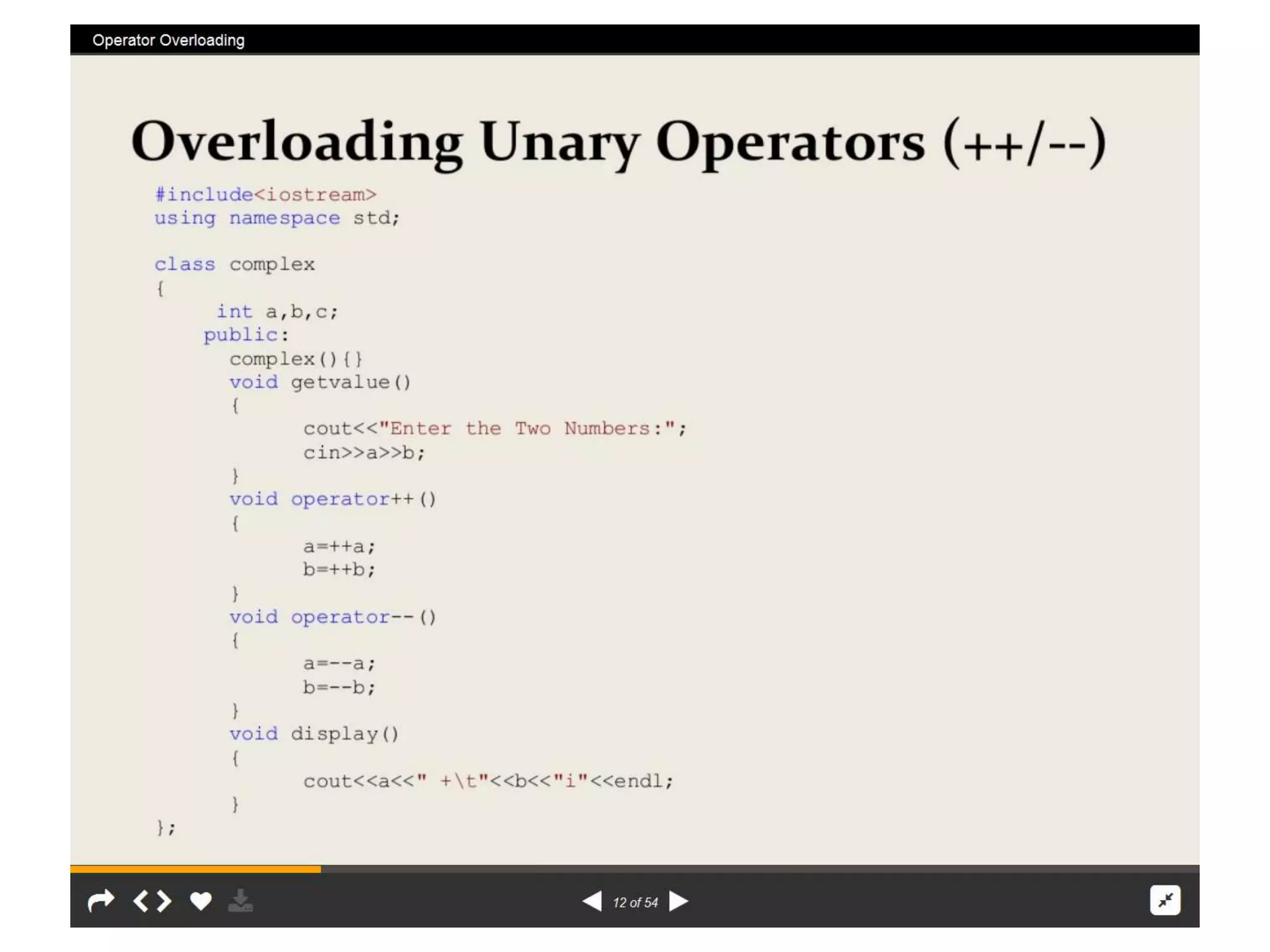
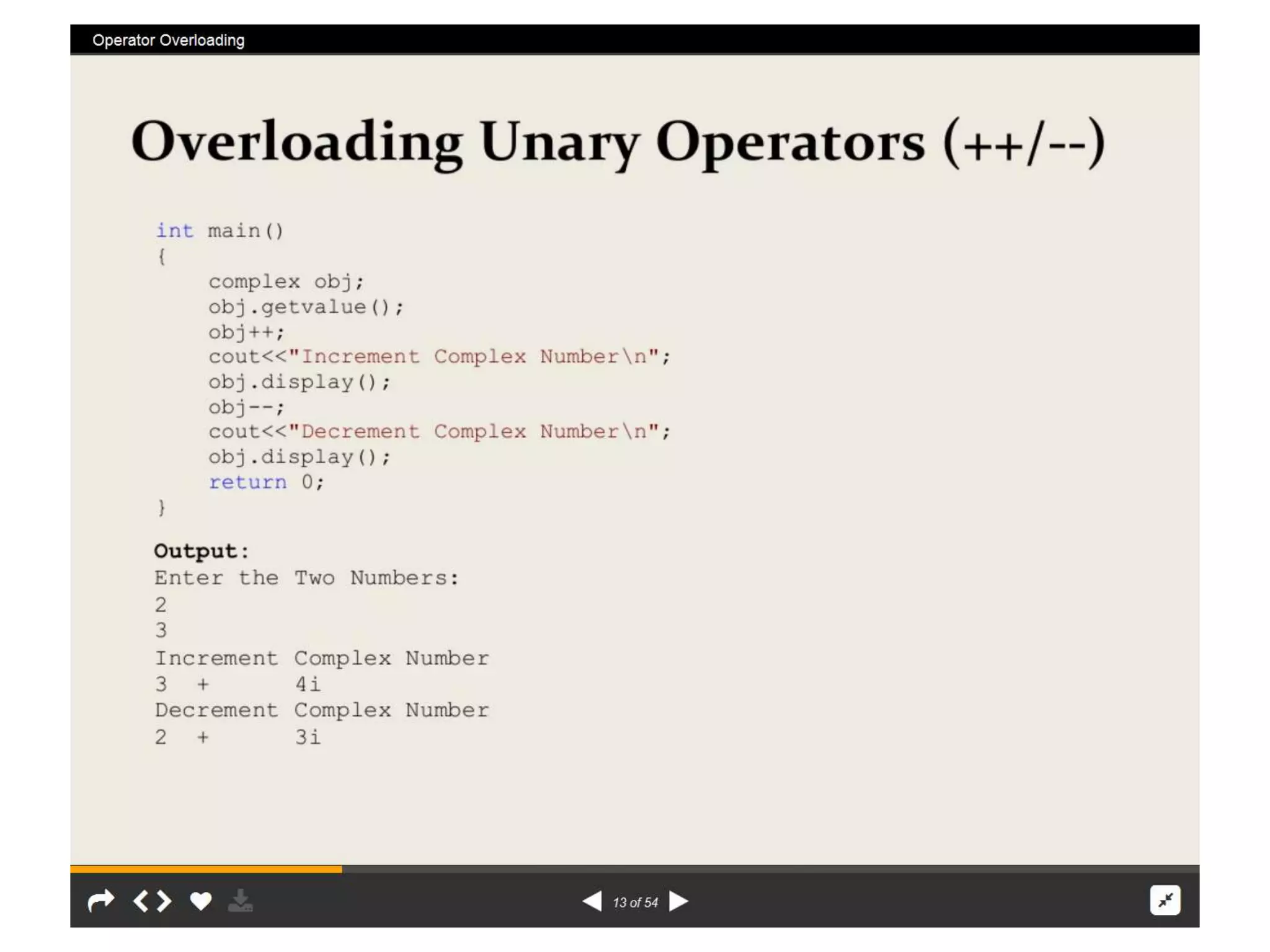
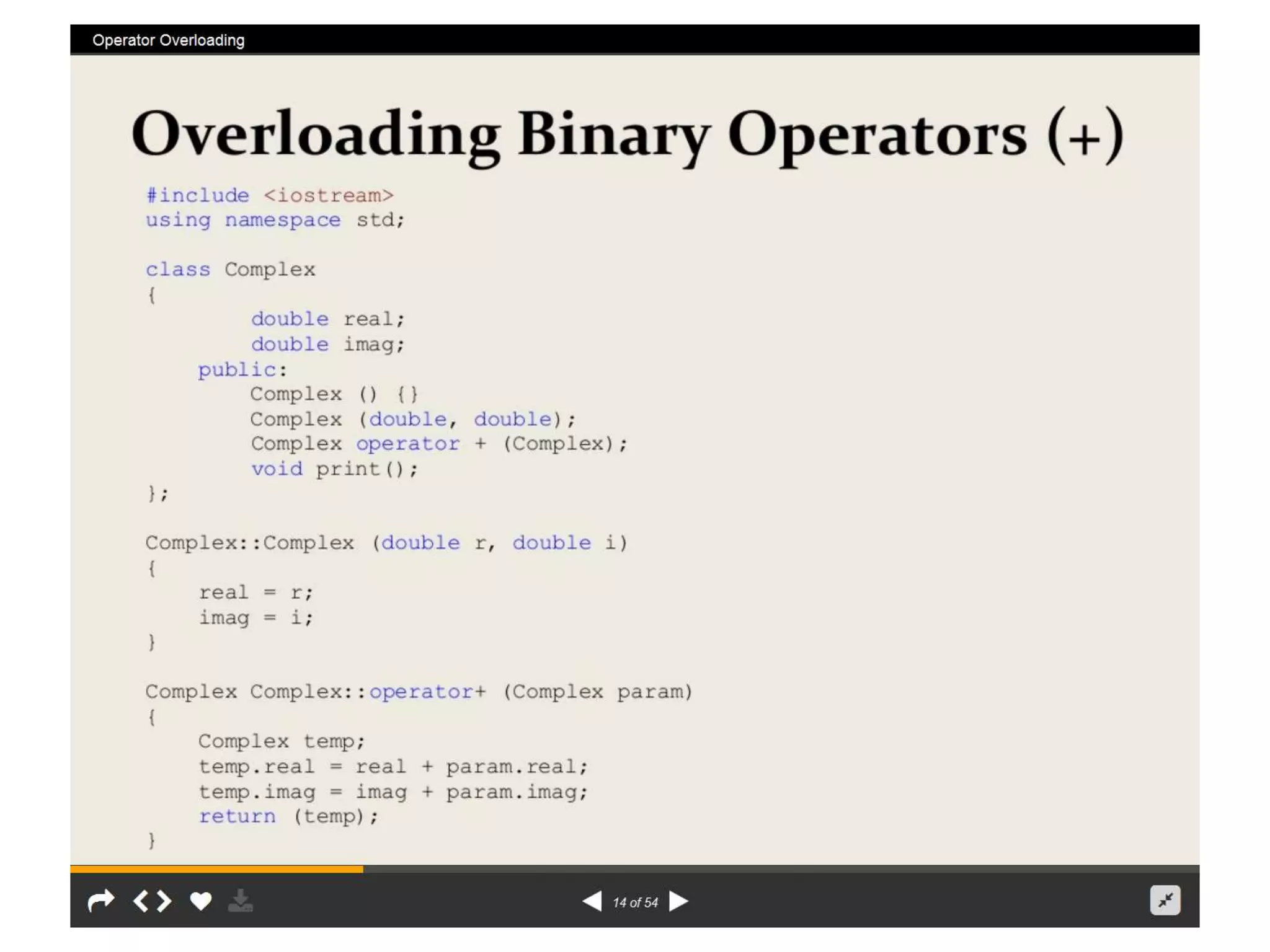
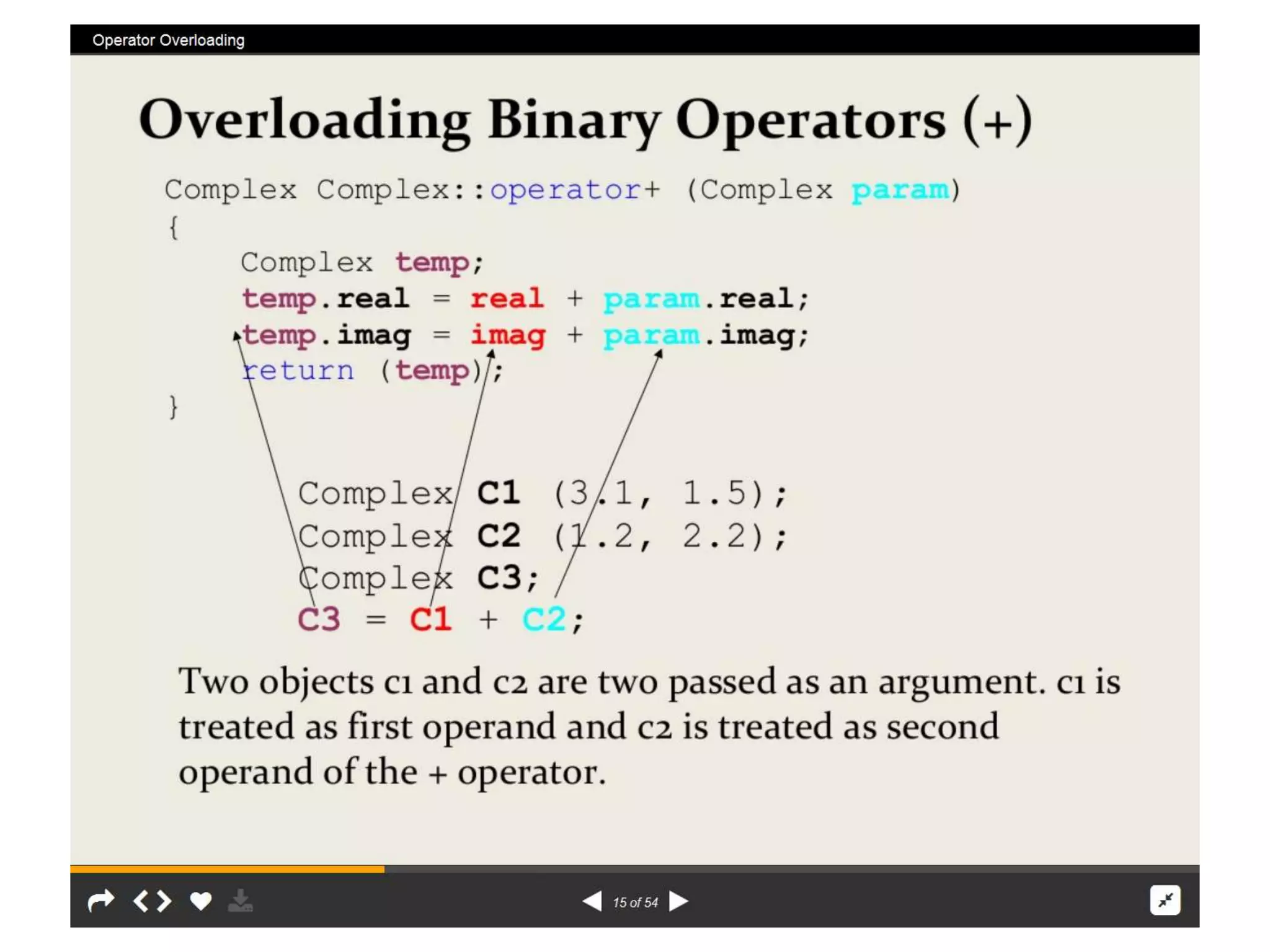
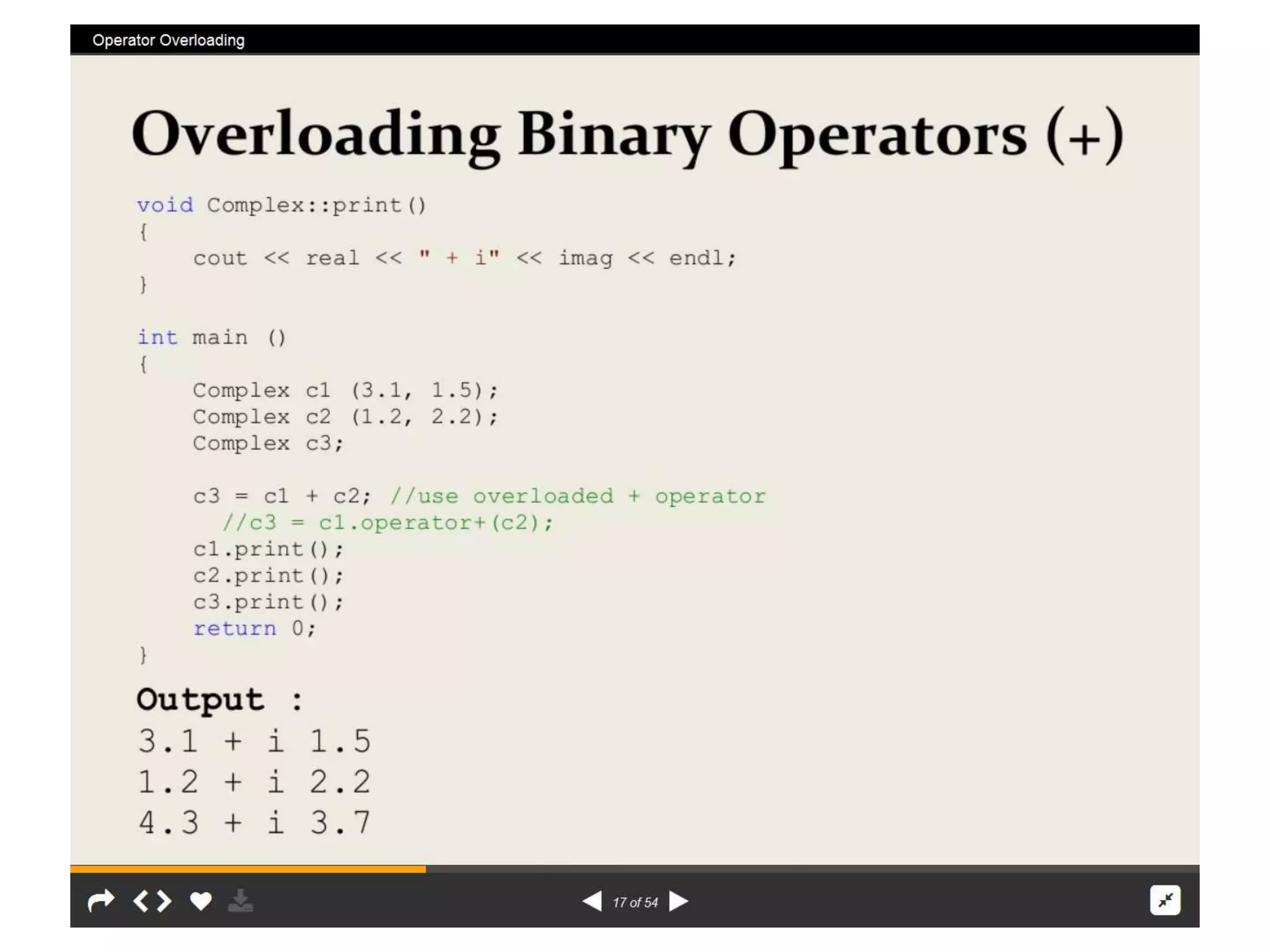
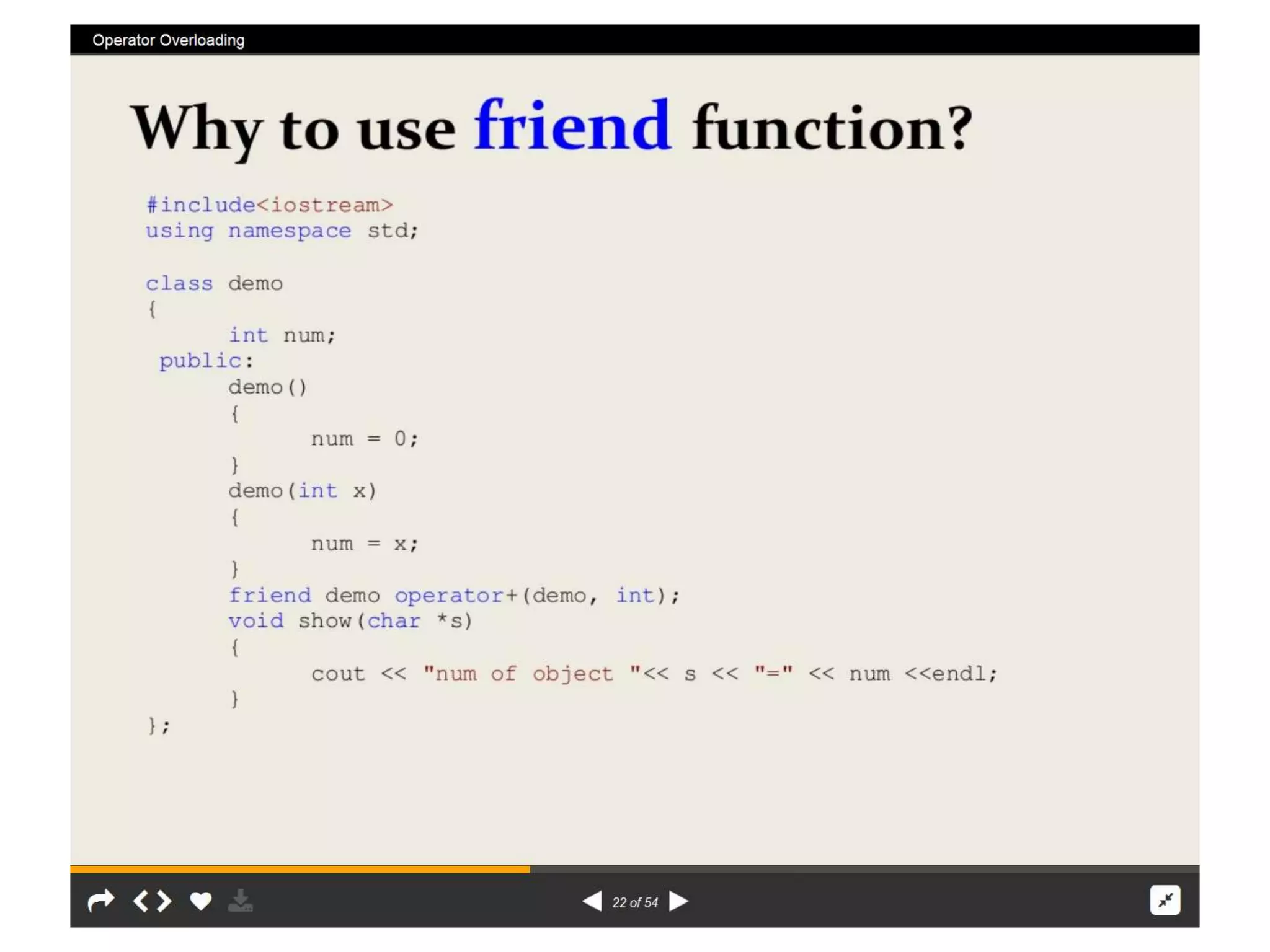
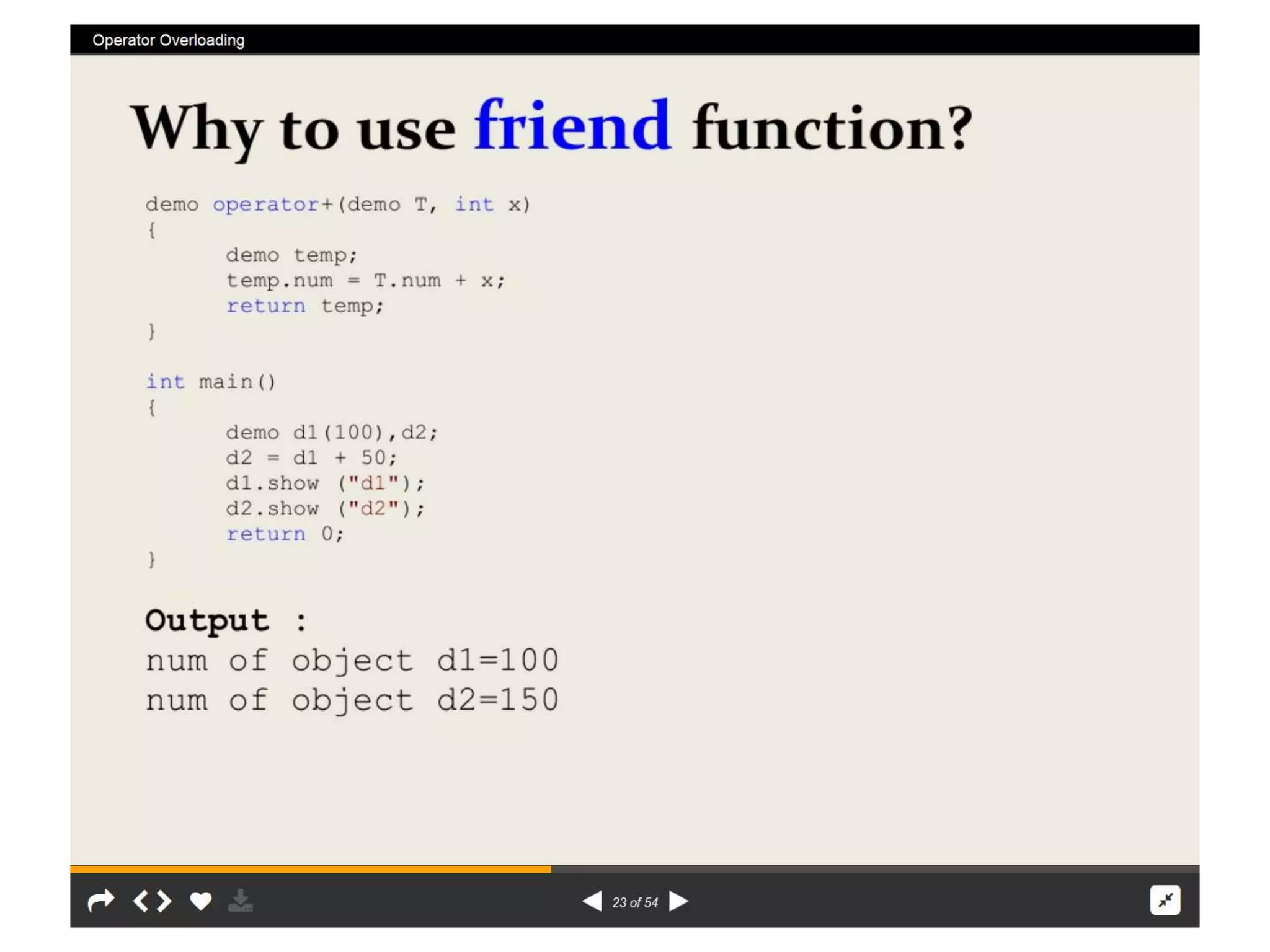
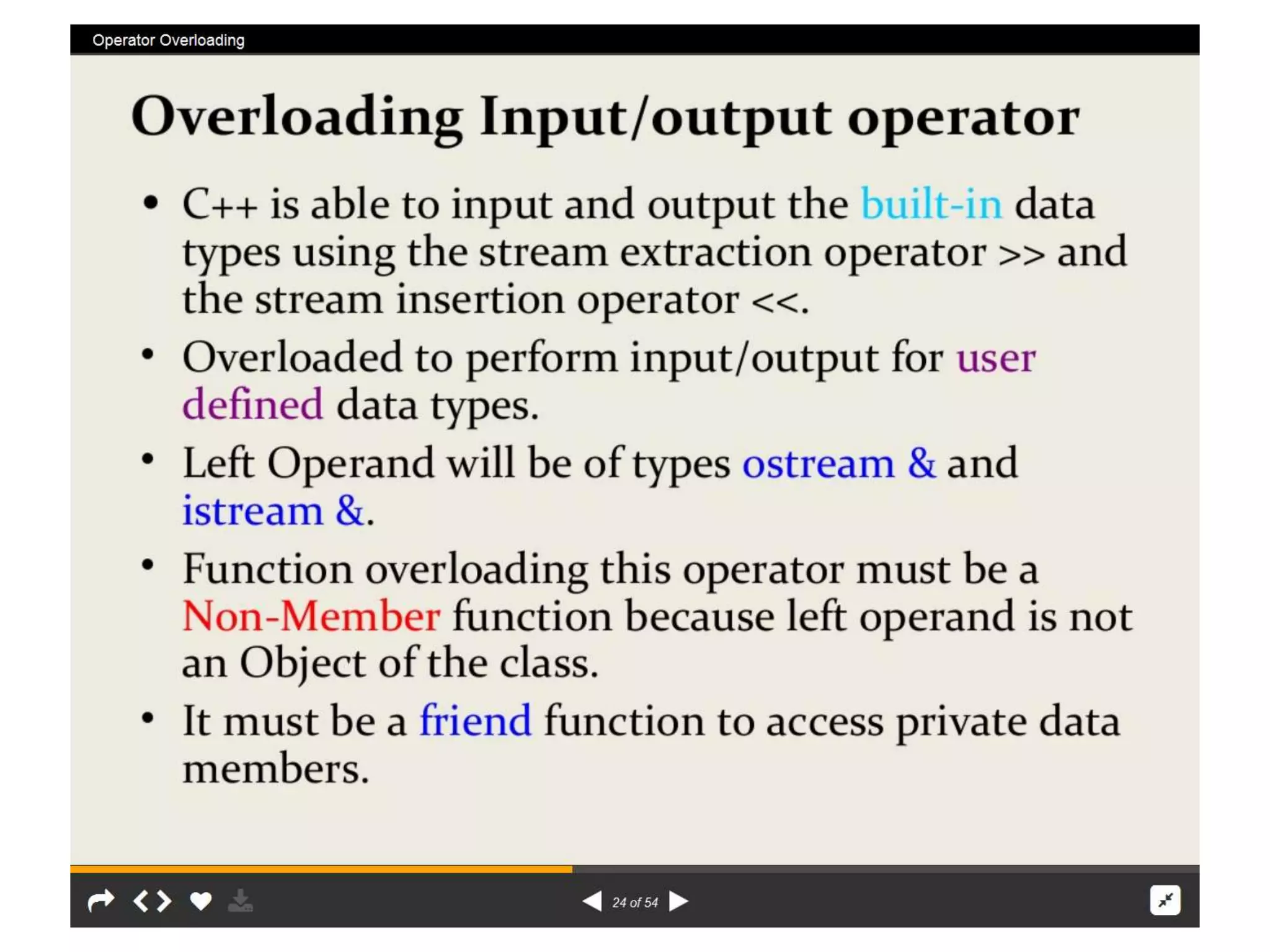
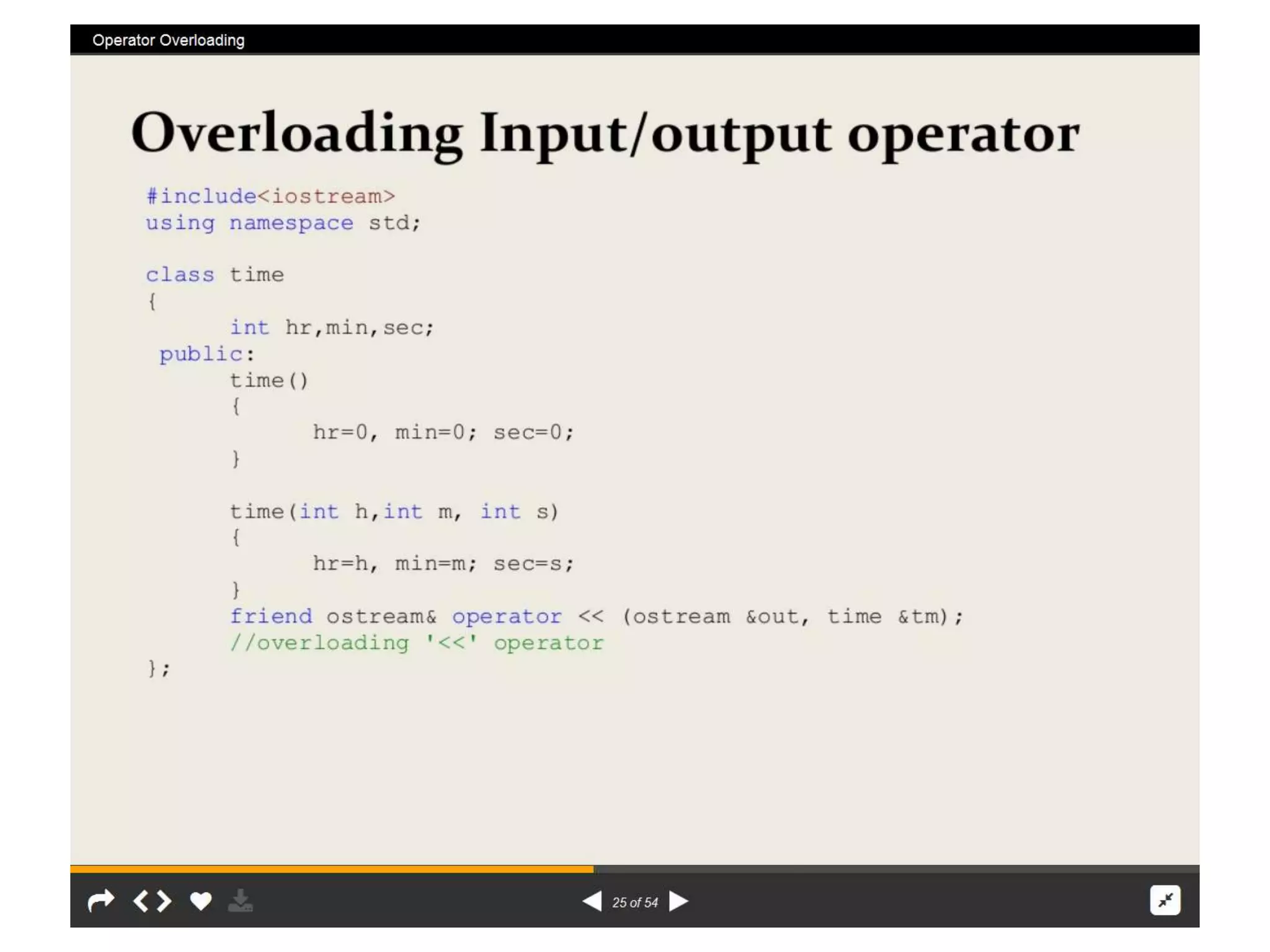
Operator overload  rr

Operator overload rr

  • 1.
  • 2.
    friend Functions andfriend Classes • friend function and friend classes – Can access private and protected members of another class – friend functions are not member functions of class • Defined outside of class scope • Properties of friendship – Friendship is granted, not taken – Not symmetric (if B a friend of A, A not necessarily a friend of B) – Not transitive (if A a friend of B, B a friend of C, A not necessarily a friend of C)
  • 3.
    friend Functions andfriend Classes • friend declarations – To declare a friend function • Type friend before the function prototype in the class that is giving friendship friend int myFunction( int x ); should appear in the class giving friendship – To declare a friend class – Type friend class Classname in the class that is giving friendship – if ClassOne is granting friendship to ClassTwo, friend class ClassTwo; – should appear in ClassOne's definition
  • 4.
    1 // Fig.7.5: fig07_05.cpp 2 // Friends can access private members of a class. 3 #include <iostream> 4 5 using std::cout; 6 using std::endl; 7 8 // Modified Count class 9 class Count { 10 friend void setX( Count &, int ); // friend declaration 11 public: 12 Count() { x = 0; } // constructor 13 void print() const { cout << x << endl; } // output 14 private: 15 int x; // data member 16 }; 17 18 // Can modify private data of Count because 19 // setX is declared as a friend function of Count 20 void setX( Count &c, int val ) 21 { 22 c.x = val; // legal: setX is a friend of Count 23 } 24 25 int main() 26 { 27 Count counter; 28 29 cout << "counter.x after instantiation: "; 30 counter.print(); Changing private variables allowed.
  • 5.
    31 cout <<"counter.x after call to setX friend function: "; 32 setX( counter, 8 ); // set x with a friend 33 counter.print(); 34 return 0; 35 } counter.x after instantiation: 0 counter.x after call to setX friend function: 8
  • 6.
    1 // Fig.7.6: fig07_06.cpp 2 // Non-friend/non-member functions cannot access 3 // private data of a class. 4 #include <iostream> 5 6 using std::cout; 7 using std::endl; 8 9 // Modified Count class 10 class Count { 11 public: 12 Count() { x = 0; } // constructor 13 void print() const { cout << x << endl; } // output 14 private: 15 int x; // data member 16 }; 17 18 // Function tries to modify private data of Count, 19 // but cannot because it is not a friend of Count. 20 void cannotSetX( Count &c, int val ) 21 { 22 c.x = val; // ERROR: 'Count::x' is not accessible 23 } 24 25 int main() 26 { 27 Count counter; 28 29 cannotSetX( counter, 3 ); // cannotSetX is not a friend 30 return 0; 31 }
  • 7.
    Program Output Compiling... Fig07_06.cpp D:books2000cpphtp3examplesCh07Fig07_06Fig07_06.cpp(22) : errorC2248: 'x' : cannot access private member declared in class 'Count' D:books2000cpphtp3examplesCh07Fig07_06 Fig07_06.cpp(15) : see declaration of 'x' Error executing cl.exe. test.exe - 1 error(s), 0 warning(s)
  • 8.
    Dynamic Memory Allocationwith Operators new and delete • new and delete – Used for dynamic memory allocation • Superior to C’s malloc and free – new • Creates an object of the proper size, calls its constructor and returns a pointer of the correct type – delete • Destroys object and frees space – Examples of new TypeName *typeNamePtr; • Creates pointer to a TypeName object typeNamePtr = new TypeName; • new creates TypeName object, returns pointer (which typeNamePtr is set equal to)
  • 9.
    Dynamic Memory Allocationwith Operators new and delete – Examples of delete delete typeNamePtr; • Calls destructor for TypeName object and frees memory Delete [] arrayPtr; • Used to dynamically delete an array • Initializing objects double *thingPtr = new double( 3.14159 ); – Initializes object of type double to 3.14159 int *arrayPtr = new int[ 10 ]; – Creates a ten element int array and assigns it to arrayPtr
  • 10.
    static Class Members •static class members – Shared by all objects of a class • Normally, each object gets its own copy of each variable – Efficient when a single copy of data is enough • Only the static variable has to be updated – May seem like global variables, but have class scope • only accessible to objects of same class – Initialized at file scope – Exist even if no instances (objects) of the class exist – Both variables and functions can be static – Can be public, private or protected
  • 11.
    static Class Members •static variables – Static variables are accessible through any object of the class – public static variables • Can also be accessed using scope resolution operator(::) Employee::count – private static variables • When no class member objects exist, can only be accessed via a public static member function – To call a public static member function combine the class name, the :: operator and the function name Employee::getCount()
  • 12.
    static Class Members •Static functions – static member functions cannot access non- static data or functions – There is no this pointer for static functions, they exist independent of objects
  • 13.
    1 // Fig.7.9: employ1.h 2 // An employee class 3 #ifndef EMPLOY1_H 4 #define EMPLOY1_H 5 6 class Employee { 7 public: 8 Employee( const char*, const char* ); // constructor 9 ~Employee(); // destructor 10 const char *getFirstName() const; // return first name 11 const char *getLastName() const; // return last name 12 13 // static member function 14 static int getCount(); // return # objects instantiated 15 16 private: 17 char *firstName; 18 char *lastName; 19 20 // static data member 21 static int count; // number of objects instantiated 22 }; 23 24 #endif
  • 14.
    25 // Fig.7.9: employ1.cpp 26 // Member function definitions for class Employee 27 #include <iostream> 28 29 using std::cout; 30 using std::endl; 31 32 #include <cstring> 33 #include <cassert> 34 #include "employ1.h" 35 36 // Initialize the static data member 37 int Employee::count = 0; 38 39 // Define the static member function that 40 // returns the number of employee objects instantiated. 41 int Employee::getCount() { return count; } 42 43 // Constructor dynamically allocates space for the 44 // first and last name and uses strcpy to copy 45 // the first and last names into the object 46 Employee::Employee( const char *first, const char *last ) 47 { 48 firstName = new char[ strlen( first ) + 1 ]; 49 assert( firstName != 0 ); // ensure memory allocated 50 strcpy( firstName, first ); 51 52 lastName = new char[ strlen( last ) + 1 ]; 53 assert( lastName != 0 ); // ensure memory allocated 54 strcpy( lastName, last ); 55 56 ++count; // increment static count of employees static data member count and function getCount( ) initialized at file scope (required). static data member count changed when a constructor/destructor called.
  • 15.
    57 cout <<"Employee constructor for " << firstName 58 << ' ' << lastName << " called." << endl; 59 } 60 61 // Destructor deallocates dynamically allocated memory 62 Employee::~Employee() 63 { 64 cout << "~Employee() called for " << firstName 65 << ' ' << lastName << endl; 66 delete [] firstName; // recapture memory 67 delete [] lastName; // recapture memory 68 --count; // decrement static count of employees 69 } 70 71 // Return first name of employee 72 const char *Employee::getFirstName() const 73 { 74 // Const before return type prevents client from modifying 75 // private data. Client should copy returned string before 76 // destructor deletes storage to prevent undefined pointer. 77 return firstName; 78 } 79 80 // Return last name of employee 81 const char *Employee::getLastName() const 82 { 83 // Const before return type prevents client from modifying 84 // private data. Client should copy returned string before 85 // destructor deletes storage to prevent undefined pointer. 86 return lastName; 87 }
  • 16.
    88 // Fig.7.9: fig07_09.cpp 89 // Driver to test the employee class 90 #include <iostream> 91 92 using std::cout; 93 using std::endl; 94 95 #include "employ1.h" 96 97 int main() 98 { 99 cout << "Number of employees before instantiation is " 100 << Employee::getCount() << endl; // use class name 101 102 Employee *e1Ptr = new Employee( "Susan", "Baker" ); 103 Employee *e2Ptr = new Employee( "Robert", "Jones" ); 104 105 cout << "Number of employees after instantiation is " 106 << e1Ptr->getCount(); 107 108 cout << "nnEmployee 1: " 109 << e1Ptr->getFirstName() 110 << " " << e1Ptr->getLastName() 111 << "nEmployee 2: " 112 << e2Ptr->getFirstName() 113 << " " << e2Ptr->getLastName() << "nn"; 114 115 delete e1Ptr; // recapture memory 116 e1Ptr = 0; 117 delete e2Ptr; // recapture memory 118 e2Ptr = 0; Number of employees after instantiation is 2
  • 17.
    119 120 cout <<"Number of employees after deletion is " 121 << Employee::getCount() << endl; 122 123 return 0; 124} Number of employees before instantiation is 0 Employee constructor for Susan Baker called. Employee constructor for Robert Jones called. Number of employees after instantiation is 2 Employee 1: Susan Baker Employee 2: Robert Jones ~Employee() called for Susan Baker ~Employee() called for Robert Jones Number of employees after deletion is 0 count back to zero.
  • 18.
    Container Classes andIterators • Container classes (collection classes) – Classes designed to hold collections of objects – Provide services such as insertion, deletion, searching, sorting, or testing an item – Examples: Arrays, stacks, queues, trees and linked lists • Iterator objects (iterators) – Object that returns the next item of a collection (or performs some action on the next item) – Can have several iterators per container • Book with multiple bookmarks – Each iterator maintains its own “position” information
  • 19.
    Container class • containerclass is a class designed to hold and organize multiple instances of another class. There are many different kinds of container classes, each of which has various advantages, disadvantages, and restrictions in their use. • Although C++ has built-in array functionality, programmers will often use an array container class instead because of the additional benefits it provides. Unlike built-in arrays, array container classes generally provide dynamically resizing (when elements are added or removed) and do bounds-checking. This not only makes array container classes more convenient than normal arrays, but safer too. • Container classes typically implement a fairly standardized minimal set of functionality. Most well-defined containers will include functions that: – Create an empty container (via a constructor) – Insert a new object into the container – Remove an object from the container – Report the number of objects currently in the container – Empty the container of all objects – Provide access to the stored objects
  • 20.
    Proxy Classes • Proxyclass – Used to hide implementation details of a class – Class that knows only the public interface of the class being hidden – Enables clients to use class’s services without giving access to class’s implementation • Forward class declaration – Used when class definition only uses a pointer to another class – Prevents the need for including the header file – Declares a class before it is referenced – Format: class ClassToLoad;
  • 21.
    1 // Fig.7.10: implementation.h 2 // Header file for class Implementation 3 4 class Implementation { 5 public: 6 Implementation( int v ) { value = v; } 7 void setValue( int v ) { value = v; } 8 int getValue() const { return value; } 9 10 private: 11 int value; 12 }; 13 // Fig. 7.10: interface.h 14 // Header file for interface.cpp 15 class Implementation; // forward class declaration 16 17 class Interface { 18 public: 19 Interface( int ); 20 void setValue( int ); // same public interface as 21 int getValue() const; // class Implementation 22 ~Interface(); 23 private: 24 Implementation *ptr; // requires previous 25 // forward declaration 26 }; Forward class declaration.
  • 22.
    27 // Fig.7.10: interface.cpp 28 // Definition of class Interface 29 #include "interface.h" 30 #include "implementation.h" 31 32 Interface::Interface( int v ) 33 : ptr ( new Implementation( v ) ) { } 34 35 // call Implementation's setValue function 36 void Interface::setValue( int v ) { ptr->setValue( v ); } 37 38 // call Implementation's getValue function 39 int Interface::getValue() const { return ptr->getValue(); } 40 41 Interface::~Interface() { delete ptr; } 42 // Fig. 7.10: fig07_10.cpp 43 // Hiding a class’s private data with a proxy class. 44 #include <iostream> 45 46 using std::cout; 47 using std::endl; 48 49 #include "interface.h" 50 51 int main() 52 { 53 Interface i( 5 ); 54 55 cout << "Interface contains: " << i.getValue() 56 << " before setValue" << endl; 57 i.setValue( 10 ); 58 cout << "Interface contains: " << i.getValue() 59 << " after setValue" << endl; 60 return 0; 61 }
  • 23.
    Program Output Interface contains:5 before setVal Interface contains: 10 after setVal
  • 24.
    Function Overloading • Singlefunction prototype to perform many tasks • Same function name to perform a variety of tasks • Called as function polymorphism. • Helps in achieving compile time polymorphism
  • 25.
    Function Prototype Declarations Declarations: •int add(int a,int b); • int add(int a, int b, int c); • float sub(float a, float b, float c); • float sub(float a,float b); Definitions: • add(5,10); • add(5,10,15); • float(4.5,9.3,2.5); • float(3.4,2.5);
  • 26.
    Program #include<iostream.h> int volume(int); float volume(float,int); intvolume(int,int,int); main() { cout<<volume(10); cout<<volume(4.5,2); cout<<volume(2,6,5); }
  • 27.
    Program Contd… int volume(ints) { return(s*s*s); } //volume of cube float volume(float r, int h) { return(3.14*r*r*h); } //vol. of cylinder int volume(int l,int b, int h) { return(l*b*h); } //volume of rectangle