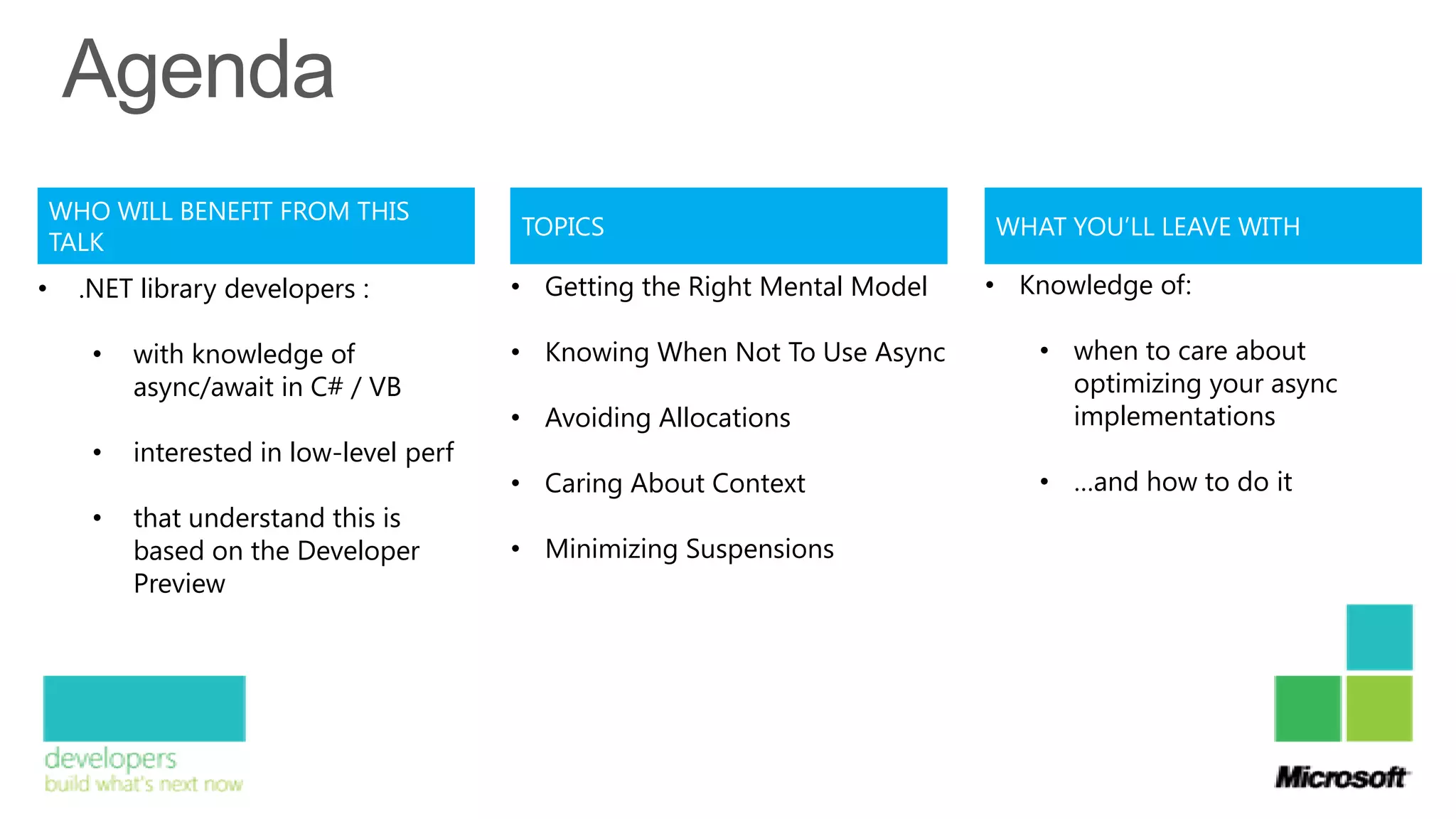
WHO WILL BENEFIT FROM THIS
                                          TOPICS                             WHAT YOU’LL LEAVE WITH
    TALK
•     .NET library developers :           • Getting the Right Mental Model   • Knowledge of:

       •   with knowledge of              • Knowing When Not To Use Async       • when to care about
           async/await in C# / VB                                                 optimizing your async
                                          • Avoiding Allocations                  implementations
       •   interested in low-level perf
                                          • Caring About Context                • …and how to do it
       •   that understand this is
           based on the Developer         • Minimizing Suspensions
           Preview
public static void SimpleBody() {
  Console.WriteLine("Hello, Async World!");
}


.method public hidebysig static void SimpleBody() cil managed
{
    .maxstack 8
    L_0000: ldstr "Hello, Async World!"
    L_0005: call void [mscorlib]System.Console::WriteLine(string)
    L_000a: ret
}
.method public hidebysig instance void MoveNext() cil managed
                                     {
                                       // Code size       66 (0x42)
                                       .maxstack 2
                                       .locals init ([0] bool '<>t__doFinallyBodies', [1] class [mscorlib]System.Exception '<>t__ex')
                                       .try
                                       {
                                         IL_0000: ldc.i4.1
                                         IL_0001: stloc.0
                                         IL_0002: ldarg.0
                                         IL_0003: ldfld       int32 Program/'<SimpleBody>d__0'::'<>1__state'
public static async Task SimpleBody() {  IL_0008: ldc.i4.m1
   Console.WriteLine("Hello, Async World!"); IL_000d
                                         IL_0009: bne.un.s
                                         IL_000b: leave.s     IL_0041
}                                        IL_000d: ldstr       "Hello, Async World!"
                                         IL_0012: call        void [mscorlib]System.Console::WriteLine(string)
                                         IL_0017: leave.s     IL_002f
.method public hidebysig static class [mscorlib]System.Threading.Tasks.Task SimpleBody() cil managed
                                       }
{                                      catch [mscorlib]System.Exception
  .custom instance void [mscorlib]System.Diagnostics.DebuggerStepThroughAttribute::.ctor() = ( 01 00 00 00 )
                                       {
  // Code size       32 (0x20)           IL_0019: stloc.1
  .maxstack 2                            IL_001a: ldarg.0
  .locals init ([0] valuetype Program/'<SimpleBody>d__0' V_0)
                                         IL_001b: ldc.i4.m1
  IL_0000: ldloca.s    V_0               IL_001c: stfld       int32 Program/'<SimpleBody>d__0'::'<>1__state'
  IL_0002: call        valuetype [mscorlib]System.Runtime.CompilerServices.AsyncTaskMethodBuilder
                                         IL_0021: ldarg.0
                       [mscorlib]System.Runtime.CompilerServices.AsyncTaskMethodBuilder::Create()
                                         IL_0022: ldflda      valuetype [mscorlib]System.Runtime.CompilerServices.AsyncTaskMethodBuilder
  IL_0007: stfld       valuetype [mscorlib]System.Runtime.CompilerServices.AsyncTaskMethodBuilder Program/'<SimpleBody>d__0'::'<>t__builder'
                                                                  Program/'<SimpleBody>d__0'::'<>t__builder'
  IL_000c: ldloca.s    V_0               IL_0027: ldloc.1
  IL_000e: call        instance void Program/'<SimpleBody>d__0'::MoveNext() [mscorlib]System.Runtime.CompilerServices.AsyncTaskMethodBuilder::SetException(
                                         IL_0028: call        instance void
  IL_0013: ldloca.s    V_0                                        class [mscorlib]System.Exception)
  IL_0015: ldflda      valuetype [mscorlib]System.Runtime.CompilerServices.AsyncTaskMethodBuilder Program/'<SimpleBody>d__0'::'<>t__builder'
                                         IL_002d: leave.s     IL_0041
  IL_001a: call        instance class [mscorlib]System.Threading.Tasks.Task [mscorlib]System.Runtime.CompilerServices.AsyncTaskMethodBuilder::get_Task()
                                       }
  IL_001f: ret                         IL_002f: ldarg.0
}                                      IL_0030: ldc.i4.m1
                                       IL_0031: stfld       int32 Program/'<SimpleBody>d__0'::'<>1__state'
                                       IL_0036: ldarg.0
                                       IL_0037: ldflda      valuetype [mscorlib]System.Runtime.CompilerServices.AsyncTaskMethodBuilder
                                                                Program/'<SimpleBody>d__0'::'<>t__builder'
                                       IL_003c: call        instance void [mscorlib]System.Runtime.CompilerServices.AsyncTaskMethodBuilder::SetResult()
                                       IL_0041: ret
                                     }
Demo
 Async methods
[CompilerGenerated]
private class <SimpleBody>d__0
{
    private int <>1__state;
    public AsyncTaskMethodBuilder <>t__builder;
    public Action <>t__MoveNextDelegate;
    public void MoveNext();
}


<>t__awaiter1.OnCompleted(<>t__MoveNextDelegate);


public static Task SimpleBodyAsync() {
    ...
    d__.<>t__builder = AsyncTaskMethodBuilder.Create();
    ...
    return d__.<>t__builder.Task;
}
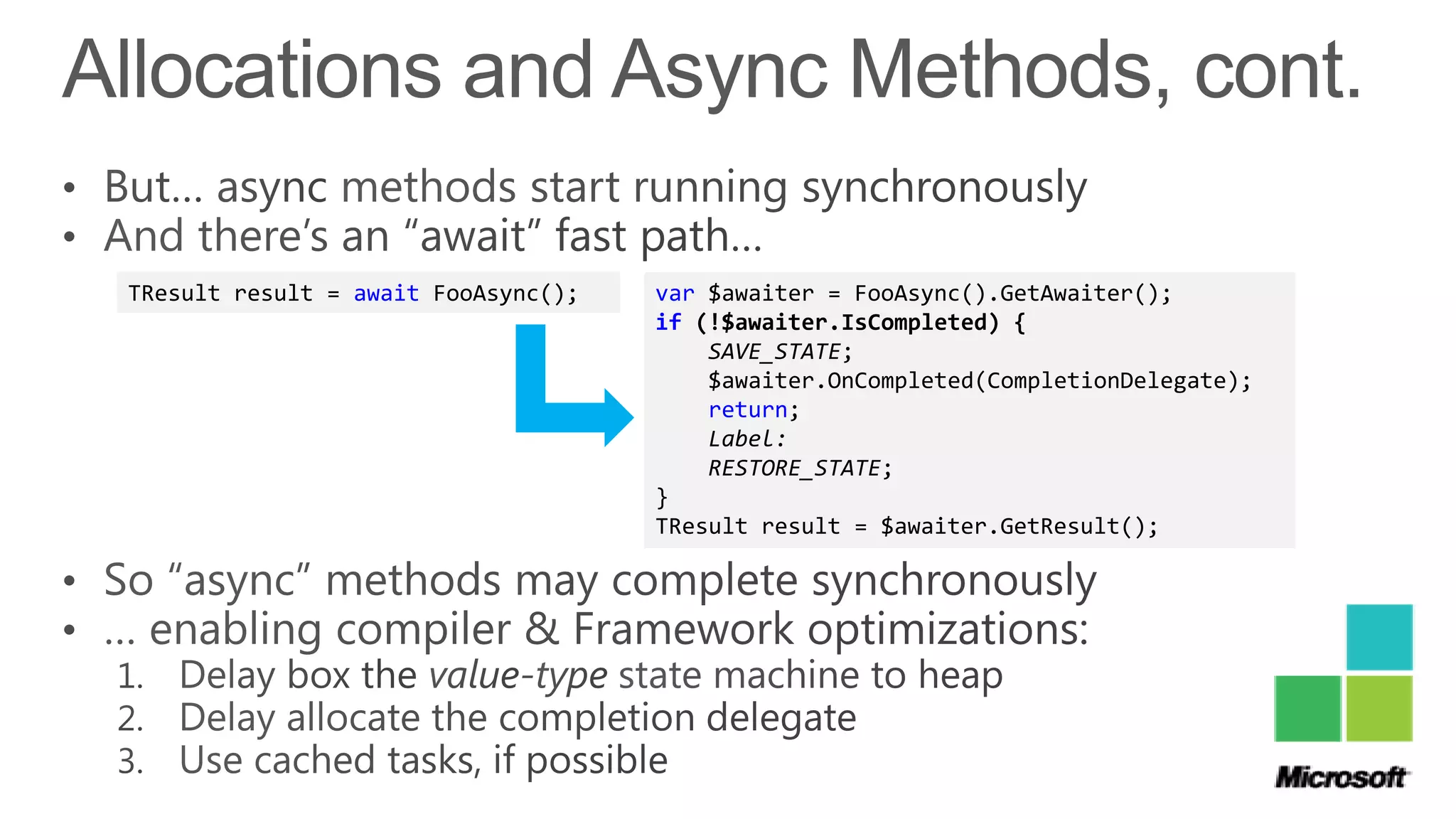
TResult result = await FooAsync();   var $awaiter = FooAsync().GetAwaiter();
                                     if (!$awaiter.IsCompleted) {
                                         SAVE_STATE;
                                         $awaiter.OnCompleted(CompletionDelegate);
                                         return;
                                         Label:
                                         RESTORE_STATE;
                                     }
                                     TResult result = $awaiter.GetResult();
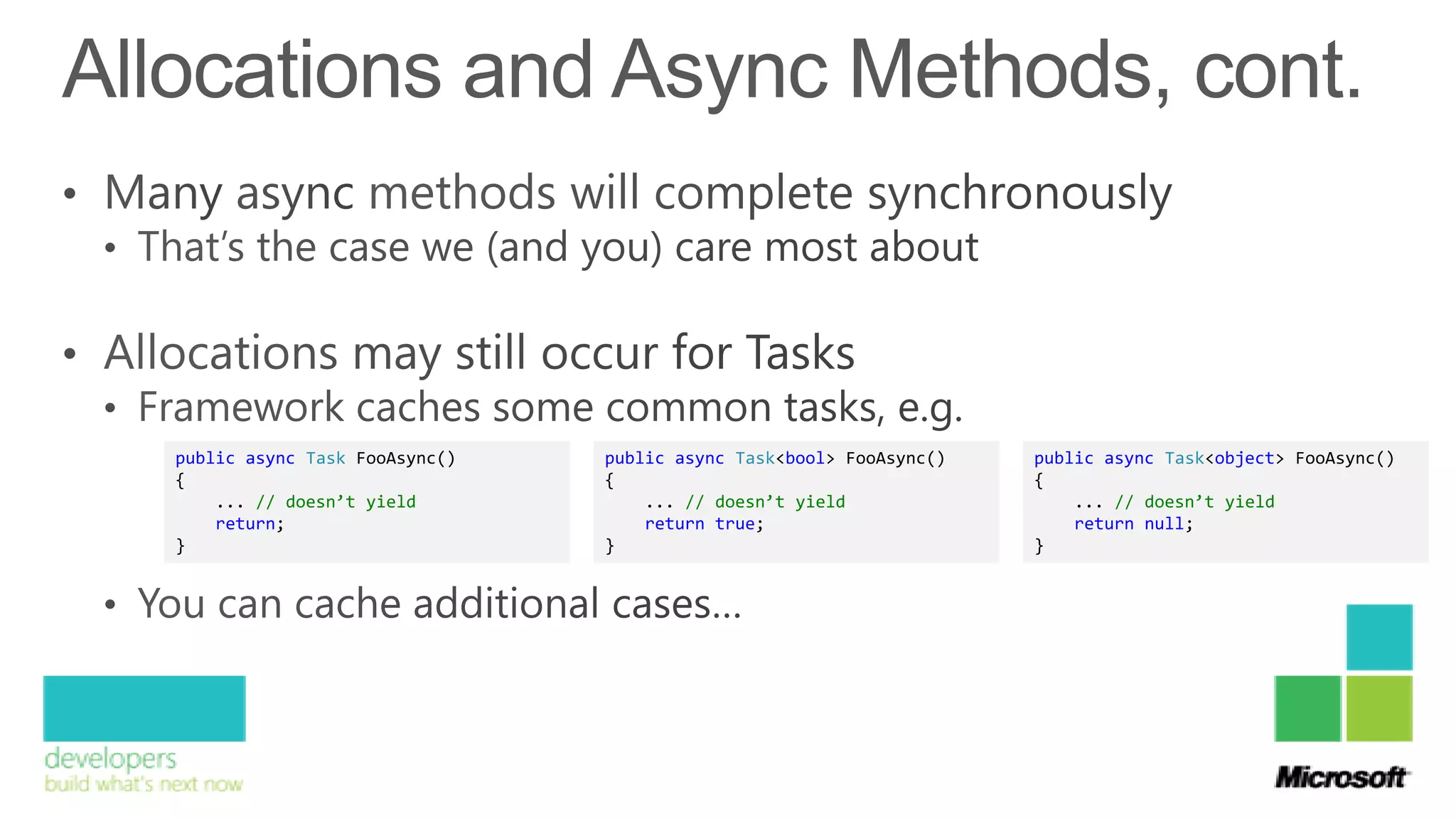
public async Task FooAsync()   public async Task<bool> FooAsync()   public async Task<object> FooAsync()
{                              {                                    {
    ... // doesn’t yield           ... // doesn’t yield                 ... // doesn’t yield
    return;                        return true;                         return null;
}                              }                                    }
public override async Task<int> ReadAsync(
    byte [] buffer, int offset, int count, CancellationToken cancellationToken)
{
    cancellationToken.ThrowIfCancellationRequested();
    return Read(buffer, offset, count);
}


public static async Task CopyStreamAsync(Stream input, Stream output)
{
    var buffer = new byte[0x1000];
    int numRead;
    while((numRead = await input.ReadAsync(buffer, 0, buffer.Length)) > 0)
    {
        await output.WriteAsync(buffer, 0, numRead);
    }
}
private Task<int> m_lastTask;

public override Task<int> ReadAsync(
  byte [] buffer, int offset, int count,
  CancellationToken cancellationToken)
{
  if (cancellationToken.IsCancellationRequested)
  {
      var tcs = new TaskCompletionSource<int>();
      tcs.SetCanceled();
      return tcs.Task;
  }

    try
    {
          int numRead = this.Read(buffer, offset, count);
          return m_lastTask != null && numRead == m_lastTask.Result ?
              m_lastTask : (m_lastTask = Task.FromResult(numRead));
    }
    catch(Exception e)
    {
        var tcs = new TaskCompletionSource<int>();
        tcs.SetException(e);
        return tcs.Task;
    }
}
Demo
 Manually caching tasks based
 on domain knowledge leads
 to improved performance.
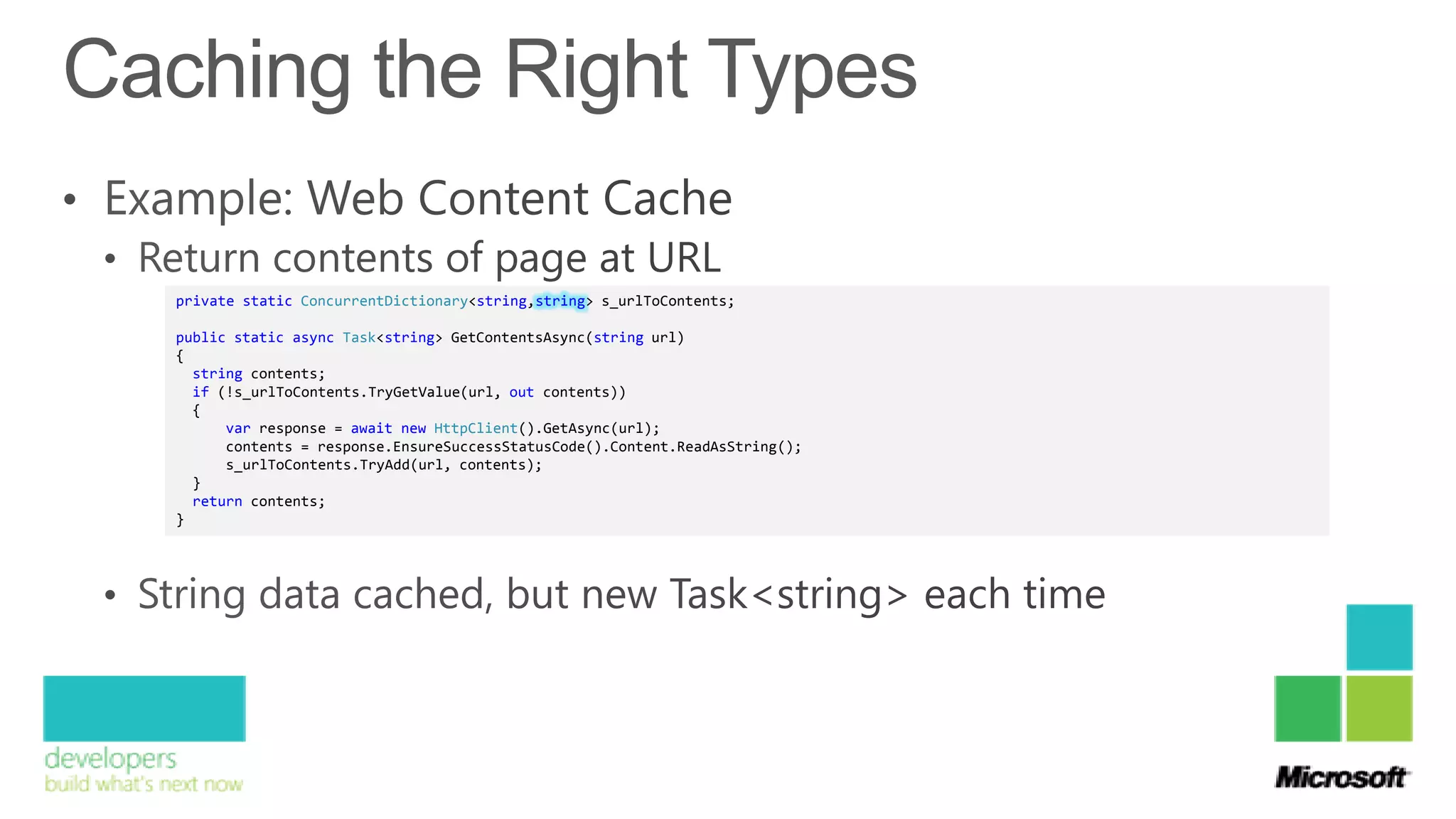
private static ConcurrentDictionary<string,string> s_urlToContents;

public static async Task<string> GetContentsAsync(string url)
{
  string contents;
  if (!s_urlToContents.TryGetValue(url, out contents))
  {
      var response = await new HttpClient().GetAsync(url);
      contents = response.EnsureSuccessStatusCode().Content.ReadAsString();
      s_urlToContents.TryAdd(url, contents);
  }
  return contents;
}
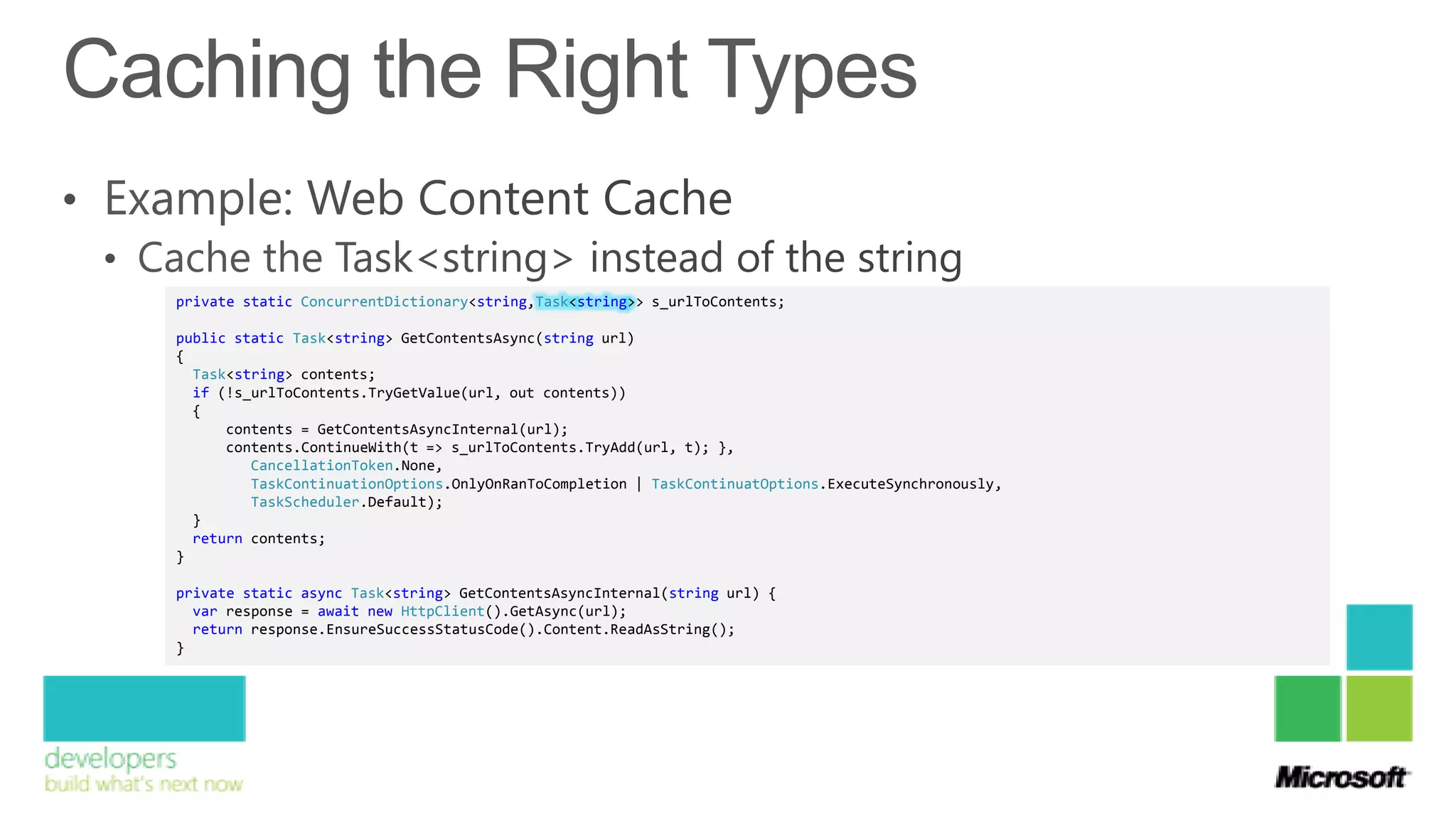
private static ConcurrentDictionary<string,Task<string>> s_urlToContents;

public static Task<string> GetContentsAsync(string url)
{
  Task<string> contents;
  if (!s_urlToContents.TryGetValue(url, out contents))
  {
      contents = GetContentsAsyncInternal(url);
      contents.ContinueWith(t => s_urlToContents.TryAdd(url, t); },
         CancellationToken.None,
         TaskContinuationOptions.OnlyOnRanToCompletion | TaskContinuatOptions.ExecuteSynchronously,
         TaskScheduler.Default);
  }
  return contents;
}

private static async Task<string> GetContentsAsyncInternal(string url) {
  var response = await new HttpClient().GetAsync(url);
  return response.EnsureSuccessStatusCode().Content.ReadAsString();
}
Demo
 Cache Task<TResult> instead
 of TResult to avoid
 unnecessary Task allocations.
Demo
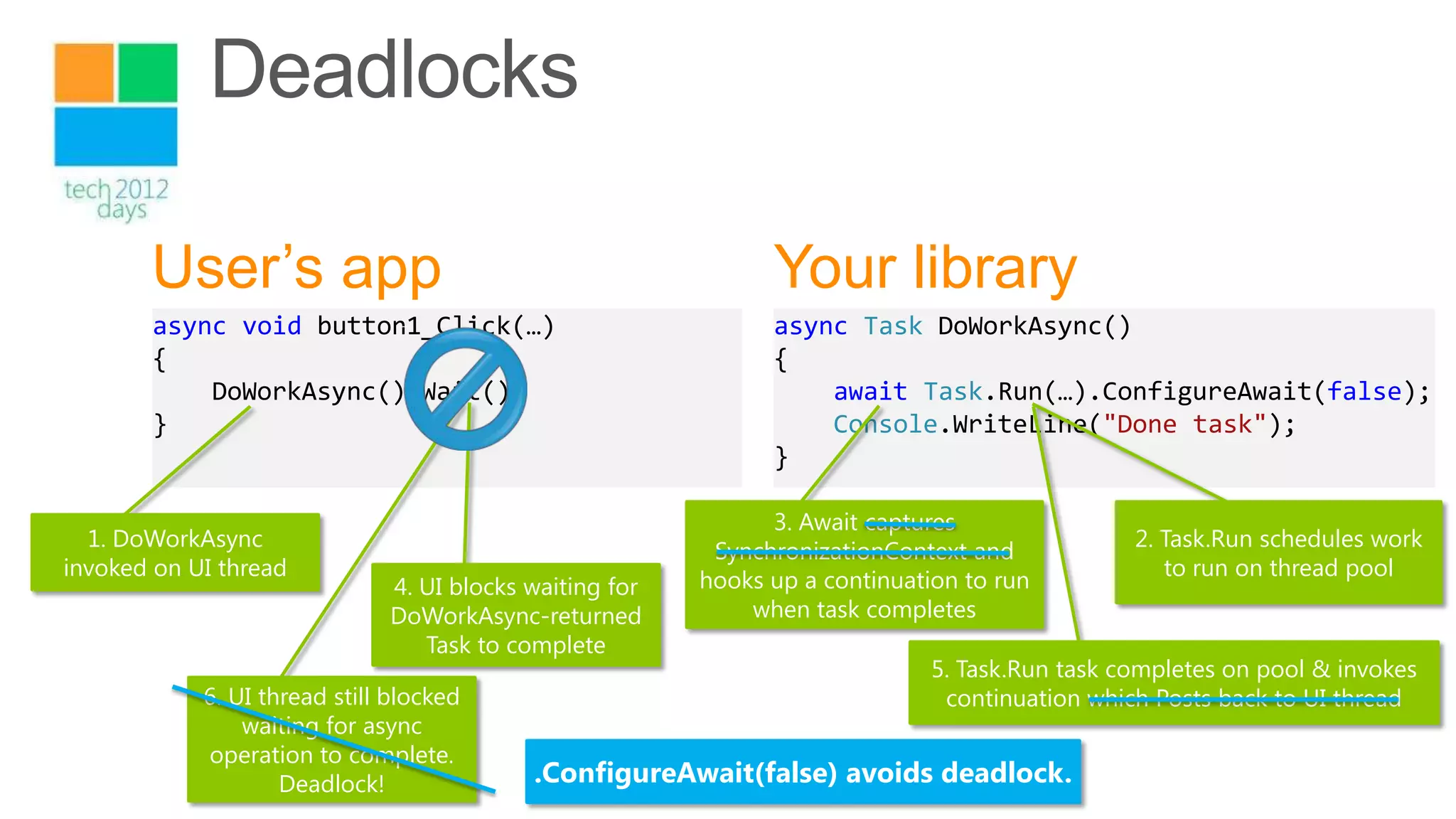
User’s app                                              Your library
       async void button1_Click(…)                             async Task DoWorkAsync()
       {                                                       {
           DoWorkAsync().Wait();
           await DoWorkAsync();                                    await Task.Run(…);
                                                                         Task.Run(…).ConfigureAwait(false);
       }                                                           Console.WriteLine("Done task");
                                                               }

                                                               3. Await captures
  1. DoWorkAsync                                                                                2. Task.Run schedules work
                                                          SynchronizationContext and
invoked on UI thread                                                                               to run on thread pool
                              4. UI blocks waiting for   hooks up a continuation to run
                              DoWorkAsync-returned           when task completes
                                 Task to complete
                                                                              5. Task.Run task completes on pool & invokes
            6. UI thread still blocked                                         continuation which Posts back to UI thread
                waiting for async
            operation to complete.
                    Deadlock!              .ConfigureAwait(false) avoids deadlock.
Demo
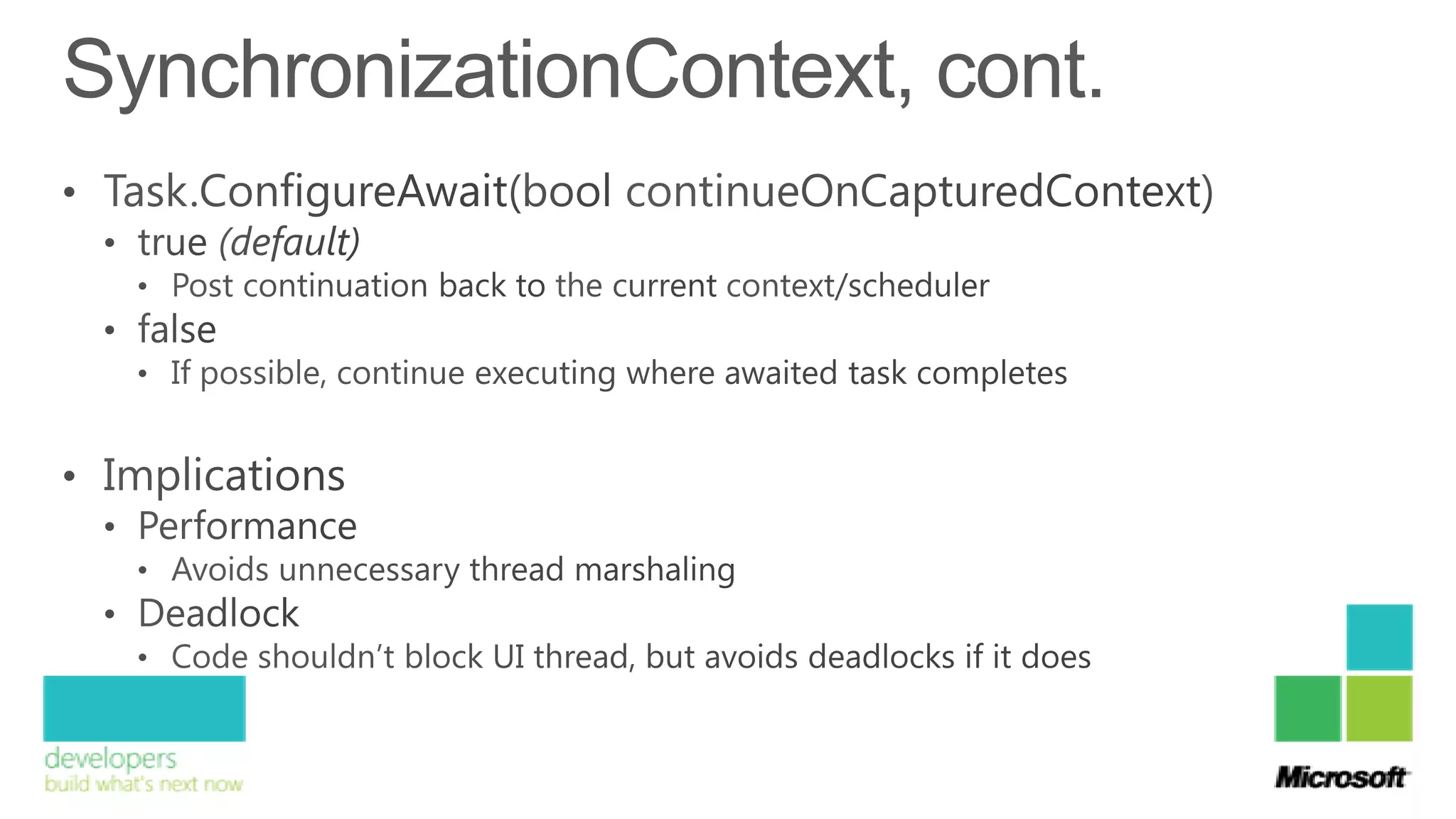
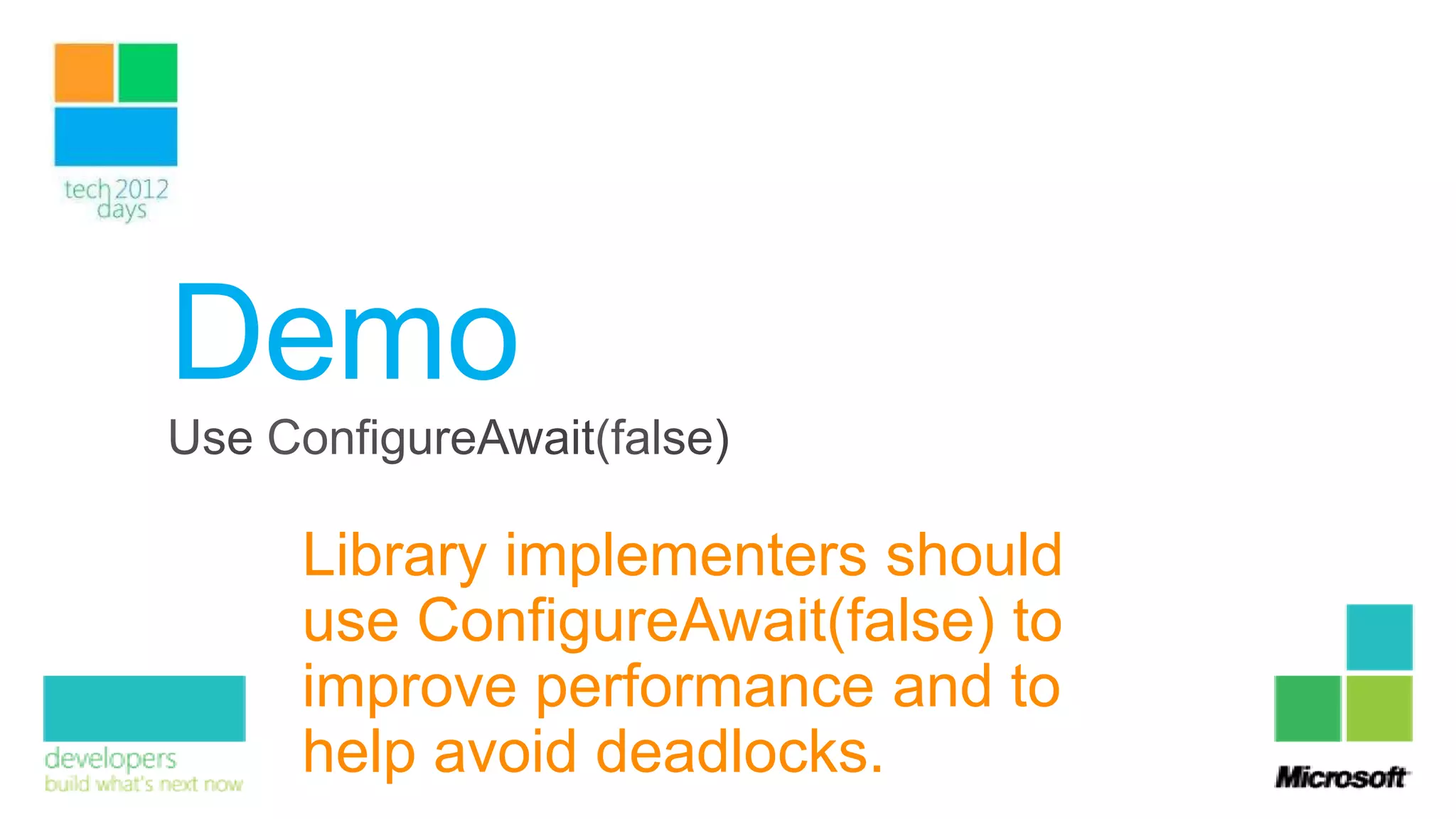
 Library implementers should
 use ConfigureAwait(false) to
 improve performance and to
 help avoid deadlocks.
Demo
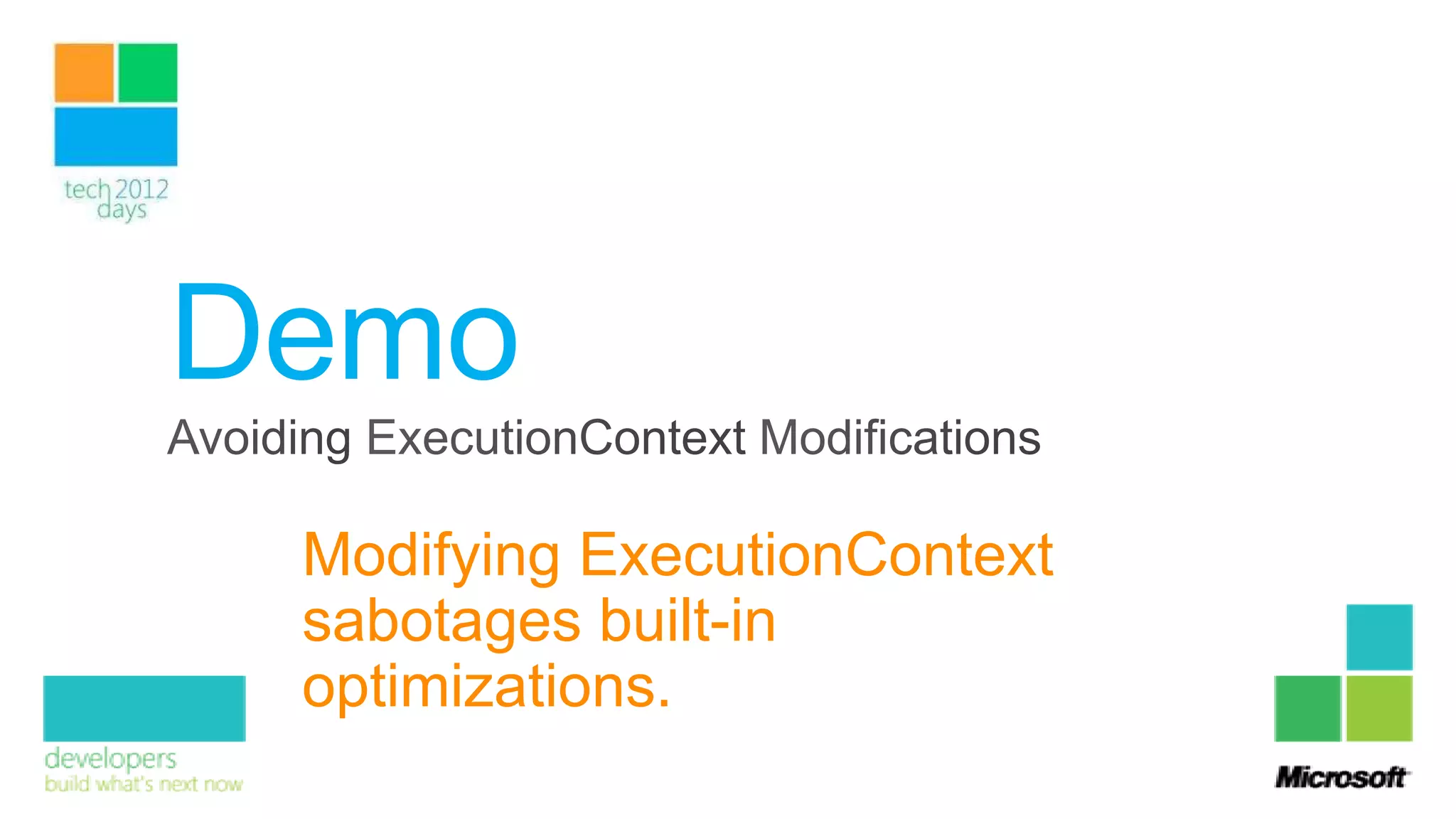
 Modifying ExecutionContext
 sabotages built-in
 optimizations.
public static async Task FooAsync() {     [CompilerGenerated, StructLayout(LayoutKind.Sequential)]
  var dto = DateTimeOffset.Now;           private struct <FooAsync>d__0 : <>t__IStateMachine {
  var dt = dto.DateTime;                    public DateTimeOffset <dto>5__1;
  await Task.Delay(1000);                   public DateTime <dt>5__2;
  Console.WriteLine(dt);                    ...
}                                         }


public static async Task FooAsync() {     [CompilerGenerated, StructLayout(LayoutKind.Sequential)]
  var dt = DateTimeOffset.Now.DateTime;   private struct <FooAsync>d__0 : <>t__IStateMachine {
  await Task.Delay(1000);                   public DateTime <dt>5__2;
  Console.WriteLine(dt);                    ...
}                                         }
Demo
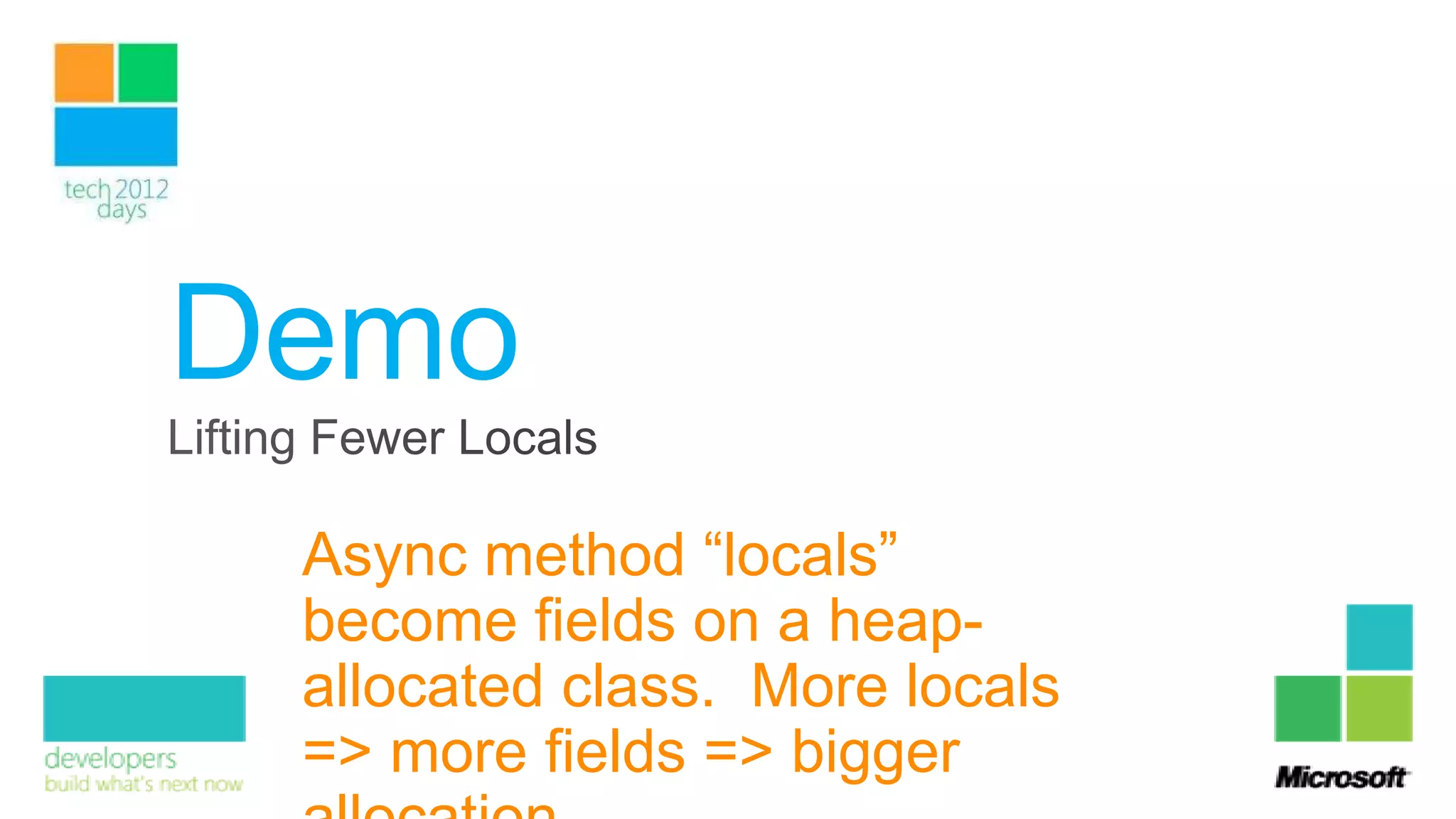
 Async method “locals”
 become fields on a heap-
 allocated class. More locals
 => more fields => bigger
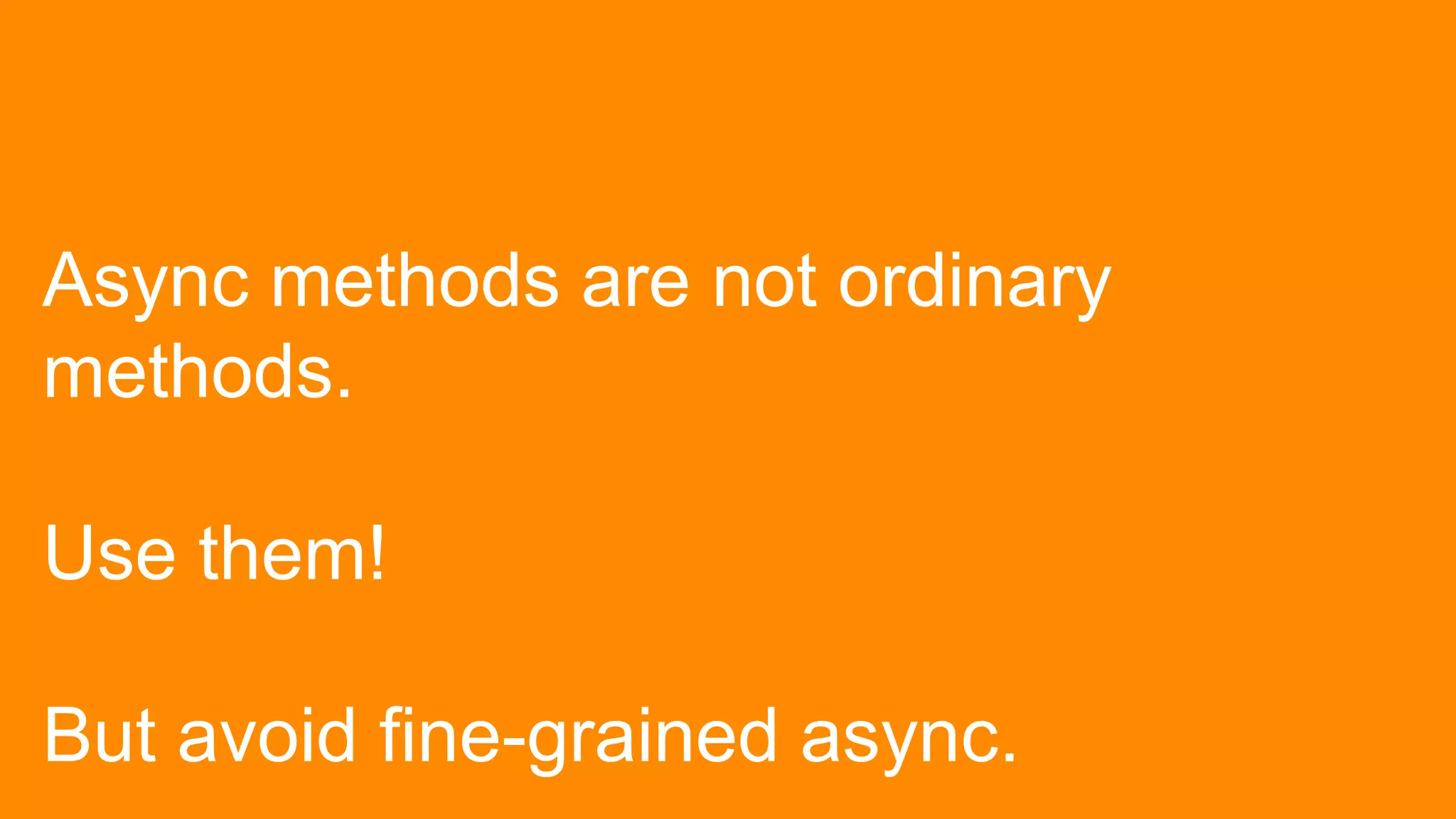
Async methods are not ordinary
methods.

Use them!

But avoid fine-grained async.
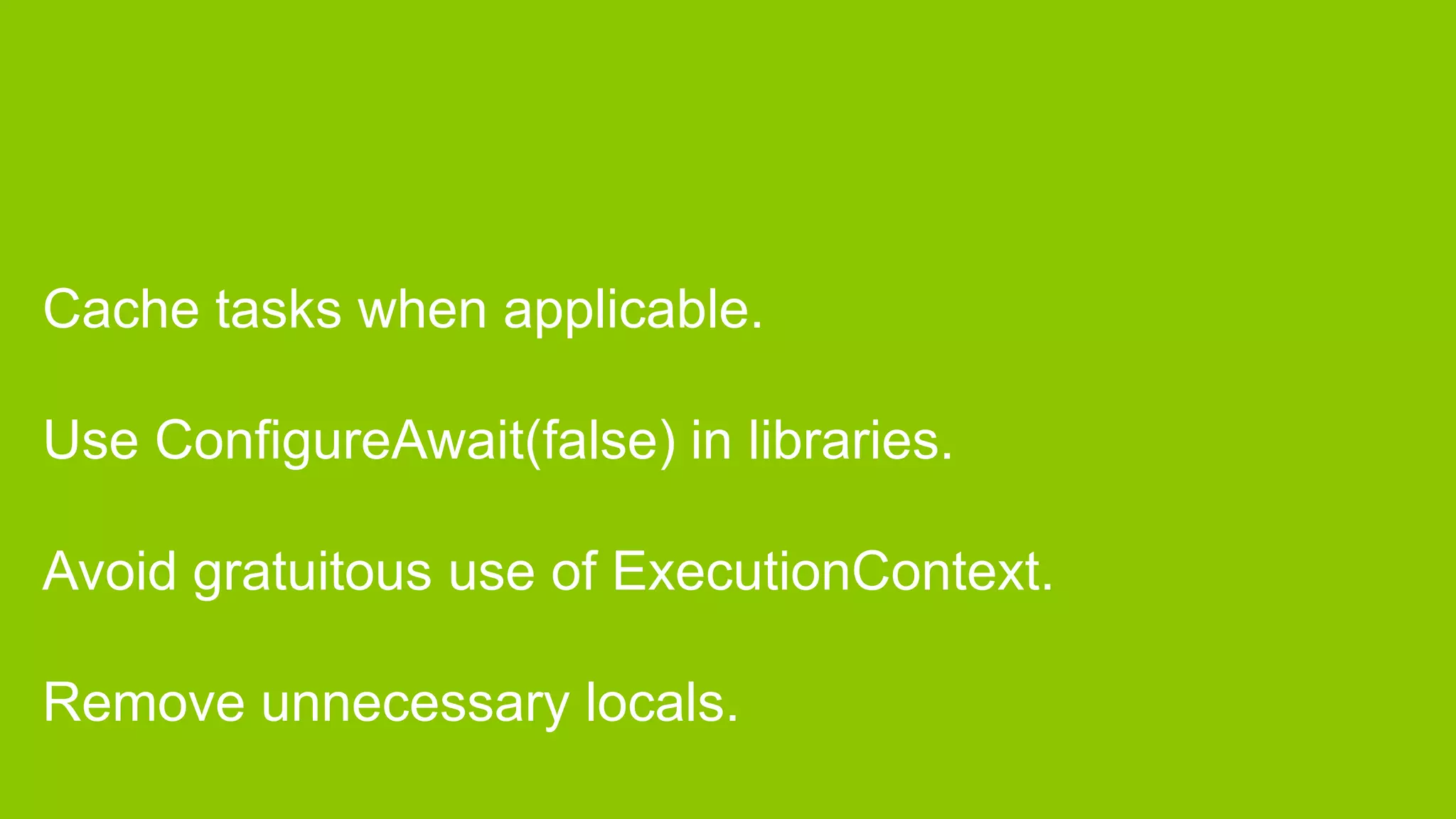
Cache tasks when applicable.

Use ConfigureAwait(false) in libraries.

Avoid gratuitous use of ExecutionContext.

Remove unnecessary locals.
The zen of async: Best practices for best performance

The zen of async: Best practices for best performance

  • 2.
    WHO WILL BENEFITFROM THIS TOPICS WHAT YOU’LL LEAVE WITH TALK • .NET library developers : • Getting the Right Mental Model • Knowledge of: • with knowledge of • Knowing When Not To Use Async • when to care about async/await in C# / VB optimizing your async • Avoiding Allocations implementations • interested in low-level perf • Caring About Context • …and how to do it • that understand this is based on the Developer • Minimizing Suspensions Preview
  • 3.
    public static voidSimpleBody() { Console.WriteLine("Hello, Async World!"); } .method public hidebysig static void SimpleBody() cil managed { .maxstack 8 L_0000: ldstr "Hello, Async World!" L_0005: call void [mscorlib]System.Console::WriteLine(string) L_000a: ret }
  • 4.
    .method public hidebysiginstance void MoveNext() cil managed { // Code size 66 (0x42) .maxstack 2 .locals init ([0] bool '<>t__doFinallyBodies', [1] class [mscorlib]System.Exception '<>t__ex') .try { IL_0000: ldc.i4.1 IL_0001: stloc.0 IL_0002: ldarg.0 IL_0003: ldfld int32 Program/'<SimpleBody>d__0'::'<>1__state' public static async Task SimpleBody() { IL_0008: ldc.i4.m1 Console.WriteLine("Hello, Async World!"); IL_000d IL_0009: bne.un.s IL_000b: leave.s IL_0041 } IL_000d: ldstr "Hello, Async World!" IL_0012: call void [mscorlib]System.Console::WriteLine(string) IL_0017: leave.s IL_002f .method public hidebysig static class [mscorlib]System.Threading.Tasks.Task SimpleBody() cil managed } { catch [mscorlib]System.Exception .custom instance void [mscorlib]System.Diagnostics.DebuggerStepThroughAttribute::.ctor() = ( 01 00 00 00 ) { // Code size 32 (0x20) IL_0019: stloc.1 .maxstack 2 IL_001a: ldarg.0 .locals init ([0] valuetype Program/'<SimpleBody>d__0' V_0) IL_001b: ldc.i4.m1 IL_0000: ldloca.s V_0 IL_001c: stfld int32 Program/'<SimpleBody>d__0'::'<>1__state' IL_0002: call valuetype [mscorlib]System.Runtime.CompilerServices.AsyncTaskMethodBuilder IL_0021: ldarg.0 [mscorlib]System.Runtime.CompilerServices.AsyncTaskMethodBuilder::Create() IL_0022: ldflda valuetype [mscorlib]System.Runtime.CompilerServices.AsyncTaskMethodBuilder IL_0007: stfld valuetype [mscorlib]System.Runtime.CompilerServices.AsyncTaskMethodBuilder Program/'<SimpleBody>d__0'::'<>t__builder' Program/'<SimpleBody>d__0'::'<>t__builder' IL_000c: ldloca.s V_0 IL_0027: ldloc.1 IL_000e: call instance void Program/'<SimpleBody>d__0'::MoveNext() [mscorlib]System.Runtime.CompilerServices.AsyncTaskMethodBuilder::SetException( IL_0028: call instance void IL_0013: ldloca.s V_0 class [mscorlib]System.Exception) IL_0015: ldflda valuetype [mscorlib]System.Runtime.CompilerServices.AsyncTaskMethodBuilder Program/'<SimpleBody>d__0'::'<>t__builder' IL_002d: leave.s IL_0041 IL_001a: call instance class [mscorlib]System.Threading.Tasks.Task [mscorlib]System.Runtime.CompilerServices.AsyncTaskMethodBuilder::get_Task() } IL_001f: ret IL_002f: ldarg.0 } IL_0030: ldc.i4.m1 IL_0031: stfld int32 Program/'<SimpleBody>d__0'::'<>1__state' IL_0036: ldarg.0 IL_0037: ldflda valuetype [mscorlib]System.Runtime.CompilerServices.AsyncTaskMethodBuilder Program/'<SimpleBody>d__0'::'<>t__builder' IL_003c: call instance void [mscorlib]System.Runtime.CompilerServices.AsyncTaskMethodBuilder::SetResult() IL_0041: ret }
  • 5.
  • 8.
    [CompilerGenerated] private class <SimpleBody>d__0 { private int <>1__state; public AsyncTaskMethodBuilder <>t__builder; public Action <>t__MoveNextDelegate; public void MoveNext(); } <>t__awaiter1.OnCompleted(<>t__MoveNextDelegate); public static Task SimpleBodyAsync() { ... d__.<>t__builder = AsyncTaskMethodBuilder.Create(); ... return d__.<>t__builder.Task; }
  • 9.
    TResult result =await FooAsync(); var $awaiter = FooAsync().GetAwaiter(); if (!$awaiter.IsCompleted) { SAVE_STATE; $awaiter.OnCompleted(CompletionDelegate); return; Label: RESTORE_STATE; } TResult result = $awaiter.GetResult();
  • 10.
    public async TaskFooAsync() public async Task<bool> FooAsync() public async Task<object> FooAsync() { { { ... // doesn’t yield ... // doesn’t yield ... // doesn’t yield return; return true; return null; } } }
  • 11.
    public override asyncTask<int> ReadAsync( byte [] buffer, int offset, int count, CancellationToken cancellationToken) { cancellationToken.ThrowIfCancellationRequested(); return Read(buffer, offset, count); } public static async Task CopyStreamAsync(Stream input, Stream output) { var buffer = new byte[0x1000]; int numRead; while((numRead = await input.ReadAsync(buffer, 0, buffer.Length)) > 0) { await output.WriteAsync(buffer, 0, numRead); } }
  • 12.
    private Task<int> m_lastTask; publicoverride Task<int> ReadAsync( byte [] buffer, int offset, int count, CancellationToken cancellationToken) { if (cancellationToken.IsCancellationRequested) { var tcs = new TaskCompletionSource<int>(); tcs.SetCanceled(); return tcs.Task; } try { int numRead = this.Read(buffer, offset, count); return m_lastTask != null && numRead == m_lastTask.Result ? m_lastTask : (m_lastTask = Task.FromResult(numRead)); } catch(Exception e) { var tcs = new TaskCompletionSource<int>(); tcs.SetException(e); return tcs.Task; } }
  • 13.
    Demo Manually cachingtasks based on domain knowledge leads to improved performance.
  • 14.
    private static ConcurrentDictionary<string,string>s_urlToContents; public static async Task<string> GetContentsAsync(string url) { string contents; if (!s_urlToContents.TryGetValue(url, out contents)) { var response = await new HttpClient().GetAsync(url); contents = response.EnsureSuccessStatusCode().Content.ReadAsString(); s_urlToContents.TryAdd(url, contents); } return contents; }
  • 15.
    private static ConcurrentDictionary<string,Task<string>>s_urlToContents; public static Task<string> GetContentsAsync(string url) { Task<string> contents; if (!s_urlToContents.TryGetValue(url, out contents)) { contents = GetContentsAsyncInternal(url); contents.ContinueWith(t => s_urlToContents.TryAdd(url, t); }, CancellationToken.None, TaskContinuationOptions.OnlyOnRanToCompletion | TaskContinuatOptions.ExecuteSynchronously, TaskScheduler.Default); } return contents; } private static async Task<string> GetContentsAsyncInternal(string url) { var response = await new HttpClient().GetAsync(url); return response.EnsureSuccessStatusCode().Content.ReadAsString(); }
  • 16.
    Demo Cache Task<TResult>instead of TResult to avoid unnecessary Task allocations.
  • 20.
  • 21.
    User’s app Your library async void button1_Click(…) async Task DoWorkAsync() { { DoWorkAsync().Wait(); await DoWorkAsync(); await Task.Run(…); Task.Run(…).ConfigureAwait(false); } Console.WriteLine("Done task"); } 3. Await captures 1. DoWorkAsync 2. Task.Run schedules work SynchronizationContext and invoked on UI thread to run on thread pool 4. UI blocks waiting for hooks up a continuation to run DoWorkAsync-returned when task completes Task to complete 5. Task.Run task completes on pool & invokes 6. UI thread still blocked continuation which Posts back to UI thread waiting for async operation to complete. Deadlock! .ConfigureAwait(false) avoids deadlock.
  • 22.
    Demo Library implementersshould use ConfigureAwait(false) to improve performance and to help avoid deadlocks.
  • 24.
    Demo Modifying ExecutionContext sabotages built-in optimizations.
  • 25.
    public static asyncTask FooAsync() { [CompilerGenerated, StructLayout(LayoutKind.Sequential)] var dto = DateTimeOffset.Now; private struct <FooAsync>d__0 : <>t__IStateMachine { var dt = dto.DateTime; public DateTimeOffset <dto>5__1; await Task.Delay(1000); public DateTime <dt>5__2; Console.WriteLine(dt); ... } } public static async Task FooAsync() { [CompilerGenerated, StructLayout(LayoutKind.Sequential)] var dt = DateTimeOffset.Now.DateTime; private struct <FooAsync>d__0 : <>t__IStateMachine { await Task.Delay(1000); public DateTime <dt>5__2; Console.WriteLine(dt); ... } }
  • 26.
    Demo Async method“locals” become fields on a heap- allocated class. More locals => more fields => bigger
  • 27.
    Async methods arenot ordinary methods. Use them! But avoid fine-grained async.
  • 28.
    Cache tasks whenapplicable. Use ConfigureAwait(false) in libraries. Avoid gratuitous use of ExecutionContext. Remove unnecessary locals.