MADHA ENGINEERING COLLEGE
DEPARTMENT OF CSE
REGULATION-2008
CS2306 – JAVA LAB
LAB MANUAL
1
SYLLABUS
1. Develop Rational number class in Java. Use Java Doc comments for
documentation. Your implementation should use efficient representation
for a rational number, i.e. (500 / 1000) should be represented as (½).
2. Develop Date class in Java similar to the one available in java.util
package. Use Java Doc comments.
3. Implement Lisp-like list in Java. Write basic operations such as 'car',
'cdr', and 'cons'. If L is a list [3, 0, 2, 5], L.car () returns 3, while L.cdr()
returns [0,2,5].
4. Design a Java interface for ADT Stack. Develop two different classes
that implement this interface, one using array and the other using linked-
list. Provide necessary exception handling in both the implementations.
5. Design a Vehicle class hierarchy in Java. Write a test program to
demonstrate polymorphism.
6. Design classes for Currency, Rupee, and Dollar. Write a program that
randomly generates Rupee and Dollar objects and write them into a file
using object serialization. Write another program to read that file, convert
to Rupee if it reads a Dollar, and while leave the value as it is if it reads a
Rupee.
7. Design a scientific calculator using event-driven programming paradigm
of Java.
8. Write a multi-threaded Java program to print all numbers below 100,000
that are both prime and Fibonacci number (some examples are 2, 3, 5,
13, etc.). Design a thread that generates prime numbers below 100,000
and writes them into a pipe. Design another thread that generates
Fibonacci numbers and writes them to another pipe. The main thread
should read both the pipes to identify numbers common to both.
9. Develop a simple OPAC system for library using even-driven and
concurrent programming paradigms of Java. Use JDBC to connect to a
back-end database.
10.Develop multi-threaded echo server and a corresponding GUI client in
Java.
11.[Mini-Project] Develop a programmer's editor in Java that supports
syntax-highlighting, compilation support, debugging support, etc.
2
1. IMPLEMENTATION OF RATIONAL NUMBER
Develop Rational number class in Java. Use JavaDoc comments for
documentation. Your implementation should use efficient representation
for a rational number, i.e. (500 / 1000) should be represented as (½).
ALGORITHM:
STEP 1: Get two inputs from the user through command line arguments.
STEP 2: Store the numerator to variable a and denominator to variable b.
STEP 3: If both a and b are either positive or negative, set the flag as 0.
STEP 4: If either a or b is negative, set flag as 1.
STEP 5: Compare the values of a and b and assign the lowest value to c.
STEP 6: Set the for loop for i=2.
STEP 7: If both a and b values are divisible by i, then perform
(i) a=a/i;
(ii) b=b/i;
(ii) i=1;
STEP 8: Repeat the loop if the value of i is less than c. Break the loop if the
condition fails.
STEP 9: If flag is 1, display the result as negative number; else display it as
positive number.
RationalClass.java
import java.util.*;
/**
*@author Sreekandan.K
*/
public class RationalClass
{
/**
The Numerator part of Rational
*/
private int numerator;
3
/**
The Denominator part of Rational
*/
private int denominator;
/**
create and initialize a new Rational object
*/
public RationalClass(int numerator,int denominator)
{
if(denominator==0)
{
throw new RuntimeException("Denominator is zero");
}
int g=gcd(numerator,denominator);
if(g==1)
{
System.out.println("No Common Divisor for Numerator and Denominator");
this.numerator=numerator;
this.denominator=denominator;
}
else
{
this.numerator=numerator/g;
this.denominator=denominator/g;
}
}
/**
return string representation
*/
public String display()
{
return numerator+"/"+denominator;
}
/**
@param m
@param n
@return Greatest common divisor for m and n
*/
private static int gcd(int n,int d)
{
4
if(d==0)
return n;
else
return gcd(d,n%d);
}
2. IMPLEMENTATION OF DATE SERVER
Develop Date class in Java similar to the one available in java.util package.
Use Java Doc comments.
ALGORITHM:
STEP 1: Create a package which consists of constructors with the following
arguments:
i) Default
ii)Taking 3 arguments year, day and month
iii)Taking 5 arguments year, day, month, hours and minutes
iv)Taking 6 arguments year, day, month, hour, minutes and seconds
STEP 2: Get the year, month, date, hours, minutes, seconds using the
getYear(), getMonth(), getDate(), getHours(), getMinutes(), getSeconds()
methods.
STEP 3: Set all these details using set methods.
STEP 4: After()-the after() method returns true if the current date comes after
the specified date else it returns false
STEP 5: Before()-the before()method returns true if the current date comes
before the specified date else it returns false
STEP 6: Compare()-the compare() method compares the current date with the
specified date and returns 0 if it is equal,if after it returns 1 and if before it
returns -1.
DateFormatDemo.java
import java.text.*;
import java.util.*;
/**
*Class DateFormatDemo formats the date and time by using java.text package
*
*/
public class DateFormatDemo
{
public static void main(String args[])
{
/**
5
* @see java.util package
*/
Date date=new Date();
/**
* @see java.text package
*/
DateFormat df;
System.out.println("Current Date and Time - Available in java.util Package:");
System.out.println("-------------------------------------------------------");
System.out.println(date);
System.out.println();
System.out.println("Formatted Date - Using DateFormat Class from java.text
Package:");
System.out.println("---------------------------------------------------------------");
df=DateFormat.getDateInstance(DateFormat.DEFAULT);
System.out.println("Default Date Format:"+df.format(date));
df=DateFormat.getDateInstance(DateFormat.SHORT);
System.out.println("Date In Short Format:"+df.format(date));
df=DateFormat.getDateInstance(DateFormat.MEDIUM);
System.out.println("Date In Medium Format:"+df.format(date));
df=DateFormat.getDateInstance(DateFormat.LONG);
System.out.println("Date In Long Format:"+df.format(date));
df=DateFormat.getDateInstance(DateFormat.FULL);
System.out.println("Date In Full Format:"+df.format(date));
System.out.println();
System.out.println("Formatted Time - Using DateFormat Class from java.text
Package:");
System.out.println("---------------------------------------------------------------");
df=DateFormat.getTimeInstance(DateFormat.DEFAULT);
System.out.println("Default Time Format:"+df.format(date));
df=DateFormat.getTimeInstance(DateFormat.SHORT);
System.out.println("Time In Short Format:"+df.format(date));
df=DateFormat.getTimeInstance(DateFormat.MEDIUM);
System.out.println("Time In Medium Format:"+df.format(date));
df=DateFormat.getTimeInstance(DateFormat.LONG);
System.out.println("Time In Long Format:"+df.format(date));
df=DateFormat.getTimeInstance(DateFormat.FULL);
System.out.println("Time In Full Format:"+df.format(date));
System.out.println();
System.out.println("Formatted Date and Time - Using SimpleDateFormat Class
from java.text Package:");
System.out.println("------------------------------------------------------------------------------"
);
/**
* @see java.text package
*/
SimpleDateFormat sdf;
sdf=new SimpleDateFormat("dd MMM yyyy hh:mm:sss:S E w D zzz");
6
System.out.println(sdf.format(date));
}
}
7
3. IMPLEMENTATION OF LISP-LIKE LIST
Implement Lisp-like list in Java. Write basic operations such as 'car', 'cdr',
and 'cons'. If L is a list [3, 0, 2, 5], L.car() returns 3, while L.cdr() returns
[0,2,5].
ALGORITHM
STEP 1: Create a node of a list having data part and link part.
STEP 2: Create a menu having the following choices : insert, car, cdr, adjoin
and display.
STEP 3: Read the choice from the user and call the respective m ethods.
STEP 4: Create another class which implements the same interface to
implement the concept of stack through linked list.
INSERT
STEP 1: Create an object of node and append to the list.
CAR
STEP 1: Return the first node data.
CDR
STEP 1: Return all the node (data part) in the list except the first node.
ADJOIN
STEP 1: Check if the node to be inserted is already present in the list, if not
present append to the list.
LispOperation.java
import java.util.*;
/**
*
*/
class Lisp
{
public Vector car(Vector v)
{
Vector elt=new Vector();
elt.addElement(v.elementAt(0));
return elt;
}
public Vector cdr(Vector v)
{
Vector elt=new Vector();
for(int i=1;i<v.size();i++)
elt.addElement(v.elementAt(i));
return elt;
}
public Vector cons(int x, Vector v)
{
v.insertElementAt(x,0);
return v;
}
}
8
4. IMPLEMENTATION OF STACK
Design a Java interface for ADT Stack. Develop two different classes that
implement this interface, one using array and the other using linked-list.
Provide necessary exception handling in both the implementations.
ALGORITHM
STEP 1: Create an interface which consists of three methods namely PUSH,
POP and DISPLAY
STEP 2: Create a class which implements the above interface to implement the
concept of stack through Array
STEP 3: Define all the methods of the interface to push any element, to pop the
top element and to display the elements present in the stack.
STEP 4: Create another class which implements the same interface to
implement the concept of stack through linked list.
STEP 5: Repeat STEP 4 for the above said class also.
STEP 6: In the main class, get the choice from the user to choose whether array
implementation or linked list implementation of the stack.
STEP 7: Call the methods appropriately according to the choices made by the
user in the previous step.
STEP 8: Repeat step 6 and step 7 until the user stops his/her execution
StackADT.java
import java.io.*;
import java.util.*;
interface stackInterface
{
int n=50;
public void pop();
public void push();
public void display();
}
class stack implements stackInterface
{
int arr[]=new int[n];
int top=-1;
Scanner in=new Scanner(System.in);
public void push()
{
try
{
System.out.println("Enter The Element of Stack");
int elt=in.nextInt();
arr[++top]=elt;
}
catch (Exception e)
{
9
System.out.println("e");
}
}
public void pop()
{
int pop=arr[top];
top--;
System.out.println("Popped Element Is:"+pop);
}
public void display()
{
if(top<0)
{
System.out.println("Stack Is Empty");
return;
}
else
{
String str=" ";
for(int i=0;i<=top;i++)
str=str+" "+arr[i];
System.out.println("Stack Elements Are:"+str);
}
}
}
/**
*
*/
10
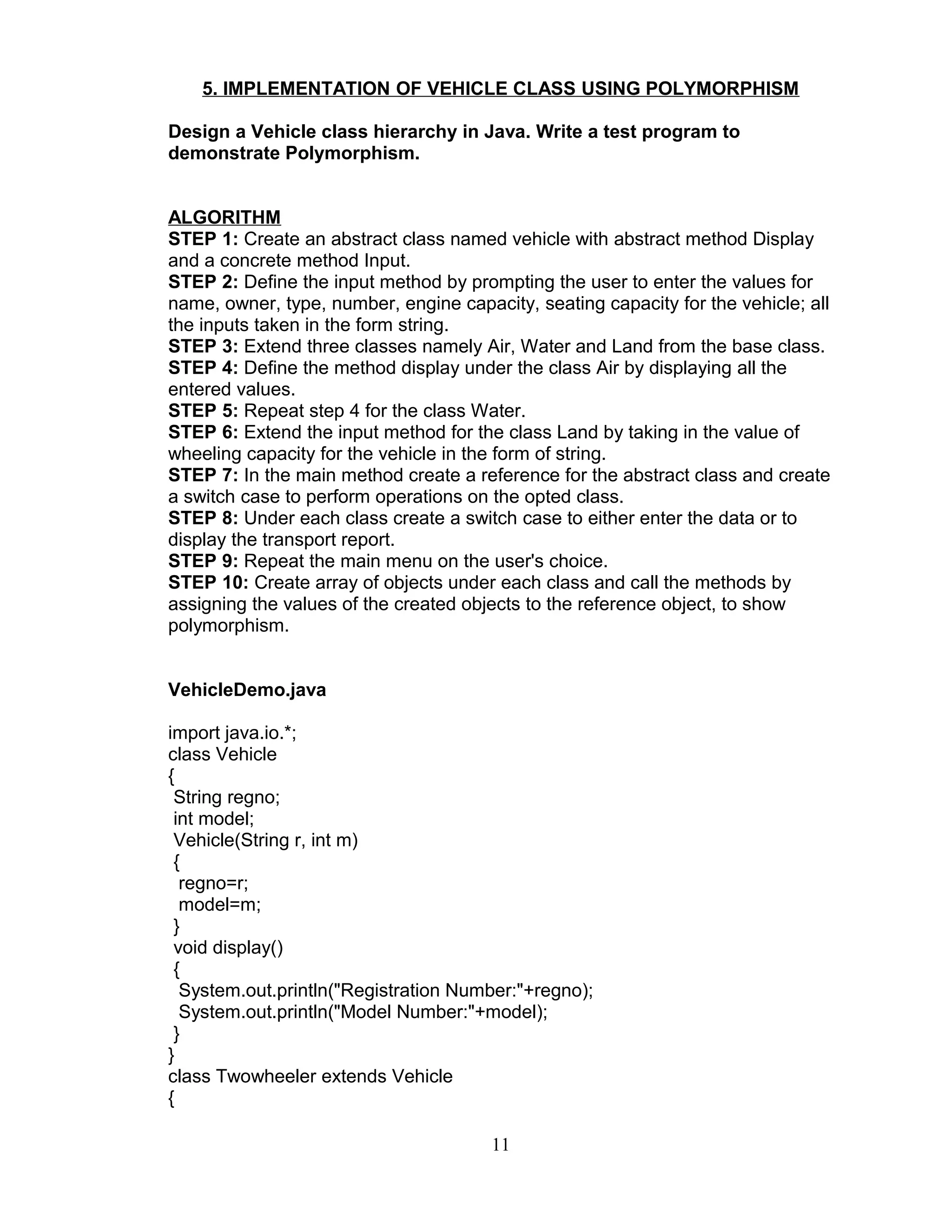
5. IMPLEMENTATION OF VEHICLE CLASS USING POLYMORPHISM
Design a Vehicle class hierarchy in Java. Write a test program to
demonstrate Polymorphism.
ALGORITHM
STEP 1: Create an abstract class named vehicle with abstract method Display
and a concrete method Input.
STEP 2: Define the input method by prompting the user to enter the values for
name, owner, type, number, engine capacity, seating capacity for the vehicle; all
the inputs taken in the form string.
STEP 3: Extend three classes namely Air, Water and Land from the base class.
STEP 4: Define the method display under the class Air by displaying all the
entered values.
STEP 5: Repeat step 4 for the class Water.
STEP 6: Extend the input method for the class Land by taking in the value of
wheeling capacity for the vehicle in the form of string.
STEP 7: In the main method create a reference for the abstract class and create
a switch case to perform operations on the opted class.
STEP 8: Under each class create a switch case to either enter the data or to
display the transport report.
STEP 9: Repeat the main menu on the user's choice.
STEP 10: Create array of objects under each class and call the methods by
assigning the values of the created objects to the reference object, to show
polymorphism.
VehicleDemo.java
import java.io.*;
class Vehicle
{
String regno;
int model;
Vehicle(String r, int m)
{
regno=r;
model=m;
}
void display()
{
System.out.println("Registration Number:"+regno);
System.out.println("Model Number:"+model);
}
}
class Twowheeler extends Vehicle
{
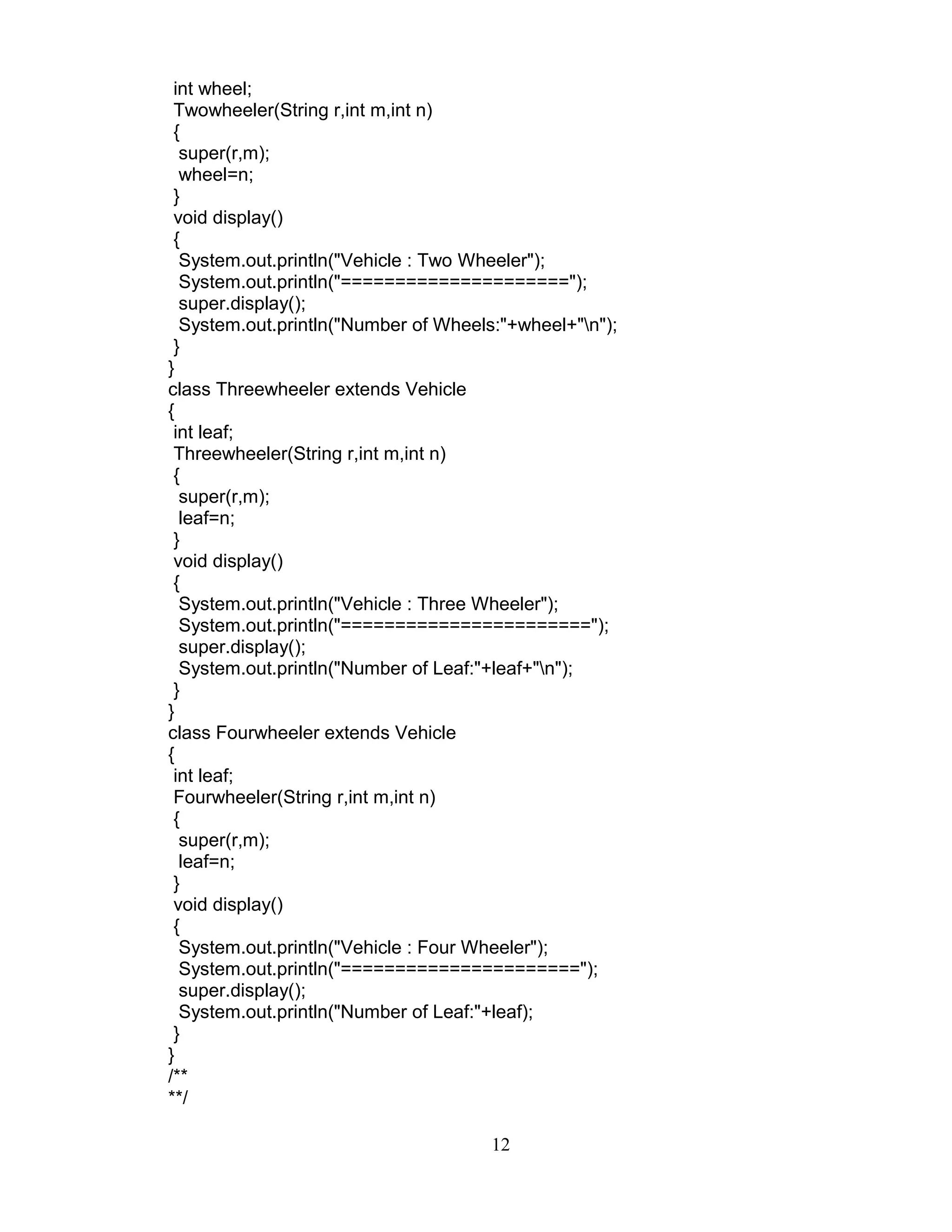
11
int wheel;
Twowheeler(String r,int m,int n)
{
super(r,m);
wheel=n;
}
void display()
{
System.out.println("Vehicle : Two Wheeler");
System.out.println("=====================");
super.display();
System.out.println("Number of Wheels:"+wheel+"n");
}
}
class Threewheeler extends Vehicle
{
int leaf;
Threewheeler(String r,int m,int n)
{
super(r,m);
leaf=n;
}
void display()
{
System.out.println("Vehicle : Three Wheeler");
System.out.println("=======================");
super.display();
System.out.println("Number of Leaf:"+leaf+"n");
}
}
class Fourwheeler extends Vehicle
{
int leaf;
Fourwheeler(String r,int m,int n)
{
super(r,m);
leaf=n;
}
void display()
{
System.out.println("Vehicle : Four Wheeler");
System.out.println("======================");
super.display();
System.out.println("Number of Leaf:"+leaf);
}
}
/**
**/
12
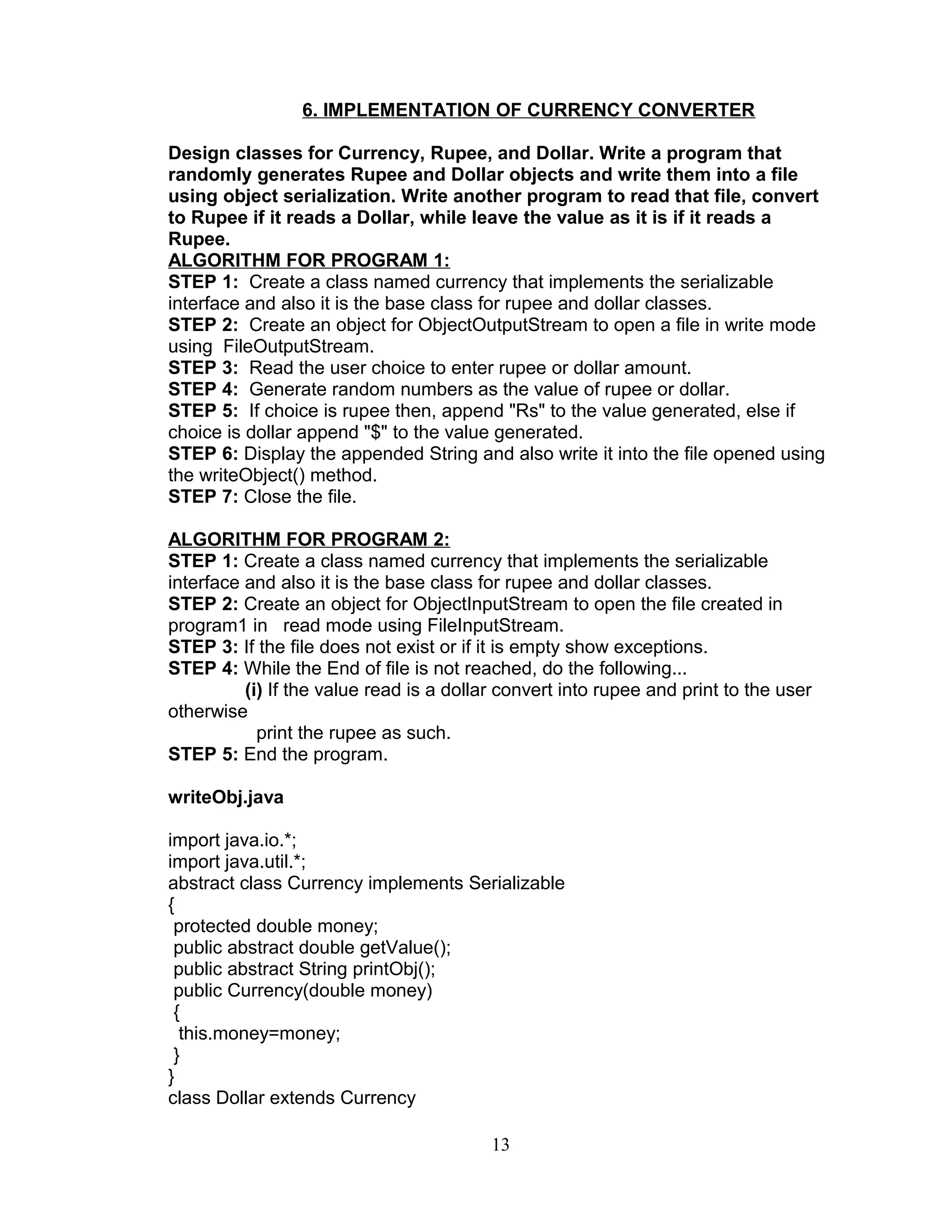
6. IMPLEMENTATION OF CURRENCY CONVERTER
Design classes for Currency, Rupee, and Dollar. Write a program that
randomly generates Rupee and Dollar objects and write them into a file
using object serialization. Write another program to read that file, convert
to Rupee if it reads a Dollar, while leave the value as it is if it reads a
Rupee.
ALGORITHM FOR PROGRAM 1:
STEP 1: Create a class named currency that implements the serializable
interface and also it is the base class for rupee and dollar classes.
STEP 2: Create an object for ObjectOutputStream to open a file in write mode
using FileOutputStream.
STEP 3: Read the user choice to enter rupee or dollar amount.
STEP 4: Generate random numbers as the value of rupee or dollar.
STEP 5: If choice is rupee then, append "Rs" to the value generated, else if
choice is dollar append "$" to the value generated.
STEP 6: Display the appended String and also write it into the file opened using
the writeObject() method.
STEP 7: Close the file.
ALGORITHM FOR PROGRAM 2:
STEP 1: Create a class named currency that implements the serializable
interface and also it is the base class for rupee and dollar classes.
STEP 2: Create an object for ObjectInputStream to open the file created in
program1 in read mode using FileInputStream.
STEP 3: If the file does not exist or if it is empty show exceptions.
STEP 4: While the End of file is not reached, do the following...
(i) If the value read is a dollar convert into rupee and print to the user
otherwise
print the rupee as such.
STEP 5: End the program.
writeObj.java
import java.io.*;
import java.util.*;
abstract class Currency implements Serializable
{
protected double money;
public abstract double getValue();
public abstract String printObj();
public Currency(double money)
{
this.money=money;
}
}
class Dollar extends Currency
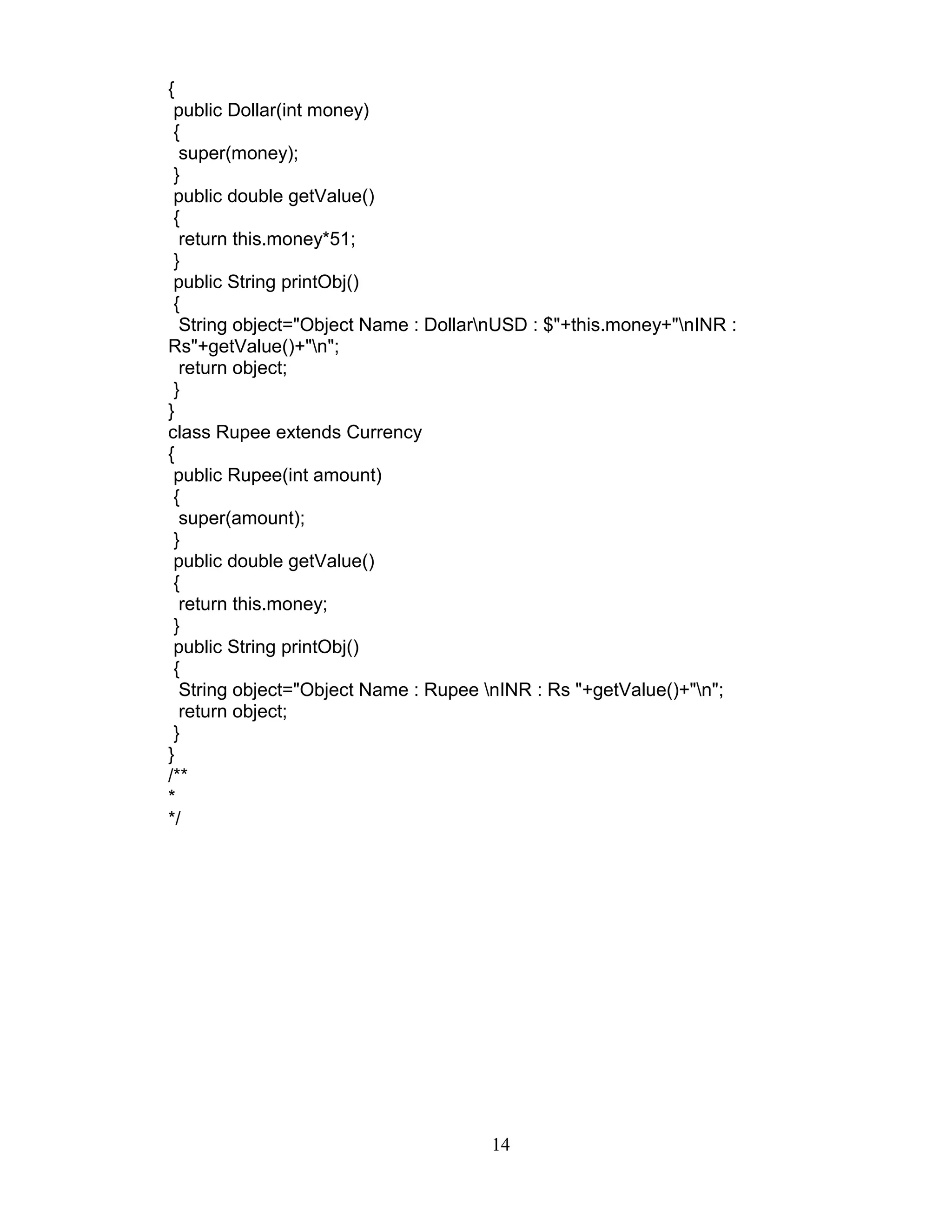
13
{
public Dollar(int money)
{
super(money);
}
public double getValue()
{
return this.money*51;
}
public String printObj()
{
String object="Object Name : DollarnUSD : $"+this.money+"nINR :
Rs"+getValue()+"n";
return object;
}
}
class Rupee extends Currency
{
public Rupee(int amount)
{
super(amount);
}
public double getValue()
{
return this.money;
}
public String printObj()
{
String object="Object Name : Rupee nINR : Rs "+getValue()+"n";
return object;
}
}
/**
*
*/
14
7. IMPLEMENTATION OF CALCULATOR
Develop a scientific calculator using even-driven programming paradigm
of Java.
ALGORITHM:
STEP 1: Create a panel consisting of Buttons for various scientific operations.
STEP 2: Create Button actions.
STEP 3: Place the panel onto a frame.
STEP 4: Associate each Button click with the corresponding actionlistener.
SimpleCalculator.java
import java.awt.*;
import java.awt.event.*;
import javax.swing.*;
import java.lang.*;
/**
*
*/
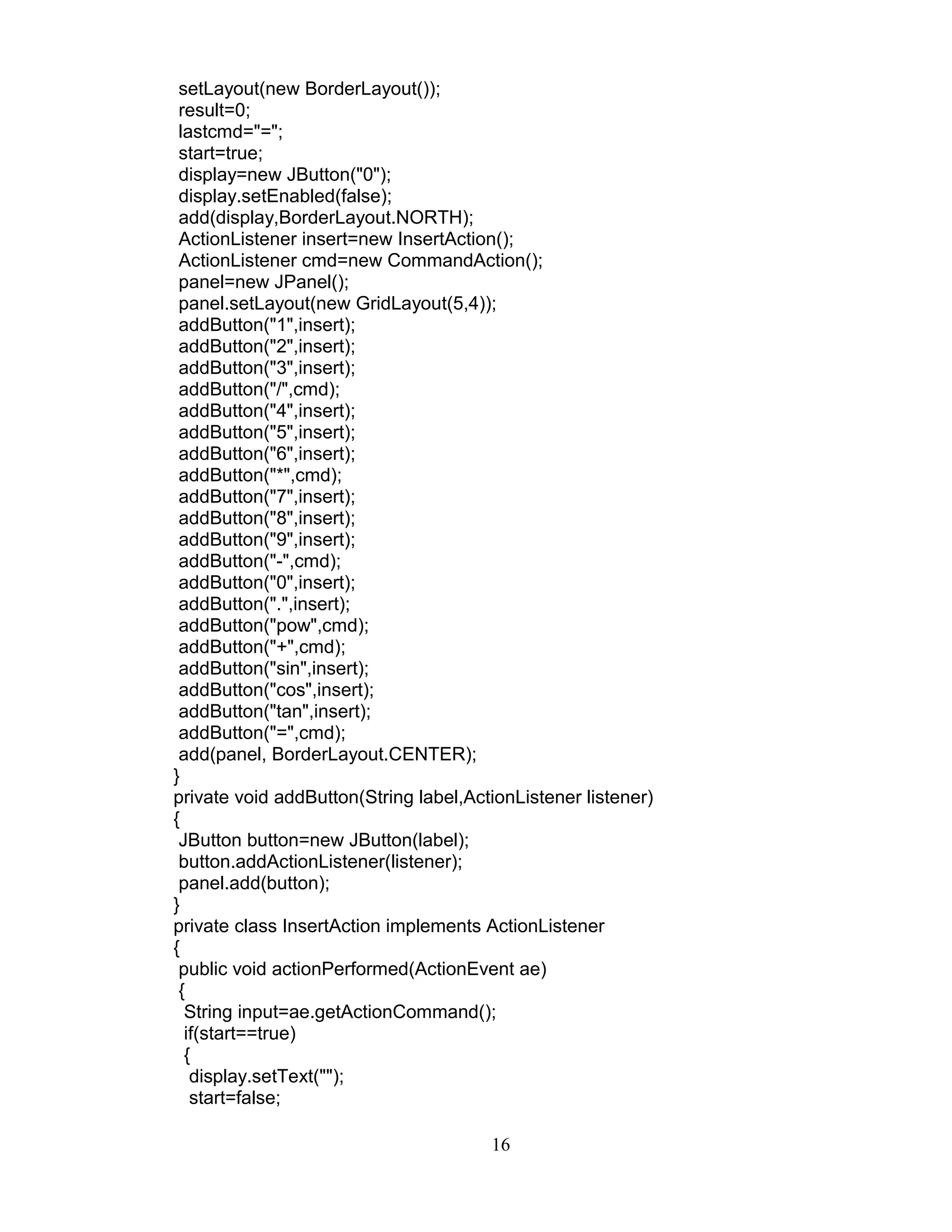
public class SimpleCalculator
{
public static void main(String[] args)
{
CalcFrame cf=new CalcFrame();
cf.setDefaultCloseOperation(JFrame.EXIT_ON_CLOSE);
cf.setVisible(true);
}
}
class CalcFrame extends JFrame
{
public CalcFrame()
{
setTitle("CALCULATOR");
CalcPanel panel=new CalcPanel();
add(panel);
pack();
}
}
class CalcPanel extends JPanel
{
JButton display;
JPanel panel;
double result;
String lastcmd;
boolean start;
public CalcPanel()
{
15
setLayout(new BorderLayout());
result=0;
lastcmd="=";
start=true;
display=new JButton("0");
display.setEnabled(false);
add(display,BorderLayout.NORTH);
ActionListener insert=new InsertAction();
ActionListener cmd=new CommandAction();
panel=new JPanel();
panel.setLayout(new GridLayout(5,4));
addButton("1",insert);
addButton("2",insert);
addButton("3",insert);
addButton("/",cmd);
addButton("4",insert);
addButton("5",insert);
addButton("6",insert);
addButton("*",cmd);
addButton("7",insert);
addButton("8",insert);
addButton("9",insert);
addButton("-",cmd);
addButton("0",insert);
addButton(".",insert);
addButton("pow",cmd);
addButton("+",cmd);
addButton("sin",insert);
addButton("cos",insert);
addButton("tan",insert);
addButton("=",cmd);
add(panel, BorderLayout.CENTER);
}
private void addButton(String label,ActionListener listener)
{
JButton button=new JButton(label);
button.addActionListener(listener);
panel.add(button);
}
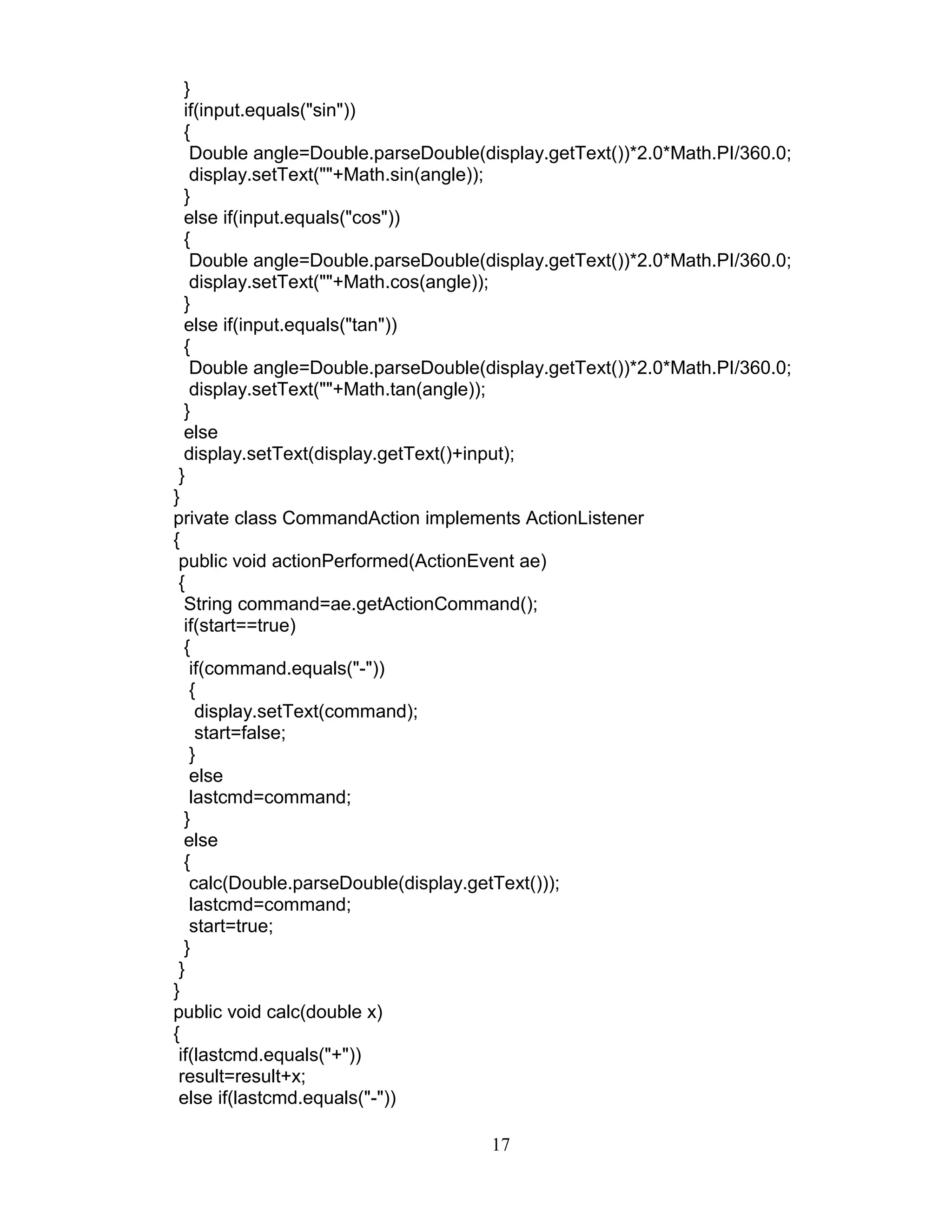
private class InsertAction implements ActionListener
{
public void actionPerformed(ActionEvent ae)
{
String input=ae.getActionCommand();
if(start==true)
{
display.setText("");
start=false;
16
}
if(input.equals("sin"))
{
Double angle=Double.parseDouble(display.getText())*2.0*Math.PI/360.0;
display.setText(""+Math.sin(angle));
}
else if(input.equals("cos"))
{
Double angle=Double.parseDouble(display.getText())*2.0*Math.PI/360.0;
display.setText(""+Math.cos(angle));
}
else if(input.equals("tan"))
{
Double angle=Double.parseDouble(display.getText())*2.0*Math.PI/360.0;
display.setText(""+Math.tan(angle));
}
else
display.setText(display.getText()+input);
}
}
private class CommandAction implements ActionListener
{
public void actionPerformed(ActionEvent ae)
{
String command=ae.getActionCommand();
if(start==true)
{
if(command.equals("-"))
{
display.setText(command);
start=false;
}
else
lastcmd=command;
}
else
{
calc(Double.parseDouble(display.getText()));
lastcmd=command;
start=true;
}
}
}
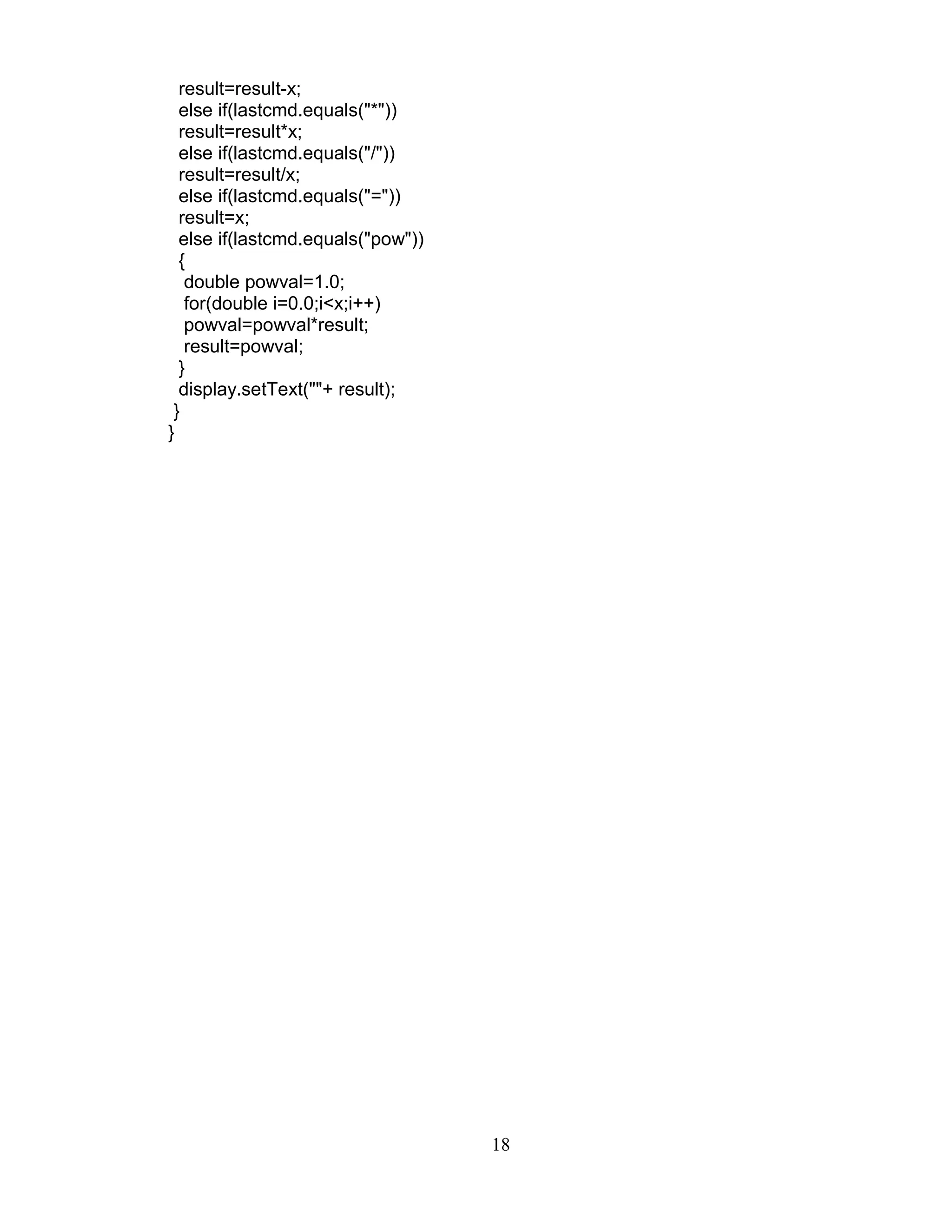
public void calc(double x)
{
if(lastcmd.equals("+"))
result=result+x;
else if(lastcmd.equals("-"))
17
result=result-x;
else if(lastcmd.equals("*"))
result=result*x;
else if(lastcmd.equals("/"))
result=result/x;
else if(lastcmd.equals("="))
result=x;
else if(lastcmd.equals("pow"))
{
double powval=1.0;
for(double i=0.0;i<x;i++)
powval=powval*result;
result=powval;
}
display.setText(""+ result);
}
}
18
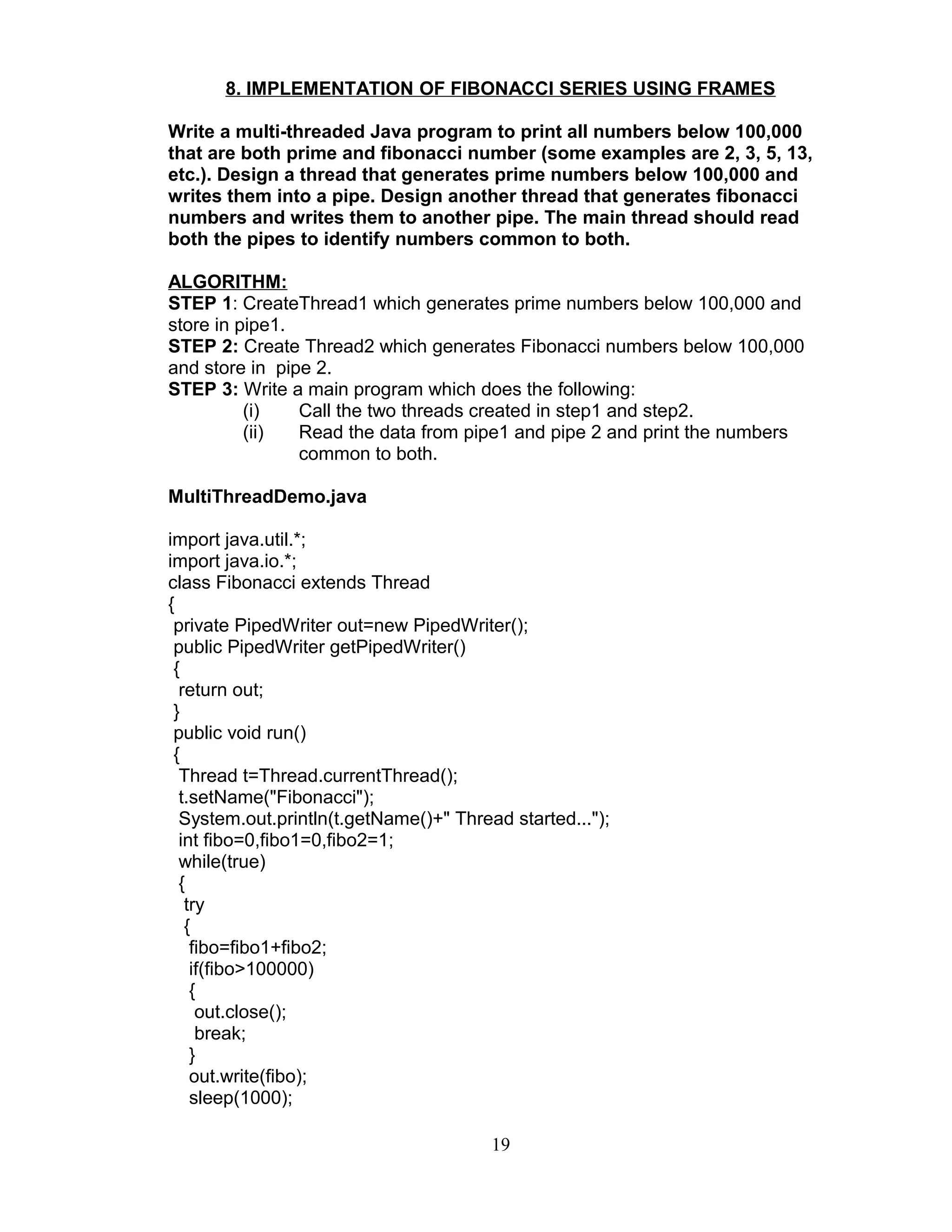
8. IMPLEMENTATION OF FIBONACCI SERIES USING FRAMES
Write a multi-threaded Java program to print all numbers below 100,000
that are both prime and fibonacci number (some examples are 2, 3, 5, 13,
etc.). Design a thread that generates prime numbers below 100,000 and
writes them into a pipe. Design another thread that generates fibonacci
numbers and writes them to another pipe. The main thread should read
both the pipes to identify numbers common to both.
ALGORITHM:
STEP 1: CreateThread1 which generates prime numbers below 100,000 and
store in pipe1.
STEP 2: Create Thread2 which generates Fibonacci numbers below 100,000
and store in pipe 2.
STEP 3: Write a main program which does the following:
(i) Call the two threads created in step1 and step2.
(ii) Read the data from pipe1 and pipe 2 and print the numbers
common to both.
MultiThreadDemo.java
import java.util.*;
import java.io.*;
class Fibonacci extends Thread
{
private PipedWriter out=new PipedWriter();
public PipedWriter getPipedWriter()
{
return out;
}
public void run()
{
Thread t=Thread.currentThread();
t.setName("Fibonacci");
System.out.println(t.getName()+" Thread started...");
int fibo=0,fibo1=0,fibo2=1;
while(true)
{
try
{
fibo=fibo1+fibo2;
if(fibo>100000)
{
out.close();
break;
}
out.write(fibo);
sleep(1000);
19
}
catch(Exception e)
{
System.out.println("Exception:"+e);
}
fibo1=fibo2;
fibo2=fibo;
}
System.out.println(t.getName()+" Thread exiting...");
}
}
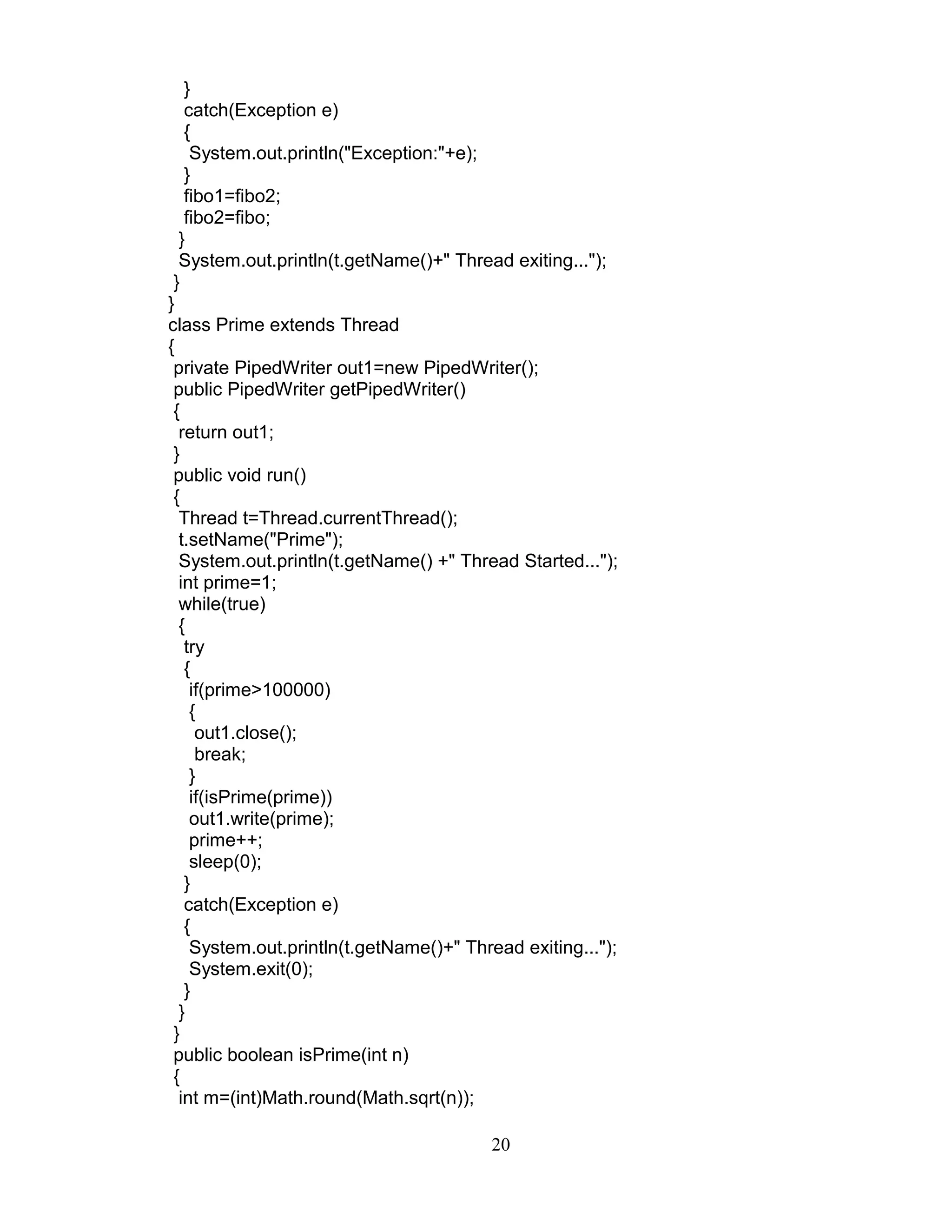
class Prime extends Thread
{
private PipedWriter out1=new PipedWriter();
public PipedWriter getPipedWriter()
{
return out1;
}
public void run()
{
Thread t=Thread.currentThread();
t.setName("Prime");
System.out.println(t.getName() +" Thread Started...");
int prime=1;
while(true)
{
try
{
if(prime>100000)
{
out1.close();
break;
}
if(isPrime(prime))
out1.write(prime);
prime++;
sleep(0);
}
catch(Exception e)
{
System.out.println(t.getName()+" Thread exiting...");
System.exit(0);
}
}
}
public boolean isPrime(int n)
{
int m=(int)Math.round(Math.sqrt(n));
20
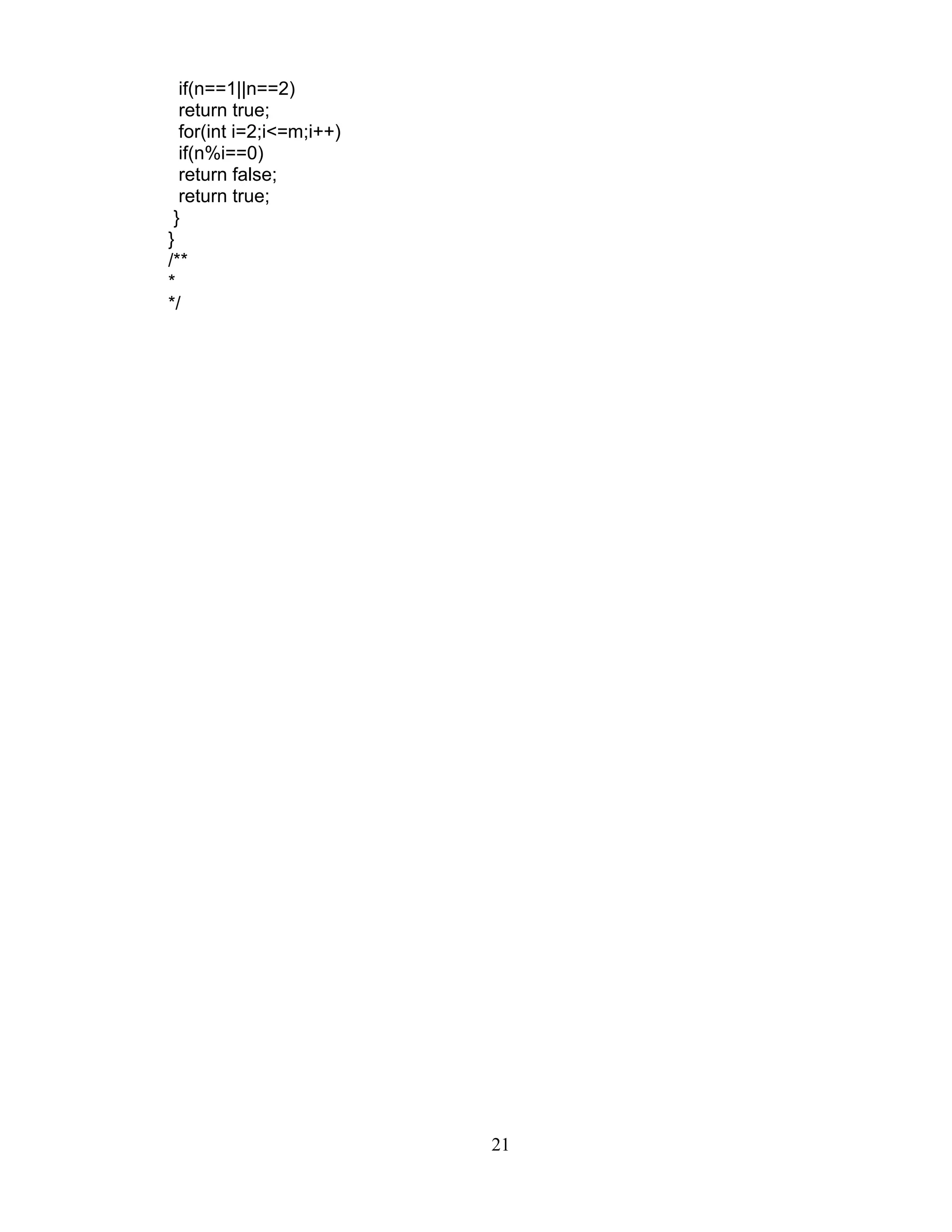
if(n==1||n==2)
return true;
for(int i=2;i<=m;i++)
if(n%i==0)
return false;
return true;
}
}
/**
*
*/
21
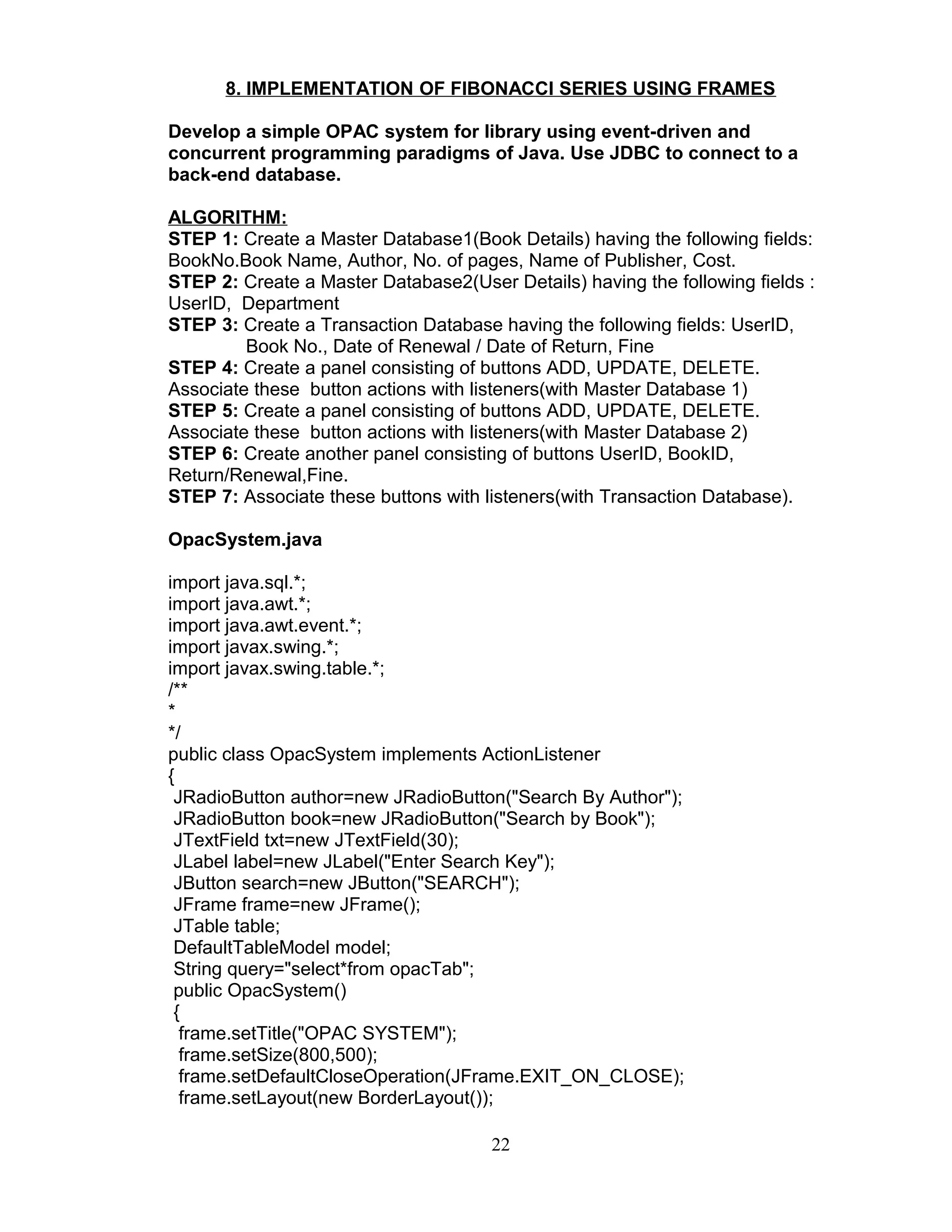
8. IMPLEMENTATION OF FIBONACCI SERIES USING FRAMES
Develop a simple OPAC system for library using event-driven and
concurrent programming paradigms of Java. Use JDBC to connect to a
back-end database.
ALGORITHM:
STEP 1: Create a Master Database1(Book Details) having the following fields:
BookNo.Book Name, Author, No. of pages, Name of Publisher, Cost.
STEP 2: Create a Master Database2(User Details) having the following fields :
UserID, Department
STEP 3: Create a Transaction Database having the following fields: UserID,
Book No., Date of Renewal / Date of Return, Fine
STEP 4: Create a panel consisting of buttons ADD, UPDATE, DELETE.
Associate these button actions with listeners(with Master Database 1)
STEP 5: Create a panel consisting of buttons ADD, UPDATE, DELETE.
Associate these button actions with listeners(with Master Database 2)
STEP 6: Create another panel consisting of buttons UserID, BookID,
Return/Renewal,Fine.
STEP 7: Associate these buttons with listeners(with Transaction Database).
OpacSystem.java
import java.sql.*;
import java.awt.*;
import java.awt.event.*;
import javax.swing.*;
import javax.swing.table.*;
/**
*
*/
public class OpacSystem implements ActionListener
{
JRadioButton author=new JRadioButton("Search By Author");
JRadioButton book=new JRadioButton("Search by Book");
JTextField txt=new JTextField(30);
JLabel label=new JLabel("Enter Search Key");
JButton search=new JButton("SEARCH");
JFrame frame=new JFrame();
JTable table;
DefaultTableModel model;
String query="select*from opacTab";
public OpacSystem()
{
frame.setTitle("OPAC SYSTEM");
frame.setSize(800,500);
frame.setDefaultCloseOperation(JFrame.EXIT_ON_CLOSE);
frame.setLayout(new BorderLayout());
22
JPanel p1=new JPanel();
p1.setLayout(new FlowLayout());
p1.add(label);
p1.add(txt);
ButtonGroup bg=new ButtonGroup();
bg.add(author);
bg.add(book);
JPanel p2=new JPanel();
p2.setLayout(new FlowLayout());
p2.add(author);
p2.add(book);
p2.add(search);
search.addActionListener(this);
JPanel p3=new JPanel();
p3.setLayout(new BorderLayout());
p3.add(p1,BorderLayout.NORTH);
p3.add(p2,BorderLayout.CENTER);
frame.add(p3,BorderLayout.NORTH);
addTable(query);
frame.setVisible(true);
}
public void addTable(String str)
{
try
{
Class.forName("sun.jdbc.odbc.JdbcOdbcDriver");
Connection con=DriverManager.getConnection("jdbc:odbc:opacDS");
Statement stmt=con.createStatement();
ResultSet rs=stmt.executeQuery(str);
ResultSetMetaData rsmd=rs.getMetaData();
int cols=rsmd.getColumnCount();
model=new DefaultTableModel(1,cols);
table=new JTable(model);
String[] tabledata=new String[cols];
int i=0;
while(i<cols)
{
tabledata[i]=rsmd.getColumnName(i+1);
i++;
}
model.addRow(tabledata);
while(rs.next())
{
for(i=0;i<cols;i++)
tabledata[i]=rs.getObject(i+1).toString();
model.addRow(tabledata);
}
frame.add(table,BorderLayout.CENTER);
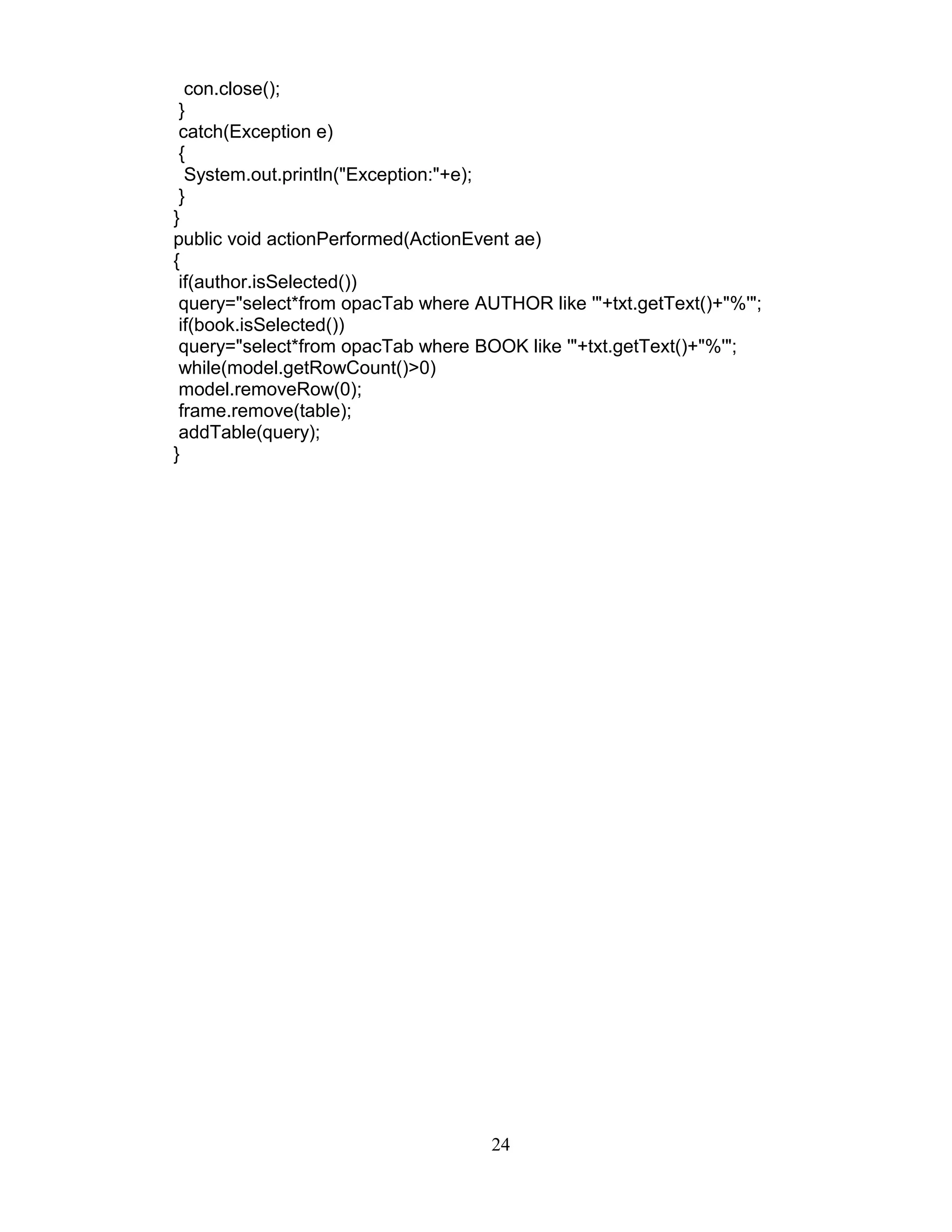
23
con.close();
}
catch(Exception e)
{
System.out.println("Exception:"+e);
}
}
public void actionPerformed(ActionEvent ae)
{
if(author.isSelected())
query="select*from opacTab where AUTHOR like '"+txt.getText()+"%'";
if(book.isSelected())
query="select*from opacTab where BOOK like '"+txt.getText()+"%'";
while(model.getRowCount()>0)
model.removeRow(0);
frame.remove(table);
addTable(query);
}
24
10. IMPLEMENTATION OF MULTITHREADED
ECHO SERVER & ECHO CLIENT
Develop multi-threaded echo server and a corresponding GUI client in
Java.
ALGORITHM FOR SERVER:
STEP 1: Establish the connection of socket.
STEP 2: Assign the local Protocol address to the socket.
STEP 3: Move the socket from closed to listener state and provide maximum no.
of Connections.
STEP 4: Create a new socket connection using client address.
STEP 5: Read the data from the socket.
STEP 6: Write the data into socket.
STEP 7: Close the socket.
EchoServer.java
import java.io.*;
import java.net.*;
/**
*
*/
public class EchoServer
{
public static void main(String [] args)
{
System.out.println("Server Started....");
try
{
ServerSocket ss=new ServerSocket(300);
while(true)
{
Socket s= ss.accept();
Thread t = new ThreadedServer(s);
t.start();
}
}
catch(Exception e)
{
System.out.println("Error: " + e);
}
}
}
class ThreadedServer extends Thread
{
Socket soc;
public ThreadedServer(Socket soc)
25
{
this.soc=soc;
}
public void run()
{
try
{
BufferedReader in=new BufferedReader(new
InputStreamReader(soc.getInputStream()));
PrintWriter out=new PrintWriter(soc.getOutputStream());
String str=in.readLine();
System.out.println("Message From Client:"+str);
out.flush();
out.println("Message To Client:"+str);
out.flush();
}
catch(Exception e)
{
System.out.println("Exception:"+e);
}
}
}
ALGORITHM FOR CLIENT:
STEP 1: Open the socket.
STEP 2: Get the host name and port number from client.
STEP 3: Write a request to the buffer that contain the request number as a byte
to the
output stream.
STEP 4: Get the message from the user.
STEP 5: Write to the socket.
STEP 6: Set the write operation for success.
STEP 7: Read the contents from the socket / Buffer.
STEP 8: Close the socket.
EchoClient.java
import java.net.*;
import java.io.*;
import javax.swing.*;
import java.awt.*;
import java.awt.event.*;
/**
*
*/
class EchoClient extends JFrame
{
26
JTextArea ta;
JTextField msg;
JPanel panel;
JScrollPane scroll;
JButton b1=new JButton("Close");
JButton b2=new JButton("Send");
JLabel l1=new JLabel("Echo Client GUI");
Container c;
EchoClient()
{
c=getContentPane();
setSize(300,470);
setTitle("GUI Client");
panel=new JPanel();
msg=new JTextField(20);
panel.setLayout(new FlowLayout(FlowLayout.CENTER));
ta=new JTextArea(20,20);
scroll=new JScrollPane(ta);
panel.add(l1);
panel.add(ta);
panel.add(msg);
panel.add(b2);
panel.add(b1);
c.add(panel);
b2.addActionListener(new ActionListener()
{
public void actionPerformed(ActionEvent ae)
{
try
{
Socket s=new Socket("localhost",300);
BufferedReader in=new BufferedReader(new
InputStreamReader(s.getInputStream()));
PrintWriter out=new PrintWriter(new
OutputStreamWriter(s.getOutputStream()));
out.println(msg.getText());
out.flush();
String temp =ta.getText();
if(temp.equalsIgnoreCase("quit"))
{
System.exit(0);
}
msg.setText("");
ta.append("n"+in.readLine());
}
catch (IOException e)
{
ta.setText("Exception:"+e);
27
}
}
});
b1.addActionListener(new ActionListener()
{
public void actionPerformed(ActionEvent e)
{
System.exit(0);
}
});
}
public static void main(String args[])
{
EchoClient frame=new EchoClient();
frame.setDefaultCloseOperation(JFrame.EXIT_ON_CLOSE);
frame.setVisible(true);
}
}
28
11. MINI PROJECT
Develop a programmer's editor in Java that supports syntax high lighting,
compilation support, debugging support, etc.
ALGORITHM:
STEP 1: Create a panel consisting of menu bar containing File, Edit, Compile
and Debug.
STEP 2: Add submenus for each of the menu.
File – New, Open, Save, Quit.
Edit – Cut, Copy, Paste.
Compile – Compile, Link
Debug – Inspect, Call Stack, Watches, BreakPoints.
STEP 3: Associate these event sources with Listeners.
29

CS2309 JAVA LAB MANUAL

  • 1.
    MADHA ENGINEERING COLLEGE DEPARTMENTOF CSE REGULATION-2008 CS2306 – JAVA LAB LAB MANUAL 1
  • 2.
    SYLLABUS 1. Develop Rationalnumber class in Java. Use Java Doc comments for documentation. Your implementation should use efficient representation for a rational number, i.e. (500 / 1000) should be represented as (½). 2. Develop Date class in Java similar to the one available in java.util package. Use Java Doc comments. 3. Implement Lisp-like list in Java. Write basic operations such as 'car', 'cdr', and 'cons'. If L is a list [3, 0, 2, 5], L.car () returns 3, while L.cdr() returns [0,2,5]. 4. Design a Java interface for ADT Stack. Develop two different classes that implement this interface, one using array and the other using linked- list. Provide necessary exception handling in both the implementations. 5. Design a Vehicle class hierarchy in Java. Write a test program to demonstrate polymorphism. 6. Design classes for Currency, Rupee, and Dollar. Write a program that randomly generates Rupee and Dollar objects and write them into a file using object serialization. Write another program to read that file, convert to Rupee if it reads a Dollar, and while leave the value as it is if it reads a Rupee. 7. Design a scientific calculator using event-driven programming paradigm of Java. 8. Write a multi-threaded Java program to print all numbers below 100,000 that are both prime and Fibonacci number (some examples are 2, 3, 5, 13, etc.). Design a thread that generates prime numbers below 100,000 and writes them into a pipe. Design another thread that generates Fibonacci numbers and writes them to another pipe. The main thread should read both the pipes to identify numbers common to both. 9. Develop a simple OPAC system for library using even-driven and concurrent programming paradigms of Java. Use JDBC to connect to a back-end database. 10.Develop multi-threaded echo server and a corresponding GUI client in Java. 11.[Mini-Project] Develop a programmer's editor in Java that supports syntax-highlighting, compilation support, debugging support, etc. 2
  • 3.
    1. IMPLEMENTATION OFRATIONAL NUMBER Develop Rational number class in Java. Use JavaDoc comments for documentation. Your implementation should use efficient representation for a rational number, i.e. (500 / 1000) should be represented as (½). ALGORITHM: STEP 1: Get two inputs from the user through command line arguments. STEP 2: Store the numerator to variable a and denominator to variable b. STEP 3: If both a and b are either positive or negative, set the flag as 0. STEP 4: If either a or b is negative, set flag as 1. STEP 5: Compare the values of a and b and assign the lowest value to c. STEP 6: Set the for loop for i=2. STEP 7: If both a and b values are divisible by i, then perform (i) a=a/i; (ii) b=b/i; (ii) i=1; STEP 8: Repeat the loop if the value of i is less than c. Break the loop if the condition fails. STEP 9: If flag is 1, display the result as negative number; else display it as positive number. RationalClass.java import java.util.*; /** *@author Sreekandan.K */ public class RationalClass { /** The Numerator part of Rational */ private int numerator; 3
  • 4.
    /** The Denominator partof Rational */ private int denominator; /** create and initialize a new Rational object */ public RationalClass(int numerator,int denominator) { if(denominator==0) { throw new RuntimeException("Denominator is zero"); } int g=gcd(numerator,denominator); if(g==1) { System.out.println("No Common Divisor for Numerator and Denominator"); this.numerator=numerator; this.denominator=denominator; } else { this.numerator=numerator/g; this.denominator=denominator/g; } } /** return string representation */ public String display() { return numerator+"/"+denominator; } /** @param m @param n @return Greatest common divisor for m and n */ private static int gcd(int n,int d) { 4
  • 5.
    if(d==0) return n; else return gcd(d,n%d); } 2.IMPLEMENTATION OF DATE SERVER Develop Date class in Java similar to the one available in java.util package. Use Java Doc comments. ALGORITHM: STEP 1: Create a package which consists of constructors with the following arguments: i) Default ii)Taking 3 arguments year, day and month iii)Taking 5 arguments year, day, month, hours and minutes iv)Taking 6 arguments year, day, month, hour, minutes and seconds STEP 2: Get the year, month, date, hours, minutes, seconds using the getYear(), getMonth(), getDate(), getHours(), getMinutes(), getSeconds() methods. STEP 3: Set all these details using set methods. STEP 4: After()-the after() method returns true if the current date comes after the specified date else it returns false STEP 5: Before()-the before()method returns true if the current date comes before the specified date else it returns false STEP 6: Compare()-the compare() method compares the current date with the specified date and returns 0 if it is equal,if after it returns 1 and if before it returns -1. DateFormatDemo.java import java.text.*; import java.util.*; /** *Class DateFormatDemo formats the date and time by using java.text package * */ public class DateFormatDemo { public static void main(String args[]) { /** 5
  • 6.
    * @see java.utilpackage */ Date date=new Date(); /** * @see java.text package */ DateFormat df; System.out.println("Current Date and Time - Available in java.util Package:"); System.out.println("-------------------------------------------------------"); System.out.println(date); System.out.println(); System.out.println("Formatted Date - Using DateFormat Class from java.text Package:"); System.out.println("---------------------------------------------------------------"); df=DateFormat.getDateInstance(DateFormat.DEFAULT); System.out.println("Default Date Format:"+df.format(date)); df=DateFormat.getDateInstance(DateFormat.SHORT); System.out.println("Date In Short Format:"+df.format(date)); df=DateFormat.getDateInstance(DateFormat.MEDIUM); System.out.println("Date In Medium Format:"+df.format(date)); df=DateFormat.getDateInstance(DateFormat.LONG); System.out.println("Date In Long Format:"+df.format(date)); df=DateFormat.getDateInstance(DateFormat.FULL); System.out.println("Date In Full Format:"+df.format(date)); System.out.println(); System.out.println("Formatted Time - Using DateFormat Class from java.text Package:"); System.out.println("---------------------------------------------------------------"); df=DateFormat.getTimeInstance(DateFormat.DEFAULT); System.out.println("Default Time Format:"+df.format(date)); df=DateFormat.getTimeInstance(DateFormat.SHORT); System.out.println("Time In Short Format:"+df.format(date)); df=DateFormat.getTimeInstance(DateFormat.MEDIUM); System.out.println("Time In Medium Format:"+df.format(date)); df=DateFormat.getTimeInstance(DateFormat.LONG); System.out.println("Time In Long Format:"+df.format(date)); df=DateFormat.getTimeInstance(DateFormat.FULL); System.out.println("Time In Full Format:"+df.format(date)); System.out.println(); System.out.println("Formatted Date and Time - Using SimpleDateFormat Class from java.text Package:"); System.out.println("------------------------------------------------------------------------------" ); /** * @see java.text package */ SimpleDateFormat sdf; sdf=new SimpleDateFormat("dd MMM yyyy hh:mm:sss:S E w D zzz"); 6
  • 7.
  • 8.
    3. IMPLEMENTATION OFLISP-LIKE LIST Implement Lisp-like list in Java. Write basic operations such as 'car', 'cdr', and 'cons'. If L is a list [3, 0, 2, 5], L.car() returns 3, while L.cdr() returns [0,2,5]. ALGORITHM STEP 1: Create a node of a list having data part and link part. STEP 2: Create a menu having the following choices : insert, car, cdr, adjoin and display. STEP 3: Read the choice from the user and call the respective m ethods. STEP 4: Create another class which implements the same interface to implement the concept of stack through linked list. INSERT STEP 1: Create an object of node and append to the list. CAR STEP 1: Return the first node data. CDR STEP 1: Return all the node (data part) in the list except the first node. ADJOIN STEP 1: Check if the node to be inserted is already present in the list, if not present append to the list. LispOperation.java import java.util.*; /** * */ class Lisp { public Vector car(Vector v) { Vector elt=new Vector(); elt.addElement(v.elementAt(0)); return elt; } public Vector cdr(Vector v) { Vector elt=new Vector(); for(int i=1;i<v.size();i++) elt.addElement(v.elementAt(i)); return elt; } public Vector cons(int x, Vector v) { v.insertElementAt(x,0); return v; } } 8
  • 9.
    4. IMPLEMENTATION OFSTACK Design a Java interface for ADT Stack. Develop two different classes that implement this interface, one using array and the other using linked-list. Provide necessary exception handling in both the implementations. ALGORITHM STEP 1: Create an interface which consists of three methods namely PUSH, POP and DISPLAY STEP 2: Create a class which implements the above interface to implement the concept of stack through Array STEP 3: Define all the methods of the interface to push any element, to pop the top element and to display the elements present in the stack. STEP 4: Create another class which implements the same interface to implement the concept of stack through linked list. STEP 5: Repeat STEP 4 for the above said class also. STEP 6: In the main class, get the choice from the user to choose whether array implementation or linked list implementation of the stack. STEP 7: Call the methods appropriately according to the choices made by the user in the previous step. STEP 8: Repeat step 6 and step 7 until the user stops his/her execution StackADT.java import java.io.*; import java.util.*; interface stackInterface { int n=50; public void pop(); public void push(); public void display(); } class stack implements stackInterface { int arr[]=new int[n]; int top=-1; Scanner in=new Scanner(System.in); public void push() { try { System.out.println("Enter The Element of Stack"); int elt=in.nextInt(); arr[++top]=elt; } catch (Exception e) { 9
  • 10.
    System.out.println("e"); } } public void pop() { intpop=arr[top]; top--; System.out.println("Popped Element Is:"+pop); } public void display() { if(top<0) { System.out.println("Stack Is Empty"); return; } else { String str=" "; for(int i=0;i<=top;i++) str=str+" "+arr[i]; System.out.println("Stack Elements Are:"+str); } } } /** * */ 10
  • 11.
    5. IMPLEMENTATION OFVEHICLE CLASS USING POLYMORPHISM Design a Vehicle class hierarchy in Java. Write a test program to demonstrate Polymorphism. ALGORITHM STEP 1: Create an abstract class named vehicle with abstract method Display and a concrete method Input. STEP 2: Define the input method by prompting the user to enter the values for name, owner, type, number, engine capacity, seating capacity for the vehicle; all the inputs taken in the form string. STEP 3: Extend three classes namely Air, Water and Land from the base class. STEP 4: Define the method display under the class Air by displaying all the entered values. STEP 5: Repeat step 4 for the class Water. STEP 6: Extend the input method for the class Land by taking in the value of wheeling capacity for the vehicle in the form of string. STEP 7: In the main method create a reference for the abstract class and create a switch case to perform operations on the opted class. STEP 8: Under each class create a switch case to either enter the data or to display the transport report. STEP 9: Repeat the main menu on the user's choice. STEP 10: Create array of objects under each class and call the methods by assigning the values of the created objects to the reference object, to show polymorphism. VehicleDemo.java import java.io.*; class Vehicle { String regno; int model; Vehicle(String r, int m) { regno=r; model=m; } void display() { System.out.println("Registration Number:"+regno); System.out.println("Model Number:"+model); } } class Twowheeler extends Vehicle { 11
  • 12.
    int wheel; Twowheeler(String r,intm,int n) { super(r,m); wheel=n; } void display() { System.out.println("Vehicle : Two Wheeler"); System.out.println("====================="); super.display(); System.out.println("Number of Wheels:"+wheel+"n"); } } class Threewheeler extends Vehicle { int leaf; Threewheeler(String r,int m,int n) { super(r,m); leaf=n; } void display() { System.out.println("Vehicle : Three Wheeler"); System.out.println("======================="); super.display(); System.out.println("Number of Leaf:"+leaf+"n"); } } class Fourwheeler extends Vehicle { int leaf; Fourwheeler(String r,int m,int n) { super(r,m); leaf=n; } void display() { System.out.println("Vehicle : Four Wheeler"); System.out.println("======================"); super.display(); System.out.println("Number of Leaf:"+leaf); } } /** **/ 12
  • 13.
    6. IMPLEMENTATION OFCURRENCY CONVERTER Design classes for Currency, Rupee, and Dollar. Write a program that randomly generates Rupee and Dollar objects and write them into a file using object serialization. Write another program to read that file, convert to Rupee if it reads a Dollar, while leave the value as it is if it reads a Rupee. ALGORITHM FOR PROGRAM 1: STEP 1: Create a class named currency that implements the serializable interface and also it is the base class for rupee and dollar classes. STEP 2: Create an object for ObjectOutputStream to open a file in write mode using FileOutputStream. STEP 3: Read the user choice to enter rupee or dollar amount. STEP 4: Generate random numbers as the value of rupee or dollar. STEP 5: If choice is rupee then, append "Rs" to the value generated, else if choice is dollar append "$" to the value generated. STEP 6: Display the appended String and also write it into the file opened using the writeObject() method. STEP 7: Close the file. ALGORITHM FOR PROGRAM 2: STEP 1: Create a class named currency that implements the serializable interface and also it is the base class for rupee and dollar classes. STEP 2: Create an object for ObjectInputStream to open the file created in program1 in read mode using FileInputStream. STEP 3: If the file does not exist or if it is empty show exceptions. STEP 4: While the End of file is not reached, do the following... (i) If the value read is a dollar convert into rupee and print to the user otherwise print the rupee as such. STEP 5: End the program. writeObj.java import java.io.*; import java.util.*; abstract class Currency implements Serializable { protected double money; public abstract double getValue(); public abstract String printObj(); public Currency(double money) { this.money=money; } } class Dollar extends Currency 13
  • 14.
    { public Dollar(int money) { super(money); } publicdouble getValue() { return this.money*51; } public String printObj() { String object="Object Name : DollarnUSD : $"+this.money+"nINR : Rs"+getValue()+"n"; return object; } } class Rupee extends Currency { public Rupee(int amount) { super(amount); } public double getValue() { return this.money; } public String printObj() { String object="Object Name : Rupee nINR : Rs "+getValue()+"n"; return object; } } /** * */ 14
  • 15.
    7. IMPLEMENTATION OFCALCULATOR Develop a scientific calculator using even-driven programming paradigm of Java. ALGORITHM: STEP 1: Create a panel consisting of Buttons for various scientific operations. STEP 2: Create Button actions. STEP 3: Place the panel onto a frame. STEP 4: Associate each Button click with the corresponding actionlistener. SimpleCalculator.java import java.awt.*; import java.awt.event.*; import javax.swing.*; import java.lang.*; /** * */ public class SimpleCalculator { public static void main(String[] args) { CalcFrame cf=new CalcFrame(); cf.setDefaultCloseOperation(JFrame.EXIT_ON_CLOSE); cf.setVisible(true); } } class CalcFrame extends JFrame { public CalcFrame() { setTitle("CALCULATOR"); CalcPanel panel=new CalcPanel(); add(panel); pack(); } } class CalcPanel extends JPanel { JButton display; JPanel panel; double result; String lastcmd; boolean start; public CalcPanel() { 15
  • 16.
    setLayout(new BorderLayout()); result=0; lastcmd="="; start=true; display=new JButton("0"); display.setEnabled(false); add(display,BorderLayout.NORTH); ActionListenerinsert=new InsertAction(); ActionListener cmd=new CommandAction(); panel=new JPanel(); panel.setLayout(new GridLayout(5,4)); addButton("1",insert); addButton("2",insert); addButton("3",insert); addButton("/",cmd); addButton("4",insert); addButton("5",insert); addButton("6",insert); addButton("*",cmd); addButton("7",insert); addButton("8",insert); addButton("9",insert); addButton("-",cmd); addButton("0",insert); addButton(".",insert); addButton("pow",cmd); addButton("+",cmd); addButton("sin",insert); addButton("cos",insert); addButton("tan",insert); addButton("=",cmd); add(panel, BorderLayout.CENTER); } private void addButton(String label,ActionListener listener) { JButton button=new JButton(label); button.addActionListener(listener); panel.add(button); } private class InsertAction implements ActionListener { public void actionPerformed(ActionEvent ae) { String input=ae.getActionCommand(); if(start==true) { display.setText(""); start=false; 16
  • 17.
    } if(input.equals("sin")) { Double angle=Double.parseDouble(display.getText())*2.0*Math.PI/360.0; display.setText(""+Math.sin(angle)); } else if(input.equals("cos")) { Doubleangle=Double.parseDouble(display.getText())*2.0*Math.PI/360.0; display.setText(""+Math.cos(angle)); } else if(input.equals("tan")) { Double angle=Double.parseDouble(display.getText())*2.0*Math.PI/360.0; display.setText(""+Math.tan(angle)); } else display.setText(display.getText()+input); } } private class CommandAction implements ActionListener { public void actionPerformed(ActionEvent ae) { String command=ae.getActionCommand(); if(start==true) { if(command.equals("-")) { display.setText(command); start=false; } else lastcmd=command; } else { calc(Double.parseDouble(display.getText())); lastcmd=command; start=true; } } } public void calc(double x) { if(lastcmd.equals("+")) result=result+x; else if(lastcmd.equals("-")) 17
  • 18.
    result=result-x; else if(lastcmd.equals("*")) result=result*x; else if(lastcmd.equals("/")) result=result/x; elseif(lastcmd.equals("=")) result=x; else if(lastcmd.equals("pow")) { double powval=1.0; for(double i=0.0;i<x;i++) powval=powval*result; result=powval; } display.setText(""+ result); } } 18
  • 19.
    8. IMPLEMENTATION OFFIBONACCI SERIES USING FRAMES Write a multi-threaded Java program to print all numbers below 100,000 that are both prime and fibonacci number (some examples are 2, 3, 5, 13, etc.). Design a thread that generates prime numbers below 100,000 and writes them into a pipe. Design another thread that generates fibonacci numbers and writes them to another pipe. The main thread should read both the pipes to identify numbers common to both. ALGORITHM: STEP 1: CreateThread1 which generates prime numbers below 100,000 and store in pipe1. STEP 2: Create Thread2 which generates Fibonacci numbers below 100,000 and store in pipe 2. STEP 3: Write a main program which does the following: (i) Call the two threads created in step1 and step2. (ii) Read the data from pipe1 and pipe 2 and print the numbers common to both. MultiThreadDemo.java import java.util.*; import java.io.*; class Fibonacci extends Thread { private PipedWriter out=new PipedWriter(); public PipedWriter getPipedWriter() { return out; } public void run() { Thread t=Thread.currentThread(); t.setName("Fibonacci"); System.out.println(t.getName()+" Thread started..."); int fibo=0,fibo1=0,fibo2=1; while(true) { try { fibo=fibo1+fibo2; if(fibo>100000) { out.close(); break; } out.write(fibo); sleep(1000); 19
  • 20.
    } catch(Exception e) { System.out.println("Exception:"+e); } fibo1=fibo2; fibo2=fibo; } System.out.println(t.getName()+" Threadexiting..."); } } class Prime extends Thread { private PipedWriter out1=new PipedWriter(); public PipedWriter getPipedWriter() { return out1; } public void run() { Thread t=Thread.currentThread(); t.setName("Prime"); System.out.println(t.getName() +" Thread Started..."); int prime=1; while(true) { try { if(prime>100000) { out1.close(); break; } if(isPrime(prime)) out1.write(prime); prime++; sleep(0); } catch(Exception e) { System.out.println(t.getName()+" Thread exiting..."); System.exit(0); } } } public boolean isPrime(int n) { int m=(int)Math.round(Math.sqrt(n)); 20
  • 21.
  • 22.
    8. IMPLEMENTATION OFFIBONACCI SERIES USING FRAMES Develop a simple OPAC system for library using event-driven and concurrent programming paradigms of Java. Use JDBC to connect to a back-end database. ALGORITHM: STEP 1: Create a Master Database1(Book Details) having the following fields: BookNo.Book Name, Author, No. of pages, Name of Publisher, Cost. STEP 2: Create a Master Database2(User Details) having the following fields : UserID, Department STEP 3: Create a Transaction Database having the following fields: UserID, Book No., Date of Renewal / Date of Return, Fine STEP 4: Create a panel consisting of buttons ADD, UPDATE, DELETE. Associate these button actions with listeners(with Master Database 1) STEP 5: Create a panel consisting of buttons ADD, UPDATE, DELETE. Associate these button actions with listeners(with Master Database 2) STEP 6: Create another panel consisting of buttons UserID, BookID, Return/Renewal,Fine. STEP 7: Associate these buttons with listeners(with Transaction Database). OpacSystem.java import java.sql.*; import java.awt.*; import java.awt.event.*; import javax.swing.*; import javax.swing.table.*; /** * */ public class OpacSystem implements ActionListener { JRadioButton author=new JRadioButton("Search By Author"); JRadioButton book=new JRadioButton("Search by Book"); JTextField txt=new JTextField(30); JLabel label=new JLabel("Enter Search Key"); JButton search=new JButton("SEARCH"); JFrame frame=new JFrame(); JTable table; DefaultTableModel model; String query="select*from opacTab"; public OpacSystem() { frame.setTitle("OPAC SYSTEM"); frame.setSize(800,500); frame.setDefaultCloseOperation(JFrame.EXIT_ON_CLOSE); frame.setLayout(new BorderLayout()); 22
  • 23.
    JPanel p1=new JPanel(); p1.setLayout(newFlowLayout()); p1.add(label); p1.add(txt); ButtonGroup bg=new ButtonGroup(); bg.add(author); bg.add(book); JPanel p2=new JPanel(); p2.setLayout(new FlowLayout()); p2.add(author); p2.add(book); p2.add(search); search.addActionListener(this); JPanel p3=new JPanel(); p3.setLayout(new BorderLayout()); p3.add(p1,BorderLayout.NORTH); p3.add(p2,BorderLayout.CENTER); frame.add(p3,BorderLayout.NORTH); addTable(query); frame.setVisible(true); } public void addTable(String str) { try { Class.forName("sun.jdbc.odbc.JdbcOdbcDriver"); Connection con=DriverManager.getConnection("jdbc:odbc:opacDS"); Statement stmt=con.createStatement(); ResultSet rs=stmt.executeQuery(str); ResultSetMetaData rsmd=rs.getMetaData(); int cols=rsmd.getColumnCount(); model=new DefaultTableModel(1,cols); table=new JTable(model); String[] tabledata=new String[cols]; int i=0; while(i<cols) { tabledata[i]=rsmd.getColumnName(i+1); i++; } model.addRow(tabledata); while(rs.next()) { for(i=0;i<cols;i++) tabledata[i]=rs.getObject(i+1).toString(); model.addRow(tabledata); } frame.add(table,BorderLayout.CENTER); 23
  • 24.
    con.close(); } catch(Exception e) { System.out.println("Exception:"+e); } } public voidactionPerformed(ActionEvent ae) { if(author.isSelected()) query="select*from opacTab where AUTHOR like '"+txt.getText()+"%'"; if(book.isSelected()) query="select*from opacTab where BOOK like '"+txt.getText()+"%'"; while(model.getRowCount()>0) model.removeRow(0); frame.remove(table); addTable(query); } 24
  • 25.
    10. IMPLEMENTATION OFMULTITHREADED ECHO SERVER & ECHO CLIENT Develop multi-threaded echo server and a corresponding GUI client in Java. ALGORITHM FOR SERVER: STEP 1: Establish the connection of socket. STEP 2: Assign the local Protocol address to the socket. STEP 3: Move the socket from closed to listener state and provide maximum no. of Connections. STEP 4: Create a new socket connection using client address. STEP 5: Read the data from the socket. STEP 6: Write the data into socket. STEP 7: Close the socket. EchoServer.java import java.io.*; import java.net.*; /** * */ public class EchoServer { public static void main(String [] args) { System.out.println("Server Started...."); try { ServerSocket ss=new ServerSocket(300); while(true) { Socket s= ss.accept(); Thread t = new ThreadedServer(s); t.start(); } } catch(Exception e) { System.out.println("Error: " + e); } } } class ThreadedServer extends Thread { Socket soc; public ThreadedServer(Socket soc) 25
  • 26.
    { this.soc=soc; } public void run() { try { BufferedReaderin=new BufferedReader(new InputStreamReader(soc.getInputStream())); PrintWriter out=new PrintWriter(soc.getOutputStream()); String str=in.readLine(); System.out.println("Message From Client:"+str); out.flush(); out.println("Message To Client:"+str); out.flush(); } catch(Exception e) { System.out.println("Exception:"+e); } } } ALGORITHM FOR CLIENT: STEP 1: Open the socket. STEP 2: Get the host name and port number from client. STEP 3: Write a request to the buffer that contain the request number as a byte to the output stream. STEP 4: Get the message from the user. STEP 5: Write to the socket. STEP 6: Set the write operation for success. STEP 7: Read the contents from the socket / Buffer. STEP 8: Close the socket. EchoClient.java import java.net.*; import java.io.*; import javax.swing.*; import java.awt.*; import java.awt.event.*; /** * */ class EchoClient extends JFrame { 26
  • 27.
    JTextArea ta; JTextField msg; JPanelpanel; JScrollPane scroll; JButton b1=new JButton("Close"); JButton b2=new JButton("Send"); JLabel l1=new JLabel("Echo Client GUI"); Container c; EchoClient() { c=getContentPane(); setSize(300,470); setTitle("GUI Client"); panel=new JPanel(); msg=new JTextField(20); panel.setLayout(new FlowLayout(FlowLayout.CENTER)); ta=new JTextArea(20,20); scroll=new JScrollPane(ta); panel.add(l1); panel.add(ta); panel.add(msg); panel.add(b2); panel.add(b1); c.add(panel); b2.addActionListener(new ActionListener() { public void actionPerformed(ActionEvent ae) { try { Socket s=new Socket("localhost",300); BufferedReader in=new BufferedReader(new InputStreamReader(s.getInputStream())); PrintWriter out=new PrintWriter(new OutputStreamWriter(s.getOutputStream())); out.println(msg.getText()); out.flush(); String temp =ta.getText(); if(temp.equalsIgnoreCase("quit")) { System.exit(0); } msg.setText(""); ta.append("n"+in.readLine()); } catch (IOException e) { ta.setText("Exception:"+e); 27
  • 28.
    } } }); b1.addActionListener(new ActionListener() { public voidactionPerformed(ActionEvent e) { System.exit(0); } }); } public static void main(String args[]) { EchoClient frame=new EchoClient(); frame.setDefaultCloseOperation(JFrame.EXIT_ON_CLOSE); frame.setVisible(true); } } 28
  • 29.
    11. MINI PROJECT Developa programmer's editor in Java that supports syntax high lighting, compilation support, debugging support, etc. ALGORITHM: STEP 1: Create a panel consisting of menu bar containing File, Edit, Compile and Debug. STEP 2: Add submenus for each of the menu. File – New, Open, Save, Quit. Edit – Cut, Copy, Paste. Compile – Compile, Link Debug – Inspect, Call Stack, Watches, BreakPoints. STEP 3: Associate these event sources with Listeners. 29