OPERATIONS
MANAGEMENT
GROUP 1
WHAT IS OPERATIONS
MANAGEMENT?
GROUP 1
OPERATIONS MANAGEMENT
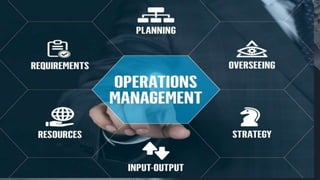
Operations management is the field of business concerned with efficiently
producing goods and services while meeting customer needs. It involves
managing the conversion of inputs into outputs and aims to increase value-
added activities in processes. This includes overseeing production,
manufacturing, equipment maintenance, and strategic planning to optimize
enterprise performance.
GROUP 1
FUNCTIONAL CONCEPT
Management basically is the task of
planning, coordinating motivating and
controlling the efforts of others towards the
goals and objectives of organization.
Henry Fayol.
"To manage is to forecast, and
plan, to organize, to
command, to coordinate and
to control."
GETTING THINGS DONE
THROUGH OTHERS' CONCEPT
This concept, 'Management is the art of
getting things done through others'. It is
very narrow and traditional concept of
management.
• Mary Parker Follet,
"Management is the art of getting things
done through others."
ID. Mooney and A.C. Railey.
"Management is the art of directing
LEADERSHIP AND DECISION-MAKING CONCEPT
This concept, "management is an art and science of decision-making and
leadership." Leadership provides efficiency, coordination and continuity
in an organization. Leadership and decision-making concept as given by
some authors is given below:
Donald J. Clough, "Management is the art and science of decision-making and leadership".
Ralph, C. Davix, "Management is the function of executive leadership anywhere."
PRODUCTIVITY CONCEPT
This concept, "management is an art of increasing productivity." Economists treat management as an
important factor of production.
The productivity concept, as given by the authors is given below:
F. W. Taylor, "Management is the art of knowing what you want to do in the best and cheapest way."
Marry Cushing Niles, "Good management achieves a social objectives with the best use of human
and material energy and time and with satisfaction of the participants and the public.
UNIVERSALITY CONCEPT
According to this concept, "Management is universal". Management is
universal in the sense that it is applicable anywhere whether social,
religious or business and industrial.
Megginson. "Management is management, whether it is in Lisbon, or
in London or in Los Angeles."
Theo Haimann. "Management principles are universal. It may be
applied to any kind of enterprises, where the human efforts are
coordinated."
NATURE OF MANAGEMENT
UNIVERSALITY
Management is an universal phenomenon in the sense that it is
common and essential element in all enterprises. Managers
perform more or less the same functions irrespective of their
position or nature of the organization. The basic principles of
management can be applied in all managerial situations
regardless of the size, nature and location of the organization.
NATURE OF MANAGEMENT
PURPOSEFUL
Management is always aimed at achieving organizational goals
and purposes.
SOCIAL PROCESS
Management essentially involves managing people organized in
work groups. It includes retaining, Developing and motivating
people at work, as well as taking care of their satisfaction as social
beings.
NATURE OF MANAGEMENT
COORDINATING FORCE
Management coordinates the efforts of organization members
through orderly arrangement of interrelated activities so as to
avoid duplication and overlapping.
INTANGIBLE
Management is intangible. It is an unseen force. Its presence can
be felt everywhere by the results of its effort which comes in the
form of orderliness, adequate work output. satisfactory working
climate, employees satisfaction, etc.
NATURE OF MANAGEMENT
CONTINUOUS PROCESS
Management is a dynamic and an on-going process. The cycle of
management continues to operate so long as there is organised
action for the achievement of group goals.
COMPOSITE PROCESS
All the functions are performed by involving several ingredients.
Therefore, the whole process is integrative and performed in a
network fashion.
NATURE OF MANAGEMENT
CREATIVE ORGAN
Management creates energetics effect by producing results which
are more than the sum of individual efforts of the group members.
SCOPE OF MANAGEMENT
Managers must make decisions to establish the purpose of the
organization and to perform a variety of activities to make the
goal a reality.
The collective goals of the organization can be achieved by
controlling the activities being performed by the individual
members of the organization.
Operations
Management
Managers are customarily
classified vertically in organizations
as top, middle, or first-line
managers.
First-line managers
are usually called supervisors. They are responsible for
directing the day-today activities of operative
employees.
Middle managers
manage other managers-and possibly some operative
employees-and are typically responsible for translating
the goals set by top management into specific details
that lower-level managers can perform
Top managers
are responsible for making decisions about the
direction of the
organization and establishing policies that affect all
organizational members. The other major difference in
management jobs occurs horizontally across the
organization as follows :
Functional managers
are responsible for departments that perform a single
functional task and have employees with similar
training and skills. include manufacturing, marketing,
finance, and human resources.
Line managers
are responsible for the manufacturing and marketing
departments that make or sell the product or service.
Line managers
are responsible for several departments that perform
different functions.
THE PROCESS OF MANAGEMENT
Management as a process has the following implications:
Management as social process: Management process involves interaction among people, Goals can be achieved only when
relations between people are productive.
Management as integrated process: Management process brings together human, physical and financial resources.
Management as iterative process. All managerial functions are contained within each other.
Management as continuous process:Management involves continuous identifying and solving problems. It is
repeated again and again.
SIGNIFICANCE OF MANAGEMENT
Management is a function, a discipline, a task to be done, and managers practice this discipline,
carry out the functions and discharge these tasks-Peter F. Drucker.
Analysis of business failures made over many years shows that a high percentage of these
failures were due to unqualified or inexperienced management.
MANAGERIAL ROLES (MINTZBERG)
Managers must wear many different hats in formulating and
implementing task activities related to their positions. In an
attempt to understand the diversity of hats managers must wear.
INTERPERSONAL ROLES
These cover the relationships that a manager has to have with
others. The three roles within this category are figurehead, leader
and liaison. Managers must act as figureheads because of their
formal authority and symbolic position representing the
organisation.
INFORMATIONAL ROLES
Monitor, disseminator, and spokesperson are the
three informational roles that a manager may assume.
DECISIONAL ROLES
Can be defined as a managerial roles where managers are
responsible for making calculated and timely decisions for the
company's welfare
Operations Management
Concerned with designing and controlling the productions of
goods and services, ensuring that businesses are efficient in
using resources to meet customer requirements.
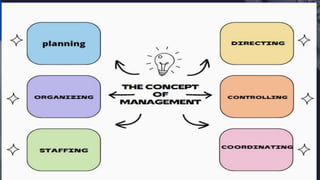
THE CONCEPT OF MANAGEMENT
FUNCTIONAL CONCEPT
This concept 'management is what a manager does'. The man followers of this concept are Louis
Allen, George R. Terry, Henry Fayol, E.F.L. Brech, James L. Lundy, Koontz and O. Donnel. GE
Milward, mcfarland, etc. The functional concept as given by some of the authors is given below:
• Louis Allen, "Management is what a manager does."
• James L. Lundy, "Management is principally the task of planning, coordinating, motivating and
controlling the effort of others towards a specific objective. Management is what management does.
It is the task of planning, executing and controlling."
THE CONCEPT OF MANAGEMENT
• George R. Terry, "Management is a distinct process consisting of planning, organizing, activating
and controlling performed to determine and accomplish the objective by the use of human beings and
other resources.
• Howard M. Carlisle, "Management is defined as the process by which the elements of a group are
integrated, coordinated and/or utilized so as to effectively and efficiently achieve organizational
objectives.
• Henry Fayol, "To manage is to forecast, and plan, to organize, to command, to coordinate and to
control."
GETTING THINGS DONE THROUGH OTHERS'
CONCEPT
This concept, 'Management is the art of getting things done through others'. It is very narrow and traditional concept of
management. Under this concept, the workers are treated as a factor of production only and the work of the manager is
confined to taking work from the workers.
Some of these authors have explained this concept in the following words:
• Mary Parker Follet, "Management is the art of getting things done through others."
• Harold Koontz, "Management is the art of getting things done through and wit people in formally organized groups. It is the art of creating and environment
in which people can perform as individuals and yet cooperate towards attaining of group goals.
• J.D Mooney and A.C. Railey, "Management is the art of directing and inspiring people"
LEADERSHIP AND DECISION-MAKING
CONCEPT
This concept, "management is an art and science of decision-making and leadership." Most of
the time of managers is consumed in taking decisions. Leadership provides efficiency,
coordination and continuity in an organization. Leadership and decision-making concept as
given by some authors is given below:
• Donald J. Clough, "Management is the art and science of decision-making and leadership".
• Ralph, C. Davix, "Management is the function of executive leadership anywhere.
• Association of Mechanical Engineers, U.S.A., "Management is the art and science of preparing,
organizing and directing human efforts applied to control the forces and utilize the materials of
nature for the benefit to man."
PRODUCTIVITY CONCEPT
This concept, "management is an art of increasing productivity." Economists treat management as an important factor of
production.
According to them, "Management is also a factor of production like land, labour, capital and enterprise."
The productivity concept, as given by the authors is given below:
• Jon, F. Mee, "Management may be defined as the art of securing maximum prosperity with a minimum of effort so as to secure
maximum prosperity and happiness for both employer and employee and give the public the best possible service."
• F. W. Taylor, "Management is the art of knowing what you want to do in the best and cheapest way.
• Marry Cushing Niles, "Good management achieves a social objectives with the best use of human and material energy and
time and with satisfaction of the participants and the public.
UNIVERSALITY CONCEPT
According to this concept, "Management is universal". Management is universal in the sense
that it is applicable anywhere whether social, religious or business and industrial.
Henry Fayol "Management is a universal activity which is equally applicable in all types of
organization wether social, religious or business and industrial"
Megginson, "Management is management, whether it is in Lisbon, or in London or in Los
Angeles."
Theo Haimann, "Management principles are universal. It may be applied to any kind of
enterprises, where the human efforts are coordinated."
NATURE OF MANAGEMENT
• UNIVERSALITY
Management is an universal phenomenon in the sense that it is common and essential element in
all enterprises. Managers perform more or less the same functions irrespective of their position or
nature of the organization.
• PURPOSEFUL
Management is always aimed at achieving organizational goals and purposes. The success of
management is measured by the extent to which the desired objectives are attained.
NATURE OF MANAGEMENT
• SOCIAL PROCESS
Management essentially involves managing people organized in work groups. It includes
retaining, Developing and motivating people at work, as well as taking care of their satisfaction
as social beings.
• COORDINATING FORCE
Management coordinates the efforts of organization members through orderly arrangement of
interrelated activities so as to avoid duplication and overlapping.
NATURE OF MANAGEMENT
• INTANGIBLE
Management is intangible. It is an unseen force. Its presence can be felt everywhere by the
results of its effort which comes in the form of orderliness, adequate work output. satisfactory
working climate, employees satisfaction, etc.
• CONTINUOUS PROCESS
Management is a dynamic and an on-going process. The cycle of management continues to
operate so long as there is organised action for the achievement of group goals.
NATURE OF MANAGEMENT
• COMPOSITE PROCESS
Functions of management cannot be undertaken sequentially, independent of each other.
Management is a composite process made up of individual ingredients.
• CREATIVE ORGAN
Management creates energetics effect by producing results which are more than the sum of
individual efforts of the group members. It provides sequence to operations, matches jobs to
goals, connects work to physical and financial resources.
NATURE OF MANAGEMENT
• SCOPE OF MANAGEMENT
Managers must make decisions to establish the purpose of the organization and to perform a
variety of activities to make the goal a reality.
All organizations have collective or shared goals, over and above the individual goals of their
members, for the achievement of which the organization is responsible to its owners and
stakeholders.
The collective goals of the organization can be achieved by controlling the activities being
performed by the individual members of the organization.
NATURE OF MANAGEMENT
This controlled performance means that:
The collective goals are known and understood by all members-planning;
The necessary resources are obtained and utilized efficiently- implementation;
The performance can be controlled and measured to determine the extent of reaching
the goals - control.
Managers are customarily classified vertically in organizations as top, middle, or first-
line managers.
Classical and Neo
classical Theories of
Management
GROUP 1
Classical Theory of Management
. The classical approach to management focuses on centralized
authority, labor specialization and incentives to optimize
productivity in an organization and, in turn, drive profits.
3 theories
Taylor’s theory of Scientific Management
Fayol’s Administrative Theory
Weber’s Theory of Bureaucracy
Taylor’s theory of Scientific Management
Frederick W. Taylor is known as the father of scientific management.
This branch of classical theory focuses on scientific methods and
empirical research to examine the most effective methods to
accomplish specific tasks. It aims to extract the best out of every
employee by assigning jobs based on employee skill set and
competency. Workflow is divided between managers and employees.
Managers strategize, train and monitor employees; employees
perform their assigned roles.
Fayol’s Administrative Theory
The main proponent of the administrative management branch of
classical theory was Henri Fayol, a French industrialist.
Administrative management aims to improve organizational
productivity by focusing on methods that managers can use to
synchronize internal processes. Fayol believed managerial practices
are key to driving efficiency in organizations. Therefore, this branch
seeks to heighten managerial performance instead of individual
worker efficiency.
Weber’s Theory of Bureaucracy
The father of modern sociology, Max Weber, developed the branch called bureaucratic
management. According to this branch of classical theory, an ideal organization, or
bureaucracy, has a hierarchical structure of management with clearly defined rules and
regulations. Labor is divided and relationships are impersonal. This ensures order and
uniformity throughout an organization, producing a specialized workforce.
Although the classical theory of management is not prevalent in the modern age, certain
principles and branches of the classical theory still find use in today’s organizations,
especially Weber’s principles of bureaucratic management.
This was first recognized by French Industrialist Fayol in the early
1900. Fayol identified 14 general principles of management :
Discipline
Unity of direction
Unity of command
Division of Work
Authority
Collective Interest Over Individual Interest
Remuneration
Centralization
Scalar Chain.
Order
Equity
Stability of Tenure of Personnel.
Initiative
Esprit de Corps
EVOLUTION OF CLASSICAL APPROACH TO MANAGEMENT
TRADITIONAL PROCESS OF LEARNING IS THROUGH
EXPERIMENT AN OBSERVATION
The german socialists, Max Weber followed the classical approach
and developed his theory of Bureaucracy which portrays the
structure and design of Organization characterized by Hierarchy of
Authority, Formalized rules and regulations
Neo classicalTheory of Management
Human Relations Theory
Human Relations management theory is a premise of organizational
psychology from the early twentieth century, which suggests that employee
productivity and motivation can be increased through positive social bonds in
the workplace and acknowledgement of the worker as a unique individual. It
holds that improved working conditions (empowerment, participation,
positive treatment) lead to increased productivity.
Human Relations Theory
Four "Actors" in Human Relations theory
The employee
Groups of employees
Supervisors and managers
The organization
Behavioral Theory
The behavioral management theory is often called the human
relations movement because it addresses the human dimension of
work. Behavioral theorists believed that a better understanding of
human behavior at work, such as motivation, conflict, expectations,
and group dynamics, improved productivity.
Social Systems Theory
Developed by Niklas Luhmann is an option for theoretical foundation of Human resource
Management
In social systems theory, a single decision is a communicative event, and events have no
duration; they vanish the same the moment they are formed. Thus, in order for an organization
to emerge and persist, each new decision must be connected (or connectable) to previous
decisions (system memory) and also enable subsequent decisions.
In Luhmann’s theory, social systems are classified into three categories, namely “interaction,”
“organization,” and “society.”
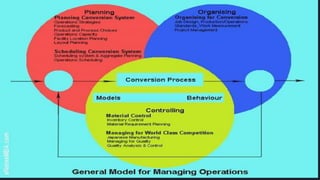
FRAMEWORK FOR MANAGING
OPERATIONS
An operational framework is a set of guidelines that dictate how a company or organization
functions. It typically includes policies, procedures, and standards that govern everything from
finances and HR to daily operations.
PLANNING
ORGANIZING
CONTROLLING
Objectives of OPS Management
Customer Service
- Satisfaction of customer wants
- Key objective of Ops Management
Resource Utilization
- Utilize resources for Satisfaction of customer wants effectively
Managing Global Operations
Globalization
Describes business deployment of facilities and operations around the
world. Defines as the process in which geographic distance become a
factor of diminishing importance in the establishment and maintenance of
cross border economic, political and socio cultural relations.
4 developments Towards Globalization
1 Improve transportation and communication technologies
2 Opened Financial systems
3 Increased Demand for imports
4 reduced import quotas and other trade barriers
Scope of Production and Operations
Management
LOCATION OF FACILITIES
The location of facilities for operations is a critical long-term decision involving geographical factors
that affect a business organization. It determines where a company's main operations should be based,
considering factors like investment in plant and machinery, expansion plans, product diversification,
and raw material sources.
Scope of Production and Operations
Management
PLANTS AND MATERIALS HANDLING
Plant layout involves arranging facilities, departments, work centers, and equipment in
the conversion process to achieve the desired output quality and quantity economically.
It encompasses the optimal arrangement of personnel, operating equipment, storage
space, material handling equipment, and supporting services.
Scope of Production and Operations
Management
PRODUCT DESIGN
Product design is the process of turning ideas into tangible products, crucial for
the survival and growth of businesses. It involves identifying needs, translating
them into technical specifications, and selecting manufacturing processes. The
process integrates marketing, product development, and manufacturing to
meet customer expectations and produce the desired product.
Scope of Production and Operations
Management
PROCESS DESIGN
Process design involves making macroscopic decisions on the overall process
route to convert raw materials into finished goods. This includes selecting
processes, choosing technology, analyzing process flow, and designing facility
layouts. Key decisions involve analyzing the workflow and selecting
workstations for each step in the process.
Scope of Production and Operations
Management
PRODUCTION PLANNING AND CONTROL
Production planning and control can be defined as the process of planning the
production in advance, setting the exact route of each item, fixing the starting and
finishing dates for each item, to give production orders to shops and to follow up
the progress of products according to orders.
FIGURE
Production planning and control involve several functions including planning, routing, scheduling, dispatching, and follow-up.
Planning is about deciding what, how, when, and by whom tasks will be performed, bridging the gap from current state to
desired outcomes. Routing determines the optimal path for each part of the product through various departments and
machines.
Scope of Production and Operations
Management
QUALITY CONTROL
Quality control is a systematic approach to maintaining desired levels of quality in products or services,
aiming to prevent defects at the source and implementing corrective measures. It ensures the production of
uniform, acceptable quality products while minimizing costs. Objectives include improving company income
by making products more acceptable to customers, reducing costs through defect reduction, achieving
interchangeability in large-scale production, producing optimal quality at reduced prices, ensuring customer
satisfaction and building goodwill, conducting prompt inspections, and monitoring variations during
manufacturing.
Scope of Production and Operations
Management
MATERIALS MANAGEMENT
Materials management is a critical aspect of management focused on acquiring,
controlling, and utilizing materials necessary for the production process, as well as
managing the flow of goods and services.
Scope of Production and Operations
Management
The main objectives of materials management are:
To minimise material cost.
To purchase, receive, transport and store materials efficiently and to reduce the related cost.
To cut down costs through simplification, standardisation, value analysis, import substitution,
etc.
To trace new sources of supply and to develop cordial relations with them in order to ensure
continuous supply at reasonable rates.
To reduce investment tied in the inventories for use in other
Scope of Production and Operations
Management
Some key functions of the Production Management department include:
1. Materials: Selecting materials for the product and researching alternatives.
2. Methods: Finding the best methods for the process and identifying process sequences.
3. Machines and Equipment: Selecting suitable machinery and designing maintenance policies.
4. Estimating: Setting production targets, delivery dates, and minimizing production costs.
5. Loading and Scheduling: Drawing timetables for production activities and materials movement.
6. Routing: Fixing flow lines for raw materials and components.
7. Despatching: Preparing documents like job cards and route sheets to initiate production
8. Expediting or Follow-up: Monitoring progress and comparing actual performance with plans.
9. Inspection: Conducting inspection activities during production.
10. Evaluation: Assessing the department's contribution to corporate and departmental objectives.
Scope of Production and Operations
Management
The Production Management department holds a crucial position within an organization, as production is
central to all its activities. Whether it functions as a line function or staff function depends on corporate
management policy. In small organizations, Production Management often oversees all production activities,
while in large industries, it's advisable for Production to be a line function to ensure decisions align with
production activities. The Production Manager typically reports directly to the General Manager, who then
reports to the Board.
Scope of Production and Operations
Management
Organisation Chart for P.C Department
There are three main classifications:
1. **Job Production**: Tailored to meet specific orders, with products made according to customer specifications. It can further be categorized based on customer interaction:
- Jobs produced only once: Products are made to order, with planning starting upon receiving the order.
- Jobs produced at irregular intervals: Orders are placed sporadically, requiring planning upon receipt of each order.
- Jobs produced periodically at regular intervals: Regular orders allow for pre-planning of materials and processes.
2. **Batch Production**: Involves manufacturing identical products in batches, either to fulfill specific orders or meet demand. It can be classified based on production frequency:
- Batches produced only once: Resources are planned upon receiving orders for specific products.
- Batches produced at irregular intervals: Planning is based on sporadic orders, with reference to previous plans.
- Batches produced periodically at known intervals: Regular orders allow for well-designed plans and bulk material purchases.
3. **Continuous Production**: Characterized by uninterrupted, high-volume production, suitable for standardized products with consistent demand. This system evolves from
Batch Production as demand increases.
Scope of Production and Operations
Management
MAINTENANCE MANAGEMENT
Maintenance management focuses on ensuring that equipment and machinery in
modern industries are properly maintained to minimize downtime and maximize
productivity. The main objectives include achieving minimal breakdowns and
keeping the plant in good working condition at the lowest cost possible, ensuring
machines and facilities can be used at optimal capacity without interruption, and
ensuring the availability of machines, buildings, and services required by other
sections of the factory for optimal return on investment.
Function and production management
department
*In small firms production manager may have to look after production planning and control
along with personnel, marketing , finance and purchase functions.*In medium size firms there
may be separate managers for personnel , marketing and finance function * Large sized firms
activities of production management is confined to the management of production activities
only
materials
methods
machines and equipment
estimating
loading and scheduling
Routing
Dispatching
expediting or follow up
Inspection
Evaluation
Function and production management
department
This is because this department knows very well regarding materials .methods and available
resources,etc. if the firms are small the function are to be carried out by the production
management .In medium sized firms addition to routing, scheduling,loading , dispatching,and
expediting ,some more functions like methods .machines may be under the control production
management department .In large firms there will be separate department for methods , machines
materials and other but routing ,loading and scheduling are the sole functions of production
management
Place of production management department in
the organization
This is to say all the activities an organization,such as finance , personnel,
marketing,...etc.Are exists in a organization because of production activity.Whether it
should be a line function or staff function,more or less depends upon the corporate
management policy .In small organization, production management is whole and sole of
it .In large industries, generally it is advisable to have production as line function ,
because the line decision by line manager and advices given by the staff personnel will be
based on the product services.
Types of production system
The basic principles that guide the formation of planning policy and it's execution may
be the same for all the manufacturing concern.But emphasis on a particular aspect of
production management in fulfilling to specific requirements of the plant and the
management approach to the problems of inventory ,machine selection,machine
setting,tooling, routing, scheduling, loading, follow up and general control will differ
depending on the types of production system
The three main factors generally determines aspects are:
1.Types of production i.e... quantities of products and regularity of
manufacture
2.size of the plant i..e..small industry ,medium sized industry on
large industry
3. Type of production in general there are three classification in
types of production system
The three main factors generally determines aspects are:
Job production
a.The job produced only once
b.The job produced at irregular intervals
c.The jobs produced periodically at irregular intervals
Batch production
Batch production is the manufacture of number of identical products either to meet
the specific order or to satisfy the demand
a. A batch produced only once
b. A batch produced at irregular intervals as per customer order or when the
need arises
c. A batch periodically at knowns intervals .
THANK YOUUU FOR
LISTENING!!
Aligato Cleah
Villanueva Kyla
Fregil Chenny Pauline
Dinaguit Jecelyn

Operations-Management-Group1.pptx may6 23

  • 1.
  • 2.
  • 4.
    OPERATIONS MANAGEMENT Operations managementis the field of business concerned with efficiently producing goods and services while meeting customer needs. It involves managing the conversion of inputs into outputs and aims to increase value- added activities in processes. This includes overseeing production, manufacturing, equipment maintenance, and strategic planning to optimize enterprise performance.
  • 5.
  • 6.
    FUNCTIONAL CONCEPT Management basicallyis the task of planning, coordinating motivating and controlling the efforts of others towards the goals and objectives of organization.
  • 7.
    Henry Fayol. "To manageis to forecast, and plan, to organize, to command, to coordinate and to control."
  • 8.
    GETTING THINGS DONE THROUGHOTHERS' CONCEPT This concept, 'Management is the art of getting things done through others'. It is very narrow and traditional concept of management.
  • 9.
    • Mary ParkerFollet, "Management is the art of getting things done through others." ID. Mooney and A.C. Railey. "Management is the art of directing
  • 10.
    LEADERSHIP AND DECISION-MAKINGCONCEPT This concept, "management is an art and science of decision-making and leadership." Leadership provides efficiency, coordination and continuity in an organization. Leadership and decision-making concept as given by some authors is given below: Donald J. Clough, "Management is the art and science of decision-making and leadership". Ralph, C. Davix, "Management is the function of executive leadership anywhere."
  • 11.
    PRODUCTIVITY CONCEPT This concept,"management is an art of increasing productivity." Economists treat management as an important factor of production. The productivity concept, as given by the authors is given below: F. W. Taylor, "Management is the art of knowing what you want to do in the best and cheapest way." Marry Cushing Niles, "Good management achieves a social objectives with the best use of human and material energy and time and with satisfaction of the participants and the public.
  • 12.
    UNIVERSALITY CONCEPT According tothis concept, "Management is universal". Management is universal in the sense that it is applicable anywhere whether social, religious or business and industrial. Megginson. "Management is management, whether it is in Lisbon, or in London or in Los Angeles." Theo Haimann. "Management principles are universal. It may be applied to any kind of enterprises, where the human efforts are coordinated."
  • 13.
    NATURE OF MANAGEMENT UNIVERSALITY Managementis an universal phenomenon in the sense that it is common and essential element in all enterprises. Managers perform more or less the same functions irrespective of their position or nature of the organization. The basic principles of management can be applied in all managerial situations regardless of the size, nature and location of the organization.
  • 14.
    NATURE OF MANAGEMENT PURPOSEFUL Managementis always aimed at achieving organizational goals and purposes. SOCIAL PROCESS Management essentially involves managing people organized in work groups. It includes retaining, Developing and motivating people at work, as well as taking care of their satisfaction as social beings.
  • 15.
    NATURE OF MANAGEMENT COORDINATINGFORCE Management coordinates the efforts of organization members through orderly arrangement of interrelated activities so as to avoid duplication and overlapping. INTANGIBLE Management is intangible. It is an unseen force. Its presence can be felt everywhere by the results of its effort which comes in the form of orderliness, adequate work output. satisfactory working climate, employees satisfaction, etc.
  • 16.
    NATURE OF MANAGEMENT CONTINUOUSPROCESS Management is a dynamic and an on-going process. The cycle of management continues to operate so long as there is organised action for the achievement of group goals. COMPOSITE PROCESS All the functions are performed by involving several ingredients. Therefore, the whole process is integrative and performed in a network fashion.
  • 17.
    NATURE OF MANAGEMENT CREATIVEORGAN Management creates energetics effect by producing results which are more than the sum of individual efforts of the group members.
  • 18.
    SCOPE OF MANAGEMENT Managersmust make decisions to establish the purpose of the organization and to perform a variety of activities to make the goal a reality. The collective goals of the organization can be achieved by controlling the activities being performed by the individual members of the organization.
  • 19.
    Operations Management Managers are customarily classifiedvertically in organizations as top, middle, or first-line managers.
  • 20.
    First-line managers are usuallycalled supervisors. They are responsible for directing the day-today activities of operative employees.
  • 21.
    Middle managers manage othermanagers-and possibly some operative employees-and are typically responsible for translating the goals set by top management into specific details that lower-level managers can perform
  • 22.
    Top managers are responsiblefor making decisions about the direction of the organization and establishing policies that affect all organizational members. The other major difference in management jobs occurs horizontally across the organization as follows :
  • 23.
    Functional managers are responsiblefor departments that perform a single functional task and have employees with similar training and skills. include manufacturing, marketing, finance, and human resources.
  • 24.
    Line managers are responsiblefor the manufacturing and marketing departments that make or sell the product or service.
  • 25.
    Line managers are responsiblefor several departments that perform different functions.
  • 26.
    THE PROCESS OFMANAGEMENT Management as a process has the following implications: Management as social process: Management process involves interaction among people, Goals can be achieved only when relations between people are productive. Management as integrated process: Management process brings together human, physical and financial resources. Management as iterative process. All managerial functions are contained within each other. Management as continuous process:Management involves continuous identifying and solving problems. It is repeated again and again.
  • 27.
    SIGNIFICANCE OF MANAGEMENT Managementis a function, a discipline, a task to be done, and managers practice this discipline, carry out the functions and discharge these tasks-Peter F. Drucker. Analysis of business failures made over many years shows that a high percentage of these failures were due to unqualified or inexperienced management.
  • 28.
    MANAGERIAL ROLES (MINTZBERG) Managersmust wear many different hats in formulating and implementing task activities related to their positions. In an attempt to understand the diversity of hats managers must wear.
  • 29.
    INTERPERSONAL ROLES These coverthe relationships that a manager has to have with others. The three roles within this category are figurehead, leader and liaison. Managers must act as figureheads because of their formal authority and symbolic position representing the organisation.
  • 30.
    INFORMATIONAL ROLES Monitor, disseminator,and spokesperson are the three informational roles that a manager may assume.
  • 31.
    DECISIONAL ROLES Can bedefined as a managerial roles where managers are responsible for making calculated and timely decisions for the company's welfare
  • 32.
    Operations Management Concerned withdesigning and controlling the productions of goods and services, ensuring that businesses are efficient in using resources to meet customer requirements.
  • 33.
    THE CONCEPT OFMANAGEMENT FUNCTIONAL CONCEPT This concept 'management is what a manager does'. The man followers of this concept are Louis Allen, George R. Terry, Henry Fayol, E.F.L. Brech, James L. Lundy, Koontz and O. Donnel. GE Milward, mcfarland, etc. The functional concept as given by some of the authors is given below: • Louis Allen, "Management is what a manager does." • James L. Lundy, "Management is principally the task of planning, coordinating, motivating and controlling the effort of others towards a specific objective. Management is what management does. It is the task of planning, executing and controlling."
  • 34.
    THE CONCEPT OFMANAGEMENT • George R. Terry, "Management is a distinct process consisting of planning, organizing, activating and controlling performed to determine and accomplish the objective by the use of human beings and other resources. • Howard M. Carlisle, "Management is defined as the process by which the elements of a group are integrated, coordinated and/or utilized so as to effectively and efficiently achieve organizational objectives. • Henry Fayol, "To manage is to forecast, and plan, to organize, to command, to coordinate and to control."
  • 35.
    GETTING THINGS DONETHROUGH OTHERS' CONCEPT This concept, 'Management is the art of getting things done through others'. It is very narrow and traditional concept of management. Under this concept, the workers are treated as a factor of production only and the work of the manager is confined to taking work from the workers. Some of these authors have explained this concept in the following words: • Mary Parker Follet, "Management is the art of getting things done through others." • Harold Koontz, "Management is the art of getting things done through and wit people in formally organized groups. It is the art of creating and environment in which people can perform as individuals and yet cooperate towards attaining of group goals. • J.D Mooney and A.C. Railey, "Management is the art of directing and inspiring people"
  • 36.
    LEADERSHIP AND DECISION-MAKING CONCEPT Thisconcept, "management is an art and science of decision-making and leadership." Most of the time of managers is consumed in taking decisions. Leadership provides efficiency, coordination and continuity in an organization. Leadership and decision-making concept as given by some authors is given below: • Donald J. Clough, "Management is the art and science of decision-making and leadership". • Ralph, C. Davix, "Management is the function of executive leadership anywhere. • Association of Mechanical Engineers, U.S.A., "Management is the art and science of preparing, organizing and directing human efforts applied to control the forces and utilize the materials of nature for the benefit to man."
  • 37.
    PRODUCTIVITY CONCEPT This concept,"management is an art of increasing productivity." Economists treat management as an important factor of production. According to them, "Management is also a factor of production like land, labour, capital and enterprise." The productivity concept, as given by the authors is given below: • Jon, F. Mee, "Management may be defined as the art of securing maximum prosperity with a minimum of effort so as to secure maximum prosperity and happiness for both employer and employee and give the public the best possible service." • F. W. Taylor, "Management is the art of knowing what you want to do in the best and cheapest way. • Marry Cushing Niles, "Good management achieves a social objectives with the best use of human and material energy and time and with satisfaction of the participants and the public.
  • 38.
    UNIVERSALITY CONCEPT According tothis concept, "Management is universal". Management is universal in the sense that it is applicable anywhere whether social, religious or business and industrial. Henry Fayol "Management is a universal activity which is equally applicable in all types of organization wether social, religious or business and industrial" Megginson, "Management is management, whether it is in Lisbon, or in London or in Los Angeles." Theo Haimann, "Management principles are universal. It may be applied to any kind of enterprises, where the human efforts are coordinated."
  • 39.
    NATURE OF MANAGEMENT •UNIVERSALITY Management is an universal phenomenon in the sense that it is common and essential element in all enterprises. Managers perform more or less the same functions irrespective of their position or nature of the organization. • PURPOSEFUL Management is always aimed at achieving organizational goals and purposes. The success of management is measured by the extent to which the desired objectives are attained.
  • 40.
    NATURE OF MANAGEMENT •SOCIAL PROCESS Management essentially involves managing people organized in work groups. It includes retaining, Developing and motivating people at work, as well as taking care of their satisfaction as social beings. • COORDINATING FORCE Management coordinates the efforts of organization members through orderly arrangement of interrelated activities so as to avoid duplication and overlapping.
  • 41.
    NATURE OF MANAGEMENT •INTANGIBLE Management is intangible. It is an unseen force. Its presence can be felt everywhere by the results of its effort which comes in the form of orderliness, adequate work output. satisfactory working climate, employees satisfaction, etc. • CONTINUOUS PROCESS Management is a dynamic and an on-going process. The cycle of management continues to operate so long as there is organised action for the achievement of group goals.
  • 42.
    NATURE OF MANAGEMENT •COMPOSITE PROCESS Functions of management cannot be undertaken sequentially, independent of each other. Management is a composite process made up of individual ingredients. • CREATIVE ORGAN Management creates energetics effect by producing results which are more than the sum of individual efforts of the group members. It provides sequence to operations, matches jobs to goals, connects work to physical and financial resources.
  • 43.
    NATURE OF MANAGEMENT •SCOPE OF MANAGEMENT Managers must make decisions to establish the purpose of the organization and to perform a variety of activities to make the goal a reality. All organizations have collective or shared goals, over and above the individual goals of their members, for the achievement of which the organization is responsible to its owners and stakeholders. The collective goals of the organization can be achieved by controlling the activities being performed by the individual members of the organization.
  • 44.
    NATURE OF MANAGEMENT Thiscontrolled performance means that: The collective goals are known and understood by all members-planning; The necessary resources are obtained and utilized efficiently- implementation; The performance can be controlled and measured to determine the extent of reaching the goals - control. Managers are customarily classified vertically in organizations as top, middle, or first- line managers.
  • 48.
    Classical and Neo classicalTheories of Management GROUP 1
  • 49.
    Classical Theory ofManagement . The classical approach to management focuses on centralized authority, labor specialization and incentives to optimize productivity in an organization and, in turn, drive profits.
  • 50.
    3 theories Taylor’s theoryof Scientific Management Fayol’s Administrative Theory Weber’s Theory of Bureaucracy
  • 51.
    Taylor’s theory ofScientific Management Frederick W. Taylor is known as the father of scientific management. This branch of classical theory focuses on scientific methods and empirical research to examine the most effective methods to accomplish specific tasks. It aims to extract the best out of every employee by assigning jobs based on employee skill set and competency. Workflow is divided between managers and employees. Managers strategize, train and monitor employees; employees perform their assigned roles.
  • 52.
    Fayol’s Administrative Theory Themain proponent of the administrative management branch of classical theory was Henri Fayol, a French industrialist. Administrative management aims to improve organizational productivity by focusing on methods that managers can use to synchronize internal processes. Fayol believed managerial practices are key to driving efficiency in organizations. Therefore, this branch seeks to heighten managerial performance instead of individual worker efficiency.
  • 53.
    Weber’s Theory ofBureaucracy The father of modern sociology, Max Weber, developed the branch called bureaucratic management. According to this branch of classical theory, an ideal organization, or bureaucracy, has a hierarchical structure of management with clearly defined rules and regulations. Labor is divided and relationships are impersonal. This ensures order and uniformity throughout an organization, producing a specialized workforce. Although the classical theory of management is not prevalent in the modern age, certain principles and branches of the classical theory still find use in today’s organizations, especially Weber’s principles of bureaucratic management.
  • 54.
    This was firstrecognized by French Industrialist Fayol in the early 1900. Fayol identified 14 general principles of management : Discipline Unity of direction Unity of command Division of Work Authority Collective Interest Over Individual Interest Remuneration Centralization Scalar Chain. Order Equity Stability of Tenure of Personnel. Initiative Esprit de Corps
  • 55.
    EVOLUTION OF CLASSICALAPPROACH TO MANAGEMENT TRADITIONAL PROCESS OF LEARNING IS THROUGH EXPERIMENT AN OBSERVATION The german socialists, Max Weber followed the classical approach and developed his theory of Bureaucracy which portrays the structure and design of Organization characterized by Hierarchy of Authority, Formalized rules and regulations
  • 56.
    Neo classicalTheory ofManagement Human Relations Theory Human Relations management theory is a premise of organizational psychology from the early twentieth century, which suggests that employee productivity and motivation can be increased through positive social bonds in the workplace and acknowledgement of the worker as a unique individual. It holds that improved working conditions (empowerment, participation, positive treatment) lead to increased productivity.
  • 57.
    Human Relations Theory Four"Actors" in Human Relations theory The employee Groups of employees Supervisors and managers The organization
  • 58.
    Behavioral Theory The behavioralmanagement theory is often called the human relations movement because it addresses the human dimension of work. Behavioral theorists believed that a better understanding of human behavior at work, such as motivation, conflict, expectations, and group dynamics, improved productivity.
  • 59.
    Social Systems Theory Developedby Niklas Luhmann is an option for theoretical foundation of Human resource Management In social systems theory, a single decision is a communicative event, and events have no duration; they vanish the same the moment they are formed. Thus, in order for an organization to emerge and persist, each new decision must be connected (or connectable) to previous decisions (system memory) and also enable subsequent decisions. In Luhmann’s theory, social systems are classified into three categories, namely “interaction,” “organization,” and “society.”
  • 60.
    FRAMEWORK FOR MANAGING OPERATIONS Anoperational framework is a set of guidelines that dictate how a company or organization functions. It typically includes policies, procedures, and standards that govern everything from finances and HR to daily operations. PLANNING ORGANIZING CONTROLLING
  • 62.
    Objectives of OPSManagement Customer Service - Satisfaction of customer wants - Key objective of Ops Management Resource Utilization - Utilize resources for Satisfaction of customer wants effectively
  • 63.
    Managing Global Operations Globalization Describesbusiness deployment of facilities and operations around the world. Defines as the process in which geographic distance become a factor of diminishing importance in the establishment and maintenance of cross border economic, political and socio cultural relations.
  • 64.
    4 developments TowardsGlobalization 1 Improve transportation and communication technologies 2 Opened Financial systems 3 Increased Demand for imports 4 reduced import quotas and other trade barriers
  • 65.
    Scope of Productionand Operations Management LOCATION OF FACILITIES The location of facilities for operations is a critical long-term decision involving geographical factors that affect a business organization. It determines where a company's main operations should be based, considering factors like investment in plant and machinery, expansion plans, product diversification, and raw material sources.
  • 66.
    Scope of Productionand Operations Management PLANTS AND MATERIALS HANDLING Plant layout involves arranging facilities, departments, work centers, and equipment in the conversion process to achieve the desired output quality and quantity economically. It encompasses the optimal arrangement of personnel, operating equipment, storage space, material handling equipment, and supporting services.
  • 67.
    Scope of Productionand Operations Management PRODUCT DESIGN Product design is the process of turning ideas into tangible products, crucial for the survival and growth of businesses. It involves identifying needs, translating them into technical specifications, and selecting manufacturing processes. The process integrates marketing, product development, and manufacturing to meet customer expectations and produce the desired product.
  • 68.
    Scope of Productionand Operations Management PROCESS DESIGN Process design involves making macroscopic decisions on the overall process route to convert raw materials into finished goods. This includes selecting processes, choosing technology, analyzing process flow, and designing facility layouts. Key decisions involve analyzing the workflow and selecting workstations for each step in the process.
  • 69.
    Scope of Productionand Operations Management PRODUCTION PLANNING AND CONTROL Production planning and control can be defined as the process of planning the production in advance, setting the exact route of each item, fixing the starting and finishing dates for each item, to give production orders to shops and to follow up the progress of products according to orders. FIGURE Production planning and control involve several functions including planning, routing, scheduling, dispatching, and follow-up. Planning is about deciding what, how, when, and by whom tasks will be performed, bridging the gap from current state to desired outcomes. Routing determines the optimal path for each part of the product through various departments and machines.
  • 70.
    Scope of Productionand Operations Management QUALITY CONTROL Quality control is a systematic approach to maintaining desired levels of quality in products or services, aiming to prevent defects at the source and implementing corrective measures. It ensures the production of uniform, acceptable quality products while minimizing costs. Objectives include improving company income by making products more acceptable to customers, reducing costs through defect reduction, achieving interchangeability in large-scale production, producing optimal quality at reduced prices, ensuring customer satisfaction and building goodwill, conducting prompt inspections, and monitoring variations during manufacturing.
  • 71.
    Scope of Productionand Operations Management MATERIALS MANAGEMENT Materials management is a critical aspect of management focused on acquiring, controlling, and utilizing materials necessary for the production process, as well as managing the flow of goods and services.
  • 72.
    Scope of Productionand Operations Management The main objectives of materials management are: To minimise material cost. To purchase, receive, transport and store materials efficiently and to reduce the related cost. To cut down costs through simplification, standardisation, value analysis, import substitution, etc. To trace new sources of supply and to develop cordial relations with them in order to ensure continuous supply at reasonable rates. To reduce investment tied in the inventories for use in other
  • 73.
    Scope of Productionand Operations Management Some key functions of the Production Management department include: 1. Materials: Selecting materials for the product and researching alternatives. 2. Methods: Finding the best methods for the process and identifying process sequences. 3. Machines and Equipment: Selecting suitable machinery and designing maintenance policies. 4. Estimating: Setting production targets, delivery dates, and minimizing production costs. 5. Loading and Scheduling: Drawing timetables for production activities and materials movement. 6. Routing: Fixing flow lines for raw materials and components. 7. Despatching: Preparing documents like job cards and route sheets to initiate production 8. Expediting or Follow-up: Monitoring progress and comparing actual performance with plans. 9. Inspection: Conducting inspection activities during production. 10. Evaluation: Assessing the department's contribution to corporate and departmental objectives.
  • 74.
    Scope of Productionand Operations Management The Production Management department holds a crucial position within an organization, as production is central to all its activities. Whether it functions as a line function or staff function depends on corporate management policy. In small organizations, Production Management often oversees all production activities, while in large industries, it's advisable for Production to be a line function to ensure decisions align with production activities. The Production Manager typically reports directly to the General Manager, who then reports to the Board.
  • 75.
    Scope of Productionand Operations Management Organisation Chart for P.C Department There are three main classifications: 1. **Job Production**: Tailored to meet specific orders, with products made according to customer specifications. It can further be categorized based on customer interaction: - Jobs produced only once: Products are made to order, with planning starting upon receiving the order. - Jobs produced at irregular intervals: Orders are placed sporadically, requiring planning upon receipt of each order. - Jobs produced periodically at regular intervals: Regular orders allow for pre-planning of materials and processes. 2. **Batch Production**: Involves manufacturing identical products in batches, either to fulfill specific orders or meet demand. It can be classified based on production frequency: - Batches produced only once: Resources are planned upon receiving orders for specific products. - Batches produced at irregular intervals: Planning is based on sporadic orders, with reference to previous plans. - Batches produced periodically at known intervals: Regular orders allow for well-designed plans and bulk material purchases. 3. **Continuous Production**: Characterized by uninterrupted, high-volume production, suitable for standardized products with consistent demand. This system evolves from Batch Production as demand increases.
  • 76.
    Scope of Productionand Operations Management MAINTENANCE MANAGEMENT Maintenance management focuses on ensuring that equipment and machinery in modern industries are properly maintained to minimize downtime and maximize productivity. The main objectives include achieving minimal breakdowns and keeping the plant in good working condition at the lowest cost possible, ensuring machines and facilities can be used at optimal capacity without interruption, and ensuring the availability of machines, buildings, and services required by other sections of the factory for optimal return on investment.
  • 77.
    Function and productionmanagement department *In small firms production manager may have to look after production planning and control along with personnel, marketing , finance and purchase functions.*In medium size firms there may be separate managers for personnel , marketing and finance function * Large sized firms activities of production management is confined to the management of production activities only materials methods machines and equipment estimating loading and scheduling Routing Dispatching expediting or follow up Inspection Evaluation
  • 78.
    Function and productionmanagement department This is because this department knows very well regarding materials .methods and available resources,etc. if the firms are small the function are to be carried out by the production management .In medium sized firms addition to routing, scheduling,loading , dispatching,and expediting ,some more functions like methods .machines may be under the control production management department .In large firms there will be separate department for methods , machines materials and other but routing ,loading and scheduling are the sole functions of production management
  • 79.
    Place of productionmanagement department in the organization This is to say all the activities an organization,such as finance , personnel, marketing,...etc.Are exists in a organization because of production activity.Whether it should be a line function or staff function,more or less depends upon the corporate management policy .In small organization, production management is whole and sole of it .In large industries, generally it is advisable to have production as line function , because the line decision by line manager and advices given by the staff personnel will be based on the product services.
  • 80.
    Types of productionsystem The basic principles that guide the formation of planning policy and it's execution may be the same for all the manufacturing concern.But emphasis on a particular aspect of production management in fulfilling to specific requirements of the plant and the management approach to the problems of inventory ,machine selection,machine setting,tooling, routing, scheduling, loading, follow up and general control will differ depending on the types of production system
  • 81.
    The three mainfactors generally determines aspects are: 1.Types of production i.e... quantities of products and regularity of manufacture 2.size of the plant i..e..small industry ,medium sized industry on large industry 3. Type of production in general there are three classification in types of production system
  • 82.
    The three mainfactors generally determines aspects are: Job production a.The job produced only once b.The job produced at irregular intervals c.The jobs produced periodically at irregular intervals
  • 83.
    Batch production Batch productionis the manufacture of number of identical products either to meet the specific order or to satisfy the demand a. A batch produced only once b. A batch produced at irregular intervals as per customer order or when the need arises c. A batch periodically at knowns intervals .
  • 84.
    THANK YOUUU FOR LISTENING!! AligatoCleah Villanueva Kyla Fregil Chenny Pauline Dinaguit Jecelyn