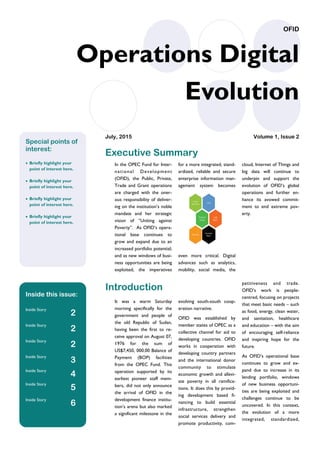
cloud, Internet of Things and
big data will continue to
underpin and support the
evolution of OFID’s global
operations and further en-
hance its avowed commit-
ment to end extreme pov-
erty.
In the OPEC Fund for Inter-
national Development
(OFID), the Public, Private,
Trade and Grant operations
are charged with the oner-
ous responsibility of deliver-
ing on the institution’s noble
mandate and her strategic
vision of “Uniting against
Poverty”. As OFID’s opera-
tional base continues to
grow and expand due to an
increased portfolio potential;
and as new windows of busi-
ness opportunities are being
exploited, the imperatives
for a more integrated, stand-
ardized, reliable and secure
enterprise information man-
agement system becomes
even more critical. Digital
advances such as analytics,
mobility, social media, the
Executive Summary
Introduction
It was a warm Saturday
morning specifically for the
government and people of
the old Republic of Sudan,
having been the first to re-
ceive approval on August 07,
1976 for the sum of
US$7,450, 000.00 Balance of
Payment (BOP) facilities
from the OPEC Fund. This
operation supported by its
earliest pioneer staff mem-
bers, did not only announce
the arrival of OFID in the
development finance institu-
tion’s arena but also marked
a significant milestone in the
evolving south-south coop-
eration narrative.
OFID was established by
member states of OPEC as a
collective channel for aid to
developing countries. OFID
works in cooperation with
developing country partners
and the international donor
community to stimulate
economic growth and allevi-
ate poverty in all ramifica-
tions. It does this by provid-
ing development based fi-
nancing to build essential
infrastructure, strengthen
social services delivery and
promote productivity, com-
petitiveness and trade.
OFID’s work is people-
centred, focusing on projects
that meet basic needs – such
as food, energy, clean water,
and sanitation, healthcare
and education – with the aim
of encouraging self-reliance
and inspiring hope for the
future.
As OFID’s operational base
continues to grow and ex-
pand due to increase in its
lending portfolio, windows
of new business opportuni-
ties are being exploited and
challenges continue to be
uncovered. In this context,
the evolution of a more
integrated, standardized,
OFID
July, 2015 Volume 1, Issue 2
Operations Digital
Evolution
Special points of
interest:
 Briefly highlight your
point of interest here.
 Briefly highlight your
point of interest here.
 Briefly highlight your
point of interest here.
 Briefly highlight your
point of interest here.
Inside this issue:
Inside Story
2
Inside Story
2
Inside Story
2
Inside Story
3
Inside Story
4
Inside Story
5
Inside Story
6
reliable and streamlined oper-
ational support system be-
comes more obvious. This
phenomenal growth over the
years meant OFID had to get
ready for increased global
opportunities, contributions
and challenges.
Prior to 2004 most of the
operational activities that
related to projects, loans and
disbursement were undertak-
en as separate entities using
manual steps, disparate com-
puter application systems and/
or in-house developed appli-
cation – Management Infor-
mation System (MIS). The
risks associated with the op-
eration of these systems cou-
pled with the need for a visi-
ble, transparent, integrated
and auditable platform to
support growth, necessitated
the re-appraisal of OFID’s
information technology sup-
port model and the evolution
of an integrated strategic plat-
form. OFID’s external and
internal Auditor’s recommen-
dation over the years on the
need for a streamlined system
incorporating best practices,
and the mitigation of observed
challenges and risks were also
given priority.
from this position grew within
OFID almost at a precipitous
rate resulting to an operation-
al /administrative slowdown in
the years 2003.
The segregated or depart-
mental approach to handling
OFID’s corporate data in
individual data silos worked
for many years. The demand
for increasing transparency,
visibility and accountability as
OFID’s operation and staff
strength grew; (including the
associated risks and issues of
data silos without a corre-
sponding Management over-
view) resulted in the clamour
for change. The challenges,
issues and conflicts resulting
Key Challenge
Need for Digital Evolution
programmed in Gupta pro-
gramming language; serving as
the first operational support
and management reporting
system. At the time, the total
number of operational project
was just over 600 with an
approved total loan amount of
approximately US$2.97B
while the signed net contract
was US$2.5B.The MIS was
commissioned by the Opera-
tions Department for its pub-
lic sector loans and disburse-
ment management functions
with the aim of further
providing a system for track-
ing the progress of projects,
administering disbursement
and re-payments, while also
providing loan accounting
functions. It is noteworthy
that the MIS system design did
not fully deliver on the above
objectives but as operations
and the associated complexi-
ties grew, system re-design,
daily design modifications and
manual interventions were
constantly required. These
manual modifications and
interventions grew with time,
aggravating support and
maintenance cost, user moti-
vation and morals coupled
with other critical business
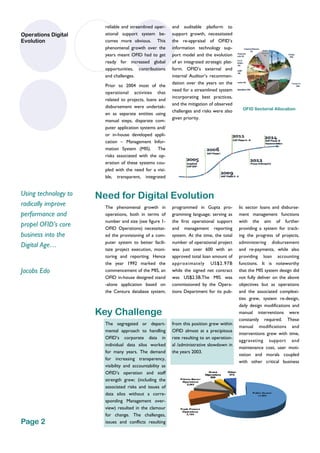
The phenomenal growth in
operations, both in terms of
number and size (see figure 1-
OFID Operations) necessitat-
ed the provisioning of a com-
puter system to better facili-
tate project execution, moni-
toring and reporting. Hence
the year 1992 marked the
commencement of the MIS, an
OFID in-house designed stand
-alone application based on
the Centura database system;
Using technology to
radically improve
performance and
propel OFID’s core
business into the
Digital Age…
Jacobs Edo
Page 2
Operations Digital
Evolution
OFID Sectorial Allocation
Enterprise information man-
agement is the key transform-
ative technology for the digital
economy. It equips the digital
enterprise with the ability to
simplify, evolve, and accelerate
its business processes in a
digital-first world. We now
live in a digital age, and infor-
mation is its currency. Infor-
mation has replace size, scale,
access to resources, and geo-
graphic presence as a key
driver of competitive ad-
vantage for the enterprise.
Only institutions that can
leverage their information
asset to evolve, innovate and
grow will be the ones that
succeed in the medium to
long term.
In view of the foregoing, an
OFID enterprise information
system adoption became nec-
essary to better address the
aforementioned challenges
and get the institution ready
for the future. All administra-
tive and transactional process-
es for core businesses – com-
pliance, loans and grant man-
agement, risk and project man-
agement needed to be com-
prehensively integrated into a
single system. In 2006 after
due considerations, OFID
Management adopted and
started the implementation of
the SAP Enterprise Resource
Planning (ERP) System and
OpenText Electronic Docu-
ment Management System
(EDMS) as its strategic infor-
mation management systems
going forward. The vision was
and still is to streamline and
standardize all OFID’s admin-
istrative and core business
processes to be able to work
with timely and accurate data
that would support effective
and efficient decision making
in the future.
Implementing the above solu-
tion at the enterprise level
to 17 different international
organizations led by the United
Nations) customer implemen-
tations including implementa-
tion by other sister organiza-
tions – first pioneered by the
African Development Bank im-
plementation. SAP ERP promis-
es to deliver powerful func-
tionality, global orientation,
and flexible enhancement
package options needed to
gain a sustainable, competitive
advantage and position the
entire institution for viable
The SAP ERP application plat-
form is the leading software
foundation enterprises trust
to achieve business excellence
and innovation. Leveraging
this foundation and its inte-
grated industry-specific func-
tionality, one can build the
best business processes re-
quired for today as well as for
future businesses. Based on
industry best practices, SAP
ERP draws from more than 30
years of experience with
more than 182,000 (in addition
and sustainable growth. SAP's
enhancement package strategy
provides a more economical
and less disruptive way of
adopting and managing soft-
ware releases and future sys-
tem upgrades. This unique
delivery and deployment
method for enterprise soft-
ware enables OFID to take
advantage of new software
functionality while meeting the
expected need to maintain
stability and integrity of the
application systems and
Operations Digital Evolution Strategy
SAP Enterprise Resource Planning?
Operations Digital Evolution Objectives
the need to further leverage
existing in-house ERP systems
with the SAP Consumer
Mortgage and Loans (CML)
and Business Partner (BP)
modules completely integrat-
ed with OpenText Enterprise
Content Management (via
enterprise workspaces – pro-
jects, loans, disbursement, ac-
counting, treasury and payment,
etc.), creating the integrated
ONE OFID working space for
documents and records.
 Integration and Opti-
mization
 Centralization and
standardization
 Automation and Sim-
plification
In order to meet and surpass
the above expectations, Man-
agement also wished for
greater transparency and con-
trol over complex business
processes related to managing
and streamlining of projects,
loans and business partner
data. As a strategic and go-to
support partner of operations,
the IT department realized
“SAP ERP -as a
dynamic &
innovative platform
to support OFID’s
digital evolutionary
objectives”
Page 3
Volume 1, Issue 2
allows the institution to get rid
of standalone and disparate
computer application systems
replacing them with a single
enterprise software solution.
The key difference is the crea-
tion of a ‘Single Version of
Business Truth’ thus eliminating
enterprise data inconsistencies
and organizational conflicts.
This requirement is now a
common denominator and
country independent legal stat-
ute for both national and inter-
national businesses and transac-
tions.
stronger focus on its Adaptive
Digital Strategy Framework
(ADSF).
At the core of the institution’s
activity are its operation busi-
ness processes in the public,
private, trade and grant units
tasked with the onerous re-
sponsibility of delivering on its
noble mandate. To do this
effectively and efficiently, the
operations officers need a
wide range of tools to per-
form tasks such as: project
solicitation and capture, pro-
ject appraisals, project and
loans management, analysis of
previous and current perfor-
mances (including risk situa-
tions) to make decisions
about future operations and
undertakings, taking into ac-
count global economic cir-
cumstances. The aforemen-
tioned requirements had to be
comprehensively covered by
the new system for the suc-
cess of the ADSF guided digiti-
zation efforts.
The new loan management
system will provides cutting-
edge functionality and loan
accounting support functions
powered by SAP NetWeaver
technology to manage the full
loan cycle and aggressively
improve loan processes. Now
the institution can design and
deliver new loan products
quickly, reduce loan manage-
ment costs and risks, and
improve customer service and
satisfaction.
Loan Management & Accounting
Record Archive and Storage
Proper storage of paper docu-
ments helps to manage paper
records effectively over time.
It ensures that the record will
survive and remain accessible
for as long as legally and statu-
tory required. The safe care
and custody of records ena-
bles the creation of official
records, thus documenting
the actions and decisions of
“Document
management is at
the heart of the day
-to-day operations
of OFID”
Miguel Linares
Senior Public Sector Officer
Page 4
Operations Digital
Evolution
Caption describing picture
or graphic.
Digitizing Operations Processes
Key Benefits
 seamless integration of loan accounting functions with
existing GL account, treasury operations and bank
communication manager.
 Reduction of loan cost, risk exposure and improve
lending processes.
 Customization of loan products and get to market
quickly including support for Islamic financing.
 Enhancement of customer service and satisfaction via
automated workflow.
 Reduction of operational cost and TCO in the long
term.
OFID’s staff, Management
and Board. It ensure that
those records which are
authorized for destruction
are managed efficiently, and
that records which have
significant on-going value
survives, and preserved as
archives with authorized
accessibility. Records by
their nature are unique and
irreplaceable, hence the need
for a central record archive
and storage. OFID’s paper
records are important busi-
ness assets which should be
managed carefully while miti-
gating the following risk asso-
ciated with poor storage:
- damaged & inability to find
record when required.
Another key sub-component
of the operations digital evolu-
tion is the enablement and
integration of an enterprise-
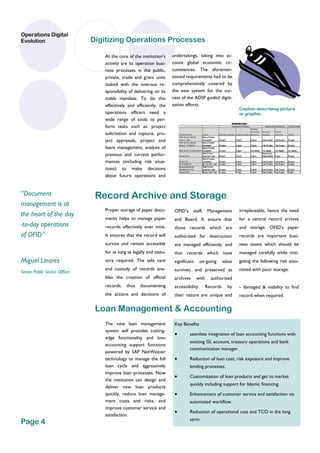
wide Electronic Document
Management System (EDMS).
The EDMS system aims to
manage content (documents
and all manner of saved rec-
ords) throughout their indi-
vidual life-cycles, from crea-
tion/acquisition to destruc-
tion. Initially, the EDMS sys-
tem will consider all docu-
ments as a work-in-progress
until they are reviewed, ap-
praised/approved, and poten-
tially saved or published
(internal & external) for for-
mal use. The final version of
the form that is saved contain-
ing all user meta-data will
become a formal record with-
in the institution with a legally
enforceable retention and
governance policies applied
(see figure 2 and 3 for more
information about retention
policy).
Key Benefits
 Management of information flows across OFID from incep-
tion through archiving and disposition.
 Application of dependable, consistent retention and govern-
ance policies across all content regardless of origin – be it
internal or external.
 Adaptation of information governance to the needs of all
users, building it into business processes and applications –
SAP, new MIS and EDMS.
 Provision of users with rapid and seamless access from any
device, or any location of the enterprise documents and
records.
 Incorporation of a common, documented and standard
content creation and management processes via enterprise
workspaces.
ONE OFID Document Management System
Business Partner Management
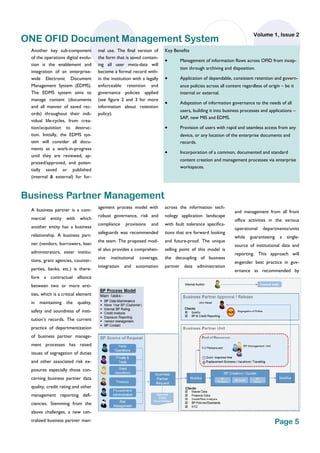
agement process model with
robust governance, risk and
compliance provisions and
safeguards was recommended
the team. The proposed mod-
el also provides a comprehen-
sive institutional coverage,
integration and automation
across the information tech-
nology application landscape
with fault tolerance specifica-
tions that are forward looking
and future-proof. The unique
selling point of this model is
the decoupling of business
partner data administration
A business partner is a com-
mercial entity with which
another entity has a business
relationship. A business part-
ner (vendors, borrowers, loan
administrators, sister institu-
tions, grant agencies, counter-
parties, banks, etc.) is there-
fore a contractual alliance
between two or more enti-
ties, which is a critical element
in maintaining the quality,
safety and soundness of insti-
tution’s records. The current
practice of departmentization
of business partner manage-
ment processes has raised
issues of segregation of duties
and other associated risk ex-
posures especially those con-
cerning business partner data
quality, credit rating and other
management reporting defi-
ciencies. Stemming from the
above challenges, a new cen-
tralized business partner man- Page 5
Volume 1, Issue 2
and management from all front
office activities in the various
operational departments/units
while guaranteeing a single-
source of institutional data and
reporting. This approach will
engender best practice in gov-
ernance as recommended by
Parkring 8
A1010
Vienna
AUSTRIA
Phone: +43-51564-142
Fax: +43-5139238
E-mail:j.edo@ofid.org
The OPEC Fund for International Development (OFID) is the development finance institution
established by the Member States of OPEC in 1976 as a collective channel of aid to the developing
countries. OFID works in cooperation with developing country partners and the international
donor community to stimulate economic growth and alleviate poverty in all disadvantaged regions
of the world. It does this by providing financing to build essential infrastructure, strengthen social
services delivery and promote productivity, competitiveness and trade. OFID’s work is people-
centered, focusing on projects that meet basic needs - such as food, energy, clean water and sani-
tation, healthcare and education – with the aim of encouraging self-reliance and inspiring hope for
the future.
OFID
mandate while preparing for
the challenges of the coming
decades.
The use of technology to
improve performances or
reach of organizations will
continue to be a hot topic
across the globe. At OFID,
apart from the strategic focus
on ending poverty, digital
advances such as analytics,
mobility, the cloud, and social
media will continually play a
significant role in the institu-
tion’s daily work. The IT appli-
cation landscape will continue
to be optimized, although
transformed stakeholder ex-
periences are the most visible
When completed, the digitali-
zation efforts will reduce the
institution’s human and tech-
nical complexities, minimize
effort and operating cost,
while optimizing its benefits in
the medium to long term. The
new system will continue to
demonstrate the benefits and
operational efficiencies of
running a shared services
center of excellence, particu-
larly for the institution’s core
operation.
This phase is a necessary step
towards achieving an integrat-
ed technological infrastructure
and services needed to sup-
port the entire OFID stake-
holders’ community and deliv-
er significant improvement to
the attainment of its noble
and arguably the most exciting
part of the institution’s work,
other aspects of digital trans-
formation at OFID like pro-
cess digitization, worker ena-
blement and business process
re-engineering will continue.
Conclusion
Uniting against
Poverty
Caption describing picture
or graphic.
WWW.OFID.ORG
134
PARTNER
COUNTRIES
FOUNDED
1976
182
PEOPLE
$17
BILLION
ENERGY 
POVERTY

Operations Digital Transformation

  • 1.
    cloud, Internet ofThings and big data will continue to underpin and support the evolution of OFID’s global operations and further en- hance its avowed commit- ment to end extreme pov- erty. In the OPEC Fund for Inter- national Development (OFID), the Public, Private, Trade and Grant operations are charged with the oner- ous responsibility of deliver- ing on the institution’s noble mandate and her strategic vision of “Uniting against Poverty”. As OFID’s opera- tional base continues to grow and expand due to an increased portfolio potential; and as new windows of busi- ness opportunities are being exploited, the imperatives for a more integrated, stand- ardized, reliable and secure enterprise information man- agement system becomes even more critical. Digital advances such as analytics, mobility, social media, the Executive Summary Introduction It was a warm Saturday morning specifically for the government and people of the old Republic of Sudan, having been the first to re- ceive approval on August 07, 1976 for the sum of US$7,450, 000.00 Balance of Payment (BOP) facilities from the OPEC Fund. This operation supported by its earliest pioneer staff mem- bers, did not only announce the arrival of OFID in the development finance institu- tion’s arena but also marked a significant milestone in the evolving south-south coop- eration narrative. OFID was established by member states of OPEC as a collective channel for aid to developing countries. OFID works in cooperation with developing country partners and the international donor community to stimulate economic growth and allevi- ate poverty in all ramifica- tions. It does this by provid- ing development based fi- nancing to build essential infrastructure, strengthen social services delivery and promote productivity, com- petitiveness and trade. OFID’s work is people- centred, focusing on projects that meet basic needs – such as food, energy, clean water, and sanitation, healthcare and education – with the aim of encouraging self-reliance and inspiring hope for the future. As OFID’s operational base continues to grow and ex- pand due to increase in its lending portfolio, windows of new business opportuni- ties are being exploited and challenges continue to be uncovered. In this context, the evolution of a more integrated, standardized, OFID July, 2015 Volume 1, Issue 2 Operations Digital Evolution Special points of interest:  Briefly highlight your point of interest here.  Briefly highlight your point of interest here.  Briefly highlight your point of interest here.  Briefly highlight your point of interest here. Inside this issue: Inside Story 2 Inside Story 2 Inside Story 2 Inside Story 3 Inside Story 4 Inside Story 5 Inside Story 6
  • 2.
    reliable and streamlinedoper- ational support system be- comes more obvious. This phenomenal growth over the years meant OFID had to get ready for increased global opportunities, contributions and challenges. Prior to 2004 most of the operational activities that related to projects, loans and disbursement were undertak- en as separate entities using manual steps, disparate com- puter application systems and/ or in-house developed appli- cation – Management Infor- mation System (MIS). The risks associated with the op- eration of these systems cou- pled with the need for a visi- ble, transparent, integrated and auditable platform to support growth, necessitated the re-appraisal of OFID’s information technology sup- port model and the evolution of an integrated strategic plat- form. OFID’s external and internal Auditor’s recommen- dation over the years on the need for a streamlined system incorporating best practices, and the mitigation of observed challenges and risks were also given priority. from this position grew within OFID almost at a precipitous rate resulting to an operation- al /administrative slowdown in the years 2003. The segregated or depart- mental approach to handling OFID’s corporate data in individual data silos worked for many years. The demand for increasing transparency, visibility and accountability as OFID’s operation and staff strength grew; (including the associated risks and issues of data silos without a corre- sponding Management over- view) resulted in the clamour for change. The challenges, issues and conflicts resulting Key Challenge Need for Digital Evolution programmed in Gupta pro- gramming language; serving as the first operational support and management reporting system. At the time, the total number of operational project was just over 600 with an approved total loan amount of approximately US$2.97B while the signed net contract was US$2.5B.The MIS was commissioned by the Opera- tions Department for its pub- lic sector loans and disburse- ment management functions with the aim of further providing a system for track- ing the progress of projects, administering disbursement and re-payments, while also providing loan accounting functions. It is noteworthy that the MIS system design did not fully deliver on the above objectives but as operations and the associated complexi- ties grew, system re-design, daily design modifications and manual interventions were constantly required. These manual modifications and interventions grew with time, aggravating support and maintenance cost, user moti- vation and morals coupled with other critical business The phenomenal growth in operations, both in terms of number and size (see figure 1- OFID Operations) necessitat- ed the provisioning of a com- puter system to better facili- tate project execution, moni- toring and reporting. Hence the year 1992 marked the commencement of the MIS, an OFID in-house designed stand -alone application based on the Centura database system; Using technology to radically improve performance and propel OFID’s core business into the Digital Age… Jacobs Edo Page 2 Operations Digital Evolution OFID Sectorial Allocation
  • 3.
    Enterprise information man- agementis the key transform- ative technology for the digital economy. It equips the digital enterprise with the ability to simplify, evolve, and accelerate its business processes in a digital-first world. We now live in a digital age, and infor- mation is its currency. Infor- mation has replace size, scale, access to resources, and geo- graphic presence as a key driver of competitive ad- vantage for the enterprise. Only institutions that can leverage their information asset to evolve, innovate and grow will be the ones that succeed in the medium to long term. In view of the foregoing, an OFID enterprise information system adoption became nec- essary to better address the aforementioned challenges and get the institution ready for the future. All administra- tive and transactional process- es for core businesses – com- pliance, loans and grant man- agement, risk and project man- agement needed to be com- prehensively integrated into a single system. In 2006 after due considerations, OFID Management adopted and started the implementation of the SAP Enterprise Resource Planning (ERP) System and OpenText Electronic Docu- ment Management System (EDMS) as its strategic infor- mation management systems going forward. The vision was and still is to streamline and standardize all OFID’s admin- istrative and core business processes to be able to work with timely and accurate data that would support effective and efficient decision making in the future. Implementing the above solu- tion at the enterprise level to 17 different international organizations led by the United Nations) customer implemen- tations including implementa- tion by other sister organiza- tions – first pioneered by the African Development Bank im- plementation. SAP ERP promis- es to deliver powerful func- tionality, global orientation, and flexible enhancement package options needed to gain a sustainable, competitive advantage and position the entire institution for viable The SAP ERP application plat- form is the leading software foundation enterprises trust to achieve business excellence and innovation. Leveraging this foundation and its inte- grated industry-specific func- tionality, one can build the best business processes re- quired for today as well as for future businesses. Based on industry best practices, SAP ERP draws from more than 30 years of experience with more than 182,000 (in addition and sustainable growth. SAP's enhancement package strategy provides a more economical and less disruptive way of adopting and managing soft- ware releases and future sys- tem upgrades. This unique delivery and deployment method for enterprise soft- ware enables OFID to take advantage of new software functionality while meeting the expected need to maintain stability and integrity of the application systems and Operations Digital Evolution Strategy SAP Enterprise Resource Planning? Operations Digital Evolution Objectives the need to further leverage existing in-house ERP systems with the SAP Consumer Mortgage and Loans (CML) and Business Partner (BP) modules completely integrat- ed with OpenText Enterprise Content Management (via enterprise workspaces – pro- jects, loans, disbursement, ac- counting, treasury and payment, etc.), creating the integrated ONE OFID working space for documents and records.  Integration and Opti- mization  Centralization and standardization  Automation and Sim- plification In order to meet and surpass the above expectations, Man- agement also wished for greater transparency and con- trol over complex business processes related to managing and streamlining of projects, loans and business partner data. As a strategic and go-to support partner of operations, the IT department realized “SAP ERP -as a dynamic & innovative platform to support OFID’s digital evolutionary objectives” Page 3 Volume 1, Issue 2 allows the institution to get rid of standalone and disparate computer application systems replacing them with a single enterprise software solution. The key difference is the crea- tion of a ‘Single Version of Business Truth’ thus eliminating enterprise data inconsistencies and organizational conflicts. This requirement is now a common denominator and country independent legal stat- ute for both national and inter- national businesses and transac- tions. stronger focus on its Adaptive Digital Strategy Framework (ADSF).
  • 4.
    At the coreof the institution’s activity are its operation busi- ness processes in the public, private, trade and grant units tasked with the onerous re- sponsibility of delivering on its noble mandate. To do this effectively and efficiently, the operations officers need a wide range of tools to per- form tasks such as: project solicitation and capture, pro- ject appraisals, project and loans management, analysis of previous and current perfor- mances (including risk situa- tions) to make decisions about future operations and undertakings, taking into ac- count global economic cir- cumstances. The aforemen- tioned requirements had to be comprehensively covered by the new system for the suc- cess of the ADSF guided digiti- zation efforts. The new loan management system will provides cutting- edge functionality and loan accounting support functions powered by SAP NetWeaver technology to manage the full loan cycle and aggressively improve loan processes. Now the institution can design and deliver new loan products quickly, reduce loan manage- ment costs and risks, and improve customer service and satisfaction. Loan Management & Accounting Record Archive and Storage Proper storage of paper docu- ments helps to manage paper records effectively over time. It ensures that the record will survive and remain accessible for as long as legally and statu- tory required. The safe care and custody of records ena- bles the creation of official records, thus documenting the actions and decisions of “Document management is at the heart of the day -to-day operations of OFID” Miguel Linares Senior Public Sector Officer Page 4 Operations Digital Evolution Caption describing picture or graphic. Digitizing Operations Processes Key Benefits  seamless integration of loan accounting functions with existing GL account, treasury operations and bank communication manager.  Reduction of loan cost, risk exposure and improve lending processes.  Customization of loan products and get to market quickly including support for Islamic financing.  Enhancement of customer service and satisfaction via automated workflow.  Reduction of operational cost and TCO in the long term. OFID’s staff, Management and Board. It ensure that those records which are authorized for destruction are managed efficiently, and that records which have significant on-going value survives, and preserved as archives with authorized accessibility. Records by their nature are unique and irreplaceable, hence the need for a central record archive and storage. OFID’s paper records are important busi- ness assets which should be managed carefully while miti- gating the following risk asso- ciated with poor storage: - damaged & inability to find record when required.
  • 5.
    Another key sub-component ofthe operations digital evolu- tion is the enablement and integration of an enterprise- wide Electronic Document Management System (EDMS). The EDMS system aims to manage content (documents and all manner of saved rec- ords) throughout their indi- vidual life-cycles, from crea- tion/acquisition to destruc- tion. Initially, the EDMS sys- tem will consider all docu- ments as a work-in-progress until they are reviewed, ap- praised/approved, and poten- tially saved or published (internal & external) for for- mal use. The final version of the form that is saved contain- ing all user meta-data will become a formal record with- in the institution with a legally enforceable retention and governance policies applied (see figure 2 and 3 for more information about retention policy). Key Benefits  Management of information flows across OFID from incep- tion through archiving and disposition.  Application of dependable, consistent retention and govern- ance policies across all content regardless of origin – be it internal or external.  Adaptation of information governance to the needs of all users, building it into business processes and applications – SAP, new MIS and EDMS.  Provision of users with rapid and seamless access from any device, or any location of the enterprise documents and records.  Incorporation of a common, documented and standard content creation and management processes via enterprise workspaces. ONE OFID Document Management System Business Partner Management agement process model with robust governance, risk and compliance provisions and safeguards was recommended the team. The proposed mod- el also provides a comprehen- sive institutional coverage, integration and automation across the information tech- nology application landscape with fault tolerance specifica- tions that are forward looking and future-proof. The unique selling point of this model is the decoupling of business partner data administration A business partner is a com- mercial entity with which another entity has a business relationship. A business part- ner (vendors, borrowers, loan administrators, sister institu- tions, grant agencies, counter- parties, banks, etc.) is there- fore a contractual alliance between two or more enti- ties, which is a critical element in maintaining the quality, safety and soundness of insti- tution’s records. The current practice of departmentization of business partner manage- ment processes has raised issues of segregation of duties and other associated risk ex- posures especially those con- cerning business partner data quality, credit rating and other management reporting defi- ciencies. Stemming from the above challenges, a new cen- tralized business partner man- Page 5 Volume 1, Issue 2 and management from all front office activities in the various operational departments/units while guaranteeing a single- source of institutional data and reporting. This approach will engender best practice in gov- ernance as recommended by
  • 6.
    Parkring 8 A1010 Vienna AUSTRIA Phone: +43-51564-142 Fax:+43-5139238 E-mail:j.edo@ofid.org The OPEC Fund for International Development (OFID) is the development finance institution established by the Member States of OPEC in 1976 as a collective channel of aid to the developing countries. OFID works in cooperation with developing country partners and the international donor community to stimulate economic growth and alleviate poverty in all disadvantaged regions of the world. It does this by providing financing to build essential infrastructure, strengthen social services delivery and promote productivity, competitiveness and trade. OFID’s work is people- centered, focusing on projects that meet basic needs - such as food, energy, clean water and sani- tation, healthcare and education – with the aim of encouraging self-reliance and inspiring hope for the future. OFID mandate while preparing for the challenges of the coming decades. The use of technology to improve performances or reach of organizations will continue to be a hot topic across the globe. At OFID, apart from the strategic focus on ending poverty, digital advances such as analytics, mobility, the cloud, and social media will continually play a significant role in the institu- tion’s daily work. The IT appli- cation landscape will continue to be optimized, although transformed stakeholder ex- periences are the most visible When completed, the digitali- zation efforts will reduce the institution’s human and tech- nical complexities, minimize effort and operating cost, while optimizing its benefits in the medium to long term. The new system will continue to demonstrate the benefits and operational efficiencies of running a shared services center of excellence, particu- larly for the institution’s core operation. This phase is a necessary step towards achieving an integrat- ed technological infrastructure and services needed to sup- port the entire OFID stake- holders’ community and deliv- er significant improvement to the attainment of its noble and arguably the most exciting part of the institution’s work, other aspects of digital trans- formation at OFID like pro- cess digitization, worker ena- blement and business process re-engineering will continue. Conclusion Uniting against Poverty Caption describing picture or graphic. WWW.OFID.ORG 134 PARTNER COUNTRIES FOUNDED 1976 182 PEOPLE $17 BILLION ENERGY  POVERTY