Threads in Operating
systems
Threads
 Overview
 Multithreading Models
 Thread Libraries
 Threading Issues
 Operating System Examples
 Windows XP Threads
 Linux Threads
Objectives
 To introduce the notion of a thread — a fundamental
unit of CPU utilization that forms the basis of
multithreaded computer systems
 To discuss the APIs for the Pthreads, Win32, and Java
thread libraries
 To examine issues related to multithreaded
programming
Single and Multithreaded Processes
Benefits
 Responsiveness
 Resource Sharing
 Economy
 Scalability
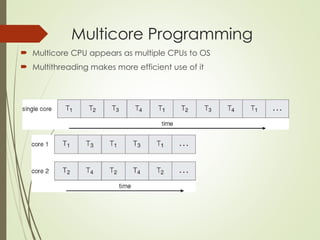
Multicore Programming
 Multicore CPU appears as multiple CPUs to OS
 Multithreading makes more efficient use of it
Multicore Programming
 Multicore systems putting
pressure on programmers,
challenges include
 Dividing activities
 Balance
 Data splitting
 Data dependency
 Testing and debugging
Types of Threads
 User threads
 Running user-level code
 Managed by user process
 Needs kernel thread to run system calls, I/O operations, etc.
 Can only be scheduled on CPU through kernel thread
 Kernel threads
 Running kernel-level code
 Managed by kernel
 Can be scheduled on CPU
 A user process needs both user threads and kernel threads to
run
Multithreading Models
 User Threads
 Thread management done by user-level threads library
 Three primary thread libraries:
 POSIX Pthreads
 Win32 threads
 Java threads
 Kernel Threads
 Supported by the Kernel
 Present in practically all OS
 Windows XP/2000
 Solaris
 Linux
 Tru64 UNIX
 Mac OS X
 Relationship between user and kernel threads
 Many-to-One
 One-to-One
 Many-to-Many
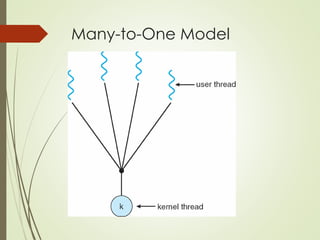
Many-to-One
 Many user-level threads mapped to single kernel
thread
 Examples:
 Solaris Green Threads
 GNU Portable Threads
Many-to-One Model
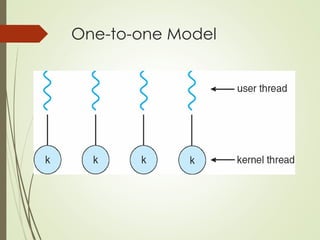
One-to-One
 Each user-level thread maps to kernel thread
 Examples
 Windows NT/XP/2000
 Linux
 Solaris 9 and later
One-to-one Model
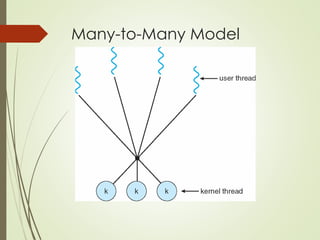
Many-to-Many Model
 Allows many user level threads to be mapped to fewer or
equal kernel threads
 Number of kernel threads can vary per system, and per
process
 Allows the operating system to create a sufficient
number of kernel threads
 Windows NT/2000 with the ThreadFiber package
Many-to-Many Model
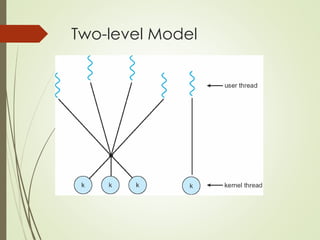
Two-level Model
 Variation of Many-to-Many, except that it allows a
user thread to be bound to kernel thread
 Examples
 IRIX
 HP-UX
 Tru64 UNIX
 Solaris 8 and earlier
Two-level Model
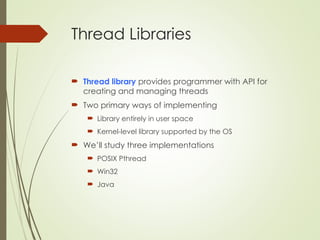
Thread Libraries
 Thread library provides programmer with API for
creating and managing threads
 Two primary ways of implementing
 Library entirely in user space
 Kernel-level library supported by the OS
 We’ll study three implementations
 POSIX Pthread
 Win32
 Java
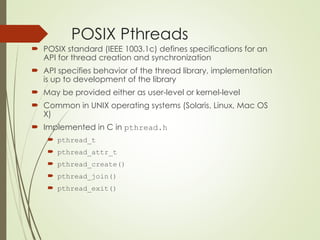
POSIX Pthreads
 POSIX standard (IEEE 1003.1c) defines specifications for an
API for thread creation and synchronization
 API specifies behavior of the thread library, implementation
is up to development of the library
 May be provided either as user-level or kernel-level
 Common in UNIX operating systems (Solaris, Linux, Mac OS
X)
 Implemented in C in pthread.h
 pthread_t
 pthread_attr_t
 pthread_create()
 pthread_join()
 pthread_exit()
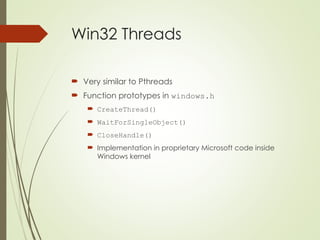
Win32 Threads
 Very similar to Pthreads
 Function prototypes in windows.h
 CreateThread()
 WaitForSingleObject()
 CloseHandle()
 Implementation in proprietary Microsoft code inside
Windows kernel
Java Threads
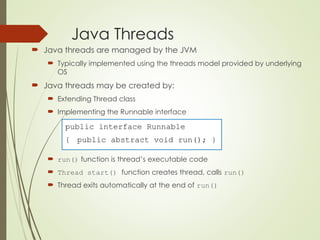
 Java threads are managed by the JVM
 Typically implemented using the threads model provided by underlying
OS
 Java threads may be created by:
 Extending Thread class
 Implementing the Runnable interface
 run() function is thread’s executable code
 Thread start() function creates thread, calls run()
 Thread exits automatically at the end of run()
public interface Runnable
{ public abstract void run(); }
Implicit Threading
 Instead of giving developer control through thread
libraries, have threads handled by compilers and run-time
libraries
 OpenMP
 Compiler directives for C/C++
 Programmer inserts preprocessor tags
 Compiler isolates parallelizable sections and creates as many
threads as there are CPUs
 Grand Central Dispatch
 Apple-specific
 Programmer inserts tags in code (like OpenMP)
 GCD manages POSIX threads, assigns work in three FIFO
priority queues
Threading Issues
 Semantics of fork() and exec() system calls
 Thread cancellation of target thread
 Asynchronous or deferred
 Signal handling
 Thread pools
 Thread-specific data
 Scheduler activations
Semantics of fork() and
exec()
 Recall: fork() and exec() functions in Unix handle new
processes
 Process creation, replace process code
 When a process has several threads, and one thread
calls these functions, does it affect all threads or just
the calling one?
Thread Cancellation
 Terminating a target thread before it has finished
 Two general approaches:
 Asynchronous cancellation terminates the target thread
immediately from another thread
 Deferred cancellation allows the target thread to
periodically check if it should cancel itself
Signal Handling
 Signals are used to notify a process that a particular event has
occurred
1. Signal is generated by particular event (typically interrupts)
2. Signal is delivered to a process
3. Signal is handled
 A signal handler is used to process signals
 Default handlers in kernel can be overwritten by user-defined
handler
 How to deliver a process-specific signal in a multithreaded
process?
 Deliver the signal to the thread to which the signal applies
 Deliver the signal to every thread in the process
 Deliver the signal to certain threads in the process
 Assign a specific thread to receive all signals for the process
Thread Pools
 So far, we’re creating threads when needed
 Thread creation/termination overhead
 With no maximum thread number, more and more threads can be
created until they exhaust system resources
 Create a number of threads at process creation in a thread
pool, where they await work and return after work is done
 Advantages:
 Usually slightly faster to service a request with an existing thread
than create a new thread
 Allows the number of threads in the application(s) to be bound to
the size of the pool
 Part of the Win32 API
 QueueUserWorkItem()
Thread Specific Data
 One advantage of threads is no duplication of common
process data
 But some threads need thread-specific data
 Data unique to that thread
 Data that did not exist at process creation time
 We need support for thread-specific data
 Included in Pthreads, Win32 and Java
Scheduler Activations
 Many-to-Many and Two-Level models have a set of kernel threads
and user threads
 Need to keep a balance in the number of each – for best
performance, should be adjusted dynamically
 Require communication between kernel and thread library
 Systems with these models often put a light-weight process
between kernel thread and user thread, to work as a virtual CPU
for the user
 This allows scheduler activation kernel-process communication
scheme
 Kernel provides a set of LWP to process
 Process schedules its own user threads on LWP
 When a thread waits for an event, the kernel warns the process with
an upcall and allocates a new LWP to process
 Process runs upcall handler on new LWP to save thread state, lose
thread’s LWP, and keeps new LWP to schedule other threads
Operating System Examples
 Windows XP Threads
 Linux Thread
Windows XP Threads
 Implements the one-to-one mapping, kernel-level
 Each thread contains
 A thread id
 Register set
 Separate user and kernel stacks, for when running in user or
kernel mode
 Private data storage area
 The register set, stacks, and private storage area are
known as the context of the threads
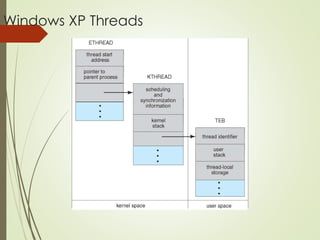
 The primary data structures of a thread include:
 ETHREAD (origin & parent)
 KTHREAD (kernel thread information)
 TEB (user thread information)
Windows XP Threads
Linux Threads
 Linux does not distinguish between processes and threads, calls them
all tasks
 Task creation is done through clone() system call, with a set of flags
 Each task is represented by a kernel structure task_struct, which
only contains pointers to other data structures instead of storing task
info
 Makes varying levels of sharing between tasks possible

Threads in Operating systems and concepts

  • 1.
  • 2.
    Threads  Overview  MultithreadingModels  Thread Libraries  Threading Issues  Operating System Examples  Windows XP Threads  Linux Threads
  • 3.
    Objectives  To introducethe notion of a thread — a fundamental unit of CPU utilization that forms the basis of multithreaded computer systems  To discuss the APIs for the Pthreads, Win32, and Java thread libraries  To examine issues related to multithreaded programming
  • 4.
  • 5.
    Benefits  Responsiveness  ResourceSharing  Economy  Scalability
  • 6.
    Multicore Programming  MulticoreCPU appears as multiple CPUs to OS  Multithreading makes more efficient use of it
  • 7.
    Multicore Programming  Multicoresystems putting pressure on programmers, challenges include  Dividing activities  Balance  Data splitting  Data dependency  Testing and debugging
  • 8.
    Types of Threads User threads  Running user-level code  Managed by user process  Needs kernel thread to run system calls, I/O operations, etc.  Can only be scheduled on CPU through kernel thread  Kernel threads  Running kernel-level code  Managed by kernel  Can be scheduled on CPU  A user process needs both user threads and kernel threads to run
  • 9.
    Multithreading Models  UserThreads  Thread management done by user-level threads library  Three primary thread libraries:  POSIX Pthreads  Win32 threads  Java threads  Kernel Threads  Supported by the Kernel  Present in practically all OS  Windows XP/2000  Solaris  Linux  Tru64 UNIX  Mac OS X  Relationship between user and kernel threads  Many-to-One  One-to-One  Many-to-Many
  • 10.
    Many-to-One  Many user-levelthreads mapped to single kernel thread  Examples:  Solaris Green Threads  GNU Portable Threads
  • 11.
  • 12.
    One-to-One  Each user-levelthread maps to kernel thread  Examples  Windows NT/XP/2000  Linux  Solaris 9 and later
  • 13.
  • 14.
    Many-to-Many Model  Allowsmany user level threads to be mapped to fewer or equal kernel threads  Number of kernel threads can vary per system, and per process  Allows the operating system to create a sufficient number of kernel threads  Windows NT/2000 with the ThreadFiber package
  • 15.
  • 16.
    Two-level Model  Variationof Many-to-Many, except that it allows a user thread to be bound to kernel thread  Examples  IRIX  HP-UX  Tru64 UNIX  Solaris 8 and earlier
  • 17.
  • 18.
    Thread Libraries  Threadlibrary provides programmer with API for creating and managing threads  Two primary ways of implementing  Library entirely in user space  Kernel-level library supported by the OS  We’ll study three implementations  POSIX Pthread  Win32  Java
  • 19.
    POSIX Pthreads  POSIXstandard (IEEE 1003.1c) defines specifications for an API for thread creation and synchronization  API specifies behavior of the thread library, implementation is up to development of the library  May be provided either as user-level or kernel-level  Common in UNIX operating systems (Solaris, Linux, Mac OS X)  Implemented in C in pthread.h  pthread_t  pthread_attr_t  pthread_create()  pthread_join()  pthread_exit()
  • 20.
    Win32 Threads  Verysimilar to Pthreads  Function prototypes in windows.h  CreateThread()  WaitForSingleObject()  CloseHandle()  Implementation in proprietary Microsoft code inside Windows kernel
  • 21.
    Java Threads  Javathreads are managed by the JVM  Typically implemented using the threads model provided by underlying OS  Java threads may be created by:  Extending Thread class  Implementing the Runnable interface  run() function is thread’s executable code  Thread start() function creates thread, calls run()  Thread exits automatically at the end of run() public interface Runnable { public abstract void run(); }
  • 22.
    Implicit Threading  Insteadof giving developer control through thread libraries, have threads handled by compilers and run-time libraries  OpenMP  Compiler directives for C/C++  Programmer inserts preprocessor tags  Compiler isolates parallelizable sections and creates as many threads as there are CPUs  Grand Central Dispatch  Apple-specific  Programmer inserts tags in code (like OpenMP)  GCD manages POSIX threads, assigns work in three FIFO priority queues
  • 23.
    Threading Issues  Semanticsof fork() and exec() system calls  Thread cancellation of target thread  Asynchronous or deferred  Signal handling  Thread pools  Thread-specific data  Scheduler activations
  • 24.
    Semantics of fork()and exec()  Recall: fork() and exec() functions in Unix handle new processes  Process creation, replace process code  When a process has several threads, and one thread calls these functions, does it affect all threads or just the calling one?
  • 25.
    Thread Cancellation  Terminatinga target thread before it has finished  Two general approaches:  Asynchronous cancellation terminates the target thread immediately from another thread  Deferred cancellation allows the target thread to periodically check if it should cancel itself
  • 26.
    Signal Handling  Signalsare used to notify a process that a particular event has occurred 1. Signal is generated by particular event (typically interrupts) 2. Signal is delivered to a process 3. Signal is handled  A signal handler is used to process signals  Default handlers in kernel can be overwritten by user-defined handler  How to deliver a process-specific signal in a multithreaded process?  Deliver the signal to the thread to which the signal applies  Deliver the signal to every thread in the process  Deliver the signal to certain threads in the process  Assign a specific thread to receive all signals for the process
  • 27.
    Thread Pools  Sofar, we’re creating threads when needed  Thread creation/termination overhead  With no maximum thread number, more and more threads can be created until they exhaust system resources  Create a number of threads at process creation in a thread pool, where they await work and return after work is done  Advantages:  Usually slightly faster to service a request with an existing thread than create a new thread  Allows the number of threads in the application(s) to be bound to the size of the pool  Part of the Win32 API  QueueUserWorkItem()
  • 28.
    Thread Specific Data One advantage of threads is no duplication of common process data  But some threads need thread-specific data  Data unique to that thread  Data that did not exist at process creation time  We need support for thread-specific data  Included in Pthreads, Win32 and Java
  • 29.
    Scheduler Activations  Many-to-Manyand Two-Level models have a set of kernel threads and user threads  Need to keep a balance in the number of each – for best performance, should be adjusted dynamically  Require communication between kernel and thread library  Systems with these models often put a light-weight process between kernel thread and user thread, to work as a virtual CPU for the user  This allows scheduler activation kernel-process communication scheme  Kernel provides a set of LWP to process  Process schedules its own user threads on LWP  When a thread waits for an event, the kernel warns the process with an upcall and allocates a new LWP to process  Process runs upcall handler on new LWP to save thread state, lose thread’s LWP, and keeps new LWP to schedule other threads
  • 30.
    Operating System Examples Windows XP Threads  Linux Thread
  • 31.
    Windows XP Threads Implements the one-to-one mapping, kernel-level  Each thread contains  A thread id  Register set  Separate user and kernel stacks, for when running in user or kernel mode  Private data storage area  The register set, stacks, and private storage area are known as the context of the threads  The primary data structures of a thread include:  ETHREAD (origin & parent)  KTHREAD (kernel thread information)  TEB (user thread information)
  • 32.
  • 33.
    Linux Threads  Linuxdoes not distinguish between processes and threads, calls them all tasks  Task creation is done through clone() system call, with a set of flags  Each task is represented by a kernel structure task_struct, which only contains pointers to other data structures instead of storing task info  Makes varying levels of sharing between tasks possible