July 2025
OPENACC AND
OPEN HACKATHONS
MONTHLY HIGHLIGHTS
2
WHO IS OPENACC?
The OpenACC Organization is dedicated to helping the research and
developer community advance science by expanding their accelerated
and parallel computing skills.
3 Areas of Focus
Ecosystem
Development
Training/Education
OpenACC
Specification
Participating in work that enables
and/or advances interoperability of
parallel programming models in
compilers or tools with the vision of
transitioning to standard language
parallelism.
Managing one of the leading
hackathon series, our events have
been instrumental in training
thousands of domain experts and
accelerating over 550 scientific
applications using a variety of
programming models and tools.
Developing and utilizing the
OpenACC directives-based
programming model to port,
accelerate, or optimize scientific
applications.
3
silica IFPEN, RMM-DIIS on P100
OPENACC SPECIFICATION MOMENTUM
Wide Adoption Across Key HPC Codes
ANSYS Fluent
Gaussian
VASP
LSDalton
MPAS
GAMERA
GTC
XGC
ACME
FLASH
COSMO
Numeca
400+ APPS* USING OPENACC
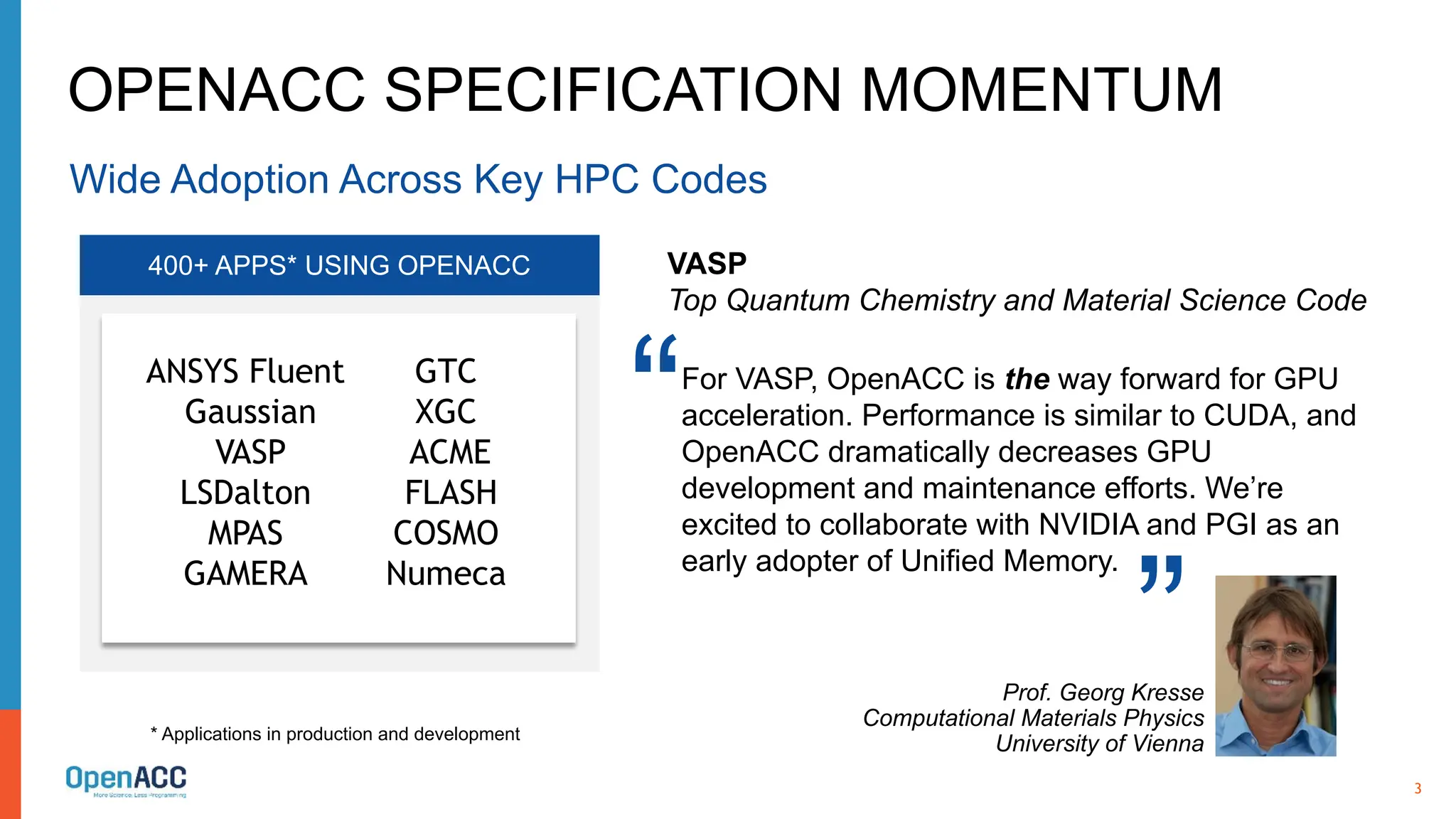
Prof. Georg Kresse
Computational Materials Physics
University of Vienna
For VASP, OpenACC is the way forward for GPU
acceleration. Performance is similar to CUDA, and
OpenACC dramatically decreases GPU
development and maintenance efforts. We’re
excited to collaborate with NVIDIA and PGI as an
early adopter of Unified Memory.
“ “
VASP
Top Quantum Chemistry and Material Science Code
* Applications in production and development
4
PROPOSE A TALK
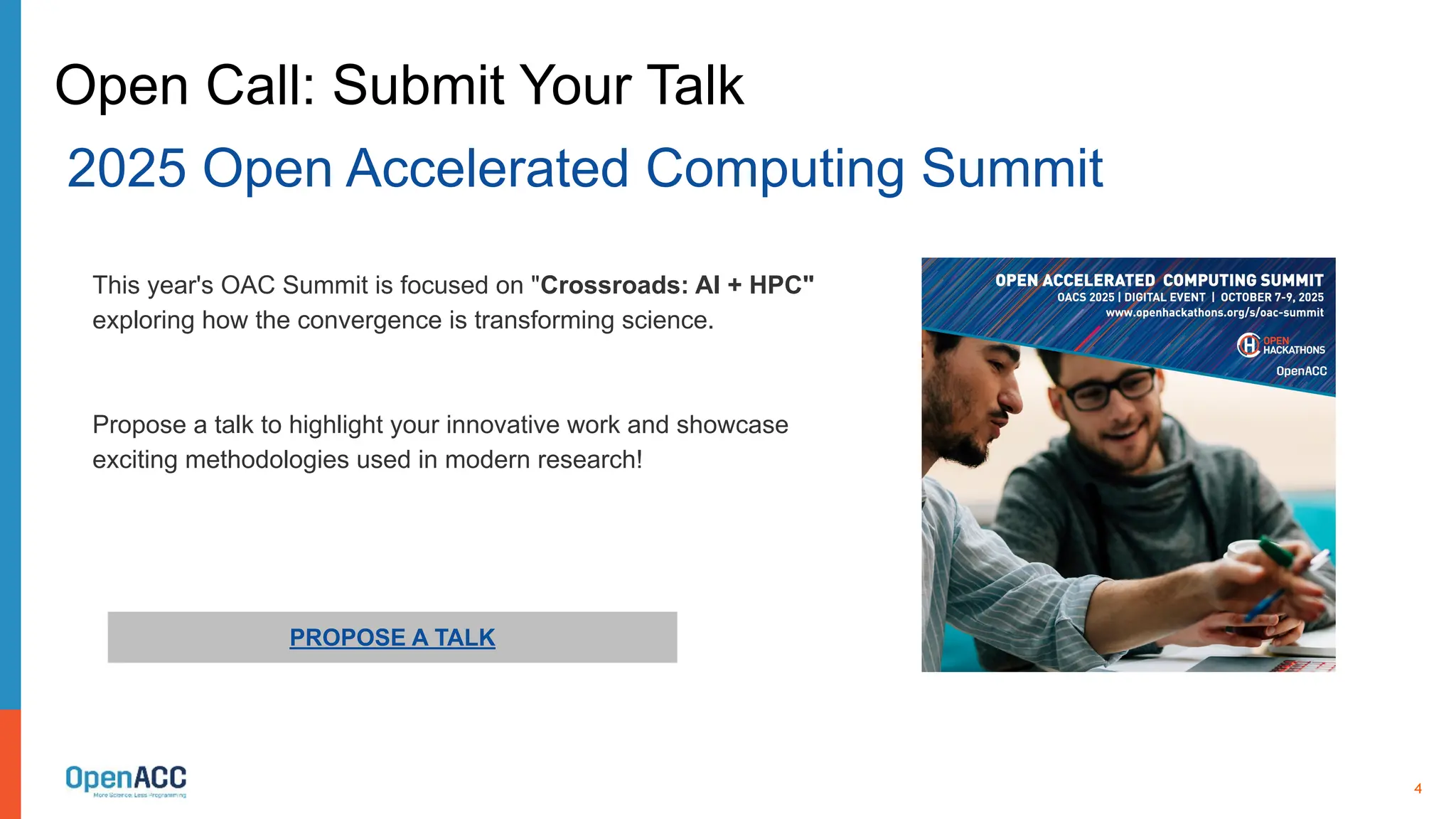
This year's OAC Summit is focused on "Crossroads: AI + HPC"
exploring how the convergence is transforming science.
Propose a talk to highlight your innovative work and showcase
exciting methodologies used in modern research!
Open Call: Submit Your Talk
2025 Open Accelerated Computing Summit
5
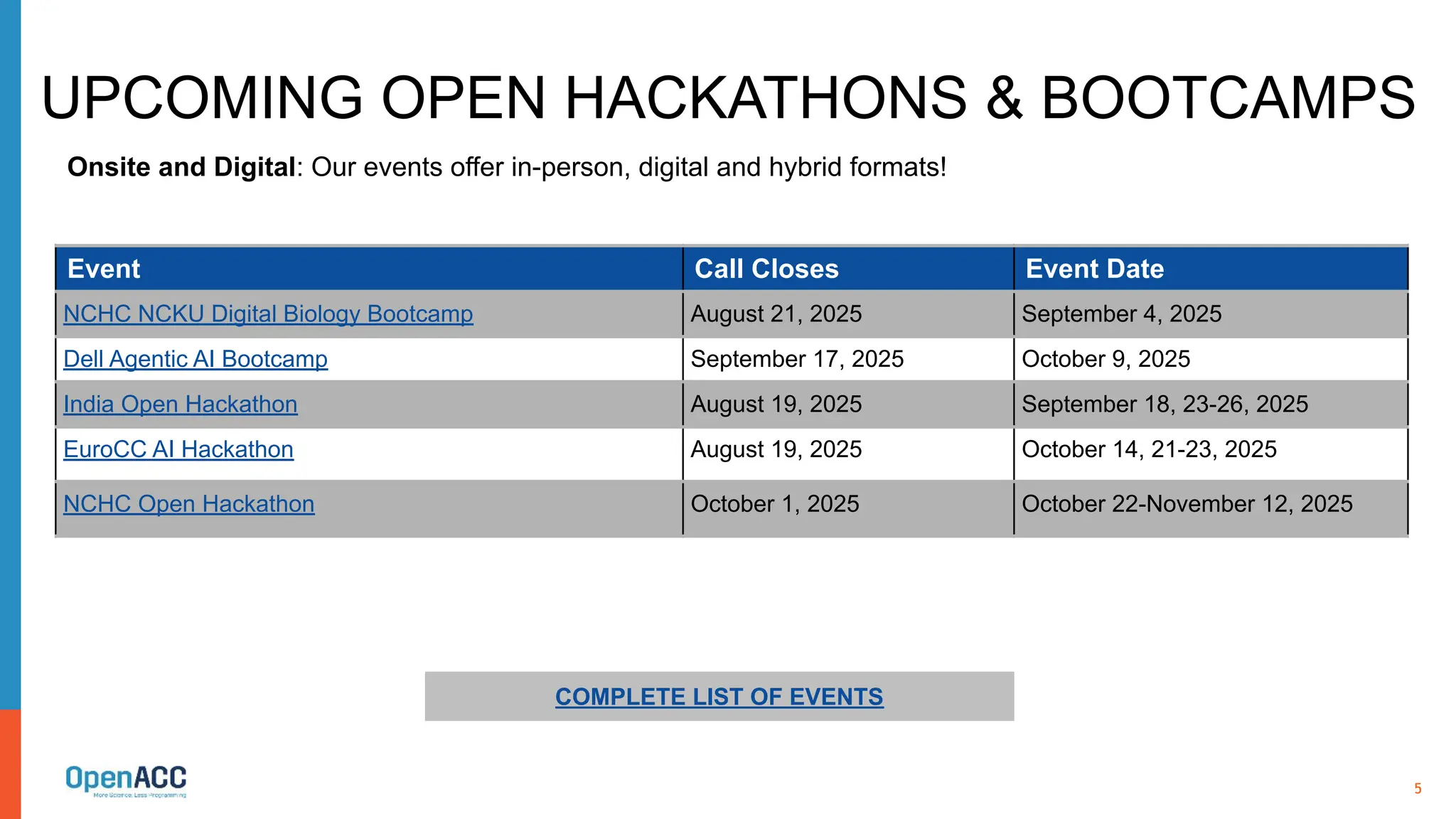
UPCOMING OPEN HACKATHONS & BOOTCAMPS
COMPLETE LIST OF EVENTS
Event Call Closes Event Date
NCHC NCKU Digital Biology Bootcamp August 21, 2025 September 4, 2025
Dell Agentic AI Bootcamp September 17, 2025 October 9, 2025
India Open Hackathon August 19, 2025 September 18, 23-26, 2025
EuroCC AI Hackathon August 19, 2025 October 14, 21-23, 2025
NCHC Open Hackathon October 1, 2025 October 22-November 12, 2025
Onsite and Digital: Our events offer in-person, digital and hybrid formats!
6
READ BLOG
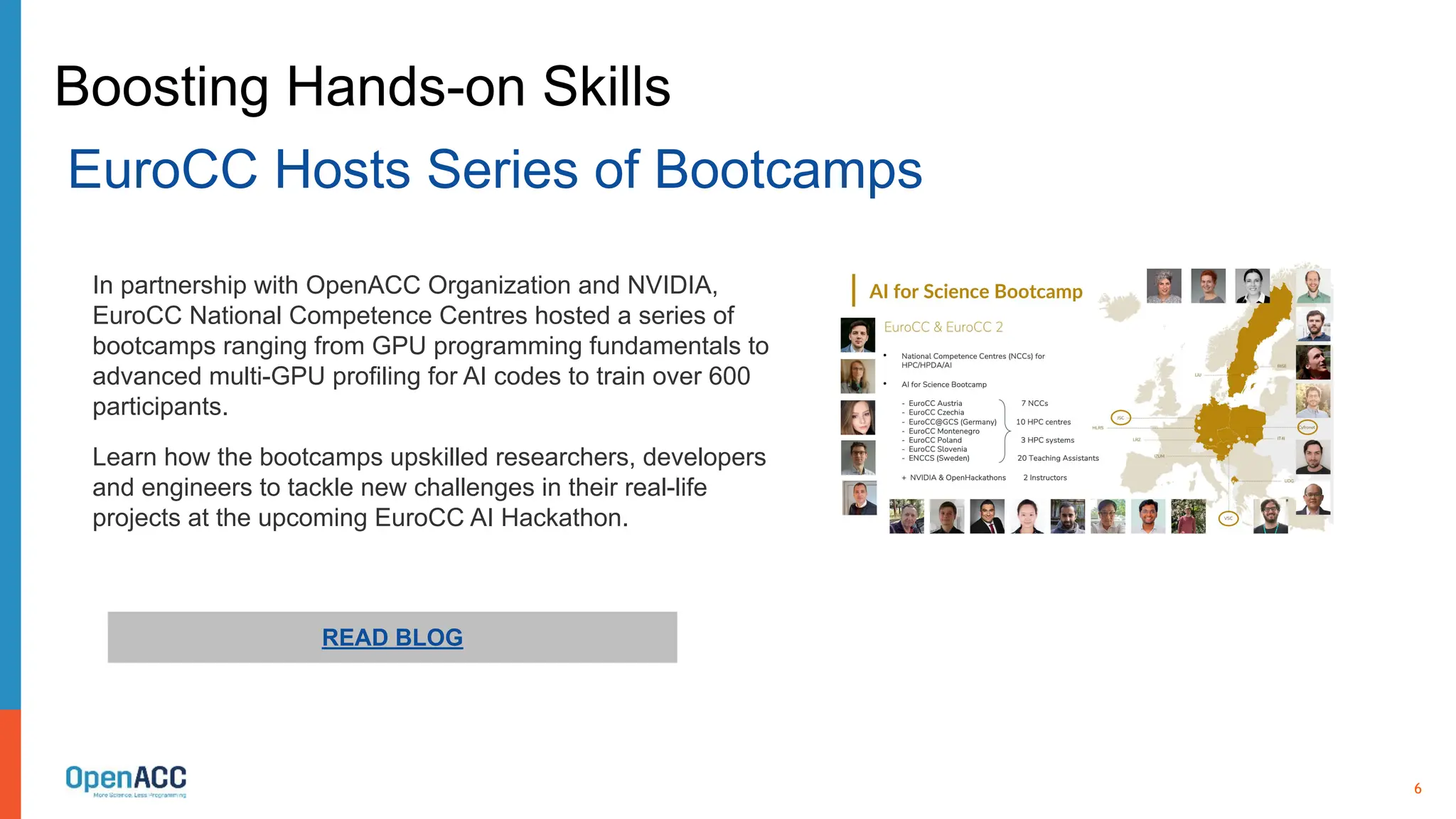
In partnership with OpenACC Organization and NVIDIA,
EuroCC National Competence Centres hosted a series of
bootcamps ranging from GPU programming fundamentals to
advanced multi-GPU profiling for AI codes to train over 600
participants.
Learn how the bootcamps upskilled researchers, developers
and engineers to tackle new challenges in their real-life
projects at the upcoming EuroCC AI Hackathon.
Boosting Hands-on Skills
EuroCC Hosts Series of Bootcamps
7
SEE THE RECAP
TPC25 opens with an examination of how science is
evolving alongside advances in AI and high performance
computing, ushering in new tools and approaches that are
reshaping scientific work across domains.
Opening Plenary
TPC25 Conference
8
LEARN MORE
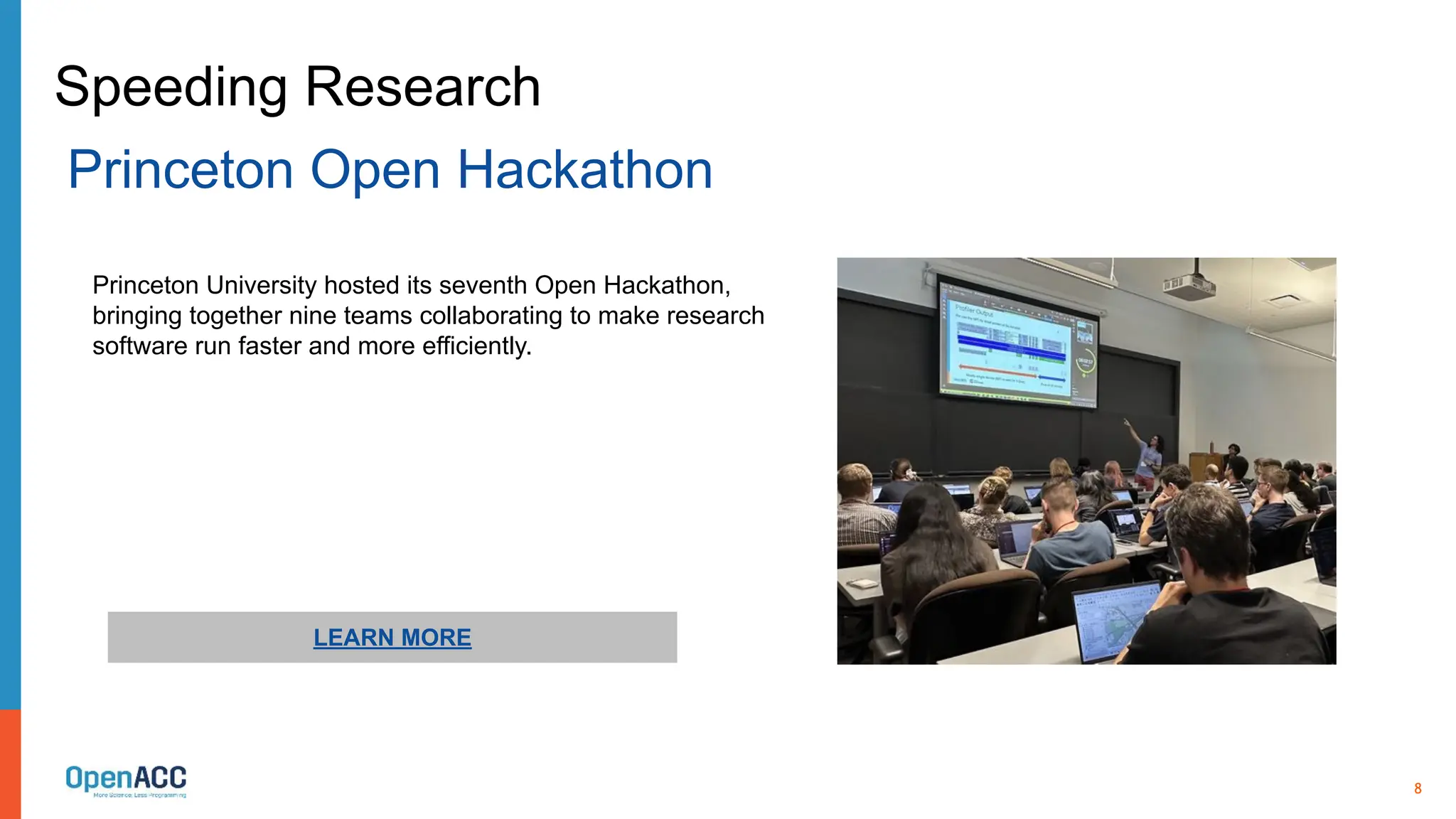
Princeton University hosted its seventh Open Hackathon,
bringing together nine teams collaborating to make research
software run faster and more efficiently.
Speeding Research
Princeton Open Hackathon
9
READ THE ARTICLE
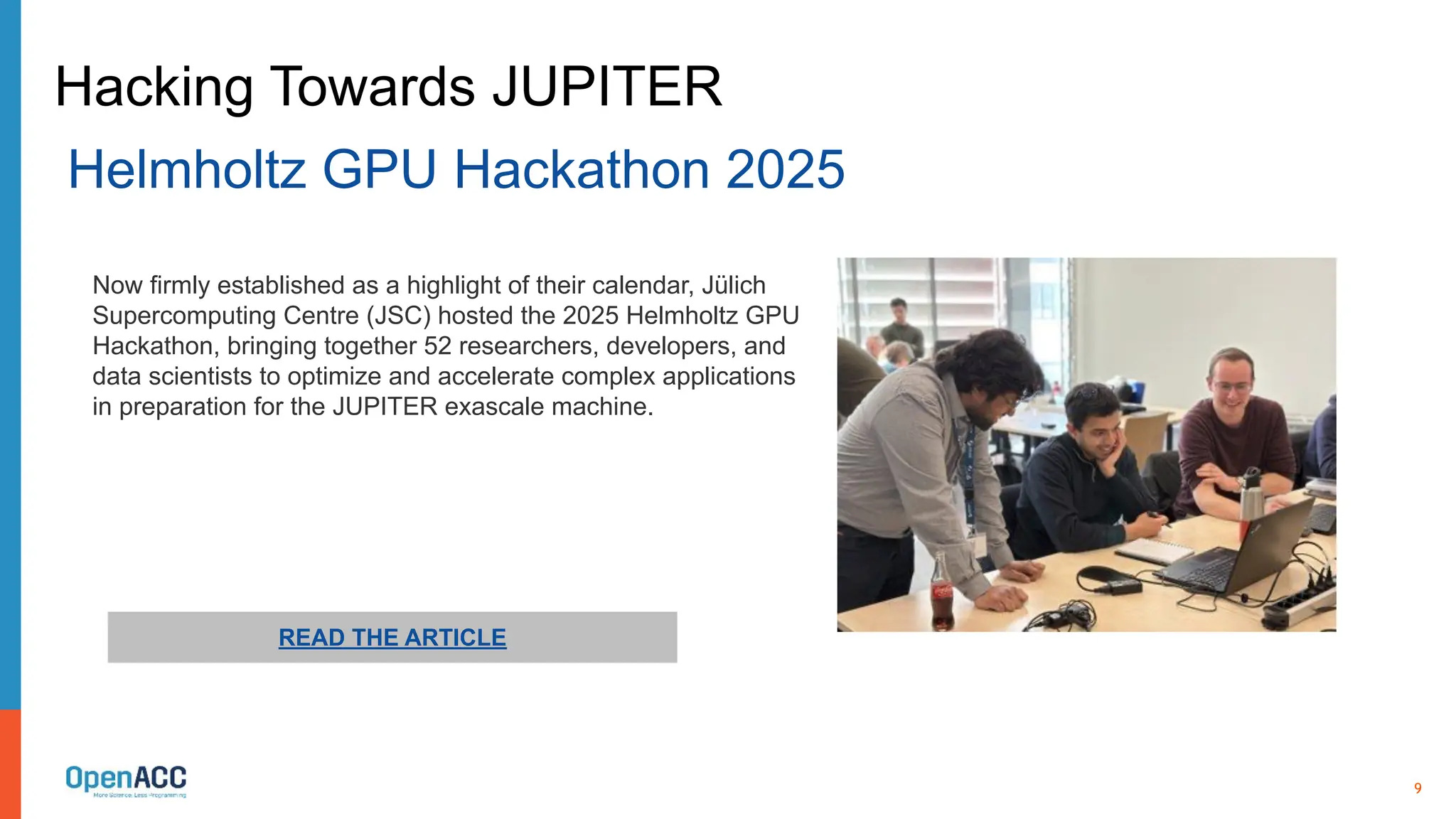
Now firmly established as a highlight of their calendar, Jülich
Supercomputing Centre (JSC) hosted the 2025 Helmholtz GPU
Hackathon, bringing together 52 researchers, developers, and
data scientists to optimize and accelerate complex applications
in preparation for the JUPITER exascale machine.
Hacking Towards JUPITER
Helmholtz GPU Hackathon 2025
10
Paper: A fast flood inundation model with groundwater
interactions and hydraulic structures
By Brett F. Sanders, Jochen E. Schubert, Eva-Marie H. Martin,
Shichen Wang, Michael C.Sukop, and Katharine J. Mach
RESOURCES
To efficiently predict flooding caused by intense rainfall (pluvial flooding), many physics-based flood inundation
models adopt simplistic parameterizations of infiltration such as the Kostiakov, Horton, Soil Conservation Service
and Green-Ampt methods. However, these methods are not explicitly dependent on soil moisture (or the
groundwater table height), which is known to strongly influence the amount of runoff generated by rainfall. Models
that fully couple surface and groundwater flow equations offer an alternative approach, but require larger amounts
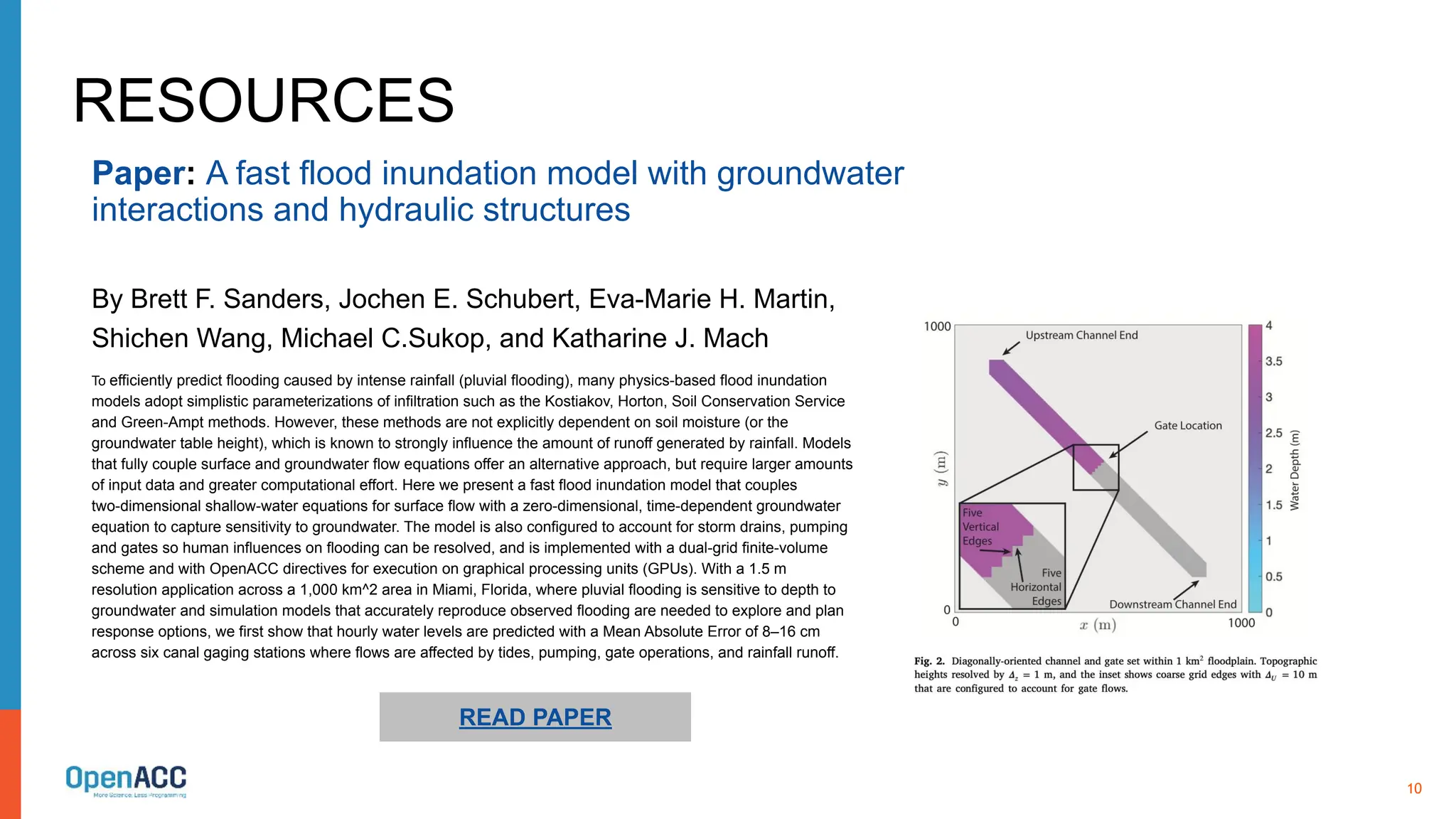
of input data and greater computational effort. Here we present a fast flood inundation model that couples
two-dimensional shallow-water equations for surface flow with a zero-dimensional, time-dependent groundwater
equation to capture sensitivity to groundwater. The model is also configured to account for storm drains, pumping
and gates so human influences on flooding can be resolved, and is implemented with a dual-grid finite-volume
scheme and with OpenACC directives for execution on graphical processing units (GPUs). With a 1.5 m
resolution application across a 1,000 km^2 area in Miami, Florida, where pluvial flooding is sensitive to depth to
groundwater and simulation models that accurately reproduce observed flooding are needed to explore and plan
response options, we first show that hourly water levels are predicted with a Mean Absolute Error of 8–16 cm
across six canal gaging stations where flows are affected by tides, pumping, gate operations, and rainfall runoff.
READ PAPER
11
RESOURCES
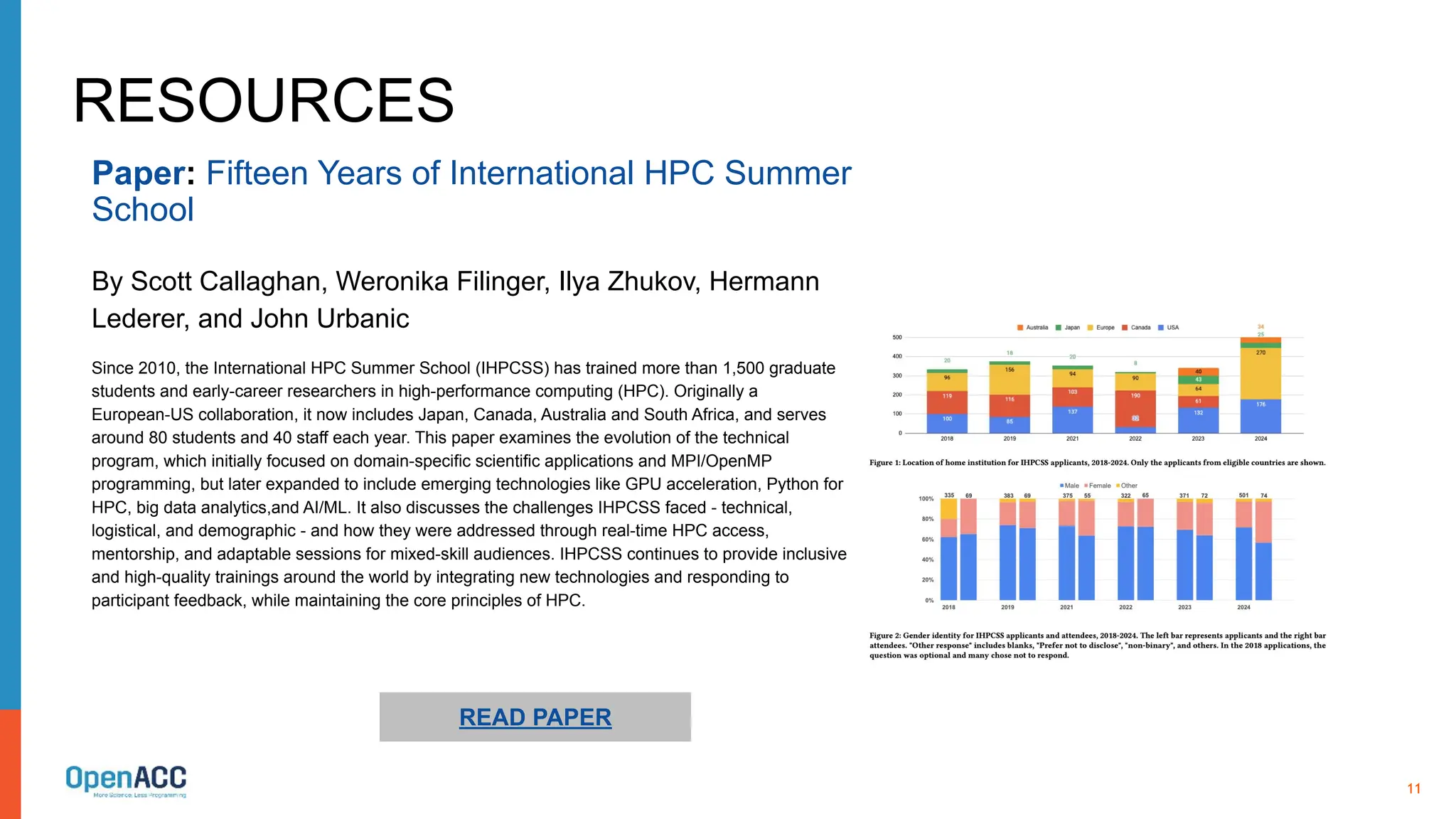
Since 2010, the International HPC Summer School (IHPCSS) has trained more than 1,500 graduate
students and early-career researchers in high-performance computing (HPC). Originally a
European-US collaboration, it now includes Japan, Canada, Australia and South Africa, and serves
around 80 students and 40 staff each year. This paper examines the evolution of the technical
program, which initially focused on domain-specific scientific applications and MPI/OpenMP
programming, but later expanded to include emerging technologies like GPU acceleration, Python for
HPC, big data analytics,and AI/ML. It also discusses the challenges IHPCSS faced - technical,
logistical, and demographic - and how they were addressed through real-time HPC access,
mentorship, and adaptable sessions for mixed-skill audiences. IHPCSS continues to provide inclusive
and high-quality trainings around the world by integrating new technologies and responding to
participant feedback, while maintaining the core principles of HPC.
READ PAPER
Paper: Fifteen Years of International HPC Summer
School
By Scott Callaghan, Weronika Filinger, Ilya Zhukov, Hermann
Lederer, and John Urbanic
12
RESOURCES
Enhancing Artificial Intelligence (AI) training environments at higher education institutions like the
Georgia Institute of Technology (GT) can significantly strengthen development of the next generation
of AI professionals. AI workflows frequently require access to GPU-accelerated computing resources,
typically provided by campus research computing services such as GT’s Partnership for an Advanced
Computing Environment (PACE). To reduce barriers to accessing GPU resources for AI development,
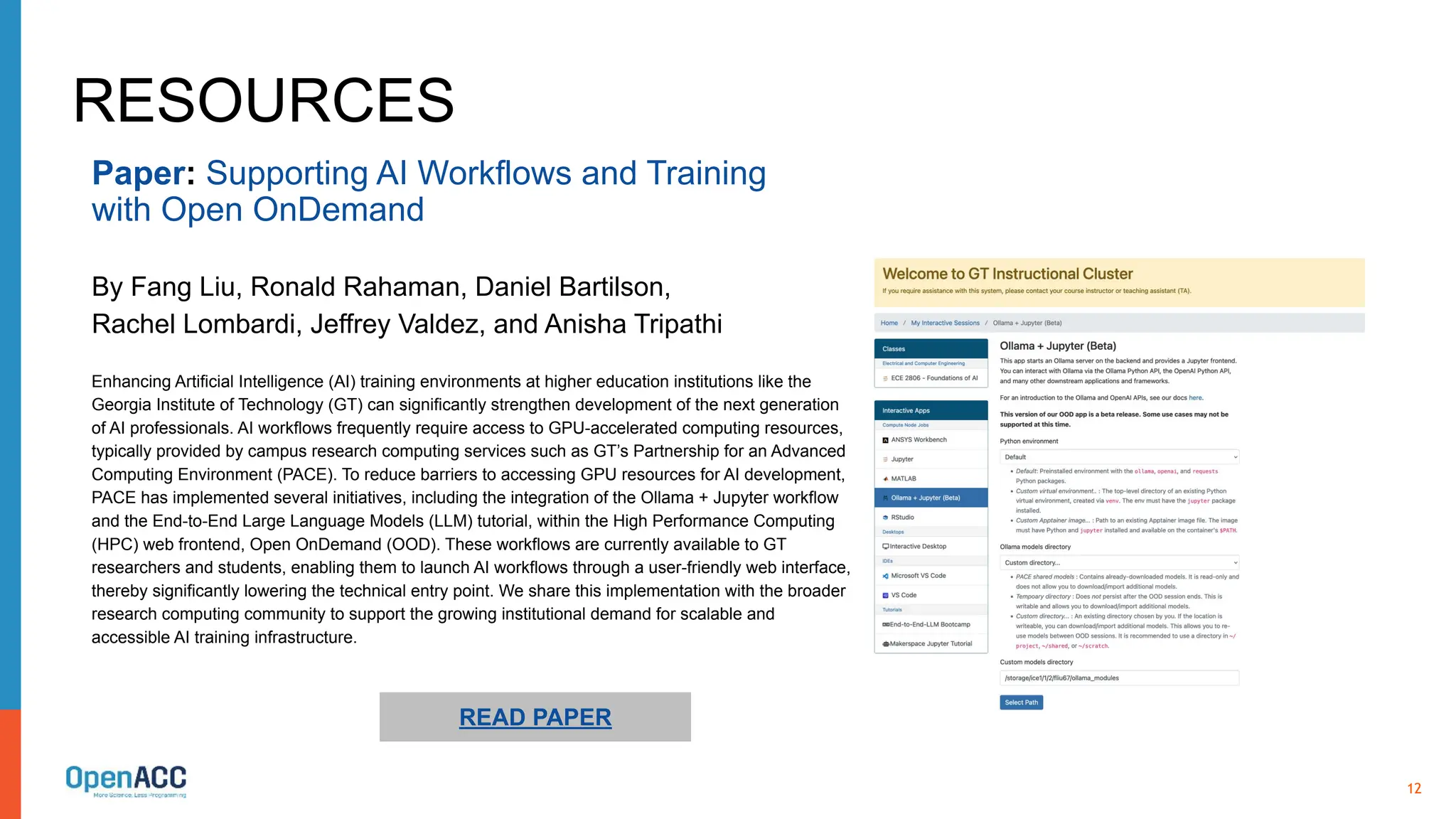
PACE has implemented several initiatives, including the integration of the Ollama + Jupyter workflow
and the End-to-End Large Language Models (LLM) tutorial, within the High Performance Computing
(HPC) web frontend, Open OnDemand (OOD). These workflows are currently available to GT
researchers and students, enabling them to launch AI workflows through a user-friendly web interface,
thereby significantly lowering the technical entry point. We share this implementation with the broader
research computing community to support the growing institutional demand for scalable and
accessible AI training infrastructure.
READ PAPER
Paper: Supporting AI Workflows and Training
with Open OnDemand
By Fang Liu, Ronald Rahaman, Daniel Bartilson,
Rachel Lombardi, Jeffrey Valdez, and Anisha Tripathi
13
RESOURCES
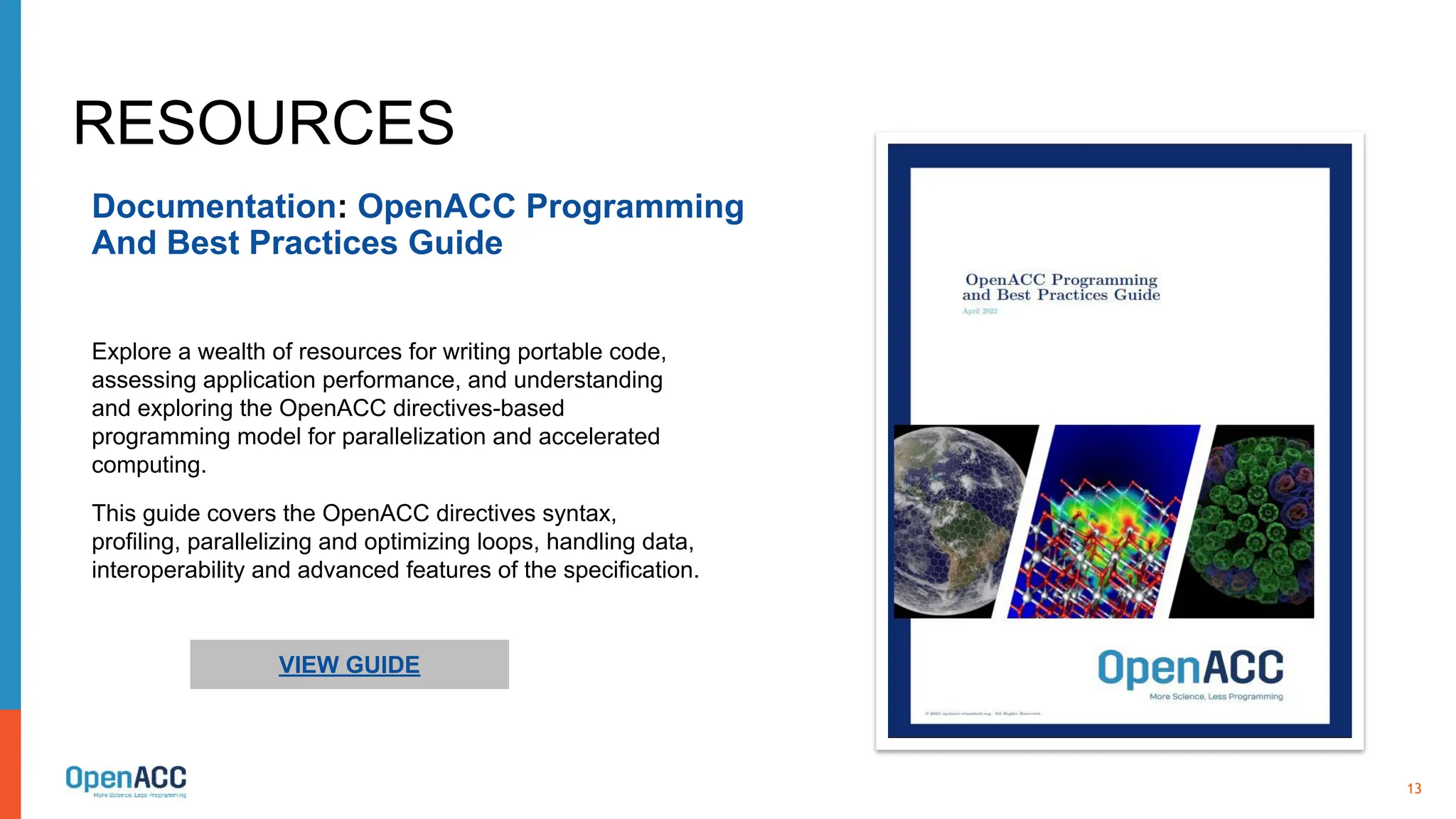
Documentation: OpenACC Programming
And Best Practices Guide
VIEW GUIDE
Explore a wealth of resources for writing portable code,
assessing application performance, and understanding
and exploring the OpenACC directives-based
programming model for parallelization and accelerated
computing.
This guide covers the OpenACC directives syntax,
profiling, parallelizing and optimizing loops, handling data,
interoperability and advanced features of the specification.
14
STAY IN THE KNOW: JOIN THE COMMUNITY
OPENACC AND HACKATHON UPDATES
JOIN TODAY
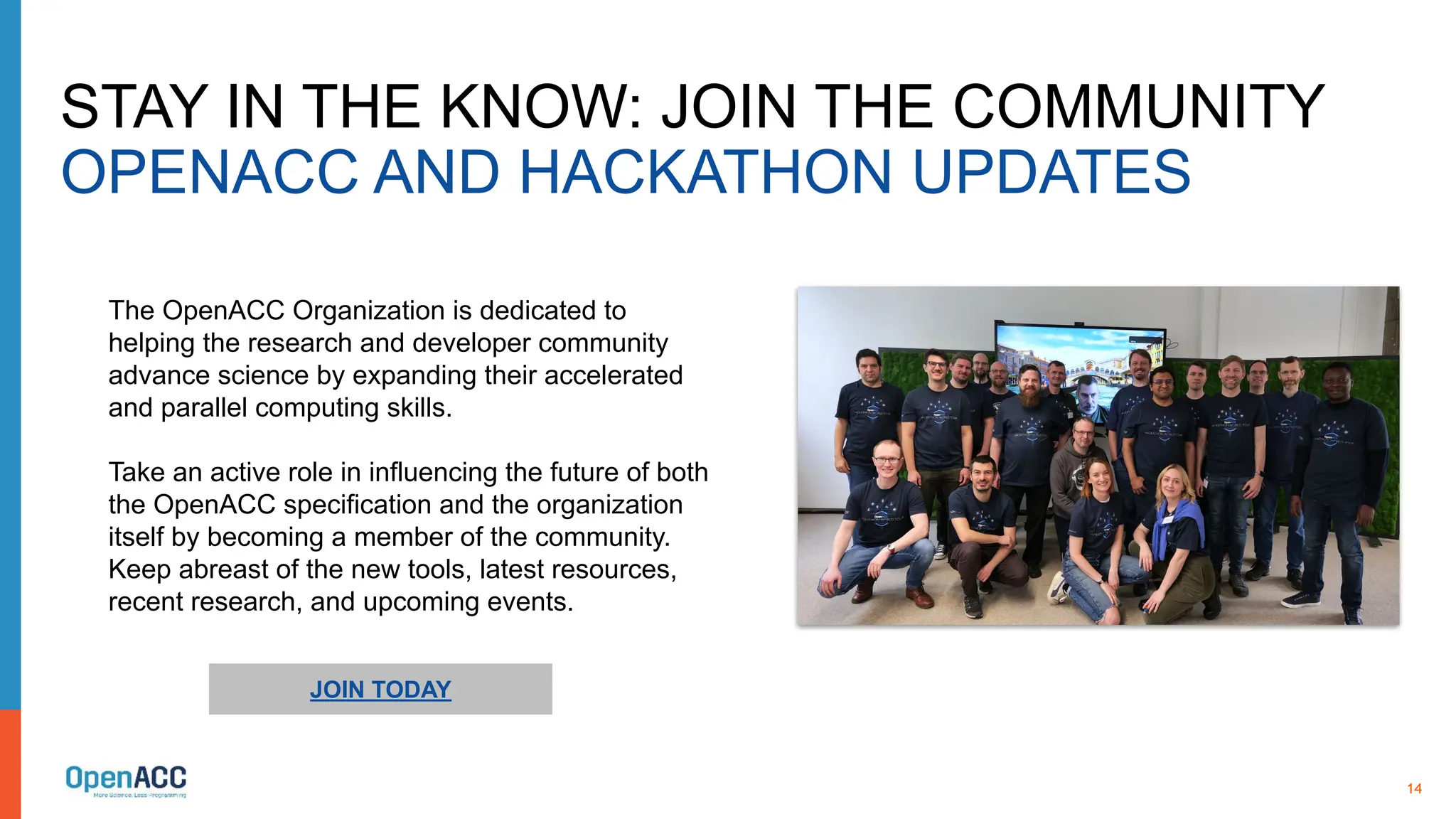
The OpenACC Organization is dedicated to
helping the research and developer community
advance science by expanding their accelerated
and parallel computing skills.
Take an active role in influencing the future of both
the OpenACC specification and the organization
itself by becoming a member of the community.
Keep abreast of the new tools, latest resources,
recent research, and upcoming events.
WWW.OPENACC.ORG
Learn more at

OpenACC and Open Hackathons Monthly Highlights July 2025

  • 1.
    July 2025 OPENACC AND OPENHACKATHONS MONTHLY HIGHLIGHTS
  • 2.
    2 WHO IS OPENACC? TheOpenACC Organization is dedicated to helping the research and developer community advance science by expanding their accelerated and parallel computing skills. 3 Areas of Focus Ecosystem Development Training/Education OpenACC Specification Participating in work that enables and/or advances interoperability of parallel programming models in compilers or tools with the vision of transitioning to standard language parallelism. Managing one of the leading hackathon series, our events have been instrumental in training thousands of domain experts and accelerating over 550 scientific applications using a variety of programming models and tools. Developing and utilizing the OpenACC directives-based programming model to port, accelerate, or optimize scientific applications.
  • 3.
    3 silica IFPEN, RMM-DIISon P100 OPENACC SPECIFICATION MOMENTUM Wide Adoption Across Key HPC Codes ANSYS Fluent Gaussian VASP LSDalton MPAS GAMERA GTC XGC ACME FLASH COSMO Numeca 400+ APPS* USING OPENACC Prof. Georg Kresse Computational Materials Physics University of Vienna For VASP, OpenACC is the way forward for GPU acceleration. Performance is similar to CUDA, and OpenACC dramatically decreases GPU development and maintenance efforts. We’re excited to collaborate with NVIDIA and PGI as an early adopter of Unified Memory. “ “ VASP Top Quantum Chemistry and Material Science Code * Applications in production and development
  • 4.
    4 PROPOSE A TALK Thisyear's OAC Summit is focused on "Crossroads: AI + HPC" exploring how the convergence is transforming science. Propose a talk to highlight your innovative work and showcase exciting methodologies used in modern research! Open Call: Submit Your Talk 2025 Open Accelerated Computing Summit
  • 5.
    5 UPCOMING OPEN HACKATHONS& BOOTCAMPS COMPLETE LIST OF EVENTS Event Call Closes Event Date NCHC NCKU Digital Biology Bootcamp August 21, 2025 September 4, 2025 Dell Agentic AI Bootcamp September 17, 2025 October 9, 2025 India Open Hackathon August 19, 2025 September 18, 23-26, 2025 EuroCC AI Hackathon August 19, 2025 October 14, 21-23, 2025 NCHC Open Hackathon October 1, 2025 October 22-November 12, 2025 Onsite and Digital: Our events offer in-person, digital and hybrid formats!
  • 6.
    6 READ BLOG In partnershipwith OpenACC Organization and NVIDIA, EuroCC National Competence Centres hosted a series of bootcamps ranging from GPU programming fundamentals to advanced multi-GPU profiling for AI codes to train over 600 participants. Learn how the bootcamps upskilled researchers, developers and engineers to tackle new challenges in their real-life projects at the upcoming EuroCC AI Hackathon. Boosting Hands-on Skills EuroCC Hosts Series of Bootcamps
  • 7.
    7 SEE THE RECAP TPC25opens with an examination of how science is evolving alongside advances in AI and high performance computing, ushering in new tools and approaches that are reshaping scientific work across domains. Opening Plenary TPC25 Conference
  • 8.
    8 LEARN MORE Princeton Universityhosted its seventh Open Hackathon, bringing together nine teams collaborating to make research software run faster and more efficiently. Speeding Research Princeton Open Hackathon
  • 9.
    9 READ THE ARTICLE Nowfirmly established as a highlight of their calendar, Jülich Supercomputing Centre (JSC) hosted the 2025 Helmholtz GPU Hackathon, bringing together 52 researchers, developers, and data scientists to optimize and accelerate complex applications in preparation for the JUPITER exascale machine. Hacking Towards JUPITER Helmholtz GPU Hackathon 2025
  • 10.
    10 Paper: A fastflood inundation model with groundwater interactions and hydraulic structures By Brett F. Sanders, Jochen E. Schubert, Eva-Marie H. Martin, Shichen Wang, Michael C.Sukop, and Katharine J. Mach RESOURCES To efficiently predict flooding caused by intense rainfall (pluvial flooding), many physics-based flood inundation models adopt simplistic parameterizations of infiltration such as the Kostiakov, Horton, Soil Conservation Service and Green-Ampt methods. However, these methods are not explicitly dependent on soil moisture (or the groundwater table height), which is known to strongly influence the amount of runoff generated by rainfall. Models that fully couple surface and groundwater flow equations offer an alternative approach, but require larger amounts of input data and greater computational effort. Here we present a fast flood inundation model that couples two-dimensional shallow-water equations for surface flow with a zero-dimensional, time-dependent groundwater equation to capture sensitivity to groundwater. The model is also configured to account for storm drains, pumping and gates so human influences on flooding can be resolved, and is implemented with a dual-grid finite-volume scheme and with OpenACC directives for execution on graphical processing units (GPUs). With a 1.5 m resolution application across a 1,000 km^2 area in Miami, Florida, where pluvial flooding is sensitive to depth to groundwater and simulation models that accurately reproduce observed flooding are needed to explore and plan response options, we first show that hourly water levels are predicted with a Mean Absolute Error of 8–16 cm across six canal gaging stations where flows are affected by tides, pumping, gate operations, and rainfall runoff. READ PAPER
  • 11.
    11 RESOURCES Since 2010, theInternational HPC Summer School (IHPCSS) has trained more than 1,500 graduate students and early-career researchers in high-performance computing (HPC). Originally a European-US collaboration, it now includes Japan, Canada, Australia and South Africa, and serves around 80 students and 40 staff each year. This paper examines the evolution of the technical program, which initially focused on domain-specific scientific applications and MPI/OpenMP programming, but later expanded to include emerging technologies like GPU acceleration, Python for HPC, big data analytics,and AI/ML. It also discusses the challenges IHPCSS faced - technical, logistical, and demographic - and how they were addressed through real-time HPC access, mentorship, and adaptable sessions for mixed-skill audiences. IHPCSS continues to provide inclusive and high-quality trainings around the world by integrating new technologies and responding to participant feedback, while maintaining the core principles of HPC. READ PAPER Paper: Fifteen Years of International HPC Summer School By Scott Callaghan, Weronika Filinger, Ilya Zhukov, Hermann Lederer, and John Urbanic
  • 12.
    12 RESOURCES Enhancing Artificial Intelligence(AI) training environments at higher education institutions like the Georgia Institute of Technology (GT) can significantly strengthen development of the next generation of AI professionals. AI workflows frequently require access to GPU-accelerated computing resources, typically provided by campus research computing services such as GT’s Partnership for an Advanced Computing Environment (PACE). To reduce barriers to accessing GPU resources for AI development, PACE has implemented several initiatives, including the integration of the Ollama + Jupyter workflow and the End-to-End Large Language Models (LLM) tutorial, within the High Performance Computing (HPC) web frontend, Open OnDemand (OOD). These workflows are currently available to GT researchers and students, enabling them to launch AI workflows through a user-friendly web interface, thereby significantly lowering the technical entry point. We share this implementation with the broader research computing community to support the growing institutional demand for scalable and accessible AI training infrastructure. READ PAPER Paper: Supporting AI Workflows and Training with Open OnDemand By Fang Liu, Ronald Rahaman, Daniel Bartilson, Rachel Lombardi, Jeffrey Valdez, and Anisha Tripathi
  • 13.
    13 RESOURCES Documentation: OpenACC Programming AndBest Practices Guide VIEW GUIDE Explore a wealth of resources for writing portable code, assessing application performance, and understanding and exploring the OpenACC directives-based programming model for parallelization and accelerated computing. This guide covers the OpenACC directives syntax, profiling, parallelizing and optimizing loops, handling data, interoperability and advanced features of the specification.
  • 14.
    14 STAY IN THEKNOW: JOIN THE COMMUNITY OPENACC AND HACKATHON UPDATES JOIN TODAY The OpenACC Organization is dedicated to helping the research and developer community advance science by expanding their accelerated and parallel computing skills. Take an active role in influencing the future of both the OpenACC specification and the organization itself by becoming a member of the community. Keep abreast of the new tools, latest resources, recent research, and upcoming events.
  • 15.