OpenStack Ecosystem
   and Xen Cloud
     Platform Amit Naik
                Prasad Nirantar
                 BMC Software


                                  1
Agenda
Introduction
Rise of OpenStack
OpenStack Details and Ecosystem
OpenStack and Xen Cloud Platform -
 Demo
Conclusion


                                      2
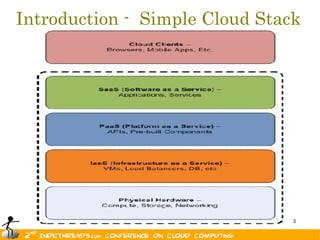
Introduction - Simple Cloud Stack


                                3
Rise of OpenStack – IaaS Enabler
Cloud Services have three main flavors:
  • IaaS
  • PaaS
  • SaaS
For early cloud platforms, IaaS
 enablement was the key focus
Help organizations build their own
 public, private, or hybrid clouds
                                          4
IaaS Enablement Platforms
AKA Cloud Management Platforms,
 Cloud Controllers, Fabric Managers,
 Cloud Orchestration, IaaS Platforms, etc
Enablement Platforms turn Physical and
 Virtual IT assets into elastic cloud entities
Resulting IaaS can provision and manage
 Compute, Storage, Networking or other
 resources in some combination
                                                 5
OpenStack Precursor –
Eucalyptus

Eucalyptus was very popular IaaS
 Platform, grew out of project at UCSB
25,000 installs and big user community
 NASA used to be one of the big vocal
 supporters of Eucalyptus
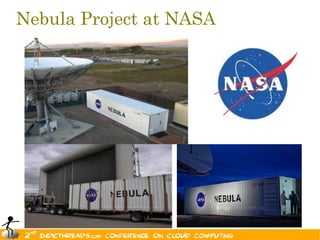
In May 2010, NASA partnered with
 Rackspace to announce a competing effort!
                                          6
Eucalyptus Falters
NASA had two main issues with Eucalyptus
• Scalability of Eucalyptus was insufficient -
  Nebula project needed massive scalability
  1 million machines & 60 million VMs
• Open Core Vs Open Source –
  NASA engineers were unable to contribute
  code to some Eucalyptus Modules due to
  some parts being closed source
                                             7
Nebula Project at NASA


                         8
Birth of OpenStack: Rackspace+NASA

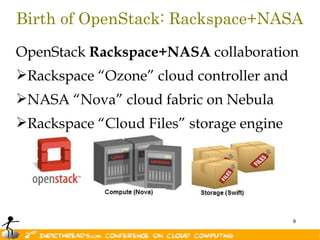
OpenStack Rackspace+NASA collaboration
Rackspace “Ozone” cloud controller and
NASA “Nova” cloud fabric on Nebula
Rackspace “Cloud Files” storage engine


                                          9
Rackspace Motivations
Needed something to counter Amazon’s
 rapid pace of innovation
Shift to open source builds rapid
 developer mindshare
Focus on their Strengths –
  • Customer Support
  • Heterogeneity
 Support offerings as new revenue stream
                                        10
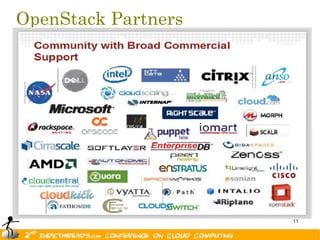
OpenStack Partners


                     11
OpenStack Project Objectives
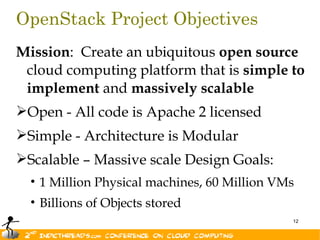
Mission: Create an ubiquitous open source
 cloud computing platform that is simple to
 implement and massively scalable
Open - All code is Apache 2 licensed
Simple - Architecture is Modular
Scalable – Massive scale Design Goals:
  • 1 Million Physical machines, 60 Million VMs
  • Billions of Objects stored
                                              12
OpenStack Flavors
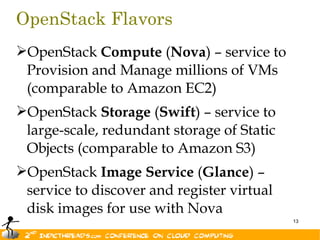
OpenStack Compute (Nova) – service to
 Provision and Manage millions of VMs
 (comparable to Amazon EC2)
OpenStack Storage (Swift) – service to
 large-scale, redundant storage of Static
 Objects (comparable to Amazon S3)
OpenStack Image Service (Glance) –
 service to discover and register virtual
 disk images for use with Nova
                                            13
OpenStack Release Train


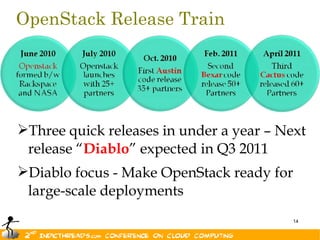
Three quick releases in under a year – Next
 release “Diablo” expected in Q3 2011
Diablo focus - Make OpenStack ready for
 large-scale deployments
                                          14
Architecture of OpenStack


                            15
Architecture of OpenStack
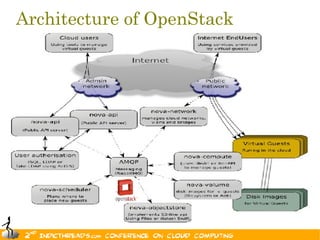
Built on a shared-nothing, messaging-based
 architecture using AMPQ based queues
nova-api process is the heart of the
 OpenStack Nova – its “Cloud Controller”
  • Provides an endpoint for all API queries
  • Initiates most of the orchestration activities
  • Enforces some policy - mostly quota checks
nova-schedule decides which compute host
 a given VM should be created on
                                                     16
OpenStack Architecture Cont’d
Three Primary Infrastructure Modules
  • nova-compute process primarily creates and
    terminates virtual machine instances.
  • nova-volume manages the creation, attach &
    detach of persistent volumes to VMs
  • nova-network manipulate the network e.g.
    configure VLANs, change iptables rules, etc
SQL DB stores run time state of cloud
 infrastructure such as Instances in use,
 Networks available, Volumes attached, etc        17
OpenStack Component Specifics
Written almost entirely in Python
Available pre-built on Ubuntu and RHEL
RabbitMQ is the AMPQ product of choice
Supports MySQL and PostgreSQL
Libvirt, Xen API used in instance creation
Support for EC2 API and S3 semantics
Supports wide variety of Hypervisors
                                          18
OpenStack – Hypervisor Support
Hypervisor agnostic – support for:
  • Hyper-V 2008
  • KVM - Kernel-based Virtual Machine
  • QEMU
  • User Mode Linux
  • VMWare - ESX/ESXi 4.1 update 1
  • Xen - XenServer 5.5
Supports OVF (open virtualization format)
                                         19
Competitors and Implementers
 Eucalyptus – Still very popular
 OpenNebula – Used at FermiLabs, CERN
 CloudStack – Cloud.com’s IaaS platform
 CloudForms – Red Hat’s IaaS offering (beta)
       OpenStack in the commercial space:
 Ubuntu Enterprise Cloud (UEC) – Switched
  from Eucalyptus to OpenStack as base
 Project Oylumpus – Citrix branded OpenStack
 Internap – Rackspace competitor switching     20
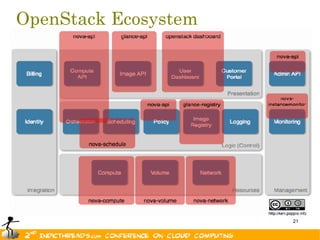
OpenStack Ecosystem


                      21
OpenStack Partners Ecosystem
Gaps in Stack filled in by Partners:
  • Billing - Chargeback and Showback
  • Integrated Metering, Capacity Planning
  • Full-Spectrum Monitoring, Analytics
  • Advanced Networking Capabilities
  • Management Systems
• Cisco has come out with a Networking as
  a Service (NaaS) Proposal for OpenStack
• Zenoss and CloudKick for monitoring
                                             22
Ecosystem-Facebook OpenCompute
Facebook recently open sourced their
 proprietary datacenter designs under
 OpenCompute project
Puts all the “secret sauce” of their
 datacenter and sever design on the web
Collaborating with OpenStack to ensure
 seamless deployment on Open Compute
Power savings of 38%, cost savings 24%
                                          23
Ecosystem – Xen Cloud Platform
Xen Cloud Platform
 Open source platform to build clouds
Virtualization platform including
  • Xen hypervisor
  • Network and Storage support
  Originally derived from XenServer – GPL2


                                              24
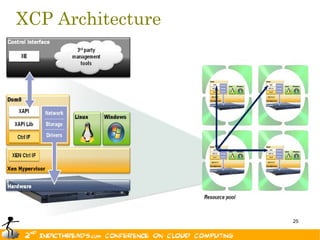
XCP Architecture


                   25
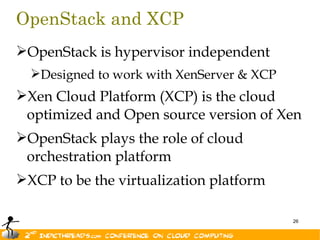
OpenStack and XCP
OpenStack is hypervisor independent
  Designed to work with XenServer & XCP
Xen Cloud Platform (XCP) is the cloud
 optimized and Open source version of Xen
OpenStack plays the role of cloud
 orchestration platform
XCP to be the virtualization platform

                                           26
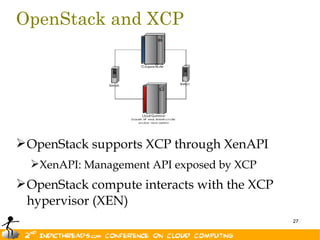
OpenStack and XCP


 OpenStack supports XCP through XenAPI
  XenAPI: Management API exposed by XCP
 OpenStack compute interacts with the XCP
  hypervisor (XEN)
                                             27
OpenStack Limitations (Cactus)
 Nova codebase = merger of Rackspace &NASA
  Cloud controllers – Still Maturing
 Swift code base is mature and Ready for
  primetime
 HA, fault tolerance support in Cactus Release is
  in proposal stage
 Lack of good documentation on Setup/usage
 “Diablo” Release will be recommended for wide
  adoption
                                                28
Conclusions
OpenStack is becoming a default open
 source cloud fabric in IaaS space
Ecosystem is an excellent opportunity to
 contribute to this exciting effort
Wide adoption by Industry heavyweights
 guarantees major traction
Lots of room for improvement but fast
 release cycles ensure quick fixes
                                            29
Q&A


      30
References
http://www.xen.org/products/cloudxen.html
http://www.openstack.org
http://open.eucalyptus.com/
http://nebula.nasa.gov/
http://ken.pepple.info/openstack/2011/04/22/openstack
  -nova-architecture/
http://www.laurentluce.com/?p=227
http://cloudopsmanagement.wordpress.com/2011/06/02
  /open-source-engine-powering-the-next-gen-cloud-
  stack-part-1/
                                                 31
Back-up Slides


                 32
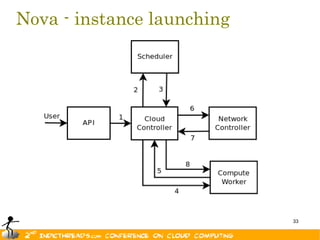
Nova - instance launching


                            33

OpenStack Ecosystem – Xen Cloud Platform and Integration into OpenStack - indicthreads cloud computing conference 2011

  • 1.
    OpenStack Ecosystem and Xen Cloud Platform Amit Naik Prasad Nirantar BMC Software 1
  • 2.
    Agenda Introduction Rise of OpenStack OpenStackDetails and Ecosystem OpenStack and Xen Cloud Platform - Demo Conclusion 2
  • 3.
    Introduction - SimpleCloud Stack 3
  • 4.
    Rise of OpenStack– IaaS Enabler Cloud Services have three main flavors: • IaaS • PaaS • SaaS For early cloud platforms, IaaS enablement was the key focus Help organizations build their own public, private, or hybrid clouds 4
  • 5.
    IaaS Enablement Platforms AKACloud Management Platforms, Cloud Controllers, Fabric Managers, Cloud Orchestration, IaaS Platforms, etc Enablement Platforms turn Physical and Virtual IT assets into elastic cloud entities Resulting IaaS can provision and manage Compute, Storage, Networking or other resources in some combination 5
  • 6.
    OpenStack Precursor – Eucalyptus Eucalyptuswas very popular IaaS Platform, grew out of project at UCSB 25,000 installs and big user community  NASA used to be one of the big vocal supporters of Eucalyptus In May 2010, NASA partnered with Rackspace to announce a competing effort! 6
  • 7.
    Eucalyptus Falters NASA hadtwo main issues with Eucalyptus • Scalability of Eucalyptus was insufficient - Nebula project needed massive scalability 1 million machines & 60 million VMs • Open Core Vs Open Source – NASA engineers were unable to contribute code to some Eucalyptus Modules due to some parts being closed source 7
  • 8.
  • 9.
    Birth of OpenStack:Rackspace+NASA OpenStack Rackspace+NASA collaboration Rackspace “Ozone” cloud controller and NASA “Nova” cloud fabric on Nebula Rackspace “Cloud Files” storage engine 9
  • 10.
    Rackspace Motivations Needed somethingto counter Amazon’s rapid pace of innovation Shift to open source builds rapid developer mindshare Focus on their Strengths – • Customer Support • Heterogeneity  Support offerings as new revenue stream 10
  • 11.
  • 12.
    OpenStack Project Objectives Mission:Create an ubiquitous open source cloud computing platform that is simple to implement and massively scalable Open - All code is Apache 2 licensed Simple - Architecture is Modular Scalable – Massive scale Design Goals: • 1 Million Physical machines, 60 Million VMs • Billions of Objects stored 12
  • 13.
    OpenStack Flavors OpenStack Compute(Nova) – service to Provision and Manage millions of VMs (comparable to Amazon EC2) OpenStack Storage (Swift) – service to large-scale, redundant storage of Static Objects (comparable to Amazon S3) OpenStack Image Service (Glance) – service to discover and register virtual disk images for use with Nova 13
  • 14.
    OpenStack Release Train Threequick releases in under a year – Next release “Diablo” expected in Q3 2011 Diablo focus - Make OpenStack ready for large-scale deployments 14
  • 15.
  • 16.
    Architecture of OpenStack Builton a shared-nothing, messaging-based architecture using AMPQ based queues nova-api process is the heart of the OpenStack Nova – its “Cloud Controller” • Provides an endpoint for all API queries • Initiates most of the orchestration activities • Enforces some policy - mostly quota checks nova-schedule decides which compute host a given VM should be created on 16
  • 17.
    OpenStack Architecture Cont’d ThreePrimary Infrastructure Modules • nova-compute process primarily creates and terminates virtual machine instances. • nova-volume manages the creation, attach & detach of persistent volumes to VMs • nova-network manipulate the network e.g. configure VLANs, change iptables rules, etc SQL DB stores run time state of cloud infrastructure such as Instances in use, Networks available, Volumes attached, etc 17
  • 18.
    OpenStack Component Specifics Writtenalmost entirely in Python Available pre-built on Ubuntu and RHEL RabbitMQ is the AMPQ product of choice Supports MySQL and PostgreSQL Libvirt, Xen API used in instance creation Support for EC2 API and S3 semantics Supports wide variety of Hypervisors 18
  • 19.
    OpenStack – HypervisorSupport Hypervisor agnostic – support for: • Hyper-V 2008 • KVM - Kernel-based Virtual Machine • QEMU • User Mode Linux • VMWare - ESX/ESXi 4.1 update 1 • Xen - XenServer 5.5 Supports OVF (open virtualization format) 19
  • 20.
    Competitors and Implementers Eucalyptus – Still very popular  OpenNebula – Used at FermiLabs, CERN  CloudStack – Cloud.com’s IaaS platform  CloudForms – Red Hat’s IaaS offering (beta) OpenStack in the commercial space:  Ubuntu Enterprise Cloud (UEC) – Switched from Eucalyptus to OpenStack as base  Project Oylumpus – Citrix branded OpenStack  Internap – Rackspace competitor switching 20
  • 21.
  • 22.
    OpenStack Partners Ecosystem Gapsin Stack filled in by Partners: • Billing - Chargeback and Showback • Integrated Metering, Capacity Planning • Full-Spectrum Monitoring, Analytics • Advanced Networking Capabilities • Management Systems • Cisco has come out with a Networking as a Service (NaaS) Proposal for OpenStack • Zenoss and CloudKick for monitoring 22
  • 23.
    Ecosystem-Facebook OpenCompute Facebook recentlyopen sourced their proprietary datacenter designs under OpenCompute project Puts all the “secret sauce” of their datacenter and sever design on the web Collaborating with OpenStack to ensure seamless deployment on Open Compute Power savings of 38%, cost savings 24% 23
  • 24.
    Ecosystem – XenCloud Platform Xen Cloud Platform Open source platform to build clouds Virtualization platform including • Xen hypervisor • Network and Storage support Originally derived from XenServer – GPL2 24
  • 25.
  • 26.
    OpenStack and XCP OpenStackis hypervisor independent Designed to work with XenServer & XCP Xen Cloud Platform (XCP) is the cloud optimized and Open source version of Xen OpenStack plays the role of cloud orchestration platform XCP to be the virtualization platform 26
  • 27.
    OpenStack and XCP OpenStack supports XCP through XenAPI XenAPI: Management API exposed by XCP  OpenStack compute interacts with the XCP hypervisor (XEN) 27
  • 28.
    OpenStack Limitations (Cactus) Nova codebase = merger of Rackspace &NASA Cloud controllers – Still Maturing  Swift code base is mature and Ready for primetime  HA, fault tolerance support in Cactus Release is in proposal stage  Lack of good documentation on Setup/usage  “Diablo” Release will be recommended for wide adoption 28
  • 29.
    Conclusions OpenStack is becominga default open source cloud fabric in IaaS space Ecosystem is an excellent opportunity to contribute to this exciting effort Wide adoption by Industry heavyweights guarantees major traction Lots of room for improvement but fast release cycles ensure quick fixes 29
  • 30.
    Q&A 30
  • 31.
  • 32.
  • 33.
    Nova - instancelaunching 33