Unraveling OpenStack clouds
Sanket Sangwikar
Technical Architect at IBM
Introduction
Sanket Sangwikar
Technical Architect, Cloud Systems Software,
IBM Software Labs
sanket.sangwikar@in.ibm.com
Patents
• Managing cache elements(Link)
- United States US8086803
• Algorithm to establish
relationships among network
entities(Link) - United States
US20120233607 A1
• System management in
datacenter using a non-relational
database(Link) - United States
United States US20130024484
• A few more
Publications
• Optimizing CIM based storage
management solutions using
indications based cache
techniques
• Designing new generation
device management solution
• System and method for
managing the life cycle of
systems using Internet
Messenger (IM) based approach
• Many more
Education
Master of Science (MS), Computer
Software Engineering
Birla Institute of Technology and
Science
Bachelor of Engineering (BE),
Computer Engineering
University of Mumbai
Interests
Environment, Backpacking, History
3
By the end of this session…
You would have known…
• Some basics of IaaS cloud to begin with
• Why has OpenStack become a sensation in today’s IaaS cloud
space?
• Architecture of OpenStack
• Who should be using OpenStack? What’s in it for you?
• The next generation of technologies - What are the businesses
doing with it?
• How can one contribute to OpenStack?
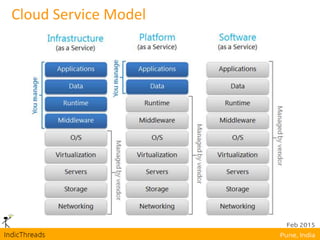
Cloud Service Model
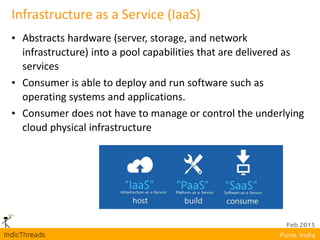
Infrastructure as a Service (IaaS)
• Abstracts hardware (server, storage, and network
infrastructure) into a pool capabilities that are delivered as
services
• Consumer is able to deploy and run software such as
operating systems and applications.
• Consumer does not have to manage or control the underlying
cloud physical infrastructure
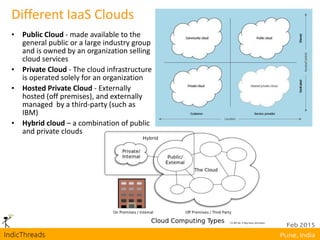
Different IaaS Clouds
• Public Cloud - made available to the
general public or a large industry group
and is owned by an organization selling
cloud services
• Private Cloud - The cloud infrastructure
is operated solely for an organization
• Hosted Private Cloud - Externally
hosted (off premises), and externally
managed by a third-party (such as
IBM)
• Hybrid cloud – a combination of public
and private clouds
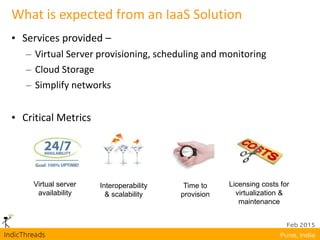
What is expected from an IaaS Solution
• Services provided –
– Virtual Server provisioning, scheduling and monitoring
– Cloud Storage
– Simplify networks
• Critical Metrics
Virtual server
availability
Time to
provision
Licensing costs for
virtualization &
maintenance
Interoperability
& scalability
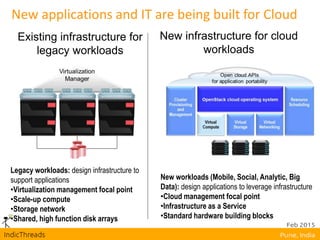
New applications and IT are being built for Cloud
Legacy workloads: design infrastructure to
support applications
•Virtualization management focal point
•Scale-up compute
•Storage network
•Shared, high function disk arrays
New workloads (Mobile, Social, Analytic, Big
Data): design applications to leverage infrastructure
•Cloud management focal point
•Infrastructure as a Service
•Standard hardware building blocks
Existing infrastructure for
legacy workloads
New infrastructure for cloud
workloads
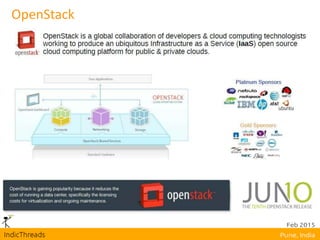
OpenStack
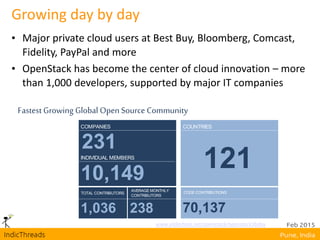
Growing day by day
• Major private cloud users at Best Buy, Bloomberg, Comcast,
Fidelity, PayPal and more
• OpenStack has become the center of cloud innovation – more
than 1,000 developers, supported by major IT companies
Fastest Growing Global Open Source Community
COMPANIES
TOTAL CONTRIBUTORS
AVERAGE MONTHLY
CONTRIBUTORS
CODE CONTRIBUTIONS
1,036 238 70,137
231
10,149
INDIVIDUAL MEMBERS
COUNTRIES
121
www.slideshare.net/openstack/openstack3bday
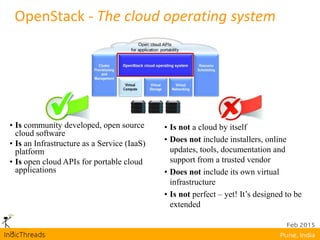
OpenStack - The cloud operating system
• Is community developed, open source
cloud software
• Is an Infrastructure as a Service (IaaS)
platform
• Is open cloud APIs for portable cloud
applications
• Is not a cloud by itself
• Does not include installers, online
updates, tools, documentation and
support from a trusted vendor
• Does not include its own virtual
infrastructure
• Is not perfect – yet! It’s designed to be
extended
11
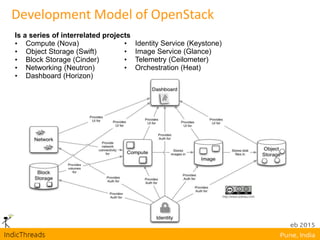
Development Model of OpenStack
• Identity Service (Keystone)
• Image Service (Glance)
• Telemetry (Ceilometer)
• Orchestration (Heat)
Is a series of interrelated projects
• Compute (Nova)
• Object Storage (Swift)
• Block Storage (Cinder)
• Networking (Neutron)
• Dashboard (Horizon)
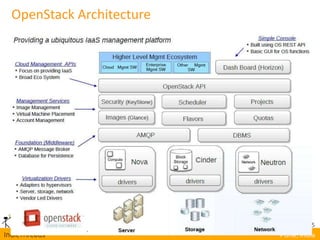
OpenStack Architecture
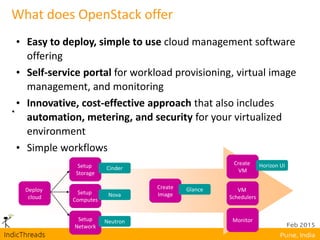
What does OpenStack offer
• Easy to deploy, simple to use cloud management software
offering
• Self-service portal for workload provisioning, virtual image
management, and monitoring
• Innovative, cost-effective approach that also includes
automation, metering, and security for your virtualized
environment
• Simple workflows
Deploy
cloud
Setup
Storage
Setup
Computes
Setup
Network
Cinder
Nova
Neutron
Create
Image
Glance
Create
VM
Horizon UI
VM
Schedulers
Monitor
Who should be using OpenStack?
• Universities
• Organization having their own infrastructure such as Banks,
telecom industries, insurance companies etc.
• Organizations who want a easily available application test bed
• Organizations offering public cloud solutions such as IBM
Softlayer, Amazon etc.
• ….
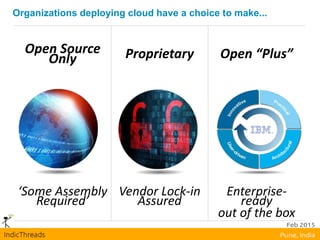
Open Source
Only Proprietary Open “Plus”
‘Some Assembly
Required’
Vendor Lock-in
Assured
Enterprise-
ready
out of the box
Organizations deploying cloud have a choice to make...
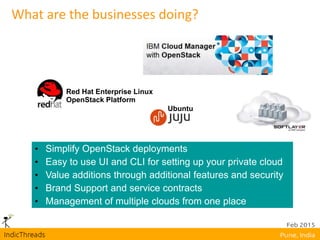
What are the businesses doing?
• Simplify OpenStack deployments
• Easy to use UI and CLI for setting up your private cloud
• Value additions through additional features and security
• Brand Support and service contracts
• Management of multiple clouds from one place
Red Hat Enterprise Linux
OpenStack Platform
Ubuntu
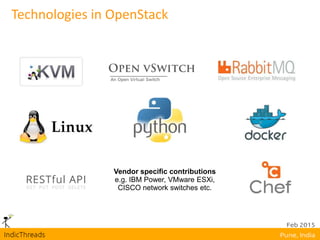
Technologies in OpenStack
Vendor specific contributions
e.g. IBM Power, VMware ESXi,
CISCO network switches etc.
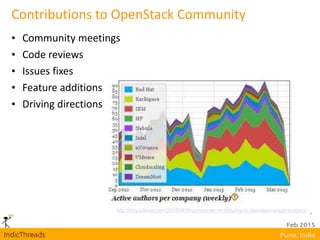
Contributions to OpenStack Community
• Community meetings
• Code reviews
• Issues fixes
• Feature additions
• Driving directions
http://blog.bitergia.com/2013/04/04/companies-contributing-to-openstack-grizzly-analysis/
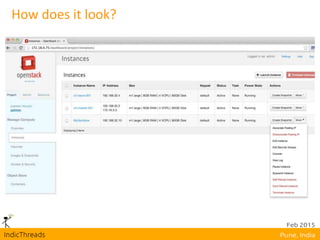
How does it look?
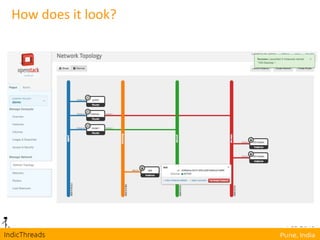
How does it look?
Summary
• Infrastructure as a Service Clouds abstract the underlying physical hardware and
provide them as services in form pool capabilities.
• OpenStack is the Open Source IaaS Platform for the Enterprise that will meet the
needs of public and private cloud providers regardless of the size, by being simple to
invent and massively scalable.
• Started by Rackspace and NASA in 2010. Became a Fastest Growing Global Open
Source Community by 2014
• It’s a series of interrelated projects and Does not include installers, online updates or
service contracts by a trusted brand.
• Provides easy to use self service portal, simple workflows to manage clouds,
monitoring and security
• Contributors of OpenStack have developed solutions on top of OpenStack such as IBM
Cloud Manager, RHEL Openstack platform etc.
• OpenStack has brought value to several new generation technologies.
• It can be used by anyone needing to set up a private or public cloud such as
universities, banks, insurance companies, IBM Softlayer public cloud etc.

Unraveling OpenStack Clouds

  • 1.
    Unraveling OpenStack clouds SanketSangwikar Technical Architect at IBM
  • 2.
    Introduction Sanket Sangwikar Technical Architect,Cloud Systems Software, IBM Software Labs sanket.sangwikar@in.ibm.com Patents • Managing cache elements(Link) - United States US8086803 • Algorithm to establish relationships among network entities(Link) - United States US20120233607 A1 • System management in datacenter using a non-relational database(Link) - United States United States US20130024484 • A few more Publications • Optimizing CIM based storage management solutions using indications based cache techniques • Designing new generation device management solution • System and method for managing the life cycle of systems using Internet Messenger (IM) based approach • Many more Education Master of Science (MS), Computer Software Engineering Birla Institute of Technology and Science Bachelor of Engineering (BE), Computer Engineering University of Mumbai Interests Environment, Backpacking, History
  • 3.
    3 By the endof this session… You would have known… • Some basics of IaaS cloud to begin with • Why has OpenStack become a sensation in today’s IaaS cloud space? • Architecture of OpenStack • Who should be using OpenStack? What’s in it for you? • The next generation of technologies - What are the businesses doing with it? • How can one contribute to OpenStack?
  • 4.
  • 5.
    Infrastructure as aService (IaaS) • Abstracts hardware (server, storage, and network infrastructure) into a pool capabilities that are delivered as services • Consumer is able to deploy and run software such as operating systems and applications. • Consumer does not have to manage or control the underlying cloud physical infrastructure
  • 6.
    Different IaaS Clouds •Public Cloud - made available to the general public or a large industry group and is owned by an organization selling cloud services • Private Cloud - The cloud infrastructure is operated solely for an organization • Hosted Private Cloud - Externally hosted (off premises), and externally managed by a third-party (such as IBM) • Hybrid cloud – a combination of public and private clouds
  • 7.
    What is expectedfrom an IaaS Solution • Services provided – – Virtual Server provisioning, scheduling and monitoring – Cloud Storage – Simplify networks • Critical Metrics Virtual server availability Time to provision Licensing costs for virtualization & maintenance Interoperability & scalability
  • 8.
    New applications andIT are being built for Cloud Legacy workloads: design infrastructure to support applications •Virtualization management focal point •Scale-up compute •Storage network •Shared, high function disk arrays New workloads (Mobile, Social, Analytic, Big Data): design applications to leverage infrastructure •Cloud management focal point •Infrastructure as a Service •Standard hardware building blocks Existing infrastructure for legacy workloads New infrastructure for cloud workloads
  • 9.
  • 10.
    Growing day byday • Major private cloud users at Best Buy, Bloomberg, Comcast, Fidelity, PayPal and more • OpenStack has become the center of cloud innovation – more than 1,000 developers, supported by major IT companies Fastest Growing Global Open Source Community COMPANIES TOTAL CONTRIBUTORS AVERAGE MONTHLY CONTRIBUTORS CODE CONTRIBUTIONS 1,036 238 70,137 231 10,149 INDIVIDUAL MEMBERS COUNTRIES 121 www.slideshare.net/openstack/openstack3bday
  • 11.
    OpenStack - Thecloud operating system • Is community developed, open source cloud software • Is an Infrastructure as a Service (IaaS) platform • Is open cloud APIs for portable cloud applications • Is not a cloud by itself • Does not include installers, online updates, tools, documentation and support from a trusted vendor • Does not include its own virtual infrastructure • Is not perfect – yet! It’s designed to be extended 11
  • 12.
    Development Model ofOpenStack • Identity Service (Keystone) • Image Service (Glance) • Telemetry (Ceilometer) • Orchestration (Heat) Is a series of interrelated projects • Compute (Nova) • Object Storage (Swift) • Block Storage (Cinder) • Networking (Neutron) • Dashboard (Horizon)
  • 13.
  • 14.
    What does OpenStackoffer • Easy to deploy, simple to use cloud management software offering • Self-service portal for workload provisioning, virtual image management, and monitoring • Innovative, cost-effective approach that also includes automation, metering, and security for your virtualized environment • Simple workflows Deploy cloud Setup Storage Setup Computes Setup Network Cinder Nova Neutron Create Image Glance Create VM Horizon UI VM Schedulers Monitor
  • 15.
    Who should beusing OpenStack? • Universities • Organization having their own infrastructure such as Banks, telecom industries, insurance companies etc. • Organizations who want a easily available application test bed • Organizations offering public cloud solutions such as IBM Softlayer, Amazon etc. • ….
  • 16.
    Open Source Only ProprietaryOpen “Plus” ‘Some Assembly Required’ Vendor Lock-in Assured Enterprise- ready out of the box Organizations deploying cloud have a choice to make...
  • 17.
    What are thebusinesses doing? • Simplify OpenStack deployments • Easy to use UI and CLI for setting up your private cloud • Value additions through additional features and security • Brand Support and service contracts • Management of multiple clouds from one place Red Hat Enterprise Linux OpenStack Platform Ubuntu
  • 18.
    Technologies in OpenStack Vendorspecific contributions e.g. IBM Power, VMware ESXi, CISCO network switches etc.
  • 19.
    Contributions to OpenStackCommunity • Community meetings • Code reviews • Issues fixes • Feature additions • Driving directions http://blog.bitergia.com/2013/04/04/companies-contributing-to-openstack-grizzly-analysis/
  • 20.
  • 21.
  • 22.
    Summary • Infrastructure asa Service Clouds abstract the underlying physical hardware and provide them as services in form pool capabilities. • OpenStack is the Open Source IaaS Platform for the Enterprise that will meet the needs of public and private cloud providers regardless of the size, by being simple to invent and massively scalable. • Started by Rackspace and NASA in 2010. Became a Fastest Growing Global Open Source Community by 2014 • It’s a series of interrelated projects and Does not include installers, online updates or service contracts by a trusted brand. • Provides easy to use self service portal, simple workflows to manage clouds, monitoring and security • Contributors of OpenStack have developed solutions on top of OpenStack such as IBM Cloud Manager, RHEL Openstack platform etc. • OpenStack has brought value to several new generation technologies. • It can be used by anyone needing to set up a private or public cloud such as universities, banks, insurance companies, IBM Softlayer public cloud etc.

Editor's Notes

  • #12 http://docs.openstack.org/training-guides/content/module001-ch003-core-projects.html
  • #17 What is the best infrastructure for my cloud? For example, should I build it in house or leverage IaaS on public – or both? How do I maintain choice and flexibility? Or put another way, how do avoid vendor lock in and ensure your investments are protected? How do I rapidly deploy and operate my cloud? This is more than just provisioning. You’ll need monitor the resources, ensure application performance, manage constant change, ensure dev and ops are aligned.