Open Source
Software Licensing
"Licenses that comply with the Open
Source Definition—in brief, they allow
software to be freely used, modified,
and shared.”
- Open Source Initiative
Which License
Should I
Choose?
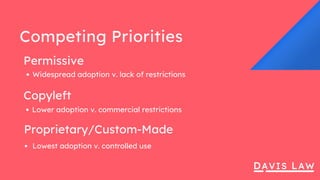
Competing Priorities
Lowest adoption v. controlled use
Permissive
Copyleft
Proprietary/Custom-Made
Widespread adoption v. lack of restrictions
Lower adoption v. commercial restrictions
Challenge:
Avoiding licensing mismatch
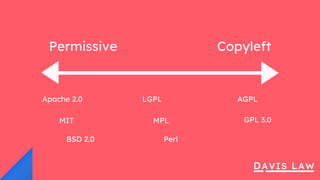
Permissive Copyleft
MIT
BSD 2.0
Apache 2.0 LGPL
MPL
AGPL
GPL 3.0
Perl
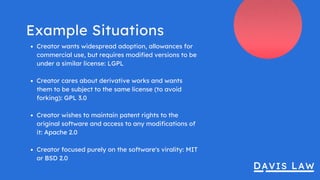
Example Situations
Creator wants widespread adoption, allowances for
commercial use, but requires modified versions to be
under a similar license: LGPL
Creator cares about derivative works and wants
them to be subject to the same license (to avoid
forking): GPL 3.0
Creator wishes to maintain patent rights to the
original software and access to any modifications of
it: Apache 2.0
Creator focused purely on the software's virality: MIT
or BSD 2.0
Ethical Open Source
Limiting the impact or unethical use of
open source software
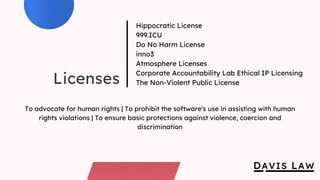
Licenses
Hippocratic License
999.ICU
Do No Harm License
inno3
Atmosphere Licenses
Corporate Accountability Lab Ethical IP Licensing
The Non-Violent Public License
To advocate for human rights | To prohibit the software's use in assisting with human
rights violations | To ensure basic protections against violence, coercion and
discrimination
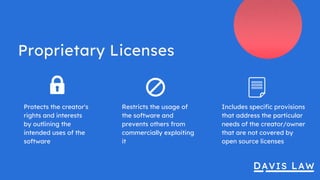
Proprietary Licenses
Protects the creator's
rights and interests
by outlining the
intended uses of the
software
Restricts the usage of
the software and
prevents others from
commercially exploiting
it
Includes specific provisions
that address the particular
needs of the creator/owner
that are not covered by
open source licenses
Interested in learning more?
Alex Davis
alexander@davislaw.io

Open Source Software Licensing

  • 1.
  • 2.
    "Licenses that complywith the Open Source Definition—in brief, they allow software to be freely used, modified, and shared.” - Open Source Initiative
  • 3.
  • 4.
    Competing Priorities Lowest adoptionv. controlled use Permissive Copyleft Proprietary/Custom-Made Widespread adoption v. lack of restrictions Lower adoption v. commercial restrictions
  • 5.
  • 6.
    Permissive Copyleft MIT BSD 2.0 Apache2.0 LGPL MPL AGPL GPL 3.0 Perl
  • 7.
    Example Situations Creator wantswidespread adoption, allowances for commercial use, but requires modified versions to be under a similar license: LGPL Creator cares about derivative works and wants them to be subject to the same license (to avoid forking): GPL 3.0 Creator wishes to maintain patent rights to the original software and access to any modifications of it: Apache 2.0 Creator focused purely on the software's virality: MIT or BSD 2.0
  • 8.
    Ethical Open Source Limitingthe impact or unethical use of open source software
  • 9.
    Licenses Hippocratic License 999.ICU Do NoHarm License inno3 Atmosphere Licenses Corporate Accountability Lab Ethical IP Licensing The Non-Violent Public License To advocate for human rights | To prohibit the software's use in assisting with human rights violations | To ensure basic protections against violence, coercion and discrimination
  • 10.
    Proprietary Licenses Protects thecreator's rights and interests by outlining the intended uses of the software Restricts the usage of the software and prevents others from commercially exploiting it Includes specific provisions that address the particular needs of the creator/owner that are not covered by open source licenses
  • 11.
    Interested in learningmore? Alex Davis alexander@davislaw.io