Open Innovation Team
Pilot phase review
500+
Academics
engaged
39
The Open Innovation Team
was set up in August 2016
to help Whitehall
departments generate
analysis and ideas by
deepening collaboration
with academics.
The team is supported by
Research Councils UK and
sponsored by four leading
universities: Bath,
Lancaster, Southampton &
Warwick.
41
58
46
27
1
125,000
Whitehall
events
Policy
projects
3
Academic
collaborations
Underway or under
discussion
Contributed by each partner
university
Policy
Announcements
PhD
Placements
Innovation
Prize
University
visits
1,000+
Followers
We do not have an exclusive relationship with our university partners, but
they do benefit from sponsoring us.
Most importantly, partner universities receive a range of agreed benefits
that lead us to collaborate more intensively with their academics and
students.
84%
The share of collaborations
under way or under discussion
accounted for by academics
from our partner universities.
More than half of our visits to
universities have been to
partners.
More than a quarter of our PhD
students have come from
partner universities.
53% 27%
“We’ve got so much to gain
from deepening collaboration
between academics and
officials. The Open Innovation
Team is doing an important job
and I’m delighted that it’s got
off to such a good start. I look
forward to even more success
in phase two.”
Jeremy Heywood,
Cabinet Secretary
This pack explains:
1. Why we set up the Open Innovation Team
2. What we’ve been trying to achieve
3. How we’ve been trying to do it
4. The impact we’ve had so far
5. How our partners have benefited
6. What we’ve learned
7. What we aim to do next
Vision
We think deeper collaboration between
academics and officials will lead to
better policy decisions.
But collaboration can be difficult so
we’ve created a specialist team to help
bridge the gap between the two
communities and develop more
effective ways of working with each
other.
By deepening collaboration we want to
accelerate innovation, make policy
more evidence-led and academic
research more demand-led.
We help departments generate analysis and
ideas by deepening collaboration with
academics.
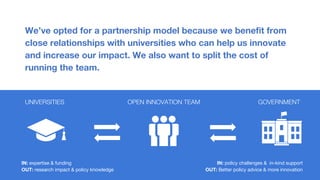
UNIVERSITIES OPEN INNOVATION TEAM GOVERNMENT
We’ve opted for a partnership model because we benefit from
close relationships with universities who can help us innovate
and increase our impact. We also want to split the cost of
running the team.
IN: expertise & funding
OUT: research impact & policy knowledge
IN: policy challenges & in-kind support
OUT: Better policy advice & more innovation
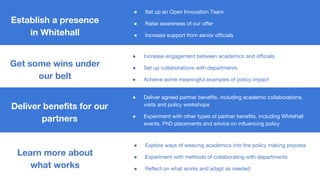
Pilot phase objectives
Establish a presence
in Whitehall
Get some wins under
our belt
Deliver benefits for our
partners
Learn more about
what works
● Set up an Open Innovation Team
● Raise awareness of our offer
● Increase support from senior officials
● Increase engagement between academics and officials
● Set up collaborations with departments
● Achieve some meaningful examples of policy impact
● Deliver agreed partner benefits, including academic collaborations,
visits and policy workshops
● Experiment with other types of partner benefits, including Whitehall
events, PhD placements and advice on influencing policy
● Explore ways of weaving academics into the policy making process
● Experiment with methods of collaborating with departments
● Reflect on what works and adapt as needed
Our approach
Whitehall
Departments
Open Innovation
Team
We’ve used the sponsorship income
received from our university partners to
establish a team of officials in the Cabinet
Office.
The team works flexibly across Whitehall
on a wide range of policy issues, including
mental health, digital transformation and
economic growth.
We try to be demand-led, meaning that we
focus primarily on responding to requests
for support from departments, rather than
approaching them with project ideas.
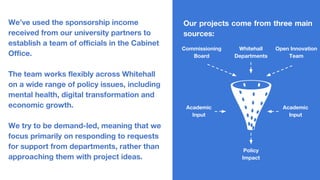
Commissioning
Board
Academic
Input
Academic
Input
Policy
Impact
Our projects come from three main
sources:
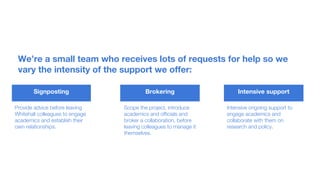
We’re a small team who receives lots of requests for help so we
vary the intensity of the support we offer:
Signposting
Provide advice before leaving
Whitehall colleagues to engage
academics and establish their
own relationships.
Brokering
Scope the project, introduce
academics and officials and
broker a collaboration, before
leaving colleagues to manage it
themselves.
Intensive ongoing support to
engage academics and
collaborate with them on
research and policy.
Intensive support
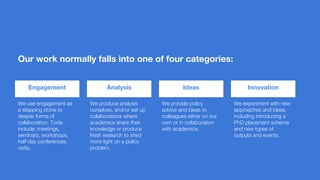
Our work normally falls into one of four categories:
Engagement
We use engagement as
a stepping stone to
deeper forms of
collaboration. Tools
include: meetings,
seminars, workshops,
half-day conferences,
visits.
Analysis Ideas Innovation
We produce analysis
ourselves, and/or set up
collaborations where
academics share their
knowledge or produce
fresh research to shed
more light on a policy
problem.
We provide policy
advice and ideas to
colleagues either on our
own or in collaboration
with academics.
We experiment with new
approaches and ideas,
including introducing a
PhD placement scheme
and new types of
outputs and events.
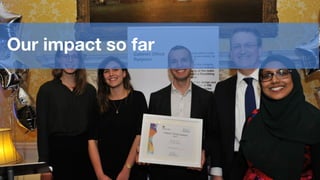
Our impact so far
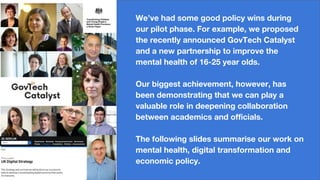
We’ve had some good policy wins during
our pilot phase. For example, we proposed
the recently announced GovTech Catalyst
and a new partnership to improve the
mental health of 16-25 year olds.
Our biggest achievement, however, has
been demonstrating that we can play a
valuable role in deepening collaboration
between academics and officials.
The following slides summarise our work on
mental health, digital transformation and
economic policy.
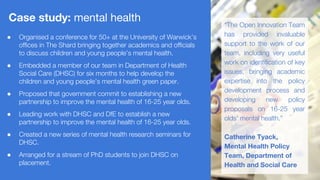
● Organised a conference for 50+ at the University of Warwick’s
offices in The Shard bringing together academics and officials
to discuss children and young people’s mental health.
● Embedded a member of our team in Department of Health
Social Care (DHSC) for six months to help develop the
children and young people’s mental health green paper.
● Proposed that government commit to establishing a new
partnership to improve the mental health of 16-25 year olds.
● Leading work with DHSC and DfE to establish a new
partnership to improve the mental health of 16-25 year olds.
● Created a new series of mental health research seminars for
DHSC.
● Arranged for a stream of PhD students to join DHSC on
placement.
Case study: mental health
“The Open Innovation Team
has provided invaluable
support to the work of our
team, including very useful
work on identification of key
issues, bringing academic
expertise into the policy
development process and
developing new policy
proposals on 16-25 year
olds’ mental health.”
Catherine Tyack,
Mental Health Policy
Team, Department of
Health and Social Care
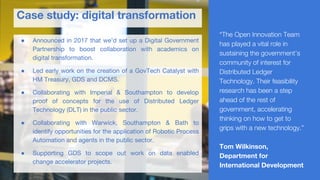
● Announced in 2017 that we’d set up a Digital Government
Partnership to boost collaboration with academics on
digital transformation.
● Led early work on the creation of a GovTech Catalyst with
HM Treasury, GDS and DCMS.
● Collaborating with Imperial & Southampton to develop
proof of concepts for the use of Distributed Ledger
Technology (DLT) in the public sector.
● Collaborating with Warwick, Southampton & Bath to
identify opportunities for the application of Robotic Process
Automation and agents in the public sector.
● Supporting GDS to scope out work on data enabled
change accelerator projects.
Case study: digital transformation
“The Open Innovation Team
has played a vital role in
sustaining the government’s
community of interest for
Distributed Ledger
Technology. Their feasibility
research has been a step
ahead of the rest of
government, accelerating
thinking on how to get to
grips with a new technology.”
Tom Wilkinson,
Department for
International Development
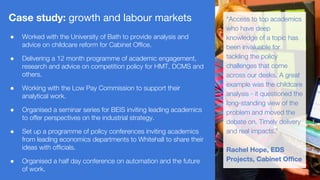
“Access to top academics
who have deep
knowledge of a topic has
been invaluable for
tackling the policy
challenges that come
across our desks. A great
example was the childcare
analysis - it questioned the
long-standing view of the
problem and moved the
debate on. Timely delivery
and real impacts.”
Rachel Hope, EDS
Projects, Cabinet Office
● Worked with the University of Bath to provide analysis and
advice on childcare reform for Cabinet Office.
● Delivering a 12 month programme of academic engagement,
research and advice on competition policy for HMT, DCMS and
others.
● Working with the Low Pay Commission to support their
analytical work.
● Organised a seminar series for BEIS inviting leading academics
to offer perspectives on the industrial strategy.
● Set up a programme of policy conferences inviting academics
from leading economics departments to Whitehall to share their
ideas with officials.
● Organised a half day conference on automation and the future
of work.
Case study: growth and labour markets
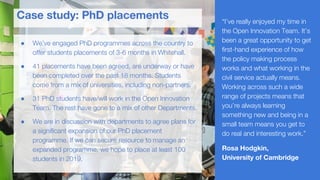
● We’ve engaged PhD programmes across the country to
offer students placements of 3-6 months in Whitehall.
● 41 placements have been agreed, are underway or have
been completed over the past 18 months. Students
come from a mix of universities, including non-partners.
● 31 PhD students have/will work in the Open Innovation
Team. The rest have gone to a mix of other Departments.
● We are in discussion with departments to agree plans for
a significant expansion of our PhD placement
programme. If we can secure resource to manage an
expanded programme, we hope to place at least 100
students in 2019.
Case study: PhD placements “I’ve really enjoyed my time in
the Open Innovation Team. It’s
been a great opportunity to get
first-hand experience of how
the policy making process
works and what working in the
civil service actually means.
Working across such a wide
range of projects means that
you’re always learning
something new and being in a
small team means you get to
do real and interesting work.”
Rosa Hodgkin,
University of Cambridge
How our partners have benefited
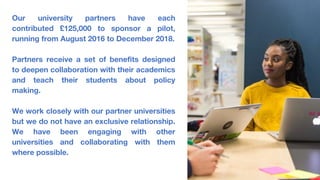
Our university partners have each
contributed £125,000 to sponsor a pilot,
running from August 2016 to December 2018.
Partners receive a set of benefits designed
to deepen collaboration with their academics
and teach their students about policy
making.
We work closely with our partner universities
but we do not have an exclusive relationship.
We have been engaging with other
universities and collaborating with them
where possible.
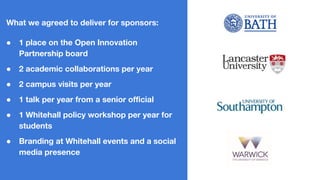
● 1 place on the Open Innovation
Partnership board
● 2 academic collaborations per year
● 2 campus visits per year
● 1 talk per year from a senior official
● 1 Whitehall policy workshop per year for
students
● Branding at Whitehall events and a social
media presence
What we agreed to deliver for sponsors:
Our approach to partner benefits has evolved over time as we
learn more about what works best for our partners.
Flexibility Prioritisation Experimentation
We originally thought we’d
bring academics into
Whitehall on three month
placements, but quickly
found that a more flexible
approach would be better
for both academics and
officials.
Arranging talks from senior
officials has been harder to
deliver than expected and is
less of a priority for partners
so we’ve focused instead on
talks from members of the
Open Innovation Team and
delivering academic
collaborations.
Partners have helped us
experiment with new ways of
adding value that benefit
both officials and
academics. For example,
they’ve helped us set up a
PhD placement scheme,
experiment with new events
formats, and introduce new
kinds of output.
• 9+ academic collaborations under way or under discussion
• 4 Open Innovation Team visits and 1 Policy Lab visit
• 3 policy events at Bath’s London office
• 2 Cabinet Office Policy School workshops for students
• 1 talk in our Whitehall speaker series, Thought Experiment
• 1 maths event as part of our conference series, Outside View
• 1 talk on industrial strategy as part of a series we created for BEIS
Our work with the University of Bath has so far focused on
labour market, health and social policy challenges, including
childcare reform, the minimum wage and loneliness.
• Quarterly partnership board meetings
• Branding on all Open Innovation Team outputs
• 2 PhD placements agreed or underway
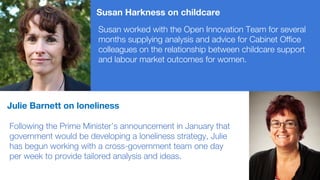
Susan Harkness on childcare
Susan worked with the Open Innovation Team for several
months supplying analysis and advice for Cabinet Office
colleagues on the relationship between childcare support
and labour market outcomes for women.
Julie Barnett on loneliness
Following the Prime Minister’s announcement in January that
government would be developing a loneliness strategy, Julie
has begun working with a cross-government team one day
per week to provide tailored analysis and ideas.
Our work with Lancaster University has so far focused primarily
on health, education, environment and innovation, including
intensive support for the Open Innovation Team itself.
• 8 academic collaborations under way or under discussion
• 5 Open Innovation Team visits to Lancaster
• 2 talks to academics on influencing policy
• 1 policy workshop for students, with another planned in Autumn 2018
• 1 talk in our Whitehall speaker series, Thought Experiment
• 1 innovation event as part of our conference series, Outside View
• Quarterly partnership board meetings
• Branding on all Open Innovation Team outputs
• 4 PhD placements completed or underway
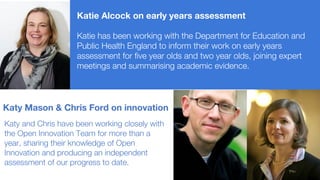
Katie Alcock on early years assessment
Katie has been working with the Department for Education and
Public Health England to inform their work on early years
assessment for five year olds and two year olds, joining expert
meetings and summarising academic evidence.
Katy Mason & Chris Ford on innovation
Katy and Chris have been working closely with
the Open Innovation Team for more than a
year, sharing their knowledge of Open
Innovation and producing an independent
assessment of our progress to date.
Our work with the University of Southampton is focusing primarily
on digital transformation and population change.
• 6 academic collaborations under way or under discussion
• 4 Open Innovation Team visits
• 1 visit with Cabinet Office and HMT to discuss research methods
• 1 visit with DCMS, GDS and others to discuss digital transformation
• 1 event in London for DWP on musculoskeletal health and work
• 2 Policy School workshops, with another planned in Autumn 2018
• 2 talks in our Whitehall speaker series, Thought Experiment
• Quarterly partnership board meetings
• Branding on all Open Innovation Team outputs
• 2 policy making talks to students
• 7 PhD placements completed or underway
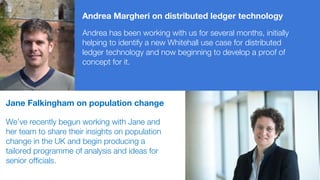
Andrea Margheri on distributed ledger technology
Andrea has been working with us for several months, initially
helping to identify a new Whitehall use case for distributed
ledger technology and now beginning to develop a proof of
concept for it.
Jane Falkingham on population change
We’ve recently begun working with Jane and
her team to share their insights on population
change in the UK and begin producing a
tailored programme of analysis and ideas for
senior officials.
Our work with the University of Warwick has so far focused
primarily on mental health, digital transformation and
productivity.
• 10+ academic collaborations under way or under discussion
• 4 Open Innovation Team visits
• 1 visit to Warwick with HMT and BEIS to discuss productivity
• 1 policy workshop for students, with another planned in Autumn 2018
• 1 talk in our Whitehall speaker series, Thought Experiment
• 1 event on productivity as part of our conference series, Outside View
• 1 talk on industrial strategy as part of a series we created for BEIS
• Quarterly partnership board meetings
• Branding on all Open Innovation Team outputs
• 1 mental health policy event at The Shard
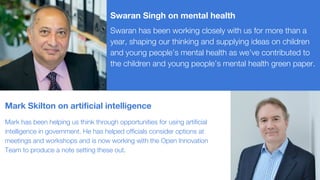
Swaran has been working closely with us for more than a
year, shaping our thinking and supplying ideas on children
and young people’s mental health as we’ve contributed to
the children and young people’s mental health green paper.
Mark has been helping us think through opportunities for using artificial
intelligence in government. He has helped officials consider options at
meetings and workshops and is now working with the Open Innovation
Team to produce a note setting these out.
Mark Skilton on artificial intelligence
Swaran Singh on mental health
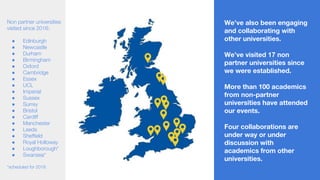
We’ve also been engaging
and collaborating with
other universities.
We’ve visited 17 non
partner universities since
we were established.
More than 100 academics
from non-partner
universities have attended
our events.
Four collaborations are
under way or under
discussion with
academics from other
universities.
Non partner universities
visited since 2016:
● Edinburgh
● Newcastle
● Durham
● Birmingham
● Oxford
● Cambridge
● Essex
● UCL
● Imperial
● Sussex
● Surrey
● Bristol
● Cardiff
● Manchester
● Leeds
● Sheffield
● Royal Holloway
● Loughborough*
● Swansea*
*scheduled for 2018
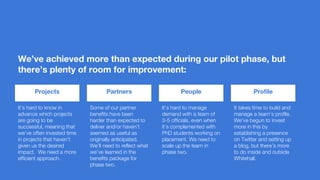
Lessons
We’ve achieved more than expected during our pilot phase, but
there’s plenty of room for improvement:
Projects
It’s hard to know in
advance which projects
are going to be
successful, meaning that
we’ve often invested time
in projects that haven’t
given us the desired
impact. We need a more
efficient approach.
Partners People Profile
Some of our partner
benefits have been
harder than expected to
deliver and/or haven’t
seemed as useful as
originally anticipated.
We’ll need to reflect what
we’ve learned in the
benefits package for
phase two.
It’s hard to manage
demand with a team of
3-5 officials, even when
it’s complemented with
PhD students working on
placement. We need to
scale up the team in
phase two.
It takes time to build and
manage a team’s profile.
We’ve begun to invest
more in this by
establishing a presence
on Twitter and setting up
a blog, but there’s more
to do inside and outside
Whitehall.
Next steps
Ministers and senior officials are keen to scale up the Open Innovation
Team so we’re inviting universities to sponsor a second phase:
Impact Partnership Competition
We want to deliver more
policy impact across a wider
range of topics and continue
the process of establishing
the team as a valued
contributor to the Whitehall
policy making process.
We see the partnership
approach adopted for the
Open Innovation Team as
successful and valuable,
both in terms of increasing
the impact we can achieve
with this kind of work and
splitting its cost. We intend
to adopt a similar approach
in phase two.
To secure a second round of
university sponsors, we will
run a competition inviting
interested UK universities to
submit proposals to Cabinet
Office. Applications will need
to cover a range of criteria,
including financial
contribution, partnership
benefits and research
excellence.
We expect the process for agreeing phase II sponsors to run as follows:
● 7th September: event with interested universities to explain our approach, answer questions
and receive feedback/ideas (e.g. on partner benefits).
● 28th September: deadline for formal sponsorship applications. A draft version of this form
can be found with the guidance document published alongside this slide pack.
● October-November: shortlisting and negotiation with preferred bidders.
● December: phase II partners announced.
● January: new package comes into effect.
Email us
openinnovation@cabinetoffice.gov.uk
Follow us on Twitter
@openinnovteam

Open Innovation Team pilot phase review

  • 1.
  • 2.
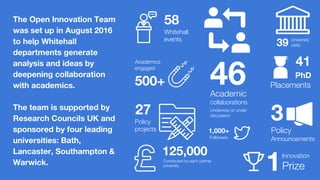
    500+ Academics engaged 39 The Open InnovationTeam was set up in August 2016 to help Whitehall departments generate analysis and ideas by deepening collaboration with academics. The team is supported by Research Councils UK and sponsored by four leading universities: Bath, Lancaster, Southampton & Warwick. 41 58 46 27 1 125,000 Whitehall events Policy projects 3 Academic collaborations Underway or under discussion Contributed by each partner university Policy Announcements PhD Placements Innovation Prize University visits 1,000+ Followers
  • 3.
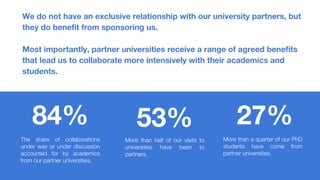
    We do nothave an exclusive relationship with our university partners, but they do benefit from sponsoring us. Most importantly, partner universities receive a range of agreed benefits that lead us to collaborate more intensively with their academics and students. 84% The share of collaborations under way or under discussion accounted for by academics from our partner universities. More than half of our visits to universities have been to partners. More than a quarter of our PhD students have come from partner universities. 53% 27%
  • 4.
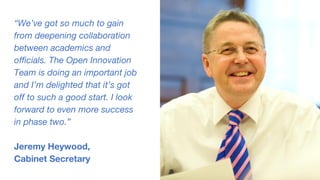
    “We’ve got somuch to gain from deepening collaboration between academics and officials. The Open Innovation Team is doing an important job and I’m delighted that it’s got off to such a good start. I look forward to even more success in phase two.” Jeremy Heywood, Cabinet Secretary
  • 5.
    This pack explains: 1.Why we set up the Open Innovation Team 2. What we’ve been trying to achieve 3. How we’ve been trying to do it 4. The impact we’ve had so far 5. How our partners have benefited 6. What we’ve learned 7. What we aim to do next
  • 6.
  • 7.
    We think deepercollaboration between academics and officials will lead to better policy decisions. But collaboration can be difficult so we’ve created a specialist team to help bridge the gap between the two communities and develop more effective ways of working with each other. By deepening collaboration we want to accelerate innovation, make policy more evidence-led and academic research more demand-led. We help departments generate analysis and ideas by deepening collaboration with academics.
  • 8.
    UNIVERSITIES OPEN INNOVATIONTEAM GOVERNMENT We’ve opted for a partnership model because we benefit from close relationships with universities who can help us innovate and increase our impact. We also want to split the cost of running the team. IN: expertise & funding OUT: research impact & policy knowledge IN: policy challenges & in-kind support OUT: Better policy advice & more innovation
  • 9.
  • 10.
    Establish a presence inWhitehall Get some wins under our belt Deliver benefits for our partners Learn more about what works ● Set up an Open Innovation Team ● Raise awareness of our offer ● Increase support from senior officials ● Increase engagement between academics and officials ● Set up collaborations with departments ● Achieve some meaningful examples of policy impact ● Deliver agreed partner benefits, including academic collaborations, visits and policy workshops ● Experiment with other types of partner benefits, including Whitehall events, PhD placements and advice on influencing policy ● Explore ways of weaving academics into the policy making process ● Experiment with methods of collaborating with departments ● Reflect on what works and adapt as needed
  • 11.
  • 12.
    Whitehall Departments Open Innovation Team We’ve usedthe sponsorship income received from our university partners to establish a team of officials in the Cabinet Office. The team works flexibly across Whitehall on a wide range of policy issues, including mental health, digital transformation and economic growth. We try to be demand-led, meaning that we focus primarily on responding to requests for support from departments, rather than approaching them with project ideas. Commissioning Board Academic Input Academic Input Policy Impact Our projects come from three main sources:
  • 13.
    We’re a smallteam who receives lots of requests for help so we vary the intensity of the support we offer: Signposting Provide advice before leaving Whitehall colleagues to engage academics and establish their own relationships. Brokering Scope the project, introduce academics and officials and broker a collaboration, before leaving colleagues to manage it themselves. Intensive ongoing support to engage academics and collaborate with them on research and policy. Intensive support
  • 14.
    Our work normallyfalls into one of four categories: Engagement We use engagement as a stepping stone to deeper forms of collaboration. Tools include: meetings, seminars, workshops, half-day conferences, visits. Analysis Ideas Innovation We produce analysis ourselves, and/or set up collaborations where academics share their knowledge or produce fresh research to shed more light on a policy problem. We provide policy advice and ideas to colleagues either on our own or in collaboration with academics. We experiment with new approaches and ideas, including introducing a PhD placement scheme and new types of outputs and events.
  • 15.
  • 16.
    We’ve had somegood policy wins during our pilot phase. For example, we proposed the recently announced GovTech Catalyst and a new partnership to improve the mental health of 16-25 year olds. Our biggest achievement, however, has been demonstrating that we can play a valuable role in deepening collaboration between academics and officials. The following slides summarise our work on mental health, digital transformation and economic policy.
  • 17.
    ● Organised aconference for 50+ at the University of Warwick’s offices in The Shard bringing together academics and officials to discuss children and young people’s mental health. ● Embedded a member of our team in Department of Health Social Care (DHSC) for six months to help develop the children and young people’s mental health green paper. ● Proposed that government commit to establishing a new partnership to improve the mental health of 16-25 year olds. ● Leading work with DHSC and DfE to establish a new partnership to improve the mental health of 16-25 year olds. ● Created a new series of mental health research seminars for DHSC. ● Arranged for a stream of PhD students to join DHSC on placement. Case study: mental health “The Open Innovation Team has provided invaluable support to the work of our team, including very useful work on identification of key issues, bringing academic expertise into the policy development process and developing new policy proposals on 16-25 year olds’ mental health.” Catherine Tyack, Mental Health Policy Team, Department of Health and Social Care
  • 18.
    ● Announced in2017 that we’d set up a Digital Government Partnership to boost collaboration with academics on digital transformation. ● Led early work on the creation of a GovTech Catalyst with HM Treasury, GDS and DCMS. ● Collaborating with Imperial & Southampton to develop proof of concepts for the use of Distributed Ledger Technology (DLT) in the public sector. ● Collaborating with Warwick, Southampton & Bath to identify opportunities for the application of Robotic Process Automation and agents in the public sector. ● Supporting GDS to scope out work on data enabled change accelerator projects. Case study: digital transformation “The Open Innovation Team has played a vital role in sustaining the government’s community of interest for Distributed Ledger Technology. Their feasibility research has been a step ahead of the rest of government, accelerating thinking on how to get to grips with a new technology.” Tom Wilkinson, Department for International Development
  • 19.
    “Access to topacademics who have deep knowledge of a topic has been invaluable for tackling the policy challenges that come across our desks. A great example was the childcare analysis - it questioned the long-standing view of the problem and moved the debate on. Timely delivery and real impacts.” Rachel Hope, EDS Projects, Cabinet Office ● Worked with the University of Bath to provide analysis and advice on childcare reform for Cabinet Office. ● Delivering a 12 month programme of academic engagement, research and advice on competition policy for HMT, DCMS and others. ● Working with the Low Pay Commission to support their analytical work. ● Organised a seminar series for BEIS inviting leading academics to offer perspectives on the industrial strategy. ● Set up a programme of policy conferences inviting academics from leading economics departments to Whitehall to share their ideas with officials. ● Organised a half day conference on automation and the future of work. Case study: growth and labour markets
  • 20.
    ● We’ve engagedPhD programmes across the country to offer students placements of 3-6 months in Whitehall. ● 41 placements have been agreed, are underway or have been completed over the past 18 months. Students come from a mix of universities, including non-partners. ● 31 PhD students have/will work in the Open Innovation Team. The rest have gone to a mix of other Departments. ● We are in discussion with departments to agree plans for a significant expansion of our PhD placement programme. If we can secure resource to manage an expanded programme, we hope to place at least 100 students in 2019. Case study: PhD placements “I’ve really enjoyed my time in the Open Innovation Team. It’s been a great opportunity to get first-hand experience of how the policy making process works and what working in the civil service actually means. Working across such a wide range of projects means that you’re always learning something new and being in a small team means you get to do real and interesting work.” Rosa Hodgkin, University of Cambridge
  • 21.
    How our partnershave benefited
  • 22.
    Our university partnershave each contributed £125,000 to sponsor a pilot, running from August 2016 to December 2018. Partners receive a set of benefits designed to deepen collaboration with their academics and teach their students about policy making. We work closely with our partner universities but we do not have an exclusive relationship. We have been engaging with other universities and collaborating with them where possible.
  • 23.
    ● 1 placeon the Open Innovation Partnership board ● 2 academic collaborations per year ● 2 campus visits per year ● 1 talk per year from a senior official ● 1 Whitehall policy workshop per year for students ● Branding at Whitehall events and a social media presence What we agreed to deliver for sponsors:
  • 24.
    Our approach topartner benefits has evolved over time as we learn more about what works best for our partners. Flexibility Prioritisation Experimentation We originally thought we’d bring academics into Whitehall on three month placements, but quickly found that a more flexible approach would be better for both academics and officials. Arranging talks from senior officials has been harder to deliver than expected and is less of a priority for partners so we’ve focused instead on talks from members of the Open Innovation Team and delivering academic collaborations. Partners have helped us experiment with new ways of adding value that benefit both officials and academics. For example, they’ve helped us set up a PhD placement scheme, experiment with new events formats, and introduce new kinds of output.
  • 25.
    • 9+ academiccollaborations under way or under discussion • 4 Open Innovation Team visits and 1 Policy Lab visit • 3 policy events at Bath’s London office • 2 Cabinet Office Policy School workshops for students • 1 talk in our Whitehall speaker series, Thought Experiment • 1 maths event as part of our conference series, Outside View • 1 talk on industrial strategy as part of a series we created for BEIS Our work with the University of Bath has so far focused on labour market, health and social policy challenges, including childcare reform, the minimum wage and loneliness. • Quarterly partnership board meetings • Branding on all Open Innovation Team outputs • 2 PhD placements agreed or underway
  • 26.
    Susan Harkness onchildcare Susan worked with the Open Innovation Team for several months supplying analysis and advice for Cabinet Office colleagues on the relationship between childcare support and labour market outcomes for women. Julie Barnett on loneliness Following the Prime Minister’s announcement in January that government would be developing a loneliness strategy, Julie has begun working with a cross-government team one day per week to provide tailored analysis and ideas.
  • 27.
    Our work withLancaster University has so far focused primarily on health, education, environment and innovation, including intensive support for the Open Innovation Team itself. • 8 academic collaborations under way or under discussion • 5 Open Innovation Team visits to Lancaster • 2 talks to academics on influencing policy • 1 policy workshop for students, with another planned in Autumn 2018 • 1 talk in our Whitehall speaker series, Thought Experiment • 1 innovation event as part of our conference series, Outside View • Quarterly partnership board meetings • Branding on all Open Innovation Team outputs • 4 PhD placements completed or underway
  • 28.
    Katie Alcock onearly years assessment Katie has been working with the Department for Education and Public Health England to inform their work on early years assessment for five year olds and two year olds, joining expert meetings and summarising academic evidence. Katy Mason & Chris Ford on innovation Katy and Chris have been working closely with the Open Innovation Team for more than a year, sharing their knowledge of Open Innovation and producing an independent assessment of our progress to date.
  • 29.
    Our work withthe University of Southampton is focusing primarily on digital transformation and population change. • 6 academic collaborations under way or under discussion • 4 Open Innovation Team visits • 1 visit with Cabinet Office and HMT to discuss research methods • 1 visit with DCMS, GDS and others to discuss digital transformation • 1 event in London for DWP on musculoskeletal health and work • 2 Policy School workshops, with another planned in Autumn 2018 • 2 talks in our Whitehall speaker series, Thought Experiment • Quarterly partnership board meetings • Branding on all Open Innovation Team outputs • 2 policy making talks to students • 7 PhD placements completed or underway
  • 30.
    Andrea Margheri ondistributed ledger technology Andrea has been working with us for several months, initially helping to identify a new Whitehall use case for distributed ledger technology and now beginning to develop a proof of concept for it. Jane Falkingham on population change We’ve recently begun working with Jane and her team to share their insights on population change in the UK and begin producing a tailored programme of analysis and ideas for senior officials.
  • 31.
    Our work withthe University of Warwick has so far focused primarily on mental health, digital transformation and productivity. • 10+ academic collaborations under way or under discussion • 4 Open Innovation Team visits • 1 visit to Warwick with HMT and BEIS to discuss productivity • 1 policy workshop for students, with another planned in Autumn 2018 • 1 talk in our Whitehall speaker series, Thought Experiment • 1 event on productivity as part of our conference series, Outside View • 1 talk on industrial strategy as part of a series we created for BEIS • Quarterly partnership board meetings • Branding on all Open Innovation Team outputs • 1 mental health policy event at The Shard
  • 32.
    Swaran has beenworking closely with us for more than a year, shaping our thinking and supplying ideas on children and young people’s mental health as we’ve contributed to the children and young people’s mental health green paper. Mark has been helping us think through opportunities for using artificial intelligence in government. He has helped officials consider options at meetings and workshops and is now working with the Open Innovation Team to produce a note setting these out. Mark Skilton on artificial intelligence Swaran Singh on mental health
  • 33.
    We’ve also beenengaging and collaborating with other universities. We’ve visited 17 non partner universities since we were established. More than 100 academics from non-partner universities have attended our events. Four collaborations are under way or under discussion with academics from other universities. Non partner universities visited since 2016: ● Edinburgh ● Newcastle ● Durham ● Birmingham ● Oxford ● Cambridge ● Essex ● UCL ● Imperial ● Sussex ● Surrey ● Bristol ● Cardiff ● Manchester ● Leeds ● Sheffield ● Royal Holloway ● Loughborough* ● Swansea* *scheduled for 2018
  • 34.
  • 35.
    We’ve achieved morethan expected during our pilot phase, but there’s plenty of room for improvement: Projects It’s hard to know in advance which projects are going to be successful, meaning that we’ve often invested time in projects that haven’t given us the desired impact. We need a more efficient approach. Partners People Profile Some of our partner benefits have been harder than expected to deliver and/or haven’t seemed as useful as originally anticipated. We’ll need to reflect what we’ve learned in the benefits package for phase two. It’s hard to manage demand with a team of 3-5 officials, even when it’s complemented with PhD students working on placement. We need to scale up the team in phase two. It takes time to build and manage a team’s profile. We’ve begun to invest more in this by establishing a presence on Twitter and setting up a blog, but there’s more to do inside and outside Whitehall.
  • 36.
  • 37.
    Ministers and seniorofficials are keen to scale up the Open Innovation Team so we’re inviting universities to sponsor a second phase: Impact Partnership Competition We want to deliver more policy impact across a wider range of topics and continue the process of establishing the team as a valued contributor to the Whitehall policy making process. We see the partnership approach adopted for the Open Innovation Team as successful and valuable, both in terms of increasing the impact we can achieve with this kind of work and splitting its cost. We intend to adopt a similar approach in phase two. To secure a second round of university sponsors, we will run a competition inviting interested UK universities to submit proposals to Cabinet Office. Applications will need to cover a range of criteria, including financial contribution, partnership benefits and research excellence.
  • 38.
    We expect theprocess for agreeing phase II sponsors to run as follows: ● 7th September: event with interested universities to explain our approach, answer questions and receive feedback/ideas (e.g. on partner benefits). ● 28th September: deadline for formal sponsorship applications. A draft version of this form can be found with the guidance document published alongside this slide pack. ● October-November: shortlisting and negotiation with preferred bidders. ● December: phase II partners announced. ● January: new package comes into effect.
  • 39.