Uniform Open ChannelFlow
Basic relationships
Continuity equation
Energy equation
Momentum equation
Resistance equations
2.
Flow in Streams
Open Channel Hydraulics
Resistance Equations
Compound Channel
Introduction
Effective Discharge
Shear Stresses
Pattern & Profile
• Sediment Transport
• Bed Load Movement
• Land Use and Land Use Change
3.
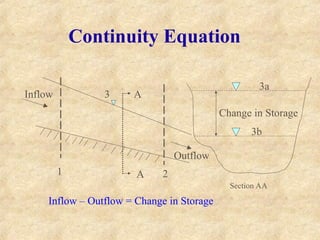
Continuity Equation
Inflow –Outflow = Change in Storage
Inflow
1 2
A
A
3
Section AA
Change in Storage
Outflow
3a
3b
4.
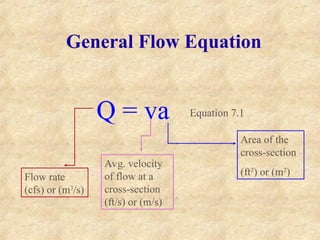
General Flow Equation
Q= va
Flow rate
(cfs) or (m3
/s)
Avg. velocity
of flow at a
cross-section
(ft/s) or (m/s)
Area of the
cross-section
(ft2
) or (m2
)
Equation 7.1
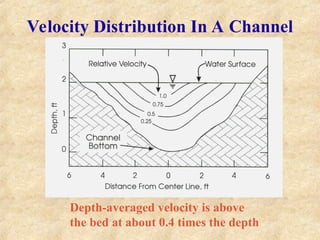
Velocity Distribution InA Channel
Depth-averaged velocity is above
the bed at about 0.4 times the depth
7.
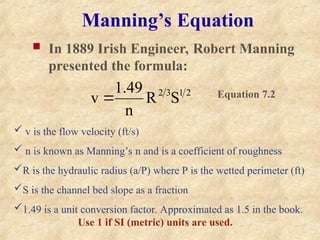
Manning’s Equation
In1889 Irish Engineer, Robert Manning
presented the formula:
2
1
3
2
S
R
n
49
.
1
v
v is the flow velocity (ft/s)
n is known as Manning’s n and is a coefficient of roughness
R is the hydraulic radius (a/P) where P is the wetted perimeter (ft)
S is the channel bed slope as a fraction
1.49 is a unit conversion factor. Approximated as 1.5 in the book.
Use 1 if SI (metric) units are used.
Equation 7.2
8.
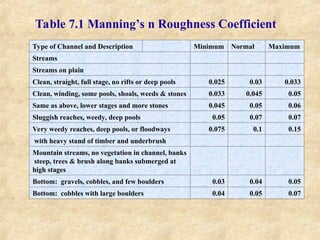
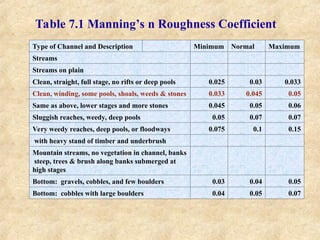
Type of Channeland Description Minimum Normal Maximum
Streams
Streams on plain
Clean, straight, full stage, no rifts or deep pools 0.025 0.03 0.033
Clean, winding, some pools, shoals, weeds & stones 0.033 0.045 0.05
Same as above, lower stages and more stones 0.045 0.05 0.06
Sluggish reaches, weedy, deep pools 0.05 0.07 0.07
Very weedy reaches, deep pools, or floodways 0.075 0.1 0.15
with heavy stand of timber and underbrush
Mountain streams, no vegetation in channel, banks
steep, trees & brush along banks submerged at
high stages
Bottom: gravels, cobbles, and few boulders 0.03 0.04 0.05
Bottom: cobbles with large boulders 0.04 0.05 0.07
Table 7.1 Manning’s n Roughness Coefficient
9.
Coarse Gravel 0.027
Degreeof irregularity Smooth n1 0.000
Minor 0.005
Moderate 0.010
Severe 0.020
Variations of Channel Cross Section Gradual n2 0.000
Alternating Occasionally 0.005
Alternating Frequently 0.010-0.015
Relative Effect of Obstructions Negligible n3 0.000
Minor 0.010-0.015
Appreciable 0.020-0.030
Severe 0.040-0.060
Vegetation Low n4 0.005-0.010
Medium 0.010-0.025
High 0.025-0.050
10.
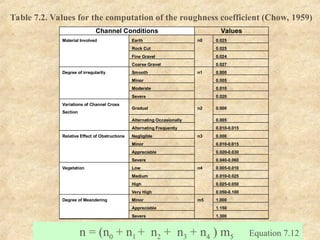
Channel Conditions Values
MaterialInvolved Earth n0 0.025
Rock Cut 0.025
Fine Gravel 0.024
Coarse Gravel 0.027
Degree of irregularity Smooth n1 0.000
Minor 0.005
Moderate 0.010
Severe 0.020
Variations of Channel Cross
Section
Gradual n2 0.000
Alternating Occasionally 0.005
Alternating Frequently 0.010-0.015
Relative Effect of Obstructions Negligible n3 0.000
Minor 0.010-0.015
Appreciable 0.020-0.030
Severe 0.040-0.060
Vegetation Low n4 0.005-0.010
Medium 0.010-0.025
High 0.025-0.050
Very High 0.050-0.100
Degree of Meandering Minor m5 1.000
Appreciable 1.150
Severe 1.300
Table 7.2. Values for the computation of the roughness coefficient (Chow, 1959)
n = (n0 + n1 + n2 + n3 + n4 ) m5 Equation 7.12
11.
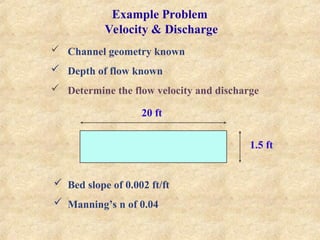
Example Problem
Velocity &Discharge
Channel geometry known
Depth of flow known
Determine the flow velocity and discharge
20 ft
1.5 ft
Bed slope of 0.002 ft/ft
Manning’s n of 0.04
12.
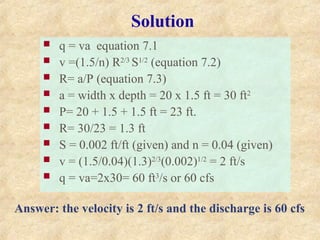
Solution
q =va equation 7.1
v =(1.5/n) R2/3
S1/2
(equation 7.2)
R= a/P (equation 7.3)
a = width x depth = 20 x 1.5 ft = 30 ft2
P= 20 + 1.5 + 1.5 ft = 23 ft.
R= 30/23 = 1.3 ft
S = 0.002 ft/ft (given) and n = 0.04 (given)
v = (1.5/0.04)(1.3)2/3
(0.002)1/2
= 2 ft/s
q = va=2x30= 60 ft3
/s or 60 cfs
Answer: the velocity is 2 ft/s and the discharge is 60 cfs
13.
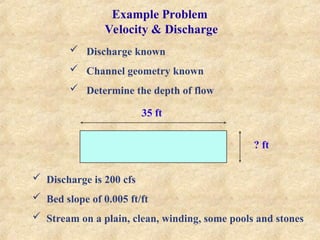
Example Problem
Velocity &Discharge
Discharge known
Channel geometry known
Determine the depth of flow
35 ft
? ft
Discharge is 200 cfs
Bed slope of 0.005 ft/ft
Stream on a plain, clean, winding, some pools and stones
14.
Type of Channeland Description Minimum Normal Maximum
Streams
Streams on plain
Clean, straight, full stage, no rifts or deep pools 0.025 0.03 0.033
Clean, winding, some pools, shoals, weeds & stones 0.033 0.045 0.05
Same as above, lower stages and more stones 0.045 0.05 0.06
Sluggish reaches, weedy, deep pools 0.05 0.07 0.07
Very weedy reaches, deep pools, or floodways 0.075 0.1 0.15
with heavy stand of timber and underbrush
Mountain streams, no vegetation in channel, banks
steep, trees & brush along banks submerged at
high stages
Bottom: gravels, cobbles, and few boulders 0.03 0.04 0.05
Bottom: cobbles with large boulders 0.04 0.05 0.07
Table 7.1 Manning’s n Roughness Coefficient
15.
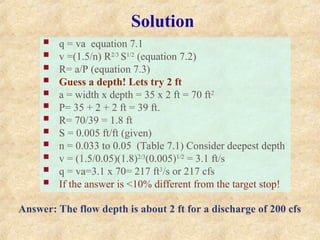
Solution
q =va equation 7.1
v =(1.5/n) R2/3
S1/2
(equation 7.2)
R= a/P (equation 7.3)
Guess a depth! Lets try 2 ft
a = width x depth = 35 x 2 ft = 70 ft2
P= 35 + 2 + 2 ft = 39 ft.
R= 70/39 = 1.8 ft
S = 0.005 ft/ft (given)
n = 0.033 to 0.05 (Table 7.1) Consider deepest depth
v = (1.5/0.05)(1.8)2/3
(0.005)1/2
= 3.1 ft/s
q = va=3.1 x 70= 217 ft3
/s or 217 cfs
If the answer is <10% different from the target stop!
Answer: The flow depth is about 2 ft for a discharge of 200 cfs
16.
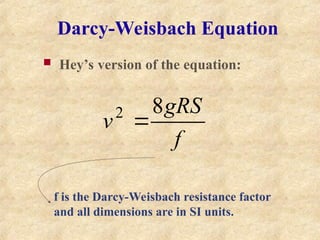
Darcy-Weisbach Equation
Hey’sversion of the equation:
f is the Darcy-Weisbach resistance factor
and all dimensions are in SI units.
f
gRS
v
8
2
17.
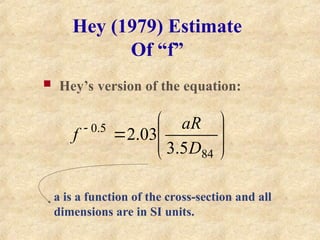
Hey (1979) Estimate
Of“f”
Hey’s version of the equation:
a is a function of the cross-section and all
dimensions are in SI units.
84
5
.
0
5
.
3
03
.
2
D
aR
f
18.
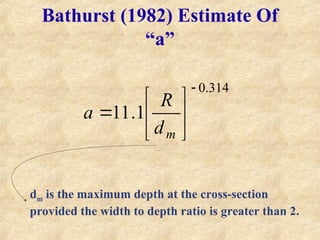
Bathurst (1982) EstimateOf
“a”
dm is the maximum depth at the cross-section
provided the width to depth ratio is greater than 2.
314
.
0
1
.
11
m
d
R
a
19.
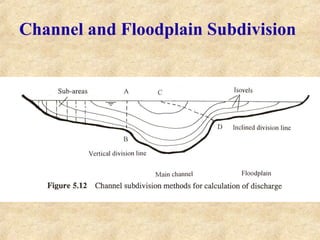
Flow in CompoundChannels
Most flow occurs in main channel; however
during flood events overbank flows may
occur.
In this case the channel is broken into cross-
sectional parts and the sum of the flow is
calculated for the various parts.
20.
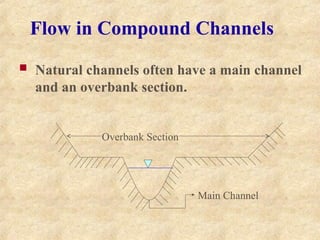
Flow in CompoundChannels
Natural channels often have a main channel
and an overbank section.
Main Channel
Overbank Section
21.
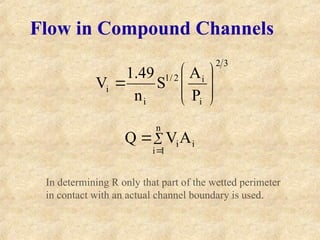
Flow in CompoundChannels
3
2
i
i
2
/
1
i
i
P
A
S
n
49
.
1
V
i
n
1
i
iA
V
Q
In determining R only that part of the wetted perimeter
in contact with an actual channel boundary is used.
#1 Chapter 4:
What are we talking about when we say open channel hydraulics.
Fluid flow through open channels
Examples of open channels:
Drainage Ditches
Irrigation ditches
culverts
streams
rivers
The difference between open channel hydraulics and pipe flow is that open channel flow is acting under atmospheric pressure, however both pipe flow and open channel flow are subject to the same general relationships.
#3 The continuity equation simply says that inflow minus outflow is equal to change in storage.
#4 The general flow equation we are all familiar with says that the flow rate, Q, is equal to the avg. velocity of the flow at a cross-section multiplied by the area of the cross-section.
We are talking about the avg. flow rate of the cross-section here. In reality the flow velocity along a boundary such as the channel wall will be zero. Figure 4.2 in the book shows typical flow profiles for different channel cross sections.