Open by default:
the challenges of
research data in Europe
Jean-François Dechamp
European Commission, Directorate-General for Research & Innovation
@OpenAccessEC
3rd LEARN Workshop, 28 June 2016, Helsinki
Challenges
Wider access to scientific facts and knowledge
helps researchers, innovators and the public
find and re-use data, and check research
results
• Offers better value for research funds: a public benefit
• Encourages research across scientific fields: essential
for solving today's complex societal challenges
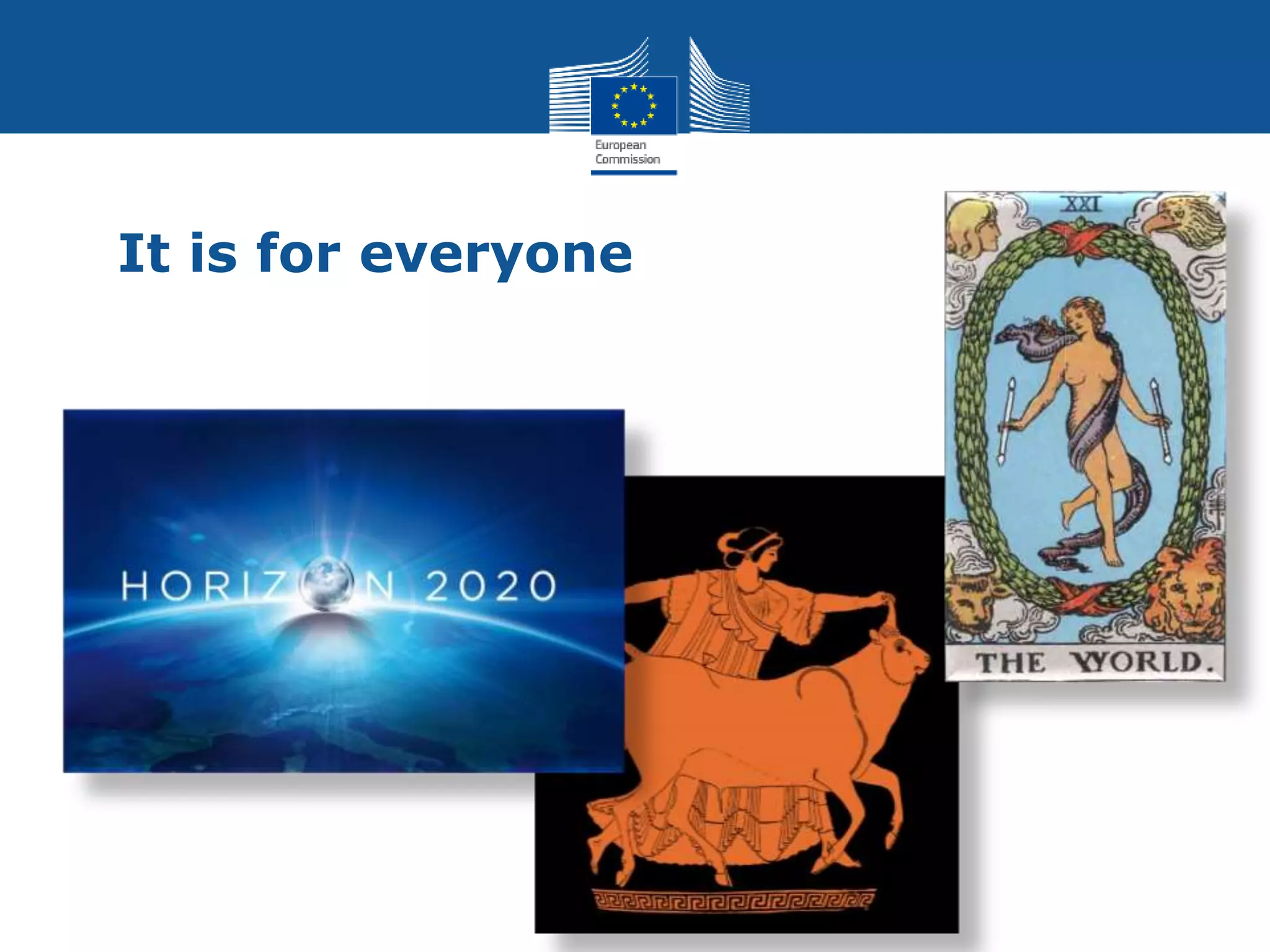
It is for everyone
Solution
Horizon 2020 already mandates open
access to all scientific publications
From 2017, research data is open by default,
with possibilities to opt out
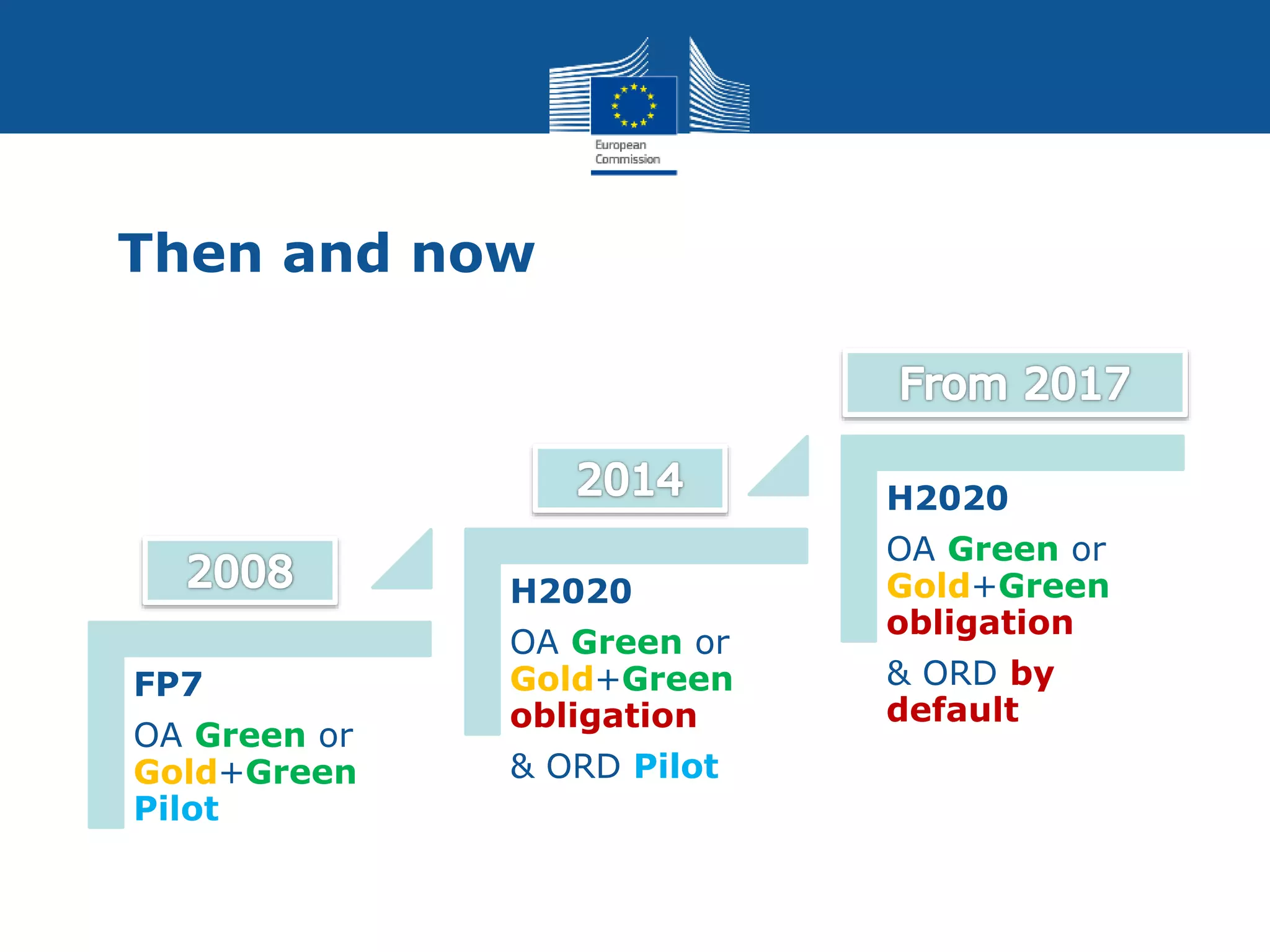
Then and now
FP7
OA Green or
Gold+Green
Pilot
H2020
OA Green or
Gold+Green
obligation
& ORD Pilot
H2020
OA Green or
Gold+Green
obligation
& ORD by
default
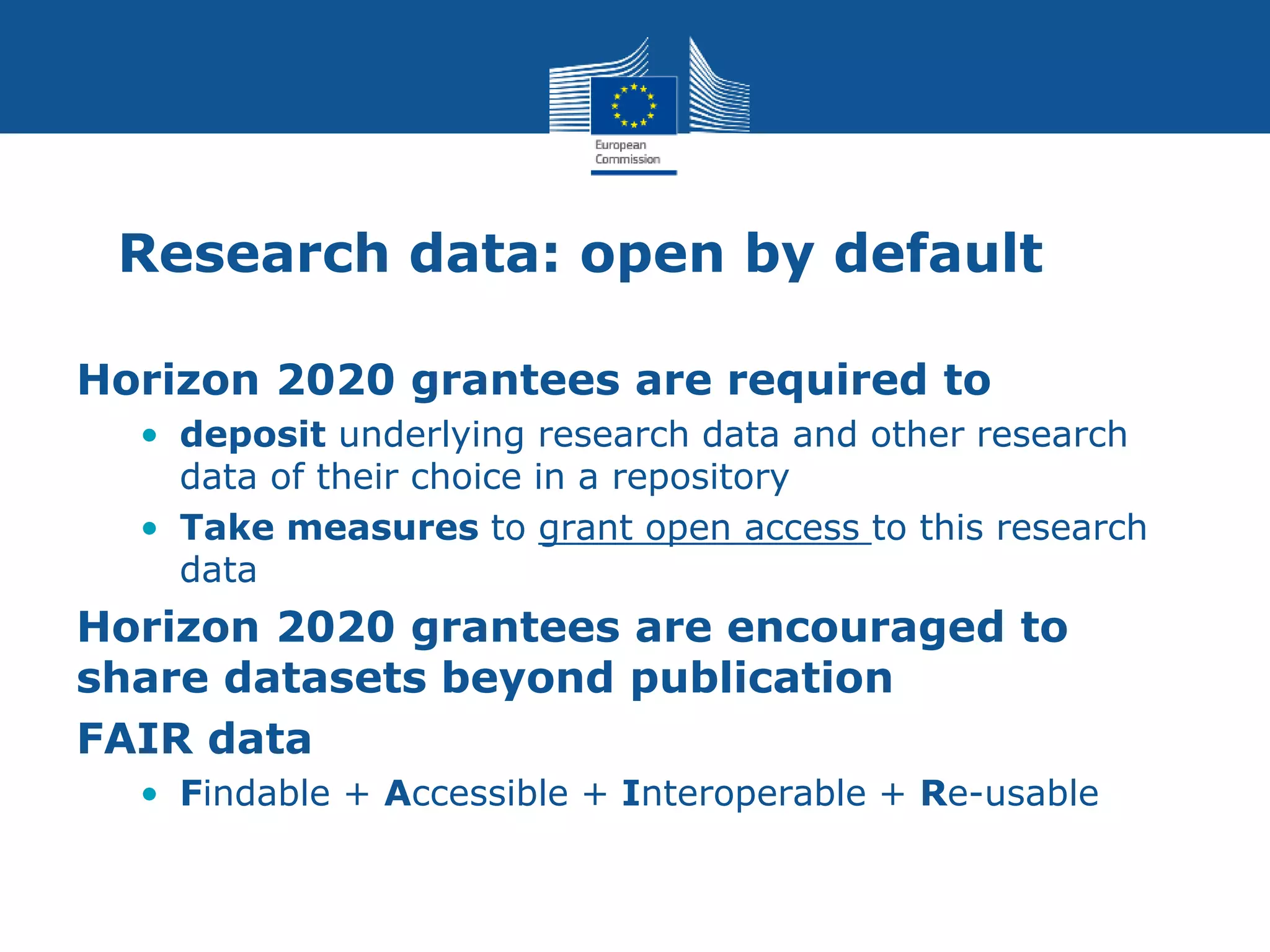
Research data: open by default
Horizon 2020 grantees are required to
• deposit underlying research data and other research
data of their choice in a repository
• Take measures to grant open access to this research
data
Horizon 2020 grantees are encouraged to
share datasets beyond publication
FAIR data
• Findable + Accessible + Interoperable + Re-usable
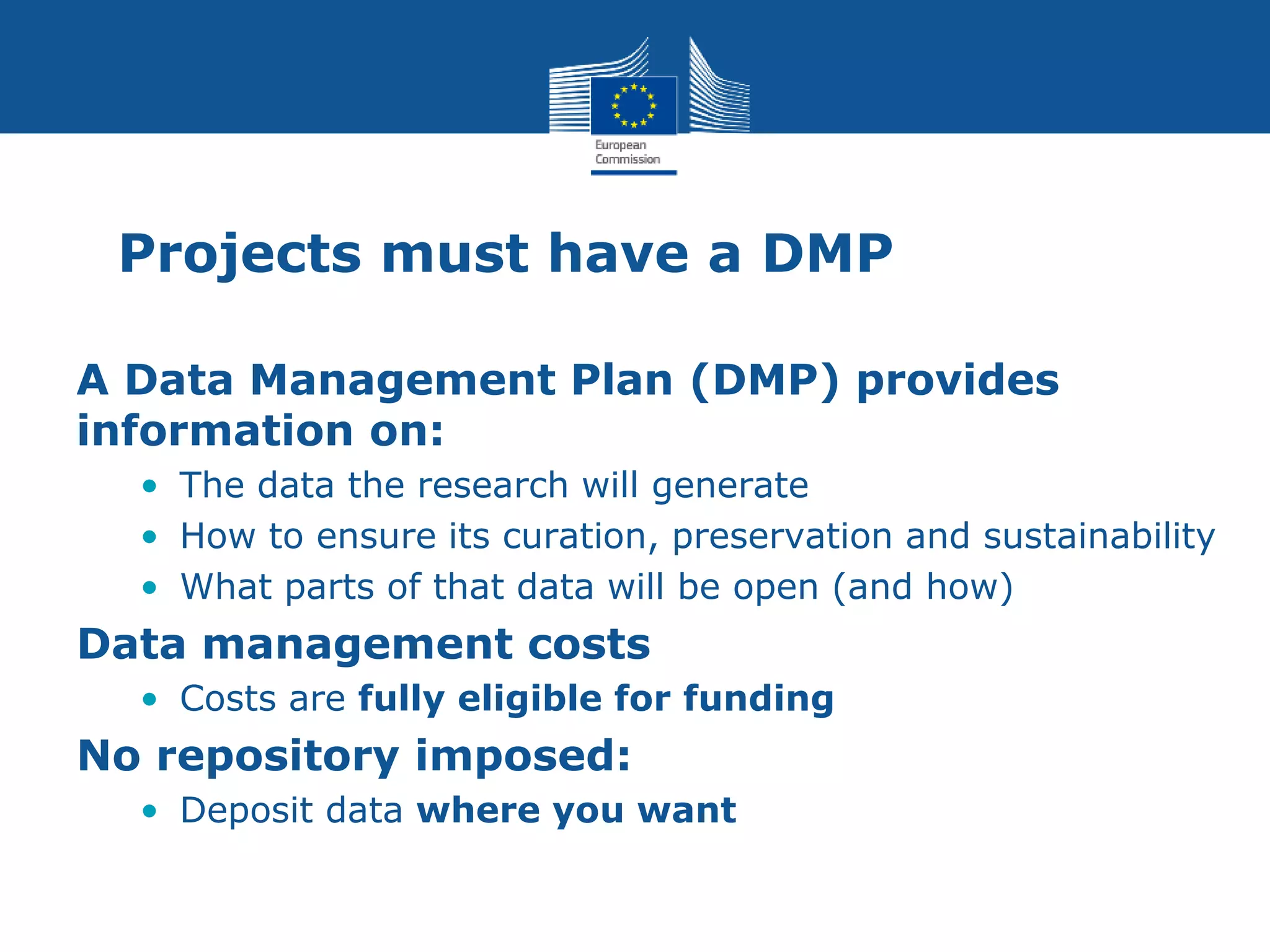
Projects must have a DMP
A Data Management Plan (DMP) provides
information on:
• The data the research will generate
• How to ensure its curation, preservation and sustainability
• What parts of that data will be open (and how)
Data management costs
• Costs are fully eligible for funding
No repository imposed:
• Deposit data where you want
As open as possible, as closed as
necessary
Grantees have the right to opt-out
• At any time
• But they need to say why
Top three reasons for opt-out
1. Intellectual property rights
2. Privacy
3. Might jeopardise project's main objective
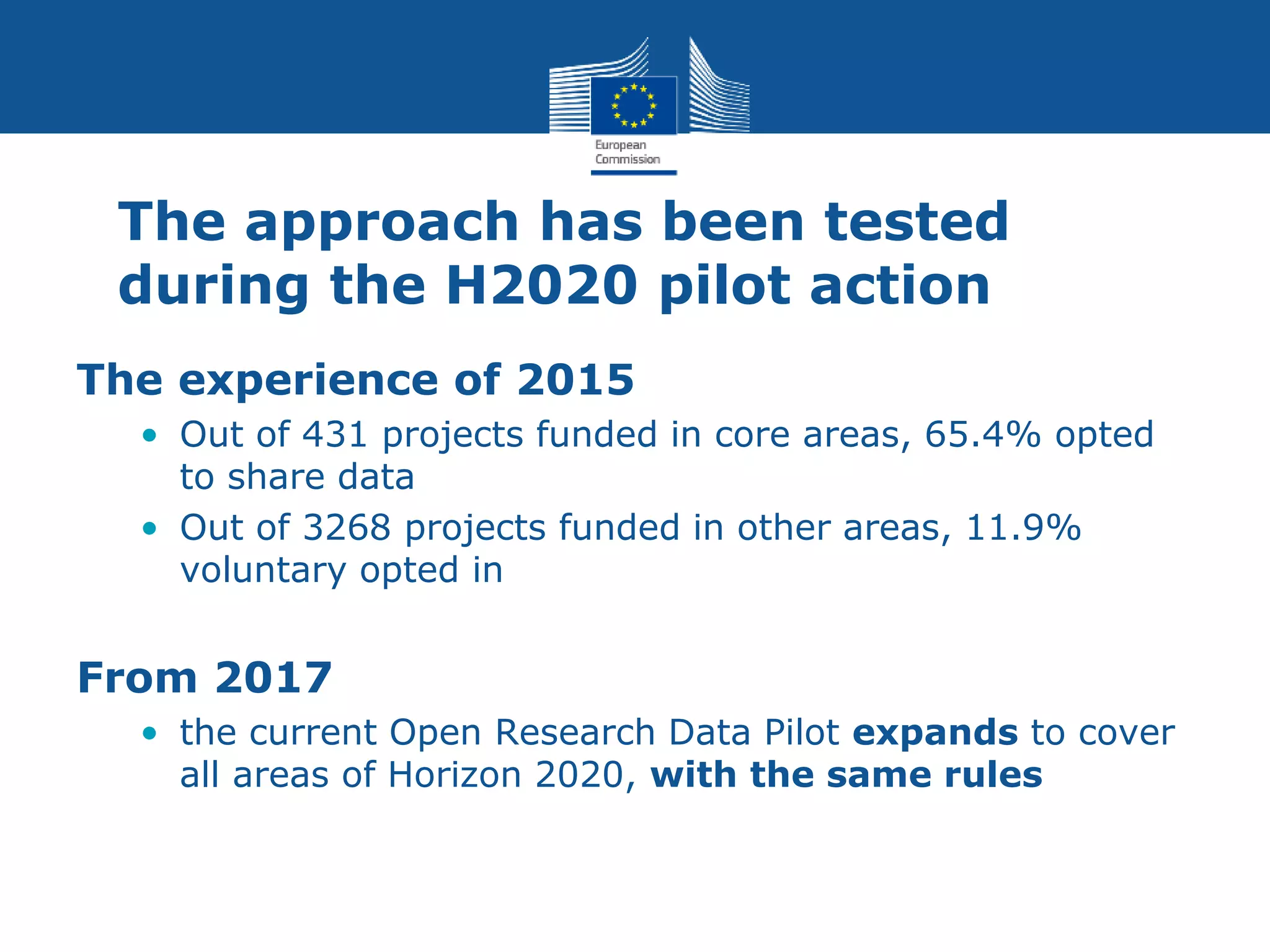
The approach has been tested
during the H2020 pilot action
The experience of 2015
• Out of 431 projects funded in core areas, 65.4% opted
to share data
• Out of 3268 projects funded in other areas, 11.9%
voluntary opted in
From 2017
• the current Open Research Data Pilot expands to cover
all areas of Horizon 2020, with the same rules
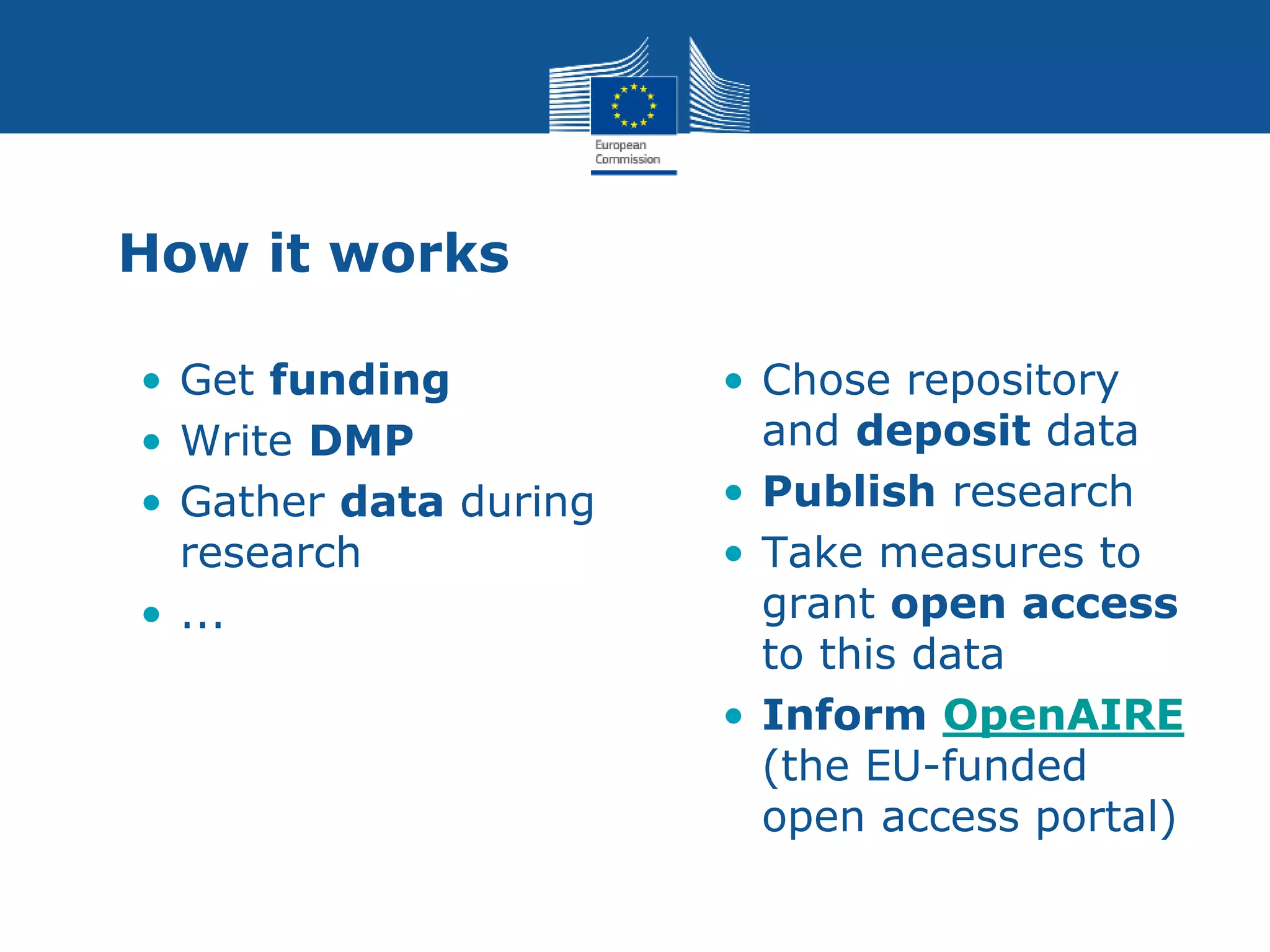
How it works
• Get funding
• Write DMP
• Gather data during
research
• ...
• Chose repository
and deposit data
• Publish research
• Take measures to
grant open access
to this data
• Inform OpenAIRE
(the EU-funded
open access portal)
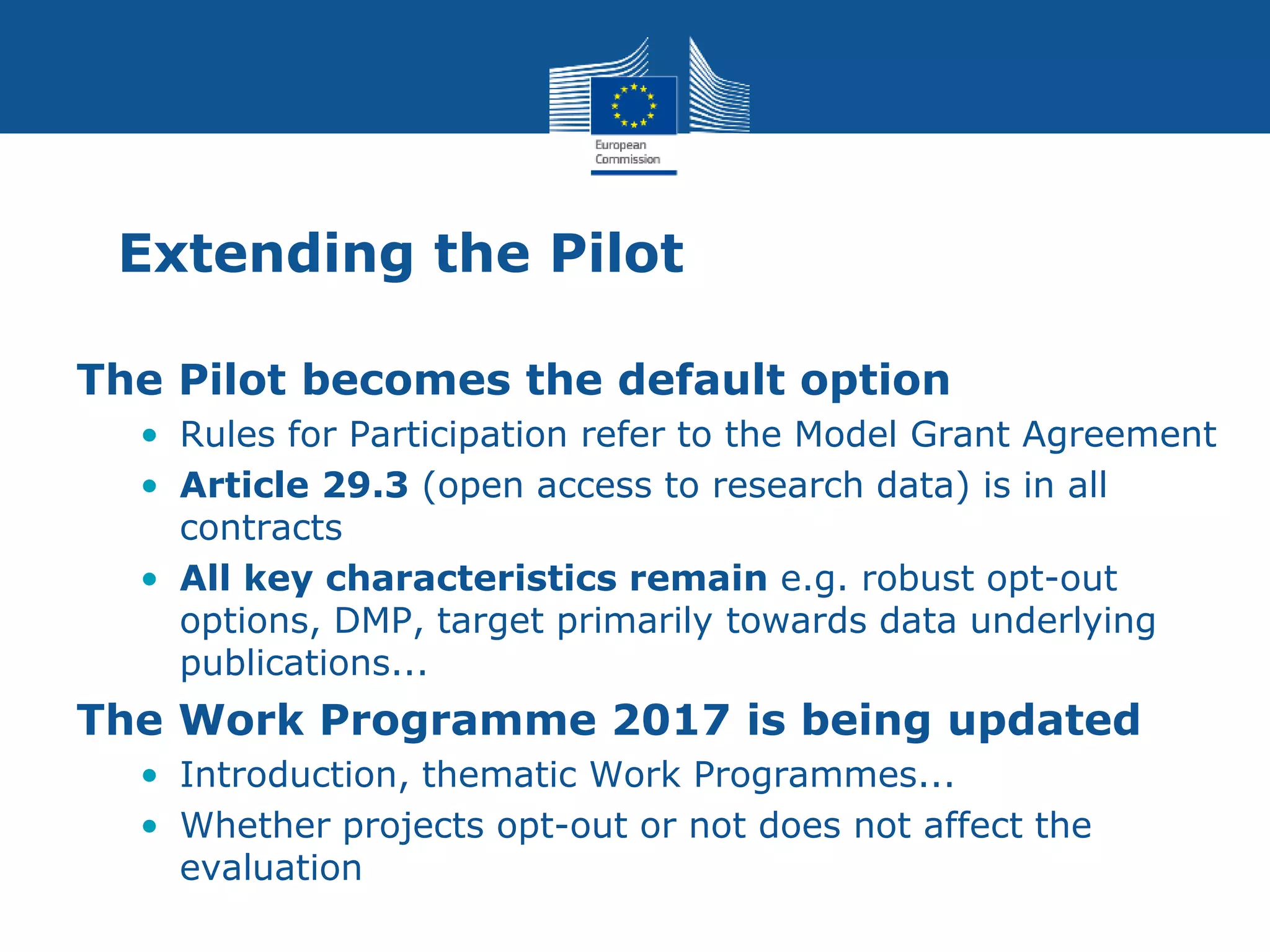
Extending the Pilot
The Pilot becomes the default option
• Rules for Participation refer to the Model Grant Agreement
• Article 29.3 (open access to research data) is in all
contracts
• All key characteristics remain e.g. robust opt-out
options, DMP, target primarily towards data underlying
publications...
The Work Programme 2017 is being updated
• Introduction, thematic Work Programmes...
• Whether projects opt-out or not does not affect the
evaluation
Be part of a new era of Open Science
Reach more people
• Have greater impact
Avoid duplication of efforts
Preserve data
• For future researchers
Simplify final Horizon 2020 reporting
• Thanks to an up-to-date DMP
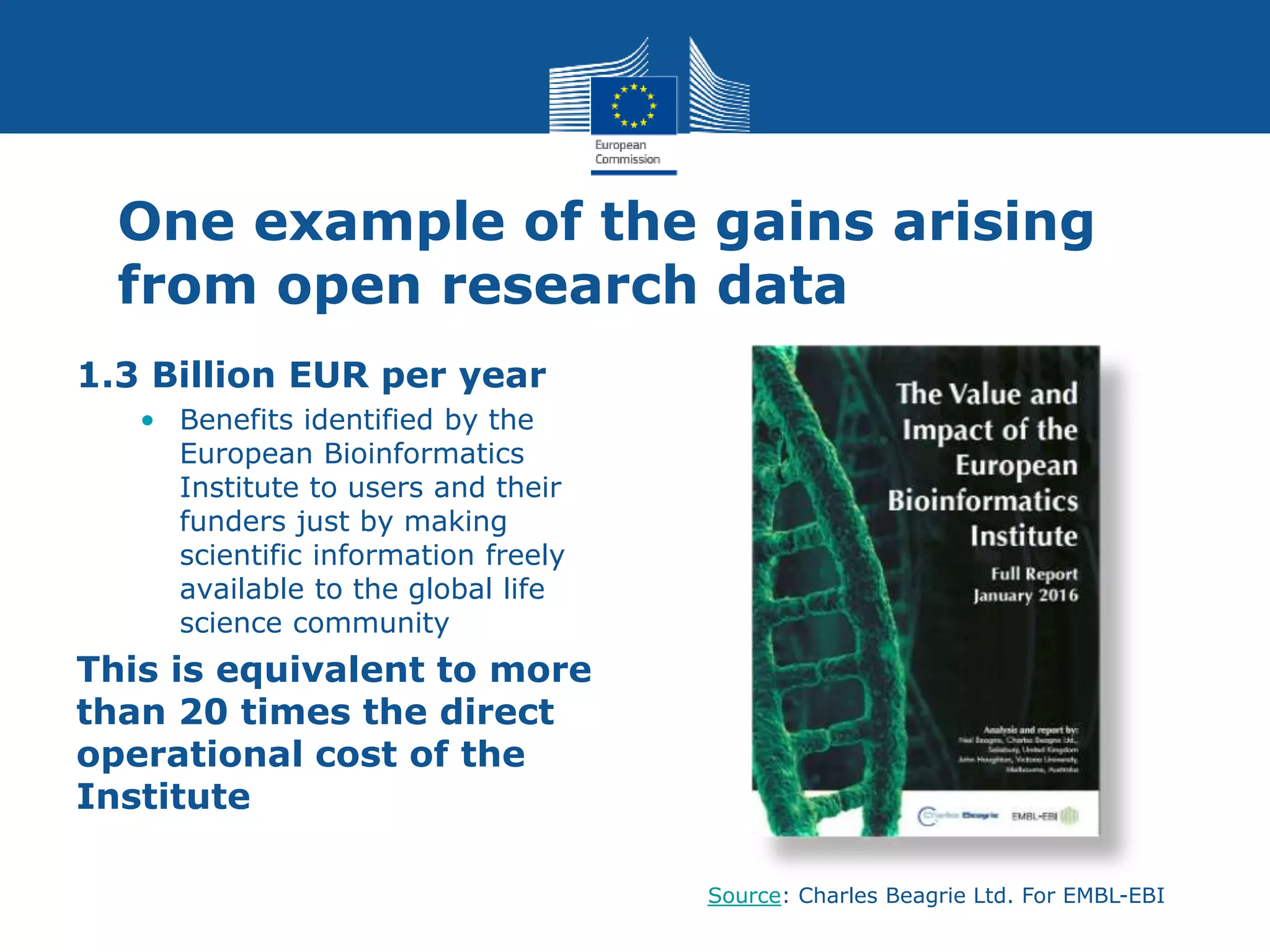
One example of the gains arising
from open research data
1.3 Billion EUR per year
• Benefits identified by the
European Bioinformatics
Institute to users and their
funders just by making
scientific information freely
available to the global life
science community
This is equivalent to more
than 20 times the direct
operational cost of the
Institute
Source: Charles Beagrie Ltd. For EMBL-EBI
In Europe
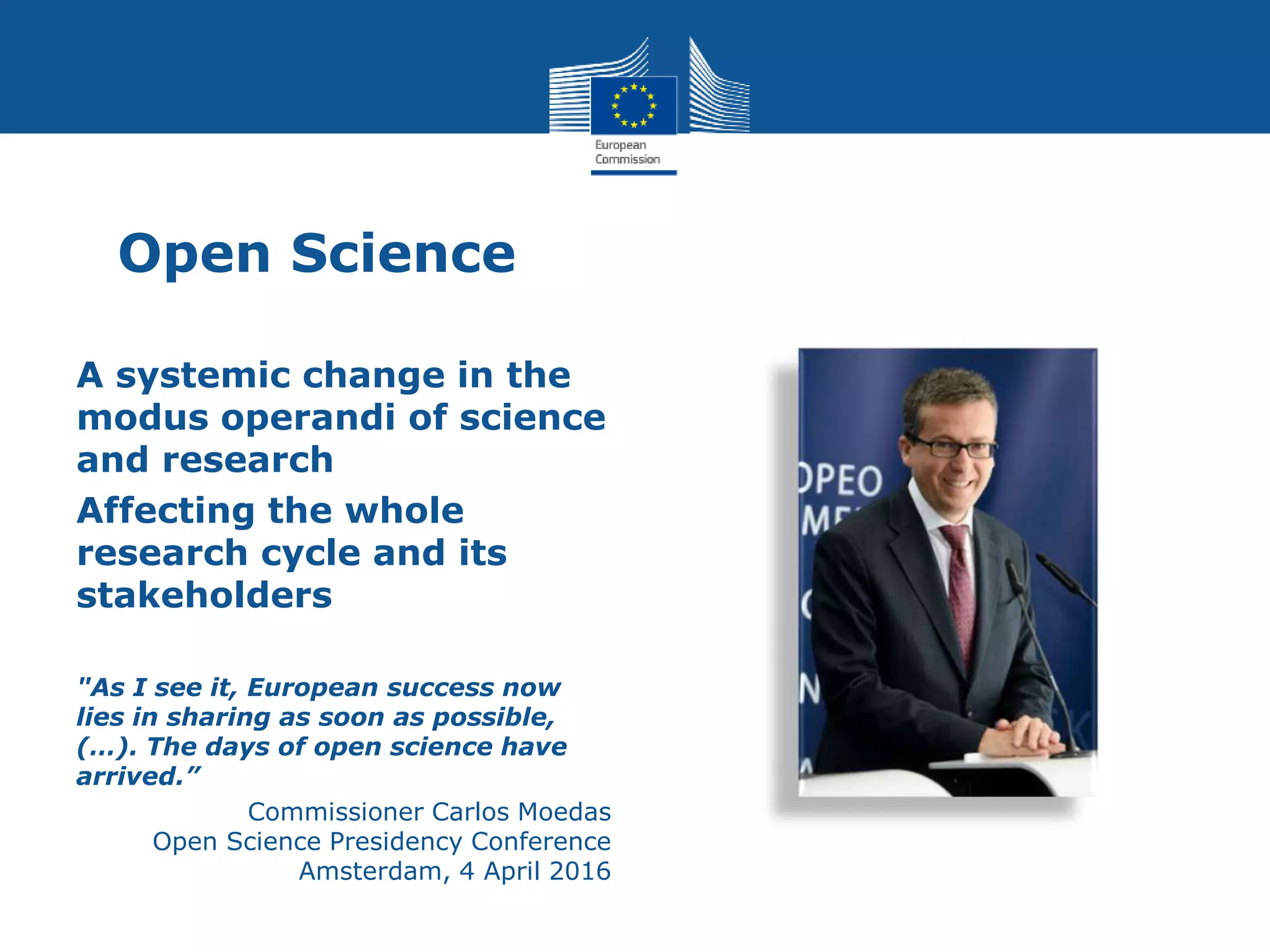
Open Science
A systemic change in the
modus operandi of science
and research
Affecting the whole
research cycle and its
stakeholders
"As I see it, European success now
lies in sharing as soon as possible,
(…). The days of open science have
arrived.”
Commissioner Carlos Moedas
Open Science Presidency Conference
Amsterdam, 4 April 2016
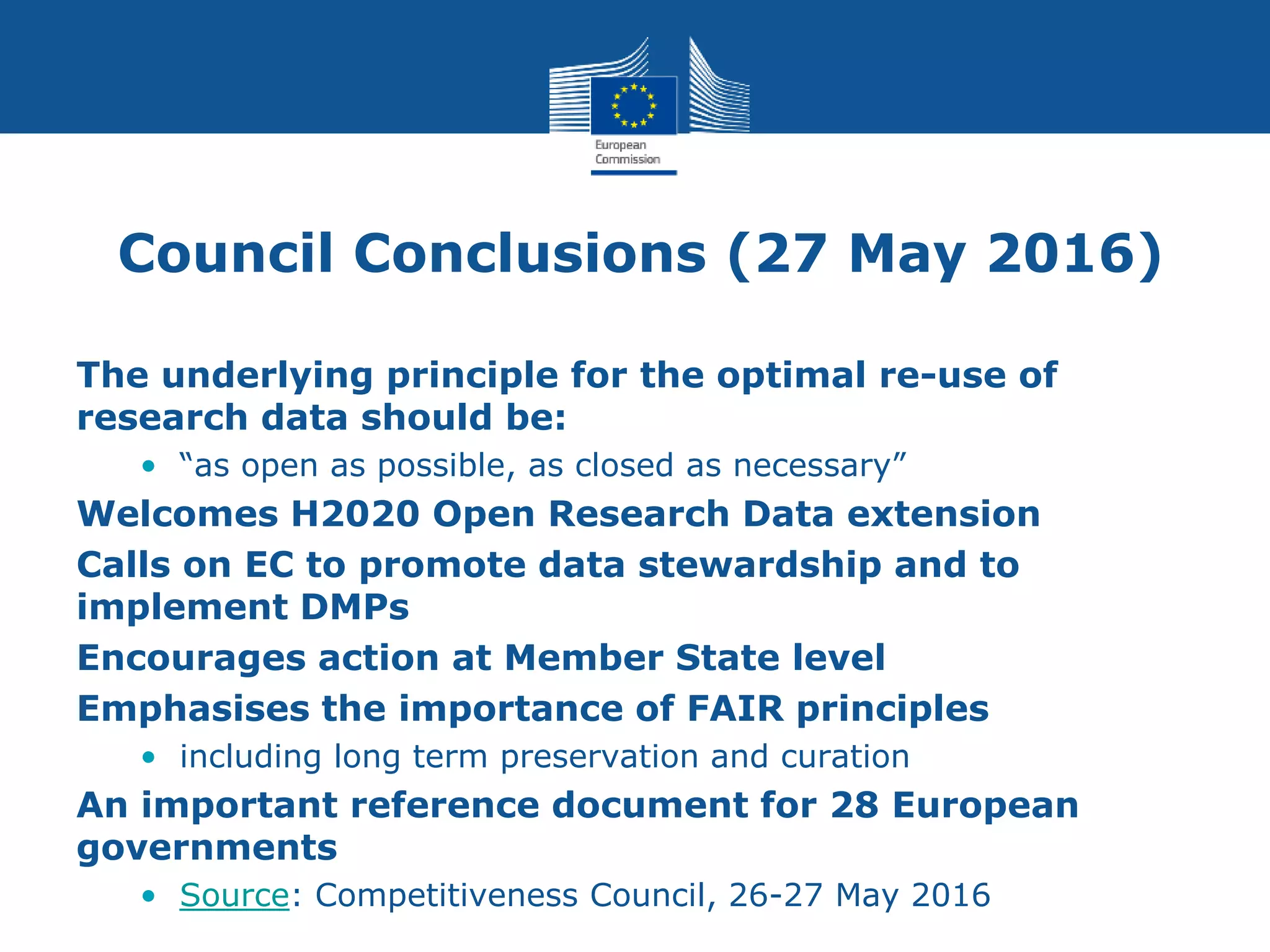
Council Conclusions (27 May 2016)
The underlying principle for the optimal re-use of
research data should be:
• “as open as possible, as closed as necessary”
Welcomes H2020 Open Research Data extension
Calls on EC to promote data stewardship and to
implement DMPs
Encourages action at Member State level
Emphasises the importance of FAIR principles
• including long term preservation and curation
An important reference document for 28 European
governments
• Source: Competitiveness Council, 26-27 May 2016
Next
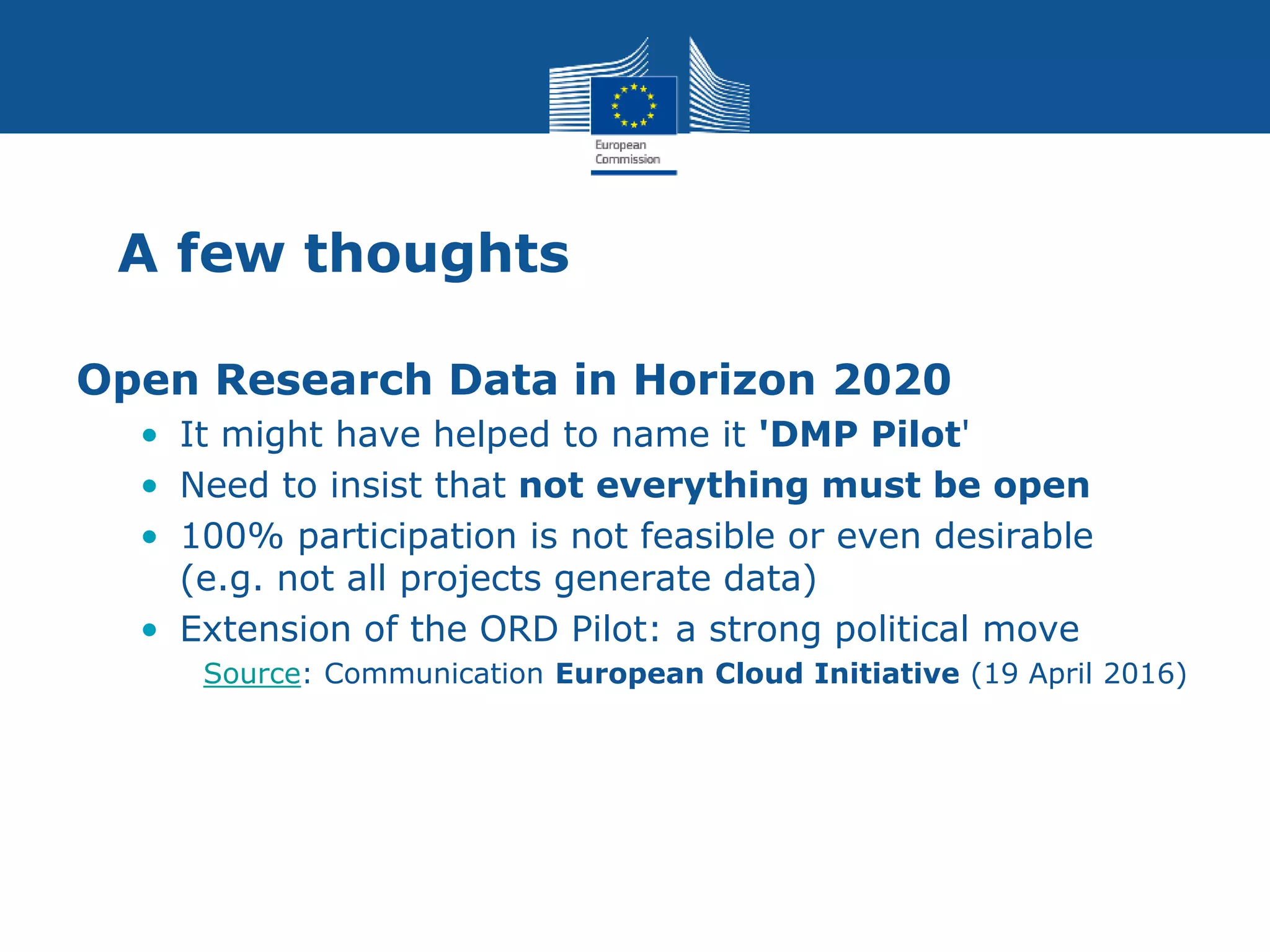
A few thoughts
Open Research Data in Horizon 2020
• It might have helped to name it 'DMP Pilot'
• Need to insist that not everything must be open
• 100% participation is not feasible or even desirable
(e.g. not all projects generate data)
• Extension of the ORD Pilot: a strong political move
Source: Communication European Cloud Initiative (19 April 2016)
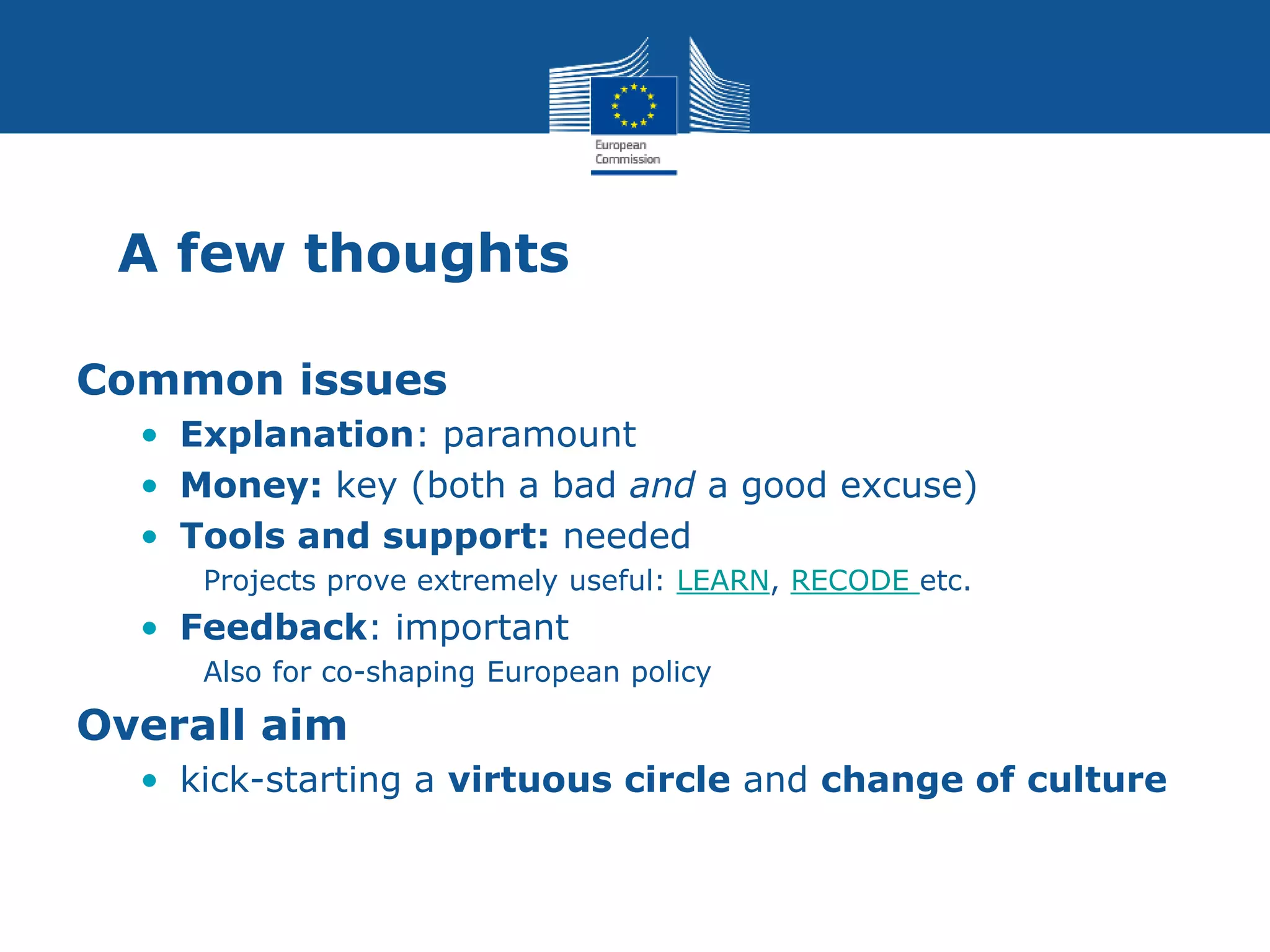
A few thoughts
Common issues
• Explanation: paramount
• Money: key (both a bad and a good excuse)
• Tools and support: needed
Projects prove extremely useful: LEARN, RECODE etc.
• Feedback: important
Also for co-shaping European policy
Overall aim
• kick-starting a virtuous circle and change of culture
Next steps
The Framework Programmes
• Monitor OA in FP7 and Horizon 2020
• Provide 360° support
More training and guidance e.g. on Data Management Plan
• 2017: mid-term review of H2020 - adapt (or not) OA 'mandates'
Working together
• Get more knowledge on open research data
• Mainstream Open Access and reach towards harmonised policies
and common standards on a global scale
• Develop more and better interactions with stakeholders
• And much more...
Thank you!
We want to give European researchers and
innovators the best conditions to do their job.
Twitter: @OpenAccessEC
Mail: RTD-open-access@ec.europa.eu
Web: ec.europa.eu/research/openscience/
This work is licensed under a Creative Commons Attribution 4.0 International License and illustrations are in the
public domain

Open by default: the challenges of research data in Europe

  • 1.
    Open by default: thechallenges of research data in Europe Jean-François Dechamp European Commission, Directorate-General for Research & Innovation @OpenAccessEC 3rd LEARN Workshop, 28 June 2016, Helsinki
  • 2.
    Challenges Wider access toscientific facts and knowledge helps researchers, innovators and the public find and re-use data, and check research results • Offers better value for research funds: a public benefit • Encourages research across scientific fields: essential for solving today's complex societal challenges
  • 3.
    It is foreveryone
  • 5.
    Solution Horizon 2020 alreadymandates open access to all scientific publications From 2017, research data is open by default, with possibilities to opt out
  • 6.
    Then and now FP7 OAGreen or Gold+Green Pilot H2020 OA Green or Gold+Green obligation & ORD Pilot H2020 OA Green or Gold+Green obligation & ORD by default
  • 7.
    Research data: openby default Horizon 2020 grantees are required to • deposit underlying research data and other research data of their choice in a repository • Take measures to grant open access to this research data Horizon 2020 grantees are encouraged to share datasets beyond publication FAIR data • Findable + Accessible + Interoperable + Re-usable
  • 8.
    Projects must havea DMP A Data Management Plan (DMP) provides information on: • The data the research will generate • How to ensure its curation, preservation and sustainability • What parts of that data will be open (and how) Data management costs • Costs are fully eligible for funding No repository imposed: • Deposit data where you want
  • 9.
    As open aspossible, as closed as necessary Grantees have the right to opt-out • At any time • But they need to say why Top three reasons for opt-out 1. Intellectual property rights 2. Privacy 3. Might jeopardise project's main objective
  • 10.
    The approach hasbeen tested during the H2020 pilot action The experience of 2015 • Out of 431 projects funded in core areas, 65.4% opted to share data • Out of 3268 projects funded in other areas, 11.9% voluntary opted in From 2017 • the current Open Research Data Pilot expands to cover all areas of Horizon 2020, with the same rules
  • 11.
    How it works •Get funding • Write DMP • Gather data during research • ... • Chose repository and deposit data • Publish research • Take measures to grant open access to this data • Inform OpenAIRE (the EU-funded open access portal)
  • 12.
    Extending the Pilot ThePilot becomes the default option • Rules for Participation refer to the Model Grant Agreement • Article 29.3 (open access to research data) is in all contracts • All key characteristics remain e.g. robust opt-out options, DMP, target primarily towards data underlying publications... The Work Programme 2017 is being updated • Introduction, thematic Work Programmes... • Whether projects opt-out or not does not affect the evaluation
  • 13.
    Be part ofa new era of Open Science Reach more people • Have greater impact Avoid duplication of efforts Preserve data • For future researchers Simplify final Horizon 2020 reporting • Thanks to an up-to-date DMP
  • 14.
    One example ofthe gains arising from open research data 1.3 Billion EUR per year • Benefits identified by the European Bioinformatics Institute to users and their funders just by making scientific information freely available to the global life science community This is equivalent to more than 20 times the direct operational cost of the Institute Source: Charles Beagrie Ltd. For EMBL-EBI
  • 15.
  • 16.
    Open Science A systemicchange in the modus operandi of science and research Affecting the whole research cycle and its stakeholders "As I see it, European success now lies in sharing as soon as possible, (…). The days of open science have arrived.” Commissioner Carlos Moedas Open Science Presidency Conference Amsterdam, 4 April 2016
  • 17.
    Council Conclusions (27May 2016) The underlying principle for the optimal re-use of research data should be: • “as open as possible, as closed as necessary” Welcomes H2020 Open Research Data extension Calls on EC to promote data stewardship and to implement DMPs Encourages action at Member State level Emphasises the importance of FAIR principles • including long term preservation and curation An important reference document for 28 European governments • Source: Competitiveness Council, 26-27 May 2016
  • 18.
  • 19.
    A few thoughts OpenResearch Data in Horizon 2020 • It might have helped to name it 'DMP Pilot' • Need to insist that not everything must be open • 100% participation is not feasible or even desirable (e.g. not all projects generate data) • Extension of the ORD Pilot: a strong political move Source: Communication European Cloud Initiative (19 April 2016)
  • 20.
    A few thoughts Commonissues • Explanation: paramount • Money: key (both a bad and a good excuse) • Tools and support: needed Projects prove extremely useful: LEARN, RECODE etc. • Feedback: important Also for co-shaping European policy Overall aim • kick-starting a virtuous circle and change of culture
  • 21.
    Next steps The FrameworkProgrammes • Monitor OA in FP7 and Horizon 2020 • Provide 360° support More training and guidance e.g. on Data Management Plan • 2017: mid-term review of H2020 - adapt (or not) OA 'mandates' Working together • Get more knowledge on open research data • Mainstream Open Access and reach towards harmonised policies and common standards on a global scale • Develop more and better interactions with stakeholders • And much more...
  • 22.
    Thank you! We wantto give European researchers and innovators the best conditions to do their job. Twitter: @OpenAccessEC Mail: RTD-open-access@ec.europa.eu Web: ec.europa.eu/research/openscience/ This work is licensed under a Creative Commons Attribution 4.0 International License and illustrations are in the public domain