@openaire_eu
OpenAIREwebinar
Horizon2020OpenSciencePoliciesandbeyond
October 22th, 2019
Hermans Emilie
Ghent University
OpenAIRE Webinar Horizon 2020 Open Science Policies and beyond – 22/10/2019
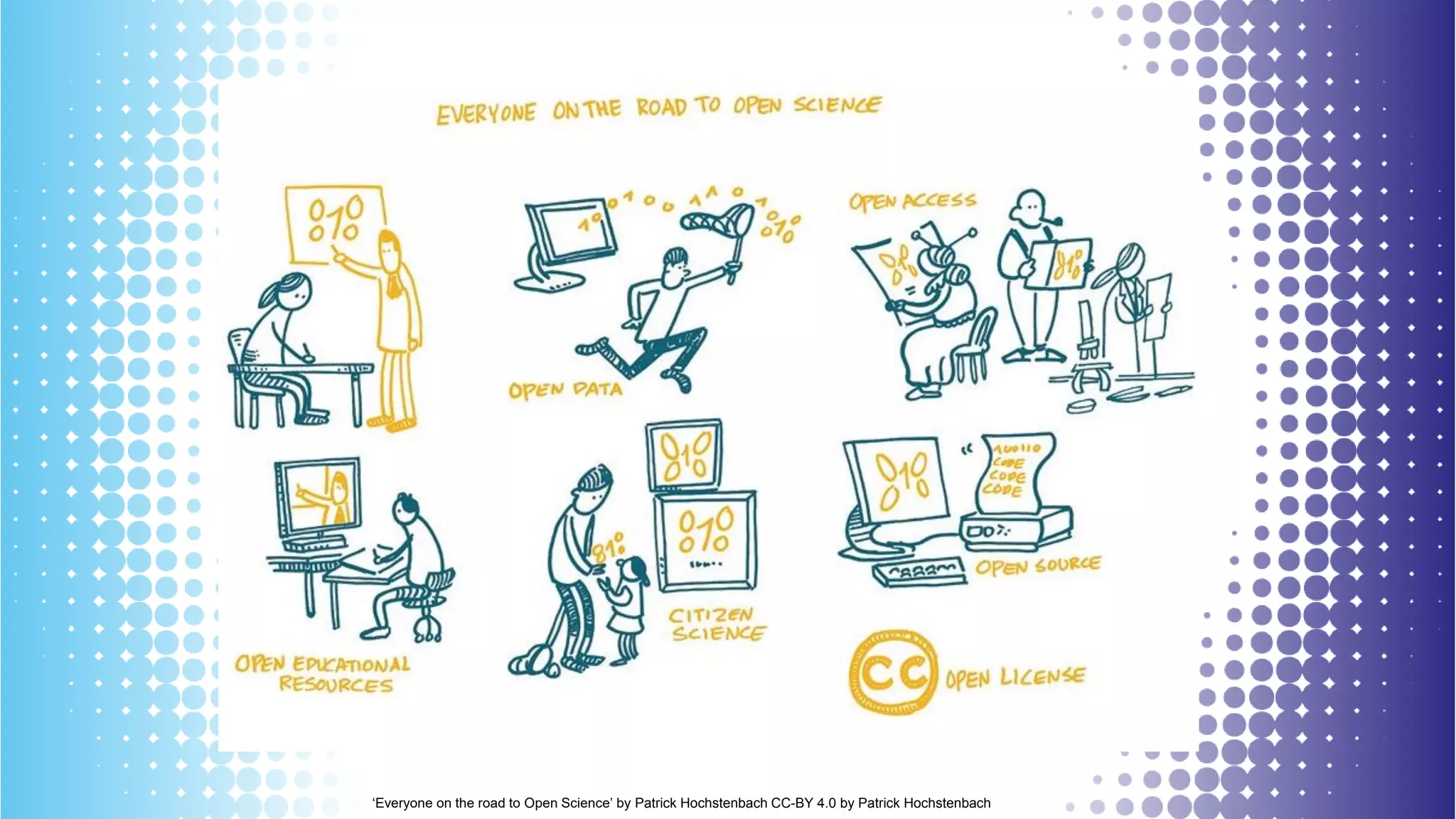
‘Everyone on the road to Open Science’ by Patrick Hochstenbach CC-BY 4.0 by Patrick Hochstenbach
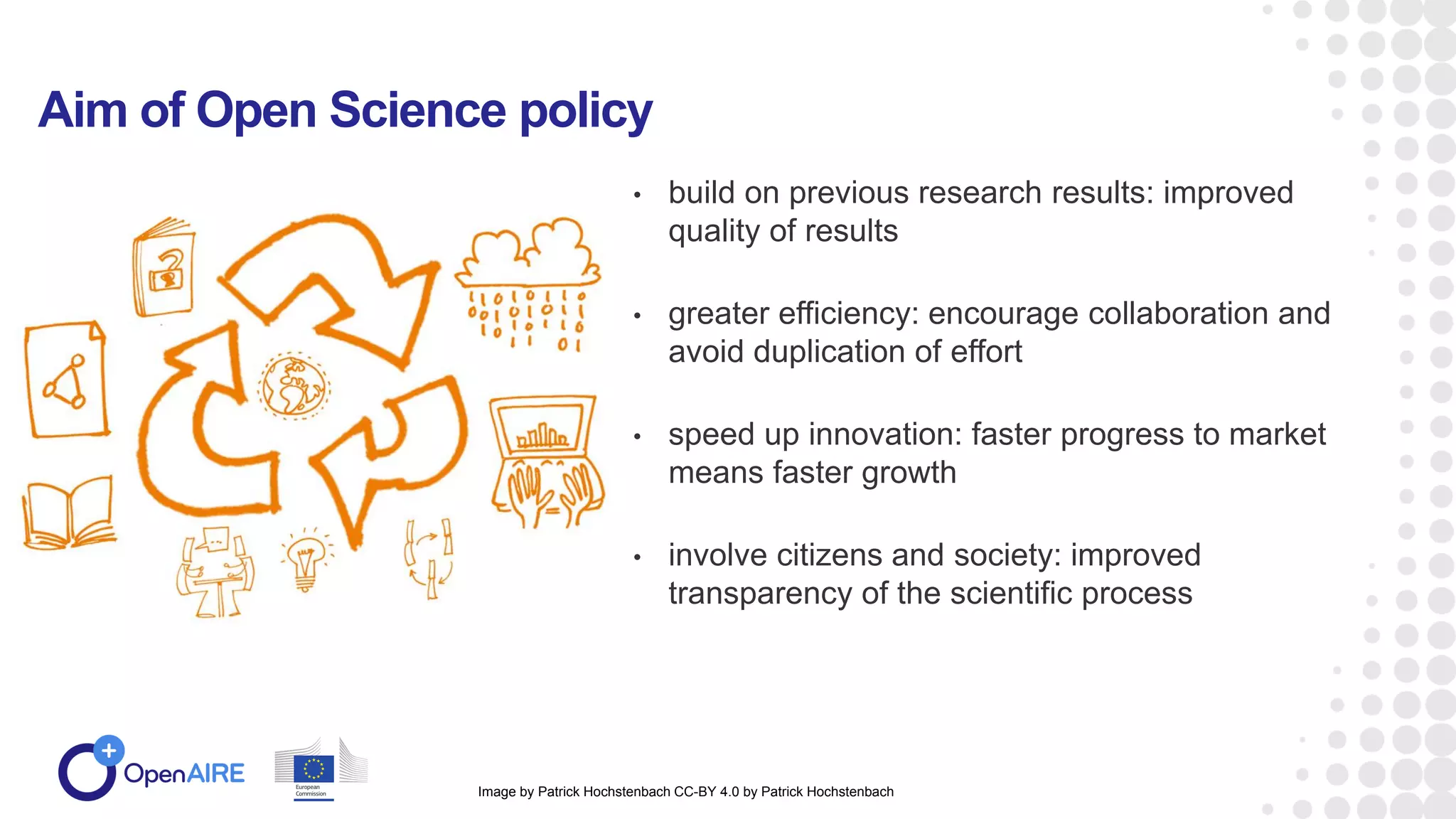
Aim of Open Science policy
• build on previous research results: improved
quality of results
• greater efficiency: encourage collaboration and
avoid duplication of effort
• speed up innovation: faster progress to market
means faster growth
• involve citizens and society: improved
transparency of the scientific process
Image by Patrick Hochstenbach CC-BY 4.0 by Patrick Hochstenbach
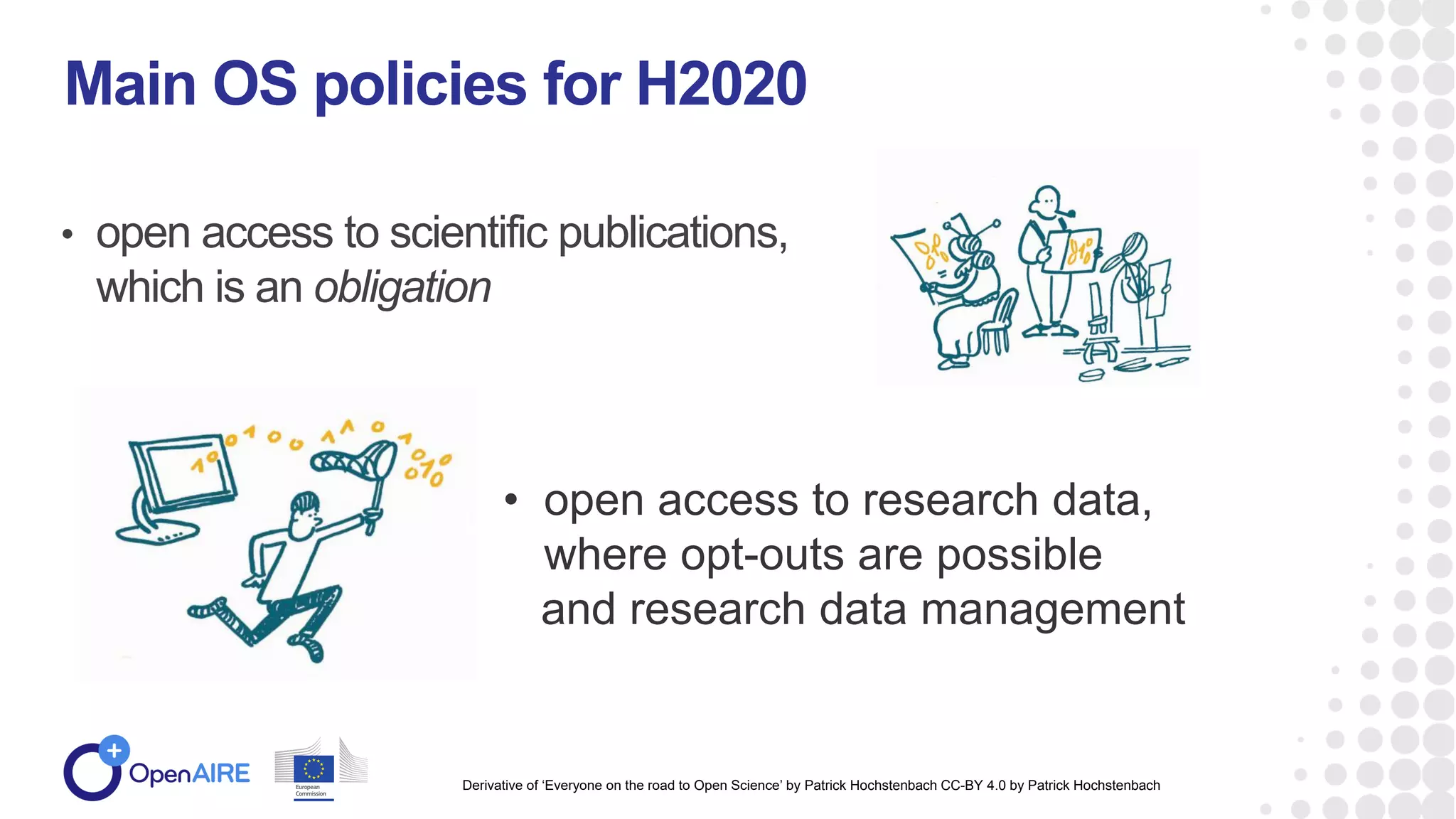
• open access to scientific publications,
which is an obligation
Main OS policies for H2020
• open access to research data,
where opt-outs are possible
and research data management
Derivative of ‘Everyone on the road to Open Science’ by Patrick Hochstenbach CC-BY 4.0 by Patrick Hochstenbach
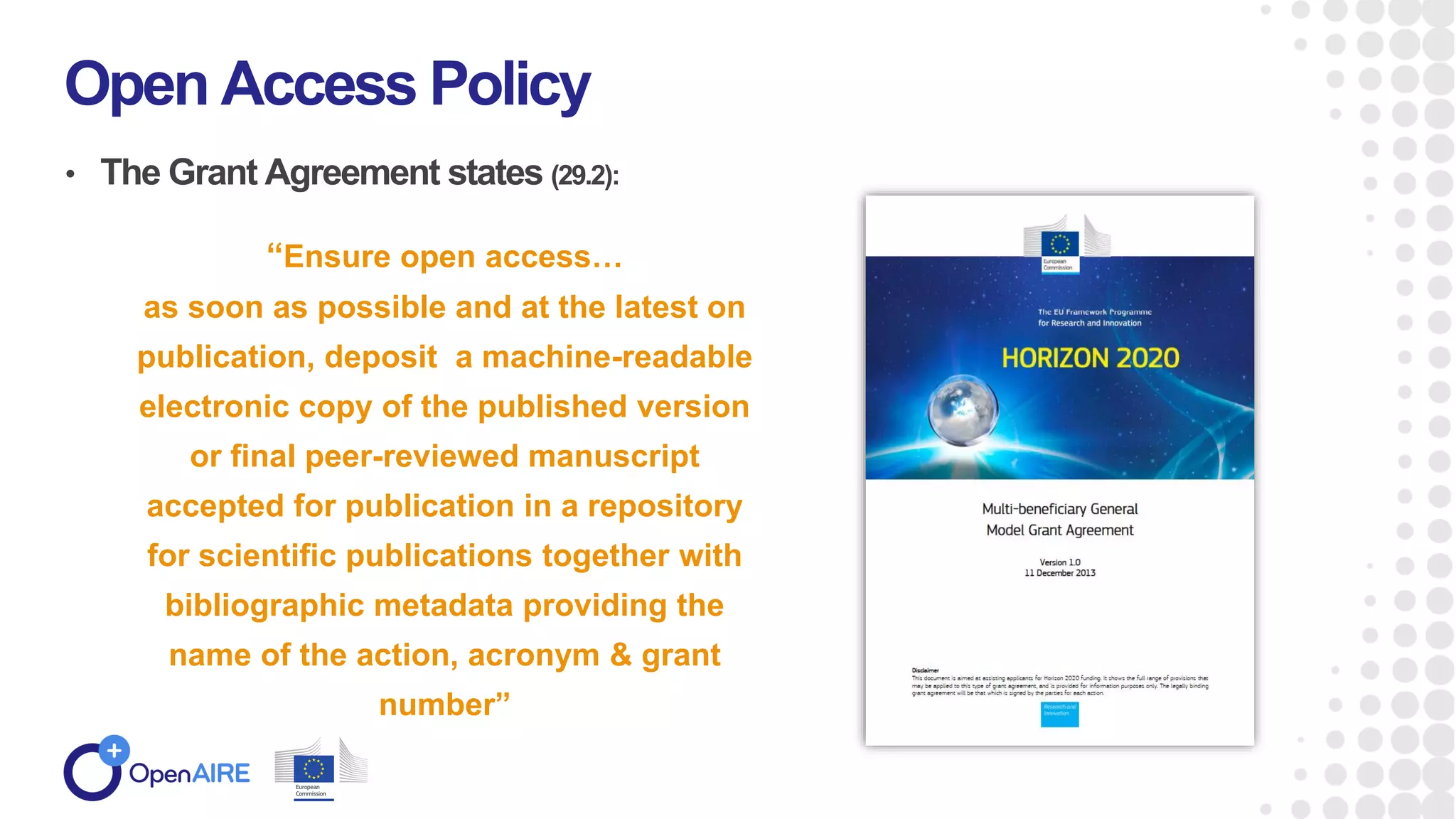
• The Grant Agreement states (29.2):
Open Access Policy
“Ensure open access…
as soon as possible and at the latest on
publication, deposit a machine-readable
electronic copy of the published version
or final peer-reviewed manuscript
accepted for publication in a repository
for scientific publications together with
bibliographic metadata providing the
name of the action, acronym & grant
number”
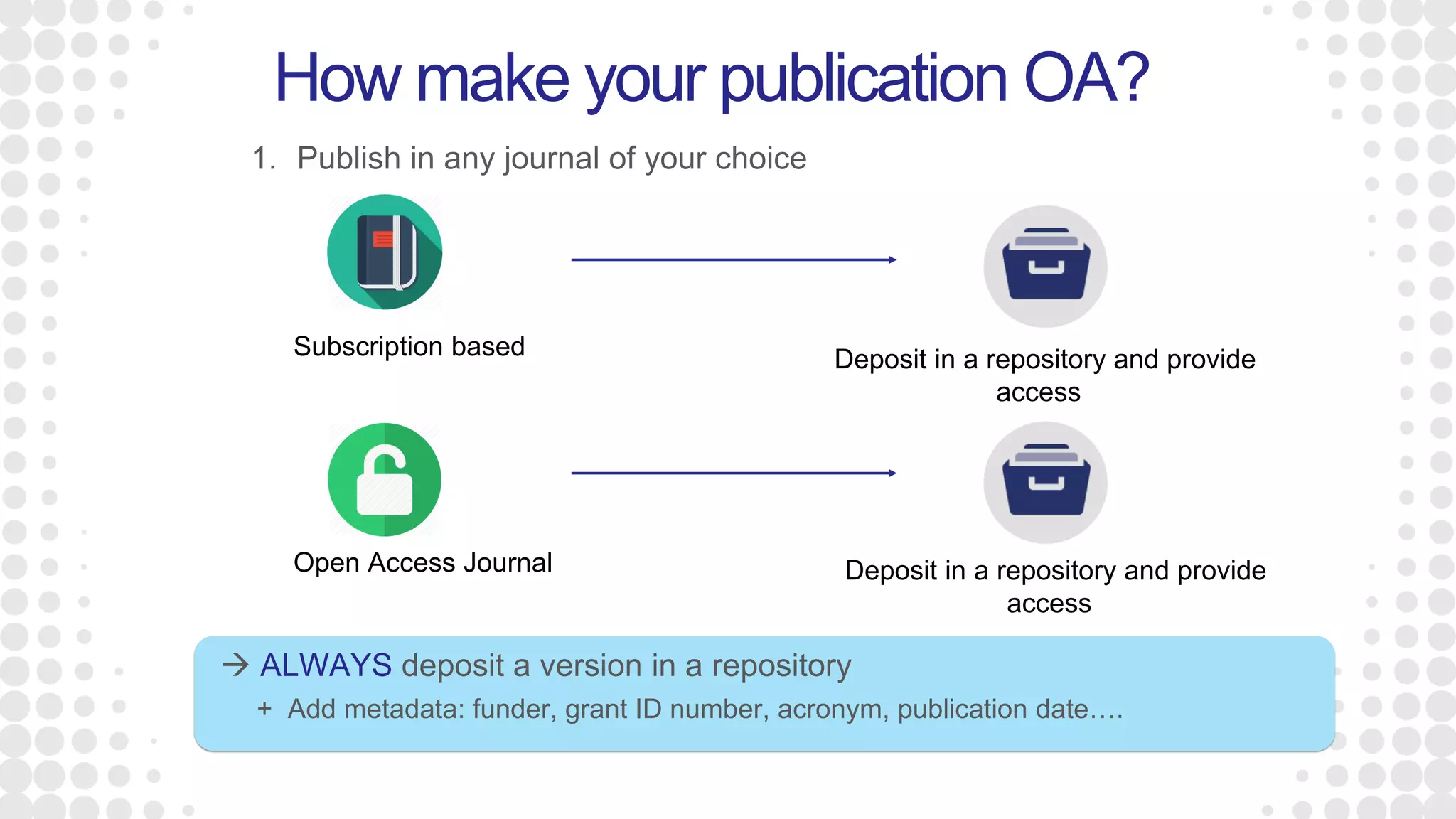
1. Publish in any journal of your choice
How make your publication OA?
Subscription based
Open Access Journal
 ALWAYS deposit a version in a repository
+ Add metadata: funder, grant ID number, acronym, publication date….
Deposit in a repository and provide
access
Deposit in a repository and provide
access
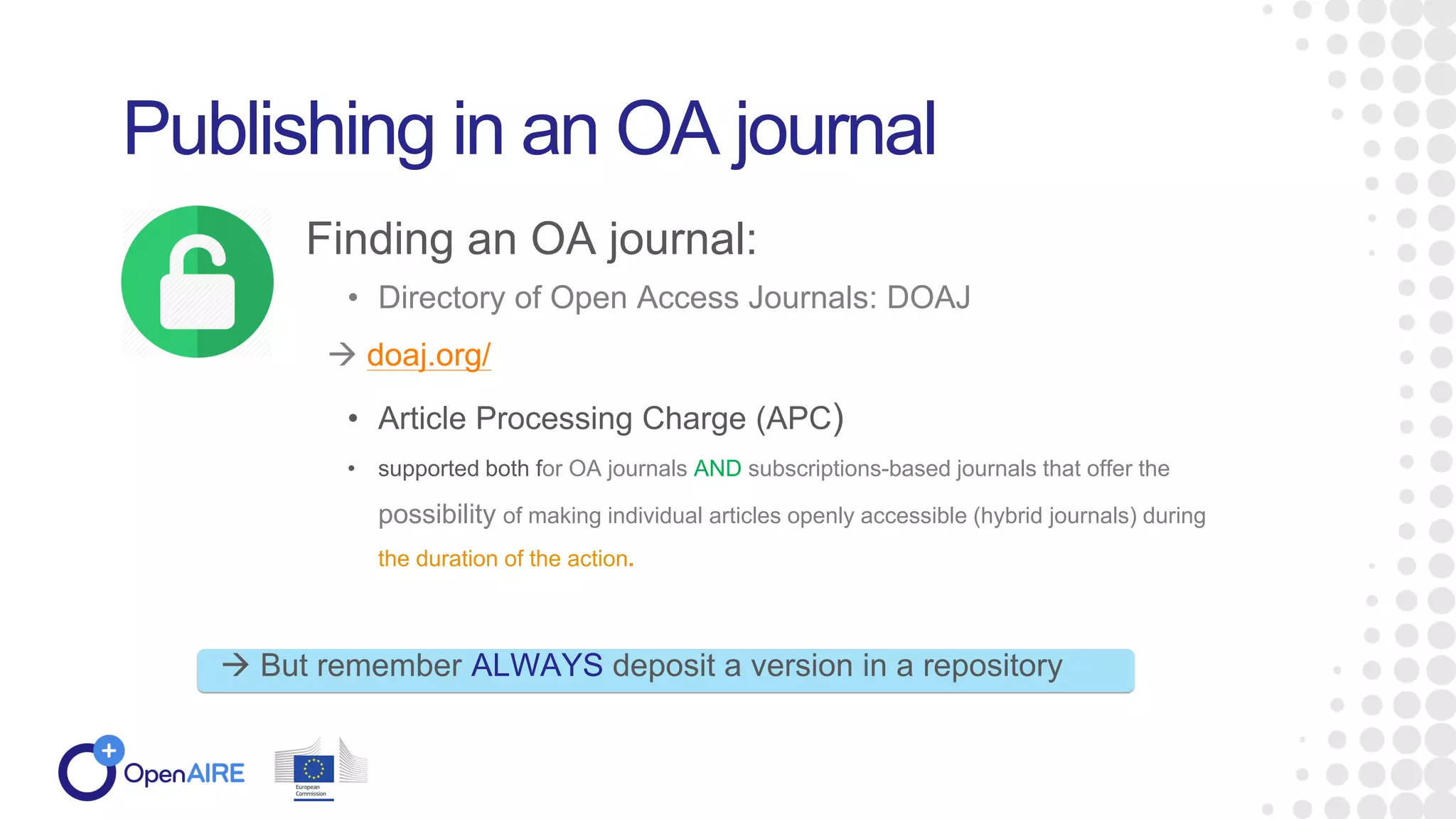
• Directory of Open Access Journals: DOAJ
 doaj.org/
• Article Processing Charge (APC)
• supported both for OA journals AND subscriptions-based journals that offer the
possibility of making individual articles openly accessible (hybrid journals) during
the duration of the action.
Publishing in an OA journal
Finding an OA journal:
 But remember ALWAYS deposit a version in a repository
• Institutional repository
• Disciplinary repository
• Or use Zenodo.org: EC-cofounded, multidisciplinary, free
repository
Where to deposit?
• The Directories of Open Access Repositories:
• v2.sherpa.ac.uk/opendoar
• roar.eprints.org
• Explore.openaire.eu
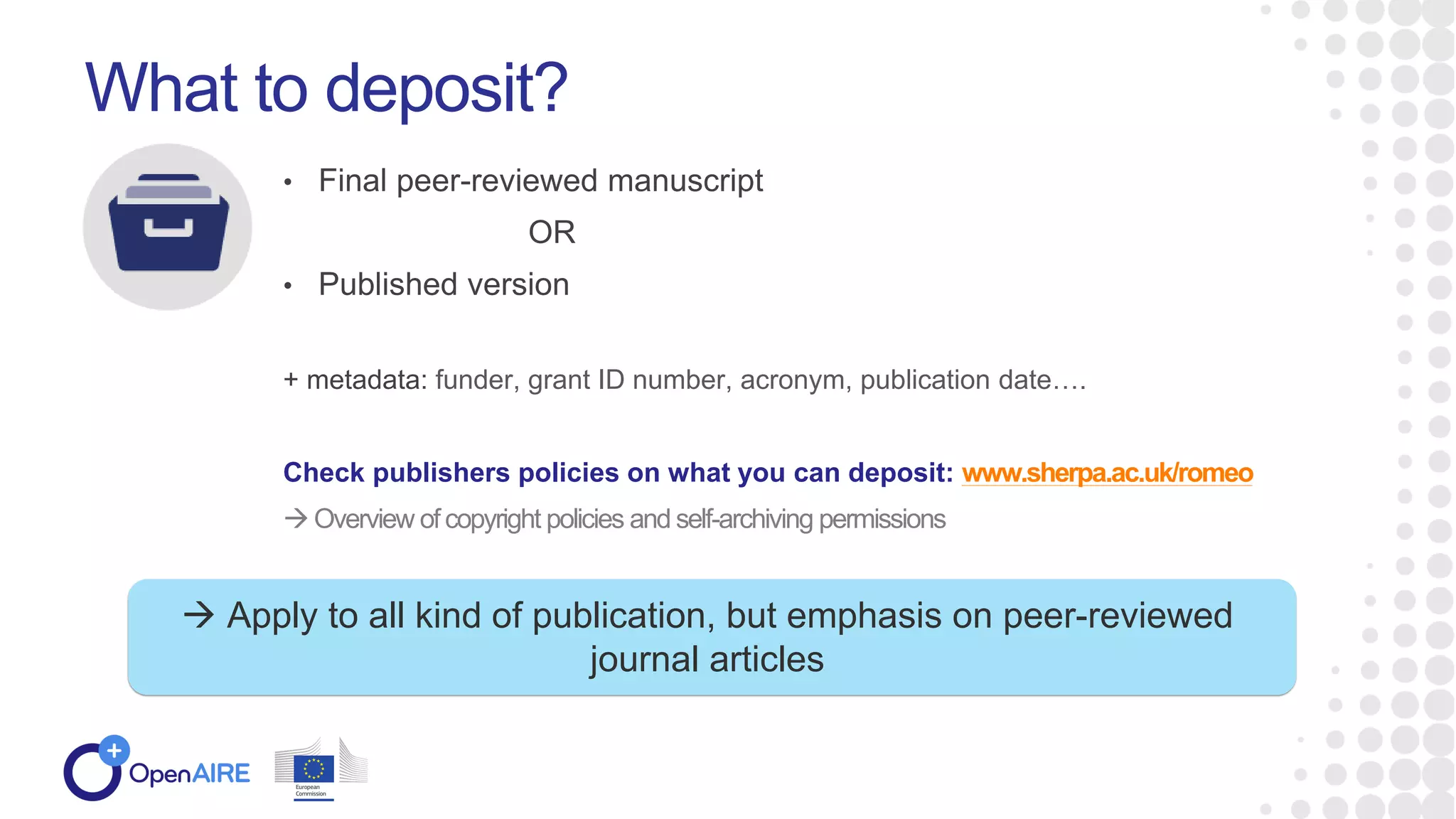
• Final peer-reviewed manuscript
OR
• Published version
+ metadata: funder, grant ID number, acronym, publication date….
Check publishers policies on what you can deposit: www.sherpa.ac.uk/romeo
 Overview of copyright policies and self-archiving permissions
What to deposit?
 Apply to all kind of publication, but emphasis on peer-reviewed
journal articles
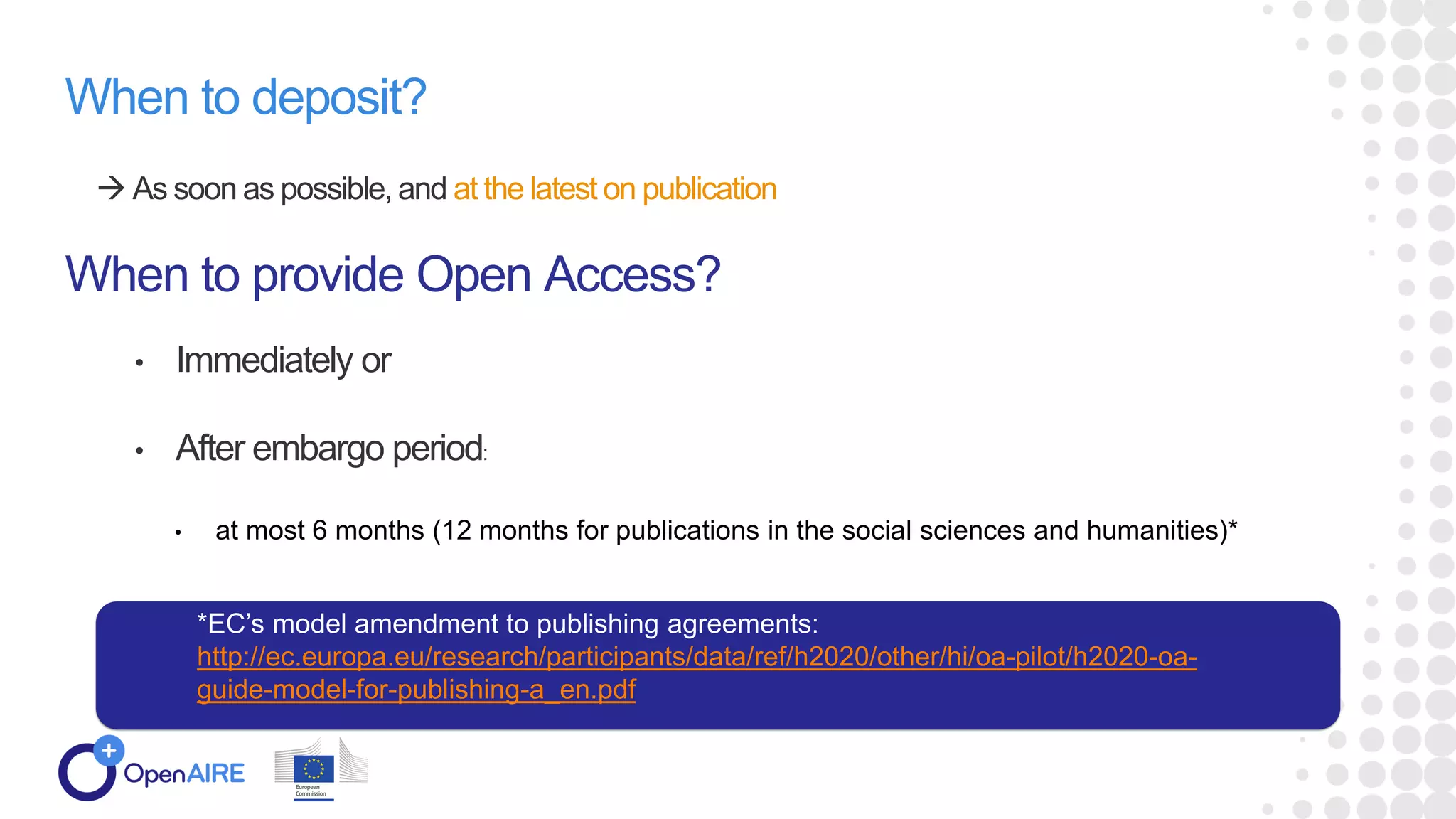
When to deposit?
 As soon as possible, and at the latest on publication
When to provide Open Access?
• Immediately or
• After embargo period:
• at most 6 months (12 months for publications in the social sciences and humanities)*
*EC’s model amendment to publishing agreements:
http://ec.europa.eu/research/participants/data/ref/h2020/other/hi/oa-pilot/h2020-oa-
guide-model-for-publishing-a_en.pdf
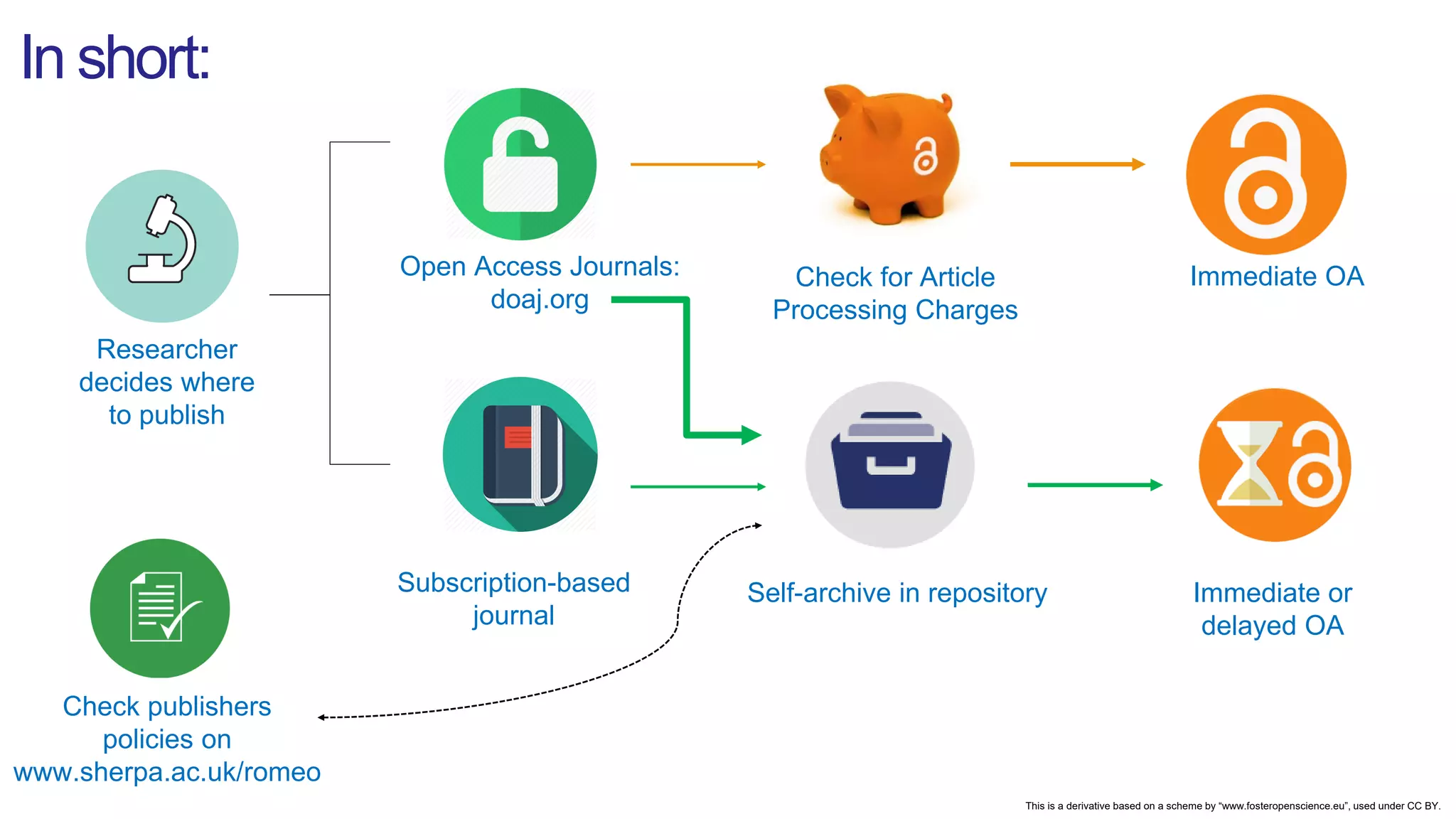
Researcher
decides where
to publish
Check publishers
policies on
www.sherpa.ac.uk/romeo
Open Access Journals:
doaj.org
Self-archive in repository
Check for Article
Processing Charges
Subscription-based
journal
In short:
This is a derivative based on a scheme by “www.fosteropenscience.eu”, used under CC BY.
Immediate OA
Immediate or
delayed OA
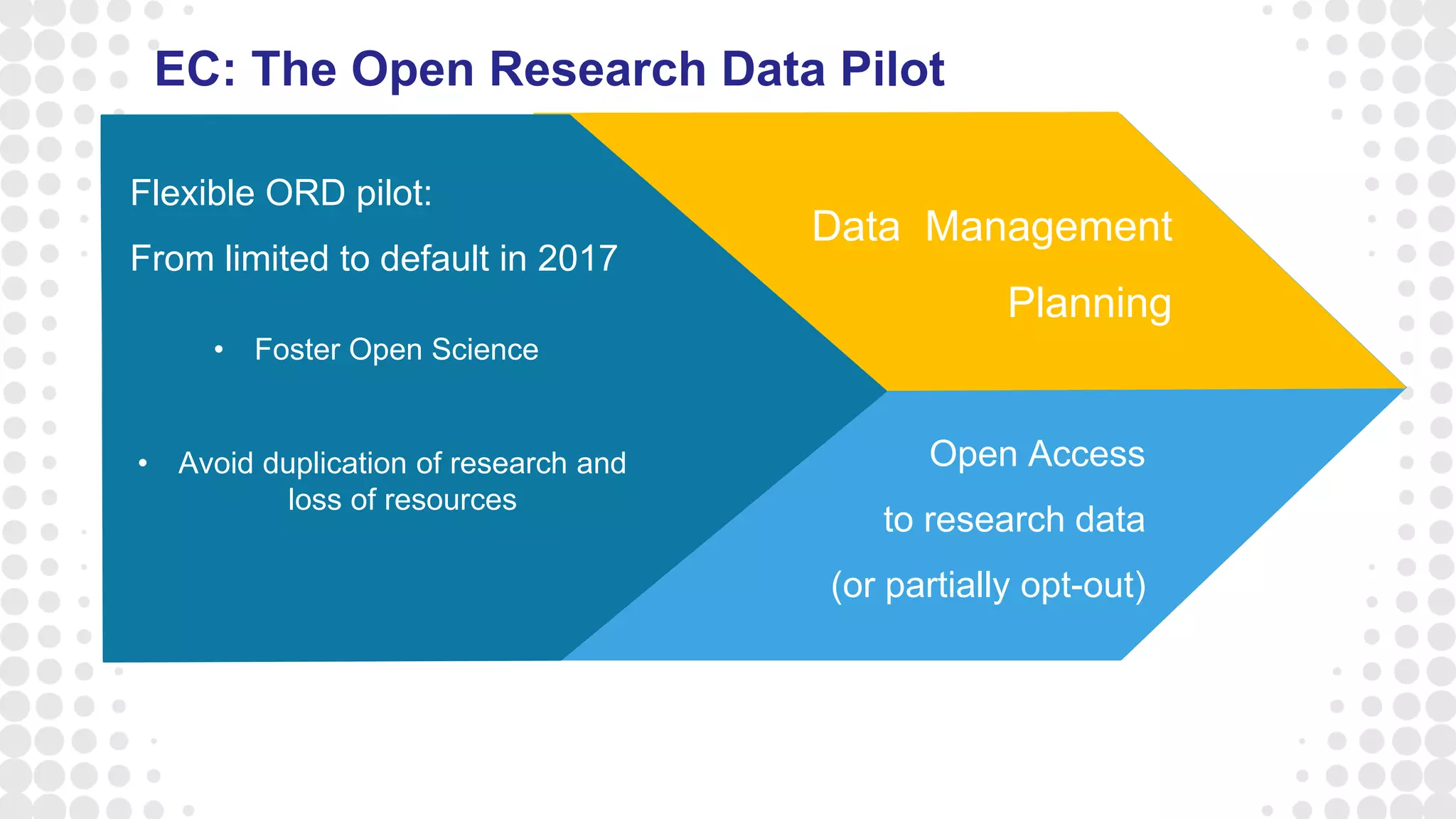
EC: The Open Research Data Pilot
Flexible ORD pilot:
From limited to default in 2017
• Avoid duplication of research and
loss of resources
• Foster Open Science
Open Access
to research data
(or partially opt-out)
Data Management
Planning
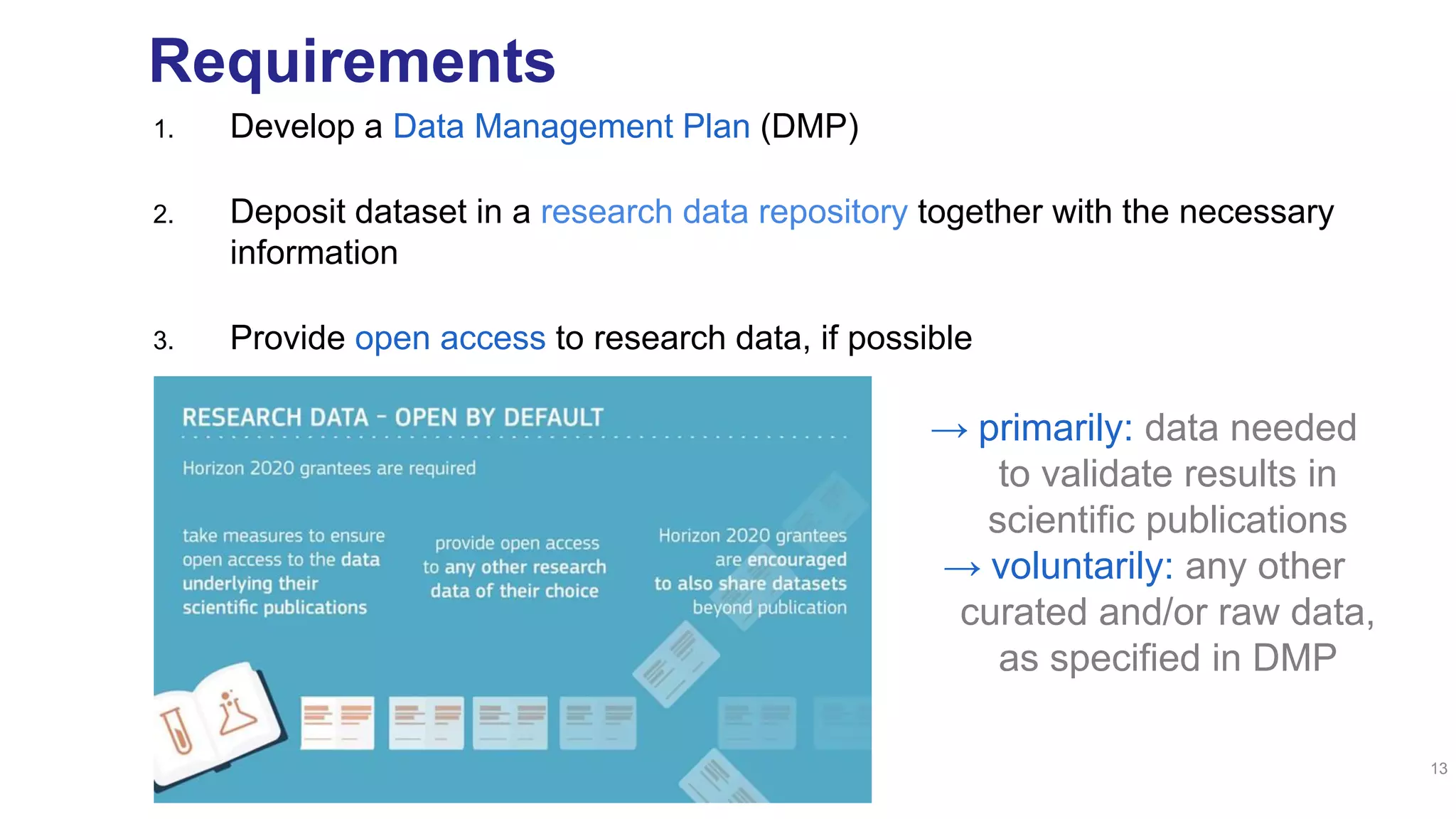
Requirements
1. Develop a Data Management Plan (DMP)
2. Deposit dataset in a research data repository together with the necessary
information
3. Provide open access to research data, if possible
13
→ primarily: data needed
to validate results in
scientific publications
→ voluntarily: any other
curated and/or raw data,
as specified in DMP
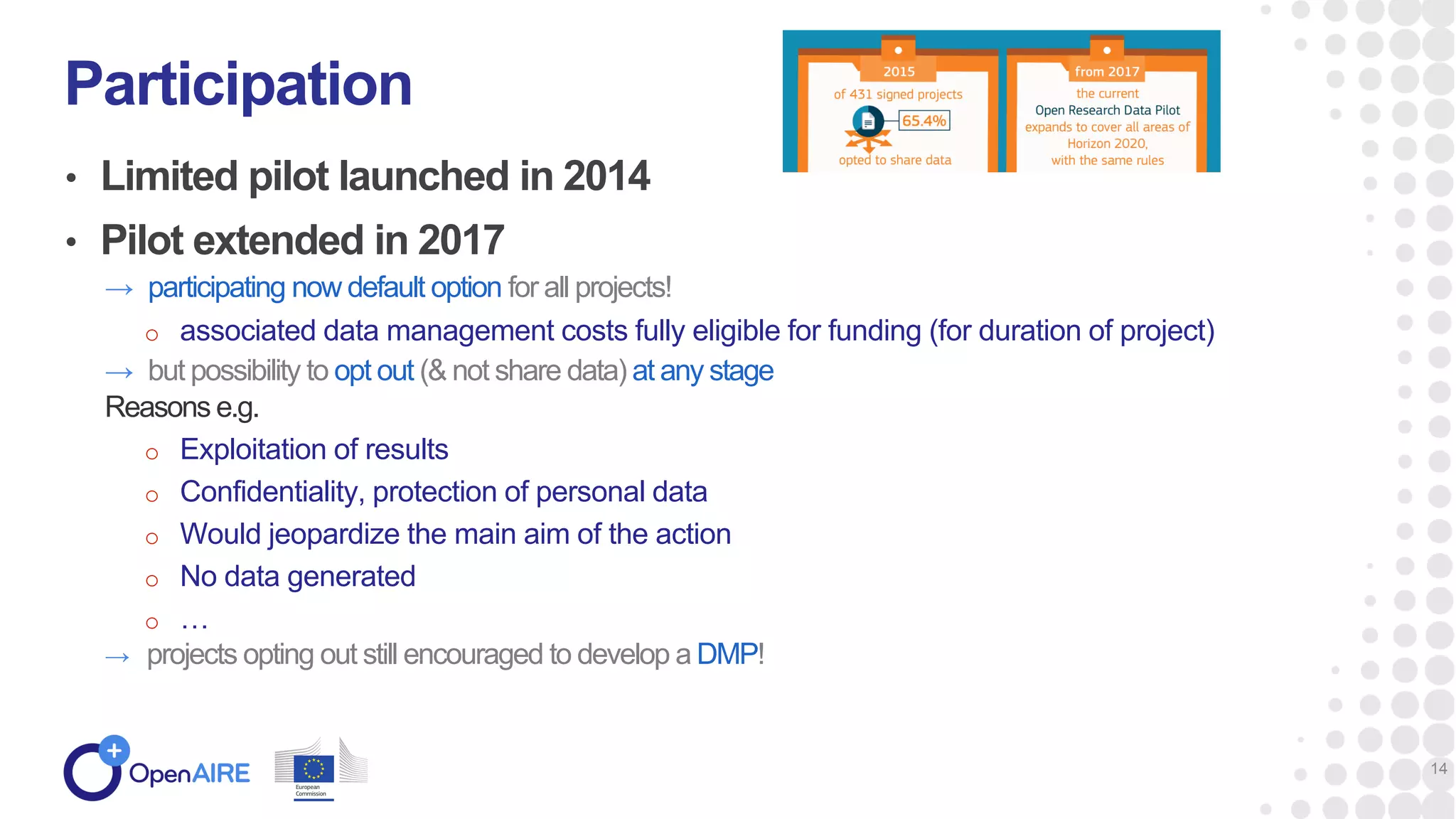
• Limited pilot launched in 2014
• Pilot extended in 2017
→ participating now default option for all projects!
o associated data management costs fully eligible for funding (for duration of project)
→ but possibility to opt out (& not share data) at any stage
Reasons e.g.
o Exploitation of results
o Confidentiality, protection of personal data
o Would jeopardize the main aim of the action
o No data generated
o …
→ projects opting out still encouraged to develop a DMP!
Participation
14
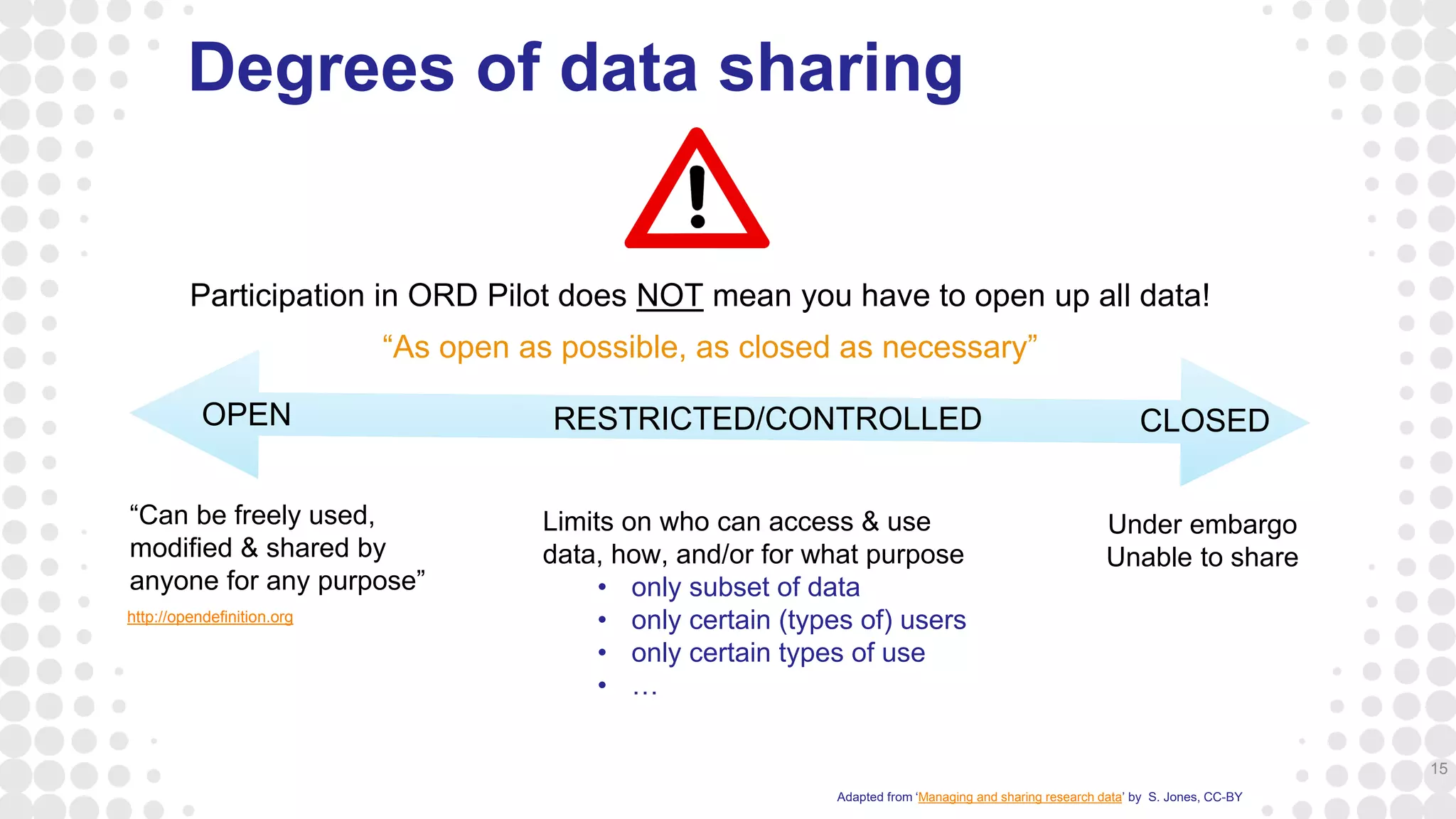
Degrees of data sharing
15
OPEN RESTRICTED/CONTROLLED CLOSED
“Can be freely used,
modified & shared by
anyone for any purpose”
http://opendefinition.org
Limits on who can access & use
data, how, and/or for what purpose
• only subset of data
• only certain (types of) users
• only certain types of use
• …
Under embargo
Unable to share
“As open as possible, as closed as necessary”
Adapted from ‘Managing and sharing research data’ by S. Jones, CC-BY
Participation in ORD Pilot does NOT mean you have to open up all data!
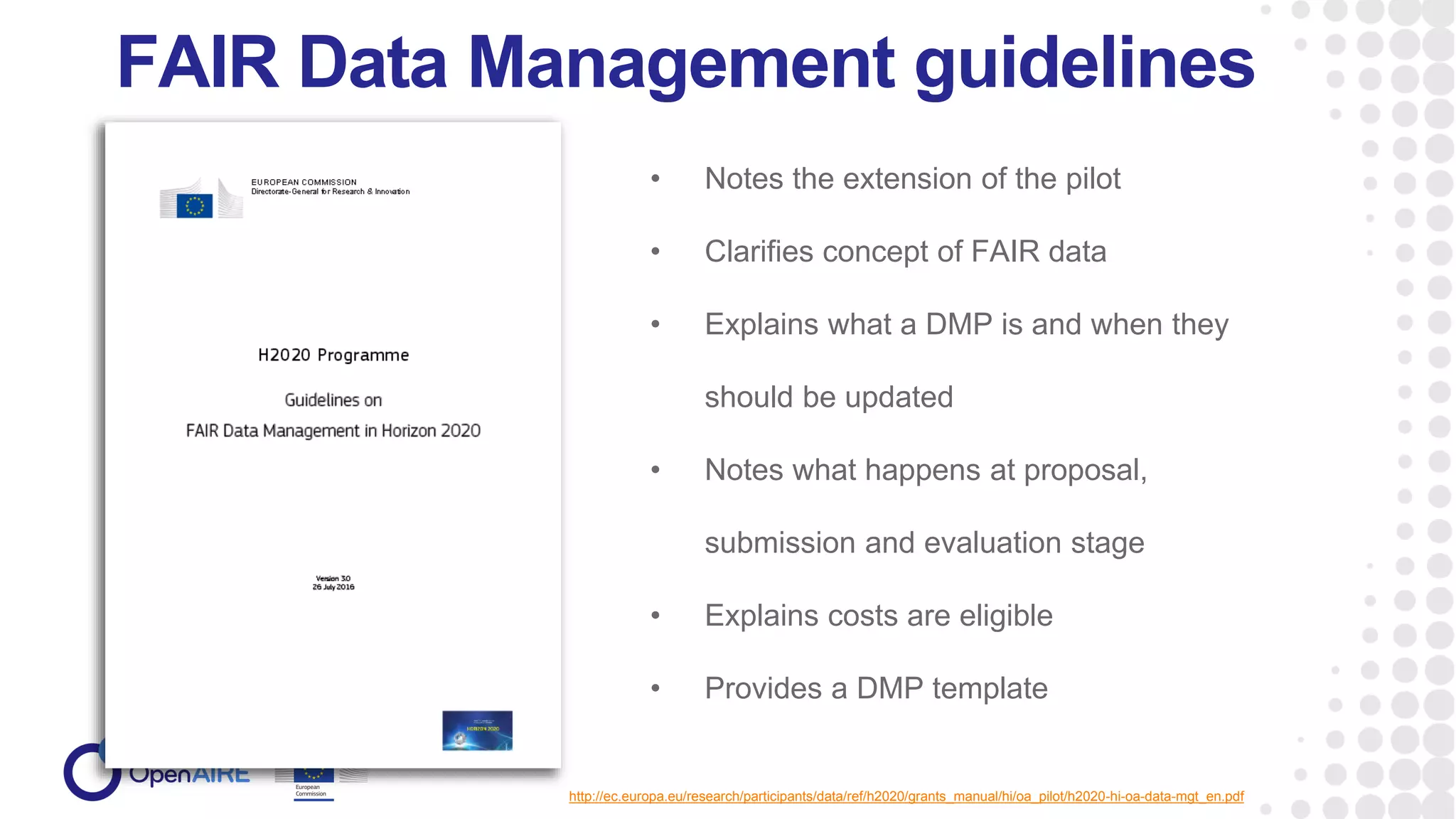
FAIR Data Management guidelines
http://ec.europa.eu/research/participants/data/ref/h2020/grants_manual/hi/oa_pilot/h2020-hi-oa-data-mgt_en.pdf
• Notes the extension of the pilot
• Clarifies concept of FAIR data
• Explains what a DMP is and when they
should be updated
• Notes what happens at proposal,
submission and evaluation stage
• Explains costs are eligible
• Provides a DMP template
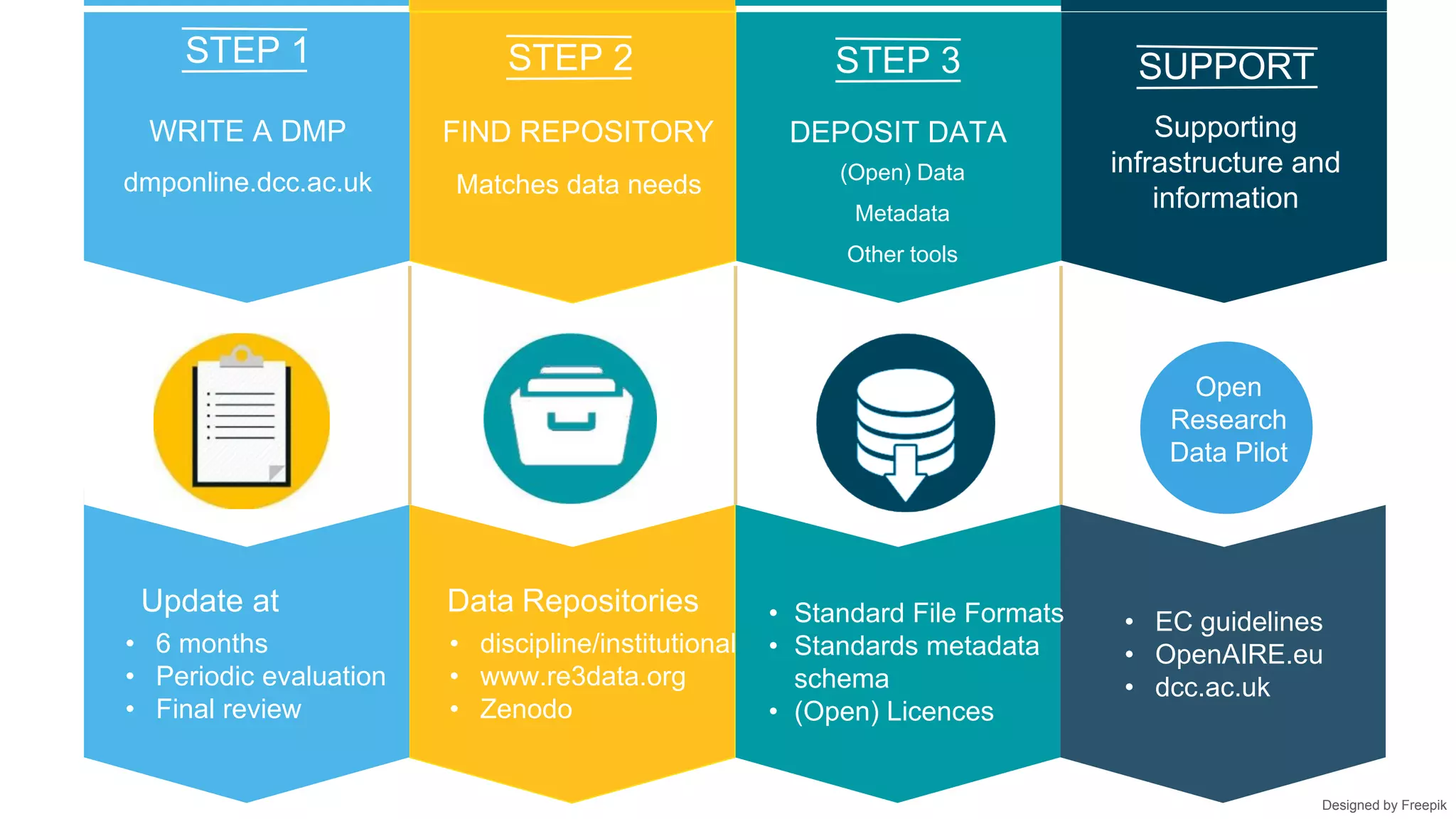
(Open) Data
Metadata
Other tools
Open
Research
Data Pilot
Data Repositories
• EC guidelines
• OpenAIRE.eu
• dcc.ac.uk
• Standard File Formats
• Standards metadata
schema
• (Open) Licences
• 6 months
• Periodic evaluation
• Final review
STEP 1
WRITE A DMP
dmponline.dcc.ac.uk
Update at
FIND REPOSITORY DEPOSIT DATA Supporting
infrastructure and
information
STEP 2 STEP 3 SUPPORT
• discipline/institutional
• www.re3data.org
• Zenodo
Matches data needs
Designed by Freepik
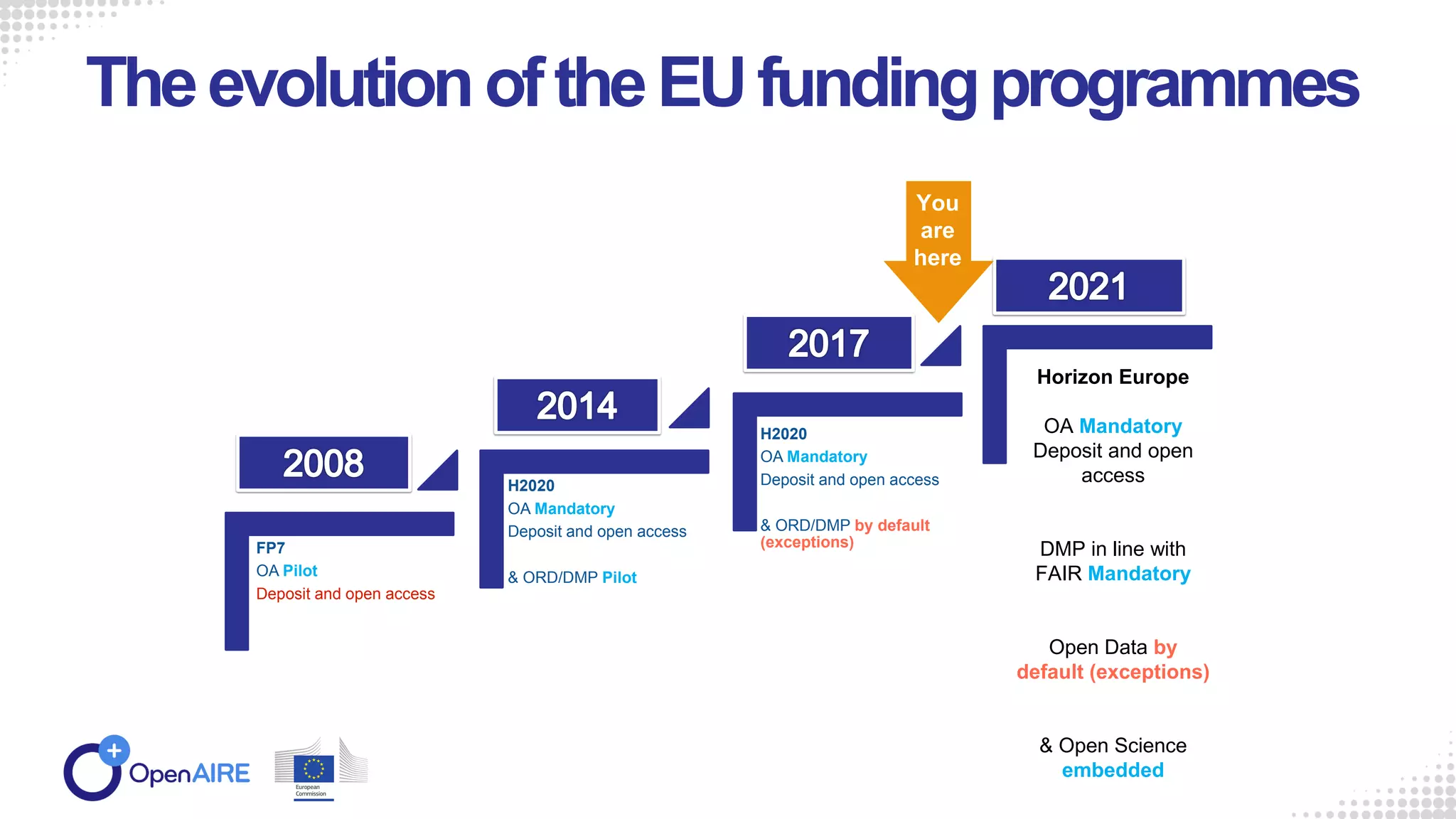
TheevolutionoftheEUfundingprogrammes
FP7
OA Pilot
Deposit and open access
H2020
OA Mandatory
Deposit and open access
& ORD/DMP Pilot
H2020
OA Mandatory
Deposit and open access
& ORD/DMP by default
(exceptions)
Horizon Europe
OA Mandatory
Deposit and open
access
DMP in line with
FAIR Mandatory
Open Data by
default (exceptions)
& Open Science
embedded
You
are
here
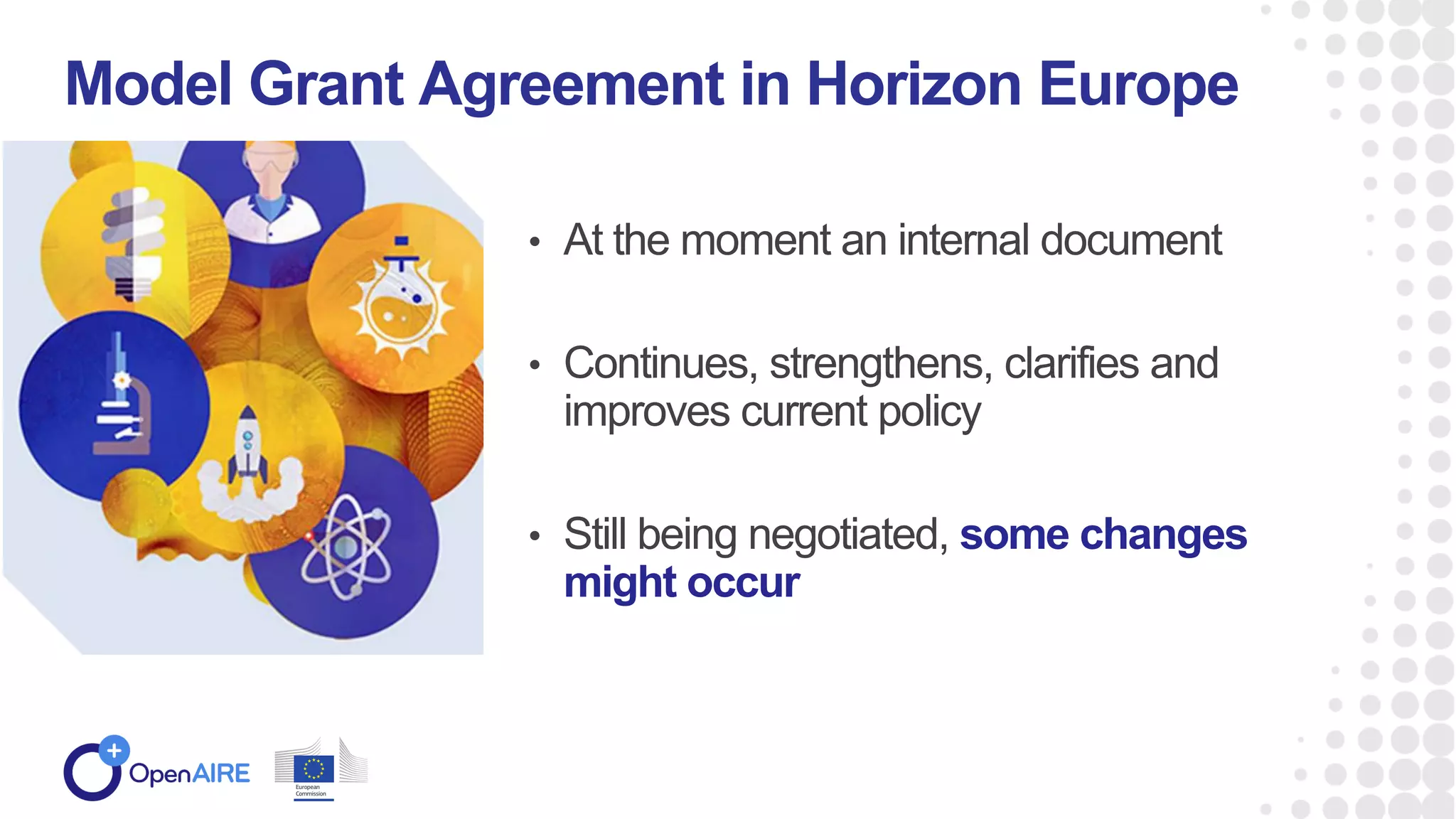
• At the moment an internal document
• Continues, strengthens, clarifies and
improves current policy
• Still being negotiated, some changes
might occur
Model Grant Agreement in Horizon Europe
Horizon Europe MGA
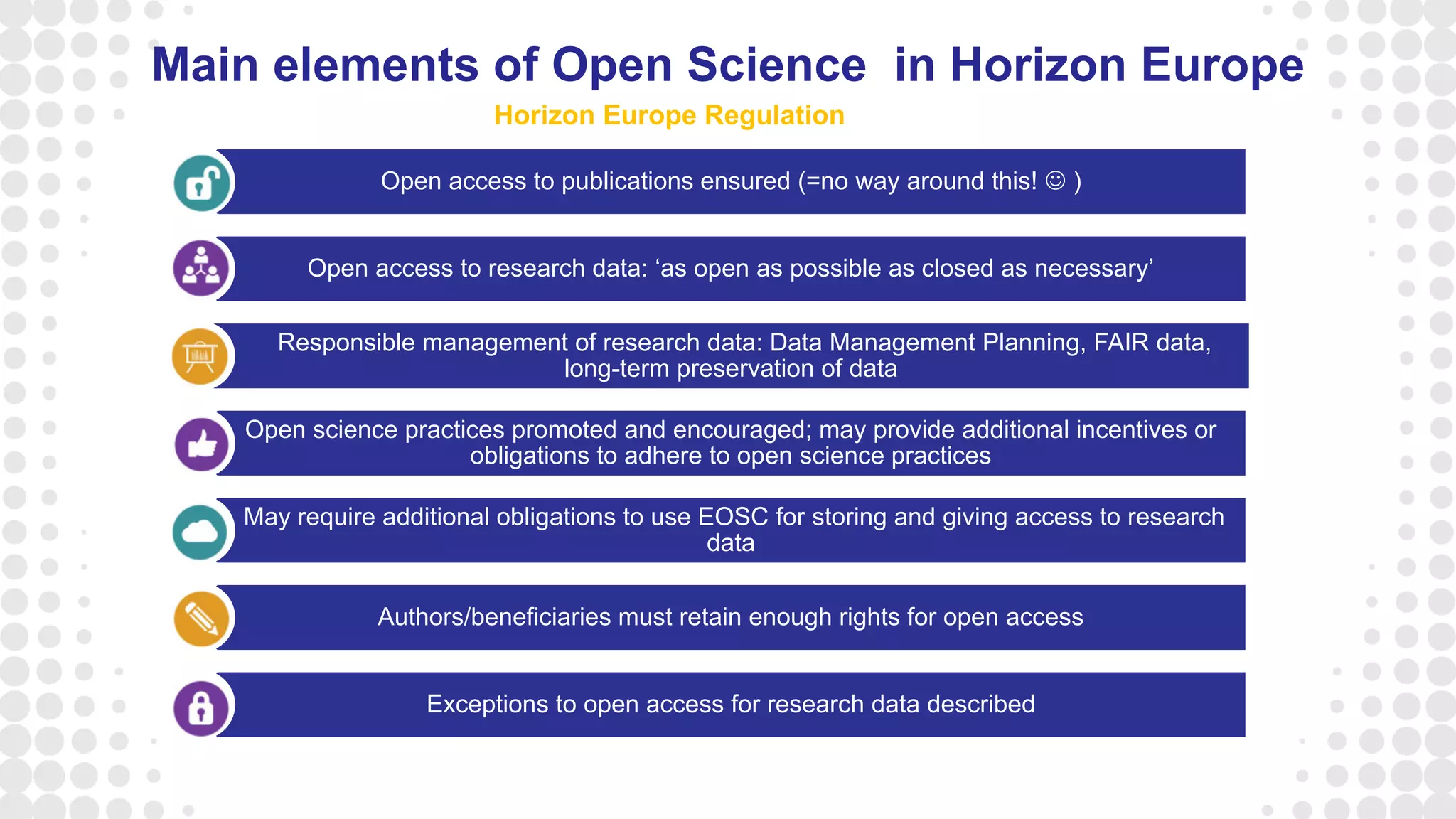
Open access to publications ensured (=no way around this!  )
Open access to research data: ‘as open as possible as closed as necessary’
Responsible management of research data: Data Management Planning, FAIR data,
long-term preservation of data
Open science practices promoted and encouraged; may provide additional incentives or
obligations to adhere to open science practices
May require additional obligations to use EOSC for storing and giving access to research
data
Authors/beneficiaries must retain enough rights for open access
Exceptions to open access for research data described
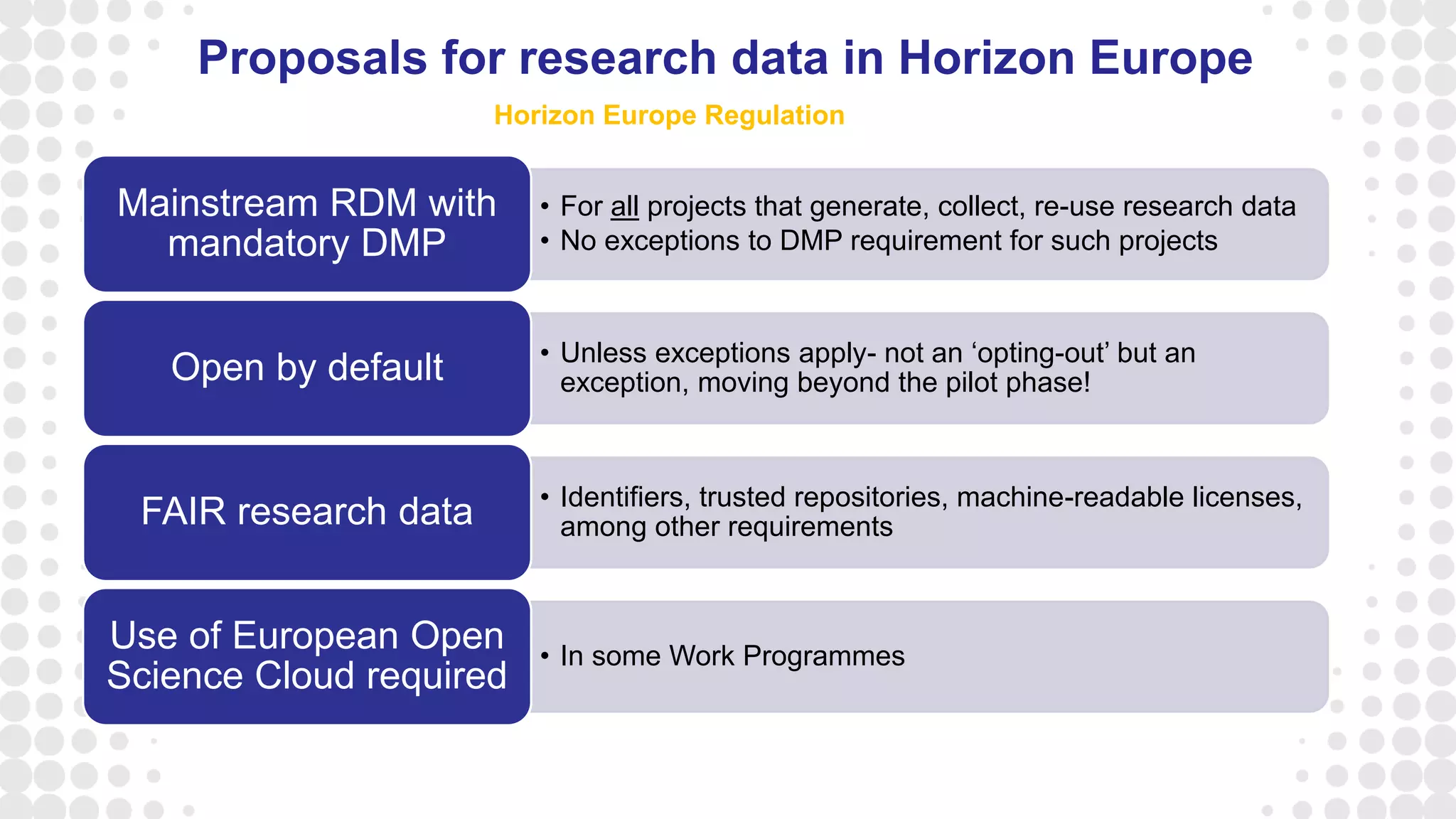
Main elements of Open Science in Horizon Europe
Horizon Europe Regulation
• For all projects that generate, collect, re-use research data
• No exceptions to DMP requirement for such projects
Mainstream RDM with
mandatory DMP
• Unless exceptions apply- not an ‘opting-out’ but an
exception, moving beyond the pilot phase!Open by default
• Identifiers, trusted repositories, machine-readable licenses,
among other requirementsFAIR research data
• In some Work Programmes
Use of European Open
Science Cloud required
Proposals for research data in Horizon Europe
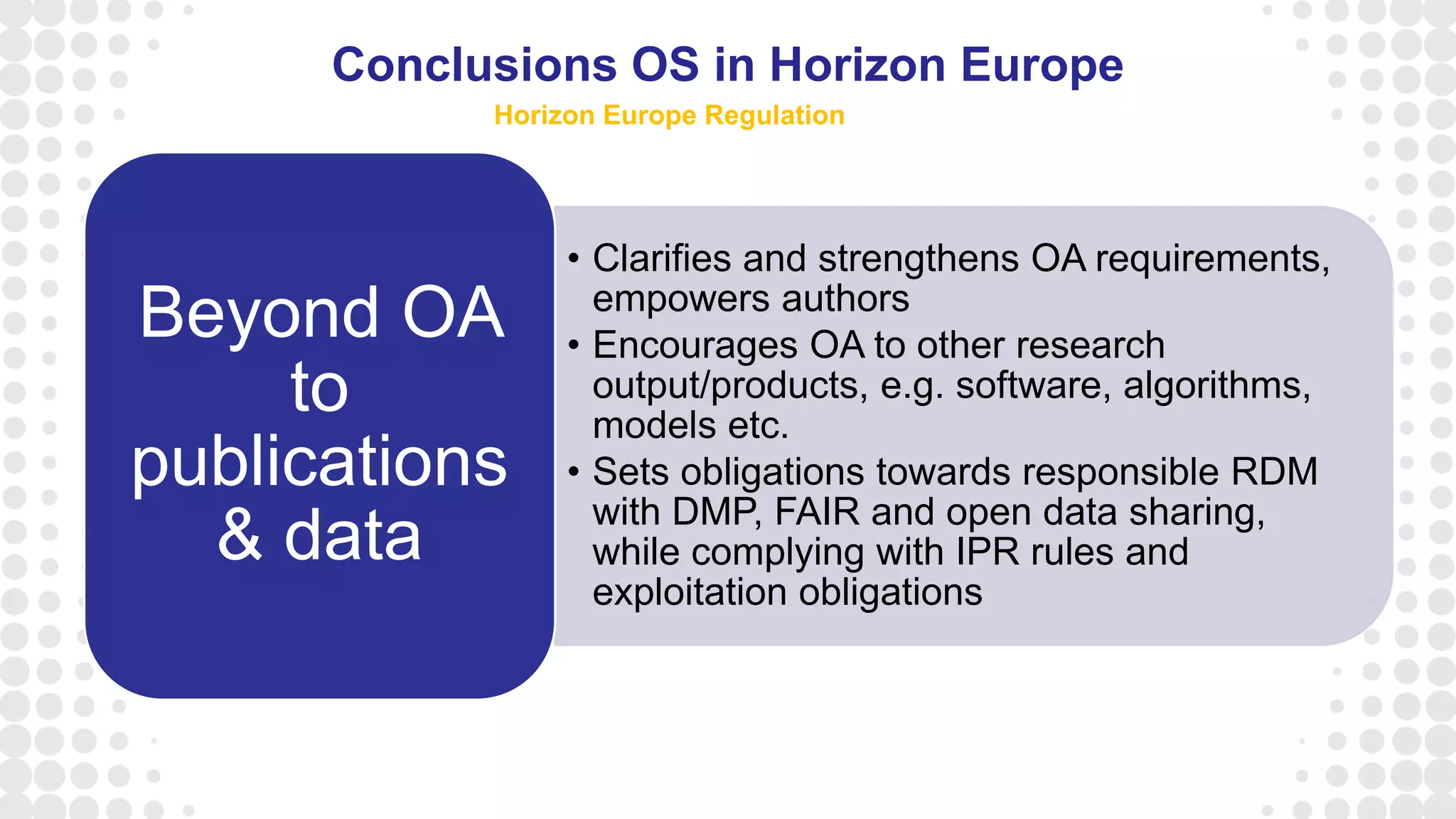
Horizon Europe Regulation
• Clarifies and strengthens OA requirements,
empowers authors
• Encourages OA to other research
output/products, e.g. software, algorithms,
models etc.
• Sets obligations towards responsible RDM
with DMP, FAIR and open data sharing,
while complying with IPR rules and
exploitation obligations
Beyond OA
to
publications
& data
Conclusions OS in Horizon Europe
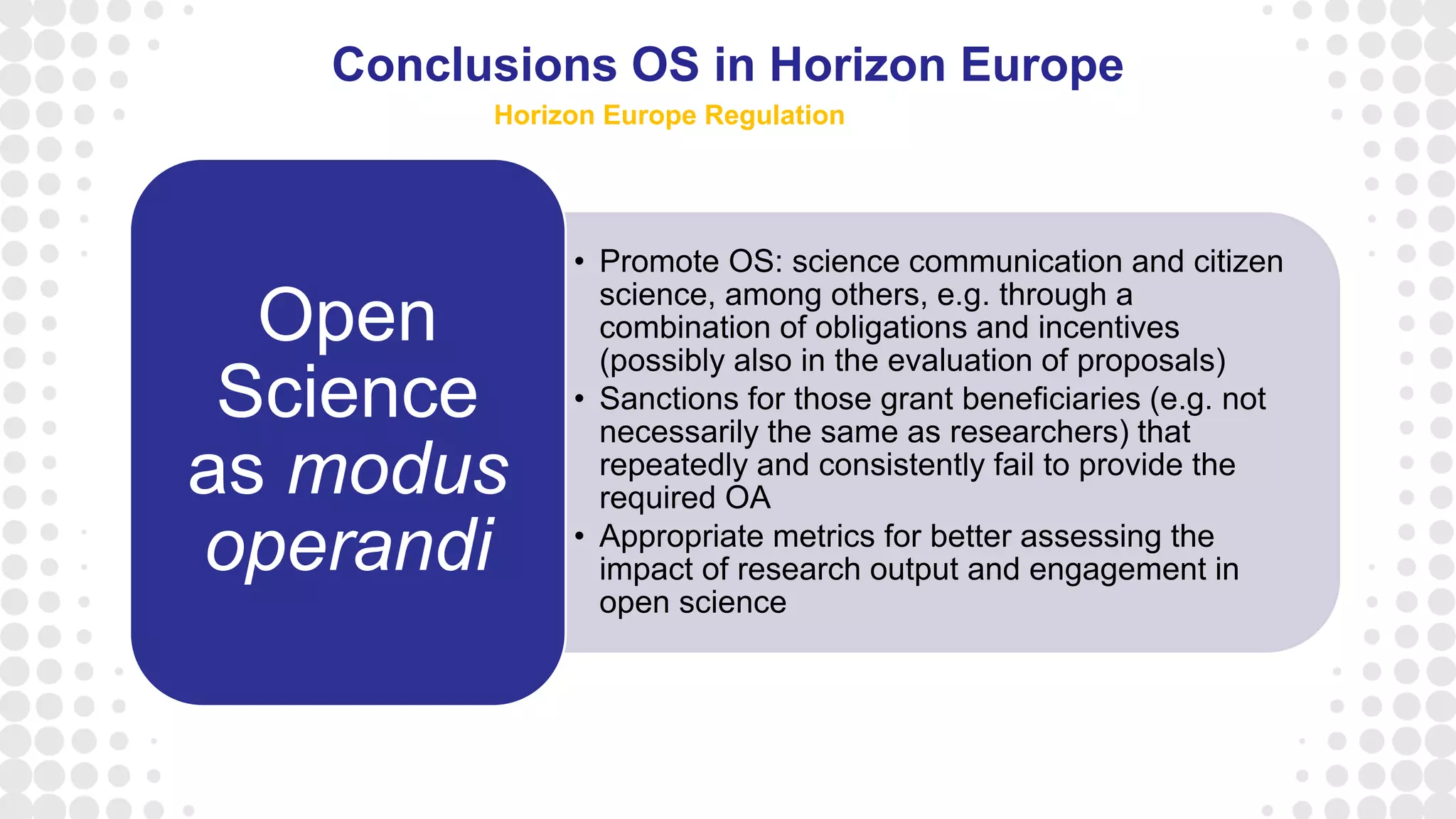
Horizon Europe Regulation
• Promote OS: science communication and citizen
science, among others, e.g. through a
combination of obligations and incentives
(possibly also in the evaluation of proposals)
• Sanctions for those grant beneficiaries (e.g. not
necessarily the same as researchers) that
repeatedly and consistently fail to provide the
required OA
• Appropriate metrics for better assessing the
impact of research output and engagement in
open science
Open
Science
as modus
operandi
Conclusions OS in Horizon Europe
Horizon Europe Regulation
Plan S and Horizon Europe?
• Plan S:
“With effect from 2021, all scholarly publications on the results from
research funded by public or private grants[…], must be published in Open
Access Journals, on Open Access Platforms, or made immediately available
through Open Access Repositories without embargo.”
• Immediate OA without embargo’s
• Authors or their institutions retain copyright and published under an
open license.
• Open Access publication fees are covered by the Funders or
research institutions, not by individual researchers. Fees must be
transparent.
• No support for hybrid models.
 The EC is a supporter of Plan S
For further information on Plan S: https://www.coalition-s.org/principles-and-implementation/
Plan S and Horizon Europe?
 The EC examines the possible implementation of main elements of
Plan S in Horizon Europe
• Immediate OA without embargo’s
 Horizon Europe: Through repositories or open access
publishing and repositories. Embargoes no longer accepted
• Authors or their institutions retain copyright and published under an
open license.
 Horizon Europe: Copyright retention already in the HE
Regulation
• No support for hybrid models.
 Horizon Europe: Hybrid journals allowed but costs not eligible
For further information on Plan S: https://www.coalition-s.org/principles-and-implementation/
Questions through the form
• Currently, there seem to be no sanctions for projects that do not fulfil their
open access or RDM obligations. Are there any signs that this will change in
the future? In Horizon Europe?
 There are already examples of project being notified of their obligations and
warnings of grants being reduced. Horizon Europe: sanctions for those grant
beneficiaries that repeatedly and consistently fail to provide the required OA.
• How different are open science policies to open access digital repositories?
 For H2020, depositing in an Open Access repository is the way to comply with
the OA mandate.
Questions through the form
• How do Academic Library participate in the Open Science Policy to provide users' information
needs?
 Depends on the academic library. Based on skills and resources they can enable:
o Advocating and raising awareness: working groups and policy work
o Giving support to the infrastructures: help with description and metadata application,
curation and preservation…
o Train and support researchers: knowledge of mandates, tools, preservation and
metadata…
o Contribute to RDM policies or support
• What will be after Horizon 2020 in Horizon Europe?
 OA to publications, OA to data by default, managing of data according to FAIR.
RESOURCES
EC
• Guidelines: Open access to publications and research data in Horizon 2020
• Guidelines on FAIR data Management in H2020
OpenAIRE
• Open Access basics: https://www.openaire.eu/oa-basics
• RDM handbook: https://www.openaire.eu/rdm-handbook
• Guides: https://www.openaire.eu/guides
• Fact sheets: https://www.openaire.eu/openaire-h2020-factsheets
Thank you!www.openaire.eu
@openaire_eu
Facebook.com/groups/openaire
https://www.linkedin.com/groups/
OpenAIRE3893548
info@openaire.eu

OpenAIRE webinar: Horizon 2020 Open Science Policies and beyond, with Emilie Hermans (OpenAIRE)

  • 1.
    @openaire_eu OpenAIREwebinar Horizon2020OpenSciencePoliciesandbeyond October 22th, 2019 HermansEmilie Ghent University OpenAIRE Webinar Horizon 2020 Open Science Policies and beyond – 22/10/2019
  • 2.
    ‘Everyone on theroad to Open Science’ by Patrick Hochstenbach CC-BY 4.0 by Patrick Hochstenbach
  • 3.
    Aim of OpenScience policy • build on previous research results: improved quality of results • greater efficiency: encourage collaboration and avoid duplication of effort • speed up innovation: faster progress to market means faster growth • involve citizens and society: improved transparency of the scientific process Image by Patrick Hochstenbach CC-BY 4.0 by Patrick Hochstenbach
  • 4.
    • open accessto scientific publications, which is an obligation Main OS policies for H2020 • open access to research data, where opt-outs are possible and research data management Derivative of ‘Everyone on the road to Open Science’ by Patrick Hochstenbach CC-BY 4.0 by Patrick Hochstenbach
  • 5.
    • The GrantAgreement states (29.2): Open Access Policy “Ensure open access… as soon as possible and at the latest on publication, deposit a machine-readable electronic copy of the published version or final peer-reviewed manuscript accepted for publication in a repository for scientific publications together with bibliographic metadata providing the name of the action, acronym & grant number”
  • 6.
    1. Publish inany journal of your choice How make your publication OA? Subscription based Open Access Journal  ALWAYS deposit a version in a repository + Add metadata: funder, grant ID number, acronym, publication date…. Deposit in a repository and provide access Deposit in a repository and provide access
  • 7.
    • Directory ofOpen Access Journals: DOAJ  doaj.org/ • Article Processing Charge (APC) • supported both for OA journals AND subscriptions-based journals that offer the possibility of making individual articles openly accessible (hybrid journals) during the duration of the action. Publishing in an OA journal Finding an OA journal:  But remember ALWAYS deposit a version in a repository
  • 8.
    • Institutional repository •Disciplinary repository • Or use Zenodo.org: EC-cofounded, multidisciplinary, free repository Where to deposit? • The Directories of Open Access Repositories: • v2.sherpa.ac.uk/opendoar • roar.eprints.org • Explore.openaire.eu
  • 9.
    • Final peer-reviewedmanuscript OR • Published version + metadata: funder, grant ID number, acronym, publication date…. Check publishers policies on what you can deposit: www.sherpa.ac.uk/romeo  Overview of copyright policies and self-archiving permissions What to deposit?  Apply to all kind of publication, but emphasis on peer-reviewed journal articles
  • 10.
    When to deposit? As soon as possible, and at the latest on publication When to provide Open Access? • Immediately or • After embargo period: • at most 6 months (12 months for publications in the social sciences and humanities)* *EC’s model amendment to publishing agreements: http://ec.europa.eu/research/participants/data/ref/h2020/other/hi/oa-pilot/h2020-oa- guide-model-for-publishing-a_en.pdf
  • 11.
    Researcher decides where to publish Checkpublishers policies on www.sherpa.ac.uk/romeo Open Access Journals: doaj.org Self-archive in repository Check for Article Processing Charges Subscription-based journal In short: This is a derivative based on a scheme by “www.fosteropenscience.eu”, used under CC BY. Immediate OA Immediate or delayed OA
  • 12.
    EC: The OpenResearch Data Pilot Flexible ORD pilot: From limited to default in 2017 • Avoid duplication of research and loss of resources • Foster Open Science Open Access to research data (or partially opt-out) Data Management Planning
  • 13.
    Requirements 1. Develop aData Management Plan (DMP) 2. Deposit dataset in a research data repository together with the necessary information 3. Provide open access to research data, if possible 13 → primarily: data needed to validate results in scientific publications → voluntarily: any other curated and/or raw data, as specified in DMP
  • 14.
    • Limited pilotlaunched in 2014 • Pilot extended in 2017 → participating now default option for all projects! o associated data management costs fully eligible for funding (for duration of project) → but possibility to opt out (& not share data) at any stage Reasons e.g. o Exploitation of results o Confidentiality, protection of personal data o Would jeopardize the main aim of the action o No data generated o … → projects opting out still encouraged to develop a DMP! Participation 14
  • 15.
    Degrees of datasharing 15 OPEN RESTRICTED/CONTROLLED CLOSED “Can be freely used, modified & shared by anyone for any purpose” http://opendefinition.org Limits on who can access & use data, how, and/or for what purpose • only subset of data • only certain (types of) users • only certain types of use • … Under embargo Unable to share “As open as possible, as closed as necessary” Adapted from ‘Managing and sharing research data’ by S. Jones, CC-BY Participation in ORD Pilot does NOT mean you have to open up all data!
  • 16.
    FAIR Data Managementguidelines http://ec.europa.eu/research/participants/data/ref/h2020/grants_manual/hi/oa_pilot/h2020-hi-oa-data-mgt_en.pdf • Notes the extension of the pilot • Clarifies concept of FAIR data • Explains what a DMP is and when they should be updated • Notes what happens at proposal, submission and evaluation stage • Explains costs are eligible • Provides a DMP template
  • 17.
    (Open) Data Metadata Other tools Open Research DataPilot Data Repositories • EC guidelines • OpenAIRE.eu • dcc.ac.uk • Standard File Formats • Standards metadata schema • (Open) Licences • 6 months • Periodic evaluation • Final review STEP 1 WRITE A DMP dmponline.dcc.ac.uk Update at FIND REPOSITORY DEPOSIT DATA Supporting infrastructure and information STEP 2 STEP 3 SUPPORT • discipline/institutional • www.re3data.org • Zenodo Matches data needs Designed by Freepik
  • 18.
    TheevolutionoftheEUfundingprogrammes FP7 OA Pilot Deposit andopen access H2020 OA Mandatory Deposit and open access & ORD/DMP Pilot H2020 OA Mandatory Deposit and open access & ORD/DMP by default (exceptions) Horizon Europe OA Mandatory Deposit and open access DMP in line with FAIR Mandatory Open Data by default (exceptions) & Open Science embedded You are here
  • 19.
    • At themoment an internal document • Continues, strengthens, clarifies and improves current policy • Still being negotiated, some changes might occur Model Grant Agreement in Horizon Europe Horizon Europe MGA
  • 20.
    Open access topublications ensured (=no way around this!  ) Open access to research data: ‘as open as possible as closed as necessary’ Responsible management of research data: Data Management Planning, FAIR data, long-term preservation of data Open science practices promoted and encouraged; may provide additional incentives or obligations to adhere to open science practices May require additional obligations to use EOSC for storing and giving access to research data Authors/beneficiaries must retain enough rights for open access Exceptions to open access for research data described Main elements of Open Science in Horizon Europe Horizon Europe Regulation
  • 21.
    • For allprojects that generate, collect, re-use research data • No exceptions to DMP requirement for such projects Mainstream RDM with mandatory DMP • Unless exceptions apply- not an ‘opting-out’ but an exception, moving beyond the pilot phase!Open by default • Identifiers, trusted repositories, machine-readable licenses, among other requirementsFAIR research data • In some Work Programmes Use of European Open Science Cloud required Proposals for research data in Horizon Europe Horizon Europe Regulation
  • 22.
    • Clarifies andstrengthens OA requirements, empowers authors • Encourages OA to other research output/products, e.g. software, algorithms, models etc. • Sets obligations towards responsible RDM with DMP, FAIR and open data sharing, while complying with IPR rules and exploitation obligations Beyond OA to publications & data Conclusions OS in Horizon Europe Horizon Europe Regulation
  • 23.
    • Promote OS:science communication and citizen science, among others, e.g. through a combination of obligations and incentives (possibly also in the evaluation of proposals) • Sanctions for those grant beneficiaries (e.g. not necessarily the same as researchers) that repeatedly and consistently fail to provide the required OA • Appropriate metrics for better assessing the impact of research output and engagement in open science Open Science as modus operandi Conclusions OS in Horizon Europe Horizon Europe Regulation
  • 24.
    Plan S andHorizon Europe? • Plan S: “With effect from 2021, all scholarly publications on the results from research funded by public or private grants[…], must be published in Open Access Journals, on Open Access Platforms, or made immediately available through Open Access Repositories without embargo.” • Immediate OA without embargo’s • Authors or their institutions retain copyright and published under an open license. • Open Access publication fees are covered by the Funders or research institutions, not by individual researchers. Fees must be transparent. • No support for hybrid models.  The EC is a supporter of Plan S For further information on Plan S: https://www.coalition-s.org/principles-and-implementation/
  • 25.
    Plan S andHorizon Europe?  The EC examines the possible implementation of main elements of Plan S in Horizon Europe • Immediate OA without embargo’s  Horizon Europe: Through repositories or open access publishing and repositories. Embargoes no longer accepted • Authors or their institutions retain copyright and published under an open license.  Horizon Europe: Copyright retention already in the HE Regulation • No support for hybrid models.  Horizon Europe: Hybrid journals allowed but costs not eligible For further information on Plan S: https://www.coalition-s.org/principles-and-implementation/
  • 26.
    Questions through theform • Currently, there seem to be no sanctions for projects that do not fulfil their open access or RDM obligations. Are there any signs that this will change in the future? In Horizon Europe?  There are already examples of project being notified of their obligations and warnings of grants being reduced. Horizon Europe: sanctions for those grant beneficiaries that repeatedly and consistently fail to provide the required OA. • How different are open science policies to open access digital repositories?  For H2020, depositing in an Open Access repository is the way to comply with the OA mandate.
  • 27.
    Questions through theform • How do Academic Library participate in the Open Science Policy to provide users' information needs?  Depends on the academic library. Based on skills and resources they can enable: o Advocating and raising awareness: working groups and policy work o Giving support to the infrastructures: help with description and metadata application, curation and preservation… o Train and support researchers: knowledge of mandates, tools, preservation and metadata… o Contribute to RDM policies or support • What will be after Horizon 2020 in Horizon Europe?  OA to publications, OA to data by default, managing of data according to FAIR.
  • 28.
    RESOURCES EC • Guidelines: Openaccess to publications and research data in Horizon 2020 • Guidelines on FAIR data Management in H2020 OpenAIRE • Open Access basics: https://www.openaire.eu/oa-basics • RDM handbook: https://www.openaire.eu/rdm-handbook • Guides: https://www.openaire.eu/guides • Fact sheets: https://www.openaire.eu/openaire-h2020-factsheets
  • 29.