OOPs Concepts in C++
Content
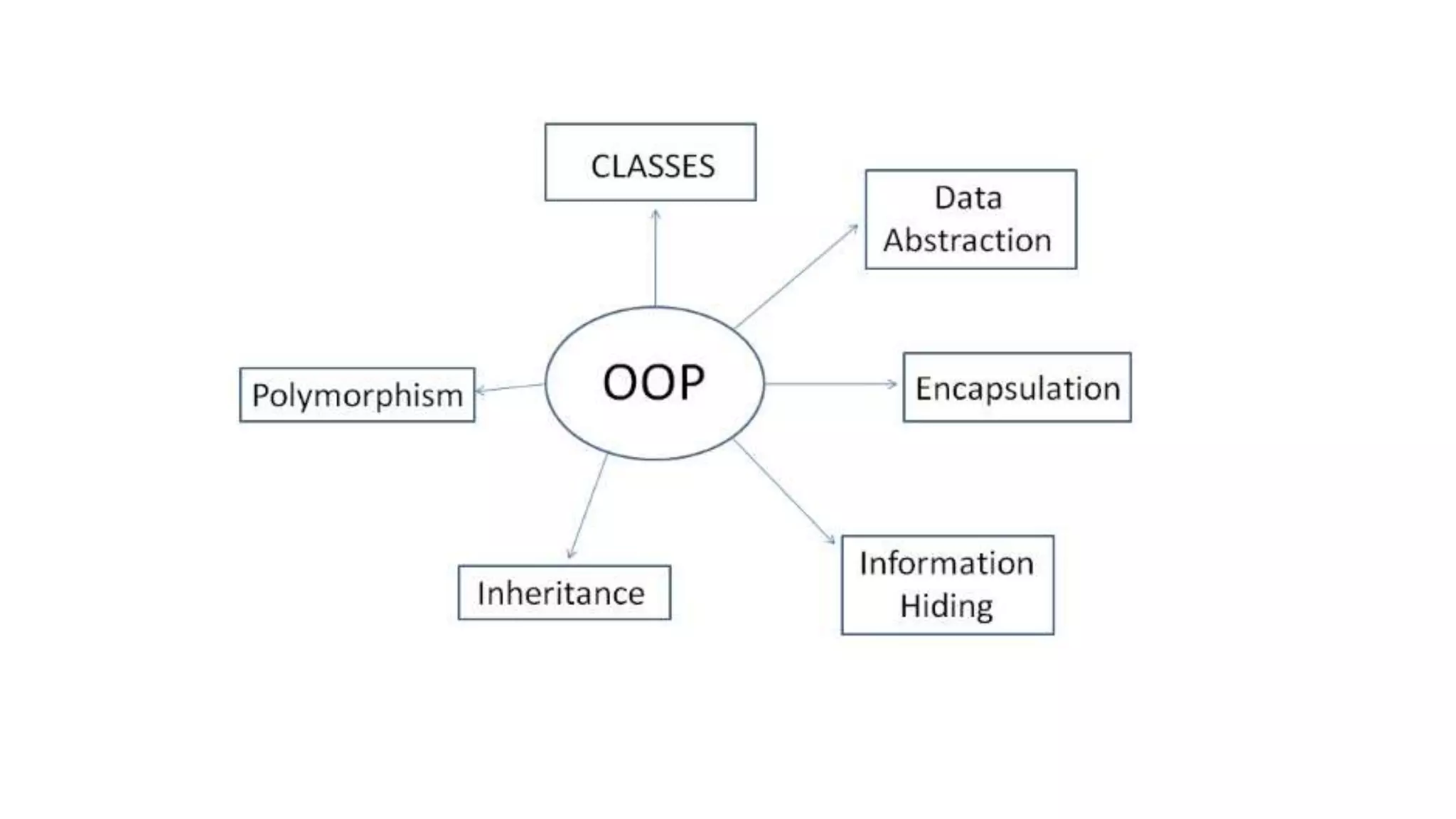
1 Introduction
2 Object
3 Classes
4 Data Abstraction
5 Encapsulation
6 Information hiding
7 Inheritance
8 Polymorphism
Introduction
Object-oriented programming (OOP) is a programming language model
organized around objects rather than "actions" and data rather than logic.
Historically, a program has been viewed as a logical procedure that takes
input data, processes it, and produces output data.
Object
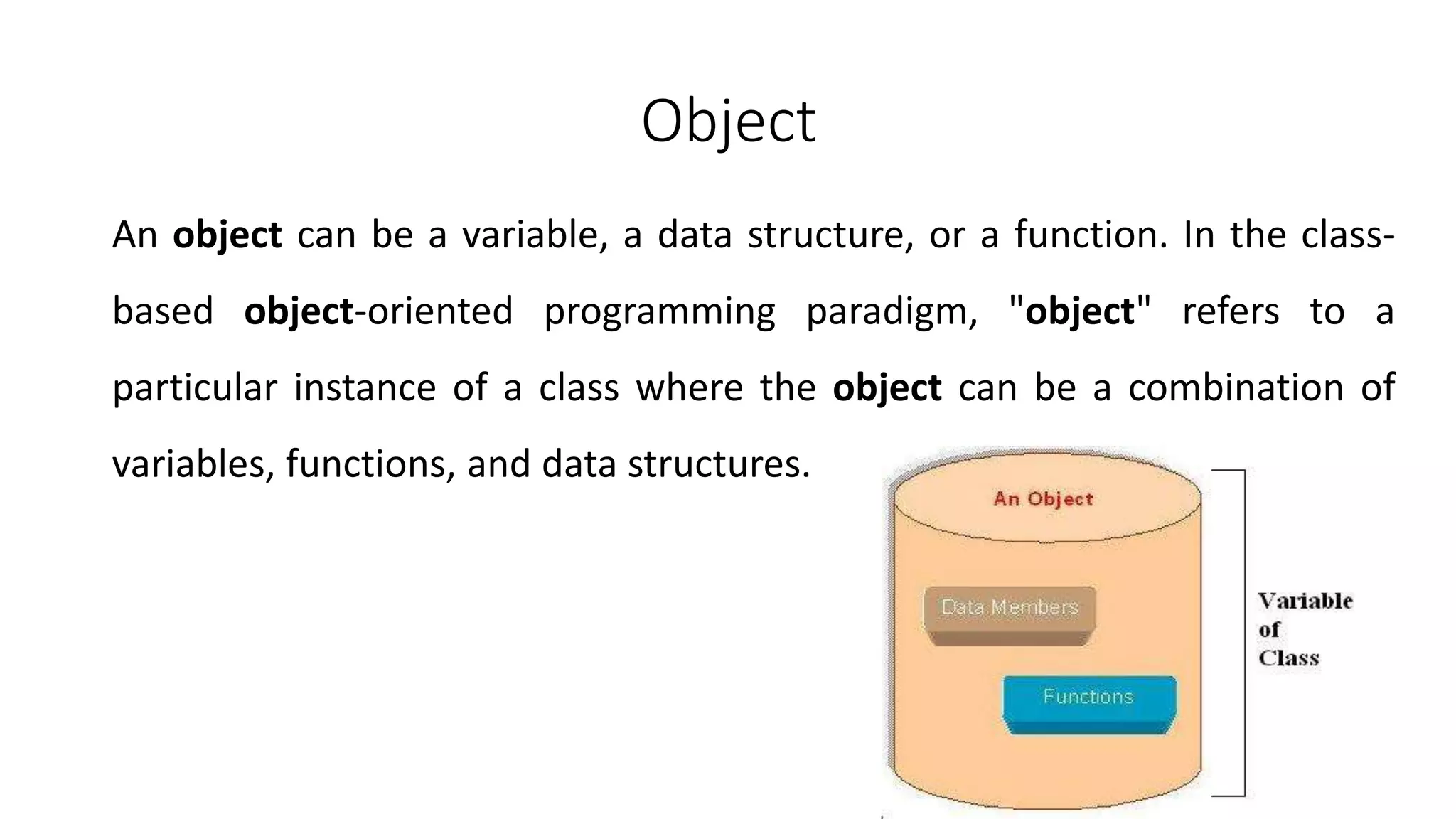
An object can be a variable, a data structure, or a function. In the class-
based object-oriented programming paradigm, "object" refers to a
particular instance of a class where the object can be a combination of
variables, functions, and data structures.
Classes
A class in C++ is a user defined type or data structure declared with
keyword class that has data and functions (also called methods) as its
members whose access is governed by the three access specifiers private,
protected or public (by default access to members of a class is private).
Data Abstraction
 Data abstraction is the reduction of a particular body of data to a simplified
representation of the whole.
 Abstraction, in general, is the process of taking away or removing
characteristics from something in order to reduce it to a set of essential
characteristics. As in abstract art, the representation is likely to be one
potential abstraction of a number of possibilities. A database abstraction
layer, for example, is one of a number of such possibilities.
• Data abstraction is usually the first step in database design. A
complete database is much too complex a system to be developed
without first creating a simplified framework. Data abstraction makes it
possible for the developer to start from essential elements -- data
abstractions and incrementally add data detail to create the final system.
Encapsulation
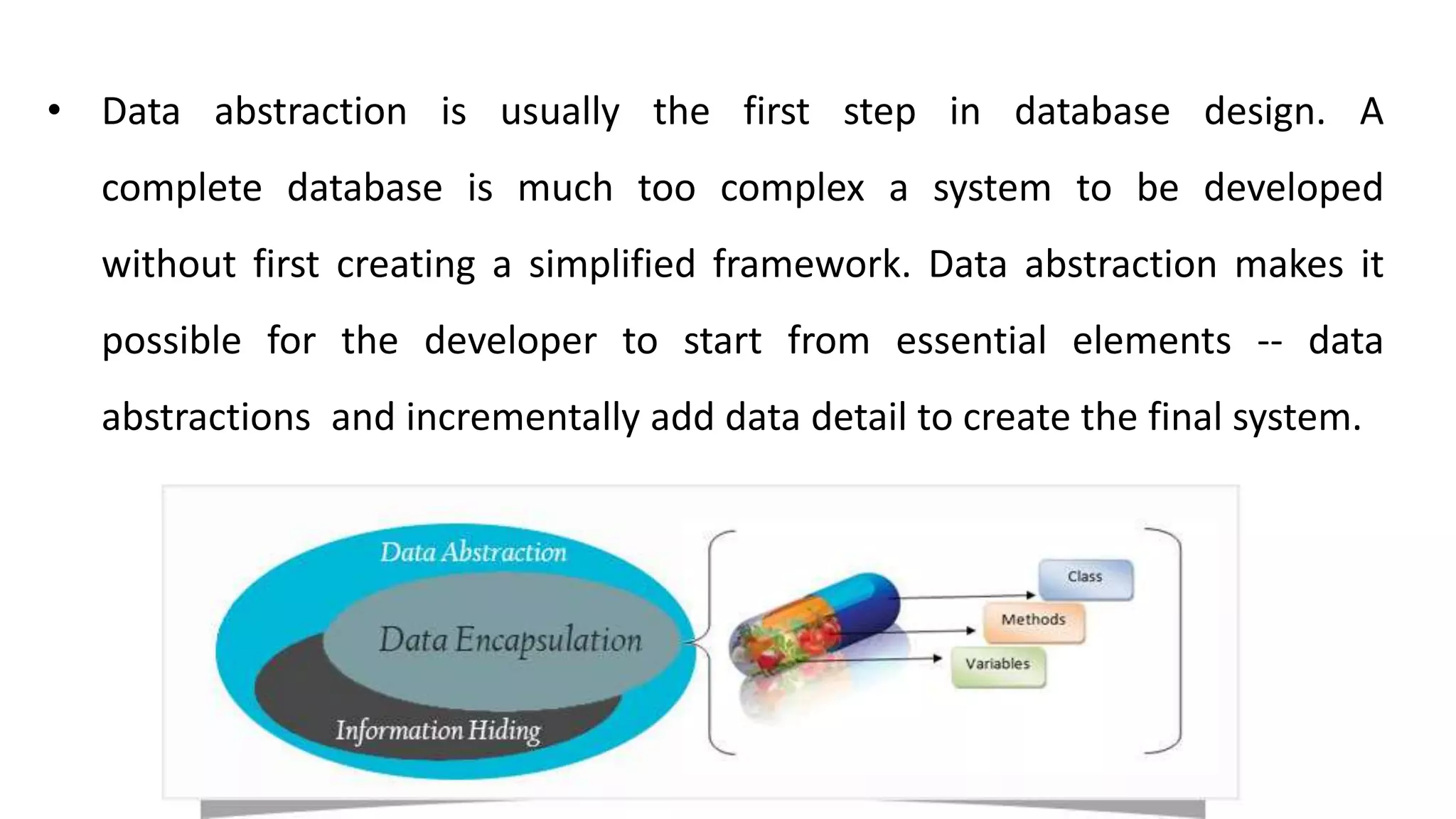
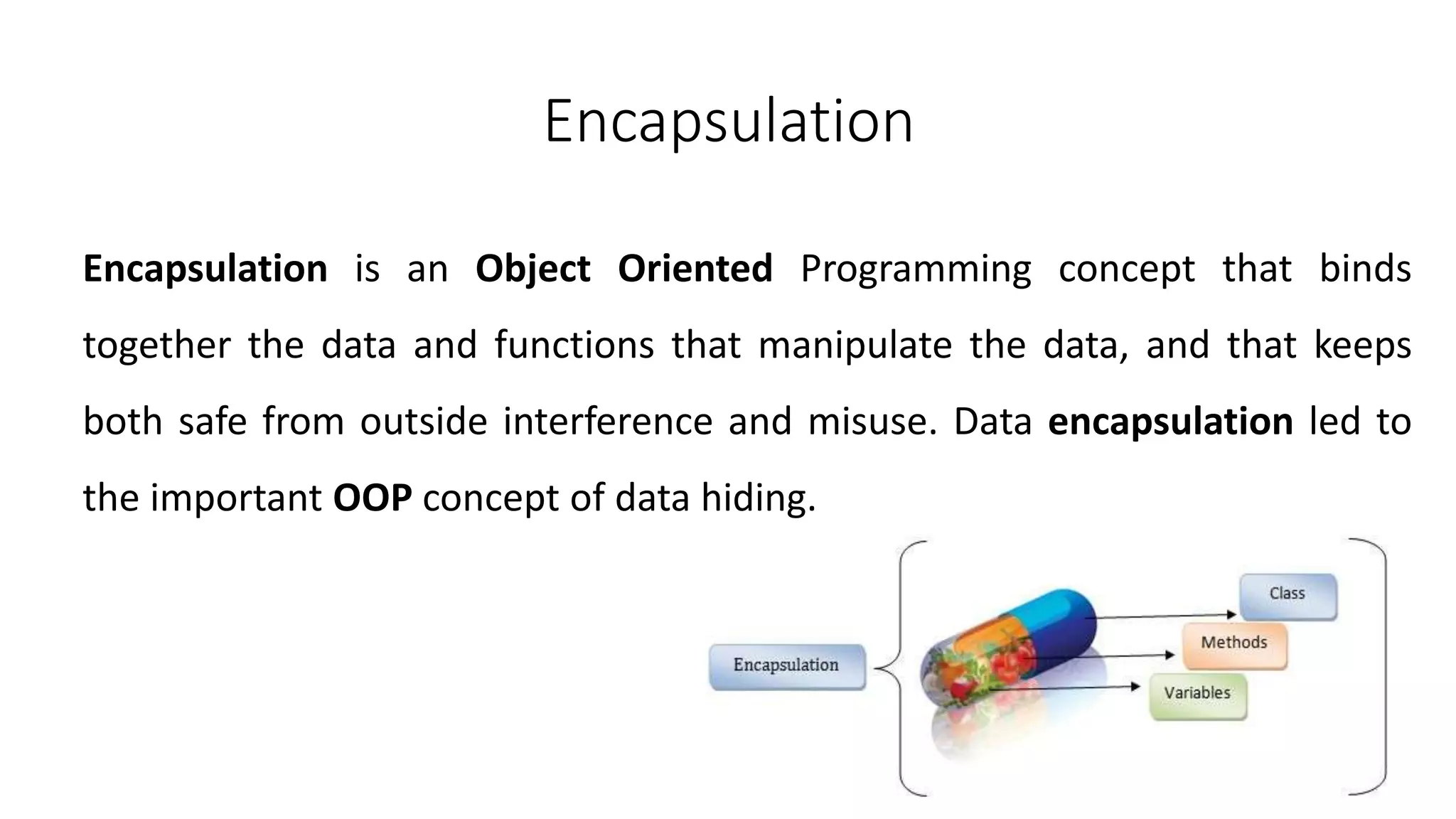
Encapsulation is an Object Oriented Programming concept that binds
together the data and functions that manipulate the data, and that keeps
both safe from outside interference and misuse. Data encapsulation led to
the important OOP concept of data hiding.
Information hiding
Information hiding is the principle of segregation of the design
decisions in a computer program that are most likely to change, thus
protecting other parts of the program from extensive modification if
the design decision is changed.
Inheritance
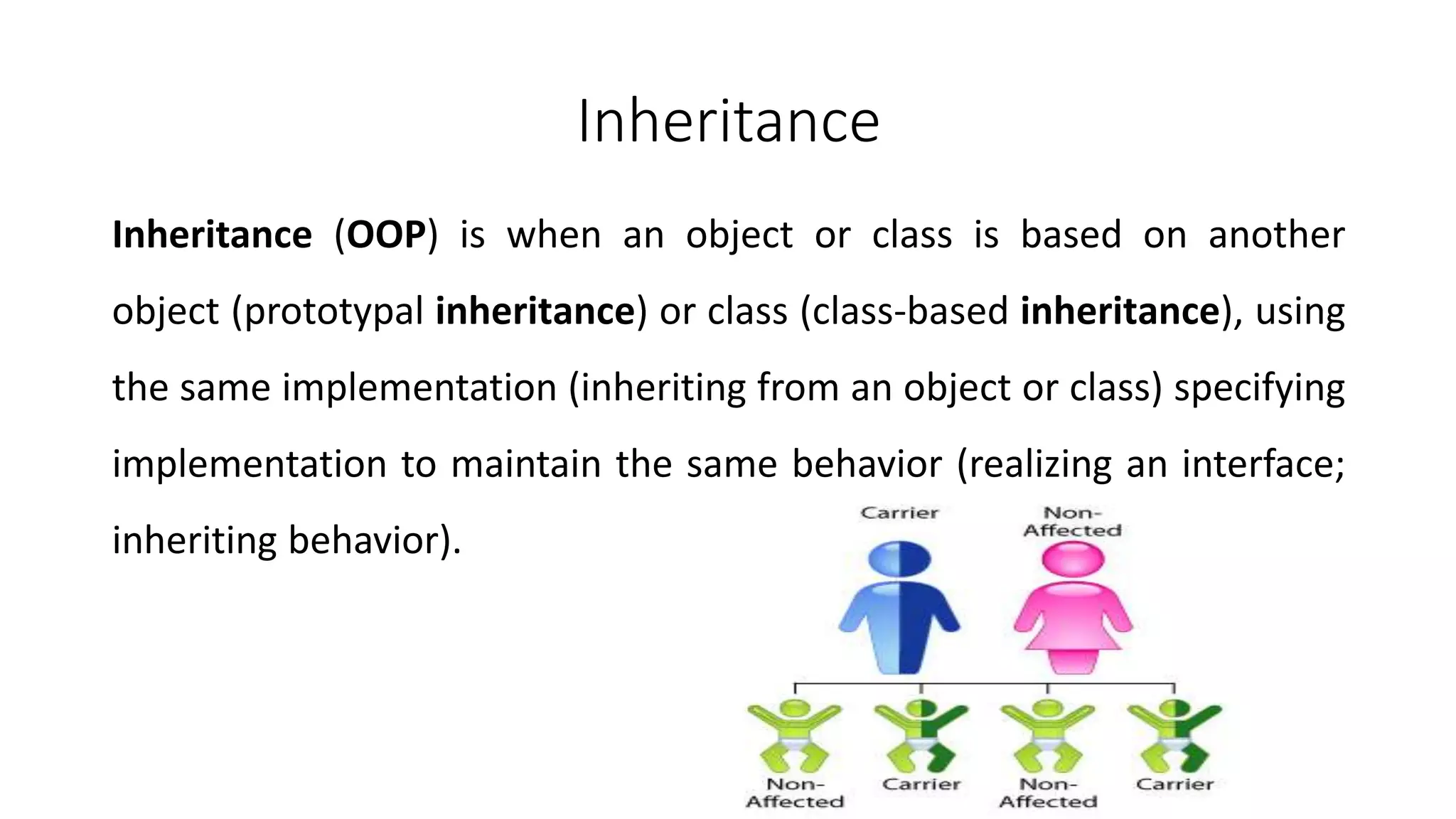
Inheritance (OOP) is when an object or class is based on another
object (prototypal inheritance) or class (class-based inheritance), using
the same implementation (inheriting from an object or class) specifying
implementation to maintain the same behavior (realizing an interface;
inheriting behavior).
Types of Inheritance
In C++, we have 5 different types of Inheritance. Namely,
1.Single Inheritance
2.Multiple Inheritance
3.Hierarchical Inheritance
4.Multilevel Inheritance
5.Hybrid Inheritance (also known as Virtual Inheritance)
Polymorphism
The word polymorphism means having many forms. Typically,
polymorphism occurs when there is a hierarchy of classes and they are
related by inheritance.
C++ polymorphism means that a call to a member function will cause a
different function to be executed depending on the type of object that
invokes the function.
Thanks for watching

Oo ps concepts in c++

  • 1.
  • 2.
    Content 1 Introduction 2 Object 3Classes 4 Data Abstraction 5 Encapsulation 6 Information hiding 7 Inheritance 8 Polymorphism
  • 4.
    Introduction Object-oriented programming (OOP)is a programming language model organized around objects rather than "actions" and data rather than logic. Historically, a program has been viewed as a logical procedure that takes input data, processes it, and produces output data.
  • 5.
    Object An object canbe a variable, a data structure, or a function. In the class- based object-oriented programming paradigm, "object" refers to a particular instance of a class where the object can be a combination of variables, functions, and data structures.
  • 6.
    Classes A class inC++ is a user defined type or data structure declared with keyword class that has data and functions (also called methods) as its members whose access is governed by the three access specifiers private, protected or public (by default access to members of a class is private).
  • 7.
    Data Abstraction  Dataabstraction is the reduction of a particular body of data to a simplified representation of the whole.  Abstraction, in general, is the process of taking away or removing characteristics from something in order to reduce it to a set of essential characteristics. As in abstract art, the representation is likely to be one potential abstraction of a number of possibilities. A database abstraction layer, for example, is one of a number of such possibilities.
  • 8.
    • Data abstractionis usually the first step in database design. A complete database is much too complex a system to be developed without first creating a simplified framework. Data abstraction makes it possible for the developer to start from essential elements -- data abstractions and incrementally add data detail to create the final system.
  • 9.
    Encapsulation Encapsulation is anObject Oriented Programming concept that binds together the data and functions that manipulate the data, and that keeps both safe from outside interference and misuse. Data encapsulation led to the important OOP concept of data hiding.
  • 10.
    Information hiding Information hidingis the principle of segregation of the design decisions in a computer program that are most likely to change, thus protecting other parts of the program from extensive modification if the design decision is changed.
  • 11.
    Inheritance Inheritance (OOP) iswhen an object or class is based on another object (prototypal inheritance) or class (class-based inheritance), using the same implementation (inheriting from an object or class) specifying implementation to maintain the same behavior (realizing an interface; inheriting behavior).
  • 12.
    Types of Inheritance InC++, we have 5 different types of Inheritance. Namely, 1.Single Inheritance 2.Multiple Inheritance 3.Hierarchical Inheritance 4.Multilevel Inheritance 5.Hybrid Inheritance (also known as Virtual Inheritance)
  • 13.
    Polymorphism The word polymorphismmeans having many forms. Typically, polymorphism occurs when there is a hierarchy of classes and they are related by inheritance. C++ polymorphism means that a call to a member function will cause a different function to be executed depending on the type of object that invokes the function.
  • 15.