On Spatiotemporal Data Modelling And Uncertainty
Quantification Using Machine Learning And
Information Theory 1st Edition Fabian Guignard
download
https://ebookbell.com/product/on-spatiotemporal-data-modelling-
and-uncertainty-quantification-using-machine-learning-and-
information-theory-1st-edition-fabian-guignard-56741900
Explore and download more ebooks at ebookbell.com
Here are some recommended products that we believe you will be
interested in. You can click the link to download.
Data Analytics In Professional Soccer Performance Analysis Based On
Spatiotemporal Tracking Data 1st Edition Daniel Link Auth
https://ebookbell.com/product/data-analytics-in-professional-soccer-
performance-analysis-based-on-spatiotemporal-tracking-data-1st-
edition-daniel-link-auth-6990090
Advanced Control Of Ac Dc Power Networks System Of Systems Approach
Based On Spatiotemporal Scales 1st Edition Benchaib
https://ebookbell.com/product/advanced-control-of-ac-dc-power-
networks-system-of-systems-approach-based-on-spatiotemporal-
scales-1st-edition-benchaib-5301506
Westernness Critical Reflections On The Spatiotemporal Construction Of
The West Christopher Gogwilt
https://ebookbell.com/product/westernness-critical-reflections-on-the-
spatiotemporal-construction-of-the-west-christopher-gogwilt-46586584
Situatedness And Place Multidisciplinary Perspectives On The
Spatiotemporal Contingency Of Human Life 1st Ed Thomas Hnefeldt
https://ebookbell.com/product/situatedness-and-place-
multidisciplinary-perspectives-on-the-spatiotemporal-contingency-of-
human-life-1st-ed-thomas-hnefeldt-7322932
On Tamim Aldari And His Waqf In Hebron Amad Ibn Al Maqrz
https://ebookbell.com/product/on-tamim-aldari-and-his-waqf-in-hebron-
amad-ibn-al-maqrz-44863816
On A Wednesday One Week 2 Whitney G
https://ebookbell.com/product/on-a-wednesday-one-
week-2-whitney-g-44898930
On Beauty And Measure Platos Symposium And Statesman John Sallis S
Montgomery Ewegen Editor
https://ebookbell.com/product/on-beauty-and-measure-platos-symposium-
and-statesman-john-sallis-s-montgomery-ewegen-editor-44912424
On Beheading Amalendu Misra
https://ebookbell.com/product/on-beheading-amalendu-misra-46084498
On The Trail Of Blackbody Radiation Max Planck And The Physics Of His
Era Don S Lemons
https://ebookbell.com/product/on-the-trail-of-blackbody-radiation-max-
planck-and-the-physics-of-his-era-don-s-lemons-46093558
SpringerTheses
Recognizing Outstanding Ph.D. Research
Fabian Guignard
On Spatio-Temporal
Data Modelling
and Uncertainty
Quantification Using
Machine Learning and
InformationTheory
Springer Theses
Recognizing Outstanding Ph.D. Research
Aims and Scope
The series “Springer Theses” brings together a selection of the very best Ph.D. theses
from around the world and across the physical sciences. Nominated and endorsed by
two recognized specialists, each published volume has been selected for its scientific
excellence and the high impact of its contents for the pertinent field of research. For
greater accessibility to non-specialists, the published versions include an extended
introduction, as well as a foreword by the student’s supervisor explaining the special
relevance of the work for the field. As a whole, the series will provide a valuable
resource both for newcomers to the research fields described, and for other scientists
seeking detailed background information on special questions. Finally, it provides
an accredited documentation of the valuable contributions made by today’s younger
generation of scientists.
Theses may be nominated for publication in this series by heads
of department at internationally leading universities or institutes
and should fulfill all of the following criteria
• They must be written in good English.
• The topic should fall within the confines of Chemistry, Physics, Earth Sciences,
Engineering and related interdisciplinary fields such as Materials, Nanoscience,
Chemical Engineering, Complex Systems and Biophysics.
• The work reported in the thesis must represent a significant scientific advance.
• If the thesis includes previously published material, permission to reproduce this
must be gained from the respective copyright holder (a maximum 30% of the thesis
should be a verbatim reproduction from the author’s previous publications).
• They must have been examined and passed during the 12 months prior to
nomination.
• Each thesis should include a foreword by the supervisor outlining the significance
of its content.
• The theses should have a clearly defined structure including an introduction
accessible to new PhD students and scientists not expert in the relevant field.
Indexed by zbMATH.
More information about this series at https://link.springer.com/bookseries/8790
Fabian Guignard
On Spatio-Temporal Data
Modelling and Uncertainty
Quantification Using
Machine Learning
and Information Theory
Doctoral Thesis accepted by
University of Lausanne, Switzerland
Author
Dr. Fabian Guignard
Institute of Earth Surface Dynamics
Faculty of Geosciences and Environment
University of Lausanne
Lausanne, Switzerland
Supervisor
Prof. Mikhail Kanevski
Institute of Earth Surface Dynamics
Faculty of Geosciences and Environment
University of Lausanne
Lausanne, Switzerland
ISSN 2190-5053 ISSN 2190-5061 (electronic)
Springer Theses
ISBN 978-3-030-95230-3 ISBN 978-3-030-95231-0 (eBook)
https://doi.org/10.1007/978-3-030-95231-0
© The Editor(s) (if applicable) and The Author(s), under exclusive license to Springer Nature
Switzerland AG 2022
This work is subject to copyright. All rights are solely and exclusively licensed by the Publisher, whether
the whole or part of the material is concerned, specifically the rights of translation, reprinting, reuse
of illustrations, recitation, broadcasting, reproduction on microfilms or in any other physical way, and
transmission or information storage and retrieval, electronic adaptation, computer software, or by similar
or dissimilar methodology now known or hereafter developed.
The use of general descriptive names, registered names, trademarks, service marks, etc. in this publication
does not imply, even in the absence of a specific statement, that such names are exempt from the relevant
protective laws and regulations and therefore free for general use.
The publisher, the authors and the editors are safe to assume that the advice and information in this book
are believed to be true and accurate at the date of publication. Neither the publisher nor the authors or
the editors give a warranty, expressed or implied, with respect to the material contained herein or for any
errors or omissions that may have been made. The publisher remains neutral with regard to jurisdictional
claims in published maps and institutional affiliations.
This Springer imprint is published by the registered company Springer Nature Switzerland AG
The registered company address is: Gewerbestrasse 11, 6330 Cham, Switzerland
N’a de convictions que celui qui n’a rien
approfondi.
Emil Cioran
To my parents, Ida and Aimé
To Sandie and our children, Samuel and Elliot
Supervisor’s Foreword
The amount of data and information available in geo- and environmental sciences
is steadily increasing due to the intensive development of monitoring networks,
field campaigns, Earth observation by remote sensing devices (satellites, drones,
lidars), and modelling results. Therefore, the efforts in technological advances in data
acquisition, storage, and access play an important role. Besides, efficient treatment
and use of these data is crucial in scientific developments and intelligent decision-
makingprocessesinsignificantfieldssuchasclimatechange,environmentalrisksand
natural hazards, and renewable energy assessment. Analysis and modelling of spatio-
temporal data are challenging because they are high dimensional and variable at many
spatio-temporal scales, multivariate, non-homogeneous, non-linear, and uncertain.
Fabian Guignard was involved in a project of the 75th National Research Program
funded by the Swiss National Science Foundation, entitled “Hybrid renewable energy
potential for the built environment using big data: forecasting and uncertainty esti-
mation”. One of the project’s fundamental objectives was to develop data-driven
approaches for exploring, analysing, and modelling renewable energy potential in
complex mountainous regions. Accordingly, Fabian’s thesis resulted in interdis-
ciplinary research combining applied mathematics, spatio-temporal geostatistics,
analysis of complex and high-frequency time series using information measures,
computerscienceandmachinelearning(ML),quantificationofdataandmodeluncer-
tainties. An innovative contribution deals with developing and adapting a generic
ML-based methodology for spatio-temporal data analysis using Extreme Learning
Machinealgorithm,forwhichanalyticalformulasofthebiasandvariancearederived.
An applied part of the work treats a variety of real environmental data case studies.
This book presents a complete data science workflow: from deriving new theo-
retical results, via implementing the developed algorithms and methods in software
packages, to applying them to concrete environmental applications, and helping
extract valuable knowledge from data. I congratulate Fabian on his outstanding work,
ix
x Supervisor’s Foreword
and I am pleased to announce that he has been awarded the Faculty of Geosciences
and Environment Award from the University of Lausanne (UNIL).
Lausanne, Switzerland
December 2021
Prof. Mikhail Kanevski
Acknowledgements
This thesis would not have the same flavour without numerous great scientists and
engineers I have met during the past four years, some of whom have become close
friends.
First, I would like to thank especially Prof. Mikhail Kanevski, my supervisor.
During this thesis, I benefited from his eclectic knowledge of data science. From the
beginning, he considered me a researcher and gave me the freedom that I needed.
As a mathematician by training, I am used to living in an abstract world. Fortu-
nately, I met Dr. Federico Amato and Dr. Mohamed Laib, who have brought me back
to reality more than once when necessary, and supported me literally until the very
last day of this adventure. Both have lived the FiSh and UncELMe adventures with
me. I also benefited from the guidance of Dr. Jean Golay, who greatly inspired me
from a scientific perspective during my darkest hours. They receive my gratitude
here.
I would like to thank the Jury members, Prof. Dionissios Hristopulos, Prof.
François Bavaud, and Prof. Antoine Guisan, for agreeing to read and review the
manuscript and endorse it for publication. I also thank the thesis advisory committee
composed of Prof. David Ginsbourger and Dr. Christian Kaiser for their guidance.
I owe a debt to all my co-authors, with whom I always had fruitful collaborations.
My special thanks go to Dr. Luciano Telesca and Dr. Dasaraden Mauree for their
insights on environmental physics. I would like to acknowledge Dr. Sylvain Robert
for his statistical advice. My thanks also go to the EPFL HyEnergy team, Dr. Alina
Walch, Prof. Jean-Louis Scartezzini, Dr. Roberto Castello, and Dr. Nahid Mohajeri.
This thesis would not have been possible without the financial support of the Swiss
National Science Foundation (SNSF). This research was conducted within the HyEn-
ergy project n°
167285, which belongs to the 75th National Research Programme
(NRP75) of the SNSF. Moreover, the entire work has been done at the Institute of
Earth Surface Dynamics of the University of Lausanne, which provides all neces-
sary support. Special thanks to the data providers, MeteoSwiss, Swisstopo, the Solar
Energy and Building Physics Laboratory LESO-PB (EPFL), the WSL Institute for
Snow and Avalanche Research SLF and the Federal Office for the Environment for
allowing me to study various environmental phenomena.
xi
xii Acknowledgements
Finally, this research would not have been possible without my family, Nonna,
Papou, Papy Marcel, Antoinette, the Thursday and Sunday victuals and the red wine.
Samuel and Elliot, it is a wonderful gift to see you grow up. I never know what you
will do next minute, pure nugget effect and no machine learning prediction possible
for you. Sandie, none of this would have been possible without you. Thank you for
your sense of humour and your patience; you have more than you believe.
Lausanne, Switzerland
December 2021
Fabian Guignard
Contents
1 Introduction . . . . . . . . . . . . . . . . . . . . . . . . . . . . . . . . . . . . . . . . . . . . . . . . . . . 1
1.1 Sketch of the Thesis . . . . . . . . . . . . . . . . . . . . . . . . . . . . . . . . . . . . . . . . 1
1.2 Spatio-Temporal Data Modelling and Analysis . . . . . . . . . . . . . . . . . 2
1.2.1 Statistical Interpolation for Spatio-Temporal Data . . . . . . . . . 3
1.2.2 Machine Learning for Spatial Data . . . . . . . . . . . . . . . . . . . . . 4
1.2.3 Uncertainty Quantification . . . . . . . . . . . . . . . . . . . . . . . . . . . . 4
1.2.4 Information Theory as an Advanced Exploratory Tool . . . . . 5
1.3 Objectives . . . . . . . . . . . . . . . . . . . . . . . . . . . . . . . . . . . . . . . . . . . . . . . . . 6
1.4 Contributions . . . . . . . . . . . . . . . . . . . . . . . . . . . . . . . . . . . . . . . . . . . . . . 8
1.5 Thesis Organisation . . . . . . . . . . . . . . . . . . . . . . . . . . . . . . . . . . . . . . . . . 10
References . . . . . . . . . . . . . . . . . . . . . . . . . . . . . . . . . . . . . . . . . . . . . . . . . . . . . 13
2 Study Area and Data Sets . . . . . . . . . . . . . . . . . . . . . . . . . . . . . . . . . . . . . . . 17
2.1 Switzerland and Its Topography . . . . . . . . . . . . . . . . . . . . . . . . . . . . . . 17
2.2 MeteoSwiss Wind Speed Data . . . . . . . . . . . . . . . . . . . . . . . . . . . . . . . . 19
2.2.1 Data Wrangling, Cleaning and Missing Values . . . . . . . . . . . 20
2.2.2 Exploratory Data Analysis . . . . . . . . . . . . . . . . . . . . . . . . . . . . 25
2.3 MoTUS High-Frequency Wind Speed Data . . . . . . . . . . . . . . . . . . . . 31
2.3.1 Data Wrangling, Cleaning and Missing Values . . . . . . . . . . . 31
2.3.2 Exploratory Data Analysis . . . . . . . . . . . . . . . . . . . . . . . . . . . . 33
2.4 Summary . . . . . . . . . . . . . . . . . . . . . . . . . . . . . . . . . . . . . . . . . . . . . . . . . . 35
References . . . . . . . . . . . . . . . . . . . . . . . . . . . . . . . . . . . . . . . . . . . . . . . . . . . . . 37
3 Advanced Exploratory Data Analysis . . . . . . . . . . . . . . . . . . . . . . . . . . . . 39
3.1 Empirical Orthogonal Functions . . . . . . . . . . . . . . . . . . . . . . . . . . . . . . 39
3.1.1 Spatial Formulation . . . . . . . . . . . . . . . . . . . . . . . . . . . . . . . . . . 39
3.1.2 Temporal Formulation . . . . . . . . . . . . . . . . . . . . . . . . . . . . . . . . 42
3.1.3 Singular Value Decomposition . . . . . . . . . . . . . . . . . . . . . . . . . 43
3.2 Variography . . . . . . . . . . . . . . . . . . . . . . . . . . . . . . . . . . . . . . . . . . . . . . . 45
3.3 Wavelet Variance Analysis . . . . . . . . . . . . . . . . . . . . . . . . . . . . . . . . . . . 47
3.3.1 Multiresolution Wavelet Analysis . . . . . . . . . . . . . . . . . . . . . . 47
3.3.2 The Wavelet Variance . . . . . . . . . . . . . . . . . . . . . . . . . . . . . . . . . 49
xiii
xiv Contents
3.3.3 Application to the MoTUS Data . . . . . . . . . . . . . . . . . . . . . . . . 50
3.4 Summary . . . . . . . . . . . . . . . . . . . . . . . . . . . . . . . . . . . . . . . . . . . . . . . . . . 52
References . . . . . . . . . . . . . . . . . . . . . . . . . . . . . . . . . . . . . . . . . . . . . . . . . . . . . 52
4 Fisher-Shannon Analysis . . . . . . . . . . . . . . . . . . . . . . . . . . . . . . . . . . . . . . . . 55
4.1 Related Work . . . . . . . . . . . . . . . . . . . . . . . . . . . . . . . . . . . . . . . . . . . . . . 55
4.2 Fisher-Shannon Analysis . . . . . . . . . . . . . . . . . . . . . . . . . . . . . . . . . . . . 56
4.2.1 Shannon Entropy Power and Fisher Information
Measure . . . . . . . . . . . . . . . . . . . . . . . . . . . . . . . . . . . . . . . . . . . . 56
4.2.2 Properties . . . . . . . . . . . . . . . . . . . . . . . . . . . . . . . . . . . . . . . . . . . 57
4.2.3 Fisher-Shannon Complexity . . . . . . . . . . . . . . . . . . . . . . . . . . . 58
4.2.4 Fisher-Shannon Information Plane . . . . . . . . . . . . . . . . . . . . . . 59
4.3 Analytical Solutions for Some Distributions . . . . . . . . . . . . . . . . . . . . 60
4.3.1 Gamma Distribution . . . . . . . . . . . . . . . . . . . . . . . . . . . . . . . . . . 60
4.3.2 Weibull Distribution . . . . . . . . . . . . . . . . . . . . . . . . . . . . . . . . . . 61
4.3.3 Log-Normal Distribution . . . . . . . . . . . . . . . . . . . . . . . . . . . . . . 62
4.4 Data-Driven Non-parametric Estimation . . . . . . . . . . . . . . . . . . . . . . . 63
4.5 Experiments and Case Studies . . . . . . . . . . . . . . . . . . . . . . . . . . . . . . . . 65
4.5.1 Logistic Map . . . . . . . . . . . . . . . . . . . . . . . . . . . . . . . . . . . . . . . . 65
4.5.2 Normal Mixtures Densities . . . . . . . . . . . . . . . . . . . . . . . . . . . . 67
4.5.3 MoTUS Data: Advanced EDA . . . . . . . . . . . . . . . . . . . . . . . . . 69
4.5.4 MoTUS Data: Complexity Discrimination . . . . . . . . . . . . . . . 71
4.5.5 Other Applications . . . . . . . . . . . . . . . . . . . . . . . . . . . . . . . . . . . 74
4.6 Summary . . . . . . . . . . . . . . . . . . . . . . . . . . . . . . . . . . . . . . . . . . . . . . . . . . 77
References . . . . . . . . . . . . . . . . . . . . . . . . . . . . . . . . . . . . . . . . . . . . . . . . . . . . . 77
5 Spatio-Temporal Prediction with Machine Learning . . . . . . . . . . . . . . . 81
5.1 Motivation . . . . . . . . . . . . . . . . . . . . . . . . . . . . . . . . . . . . . . . . . . . . . . . . 81
5.2 Machine-Learning-Based Framework for Spatio-Temporal
Interpolation . . . . . . . . . . . . . . . . . . . . . . . . . . . . . . . . . . . . . . . . . . . . . . . 82
5.2.1 Decomposition of Spatio-Temporal Data Using EOFs . . . . . 82
5.2.2 Spatial Modelling of the Coefficients . . . . . . . . . . . . . . . . . . . 83
5.3 Simulated Data Case Study . . . . . . . . . . . . . . . . . . . . . . . . . . . . . . . . . . 85
5.4 Experiment on Temperature Monitoring Network . . . . . . . . . . . . . . . 87
5.5 Experiment on the MeteoSwiss Data . . . . . . . . . . . . . . . . . . . . . . . . . . 91
5.6 Summary . . . . . . . . . . . . . . . . . . . . . . . . . . . . . . . . . . . . . . . . . . . . . . . . . . 94
References . . . . . . . . . . . . . . . . . . . . . . . . . . . . . . . . . . . . . . . . . . . . . . . . . . . . . 94
6 Uncertainty Quantification with Extreme Learning Machine . . . . . . . 97
6.1 Related Work and Motivation . . . . . . . . . . . . . . . . . . . . . . . . . . . . . . . . 97
6.2 Background and Notations . . . . . . . . . . . . . . . . . . . . . . . . . . . . . . . . . . . 98
6.2.1 Extreme Learning Machine . . . . . . . . . . . . . . . . . . . . . . . . . . . . 99
6.2.2 Regularised ELM . . . . . . . . . . . . . . . . . . . . . . . . . . . . . . . . . . . . 100
6.2.3 ELM Ensemble . . . . . . . . . . . . . . . . . . . . . . . . . . . . . . . . . . . . . . 101
6.3 Analytical Developments . . . . . . . . . . . . . . . . . . . . . . . . . . . . . . . . . . . . 101
6.3.1 Bias and Variance for a Single ELM . . . . . . . . . . . . . . . . . . . . 101
Contents xv
6.3.2 Bias and Variance for ELM Ensemble . . . . . . . . . . . . . . . . . . . 102
6.3.3 Use of Random Variable Quadratic Forms . . . . . . . . . . . . . . . 104
6.3.4 Correlation Between Two ELMs . . . . . . . . . . . . . . . . . . . . . . . 105
6.4 Variance Estimation of ELM Ensemble . . . . . . . . . . . . . . . . . . . . . . . . 105
6.4.1 Estimation of the Least-Squares Bias Variation . . . . . . . . . . . 106
6.4.2 Estimation Under Independence and Homoskedastic
Assumptions . . . . . . . . . . . . . . . . . . . . . . . . . . . . . . . . . . . . . . . . 107
6.4.3 Estimation Under Independence and Heteroskedastic
Assumptions . . . . . . . . . . . . . . . . . . . . . . . . . . . . . . . . . . . . . . . . 112
6.5 Synthetic Experiments . . . . . . . . . . . . . . . . . . . . . . . . . . . . . . . . . . . . . . 114
6.5.1 One-Dimensional Case . . . . . . . . . . . . . . . . . . . . . . . . . . . . . . . 114
6.5.2 Multi-dimensional Case . . . . . . . . . . . . . . . . . . . . . . . . . . . . . . . 118
6.5.3 Towards Confidence Intervals . . . . . . . . . . . . . . . . . . . . . . . . . . 122
6.6 Summary . . . . . . . . . . . . . . . . . . . . . . . . . . . . . . . . . . . . . . . . . . . . . . . . . . 126
References . . . . . . . . . . . . . . . . . . . . . . . . . . . . . . . . . . . . . . . . . . . . . . . . . . . . . 127
7 Spatio-Temporal Modelling Using Extreme Learning Machine . . . . . 129
7.1 Spatio-Temporal ELM Model . . . . . . . . . . . . . . . . . . . . . . . . . . . . . . . . 129
7.1.1 ELM Modelling of the Spatial Coefficients . . . . . . . . . . . . . . 130
7.1.2 Model Variance Estimation . . . . . . . . . . . . . . . . . . . . . . . . . . . . 130
7.1.3 Prediction Variance Estimation . . . . . . . . . . . . . . . . . . . . . . . . . 132
7.2 Application to the MeteoSwiss Data . . . . . . . . . . . . . . . . . . . . . . . . . . . 133
7.2.1 Wind Speed Modelling . . . . . . . . . . . . . . . . . . . . . . . . . . . . . . . 133
7.2.2 Residual Analysis . . . . . . . . . . . . . . . . . . . . . . . . . . . . . . . . . . . . 140
7.3 Aeolian Energy Potential Estimation . . . . . . . . . . . . . . . . . . . . . . . . . . 144
7.3.1 Wind Speed Conversion and Uncertainty Propagation . . . . . 144
7.3.2 Power Estimation for Switzerland . . . . . . . . . . . . . . . . . . . . . . 146
7.4 Summary . . . . . . . . . . . . . . . . . . . . . . . . . . . . . . . . . . . . . . . . . . . . . . . . . . 149
References . . . . . . . . . . . . . . . . . . . . . . . . . . . . . . . . . . . . . . . . . . . . . . . . . . . . . 150
8 Conclusions, Perspectives and Recommendations . . . . . . . . . . . . . . . . . . 151
8.1 Fisher-Shannon Analysis and Complexity Quantification . . . . . . . . . 151
8.1.1 Thesis Achievements . . . . . . . . . . . . . . . . . . . . . . . . . . . . . . . . . 151
8.1.2 Implications and Future Challenges . . . . . . . . . . . . . . . . . . . . . 152
8.2 Spatio-Temporal Interpolation with Machine Learning . . . . . . . . . . . 153
8.2.1 Thesis Achievements . . . . . . . . . . . . . . . . . . . . . . . . . . . . . . . . . 153
8.2.2 Implications and Future Challenges . . . . . . . . . . . . . . . . . . . . . 154
8.3 Uncertainty Quantification with Extreme Learning Machine . . . . . . 154
8.3.1 Thesis Achievements . . . . . . . . . . . . . . . . . . . . . . . . . . . . . . . . . 154
8.3.2 Implications and Future Challenges . . . . . . . . . . . . . . . . . . . . . 155
8.4 Application on Wind Phenomenon and Wind Energy
Potential Estimation . . . . . . . . . . . . . . . . . . . . . . . . . . . . . . . . . . . . . . . . 155
8.4.1 Thesis Achievements . . . . . . . . . . . . . . . . . . . . . . . . . . . . . . . . . 155
8.4.2 Implications and Future Challenges . . . . . . . . . . . . . . . . . . . . . 156
References . . . . . . . . . . . . . . . . . . . . . . . . . . . . . . . . . . . . . . . . . . . . . . . . . . . . . 157
Abbreviations
ACF Auto Correlation Function
ANN Artificial Neural Network
APV A Priori Variance
BHM Bayesian Hierarchical Model
BR Bias-Reduced Estimate
CI Confidence Intervals
DEM Digital Elevation Model
DL Deep Learning
DoG Difference of Gaussians
DSTM Dynamic Spatio-Temporal Model
DWT Discrete Wavelet Transform
EDA Exploratory Data Analysis
ELM Extreme Learning Machine
EOF Empirical Orthogonal Function
EPFL Ecole Polytechnique Fédérale de Lausanne
FIM Fisher Information Measure
FNN Feed-Forward Neural Network
FSC Fisher-Shannon Complexity
FSIP Fisher-Shannon Information Plane
GCV Generalised Cross-Validation
HCCME Heteroskedastic-Consistent Covariance Matrix Estimator
HyREP Hybrid Renewable Energy Potential
i.i.d. Independent and Identically Distributed
IT Information Theory
KDE Kernel Density Estimator
LS Least-Squares
MAE Mean Absolute Error
ML Machine Learning
MLR Multiple Linear Regression
MoTUS Measurement of Turbulence in a Urban Setup
MRWA Multiresolution Wavelet Analysis
xvii
xviii Abbreviations
MSE Mean Square Error
NHe Naive Heteroskedastic Estimate
NHo Naive Homoskedastic Estimate
NRP75 National Research Programme 75
PC Principal Component
PCA Principal Component Analysis
PDF Probability Density Function
PSD Power Spectral Density
Q-Q Quantile-Quantile
RE Relative Mean Square Error
RHS Right-Hand Side
RMSE Root Mean Square Error
RSS Residual Sum of Squares
SEP Shannon Entropy Power
SNSF Swiss National Science Foundation
SVD Singular Value Decomposition
UNIL UNIversité de Lausanne
UQ Uncertainty Quantification
Chapter 1
Introduction
Spatio-temporal data are everywhere. Scientific observations are spatio-temporal by
nature in many problems coming from various fields such as geo-environmental sci-
ences, electricity demand management, geomarketing, neurosciences, public-health,
or archaeology. This thesis is focused on methods that visualise, explore, unveil pat-
terns, and predict such spatio-temporal data. Applications of the proposed method-
ologies are specifically concentrated on data from environmental sciences, with an
emphasis on wind speed modelling in complex mountainous terrain and the resulting
renewable energy assessment.
In this chapter, Sect.1.1 briefly introduces the main topics of the thesis. Section1.2
deepens the general context. The objectives are specified in Sect.1.3. Section1.4 pro-
vides thesis contributions that address these objectives. Section1.5 gives the outline
of the thesis and lists all the published sources on which the manuscript is based.
1.1 Sketch of the Thesis
Spatio-temporal data generated by environmental phenomena can be very complex.
Depending on the temporal frequency of the study, the data can show temporal
non-stationarity, seasonalities, high variability at multiple scales and complicated
behaviour. This behaviour can change in time, but also across space. Although these
data are known for temporal and spatial dependencies, they can also hide spatio-
temporal interactions in their structures. Moreover, complex spatio-temporal phe-
nomena are often generated by non-linear processes.
First, to gain understanding from such complicated spatio-temporal data and
uncover real data patterns, effective and efficient exploratory tools are necessary.
Information Theory (IT) offers a convenient framework and can provide numerous
insights into the data. The thesis investigates the joint use of Fisher Information
© The Author(s), under exclusive license to Springer Nature Switzerland AG 2022
F. Guignard, On Spatio-Temporal Data Modelling and Uncertainty Quantification
Using Machine Learning and Information Theory , Springer Theses,
https://doi.org/10.1007/978-3-030-95231-0_1
1
Random documents with unrelated
content Scribd suggests to you:
ῥᾳδίως ἀκοῦσαί τινα Δημοσθένους ἐπὶ καιροῦ λέγοντος, ἀλλὰ
καθήμενον ἐν ἐκκλησίᾳ πολλάκις τοῦ δήμου καλοῦντος ὀνομαστὶ μὴ
παρελθεῖν, εἰ μὴ τύχοι πεφροντικὼς καὶ παρεσκευασμένος. εἰς τοῦτο
δ’ ἄλλοι τε πολλοὶ τῶν δημαγωγῶν ἐχλεύαζον αὐτὸν καὶ Πυθέας
ἐπισκώπτων ἐλλυχνίων ἔφησεν ὄζειν αὐτοῦ τὰ ἐνθυμήματα. The
really artistic Athens had, as Dionysius so forcibly indicates in this
passage, always considered as a crime not preparation, but the want
of preparation.
ἦν, ὥσθ’, ὅτε γράφοι τοὺς
λόγους, μέτρα καὶ ῥυθμοὺς
ὥσπερ
οἱ πλάσται παρατιθέμενος,
ἐναρμόττειν ἐπειρᾶτο τούτοις τοῖς
τύποις τὰ κῶλα, στρέφων ἄνω
καὶ κάτω τὰ ὀνόματα, καὶ
παραφυλάττων τὰ μήκη καὶ τοὺς
χρόνους, καὶ τὰς πτώσεις
τῶν ὀνομάτων καὶ τὰς ἐγκλίσεις
τῶν ῥημάτων καὶ πάντα τὰ 5
συμβεβηκότα τοῖς μορίοις τοῦ
λόγου πολυπραγμονῶν; ἠλίθιος
μέντἂν εἴη εἰς τοσαύτην
σκευωρίαν καὶ φλυαρίαν ὁ
τηλικοῦτος
ἀνὴρ ἑαυτὸν διδούς. ταῦτα δὴ καὶ
τὰ τούτοις παραπλήσια
κωμῳδοῦντας αὐτοὺς καὶ
καταχλευάζοντας οὐ χαλεπῶς ἄν
τις ἀποκρούσαιτο ταῦτα εἰπών·
πρῶτον μὲν ὅτι οὐδὲν
ἄτοπον 10
ἦν, εἰ ‹ὁ› τοσαύτης δόξης
ἠξιωμένος ἀνὴρ ὅσης οὐδεὶς τῶν
πρότερον ὀνομασθέντων ἐπὶ
δεινότητι λόγων, ἔργα
συνταττόμενος
αἰώνια καὶ διδοὺς ἑαυτὸν
ὑπεύθυνον τῷ πάντα βασανίζοντι
φθόνῳ καὶ χρόνῳ ἐβουλήθη
μηδὲν εἰκῇ μήτε πρᾶγμα
παραλαμβάνειν
μήτ’ ὄνομα, πολλὴν δ’ ἀμφοῖν
ἔχειν τούτων 15
that, whenever he was writing his
speeches, he would work in
metres and rhythms after the
fashion of clay-modellers, and
would try to fit his clauses into
these moulds, shifting the words
to and fro, keeping an anxious
eye on his longs and shorts, and
fretting himself about cases of
nouns, moods of verbs, and all
the accidents of the parts of
speech? So great a man would
be a fool indeed were he to stoop
to all this niggling and peddling.”
If they scoff and jeer in these or
similar terms, they may easily be
countered by the following reply:
First, it is not surprising after all
that a man who is held to
deserve a greater reputation than
any of his predecessors who
were distinguished for eloquence
was anxious, when composing
eternal works and submitting
himself to the scrutiny of all-
testing envy and time, not to
admit either subject or word at
random, and to attend carefully
to both arrangement of ideas and
beauty of words: particularly as
the authors of that day were
producing discourses which
suggested not writing but carving
and chasing—those, I mean, of
πρόνοιαν τῆς τε ἐν τοῖς νοήμασιν
οἰκονομίας καὶ τῆς εὐμορφίας
τῆς περὶ τὰ ὀνόματα, ἄλλως τε
καὶ τῶν τότε ἀνθρώπων οὐ
γραπτοῖς ἀλλὰ γλυπτοῖς καὶ
τορευτοῖς ἐοικότας ἐκφερόντων
λόγους, λέγω δὲ Ἰσοκράτους καὶ
Πλάτωνος τῶν σοφιστῶν·
ὁ μὲν γὰρ τὸν πανηγυρικὸν
λόγον, ὡς οἱ τὸν ἐλάχιστον 20
χρόνον γράφοντες ἀποφαίνουσιν,
ἐν ἔτεσι δέκα συνετάξατο, ὁ
δὲ Πλάτων τοὺς ἑαυτοῦ
διαλόγους κτενίζων καὶ
βοστρυχίζων
καὶ πάντα τρόπον ἀναπλέκων οὐ
διέλειπεν ὀγδοήκοντα
γεγονὼς ἔτη· πᾶσι γὰρ δήπου
τοῖς φιλολόγοις γνώριμα τὰ
περὶ τῆς φιλοπονίας τἀνδρὸς
ἱστορούμενα τά τε ἄλλα
καὶ 25
δὴ καὶ τὰ περὶ τὴν δέλτον, ἣν
τελευτήσαντος αὐτοῦ λέγουσιν
the sophists Isocrates and Plato.
For the former spent ten years
over the composition of his
Panegyric, according to the
lowest recorded estimate of the
time; while Plato did not cease,
when eighty years old, to comb
and curl his dialogues and
reshape them in every way.
Surely every scholar is
acquainted with the stories of
Plato’s passion for taking pains,
especially that of the tablet which
they say was found after his
1 ὥσθ’] ὥστ’ ἔστιν M || ὅτε compendio P: ὅταν MV || γράφη MV 4
τὰ μήκη ... ὀνομάτων om. P 8 διδουσα· P 10 ᾱ μὲν P 11 ὁ
inseruit Sadaeus (coll. commentario de adm. vi dic. in Dem. c. 51)
13 διδοῦσ(ιν) P || ἑαυτὸν EM: αὐτὸν PV 14 φθόνω καὶ χρόνω PMV:
χρόνῳ E || ἠβουλήθη E: om. PMV || εἰκῆι P 20 μὲν γὰρ MV: μέν γε
EP 21 ἀποφαίνουσιν, ἐν MV: om. EP || συνετάξαντο V 23
διέλειπεν PM: διέλιπεν EV 24 γνώριμα PV: γνώρισμα E: γνωρίσματα
M
4. τὰ μήκη: we cannot (for example) imagine Thucydides as
anxiously counting the long syllables that find a place in his striking
dictum οὕτως ἀταλαίπωρος τοῖς πολλοῖς ἡ ζήτησις τῆς ἀληθείας (i.
20). But they are there, all the same, and add greatly to the dignity
of the utterance.
6. ἠλίθιος: a slight word-play on ἄθλιος in 262 23 supra may be
intended.
14. φθόνῳ καὶ χρόνῳ: the word-play might be represented in
English by some such rendering as “submitting himself to the
revision of those scrutineers of all immortality, the tooth of envy and
the tooth of time,” or (simply) “envious tongues and envious time.”
To such jingles Dionysius shows himself partial in the C.V. (cp. note
on 64 11 supra). It may be that, in his essay on Demosthenes, he
omits the words φθόνῳ καί deliberately and on the grounds of taste;
but the later version differs so greatly from the earlier that not much
significance can be attached to slight variations of this kind.
18. γραπτοῖς, ‘mere mechanical writing,’ ‘scratching,’ ‘scribbling.’
21. For this period of ten years cp. Long. de Sublim. iv. 2, and also
Quintil. x. 4. 4. Quintilian writes: “temporis quoque esse debet
modus. nam quod Cinnae Smyrnam novem annis accepimus
scriptam, et Panegyricum Isokratis, qui parcissime, decem annis
dicunt elaboratum, ad oratorem nihil pertinet, cuius nullum erit, si
tam tardum fuerit, auxilium.” In using the words “qui parcissime”
Quintilian may have had the present passage of the C.V. in mind.
26. δέλτον, ‘tablet’: originally so called because of its delta-like, or
triangular, shape.
εὑρεθῆναι ποικίλως μετακειμένην
τὴν ἀρχὴν τῆς Πολιτείας
ἔχουσαν τήνδε “Κατέβην χθὲς εἰς
Πειραιᾶ μετὰ Γλαύκωνος
τοῦ Ἀρίστωνος.” τί οὖν ἦν
ἄτοπον, εἰ καὶ Δημοσθένει
φροντὶς εὐφωνίας τε καὶ
ἐμμελείας ἐγένετο καὶ τοῦ μηδὲν
εἰκῇ καὶ ἀβασανίστως τιθέναι
μήτε ὄνομα μήτε νόημα;
πολύ 5
τε γὰρ μᾶλλον ἐμοὶ δοκεῖ
προσήκειν ἀνδρὶ κατασκευάζοντι
λόγους πολιτικοὺς μνημεῖα τῆς
ἑαυτοῦ δυνάμεως αἰώνια μηδενὸς
τῶν ἐλαχίστων ὀλιγωρεῖν, ἢ
ζῳγράφων τε καὶ τορευτῶν
παισὶν ἐν ὕλῃ φθαρτῇ χειρῶν
εὐστοχίας καὶ πόνους
ἀποδεικνυμένοις
περὶ τὰ φλέβια καὶ τὰ πτίλα καὶ
τὸν χνοῦν καὶ 10
τὰς τοιαύτας μικρολογίας
κατατρίβειν τῆς τέχνης τὴν
ἀκρίβειαν.
τούτοις τε δὴ τοῖς λόγοις
χρώμενος δοκεῖ μοί τις ἂν οὐδὲν
ἔξω τοῦ εἰκότος ἀξιοῦν καὶ ἔτι
ἐκεῖνα εἰπών, ὅτι μειράκιον
μὲν ὄντα καὶ νεωστὶ τοῦ
μαθήματος ἁπτόμενον αὐτὸν οὐκ
ἄλογον πάντα περισκοπεῖν, ὅσα
δυνατὰ ἦν εἰς ἐπιτήδευσιν 15
death, with the beginning of the
Republic (“I went down yesterday
to the Piraeus together with
Glaucon the son of Ariston”[193])
arranged in elaborately varying
orders. What wonder, then, if
Demosthenes also was careful to
secure euphony and melody and
to employ no random or untested
word or thought? For it appears
to me far more reasonable for a
man who is composing public
speeches, eternal memorials of
his own powers, to attend even
to the slightest details, than it is
for the disciples of painters and
workers in relief, who display the
dexterity and industry of their
hands in a perishable medium, to
expend the finished resources of
their art on veins and down and
bloom and similar minutiae.
These arguments seem to me to
make no unreasonable claim; and
we may further add that though
when Demosthenes was a lad,
and had but recently taken up
the study of rhetoric, he naturally
had to ask himself consciously
what the effects attainable
3 Ἀρίστωνος] κεφάλου P 4 εὐμελείας M1
5 εἰκῆι P || νόημα
Schaeferus (dittographiam suspicatus et coll. 264 16, 66 5): μήτ’
(μήτε V) ἐννόημα MV: om. P 9 ἀποδεικνομένοις Us.:
ὑποδεικνυμένοις libri 10 φλέβια PMV: φλεβία E 12 τούτοις τε PM:
τούτοις V || τις ἂν PM: τις V
2. Demetrius (de Eloc. § 21) calls attention to the studied ease and
intentional laxity of the opening period of the Republic: “The period
of dialogue is one which remains lax, and is also simpler than the
historical. It scarcely betrays the fact that it is a period. For instance:
‘I went down to the Piraeus,’ as far as the words ‘since they were
now celebrating it for the first time.’ Here the clauses are flung one
upon the other as in the disjointed style, and when we reach the
end we hardly realize that the words form a period” (see also § 205
ibid.). In the passage of Dionysius it may well be meant that the
words whose order was changed by Plato were not merely κατέβην
... Ἀρίστωνος, but the sentence, or sentences, which these
introduce. (Usener suggests that P’s reading Κεφάλου points to a
longer quotation than that actually found in existing manuscripts;
and Persius’ Arma virum, and Cicero’s O Tite, i.e. the De Senectute,
may be recalled.) Quintilian, however, seems to think that the first
four words only, or chiefly, are meant: though the possible
permutations of these are few and would hardly need to be written
down. He says (Inst. Or. viii. 6. 64): “nec aliud potest sermonem
facere numerosum quam opportuna ordinis permutatio; neque alio
ceris Platonis inventa sunt quattuor illa verba, quibus in illo
pulcherrimo operum in Piraeeum se descendisse significat, plurimis
modis scripta, quam quod eum quoque maxime facere experiretur.”
Diog. Laert. iii. 37 makes a more general statement: Εὐφορίων δὲ
καὶ Παναίτιος εἰρήκασι πολλάκις ἐστραμμένην εὑρῆσθαι τὴν ἀρχὴν
τῆς Πολιτείας. But be the words few or many, the main point is that
trouble of this kind was reckoned an artistic (and even a patriotic)
duty. Upton has stated the case well, in reference to Cicero’s anxiety
to express the words ‘to the Piraeus’ in good Latin: “Quod si Platonis
haec industria quibusdam curiosa nimis et sollicita videtur, ut quae
nec aetati tanti viri, nec officio congruat: quid Cicero itidem fecerit,
quantum latinitatis curam gravissimis etiam reipublicae negotiis
districtus habuerit, in memoriam revocent. is annum iam agens
sexagesimum, inter medios civilium bellorum tumultus, qui a
Caesare Pompeioque excitarentur, cum nesciret, quo mittenda esset
uxor, quo liberi; quem ad locum se reciperet, missis ad Atticum
litteris [ad Att. vii. 3], ab eo doceri, an esset scribendum, ad Piraeea,
in Piraeea, an in Piraeum, an Piraeum sine praepositione, impensius
rogabat. quae res etsi levior, et grammaticis propria, patrem
eloquentiae temporibus etiam periculosissimis adeo exercuit, ut haec
verba, quae amicum exstimularent, addiderit: Si hoc mihi ζήτημα
persolveris, magna me molestia liberaris.” Nor was Julius Caesar less
scrupulous in such matters than Cicero himself: their styles, different
as they are, agree in exhibiting the fastidiousness of literary artists.
Compare the modern instances mentioned in Long. p. 33, to which
may be added that of Luther as described by Spalding: “non dubito
narrare in Bibliotheca nostrae urbis regia servari chirographum
Martini Lutheri, herois nostri, in quo exstat initium versionis
Psalmorum mirifice et ipsum immutatum et subterlitum, ad
conciliandos orationi, quamquam salutae, numeros.” See also Byron’s
Letters (ed. Prothero) Nos. 247-255 and passim, and Antoine
Albalat’s Le Travail du style enseigné par les corrections manuscrites
des grands écrivains, passim.
8. τῶν ἐλαχίστων: an interesting addition is made in the de
Demosth. c. 51 πολιτικὸς δ’ ἄρα δημιουργός, πάντας ὑπεράρας τοὺς
καθ’ αὑτὸν φύσει τε καὶ πόνῳ, τῶν ἐλαχίστων τινὸς εἰς τὸ εὖ λέγειν,
ε ἰ δ ὴ κ α ὶ τ α ῦ τ α ἐ λ ά χ ι σ τ α, ὠλιγώρησε.
9. ἐνδεικνυμένοις may perhaps be suggested in place of
ἀποδεικνυμένοις: cp. de Demosth. c. 51 οὐ γὰρ δή τοι πλάσται
μὲν καὶ γραφεῖς ἐν ὕλῃ φθαρτῇ χειρῶν εὐστοχίας ἐνδεικνύμενοι
τοσούτους εἰσφέρονται πόνους, ὥστε κτλ. If, on the other hand,
ὑποδεικνυμένοις be retained, we may perhaps translate ‘pupils who
have exercises in manual dexterity, and studies of veins, etc., given
them to copy (cp. ὑπόδειγμα).’—With χειρῶν εὐστοχίας cp. χερὸς
εὐστοχίαν (‘well-aimed shafts’) in Eurip. Troad. 811.
10. τὸν χνοῦν: cp. Hor. Ars P. 32 “Aemilium circa ludum faber imus
et ungues | exprimet et molles imitabitur aere capillos, | infelix
operis summa, quia ponere totum | nesciet.” χνοῦς is the ‘lanugo
plumea.’ Cp. de Demosth. c. 38 χνοῦς ἀρχαιοπινής.
11. κατατρίβειν κτλ. = κατατήκειν εἰς ταῦτα τὰς τέχνας, de
Demosth. c. 51.
15. After ἄλογον, ἦν may be inserted with Sauppe, who compares
de Demosth. c. 52 ὅτι μειράκιον μὲν ἔτι ὄντα καὶ νεωστὶ τοῦ
μαθήματος ἁπτόμενον αὐτὸν οὐκ ἄλογον ἦν καὶ ταῦτα καὶ τἆλλα
πάντα διὰ πολλῆς ἐπιμελείας τε καὶ φροντίδος ἔχειν. But the verb
may have been omitted in the C.V. in order to avoid its repetition
with ὅσα δυνατὰ ἦν.
ἀνθρωπίνην πεσεῖν· ἐπειδὴ δὲ ἡ
χρόνιος ἄσκησις ἰσχὺν
πολλὴν λαβοῦσα τύπους τινὰς ἐν
τῇ διανοίᾳ παντὸς τοῦ
μελετωμένου καὶ σφραγῖδας
ἐνεποίησεν, ἐκ τοῦ ῥᾴστου τε
καὶ ἀπὸ τῆς ἕξεως αὐτὰ ἤδη
ποιεῖν. οἷόν τι γίνεται κἀν
ταῖς ἄλλαις τέχναις, ὧν ἐνέργειά
τις ἢ ποίησις τὸ τέλος· 5
αὐτίκα οἱ κιθαρίζειν τε καὶ ψάλλειν
καὶ αὐλεῖν ἄκρως εἰδότες
ὅταν κρούσεως ἀκούσωσιν
ἀσυνήθους, οὐ πολλὰ
πραγματευθέντες
ἀπαριθμοῦσιν αὐτὴν εὐθὺς ἐπὶ
τῶν ὀργάνων ἅμα
νοήσει· μανθάνοντες δέ γε χρόνῳ
τε πολλῷ καὶ πόνῳ τὰς
δυνάμεις τῶν φθόγγων
ἀναλαμβάνουσιν, καὶ οὐκ εὐθὺς
αἱ 10
χεῖρες αὐτῶν ἐν ἕξει τοῦ δρᾶν τὰ
παραγγελλόμενα ἦσαν, ὀψὲ
δέ ποτε καὶ ὅτε ἡ πολλὴ ἄσκησις
αὐταῖς εἰς φύσεως ἰσχὺν
κατέστησε τὸ ἔθος, τότε τῶν
ἔργων ἐγένοντο ἐπιτυχεῖς. καὶ
τί δεῖ περὶ τῶν ἄλλων λέγειν; ὃ
γὰρ ἅπαντες ἴσμεν, ἀπόχρη
καὶ πᾶσαν αὐτῶν διακόψαι τὴν
φλυαρίαν. τί δ’ ἐστὶ τοῦτο; 15
τὰ γράμματα ὅταν παιδευώμεθα,
πρῶτον μὲν τὰ ὀνόματα
αὐτῶν ἐκμανθάνομεν, ἔπειτα τοὺς
τύπους καὶ τὰς δυνάμεις,
by human skill were, yet when
long training had issued in perfect
mastery, and had graven on his
mind forms and impressions of all
that he had practised, he
henceforth produced his effects
with the utmost ease from sheer
force of habit. Something similar
occurs in the other arts whose
end is activity or production. For
example, when accomplished
players on the lyre, the harp, or
the flute hear an unfamiliar tune,
they no sooner grasp it than with
little trouble they run over it on
the instrument themselves. They
have mastered the values of the
notes after much toiling and
moiling, and so can reproduce
them. Their hands were not at
the outset in condition to do what
was bidden them; they attained
command of this accomplishment
only after much time, when
ample training had converted
custom into second nature.
Why pursue the subject? A fact
familiar to all of us is enough to
silence these quibblers. What may
this be? When we are taught to
read, first we learn off the names
of the letters, then their forms
and their values, then in due
course syllables and their
εἶθ’ οὕτω τὰς συλλαβὰς καὶ τὰ ἐν
ταύταις πάθη, καὶ μετὰ
τοῦτο ἤδη τὰς λέξεις καὶ τὰ
συμβεβηκότα αὐταῖς, ἐκτάσεις
τε λέγω καὶ συστολὰς καὶ
προσῳδίας καὶ τὰ
παραπλήσια 20
τούτοις· ὅταν δὲ τὴν τούτων
ἐπιστήμην λάβωμεν, τότε
ἀρχόμεθα γράφειν τε καὶ
ἀναγινώσκειν, κατὰ συλλαβὴν
‹μὲν› καὶ βραδέως τὸ πρῶτον·
ἐπειδὰν δὲ ὁ χρόνος ἀξιόλογος
προσελθὼν τύπους ἰσχυροὺς
αὐτῶν ἐν ταῖς ψυχαῖς
ἡμῶν ἐμποιήσῃ, τότε ἀπὸ τοῦ
ῥᾴστου δρῶμεν αὐτὰ καὶ
πᾶν 25
ὅ τι ἂν ἐπιδῷ τις βιβλίον
ἀπταίστως διερχόμεθα ἕξει τε
καὶ τάχει ἀπίστῳ. τοιοῦτο δὴ καὶ
περὶ τὴν σύνθεσιν τῶν
ὀνομάτων καὶ περὶ τὴν εὐέπειαν
τῶν κώλων ὑποληπτέον
γίνεσθαι παρὰ τοῖς ἀθληταῖς τοῦ
ἔργου. τοὺς δὲ τούτου
modifications, and finally words
and their properties, viz.
lengthenings and shortenings,
accents, and the like. After
acquiring the knowledge of these
things, we begin to write and
read, syllable by syllable and
slowly at first. And when the
lapse of a considerable time has
implanted the forms of words
firmly in our minds, then we deal
with them without the least
difficulty, and whenever any book
is placed in our hands we go
through it without stumbling, and
with incredible facility and speed.
We must suppose that something
of this kind happens in the case
of the trained exponent of the
literary profession as regards the
arrangement of words and the
euphony of clauses. And it is not
unnatural that those who
1 πεσεῖν EP: ἐλθεῖν MV 3 σφαγίδας P: σφραγίδας V 4 ᾔδει ποιεῖν E
8 ἅμα Us.: ἀλλὰ PMV1
: ἀλλὰ καὶ V2
21 δὲ EM: τε PV 23 μὲν
inseruit Sadaeus coll. comment. de Demosth. c. 52 || ἐπειδὰν E: ἐπεὶ
PV: ἔπειτα M 25 ποιήση EM1
: ποιήσει PM2
V 27 τοιοῦτο EM:
τοιούτω P: τοιοῦτον V 29 τοὺς ... ἀπείρους E: τοῖς ... ἀπείροις PMV
3. ἐκ τοῦ ῥᾴστου: cp. ἀπὸ τοῦ ῥᾴστου l. 25 infra.
5. Dionysius is thinking of Aristot. Eth. Nic. i. 1 διαφορὰ δέ τις
φαίνεται τῶν τελῶν· τὰ μὲν γάρ εἰσιν ἐνέργειαι, τὰ δὲ παρ’ αὐτὰς
ἔργα τινά. ὧν δ’ εἰσὶ τέλη τινὰ παρὰ τὰς πράξεις, ἐν τούτοις βελτίω
πέφυκε τῶν ἐνεργείων τὰ ἔργα.
8. If ἀλλὰ νοήσει be retained, the meaning will be ‘not with much
trouble, but by means of their acquired skill.’ But ἅμα νοήσει derives
support from the parallel passages in de Demosth. c. 52 ἅμα νοήσει
[νοήσει Sylburg, for the manuscript reading νοήσεις] and ὥστε ἅμα
νοήσει κεκριμένον τε καὶ ἄπταιστον αὐτῆς εἶναι τὸ ἔργον.
16. Referring to this description in the Cambridge Companion to
Greek Studies p. 507, the late Dr. A. S. Wilkins remarks: “Some have
supposed that Dionysius here describes the method of acquiring the
power of reading, not by learning the names of the letters first, but
by learning their powers, so combining them at once into syllables.
But this is hardly consistent with his language, and is directly
contradicted by a passage in Athenaeus, which tells how there was a
kind of chant used in schools:—βῆτα ἄλφα βα, βῆτα εἶ βε, etc. A
terracotta plate found in Attica, doubtless intended for use in schools,
contains a number of syllables αρ βαρ γαρ δαρ ερ βερ γερ δερ κτλ.”
26. ἀπταίστως: Usener reads ἀπταίστῳ. But the adverb goes better
with διερχόμεθα than the adjective would with ἕξει τε καὶ τάχει. Cp.
de Demosth. c. 51 (the later version of the present passage)
ἀπταίστως τε καὶ κατὰ πολλὴν εὐπέτειαν, and Plato Theaet. 144 B ὁ
δὲ οὕτω λείως τε καὶ ἀπταίστως καὶ ἀνυσίμως ἔρχεται ἐπὶ τὰς
μαθήσεις τε καὶ ζητήσεις μετὰ πολλῆς πρᾳότητος, οἷον ἐλαίου ῥεῦμα
ἀψοφητὶ ῥέοντος (these last words are echoed in the de Demosth. c.
20).
29. ἀθληταῖς: cp. de Demosth. c. 18 καίτοι γε τοῖς ἀθληταῖς τῆς
ἀληθινῆς λέξεως ἰσχυρὰς τὰς ἁφὰς προσεῖναι δεῖ καὶ ἀφύκτους τὰς
λαβάς, and de Isocr. c. 11 fin.; also δεινοὺς ἀγωνιστάς 282 3 infra.
ἀπείρους ἢ ἀτριβεῖς ἔργου
ὁτουοῦν θαυμάζειν καὶ ἀπιστεῖν,
εἴ τι κεκρατημένως ὑφ’ ἑτέρου
γίνεται διὰ τέχνης, οὐκ ἄλογον.
πρὸς μὲν οὖν τοὺς εἰωθότας
χλευάζειν τὰ παραγγέλματα τῶν
τεχνῶν ταῦτα εἰρήσθω.
XXVI
περὶ δὲ τῆς ἐμμελοῦς τε καὶ
ἐμμέτρου συνθέσεως τῆς 5
ἐχούσης πολλὴν ὁμοιότητα πρὸς
τὴν πεζὴν λέξιν τοιαῦτά
τινα λέγειν ἔχω, ὡς πρώτη μέν
ἐστιν αἰτία κἀνταῦθα τὸν
αὐτὸν τρόπον ὅνπερ ἐπὶ τῆς
ἀμέτρου ποιητικῆς ἡ τῶν
ὀνομάτων
αὐτῶν ἁρμογή, δευτέρα δὲ ἡ τῶν
κώλων σύνθεσις, τρίτη
δὲ ἡ τῶν περιόδων συμμετρία.
τὸν δὴ βουλόμενον ἐν
τούτῳ 10
τῷ μέρει κατορθοῦν τὰ τῆς
λέξεως μόρια δεῖ πολυειδῶς
στρέφειν
τε καὶ συναρμόττειν καὶ τὰ κῶλα
ἐν διαστήμασι ποιεῖν
συμμέτρως, μὴ συναπαρτίζοντα
τοῖς στίχοις ἀλλὰ διατέμνοντα
τὸ μέτρον, ἄνισά τε ποιεῖν αὐτὰ
καὶ ἀνόμοια, πολλάκις δὲ
καὶ εἰς κόμματα συνάγειν
βραχύτερα κώλων, τάς τε
are ignorant of this or unversed in
any profession whatsoever should
be surprised and incredulous
when they hear that anything is
executed with such mastery by
another as a result of artistic
training. This may suffice as a
rejoinder to those who are
accustomed to scoff at the rules
of the rhetorical manuals.
CHAPTER XXVI
HOW VERSE CAN RESEMBLE
PROSE
Concerning melodious metrical
composition which bears a close
affinity to prose, my views are of
the following kind. The prime
factor here too, just as in the case
of poetical prose, is the
collocation of the words
themselves; next, the composition
of the clauses; third, the
arrangement of the periods. He
who wishes to succeed in this
department must change the
words about and connect them
with each other in manifold ways,
and make the clauses begin and
end at various places within the
lines, not allowing their sense to
be self-contained in separate
περιόδους 15
μήτε ἰσομεγέθεις μήτε
ὁμοιοσχήμονας τὰς γοῦν
παρακειμένας
ἀλλήλαις ἐργάζεσθαι· ἔγγιστα γὰρ
φαίνεται λόγοις
τὸ περὶ τοὺς ῥυθμοὺς καὶ τὰ
μέτρα πεπλανημένον. τοῖς μὲν
οὖν τὰ ἔπη καὶ τοὺς ἰάμβους καὶ
τὰ ἄλλα τὰ ὁμοειδῆ μέτρα
κατασκευάζουσιν οὐκ ἔξεστι
πολλοῖς διαλαμβάνειν μέτροις
ἢ 20
ῥυθμοῖς τὰς ποιήσεις, ἀλλ’ ἀνάγκη
μένειν ἀεὶ ἐπὶ τοῦ αὐτοῦ
σχήματος· τοῖς δὲ μελοποιοῖς
ἔξεστι πολλὰ μέτρα καὶ
ῥυθμοὺς εἰς μίαν ἐμβαλεῖν
περίοδον· ὥσθ’ οἱ μὲν τὰ
μονόμετρα
verses, but breaking up the
measure. He must make the
clauses vary in length and form,
and will often also reduce them to
phrases which are shorter than
clauses, and will make the periods
—those at any rate which adjoin
one another—neither equal in size
nor alike in construction; for an
elastic treatment of rhythms and
metres seems to bring verse quite
near to prose. Now those authors
who compose in epic or iambic
verse, or use the other regular
metres, cannot diversify their
poetical works with many metres
or rhythms, but must always
adhere to the same metrical form.
But the lyric poets can include
many metres and rhythms in a
single period. So that when the
writers of monometers break up
1 ἀτριβεῖς Reiskius: ἀτριβέσιν libri 2 κεκρατημένως PM:
κεκροτημένως V 5 συνθήκης M 10 συμμετρία M: ἐμμετρία EPV 17
ἀλλήλαις EM: ἀλλήλοις PV
2. κεκρατημένως, ‘vigorously’: cp. Sext. Empir. p. 554 (Bekker) οὐ
κεκρατημένως ὑπέγραψαν οἱ δογματικοὶ τὴν ἐπίνοιαν τοῦ τε ἀγαθοῦ
καὶ κακοῦ. The other reading κεκροτημένως would mean ‘with tumult
of applause’; or perhaps ‘in a welded, well-wrought way.’
5. For the relation of Verse to Prose see Introduction, pp. 33-9.
8. Other references to poetical prose occur in 208 5, 250 10, 16
supra.
13. μὴ συναπαρτίζοντα τοῖς στίχοις, ‘not allowing the sense of
the clauses to be self-contained in separate lines,’ lit. ‘not completing
the clauses together with the lines.’ Dionysius means that verse-
writers must (for the sake of variety) practise enjambement, i.e. the
completion of the sense in another line. It is the neglect of this
principle that makes the language of French classical tragedy [with
exceptions, of course; e.g. Racine Athalie i. 1 “Celui qui met un frein,”
etc.] so monotonous when compared with that of the Greek or
Shakespearian tragedy. Besides the examples adduced by Dionysius,
compare that quoted from Callimachus in the note on 272 4 infra
and, in English, Tennyson’s Dora and Wordsworth’s Michael. Such
English poems without rhyme might be written out as continuous
prose, and their true character would pass unsuspected by many
readers, pauses at the ends of lines being often studiously avoided;
e.g. the opening of Tennyson’s Dora: “With farmer Allen at the farm
abode William and Dora. William was his son, and she his niece. He
often look’d at them, and often thought, ‘I’ll make them man and
wife.’ Now Dora felt her uncle’s will in all, and yearn’d toward William;
but the youth, because he had been always with her in the house,
thought not of Dora.” Similarly Homer’s “ἀλλά μ’ ἀνήρπαξαν Τάφιοι
ληίστορες ἄνδρες ἀγρόθεν ἐρχομένην, περάσαν δέ με δεῦρ’
ἀγαγόντες τοῦδ’ ἀνδρὸς πρὸς δώμαθ’· ὁ δ’ ἄξιον ὦνον ἔδωκε” (Odyss.
xv. 427-9) might almost be an extract from a speech of Lysias. Some
remarkable examples of enjambement (or ‘overflow’) might also be
quoted from Swinburne’s recent poem, The Duke of Gandia.
17. Cp. Cic. de Orat. i. 16. 70 “est enim finitimus oratori poëta,
numeris astrictor paulo, verborum autem licentia liberior, multis vero
ornandi generibus socius, ac paene par.”
συντιθέντες ὅταν διαλύσωσι τοὺς
στίχους τοῖς κώλοις
διαλαμβάνοντες ἄλλοτε ἄλλως,
διαχέουσι καὶ ἀφανίζουσι τὴν
ἀκρίβειαν τοῦ μέτρου, καὶ ὅταν
τὰς περιόδους μεγέθει τε καὶ
σχήματι ποικίλας ποιῶσιν, εἰς
λήθην ἐμβάλλουσιν ἡμᾶς τοῦ
μέτρου· οἱ δὲ μελοποιοὶ
πολυμέτρους τὰς στροφὰς
ἐργαζόμενοι 5
καὶ τῶν κώλων ἑκάστοτε πάλιν
ἀνίσων τε ὄντων καὶ ἀνομοίων
ἀλλήλοις ἀνομοίους τε καὶ ἀνίσους
ποιούμενοι τὰς διαιρέσεις,
δι’ ἄμφω δὲ ταῦτα οὐκ ἐῶντες,
ἡμᾶς ὁμοειδοῦς ἀντίληψιν
λαβεῖν ῥυθμοῦ πολλὴν τὴν πρὸς
τοὺς λόγους ὁμοιότητα
κατασκευάζουσιν
ἐν τοῖς μέλεσιν, ἔνεστί τε καὶ
τροπικῶν καὶ 10
ξένων καὶ γλωττηματικῶν καὶ τῶν
ἄλλων ποιητικῶν ὀνομάτων
μενόντων ἐν τοῖς ποιήμασιν μηδὲν
ἧττον αὐτὰ φαίνεσθαι
λόγῳ παραπλήσια.
μηδεὶς δὲ ὑπολαμβανέτω με
ἀγνοεῖν ὅτι κακία ποιήματος
ἡ καλουμένη λογοείδεια δοκεῖ τις
εἶναι, μηδὲ καταγινωσκέτω 15
μου ταύτην τὴν ἀμαθίαν, ὡς ἄρα
ἐγὼ κακίαν τινὰ ἐν ἀρεταῖς
τάττω ποιημάτων ἢ λόγων· ὡς δὲ
ἀξιῶ διαιρεῖν κἀν τούτοις
the lines by distributing them into
clauses now one way now
another, they dissolve and efface
the regularity of the metre; and
when they diversify the periods in
size and form, they make us
forget the metre. On the other
hand, the lyric poets compose
their strophes in many metres;
and again, from the fact that the
clauses vary from time to time in
length and form, they make the
divisions unlike in form and size.
From both these causes they
hinder our apprehension of any
uniform rhythm, and so they
produce, as by design, in lyric
poems a great likeness to prose.
It is quite possible, moreover, for
the poems to retain many
figurative, unfamiliar, exceptional,
and otherwise poetical words, and
none the less to show a close
resemblance to prose.
And let no one think me ignorant
of the fact that the so-called
“pedestrian character” is
commonly regarded as a vice in
poetry, or impute to me, of all
persons, the folly of ranking any
bad quality among the virtues of
poetry or prose. Let my critic
rather pay attention and learn
how here once more I claim to
τὰ σπουδαῖα ἀπὸ τῶν μηδενὸς
ἀξίων, ἀκούσας μαθέτω. ἐγὼ
τοὺς λόγους τὸν μὲν ἰδιώτην
ἐπιστάμενος ὄντα, τὸν ἀδολέσχην
τοῦτον λέγω καὶ φλύαρον, τὸν δὲ
πολιτικόν, ἐν ᾧ τὸ πολὺ 20
κατεσκευασμένον ἐστὶ καὶ
ἔντεχνον, ὅ τι μὲν ἂν τῶν
ποιημάτων
ὅμοιον εὑρίσκω τῷ φλυάρῳ καὶ
ἀδολέσχῃ, γέλωτος ἄξιον
τίθεμαι, ὅ τι δ’ ἂν τῷ
κατεσκευασμένῳ καὶ ἐντέχνῳ,
ζήλου
καὶ σπουδῆς ἐπιτήδειον τυχάνειν
οἴομαι. εἰ μὲν οὖν
διαφόρου προσηγορίας τῶν
λόγων ἑκάτερος ἐτύγχανεν,
ἀκόλουθον 25
ἦν ἂν καὶ τῶν ποιημάτων ἃ
τούτοις ἔοικεν διαφόροις
ὀνόμασι καλεῖν ἑκάτερον· ἐπειδὴ
δὲ ὅ τε σπουδαῖος καὶ ὁ
τοῦ μηδενὸς ἄξιος ὁμοίως καλεῖται
λόγος, οὐκ ἂν ἁμαρτάνοι
τις τὰ μὲν ἐοικότα τῷ καλῷ λόγῳ
ποιήματα καλὰ ἡγούμενος,
distinguish what merits serious
consideration from what is
worthless. I observe that, among
prose styles, there is on the one
side the uncultivated style, by
which I mean the prevailing
frivolous gabble, and on the other
side the language of public life
which is, in the main, studied and
artistic; and so, whenever I find
any poetry which resembles the
frivolous gabble I have referred
to, I regard it as beneath
criticism. I think that alone to be
fit for serious imitation which
resembles the studied and artistic
kind. Now, if each sort of prose
had a different appellation, it
would have been only consistent
to call the corresponding sorts of
poetry also by different names.
But since both the good and the
worthless are called “prose,” it
may not be wrong to regard as
noble and bad “poetry” that which
1 διαλύσωσι P: διαλείπωσι M: διαλίπωσι V 3 μεγέθη P 5 τὰσ
τροφὰς P 6 ἑκάστοτε Us.: ἑκάστου libri || τε ὄντων M: ὄντων PV 8
ἄμφω δὲ M: ἄμφω PV 11 τῶν ἄλλων Us.: τῶν ἄλλων τῶν libri 15
καλουμένη om. M || τις] τησ P || καταγινωσκέτω MV:
καταγιγνωσκέτω P (sed cf. 278 7 et alibi) 17 κ’ ἂν P 19 τοὺς
λόγους Schaeferus: τοῦ λόγου libri || ἁδολέσχην P 20 τὸ πολὺ PM:
πολὺ τὸ V 21 ποιημάτων PM: ποιητῶν V 22 ἁδολέσχηι P || ἄξιον P:
ἄξιον αὐτὸ MV 28 ὁμοίως compendio P: om. MV
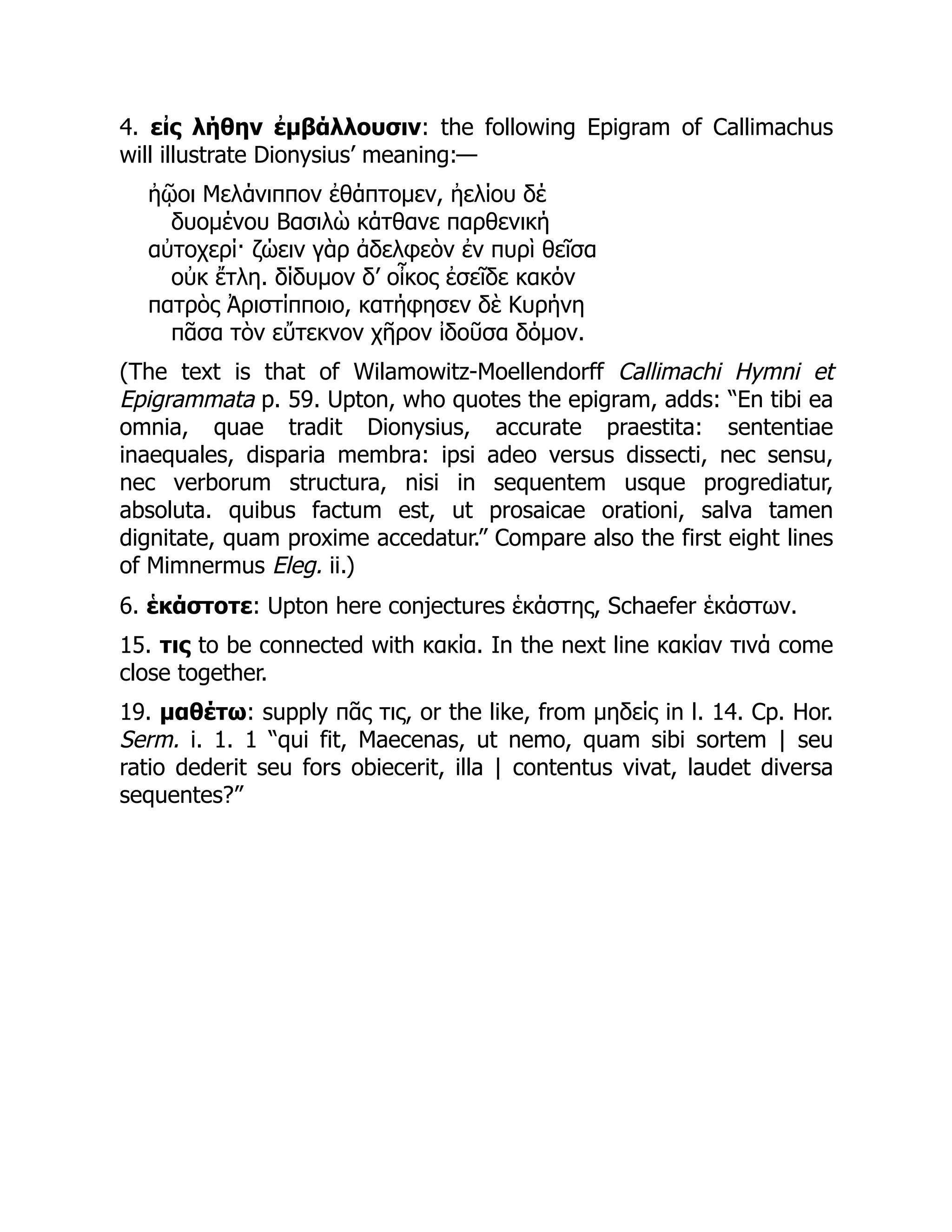
4. εἰς λήθην ἐμβάλλουσιν: the following Epigram of Callimachus
will illustrate Dionysius’ meaning:—
ἠῷοι Μελάνιππον ἐθάπτομεν, ἠελίου δέ
δυομένου Βασιλὼ κάτθανε παρθενική
αὐτοχερί· ζώειν γὰρ ἀδελφεὸν ἐν πυρὶ θεῖσα
οὐκ ἔτλη. δίδυμον δ’ οἶκος ἐσεῖδε κακόν
πατρὸς Ἀριστίπποιο, κατήφησεν δὲ Κυρήνη
πᾶσα τὸν εὔτεκνον χῆρον ἰδοῦσα δόμον.
(The text is that of Wilamowitz-Moellendorff Callimachi Hymni et
Epigrammata p. 59. Upton, who quotes the epigram, adds: “En tibi ea
omnia, quae tradit Dionysius, accurate praestita: sententiae
inaequales, disparia membra: ipsi adeo versus dissecti, nec sensu,
nec verborum structura, nisi in sequentem usque progrediatur,
absoluta. quibus factum est, ut prosaicae orationi, salva tamen
dignitate, quam proxime accedatur.” Compare also the first eight lines
of Mimnermus Eleg. ii.)
6. ἑκάστοτε: Upton here conjectures ἑκάστης, Schaefer ἑκάστων.
15. τις to be connected with κακία. In the next line κακίαν τινά come
close together.
19. μαθέτω: supply πᾶς τις, or the like, from μηδείς in l. 14. Cp. Hor.
Serm. i. 1. 1 “qui fit, Maecenas, ut nemo, quam sibi sortem | seu
ratio dederit seu fors obiecerit, illa | contentus vivat, laudet diversa
sequentes?”
τὰ δὲ τῷ μοχθηρῷ πονηρά, οὐδὲν
ὑπὸ τῆς τοῦ λόγου ὁμοειδείας
ταραττόμενος. κωλύσει γὰρ οὐδὲν
ἡ τῆς ὀνομασίας ὁμοιότης
κατὰ διαφόρων ταττομένης
πραγμάτων τὴν ἑκατέρου φύσιν
ὁρᾶν.
εἰρηκὼς δὴ καὶ περὶ τούτων,
παραδείγματά σοι τῶν 5
εἰρημένων ὀλίγα θεὶς αὐτοῦ
κατακλείσω τὸν λόγον. ἐκ μὲν
οὖν τῆς ἐπικῆς ποιήσεως ταῦτα
ἀπόχρη·
αὐτὰρ ὅ γ’ ἐκ λιμένος προσέβη
τρηχεῖαν ἀταρπόν·
ἓν μὲν δὴ τοῦτο κῶλον. ἕτερον δὲ
χῶρον ἀν’ ὑλήεντα 10
ἔλαττόν τε τοῦ προτέρου καὶ δίχα
τέμνον τὸν στίχον. τρίτον
δὲ τουτί
δι’ ἄκριας
ἔλαττον κώλου κομμάτιον.
τέταρτον δὲ
ᾗ οἱ
Ἀθήνη 15
πέφραδε δῖον ὑφορβόν
ἐξ ἡμιστιχίων δύο συγκείμενον καὶ
τοῖς προτέροις οὐδὲν
ἐοικός. ἔπειτα τὸ τελευταῖον
ὅ οἱ
βιότοιο μάλιστα
resembles noble and contemptible
prose respectively, and not to be
in any way disturbed by mere
identity of terms. The application
of similar names to different
things will not prevent us from
discerning the true nature of the
things in either case.
As I have gone so far as to deal
with this subject, I will end by
subjoining a few examples of the
features in question. From epic
poetry it will be enough to quote
the following lines:—
But he from the haven went
where the rugged pathway led.
[194]
Here we have one clause.
Observe the next—
Up the wooded land.
It is shorter than the other, and
cuts the line in two. The third is—
through
the hills:
a segment still shorter than a
clause. The fourth—
u
nto where Athene had said
That he should light on the
goodly swineherd—
κήδετο οἰκήων οὓς κτήσατο δῖος
Ὀδυσσεύς 20
ἀτελῆ μὲν τὸν τρίτον ποιοῦν
στίχον, τοῦ δὲ τετάρτου τῇ
προσθήκῃ τὴν ἀκρίβειαν
ἀφῃρημένον. ἔπειτ’ αὖθις
τὸν δ’ ἄρ’ ἐνὶ προδόμῳ εὗρ’
ἥμενον
οὐ συνεκτρέχον οὐδὲ τοῦτο τῷ
στίχῳ.
ἔνθα οἱ
αὐλὴ 25
ὑψηλὴ δέδμητο
consists of two half-lines and is in
no way like the former. Then the
conclusion—
t
he man who best
Gave heed to the goods of his
lord, of the thralls that Odysseus
possessed,
which leaves the third line
unfinished, while by the addition
of the fourth it loses all undue
uniformity. Then again—
By the house-front sitting he
found him,
where once more the words do
not run out the full course of the
line.
there
where the courtyard wall
Was builded tall.
1 οὐδὲν ... ταραττόμενος MV: om. P 3 ταττομένης Sauppius:
ταττομένη libri 5 εἰρηκὼς ... θεὶς Us.: καὶ περὶ τούτων [μὲν add. MV]
ἅλις. ὧν δὲ προυθέμην τὰ παραδείγματα θεὶς PMV 8 ὅ γ’] ὁ Hom.
11 τέμνον EV: τέμνοντος PM 14 τέταρτον δὲ E: om. PMV 15 ᾗ
Hom.: ἧ V: οἷ [fort. οἷ] PM, E 22 ἔπειτ’ ... ἥμενον om. P 25 ἔνθά οἱ
PM
3. κατὰ ... ταττομένης: cp. Ven. A Schol. on Il. xv. 347 ὅτι
Ζηνόδοτος γράφει ἐ π ι σ σ ε ύ ε σ θ ο ν. συγχεῖται δὲ τὸ δυϊκὸν κατὰ
πλειόνων τασσόμενον.
6. αὐτοῦ, ‘here,’ ‘on the spot.’ Cp. Diod. Sic. ii. 60 ἡμεῖς δὲ τὴν ἐν
ἀρχῇ τῆς βίβλου γεγενημένην ἐπαγγελίαν τετελεκότες αὐτοῦ
περιγράψομεν τήνδε τὴν βίβλον.—With κατακλείσω cp. Antiq. Rom.
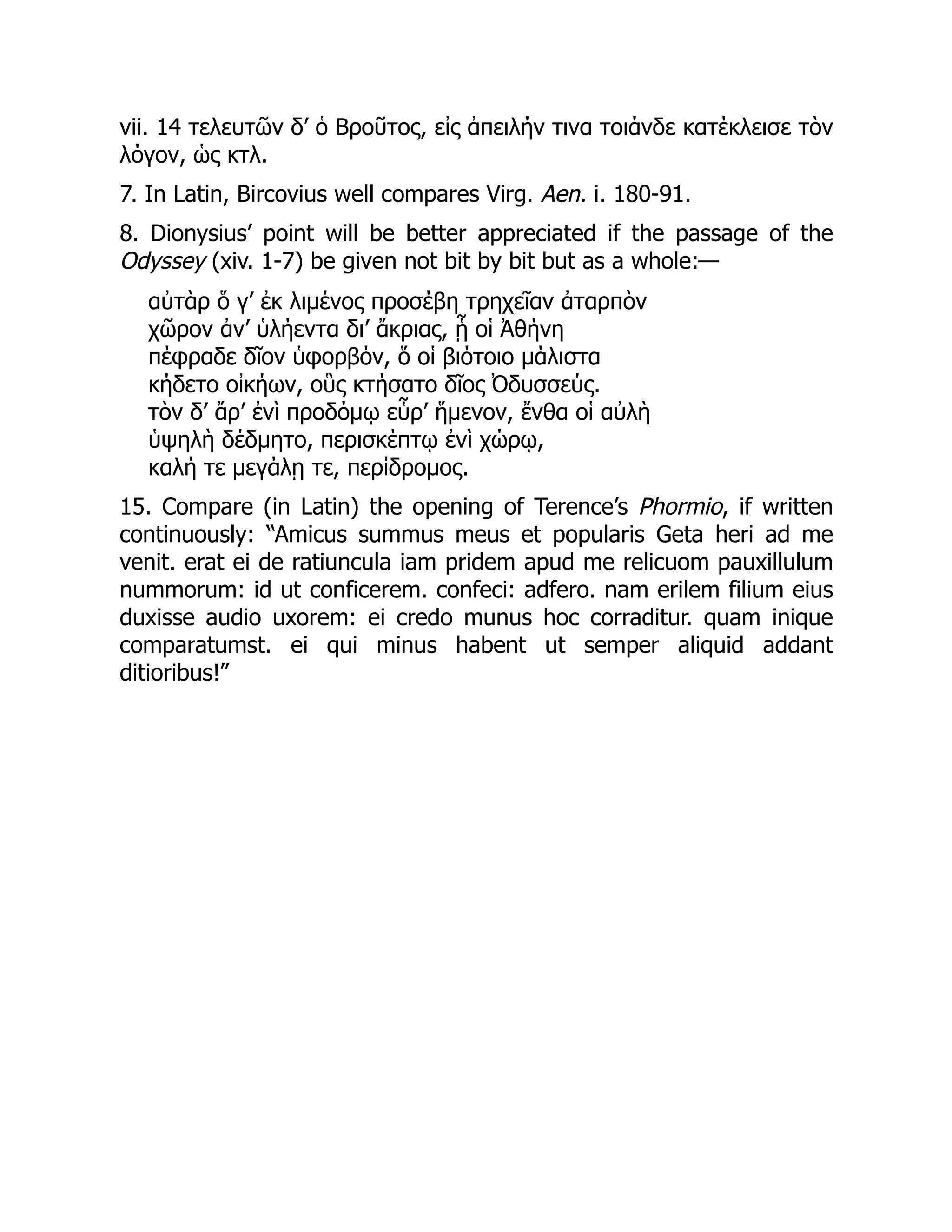
vii. 14 τελευτῶν δ’ ὁ Βροῦτος, εἰς ἀπειλήν τινα τοιάνδε κατέκλεισε τὸν
λόγον, ὡς κτλ.
7. In Latin, Bircovius well compares Virg. Aen. i. 180-91.
8. Dionysius’ point will be better appreciated if the passage of the
Odyssey (xiv. 1-7) be given not bit by bit but as a whole:—
αὐτὰρ ὅ γ’ ἐκ λιμένος προσέβη τρηχεῖαν ἀταρπὸν
χῶρον ἀν’ ὑλήεντα δι’ ἄκριας, ᾗ οἱ Ἀθήνη
πέφραδε δῖον ὑφορβόν, ὅ οἱ βιότοιο μάλιστα
κήδετο οἰκήων, οὓς κτήσατο δῖος Ὀδυσσεύς.
τὸν δ’ ἄρ’ ἐνὶ προδόμῳ εὗρ’ ἥμενον, ἔνθα οἱ αὐλὴ
ὑψηλὴ δέδμητο, περισκέπτῳ ἐνὶ χώρῳ,
καλή τε μεγάλῃ τε, περίδρομος.
15. Compare (in Latin) the opening of Terence’s Phormio, if written
continuously: “Amicus summus meus et popularis Geta heri ad me
venit. erat ei de ratiuncula iam pridem apud me relicuom pauxillulum
nummorum: id ut conficerem. confeci: adfero. nam erilem filium eius
duxisse audio uxorem: ei credo munus hoc corraditur. quam inique
comparatumst. ei qui minus habent ut semper aliquid addant
ditioribus!”
ἄνισον καὶ τοῦτο τῷ πρότερῳ.
κἄπειτα ὁ ἑξῆς νοῦς ἀπερίοδος
ἐν κώλοις τε καὶ κόμμασι
λεγόμενος· ἐπιθεὶς γὰρ
περισκέπτῳ ἐνὶ χώρῳ,
πάλιν ἐποίσει
καλή τε μεγάλη τε 5
βραχύτερον κώλου κομμάτιον,
εἶτα
περίδρομο
ς
ὄνομα καθ’ ἑαυτὸ νοῦν τινα ἔχον.
εἶθ’ ἑξῆς τὰ ἄλλα τὸν
αὐτὸν κατασκευάσει τρόπον· τί
γὰρ δεῖ μηκύνειν;
ἐκ δὲ τῆς ποιήσεως τῆς ἰαμβικῆς
τὰ παρ’ Εὐριπίδου 10
ταυτί
Ὦ γαῖα πατρὶς ἣν Πέλοψ
ὁρίζεται,
χαῖρ’,
τὸ πρῶτον ἄχρι τούτου κῶλον.
ὅς τε πέτραν Ἀρκάδων
δυσχείμερον 15
‹Πὰν› ἐμβατεύεις
τὸ δεύτερον μέχρι τοῦδε.
ἔνθεν
εὔχομαι γένος.
This, too, does not balance the
former. Further, the order of ideas
in the continuation of the passage
is unperiodic, though the words
are cast into the form of clauses
and sections. For, after adding
In a place with a clear view
round about,
we shall find him subjoining:
Massy and fair to behold,
which is a segment shorter than a
clause. Next we find
Free on every side,
where the one Greek word
(περίδρομος) by itself carries a
certain meaning. And so on: we
shall find him elaborating
everything that follows in the
same way. Why go into
unnecessary detail?
From iambic poetry may be taken
these lines of Euripides:—
Fatherland, ta’en by Pelops in
possession,
Hail![195]
Thus far the first clause extends.
And thou, Pan, who haunt’st the
stormy steeps
Of Arcady.[195]
τοῦτο τρίτον. τὰ μὲν πρότερα
μείζονα στίχου, τοῦτο δὲ
ἔλαττον. 20
Αὔγη γὰρ Ἀλέου παῖς με τῷ
Τιρυνθίῳ
τίκτει λαθραίως Ἡρακλεῖ·
μετὰ τοῦτο
ξύνοιδ’
ὄρος
Παρθένιον, 25
οὐθέτερον αὐτῶν στίχῳ
συμμετρούμενον. εἶτ’ αὖθις
ἕτερον
στίχου τε ἔλαττον καὶ στίχου
μεῖζον
So far the second extends.
Whereof I boast my birth.[195]
That is the third. The former are
longer than a line; the last is
shorter.
Me Auge, Aleus’ daughter, not of
wedlock
Bare to Tirynthian Heracles.[195]
And afterwards—
Thi
s knows
Yon hill Parthenian.[195]
Not one of these corresponds
exactly to a line. Then once more
we find another clause which is
from one point of view less than a
line and from the other longer—
1 καὶ V: κατὰ PM 4 ἐποίει P 5 καλήν τε μεγάλην τε PM 9 μηκύνειν
P: μηκύνειν τὸν λόγον MV 10 παρ’ εὐριπ
δ
ι sic P: εὐριπίδου MV 15
ὅς τε s: ὥστε PMV || δυσχείμερον ἀρκάδων PMV: transposuit
Sylburgius 16 Πὰν inseruit Musgravius 19 μείζονα om. P || στίχου
MV: στ
χ
ι P: στίχον s 21 αὐγὴ M: αὐτὴ PV 24 ξύνοιδ’ s: ξύνοιδε P:
ξυνοὶδὲ MV 26 οὔθ’ ἕτερον PM: οὐδέτερον V
12. ὁρίζεται: sibi vindicat, ‘annexes.’—The fragment of Euripides,
taken as a whole, runs thus in Nauck’s collection:—
ὦ γαῖα πατρίς, ἣν Πέλοψ ὁρίζεται,
χαῖρ’, ὅς τε πέτρον Ἀρκάδων δυσχείμερον
‹Πὰν› ἐμβατεύεις, ἔνθεν εὔχομαι γένος.
Αὔγη γὰρ Ἀλέου παῖς με τῷ Τιρυνθίῳ
τίκτει λαθραίως Ἡρακλεῖ· ξύνοιδ’ ὄρος
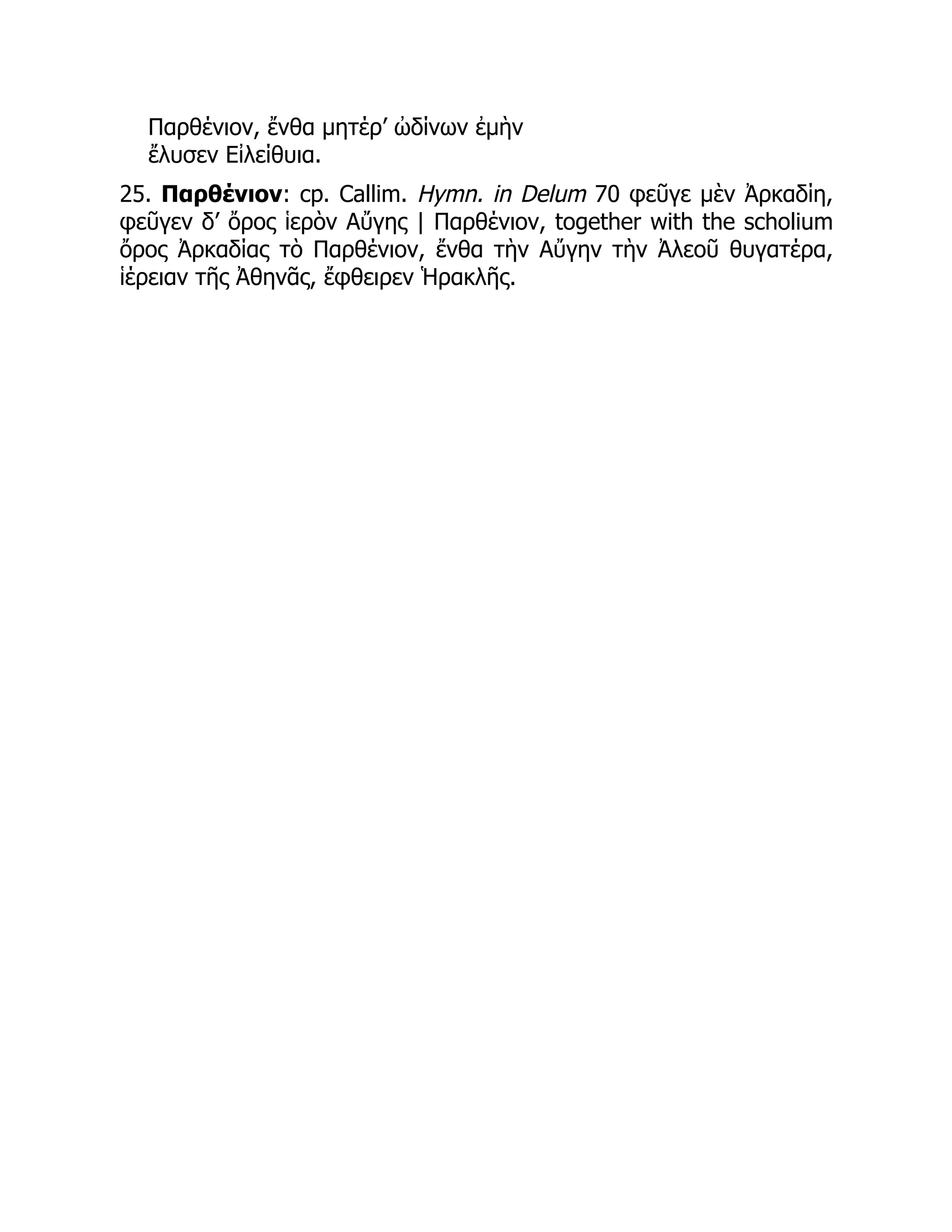
Παρθένιον, ἔνθα μητέρ’ ὠδίνων ἐμὴν
ἔλυσεν Εἰλείθυια.
25. Παρθένιον: cp. Callim. Hymn. in Delum 70 φεῦγε μὲν Ἀρκαδίη,
φεῦγεν δ’ ὄρος ἱερὸν Αὔγης | Παρθένιον, together with the scholium
ὄρος Ἀρκαδίας τὸ Παρθένιον, ἔνθα τὴν Αὔγην τὴν Ἀλεοῦ θυγατέρα,
ἱέρειαν τῆς Ἀθηνᾶς, ἔφθειρεν Ἡρακλῆς.
ἔνθα μητέρ’
ὠδίνων ἐμὴν
ἔλυσεν Εἰλείθυια
καὶ τὰ ἑξῆς τούτοις παραπλήσια.
ἐκ δὲ τῆς μελικῆς τὰ Σιμωνίδεια
ταῦτα· γέγραπται δὲ
κατὰ διαστολὰς οὐχ ὧν
Ἀριστοφάνης ἢ ἄλλος τις
κατεσκεύασε 5
κώλων ἀλλ’ ὧν ὁ πεζὸς λόγος
ἀπαιτεῖ. πρόσεχε δὴ τῷ μέλει
καὶ ἀναγίνωσκε κατὰ διαστολάς,
καὶ εὖ ἴσθ’ ὅτι λήσεταί σε ὁ
ῥυθμὸς τῆς ᾠδῆς καὶ οὐχ ἕξεις
συμβαλεῖν οὔτε στροφὴν οὔτε
ἀντίστροφον οὔτ’ ἐπῳδόν, ἀλλὰ
φανήσεταί σοι λόγος εἷς
εἰρόμενος. ἔστι δὲ ἡ διὰ πελάγους
φερομένη Δανάη τὰς 10
ἑαυτῆς ἀποδυρομένη τύχας·
ὅτε λάρνακι ἐν δαιδαλέᾳ
ἄνεμός τε μιν πνέων ‹ἐφόρει›
κινηθεῖσά τε λίμνα,
δείματι ἤριπεν οὐκ ἀδιάντοισι
παρειαῖς 15
ἀμφί τε Περσέϊ βάλλε φίλαν
χέρα
where
the Travail-queen
From birth-pangs set my mother
free.[196]
And similarly with the lines which
follow these.
From lyric poetry the subjoined
lines of Simonides may be taken.
They are written according to
divisions: not into those clauses
for which Aristophanes or some
other metrist laid down his
canons, but into those which are
required by prose. Please read
the piece carefully by divisions:
you may rest assured that the
rhythmical arrangement of the
ode will escape you, and you will
be unable to guess which is the
strophe or which the antistrophe
or which the epode, but you will
think it all one continuous piece
of prose. The subject is Danaë,
borne across the sea lamenting
her fate:—
And when, in the carved ark
lying,
She felt it through darkness
drifting
Before the drear wind’s
sighing
And the great sea-ridges
lifting,
She shuddered with terror, she
brake into weeping,
And she folded her arms round
Perseus sleeping;
5 ἄλλός τις P || κατεστεύασε P 6 ἀπετεῖ P || δὴ PM: δὲ V 7 κατὰ P:
ταῦτα κατὰ MV 9 ἀντίστροφον PM: ἀντιστροφὴν V || λόγος
εἰσειρόμενος P: λόγος οὑτωσὶ διειρόμενος MV 10 Δανάη] δ’ ἀν ἡ P
13 τέ μιν Schneidewinus: τε μὴν PM: τ’ ἐμῇ V || ἐφόρει ante μιν
Bergkius inseruit, post πνέων Usenerus 14 τε Brunckius: δὲ PMV
15 ἤριπεν Brunckius: ἔριπεν P: ἔρειπεν MV || οὐκ Thierschius: οὐτ’ P:
οὔτ’ MV
4. Bircovius points out that Hor. Carm. iii. 27. 33 ff. might be printed
as continuous prose, thus: “quae simul centum tetigit potentem
oppidis Creten: ‘Pater, o relictae filiae nomen, pietasque’ dixit ‘victa
furore! unde quo veni? levis una mors est virginum culpae. vigilansne
ploro turpe commissum, an vitiis carentem ludit imago vana, quae
porta fugiens eburna somnium ducit?’” etc. The short rhymeless lines
of Matthew Arnold’s Rugby Chapel might be run together in the same
way, e.g. “There thou dost lie, in the gloom of the autumn evening.
But ah! that word, gloom, to my mind brings thee back, in the light of
thy radiant vigour, again; in the gloom of November we pass’d days
not dark at thy side; seasons impair’d not the ray of thy buoyant
cheerfulness clear. Such thou wast! and I stand in the autumn
evening, and think of by-gone evenings with thee.” The word-
arrangement from line to line is such that this passage might almost
be read as prose, except for a certain rhythm and for an occasional
departure from the word-order of ordinary prose.
5. Aristophanes: cp. note on 218 19 supra.
8. Compare, for example, the last two stanzas, printed continuously,
of Tennyson’s In Memoriam cxv.: “Where now the seamew pipes, or
dives in yonder greening gleam, and fly the happy birds, that change
their sky to build and brood, that live their lives from land to land;
and in my breast spring wakens too; and my regret becomes an April
violet, and buds and blossoms like the rest.”
11. ἀποδυρομένη: probably the Danaë was a θρῆνος, and in any
case it illustrates, to the full, the “maestius lacrimis Simonideis” of
Catullus (Carm. xxxviii. 8), or Wordsworth’s “one precious, tender-
hearted scroll | Of pure Simonides.” Cp. also de Imitat. ii. 6. 2 καθ’
ὃ βελτίων εὑρίσκεται καὶ Πινδάρου, τὸ οἰκτίζεσθαι μὴ μεγαλοπρεπῶς
ἀλλὰ παθητικῶς: and Quintil. x. 1. 64 “Simonides, tenuis alioqui,
sermone proprio et iucunditate quadam commendari potest;
praecipua tamen eius in commovenda miseratione virtus, ut quidam
in hac eum parte omnibus eius operis auctoribus praeferant.”
12. Verse-translations of the Danaë will be found also in J. A.
Symonds’ Studies of the Greek Poets i. 160, and in Walter Headlam’s
Book of Greek Verse pp. 49-51. Headlam observes that the Danaë is
a passage extracted from a longer poem, and that the best
commentary on it is Lucian’s Dialogues of the Sea 12. Weir Smyth
(Greek Lyric Poetry p. 321) remarks: “It must be confessed that, if we
have all that Dionysius transcribed, he has proved his point [viz. that
by an arrangement into διαστολαί the poetical rhythm can be so
obscured that the reader will be unable to recognize strophe,
antistrophe, or epode] so successfully that no one has been able to
demonstrate the existence of all three parts of the triad. Wilamowitz
(Isyllos 144) claims to have restored strophe (ἄνεμος ... δούρατι),
epode (χαλκεογόμφῳ ... δεινὸν ἦν), and antistrophe (καὶ ἐμῶν ...);
ὅτε ... δαιδαλέᾳ belonging to another triad. To accept this adjustment
one must have faith in the extremely elastic ionics of the German
scholar. Nietzsche, R. M. 23. 481, thought that 1-3 formed the end of
the strophe, 4-12 the antistrophe (1-3 = 10-12). In v. 1 he omitted ἐν
and read τ’ ἐμάνη πνείων with ἀλεγίζεις in 10, but even then the
dactyls vary with spondees over frequently. By a series of reckless
conjectures Hartung extricated strophe and antistrophe out of the
lines, while Blass’ (Philol. 32. 140) similar conclusion is reached by
conjectures only less hazardous than those of Hartung. Schneidewin
and Bergk, adopting the easier course, which refuses all credence to
Dionysius, found only antistrophe and epode; and so, doubtfully,
Michelangeli; while Ahrens (Jahresber. des Lyceums zu Hannover,
1853), in despair, classed the fragment among the ἀπολελυμένα.
Since verses 2-3 may = 11-12, I have followed Nietzsche, though
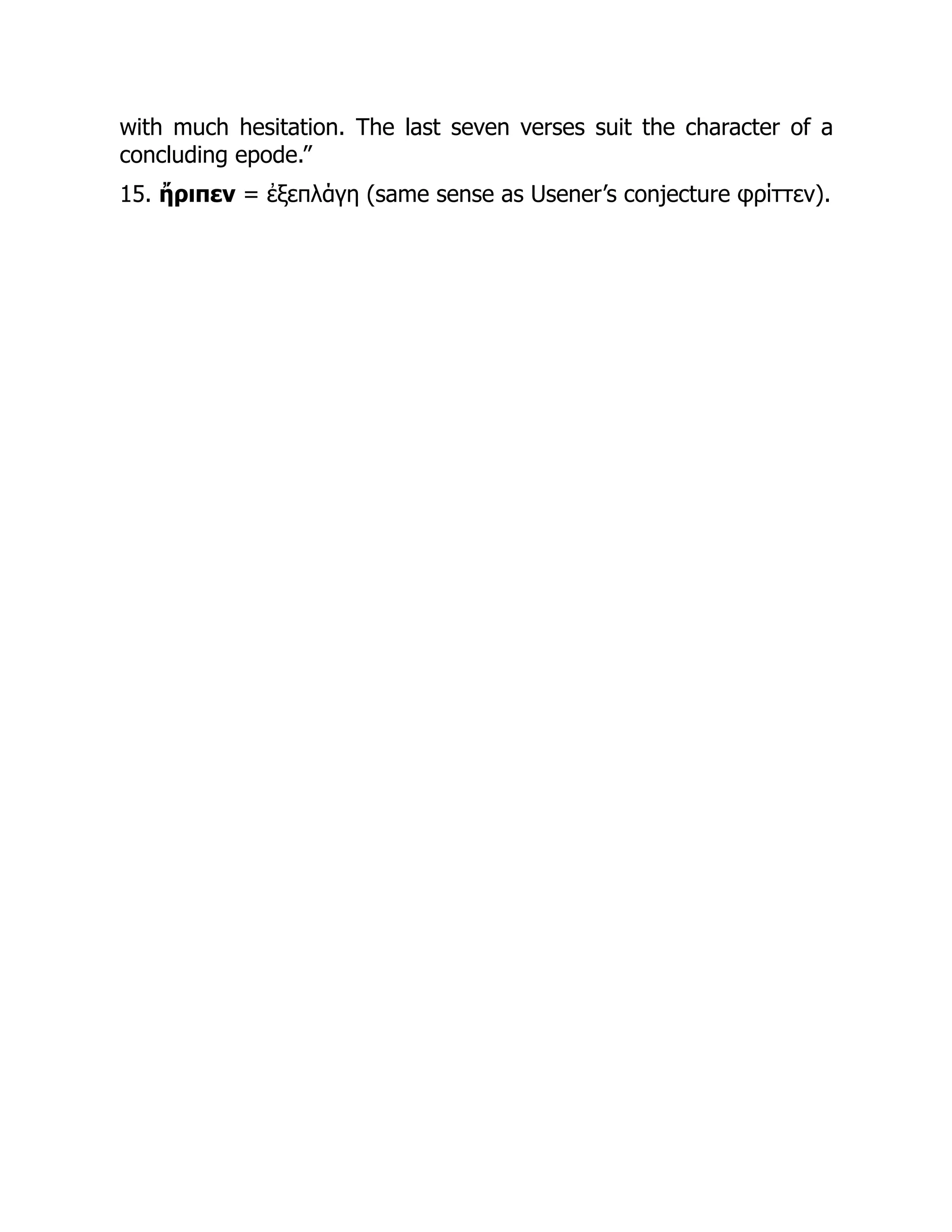
with much hesitation. The last seven verses suit the character of a
concluding epode.”
15. ἤριπεν = ἐξεπλάγη (same sense as Usener’s conjecture φρίττεν).
εἶπέν τ’· ὦ τέκος,
οἷον ἔχω πόνον, σὺ δ’ ἀωτεῖς·
γαλαθηνῷ δ’ ἤθεϊ κνοώσσεις
ἐν ἀτερπέι δούρατι
χαλκεογόμφῳ δίχα νυκτὸς
ἀλαμπεῖ
κυανέῳ τε δνόφῳ σταλείς. 5
ἅλμαν δ’ ὕπερθεν τεᾶν κομᾶν
βαθεῖαν
παριόντος κύματος οὐκ ἀλέγεις
οὐδ’ ἀνέμου φθόγγον,
πορφυρέᾳ
κείμενος ἐν χλανίδι πρὸς κόλπῳ
καλὸν πρόσωπον.
εἰ δέ τοι δεινὸν τό γε δεινὸν
ἦν, 10
καί κεν ἐμῶν ῥημάτων λεπτὸν
ὑπεῖχες οὖας·
κέλομαι, εὗδε βρέφος,
εὑδέτω δὲ πόντος, εὑδέτω
ἄμετρον κακόν.
μεταβουλία δέ τις φανείη,
Ζεῦ πάτερ, ἐκ σέο· 15
ὅ τι δὴ θαρσαλέον ἔπος εὔχομαι
νόσφι δίκας, σύγγνωθί μοι.
τοιαῦτά ἐστι τὰ ὅμοια τοῖς καλοῖς
λόγοις μέτρα καὶ μέλη,
διὰ ταύτας γινόμενα τὰς αἰτίας ἃς
προεῖπόν σοι.
τοῦθ’ ἕξεις δῶρον ἡμέτερον, ὦ
Ῥοῦφε, “πολλῶν ἀντάξιον 20
ἄλλων,” εἰ βουληθείης ἐν ταῖς
χερσί τε αὐτὸ συνεχῶς ὥσπερ
And “Oh my baby,” she
moaned, “for my lot
Of anguish!—but thou, thou
carest not:
Adown sleep’s flood is thy child-
soul sweeping,
Though beams brass-welded
on every side
Make a darkness, even had
the day not died
When they launched thee
forth at gloaming-tide.
And the surf-crests fly o’er thy
sunny hair
As the waves roll past—thou
dost not care:
Neither carest thou for the
wind’s shrill cry,
As lapped in my crimson cloak
thou dost lie
On my breast, little face so
fair—so fair!
Ah, were these sights, these
sounds of fear
Fearsome to thee, that dainty
ear
Would hearken my words—
nay, nay, my dear,
Hear them not thou! Sleep,
little one, sleep;
And slumber thou, O unrestful
deep!
Sleep, measureless wrongs;
let the past suffice:
And oh, may a new day’s
dawn arise
On thy counsels, Zeus! O
change them now!
But if aught be presumptuous
in this my prayer,
If aught, O Father, of sin be
there,
Forg
ive it thou.”[197]
Such are the verses and lyrics
which resemble beautiful prose;
and they owe this resemblance to
the causes which I have already
set forth to you.
Here, then, Rufus, is my gift to
you, which you will find “outweigh
a multitude of others,”[198] if only
you will keep it in
1 τέκος Athen. ix. 396 E: τέκνον PMV 2 σὺ δ’ ἀωτεῖς Casaubonus:
οὐδ’ αυταις P: σὺ δ’ αὖτε εἷς Athen. (l.c.) 3 ἐγαλαθηνωδει θει P, V:
γαλαθηνῷ δ’ ἤτορι Athen.: corr. Bergkius || κνοώσσεισ P, V: κνώσσεις
Athen. 4 δούρατι Guelf.: δούνατι PM: δούναντι V || δίχα νυκτὸς
ἀλαμπεῖ Us.: δενυκτι λαμπεῖ P, MV 5 σταλείς Bergkius: ταδ’ εἰσ P, MV
6 ἅλμαν δ’ Bergkius: αὐλεαν δ’ P, V: αὐλαίαν δ’ M 9 πρὸς κόλπῳ κ.
πρ. Us.: πρόσωπον καλον πρόσωπον P: πρόσωπον καλὸν MV 10 ἦν
Sylburgius: ἦι P: ἦ M: ἢ V 11 καί M: κἀί V: κε cum litura P || λεπτὸν
s: λεπτῶν PMV 14 μαιτ(α)βουλία (i.e. μεταβουλία: cp. 90 4 supra)
P: μαιτ(α)βουλίου M: ματαιοβουλία V 17 νόσφι δίκας Victorius:
ηνοφι δικασ P: ἣν ὀφειδίασ MV 19 προεῖπά PMV (cf. εἴπειεν P,
Aristot. Rhet. 1408 a 32) 21 αὐτὸ Sylburgius: αὐτὰ PMV
4. δίχα νυκτός: cp. δίχα μελέτης τε καὶ γυμνασίας (282 4), which
may be an unconscious echo of this passage. “To me the expression
seems to indicate that Simonides took a view of the story different
Welcome to our website – the perfect destination for book lovers and
knowledge seekers. We believe that every book holds a new world,
offering opportunities for learning, discovery, and personal growth.
That’s why we are dedicated to bringing you a diverse collection of
books, ranging from classic literature and specialized publications to
self-development guides and children's books.
More than just a book-buying platform, we strive to be a bridge
connecting you with timeless cultural and intellectual values. With an
elegant, user-friendly interface and a smart search system, you can
quickly find the books that best suit your interests. Additionally,
our special promotions and home delivery services help you save time
and fully enjoy the joy of reading.
Join us on a journey of knowledge exploration, passion nurturing, and
personal growth every day!
ebookbell.com

On Spatiotemporal Data Modelling And Uncertainty Quantification Using Machine Learning And Information Theory 1st Edition Fabian Guignard

  • 1.
    On Spatiotemporal DataModelling And Uncertainty Quantification Using Machine Learning And Information Theory 1st Edition Fabian Guignard download https://ebookbell.com/product/on-spatiotemporal-data-modelling- and-uncertainty-quantification-using-machine-learning-and- information-theory-1st-edition-fabian-guignard-56741900 Explore and download more ebooks at ebookbell.com
  • 2.
    Here are somerecommended products that we believe you will be interested in. You can click the link to download. Data Analytics In Professional Soccer Performance Analysis Based On Spatiotemporal Tracking Data 1st Edition Daniel Link Auth https://ebookbell.com/product/data-analytics-in-professional-soccer- performance-analysis-based-on-spatiotemporal-tracking-data-1st- edition-daniel-link-auth-6990090 Advanced Control Of Ac Dc Power Networks System Of Systems Approach Based On Spatiotemporal Scales 1st Edition Benchaib https://ebookbell.com/product/advanced-control-of-ac-dc-power- networks-system-of-systems-approach-based-on-spatiotemporal- scales-1st-edition-benchaib-5301506 Westernness Critical Reflections On The Spatiotemporal Construction Of The West Christopher Gogwilt https://ebookbell.com/product/westernness-critical-reflections-on-the- spatiotemporal-construction-of-the-west-christopher-gogwilt-46586584 Situatedness And Place Multidisciplinary Perspectives On The Spatiotemporal Contingency Of Human Life 1st Ed Thomas Hnefeldt https://ebookbell.com/product/situatedness-and-place- multidisciplinary-perspectives-on-the-spatiotemporal-contingency-of- human-life-1st-ed-thomas-hnefeldt-7322932
  • 3.
    On Tamim AldariAnd His Waqf In Hebron Amad Ibn Al Maqrz https://ebookbell.com/product/on-tamim-aldari-and-his-waqf-in-hebron- amad-ibn-al-maqrz-44863816 On A Wednesday One Week 2 Whitney G https://ebookbell.com/product/on-a-wednesday-one- week-2-whitney-g-44898930 On Beauty And Measure Platos Symposium And Statesman John Sallis S Montgomery Ewegen Editor https://ebookbell.com/product/on-beauty-and-measure-platos-symposium- and-statesman-john-sallis-s-montgomery-ewegen-editor-44912424 On Beheading Amalendu Misra https://ebookbell.com/product/on-beheading-amalendu-misra-46084498 On The Trail Of Blackbody Radiation Max Planck And The Physics Of His Era Don S Lemons https://ebookbell.com/product/on-the-trail-of-blackbody-radiation-max- planck-and-the-physics-of-his-era-don-s-lemons-46093558
  • 5.
    SpringerTheses Recognizing Outstanding Ph.D.Research Fabian Guignard On Spatio-Temporal Data Modelling and Uncertainty Quantification Using Machine Learning and InformationTheory
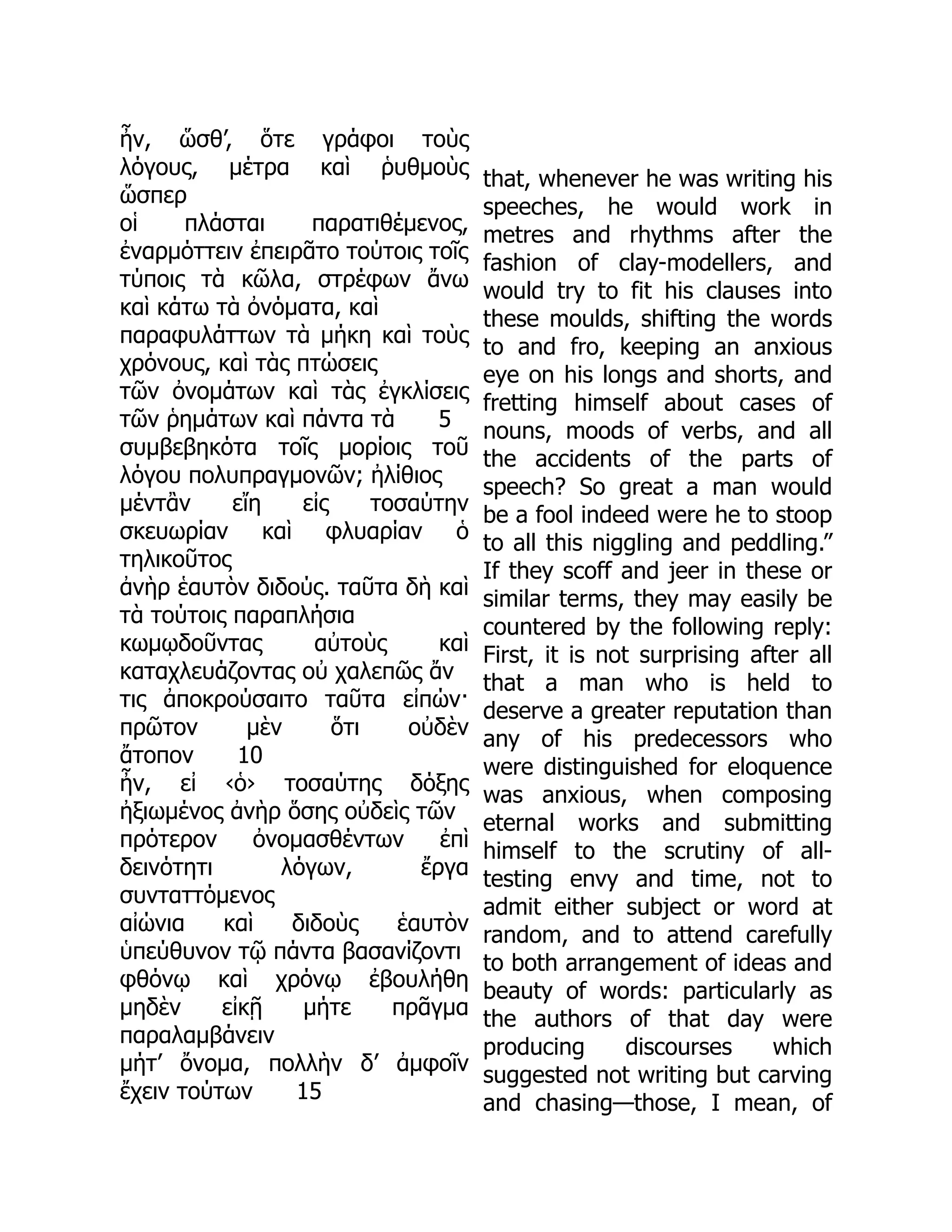
  • 6.
  • 7.
    Aims and Scope Theseries “Springer Theses” brings together a selection of the very best Ph.D. theses from around the world and across the physical sciences. Nominated and endorsed by two recognized specialists, each published volume has been selected for its scientific excellence and the high impact of its contents for the pertinent field of research. For greater accessibility to non-specialists, the published versions include an extended introduction, as well as a foreword by the student’s supervisor explaining the special relevance of the work for the field. As a whole, the series will provide a valuable resource both for newcomers to the research fields described, and for other scientists seeking detailed background information on special questions. Finally, it provides an accredited documentation of the valuable contributions made by today’s younger generation of scientists. Theses may be nominated for publication in this series by heads of department at internationally leading universities or institutes and should fulfill all of the following criteria • They must be written in good English. • The topic should fall within the confines of Chemistry, Physics, Earth Sciences, Engineering and related interdisciplinary fields such as Materials, Nanoscience, Chemical Engineering, Complex Systems and Biophysics. • The work reported in the thesis must represent a significant scientific advance. • If the thesis includes previously published material, permission to reproduce this must be gained from the respective copyright holder (a maximum 30% of the thesis should be a verbatim reproduction from the author’s previous publications). • They must have been examined and passed during the 12 months prior to nomination. • Each thesis should include a foreword by the supervisor outlining the significance of its content. • The theses should have a clearly defined structure including an introduction accessible to new PhD students and scientists not expert in the relevant field. Indexed by zbMATH. More information about this series at https://link.springer.com/bookseries/8790
  • 8.
    Fabian Guignard On Spatio-TemporalData Modelling and Uncertainty Quantification Using Machine Learning and Information Theory Doctoral Thesis accepted by University of Lausanne, Switzerland
  • 9.
    Author Dr. Fabian Guignard Instituteof Earth Surface Dynamics Faculty of Geosciences and Environment University of Lausanne Lausanne, Switzerland Supervisor Prof. Mikhail Kanevski Institute of Earth Surface Dynamics Faculty of Geosciences and Environment University of Lausanne Lausanne, Switzerland ISSN 2190-5053 ISSN 2190-5061 (electronic) Springer Theses ISBN 978-3-030-95230-3 ISBN 978-3-030-95231-0 (eBook) https://doi.org/10.1007/978-3-030-95231-0 © The Editor(s) (if applicable) and The Author(s), under exclusive license to Springer Nature Switzerland AG 2022 This work is subject to copyright. All rights are solely and exclusively licensed by the Publisher, whether the whole or part of the material is concerned, specifically the rights of translation, reprinting, reuse of illustrations, recitation, broadcasting, reproduction on microfilms or in any other physical way, and transmission or information storage and retrieval, electronic adaptation, computer software, or by similar or dissimilar methodology now known or hereafter developed. The use of general descriptive names, registered names, trademarks, service marks, etc. in this publication does not imply, even in the absence of a specific statement, that such names are exempt from the relevant protective laws and regulations and therefore free for general use. The publisher, the authors and the editors are safe to assume that the advice and information in this book are believed to be true and accurate at the date of publication. Neither the publisher nor the authors or the editors give a warranty, expressed or implied, with respect to the material contained herein or for any errors or omissions that may have been made. The publisher remains neutral with regard to jurisdictional claims in published maps and institutional affiliations. This Springer imprint is published by the registered company Springer Nature Switzerland AG The registered company address is: Gewerbestrasse 11, 6330 Cham, Switzerland
  • 10.
    N’a de convictionsque celui qui n’a rien approfondi. Emil Cioran
  • 11.
    To my parents,Ida and Aimé To Sandie and our children, Samuel and Elliot
  • 12.
    Supervisor’s Foreword The amountof data and information available in geo- and environmental sciences is steadily increasing due to the intensive development of monitoring networks, field campaigns, Earth observation by remote sensing devices (satellites, drones, lidars), and modelling results. Therefore, the efforts in technological advances in data acquisition, storage, and access play an important role. Besides, efficient treatment and use of these data is crucial in scientific developments and intelligent decision- makingprocessesinsignificantfieldssuchasclimatechange,environmentalrisksand natural hazards, and renewable energy assessment. Analysis and modelling of spatio- temporal data are challenging because they are high dimensional and variable at many spatio-temporal scales, multivariate, non-homogeneous, non-linear, and uncertain. Fabian Guignard was involved in a project of the 75th National Research Program funded by the Swiss National Science Foundation, entitled “Hybrid renewable energy potential for the built environment using big data: forecasting and uncertainty esti- mation”. One of the project’s fundamental objectives was to develop data-driven approaches for exploring, analysing, and modelling renewable energy potential in complex mountainous regions. Accordingly, Fabian’s thesis resulted in interdis- ciplinary research combining applied mathematics, spatio-temporal geostatistics, analysis of complex and high-frequency time series using information measures, computerscienceandmachinelearning(ML),quantificationofdataandmodeluncer- tainties. An innovative contribution deals with developing and adapting a generic ML-based methodology for spatio-temporal data analysis using Extreme Learning Machinealgorithm,forwhichanalyticalformulasofthebiasandvariancearederived. An applied part of the work treats a variety of real environmental data case studies. This book presents a complete data science workflow: from deriving new theo- retical results, via implementing the developed algorithms and methods in software packages, to applying them to concrete environmental applications, and helping extract valuable knowledge from data. I congratulate Fabian on his outstanding work, ix
  • 13.
    x Supervisor’s Foreword andI am pleased to announce that he has been awarded the Faculty of Geosciences and Environment Award from the University of Lausanne (UNIL). Lausanne, Switzerland December 2021 Prof. Mikhail Kanevski
  • 14.
    Acknowledgements This thesis wouldnot have the same flavour without numerous great scientists and engineers I have met during the past four years, some of whom have become close friends. First, I would like to thank especially Prof. Mikhail Kanevski, my supervisor. During this thesis, I benefited from his eclectic knowledge of data science. From the beginning, he considered me a researcher and gave me the freedom that I needed. As a mathematician by training, I am used to living in an abstract world. Fortu- nately, I met Dr. Federico Amato and Dr. Mohamed Laib, who have brought me back to reality more than once when necessary, and supported me literally until the very last day of this adventure. Both have lived the FiSh and UncELMe adventures with me. I also benefited from the guidance of Dr. Jean Golay, who greatly inspired me from a scientific perspective during my darkest hours. They receive my gratitude here. I would like to thank the Jury members, Prof. Dionissios Hristopulos, Prof. François Bavaud, and Prof. Antoine Guisan, for agreeing to read and review the manuscript and endorse it for publication. I also thank the thesis advisory committee composed of Prof. David Ginsbourger and Dr. Christian Kaiser for their guidance. I owe a debt to all my co-authors, with whom I always had fruitful collaborations. My special thanks go to Dr. Luciano Telesca and Dr. Dasaraden Mauree for their insights on environmental physics. I would like to acknowledge Dr. Sylvain Robert for his statistical advice. My thanks also go to the EPFL HyEnergy team, Dr. Alina Walch, Prof. Jean-Louis Scartezzini, Dr. Roberto Castello, and Dr. Nahid Mohajeri. This thesis would not have been possible without the financial support of the Swiss National Science Foundation (SNSF). This research was conducted within the HyEn- ergy project n° 167285, which belongs to the 75th National Research Programme (NRP75) of the SNSF. Moreover, the entire work has been done at the Institute of Earth Surface Dynamics of the University of Lausanne, which provides all neces- sary support. Special thanks to the data providers, MeteoSwiss, Swisstopo, the Solar Energy and Building Physics Laboratory LESO-PB (EPFL), the WSL Institute for Snow and Avalanche Research SLF and the Federal Office for the Environment for allowing me to study various environmental phenomena. xi
  • 15.
    xii Acknowledgements Finally, thisresearch would not have been possible without my family, Nonna, Papou, Papy Marcel, Antoinette, the Thursday and Sunday victuals and the red wine. Samuel and Elliot, it is a wonderful gift to see you grow up. I never know what you will do next minute, pure nugget effect and no machine learning prediction possible for you. Sandie, none of this would have been possible without you. Thank you for your sense of humour and your patience; you have more than you believe. Lausanne, Switzerland December 2021 Fabian Guignard
  • 16.
    Contents 1 Introduction .. . . . . . . . . . . . . . . . . . . . . . . . . . . . . . . . . . . . . . . . . . . . . . . . . . 1 1.1 Sketch of the Thesis . . . . . . . . . . . . . . . . . . . . . . . . . . . . . . . . . . . . . . . . 1 1.2 Spatio-Temporal Data Modelling and Analysis . . . . . . . . . . . . . . . . . 2 1.2.1 Statistical Interpolation for Spatio-Temporal Data . . . . . . . . . 3 1.2.2 Machine Learning for Spatial Data . . . . . . . . . . . . . . . . . . . . . 4 1.2.3 Uncertainty Quantification . . . . . . . . . . . . . . . . . . . . . . . . . . . . 4 1.2.4 Information Theory as an Advanced Exploratory Tool . . . . . 5 1.3 Objectives . . . . . . . . . . . . . . . . . . . . . . . . . . . . . . . . . . . . . . . . . . . . . . . . . 6 1.4 Contributions . . . . . . . . . . . . . . . . . . . . . . . . . . . . . . . . . . . . . . . . . . . . . . 8 1.5 Thesis Organisation . . . . . . . . . . . . . . . . . . . . . . . . . . . . . . . . . . . . . . . . . 10 References . . . . . . . . . . . . . . . . . . . . . . . . . . . . . . . . . . . . . . . . . . . . . . . . . . . . . 13 2 Study Area and Data Sets . . . . . . . . . . . . . . . . . . . . . . . . . . . . . . . . . . . . . . . 17 2.1 Switzerland and Its Topography . . . . . . . . . . . . . . . . . . . . . . . . . . . . . . 17 2.2 MeteoSwiss Wind Speed Data . . . . . . . . . . . . . . . . . . . . . . . . . . . . . . . . 19 2.2.1 Data Wrangling, Cleaning and Missing Values . . . . . . . . . . . 20 2.2.2 Exploratory Data Analysis . . . . . . . . . . . . . . . . . . . . . . . . . . . . 25 2.3 MoTUS High-Frequency Wind Speed Data . . . . . . . . . . . . . . . . . . . . 31 2.3.1 Data Wrangling, Cleaning and Missing Values . . . . . . . . . . . 31 2.3.2 Exploratory Data Analysis . . . . . . . . . . . . . . . . . . . . . . . . . . . . 33 2.4 Summary . . . . . . . . . . . . . . . . . . . . . . . . . . . . . . . . . . . . . . . . . . . . . . . . . . 35 References . . . . . . . . . . . . . . . . . . . . . . . . . . . . . . . . . . . . . . . . . . . . . . . . . . . . . 37 3 Advanced Exploratory Data Analysis . . . . . . . . . . . . . . . . . . . . . . . . . . . . 39 3.1 Empirical Orthogonal Functions . . . . . . . . . . . . . . . . . . . . . . . . . . . . . . 39 3.1.1 Spatial Formulation . . . . . . . . . . . . . . . . . . . . . . . . . . . . . . . . . . 39 3.1.2 Temporal Formulation . . . . . . . . . . . . . . . . . . . . . . . . . . . . . . . . 42 3.1.3 Singular Value Decomposition . . . . . . . . . . . . . . . . . . . . . . . . . 43 3.2 Variography . . . . . . . . . . . . . . . . . . . . . . . . . . . . . . . . . . . . . . . . . . . . . . . 45 3.3 Wavelet Variance Analysis . . . . . . . . . . . . . . . . . . . . . . . . . . . . . . . . . . . 47 3.3.1 Multiresolution Wavelet Analysis . . . . . . . . . . . . . . . . . . . . . . 47 3.3.2 The Wavelet Variance . . . . . . . . . . . . . . . . . . . . . . . . . . . . . . . . . 49 xiii
  • 17.
    xiv Contents 3.3.3 Applicationto the MoTUS Data . . . . . . . . . . . . . . . . . . . . . . . . 50 3.4 Summary . . . . . . . . . . . . . . . . . . . . . . . . . . . . . . . . . . . . . . . . . . . . . . . . . . 52 References . . . . . . . . . . . . . . . . . . . . . . . . . . . . . . . . . . . . . . . . . . . . . . . . . . . . . 52 4 Fisher-Shannon Analysis . . . . . . . . . . . . . . . . . . . . . . . . . . . . . . . . . . . . . . . . 55 4.1 Related Work . . . . . . . . . . . . . . . . . . . . . . . . . . . . . . . . . . . . . . . . . . . . . . 55 4.2 Fisher-Shannon Analysis . . . . . . . . . . . . . . . . . . . . . . . . . . . . . . . . . . . . 56 4.2.1 Shannon Entropy Power and Fisher Information Measure . . . . . . . . . . . . . . . . . . . . . . . . . . . . . . . . . . . . . . . . . . . . 56 4.2.2 Properties . . . . . . . . . . . . . . . . . . . . . . . . . . . . . . . . . . . . . . . . . . . 57 4.2.3 Fisher-Shannon Complexity . . . . . . . . . . . . . . . . . . . . . . . . . . . 58 4.2.4 Fisher-Shannon Information Plane . . . . . . . . . . . . . . . . . . . . . . 59 4.3 Analytical Solutions for Some Distributions . . . . . . . . . . . . . . . . . . . . 60 4.3.1 Gamma Distribution . . . . . . . . . . . . . . . . . . . . . . . . . . . . . . . . . . 60 4.3.2 Weibull Distribution . . . . . . . . . . . . . . . . . . . . . . . . . . . . . . . . . . 61 4.3.3 Log-Normal Distribution . . . . . . . . . . . . . . . . . . . . . . . . . . . . . . 62 4.4 Data-Driven Non-parametric Estimation . . . . . . . . . . . . . . . . . . . . . . . 63 4.5 Experiments and Case Studies . . . . . . . . . . . . . . . . . . . . . . . . . . . . . . . . 65 4.5.1 Logistic Map . . . . . . . . . . . . . . . . . . . . . . . . . . . . . . . . . . . . . . . . 65 4.5.2 Normal Mixtures Densities . . . . . . . . . . . . . . . . . . . . . . . . . . . . 67 4.5.3 MoTUS Data: Advanced EDA . . . . . . . . . . . . . . . . . . . . . . . . . 69 4.5.4 MoTUS Data: Complexity Discrimination . . . . . . . . . . . . . . . 71 4.5.5 Other Applications . . . . . . . . . . . . . . . . . . . . . . . . . . . . . . . . . . . 74 4.6 Summary . . . . . . . . . . . . . . . . . . . . . . . . . . . . . . . . . . . . . . . . . . . . . . . . . . 77 References . . . . . . . . . . . . . . . . . . . . . . . . . . . . . . . . . . . . . . . . . . . . . . . . . . . . . 77 5 Spatio-Temporal Prediction with Machine Learning . . . . . . . . . . . . . . . 81 5.1 Motivation . . . . . . . . . . . . . . . . . . . . . . . . . . . . . . . . . . . . . . . . . . . . . . . . 81 5.2 Machine-Learning-Based Framework for Spatio-Temporal Interpolation . . . . . . . . . . . . . . . . . . . . . . . . . . . . . . . . . . . . . . . . . . . . . . . 82 5.2.1 Decomposition of Spatio-Temporal Data Using EOFs . . . . . 82 5.2.2 Spatial Modelling of the Coefficients . . . . . . . . . . . . . . . . . . . 83 5.3 Simulated Data Case Study . . . . . . . . . . . . . . . . . . . . . . . . . . . . . . . . . . 85 5.4 Experiment on Temperature Monitoring Network . . . . . . . . . . . . . . . 87 5.5 Experiment on the MeteoSwiss Data . . . . . . . . . . . . . . . . . . . . . . . . . . 91 5.6 Summary . . . . . . . . . . . . . . . . . . . . . . . . . . . . . . . . . . . . . . . . . . . . . . . . . . 94 References . . . . . . . . . . . . . . . . . . . . . . . . . . . . . . . . . . . . . . . . . . . . . . . . . . . . . 94 6 Uncertainty Quantification with Extreme Learning Machine . . . . . . . 97 6.1 Related Work and Motivation . . . . . . . . . . . . . . . . . . . . . . . . . . . . . . . . 97 6.2 Background and Notations . . . . . . . . . . . . . . . . . . . . . . . . . . . . . . . . . . . 98 6.2.1 Extreme Learning Machine . . . . . . . . . . . . . . . . . . . . . . . . . . . . 99 6.2.2 Regularised ELM . . . . . . . . . . . . . . . . . . . . . . . . . . . . . . . . . . . . 100 6.2.3 ELM Ensemble . . . . . . . . . . . . . . . . . . . . . . . . . . . . . . . . . . . . . . 101 6.3 Analytical Developments . . . . . . . . . . . . . . . . . . . . . . . . . . . . . . . . . . . . 101 6.3.1 Bias and Variance for a Single ELM . . . . . . . . . . . . . . . . . . . . 101
  • 18.
    Contents xv 6.3.2 Biasand Variance for ELM Ensemble . . . . . . . . . . . . . . . . . . . 102 6.3.3 Use of Random Variable Quadratic Forms . . . . . . . . . . . . . . . 104 6.3.4 Correlation Between Two ELMs . . . . . . . . . . . . . . . . . . . . . . . 105 6.4 Variance Estimation of ELM Ensemble . . . . . . . . . . . . . . . . . . . . . . . . 105 6.4.1 Estimation of the Least-Squares Bias Variation . . . . . . . . . . . 106 6.4.2 Estimation Under Independence and Homoskedastic Assumptions . . . . . . . . . . . . . . . . . . . . . . . . . . . . . . . . . . . . . . . . 107 6.4.3 Estimation Under Independence and Heteroskedastic Assumptions . . . . . . . . . . . . . . . . . . . . . . . . . . . . . . . . . . . . . . . . 112 6.5 Synthetic Experiments . . . . . . . . . . . . . . . . . . . . . . . . . . . . . . . . . . . . . . 114 6.5.1 One-Dimensional Case . . . . . . . . . . . . . . . . . . . . . . . . . . . . . . . 114 6.5.2 Multi-dimensional Case . . . . . . . . . . . . . . . . . . . . . . . . . . . . . . . 118 6.5.3 Towards Confidence Intervals . . . . . . . . . . . . . . . . . . . . . . . . . . 122 6.6 Summary . . . . . . . . . . . . . . . . . . . . . . . . . . . . . . . . . . . . . . . . . . . . . . . . . . 126 References . . . . . . . . . . . . . . . . . . . . . . . . . . . . . . . . . . . . . . . . . . . . . . . . . . . . . 127 7 Spatio-Temporal Modelling Using Extreme Learning Machine . . . . . 129 7.1 Spatio-Temporal ELM Model . . . . . . . . . . . . . . . . . . . . . . . . . . . . . . . . 129 7.1.1 ELM Modelling of the Spatial Coefficients . . . . . . . . . . . . . . 130 7.1.2 Model Variance Estimation . . . . . . . . . . . . . . . . . . . . . . . . . . . . 130 7.1.3 Prediction Variance Estimation . . . . . . . . . . . . . . . . . . . . . . . . . 132 7.2 Application to the MeteoSwiss Data . . . . . . . . . . . . . . . . . . . . . . . . . . . 133 7.2.1 Wind Speed Modelling . . . . . . . . . . . . . . . . . . . . . . . . . . . . . . . 133 7.2.2 Residual Analysis . . . . . . . . . . . . . . . . . . . . . . . . . . . . . . . . . . . . 140 7.3 Aeolian Energy Potential Estimation . . . . . . . . . . . . . . . . . . . . . . . . . . 144 7.3.1 Wind Speed Conversion and Uncertainty Propagation . . . . . 144 7.3.2 Power Estimation for Switzerland . . . . . . . . . . . . . . . . . . . . . . 146 7.4 Summary . . . . . . . . . . . . . . . . . . . . . . . . . . . . . . . . . . . . . . . . . . . . . . . . . . 149 References . . . . . . . . . . . . . . . . . . . . . . . . . . . . . . . . . . . . . . . . . . . . . . . . . . . . . 150 8 Conclusions, Perspectives and Recommendations . . . . . . . . . . . . . . . . . . 151 8.1 Fisher-Shannon Analysis and Complexity Quantification . . . . . . . . . 151 8.1.1 Thesis Achievements . . . . . . . . . . . . . . . . . . . . . . . . . . . . . . . . . 151 8.1.2 Implications and Future Challenges . . . . . . . . . . . . . . . . . . . . . 152 8.2 Spatio-Temporal Interpolation with Machine Learning . . . . . . . . . . . 153 8.2.1 Thesis Achievements . . . . . . . . . . . . . . . . . . . . . . . . . . . . . . . . . 153 8.2.2 Implications and Future Challenges . . . . . . . . . . . . . . . . . . . . . 154 8.3 Uncertainty Quantification with Extreme Learning Machine . . . . . . 154 8.3.1 Thesis Achievements . . . . . . . . . . . . . . . . . . . . . . . . . . . . . . . . . 154 8.3.2 Implications and Future Challenges . . . . . . . . . . . . . . . . . . . . . 155 8.4 Application on Wind Phenomenon and Wind Energy Potential Estimation . . . . . . . . . . . . . . . . . . . . . . . . . . . . . . . . . . . . . . . . 155 8.4.1 Thesis Achievements . . . . . . . . . . . . . . . . . . . . . . . . . . . . . . . . . 155 8.4.2 Implications and Future Challenges . . . . . . . . . . . . . . . . . . . . . 156 References . . . . . . . . . . . . . . . . . . . . . . . . . . . . . . . . . . . . . . . . . . . . . . . . . . . . . 157
  • 19.
    Abbreviations ACF Auto CorrelationFunction ANN Artificial Neural Network APV A Priori Variance BHM Bayesian Hierarchical Model BR Bias-Reduced Estimate CI Confidence Intervals DEM Digital Elevation Model DL Deep Learning DoG Difference of Gaussians DSTM Dynamic Spatio-Temporal Model DWT Discrete Wavelet Transform EDA Exploratory Data Analysis ELM Extreme Learning Machine EOF Empirical Orthogonal Function EPFL Ecole Polytechnique Fédérale de Lausanne FIM Fisher Information Measure FNN Feed-Forward Neural Network FSC Fisher-Shannon Complexity FSIP Fisher-Shannon Information Plane GCV Generalised Cross-Validation HCCME Heteroskedastic-Consistent Covariance Matrix Estimator HyREP Hybrid Renewable Energy Potential i.i.d. Independent and Identically Distributed IT Information Theory KDE Kernel Density Estimator LS Least-Squares MAE Mean Absolute Error ML Machine Learning MLR Multiple Linear Regression MoTUS Measurement of Turbulence in a Urban Setup MRWA Multiresolution Wavelet Analysis xvii
  • 20.
    xviii Abbreviations MSE MeanSquare Error NHe Naive Heteroskedastic Estimate NHo Naive Homoskedastic Estimate NRP75 National Research Programme 75 PC Principal Component PCA Principal Component Analysis PDF Probability Density Function PSD Power Spectral Density Q-Q Quantile-Quantile RE Relative Mean Square Error RHS Right-Hand Side RMSE Root Mean Square Error RSS Residual Sum of Squares SEP Shannon Entropy Power SNSF Swiss National Science Foundation SVD Singular Value Decomposition UNIL UNIversité de Lausanne UQ Uncertainty Quantification
  • 21.
    Chapter 1 Introduction Spatio-temporal dataare everywhere. Scientific observations are spatio-temporal by nature in many problems coming from various fields such as geo-environmental sci- ences, electricity demand management, geomarketing, neurosciences, public-health, or archaeology. This thesis is focused on methods that visualise, explore, unveil pat- terns, and predict such spatio-temporal data. Applications of the proposed method- ologies are specifically concentrated on data from environmental sciences, with an emphasis on wind speed modelling in complex mountainous terrain and the resulting renewable energy assessment. In this chapter, Sect.1.1 briefly introduces the main topics of the thesis. Section1.2 deepens the general context. The objectives are specified in Sect.1.3. Section1.4 pro- vides thesis contributions that address these objectives. Section1.5 gives the outline of the thesis and lists all the published sources on which the manuscript is based. 1.1 Sketch of the Thesis Spatio-temporal data generated by environmental phenomena can be very complex. Depending on the temporal frequency of the study, the data can show temporal non-stationarity, seasonalities, high variability at multiple scales and complicated behaviour. This behaviour can change in time, but also across space. Although these data are known for temporal and spatial dependencies, they can also hide spatio- temporal interactions in their structures. Moreover, complex spatio-temporal phe- nomena are often generated by non-linear processes. First, to gain understanding from such complicated spatio-temporal data and uncover real data patterns, effective and efficient exploratory tools are necessary. Information Theory (IT) offers a convenient framework and can provide numerous insights into the data. The thesis investigates the joint use of Fisher Information © The Author(s), under exclusive license to Springer Nature Switzerland AG 2022 F. Guignard, On Spatio-Temporal Data Modelling and Uncertainty Quantification Using Machine Learning and Information Theory , Springer Theses, https://doi.org/10.1007/978-3-030-95231-0_1 1
  • 22.
    Random documents withunrelated content Scribd suggests to you:
  • 23.
    ῥᾳδίως ἀκοῦσαί τιναΔημοσθένους ἐπὶ καιροῦ λέγοντος, ἀλλὰ καθήμενον ἐν ἐκκλησίᾳ πολλάκις τοῦ δήμου καλοῦντος ὀνομαστὶ μὴ παρελθεῖν, εἰ μὴ τύχοι πεφροντικὼς καὶ παρεσκευασμένος. εἰς τοῦτο δ’ ἄλλοι τε πολλοὶ τῶν δημαγωγῶν ἐχλεύαζον αὐτὸν καὶ Πυθέας ἐπισκώπτων ἐλλυχνίων ἔφησεν ὄζειν αὐτοῦ τὰ ἐνθυμήματα. The really artistic Athens had, as Dionysius so forcibly indicates in this passage, always considered as a crime not preparation, but the want of preparation.
  • 24.
    ἦν, ὥσθ’, ὅτεγράφοι τοὺς λόγους, μέτρα καὶ ῥυθμοὺς ὥσπερ οἱ πλάσται παρατιθέμενος, ἐναρμόττειν ἐπειρᾶτο τούτοις τοῖς τύποις τὰ κῶλα, στρέφων ἄνω καὶ κάτω τὰ ὀνόματα, καὶ παραφυλάττων τὰ μήκη καὶ τοὺς χρόνους, καὶ τὰς πτώσεις τῶν ὀνομάτων καὶ τὰς ἐγκλίσεις τῶν ῥημάτων καὶ πάντα τὰ 5 συμβεβηκότα τοῖς μορίοις τοῦ λόγου πολυπραγμονῶν; ἠλίθιος μέντἂν εἴη εἰς τοσαύτην σκευωρίαν καὶ φλυαρίαν ὁ τηλικοῦτος ἀνὴρ ἑαυτὸν διδούς. ταῦτα δὴ καὶ τὰ τούτοις παραπλήσια κωμῳδοῦντας αὐτοὺς καὶ καταχλευάζοντας οὐ χαλεπῶς ἄν τις ἀποκρούσαιτο ταῦτα εἰπών· πρῶτον μὲν ὅτι οὐδὲν ἄτοπον 10 ἦν, εἰ ‹ὁ› τοσαύτης δόξης ἠξιωμένος ἀνὴρ ὅσης οὐδεὶς τῶν πρότερον ὀνομασθέντων ἐπὶ δεινότητι λόγων, ἔργα συνταττόμενος αἰώνια καὶ διδοὺς ἑαυτὸν ὑπεύθυνον τῷ πάντα βασανίζοντι φθόνῳ καὶ χρόνῳ ἐβουλήθη μηδὲν εἰκῇ μήτε πρᾶγμα παραλαμβάνειν μήτ’ ὄνομα, πολλὴν δ’ ἀμφοῖν ἔχειν τούτων 15 that, whenever he was writing his speeches, he would work in metres and rhythms after the fashion of clay-modellers, and would try to fit his clauses into these moulds, shifting the words to and fro, keeping an anxious eye on his longs and shorts, and fretting himself about cases of nouns, moods of verbs, and all the accidents of the parts of speech? So great a man would be a fool indeed were he to stoop to all this niggling and peddling.” If they scoff and jeer in these or similar terms, they may easily be countered by the following reply: First, it is not surprising after all that a man who is held to deserve a greater reputation than any of his predecessors who were distinguished for eloquence was anxious, when composing eternal works and submitting himself to the scrutiny of all- testing envy and time, not to admit either subject or word at random, and to attend carefully to both arrangement of ideas and beauty of words: particularly as the authors of that day were producing discourses which suggested not writing but carving and chasing—those, I mean, of
  • 25.
    πρόνοιαν τῆς τεἐν τοῖς νοήμασιν οἰκονομίας καὶ τῆς εὐμορφίας τῆς περὶ τὰ ὀνόματα, ἄλλως τε καὶ τῶν τότε ἀνθρώπων οὐ γραπτοῖς ἀλλὰ γλυπτοῖς καὶ τορευτοῖς ἐοικότας ἐκφερόντων λόγους, λέγω δὲ Ἰσοκράτους καὶ Πλάτωνος τῶν σοφιστῶν· ὁ μὲν γὰρ τὸν πανηγυρικὸν λόγον, ὡς οἱ τὸν ἐλάχιστον 20 χρόνον γράφοντες ἀποφαίνουσιν, ἐν ἔτεσι δέκα συνετάξατο, ὁ δὲ Πλάτων τοὺς ἑαυτοῦ διαλόγους κτενίζων καὶ βοστρυχίζων καὶ πάντα τρόπον ἀναπλέκων οὐ διέλειπεν ὀγδοήκοντα γεγονὼς ἔτη· πᾶσι γὰρ δήπου τοῖς φιλολόγοις γνώριμα τὰ περὶ τῆς φιλοπονίας τἀνδρὸς ἱστορούμενα τά τε ἄλλα καὶ 25 δὴ καὶ τὰ περὶ τὴν δέλτον, ἣν τελευτήσαντος αὐτοῦ λέγουσιν the sophists Isocrates and Plato. For the former spent ten years over the composition of his Panegyric, according to the lowest recorded estimate of the time; while Plato did not cease, when eighty years old, to comb and curl his dialogues and reshape them in every way. Surely every scholar is acquainted with the stories of Plato’s passion for taking pains, especially that of the tablet which they say was found after his 1 ὥσθ’] ὥστ’ ἔστιν M || ὅτε compendio P: ὅταν MV || γράφη MV 4 τὰ μήκη ... ὀνομάτων om. P 8 διδουσα· P 10 ᾱ μὲν P 11 ὁ inseruit Sadaeus (coll. commentario de adm. vi dic. in Dem. c. 51) 13 διδοῦσ(ιν) P || ἑαυτὸν EM: αὐτὸν PV 14 φθόνω καὶ χρόνω PMV: χρόνῳ E || ἠβουλήθη E: om. PMV || εἰκῆι P 20 μὲν γὰρ MV: μέν γε EP 21 ἀποφαίνουσιν, ἐν MV: om. EP || συνετάξαντο V 23 διέλειπεν PM: διέλιπεν EV 24 γνώριμα PV: γνώρισμα E: γνωρίσματα M 4. τὰ μήκη: we cannot (for example) imagine Thucydides as anxiously counting the long syllables that find a place in his striking dictum οὕτως ἀταλαίπωρος τοῖς πολλοῖς ἡ ζήτησις τῆς ἀληθείας (i.
  • 26.
    20). But theyare there, all the same, and add greatly to the dignity of the utterance. 6. ἠλίθιος: a slight word-play on ἄθλιος in 262 23 supra may be intended. 14. φθόνῳ καὶ χρόνῳ: the word-play might be represented in English by some such rendering as “submitting himself to the revision of those scrutineers of all immortality, the tooth of envy and the tooth of time,” or (simply) “envious tongues and envious time.” To such jingles Dionysius shows himself partial in the C.V. (cp. note on 64 11 supra). It may be that, in his essay on Demosthenes, he omits the words φθόνῳ καί deliberately and on the grounds of taste; but the later version differs so greatly from the earlier that not much significance can be attached to slight variations of this kind. 18. γραπτοῖς, ‘mere mechanical writing,’ ‘scratching,’ ‘scribbling.’ 21. For this period of ten years cp. Long. de Sublim. iv. 2, and also Quintil. x. 4. 4. Quintilian writes: “temporis quoque esse debet modus. nam quod Cinnae Smyrnam novem annis accepimus scriptam, et Panegyricum Isokratis, qui parcissime, decem annis dicunt elaboratum, ad oratorem nihil pertinet, cuius nullum erit, si tam tardum fuerit, auxilium.” In using the words “qui parcissime” Quintilian may have had the present passage of the C.V. in mind. 26. δέλτον, ‘tablet’: originally so called because of its delta-like, or triangular, shape.
  • 27.
    εὑρεθῆναι ποικίλως μετακειμένην τὴνἀρχὴν τῆς Πολιτείας ἔχουσαν τήνδε “Κατέβην χθὲς εἰς Πειραιᾶ μετὰ Γλαύκωνος τοῦ Ἀρίστωνος.” τί οὖν ἦν ἄτοπον, εἰ καὶ Δημοσθένει φροντὶς εὐφωνίας τε καὶ ἐμμελείας ἐγένετο καὶ τοῦ μηδὲν εἰκῇ καὶ ἀβασανίστως τιθέναι μήτε ὄνομα μήτε νόημα; πολύ 5 τε γὰρ μᾶλλον ἐμοὶ δοκεῖ προσήκειν ἀνδρὶ κατασκευάζοντι λόγους πολιτικοὺς μνημεῖα τῆς ἑαυτοῦ δυνάμεως αἰώνια μηδενὸς τῶν ἐλαχίστων ὀλιγωρεῖν, ἢ ζῳγράφων τε καὶ τορευτῶν παισὶν ἐν ὕλῃ φθαρτῇ χειρῶν εὐστοχίας καὶ πόνους ἀποδεικνυμένοις περὶ τὰ φλέβια καὶ τὰ πτίλα καὶ τὸν χνοῦν καὶ 10 τὰς τοιαύτας μικρολογίας κατατρίβειν τῆς τέχνης τὴν ἀκρίβειαν. τούτοις τε δὴ τοῖς λόγοις χρώμενος δοκεῖ μοί τις ἂν οὐδὲν ἔξω τοῦ εἰκότος ἀξιοῦν καὶ ἔτι ἐκεῖνα εἰπών, ὅτι μειράκιον μὲν ὄντα καὶ νεωστὶ τοῦ μαθήματος ἁπτόμενον αὐτὸν οὐκ ἄλογον πάντα περισκοπεῖν, ὅσα δυνατὰ ἦν εἰς ἐπιτήδευσιν 15 death, with the beginning of the Republic (“I went down yesterday to the Piraeus together with Glaucon the son of Ariston”[193]) arranged in elaborately varying orders. What wonder, then, if Demosthenes also was careful to secure euphony and melody and to employ no random or untested word or thought? For it appears to me far more reasonable for a man who is composing public speeches, eternal memorials of his own powers, to attend even to the slightest details, than it is for the disciples of painters and workers in relief, who display the dexterity and industry of their hands in a perishable medium, to expend the finished resources of their art on veins and down and bloom and similar minutiae. These arguments seem to me to make no unreasonable claim; and we may further add that though when Demosthenes was a lad, and had but recently taken up the study of rhetoric, he naturally had to ask himself consciously what the effects attainable 3 Ἀρίστωνος] κεφάλου P 4 εὐμελείας M1 5 εἰκῆι P || νόημα Schaeferus (dittographiam suspicatus et coll. 264 16, 66 5): μήτ’
  • 28.
    (μήτε V) ἐννόημαMV: om. P 9 ἀποδεικνομένοις Us.: ὑποδεικνυμένοις libri 10 φλέβια PMV: φλεβία E 12 τούτοις τε PM: τούτοις V || τις ἂν PM: τις V 2. Demetrius (de Eloc. § 21) calls attention to the studied ease and intentional laxity of the opening period of the Republic: “The period of dialogue is one which remains lax, and is also simpler than the historical. It scarcely betrays the fact that it is a period. For instance: ‘I went down to the Piraeus,’ as far as the words ‘since they were now celebrating it for the first time.’ Here the clauses are flung one upon the other as in the disjointed style, and when we reach the end we hardly realize that the words form a period” (see also § 205 ibid.). In the passage of Dionysius it may well be meant that the words whose order was changed by Plato were not merely κατέβην ... Ἀρίστωνος, but the sentence, or sentences, which these introduce. (Usener suggests that P’s reading Κεφάλου points to a longer quotation than that actually found in existing manuscripts; and Persius’ Arma virum, and Cicero’s O Tite, i.e. the De Senectute, may be recalled.) Quintilian, however, seems to think that the first four words only, or chiefly, are meant: though the possible permutations of these are few and would hardly need to be written down. He says (Inst. Or. viii. 6. 64): “nec aliud potest sermonem facere numerosum quam opportuna ordinis permutatio; neque alio ceris Platonis inventa sunt quattuor illa verba, quibus in illo pulcherrimo operum in Piraeeum se descendisse significat, plurimis modis scripta, quam quod eum quoque maxime facere experiretur.” Diog. Laert. iii. 37 makes a more general statement: Εὐφορίων δὲ καὶ Παναίτιος εἰρήκασι πολλάκις ἐστραμμένην εὑρῆσθαι τὴν ἀρχὴν τῆς Πολιτείας. But be the words few or many, the main point is that trouble of this kind was reckoned an artistic (and even a patriotic) duty. Upton has stated the case well, in reference to Cicero’s anxiety to express the words ‘to the Piraeus’ in good Latin: “Quod si Platonis haec industria quibusdam curiosa nimis et sollicita videtur, ut quae nec aetati tanti viri, nec officio congruat: quid Cicero itidem fecerit, quantum latinitatis curam gravissimis etiam reipublicae negotiis districtus habuerit, in memoriam revocent. is annum iam agens
  • 29.
    sexagesimum, inter medioscivilium bellorum tumultus, qui a Caesare Pompeioque excitarentur, cum nesciret, quo mittenda esset uxor, quo liberi; quem ad locum se reciperet, missis ad Atticum litteris [ad Att. vii. 3], ab eo doceri, an esset scribendum, ad Piraeea, in Piraeea, an in Piraeum, an Piraeum sine praepositione, impensius rogabat. quae res etsi levior, et grammaticis propria, patrem eloquentiae temporibus etiam periculosissimis adeo exercuit, ut haec verba, quae amicum exstimularent, addiderit: Si hoc mihi ζήτημα persolveris, magna me molestia liberaris.” Nor was Julius Caesar less scrupulous in such matters than Cicero himself: their styles, different as they are, agree in exhibiting the fastidiousness of literary artists. Compare the modern instances mentioned in Long. p. 33, to which may be added that of Luther as described by Spalding: “non dubito narrare in Bibliotheca nostrae urbis regia servari chirographum Martini Lutheri, herois nostri, in quo exstat initium versionis Psalmorum mirifice et ipsum immutatum et subterlitum, ad conciliandos orationi, quamquam salutae, numeros.” See also Byron’s Letters (ed. Prothero) Nos. 247-255 and passim, and Antoine Albalat’s Le Travail du style enseigné par les corrections manuscrites des grands écrivains, passim. 8. τῶν ἐλαχίστων: an interesting addition is made in the de Demosth. c. 51 πολιτικὸς δ’ ἄρα δημιουργός, πάντας ὑπεράρας τοὺς καθ’ αὑτὸν φύσει τε καὶ πόνῳ, τῶν ἐλαχίστων τινὸς εἰς τὸ εὖ λέγειν, ε ἰ δ ὴ κ α ὶ τ α ῦ τ α ἐ λ ά χ ι σ τ α, ὠλιγώρησε. 9. ἐνδεικνυμένοις may perhaps be suggested in place of ἀποδεικνυμένοις: cp. de Demosth. c. 51 οὐ γὰρ δή τοι πλάσται μὲν καὶ γραφεῖς ἐν ὕλῃ φθαρτῇ χειρῶν εὐστοχίας ἐνδεικνύμενοι τοσούτους εἰσφέρονται πόνους, ὥστε κτλ. If, on the other hand, ὑποδεικνυμένοις be retained, we may perhaps translate ‘pupils who have exercises in manual dexterity, and studies of veins, etc., given them to copy (cp. ὑπόδειγμα).’—With χειρῶν εὐστοχίας cp. χερὸς εὐστοχίαν (‘well-aimed shafts’) in Eurip. Troad. 811. 10. τὸν χνοῦν: cp. Hor. Ars P. 32 “Aemilium circa ludum faber imus et ungues | exprimet et molles imitabitur aere capillos, | infelix
  • 30.
    operis summa, quiaponere totum | nesciet.” χνοῦς is the ‘lanugo plumea.’ Cp. de Demosth. c. 38 χνοῦς ἀρχαιοπινής. 11. κατατρίβειν κτλ. = κατατήκειν εἰς ταῦτα τὰς τέχνας, de Demosth. c. 51. 15. After ἄλογον, ἦν may be inserted with Sauppe, who compares de Demosth. c. 52 ὅτι μειράκιον μὲν ἔτι ὄντα καὶ νεωστὶ τοῦ μαθήματος ἁπτόμενον αὐτὸν οὐκ ἄλογον ἦν καὶ ταῦτα καὶ τἆλλα πάντα διὰ πολλῆς ἐπιμελείας τε καὶ φροντίδος ἔχειν. But the verb may have been omitted in the C.V. in order to avoid its repetition with ὅσα δυνατὰ ἦν.
  • 31.
    ἀνθρωπίνην πεσεῖν· ἐπειδὴδὲ ἡ χρόνιος ἄσκησις ἰσχὺν πολλὴν λαβοῦσα τύπους τινὰς ἐν τῇ διανοίᾳ παντὸς τοῦ μελετωμένου καὶ σφραγῖδας ἐνεποίησεν, ἐκ τοῦ ῥᾴστου τε καὶ ἀπὸ τῆς ἕξεως αὐτὰ ἤδη ποιεῖν. οἷόν τι γίνεται κἀν ταῖς ἄλλαις τέχναις, ὧν ἐνέργειά τις ἢ ποίησις τὸ τέλος· 5 αὐτίκα οἱ κιθαρίζειν τε καὶ ψάλλειν καὶ αὐλεῖν ἄκρως εἰδότες ὅταν κρούσεως ἀκούσωσιν ἀσυνήθους, οὐ πολλὰ πραγματευθέντες ἀπαριθμοῦσιν αὐτὴν εὐθὺς ἐπὶ τῶν ὀργάνων ἅμα νοήσει· μανθάνοντες δέ γε χρόνῳ τε πολλῷ καὶ πόνῳ τὰς δυνάμεις τῶν φθόγγων ἀναλαμβάνουσιν, καὶ οὐκ εὐθὺς αἱ 10 χεῖρες αὐτῶν ἐν ἕξει τοῦ δρᾶν τὰ παραγγελλόμενα ἦσαν, ὀψὲ δέ ποτε καὶ ὅτε ἡ πολλὴ ἄσκησις αὐταῖς εἰς φύσεως ἰσχὺν κατέστησε τὸ ἔθος, τότε τῶν ἔργων ἐγένοντο ἐπιτυχεῖς. καὶ τί δεῖ περὶ τῶν ἄλλων λέγειν; ὃ γὰρ ἅπαντες ἴσμεν, ἀπόχρη καὶ πᾶσαν αὐτῶν διακόψαι τὴν φλυαρίαν. τί δ’ ἐστὶ τοῦτο; 15 τὰ γράμματα ὅταν παιδευώμεθα, πρῶτον μὲν τὰ ὀνόματα αὐτῶν ἐκμανθάνομεν, ἔπειτα τοὺς τύπους καὶ τὰς δυνάμεις, by human skill were, yet when long training had issued in perfect mastery, and had graven on his mind forms and impressions of all that he had practised, he henceforth produced his effects with the utmost ease from sheer force of habit. Something similar occurs in the other arts whose end is activity or production. For example, when accomplished players on the lyre, the harp, or the flute hear an unfamiliar tune, they no sooner grasp it than with little trouble they run over it on the instrument themselves. They have mastered the values of the notes after much toiling and moiling, and so can reproduce them. Their hands were not at the outset in condition to do what was bidden them; they attained command of this accomplishment only after much time, when ample training had converted custom into second nature. Why pursue the subject? A fact familiar to all of us is enough to silence these quibblers. What may this be? When we are taught to read, first we learn off the names of the letters, then their forms and their values, then in due course syllables and their
  • 32.
    εἶθ’ οὕτω τὰςσυλλαβὰς καὶ τὰ ἐν ταύταις πάθη, καὶ μετὰ τοῦτο ἤδη τὰς λέξεις καὶ τὰ συμβεβηκότα αὐταῖς, ἐκτάσεις τε λέγω καὶ συστολὰς καὶ προσῳδίας καὶ τὰ παραπλήσια 20 τούτοις· ὅταν δὲ τὴν τούτων ἐπιστήμην λάβωμεν, τότε ἀρχόμεθα γράφειν τε καὶ ἀναγινώσκειν, κατὰ συλλαβὴν ‹μὲν› καὶ βραδέως τὸ πρῶτον· ἐπειδὰν δὲ ὁ χρόνος ἀξιόλογος προσελθὼν τύπους ἰσχυροὺς αὐτῶν ἐν ταῖς ψυχαῖς ἡμῶν ἐμποιήσῃ, τότε ἀπὸ τοῦ ῥᾴστου δρῶμεν αὐτὰ καὶ πᾶν 25 ὅ τι ἂν ἐπιδῷ τις βιβλίον ἀπταίστως διερχόμεθα ἕξει τε καὶ τάχει ἀπίστῳ. τοιοῦτο δὴ καὶ περὶ τὴν σύνθεσιν τῶν ὀνομάτων καὶ περὶ τὴν εὐέπειαν τῶν κώλων ὑποληπτέον γίνεσθαι παρὰ τοῖς ἀθληταῖς τοῦ ἔργου. τοὺς δὲ τούτου modifications, and finally words and their properties, viz. lengthenings and shortenings, accents, and the like. After acquiring the knowledge of these things, we begin to write and read, syllable by syllable and slowly at first. And when the lapse of a considerable time has implanted the forms of words firmly in our minds, then we deal with them without the least difficulty, and whenever any book is placed in our hands we go through it without stumbling, and with incredible facility and speed. We must suppose that something of this kind happens in the case of the trained exponent of the literary profession as regards the arrangement of words and the euphony of clauses. And it is not unnatural that those who 1 πεσεῖν EP: ἐλθεῖν MV 3 σφαγίδας P: σφραγίδας V 4 ᾔδει ποιεῖν E 8 ἅμα Us.: ἀλλὰ PMV1 : ἀλλὰ καὶ V2 21 δὲ EM: τε PV 23 μὲν inseruit Sadaeus coll. comment. de Demosth. c. 52 || ἐπειδὰν E: ἐπεὶ PV: ἔπειτα M 25 ποιήση EM1 : ποιήσει PM2 V 27 τοιοῦτο EM: τοιούτω P: τοιοῦτον V 29 τοὺς ... ἀπείρους E: τοῖς ... ἀπείροις PMV 3. ἐκ τοῦ ῥᾴστου: cp. ἀπὸ τοῦ ῥᾴστου l. 25 infra. 5. Dionysius is thinking of Aristot. Eth. Nic. i. 1 διαφορὰ δέ τις φαίνεται τῶν τελῶν· τὰ μὲν γάρ εἰσιν ἐνέργειαι, τὰ δὲ παρ’ αὐτὰς
  • 33.
    ἔργα τινά. ὧνδ’ εἰσὶ τέλη τινὰ παρὰ τὰς πράξεις, ἐν τούτοις βελτίω πέφυκε τῶν ἐνεργείων τὰ ἔργα. 8. If ἀλλὰ νοήσει be retained, the meaning will be ‘not with much trouble, but by means of their acquired skill.’ But ἅμα νοήσει derives support from the parallel passages in de Demosth. c. 52 ἅμα νοήσει [νοήσει Sylburg, for the manuscript reading νοήσεις] and ὥστε ἅμα νοήσει κεκριμένον τε καὶ ἄπταιστον αὐτῆς εἶναι τὸ ἔργον. 16. Referring to this description in the Cambridge Companion to Greek Studies p. 507, the late Dr. A. S. Wilkins remarks: “Some have supposed that Dionysius here describes the method of acquiring the power of reading, not by learning the names of the letters first, but by learning their powers, so combining them at once into syllables. But this is hardly consistent with his language, and is directly contradicted by a passage in Athenaeus, which tells how there was a kind of chant used in schools:—βῆτα ἄλφα βα, βῆτα εἶ βε, etc. A terracotta plate found in Attica, doubtless intended for use in schools, contains a number of syllables αρ βαρ γαρ δαρ ερ βερ γερ δερ κτλ.” 26. ἀπταίστως: Usener reads ἀπταίστῳ. But the adverb goes better with διερχόμεθα than the adjective would with ἕξει τε καὶ τάχει. Cp. de Demosth. c. 51 (the later version of the present passage) ἀπταίστως τε καὶ κατὰ πολλὴν εὐπέτειαν, and Plato Theaet. 144 B ὁ δὲ οὕτω λείως τε καὶ ἀπταίστως καὶ ἀνυσίμως ἔρχεται ἐπὶ τὰς μαθήσεις τε καὶ ζητήσεις μετὰ πολλῆς πρᾳότητος, οἷον ἐλαίου ῥεῦμα ἀψοφητὶ ῥέοντος (these last words are echoed in the de Demosth. c. 20). 29. ἀθληταῖς: cp. de Demosth. c. 18 καίτοι γε τοῖς ἀθληταῖς τῆς ἀληθινῆς λέξεως ἰσχυρὰς τὰς ἁφὰς προσεῖναι δεῖ καὶ ἀφύκτους τὰς λαβάς, and de Isocr. c. 11 fin.; also δεινοὺς ἀγωνιστάς 282 3 infra.
  • 34.
    ἀπείρους ἢ ἀτριβεῖςἔργου ὁτουοῦν θαυμάζειν καὶ ἀπιστεῖν, εἴ τι κεκρατημένως ὑφ’ ἑτέρου γίνεται διὰ τέχνης, οὐκ ἄλογον. πρὸς μὲν οὖν τοὺς εἰωθότας χλευάζειν τὰ παραγγέλματα τῶν τεχνῶν ταῦτα εἰρήσθω. XXVI περὶ δὲ τῆς ἐμμελοῦς τε καὶ ἐμμέτρου συνθέσεως τῆς 5 ἐχούσης πολλὴν ὁμοιότητα πρὸς τὴν πεζὴν λέξιν τοιαῦτά τινα λέγειν ἔχω, ὡς πρώτη μέν ἐστιν αἰτία κἀνταῦθα τὸν αὐτὸν τρόπον ὅνπερ ἐπὶ τῆς ἀμέτρου ποιητικῆς ἡ τῶν ὀνομάτων αὐτῶν ἁρμογή, δευτέρα δὲ ἡ τῶν κώλων σύνθεσις, τρίτη δὲ ἡ τῶν περιόδων συμμετρία. τὸν δὴ βουλόμενον ἐν τούτῳ 10 τῷ μέρει κατορθοῦν τὰ τῆς λέξεως μόρια δεῖ πολυειδῶς στρέφειν τε καὶ συναρμόττειν καὶ τὰ κῶλα ἐν διαστήμασι ποιεῖν συμμέτρως, μὴ συναπαρτίζοντα τοῖς στίχοις ἀλλὰ διατέμνοντα τὸ μέτρον, ἄνισά τε ποιεῖν αὐτὰ καὶ ἀνόμοια, πολλάκις δὲ καὶ εἰς κόμματα συνάγειν βραχύτερα κώλων, τάς τε are ignorant of this or unversed in any profession whatsoever should be surprised and incredulous when they hear that anything is executed with such mastery by another as a result of artistic training. This may suffice as a rejoinder to those who are accustomed to scoff at the rules of the rhetorical manuals. CHAPTER XXVI HOW VERSE CAN RESEMBLE PROSE Concerning melodious metrical composition which bears a close affinity to prose, my views are of the following kind. The prime factor here too, just as in the case of poetical prose, is the collocation of the words themselves; next, the composition of the clauses; third, the arrangement of the periods. He who wishes to succeed in this department must change the words about and connect them with each other in manifold ways, and make the clauses begin and end at various places within the lines, not allowing their sense to be self-contained in separate
  • 35.
    περιόδους 15 μήτε ἰσομεγέθειςμήτε ὁμοιοσχήμονας τὰς γοῦν παρακειμένας ἀλλήλαις ἐργάζεσθαι· ἔγγιστα γὰρ φαίνεται λόγοις τὸ περὶ τοὺς ῥυθμοὺς καὶ τὰ μέτρα πεπλανημένον. τοῖς μὲν οὖν τὰ ἔπη καὶ τοὺς ἰάμβους καὶ τὰ ἄλλα τὰ ὁμοειδῆ μέτρα κατασκευάζουσιν οὐκ ἔξεστι πολλοῖς διαλαμβάνειν μέτροις ἢ 20 ῥυθμοῖς τὰς ποιήσεις, ἀλλ’ ἀνάγκη μένειν ἀεὶ ἐπὶ τοῦ αὐτοῦ σχήματος· τοῖς δὲ μελοποιοῖς ἔξεστι πολλὰ μέτρα καὶ ῥυθμοὺς εἰς μίαν ἐμβαλεῖν περίοδον· ὥσθ’ οἱ μὲν τὰ μονόμετρα verses, but breaking up the measure. He must make the clauses vary in length and form, and will often also reduce them to phrases which are shorter than clauses, and will make the periods —those at any rate which adjoin one another—neither equal in size nor alike in construction; for an elastic treatment of rhythms and metres seems to bring verse quite near to prose. Now those authors who compose in epic or iambic verse, or use the other regular metres, cannot diversify their poetical works with many metres or rhythms, but must always adhere to the same metrical form. But the lyric poets can include many metres and rhythms in a single period. So that when the writers of monometers break up 1 ἀτριβεῖς Reiskius: ἀτριβέσιν libri 2 κεκρατημένως PM: κεκροτημένως V 5 συνθήκης M 10 συμμετρία M: ἐμμετρία EPV 17 ἀλλήλαις EM: ἀλλήλοις PV 2. κεκρατημένως, ‘vigorously’: cp. Sext. Empir. p. 554 (Bekker) οὐ κεκρατημένως ὑπέγραψαν οἱ δογματικοὶ τὴν ἐπίνοιαν τοῦ τε ἀγαθοῦ καὶ κακοῦ. The other reading κεκροτημένως would mean ‘with tumult of applause’; or perhaps ‘in a welded, well-wrought way.’ 5. For the relation of Verse to Prose see Introduction, pp. 33-9. 8. Other references to poetical prose occur in 208 5, 250 10, 16 supra. 13. μὴ συναπαρτίζοντα τοῖς στίχοις, ‘not allowing the sense of the clauses to be self-contained in separate lines,’ lit. ‘not completing
  • 36.
    the clauses togetherwith the lines.’ Dionysius means that verse- writers must (for the sake of variety) practise enjambement, i.e. the completion of the sense in another line. It is the neglect of this principle that makes the language of French classical tragedy [with exceptions, of course; e.g. Racine Athalie i. 1 “Celui qui met un frein,” etc.] so monotonous when compared with that of the Greek or Shakespearian tragedy. Besides the examples adduced by Dionysius, compare that quoted from Callimachus in the note on 272 4 infra and, in English, Tennyson’s Dora and Wordsworth’s Michael. Such English poems without rhyme might be written out as continuous prose, and their true character would pass unsuspected by many readers, pauses at the ends of lines being often studiously avoided; e.g. the opening of Tennyson’s Dora: “With farmer Allen at the farm abode William and Dora. William was his son, and she his niece. He often look’d at them, and often thought, ‘I’ll make them man and wife.’ Now Dora felt her uncle’s will in all, and yearn’d toward William; but the youth, because he had been always with her in the house, thought not of Dora.” Similarly Homer’s “ἀλλά μ’ ἀνήρπαξαν Τάφιοι ληίστορες ἄνδρες ἀγρόθεν ἐρχομένην, περάσαν δέ με δεῦρ’ ἀγαγόντες τοῦδ’ ἀνδρὸς πρὸς δώμαθ’· ὁ δ’ ἄξιον ὦνον ἔδωκε” (Odyss. xv. 427-9) might almost be an extract from a speech of Lysias. Some remarkable examples of enjambement (or ‘overflow’) might also be quoted from Swinburne’s recent poem, The Duke of Gandia. 17. Cp. Cic. de Orat. i. 16. 70 “est enim finitimus oratori poëta, numeris astrictor paulo, verborum autem licentia liberior, multis vero ornandi generibus socius, ac paene par.”
  • 37.
    συντιθέντες ὅταν διαλύσωσιτοὺς στίχους τοῖς κώλοις διαλαμβάνοντες ἄλλοτε ἄλλως, διαχέουσι καὶ ἀφανίζουσι τὴν ἀκρίβειαν τοῦ μέτρου, καὶ ὅταν τὰς περιόδους μεγέθει τε καὶ σχήματι ποικίλας ποιῶσιν, εἰς λήθην ἐμβάλλουσιν ἡμᾶς τοῦ μέτρου· οἱ δὲ μελοποιοὶ πολυμέτρους τὰς στροφὰς ἐργαζόμενοι 5 καὶ τῶν κώλων ἑκάστοτε πάλιν ἀνίσων τε ὄντων καὶ ἀνομοίων ἀλλήλοις ἀνομοίους τε καὶ ἀνίσους ποιούμενοι τὰς διαιρέσεις, δι’ ἄμφω δὲ ταῦτα οὐκ ἐῶντες, ἡμᾶς ὁμοειδοῦς ἀντίληψιν λαβεῖν ῥυθμοῦ πολλὴν τὴν πρὸς τοὺς λόγους ὁμοιότητα κατασκευάζουσιν ἐν τοῖς μέλεσιν, ἔνεστί τε καὶ τροπικῶν καὶ 10 ξένων καὶ γλωττηματικῶν καὶ τῶν ἄλλων ποιητικῶν ὀνομάτων μενόντων ἐν τοῖς ποιήμασιν μηδὲν ἧττον αὐτὰ φαίνεσθαι λόγῳ παραπλήσια. μηδεὶς δὲ ὑπολαμβανέτω με ἀγνοεῖν ὅτι κακία ποιήματος ἡ καλουμένη λογοείδεια δοκεῖ τις εἶναι, μηδὲ καταγινωσκέτω 15 μου ταύτην τὴν ἀμαθίαν, ὡς ἄρα ἐγὼ κακίαν τινὰ ἐν ἀρεταῖς τάττω ποιημάτων ἢ λόγων· ὡς δὲ ἀξιῶ διαιρεῖν κἀν τούτοις the lines by distributing them into clauses now one way now another, they dissolve and efface the regularity of the metre; and when they diversify the periods in size and form, they make us forget the metre. On the other hand, the lyric poets compose their strophes in many metres; and again, from the fact that the clauses vary from time to time in length and form, they make the divisions unlike in form and size. From both these causes they hinder our apprehension of any uniform rhythm, and so they produce, as by design, in lyric poems a great likeness to prose. It is quite possible, moreover, for the poems to retain many figurative, unfamiliar, exceptional, and otherwise poetical words, and none the less to show a close resemblance to prose. And let no one think me ignorant of the fact that the so-called “pedestrian character” is commonly regarded as a vice in poetry, or impute to me, of all persons, the folly of ranking any bad quality among the virtues of poetry or prose. Let my critic rather pay attention and learn how here once more I claim to
  • 38.
    τὰ σπουδαῖα ἀπὸτῶν μηδενὸς ἀξίων, ἀκούσας μαθέτω. ἐγὼ τοὺς λόγους τὸν μὲν ἰδιώτην ἐπιστάμενος ὄντα, τὸν ἀδολέσχην τοῦτον λέγω καὶ φλύαρον, τὸν δὲ πολιτικόν, ἐν ᾧ τὸ πολὺ 20 κατεσκευασμένον ἐστὶ καὶ ἔντεχνον, ὅ τι μὲν ἂν τῶν ποιημάτων ὅμοιον εὑρίσκω τῷ φλυάρῳ καὶ ἀδολέσχῃ, γέλωτος ἄξιον τίθεμαι, ὅ τι δ’ ἂν τῷ κατεσκευασμένῳ καὶ ἐντέχνῳ, ζήλου καὶ σπουδῆς ἐπιτήδειον τυχάνειν οἴομαι. εἰ μὲν οὖν διαφόρου προσηγορίας τῶν λόγων ἑκάτερος ἐτύγχανεν, ἀκόλουθον 25 ἦν ἂν καὶ τῶν ποιημάτων ἃ τούτοις ἔοικεν διαφόροις ὀνόμασι καλεῖν ἑκάτερον· ἐπειδὴ δὲ ὅ τε σπουδαῖος καὶ ὁ τοῦ μηδενὸς ἄξιος ὁμοίως καλεῖται λόγος, οὐκ ἂν ἁμαρτάνοι τις τὰ μὲν ἐοικότα τῷ καλῷ λόγῳ ποιήματα καλὰ ἡγούμενος, distinguish what merits serious consideration from what is worthless. I observe that, among prose styles, there is on the one side the uncultivated style, by which I mean the prevailing frivolous gabble, and on the other side the language of public life which is, in the main, studied and artistic; and so, whenever I find any poetry which resembles the frivolous gabble I have referred to, I regard it as beneath criticism. I think that alone to be fit for serious imitation which resembles the studied and artistic kind. Now, if each sort of prose had a different appellation, it would have been only consistent to call the corresponding sorts of poetry also by different names. But since both the good and the worthless are called “prose,” it may not be wrong to regard as noble and bad “poetry” that which 1 διαλύσωσι P: διαλείπωσι M: διαλίπωσι V 3 μεγέθη P 5 τὰσ τροφὰς P 6 ἑκάστοτε Us.: ἑκάστου libri || τε ὄντων M: ὄντων PV 8 ἄμφω δὲ M: ἄμφω PV 11 τῶν ἄλλων Us.: τῶν ἄλλων τῶν libri 15 καλουμένη om. M || τις] τησ P || καταγινωσκέτω MV: καταγιγνωσκέτω P (sed cf. 278 7 et alibi) 17 κ’ ἂν P 19 τοὺς λόγους Schaeferus: τοῦ λόγου libri || ἁδολέσχην P 20 τὸ πολὺ PM: πολὺ τὸ V 21 ποιημάτων PM: ποιητῶν V 22 ἁδολέσχηι P || ἄξιον P: ἄξιον αὐτὸ MV 28 ὁμοίως compendio P: om. MV
  • 39.
    4. εἰς λήθηνἐμβάλλουσιν: the following Epigram of Callimachus will illustrate Dionysius’ meaning:— ἠῷοι Μελάνιππον ἐθάπτομεν, ἠελίου δέ δυομένου Βασιλὼ κάτθανε παρθενική αὐτοχερί· ζώειν γὰρ ἀδελφεὸν ἐν πυρὶ θεῖσα οὐκ ἔτλη. δίδυμον δ’ οἶκος ἐσεῖδε κακόν πατρὸς Ἀριστίπποιο, κατήφησεν δὲ Κυρήνη πᾶσα τὸν εὔτεκνον χῆρον ἰδοῦσα δόμον. (The text is that of Wilamowitz-Moellendorff Callimachi Hymni et Epigrammata p. 59. Upton, who quotes the epigram, adds: “En tibi ea omnia, quae tradit Dionysius, accurate praestita: sententiae inaequales, disparia membra: ipsi adeo versus dissecti, nec sensu, nec verborum structura, nisi in sequentem usque progrediatur, absoluta. quibus factum est, ut prosaicae orationi, salva tamen dignitate, quam proxime accedatur.” Compare also the first eight lines of Mimnermus Eleg. ii.) 6. ἑκάστοτε: Upton here conjectures ἑκάστης, Schaefer ἑκάστων. 15. τις to be connected with κακία. In the next line κακίαν τινά come close together. 19. μαθέτω: supply πᾶς τις, or the like, from μηδείς in l. 14. Cp. Hor. Serm. i. 1. 1 “qui fit, Maecenas, ut nemo, quam sibi sortem | seu ratio dederit seu fors obiecerit, illa | contentus vivat, laudet diversa sequentes?”
  • 40.
    τὰ δὲ τῷμοχθηρῷ πονηρά, οὐδὲν ὑπὸ τῆς τοῦ λόγου ὁμοειδείας ταραττόμενος. κωλύσει γὰρ οὐδὲν ἡ τῆς ὀνομασίας ὁμοιότης κατὰ διαφόρων ταττομένης πραγμάτων τὴν ἑκατέρου φύσιν ὁρᾶν. εἰρηκὼς δὴ καὶ περὶ τούτων, παραδείγματά σοι τῶν 5 εἰρημένων ὀλίγα θεὶς αὐτοῦ κατακλείσω τὸν λόγον. ἐκ μὲν οὖν τῆς ἐπικῆς ποιήσεως ταῦτα ἀπόχρη· αὐτὰρ ὅ γ’ ἐκ λιμένος προσέβη τρηχεῖαν ἀταρπόν· ἓν μὲν δὴ τοῦτο κῶλον. ἕτερον δὲ χῶρον ἀν’ ὑλήεντα 10 ἔλαττόν τε τοῦ προτέρου καὶ δίχα τέμνον τὸν στίχον. τρίτον δὲ τουτί δι’ ἄκριας ἔλαττον κώλου κομμάτιον. τέταρτον δὲ ᾗ οἱ Ἀθήνη 15 πέφραδε δῖον ὑφορβόν ἐξ ἡμιστιχίων δύο συγκείμενον καὶ τοῖς προτέροις οὐδὲν ἐοικός. ἔπειτα τὸ τελευταῖον ὅ οἱ βιότοιο μάλιστα resembles noble and contemptible prose respectively, and not to be in any way disturbed by mere identity of terms. The application of similar names to different things will not prevent us from discerning the true nature of the things in either case. As I have gone so far as to deal with this subject, I will end by subjoining a few examples of the features in question. From epic poetry it will be enough to quote the following lines:— But he from the haven went where the rugged pathway led. [194] Here we have one clause. Observe the next— Up the wooded land. It is shorter than the other, and cuts the line in two. The third is— through the hills: a segment still shorter than a clause. The fourth— u nto where Athene had said That he should light on the goodly swineherd—
  • 41.
    κήδετο οἰκήων οὓςκτήσατο δῖος Ὀδυσσεύς 20 ἀτελῆ μὲν τὸν τρίτον ποιοῦν στίχον, τοῦ δὲ τετάρτου τῇ προσθήκῃ τὴν ἀκρίβειαν ἀφῃρημένον. ἔπειτ’ αὖθις τὸν δ’ ἄρ’ ἐνὶ προδόμῳ εὗρ’ ἥμενον οὐ συνεκτρέχον οὐδὲ τοῦτο τῷ στίχῳ. ἔνθα οἱ αὐλὴ 25 ὑψηλὴ δέδμητο consists of two half-lines and is in no way like the former. Then the conclusion— t he man who best Gave heed to the goods of his lord, of the thralls that Odysseus possessed, which leaves the third line unfinished, while by the addition of the fourth it loses all undue uniformity. Then again— By the house-front sitting he found him, where once more the words do not run out the full course of the line. there where the courtyard wall Was builded tall. 1 οὐδὲν ... ταραττόμενος MV: om. P 3 ταττομένης Sauppius: ταττομένη libri 5 εἰρηκὼς ... θεὶς Us.: καὶ περὶ τούτων [μὲν add. MV] ἅλις. ὧν δὲ προυθέμην τὰ παραδείγματα θεὶς PMV 8 ὅ γ’] ὁ Hom. 11 τέμνον EV: τέμνοντος PM 14 τέταρτον δὲ E: om. PMV 15 ᾗ Hom.: ἧ V: οἷ [fort. οἷ] PM, E 22 ἔπειτ’ ... ἥμενον om. P 25 ἔνθά οἱ PM 3. κατὰ ... ταττομένης: cp. Ven. A Schol. on Il. xv. 347 ὅτι Ζηνόδοτος γράφει ἐ π ι σ σ ε ύ ε σ θ ο ν. συγχεῖται δὲ τὸ δυϊκὸν κατὰ πλειόνων τασσόμενον. 6. αὐτοῦ, ‘here,’ ‘on the spot.’ Cp. Diod. Sic. ii. 60 ἡμεῖς δὲ τὴν ἐν ἀρχῇ τῆς βίβλου γεγενημένην ἐπαγγελίαν τετελεκότες αὐτοῦ περιγράψομεν τήνδε τὴν βίβλον.—With κατακλείσω cp. Antiq. Rom.
  • 42.
    vii. 14 τελευτῶνδ’ ὁ Βροῦτος, εἰς ἀπειλήν τινα τοιάνδε κατέκλεισε τὸν λόγον, ὡς κτλ. 7. In Latin, Bircovius well compares Virg. Aen. i. 180-91. 8. Dionysius’ point will be better appreciated if the passage of the Odyssey (xiv. 1-7) be given not bit by bit but as a whole:— αὐτὰρ ὅ γ’ ἐκ λιμένος προσέβη τρηχεῖαν ἀταρπὸν χῶρον ἀν’ ὑλήεντα δι’ ἄκριας, ᾗ οἱ Ἀθήνη πέφραδε δῖον ὑφορβόν, ὅ οἱ βιότοιο μάλιστα κήδετο οἰκήων, οὓς κτήσατο δῖος Ὀδυσσεύς. τὸν δ’ ἄρ’ ἐνὶ προδόμῳ εὗρ’ ἥμενον, ἔνθα οἱ αὐλὴ ὑψηλὴ δέδμητο, περισκέπτῳ ἐνὶ χώρῳ, καλή τε μεγάλῃ τε, περίδρομος. 15. Compare (in Latin) the opening of Terence’s Phormio, if written continuously: “Amicus summus meus et popularis Geta heri ad me venit. erat ei de ratiuncula iam pridem apud me relicuom pauxillulum nummorum: id ut conficerem. confeci: adfero. nam erilem filium eius duxisse audio uxorem: ei credo munus hoc corraditur. quam inique comparatumst. ei qui minus habent ut semper aliquid addant ditioribus!”
  • 43.
    ἄνισον καὶ τοῦτοτῷ πρότερῳ. κἄπειτα ὁ ἑξῆς νοῦς ἀπερίοδος ἐν κώλοις τε καὶ κόμμασι λεγόμενος· ἐπιθεὶς γὰρ περισκέπτῳ ἐνὶ χώρῳ, πάλιν ἐποίσει καλή τε μεγάλη τε 5 βραχύτερον κώλου κομμάτιον, εἶτα περίδρομο ς ὄνομα καθ’ ἑαυτὸ νοῦν τινα ἔχον. εἶθ’ ἑξῆς τὰ ἄλλα τὸν αὐτὸν κατασκευάσει τρόπον· τί γὰρ δεῖ μηκύνειν; ἐκ δὲ τῆς ποιήσεως τῆς ἰαμβικῆς τὰ παρ’ Εὐριπίδου 10 ταυτί Ὦ γαῖα πατρὶς ἣν Πέλοψ ὁρίζεται, χαῖρ’, τὸ πρῶτον ἄχρι τούτου κῶλον. ὅς τε πέτραν Ἀρκάδων δυσχείμερον 15 ‹Πὰν› ἐμβατεύεις τὸ δεύτερον μέχρι τοῦδε. ἔνθεν εὔχομαι γένος. This, too, does not balance the former. Further, the order of ideas in the continuation of the passage is unperiodic, though the words are cast into the form of clauses and sections. For, after adding In a place with a clear view round about, we shall find him subjoining: Massy and fair to behold, which is a segment shorter than a clause. Next we find Free on every side, where the one Greek word (περίδρομος) by itself carries a certain meaning. And so on: we shall find him elaborating everything that follows in the same way. Why go into unnecessary detail? From iambic poetry may be taken these lines of Euripides:— Fatherland, ta’en by Pelops in possession, Hail![195] Thus far the first clause extends. And thou, Pan, who haunt’st the stormy steeps Of Arcady.[195]
  • 44.
    τοῦτο τρίτον. τὰμὲν πρότερα μείζονα στίχου, τοῦτο δὲ ἔλαττον. 20 Αὔγη γὰρ Ἀλέου παῖς με τῷ Τιρυνθίῳ τίκτει λαθραίως Ἡρακλεῖ· μετὰ τοῦτο ξύνοιδ’ ὄρος Παρθένιον, 25 οὐθέτερον αὐτῶν στίχῳ συμμετρούμενον. εἶτ’ αὖθις ἕτερον στίχου τε ἔλαττον καὶ στίχου μεῖζον So far the second extends. Whereof I boast my birth.[195] That is the third. The former are longer than a line; the last is shorter. Me Auge, Aleus’ daughter, not of wedlock Bare to Tirynthian Heracles.[195] And afterwards— Thi s knows Yon hill Parthenian.[195] Not one of these corresponds exactly to a line. Then once more we find another clause which is from one point of view less than a line and from the other longer— 1 καὶ V: κατὰ PM 4 ἐποίει P 5 καλήν τε μεγάλην τε PM 9 μηκύνειν P: μηκύνειν τὸν λόγον MV 10 παρ’ εὐριπ δ ι sic P: εὐριπίδου MV 15 ὅς τε s: ὥστε PMV || δυσχείμερον ἀρκάδων PMV: transposuit Sylburgius 16 Πὰν inseruit Musgravius 19 μείζονα om. P || στίχου MV: στ χ ι P: στίχον s 21 αὐγὴ M: αὐτὴ PV 24 ξύνοιδ’ s: ξύνοιδε P: ξυνοὶδὲ MV 26 οὔθ’ ἕτερον PM: οὐδέτερον V 12. ὁρίζεται: sibi vindicat, ‘annexes.’—The fragment of Euripides, taken as a whole, runs thus in Nauck’s collection:— ὦ γαῖα πατρίς, ἣν Πέλοψ ὁρίζεται, χαῖρ’, ὅς τε πέτρον Ἀρκάδων δυσχείμερον ‹Πὰν› ἐμβατεύεις, ἔνθεν εὔχομαι γένος. Αὔγη γὰρ Ἀλέου παῖς με τῷ Τιρυνθίῳ τίκτει λαθραίως Ἡρακλεῖ· ξύνοιδ’ ὄρος
  • 45.
    Παρθένιον, ἔνθα μητέρ’ὠδίνων ἐμὴν ἔλυσεν Εἰλείθυια. 25. Παρθένιον: cp. Callim. Hymn. in Delum 70 φεῦγε μὲν Ἀρκαδίη, φεῦγεν δ’ ὄρος ἱερὸν Αὔγης | Παρθένιον, together with the scholium ὄρος Ἀρκαδίας τὸ Παρθένιον, ἔνθα τὴν Αὔγην τὴν Ἀλεοῦ θυγατέρα, ἱέρειαν τῆς Ἀθηνᾶς, ἔφθειρεν Ἡρακλῆς.
  • 46.
    ἔνθα μητέρ’ ὠδίνων ἐμὴν ἔλυσενΕἰλείθυια καὶ τὰ ἑξῆς τούτοις παραπλήσια. ἐκ δὲ τῆς μελικῆς τὰ Σιμωνίδεια ταῦτα· γέγραπται δὲ κατὰ διαστολὰς οὐχ ὧν Ἀριστοφάνης ἢ ἄλλος τις κατεσκεύασε 5 κώλων ἀλλ’ ὧν ὁ πεζὸς λόγος ἀπαιτεῖ. πρόσεχε δὴ τῷ μέλει καὶ ἀναγίνωσκε κατὰ διαστολάς, καὶ εὖ ἴσθ’ ὅτι λήσεταί σε ὁ ῥυθμὸς τῆς ᾠδῆς καὶ οὐχ ἕξεις συμβαλεῖν οὔτε στροφὴν οὔτε ἀντίστροφον οὔτ’ ἐπῳδόν, ἀλλὰ φανήσεταί σοι λόγος εἷς εἰρόμενος. ἔστι δὲ ἡ διὰ πελάγους φερομένη Δανάη τὰς 10 ἑαυτῆς ἀποδυρομένη τύχας· ὅτε λάρνακι ἐν δαιδαλέᾳ ἄνεμός τε μιν πνέων ‹ἐφόρει› κινηθεῖσά τε λίμνα, δείματι ἤριπεν οὐκ ἀδιάντοισι παρειαῖς 15 ἀμφί τε Περσέϊ βάλλε φίλαν χέρα where the Travail-queen From birth-pangs set my mother free.[196] And similarly with the lines which follow these. From lyric poetry the subjoined lines of Simonides may be taken. They are written according to divisions: not into those clauses for which Aristophanes or some other metrist laid down his canons, but into those which are required by prose. Please read the piece carefully by divisions: you may rest assured that the rhythmical arrangement of the ode will escape you, and you will be unable to guess which is the strophe or which the antistrophe or which the epode, but you will think it all one continuous piece of prose. The subject is Danaë, borne across the sea lamenting her fate:— And when, in the carved ark lying, She felt it through darkness drifting Before the drear wind’s sighing And the great sea-ridges lifting,
  • 47.
    She shuddered withterror, she brake into weeping, And she folded her arms round Perseus sleeping; 5 ἄλλός τις P || κατεστεύασε P 6 ἀπετεῖ P || δὴ PM: δὲ V 7 κατὰ P: ταῦτα κατὰ MV 9 ἀντίστροφον PM: ἀντιστροφὴν V || λόγος εἰσειρόμενος P: λόγος οὑτωσὶ διειρόμενος MV 10 Δανάη] δ’ ἀν ἡ P 13 τέ μιν Schneidewinus: τε μὴν PM: τ’ ἐμῇ V || ἐφόρει ante μιν Bergkius inseruit, post πνέων Usenerus 14 τε Brunckius: δὲ PMV 15 ἤριπεν Brunckius: ἔριπεν P: ἔρειπεν MV || οὐκ Thierschius: οὐτ’ P: οὔτ’ MV 4. Bircovius points out that Hor. Carm. iii. 27. 33 ff. might be printed as continuous prose, thus: “quae simul centum tetigit potentem oppidis Creten: ‘Pater, o relictae filiae nomen, pietasque’ dixit ‘victa furore! unde quo veni? levis una mors est virginum culpae. vigilansne ploro turpe commissum, an vitiis carentem ludit imago vana, quae porta fugiens eburna somnium ducit?’” etc. The short rhymeless lines of Matthew Arnold’s Rugby Chapel might be run together in the same way, e.g. “There thou dost lie, in the gloom of the autumn evening. But ah! that word, gloom, to my mind brings thee back, in the light of thy radiant vigour, again; in the gloom of November we pass’d days not dark at thy side; seasons impair’d not the ray of thy buoyant cheerfulness clear. Such thou wast! and I stand in the autumn evening, and think of by-gone evenings with thee.” The word- arrangement from line to line is such that this passage might almost be read as prose, except for a certain rhythm and for an occasional departure from the word-order of ordinary prose. 5. Aristophanes: cp. note on 218 19 supra. 8. Compare, for example, the last two stanzas, printed continuously, of Tennyson’s In Memoriam cxv.: “Where now the seamew pipes, or dives in yonder greening gleam, and fly the happy birds, that change their sky to build and brood, that live their lives from land to land; and in my breast spring wakens too; and my regret becomes an April violet, and buds and blossoms like the rest.”
  • 48.
    11. ἀποδυρομένη: probablythe Danaë was a θρῆνος, and in any case it illustrates, to the full, the “maestius lacrimis Simonideis” of Catullus (Carm. xxxviii. 8), or Wordsworth’s “one precious, tender- hearted scroll | Of pure Simonides.” Cp. also de Imitat. ii. 6. 2 καθ’ ὃ βελτίων εὑρίσκεται καὶ Πινδάρου, τὸ οἰκτίζεσθαι μὴ μεγαλοπρεπῶς ἀλλὰ παθητικῶς: and Quintil. x. 1. 64 “Simonides, tenuis alioqui, sermone proprio et iucunditate quadam commendari potest; praecipua tamen eius in commovenda miseratione virtus, ut quidam in hac eum parte omnibus eius operis auctoribus praeferant.” 12. Verse-translations of the Danaë will be found also in J. A. Symonds’ Studies of the Greek Poets i. 160, and in Walter Headlam’s Book of Greek Verse pp. 49-51. Headlam observes that the Danaë is a passage extracted from a longer poem, and that the best commentary on it is Lucian’s Dialogues of the Sea 12. Weir Smyth (Greek Lyric Poetry p. 321) remarks: “It must be confessed that, if we have all that Dionysius transcribed, he has proved his point [viz. that by an arrangement into διαστολαί the poetical rhythm can be so obscured that the reader will be unable to recognize strophe, antistrophe, or epode] so successfully that no one has been able to demonstrate the existence of all three parts of the triad. Wilamowitz (Isyllos 144) claims to have restored strophe (ἄνεμος ... δούρατι), epode (χαλκεογόμφῳ ... δεινὸν ἦν), and antistrophe (καὶ ἐμῶν ...); ὅτε ... δαιδαλέᾳ belonging to another triad. To accept this adjustment one must have faith in the extremely elastic ionics of the German scholar. Nietzsche, R. M. 23. 481, thought that 1-3 formed the end of the strophe, 4-12 the antistrophe (1-3 = 10-12). In v. 1 he omitted ἐν and read τ’ ἐμάνη πνείων with ἀλεγίζεις in 10, but even then the dactyls vary with spondees over frequently. By a series of reckless conjectures Hartung extricated strophe and antistrophe out of the lines, while Blass’ (Philol. 32. 140) similar conclusion is reached by conjectures only less hazardous than those of Hartung. Schneidewin and Bergk, adopting the easier course, which refuses all credence to Dionysius, found only antistrophe and epode; and so, doubtfully, Michelangeli; while Ahrens (Jahresber. des Lyceums zu Hannover, 1853), in despair, classed the fragment among the ἀπολελυμένα. Since verses 2-3 may = 11-12, I have followed Nietzsche, though
  • 49.
    with much hesitation.The last seven verses suit the character of a concluding epode.” 15. ἤριπεν = ἐξεπλάγη (same sense as Usener’s conjecture φρίττεν).
  • 50.
    εἶπέν τ’· ὦτέκος, οἷον ἔχω πόνον, σὺ δ’ ἀωτεῖς· γαλαθηνῷ δ’ ἤθεϊ κνοώσσεις ἐν ἀτερπέι δούρατι χαλκεογόμφῳ δίχα νυκτὸς ἀλαμπεῖ κυανέῳ τε δνόφῳ σταλείς. 5 ἅλμαν δ’ ὕπερθεν τεᾶν κομᾶν βαθεῖαν παριόντος κύματος οὐκ ἀλέγεις οὐδ’ ἀνέμου φθόγγον, πορφυρέᾳ κείμενος ἐν χλανίδι πρὸς κόλπῳ καλὸν πρόσωπον. εἰ δέ τοι δεινὸν τό γε δεινὸν ἦν, 10 καί κεν ἐμῶν ῥημάτων λεπτὸν ὑπεῖχες οὖας· κέλομαι, εὗδε βρέφος, εὑδέτω δὲ πόντος, εὑδέτω ἄμετρον κακόν. μεταβουλία δέ τις φανείη, Ζεῦ πάτερ, ἐκ σέο· 15 ὅ τι δὴ θαρσαλέον ἔπος εὔχομαι νόσφι δίκας, σύγγνωθί μοι. τοιαῦτά ἐστι τὰ ὅμοια τοῖς καλοῖς λόγοις μέτρα καὶ μέλη, διὰ ταύτας γινόμενα τὰς αἰτίας ἃς προεῖπόν σοι. τοῦθ’ ἕξεις δῶρον ἡμέτερον, ὦ Ῥοῦφε, “πολλῶν ἀντάξιον 20 ἄλλων,” εἰ βουληθείης ἐν ταῖς χερσί τε αὐτὸ συνεχῶς ὥσπερ And “Oh my baby,” she moaned, “for my lot Of anguish!—but thou, thou carest not: Adown sleep’s flood is thy child- soul sweeping, Though beams brass-welded on every side Make a darkness, even had the day not died When they launched thee forth at gloaming-tide. And the surf-crests fly o’er thy sunny hair As the waves roll past—thou dost not care: Neither carest thou for the wind’s shrill cry, As lapped in my crimson cloak thou dost lie On my breast, little face so fair—so fair! Ah, were these sights, these sounds of fear Fearsome to thee, that dainty ear Would hearken my words— nay, nay, my dear, Hear them not thou! Sleep, little one, sleep; And slumber thou, O unrestful deep! Sleep, measureless wrongs; let the past suffice:
  • 51.
    And oh, maya new day’s dawn arise On thy counsels, Zeus! O change them now! But if aught be presumptuous in this my prayer, If aught, O Father, of sin be there, Forg ive it thou.”[197] Such are the verses and lyrics which resemble beautiful prose; and they owe this resemblance to the causes which I have already set forth to you. Here, then, Rufus, is my gift to you, which you will find “outweigh a multitude of others,”[198] if only you will keep it in 1 τέκος Athen. ix. 396 E: τέκνον PMV 2 σὺ δ’ ἀωτεῖς Casaubonus: οὐδ’ αυταις P: σὺ δ’ αὖτε εἷς Athen. (l.c.) 3 ἐγαλαθηνωδει θει P, V: γαλαθηνῷ δ’ ἤτορι Athen.: corr. Bergkius || κνοώσσεισ P, V: κνώσσεις Athen. 4 δούρατι Guelf.: δούνατι PM: δούναντι V || δίχα νυκτὸς ἀλαμπεῖ Us.: δενυκτι λαμπεῖ P, MV 5 σταλείς Bergkius: ταδ’ εἰσ P, MV 6 ἅλμαν δ’ Bergkius: αὐλεαν δ’ P, V: αὐλαίαν δ’ M 9 πρὸς κόλπῳ κ. πρ. Us.: πρόσωπον καλον πρόσωπον P: πρόσωπον καλὸν MV 10 ἦν Sylburgius: ἦι P: ἦ M: ἢ V 11 καί M: κἀί V: κε cum litura P || λεπτὸν s: λεπτῶν PMV 14 μαιτ(α)βουλία (i.e. μεταβουλία: cp. 90 4 supra) P: μαιτ(α)βουλίου M: ματαιοβουλία V 17 νόσφι δίκας Victorius: ηνοφι δικασ P: ἣν ὀφειδίασ MV 19 προεῖπά PMV (cf. εἴπειεν P, Aristot. Rhet. 1408 a 32) 21 αὐτὸ Sylburgius: αὐτὰ PMV 4. δίχα νυκτός: cp. δίχα μελέτης τε καὶ γυμνασίας (282 4), which may be an unconscious echo of this passage. “To me the expression seems to indicate that Simonides took a view of the story different
  • 52.
    Welcome to ourwebsite – the perfect destination for book lovers and knowledge seekers. We believe that every book holds a new world, offering opportunities for learning, discovery, and personal growth. That’s why we are dedicated to bringing you a diverse collection of books, ranging from classic literature and specialized publications to self-development guides and children's books. More than just a book-buying platform, we strive to be a bridge connecting you with timeless cultural and intellectual values. With an elegant, user-friendly interface and a smart search system, you can quickly find the books that best suit your interests. Additionally, our special promotions and home delivery services help you save time and fully enjoy the joy of reading. Join us on a journey of knowledge exploration, passion nurturing, and personal growth every day! ebookbell.com