Seminar @ DEI
               Cardiff School of Computer Science                               University of Padova (Italy)
                                                                                                 April, 2009


                                   On Multi-Sensor
                                   Task Allocation
                                               Diego Pizzocaro
                                                   PhD candidate


                                                     Supervisors:
                                       Prof. Alun Preece - Dr. Roger Whitaker


http://users.cs.cf.ac.uk/D.Pizzocaro                                                    D.Pizzocaro@cs.cf.ac.uk
Brief Bio
            •      2007 - Computer Engineering, University of Padova (Italy),
                   supervised by Prof. Luca Schenato


            •      2008 - Start PhD in Computer Science at Cardiff University (UK),
                   supervised by Prof. Alun Preece and Dr. Roger Whitaker


            •      International Technology Alliance (ITA) project:
                   multi-national teams supported by complex information networks


                 U.K. Ministry of Defence   U.S. Army Research Lab


            •      Our research focus: intelligent resource allocation in sensor networks.

http://users.cs.cf.ac.uk/D.Pizzocaro                                                   D.Pizzocaro@cs.cf.ac.uk
Outline


                          1. Motivations & MSTA problem

                          2. MSTA in Homogeneous Sensor Network

                          3. MSTA in Heterogeneous Sensor Network

                          4. Taxonomy of MSTA problems

                          5. Conclusion


http://users.cs.cf.ac.uk/D.Pizzocaro                           D.Pizzocaro@cs.cf.ac.uk
Motivation
                                            &
                                       MSTA problem


http://users.cs.cf.ac.uk/D.Pizzocaro                  D.Pizzocaro@cs.cf.ac.uk
Sensors
                     Simple sensors


                           Platforms


http://users.cs.cf.ac.uk/D.Pizzocaro   D.Pizzocaro@cs.cf.ac.uk
Sensors
                     Simple sensors


                           Platforms


http://users.cs.cf.ac.uk/D.Pizzocaro   D.Pizzocaro@cs.cf.ac.uk
Sensors                Tasks
                     Simple sensors    e.g. Search-&-Rescue mission


                           Platforms


http://users.cs.cf.ac.uk/D.Pizzocaro                     D.Pizzocaro@cs.cf.ac.uk
Sensors                             Tasks
                     Simple sensors     e.g. Search-&-Rescue mission


                                                                            TASK 3
                                          TASK 4
                                                                               Area
                                                                          Surveillance
                                             Area                        (possible threats)
                                                             TASK 1
                           Platforms    Surveillance
                                       (possible threats)     Injured
                                                             people to        TASK 2
                                                             identify          Injured
                                                                              people to
                                                                              identify


http://users.cs.cf.ac.uk/D.Pizzocaro                                     D.Pizzocaro@cs.cf.ac.uk
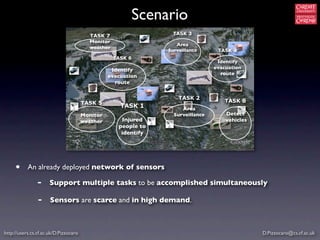
Scenario


http://users.cs.cf.ac.uk/D.Pizzocaro              D.Pizzocaro@cs.cf.ac.uk
Scenario


     •     An already deployed network of sensors


http://users.cs.cf.ac.uk/D.Pizzocaro                D.Pizzocaro@cs.cf.ac.uk
Scenario
                                                                  TASK 3
                                         TASK 7
                                         Monitor
                                                                   Area
                                         weather
                                                                Surveillance      TASK 4
                                                   TASK 6
                                                                                  Identify
                                                  Identify                       evacuation
                                                                                   route
                                                 evacuation
                                                   route

                                                                    TASK 2
                                       TASK 5                                       TASK 8
                                                     TASK 1          Area
                                       Monitor                    Surveillance       Detect
                                       weather       Injured                         vehicles
                                                    people to
                                                     identify


     •     An already deployed network of sensors

                -     Support multiple tasks to be accomplished simultaneously


http://users.cs.cf.ac.uk/D.Pizzocaro                                                            D.Pizzocaro@cs.cf.ac.uk
Scenario
                                                                  TASK 3
                                         TASK 7
                                         Monitor
                                                                   Area
                                         weather
                                                                Surveillance      TASK 4
                                                   TASK 6
                                                                                  Identify
                                                  Identify                       evacuation
                                                                                   route
                                                 evacuation
                                                   route

                                                                    TASK 2
                                       TASK 5                                       TASK 8
                                                     TASK 1          Area
                                       Monitor                    Surveillance       Detect
                                       weather       Injured                         vehicles
                                                    people to
                                                     identify


     •     An already deployed network of sensors

                -     Support multiple tasks to be accomplished simultaneously

                -     Sensors are scarce and in high demand.


http://users.cs.cf.ac.uk/D.Pizzocaro                                                            D.Pizzocaro@cs.cf.ac.uk
Scenario
                                                                  TASK 3
                                         TASK 7
                                         Monitor
                                                                   Area
                                         weather
                                                                Surveillance      TASK 4
                                                   TASK 6
                                                                                  Identify
                                                  Identify                       evacuation
                                                                                   route
                                                 evacuation
                                                   route

                                                                    TASK 2
                                       TASK 5                                       TASK 8
                                                     TASK 1          Area
                                       Monitor                    Surveillance       Detect
                                       weather       Injured                         vehicles
                                                    people to
                                                     identify


     •     An already deployed network of sensors

                -     Support multiple tasks to be accomplished simultaneously

                -     Sensors are scarce and in high demand.

                -     Highly dynamic (sensor failures, change of plan)
http://users.cs.cf.ac.uk/D.Pizzocaro                                                            D.Pizzocaro@cs.cf.ac.uk
Scenario


                                       “Where is it better to send that particular UAV?”


                                                                   TASK 2
                                                 TASK 1             Area
                                                                 Surveillance
                                                  Injured
                                                 people to
                                                  identify


     •     An already deployed network of sensors

                -     Support multiple tasks to be accomplished simultaneously

            -       Sensors are scarce and in high demand.

                -     Highly dynamic (sensor failures, change of plan)
http://users.cs.cf.ac.uk/D.Pizzocaro                                                       D.Pizzocaro@cs.cf.ac.uk
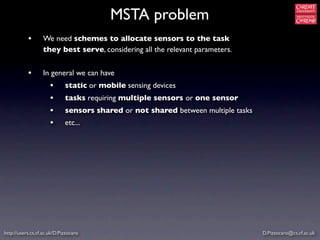
MSTA problem
           •      We need schemes to allocate sensors to the task
                  they best serve, considering all the relevant parameters.


           •      In general we can have
                      •      static or mobile sensing devices
                      •      tasks requiring multiple sensors or one sensor
                      •      sensors shared or not shared between multiple tasks
                      •      etc...


http://users.cs.cf.ac.uk/D.Pizzocaro                                               D.Pizzocaro@cs.cf.ac.uk
MSTA problem
           •      We need schemes to allocate sensors to the task
                  they best serve, considering all the relevant parameters.


           •      In general we can have
                      •      static or mobile sensing devices
                      •      tasks requiring multiple sensors or one sensor
                      •      sensors shared or not shared between multiple tasks
                      •      etc...


            •      The fundamental question remains:

                         Which sensor should
                      be allocated to which task?


http://users.cs.cf.ac.uk/D.Pizzocaro                                               D.Pizzocaro@cs.cf.ac.uk
MSTA problem
           •      We need schemes to allocate sensors to the task
                  they best serve, considering all the relevant parameters.


           •      In general we can have
                      •      static or mobile sensing devices
                      •      tasks requiring multiple sensors or one sensor
                      •      sensors shared or not shared between multiple tasks
                      •      etc...


            •      The fundamental question remains:

                         Which sensor should                    Multi-Sensor Task Allocation
                      be allocated to which task?                         (MSTA)


http://users.cs.cf.ac.uk/D.Pizzocaro                                               D.Pizzocaro@cs.cf.ac.uk
MSTA applications
           •       MSTA arises in a variety of domains:
                      •      environmental monitoring
                      •      natural disaster (e.g. earthquakes), ....


http://users.cs.cf.ac.uk/D.Pizzocaro                                     D.Pizzocaro@cs.cf.ac.uk
MSTA applications
           •       MSTA arises in a variety of domains:
                      •      environmental monitoring
                      •      natural disaster (e.g. earthquakes), ....


           •       We focus on military/humanitarian scenarios
                 ‣        our allocation mechanisms can be applied to other domains!


http://users.cs.cf.ac.uk/D.Pizzocaro                                         D.Pizzocaro@cs.cf.ac.uk
MSTA applications
           •       MSTA arises in a variety of domains:
                      •      environmental monitoring
                      •      natural disaster (e.g. earthquakes), ....


           •       We focus on military/humanitarian scenarios
                 ‣        our allocation mechanisms can be applied to other domains!


           •       The task allocation process differs a lot when
                 ‣        in a homogeneous sensor network (e.g. only seismic sensors)
                 ‣        in a heterogeneous sensor network (e.g. seismic+UAVs+UGVs)


http://users.cs.cf.ac.uk/D.Pizzocaro                                              D.Pizzocaro@cs.cf.ac.uk
MSTA applications
           •       MSTA arises in a variety of domains:
                      •      environmental monitoring
                      •      natural disaster (e.g. earthquakes), ....


           •       We focus on military/humanitarian scenarios
                 ‣        our allocation mechanisms can be applied to other domains!


           •       The task allocation process differs a lot when
                 ‣        in a homogeneous sensor network (e.g. only seismic sensors)
                 ‣        in a heterogeneous sensor network (e.g. seismic+UAVs+UGVs)


           •       We discuss two examples of MSTA instances in both networks


http://users.cs.cf.ac.uk/D.Pizzocaro                                              D.Pizzocaro@cs.cf.ac.uk
MSTA
                                   in Homogeneous
                                   Sensor Network


http://users.cs.cf.ac.uk/D.Pizzocaro                D.Pizzocaro@cs.cf.ac.uk
Why Homogeneous SN ?

        •      Governmental institutions (ARL, MoD), and researchers suggest Wireless
               Sensor Networks (WSNs) as “the future” for military operations.


http://users.cs.cf.ac.uk/D.Pizzocaro                                             D.Pizzocaro@cs.cf.ac.uk
Why Homogeneous SN ?

        •      Governmental institutions (ARL, MoD), and researchers suggest Wireless
               Sensor Networks (WSNs) as “the future” for military operations.


        •      WSNs are often composed exclusively by hundreds of cheap miniaturized
               wireless sensors (called motes) with the same sensing capabilities.


http://users.cs.cf.ac.uk/D.Pizzocaro                                             D.Pizzocaro@cs.cf.ac.uk
Why Homogeneous SN ?

        •      Governmental institutions (ARL, MoD), and researchers suggest Wireless
               Sensor Networks (WSNs) as “the future” for military operations.


        •      WSNs are often composed exclusively by hundreds of cheap miniaturized
               wireless sensors (called motes) with the same sensing capabilities.


        •      In general every network composed exclusively sensors with the same sensing
               capabilities is called “Homogeneous Sensor Network”.


http://users.cs.cf.ac.uk/D.Pizzocaro                                               D.Pizzocaro@cs.cf.ac.uk
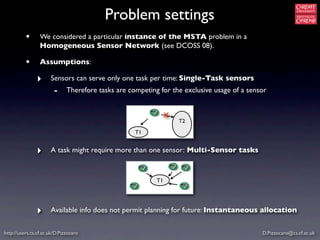
Problem settings
          •      We considered a particular instance of the MSTA problem in a
                 Homogeneous Sensor Network (see DCOSS 08).

          •      Assumptions:

               ‣      Sensors can serve only one task per time: Single-Task sensors
                        -     Therefore tasks are competing for the exclusive usage of a sensor


                                                                x   T2

                                                    T1


               ‣      A task might require more than one sensor: Multi-Sensor tasks


                                                           T1


               ‣      Available info does not permit planning for future: Instantaneous allocation

http://users.cs.cf.ac.uk/D.Pizzocaro                                                         D.Pizzocaro@cs.cf.ac.uk
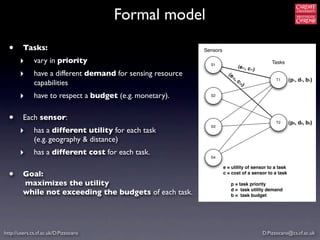
Formal model
  •      Tasks:                                              Sensors

       ‣      vary in priority                                 S1
                                                                                    (e11, c11
                                                                                                        Tasks
                                                                                                )
       ‣      have a different demand for sensing resource               (e
                                                                              12
                                                                                   ,c                           (p1, d1, b1)
              capabilities
                                                                                                         T1
                                                                                    12
                                                                                         )

       ‣      have to respect a budget (e.g. monetary).        S2


  •      Each sensor:
                                                                                                         T2     (p2, d2, b2)
       ‣
                                                               S3
              has a different utility for each task
              (e.g. geography & distance)
       ‣      has a different cost for each task.
                                                               S4

                                                                       e = utility of sensor to a task

  •      Goal:                                                         c = cost of a sensor to a task

         maximizes the utility                                            p = task priority
         while not exceeding the budgets of each task.                    d = task utility demand
                                                                          b = task budget


http://users.cs.cf.ac.uk/D.Pizzocaro                                                                D.Pizzocaro@cs.cf.ac.uk
Allocation algorithms
      •       At least as hard as the Knapsack problem which is NP-Complete

                 ➡ we developed heuristic algs and
                        compared them with state of the art pre-existent approaches.

      •      Simulation environment implemented in Java (with Penn State University)


http://users.cs.cf.ac.uk/D.Pizzocaro                                                   D.Pizzocaro@cs.cf.ac.uk
Allocation algorithms
      •         At least as hard as the Knapsack problem which is NP-Complete

                 ➡ we developed heuristic algs and
                        compared them with state of the art pre-existent approaches.

      •      Simulation environment implemented in Java (with Penn State University)


      •      The algorithm which offers the best trade-off optimality Vs computational cost:
             MRGAP algorithm:

            ‣      a centralized algorithm:
                   i.e. we collect all the info about the network in a single node


            ‣      it can be easily implemented as a distributed algorithm:
                   less communication overhead.


http://users.cs.cf.ac.uk/D.Pizzocaro                                                   D.Pizzocaro@cs.cf.ac.uk
MSTA
                                 in Heterogeneous
                                  Sensor Network


http://users.cs.cf.ac.uk/D.Pizzocaro                D.Pizzocaro@cs.cf.ac.uk
Why Heterogeneous SN ?
         •      Sensor network deployment during military/humanitarian missions:
                    ‣     UAV will fly on the battlefield and drop hundreds of motes
                    ‣     Some motes might also be mobile.


http://users.cs.cf.ac.uk/D.Pizzocaro                                                 D.Pizzocaro@cs.cf.ac.uk
Why Heterogeneous SN ?
         •      Sensor network deployment during military/humanitarian missions:
                    ‣     UAV will fly on the battlefield and drop hundreds of motes
                    ‣     Some motes might also be mobile.


         •      Therefore we have a sensor network composed by sensors with different sensing
                capabilities and mobility capabilities: “Heterogeneous sensor network”


http://users.cs.cf.ac.uk/D.Pizzocaro                                                     D.Pizzocaro@cs.cf.ac.uk
Why Heterogeneous SN ?
         •      Sensor network deployment during military/humanitarian missions:
                    ‣     UAV will fly on the battlefield and drop hundreds of motes
                    ‣     Some motes might also be mobile.


         •      Therefore we have a sensor network composed by sensors with different sensing
                capabilities and mobility capabilities: “Heterogeneous sensor network”

         •      Another example: Sensor Web by Open Geospatial Consortium (OGC) with
                environmental monitoring applications.
http://users.cs.cf.ac.uk/D.Pizzocaro                                                     D.Pizzocaro@cs.cf.ac.uk
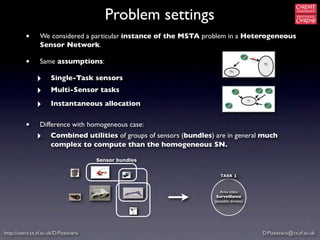
Problem settings
          •      We considered a particular instance of the MSTA problem in a Heterogeneous
                 Sensor Network.
                                                                                                 x
          •      Same assumptions:                                                                   T2

                                                                                T1

               ‣      Single-Task sensors
               ‣      Multi-Sensor tasks

               ‣      Instantaneous allocation
                                                                                            T1


          •      Difference with homogeneous case:
               ‣      Combined utilities of groups of sensors (bundles) are in general much
                      complex to compute than the homogeneous SN.


                                                                          TASK 1


                                                                          Area video
                                                                        Surveillance
                                                                       (possible threats)


http://users.cs.cf.ac.uk/D.Pizzocaro                                                                 D.Pizzocaro@cs.cf.ac.uk
Problem settings
          •      We considered a particular instance of the MSTA problem in a Heterogeneous
                 Sensor Network.
                                                                                                 x
          •      Same assumptions:                                                                   T2

                                                                                T1

               ‣      Single-Task sensors
               ‣      Multi-Sensor tasks

               ‣      Instantaneous allocation
                                                                                            T1


          •      Difference with homogeneous case:
               ‣      Combined utilities of groups of sensors (bundles) are in general much
                      complex to compute than the homogeneous SN.

                                       Sensor bundles


                                                                          TASK 1


                                                                          Area video
                                                                        Surveillance
                                                                       (possible threats)


http://users.cs.cf.ac.uk/D.Pizzocaro                                                                 D.Pizzocaro@cs.cf.ac.uk
Formal model

     •      We first want to group sensors into bundles,
            and then we want to find the best assignment of bundles to tasks.


                                       Sensors
                                                                Bundles                Tasks

                                         S1
                                                                             e11
                                                                   B1                      T1   (p1)

                                         S2
                                                                           e1
                                                                             2


                                         S3

                                                                   B2                      T2   (p2)

                                         S4


                                                 e = joint utility of a bundle to a task
                                                            p = task priority


http://users.cs.cf.ac.uk/D.Pizzocaro                                                                   D.Pizzocaro@cs.cf.ac.uk
Allocation mechanisms (1)
      •      Problem well studied in Multi-agent Systems: Coalition formation


      •      Typical approach: combinatorial auction

                ‣      bidders: tasks

                ‣      items: sensors

                ‣      tasks bids for bundles of sensors


http://users.cs.cf.ac.uk/D.Pizzocaro                                            D.Pizzocaro@cs.cf.ac.uk
Allocation mechanisms (1)
      •      Problem well studied in Multi-agent Systems: Coalition formation


      •      Typical approach: combinatorial auction

                ‣      bidders: tasks

                ‣      items: sensors

                ‣      tasks bids for bundles of sensors


       •      Need to enumerate all possible bundles for each task.

       •      Large number of sensors and tasks: the computational cost is too large.

       •      Our contribution:
              Prune the set of bids placed by tasks (i.e. reduce the number of possible bundles).


http://users.cs.cf.ac.uk/D.Pizzocaro                                              D.Pizzocaro@cs.cf.ac.uk
Allocation mechanisms (2)
      •     We define a system architecture in which we gradually reduce the search space of the
            allocation algorithms (see EKAW08).


http://users.cs.cf.ac.uk/D.Pizzocaro                                             D.Pizzocaro@cs.cf.ac.uk
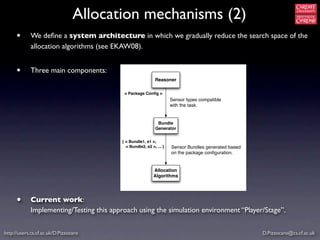
Allocation mechanisms (2)
      •     We define a system architecture in which we gradually reduce the search space of the
            allocation algorithms (see EKAW08).


      •     Three main components:
                                                          Reasoner

                                         < Package Config >
                                                                   Sensor types compatible
                                                                   with the task.


                                                           Bundle
                                                          Generator

                                        { < Bundle1, e1 >,
                                          < Bundle2, e2 >, ... }   Sensor Bundles generated based
                                                                   on the package configuration.


                                                         Allocation
                                                         Algorithms


http://users.cs.cf.ac.uk/D.Pizzocaro                                                                D.Pizzocaro@cs.cf.ac.uk
Allocation mechanisms (2)
      •     We define a system architecture in which we gradually reduce the search space of the
            allocation algorithms (see EKAW08).


      •     Three main components:
                                                           Reasoner

                                          < Package Config >
                                                                    Sensor types compatible
                                                                    with the task.


                                                            Bundle
                                                           Generator

                                         { < Bundle1, e1 >,
                                           < Bundle2, e2 >, ... }   Sensor Bundles generated based
                                                                    on the package configuration.


                                                          Allocation
                                                          Algorithms


      •     Current work:
            Implementing/Testing this approach using the simulation environment “Player/Stage”.

http://users.cs.cf.ac.uk/D.Pizzocaro                                                                 D.Pizzocaro@cs.cf.ac.uk
Taxonomy of
                                       MSTA problems


http://users.cs.cf.ac.uk/D.Pizzocaro                   D.Pizzocaro@cs.cf.ac.uk
Related work - MRTA
        •      MSTA is closely related to Multi-Robot Task Allocation (MRTA):
                                       “Which robot should execute which task?"
                                          in a Multi-Robot System (MRS).


http://users.cs.cf.ac.uk/D.Pizzocaro                                              D.Pizzocaro@cs.cf.ac.uk
Related work - MRTA
        •      MSTA is closely related to Multi-Robot Task Allocation (MRTA):
                                       “Which robot should execute which task?"
                                          in a Multi-Robot System (MRS).


        •      Gerkey et al (2004) proposed an MRTA taxonomy:

                  ➡ MRTA problems can be viewed as instances of other well-studied,
                          optimization problems.


                  ➡ therefore allowing comparison of different solutions.


http://users.cs.cf.ac.uk/D.Pizzocaro                                              D.Pizzocaro@cs.cf.ac.uk
Preliminary MSTA taxonomy

     •      We propose a preliminary MSTA taxonomy as an extension of MRTA to cover
            important features of sensor networks (INFOCOM 09).


http://users.cs.cf.ac.uk/D.Pizzocaro                                    D.Pizzocaro@cs.cf.ac.uk
Preliminary MSTA taxonomy

     •       We propose a preliminary MSTA taxonomy as an extension of MRTA to cover
             important features of sensor networks (INFOCOM 09).


         •       MSTA taxonomy organized on four main axes:
                    1.     Sensors: Single-task (ST) vs. multi-task (MT).
                    2.     Tasks: Single-sensor (SS) vs. multi-sensor (MS).
                    3.     Assignment: Instantaneous (IA) vs. time-extended (TA).
                    4.     Sensor Network: Homogeneous (HO) vs. heterogeneous (HE).


         •       Example: previously we have considered ST-MS-IA-HO and ST-MS-IA-HE


http://users.cs.cf.ac.uk/D.Pizzocaro                                            D.Pizzocaro@cs.cf.ac.uk
Conclusion
        •      We have presented the general MSTA problem,
        •      Discussed two MSTA instances with applications in military/humanitarian
               missions,
        •      Outlined the need for a MSTA taxonomy and presented a preliminary
               version of it.


http://users.cs.cf.ac.uk/D.Pizzocaro                                         D.Pizzocaro@cs.cf.ac.uk
Conclusion
        •      We have presented the general MSTA problem,
        •      Discussed two MSTA instances with applications in military/humanitarian
               missions,
        •      Outlined the need for a MSTA taxonomy and presented a preliminary
               version of it.


        •      Future research:

             ‣       Refine MSTA taxonomy

                        ‣      What are the most important SN features to include?

             ‣       Explore different MSTA instances:

                        ‣      Heterogeneous SN with Multi-Task sensors (sensors can be shared)


http://users.cs.cf.ac.uk/D.Pizzocaro                                               D.Pizzocaro@cs.cf.ac.uk
Thanks for listening !

          Cardiff School of Computer Science


         D.Pizzocaro@cs.cf.ac.uk

   http://users.cs.cf.ac.uk/D.Pizzocaro

On Multi-Sensor Task Allocation

  • 1.
    Seminar @ DEI Cardiff School of Computer Science University of Padova (Italy) April, 2009 On Multi-Sensor Task Allocation Diego Pizzocaro PhD candidate Supervisors: Prof. Alun Preece - Dr. Roger Whitaker http://users.cs.cf.ac.uk/D.Pizzocaro D.Pizzocaro@cs.cf.ac.uk
  • 2.
    Brief Bio • 2007 - Computer Engineering, University of Padova (Italy), supervised by Prof. Luca Schenato • 2008 - Start PhD in Computer Science at Cardiff University (UK), supervised by Prof. Alun Preece and Dr. Roger Whitaker • International Technology Alliance (ITA) project: multi-national teams supported by complex information networks U.K. Ministry of Defence U.S. Army Research Lab • Our research focus: intelligent resource allocation in sensor networks. http://users.cs.cf.ac.uk/D.Pizzocaro D.Pizzocaro@cs.cf.ac.uk
  • 3.
    Outline 1. Motivations & MSTA problem 2. MSTA in Homogeneous Sensor Network 3. MSTA in Heterogeneous Sensor Network 4. Taxonomy of MSTA problems 5. Conclusion http://users.cs.cf.ac.uk/D.Pizzocaro D.Pizzocaro@cs.cf.ac.uk
  • 4.
    Motivation & MSTA problem http://users.cs.cf.ac.uk/D.Pizzocaro D.Pizzocaro@cs.cf.ac.uk
  • 5.
    Sensors Simple sensors Platforms http://users.cs.cf.ac.uk/D.Pizzocaro D.Pizzocaro@cs.cf.ac.uk
  • 6.
    Sensors Simple sensors Platforms http://users.cs.cf.ac.uk/D.Pizzocaro D.Pizzocaro@cs.cf.ac.uk
  • 7.
    Sensors Tasks Simple sensors e.g. Search-&-Rescue mission Platforms http://users.cs.cf.ac.uk/D.Pizzocaro D.Pizzocaro@cs.cf.ac.uk
  • 8.
    Sensors Tasks Simple sensors e.g. Search-&-Rescue mission TASK 3 TASK 4 Area Surveillance Area (possible threats) TASK 1 Platforms Surveillance (possible threats) Injured people to TASK 2 identify Injured people to identify http://users.cs.cf.ac.uk/D.Pizzocaro D.Pizzocaro@cs.cf.ac.uk
  • 9.
  • 10.
    Scenario • An already deployed network of sensors http://users.cs.cf.ac.uk/D.Pizzocaro D.Pizzocaro@cs.cf.ac.uk
  • 11.
    Scenario TASK 3 TASK 7 Monitor Area weather Surveillance TASK 4 TASK 6 Identify Identify evacuation route evacuation route TASK 2 TASK 5 TASK 8 TASK 1 Area Monitor Surveillance Detect weather Injured vehicles people to identify • An already deployed network of sensors - Support multiple tasks to be accomplished simultaneously http://users.cs.cf.ac.uk/D.Pizzocaro D.Pizzocaro@cs.cf.ac.uk
  • 12.
    Scenario TASK 3 TASK 7 Monitor Area weather Surveillance TASK 4 TASK 6 Identify Identify evacuation route evacuation route TASK 2 TASK 5 TASK 8 TASK 1 Area Monitor Surveillance Detect weather Injured vehicles people to identify • An already deployed network of sensors - Support multiple tasks to be accomplished simultaneously - Sensors are scarce and in high demand. http://users.cs.cf.ac.uk/D.Pizzocaro D.Pizzocaro@cs.cf.ac.uk
  • 13.
    Scenario TASK 3 TASK 7 Monitor Area weather Surveillance TASK 4 TASK 6 Identify Identify evacuation route evacuation route TASK 2 TASK 5 TASK 8 TASK 1 Area Monitor Surveillance Detect weather Injured vehicles people to identify • An already deployed network of sensors - Support multiple tasks to be accomplished simultaneously - Sensors are scarce and in high demand. - Highly dynamic (sensor failures, change of plan) http://users.cs.cf.ac.uk/D.Pizzocaro D.Pizzocaro@cs.cf.ac.uk
  • 14.
    Scenario “Where is it better to send that particular UAV?” TASK 2 TASK 1 Area Surveillance Injured people to identify • An already deployed network of sensors - Support multiple tasks to be accomplished simultaneously - Sensors are scarce and in high demand. - Highly dynamic (sensor failures, change of plan) http://users.cs.cf.ac.uk/D.Pizzocaro D.Pizzocaro@cs.cf.ac.uk
  • 15.
    MSTA problem • We need schemes to allocate sensors to the task they best serve, considering all the relevant parameters. • In general we can have • static or mobile sensing devices • tasks requiring multiple sensors or one sensor • sensors shared or not shared between multiple tasks • etc... http://users.cs.cf.ac.uk/D.Pizzocaro D.Pizzocaro@cs.cf.ac.uk
  • 16.
    MSTA problem • We need schemes to allocate sensors to the task they best serve, considering all the relevant parameters. • In general we can have • static or mobile sensing devices • tasks requiring multiple sensors or one sensor • sensors shared or not shared between multiple tasks • etc... • The fundamental question remains: Which sensor should be allocated to which task? http://users.cs.cf.ac.uk/D.Pizzocaro D.Pizzocaro@cs.cf.ac.uk
  • 17.
    MSTA problem • We need schemes to allocate sensors to the task they best serve, considering all the relevant parameters. • In general we can have • static or mobile sensing devices • tasks requiring multiple sensors or one sensor • sensors shared or not shared between multiple tasks • etc... • The fundamental question remains: Which sensor should Multi-Sensor Task Allocation be allocated to which task? (MSTA) http://users.cs.cf.ac.uk/D.Pizzocaro D.Pizzocaro@cs.cf.ac.uk
  • 18.
    MSTA applications • MSTA arises in a variety of domains: • environmental monitoring • natural disaster (e.g. earthquakes), .... http://users.cs.cf.ac.uk/D.Pizzocaro D.Pizzocaro@cs.cf.ac.uk
  • 19.
    MSTA applications • MSTA arises in a variety of domains: • environmental monitoring • natural disaster (e.g. earthquakes), .... • We focus on military/humanitarian scenarios ‣ our allocation mechanisms can be applied to other domains! http://users.cs.cf.ac.uk/D.Pizzocaro D.Pizzocaro@cs.cf.ac.uk
  • 20.
    MSTA applications • MSTA arises in a variety of domains: • environmental monitoring • natural disaster (e.g. earthquakes), .... • We focus on military/humanitarian scenarios ‣ our allocation mechanisms can be applied to other domains! • The task allocation process differs a lot when ‣ in a homogeneous sensor network (e.g. only seismic sensors) ‣ in a heterogeneous sensor network (e.g. seismic+UAVs+UGVs) http://users.cs.cf.ac.uk/D.Pizzocaro D.Pizzocaro@cs.cf.ac.uk
  • 21.
    MSTA applications • MSTA arises in a variety of domains: • environmental monitoring • natural disaster (e.g. earthquakes), .... • We focus on military/humanitarian scenarios ‣ our allocation mechanisms can be applied to other domains! • The task allocation process differs a lot when ‣ in a homogeneous sensor network (e.g. only seismic sensors) ‣ in a heterogeneous sensor network (e.g. seismic+UAVs+UGVs) • We discuss two examples of MSTA instances in both networks http://users.cs.cf.ac.uk/D.Pizzocaro D.Pizzocaro@cs.cf.ac.uk
  • 22.
    MSTA in Homogeneous Sensor Network http://users.cs.cf.ac.uk/D.Pizzocaro D.Pizzocaro@cs.cf.ac.uk
  • 23.
    Why Homogeneous SN? • Governmental institutions (ARL, MoD), and researchers suggest Wireless Sensor Networks (WSNs) as “the future” for military operations. http://users.cs.cf.ac.uk/D.Pizzocaro D.Pizzocaro@cs.cf.ac.uk
  • 24.
    Why Homogeneous SN? • Governmental institutions (ARL, MoD), and researchers suggest Wireless Sensor Networks (WSNs) as “the future” for military operations. • WSNs are often composed exclusively by hundreds of cheap miniaturized wireless sensors (called motes) with the same sensing capabilities. http://users.cs.cf.ac.uk/D.Pizzocaro D.Pizzocaro@cs.cf.ac.uk
  • 25.
    Why Homogeneous SN? • Governmental institutions (ARL, MoD), and researchers suggest Wireless Sensor Networks (WSNs) as “the future” for military operations. • WSNs are often composed exclusively by hundreds of cheap miniaturized wireless sensors (called motes) with the same sensing capabilities. • In general every network composed exclusively sensors with the same sensing capabilities is called “Homogeneous Sensor Network”. http://users.cs.cf.ac.uk/D.Pizzocaro D.Pizzocaro@cs.cf.ac.uk
  • 26.
    Problem settings • We considered a particular instance of the MSTA problem in a Homogeneous Sensor Network (see DCOSS 08). • Assumptions: ‣ Sensors can serve only one task per time: Single-Task sensors - Therefore tasks are competing for the exclusive usage of a sensor x T2 T1 ‣ A task might require more than one sensor: Multi-Sensor tasks T1 ‣ Available info does not permit planning for future: Instantaneous allocation http://users.cs.cf.ac.uk/D.Pizzocaro D.Pizzocaro@cs.cf.ac.uk
  • 27.
    Formal model • Tasks: Sensors ‣ vary in priority S1 (e11, c11 Tasks ) ‣ have a different demand for sensing resource (e 12 ,c (p1, d1, b1) capabilities T1 12 ) ‣ have to respect a budget (e.g. monetary). S2 • Each sensor: T2 (p2, d2, b2) ‣ S3 has a different utility for each task (e.g. geography & distance) ‣ has a different cost for each task. S4 e = utility of sensor to a task • Goal: c = cost of a sensor to a task maximizes the utility p = task priority while not exceeding the budgets of each task. d = task utility demand b = task budget http://users.cs.cf.ac.uk/D.Pizzocaro D.Pizzocaro@cs.cf.ac.uk
  • 28.
    Allocation algorithms • At least as hard as the Knapsack problem which is NP-Complete ➡ we developed heuristic algs and compared them with state of the art pre-existent approaches. • Simulation environment implemented in Java (with Penn State University) http://users.cs.cf.ac.uk/D.Pizzocaro D.Pizzocaro@cs.cf.ac.uk
  • 29.
    Allocation algorithms • At least as hard as the Knapsack problem which is NP-Complete ➡ we developed heuristic algs and compared them with state of the art pre-existent approaches. • Simulation environment implemented in Java (with Penn State University) • The algorithm which offers the best trade-off optimality Vs computational cost: MRGAP algorithm: ‣ a centralized algorithm: i.e. we collect all the info about the network in a single node ‣ it can be easily implemented as a distributed algorithm: less communication overhead. http://users.cs.cf.ac.uk/D.Pizzocaro D.Pizzocaro@cs.cf.ac.uk
  • 30.
    MSTA in Heterogeneous Sensor Network http://users.cs.cf.ac.uk/D.Pizzocaro D.Pizzocaro@cs.cf.ac.uk
  • 31.
    Why Heterogeneous SN? • Sensor network deployment during military/humanitarian missions: ‣ UAV will fly on the battlefield and drop hundreds of motes ‣ Some motes might also be mobile. http://users.cs.cf.ac.uk/D.Pizzocaro D.Pizzocaro@cs.cf.ac.uk
  • 32.
    Why Heterogeneous SN? • Sensor network deployment during military/humanitarian missions: ‣ UAV will fly on the battlefield and drop hundreds of motes ‣ Some motes might also be mobile. • Therefore we have a sensor network composed by sensors with different sensing capabilities and mobility capabilities: “Heterogeneous sensor network” http://users.cs.cf.ac.uk/D.Pizzocaro D.Pizzocaro@cs.cf.ac.uk
  • 33.
    Why Heterogeneous SN? • Sensor network deployment during military/humanitarian missions: ‣ UAV will fly on the battlefield and drop hundreds of motes ‣ Some motes might also be mobile. • Therefore we have a sensor network composed by sensors with different sensing capabilities and mobility capabilities: “Heterogeneous sensor network” • Another example: Sensor Web by Open Geospatial Consortium (OGC) with environmental monitoring applications. http://users.cs.cf.ac.uk/D.Pizzocaro D.Pizzocaro@cs.cf.ac.uk
  • 34.
    Problem settings • We considered a particular instance of the MSTA problem in a Heterogeneous Sensor Network. x • Same assumptions: T2 T1 ‣ Single-Task sensors ‣ Multi-Sensor tasks ‣ Instantaneous allocation T1 • Difference with homogeneous case: ‣ Combined utilities of groups of sensors (bundles) are in general much complex to compute than the homogeneous SN. TASK 1 Area video Surveillance (possible threats) http://users.cs.cf.ac.uk/D.Pizzocaro D.Pizzocaro@cs.cf.ac.uk
  • 35.
    Problem settings • We considered a particular instance of the MSTA problem in a Heterogeneous Sensor Network. x • Same assumptions: T2 T1 ‣ Single-Task sensors ‣ Multi-Sensor tasks ‣ Instantaneous allocation T1 • Difference with homogeneous case: ‣ Combined utilities of groups of sensors (bundles) are in general much complex to compute than the homogeneous SN. Sensor bundles TASK 1 Area video Surveillance (possible threats) http://users.cs.cf.ac.uk/D.Pizzocaro D.Pizzocaro@cs.cf.ac.uk
  • 36.
    Formal model • We first want to group sensors into bundles, and then we want to find the best assignment of bundles to tasks. Sensors Bundles Tasks S1 e11 B1 T1 (p1) S2 e1 2 S3 B2 T2 (p2) S4 e = joint utility of a bundle to a task p = task priority http://users.cs.cf.ac.uk/D.Pizzocaro D.Pizzocaro@cs.cf.ac.uk
  • 37.
    Allocation mechanisms (1) • Problem well studied in Multi-agent Systems: Coalition formation • Typical approach: combinatorial auction ‣ bidders: tasks ‣ items: sensors ‣ tasks bids for bundles of sensors http://users.cs.cf.ac.uk/D.Pizzocaro D.Pizzocaro@cs.cf.ac.uk
  • 38.
    Allocation mechanisms (1) • Problem well studied in Multi-agent Systems: Coalition formation • Typical approach: combinatorial auction ‣ bidders: tasks ‣ items: sensors ‣ tasks bids for bundles of sensors • Need to enumerate all possible bundles for each task. • Large number of sensors and tasks: the computational cost is too large. • Our contribution: Prune the set of bids placed by tasks (i.e. reduce the number of possible bundles). http://users.cs.cf.ac.uk/D.Pizzocaro D.Pizzocaro@cs.cf.ac.uk
  • 39.
    Allocation mechanisms (2) • We define a system architecture in which we gradually reduce the search space of the allocation algorithms (see EKAW08). http://users.cs.cf.ac.uk/D.Pizzocaro D.Pizzocaro@cs.cf.ac.uk
  • 40.
    Allocation mechanisms (2) • We define a system architecture in which we gradually reduce the search space of the allocation algorithms (see EKAW08). • Three main components: Reasoner < Package Config > Sensor types compatible with the task. Bundle Generator { < Bundle1, e1 >, < Bundle2, e2 >, ... } Sensor Bundles generated based on the package configuration. Allocation Algorithms http://users.cs.cf.ac.uk/D.Pizzocaro D.Pizzocaro@cs.cf.ac.uk
  • 41.
    Allocation mechanisms (2) • We define a system architecture in which we gradually reduce the search space of the allocation algorithms (see EKAW08). • Three main components: Reasoner < Package Config > Sensor types compatible with the task. Bundle Generator { < Bundle1, e1 >, < Bundle2, e2 >, ... } Sensor Bundles generated based on the package configuration. Allocation Algorithms • Current work: Implementing/Testing this approach using the simulation environment “Player/Stage”. http://users.cs.cf.ac.uk/D.Pizzocaro D.Pizzocaro@cs.cf.ac.uk
  • 42.
    Taxonomy of MSTA problems http://users.cs.cf.ac.uk/D.Pizzocaro D.Pizzocaro@cs.cf.ac.uk
  • 43.
    Related work -MRTA • MSTA is closely related to Multi-Robot Task Allocation (MRTA): “Which robot should execute which task?" in a Multi-Robot System (MRS). http://users.cs.cf.ac.uk/D.Pizzocaro D.Pizzocaro@cs.cf.ac.uk
  • 44.
    Related work -MRTA • MSTA is closely related to Multi-Robot Task Allocation (MRTA): “Which robot should execute which task?" in a Multi-Robot System (MRS). • Gerkey et al (2004) proposed an MRTA taxonomy: ➡ MRTA problems can be viewed as instances of other well-studied, optimization problems. ➡ therefore allowing comparison of different solutions. http://users.cs.cf.ac.uk/D.Pizzocaro D.Pizzocaro@cs.cf.ac.uk
  • 45.
    Preliminary MSTA taxonomy • We propose a preliminary MSTA taxonomy as an extension of MRTA to cover important features of sensor networks (INFOCOM 09). http://users.cs.cf.ac.uk/D.Pizzocaro D.Pizzocaro@cs.cf.ac.uk
  • 46.
    Preliminary MSTA taxonomy • We propose a preliminary MSTA taxonomy as an extension of MRTA to cover important features of sensor networks (INFOCOM 09). • MSTA taxonomy organized on four main axes: 1. Sensors: Single-task (ST) vs. multi-task (MT). 2. Tasks: Single-sensor (SS) vs. multi-sensor (MS). 3. Assignment: Instantaneous (IA) vs. time-extended (TA). 4. Sensor Network: Homogeneous (HO) vs. heterogeneous (HE). • Example: previously we have considered ST-MS-IA-HO and ST-MS-IA-HE http://users.cs.cf.ac.uk/D.Pizzocaro D.Pizzocaro@cs.cf.ac.uk
  • 47.
    Conclusion • We have presented the general MSTA problem, • Discussed two MSTA instances with applications in military/humanitarian missions, • Outlined the need for a MSTA taxonomy and presented a preliminary version of it. http://users.cs.cf.ac.uk/D.Pizzocaro D.Pizzocaro@cs.cf.ac.uk
  • 48.
    Conclusion • We have presented the general MSTA problem, • Discussed two MSTA instances with applications in military/humanitarian missions, • Outlined the need for a MSTA taxonomy and presented a preliminary version of it. • Future research: ‣ Refine MSTA taxonomy ‣ What are the most important SN features to include? ‣ Explore different MSTA instances: ‣ Heterogeneous SN with Multi-Task sensors (sensors can be shared) http://users.cs.cf.ac.uk/D.Pizzocaro D.Pizzocaro@cs.cf.ac.uk
  • 49.
    Thanks for listening! Cardiff School of Computer Science D.Pizzocaro@cs.cf.ac.uk http://users.cs.cf.ac.uk/D.Pizzocaro