On Being Concise
Confident writers write concisely.!
TL;DR
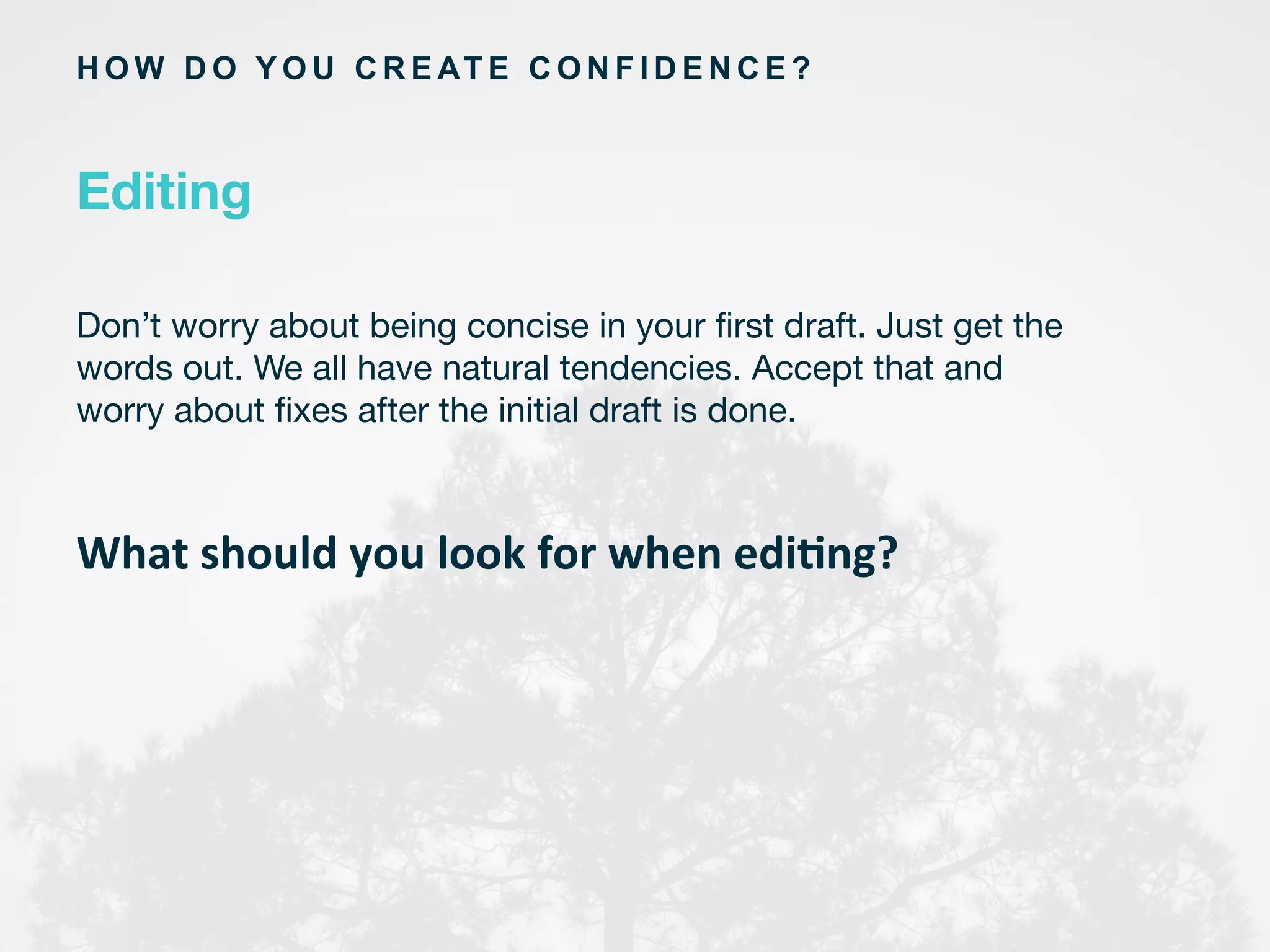
H O W D O Y O U C R E AT E C O N F I D E N C E ?
Time
Time as a writer 
Unseasoned writers are naturally going to be less confident in their
ability to clearly convey an idea or thought. Have patience with
them. Have patience with yourself.
Time with the subject 
Writers new to a subject won’t write as concisely as someone who
has more experience in that area. Spend some time familiarizing
yourself with your subject matter, but don’t expect to be an expert
right away. 	


Preparation
H O W D O Y O U C R E AT E C O N F I D E N C E ?
Know what you will say
Know what it is you want the reader to take away. Make it a
specific idea. The more focused the idea, the more focused the
writing. The broader the idea, the more likely you are to ramble.
Know how you will say it
Use an outline. It is the map that will show you the quickest
route from beginning to end. There’s no right way or wrong way
to outline. Use what helps you, but the more specific the outline
the more helpful it will be.


What	
  should	
  you	
  look	
  for	
  when	
  edi3ng?	
  
H O W D O Y O U C R E AT E C O N F I D E N C E ?
Editing
Don’t worry about being concise in your first draft. Just get the
words out. We all have natural tendencies. Accept that and
worry about fixes after the initial draft is done.


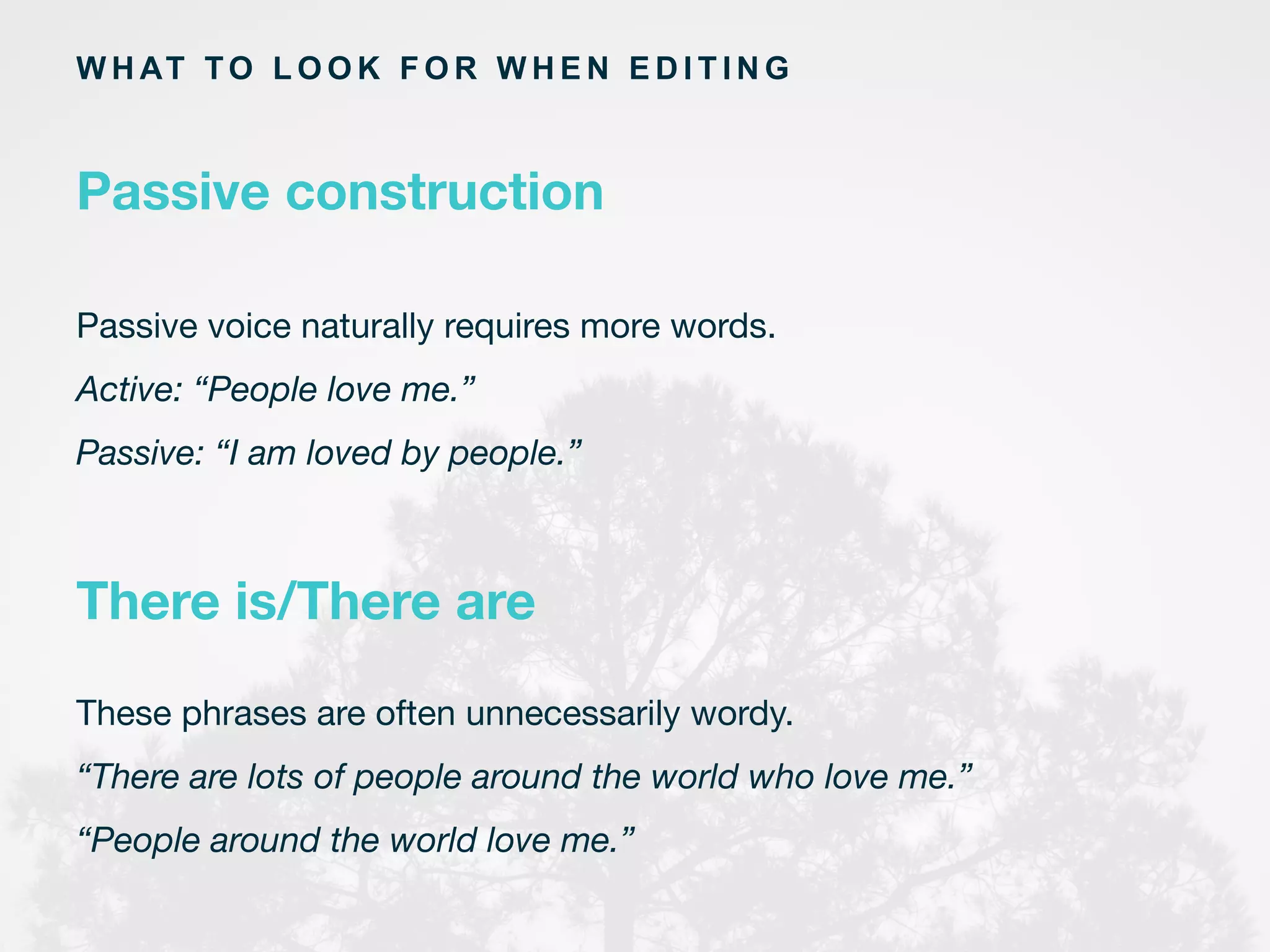
Passive voice naturally requires more words.
Active: “People love me.”
Passive: “I am loved by people.”
	
  
There is/There are
W H AT TO L O O K F O R W H E N E D I T I N G
Passive construction
These phrases are often unnecessarily wordy.
“There are lots of people around the world who love me.”
“People around the world love me.”
	
  
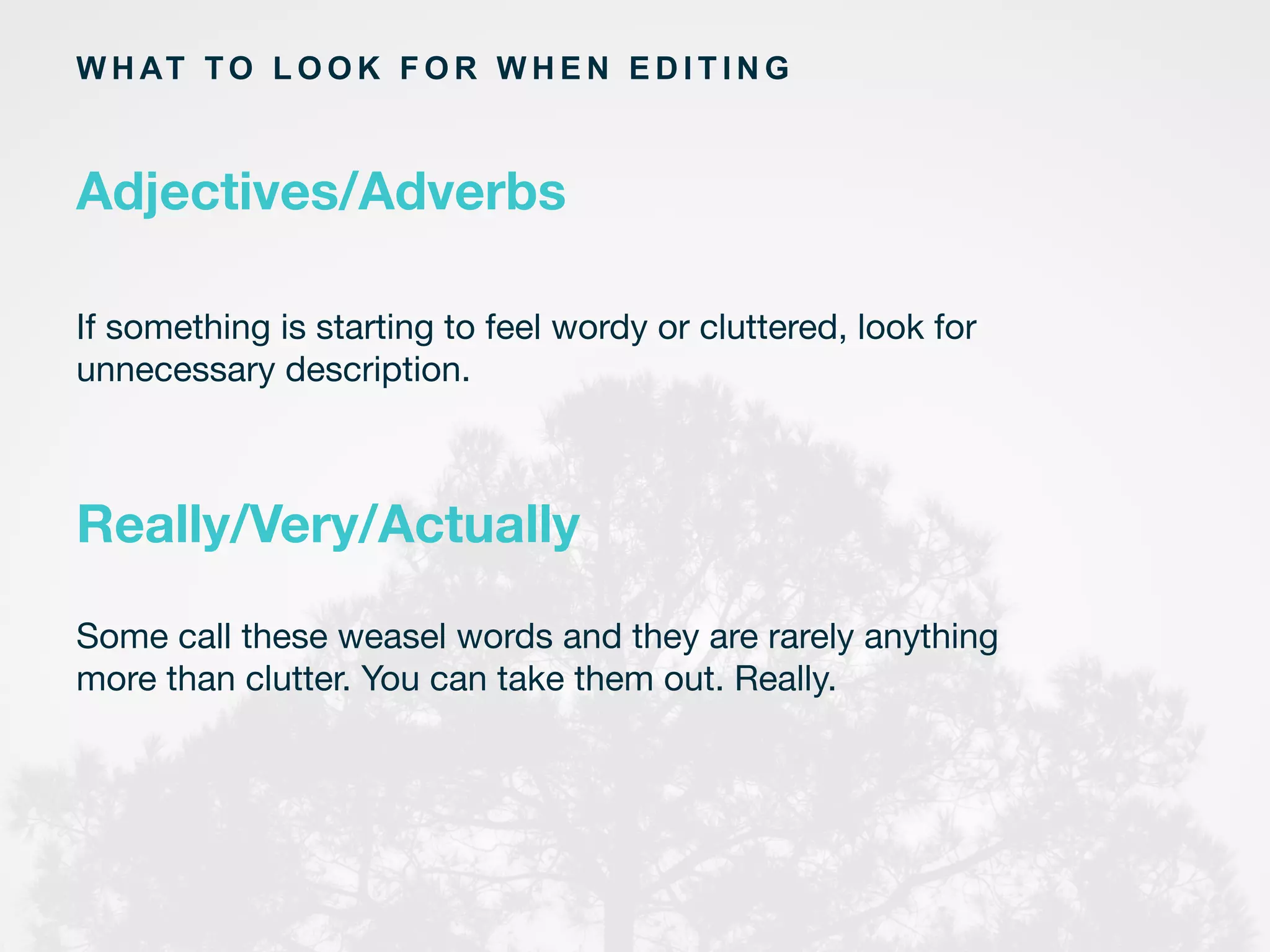
If something is starting to feel wordy or cluttered, look for
unnecessary description.
	
  
W H AT TO L O O K F O R W H E N E D I T I N G
Adjectives/Adverbs
Really/Very/Actually
Some call these weasel words and they are rarely anything
more than clutter. You can take them out. Really.
	
  
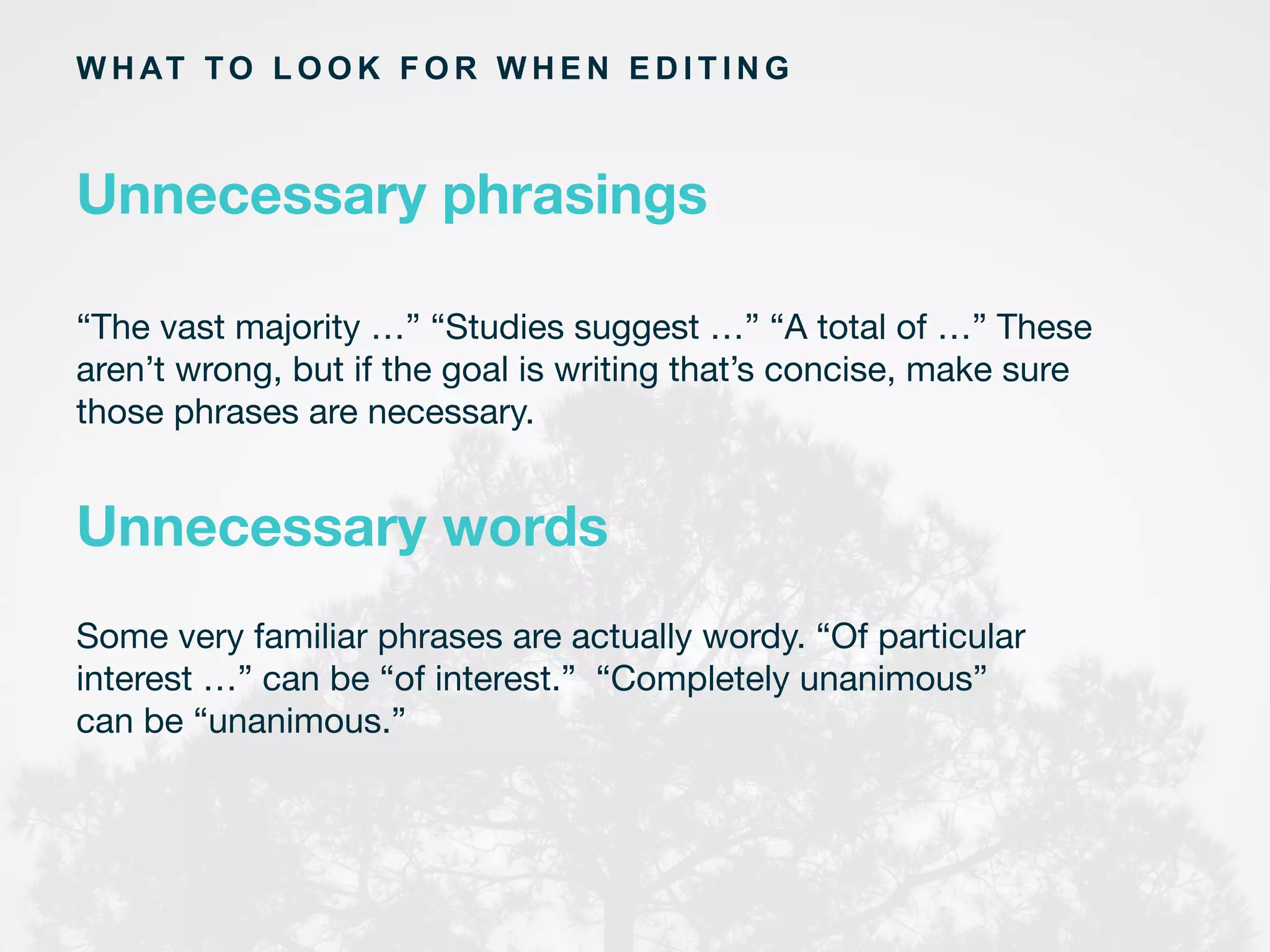
W H AT TO L O O K F O R W H E N E D I T I N G
“The vast majority …” “Studies suggest …” “A total of …” These
aren’t wrong, but if the goal is writing that’s concise, make sure
those phrases are necessary.	
  
Unnecessary phrasings
Unnecessary words
Some very familiar phrases are actually wordy. “Of particular
interest …” can be “of interest.” “Completely unanimous”
can be “unanimous.”
W H AT TO L O O K F O R W H E N E D I T I N G
When we aren’t confident in what we’re writing we will often
make the same point over and over just reworded. These can be
in a sentence, in a paragraph, or large points throughout a piece.
Look for this repetition and remove it.
Redundancies
L E T ’ S R E V I E W.
1.  Giving yourself (and others) enough time and patience.
2.  Preparing for what you’ll say and how you’ll say it.
3.  Editing, and knowing what to look for when you do.


Create confidence by:
1.  Passive construction
2.  There is/there are
3.  Adjectives/adverbs
4.  Really/very/actually
5.  Unnecessary phrasings
6.  Unnecessary words
7.  Redundancies

A N D W H I L E E D I T I N G …
Look out for these things:
Go forth. Be concise.!

On Being Concise

  • 1.
  • 2.
    Confident writers writeconcisely.! TL;DR
  • 3.
    H O WD O Y O U C R E AT E C O N F I D E N C E ? Time Time as a writer Unseasoned writers are naturally going to be less confident in their ability to clearly convey an idea or thought. Have patience with them. Have patience with yourself. Time with the subject Writers new to a subject won’t write as concisely as someone who has more experience in that area. Spend some time familiarizing yourself with your subject matter, but don’t expect to be an expert right away.      
  • 4.
    Preparation H O WD O Y O U C R E AT E C O N F I D E N C E ? Know what you will say Know what it is you want the reader to take away. Make it a specific idea. The more focused the idea, the more focused the writing. The broader the idea, the more likely you are to ramble. Know how you will say it Use an outline. It is the map that will show you the quickest route from beginning to end. There’s no right way or wrong way to outline. Use what helps you, but the more specific the outline the more helpful it will be.      
  • 5.
    What  should  you  look  for  when  edi3ng?   H O W D O Y O U C R E AT E C O N F I D E N C E ? Editing Don’t worry about being concise in your first draft. Just get the words out. We all have natural tendencies. Accept that and worry about fixes after the initial draft is done.    
  • 6.
    Passive voice naturallyrequires more words. Active: “People love me.” Passive: “I am loved by people.”   There is/There are W H AT TO L O O K F O R W H E N E D I T I N G Passive construction These phrases are often unnecessarily wordy. “There are lots of people around the world who love me.” “People around the world love me.”  
  • 7.
    If something isstarting to feel wordy or cluttered, look for unnecessary description.   W H AT TO L O O K F O R W H E N E D I T I N G Adjectives/Adverbs Really/Very/Actually Some call these weasel words and they are rarely anything more than clutter. You can take them out. Really.  
  • 8.
    W H ATTO L O O K F O R W H E N E D I T I N G “The vast majority …” “Studies suggest …” “A total of …” These aren’t wrong, but if the goal is writing that’s concise, make sure those phrases are necessary.   Unnecessary phrasings Unnecessary words Some very familiar phrases are actually wordy. “Of particular interest …” can be “of interest.” “Completely unanimous” can be “unanimous.”
  • 9.
    W H ATTO L O O K F O R W H E N E D I T I N G When we aren’t confident in what we’re writing we will often make the same point over and over just reworded. These can be in a sentence, in a paragraph, or large points throughout a piece. Look for this repetition and remove it. Redundancies
  • 10.
    L E T’ S R E V I E W. 1.  Giving yourself (and others) enough time and patience. 2.  Preparing for what you’ll say and how you’ll say it. 3.  Editing, and knowing what to look for when you do. Create confidence by:
  • 11.
    1.  Passive construction 2. There is/there are 3.  Adjectives/adverbs 4.  Really/very/actually 5.  Unnecessary phrasings 6.  Unnecessary words 7.  Redundancies A N D W H I L E E D I T I N G … Look out for these things:
  • 12.
    Go forth. Beconcise.!