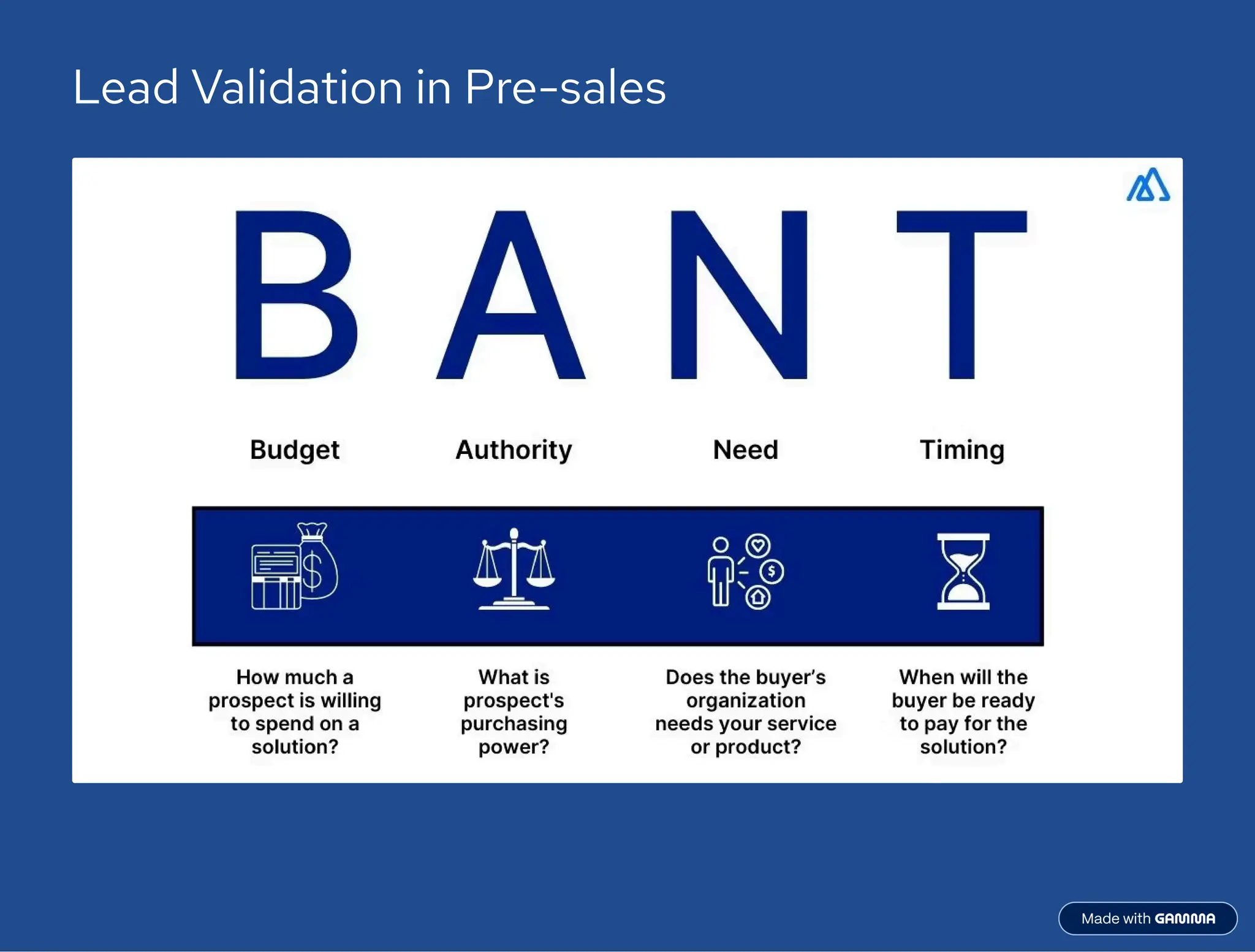
Lead Validation in Pre-sales
RFI, RFQ, RFP Processes
Which most likely leads to the contract signed?
RFI ( Request for Information)
How to Respond:
Understand the Client9s Objectives: Thoroughly read the RFI to understand what information the client is seeking. Often,
they are looking for general knowledge about your products or services and how they align with their business needs.
Provide a High-Level Overview: Focus on presenting your company9s capabilities, industry expertise, and the solutions
you offer. Include details on your experience with similar clients or industries but avoid going into pricing specifics unless
explicitly asked.
Highlight Differentiators: Showcase what sets your company apart from competitors. This could include innovative
technology, unique methodologies, strong client support, or particular industry experience.
Be Concise and Informative: Since an RFI is not a commitment to buy, keep the response informative but concise. Too
much technical detail might overwhelm the client at this stage.
Offer to Follow Up: Indicate your willingness to engage in a follow-up discussion or provide more detailed information.
Establishing a personal connection early on can set you apart in the later stages.
RFQ ( Request for Quote)
How to Respond:
Be Detailed and Specific: Since the client is looking for price comparisons, your response should be very detailed.
Include a clear breakdown of costs, timelines, and deliverables, and make sure everything aligns with the specifications
provided.
Offer Alternatives: If you believe a different solution would be more cost-effective or better suited to the client9s needs,
include that as an option alongside the requested solution. Justify why this alternative may benefit the client in terms of
cost or value.
Stay Competitive: If possible, offer competitive pricing while maintaining your margins. If you have additional value-
added services, mention them (e.g., extended support, faster delivery) to enhance your offer.
Clarify Any Assumptions: If the client9s RFQ is unclear in certain areas, make sure to note any assumptions you made
when creating your quotation. This can avoid misunderstandings later.
Present a Clear Format: Use tables and structured formats to present the pricing. Clients often want to easily compare
quotes from different vendors, so making your document easy to read can work in your favor.
RFP ( Request for Proposal)
How to Respond:
Tailor Your Response to the Client9s Needs: Thoroughly understand the client9s business challenges and goals as
outlined in the RFP. Your response should demonstrate that you can solve their problem efficiently, effectively, and
uniquely.
Include a Solution Proposal: Clearly describe how your solution addresses the client's specific needs. Include technical
details, architecture, methodologies, and how your team will deliver the solution.
Showcase Your Expertise: Include examples of similar projects you9ve successfully completed, case studies, or
references. Highlight your team9s experience and capabilities.
Provide a Clear Project Plan: Outline a step-by-step approach to delivering the project, including timelines, milestones,
deliverables, and risk mitigation strategies.
Comprehensive Pricing: While an RFP response is about more than just cost, your pricing must still be clear and
comprehensive. Provide both detailed and transparent pricing structures, including any optional services or add-ons that
might be of value.
Demonstrate Value-Add: Explain any additional value your company can offer beyond the basic solution. This could be
in the form of ongoing support, flexibility, or future scalability.
Compliance: Ensure that you meet all the specific requirements and criteria laid out in the RFP. Missing any key
components could disqualify your response.
Professional Presentation: Make sure the document is professional and well-organized. Attention to detail in your
response will reflect on your ability to deliver the project.
RFP Process
1
RFP Issued
The client issues an RFP outlining their
requirements, goals, and desired project
deliverables. This includes timelines, budget
considerations, and expectations for the proposed
solution.
2 RFP Response
Potential vendors analyze the RFP, prepare
detailed proposals, and submit their responses.
This typically includes a comprehensive solution
overview, pricing structure, project plan, and
qualifications.
3
Evaluation and Selection
The client carefully reviews all submitted RFP
responses, evaluating each vendor based on their
proposed solution, experience, pricing, and overall
fit with the project requirements.
4 Contract Negotiation
The selected vendor engages in negotiations with
the client to finalize the contract terms, including
scope of work, deliverables, timelines, payment
schedule, and any other relevant details.
5
Contract Signed
The client and selected vendor formally sign the
contract, establishing a legally binding agreement
outlining the project's key terms and conditions.
What is Business Value in the Project?
Why PreSales should focus on Proving Solution
Value
Definition and Explanation
Value management in business transformation refers to the process of managing and maximising the value of an
investment from inception through to completion. It involves defining business benefits, assessing the feasibility of
achieving these benefits, and ensuring that the realised value aligns with organisational objectives.
POV vs POC
Proof of concept vs proof of value are complementary initial steps in the product development timeline that have various
objectives. POC is used to prove the feasibility of an idea, ascertaining it can work and there's a market for it before
committing significant resources. POV assesses whether the product can bring benefits and meet market needs, validating
its commercial potential, value for users, and return on investment.
What is Value Selling?
Value selling is a strategy that focuses on the benefits and outcomes that a product or service delivers, rather than its
features or technical specifications. It's about understanding the customer's challenges, needs, and goals, and
demonstrating how your solution can address these effectively. For pre-sales managers, it's a powerful way to leverage their
deep product knowledge and technical expertise to build compelling value propositions.
Why is Value Selling Crucial for Delivery Managers?
Enhanced Customer Understanding: It encourages delivery managers to delve deeper into the customer's world,
fostering a consultative approach that's more about solving problems than just selling a product.
1.
Differentiation in a Competitive Market: In industries where products are often complex and the competition is fierce,
highlighting the unique value your solution offers can make all the difference.
2.
Long-term Relationships: By focusing on how your solution improves the customer's situation, you're not just closing a
sale; you're laying the foundation for ongoing partnerships.
3.
How to Implement Value Selling: A Step-by-
Step Guide
Step 1: Understand Your Customer's Business
Before you can sell value, you need to know what value means to your customer. This involves
understanding their business model, challenges, and how success is measured in their world. It9s
important to get a solid understanding of the challenges and what negative things occur as a result
of the current challenges.
Step 2: Align Solutions with Business Outcomes What product capabilities solve what problems,
ask yourself that first. Then articulating the business value of your solution and how you help solve
those specific problems. Don't just talk about what your product does; explain how it helps remove
challenges, solves problems, achieves business goals, reduces costs, or increases efficiency.
Step 3: Use Stories and Examples People relate to stories. Share examples of how your product
has helped similar customers. This not only makes your message more relatable but also helps
illustrate the practical application of your solution in addressing specific problems identified earlier
in the process.
Step 4: Quantify the Value Whenever possible, attach numbers to your value proposition. If your
solution can save time, reduce costs or reduce risks, present these savings or reductions in a
tangible, quantifiable way.
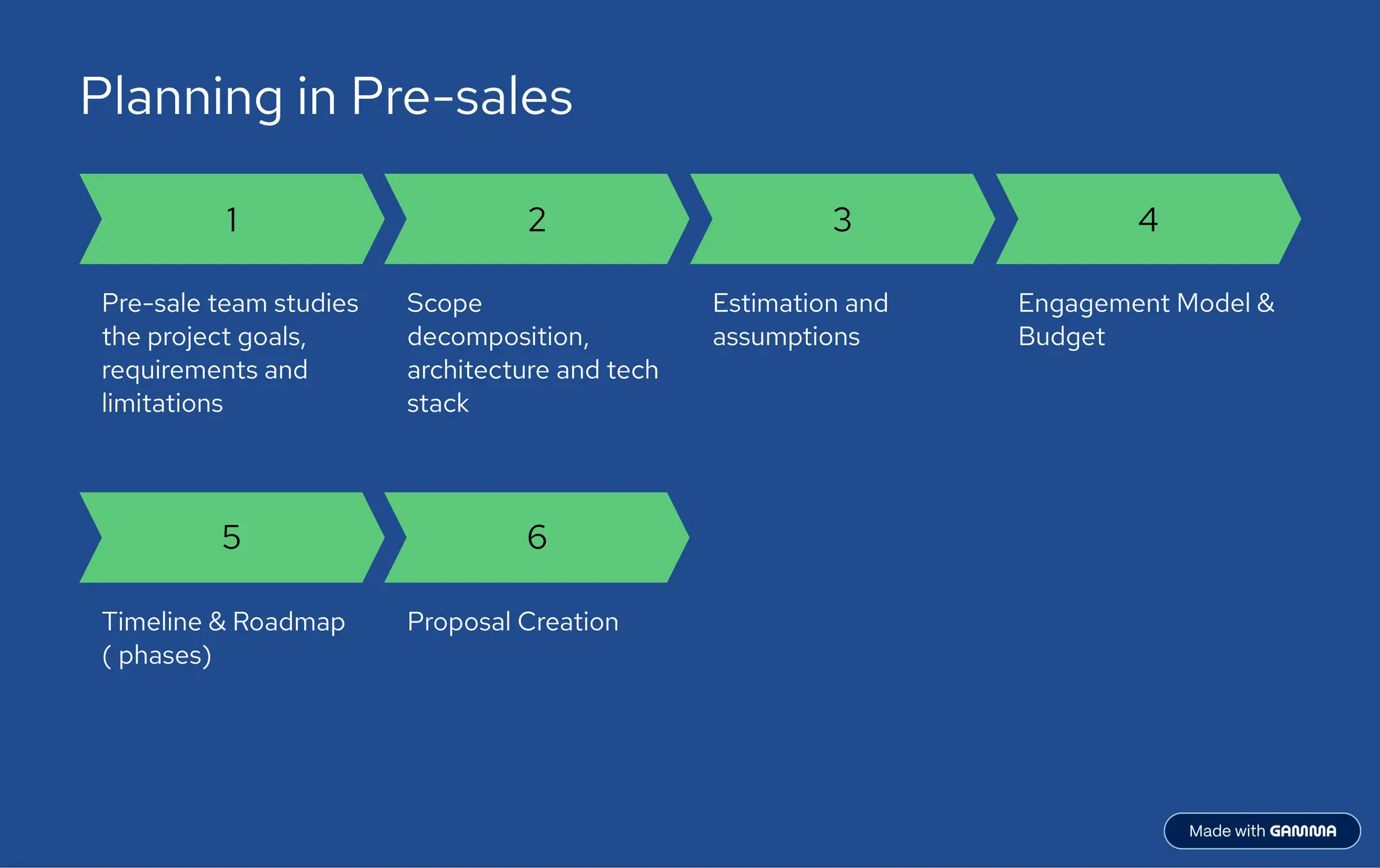
Planning in Pre-sales
1
Pre-sale team studies
the project goals,
requirements and
limitations
2
Scope
decomposition,
architecture and tech
stack
3
Estimation and
assumptions
4
Engagement Model &
Budget
5
Timeline & Roadmap
( phases)
6
Proposal Creation
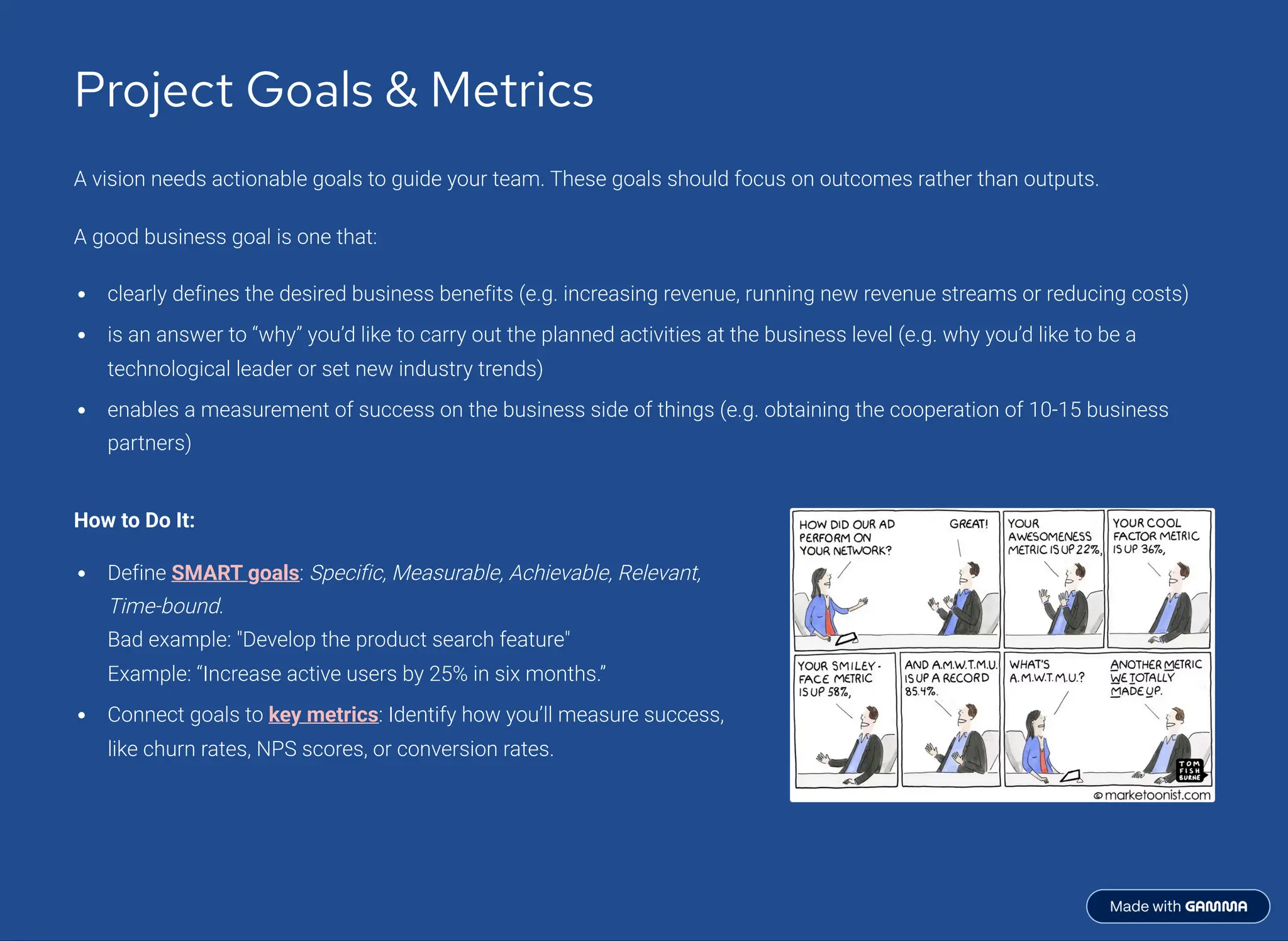
Project Goals & Metrics
A vision needs actionable goals to guide your team. These goals should focus on outcomes rather than outputs.
A good business goal is one that:
clearly defines the desired business benefits (e.g. increasing revenue, running new revenue streams or reducing costs)
is an answer to <why= you9d like to carry out the planned activities at the business level (e.g. why you9d like to be a
technological leader or set new industry trends)
enables a measurement of success on the business side of things (e.g. obtaining the cooperation of 10-15 business
partners)
How to Do It:
Define SMART goals: Specific, Measurable, Achievable, Relevant,
Time-bound.
Bad example: "Develop the product search feature"
Example: <Increase active users by 25% in six months.=
Connect goals to key metrics: Identify how you9ll measure success,
like churn rates, NPS scores, or conversion rates.
Estimates Tips & Tricks
Assumption is the key
Never ever provide estimates without assumptions!
Embed the contingency (confidence level / scope clarity) into estimates
Validate estimates using at least two approaches
Have different estimate levels for each pre-sales stage
Keep in mind history of engagement ( new leads VS existing clients)
Engage your client into the process
Engagement Model and Budget
Fixed-price ALWAYS should have contingency and change buffer.
For T&M it is essential to keep good balance between the hourly rate and number of hours
Dedicated Team model should ALWAYS have built-in business incentive different from T&M and fixed-
price ( for example, starting from 3 months, the hourly rate in FTE ( full time equivalent fee) is lower
than in common T&M)
We calculate the budget using our hourly rates or blended hourly rate and then we validate with the
client. If the company focus is on a specific model, it should be pitched first together with the budget.
Engagement Model and Budget Exercise
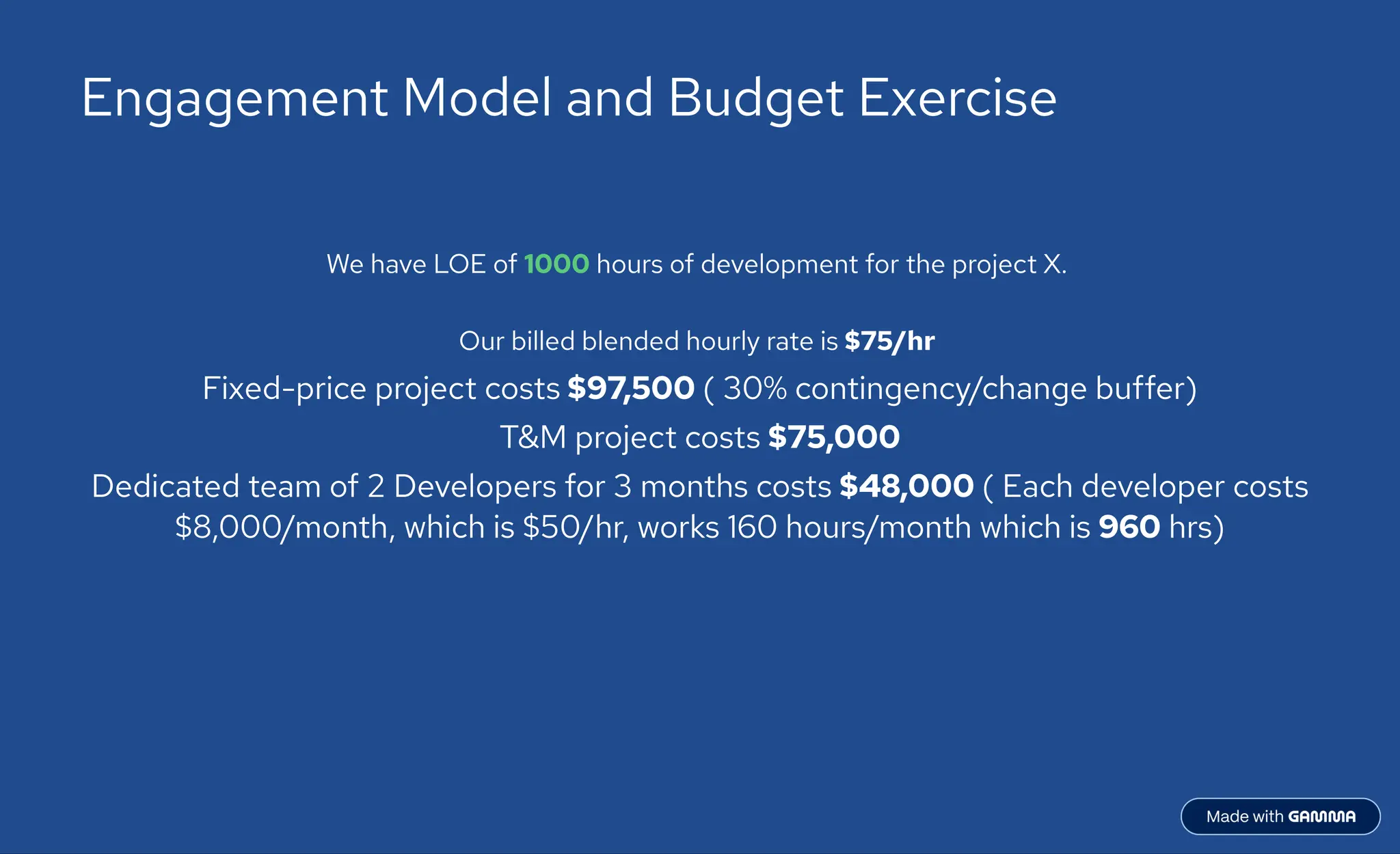
We have LOE of 1000 hours of development for the project X.
Our billed blended hourly rate is $75/hr
Fixed-price project costs $97,500 ( 30% contingency/change buffer)
T&M project costs $75,000
Dedicated team of 2 Developers for 3 months costs $48,000 ( Each developer costs
$8,000/month, which is $50/hr, works 160 hours/month which is 960 hrs)
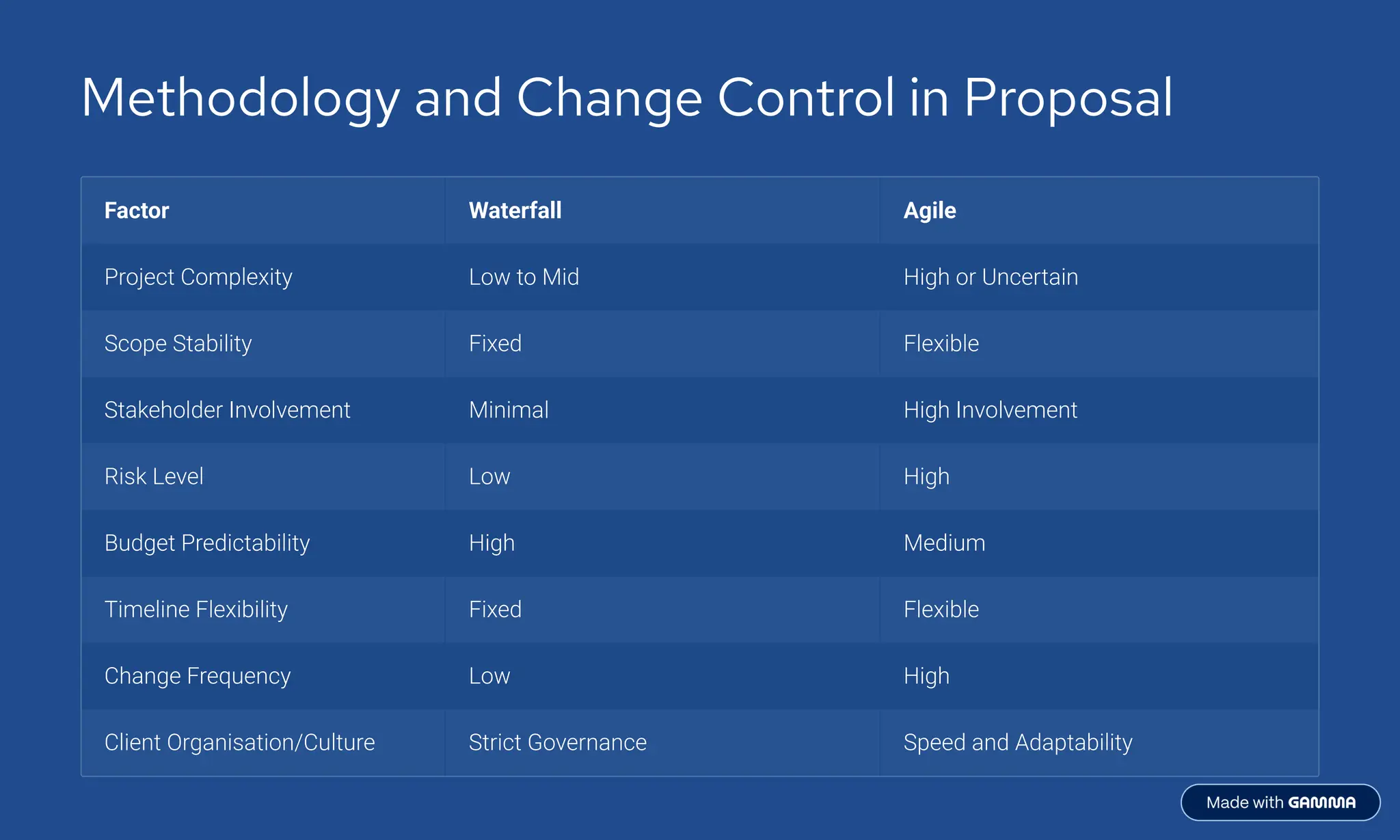
Methodology and Change Control in Proposal
Factor Waterfall Agile
Project Complexity Low to Mid High or Uncertain
Scope Stability Fixed Flexible
Stakeholder Involvement Minimal High Involvement
Risk Level Low High
Budget Predictability High Medium
Timeline Flexibility Fixed Flexible
Change Frequency Low High
Client Organisation/Culture Strict Governance Speed and Adaptability
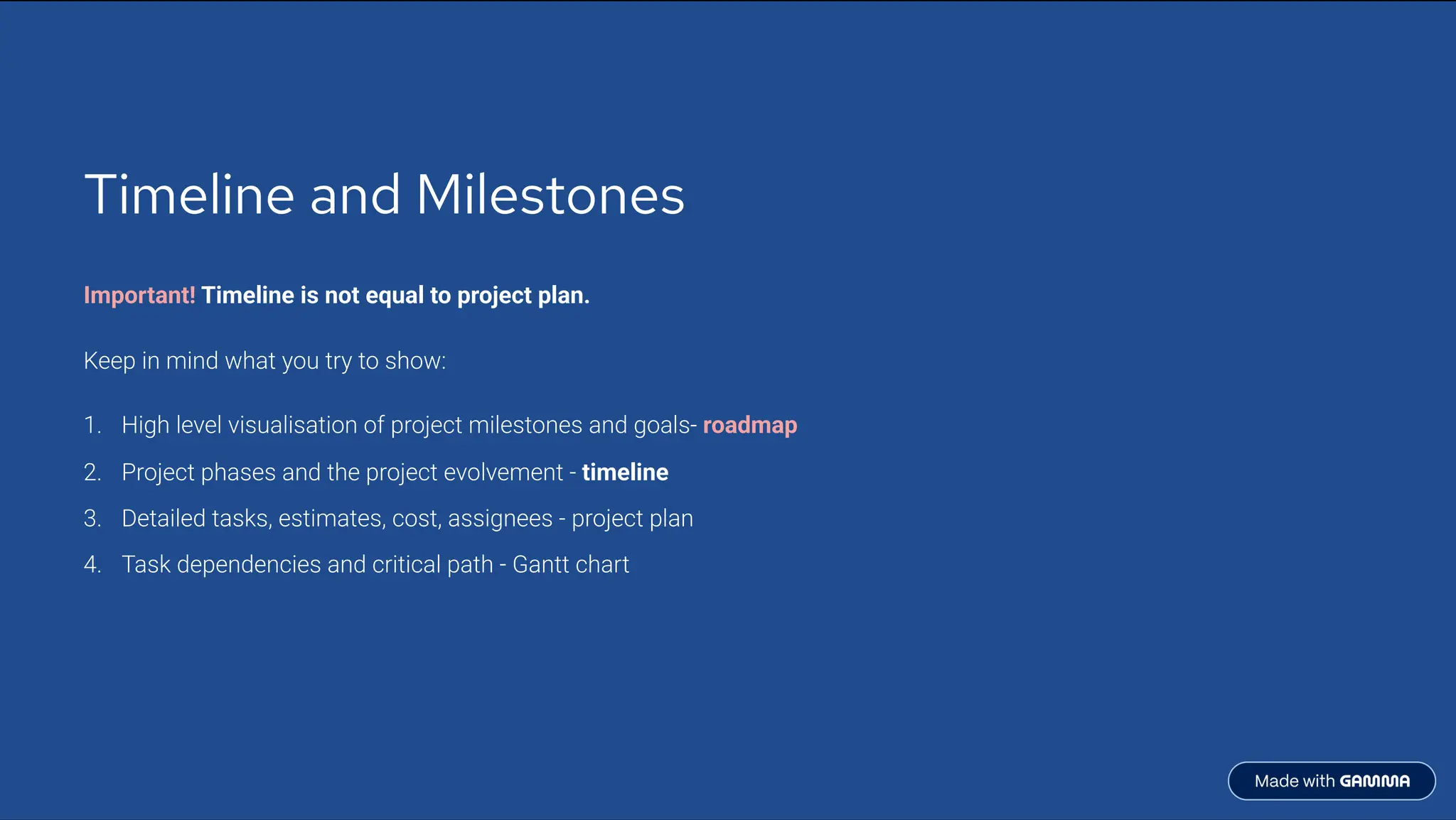
Timeline and Milestones
Important! Timeline is not equal to project plan.
Keep in mind what you try to show:
High level visualisation of project milestones and goals- roadmap
1.
Project phases and the project evolvement - timeline
2.
Detailed tasks, estimates, cost, assignees - project plan
3.
Task dependencies and critical path - Gantt chart
4.
Roadmap
Timeline for Agile Project
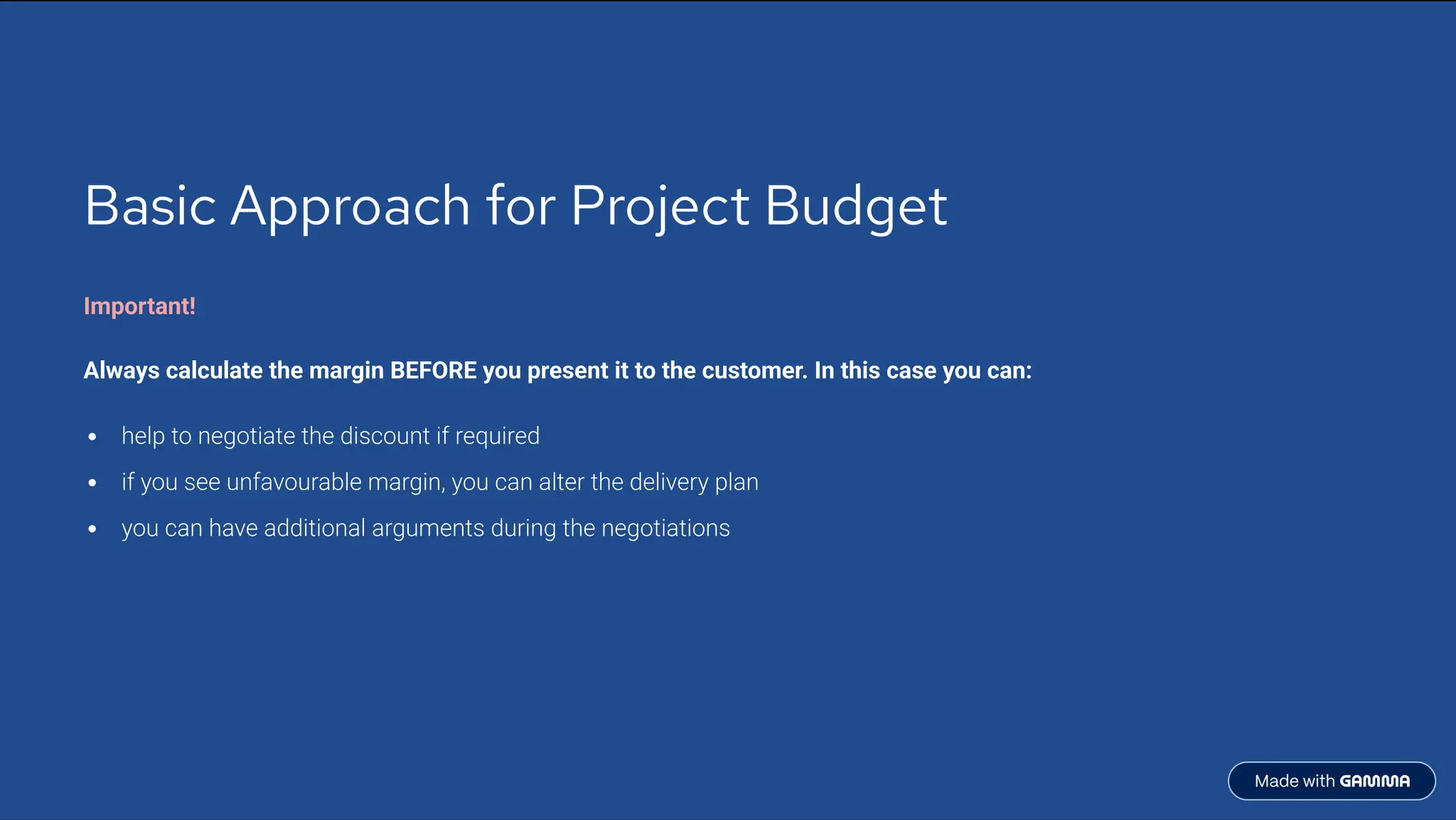
Basic Approach for Project Budget
Important!
Always calculate the margin BEFORE you present it to the customer. In this case you can:
help to negotiate the discount if required
if you see unfavourable margin, you can alter the delivery plan
you can have additional arguments during the negotiations
Basic Approach for Project Budget
For long-term projects ( 6+ months) you also need to consider:
10 - 15% from the team cost for the raises for critical team members
cost of 1 non-billable FTE for a 2-4 weeks if someone quits and you need to have have replacement
potential bonuses and overtimes
licences costs ( if appropriate)
trip expenses (if appropriate)
Proposal
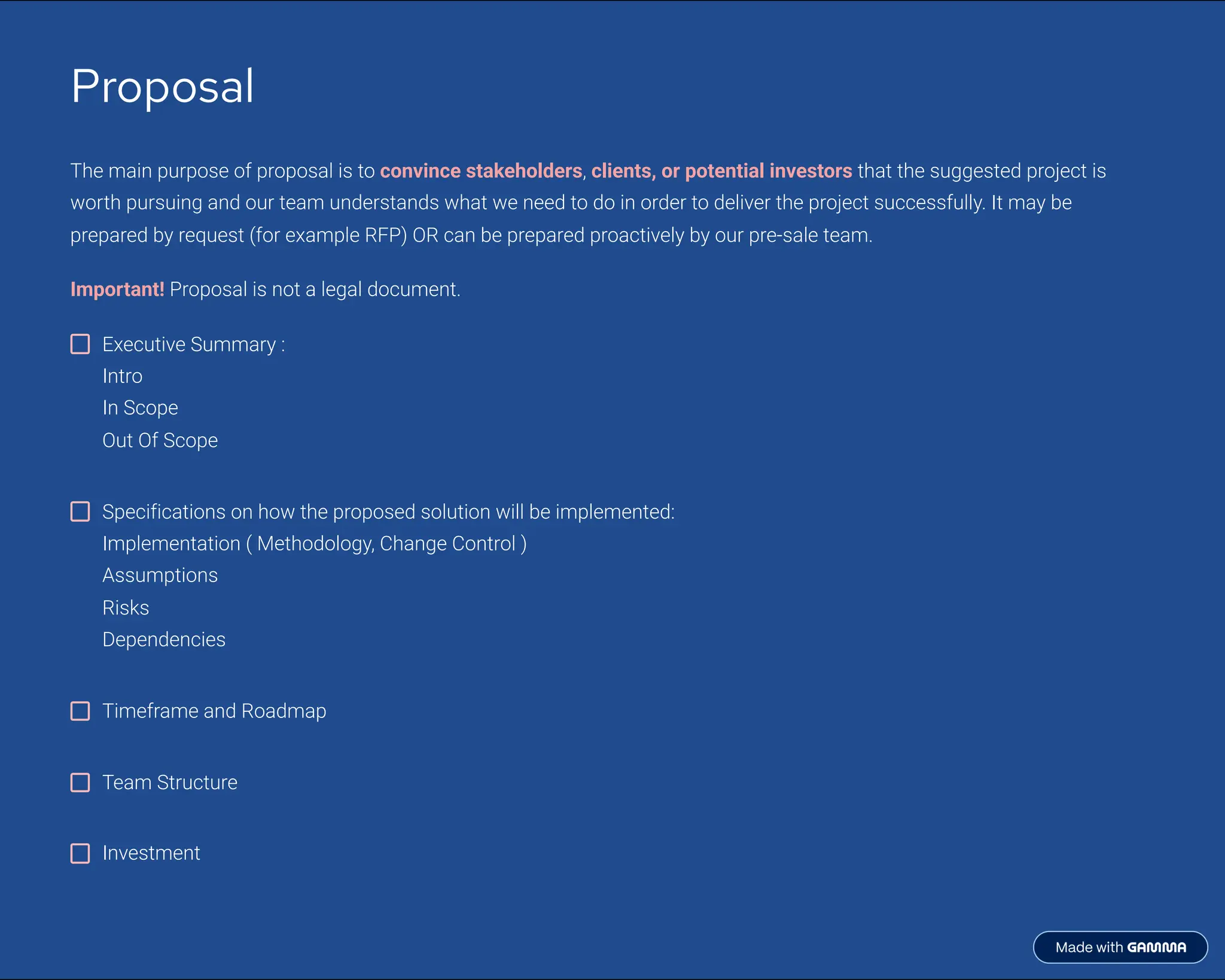
The main purpose of proposal is to convince stakeholders, clients, or potential investors that the suggested project is
worth pursuing and our team understands what we need to do in order to deliver the project successfully. It may be
prepared by request (for example RFP) OR can be prepared proactively by our pre-sale team.
Important! Proposal is not a legal document.
Executive Summary :
Intro
In Scope
Out Of Scope
Specifications on how the proposed solution will be implemented:
Implementation ( Methodology, Change Control )
Assumptions
Risks
Dependencies
Timeframe and Roadmap
Team Structure
Investment
Converting Proposal into SOW
A proposal is an offer of work, sometimes delivered in response to a request, while an SOW specifies the work to be
done and the terms of the project. A contract is usually the last step in the negotiation process. It legally joins two or more
parties and outlines the terms and conditions of the agreement.
Most typical contracts Delivery Manager work with:
Statement of Work (SOW) A detailed document that defines the scope of services to be provided, including specific
deliverables, milestones, timelines, and responsibilities. It may be a high-level SOW in the presales stage, subject to
refinement once the project is formalized.
1.
Master Services Agreement (MSA) A broad, overarching agreement that establishes the general terms and conditions
under which future projects or services will be governed. It sets up the legal framework for working with the client but
does not usually include specific project details (those go into the SOW).
2.
Service Level Agreement (SLA) A contractual document that outlines the performance expectations and service
standards that will be maintained during the project (e.g., uptime guarantees, response times). It may be drafted as part
of the presales process to show the client the level of commitment to quality and support.
3.
Non-Disclosure Agreement (NDA) Ensures the confidentiality of shared information during the presales discussions. It
protects both the client and the vendor from leaking sensitive business, technical, or financial details. Often a
prerequisite before engaging in detailed discussions about the project.
4.
Pricing and Rate Cards This document outlines the proposed pricing model, rates for resources, and any other costs
associated with the project. It may include hourly or daily rates for specific roles or fixed pricing for project deliverables.
5.
DPA. It is a legally binding contract between a company (data controller) and a third party (data processor) that handles
personal data on the company's behalf. The purpose of the DPA is to ensure that both parties comply with data
protection laws, such as the General Data Protection Regulation (GDPR) in Europe or other relevant privacy laws.
6.
Q & A
LinkedIn - Olga Grom

Olga Grom: Перехід від пресейлу до контракту (UA)

  • 2.
  • 3.
    RFI, RFQ, RFPProcesses
  • 4.
    Which most likelyleads to the contract signed?
  • 5.
    RFI ( Requestfor Information) How to Respond: Understand the Client9s Objectives: Thoroughly read the RFI to understand what information the client is seeking. Often, they are looking for general knowledge about your products or services and how they align with their business needs. Provide a High-Level Overview: Focus on presenting your company9s capabilities, industry expertise, and the solutions you offer. Include details on your experience with similar clients or industries but avoid going into pricing specifics unless explicitly asked. Highlight Differentiators: Showcase what sets your company apart from competitors. This could include innovative technology, unique methodologies, strong client support, or particular industry experience. Be Concise and Informative: Since an RFI is not a commitment to buy, keep the response informative but concise. Too much technical detail might overwhelm the client at this stage. Offer to Follow Up: Indicate your willingness to engage in a follow-up discussion or provide more detailed information. Establishing a personal connection early on can set you apart in the later stages.
  • 6.
    RFQ ( Requestfor Quote) How to Respond: Be Detailed and Specific: Since the client is looking for price comparisons, your response should be very detailed. Include a clear breakdown of costs, timelines, and deliverables, and make sure everything aligns with the specifications provided. Offer Alternatives: If you believe a different solution would be more cost-effective or better suited to the client9s needs, include that as an option alongside the requested solution. Justify why this alternative may benefit the client in terms of cost or value. Stay Competitive: If possible, offer competitive pricing while maintaining your margins. If you have additional value- added services, mention them (e.g., extended support, faster delivery) to enhance your offer. Clarify Any Assumptions: If the client9s RFQ is unclear in certain areas, make sure to note any assumptions you made when creating your quotation. This can avoid misunderstandings later. Present a Clear Format: Use tables and structured formats to present the pricing. Clients often want to easily compare quotes from different vendors, so making your document easy to read can work in your favor.
  • 7.
    RFP ( Requestfor Proposal) How to Respond: Tailor Your Response to the Client9s Needs: Thoroughly understand the client9s business challenges and goals as outlined in the RFP. Your response should demonstrate that you can solve their problem efficiently, effectively, and uniquely. Include a Solution Proposal: Clearly describe how your solution addresses the client's specific needs. Include technical details, architecture, methodologies, and how your team will deliver the solution. Showcase Your Expertise: Include examples of similar projects you9ve successfully completed, case studies, or references. Highlight your team9s experience and capabilities. Provide a Clear Project Plan: Outline a step-by-step approach to delivering the project, including timelines, milestones, deliverables, and risk mitigation strategies. Comprehensive Pricing: While an RFP response is about more than just cost, your pricing must still be clear and comprehensive. Provide both detailed and transparent pricing structures, including any optional services or add-ons that might be of value. Demonstrate Value-Add: Explain any additional value your company can offer beyond the basic solution. This could be in the form of ongoing support, flexibility, or future scalability. Compliance: Ensure that you meet all the specific requirements and criteria laid out in the RFP. Missing any key components could disqualify your response. Professional Presentation: Make sure the document is professional and well-organized. Attention to detail in your response will reflect on your ability to deliver the project.
  • 8.
    RFP Process 1 RFP Issued Theclient issues an RFP outlining their requirements, goals, and desired project deliverables. This includes timelines, budget considerations, and expectations for the proposed solution. 2 RFP Response Potential vendors analyze the RFP, prepare detailed proposals, and submit their responses. This typically includes a comprehensive solution overview, pricing structure, project plan, and qualifications. 3 Evaluation and Selection The client carefully reviews all submitted RFP responses, evaluating each vendor based on their proposed solution, experience, pricing, and overall fit with the project requirements. 4 Contract Negotiation The selected vendor engages in negotiations with the client to finalize the contract terms, including scope of work, deliverables, timelines, payment schedule, and any other relevant details. 5 Contract Signed The client and selected vendor formally sign the contract, establishing a legally binding agreement outlining the project's key terms and conditions.
  • 9.
    What is BusinessValue in the Project?
  • 10.
    Why PreSales shouldfocus on Proving Solution Value Definition and Explanation Value management in business transformation refers to the process of managing and maximising the value of an investment from inception through to completion. It involves defining business benefits, assessing the feasibility of achieving these benefits, and ensuring that the realised value aligns with organisational objectives. POV vs POC Proof of concept vs proof of value are complementary initial steps in the product development timeline that have various objectives. POC is used to prove the feasibility of an idea, ascertaining it can work and there's a market for it before committing significant resources. POV assesses whether the product can bring benefits and meet market needs, validating its commercial potential, value for users, and return on investment.
  • 11.
    What is ValueSelling? Value selling is a strategy that focuses on the benefits and outcomes that a product or service delivers, rather than its features or technical specifications. It's about understanding the customer's challenges, needs, and goals, and demonstrating how your solution can address these effectively. For pre-sales managers, it's a powerful way to leverage their deep product knowledge and technical expertise to build compelling value propositions. Why is Value Selling Crucial for Delivery Managers? Enhanced Customer Understanding: It encourages delivery managers to delve deeper into the customer's world, fostering a consultative approach that's more about solving problems than just selling a product. 1. Differentiation in a Competitive Market: In industries where products are often complex and the competition is fierce, highlighting the unique value your solution offers can make all the difference. 2. Long-term Relationships: By focusing on how your solution improves the customer's situation, you're not just closing a sale; you're laying the foundation for ongoing partnerships. 3.
  • 12.
    How to ImplementValue Selling: A Step-by- Step Guide Step 1: Understand Your Customer's Business Before you can sell value, you need to know what value means to your customer. This involves understanding their business model, challenges, and how success is measured in their world. It9s important to get a solid understanding of the challenges and what negative things occur as a result of the current challenges. Step 2: Align Solutions with Business Outcomes What product capabilities solve what problems, ask yourself that first. Then articulating the business value of your solution and how you help solve those specific problems. Don't just talk about what your product does; explain how it helps remove challenges, solves problems, achieves business goals, reduces costs, or increases efficiency. Step 3: Use Stories and Examples People relate to stories. Share examples of how your product has helped similar customers. This not only makes your message more relatable but also helps illustrate the practical application of your solution in addressing specific problems identified earlier in the process. Step 4: Quantify the Value Whenever possible, attach numbers to your value proposition. If your solution can save time, reduce costs or reduce risks, present these savings or reductions in a tangible, quantifiable way.
  • 13.
    Planning in Pre-sales 1 Pre-saleteam studies the project goals, requirements and limitations 2 Scope decomposition, architecture and tech stack 3 Estimation and assumptions 4 Engagement Model & Budget 5 Timeline & Roadmap ( phases) 6 Proposal Creation
  • 14.
    Project Goals &Metrics A vision needs actionable goals to guide your team. These goals should focus on outcomes rather than outputs. A good business goal is one that: clearly defines the desired business benefits (e.g. increasing revenue, running new revenue streams or reducing costs) is an answer to <why= you9d like to carry out the planned activities at the business level (e.g. why you9d like to be a technological leader or set new industry trends) enables a measurement of success on the business side of things (e.g. obtaining the cooperation of 10-15 business partners) How to Do It: Define SMART goals: Specific, Measurable, Achievable, Relevant, Time-bound. Bad example: "Develop the product search feature" Example: <Increase active users by 25% in six months.= Connect goals to key metrics: Identify how you9ll measure success, like churn rates, NPS scores, or conversion rates.
  • 15.
    Estimates Tips &Tricks Assumption is the key Never ever provide estimates without assumptions! Embed the contingency (confidence level / scope clarity) into estimates Validate estimates using at least two approaches Have different estimate levels for each pre-sales stage Keep in mind history of engagement ( new leads VS existing clients) Engage your client into the process
  • 16.
    Engagement Model andBudget Fixed-price ALWAYS should have contingency and change buffer. For T&M it is essential to keep good balance between the hourly rate and number of hours Dedicated Team model should ALWAYS have built-in business incentive different from T&M and fixed- price ( for example, starting from 3 months, the hourly rate in FTE ( full time equivalent fee) is lower than in common T&M) We calculate the budget using our hourly rates or blended hourly rate and then we validate with the client. If the company focus is on a specific model, it should be pitched first together with the budget.
  • 17.
    Engagement Model andBudget Exercise We have LOE of 1000 hours of development for the project X. Our billed blended hourly rate is $75/hr Fixed-price project costs $97,500 ( 30% contingency/change buffer) T&M project costs $75,000 Dedicated team of 2 Developers for 3 months costs $48,000 ( Each developer costs $8,000/month, which is $50/hr, works 160 hours/month which is 960 hrs)
  • 18.
    Methodology and ChangeControl in Proposal Factor Waterfall Agile Project Complexity Low to Mid High or Uncertain Scope Stability Fixed Flexible Stakeholder Involvement Minimal High Involvement Risk Level Low High Budget Predictability High Medium Timeline Flexibility Fixed Flexible Change Frequency Low High Client Organisation/Culture Strict Governance Speed and Adaptability
  • 19.
    Timeline and Milestones Important!Timeline is not equal to project plan. Keep in mind what you try to show: High level visualisation of project milestones and goals- roadmap 1. Project phases and the project evolvement - timeline 2. Detailed tasks, estimates, cost, assignees - project plan 3. Task dependencies and critical path - Gantt chart 4.
  • 20.
  • 21.
  • 22.
    Basic Approach forProject Budget Important! Always calculate the margin BEFORE you present it to the customer. In this case you can: help to negotiate the discount if required if you see unfavourable margin, you can alter the delivery plan you can have additional arguments during the negotiations
  • 23.
    Basic Approach forProject Budget For long-term projects ( 6+ months) you also need to consider: 10 - 15% from the team cost for the raises for critical team members cost of 1 non-billable FTE for a 2-4 weeks if someone quits and you need to have have replacement potential bonuses and overtimes licences costs ( if appropriate) trip expenses (if appropriate)
  • 24.
    Proposal The main purposeof proposal is to convince stakeholders, clients, or potential investors that the suggested project is worth pursuing and our team understands what we need to do in order to deliver the project successfully. It may be prepared by request (for example RFP) OR can be prepared proactively by our pre-sale team. Important! Proposal is not a legal document. Executive Summary : Intro In Scope Out Of Scope Specifications on how the proposed solution will be implemented: Implementation ( Methodology, Change Control ) Assumptions Risks Dependencies Timeframe and Roadmap Team Structure Investment
  • 25.
    Converting Proposal intoSOW A proposal is an offer of work, sometimes delivered in response to a request, while an SOW specifies the work to be done and the terms of the project. A contract is usually the last step in the negotiation process. It legally joins two or more parties and outlines the terms and conditions of the agreement. Most typical contracts Delivery Manager work with: Statement of Work (SOW) A detailed document that defines the scope of services to be provided, including specific deliverables, milestones, timelines, and responsibilities. It may be a high-level SOW in the presales stage, subject to refinement once the project is formalized. 1. Master Services Agreement (MSA) A broad, overarching agreement that establishes the general terms and conditions under which future projects or services will be governed. It sets up the legal framework for working with the client but does not usually include specific project details (those go into the SOW). 2. Service Level Agreement (SLA) A contractual document that outlines the performance expectations and service standards that will be maintained during the project (e.g., uptime guarantees, response times). It may be drafted as part of the presales process to show the client the level of commitment to quality and support. 3. Non-Disclosure Agreement (NDA) Ensures the confidentiality of shared information during the presales discussions. It protects both the client and the vendor from leaking sensitive business, technical, or financial details. Often a prerequisite before engaging in detailed discussions about the project. 4. Pricing and Rate Cards This document outlines the proposed pricing model, rates for resources, and any other costs associated with the project. It may include hourly or daily rates for specific roles or fixed pricing for project deliverables. 5. DPA. It is a legally binding contract between a company (data controller) and a third party (data processor) that handles personal data on the company's behalf. The purpose of the DPA is to ensure that both parties comply with data protection laws, such as the General Data Protection Regulation (GDPR) in Europe or other relevant privacy laws. 6.
  • 26.
    Q & A LinkedIn- Olga Grom