Creating a Business Case for SOA
Guidelines
Steps
1.   Identify current Business-level Strategy
2.   Identify the Value Chain
3.   Select the Business Processes – Scope
4.   Create performance indicators
5.   Design the solution
6.   Identify stakeholders and their benefits
7.   Make the calculations


                                  2
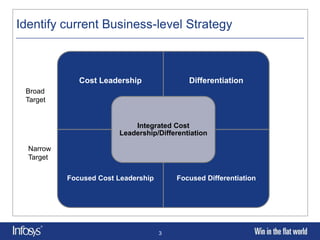
Identify current Business-level Strategy


              Cost Leadership               Differentiation
 Broad
 Target


                            Integrated Cost
                        Leadership/Differentiation

  Narrow
  Target

           Focused Cost Leadership       Focused Differentiation


                                     3
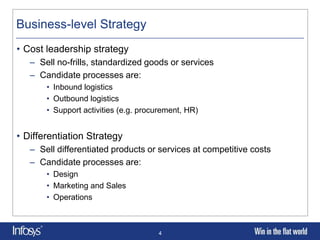
Business-level Strategy
• Cost leadership strategy
   – Sell no-frills, standardized goods or services
   – Candidate processes are:
       • Inbound logistics
       • Outbound logistics
       • Support activities (e.g. procurement, HR)


• Differentiation Strategy
   – Sell differentiated products or services at competitive costs
   – Candidate processes are:
       • Design
       • Marketing and Sales
       • Operations


                                      4
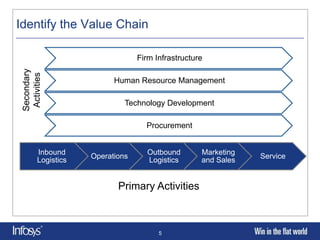
Identify the Value Chain

                                  Firm Infrastructure
 Secondary
  Activities


                           Human Resource Management

                              Technology Development

                                    Procurement


         Inbound                     Outbound       Marketing
                     Operations                                 Service
         Logistics                   Logistics      and Sales


                            Primary Activities


                                        5
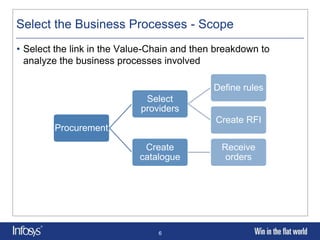
Select the Business Processes - Scope
• Select the link in the Value-Chain and then breakdown to
  analyze the business processes involved

                                             Define rules
                             Select
                            providers
                                             Create RFI
        Procurement

                             Create            Receive
                            catalogue           orders


                                6
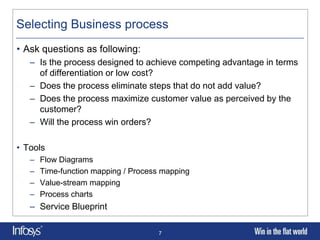
Selecting Business process
• Ask questions as following:
   – Is the process designed to achieve competing advantage in terms
     of differentiation or low cost?
   – Does the process eliminate steps that do not add value?
   – Does the process maximize customer value as perceived by the
     customer?
   – Will the process win orders?

• Tools
   –   Flow Diagrams
   –   Time-function mapping / Process mapping
   –   Value-stream mapping
   –   Process charts
   – Service Blueprint

                                     7
Create performance indicators
• Accordingly to the business strategy:
   – Differentiation strategy
       • Focus on Revenues indicators
   – Cost Leadership
       • Focus on Costs indicators


• Look for industry benchmarks

• Indicators must be SMART
  (Specific, Measurable, Achievable, Relevant, Time-Bound)

• Use this indicators to estimate the cash flow from the project


                                     8
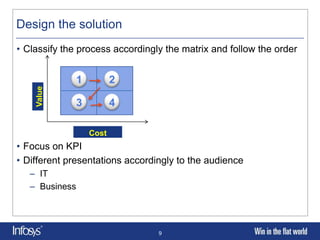
Design the solution
• Classify the process accordingly the matrix and follow the order


                1          2
    Value


                3          4

                    Cost
• Focus on KPI
• Different presentations accordingly to the audience
   – IT
   – Business


                                 9
Identify stakeholders and their benefits


• Identify Organizational Structure

• Match with the Business Process

• Identify benefits
   – Tangible X Intangible
   – Quantitative X Qualitative


                                  10
Make the calculations
• Calculate the cash flow expected from the project
    – The increase of revenues or decrease of costs


• Decide the timeframe (3 years, 5 years)

• Choose the discount rate*
    – Based on Industry
    – Risk of the project

* the rate of return that could be earned on an investment in the financial markets with
  similar risk


                                             11
Make the calculations (cont.)
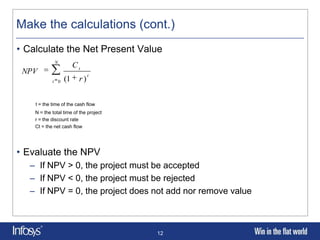
• Calculate the Net Present Value
             N
                       Ct
 NPV                          t
            t 0   (1     r)


    t = the time of the cash flow
    N = the total time of the project
    r = the discount rate
    Ct = the net cash flow


• Evaluate the NPV
   – If NPV > 0, the project must be accepted
   – If NPV < 0, the project must be rejected
   – If NPV = 0, the project does not add nor remove value


                                        12
Making assumptions
• Look for similar projects to assess the risk

• Always keep the business sense
   – Is it feasible?
   – Does it make sense?

• Just assume when something is find to research, if not
  research it!


                                  13
Thank You
rodrigo_nascimento@infosys.com


          “The contents of this document are proprietary and confidential to Infosys Technologies Ltd. and may
          not be disclosed in whole or in part at any time, to any third party without the prior written consent of
          Infosys Technologies Ltd.”

          “© 2006 Infosys Technologies Ltd. All rights reserved. Copyright in the whole and any part of this
          document belongs to Infosys Technologies Ltd. This work may not be used, sold, transferred, adapted,
          abridged, copied or reproduced in whole or in part, in any manner or form, or in any media, without the
          prior written consent of Infosys Technologies Ltd.”

Creating A Business Case for SOA

  • 1.
    Creating a BusinessCase for SOA Guidelines
  • 2.
    Steps 1. Identify current Business-level Strategy 2. Identify the Value Chain 3. Select the Business Processes – Scope 4. Create performance indicators 5. Design the solution 6. Identify stakeholders and their benefits 7. Make the calculations 2
  • 3.
    Identify current Business-levelStrategy Cost Leadership Differentiation Broad Target Integrated Cost Leadership/Differentiation Narrow Target Focused Cost Leadership Focused Differentiation 3
  • 4.
    Business-level Strategy • Costleadership strategy – Sell no-frills, standardized goods or services – Candidate processes are: • Inbound logistics • Outbound logistics • Support activities (e.g. procurement, HR) • Differentiation Strategy – Sell differentiated products or services at competitive costs – Candidate processes are: • Design • Marketing and Sales • Operations 4
  • 5.
    Identify the ValueChain Firm Infrastructure Secondary Activities Human Resource Management Technology Development Procurement Inbound Outbound Marketing Operations Service Logistics Logistics and Sales Primary Activities 5
  • 6.
    Select the BusinessProcesses - Scope • Select the link in the Value-Chain and then breakdown to analyze the business processes involved Define rules Select providers Create RFI Procurement Create Receive catalogue orders 6
  • 7.
    Selecting Business process •Ask questions as following: – Is the process designed to achieve competing advantage in terms of differentiation or low cost? – Does the process eliminate steps that do not add value? – Does the process maximize customer value as perceived by the customer? – Will the process win orders? • Tools – Flow Diagrams – Time-function mapping / Process mapping – Value-stream mapping – Process charts – Service Blueprint 7
  • 8.
    Create performance indicators •Accordingly to the business strategy: – Differentiation strategy • Focus on Revenues indicators – Cost Leadership • Focus on Costs indicators • Look for industry benchmarks • Indicators must be SMART (Specific, Measurable, Achievable, Relevant, Time-Bound) • Use this indicators to estimate the cash flow from the project 8
  • 9.
    Design the solution •Classify the process accordingly the matrix and follow the order 1 2 Value 3 4 Cost • Focus on KPI • Different presentations accordingly to the audience – IT – Business 9
  • 10.
    Identify stakeholders andtheir benefits • Identify Organizational Structure • Match with the Business Process • Identify benefits – Tangible X Intangible – Quantitative X Qualitative 10
  • 11.
    Make the calculations •Calculate the cash flow expected from the project – The increase of revenues or decrease of costs • Decide the timeframe (3 years, 5 years) • Choose the discount rate* – Based on Industry – Risk of the project * the rate of return that could be earned on an investment in the financial markets with similar risk 11
  • 12.
    Make the calculations(cont.) • Calculate the Net Present Value N Ct NPV t t 0 (1 r) t = the time of the cash flow N = the total time of the project r = the discount rate Ct = the net cash flow • Evaluate the NPV – If NPV > 0, the project must be accepted – If NPV < 0, the project must be rejected – If NPV = 0, the project does not add nor remove value 12
  • 13.
    Making assumptions • Lookfor similar projects to assess the risk • Always keep the business sense – Is it feasible? – Does it make sense? • Just assume when something is find to research, if not research it! 13
  • 14.
    Thank You rodrigo_nascimento@infosys.com “The contents of this document are proprietary and confidential to Infosys Technologies Ltd. and may not be disclosed in whole or in part at any time, to any third party without the prior written consent of Infosys Technologies Ltd.” “© 2006 Infosys Technologies Ltd. All rights reserved. Copyright in the whole and any part of this document belongs to Infosys Technologies Ltd. This work may not be used, sold, transferred, adapted, abridged, copied or reproduced in whole or in part, in any manner or form, or in any media, without the prior written consent of Infosys Technologies Ltd.”