Chapter 8
Offerings, Capabilities, and the
Business Model
A high-pitched electronic noise penetrates her strange dream, and
soon the world around her dissolves and she is back in her bed,
half-closed curtains flapping in the early morning breeze. Sleepily
she reaches over to the mahogany bedside table and picks up the
offensive object. The alarm has been set for 6:00 a.m.; she shuts it
off. Swinging her legs off the side of the bed she yawns, then peers
more closely at the screen of her mobile phone. The date tells her it
is the last Friday of the month: payday.
Stepping into the office, the secretary hands her a crisp check
(oops, this how it used to work in the old days). It’s her first
payday and she has yet to open a bank account. In fact, there’s a
whole host of things she needs to get done, and cashing the check
will be one of the first. Buying an automobile will be next on the
list, and since it would be silly not to blow her entire first paycheck
in celebration, she would spoil herself with a personal media
player too. These prospects were a constant source of excitement
for the rest of the morning.
Noon rolled by and her boss, well aware of the excitement of
the day, decided to let her leave early to sort out her affairs. So
there she was, with some serious choices. She had to decide which
bank to join and which package to choose; she needed to pick out a
make of automobile that would best suit her. She also wanted to
find the perfect media player to fit her personality and lifestyle.
The automobile and media player would have to wait, and she
headed off to a nearby banking complex armed with her crisp
check tucked neatly in her purse alongside documents proclaiming
190 Built to Thrive
her identity and residence. The bus dropped her off, and she
noticed the large colorful boards displaying the different bank
names. She had dinner with her parents the night before, and she
remembers they told her to go into each branch and compare the
prices and package options, but she also remembers her best friend
telling her about the bank he joined a week earlier. He said the
rates were good, they gave him in-store card payments, and even
offered free online banking.
The heat rose off the tarmac on the sidewalk and the roofs of
the nearby cars. Then she remembered her own automobile, sitting
on a showroom floor somewhere, just waiting to be bought. Going
to her friend’s bank topped the idea of tediously comparing prices,
and the option of free Internet banking was desirable. She had
cashed her check in under an hour.
Now the task was to decide on a car. There are a host of
Internet sites that compare and rate different vehicles based on
users’ reviews, and for an instant she toyed with the idea of
heading to the nearest Internet café. But her heart was set, there
was only one brand that really spoke to her and complemented her
lifestyle. She also knew that the range of new models offered by
the automobile company in question gave buyers a variety of
different options to choose from in terms of style, wheels, interior,
and features, and at only a marginal additional cost. Her next stop
would have to be the showroom.
Stepping into the air-conditioned room, and walking between
new and used cars alike, she caught the attention of a sales
associate. They spent a while drifting among the cars on display
and chatting about the various payment options on different
models, until finally settling at the sales rep’s desk and attacking
the paperwork. Grinning profusely and swinging a shiny set of
keys between forefinger and thumb, she made her way out to the
back of the building to collect her new baby. But she had not
bought it since she needed credit to purchase; she had decided
instead to lease it. After all she only needed it for the service it
provided her. So now she had a vehicle that looked good, fit her
style, and could be given back at any time.
As she drove onto the road, she paused to think about her day
so far. Both the bank and the automobile dealership had been quick
Jay van Zyl 191
and convenient; it was lucky she knew just what she wanted. She
does know that using Zipcar could’ve been as easy to obtain a car
on a pay-per-use basis. Her final stop was the electronics store. As
she cruised along to the nearest shop, her mind drifted onto other
things since she already knew exactly what to buy.
The value constellation has shifted from the rational buyer
sorting through facts and details, as explained by the sales person, to
the fickle buyer who purchases something because it is cool to own.
Yet as we have seen, the concept of ownership is changing. Friends
influence the views and decisions made by users and consumers,
and even strangers have a hand in the selection process as they
participate in online forums providing reviews, rankings, and ratings
on products and services. What we see in this story are the choices
made by a consumer based on what she feels the commodity can
offer her in the context of her individual lifestyle. The Western
economy has seen a move from product to service, but even a
service has to be contextualized to the situation of the individual
buyer, and in this sense services need to be viewed as offerings.
We have moved from a market of consumers to an era of
users. While we still consume products and services, we do so with
new and explicit emphasis on the use of the service a product
offers. Therefore we buy with the intention to use and our choice
of service is dictated by our lifestyle and personal taste. An
economic entity has to realize the offerings it is capable of
supplying to its clients since this is what they are want. There are
two ways we use services as we move into the third megawave.
We make our choices based on the interactive and socially
connected viewpoints and reviews made available through
networks, or we make our choices based on how we perceive the
offering to be valuable to our own lives and experiences, which are
directly influenced by our larger social setting.
Making Waves at the Edge of the World
This chapter is about realizing the difference between the offerings
and capabilities of the organization, placing them in opposition to
the outdated concepts of products and processes, and
conceptualizing how a change in either of these can lead your
innovations into the realm of the radical.
192 Built to Thrive
Think back to the initial chapters of the book: the future of
the contemporary landscape cannot be known, it can only be
guessed. Moving into the future is an act of faith based on your
own predictions and understandings of contemporary landscapes,
so too is radical change. Very often implementing strategies that
may lead to radical change is like jumping into the unknown, and
this is why radical changes are so infrequent.
This leads me to maps.
Maps are good and bad. Good because they give you
direction and help you find your way, bad because maps are based
on another person’s discovery, a representation of his physical
world. Take a look at the ancient map: the world was square, the
dimensions of the land grossly incorrect, and it would have
offended a great many nations to know they did not even exist
according to some maps. Before the discovery of Australasia, a
European map would not include the island of Tasmania, the larger
landmass of Australia, and a few thousand more. Similarly, a map
in China would not include America.
Early maps were not complete in their representation of world
geography, they were location-specific and subject to the
individual experiences of those who drew them. Their implications
were profound though. Suddenly, through the use of maps, people
had an idea of what lay beyond their individual experience, based
on the experience of others. The white-tipped mountains
surrounding a village could be conceptualized. But maps were not
merely taken for granted and left as they were. Maps were tested to
ensure what they depicted was true. Slowly, they became better,
more accurate, and wide-ranging. But it’s always trapped in the
past; its time dimension is strictly retrospective since it can only
portray what has already been discovered; the only provision for
the future would be for the edges of a map to be left blank.
A map, therefore, is old knowledge. A frozen image of the
perceptive structure of what it represents.
When explorers set forth to search and confirm what the
edges of the map portrayed, they began to inch into new territory
and the map began to expand. At the edge of the map, they found
themselves with two choices, to go back, having confirmed the
existing information found on the map, or continue into the
Jay van Zyl 193
unknown and expand the map. A map drawn on paper is different
to the conceptual map we use when physically exploring. We
cannot see what lies beyond the edges of a map when we view it
on paper, but floating on the sea the unknown is not a dark blanket
of mystery; it is clearly visible. Explorers could continue to redraw
the map since every time they reached the edge of it they could see
more ocean, and eventually new land, proving that there was
always more to explore.
Before the invention of seaworthy vessels, people could map
the sea up until the horizon, so effectively the world ended around
30km offshore of every land. As sea travel entered the human
sphere of activity, what do you think the captains did when they
reached the edge of their maps and stood staring out into a vast
ocean with no knowledge of what lay before them? Well, those
who went on to achieve greatness pulled out their trusty quills and
ink bottles and began to redraw the map as their ship plunged into
unknown, yet visible, territory.
Of course there must have been many ships that set sail only
to find starvation on the empty seas resulting in a tragic end for a
crew of adventurous sailors. And it was a while before more
successful vessels mapped what they had experienced, but here is
where the distinction lies. For radical change to occur, you must
recognize the chance of failure yet continue with hopes of success.
Moving into unknown territories based on your reframed view of
the landscape, as well as a sound business philosophy, will help
guide you into new areas of radical change. Just imagine if no one
had challenged the boundaries of the nautical map.
So what has the phenomenon of maps got to do with the
offerings and capabilities of an economic entity? They form part of
a new map. We know the world has been mapped geographically,
and many feel that their areas of business operation have also been
mapped out. How often do we hear people moaning about the
difficulties of competing in a marketplace that has been mapped
out? The phrase situation trap should ring in your ears at this point.
But what do we do when the map seems complete? We throw
away the map.
The concept of products and the processes that lead up to
creating them exist in a map of the landscape that is weary and
194 Built to Thrive
tired. Many people feel that the business landscape has been
mapped out sufficiently. We buy books outlining the key elements
to success and attend schools that teach us how to effectively
navigate and operate within these maps. We believe we have
mapped out the social needs of our landscape, and the economic
behavior of the entities that operate in it, but there was a time when
people thought the earth was flat too.
As we slowly become conscious of the shifting needs of a
socially aware society, the boundaries of our map become
increasingly blurred. But if maps are only extensions of old
knowledge, why should the concept of offerings and capabilities
present anything other than another map based on existing
knowledge? I argue that as we move into the third megawave we
will begin to utilize a new map of what the landscape around us
comprises. The new map will exist with the unknown on every
side.
Offerings and capabilities present one entry point into the
fledgling map that is our emerging economic landscape in the third
megawave. We live in exciting times since suddenly we are in an
era surrounded by unknowns, and what our ecosystem within the
third megawave presents is a chance for anyone to discover and
map new emergent spheres of opportunity.
Eric von Hippel’s book Democratizing Innovation focuses on
the emergence of user-centric innovation. What we are
experiencing in our digitally connected ecosystem is the ability of
users both as individuals and entities to innovate for themselves.
Technology is one aspect that allows us to design our lives around
our needs, and part of this is the restructuring of what we consume
to supplement these lifestyles.
Products and services are two closely linked words used in
most academic theory that focuses on commercial activity. Both
words have become part of the business language in a world based
on old knowledge and understandings that have persisted for a few
hundred years. But as we increasingly try to make sense of the
ways the modern consumer uses and applies products in a daily
setting, we notice a shift in traditional concepts of products and
services.
Jay van Zyl 195
With the ability to design our own lives, products have
become drivers for services, and services have entered a paradigm
where they are no longer generic services but specialized to
accommodate the needs of a consumer who seeks meaning: they
have become offerings. The challenge is that services innovations
are shortchanged due to the lack of innovation theory to show the
relevance of the ways innovative products are applied in unique
situations.
Products are seen as generic and they target a market lacking
a dynamic makeup. The reality of the market, though, is far from
the traditional conceptions of products. Until recently we have
experienced a persistent innovation in processes that serve to either
enhance products or services in the traditional sense, based on an
outdated understanding of the market. Process innovation
approaches are scattered across many different industries. The
manufacturing world deals with process differently than the
banking world for example, based on the intended outcomes of the
organization. Processes are integrated with the organization’s
design in ways that reflect the use and application of the outcomes
sought by executing process.
The modern organization is much more dynamic and flexible
than the theories that describe product and process. This requires a
more holistic and integrated approach to viewing the ways the
organization implements its business philosophy. The company
needs to be dynamic enough to accept changes to its processes
through the involvement of people from diverse areas. This sees
the rise in offerings. Products and services shape offerings.
The concept of offerings modifies the idea of a product
becoming a service, but it also modifies the existing concept of
services found within what we traditionally view as the services
industry. The service we derive through our consumption is
evolving into an offering provided by an organization that fits
with the dynamic needs and behavior of our socially aware
society.
In the realm of products, a company can embed them in the
offering they provide. Before, the service derived from a product
was the outcome of ownership of the product itself. Now, with
increased focus being paid to the services component of a product,
196 Built to Thrive
the offering encompasses both the product and the service it
provides. In the services industry, an offering is the amalgamation
of the original service required as well as the context in which it is
tailored to suit the needs of the user. You can’t look at services as
generic commodities obtained by consumers; now they are holistic
and individually suited offerings. Capabilities form the ability of
an economic entity to create and provide offerings.
There are three macro means of shaping strategic outcomes:
offering, capability, and the resulting business model. We are not
sitting at the edge of an old world, but in the center of a new one.
Bringing It All Together in a Portfolio
The creation of an innovation portfolio rests on the ability to
recognize your capabilities and offerings and visualize their
potential impact on the market. The innovation portfolio is the
foundation for growth and success. To understand the emergence
of a successful innovation portfolio, place it in context and view
the processes leading up to its establishment systemically.
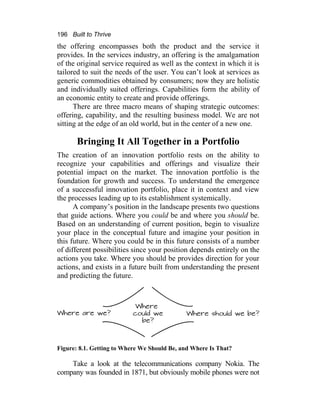
A company’s position in the landscape presents two questions
that guide actions. Where you could be and where you should be.
Based on an understanding of current position, begin to visualize
your place in the conceptual future and imagine your position in
this future. Where you could be in this future consists of a number
of different possibilities since your position depends entirely on the
actions you take. Where you should be provides direction for your
actions, and exists in a future built from understanding the present
and predicting the future.
Figure: 8.1. Getting to Where We Should Be, and Where Is That?
Take a look at the telecommunications company Nokia. The
company was founded in 1871, but obviously mobile phones were not
Jay van Zyl 197
their primary focus. Instead the company, founded by mining engineer
Fredrik Idestam, was in the papermaking business. When Idestam
retired, Nokia expanded into the electricity industry, and then in 1898
it expanded again into the rubber industry. The Finnish Cable Works
Company, founded in 1912, became the foundation of Nokia’s cable
and electronics business, and in 1967 the amalgamation of companies
making up Nokia merged to form the Nokia Corporation. The ’60s
was a period of great change for the company as they formally entered
the telecommunications industry. Throughout the lifetime of the
company, they kept envisioning where they should be in the
conceptual future in relation to where they could be. They could have
remained a paper mill indefinitely, but they realized they should be
something else entirely. Has their recent focus put them in jeopardy?
The innovation portfolio is a means to assess your abilities as an
entity operating within a larger landscape, and based on these abilities
it assists in directing your actions toward a conceptual future—where
you should be. The creation of the innovation portfolio sits within
three paradigms forming a holistic and systemic view of the world
and how you make sense of it. The three paradigms are: your
understanding of the external landscape, your ability to use this
understanding to transform the way you think and motivate your own
actions, and the manifestation of these understandings in your future
actions as you move toward your place in the conceptual future.
The innovation portfolio makes up a portion of the middle
paradigm, reconfiguring your own methods and understandings.
The first paradigm, viewing your landscape holistically, consists
of your ability to reframe your views. Companies need to consider the
current trends of the market, the actions of your competitors, and the
changes within different spheres of the landscape such as
technological change, hype curves, and innovation assimilation. They
also need to understand social changes that occur, such as a move
toward co-production, crowdsourcing, and swarm theory, as well as
how innovation has previously disrupted the landscape and how it has
been adopted in the past. The first paradigm consists of the initial
undertakings of an entity and feeds into the second paradigm:
applying these understandings to an understanding of the self.
The second paradigm is based on the entity’s acknowledged
position in relation to the market in intends to target, as influenced by
198 Built to Thrive
the external landscape or ecosystem. By understanding how the
external environment affects it, an entity can visualize who its
intended market is with clarity and with insight into how the market is
affected by its landscape. This feeds into the development of an
ecogenetic understanding as well as the development of an embedded
philosophical mantra, both of which form the groundwork for the
establishment of an innovation ecosystem.
Within the innovation ecosystem we find the innovation
portfolio, which is influenced by two parallel paradigms—the type of
innovation and the impact of innovation—that need to be taken into
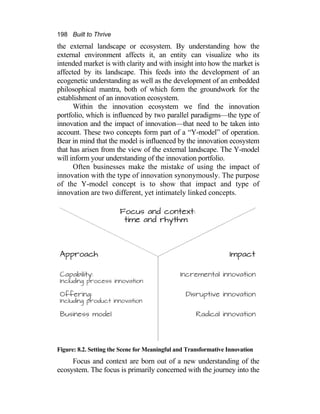
account. These two concepts form part of a “Y-model” of operation.
Bear in mind that the model is influenced by the innovation ecosystem
that has arisen from the view of the external landscape. The Y-model
will inform your understanding of the innovation portfolio.
Often businesses make the mistake of using the impact of
innovation with the type of innovation synonymously. The purpose
of the Y-model concept is to show that impact and type of
innovation are two different, yet intimately linked concepts.
Figure: 8.2. Setting the Scene for Meaningful and Transformative Innovation
Focus and context are born out of a new understanding of the
ecosystem. The focus is primarily concerned with the journey into the
Jay van Zyl 199
conceptual future, guiding an entity to where it should be. With the
focus centered on growth moving into the future, the approach and
impact of innovation are always seen within the context of this focus.
The type of innovation within organizations can be grouped
under offerings and capabilities, which collectively make up the
business model of an organization. How you choose to operate and
implement your strategies based on your view of the landscape and
the areas where innovation is implemented would determine the type
of innovation. The concepts form a symbiotic relationship and one
cannot gauge the potential impact of your innovative ideas without
looking at the type of innovation you plan to implement concurrently.
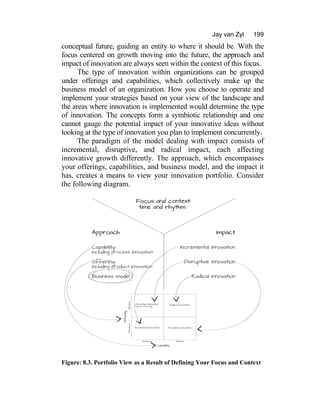
The paradigm of the model dealing with impact consists of
incremental, disruptive, and radical impact, each affecting
innovative growth differently. The approach, which encompasses
your offerings, capabilities, and business model, and the impact it
has, creates a means to view your innovation portfolio. Consider
the following diagram.
Figure: 8.3. Portfolio View as a Result of Defining Your Focus and Context
200 Built to Thrive
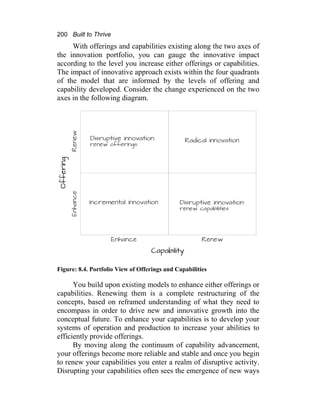
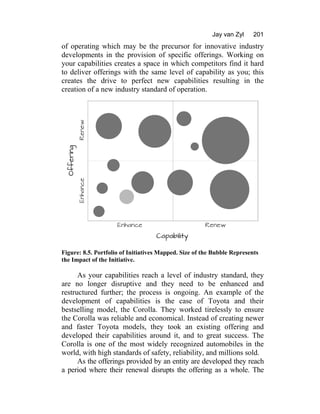
With offerings and capabilities existing along the two axes of
the innovation portfolio, you can gauge the innovative impact
according to the level you increase either offerings or capabilities.
The impact of innovative approach exists within the four quadrants
of the model that are informed by the levels of offering and
capability developed. Consider the change experienced on the two
axes in the following diagram.
Figure: 8.4. Portfolio View of Offerings and Capabilities
You build upon existing models to enhance either offerings or
capabilities. Renewing them is a complete restructuring of the
concepts, based on reframed understanding of what they need to
encompass in order to drive new and innovative growth into the
conceptual future. To enhance your capabilities is to develop your
systems of operation and production to increase your abilities to
efficiently provide offerings.
By moving along the continuum of capability advancement,
your offerings become more reliable and stable and once you begin
to renew your capabilities you enter a realm of disruptive activity.
Disrupting your capabilities often sees the emergence of new ways
Jay van Zyl 201
of operating which may be the precursor for innovative industry
developments in the provision of specific offerings. Working on
your capabilities creates a space in which competitors find it hard
to deliver offerings with the same level of capability as you; this
creates the drive to perfect new capabilities resulting in the
creation of a new industry standard of operation.
Figure: 8.5. Portfolio of Initiatives Mapped. Size of the Bubble Represents
the Impact of the Initiative.
As your capabilities reach a level of industry standard, they
are no longer disruptive and they need to be enhanced and
restructured further; the process is ongoing. An example of the
development of capabilities is the case of Toyota and their
bestselling model, the Corolla. They worked tirelessly to ensure
the Corolla was reliable and economical. Instead of creating newer
and faster Toyota models, they took an existing offering and
developed their capabilities around it, and to great success. The
Corolla is one of the most widely recognized automobiles in the
world, with high standards of safety, reliability, and millions sold.
As the offerings provided by an entity are developed they reach
a period where their renewal disrupts the offering as a whole. The
202 Built to Thrive
disruption sees the emergence of new offerings. In the context of cars,
a model may be faster or more powerful, or it may target a new
market. When automobile companies decided to enhance and renew
their offerings, they developed SUVs in the mid-twentieth century.
They effectively disrupted the offerings provided by the motor
vehicle industry, and SUVs have subsequently become a standard
offering. We still see companies such as BMW, Audi, and Porsche
renewing their offerings to produce SUVs, although their versions of
these automobiles is gradually becoming embedded in their offering.
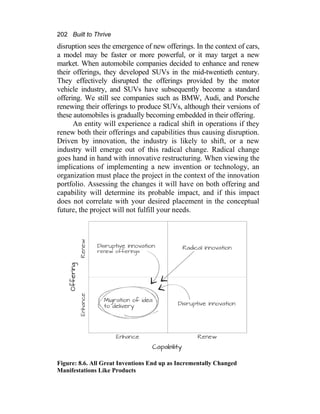
An entity will experience a radical shift in operations if they
renew both their offerings and capabilities thus causing disruption.
Driven by innovation, the industry is likely to shift, or a new
industry will emerge out of this radical change. Radical change
goes hand in hand with innovative restructuring. When viewing the
implications of implementing a new invention or technology, an
organization must place the project in the context of the innovation
portfolio. Assessing the changes it will have on both offering and
capability will determine its probable impact, and if this impact
does not correlate with your desired placement in the conceptual
future, the project will not fulfill your needs.
Figure: 8.6. All Great Inventions End up as Incrementally Changed
Manifestations Like Products
Jay van Zyl 203
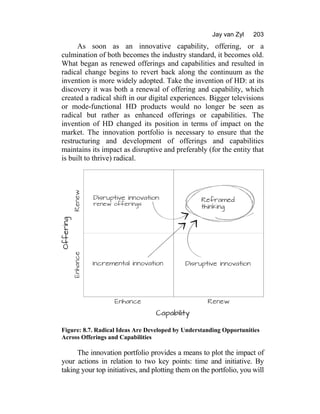
As soon as an innovative capability, offering, or a
culmination of both becomes the industry standard, it becomes old.
What began as renewed offerings and capabilities and resulted in
radical change begins to revert back along the continuum as the
invention is more widely adopted. Take the invention of HD: at its
discovery it was both a renewal of offering and capability, which
created a radical shift in our digital experiences. Bigger televisions
or mode-functional HD products would no longer be seen as
radical but rather as enhanced offerings or capabilities. The
invention of HD changed its position in terms of impact on the
market. The innovation portfolio is necessary to ensure that the
restructuring and development of offerings and capabilities
maintains its impact as disruptive and preferably (for the entity that
is built to thrive) radical.
Figure: 8.7. Radical Ideas Are Developed by Understanding Opportunities
Across Offerings and Capabilities
The innovation portfolio provides a means to plot the impact of
your actions in relation to two key points: time and initiative. By
taking your top initiatives, and plotting them on the portfolio, you will
204 Built to Thrive
be able to assess the impact and the size each initiative will have on
the revenue of the organization. By projecting the portfolio into the
future, you will also be able to assess what potential impact on the
industry your initiatives will have in a few years’ time. The impact
assessment of initiatives helps guide an organization toward effective
implementation of initiatives with the desired impact, through the
effective restructuring of the business model and means of operating.
Forces of Change
As we have seen, the emergence of innovative ideas that are
implemented fall within different realms in terms of impact and
effect. Essentially we can categorize four levels of innovation impact:
radical, incremental, disruptive, and none. Each type of innovation
within the context of its area of effect has a degree of impact on the
organization. In order to determine whether or not your innovative
strategies will have a chance of succeeding, you need to gauge their
potential impact.
Radical impact refers to a large degree of change, possibly even
revolutionary in nature. An entity rarely experiences impact of this
magnitude, yet innovation with a radical impact is what will see
economic entities thrive. The invention of the wheel, the heart
transplant, Google’s idea to make their services free, and Starbuck’s
strategy to open more shops when there was no demand are all
strategies that saw a radical impact on operations, and the returns
proved outstanding. As we move into the third megawave of change,
our new understanding of the landscape will slowly bring to light a
realization that in order for us to truly become leaders and thrive, we
need to jump headfirst into unknown territory; and instead of making
ripples, we must conjure up tidal waves of radical change.
Disruptive innovation refers to impact that effectively
disrupts the market and aspects of production in the organization.
Think about Apple’s move to replace the iPod mini with the Nano;
it completely disrupted the market and ensured that the product had
no time to stagnate. Disruptive innovation drives success but only
to an extent, even the almighty Apple stays ahead of the pack by
the skin of its teeth. Blackberry challenges the iPhone and
Amazon’s Kindle is providing fair competition in the eBook
Jay van Zyl 205
industry. Disruptive innovation is healthy for a successful
organization but still one step short of revolutionary innovation.
Incremental impact refers to minor improvements in the area
of focus and is the most common form of innovation in
organizations. Samsung, Sony, and LG spring to mind when you
think about the home entertainment industry. As CEO of Samsung,
how would you feel knowing that your company is regarded as one
of the top three home entertainment companies? Content is the
wrong answer. BMW and Audi, Nokia and Sony Ericsson,
PlayStation and Xbox, Nike and Adidas—they are all companies
that are grouped together in their respective industries.
Incremental innovation generally sees companies innovating
with the intention of besting their competitors rather than breaking
into a new field. These companies produce products that are
similar to existing ones, or easy to copy, so even when one
company pioneers a new product (color screen mobile phones, flat
screen TVs, 3D TVs) the rest soon follow suit. Just as the company
that does not embrace the creation of new knowledge through
reframed thinking will soon start to slow down and die, the same
can be said for those who only change and innovate incrementally.
Innovation that has no impact is obviously no innovation at all.
Radical innovation presents us with the most desired (albeit
terrifying) level of impact; so how do you radically innovate? That
is the underlying question of this book, and the purpose of my
writing is to encourage you to change the way you conceptualize
innovation. Radical innovation cannot be taught, but the processes
leading up to this type of innovation can be.
From Product to Offering
Offerings are the provision of a commodity based on a
reconfigured relationship between organization and customer. It is
not a service as such, but an amalgamation of services and value
derived from processes of co-creation and collaboration between
user (customer) and supplier (company). The service forms part of
the offering, while the offering facilitates a process by which the
customer derives use from what is provided.
Increasingly individuals want to participate in the process of
meaning-making, and since products exist to provide services that
206 Built to Thrive
enhance the experience of the user, the offering presents the
configuration by which the user can participate and derive meaning
from the commodity. The phenomenon of co-production allows the
user to collaborate with the provider in creating a commodity. For
this interaction to take place, the offering must be made available
by the producer: the economic entity.
The development of offerings creates the possibility of new
linkages, the ways that meaning is provided through the offering.
With the renewal of offerings, an organization will experience the
creation of new value-creating activities that change the way
customers utilize the services provided by the industry. Offerings,
therefore, stimulate and enable value-creation, so enhancing the
offering also enhances the value-creation, and disrupting the offerings
disrupts the value-creation.
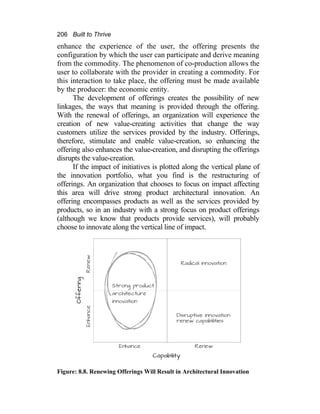
If the impact of initiatives is plotted along the vertical plane of
the innovation portfolio, what you find is the restructuring of
offerings. An organization that chooses to focus on impact affecting
this area will drive strong product architectural innovation. An
offering encompasses products as well as the services provided by
products, so in an industry with a strong focus on product offerings
(although we know that products provide services), will probably
choose to innovate along the vertical line of impact.
Figure: 8.8. Renewing Offerings Will Result in Architectural Innovation
Jay van Zyl 207
The innovation portfolio may help an entity discover the
impact of their products-based innovation initiatives, both in the
present and the future. Driving radical change by focusing on
new offerings will see traditional concepts of value-creation
changing. The concept of value, and what it entails in a
collaborative ecosystem, will shift as initiatives drive radical
change. The capabilities by which offerings are provided will
shift as offerings shift, but an entity focusing primarily on the
development of its offerings will probably be interested in
improving its “product.” Offerings in any form serve to
stimulate emotional, intellectual, and physical responses in the
customers. This stimulation, in our ecosystem of meaningful
interactions means that value-creation through processes of
meaning-making will be enhanced. It is important to remember
that value is derived through processes of meaning-making, both
consciously and unconsciously.
Offerings provide both access to the inventory of past
activities and a foundation to stimulate new value-creation. The
knowledge systems of the past are embedded in the offering, but
how we use old knowledge to create new value determines the
success of the offering. If we take an automobile as an example,
the basic mechanical processes used to facilitate the automobile’s
function are based on old systems of value and knowledge. The
core purpose of the vehicle—to get from A to B—also remains the
same. But the use of cars is no longer merely functional; they also
provide the service of letting the consumer assert their
individuality, which assists in their constant search for meaning in
our interconnected world. The car becomes an offering. With
knowledge of the past embedded within its design, the service it
provides allows old systems of knowledge to create a foundation to
assist new value-creation.
To be competitive, customer offerings need to have an
element of learning since the customer is constantly searching for
meaning. The offering also becomes subject to the actions of the
user, since users have developed from blind consumers to active
participants in the value and production process. The user is a
source of value for a system that offers value back; the concept of
offering is a dynamic one.
208 Built to Thrive
From Process to Capability
A process describes the sequence of actions forming a routine that
leads to an outcome. To keep your teeth clean, you initiate a
process where you put toothpaste on a toothbrush, scrub your teeth,
and rinse your mouth out. In almost every part of your everyday
life you will notice processes. Turning on your computer, taking
the kids to school, making dinner, and driving a company to
success all consist of processes. The build up to every outcome we
desire is made up of a series of processes. Turning on your
computer may seem like a single action, but first you had to
visualize the action and then physically get up and perform it. The
same can be said for fixing dinner or taking the kids to school, and
listing the processes that create a successful company could take a
while.
So how does process differ from capability, and why is there
a need for the distinction? A process is generally defined in terms
of a linear set of procedural actions. Wood needs to be sourced and
chopped to make a chair. In the factory it needs to be measured and
then cut. On the production line it must be assembled and then
finished.
But while procedure is systematic, capability is systemic. A
process creates a product or a service. The procedures involved in
the production are straightforward, as we saw with the wooden
chair. With services (in the context of the services industry, not
services provided by products) the processes involved are not as
visible, yet they are present. A company goes through a series of
procedures where they evaluate their market, make assumptions
about their market needs based on these evaluations, and enter into
a new series of procedures leading up to the establishment of their
services. An oversimplified version to be sure, but the primary
difference between capability and process lies in the relationship
between the organization and their clients and how an offering
differs from both a product and a traditional service. Capabilities
are influenced by the offerings they produce.
Take a look at what Toyota did with their Scion model.
Without significantly altering their offering (the automobile itself),
they created a highly efficient means of improving their
capabilities. The actual automated production line, where the
Jay van Zyl 209
products are assembled, has been structured to efficiently modify
and build automobile components at high speed. While traditional
production lines manufactured a single product identically in large
numbers, the Toyota factories operate differently. They increased
their capabilities to ensure their ability to produce a variety of
slightly different models based on the same offering. The Scion
model remains the Scion model, but they have developed their
capabilities in producing the model to include the client’s needs.
An online program allows a potential buyer to customize and
specify exactly what components he or she would like included in
the offering. By taking the customer through an interactive
experience of personally modifying the offering, Toyota have
changed and altered their capabilities.
An offering is an amalgamation of services and value derived
from processes of co-creation and collaboration between user and
supplier. Toyota is a perfect example of how this collaboration
produces an offering with coproduced value. The relationship
between an organization and their client is dynamic and
interactive. A user no longer passively receives the commodity
provided by an organization, but becomes a participant in the
value-creation processes. The process, therefore, is no longer a
linear set of procedural routines undertaken by a single entity, but
is subject to different influences based on the dynamic interactions
between all the actors within the realm of value-creation.
Capabilities are multidimensional, and here is where the
relation between capability and offering is most distinct. On the
one hand, a capability consists of the ability to provide and sustain
an offering. Increasingly this aspect of capability utilizes
automated abilities rather than human resources. In sustaining or
producing an offering, certain processes are used, and as soon as a
process becomes routine, the human element can be removed.
Automation provides the most efficient and effective means to run
processes that no longer require an intellectual aspect. The
industrial revolution was the first time routine processes replaced
the human laborer with automation on a massive scale.
But the human aspect is still fundamental to the capabilities
of an organization. Because offerings consist of coproduced value,
the process of creating the value falls under the capability of an
210 Built to Thrive
entity. The interaction between individuals who collaborate and
produce value forms an integral part of the capabilities. In the drive
to produce and sustain offerings effectively, the systems are
automated and the human element is removed as soon as systems
of value-creation become routine. Therefore, the function of the
human in the processes of production constantly changes.
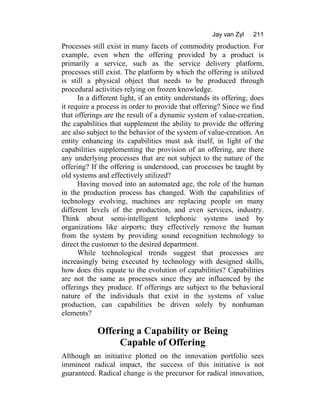
An organization that focuses primarily on the development of
their capabilities will plot their initiatives on the innovation portfolio
and pinpoint the ones whose impact will fall along the horizontal
scale of the portfolio. Moving along the continuum from incremental
development of capability to disruptive capabilities will provide the
means to increase the ability to provide and sustain offerings.
Enhancing capabilities will increase the quality of the
offering, and as the impact of capability development moves along
the portfolio to its disruptive levels, the offerings will also shift as
a result. Organizations driving innovation that will impact their
capabilities rather than their offerings may be viewed as heritage-
bound entities. Their offerings form part of the heritage of the
organization, so their primary aim is to increase their capabilities
in providing the existing offering.
Figure: 8.9. Focus on Renewing Capabilities Will Drive Efficiency and
Spread of Delivery
Jay van Zyl 211
Processes still exist in many facets of commodity production. For
example, even when the offering provided by a product is
primarily a service, such as the service delivery platform,
processes still exist. The platform by which the offering is utilized
is still a physical object that needs to be produced through
procedural activities relying on frozen knowledge.
In a different light, if an entity understands its offering, does
it require a process in order to provide that offering? Since we find
that offerings are the result of a dynamic system of value-creation,
the capabilities that supplement the ability to provide the offering
are also subject to the behavior of the system of value-creation. An
entity enhancing its capabilities must ask itself, in light of the
capabilities supplementing the provision of an offering, are there
any underlying processes that are not subject to the nature of the
offering? If the offering is understood, can processes be taught by
old systems and effectively utilized?
Having moved into an automated age, the role of the human
in the production process has changed. With the capabilities of
technology evolving, machines are replacing people on many
different levels of the production, and even services, industry.
Think about semi-intelligent telephonic systems used by
organizations like airports; they effectively remove the human
from the system by providing sound recognition technology to
direct the customer to the desired department.
While technological trends suggest that processes are
increasingly being executed by technology with designed skills,
how does this equate to the evolution of capabilities? Capabilities
are not the same as processes since they are influenced by the
offerings they produce. If offerings are subject to the behavioral
nature of the individuals that exist in the systems of value
production, can capabilities be driven solely by nonhuman
elements?
Offering a Capability or Being
Capable of Offering
Although an initiative plotted on the innovation portfolio sees
imminent radical impact, the success of this initiative is not
guaranteed. Radical change is the precursor for radical innovation,
212 Built to Thrive
but it is the type of innovation developed that will see
implementation of initiatives resulting in positive or negative
impact. The type of innovation, as displayed on the two axes of the
innovation portfolio, encompasses either offerings or capabilities.
The two concepts each have a function within an organization, but
certain situations call for a more concentrated approach to the
development of one concept rather than the other. Successful
innovation is the ability to recognize where the focus should
predominantly lie, on offerings or capabilities or evenly on both. A
restructuring of either your offerings or your capabilities will see a
shift in the way your business functions and performs, and this
shift can potentially lead you into a sphere of radical change.
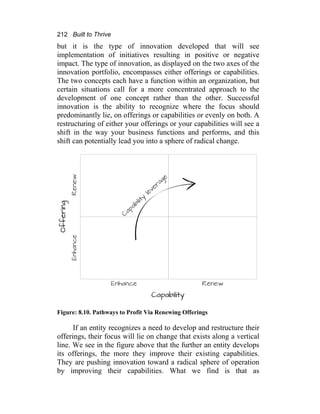
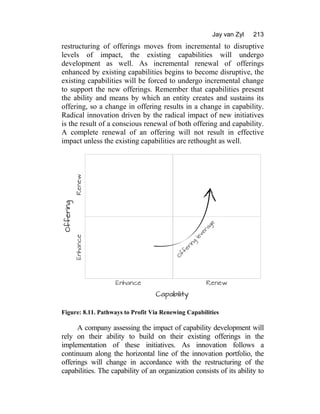
Figure: 8.10. Pathways to Profit Via Renewing Offerings
If an entity recognizes a need to develop and restructure their
offerings, their focus will lie on change that exists along a vertical
line. We see in the figure above that the further an entity develops
its offerings, the more they improve their existing capabilities.
They are pushing innovation toward a radical sphere of operation
by improving their capabilities. What we find is that as
Jay van Zyl 213
restructuring of offerings moves from incremental to disruptive
levels of impact, the existing capabilities will undergo
development as well. As incremental renewal of offerings
enhanced by existing capabilities begins to become disruptive, the
existing capabilities will be forced to undergo incremental change
to support the new offerings. Remember that capabilities present
the ability and means by which an entity creates and sustains its
offering, so a change in offering results in a change in capability.
Radical innovation driven by the radical impact of new initiatives
is the result of a conscious renewal of both offering and capability.
A complete renewal of an offering will not result in effective
impact unless the existing capabilities are rethought as well.
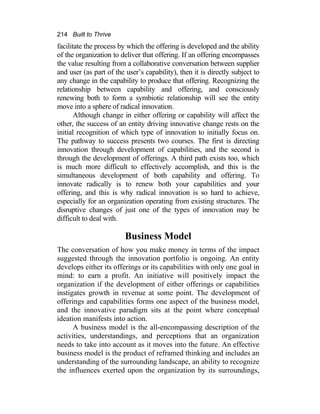
Figure: 8.11. Pathways to Profit Via Renewing Capabilities
A company assessing the impact of capability development will
rely on their ability to build on their existing offerings in the
implementation of these initiatives. As innovation follows a
continuum along the horizontal line of the innovation portfolio, the
offerings will change in accordance with the restructuring of the
capabilities. The capability of an organization consists of its ability to
214 Built to Thrive
facilitate the process by which the offering is developed and the ability
of the organization to deliver that offering. If an offering encompasses
the value resulting from a collaborative conversation between supplier
and user (as part of the user’s capability), then it is directly subject to
any change in the capability to produce that offering. Recognizing the
relationship between capability and offering, and consciously
renewing both to form a symbiotic relationship will see the entity
move into a sphere of radical innovation.
Although change in either offering or capability will affect the
other, the success of an entity driving innovative change rests on the
initial recognition of which type of innovation to initially focus on.
The pathway to success presents two courses. The first is directing
innovation through development of capabilities, and the second is
through the development of offerings. A third path exists too, which
is much more difficult to effectively accomplish, and this is the
simultaneous development of both capability and offering. To
innovate radically is to renew both your capabilities and your
offering, and this is why radical innovation is so hard to achieve,
especially for an organization operating from existing structures. The
disruptive changes of just one of the types of innovation may be
difficult to deal with.
Business Model
The conversation of how you make money in terms of the impact
suggested through the innovation portfolio is ongoing. An entity
develops either its offerings or its capabilities with only one goal in
mind: to earn a profit. An initiative will positively impact the
organization if the development of either offerings or capabilities
instigates growth in revenue at some point. The development of
offerings and capabilities forms one aspect of the business model,
and the innovative paradigm sits at the point where conceptual
ideation manifests into action.
A business model is the all-encompassing description of the
activities, understandings, and perceptions that an organization
needs to take into account as it moves into the future. An effective
business model is the product of reframed thinking and includes an
understanding of the surrounding landscape, an ability to recognize
the influences exerted upon the organization by its surroundings,
Jay van Zyl 215
and a perceptive view of the future. The ability to conceptualize a
future based on present happenings will see a business model
emerge that is consistent with this understanding. Yet as the
landscape changes, so do our perceptions of the future, and
therefore a business model is subject to constant scrutiny and
change. The actions taken in guiding an entity into its place in the
conceptual future are outlined in the business model and exist
under the influence of a business philosophy. At the point where
planning manifests in action, we find the innovation portfolio.
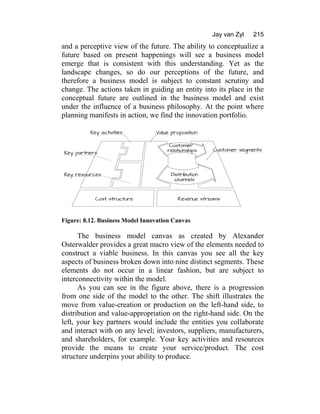
Figure: 8.12. Business Model Innovation Canvas
The business model canvas as created by Alexander
Osterwalder provides a great macro view of the elements needed to
construct a viable business. In this canvas you see all the key
aspects of business broken down into nine distinct segments. These
elements do not occur in a linear fashion, but are subject to
interconnectivity within the model.
As you can see in the figure above, there is a progression
from one side of the model to the other. The shift illustrates the
move from value-creation or production on the left-hand side, to
distribution and value-appropriation on the right-hand side. On the
left, your key partners would include the entities you collaborate
and interact with on any level; investors, suppliers, manufacturers,
and shareholders, for example. Your key activities and resources
provide the means to create your service/product. The cost
structure underpins your ability to produce.
216 Built to Thrive
On the right, you find your customer segments, which would
represent your target market. Your customer relationships and
distribution channels provide the link between you and your
customers. Revenue streams represent the value created from the
interaction between you and your customers. Your value proposition
sits in the middle and includes the products and services you have
created (left-hand side) in order to offer (right-hand side).
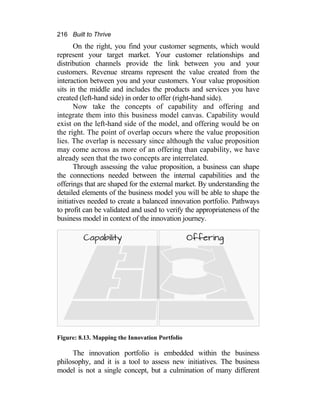
Now take the concepts of capability and offering and
integrate them into this business model canvas. Capability would
exist on the left-hand side of the model, and offering would be on
the right. The point of overlap occurs where the value proposition
lies. The overlap is necessary since although the value proposition
may come across as more of an offering than capability, we have
already seen that the two concepts are interrelated.
Through assessing the value proposition, a business can shape
the connections needed between the internal capabilities and the
offerings that are shaped for the external market. By understanding the
detailed elements of the business model you will be able to shape the
initiatives needed to create a balanced innovation portfolio. Pathways
to profit can be validated and used to verify the appropriateness of the
business model in context of the innovation journey.
Figure: 8.13. Mapping the Innovation Portfolio
The innovation portfolio is embedded within the business
philosophy, and it is a tool to assess new initiatives. The business
model is not a single concept, but a culmination of many different
Jay van Zyl 217
aspects of business operation. The part of the business model that
drives innovation emerges once offerings are shaped or capabilities are
determined and executed. Shaping offerings or determining
capabilities is based on an initial form of business model, but the
model evolves to encompass the changes through utilization of the
innovation portfolio. How you want to make money is informed by the
impact of change; therefore, the innovation portfolio directly affects
the business model. Essentially, the innovation portfolio guides the
conceptual portion of the business model that drives new growth.
Ecogenetic Patterns in Shaping Portfolios
Just as every component of our ecosystem plays a part in the
ecogenetic activity that we experience, portfolios also form part of
the ecogenetic makeup of our landscape. Industries and
organizations are potentially affected by the adoption, integration,
and exclusion of portfolio-influenced innovative initiatives.
Let us view various scenarios where radical impact creates a
change in the ecogenetic makeup of the landscape. If radical
restructuring takes place, there is the possibility of a new invention
or technology coming to the fore. The platform used to advance the
invention will set a new industry standard by which to operate.
Offerings can no longer be based on outdated platforms and
technologies; instead, the offerings provided by an entire industry
will shift.
218 Built to Thrive
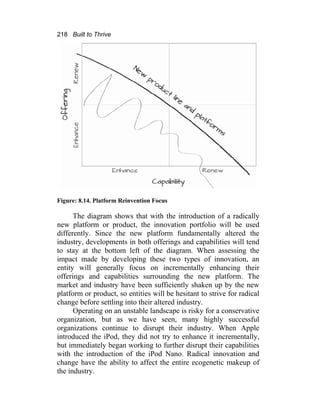
Figure: 8.14. Platform Reinvention Focus
The diagram shows that with the introduction of a radically
new platform or product, the innovation portfolio will be used
differently. Since the new platform fundamentally altered the
industry, developments in both offerings and capabilities will tend
to stay at the bottom left of the diagram. When assessing the
impact made by developing these two types of innovation, an
entity will generally focus on incrementally enhancing their
offerings and capabilities surrounding the new platform. The
market and industry have been sufficiently shaken up by the new
platform or product, so entities will be hesitant to strive for radical
change before settling into their altered industry.
Operating on an unstable landscape is risky for a conservative
organization, but as we have seen, many highly successful
organizations continue to disrupt their industry. When Apple
introduced the iPod, they did not try to enhance it incrementally,
but immediately began working to further disrupt their capabilities
with the introduction of the iPod Nano. Radical innovation and
change have the ability to affect the entire ecogenetic makeup of
the industry.
Jay van Zyl 219
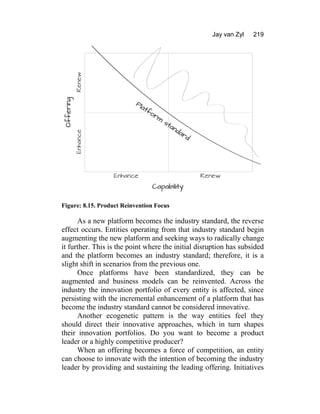
Figure: 8.15. Product Reinvention Focus
As a new platform becomes the industry standard, the reverse
effect occurs. Entities operating from that industry standard begin
augmenting the new platform and seeking ways to radically change
it further. This is the point where the initial disruption has subsided
and the platform becomes an industry standard; therefore, it is a
slight shift in scenarios from the previous one.
Once platforms have been standardized, they can be
augmented and business models can be reinvented. Across the
industry the innovation portfolio of every entity is affected, since
persisting with the incremental enhancement of a platform that has
become the industry standard cannot be considered innovative.
Another ecogenetic pattern is the way entities feel they
should direct their innovative approaches, which in turn shapes
their innovation portfolios. Do you want to become a product
leader or a highly competitive producer?
When an offering becomes a force of competition, an entity
can choose to innovate with the intention of becoming the industry
leader by providing and sustaining the leading offering. Initiatives
220 Built to Thrive
with this purpose in mind will tend to focus on causing impact
from an offering’s standpoint. Apple does this by enhancing the
MP3 platform and enhancing and renewing their offerings based
on this platform. In this manner they become industry leaders.
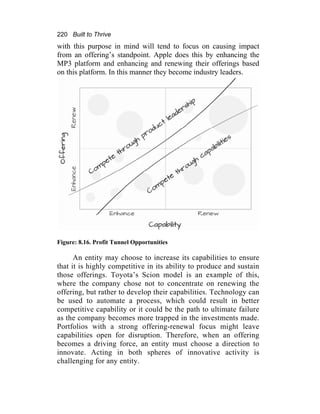
Figure: 8.16. Profit Tunnel Opportunities
An entity may choose to increase its capabilities to ensure
that it is highly competitive in its ability to produce and sustain
those offerings. Toyota’s Scion model is an example of this,
where the company chose not to concentrate on renewing the
offering, but rather to develop their capabilities. Technology can
be used to automate a process, which could result in better
competitive capability or it could be the path to ultimate failure
as the company becomes more trapped in the investments made.
Portfolios with a strong offering-renewal focus might leave
capabilities open for disruption. Therefore, when an offering
becomes a driving force, an entity must choose a direction to
innovate. Acting in both spheres of innovative activity is
challenging for any entity.
Jay van Zyl 221
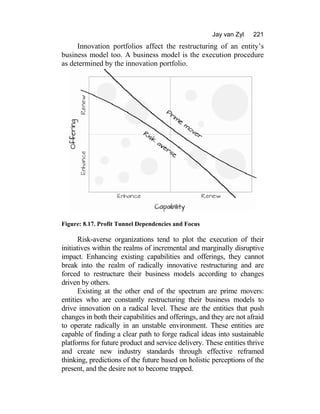
Innovation portfolios affect the restructuring of an entity’s
business model too. A business model is the execution procedure
as determined by the innovation portfolio.
Figure: 8.17. Profit Tunnel Dependencies and Focus
Risk-averse organizations tend to plot the execution of their
initiatives within the realms of incremental and marginally disruptive
impact. Enhancing existing capabilities and offerings, they cannot
break into the realm of radically innovative restructuring and are
forced to restructure their business models according to changes
driven by others.
Existing at the other end of the spectrum are prime movers:
entities who are constantly restructuring their business models to
drive innovation on a radical level. These are the entities that push
changes in both their capabilities and offerings, and they are not afraid
to operate radically in an unstable environment. These entities are
capable of finding a clear path to forge radical ideas into sustainable
platforms for future product and service delivery. These entities thrive
and create new industry standards through effective reframed
thinking, predictions of the future based on holistic perceptions of the
present, and the desire not to become trapped.

Offerings-Capabilities-BM - by Jay van Zyl

  • 1.
    Chapter 8 Offerings, Capabilities,and the Business Model A high-pitched electronic noise penetrates her strange dream, and soon the world around her dissolves and she is back in her bed, half-closed curtains flapping in the early morning breeze. Sleepily she reaches over to the mahogany bedside table and picks up the offensive object. The alarm has been set for 6:00 a.m.; she shuts it off. Swinging her legs off the side of the bed she yawns, then peers more closely at the screen of her mobile phone. The date tells her it is the last Friday of the month: payday. Stepping into the office, the secretary hands her a crisp check (oops, this how it used to work in the old days). It’s her first payday and she has yet to open a bank account. In fact, there’s a whole host of things she needs to get done, and cashing the check will be one of the first. Buying an automobile will be next on the list, and since it would be silly not to blow her entire first paycheck in celebration, she would spoil herself with a personal media player too. These prospects were a constant source of excitement for the rest of the morning. Noon rolled by and her boss, well aware of the excitement of the day, decided to let her leave early to sort out her affairs. So there she was, with some serious choices. She had to decide which bank to join and which package to choose; she needed to pick out a make of automobile that would best suit her. She also wanted to find the perfect media player to fit her personality and lifestyle. The automobile and media player would have to wait, and she headed off to a nearby banking complex armed with her crisp check tucked neatly in her purse alongside documents proclaiming
  • 2.
    190 Built toThrive her identity and residence. The bus dropped her off, and she noticed the large colorful boards displaying the different bank names. She had dinner with her parents the night before, and she remembers they told her to go into each branch and compare the prices and package options, but she also remembers her best friend telling her about the bank he joined a week earlier. He said the rates were good, they gave him in-store card payments, and even offered free online banking. The heat rose off the tarmac on the sidewalk and the roofs of the nearby cars. Then she remembered her own automobile, sitting on a showroom floor somewhere, just waiting to be bought. Going to her friend’s bank topped the idea of tediously comparing prices, and the option of free Internet banking was desirable. She had cashed her check in under an hour. Now the task was to decide on a car. There are a host of Internet sites that compare and rate different vehicles based on users’ reviews, and for an instant she toyed with the idea of heading to the nearest Internet café. But her heart was set, there was only one brand that really spoke to her and complemented her lifestyle. She also knew that the range of new models offered by the automobile company in question gave buyers a variety of different options to choose from in terms of style, wheels, interior, and features, and at only a marginal additional cost. Her next stop would have to be the showroom. Stepping into the air-conditioned room, and walking between new and used cars alike, she caught the attention of a sales associate. They spent a while drifting among the cars on display and chatting about the various payment options on different models, until finally settling at the sales rep’s desk and attacking the paperwork. Grinning profusely and swinging a shiny set of keys between forefinger and thumb, she made her way out to the back of the building to collect her new baby. But she had not bought it since she needed credit to purchase; she had decided instead to lease it. After all she only needed it for the service it provided her. So now she had a vehicle that looked good, fit her style, and could be given back at any time. As she drove onto the road, she paused to think about her day so far. Both the bank and the automobile dealership had been quick
  • 3.
    Jay van Zyl191 and convenient; it was lucky she knew just what she wanted. She does know that using Zipcar could’ve been as easy to obtain a car on a pay-per-use basis. Her final stop was the electronics store. As she cruised along to the nearest shop, her mind drifted onto other things since she already knew exactly what to buy. The value constellation has shifted from the rational buyer sorting through facts and details, as explained by the sales person, to the fickle buyer who purchases something because it is cool to own. Yet as we have seen, the concept of ownership is changing. Friends influence the views and decisions made by users and consumers, and even strangers have a hand in the selection process as they participate in online forums providing reviews, rankings, and ratings on products and services. What we see in this story are the choices made by a consumer based on what she feels the commodity can offer her in the context of her individual lifestyle. The Western economy has seen a move from product to service, but even a service has to be contextualized to the situation of the individual buyer, and in this sense services need to be viewed as offerings. We have moved from a market of consumers to an era of users. While we still consume products and services, we do so with new and explicit emphasis on the use of the service a product offers. Therefore we buy with the intention to use and our choice of service is dictated by our lifestyle and personal taste. An economic entity has to realize the offerings it is capable of supplying to its clients since this is what they are want. There are two ways we use services as we move into the third megawave. We make our choices based on the interactive and socially connected viewpoints and reviews made available through networks, or we make our choices based on how we perceive the offering to be valuable to our own lives and experiences, which are directly influenced by our larger social setting. Making Waves at the Edge of the World This chapter is about realizing the difference between the offerings and capabilities of the organization, placing them in opposition to the outdated concepts of products and processes, and conceptualizing how a change in either of these can lead your innovations into the realm of the radical.
  • 4.
    192 Built toThrive Think back to the initial chapters of the book: the future of the contemporary landscape cannot be known, it can only be guessed. Moving into the future is an act of faith based on your own predictions and understandings of contemporary landscapes, so too is radical change. Very often implementing strategies that may lead to radical change is like jumping into the unknown, and this is why radical changes are so infrequent. This leads me to maps. Maps are good and bad. Good because they give you direction and help you find your way, bad because maps are based on another person’s discovery, a representation of his physical world. Take a look at the ancient map: the world was square, the dimensions of the land grossly incorrect, and it would have offended a great many nations to know they did not even exist according to some maps. Before the discovery of Australasia, a European map would not include the island of Tasmania, the larger landmass of Australia, and a few thousand more. Similarly, a map in China would not include America. Early maps were not complete in their representation of world geography, they were location-specific and subject to the individual experiences of those who drew them. Their implications were profound though. Suddenly, through the use of maps, people had an idea of what lay beyond their individual experience, based on the experience of others. The white-tipped mountains surrounding a village could be conceptualized. But maps were not merely taken for granted and left as they were. Maps were tested to ensure what they depicted was true. Slowly, they became better, more accurate, and wide-ranging. But it’s always trapped in the past; its time dimension is strictly retrospective since it can only portray what has already been discovered; the only provision for the future would be for the edges of a map to be left blank. A map, therefore, is old knowledge. A frozen image of the perceptive structure of what it represents. When explorers set forth to search and confirm what the edges of the map portrayed, they began to inch into new territory and the map began to expand. At the edge of the map, they found themselves with two choices, to go back, having confirmed the existing information found on the map, or continue into the
  • 5.
    Jay van Zyl193 unknown and expand the map. A map drawn on paper is different to the conceptual map we use when physically exploring. We cannot see what lies beyond the edges of a map when we view it on paper, but floating on the sea the unknown is not a dark blanket of mystery; it is clearly visible. Explorers could continue to redraw the map since every time they reached the edge of it they could see more ocean, and eventually new land, proving that there was always more to explore. Before the invention of seaworthy vessels, people could map the sea up until the horizon, so effectively the world ended around 30km offshore of every land. As sea travel entered the human sphere of activity, what do you think the captains did when they reached the edge of their maps and stood staring out into a vast ocean with no knowledge of what lay before them? Well, those who went on to achieve greatness pulled out their trusty quills and ink bottles and began to redraw the map as their ship plunged into unknown, yet visible, territory. Of course there must have been many ships that set sail only to find starvation on the empty seas resulting in a tragic end for a crew of adventurous sailors. And it was a while before more successful vessels mapped what they had experienced, but here is where the distinction lies. For radical change to occur, you must recognize the chance of failure yet continue with hopes of success. Moving into unknown territories based on your reframed view of the landscape, as well as a sound business philosophy, will help guide you into new areas of radical change. Just imagine if no one had challenged the boundaries of the nautical map. So what has the phenomenon of maps got to do with the offerings and capabilities of an economic entity? They form part of a new map. We know the world has been mapped geographically, and many feel that their areas of business operation have also been mapped out. How often do we hear people moaning about the difficulties of competing in a marketplace that has been mapped out? The phrase situation trap should ring in your ears at this point. But what do we do when the map seems complete? We throw away the map. The concept of products and the processes that lead up to creating them exist in a map of the landscape that is weary and
  • 6.
    194 Built toThrive tired. Many people feel that the business landscape has been mapped out sufficiently. We buy books outlining the key elements to success and attend schools that teach us how to effectively navigate and operate within these maps. We believe we have mapped out the social needs of our landscape, and the economic behavior of the entities that operate in it, but there was a time when people thought the earth was flat too. As we slowly become conscious of the shifting needs of a socially aware society, the boundaries of our map become increasingly blurred. But if maps are only extensions of old knowledge, why should the concept of offerings and capabilities present anything other than another map based on existing knowledge? I argue that as we move into the third megawave we will begin to utilize a new map of what the landscape around us comprises. The new map will exist with the unknown on every side. Offerings and capabilities present one entry point into the fledgling map that is our emerging economic landscape in the third megawave. We live in exciting times since suddenly we are in an era surrounded by unknowns, and what our ecosystem within the third megawave presents is a chance for anyone to discover and map new emergent spheres of opportunity. Eric von Hippel’s book Democratizing Innovation focuses on the emergence of user-centric innovation. What we are experiencing in our digitally connected ecosystem is the ability of users both as individuals and entities to innovate for themselves. Technology is one aspect that allows us to design our lives around our needs, and part of this is the restructuring of what we consume to supplement these lifestyles. Products and services are two closely linked words used in most academic theory that focuses on commercial activity. Both words have become part of the business language in a world based on old knowledge and understandings that have persisted for a few hundred years. But as we increasingly try to make sense of the ways the modern consumer uses and applies products in a daily setting, we notice a shift in traditional concepts of products and services.
  • 7.
    Jay van Zyl195 With the ability to design our own lives, products have become drivers for services, and services have entered a paradigm where they are no longer generic services but specialized to accommodate the needs of a consumer who seeks meaning: they have become offerings. The challenge is that services innovations are shortchanged due to the lack of innovation theory to show the relevance of the ways innovative products are applied in unique situations. Products are seen as generic and they target a market lacking a dynamic makeup. The reality of the market, though, is far from the traditional conceptions of products. Until recently we have experienced a persistent innovation in processes that serve to either enhance products or services in the traditional sense, based on an outdated understanding of the market. Process innovation approaches are scattered across many different industries. The manufacturing world deals with process differently than the banking world for example, based on the intended outcomes of the organization. Processes are integrated with the organization’s design in ways that reflect the use and application of the outcomes sought by executing process. The modern organization is much more dynamic and flexible than the theories that describe product and process. This requires a more holistic and integrated approach to viewing the ways the organization implements its business philosophy. The company needs to be dynamic enough to accept changes to its processes through the involvement of people from diverse areas. This sees the rise in offerings. Products and services shape offerings. The concept of offerings modifies the idea of a product becoming a service, but it also modifies the existing concept of services found within what we traditionally view as the services industry. The service we derive through our consumption is evolving into an offering provided by an organization that fits with the dynamic needs and behavior of our socially aware society. In the realm of products, a company can embed them in the offering they provide. Before, the service derived from a product was the outcome of ownership of the product itself. Now, with increased focus being paid to the services component of a product,
  • 8.
    196 Built toThrive the offering encompasses both the product and the service it provides. In the services industry, an offering is the amalgamation of the original service required as well as the context in which it is tailored to suit the needs of the user. You can’t look at services as generic commodities obtained by consumers; now they are holistic and individually suited offerings. Capabilities form the ability of an economic entity to create and provide offerings. There are three macro means of shaping strategic outcomes: offering, capability, and the resulting business model. We are not sitting at the edge of an old world, but in the center of a new one. Bringing It All Together in a Portfolio The creation of an innovation portfolio rests on the ability to recognize your capabilities and offerings and visualize their potential impact on the market. The innovation portfolio is the foundation for growth and success. To understand the emergence of a successful innovation portfolio, place it in context and view the processes leading up to its establishment systemically. A company’s position in the landscape presents two questions that guide actions. Where you could be and where you should be. Based on an understanding of current position, begin to visualize your place in the conceptual future and imagine your position in this future. Where you could be in this future consists of a number of different possibilities since your position depends entirely on the actions you take. Where you should be provides direction for your actions, and exists in a future built from understanding the present and predicting the future. Figure: 8.1. Getting to Where We Should Be, and Where Is That? Take a look at the telecommunications company Nokia. The company was founded in 1871, but obviously mobile phones were not
  • 9.
    Jay van Zyl197 their primary focus. Instead the company, founded by mining engineer Fredrik Idestam, was in the papermaking business. When Idestam retired, Nokia expanded into the electricity industry, and then in 1898 it expanded again into the rubber industry. The Finnish Cable Works Company, founded in 1912, became the foundation of Nokia’s cable and electronics business, and in 1967 the amalgamation of companies making up Nokia merged to form the Nokia Corporation. The ’60s was a period of great change for the company as they formally entered the telecommunications industry. Throughout the lifetime of the company, they kept envisioning where they should be in the conceptual future in relation to where they could be. They could have remained a paper mill indefinitely, but they realized they should be something else entirely. Has their recent focus put them in jeopardy? The innovation portfolio is a means to assess your abilities as an entity operating within a larger landscape, and based on these abilities it assists in directing your actions toward a conceptual future—where you should be. The creation of the innovation portfolio sits within three paradigms forming a holistic and systemic view of the world and how you make sense of it. The three paradigms are: your understanding of the external landscape, your ability to use this understanding to transform the way you think and motivate your own actions, and the manifestation of these understandings in your future actions as you move toward your place in the conceptual future. The innovation portfolio makes up a portion of the middle paradigm, reconfiguring your own methods and understandings. The first paradigm, viewing your landscape holistically, consists of your ability to reframe your views. Companies need to consider the current trends of the market, the actions of your competitors, and the changes within different spheres of the landscape such as technological change, hype curves, and innovation assimilation. They also need to understand social changes that occur, such as a move toward co-production, crowdsourcing, and swarm theory, as well as how innovation has previously disrupted the landscape and how it has been adopted in the past. The first paradigm consists of the initial undertakings of an entity and feeds into the second paradigm: applying these understandings to an understanding of the self. The second paradigm is based on the entity’s acknowledged position in relation to the market in intends to target, as influenced by
  • 10.
    198 Built toThrive the external landscape or ecosystem. By understanding how the external environment affects it, an entity can visualize who its intended market is with clarity and with insight into how the market is affected by its landscape. This feeds into the development of an ecogenetic understanding as well as the development of an embedded philosophical mantra, both of which form the groundwork for the establishment of an innovation ecosystem. Within the innovation ecosystem we find the innovation portfolio, which is influenced by two parallel paradigms—the type of innovation and the impact of innovation—that need to be taken into account. These two concepts form part of a “Y-model” of operation. Bear in mind that the model is influenced by the innovation ecosystem that has arisen from the view of the external landscape. The Y-model will inform your understanding of the innovation portfolio. Often businesses make the mistake of using the impact of innovation with the type of innovation synonymously. The purpose of the Y-model concept is to show that impact and type of innovation are two different, yet intimately linked concepts. Figure: 8.2. Setting the Scene for Meaningful and Transformative Innovation Focus and context are born out of a new understanding of the ecosystem. The focus is primarily concerned with the journey into the
  • 11.
    Jay van Zyl199 conceptual future, guiding an entity to where it should be. With the focus centered on growth moving into the future, the approach and impact of innovation are always seen within the context of this focus. The type of innovation within organizations can be grouped under offerings and capabilities, which collectively make up the business model of an organization. How you choose to operate and implement your strategies based on your view of the landscape and the areas where innovation is implemented would determine the type of innovation. The concepts form a symbiotic relationship and one cannot gauge the potential impact of your innovative ideas without looking at the type of innovation you plan to implement concurrently. The paradigm of the model dealing with impact consists of incremental, disruptive, and radical impact, each affecting innovative growth differently. The approach, which encompasses your offerings, capabilities, and business model, and the impact it has, creates a means to view your innovation portfolio. Consider the following diagram. Figure: 8.3. Portfolio View as a Result of Defining Your Focus and Context
  • 12.
    200 Built toThrive With offerings and capabilities existing along the two axes of the innovation portfolio, you can gauge the innovative impact according to the level you increase either offerings or capabilities. The impact of innovative approach exists within the four quadrants of the model that are informed by the levels of offering and capability developed. Consider the change experienced on the two axes in the following diagram. Figure: 8.4. Portfolio View of Offerings and Capabilities You build upon existing models to enhance either offerings or capabilities. Renewing them is a complete restructuring of the concepts, based on reframed understanding of what they need to encompass in order to drive new and innovative growth into the conceptual future. To enhance your capabilities is to develop your systems of operation and production to increase your abilities to efficiently provide offerings. By moving along the continuum of capability advancement, your offerings become more reliable and stable and once you begin to renew your capabilities you enter a realm of disruptive activity. Disrupting your capabilities often sees the emergence of new ways
  • 13.
    Jay van Zyl201 of operating which may be the precursor for innovative industry developments in the provision of specific offerings. Working on your capabilities creates a space in which competitors find it hard to deliver offerings with the same level of capability as you; this creates the drive to perfect new capabilities resulting in the creation of a new industry standard of operation. Figure: 8.5. Portfolio of Initiatives Mapped. Size of the Bubble Represents the Impact of the Initiative. As your capabilities reach a level of industry standard, they are no longer disruptive and they need to be enhanced and restructured further; the process is ongoing. An example of the development of capabilities is the case of Toyota and their bestselling model, the Corolla. They worked tirelessly to ensure the Corolla was reliable and economical. Instead of creating newer and faster Toyota models, they took an existing offering and developed their capabilities around it, and to great success. The Corolla is one of the most widely recognized automobiles in the world, with high standards of safety, reliability, and millions sold. As the offerings provided by an entity are developed they reach a period where their renewal disrupts the offering as a whole. The
  • 14.
    202 Built toThrive disruption sees the emergence of new offerings. In the context of cars, a model may be faster or more powerful, or it may target a new market. When automobile companies decided to enhance and renew their offerings, they developed SUVs in the mid-twentieth century. They effectively disrupted the offerings provided by the motor vehicle industry, and SUVs have subsequently become a standard offering. We still see companies such as BMW, Audi, and Porsche renewing their offerings to produce SUVs, although their versions of these automobiles is gradually becoming embedded in their offering. An entity will experience a radical shift in operations if they renew both their offerings and capabilities thus causing disruption. Driven by innovation, the industry is likely to shift, or a new industry will emerge out of this radical change. Radical change goes hand in hand with innovative restructuring. When viewing the implications of implementing a new invention or technology, an organization must place the project in the context of the innovation portfolio. Assessing the changes it will have on both offering and capability will determine its probable impact, and if this impact does not correlate with your desired placement in the conceptual future, the project will not fulfill your needs. Figure: 8.6. All Great Inventions End up as Incrementally Changed Manifestations Like Products
  • 15.
    Jay van Zyl203 As soon as an innovative capability, offering, or a culmination of both becomes the industry standard, it becomes old. What began as renewed offerings and capabilities and resulted in radical change begins to revert back along the continuum as the invention is more widely adopted. Take the invention of HD: at its discovery it was both a renewal of offering and capability, which created a radical shift in our digital experiences. Bigger televisions or mode-functional HD products would no longer be seen as radical but rather as enhanced offerings or capabilities. The invention of HD changed its position in terms of impact on the market. The innovation portfolio is necessary to ensure that the restructuring and development of offerings and capabilities maintains its impact as disruptive and preferably (for the entity that is built to thrive) radical. Figure: 8.7. Radical Ideas Are Developed by Understanding Opportunities Across Offerings and Capabilities The innovation portfolio provides a means to plot the impact of your actions in relation to two key points: time and initiative. By taking your top initiatives, and plotting them on the portfolio, you will
  • 16.
    204 Built toThrive be able to assess the impact and the size each initiative will have on the revenue of the organization. By projecting the portfolio into the future, you will also be able to assess what potential impact on the industry your initiatives will have in a few years’ time. The impact assessment of initiatives helps guide an organization toward effective implementation of initiatives with the desired impact, through the effective restructuring of the business model and means of operating. Forces of Change As we have seen, the emergence of innovative ideas that are implemented fall within different realms in terms of impact and effect. Essentially we can categorize four levels of innovation impact: radical, incremental, disruptive, and none. Each type of innovation within the context of its area of effect has a degree of impact on the organization. In order to determine whether or not your innovative strategies will have a chance of succeeding, you need to gauge their potential impact. Radical impact refers to a large degree of change, possibly even revolutionary in nature. An entity rarely experiences impact of this magnitude, yet innovation with a radical impact is what will see economic entities thrive. The invention of the wheel, the heart transplant, Google’s idea to make their services free, and Starbuck’s strategy to open more shops when there was no demand are all strategies that saw a radical impact on operations, and the returns proved outstanding. As we move into the third megawave of change, our new understanding of the landscape will slowly bring to light a realization that in order for us to truly become leaders and thrive, we need to jump headfirst into unknown territory; and instead of making ripples, we must conjure up tidal waves of radical change. Disruptive innovation refers to impact that effectively disrupts the market and aspects of production in the organization. Think about Apple’s move to replace the iPod mini with the Nano; it completely disrupted the market and ensured that the product had no time to stagnate. Disruptive innovation drives success but only to an extent, even the almighty Apple stays ahead of the pack by the skin of its teeth. Blackberry challenges the iPhone and Amazon’s Kindle is providing fair competition in the eBook
  • 17.
    Jay van Zyl205 industry. Disruptive innovation is healthy for a successful organization but still one step short of revolutionary innovation. Incremental impact refers to minor improvements in the area of focus and is the most common form of innovation in organizations. Samsung, Sony, and LG spring to mind when you think about the home entertainment industry. As CEO of Samsung, how would you feel knowing that your company is regarded as one of the top three home entertainment companies? Content is the wrong answer. BMW and Audi, Nokia and Sony Ericsson, PlayStation and Xbox, Nike and Adidas—they are all companies that are grouped together in their respective industries. Incremental innovation generally sees companies innovating with the intention of besting their competitors rather than breaking into a new field. These companies produce products that are similar to existing ones, or easy to copy, so even when one company pioneers a new product (color screen mobile phones, flat screen TVs, 3D TVs) the rest soon follow suit. Just as the company that does not embrace the creation of new knowledge through reframed thinking will soon start to slow down and die, the same can be said for those who only change and innovate incrementally. Innovation that has no impact is obviously no innovation at all. Radical innovation presents us with the most desired (albeit terrifying) level of impact; so how do you radically innovate? That is the underlying question of this book, and the purpose of my writing is to encourage you to change the way you conceptualize innovation. Radical innovation cannot be taught, but the processes leading up to this type of innovation can be. From Product to Offering Offerings are the provision of a commodity based on a reconfigured relationship between organization and customer. It is not a service as such, but an amalgamation of services and value derived from processes of co-creation and collaboration between user (customer) and supplier (company). The service forms part of the offering, while the offering facilitates a process by which the customer derives use from what is provided. Increasingly individuals want to participate in the process of meaning-making, and since products exist to provide services that
  • 18.
    206 Built toThrive enhance the experience of the user, the offering presents the configuration by which the user can participate and derive meaning from the commodity. The phenomenon of co-production allows the user to collaborate with the provider in creating a commodity. For this interaction to take place, the offering must be made available by the producer: the economic entity. The development of offerings creates the possibility of new linkages, the ways that meaning is provided through the offering. With the renewal of offerings, an organization will experience the creation of new value-creating activities that change the way customers utilize the services provided by the industry. Offerings, therefore, stimulate and enable value-creation, so enhancing the offering also enhances the value-creation, and disrupting the offerings disrupts the value-creation. If the impact of initiatives is plotted along the vertical plane of the innovation portfolio, what you find is the restructuring of offerings. An organization that chooses to focus on impact affecting this area will drive strong product architectural innovation. An offering encompasses products as well as the services provided by products, so in an industry with a strong focus on product offerings (although we know that products provide services), will probably choose to innovate along the vertical line of impact. Figure: 8.8. Renewing Offerings Will Result in Architectural Innovation
  • 19.
    Jay van Zyl207 The innovation portfolio may help an entity discover the impact of their products-based innovation initiatives, both in the present and the future. Driving radical change by focusing on new offerings will see traditional concepts of value-creation changing. The concept of value, and what it entails in a collaborative ecosystem, will shift as initiatives drive radical change. The capabilities by which offerings are provided will shift as offerings shift, but an entity focusing primarily on the development of its offerings will probably be interested in improving its “product.” Offerings in any form serve to stimulate emotional, intellectual, and physical responses in the customers. This stimulation, in our ecosystem of meaningful interactions means that value-creation through processes of meaning-making will be enhanced. It is important to remember that value is derived through processes of meaning-making, both consciously and unconsciously. Offerings provide both access to the inventory of past activities and a foundation to stimulate new value-creation. The knowledge systems of the past are embedded in the offering, but how we use old knowledge to create new value determines the success of the offering. If we take an automobile as an example, the basic mechanical processes used to facilitate the automobile’s function are based on old systems of value and knowledge. The core purpose of the vehicle—to get from A to B—also remains the same. But the use of cars is no longer merely functional; they also provide the service of letting the consumer assert their individuality, which assists in their constant search for meaning in our interconnected world. The car becomes an offering. With knowledge of the past embedded within its design, the service it provides allows old systems of knowledge to create a foundation to assist new value-creation. To be competitive, customer offerings need to have an element of learning since the customer is constantly searching for meaning. The offering also becomes subject to the actions of the user, since users have developed from blind consumers to active participants in the value and production process. The user is a source of value for a system that offers value back; the concept of offering is a dynamic one.
  • 20.
    208 Built toThrive From Process to Capability A process describes the sequence of actions forming a routine that leads to an outcome. To keep your teeth clean, you initiate a process where you put toothpaste on a toothbrush, scrub your teeth, and rinse your mouth out. In almost every part of your everyday life you will notice processes. Turning on your computer, taking the kids to school, making dinner, and driving a company to success all consist of processes. The build up to every outcome we desire is made up of a series of processes. Turning on your computer may seem like a single action, but first you had to visualize the action and then physically get up and perform it. The same can be said for fixing dinner or taking the kids to school, and listing the processes that create a successful company could take a while. So how does process differ from capability, and why is there a need for the distinction? A process is generally defined in terms of a linear set of procedural actions. Wood needs to be sourced and chopped to make a chair. In the factory it needs to be measured and then cut. On the production line it must be assembled and then finished. But while procedure is systematic, capability is systemic. A process creates a product or a service. The procedures involved in the production are straightforward, as we saw with the wooden chair. With services (in the context of the services industry, not services provided by products) the processes involved are not as visible, yet they are present. A company goes through a series of procedures where they evaluate their market, make assumptions about their market needs based on these evaluations, and enter into a new series of procedures leading up to the establishment of their services. An oversimplified version to be sure, but the primary difference between capability and process lies in the relationship between the organization and their clients and how an offering differs from both a product and a traditional service. Capabilities are influenced by the offerings they produce. Take a look at what Toyota did with their Scion model. Without significantly altering their offering (the automobile itself), they created a highly efficient means of improving their capabilities. The actual automated production line, where the
  • 21.
    Jay van Zyl209 products are assembled, has been structured to efficiently modify and build automobile components at high speed. While traditional production lines manufactured a single product identically in large numbers, the Toyota factories operate differently. They increased their capabilities to ensure their ability to produce a variety of slightly different models based on the same offering. The Scion model remains the Scion model, but they have developed their capabilities in producing the model to include the client’s needs. An online program allows a potential buyer to customize and specify exactly what components he or she would like included in the offering. By taking the customer through an interactive experience of personally modifying the offering, Toyota have changed and altered their capabilities. An offering is an amalgamation of services and value derived from processes of co-creation and collaboration between user and supplier. Toyota is a perfect example of how this collaboration produces an offering with coproduced value. The relationship between an organization and their client is dynamic and interactive. A user no longer passively receives the commodity provided by an organization, but becomes a participant in the value-creation processes. The process, therefore, is no longer a linear set of procedural routines undertaken by a single entity, but is subject to different influences based on the dynamic interactions between all the actors within the realm of value-creation. Capabilities are multidimensional, and here is where the relation between capability and offering is most distinct. On the one hand, a capability consists of the ability to provide and sustain an offering. Increasingly this aspect of capability utilizes automated abilities rather than human resources. In sustaining or producing an offering, certain processes are used, and as soon as a process becomes routine, the human element can be removed. Automation provides the most efficient and effective means to run processes that no longer require an intellectual aspect. The industrial revolution was the first time routine processes replaced the human laborer with automation on a massive scale. But the human aspect is still fundamental to the capabilities of an organization. Because offerings consist of coproduced value, the process of creating the value falls under the capability of an
  • 22.
    210 Built toThrive entity. The interaction between individuals who collaborate and produce value forms an integral part of the capabilities. In the drive to produce and sustain offerings effectively, the systems are automated and the human element is removed as soon as systems of value-creation become routine. Therefore, the function of the human in the processes of production constantly changes. An organization that focuses primarily on the development of their capabilities will plot their initiatives on the innovation portfolio and pinpoint the ones whose impact will fall along the horizontal scale of the portfolio. Moving along the continuum from incremental development of capability to disruptive capabilities will provide the means to increase the ability to provide and sustain offerings. Enhancing capabilities will increase the quality of the offering, and as the impact of capability development moves along the portfolio to its disruptive levels, the offerings will also shift as a result. Organizations driving innovation that will impact their capabilities rather than their offerings may be viewed as heritage- bound entities. Their offerings form part of the heritage of the organization, so their primary aim is to increase their capabilities in providing the existing offering. Figure: 8.9. Focus on Renewing Capabilities Will Drive Efficiency and Spread of Delivery
  • 23.
    Jay van Zyl211 Processes still exist in many facets of commodity production. For example, even when the offering provided by a product is primarily a service, such as the service delivery platform, processes still exist. The platform by which the offering is utilized is still a physical object that needs to be produced through procedural activities relying on frozen knowledge. In a different light, if an entity understands its offering, does it require a process in order to provide that offering? Since we find that offerings are the result of a dynamic system of value-creation, the capabilities that supplement the ability to provide the offering are also subject to the behavior of the system of value-creation. An entity enhancing its capabilities must ask itself, in light of the capabilities supplementing the provision of an offering, are there any underlying processes that are not subject to the nature of the offering? If the offering is understood, can processes be taught by old systems and effectively utilized? Having moved into an automated age, the role of the human in the production process has changed. With the capabilities of technology evolving, machines are replacing people on many different levels of the production, and even services, industry. Think about semi-intelligent telephonic systems used by organizations like airports; they effectively remove the human from the system by providing sound recognition technology to direct the customer to the desired department. While technological trends suggest that processes are increasingly being executed by technology with designed skills, how does this equate to the evolution of capabilities? Capabilities are not the same as processes since they are influenced by the offerings they produce. If offerings are subject to the behavioral nature of the individuals that exist in the systems of value production, can capabilities be driven solely by nonhuman elements? Offering a Capability or Being Capable of Offering Although an initiative plotted on the innovation portfolio sees imminent radical impact, the success of this initiative is not guaranteed. Radical change is the precursor for radical innovation,
  • 24.
    212 Built toThrive but it is the type of innovation developed that will see implementation of initiatives resulting in positive or negative impact. The type of innovation, as displayed on the two axes of the innovation portfolio, encompasses either offerings or capabilities. The two concepts each have a function within an organization, but certain situations call for a more concentrated approach to the development of one concept rather than the other. Successful innovation is the ability to recognize where the focus should predominantly lie, on offerings or capabilities or evenly on both. A restructuring of either your offerings or your capabilities will see a shift in the way your business functions and performs, and this shift can potentially lead you into a sphere of radical change. Figure: 8.10. Pathways to Profit Via Renewing Offerings If an entity recognizes a need to develop and restructure their offerings, their focus will lie on change that exists along a vertical line. We see in the figure above that the further an entity develops its offerings, the more they improve their existing capabilities. They are pushing innovation toward a radical sphere of operation by improving their capabilities. What we find is that as
  • 25.
    Jay van Zyl213 restructuring of offerings moves from incremental to disruptive levels of impact, the existing capabilities will undergo development as well. As incremental renewal of offerings enhanced by existing capabilities begins to become disruptive, the existing capabilities will be forced to undergo incremental change to support the new offerings. Remember that capabilities present the ability and means by which an entity creates and sustains its offering, so a change in offering results in a change in capability. Radical innovation driven by the radical impact of new initiatives is the result of a conscious renewal of both offering and capability. A complete renewal of an offering will not result in effective impact unless the existing capabilities are rethought as well. Figure: 8.11. Pathways to Profit Via Renewing Capabilities A company assessing the impact of capability development will rely on their ability to build on their existing offerings in the implementation of these initiatives. As innovation follows a continuum along the horizontal line of the innovation portfolio, the offerings will change in accordance with the restructuring of the capabilities. The capability of an organization consists of its ability to
  • 26.
    214 Built toThrive facilitate the process by which the offering is developed and the ability of the organization to deliver that offering. If an offering encompasses the value resulting from a collaborative conversation between supplier and user (as part of the user’s capability), then it is directly subject to any change in the capability to produce that offering. Recognizing the relationship between capability and offering, and consciously renewing both to form a symbiotic relationship will see the entity move into a sphere of radical innovation. Although change in either offering or capability will affect the other, the success of an entity driving innovative change rests on the initial recognition of which type of innovation to initially focus on. The pathway to success presents two courses. The first is directing innovation through development of capabilities, and the second is through the development of offerings. A third path exists too, which is much more difficult to effectively accomplish, and this is the simultaneous development of both capability and offering. To innovate radically is to renew both your capabilities and your offering, and this is why radical innovation is so hard to achieve, especially for an organization operating from existing structures. The disruptive changes of just one of the types of innovation may be difficult to deal with. Business Model The conversation of how you make money in terms of the impact suggested through the innovation portfolio is ongoing. An entity develops either its offerings or its capabilities with only one goal in mind: to earn a profit. An initiative will positively impact the organization if the development of either offerings or capabilities instigates growth in revenue at some point. The development of offerings and capabilities forms one aspect of the business model, and the innovative paradigm sits at the point where conceptual ideation manifests into action. A business model is the all-encompassing description of the activities, understandings, and perceptions that an organization needs to take into account as it moves into the future. An effective business model is the product of reframed thinking and includes an understanding of the surrounding landscape, an ability to recognize the influences exerted upon the organization by its surroundings,
  • 27.
    Jay van Zyl215 and a perceptive view of the future. The ability to conceptualize a future based on present happenings will see a business model emerge that is consistent with this understanding. Yet as the landscape changes, so do our perceptions of the future, and therefore a business model is subject to constant scrutiny and change. The actions taken in guiding an entity into its place in the conceptual future are outlined in the business model and exist under the influence of a business philosophy. At the point where planning manifests in action, we find the innovation portfolio. Figure: 8.12. Business Model Innovation Canvas The business model canvas as created by Alexander Osterwalder provides a great macro view of the elements needed to construct a viable business. In this canvas you see all the key aspects of business broken down into nine distinct segments. These elements do not occur in a linear fashion, but are subject to interconnectivity within the model. As you can see in the figure above, there is a progression from one side of the model to the other. The shift illustrates the move from value-creation or production on the left-hand side, to distribution and value-appropriation on the right-hand side. On the left, your key partners would include the entities you collaborate and interact with on any level; investors, suppliers, manufacturers, and shareholders, for example. Your key activities and resources provide the means to create your service/product. The cost structure underpins your ability to produce.
  • 28.
    216 Built toThrive On the right, you find your customer segments, which would represent your target market. Your customer relationships and distribution channels provide the link between you and your customers. Revenue streams represent the value created from the interaction between you and your customers. Your value proposition sits in the middle and includes the products and services you have created (left-hand side) in order to offer (right-hand side). Now take the concepts of capability and offering and integrate them into this business model canvas. Capability would exist on the left-hand side of the model, and offering would be on the right. The point of overlap occurs where the value proposition lies. The overlap is necessary since although the value proposition may come across as more of an offering than capability, we have already seen that the two concepts are interrelated. Through assessing the value proposition, a business can shape the connections needed between the internal capabilities and the offerings that are shaped for the external market. By understanding the detailed elements of the business model you will be able to shape the initiatives needed to create a balanced innovation portfolio. Pathways to profit can be validated and used to verify the appropriateness of the business model in context of the innovation journey. Figure: 8.13. Mapping the Innovation Portfolio The innovation portfolio is embedded within the business philosophy, and it is a tool to assess new initiatives. The business model is not a single concept, but a culmination of many different
  • 29.
    Jay van Zyl217 aspects of business operation. The part of the business model that drives innovation emerges once offerings are shaped or capabilities are determined and executed. Shaping offerings or determining capabilities is based on an initial form of business model, but the model evolves to encompass the changes through utilization of the innovation portfolio. How you want to make money is informed by the impact of change; therefore, the innovation portfolio directly affects the business model. Essentially, the innovation portfolio guides the conceptual portion of the business model that drives new growth. Ecogenetic Patterns in Shaping Portfolios Just as every component of our ecosystem plays a part in the ecogenetic activity that we experience, portfolios also form part of the ecogenetic makeup of our landscape. Industries and organizations are potentially affected by the adoption, integration, and exclusion of portfolio-influenced innovative initiatives. Let us view various scenarios where radical impact creates a change in the ecogenetic makeup of the landscape. If radical restructuring takes place, there is the possibility of a new invention or technology coming to the fore. The platform used to advance the invention will set a new industry standard by which to operate. Offerings can no longer be based on outdated platforms and technologies; instead, the offerings provided by an entire industry will shift.
  • 30.
    218 Built toThrive Figure: 8.14. Platform Reinvention Focus The diagram shows that with the introduction of a radically new platform or product, the innovation portfolio will be used differently. Since the new platform fundamentally altered the industry, developments in both offerings and capabilities will tend to stay at the bottom left of the diagram. When assessing the impact made by developing these two types of innovation, an entity will generally focus on incrementally enhancing their offerings and capabilities surrounding the new platform. The market and industry have been sufficiently shaken up by the new platform or product, so entities will be hesitant to strive for radical change before settling into their altered industry. Operating on an unstable landscape is risky for a conservative organization, but as we have seen, many highly successful organizations continue to disrupt their industry. When Apple introduced the iPod, they did not try to enhance it incrementally, but immediately began working to further disrupt their capabilities with the introduction of the iPod Nano. Radical innovation and change have the ability to affect the entire ecogenetic makeup of the industry.
  • 31.
    Jay van Zyl219 Figure: 8.15. Product Reinvention Focus As a new platform becomes the industry standard, the reverse effect occurs. Entities operating from that industry standard begin augmenting the new platform and seeking ways to radically change it further. This is the point where the initial disruption has subsided and the platform becomes an industry standard; therefore, it is a slight shift in scenarios from the previous one. Once platforms have been standardized, they can be augmented and business models can be reinvented. Across the industry the innovation portfolio of every entity is affected, since persisting with the incremental enhancement of a platform that has become the industry standard cannot be considered innovative. Another ecogenetic pattern is the way entities feel they should direct their innovative approaches, which in turn shapes their innovation portfolios. Do you want to become a product leader or a highly competitive producer? When an offering becomes a force of competition, an entity can choose to innovate with the intention of becoming the industry leader by providing and sustaining the leading offering. Initiatives
  • 32.
    220 Built toThrive with this purpose in mind will tend to focus on causing impact from an offering’s standpoint. Apple does this by enhancing the MP3 platform and enhancing and renewing their offerings based on this platform. In this manner they become industry leaders. Figure: 8.16. Profit Tunnel Opportunities An entity may choose to increase its capabilities to ensure that it is highly competitive in its ability to produce and sustain those offerings. Toyota’s Scion model is an example of this, where the company chose not to concentrate on renewing the offering, but rather to develop their capabilities. Technology can be used to automate a process, which could result in better competitive capability or it could be the path to ultimate failure as the company becomes more trapped in the investments made. Portfolios with a strong offering-renewal focus might leave capabilities open for disruption. Therefore, when an offering becomes a driving force, an entity must choose a direction to innovate. Acting in both spheres of innovative activity is challenging for any entity.
  • 33.
    Jay van Zyl221 Innovation portfolios affect the restructuring of an entity’s business model too. A business model is the execution procedure as determined by the innovation portfolio. Figure: 8.17. Profit Tunnel Dependencies and Focus Risk-averse organizations tend to plot the execution of their initiatives within the realms of incremental and marginally disruptive impact. Enhancing existing capabilities and offerings, they cannot break into the realm of radically innovative restructuring and are forced to restructure their business models according to changes driven by others. Existing at the other end of the spectrum are prime movers: entities who are constantly restructuring their business models to drive innovation on a radical level. These are the entities that push changes in both their capabilities and offerings, and they are not afraid to operate radically in an unstable environment. These entities are capable of finding a clear path to forge radical ideas into sustainable platforms for future product and service delivery. These entities thrive and create new industry standards through effective reframed thinking, predictions of the future based on holistic perceptions of the present, and the desire not to become trapped.