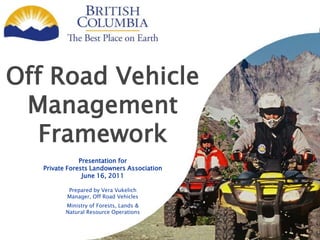
Off Road Vehicle
Management
Framework
Presentation for
Private Forests Landowners Association
June 16, 2011
Prepared by Vera Vukelich
Manager, Off Road Vehicles
Ministry of Forests, Lands &
Natural Resource Operations
 On November 10, 2009, Government
announced the Off-Road Vehicle (ORV)
Management Framework.
 The goal of the ORV framework is to develop
policy that will encourage safe and responsible
ORV riding and support a growing industry that
has the opportunity to deliver lasting
socioeconomic benefits to rural communities.
 In 2005, the Coalition for Licensing and Registration of
Off-Road Vehicles in BC produced a report with 47
recommendations to address longstanding ORV
management issues in BC.
 In 2006, the Coroners Service of British Columbia
recommended improved laws to help address ORV
accidents resulting in injuries to youth and deaths.
 In early 2009, during the review of the proposed Trails
Strategy, there was strong overall public support for
improving ORV management in BC.
 Over the years, the Union of British Columbia
Municipalities has passed nine resolutions requesting
an improved ORV management regime.
 Through extensive dialogue with
stakeholders, agencies and ministries over the
years, we have learned that ORV issues are
complex and achieving consensus among the range
of parties was challenging.
 As time progressed, we also found that there were
many aspects of shared interest and common
ground.
 The result of this hard work is the ORV framework
 Improved public safety
 Protecting the environment
 Identification through registration
 Better compliance & enforcement
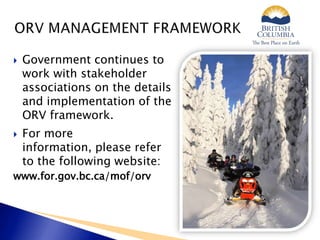
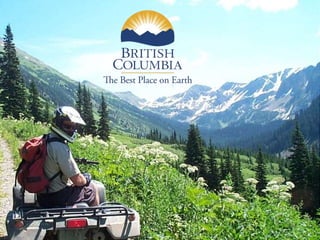
 ORVs are used for work, leisure and commuting.
 An expanded definition of ORVs will include
small, self-propelled motor vehicles manufactured
to be operated for off highway travel purposes and
are ride-astride or side-by-side vehicles with
wheels, tracks and/or skis.
 Examples of ORVs include: all terrain
vehicles, ‘quads’, off highway
motorcycles, snowmobiles, utility
vehicles, recreational vehicles, amphibious
argos, golf carts and dune buggies.
 Registration is mandatory for ORVs operated
on Crown land, including resource roads.
 Registration applies to current and new owners.
 A clearly visible number plate/decal will:
◦ Help address irresponsible ORV operators,
◦ track stolen ORVs, and
◦ aide in search and rescue efforts to find lost or
injured ORV enthusiasts.
 Non-residents of BC will require a temporary
permit if their ORV is not already registered
from their home jurisdiction with a visible
plate/decal.
 For example, Albertan’s would already comply.
 All ORV operators will be required to wear a safety-
approved helmet and, where installed by the
manufacturer, seatbelt use will also be requisite for
side-by-side ORVs (e.g. UTV).
 All ORVs must use lights for low visibility
conditions. Off-highway motorcycles that do not
have lights will be permitted to use temporary bike
lights.
 Additional safety rules for youth under 16 years
include: adult supervision, appropriate size vehicle
for age/weight, and reduced speed limits.
 Equipment exemptions continue to apply at
sporting/competitive events.
 Designated highway crossings will make it
more convenient for ORV operators to safely
cross highways.
 These optional crossings will help connect our
communities and trail systems.
 At designated ORV crossings, a police-issued
Operations Permit will no longer be required
but all other Motor Vehicle Act requirements
continue to apply.
 A police-issued Operation Permit will also
continue to be available for incidental road
crossings at non-designated locations.
 Spark arrestors will be required for ORVs
(excluding snowmobiles) to help prevent forest
fires and reduce noise disturbance to
wildlife, communities and other outdoor
enthusiasts.
 The Forest and Range Practices Act has already
been amended to add penalties for
irresponsible ORV operators that damage
sensitive habitat, such as alpine, wetland and
grassland areas.
 A provincial compliance and enforcement
strategy for ORVs is being developed.
 The strategy includes voluntary compliance
through public awareness and education.
 Government has been working with provincial
stakeholder associations on the development
of this strategy.
 Implementation of the ORV framework was
estimated to take approximately two years to
ensure that the ICBC has adequate time to
upgrade their systems and to ensure smooth
business transition for over 900 brokers.
 Government continues to
work with stakeholder
associations on the details
and implementation of the
ORV framework.
 For more
information, please refer
to the following website:
www.for.gov.bc.ca/mof/orv
Off Road Vehicle Management Framework (June 2011)

Off Road Vehicle Management Framework (June 2011)

  • 1.
    Off Road Vehicle Management Framework Presentationfor Private Forests Landowners Association June 16, 2011 Prepared by Vera Vukelich Manager, Off Road Vehicles Ministry of Forests, Lands & Natural Resource Operations
  • 2.
     On November10, 2009, Government announced the Off-Road Vehicle (ORV) Management Framework.  The goal of the ORV framework is to develop policy that will encourage safe and responsible ORV riding and support a growing industry that has the opportunity to deliver lasting socioeconomic benefits to rural communities.
  • 3.
     In 2005,the Coalition for Licensing and Registration of Off-Road Vehicles in BC produced a report with 47 recommendations to address longstanding ORV management issues in BC.  In 2006, the Coroners Service of British Columbia recommended improved laws to help address ORV accidents resulting in injuries to youth and deaths.  In early 2009, during the review of the proposed Trails Strategy, there was strong overall public support for improving ORV management in BC.  Over the years, the Union of British Columbia Municipalities has passed nine resolutions requesting an improved ORV management regime.
  • 4.
     Through extensivedialogue with stakeholders, agencies and ministries over the years, we have learned that ORV issues are complex and achieving consensus among the range of parties was challenging.  As time progressed, we also found that there were many aspects of shared interest and common ground.  The result of this hard work is the ORV framework
  • 5.
     Improved publicsafety  Protecting the environment  Identification through registration  Better compliance & enforcement
  • 6.
     ORVs areused for work, leisure and commuting.  An expanded definition of ORVs will include small, self-propelled motor vehicles manufactured to be operated for off highway travel purposes and are ride-astride or side-by-side vehicles with wheels, tracks and/or skis.  Examples of ORVs include: all terrain vehicles, ‘quads’, off highway motorcycles, snowmobiles, utility vehicles, recreational vehicles, amphibious argos, golf carts and dune buggies.
  • 7.
     Registration ismandatory for ORVs operated on Crown land, including resource roads.  Registration applies to current and new owners.  A clearly visible number plate/decal will: ◦ Help address irresponsible ORV operators, ◦ track stolen ORVs, and ◦ aide in search and rescue efforts to find lost or injured ORV enthusiasts.
  • 8.
     Non-residents ofBC will require a temporary permit if their ORV is not already registered from their home jurisdiction with a visible plate/decal.  For example, Albertan’s would already comply.
  • 9.
     All ORVoperators will be required to wear a safety- approved helmet and, where installed by the manufacturer, seatbelt use will also be requisite for side-by-side ORVs (e.g. UTV).  All ORVs must use lights for low visibility conditions. Off-highway motorcycles that do not have lights will be permitted to use temporary bike lights.  Additional safety rules for youth under 16 years include: adult supervision, appropriate size vehicle for age/weight, and reduced speed limits.  Equipment exemptions continue to apply at sporting/competitive events.
  • 10.
     Designated highwaycrossings will make it more convenient for ORV operators to safely cross highways.  These optional crossings will help connect our communities and trail systems.  At designated ORV crossings, a police-issued Operations Permit will no longer be required but all other Motor Vehicle Act requirements continue to apply.  A police-issued Operation Permit will also continue to be available for incidental road crossings at non-designated locations.
  • 11.
     Spark arrestorswill be required for ORVs (excluding snowmobiles) to help prevent forest fires and reduce noise disturbance to wildlife, communities and other outdoor enthusiasts.  The Forest and Range Practices Act has already been amended to add penalties for irresponsible ORV operators that damage sensitive habitat, such as alpine, wetland and grassland areas.
  • 12.
     A provincialcompliance and enforcement strategy for ORVs is being developed.  The strategy includes voluntary compliance through public awareness and education.  Government has been working with provincial stakeholder associations on the development of this strategy.
  • 13.
     Implementation ofthe ORV framework was estimated to take approximately two years to ensure that the ICBC has adequate time to upgrade their systems and to ensure smooth business transition for over 900 brokers.
  • 14.
     Government continuesto work with stakeholder associations on the details and implementation of the ORV framework.  For more information, please refer to the following website: www.for.gov.bc.ca/mof/orv