upfront


                     Opinion
                                                                                                  Ian McConnachie
                                                                                                           DDS MS


             Orthodontic-Related
          Decalcifications and Caries:
              It’s Time for a Shift in Outcomes


W
              e all have patients who        pleted. Reports indicate that decalci-        at-home use, with the support of the
             complete a comprehensive        fication can start within the first           orthodontic office. The communica-
            course of orthodontic care       month after bracketing;1 on facial sur-       tion must be ongoing and three-way.
and look forward to enjoying the             faces, it mostly occurs around and               Preventive strategies depend on
pleasure of a beautiful new smile. It        gingival to the brackets.2 The devel-         level of risk and fall into two general
is deeply disturbing when our patient        opment of decalcification and decay           categories: diagnostic techniques and
instead faces unsightly decalcifica-         with these patients is a failure equally      therapeutic interventions. All ortho-
tions and decay. One such case is one        of the orthodontic team, the primary          dontic patients should have a com-
too many. A leading orthodontic              care team, and the family. Solutions          prehensive       oral     examination,
speaker, Dr. Gerry Samson, suggests          to this problem equally lie with this         including bitewing radiographs, com-
the desired orthodontic outcome is           same triad.                                   pleted pre-treatment. During active
good function, esthetics and stability.         When orthodontic treatment is              treatment with fixed appliances, up-
When there is decalcification and            scheduled to start, the primary care          dated bitewings must be scheduled at
decay, this is a failure to achieve the      dental office and the orthodontic of-         appropriate intervals; this may neces-
esthetic outcome. This situation is to-      fice should begin a collaboration and         sitate co-ordination of visits such that
tally preventable and I believe it is        communication triad with the patient          the orthodontist removes the wires so
time to make the necessary adjust-           to achieve the desired outcomes.              bitewings can be taken then replaces
ments in care to achieve that.               Gone are the days when adolescent             the wires after. A very interesting and
   Decay risk exists for all patients to     patients received essentially the same        promising complementary diagnostic
varying degrees in occlusal pits and         treatment and preventive measures in          technique is the use of the Canary
fissures, interproximal surfaces and fa-     the dental office. We know now that           System, a laser-based device that
cial surfaces. Orthodontic treatment         these interventions should be the re-         quantifies levels of decalcification on
increases the risk of decay for a vari-      sult of a thorough risk assessment.           all tooth surfaces, including inter-
ety of reasons. Oral hygiene is more         That risk assessment should be docu-          proximal. Frequencies of diagnosis
difficult; wires are in place for two to     mented and shared with the patient            should depend on the level of risk.
three years or longer with little op-        and the orthodontic office. If the or-        Determining this risk requires ongo-
portunity to obtain bitewing radi-           thodontic office is unaware of the pa-        ing monitoring of hygiene levels and
ographs; excess resin around brackets        tient’s risk level, it should either do its   for evidence of decalcification at the
acts as a plaque trap; patients some-        own risk assessment or request one            orthodontic office and, possibly, at
times believe that because they are          from the general dentist. Once risk           the primary care provider as well,
being seen regularly at the orthodon-        level is established, the general den-        with corresponding communication.
tic office, they don’t need to visit their   tist must create a comprehensive pre-            Therapeutic interventions again be-
regular dentist until treatment is com-      ventive protocol for in-office and            long with all three parts of the triad.

14    Ontario Dentist • May 2012
Opinion


The home care program with measures such as high fluo-
ride toothpaste or oral rinses, flossing and proxy-brushes
must be reinforced by the parents. The primary care office
must schedule appropriate office visits for fluoride varnish,
oral hygiene reinforcement and, in the high-risk situation,
consider using anti-microbials such as povidone iodine
topically together with the fluoride varnish to dramatically


                                                                                                                                       Photo courtesy of Reliance Orthodontics
lower Strep mutans counts.3 The orthodontic office should
consider fully sealing the entire facial enamel surface, not
just the surface under the bracket, at the time of bracket
placement. This should be done with a specially designed
fluoride-releasing sealant material such as Reliance’s Pro
Seal and Opal Orthodontic’s Opalseal. The retention status
of these materials should be monitored and the sealant re-
applied as necessary.
   What is briefly described here is a strategy to prevent
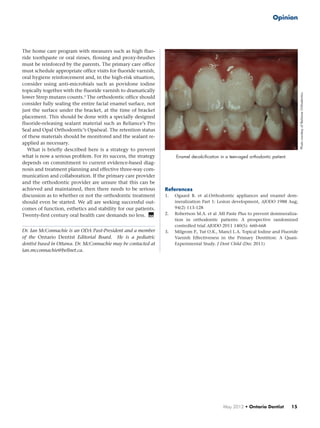
what is now a serious problem. For its success, the strategy         Enamel decalcification in a teen-aged orthodontic patient.
depends on commitment to current evidence-based diag-
nosis and treatment planning and effective three-way com-
munication and collaboration. If the primary care provider
and the orthodontic provider are unsure that this can be
achieved and maintained, then there needs to be serious         References
discussion as to whether or not the orthodontic treatment       1.   Ogaard B. et al.Orthodontic appliances and enamel dem-
should even be started. We all are seeking successful out-           ineralization Part 1: Lesion development, AJODO 1988 Aug;
comes of function, esthetics and stability for our patients.         94(2) 113-128
Twenty-first century oral health care demands no less.          2.   Robertson M.A. et al .MI Paste Plus to prevent demineraliza-
                                                                     tion in orthodontic patients: A prospective randomized
                                                                     controlled trial AJODO 2011 140(5): 660-668
Dr. Ian McConnachie is an ODA Past-President and a member       3.   Milgrom P., Tut O.K., Mancl L.A. Topical Iodine and Fluoride
of the Ontario Dentist Editorial Board. He is a pediatric            Varnish Effectiveness in the Primary Dentition: A Quasi-
dentist based in Ottawa. Dr. McConnachie may be contacted at         Experimental Study. J Dent Child (Dec 2011)
ian.mcconnachie@bellnet.ca.


                                                                                             May 2012 • Ontario Dentist           15

Orthodontic-Related Decalcifications & Caries

  • 1.
    upfront Opinion Ian McConnachie DDS MS Orthodontic-Related Decalcifications and Caries: It’s Time for a Shift in Outcomes W e all have patients who pleted. Reports indicate that decalci- at-home use, with the support of the complete a comprehensive fication can start within the first orthodontic office. The communica- course of orthodontic care month after bracketing;1 on facial sur- tion must be ongoing and three-way. and look forward to enjoying the faces, it mostly occurs around and Preventive strategies depend on pleasure of a beautiful new smile. It gingival to the brackets.2 The devel- level of risk and fall into two general is deeply disturbing when our patient opment of decalcification and decay categories: diagnostic techniques and instead faces unsightly decalcifica- with these patients is a failure equally therapeutic interventions. All ortho- tions and decay. One such case is one of the orthodontic team, the primary dontic patients should have a com- too many. A leading orthodontic care team, and the family. Solutions prehensive oral examination, speaker, Dr. Gerry Samson, suggests to this problem equally lie with this including bitewing radiographs, com- the desired orthodontic outcome is same triad. pleted pre-treatment. During active good function, esthetics and stability. When orthodontic treatment is treatment with fixed appliances, up- When there is decalcification and scheduled to start, the primary care dated bitewings must be scheduled at decay, this is a failure to achieve the dental office and the orthodontic of- appropriate intervals; this may neces- esthetic outcome. This situation is to- fice should begin a collaboration and sitate co-ordination of visits such that tally preventable and I believe it is communication triad with the patient the orthodontist removes the wires so time to make the necessary adjust- to achieve the desired outcomes. bitewings can be taken then replaces ments in care to achieve that. Gone are the days when adolescent the wires after. A very interesting and Decay risk exists for all patients to patients received essentially the same promising complementary diagnostic varying degrees in occlusal pits and treatment and preventive measures in technique is the use of the Canary fissures, interproximal surfaces and fa- the dental office. We know now that System, a laser-based device that cial surfaces. Orthodontic treatment these interventions should be the re- quantifies levels of decalcification on increases the risk of decay for a vari- sult of a thorough risk assessment. all tooth surfaces, including inter- ety of reasons. Oral hygiene is more That risk assessment should be docu- proximal. Frequencies of diagnosis difficult; wires are in place for two to mented and shared with the patient should depend on the level of risk. three years or longer with little op- and the orthodontic office. If the or- Determining this risk requires ongo- portunity to obtain bitewing radi- thodontic office is unaware of the pa- ing monitoring of hygiene levels and ographs; excess resin around brackets tient’s risk level, it should either do its for evidence of decalcification at the acts as a plaque trap; patients some- own risk assessment or request one orthodontic office and, possibly, at times believe that because they are from the general dentist. Once risk the primary care provider as well, being seen regularly at the orthodon- level is established, the general den- with corresponding communication. tic office, they don’t need to visit their tist must create a comprehensive pre- Therapeutic interventions again be- regular dentist until treatment is com- ventive protocol for in-office and long with all three parts of the triad. 14 Ontario Dentist • May 2012
  • 2.
    Opinion The home careprogram with measures such as high fluo- ride toothpaste or oral rinses, flossing and proxy-brushes must be reinforced by the parents. The primary care office must schedule appropriate office visits for fluoride varnish, oral hygiene reinforcement and, in the high-risk situation, consider using anti-microbials such as povidone iodine topically together with the fluoride varnish to dramatically Photo courtesy of Reliance Orthodontics lower Strep mutans counts.3 The orthodontic office should consider fully sealing the entire facial enamel surface, not just the surface under the bracket, at the time of bracket placement. This should be done with a specially designed fluoride-releasing sealant material such as Reliance’s Pro Seal and Opal Orthodontic’s Opalseal. The retention status of these materials should be monitored and the sealant re- applied as necessary. What is briefly described here is a strategy to prevent what is now a serious problem. For its success, the strategy Enamel decalcification in a teen-aged orthodontic patient. depends on commitment to current evidence-based diag- nosis and treatment planning and effective three-way com- munication and collaboration. If the primary care provider and the orthodontic provider are unsure that this can be achieved and maintained, then there needs to be serious References discussion as to whether or not the orthodontic treatment 1. Ogaard B. et al.Orthodontic appliances and enamel dem- should even be started. We all are seeking successful out- ineralization Part 1: Lesion development, AJODO 1988 Aug; comes of function, esthetics and stability for our patients. 94(2) 113-128 Twenty-first century oral health care demands no less. 2. Robertson M.A. et al .MI Paste Plus to prevent demineraliza- tion in orthodontic patients: A prospective randomized controlled trial AJODO 2011 140(5): 660-668 Dr. Ian McConnachie is an ODA Past-President and a member 3. Milgrom P., Tut O.K., Mancl L.A. Topical Iodine and Fluoride of the Ontario Dentist Editorial Board. He is a pediatric Varnish Effectiveness in the Primary Dentition: A Quasi- dentist based in Ottawa. Dr. McConnachie may be contacted at Experimental Study. J Dent Child (Dec 2011) ian.mcconnachie@bellnet.ca. May 2012 • Ontario Dentist 15