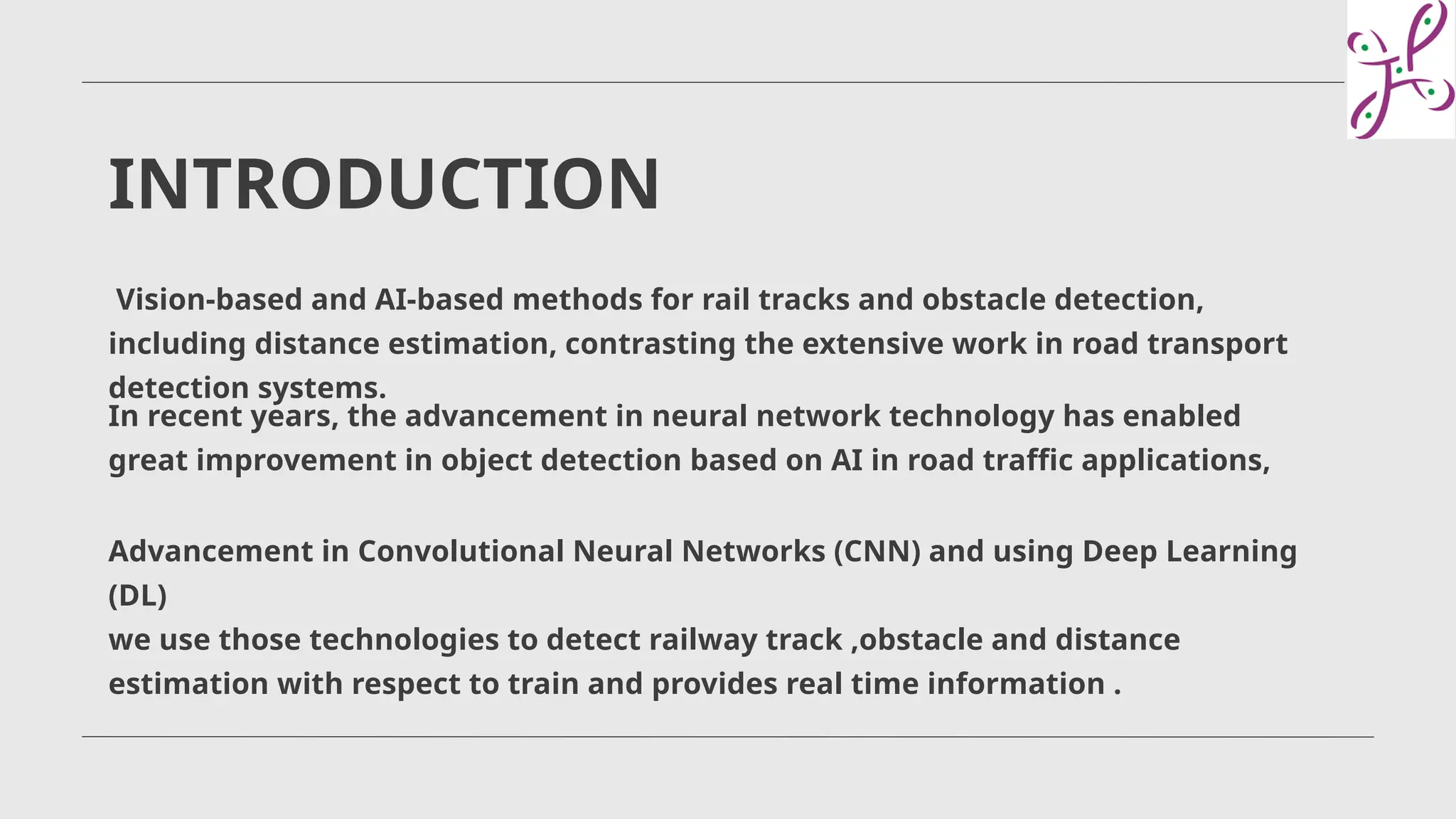
Rail Track Obstacle
System
INTRODUCTION
Vision-based and AI-based methods for rail tracks and obstacle detection,
including distance estimation, contrasting the extensive work in road transport
detection systems.
In recent years, the advancement in neural network technology has enabled
great improvement in object detection based on AI in road traffic applications,
Advancement in Convolutional Neural Networks (CNN) and using Deep Learning
(DL)
we use those technologies to detect railway track ,obstacle and distance
estimation with respect to train and provides real time information .
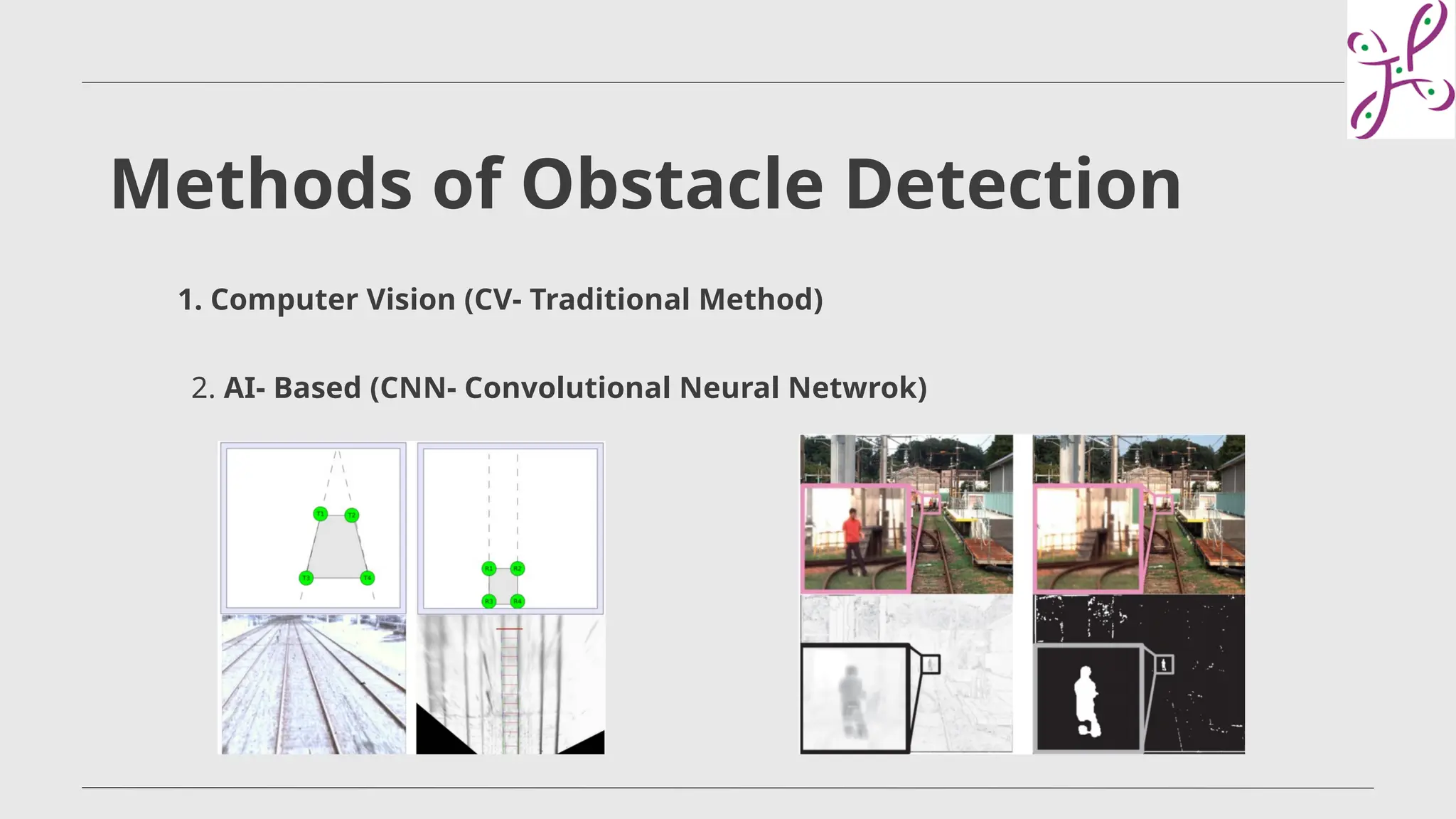
Methods of Obstacle Detection
1. Computer Vision (CV- Traditional Method)
2. AI- Based (CNN- Convolutional Neural Netwrok)
AI Based Detection Methods
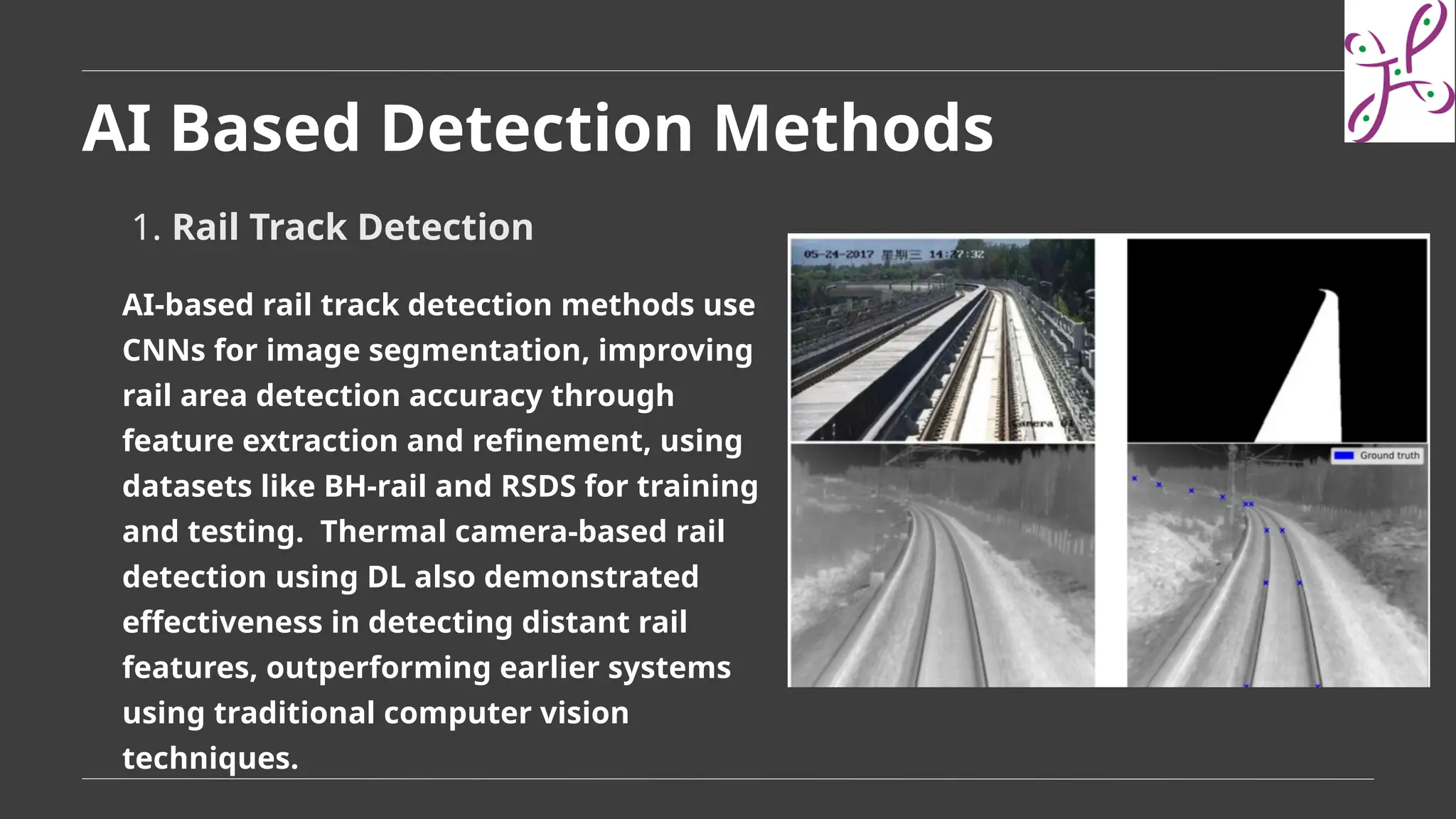
1. Rail Track Detection
AI-based rail track detection methods use
CNNs for image segmentation, improving
rail area detection accuracy through
feature extraction and refinement, using
datasets like BH-rail and RSDS for training
and testing. Thermal camera-based rail
detection using DL also demonstrated
effectiveness in detecting distant rail
features, outperforming earlier systems
using traditional computer vision
techniques.
2. Obstacle detection
04
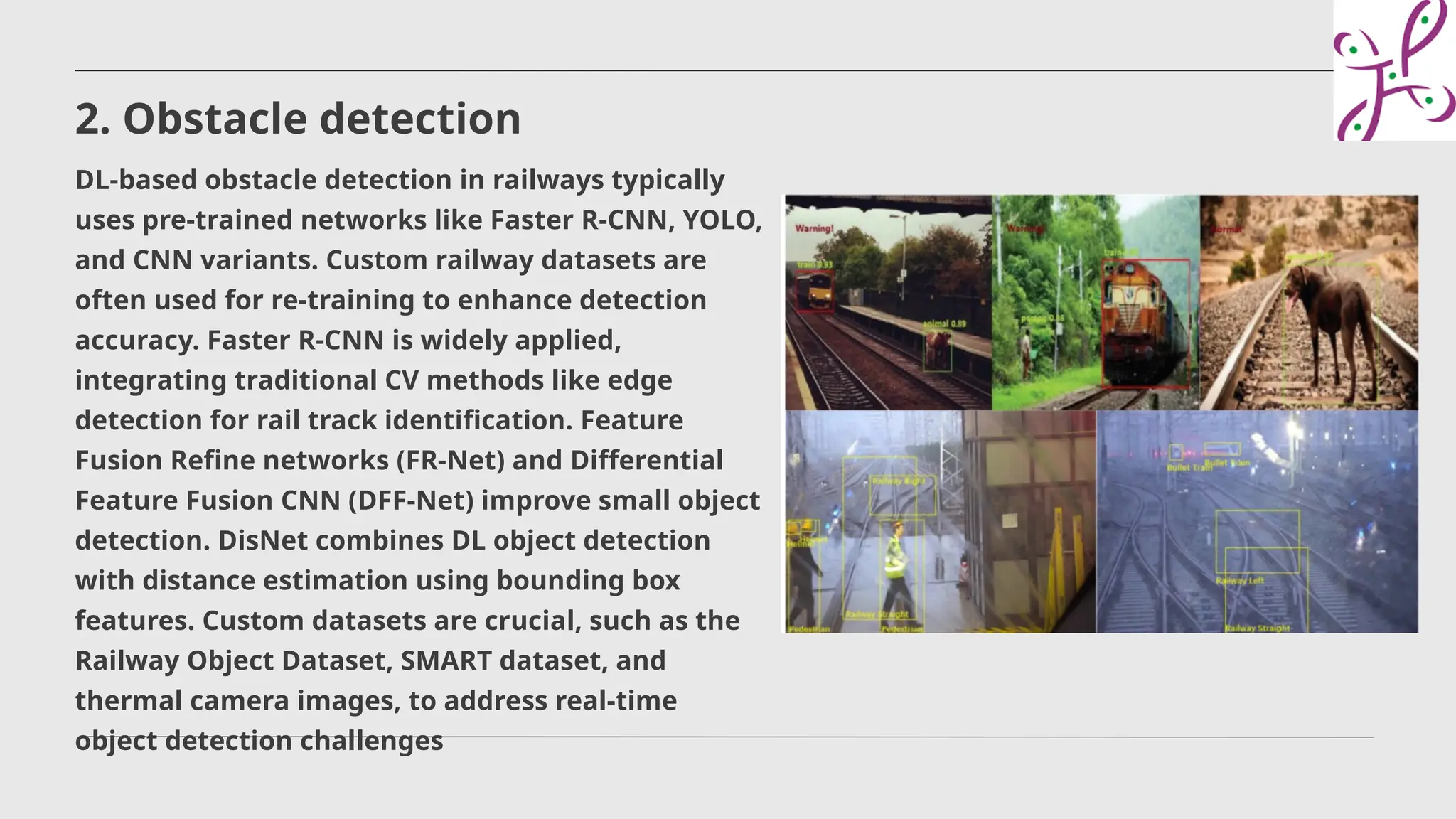
DL-based obstacle detection in railways typically
uses pre-trained networks like Faster R-CNN, YOLO,
and CNN variants. Custom railway datasets are
often used for re-training to enhance detection
accuracy. Faster R-CNN is widely applied,
integrating traditional CV methods like edge
detection for rail track identification. Feature
Fusion Refine networks (FR-Net) and Differential
Feature Fusion CNN (DFF-Net) improve small object
detection. DisNet combines DL object detection
with distance estimation using bounding box
features. Custom datasets are crucial, such as the
Railway Object Dataset, SMART dataset, and
thermal camera images, to address real-time
object detection challenges
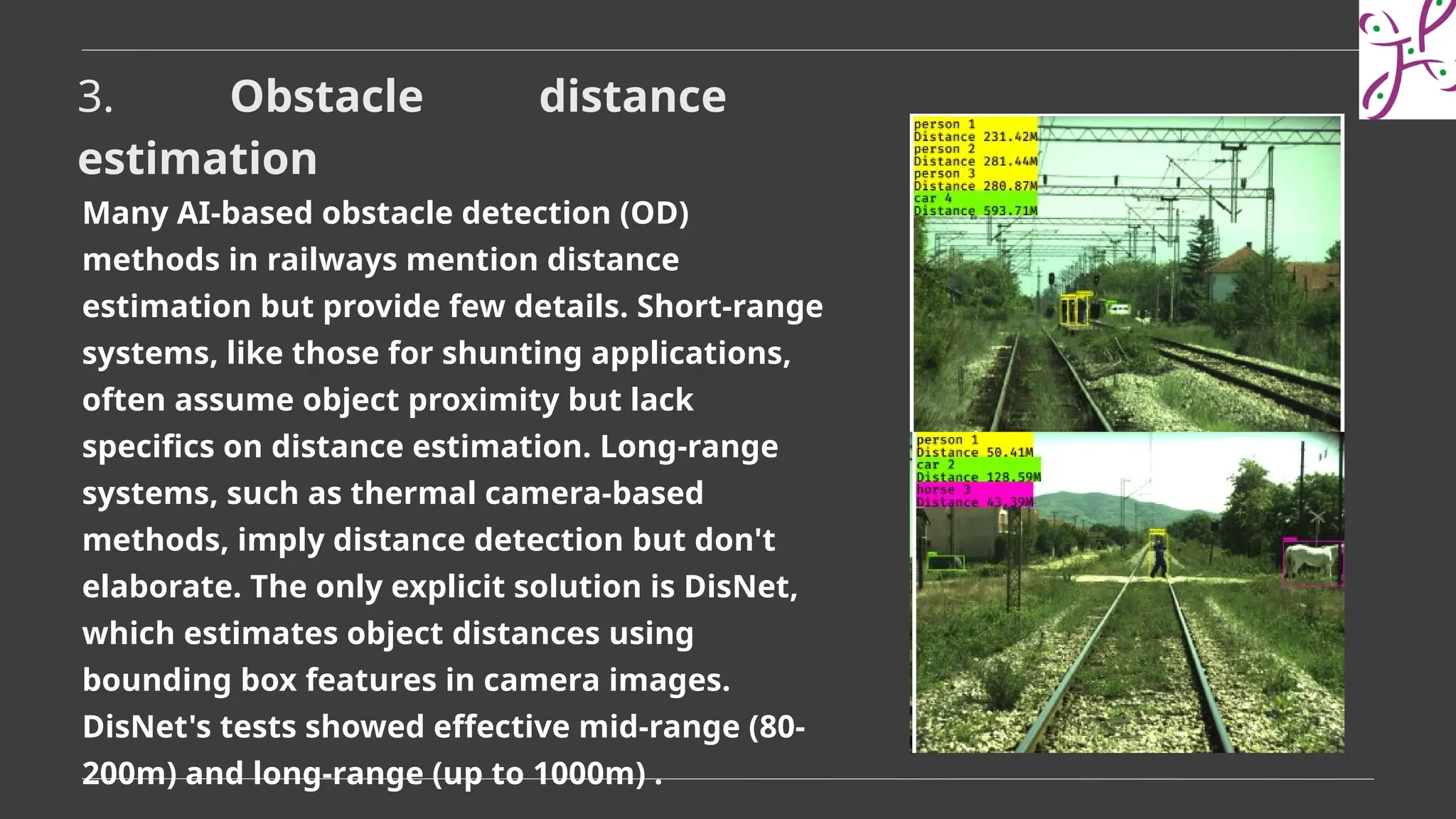
Many AI-based obstacle detection (OD)
methods in railways mention distance
estimation but provide few details. Short-range
systems, like those for shunting applications,
often assume object proximity but lack
specifics on distance estimation. Long-range
systems, such as thermal camera-based
methods, imply distance detection but don't
elaborate. The only explicit solution is DisNet,
which estimates object distances using
bounding box features in camera images.
DisNet's tests showed effective mid-range (80-
200m) and long-range (up to 1000m) .
3. Obstacle distance
estimation
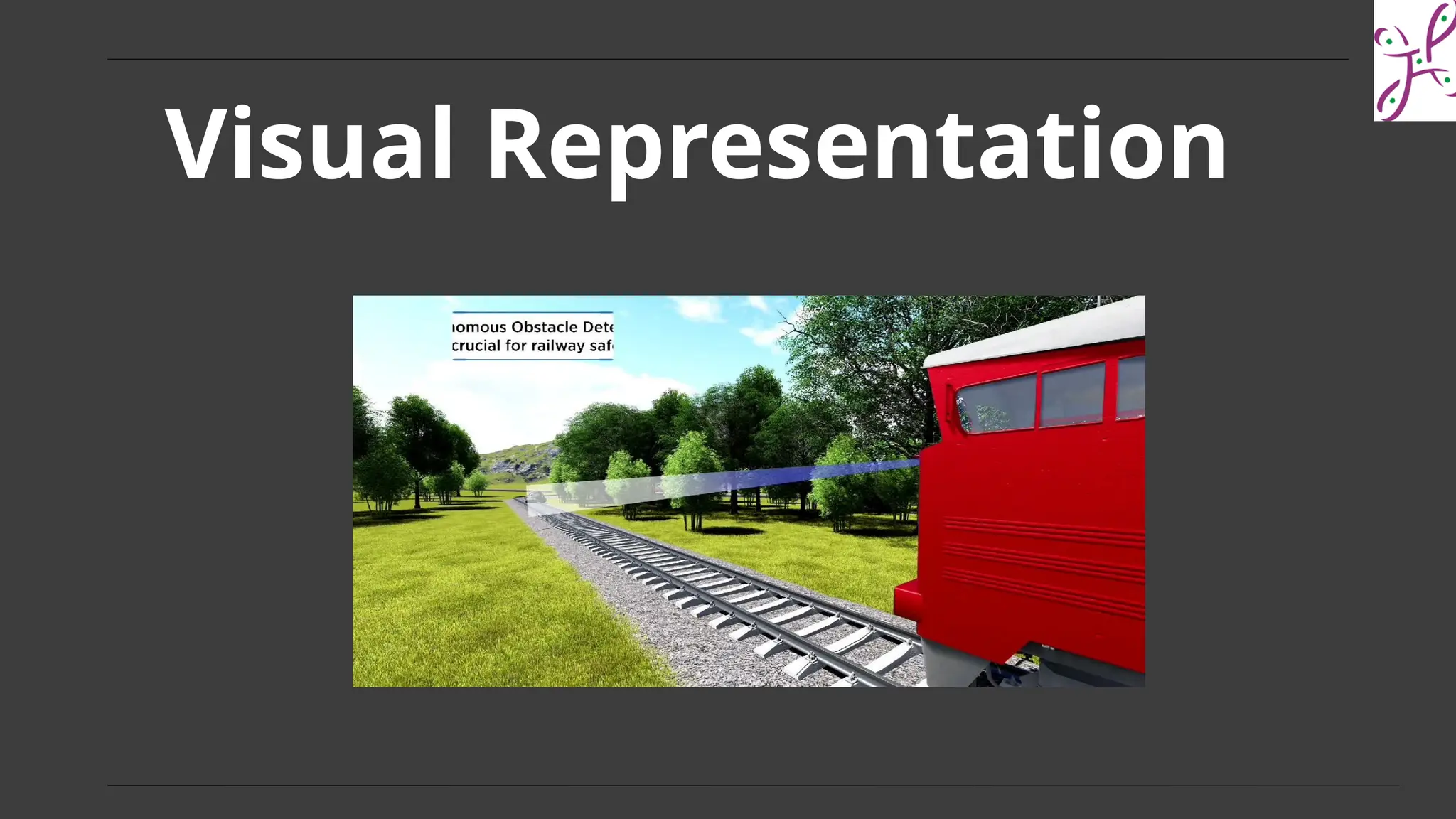
Visual Representation
01
Conclusion
Refrences:
1.A Review of Vision-Based On-Board Obstacle Detection and Distance Estimation in Railw
ays
2.Obstacle detection {Video}
We finally get the detected obstacle from the earlier steps and the distance can be
estimated with most approximate accuracy. Since the Metro systems deals with
majorly the three obstacles - Animal, Object and Human, These data can be fed to
the DisNet system with all the possible cases which might occur in the real life. The
data which has been taken from obstacle detection and distance estimation is sent
to cloud management which gives final result about type object detected and
distance with respect to train and sends to Loco pilot and Control Center for further
actions.
Obstacle Object Detection _Computer vision methods.pptx

Obstacle Object Detection _Computer vision methods.pptx

  • 1.
  • 2.
    INTRODUCTION Vision-based and AI-basedmethods for rail tracks and obstacle detection, including distance estimation, contrasting the extensive work in road transport detection systems. In recent years, the advancement in neural network technology has enabled great improvement in object detection based on AI in road traffic applications, Advancement in Convolutional Neural Networks (CNN) and using Deep Learning (DL) we use those technologies to detect railway track ,obstacle and distance estimation with respect to train and provides real time information .
  • 3.
    Methods of ObstacleDetection 1. Computer Vision (CV- Traditional Method) 2. AI- Based (CNN- Convolutional Neural Netwrok)
  • 4.
    AI Based DetectionMethods 1. Rail Track Detection AI-based rail track detection methods use CNNs for image segmentation, improving rail area detection accuracy through feature extraction and refinement, using datasets like BH-rail and RSDS for training and testing. Thermal camera-based rail detection using DL also demonstrated effectiveness in detecting distant rail features, outperforming earlier systems using traditional computer vision techniques.
  • 5.
    2. Obstacle detection 04 DL-basedobstacle detection in railways typically uses pre-trained networks like Faster R-CNN, YOLO, and CNN variants. Custom railway datasets are often used for re-training to enhance detection accuracy. Faster R-CNN is widely applied, integrating traditional CV methods like edge detection for rail track identification. Feature Fusion Refine networks (FR-Net) and Differential Feature Fusion CNN (DFF-Net) improve small object detection. DisNet combines DL object detection with distance estimation using bounding box features. Custom datasets are crucial, such as the Railway Object Dataset, SMART dataset, and thermal camera images, to address real-time object detection challenges
  • 6.
    Many AI-based obstacledetection (OD) methods in railways mention distance estimation but provide few details. Short-range systems, like those for shunting applications, often assume object proximity but lack specifics on distance estimation. Long-range systems, such as thermal camera-based methods, imply distance detection but don't elaborate. The only explicit solution is DisNet, which estimates object distances using bounding box features in camera images. DisNet's tests showed effective mid-range (80- 200m) and long-range (up to 1000m) . 3. Obstacle distance estimation
  • 7.
  • 8.
    Conclusion Refrences: 1.A Review ofVision-Based On-Board Obstacle Detection and Distance Estimation in Railw ays 2.Obstacle detection {Video} We finally get the detected obstacle from the earlier steps and the distance can be estimated with most approximate accuracy. Since the Metro systems deals with majorly the three obstacles - Animal, Object and Human, These data can be fed to the DisNet system with all the possible cases which might occur in the real life. The data which has been taken from obstacle detection and distance estimation is sent to cloud management which gives final result about type object detected and distance with respect to train and sends to Loco pilot and Control Center for further actions.