Objectives and Key Results- Measure what matters.pdf
1.
Implementing
OKRs
Objectives and KeyResults
A management methodology that helps to ensure that the company
focuses efforts on the same important issues throughout the
organization.
2.
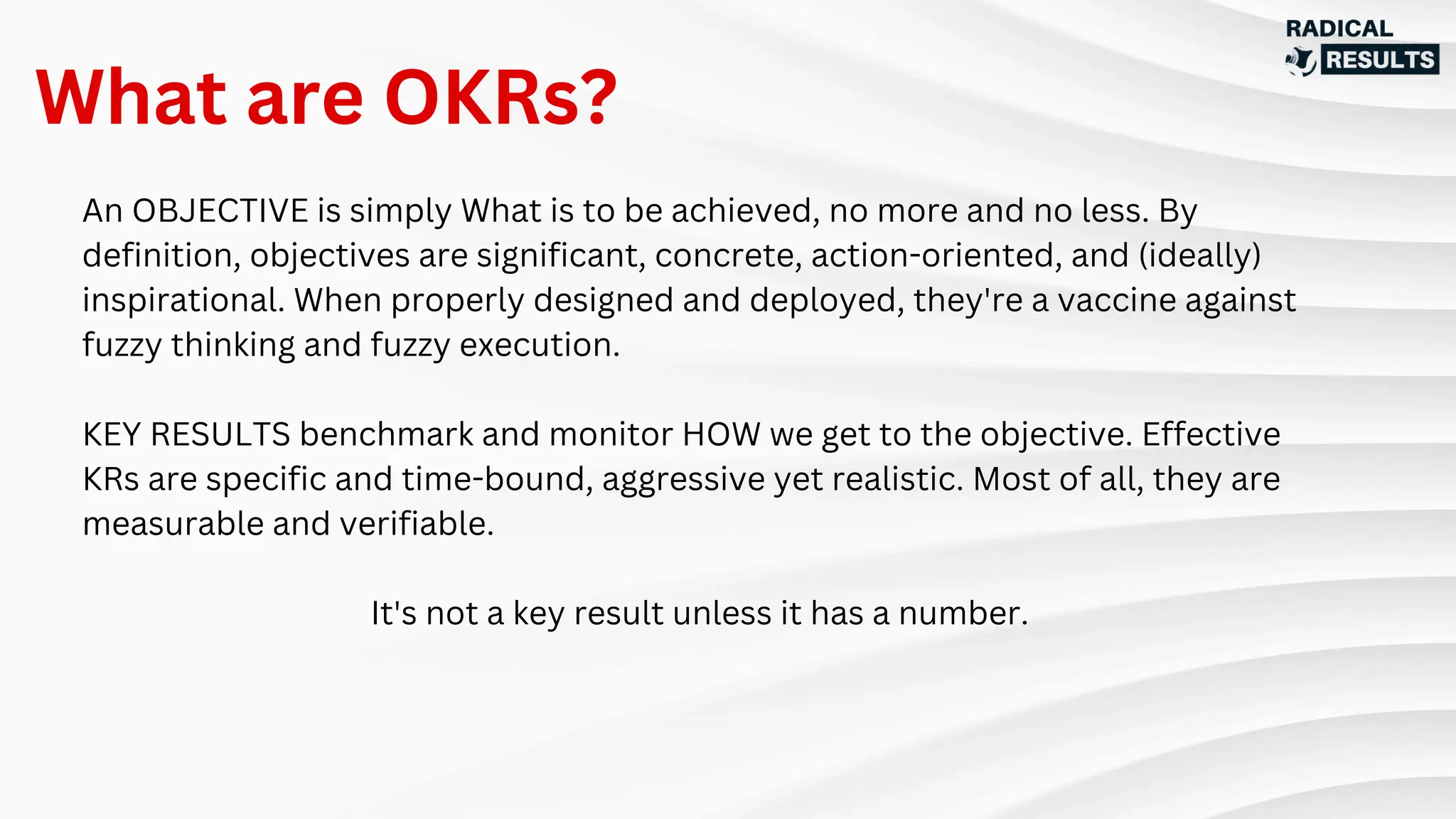
An OBJECTIVE issimply What is to be achieved, no more and no less. By
definition, objectives are significant, concrete, action-oriented, and (ideally)
inspirational. When properly designed and deployed, they're a vaccine against
fuzzy thinking and fuzzy execution.
KEY RESULTS benchmark and monitor HOW we get to the objective. Effective
KRs are specific and time-bound, aggressive yet realistic. Most of all, they are
measurable and verifiable.
It's not a key result unless it has a number.
What are OKRs?
3.
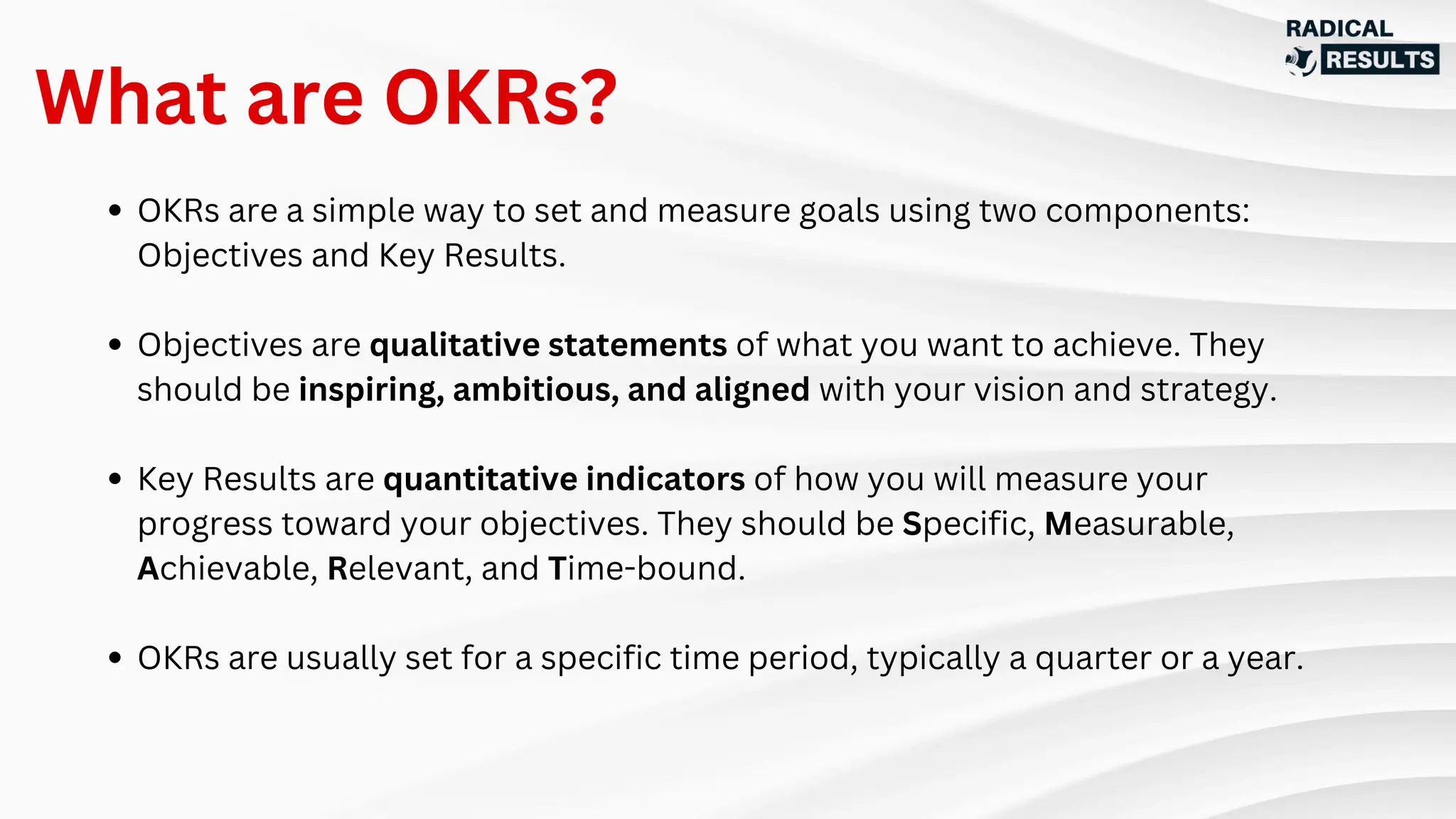
OKRs are asimple way to set and measure goals using two components:
Objectives and Key Results.
Objectives are qualitative statements of what you want to achieve. They
should be inspiring, ambitious, and aligned with your vision and strategy.
Key Results are quantitative indicators of how you will measure your
progress toward your objectives. They should be Specific, Measurable,
Achievable, Relevant, and Time-bound.
OKRs are usually set for a specific time period, typically a quarter or a year.
What are OKRs?
4.
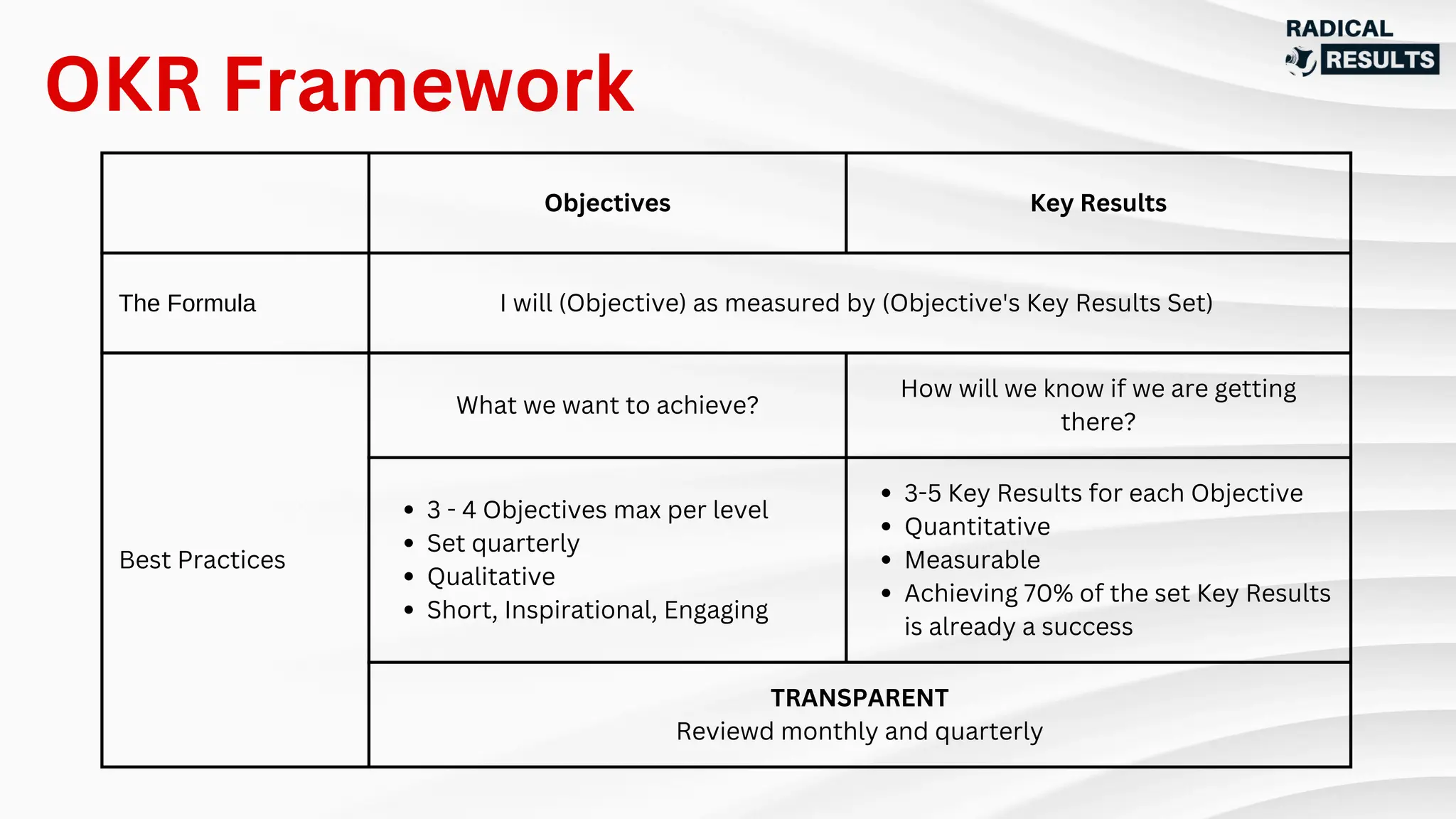
Objectives Key Results
TheFormula I will (Objective) as measured by (Objective's Key Results Set)
Best Practices
What we want to achieve?
How will we know if we are getting
there?
3 - 4 Objectives max per level
Set quarterly
Qualitative
Short, Inspirational, Engaging
3-5 Key Results for each Objective
Quantitative
Measurable
Achieving 70% of the set Key Results
is already a success
TRANSPARENT
Reviewd monthly and quarterly
OKR Framework
5.
OKRs can helpyou:
Communicate your Vision and Strategy clearly and consistently across the
organization
Align your teams and individuals around common goals and priorities
Track your progress and performance using data and feedback
Foster a culture of innovation, collaboration, and learning
Why use OKRs?
6.
Implementing OKRs successfullyrequires four main steps:
1. Creating the right company culture for OKRs
2. Integrating OKRs into your Organizational Rhythm
3. Educating your team about OKRs
4. Making sure OKRs stick
How to implement OKRs?
7.
Focus on thebig rocks
Be Ambitious and bring a sense of urgency
The best idea wins - not the best title
In God we trust, all others must bring data
Do not brake, it's not easy to reaccelerate!
No carrots or sticks, but a common sense of purpose
Enable risk-taking, spur innovation
Listen... listen... listen... to objections, concerns, and questions.
"esprit de corps"
One for all and all for one.
Respect, support, and trust everyone throughout the OKR implementation
process. Start small, be patient, and be human.
The Culture
8.
To make sureOKRs stick, you need to:
Make OKRs visible and accessible to everyone in the organization. Use tools
or platforms that allow you to create, share, update, and track your OKRs
easily and efficiently.
Make OKRs part of your regular conversations and meetings. Use OKRs as a
common language to communicate goals, expectations, progress,
challenges, and solutions.
Make OKRs part of your continuous improvement process. Use OKRs as a
feedback loop to learn from your successes and failures. Use OKRs as a
catalyst for innovation and growth.
Making sure OKRs stick
9.
To make sureOKRs stick, you need to:
Make OKRs visible and accessible to everyone in the organization. Use tools
or platforms that allow you to create, share, update, and track your OKRs
easily and efficiently.
Make OKRs part of your regular conversations and meetings. Use OKRs as a
common language to communicate goals, expectations, progress,
challenges, and solutions.
Make OKRs part of your continuous improvement process. Use OKRs as a
feedback loop to learn from your successes and failures. Use OKRs as a
catalyst for innovation and growth.
Making sure OKRs stick