Building Impactful Segments Using
Defined Objective Functions
Objective Driven Segmentation (ODS)
By
Guha Athreya
Gurgaon, Haryana-122002
Email: guha.athreya@absolutdata.com
Vamsi Krishna
Gurgaon, Haryana-122002
Email: vamsi.krishna@absolutdata.com
TABLE OF CONTENTS
Abstract………………………………………………………………………………….. 3
1) Introduction to Objective Driven Segmentation (ODS) ……..………………………….. 4
2) What does ODS deliver? ………………………………………………………………… 5
3) ODS Approach & Methodology Illustration…………………………………………….. 6
4) Case Study 1 – CPG ……………….……………………………………………………. 11
5) Case Study 2 – Hospitality Services ……………………………………………………. 16
6) Implementation Guidelines …………………………………………………………….. 21
Appendix………………………………………………………………………………… 22
Acknowledgements……………………………………………………………………. 23
ABSTRACT
Segmentation is a widely used marketing approach for solving a variety of business problems. In
the case where the focus is to drive growth, an impactful segmentation must clearly identify what
are the key consumer and customer behaviours that we need to leverage or change in order to
drive towards the growth goals.
Objective Driven Segmentation (ODS) ensures that people within a given market segment are
likely to respond similarly to defined marketing strategies. It provides a heat map of
opportunities that informs decisions of “Where to Play” vis-à-vis each growth objective.
The ODS approach is one of defining objective functions that represent growth strategies and
these objective functions then guide the selection and use of segmenting variables. ODS uses a
multitude of techniques including but not limited to Univariate, Bivariate Analyses as well as
Multivariate Techniques including Correspondence Analysis, CHAID etc.
This paper provides a detailed understanding of the context & principles of ODS as well as the
analytical approach to applying ODS. We look at two case studies - a multi brand beverage
manufacturer & a hospitality giant; to understand and value delivered by ODS.
Keywords: predictive analytics, marketing effectiveness, portfolio strategy, targeted CRM,
hospitality services, CPG
1. INTRODUCTION TO OBJECTIVE DRIVEN SEGMENTATION
1.1 Background
Segmentation is a widely used marketing approach for solving a variety of business problems.
The purpose of segmentation is sometimes to explore and better understand the market
landscape. However, we often have a lot of prior knowledge and research and the business goal
is very specific - such as growing market share, slowing decline in a mature category, growing
value etc. In the case where the focus is to drive growth, a good segmentation should provide a
„Where to Play‟ map for finding value and growth in the consumer and customer market for the
whole business.
To support organic growth, a good segmentation solution must link directly to the growth
strategies, show opportunities and gaps in the market-place, create guidance for brand managers
about where the brand needs to win & directly link to the activation activities in-market
1.2 Issue
More often than not, growth strategies aim to change consumer and customer behaviour. To
enable the execution of such growth strategies, an impactful segmentation must clearly identify
what are the key behaviours that we need to change in order to drive towards the growth goals.
Segmentation traditionally involves using consumer data in statistical techniques and seeing how
it clusters. While this is a good way to understand market landscape, these approaches cannot
guarantee identification of the best opportunities to achieve defined growth objectives. In the
past, a small number of approaches have been developed for ensuring the most effective variable
selection for segmentation but these approaches have not allowed the objective of segmentation
to affect the selection and use of variables.
1.3 Resolution
In the case where the focus is to drive growth, we recommend using a more advanced approach -
Objective Driven Segmentation (ODS). ODS ensures that people within a given market segment
are likely to respond similarly to defined marketing strategies. It provides a heat map of
opportunities that informs decisions of “Where to Play” vis-à-vis each growth objective.
2. WHAT DOES ODS DELIVER?
ODS is purpose driven. It aims to:
Articulate the “from and to” of objectives in the context of the businesses strategic
thrusts
Create a common language for communicating about markets cross-functionally (e.g.
between sales and trade marketing and brand marketing)
Forms an information backbone for the planning cycle that allows one to trace strategy
choices, through planning, implementation and measurement
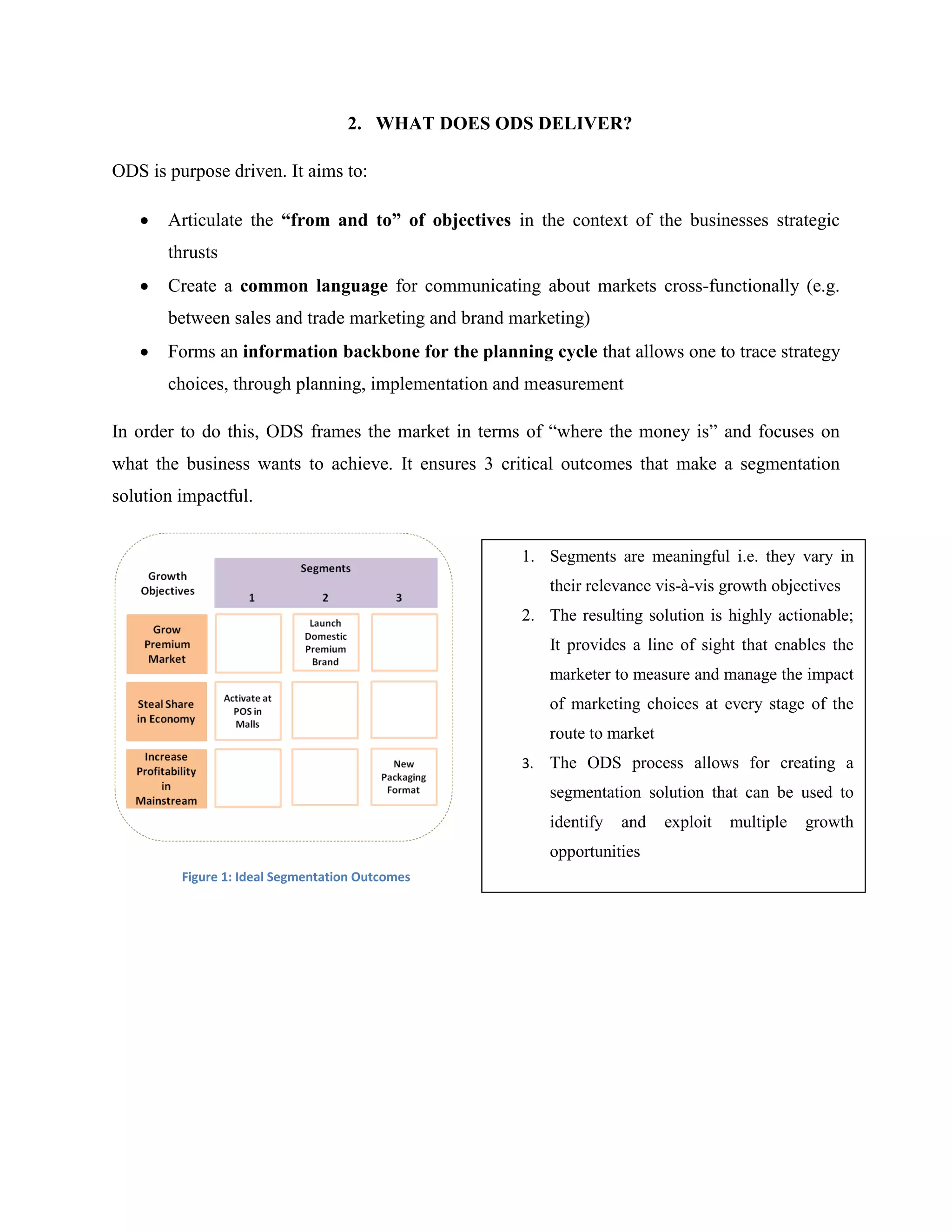
In order to do this, ODS frames the market in terms of “where the money is” and focuses on
what the business wants to achieve. It ensures 3 critical outcomes that make a segmentation
solution impactful.
Figure 1: Ideal Segmentation Outcomes
1. Segments are meaningful i.e. they vary in
their relevance vis-à-vis growth objectives
2. The resulting solution is highly actionable;
It provides a line of sight that enables the
marketer to measure and manage the impact
of marketing choices at every stage of the
route to market
3. The ODS process allows for creating a
segmentation solution that can be used to
identify and exploit multiple growth
opportunities
3. ODS APPROACH & METHODOLOGY ILLUSTRATION
3.1 The ODS Approach
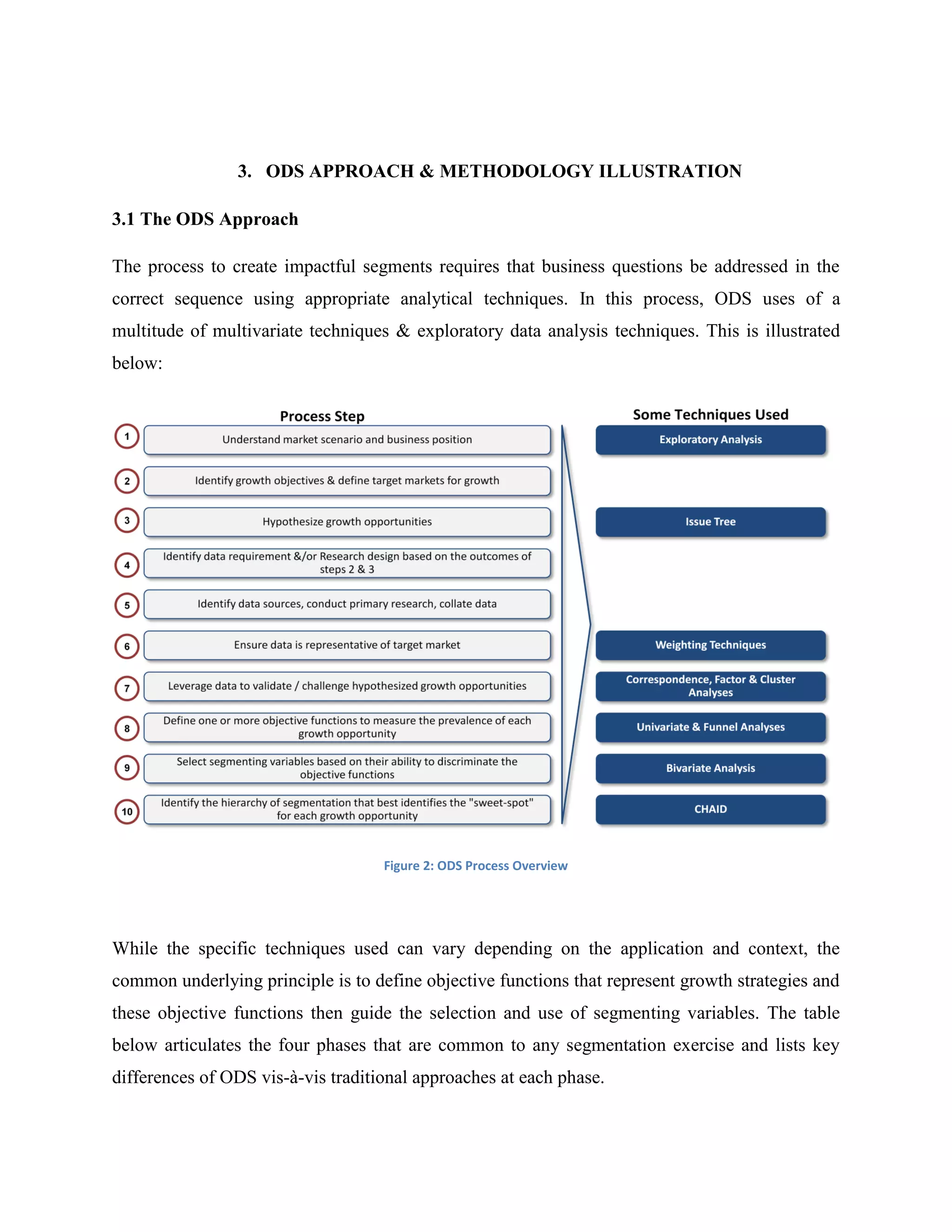
The process to create impactful segments requires that business questions be addressed in the
correct sequence using appropriate analytical techniques. In this process, ODS uses of a
multitude of multivariate techniques & exploratory data analysis techniques. This is illustrated
below:
Figure 2: ODS Process Overview
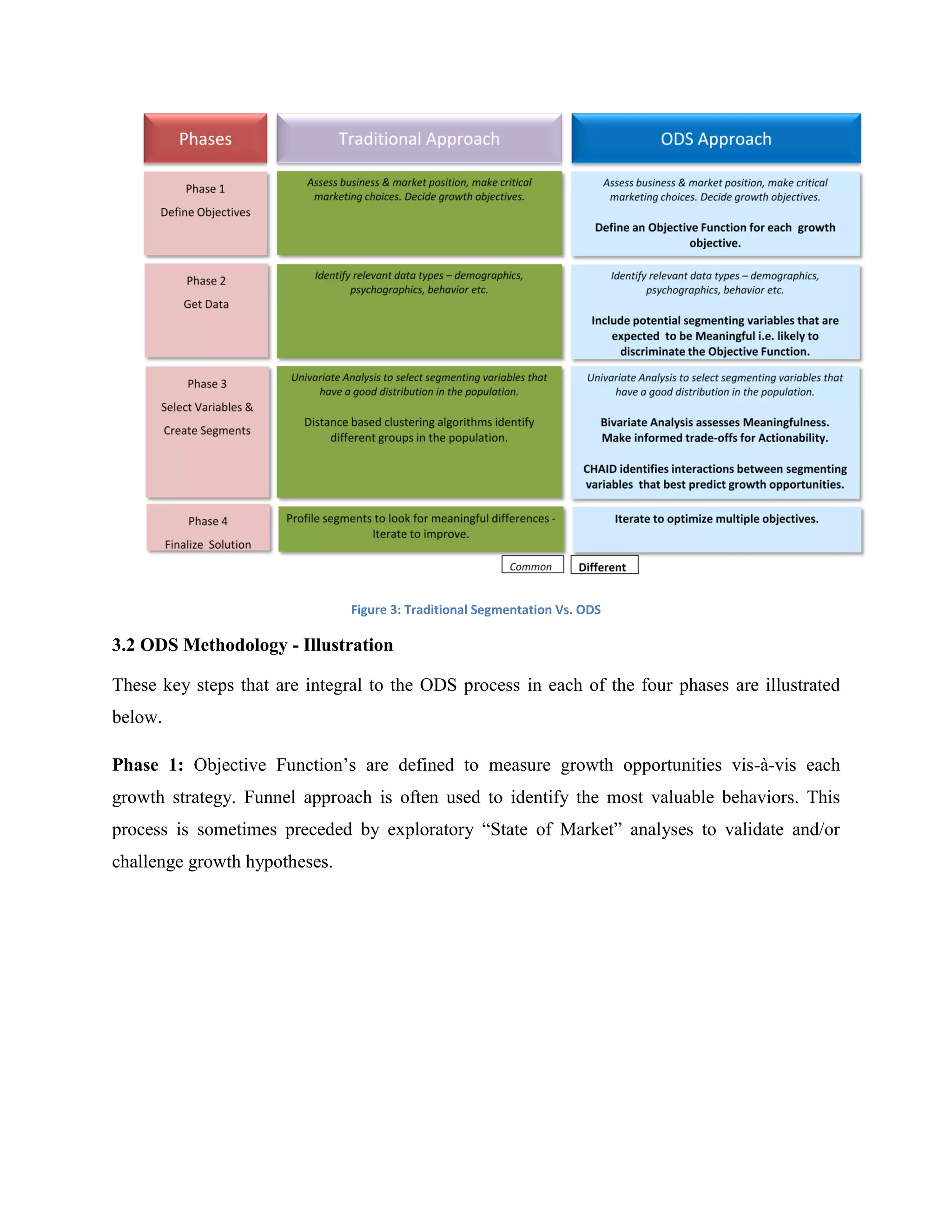
While the specific techniques used can vary depending on the application and context, the
common underlying principle is to define objective functions that represent growth strategies and
these objective functions then guide the selection and use of segmenting variables. The table
below articulates the four phases that are common to any segmentation exercise and lists key
differences of ODS vis-à-vis traditional approaches at each phase.
Figure 3: Traditional Segmentation Vs. ODS
3.2 ODS Methodology - Illustration
These key steps that are integral to the ODS process in each of the four phases are illustrated
below.
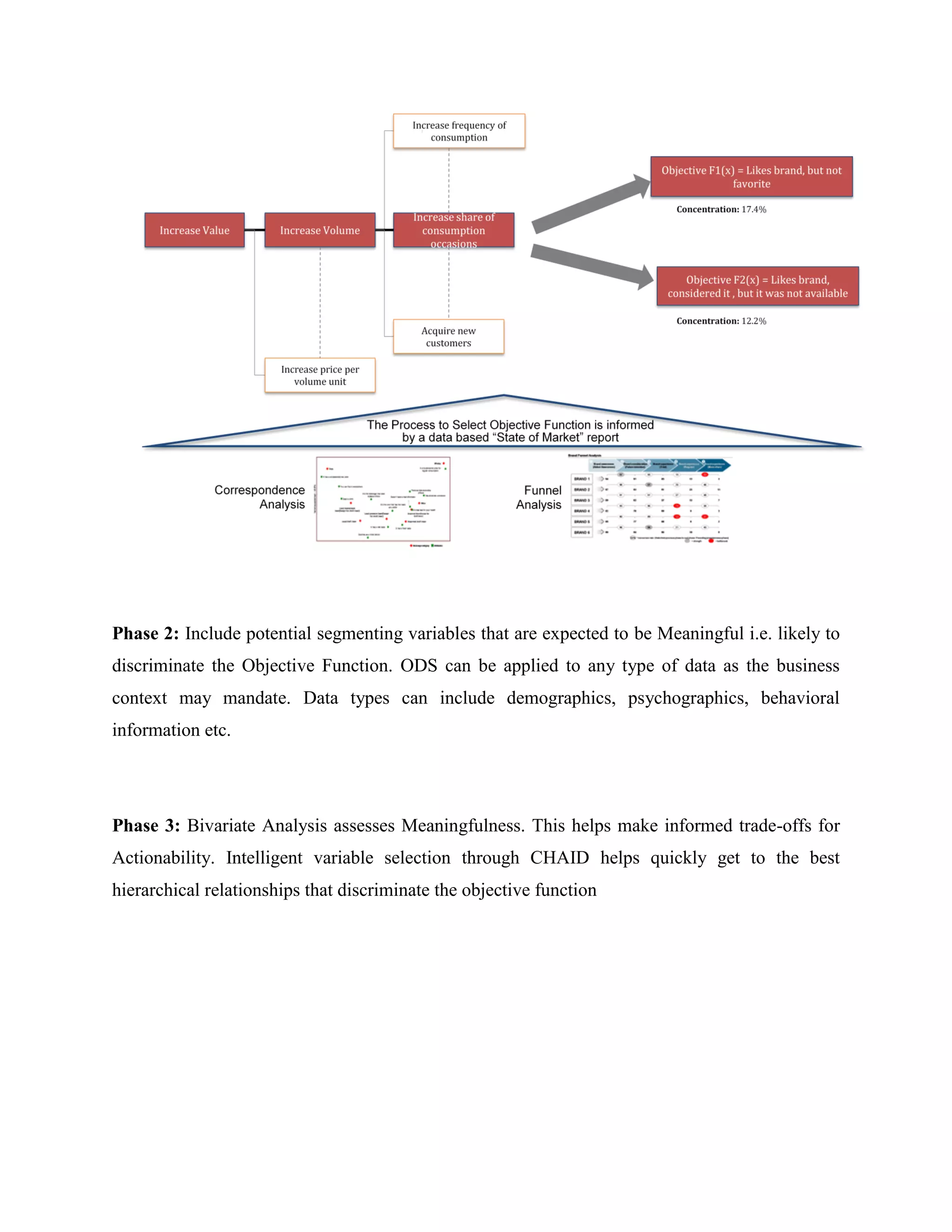
Phase 1: Objective Function‟s are defined to measure growth opportunities vis-à-vis each
growth strategy. Funnel approach is often used to identify the most valuable behaviors. This
process is sometimes preceded by exploratory “State of Market” analyses to validate and/or
challenge growth hypotheses.
Phase 2: Include potential segmenting variables that are expected to be Meaningful i.e. likely to
discriminate the Objective Function. ODS can be applied to any type of data as the business
context may mandate. Data types can include demographics, psychographics, behavioral
information etc.
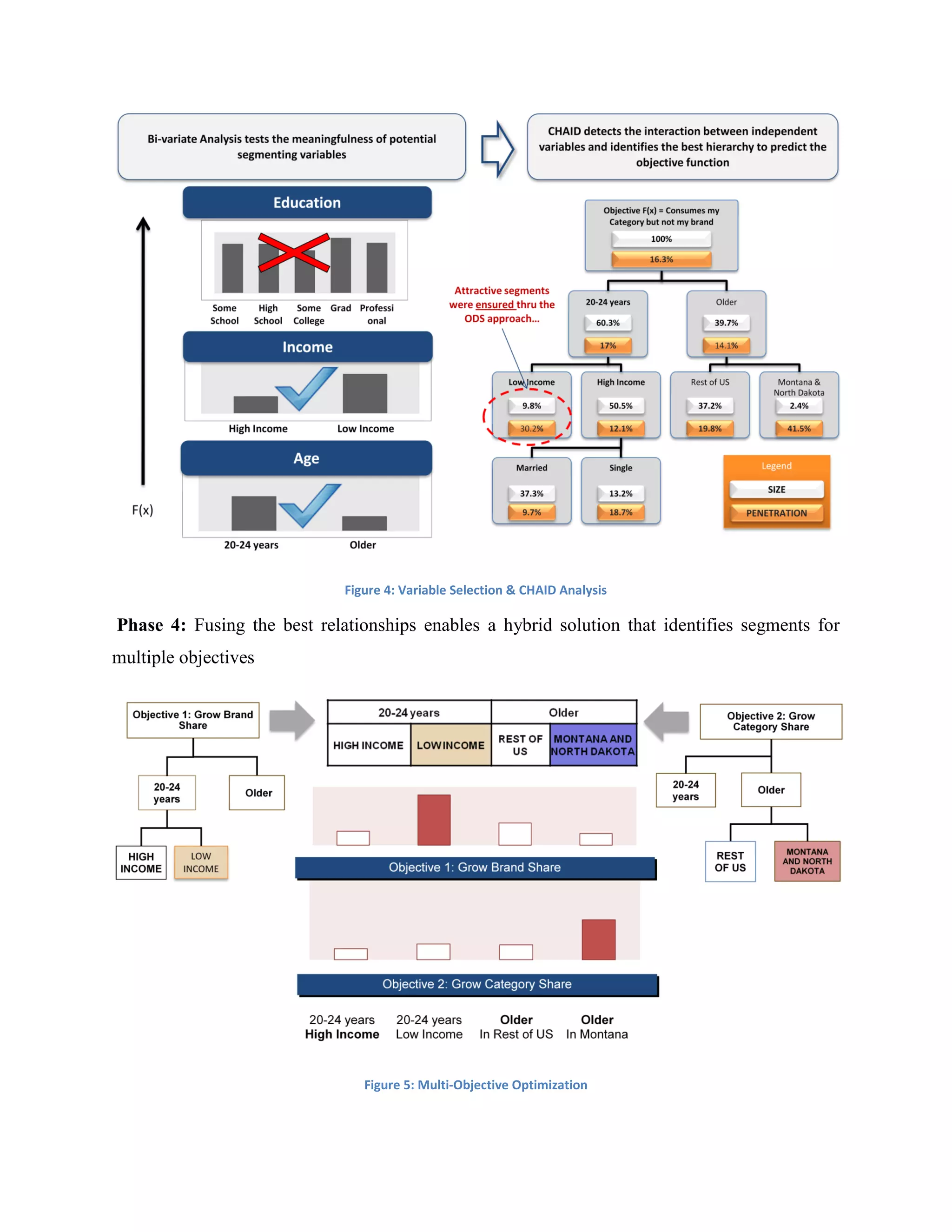
Phase 3: Bivariate Analysis assesses Meaningfulness. This helps make informed trade-offs for
Actionability. Intelligent variable selection through CHAID helps quickly get to the best
hierarchical relationships that discriminate the objective function
Figure 4: Variable Selection & CHAID Analysis
Phase 4: Fusing the best relationships enables a hybrid solution that identifies segments for
multiple objectives
Figure 5: Multi-Objective Optimization
Having understood the principles and core analytical elements of ODS, we now look at 2 case
studies that demonstrate:
- The versatility of this approach. We look at 2 diverse applications, one in the CPG
industry and another in the Hospitality services space
- The complexity of the business problems that can be tackled with this approach. While
the CPG case focuses on the application of ODS in portfolio strategy development, the
Hospitality case is in the context of creating the information backbone for enabling
targeted CRM promotions
- Value delivered across 5 continents and over 10 countries
4. CASE STUDY 1: CPG
Finding Opportunities for Organic Growth in International Beer Markets
4.1 Background to the case:
The client Brewers International (BI) is a large UK based global beer company. BI has more
operating companies and more diverse market positions than its competitors. Having participated
in the consolidation of the industry, BI now needed to move from M&A to organic growth.
In support of organic growth, an approach to market segmentation was needed that was:
• Purpose driven: Framing the market in terms of “where the money is” and focusing on
what the business wants to achieve.
• Incident based: Focussing on specific consumer/shopper occasions, because we believe
they behave differently on different occasions.
• Behavioural: It seeks to understand how consumers/shoppers behave, and then what
motivates behaviour, identifying what the business needs to change.
4.2 Approach & ODS Application:
In this context, consumer behavior is studied through market research involving diary based data
collection methodology.
Information is collected around 3 broad areas
General consumer information – Demographics, attitudes, media consumption habits, etc.
Consumption occasion details (Diary) – occasion characteristics, respondent behavior in
the occasion and reasons/ drivers for the same, etc.
Engagement with beer – Awareness/ consideration, consumption of different types and
brands of beer, favorite drinks, typical drinking patterns, etc.
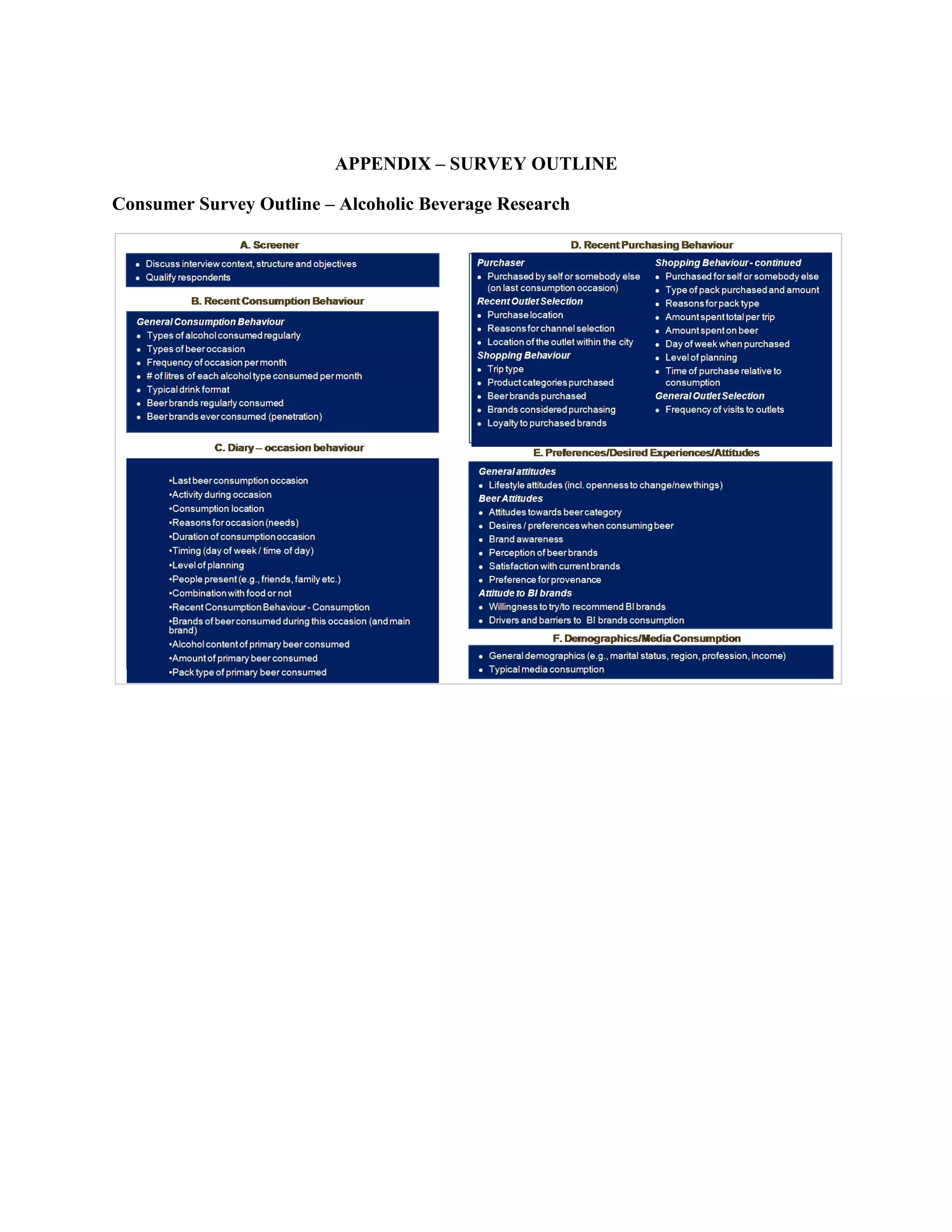
Refer to the appendix for a more detailed view of the contents of the questionnaire.
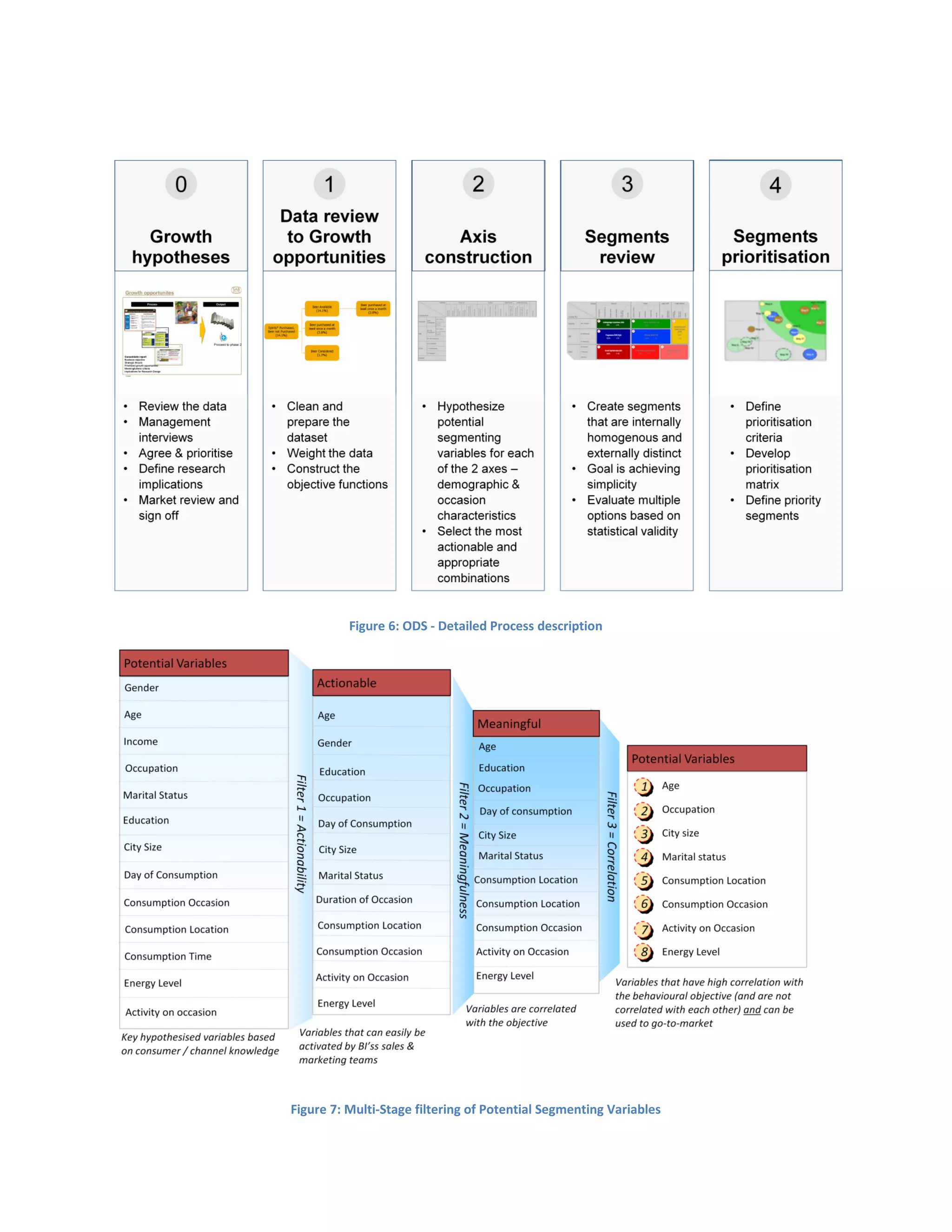
ODS is then applied through an iterative process between business ideas/needs and data validity
for effective variable selection:
Figure 6: ODS - Detailed Process description
Figure 7: Multi-Stage filtering of Potential Segmenting Variables
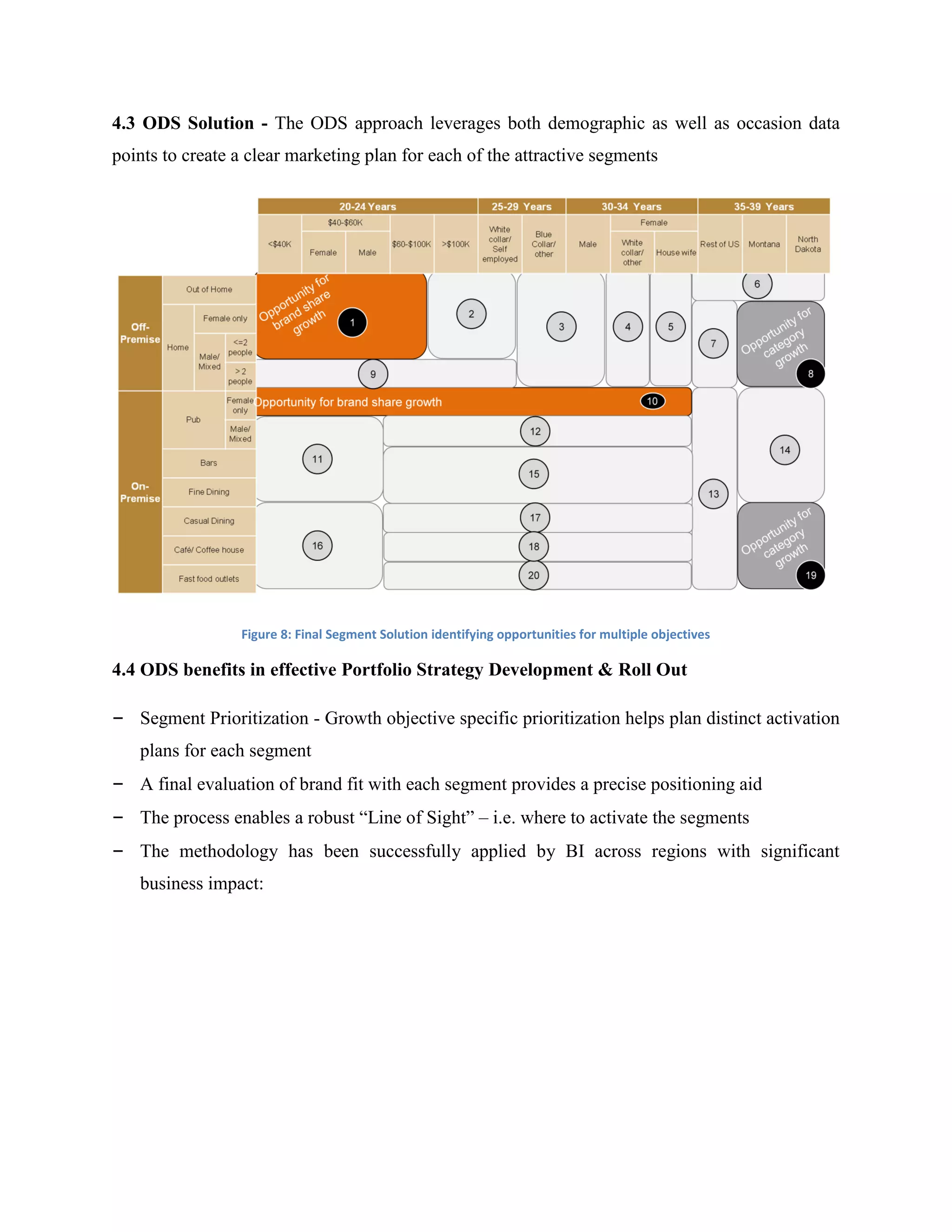
4.3 ODS Solution - The ODS approach leverages both demographic as well as occasion data
points to create a clear marketing plan for each of the attractive segments
Figure 8: Final Segment Solution identifying opportunities for multiple objectives
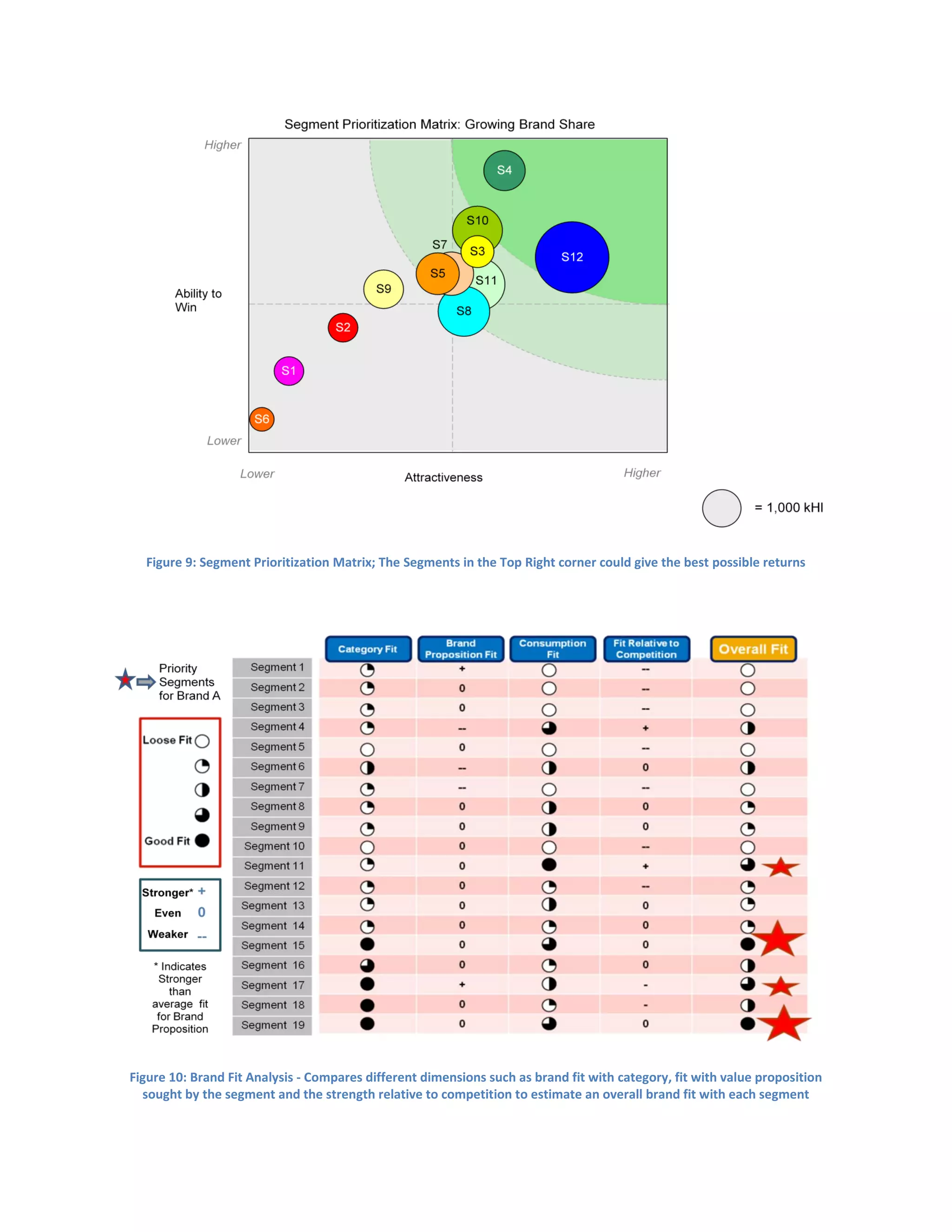
4.4 ODS benefits in effective Portfolio Strategy Development & Roll Out
– Segment Prioritization - Growth objective specific prioritization helps plan distinct activation
plans for each segment
– A final evaluation of brand fit with each segment provides a precise positioning aid
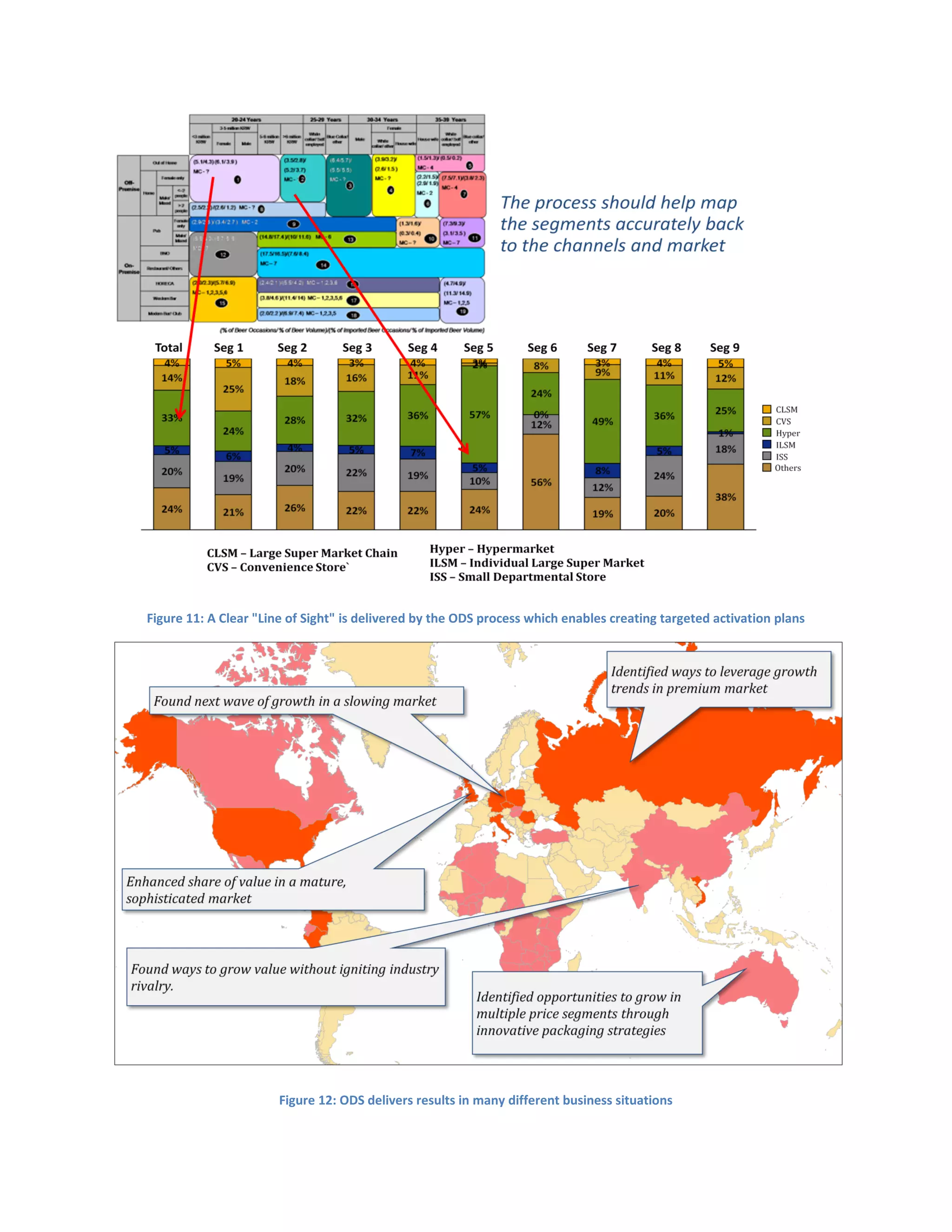
– The process enables a robust “Line of Sight” – i.e. where to activate the segments
– The methodology has been successfully applied by BI across regions with significant
business impact:
Figure 9: Segment Prioritization Matrix; The Segments in the Top Right corner could give the best possible returns
Figure 10: Brand Fit Analysis - Compares different dimensions such as brand fit with category, fit with value proposition
sought by the segment and the strength relative to competition to estimate an overall brand fit with each segment
Figure 11: A Clear "Line of Sight" is delivered by the ODS process which enables creating targeted activation plans
Figure 12: ODS delivers results in many different business situations
CASE STUDY 2: HOSPITALITY SERVICES
Developing a 3600
Guest Segmentation for effective CRM
5.1 Background
Hospitalities Inc (HI), a multi brand hotel conglomerate was looking to identify opportunities for
highly targeted campaigns and the ability to deliver the right offer from the right brand at the
right time.
HI was looking to create a segmentation framework that would help them transform the way they
communicated with their customers:
From:
– Top-down, brand-focused planning
– Mass appeal
– Invest according to current value
– Exclusively focused on Loyalty Program Members
To:
– Bottoms up, customer-focused planning
– Highly targeted promotions
– Invest according to growth opportunity
– Inclusive of members and non-members
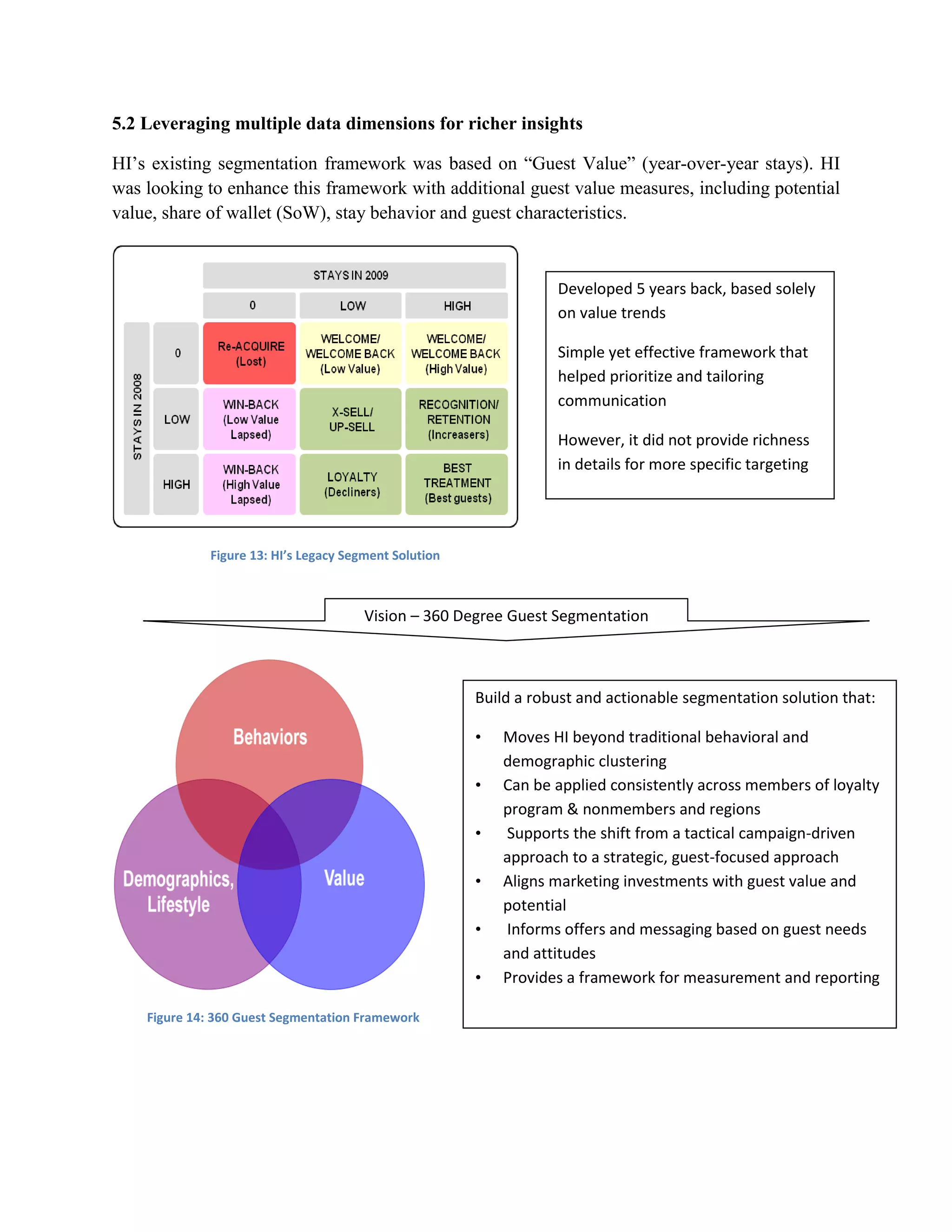
5.2 Leveraging multiple data dimensions for richer insights
HI‟s existing segmentation framework was based on “Guest Value” (year-over-year stays). HI
was looking to enhance this framework with additional guest value measures, including potential
value, share of wallet (SoW), stay behavior and guest characteristics.
Figure 13: HI’s Legacy Segment Solution
Figure 14: 360 Guest Segmentation Framework
Vision – 360 Degree Guest Segmentation
Developed 5 years back, based solely
on value trends
Simple yet effective framework that
helped prioritize and tailoring
communication
However, it did not provide richness
in details for more specific targeting
Build a robust and actionable segmentation solution that:
• Moves HI beyond traditional behavioral and
demographic clustering
• Can be applied consistently across members of loyalty
program & nonmembers and regions
• Supports the shift from a tactical campaign-driven
approach to a strategic, guest-focused approach
• Aligns marketing investments with guest value and
potential
• Informs offers and messaging based on guest needs
and attitudes
• Provides a framework for measurement and reporting
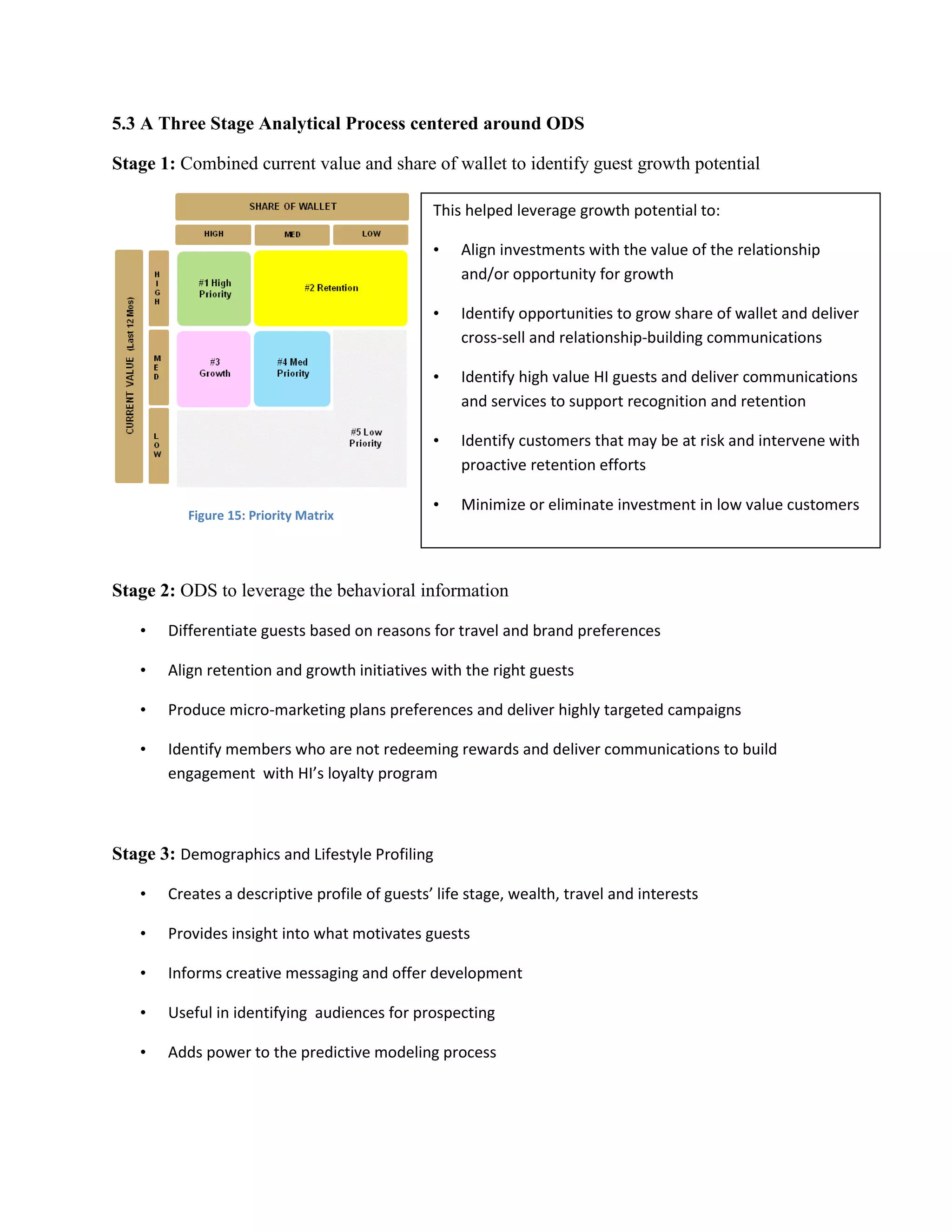
5.3 A Three Stage Analytical Process centered around ODS
Stage 1: Combined current value and share of wallet to identify guest growth potential
Figure 15: Priority Matrix
Stage 2: ODS to leverage the behavioral information
• Differentiate guests based on reasons for travel and brand preferences
• Align retention and growth initiatives with the right guests
• Produce micro-marketing plans preferences and deliver highly targeted campaigns
• Identify members who are not redeeming rewards and deliver communications to build
engagement with HI’s loyalty program
Stage 3: Demographics and Lifestyle Profiling
• Creates a descriptive profile of guests’ life stage, wealth, travel and interests
• Provides insight into what motivates guests
• Informs creative messaging and offer development
• Useful in identifying audiences for prospecting
• Adds power to the predictive modeling process
This helped leverage growth potential to:
• Align investments with the value of the relationship
and/or opportunity for growth
• Identify opportunities to grow share of wallet and deliver
cross-sell and relationship-building communications
• Identify high value HI guests and deliver communications
and services to support recognition and retention
• Identify customers that may be at risk and intervene with
proactive retention efforts
• Minimize or eliminate investment in low value customers
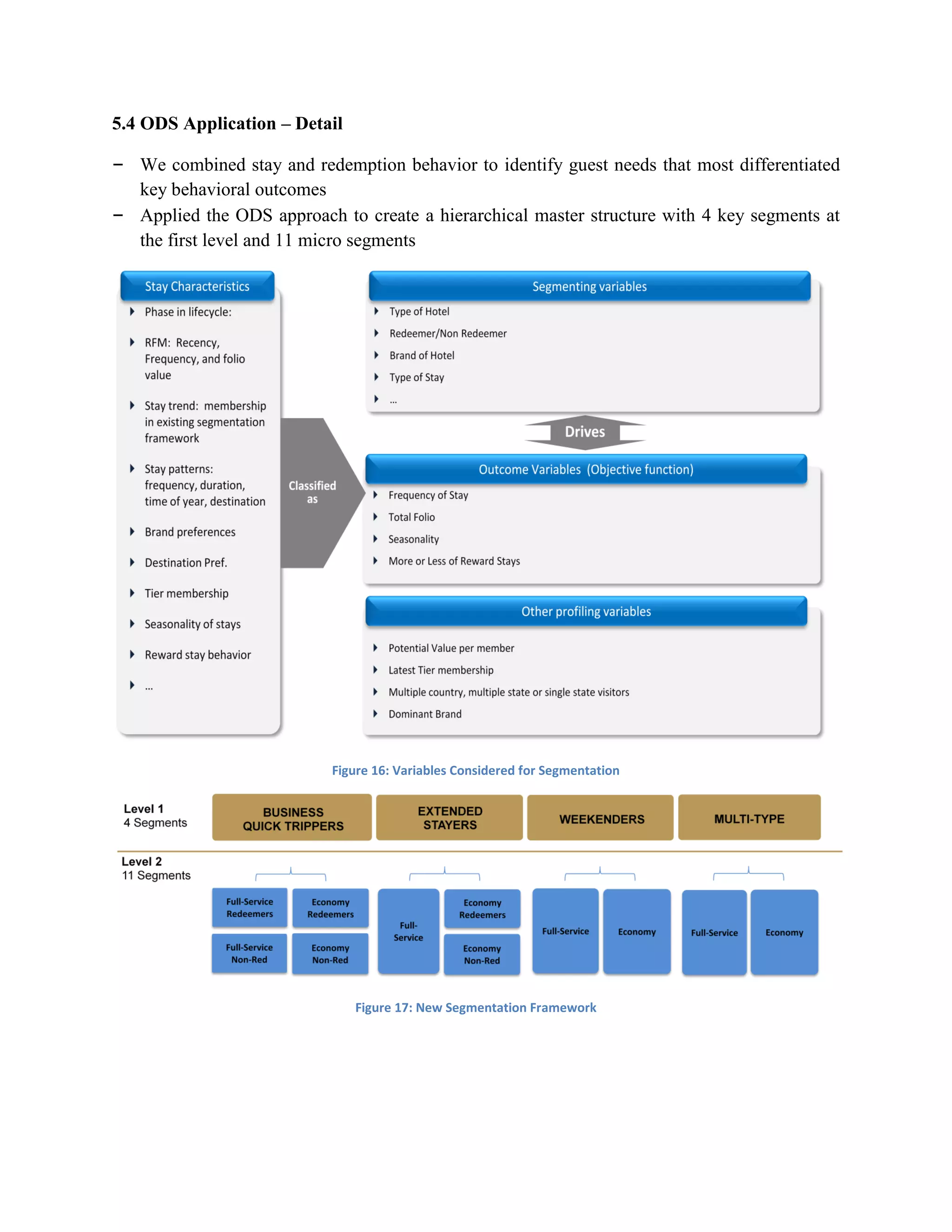
5.4 ODS Application – Detail
– We combined stay and redemption behavior to identify guest needs that most differentiated
key behavioral outcomes
– Applied the ODS approach to create a hierarchical master structure with 4 key segments at
the first level and 11 micro segments
Figure 16: Variables Considered for Segmentation
Figure 17: New Segmentation Framework
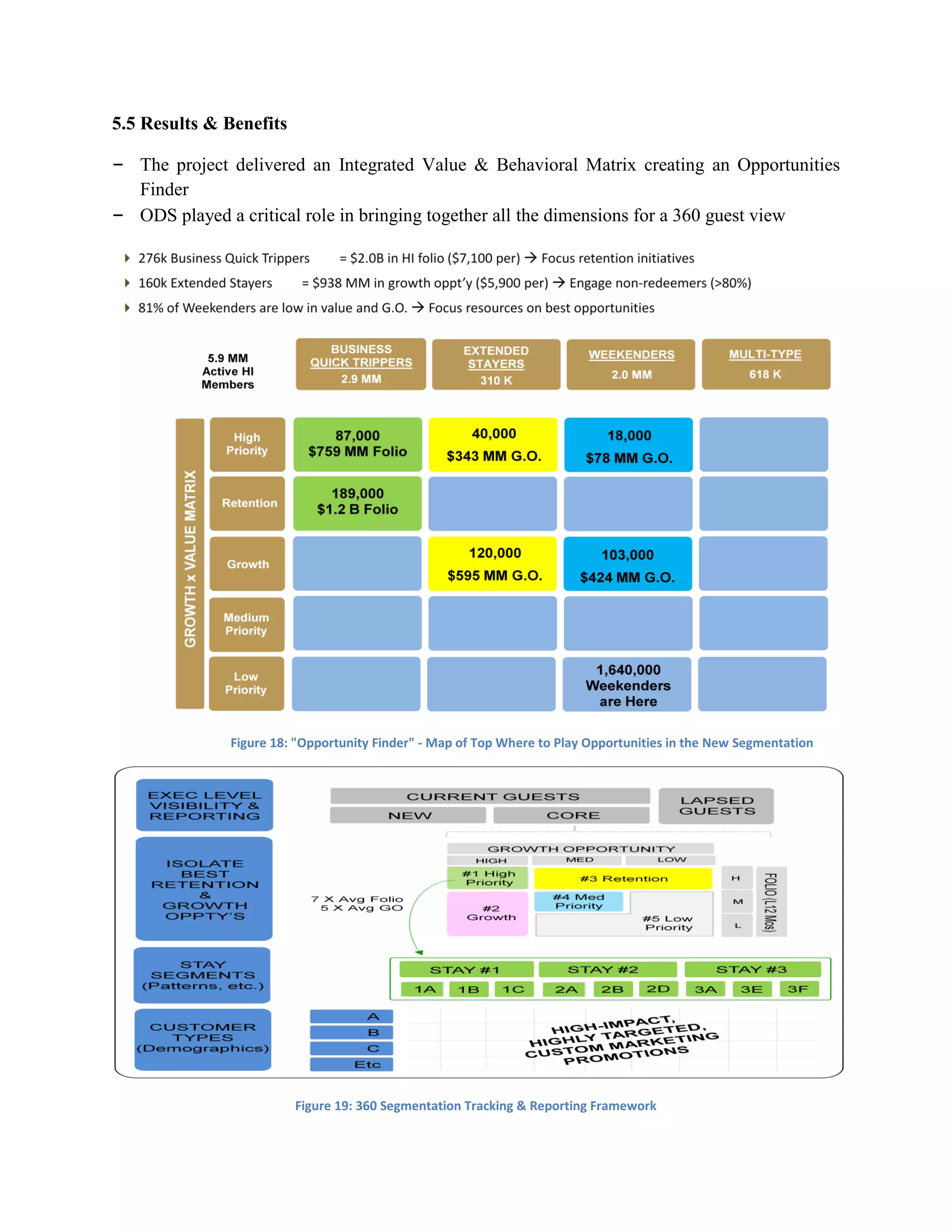
5.5 Results & Benefits
– The project delivered an Integrated Value & Behavioral Matrix creating an Opportunities
Finder
– ODS played a critical role in bringing together all the dimensions for a 360 guest view
Figure 18: "Opportunity Finder" - Map of Top Where to Play Opportunities in the New Segmentation
Figure 19: 360 Segmentation Tracking & Reporting Framework
5. ODS IMPLEMENTATION GUIDELINES
5.1 When to Use ODS? ODS is right for you is you can hear yourself saying some of the
following…
o “We know what we want to do to grow the business, but we don‟t know where to
find my most attractive customers”
o “We know who are the customers most likely to buy our product, but we don‟t
know how to prioritize in order to achieve growth targets”
o “We have a global presence; we want to establish a common basis for marketing
strategy that we can apply across countries and track results accurately”
5.2 Key Implementation Choices
o Static vs. Dynamic solutions – “How to build a solution that can be periodically
tweaked to accommodate emerging consumer trends?”
o Standardized vs. Adaptable solutions - How to set up a standardized template
across markets while having the flexibility to improvise according to local market
requirements?
Over the years, AbsolutData has developed a rich understanding and strong capability in
implementing ODS.
APPENDIX – SURVEY OUTLINE
Consumer Survey Outline – Alcoholic Beverage Research
ACKNOWLEDGEMENTS
We express our sincere gratitude to Mr. Anil Kaul, CEO, AbsolutData Research and Analytics,
for his able guidance, continuous support and cooperation throughout our work, without which
this would not have been possible.
We would also like to thank the entire team of Human Resources, AbsolutData Research and
Analytics for the constant support and help in the successful completion of our paper.
Also, we are thankful to our colleagues at AbsolutData Research and Analytics, for their
continued guidance and invaluable encouragement.
Finally, we also wish to thank the organizers at Indian Institute of Management, Ahmedabad for
the opportunity to present this body of work.

Objective Driven Segmentation

  • 1.
    Building Impactful SegmentsUsing Defined Objective Functions Objective Driven Segmentation (ODS) By Guha Athreya Gurgaon, Haryana-122002 Email: guha.athreya@absolutdata.com Vamsi Krishna Gurgaon, Haryana-122002 Email: vamsi.krishna@absolutdata.com
  • 2.
    TABLE OF CONTENTS Abstract…………………………………………………………………………………..3 1) Introduction to Objective Driven Segmentation (ODS) ……..………………………….. 4 2) What does ODS deliver? ………………………………………………………………… 5 3) ODS Approach & Methodology Illustration…………………………………………….. 6 4) Case Study 1 – CPG ……………….……………………………………………………. 11 5) Case Study 2 – Hospitality Services ……………………………………………………. 16 6) Implementation Guidelines …………………………………………………………….. 21 Appendix………………………………………………………………………………… 22 Acknowledgements……………………………………………………………………. 23
  • 3.
    ABSTRACT Segmentation is awidely used marketing approach for solving a variety of business problems. In the case where the focus is to drive growth, an impactful segmentation must clearly identify what are the key consumer and customer behaviours that we need to leverage or change in order to drive towards the growth goals. Objective Driven Segmentation (ODS) ensures that people within a given market segment are likely to respond similarly to defined marketing strategies. It provides a heat map of opportunities that informs decisions of “Where to Play” vis-à-vis each growth objective. The ODS approach is one of defining objective functions that represent growth strategies and these objective functions then guide the selection and use of segmenting variables. ODS uses a multitude of techniques including but not limited to Univariate, Bivariate Analyses as well as Multivariate Techniques including Correspondence Analysis, CHAID etc. This paper provides a detailed understanding of the context & principles of ODS as well as the analytical approach to applying ODS. We look at two case studies - a multi brand beverage manufacturer & a hospitality giant; to understand and value delivered by ODS. Keywords: predictive analytics, marketing effectiveness, portfolio strategy, targeted CRM, hospitality services, CPG
  • 4.
    1. INTRODUCTION TOOBJECTIVE DRIVEN SEGMENTATION 1.1 Background Segmentation is a widely used marketing approach for solving a variety of business problems. The purpose of segmentation is sometimes to explore and better understand the market landscape. However, we often have a lot of prior knowledge and research and the business goal is very specific - such as growing market share, slowing decline in a mature category, growing value etc. In the case where the focus is to drive growth, a good segmentation should provide a „Where to Play‟ map for finding value and growth in the consumer and customer market for the whole business. To support organic growth, a good segmentation solution must link directly to the growth strategies, show opportunities and gaps in the market-place, create guidance for brand managers about where the brand needs to win & directly link to the activation activities in-market 1.2 Issue More often than not, growth strategies aim to change consumer and customer behaviour. To enable the execution of such growth strategies, an impactful segmentation must clearly identify what are the key behaviours that we need to change in order to drive towards the growth goals. Segmentation traditionally involves using consumer data in statistical techniques and seeing how it clusters. While this is a good way to understand market landscape, these approaches cannot guarantee identification of the best opportunities to achieve defined growth objectives. In the past, a small number of approaches have been developed for ensuring the most effective variable selection for segmentation but these approaches have not allowed the objective of segmentation to affect the selection and use of variables. 1.3 Resolution In the case where the focus is to drive growth, we recommend using a more advanced approach - Objective Driven Segmentation (ODS). ODS ensures that people within a given market segment are likely to respond similarly to defined marketing strategies. It provides a heat map of opportunities that informs decisions of “Where to Play” vis-à-vis each growth objective.
  • 5.
    2. WHAT DOESODS DELIVER? ODS is purpose driven. It aims to: Articulate the “from and to” of objectives in the context of the businesses strategic thrusts Create a common language for communicating about markets cross-functionally (e.g. between sales and trade marketing and brand marketing) Forms an information backbone for the planning cycle that allows one to trace strategy choices, through planning, implementation and measurement In order to do this, ODS frames the market in terms of “where the money is” and focuses on what the business wants to achieve. It ensures 3 critical outcomes that make a segmentation solution impactful. Figure 1: Ideal Segmentation Outcomes 1. Segments are meaningful i.e. they vary in their relevance vis-à-vis growth objectives 2. The resulting solution is highly actionable; It provides a line of sight that enables the marketer to measure and manage the impact of marketing choices at every stage of the route to market 3. The ODS process allows for creating a segmentation solution that can be used to identify and exploit multiple growth opportunities
  • 6.
    3. ODS APPROACH& METHODOLOGY ILLUSTRATION 3.1 The ODS Approach The process to create impactful segments requires that business questions be addressed in the correct sequence using appropriate analytical techniques. In this process, ODS uses of a multitude of multivariate techniques & exploratory data analysis techniques. This is illustrated below: Figure 2: ODS Process Overview While the specific techniques used can vary depending on the application and context, the common underlying principle is to define objective functions that represent growth strategies and these objective functions then guide the selection and use of segmenting variables. The table below articulates the four phases that are common to any segmentation exercise and lists key differences of ODS vis-à-vis traditional approaches at each phase.
  • 7.
    Figure 3: TraditionalSegmentation Vs. ODS 3.2 ODS Methodology - Illustration These key steps that are integral to the ODS process in each of the four phases are illustrated below. Phase 1: Objective Function‟s are defined to measure growth opportunities vis-à-vis each growth strategy. Funnel approach is often used to identify the most valuable behaviors. This process is sometimes preceded by exploratory “State of Market” analyses to validate and/or challenge growth hypotheses.
  • 8.
    Phase 2: Includepotential segmenting variables that are expected to be Meaningful i.e. likely to discriminate the Objective Function. ODS can be applied to any type of data as the business context may mandate. Data types can include demographics, psychographics, behavioral information etc. Phase 3: Bivariate Analysis assesses Meaningfulness. This helps make informed trade-offs for Actionability. Intelligent variable selection through CHAID helps quickly get to the best hierarchical relationships that discriminate the objective function
  • 9.
    Figure 4: VariableSelection & CHAID Analysis Phase 4: Fusing the best relationships enables a hybrid solution that identifies segments for multiple objectives Figure 5: Multi-Objective Optimization
  • 10.
    Having understood theprinciples and core analytical elements of ODS, we now look at 2 case studies that demonstrate: - The versatility of this approach. We look at 2 diverse applications, one in the CPG industry and another in the Hospitality services space - The complexity of the business problems that can be tackled with this approach. While the CPG case focuses on the application of ODS in portfolio strategy development, the Hospitality case is in the context of creating the information backbone for enabling targeted CRM promotions - Value delivered across 5 continents and over 10 countries
  • 11.
    4. CASE STUDY1: CPG Finding Opportunities for Organic Growth in International Beer Markets 4.1 Background to the case: The client Brewers International (BI) is a large UK based global beer company. BI has more operating companies and more diverse market positions than its competitors. Having participated in the consolidation of the industry, BI now needed to move from M&A to organic growth. In support of organic growth, an approach to market segmentation was needed that was: • Purpose driven: Framing the market in terms of “where the money is” and focusing on what the business wants to achieve. • Incident based: Focussing on specific consumer/shopper occasions, because we believe they behave differently on different occasions. • Behavioural: It seeks to understand how consumers/shoppers behave, and then what motivates behaviour, identifying what the business needs to change. 4.2 Approach & ODS Application: In this context, consumer behavior is studied through market research involving diary based data collection methodology. Information is collected around 3 broad areas General consumer information – Demographics, attitudes, media consumption habits, etc. Consumption occasion details (Diary) – occasion characteristics, respondent behavior in the occasion and reasons/ drivers for the same, etc. Engagement with beer – Awareness/ consideration, consumption of different types and brands of beer, favorite drinks, typical drinking patterns, etc. Refer to the appendix for a more detailed view of the contents of the questionnaire. ODS is then applied through an iterative process between business ideas/needs and data validity for effective variable selection:
  • 12.
    Figure 6: ODS- Detailed Process description Figure 7: Multi-Stage filtering of Potential Segmenting Variables
  • 13.
    4.3 ODS Solution- The ODS approach leverages both demographic as well as occasion data points to create a clear marketing plan for each of the attractive segments Figure 8: Final Segment Solution identifying opportunities for multiple objectives 4.4 ODS benefits in effective Portfolio Strategy Development & Roll Out – Segment Prioritization - Growth objective specific prioritization helps plan distinct activation plans for each segment – A final evaluation of brand fit with each segment provides a precise positioning aid – The process enables a robust “Line of Sight” – i.e. where to activate the segments – The methodology has been successfully applied by BI across regions with significant business impact:
  • 14.
    Figure 9: SegmentPrioritization Matrix; The Segments in the Top Right corner could give the best possible returns Figure 10: Brand Fit Analysis - Compares different dimensions such as brand fit with category, fit with value proposition sought by the segment and the strength relative to competition to estimate an overall brand fit with each segment
  • 15.
    Figure 11: AClear "Line of Sight" is delivered by the ODS process which enables creating targeted activation plans Figure 12: ODS delivers results in many different business situations
  • 16.
    CASE STUDY 2:HOSPITALITY SERVICES Developing a 3600 Guest Segmentation for effective CRM 5.1 Background Hospitalities Inc (HI), a multi brand hotel conglomerate was looking to identify opportunities for highly targeted campaigns and the ability to deliver the right offer from the right brand at the right time. HI was looking to create a segmentation framework that would help them transform the way they communicated with their customers: From: – Top-down, brand-focused planning – Mass appeal – Invest according to current value – Exclusively focused on Loyalty Program Members To: – Bottoms up, customer-focused planning – Highly targeted promotions – Invest according to growth opportunity – Inclusive of members and non-members
  • 17.
    5.2 Leveraging multipledata dimensions for richer insights HI‟s existing segmentation framework was based on “Guest Value” (year-over-year stays). HI was looking to enhance this framework with additional guest value measures, including potential value, share of wallet (SoW), stay behavior and guest characteristics. Figure 13: HI’s Legacy Segment Solution Figure 14: 360 Guest Segmentation Framework Vision – 360 Degree Guest Segmentation Developed 5 years back, based solely on value trends Simple yet effective framework that helped prioritize and tailoring communication However, it did not provide richness in details for more specific targeting Build a robust and actionable segmentation solution that: • Moves HI beyond traditional behavioral and demographic clustering • Can be applied consistently across members of loyalty program & nonmembers and regions • Supports the shift from a tactical campaign-driven approach to a strategic, guest-focused approach • Aligns marketing investments with guest value and potential • Informs offers and messaging based on guest needs and attitudes • Provides a framework for measurement and reporting
  • 18.
    5.3 A ThreeStage Analytical Process centered around ODS Stage 1: Combined current value and share of wallet to identify guest growth potential Figure 15: Priority Matrix Stage 2: ODS to leverage the behavioral information • Differentiate guests based on reasons for travel and brand preferences • Align retention and growth initiatives with the right guests • Produce micro-marketing plans preferences and deliver highly targeted campaigns • Identify members who are not redeeming rewards and deliver communications to build engagement with HI’s loyalty program Stage 3: Demographics and Lifestyle Profiling • Creates a descriptive profile of guests’ life stage, wealth, travel and interests • Provides insight into what motivates guests • Informs creative messaging and offer development • Useful in identifying audiences for prospecting • Adds power to the predictive modeling process This helped leverage growth potential to: • Align investments with the value of the relationship and/or opportunity for growth • Identify opportunities to grow share of wallet and deliver cross-sell and relationship-building communications • Identify high value HI guests and deliver communications and services to support recognition and retention • Identify customers that may be at risk and intervene with proactive retention efforts • Minimize or eliminate investment in low value customers
  • 19.
    5.4 ODS Application– Detail – We combined stay and redemption behavior to identify guest needs that most differentiated key behavioral outcomes – Applied the ODS approach to create a hierarchical master structure with 4 key segments at the first level and 11 micro segments Figure 16: Variables Considered for Segmentation Figure 17: New Segmentation Framework
  • 20.
    5.5 Results &Benefits – The project delivered an Integrated Value & Behavioral Matrix creating an Opportunities Finder – ODS played a critical role in bringing together all the dimensions for a 360 guest view Figure 18: "Opportunity Finder" - Map of Top Where to Play Opportunities in the New Segmentation Figure 19: 360 Segmentation Tracking & Reporting Framework
  • 21.
    5. ODS IMPLEMENTATIONGUIDELINES 5.1 When to Use ODS? ODS is right for you is you can hear yourself saying some of the following… o “We know what we want to do to grow the business, but we don‟t know where to find my most attractive customers” o “We know who are the customers most likely to buy our product, but we don‟t know how to prioritize in order to achieve growth targets” o “We have a global presence; we want to establish a common basis for marketing strategy that we can apply across countries and track results accurately” 5.2 Key Implementation Choices o Static vs. Dynamic solutions – “How to build a solution that can be periodically tweaked to accommodate emerging consumer trends?” o Standardized vs. Adaptable solutions - How to set up a standardized template across markets while having the flexibility to improvise according to local market requirements? Over the years, AbsolutData has developed a rich understanding and strong capability in implementing ODS.
  • 22.
    APPENDIX – SURVEYOUTLINE Consumer Survey Outline – Alcoholic Beverage Research
  • 23.
    ACKNOWLEDGEMENTS We express oursincere gratitude to Mr. Anil Kaul, CEO, AbsolutData Research and Analytics, for his able guidance, continuous support and cooperation throughout our work, without which this would not have been possible. We would also like to thank the entire team of Human Resources, AbsolutData Research and Analytics for the constant support and help in the successful completion of our paper. Also, we are thankful to our colleagues at AbsolutData Research and Analytics, for their continued guidance and invaluable encouragement. Finally, we also wish to thank the organizers at Indian Institute of Management, Ahmedabad for the opportunity to present this body of work.