WILMINGTON HISTORICAL SOCIETY
Objective Able
Summary Of The Battle For Hill 673
Vicente Jurado Jr.
9/22/2014
Thispaperis a summary writtenwiththe intentionof helpingcaseworkersandinvestigatorsto
understandwhere the incidentwhereMr.RobertoSerranoperformedhisactsthat saw himawarded
the NavyCross. The paperalthoughitis notthe firstthatdealswithHill 673 itbuildsonpreviouswork
and addsnew informationthatcame aboutas I investigatedMr.Serranoand the Hill.
Jurado1
For the reader to have an easy time understanding the positions of Hill 673 when reading
the Marine Historical Diaries, which are primary sources, included are the Marine coordinates
that were used to identify the hill. “DT 296443, the western slope of Hill 673.”1 Hill 673 appears
in another Historical diary as being in the area of TA-2944.2 TA-2944 along with letters after the
2944 designation such as TA-2944-X are also part of the Hill. Hill 673 also appears as
(DT2944S), High ground (DT2844S) in the 7th Marine Regiment diary for September 1951.3
Hill 673 located in an area known as Kanmubong Ridge was the scene of some of the
hardest fighting, which was the norm in the area known as the Punchbowl in late 1951, located
near Soyang River. Hill 673 received designation from its height in meters above sea level.4 The
areas that the Marines faced in Kanmubong Ridge were ideal defensive positions for the
communist forces.5 Three enemy positions, Hills 812, 980, and 1052 dominated Kanmubong
Ridge.6 The primary purpose by the Marines in securing Kanmubong was because it would give
access to the main NKPA defense line, some 4,000 yards to the north.7 The Marines were not
only up against well-entrenched bunkers in a strategically organized defensive terrain. Before the
1 .) United States Marine Corps History Division, United States Marine Corps, 1ST MARINE DIVISION -
HISTORICAL DIARY - SEPTEMBER 1951 , 1st Marine Division, National Archives and Records Administration,
College Park, Maryland, Editor Hal Baker, Korean War Project Record: USMC-1183
CD: 15, Korean War Project, P.O. Box 180190,Dallas, TX 75218-0190,
http://www.koreanwar.org/html/usmc_korean_war_records_unit.html?pid=1 (Accessed October 21, 2013), 10
The Historical Diaries files at times don’t contain page numbers on the bottomor top. So I have to rely on the page
number that the PDF file gives.
2.) United States Marine Corps History Division, United States Marine Corps , 7TH MARINE REGIMENT - 1ST
BATTALION - HISTORICAL DIARY - SEPTEMBER 1951, 1st Marine Division, RG 127, National Archives and
Records Administration, College Park, Maryland, Editor Hal Baker, Korean War Project Record: USMC-2321
CD: 23 , Korean War Project, P.O. Box 180190, Dallas, TX 75218-0190,
http://www.koreanwar.org/html/usmc_korean_war_records_unit.html?pid=84 (Accessed August 10, 2014), 6
3.)United States Marine Corps History Division, United States Marine Corps, 7TH MARINE REGIMENT -
HISTORICAL DIARY – SEPTEMBER 1951, 1st Marine Division, RG 127, National Archives and Records
Administration, College Park, Maryland, Editor Hal Baker, Korean War Project Record: USMC-2290
CD: 22, Korean War Project, P.O. Box 180190,Dallas, TX 75218-0190,
http://www.koreanwar.org/html/usmc_korean_war_records_unit.html?pid=83 (Accessed October21, 2013),46
4.)Brigadier General Edwin H Simmons, USMC (Ret.), Frozen Chosin: U.S. Marines At The Changjin Reservoir,
Ed. by Charles R. Smith, U.S. Marinesin the Korean War (History Division
United States Marine Corps, Washington,D.C., 2007), P. 224
5.) LYNN MONTROSS MAJOR HUBARD D. KUOKKA, USMC and MAJOR NORMAN W. HICKS, USMC
U.S. MARINE OPERATIONS IN KOREA 1950-1953 VOLUME IV The East-Central Front (Historical Branch, G-3
Headquarters, U. S. Marine Corps, Washington,D. C.,1962 ), 183
6.) U. S. MARINE OPERATIONS IN KOREA 1950-1953 VOLUME IV The East-Central Front P. 183
7.) U. S. MARINE OPERATIONS IN KOREA 1950-1953 VOLUME IV The East-Central Front P. 183
Jurado2
Marines could reach Hills 812, 980, and 1052 it first had to deal with hills such as 673. The
enemy had sent some of its best soldiers to maintain the defenses on the enemy held hills.
“NKPA III Corps—was one of the largest (30,000 soldiers) and best-trained in the North
Korean army. Unlike the Chinese, the North Koreans had plenty of artillery, too, out-numbering
Marine artillery pieces in the Punchbowl sector.”8 The Marines not only had to worry about
difficult terrain but had to contend with a large enemy force that was well armed. Furthermore,
the North Koreans were behind defenses that were tough to capture due to having to climb hills
on open ground that left them vulnerable to North Korean fire. The Marines faced the 2nd
Regiment, 1st Div. III NK Corps who occupied Hills 673 and 749 with 1,500 men.9
On September 1, 1951, the 1 Battalion 7th Marines positioned themselves near Hill 673.10
They immediately began to consolidate forces and started patrol operations to gather intelligence
on enemy forces in the region and to obtain information on the defenses on Hill 673.11 B
Company known as Baker Company began observing hill 673 and enemy movements. From the
observations by B Company, artillery was called on hill 673. The result was 2 KIA or Killed In
Action, 15 WIA or wounded in action “plus 14 other KIA observed by A Company known as
Able Company.”12
8.) Colonel Allan R. Millett, U.S. Marine Corps Reserve, Retired, DRIVE NORTH
U.S. Marines at the Punchbowl, Ed. By Charles R. Smith, U.S. Marines in the Korean War, (History Division
United States Marine Corps, Washington,D.C., 2007), 455
9.) 7TH MARINE REGIMENT - HISTORICAL DIARY – SEPTEMBER 1951, 46,
10 .) 7TH MARINE REGIMENT - 1ST BATTALION - HISTORICAL DIARY - SEPTEMBER 1951, 6
I came to the conclusion that was date of the first day that marines were near Hill 673 after comparing the vicinity
coordinate designations given for day entries.
11 .) 7TH MARINE REGIMENT - 1ST BATTALION - HISTORICAL DIARY -SEPTEMBER 1951,6
8.) 7TH MARINE REGIMENT - 1ST BATTALION - HISTORICAL DIARY -SEPTEMBER 1951, 6
Jurado3
The 1st Battalion began to consolidate terrain on September 2 that was going to be used as
defensive positions and which would continue until September 9.13 Patrol operations continued
from the previous day of September 1, up to September 11.14 These patrols often ran into NKPA
forces and resulted in firefights. During one of these patrols on September 7 by a platoon of A
Company on Hill 673 at the vicinity of TA-2944-S, the patrol was ambushed. A squad was cut
off; eight men remained behind of which 6 returned.15 A platoon of B Company covered the
withdrawal of the patrol.16 Navy Corpsman Robert C. Wagner, who was attached to the patrol,
would play an immense part in making sure that 2of the six men returned back to friendly lines.
Mr. Wagner treated these two men who were wounded and stayed with them for 40 hrs. a few
yards from enemy positions until all three could move back to friendly lines.17 The bravery that
was shown by Mr. Wagner to save and care for wounded Marines would not be the last act
performed by Hospital Corpsman on Hill 673 on the days to come. Starting on September 3 and
ending on September 10, 1951 the 1st Battalion received artillery and mortar fire. The worst day
that 1st Battalion Marines experienced according to the historical diary was September 10, 1951,
approximately 253 rounds of mortar and artillery fire from Hill 673 targeted Marine positions.18
At 11:20 A.M on September 10 all units learned that the attack would begin at 3:00 A.M. the
following day.19
13.) 7TH MARINE REGIMENT - 1ST BATTALION - HISTORICAL DIARY -SEPTEMBER 1951,6-8
14.) 7TH MARINE REGIMENT - 1ST BATTALION - HISTORICAL DIARY -SEPTEMBER 1951,6-8
15 .) 7TH MARINE REGIMENT - 1ST BATTALION - HISTORICAL DIARY - SEPTEMBER 1951, 8
16.) 7TH MARINE REGIMENT - 1ST BATTALION - HISTORICAL DIARY - SEPTEMBER 1951, 9
17.) Navy Cross Citation of Robert C. Wagner. http://projects.militarytimes.com/citations-medals-
awards/recipient.php?recipientid=5879 (Accessed August 11,2014)
18.) 7TH MARINE REGIMENT - 1ST BATTALION - HISTORICAL DIARY -SEPTEMBER 1951,8
19.) 1ST MARINE DIVISION - HISTORICAL DIARY - SEPTEMBER 1951, 13
Jurado4
“The division planned to attack with the 7th Marines on the right to seize Hill 673, DT
2944 and Hill 749, DT 2945.”20 H Company known as How from the 3 Battalion, 7th Marine
regiment moved at 2:30 A.M. on September 11 to seize its objective. 21 At 3:00 A.M Marines
from H Company moved, and those that followed from 7th Regiment had to deal against the
elements. The night was very dark, and rain had made the ground into mud.22 On Hill 673, the 1st
Battalion elements of B Company was in the lead. “A Company in close support. C Company or
Charlie Company in close reserve.”23 The reason to keep C Company in reserve was to have
fresh troops available if the Marines ran into heavy resistance and casualties. A and B
Companies faced stiff opposition from Hill 673 in the form of “very heavy small arms, automatic
weapons, artillery, mortar fire, hand grenades and anti -personne1 mines.”24 “Visibility was
extremely limited at 7:20 A.M. restricting the use of supporting arms.”25 There was dense fog
and low lying mist in the valleys as late as 10:00 A.M.26 The lack of supporting arms to the
Marines in the attack left them vulnerable in their assault operations to the North Korean
bunkers, and it’s defenders. “After an air strike, artillery fire and' three separate assaults, the 3rd
Battalion consolidated for the night 300 yards short of the Hill at DT 28443.”27
After keeping C company in reserve it was committed at 5:45 P.M. “C Company made a
night attack but ran- into a heavily mined booby trapped' area.28 All assault operations after C
20.) 1ST MARINE DIVISION - HISTORICAL DIARY - SEPTEMBER 1951 Korean War, 13
21 .) United States Marine Corps History Division, United States Marine Corps ,7TH MARINE REGIMENT - 3RD
BATTALION - HISTORICAL DIARY -SEPTEMBER 1951,1st Marine Division, RG 127, National Archives and
Records Administration, College Park, Maryland, Editor Hal Baker, Korean War Project Record: USMC-2390
CD: 23, P.O. Box 180190,Dallas, TX 75218-0190,
http://www.koreanwar.org/html/usmc_korean_war_records_unit.html?pid=87 (Accessed January 30, 2014), 7
22.)7TH MARINE REGIMENT - 3RD BATTALION - HISTORICAL DIARY -SEPTEMBER 1951, 7
23 .) 7TH MARINE REGIMENT - 1ST BATTALION - HISTORICAL DIARY - SEPTEMBER 1951,8
24.) 7TH MARINE REGIMENT - 1ST BATTALION - HISTORICAL DIARY - SEPTEMBER 1951,9
25.) 1ST MARINE DIVISION - HISTORICAL DIARY - SEPTEMBER 1951 Korean War. 14
26.) 1ST MARINE DIVISION - HISTORICAL DIARY - SEPTEMBER 1951 Korean War. 14
27.) 1ST MARINE DIVISION - HISTORICAL DIARY - SEPTEMBER 1951 Korean War. 14
28.) 7TH MARINE REGIMENT - 1ST BATTALION - HISTORICAL DIARY - SEPTEMBER 1951,9
Jurado5
Companies last assault stopped for the day. At 1835 military time or 6:35 P.M G Company
known as George Company of the 3 Battalion, 7th Marine Regiment reached the river near
DT2843.29 Since the company had reached their destination as the area was getting dark, it had to
stop. A perimeter defense had to be set so as not to be surprised by the enemy as it waited to
participate in assault operations. “G Company established a night position in a long irrigation
ditch in the vicinity of DT2843ST.” During the night Marines of G, Company received moderate
North Korean fire from76 mm. artillery and 82 mm mortar fire, as they waited to move once
again and begin assault operations.30 1st Platoon of G Company would move to provide support
to the assault on Hill 673
Hill 673 also known as Objective Able to the Marines was not captured on the first day of
the assault operation due to the strong defenses that were employed by the North Korean. The
defenses included a mix of bunkers, minefields, and trench systems that allowed the enemy to
move from bunker to bunker.31 “Each bunker system came ringed with mines and booby-traps,
and Korean mortar shells and grenades showered crippling fragments across every contested
position. Long-range heavy machine gun fire from higher up Kanmubong Ridge took its toll
among the Marine assault units that struggled forward with flamethrowers and satchel
charges.”32 The Marines had to carry 80 pounds of equipment in backpacks to the frontlines.33
As Eddie Le Baron of Baker Company related to John Nolan, who was a 1st Lt. of Baker
Company, 1st Platoon. “The NK’s interlocking fields of fire gave them complete control of the
29 .) 7TH MARINE REGIMENT - 3RD BATTALION - HISTORICAL DIARY - SEPTEMBER 1951, 8
30.) 7TH MARINE REGIMENT - 3RD BATTALION - HISTORICAL DIARY -SEPTEMBER 1951, 8
31 .) U. S. MARINE OPERATIONS IN KOREA 1950-1953 VOLUME IV The East-Central Front P. 183
32 .) U.S. Marines in the Korean War, 45
33 .) Harries-Clichy Peterson , Marine's view of Korea, Life Magazine, March 30, 1953,72
Jurado6
top of Hill 673.”34 For the Marines and Navy Corpsman they had experienced close combat on
Hill 673 which could be compared to the ferocious close combat that Americans had experienced
on Japanese occupied hills in the previous war.35Since the enemy proved to be tough to dislodge
from its defenses, a decision was made to get Marine reinforcements. “The 2nd Battalion, 7th
regiment was ordered to advance up the narrow valley to move under cover of darkness around
the left flank of 1/7 and into a position behind the enemy before wheeling to the northeast to trap
the North Koreans defending Hill 673.”36
By daybreak on 12 September the 2/7 had two platoons in position behind the enemy to
lead the attack.37 The 2/7 went forward to the crest of Hill 673 against confused and ineffectual
opposition. Griffin's battalion the 2/7 and Kelly’s 1/7 had the enemy between them, but both
battalions could not close with the enemy because of the minefields.38 “Grenades were the most
effective weapons as J. G. Kelly's men slugged their way to the summit at 1415 while 2/7 was
attacking Objective BAKER, Hill 749.”39
C Company, held in reserve for most of the time on the last day, led the attack at dawn on
Hill 673. A and B Companies which had taken the brunt of the assault on the previous day would
be supportive of C Company.40 “A plan was devised for a frontal assault and double
envelopment using all three companies.”41 A double envelopment by definition is an attack on
34.) John Nolan, The Run-Up to the Punch Bowl: A Memoir of the Korean War, 1951, (Xlibris,Corp,2006,United
States), 152
35.) 1ST MARINE DIVISION - HISTORICAL DIARY - SEPTEMBER 1951 Korean War, 2
36.) U. S. MARINE OPERATIONS IN KOREA 1950-1953 VOLUME IV The East-Central Front, 183-84
37.) U. S. MARINE OPERATIONS IN KOREA 1950-1953 VOLUME IV The East-Central Front, 184
38.) U. S. MARINE OPERATIONS IN KOREA 1950-1953 VOLUME IV The East-Central Front, 184
39.) U. S. MARINE OPERATIONS IN KOREA 1950-1953 VOLUME IV The East-Central Front, 184
40.) 7TH MARINE REGIMENT - 1ST BATTALION - HISTORICAL DIARY - SEPTEMBER 1951,9
41.) 7TH MARINE REGIMENT - 1ST BATTALION - HISTORICAL DIARY - SEPTEMBER 1951,9
Jurado7
the flanks or sides of the enemy.42 “A unit performs a double envelopment by conducting a
frontal attack as a shaping operation in the center to fix the enemy in place while enveloping
both hostile flanks.”43 If the 1st Battalion had just assaulted the sides of the bunkers, the enemy
could have centralized their troops and repulsed both attacking sides. For this plan to work, it
was necessary to use three attacking points against the defenses of the enemy.
The 2nd Battalion, 7th Marines moved forward and attacked north, and east around the
left flank of the 1st Battalion to seize Hill 673 and 749.44 1st Platoon of George Company, 3
Battalion, 7th Marine Regiment had moved into Hill 673.45 The 3 Battalion, 7th Marine Regiment
contributed H known as How, I known as Item, and the 1st Platoon of George Company. “While
How and Item Companies attacked up the southeast spur, where they had been stopped the day
before, George Company launched a surprise assault up the southwest spur. This was the blow
that broke the enemy's will to resist. George Company knocked out seven active enemy bunkers,
one by one, thus taking the pressure off the troops on the other spur.”46 At dusk in the 1st Platoon
section of the G Company attack, Navy Corpsman Roberto Serrano attached to the platoon
accompanied them as they made their way through concealed bunkers. As they approached the
base of the hill, they started to draw fire and began to take casualties.47It was through the
leadership of Lieutenant Charles Schroeder and Sergeant Charles E. Cowger that the men
42.) U.S. Department of the Army, Field Manual No. 3-90 (Headquarters Department of the Army Washington,DC
, 4 July 2001), 3-30, http://www.globalsecurity.org/military/library/policy/army/fm/3-90/ch3.htm
43.) Field Manual No. 3-90, 3-30
44.) 1ST MARINE DIVISION - HISTORICAL DIARY - SEPTEMBER 1951 Korean War. 14
45 Keene, R.R, Korea: The Hill Battles (Originally Published Sept. 1991). https://www.mca-
marines.org/leatherneck/korea-hill-battles, (Accessed July 17, 2014The 1st Platoon is not mentioned in the article
but I found it was the 1st Platoon in the assault through examining Navy Corpsman Roberto Serrano’s veterans
interview and his military file which was provided to me by his family.
46 .) U. S. MARINE OPERATIONS IN KOREA 1950-1953 VOLUME IV The East-Central Front P. 184
47.) Jim Nicholson, George - 3 - 7th Marines: A Brief Glimpse Through Time of a Group of Young Marines,
(Trafford Publishing, USA, 2010), 268
Jurado8
continued forward even though they were losing men to wounds.48 1st Platoon made an assault on
Item’s left flank.49 Corpsman Serrano by himself going to the aid of a wounded Marine faced
very intense fire from auto weapons, small arms and had to deal with a mined area to reach the
Marine.50 Serrano found himself having to make the decision to shield the wounded Marine from
1st squad, 1st Platoon after tripping a hidden mine near the top of the hill.51 Corpsman Serrano
made a split second decision to throw himself on the Marine and save him from the blast.52 Even
though, he risked death in his act of taking the shock from the explosion he was able to survive
after the blast threw him several feet.53 As soon as he and the Marine that he saved were able to
leave, both walked out under sniper fire.54 The remaining members of Loren Biggerstaff’s squad
continued forward to the crest of Hill 673 which had one large bunker which was the main
defense and also contained a U-shaped trench. The squad found itself under fire, and it killed the
NKPA that shot at them.55 The North Koreans not killed fled down the reverse slope.56
48.) George - 3 - 7th Marines: A Brief Glimpse Through Time of a Group of Young Marines, 268
49.) George - 3 - 7th Marines: A Brief Glimpse Through Time of a Group of Young Marines, 289. The information
which is provided by Loren Biggerstaff contradicts Mr. Serrano’s story of saving the Marine in a Veterans interview
and in his profile piece in the book. Extra care must be taken by the reader in evaluating his testimony concerning
Serrano. Furthermore, I cannot establish what part of Item Company this was. I have no way of knowing if this was
George Ramer’s Item Company 3rd Platoon.
50.) Combat Award Recommendation Card, Official Military Personnel File for Roberto Serrano, Official Military
Personnel Files, 1885 - 1998, National Personnel Records Center, St. Louis, Missouri. In the same document it
mentions that 39 men were wounded and 3 were killed. I cannot confirm if it is the whole Company or the Platoon.
51.) George - 3 - 7th Marines: A Brief Glimpse Through Time of a Group of Young Marines, 268, 289.
52.) Navy Cross Citation for Navy Corpsman Roberto Serrano. The citation makes no mention of the time in which
the incident occurred. I was able to find an approximate time after reviewing Roberto Serrano Veterans interview in
which he gave a time of when the incident occurred.
53.) Navy Cross Citation for Navy Corpsman Roberto Serrano
54.) George - 3 - 7th Marines: A Brief Glimpse Through Time of a Group of Young Marines, 268. In the Official
Military Personnel Files for Roberto Serrano there is a Statement from Corporal James M. Carr who also mentions
that Serrano walked off the hill underhis own power. Furthermore, in the unedited profile that Mr. Serrano wrote for
the book he expanded on leaving the area. “I patched my wounded buddy up and me started back to the forward aid
station.I got halfway back before I was put on a stretcher.” The unedited profile is in the possession ofthe family
and me.
55.) George - 3 - 7th Marines: A Brief Glimpse Through Time of a Group of Young Marines, 289
56.) George - 3 - 7th Marines: A Brief Glimpse Through Time of a Group of Young Marines, 289. Loren Biggerstaff
passed away in 2001.
Jurado9
“To eliminate a transverse ridge spur (Hill680), a secondary attack would strike directly
north from the Hays Line on Yoke Ridge.”57 Paul Welch, who was with 3rd Platoon Item
Company under the command of George Ramer, recounted a little of what happened. “It was
dawn. We were at the foot of the hill, and everything went wrong. Because a Major made a
mistake, he ordered our platoon leader, 2nd Lt. George Ramer, to lead us up the wrong side of
the hill.” 2nd Lt. George Ramer and his men found themselves fighting fierce opposition and
losing able-bodied men to battle wounds fast. Ramer and his remaining eight men went forward
to their objective and captured their objective but were forced to retreat after overwhelming
North Korean troops advanced on their position. 2nd Lt. Ramer stayed behind to cover his men’s
retreat and died after being overwhelmed.” 58
“At 0950 the lead fire team of the left platoon successfully assaulted the top machine gun
position on the first pinnacle of the objective.”59 As the 1st Platoon reorganized it prepared to
meet a counterattack.60 “The combined effort of the three companies was sufficient to seize the
top of the objective. By 1028, all three companies had made physical contact on the objective. At
1100, the enemy made a futile counterattack against G Company’s left was quickly repulsed. By
1115, all of objective #1 been secured, and all enemy defenders either destroyed or driven from
the hill. All three companies began receiving heavy 82mm and 120mm mortar fire as soon as the
hill was secured. This fire continued until dark and caused numerous casualties on our side. The
observation post received more than seventy rounds of 76mm artillery fire during the afternoon.
At 2250 H Company received an enemy counterattack that lasted fifteen minutes before the
57.) Ronald Wheatley, CALLING ALL VETERANS: Memories of Heartbreak Ridge, Jul 30, 2010
http://www.wickedlocal.com/article/20100730/News/307309795 ,(Accessed September 6, 2014)
58.) Medal Of Honor Citation for George H. Ramer. Hill 680 is a Traverse spurwhich makes it part of Hill 673.
59 .) 7TH MARINE REGIMENT - 3RD BATTALION - HISTORICAL DIARY - SEPTEMBER 1951, 8
60.) 7TH MARINE REGIMENT - 3RD BATTALION - HISTORICAL DIARY - SEPTEMBER 1951, 8
Jurado10
enemy was repulsed.”61 Thus, the battle for Hill 673 finally came to an end after prolonged
patrols to gather intelligence on its defenders and its defenses and the 2-day assault that it took to
take the hill finally.
Hill 673 even though the information on military awards show it produced two Medal of
Honor recipients, three Navy Crosses, and 8 Silver Stars on September 12, 1951. Unfortunately,
in the present it is an overlooked battle of the Korean War to the public due to numerous Hill
battles fought in the war.62 The figure provided when it came to medals awarded on September
12 is not complete because the 2nd Battalion, 7th Marine Regiment is not included. Units from the
2nd Battalion participated on the attacks on Hill 673 and 749.63 Based on the current information
available to me about the 2nd Battalion I could not come to a conclusion where individuals
belonging to it received their awards. Only two of all the awards mentioned before and during
the date of September 12, 1951 of them referred to Hill 673 in their citations. The names are
Navy Corpsman Robert C. Wagner and Marine Sgt. Frederick William Mausert III.
61 .) 7TH MARINE REGIMENT - 3RD BATTALION - HISTORICAL DIARY - SEPTEMBER 1951, 8
62 .) http://www.militarytimes.com/. I was able to confirm the numbers of medals awarded on Hill 673 after
carefully studying the units that were involved in the fighting through studying the Marine Historical diaries, Navy
Corpsman Roberto Serrano Official Military File, and finally examining each citation and comparing their
descriptions.As stated before I could not include soldiers of the 2nd Battalion who received medals due to not having
enough information available to confirm the location where their actions took place. Furthermore, Hill 680 is
considered a part of Hill 673 since it is a Traverse Ridge. Medal of Honor recipient Lt. Ramer acts are attributed as
occurring on Hill 680. For anyone interested in further understanding the fighting that took place each citation of
these individuals should be read. The names of all confirmed Medal of Honor, Navy Cross and Silver Star recipients
for September are on following page.
63.) U. S. MARINE OPERATIONS IN KOREA 1950-1953 VOLUME IV The East-Central Front P. 184
Jurado11
The names of all in order of medals confirmed as awarded on Hill 673 on
September 12, 1951
2 Medals of Honor for Frederick W. Mausert III, Baker Company, 1st Battalion, 7th
Marines. George Ramer, Item Company, 3rd Battalion, 7th Marines.64
3 Navy Crosses for Charles Vernon Rust, Baker Company, 1st Battalion, 7th Marines.
Capt. Robert C Hendrickson, George Company, 3rd Battalion, 7th Marines. Navy Corpsman
Robert Serrano attached to George Company, 3rd Battalion, 7th Marines.65
8 Silver Stars for Aurelio C. Sanchez, Baker Company, 1st Battalion, 7th Marines.
Norman Peter Frazzini, Charlie Company, 1st Battalion, 7th Marines. Kenneth Carroll
Hamilton, Charlie Company, 1st Battalion, 7th Marines. William Kaiwi Opulauoho, Jr, Baker
Company, 1st Battalion, 7th Marines. Vernie L. Collins, Charlie Company, 1st Battalion, 7th
Marines. John F. McMahon, Jr., Charlie Company, 1st Battalion, 7th Marines. Jack Eugene
Barber, Charlie Company, 1st Battalion, 7th Marines. James H. Andrews, Charlie Company, 1st
Battalion, 7th Marines.66
64.) http://www.militarytimes.com/.
65.) http://www.militarytimes.com/.
66.) http://www.militarytimes.com/. The medals included on the list do not include medals below Silver Star since
database did not contain that information.
Jurado12
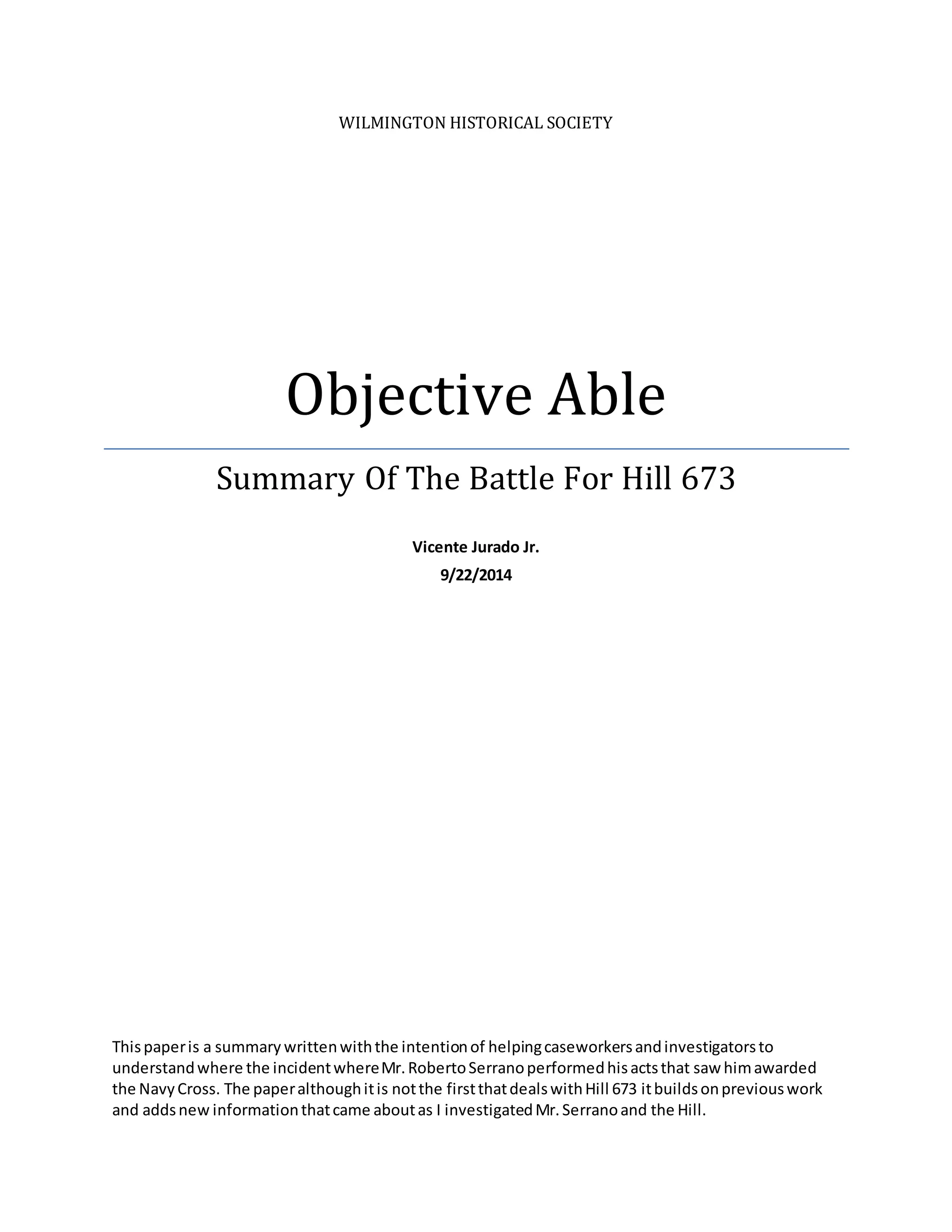
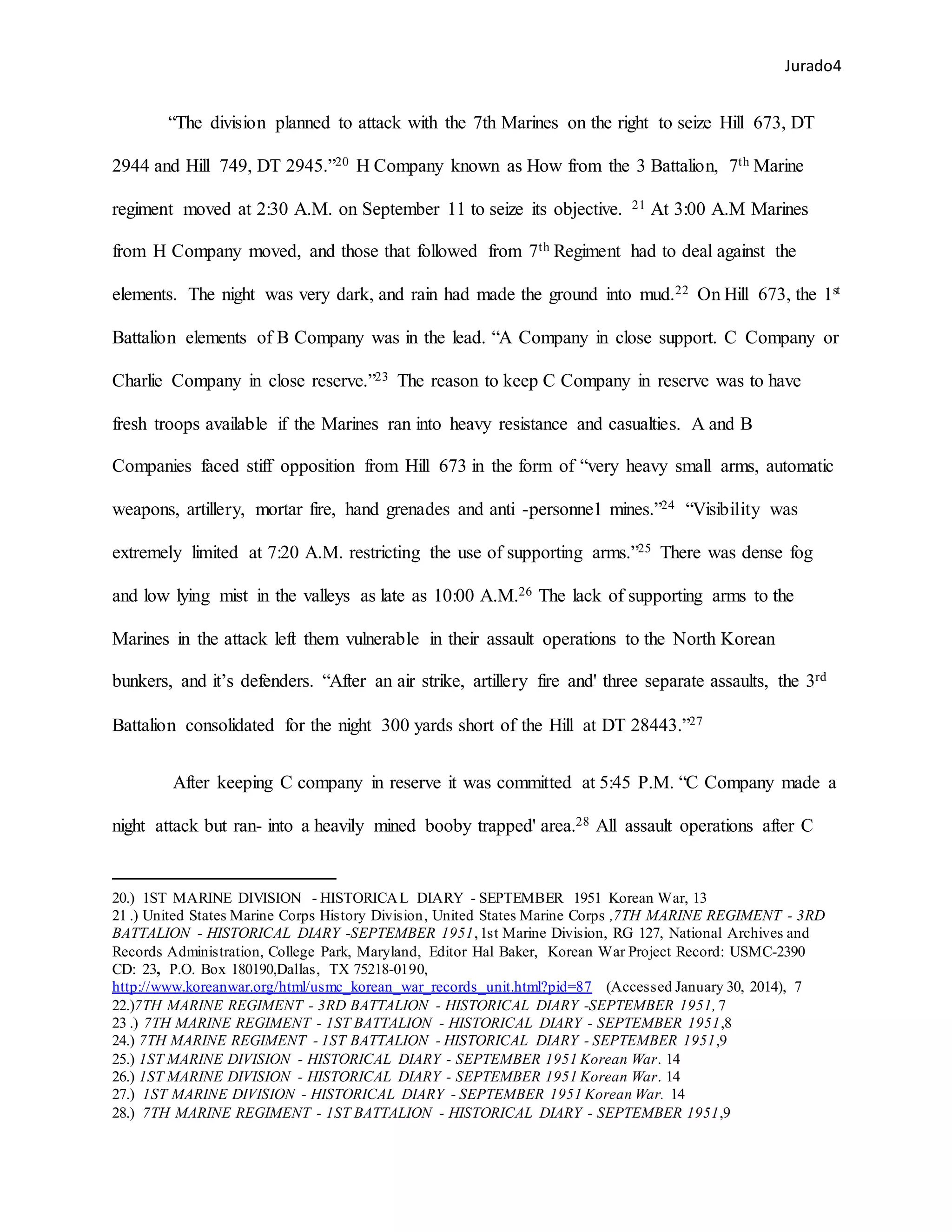
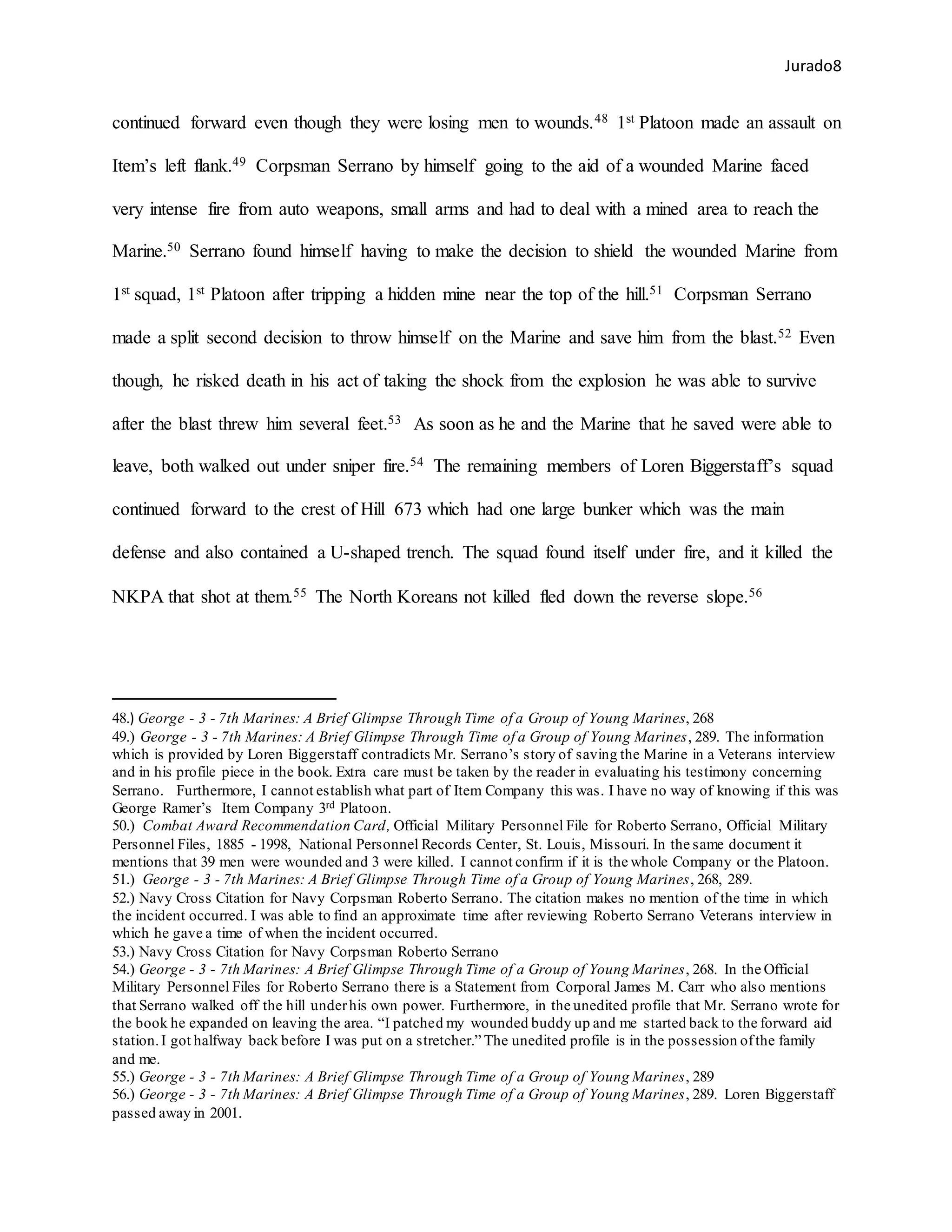
Source: U. S. Pacific Fleet, “Third Interim Evaluation Report”
Jurado13
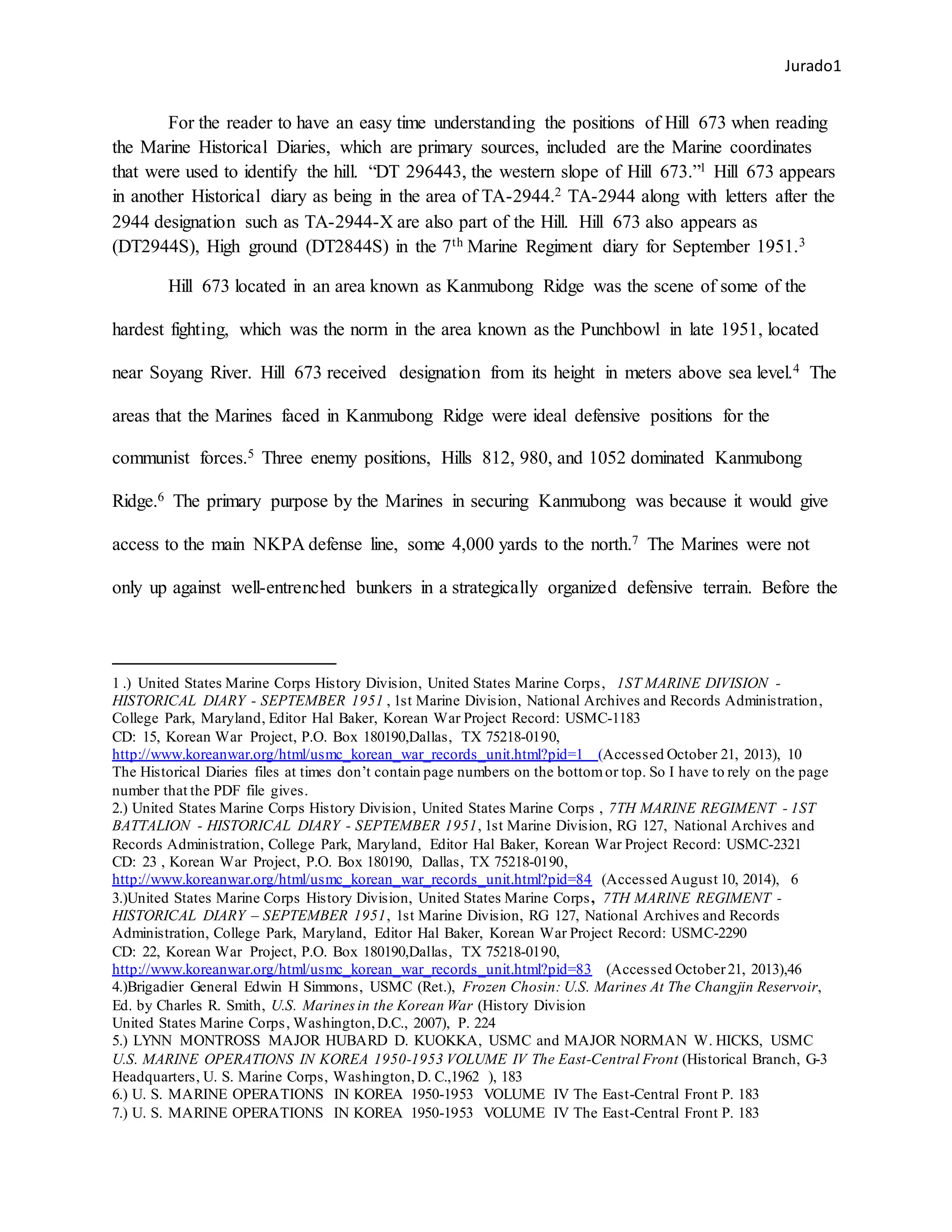
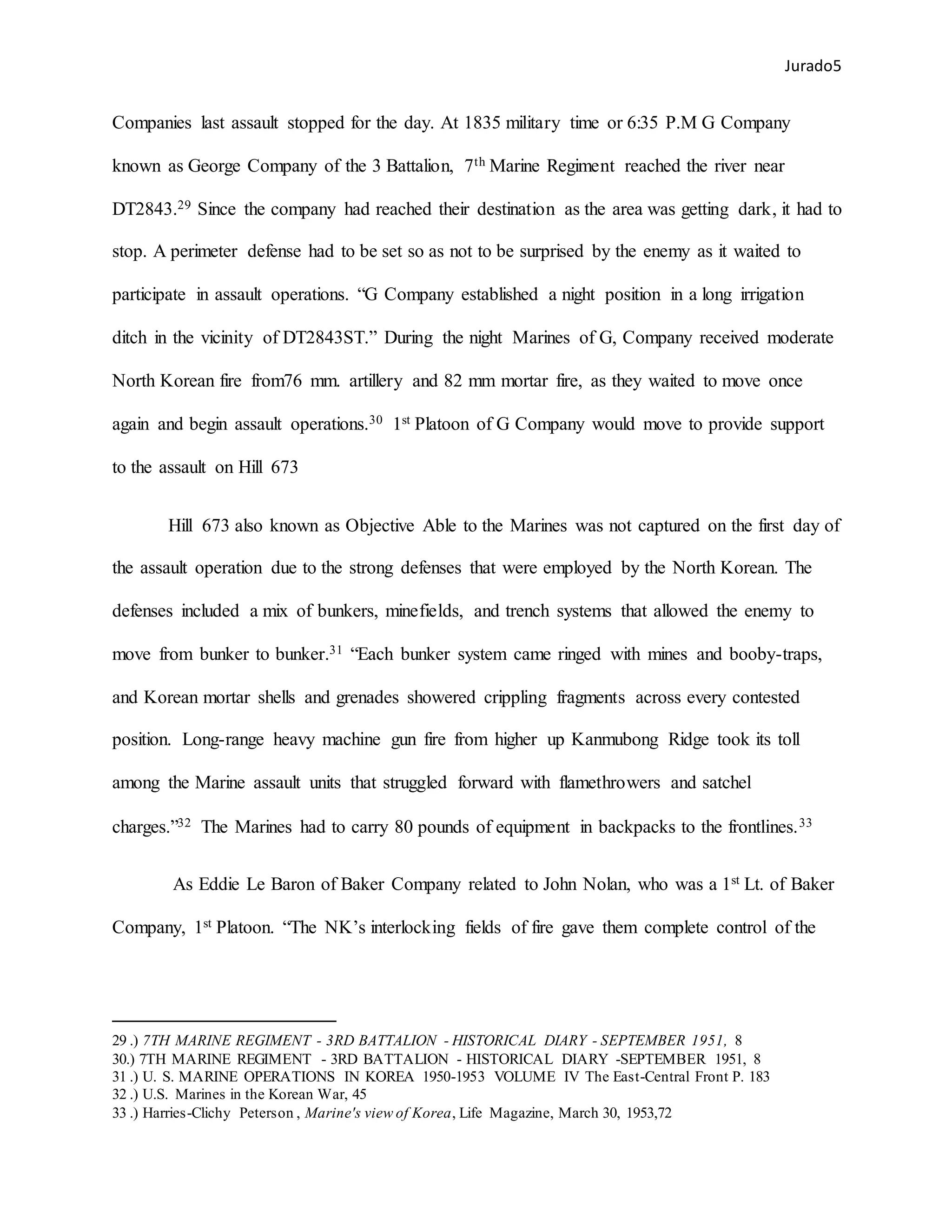
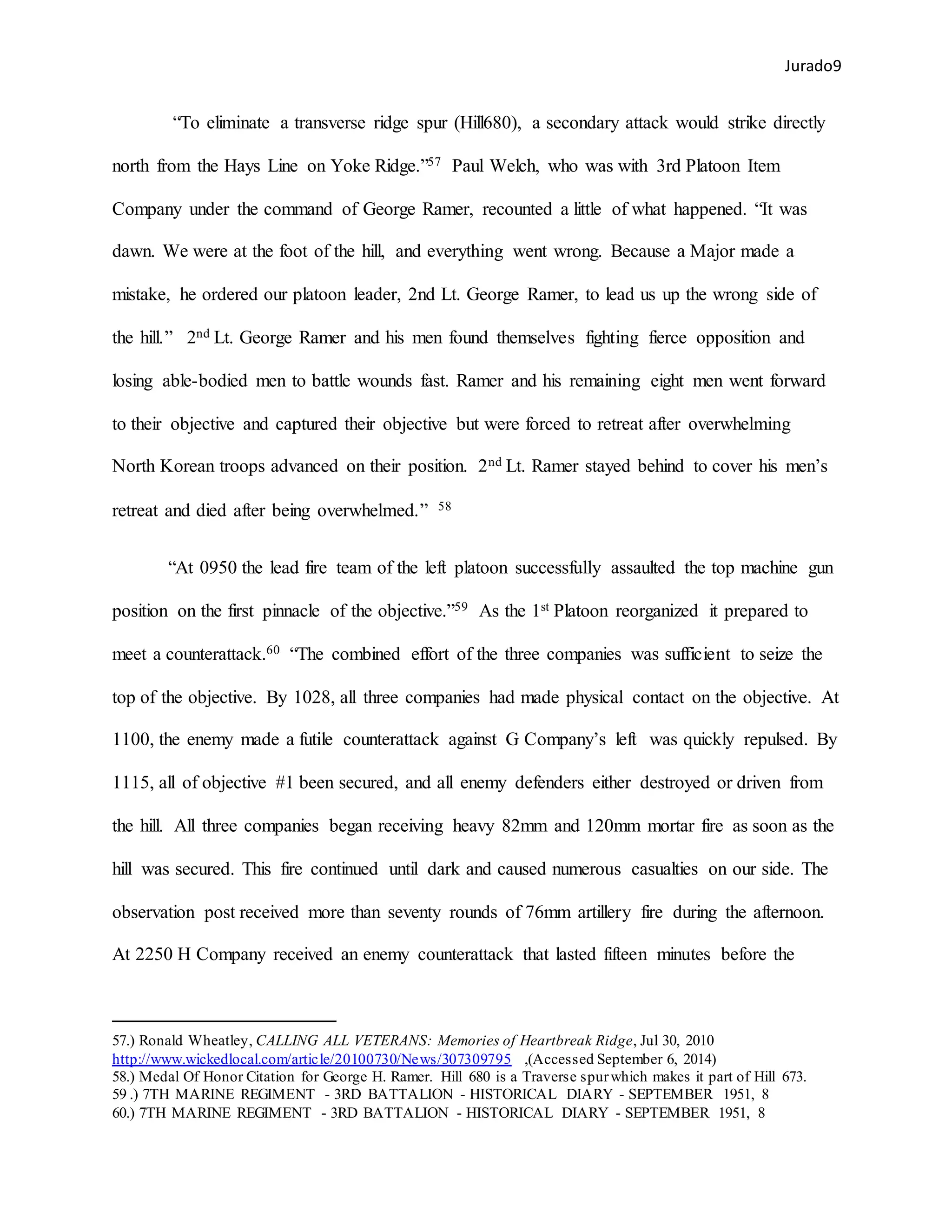
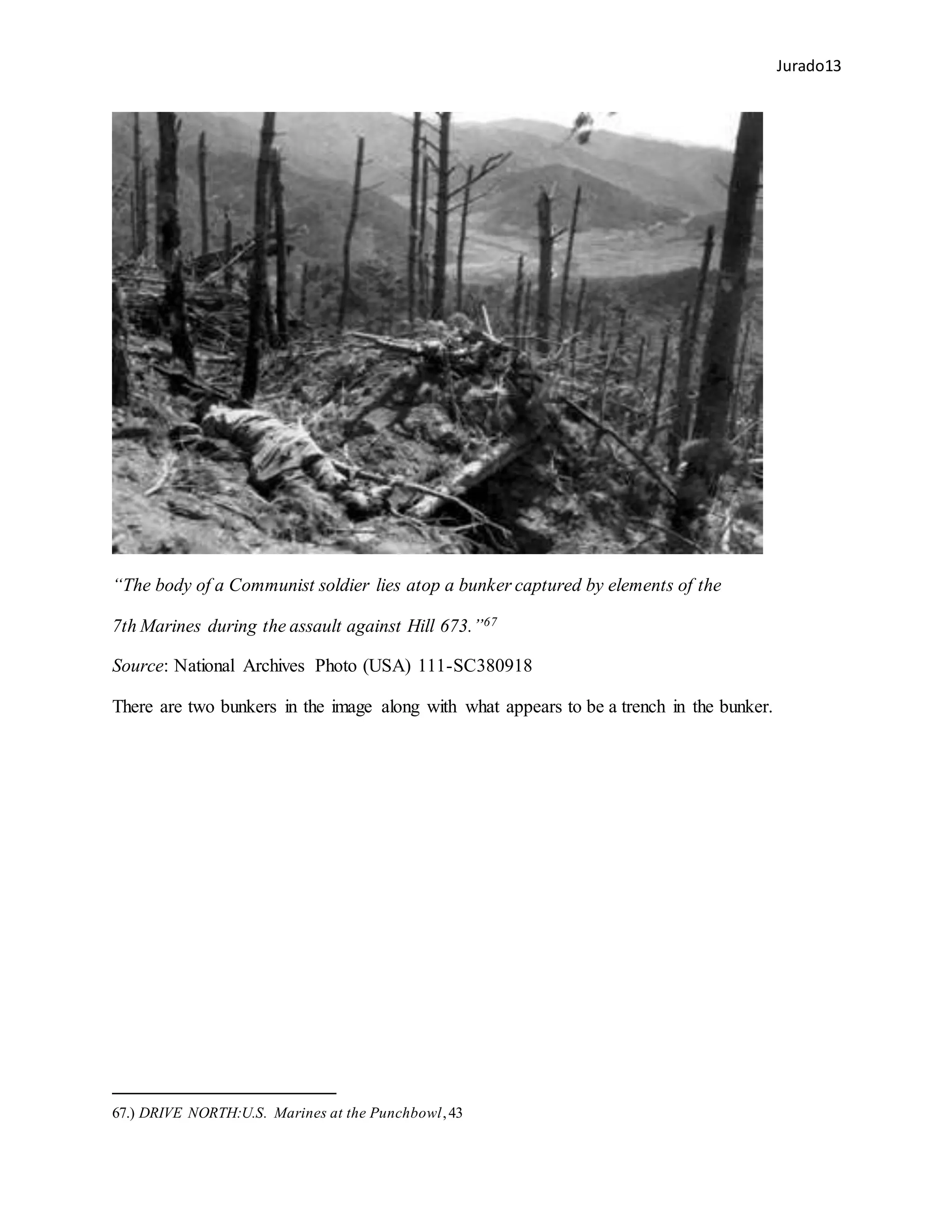
“The body of a Communist soldier lies atop a bunker captured by elements of the
7th Marines during the assault against Hill 673.”67
Source: National Archives Photo (USA) 111-SC380918
There are two bunkers in the image along with what appears to be a trench in the bunker.
67.) DRIVE NORTH:U.S. Marines at the Punchbowl,43
Jurado14
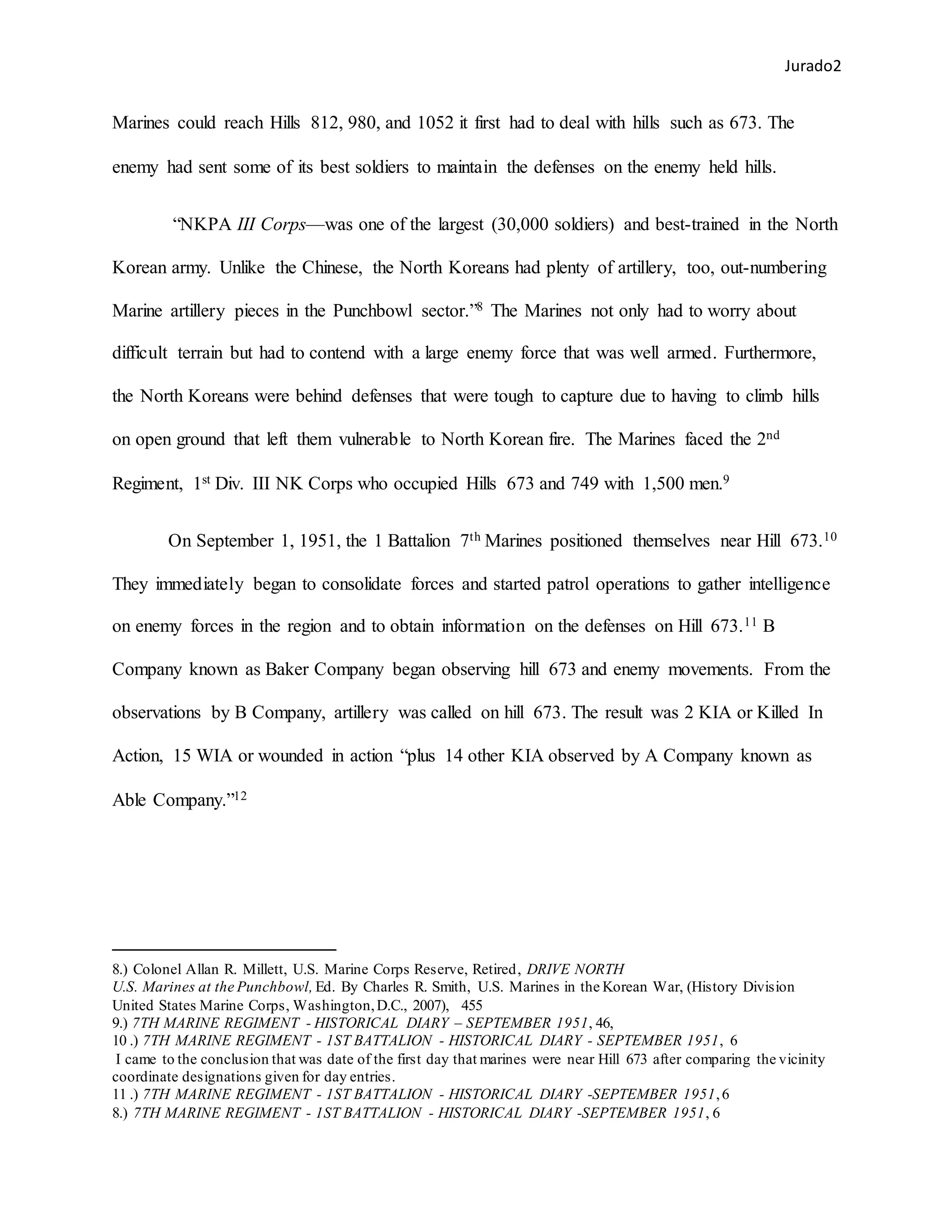
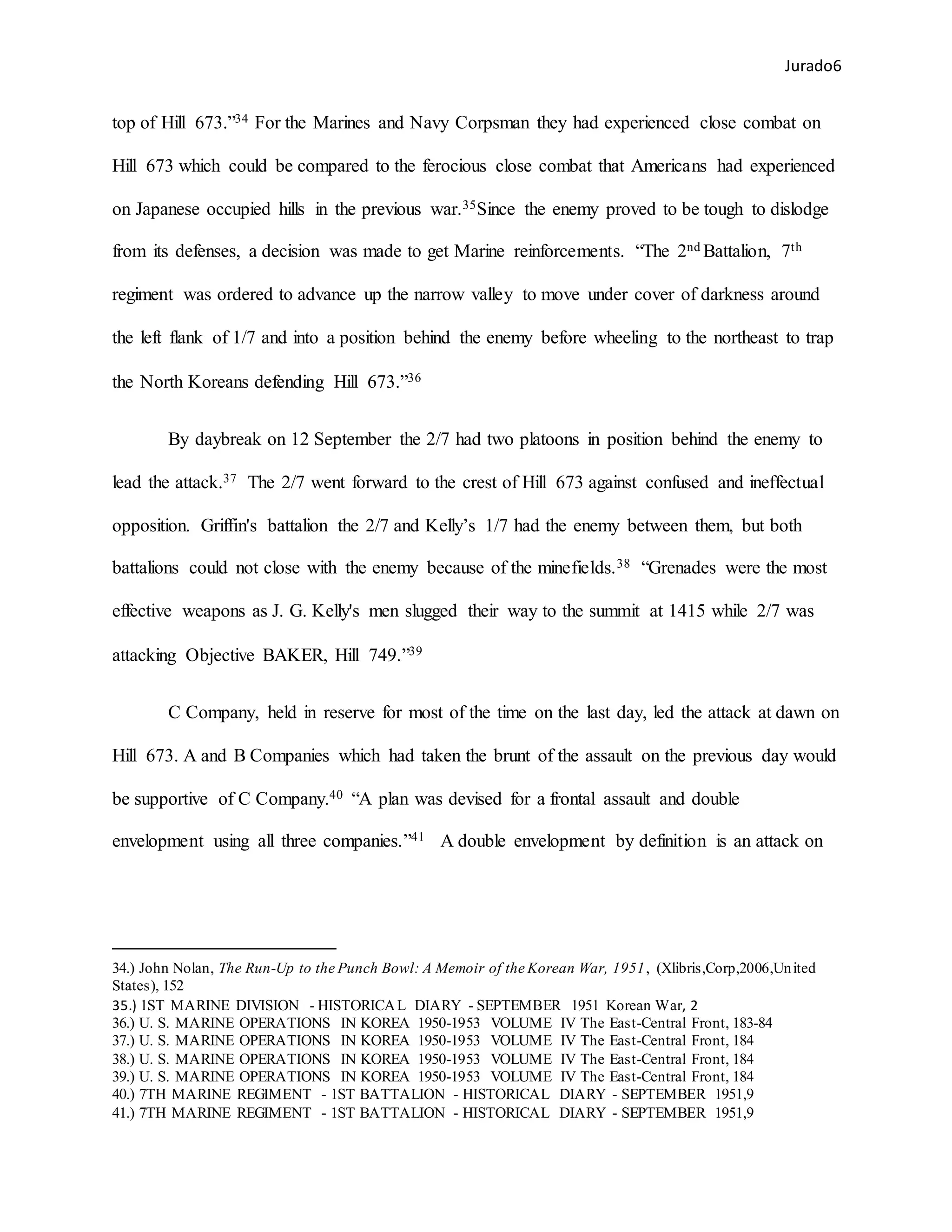
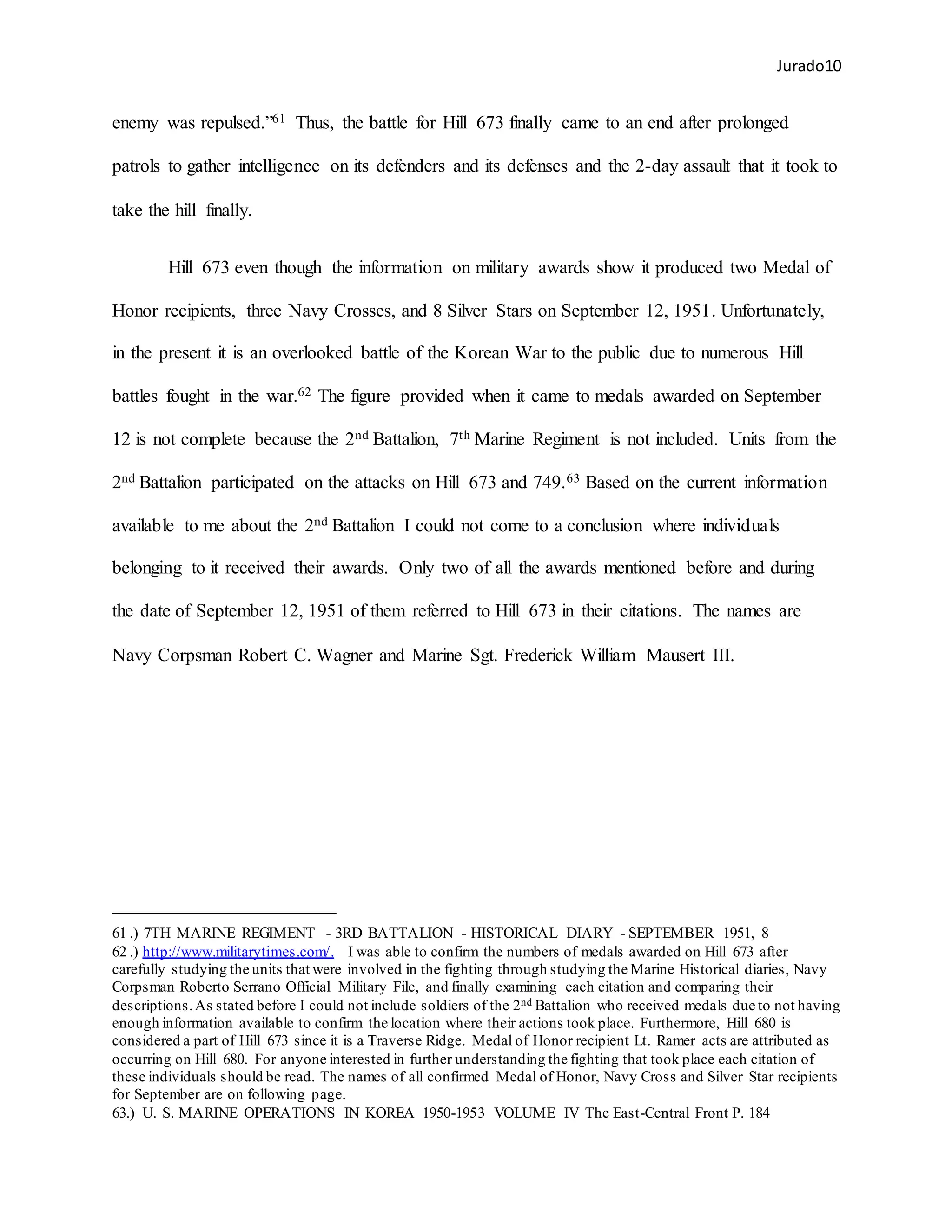
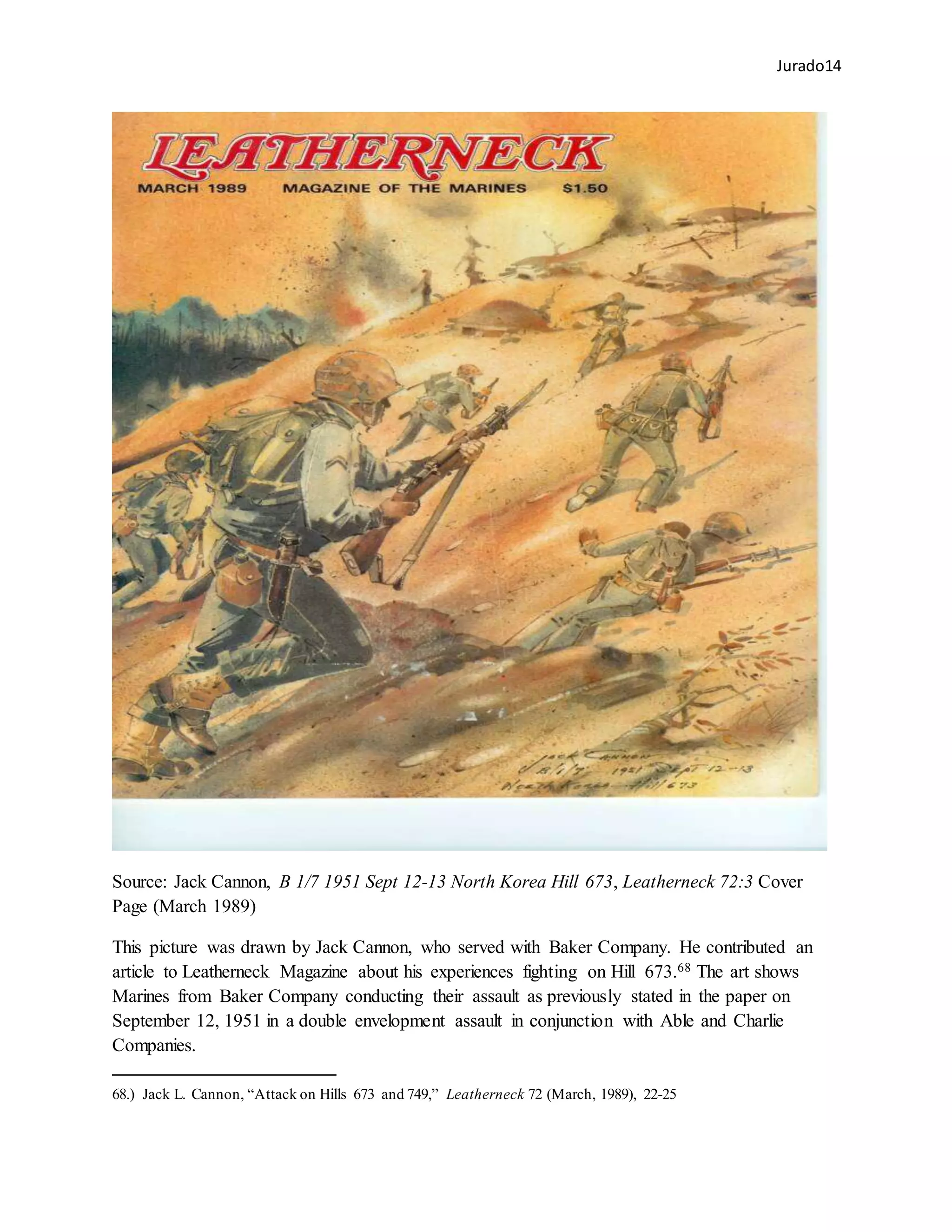
Source: Jack Cannon, B 1/7 1951 Sept 12-13 North Korea Hill 673, Leatherneck 72:3 Cover
Page (March 1989)
This picture was drawn by Jack Cannon, who served with Baker Company. He contributed an
article to Leatherneck Magazine about his experiences fighting on Hill 673.68 The art shows
Marines from Baker Company conducting their assault as previously stated in the paper on
September 12, 1951 in a double envelopment assault in conjunction with Able and Charlie
Companies.
68.) Jack L. Cannon, “Attack on Hills 673 and 749,” Leatherneck 72 (March, 1989), 22-25
Jurado15
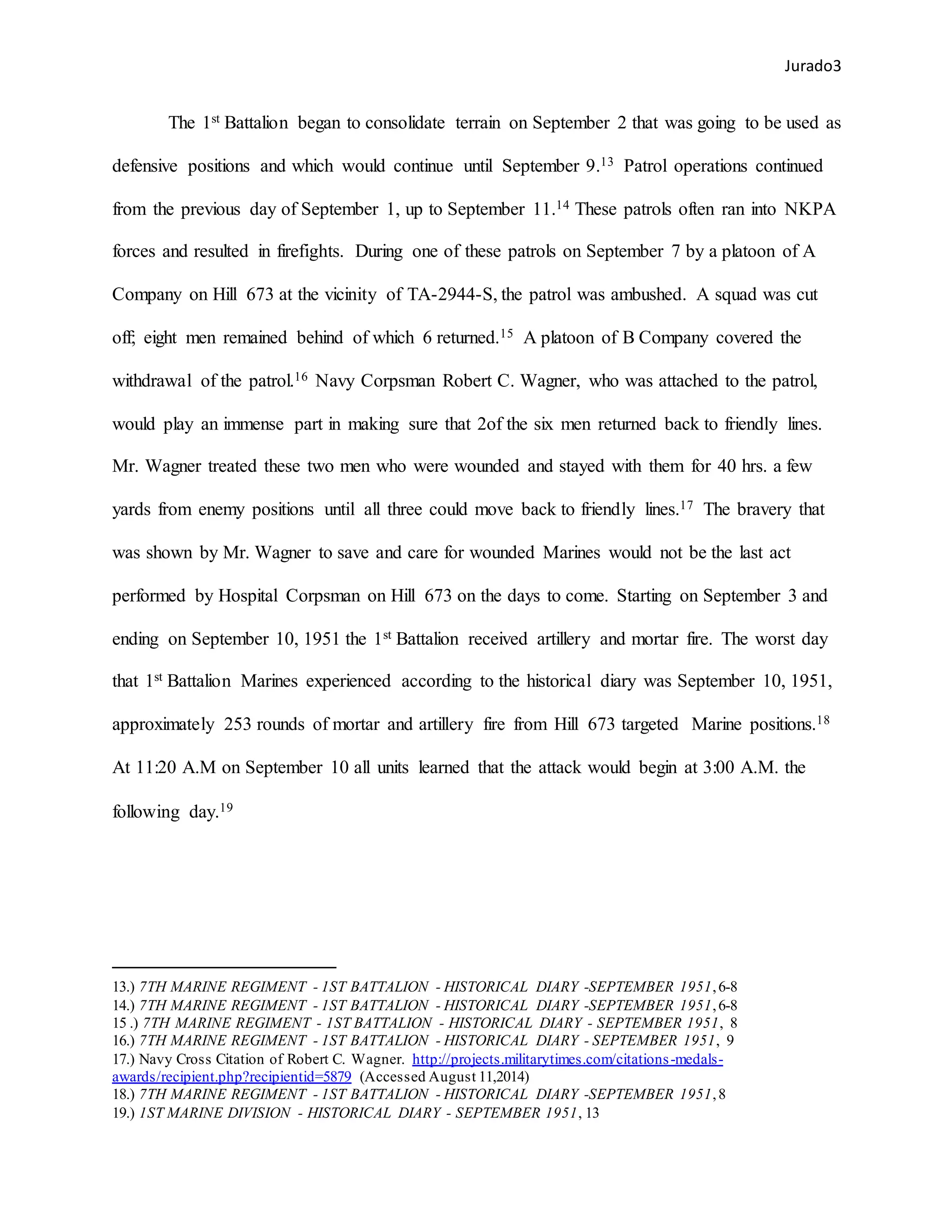
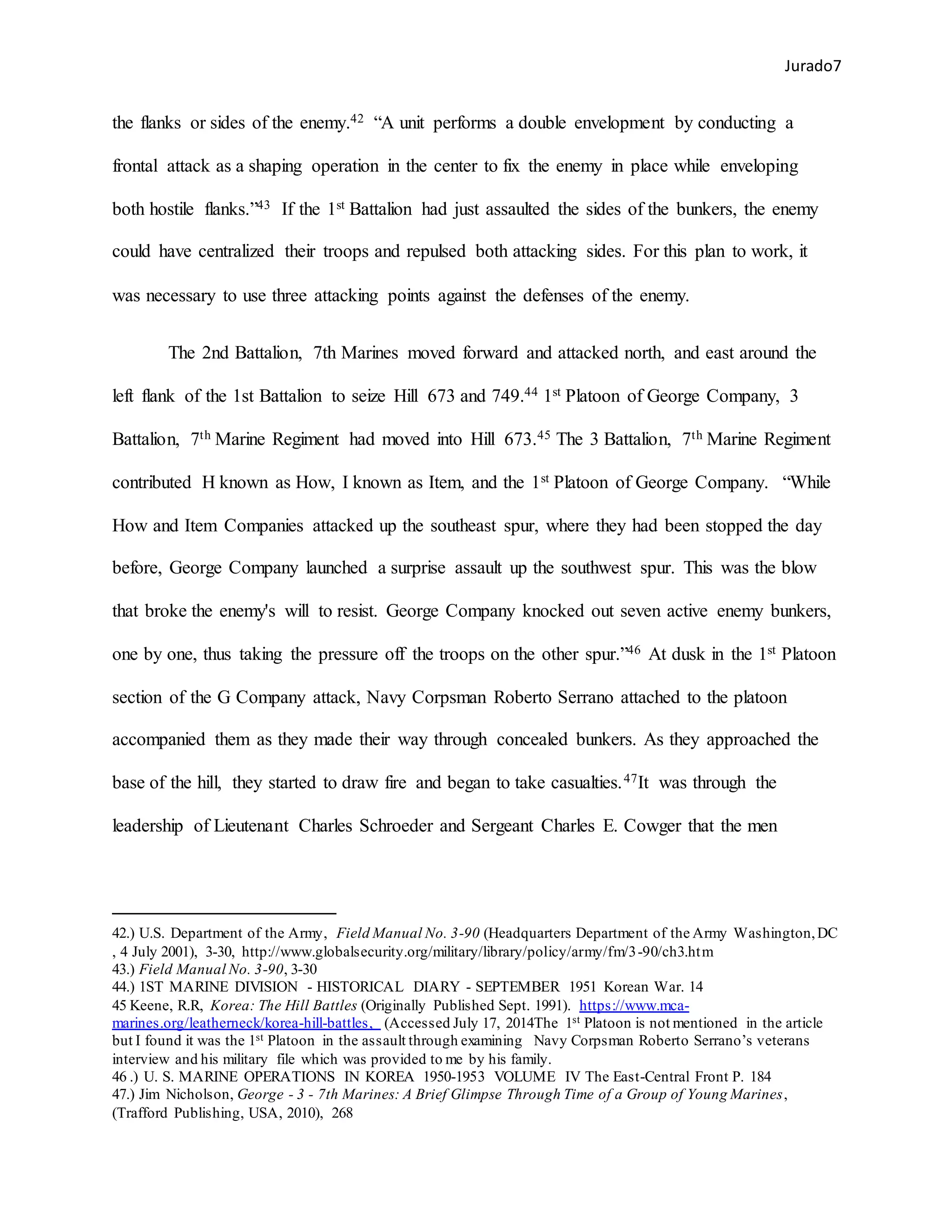
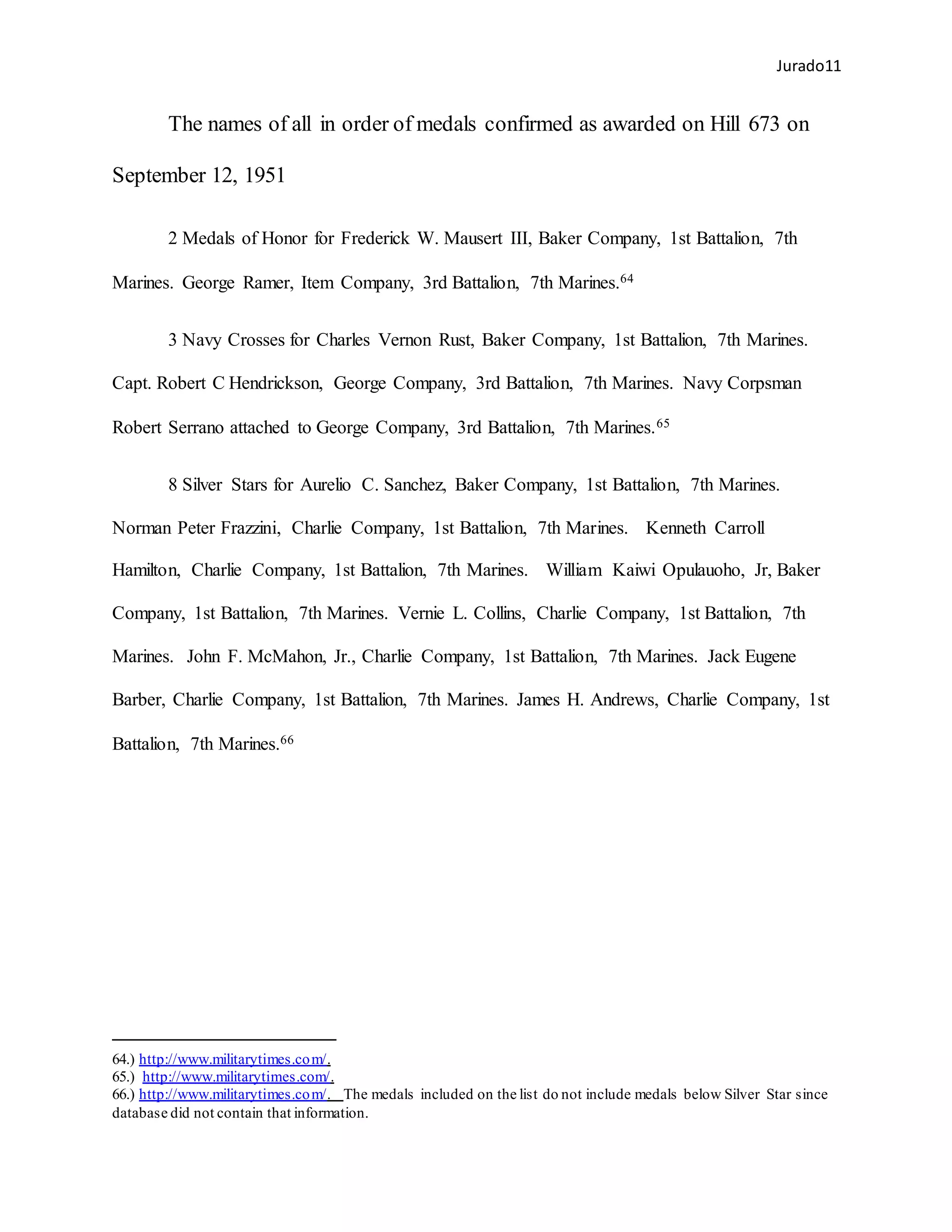
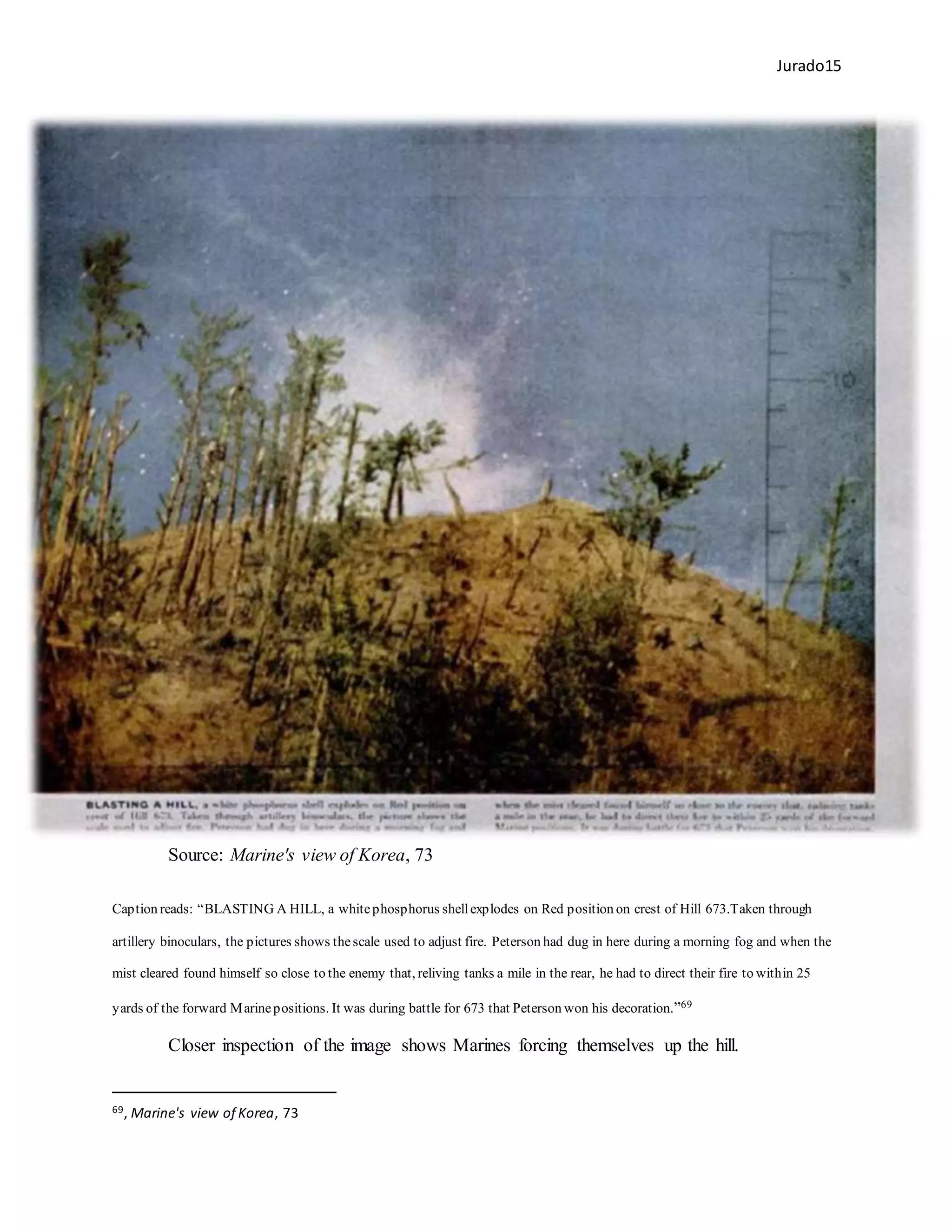
Source: Marine's view of Korea, 73
Caption reads: “BLASTING A HILL, a whitephosphorus shellexplodes on Red position on crest of Hill 673.Taken through
artillery binoculars, the pictures shows thescale used to adjust fire. Peterson had dug in here during a morning fog and when the
mist cleared found himself so close to the enemy that, reliving tanks a mile in the rear, he had to direct their fire to within 25
yards of the forward Marinepositions. It was during battle for 673 that Peterson won his decoration.”69
Closer inspection of the image shows Marines forcing themselves up the hill.
69, Marine's view of Korea, 73
Jurado16
Bibliography
Brigadier General Simmons, Edwin H, USMC (Ret.), Frozen Chosin: U.S. Marines At
The Changjin Reservoir, Edited by Charles R. Smith, U.S. Marines in the Korean War (History
Division United States Marine Corps, Washington, D.C., 2007)
Colonel Millett, Allan R., U.S. Marine Corps Reserve, Retired, DRIVE NORTH U.S.
Marines at the Punchbowl, Edited by Charles R. Smith, U.S. Marines in the Korean War
(History Division United States Marine Corps, Washington, D.C., 2007)
Montross, Lynn, Major Kuokka, Hubard D., USMC and Major Hicks, Norman W.,
USMC U.S. Marine Operations In Korea 1950-1953 Volume IV The East-Central Front
(Washington, D. C: Headquarters, U.S. Marine Corps, Historical Branch.)
Nolan, John, The Run-Up to the Punch Bowl: A Memoir of the Korean War, 1951,
(Xlibris Corp, United States, 2006)
Keene, R.R, Korea: The Hill Battles (Originally Published Sept. 1991). https://www.mca-
marines.org/leatherneck/korea-hill-battles (Accessed September 5, 2014)
Wheatley, Ronald, CALLING ALL VETERANS: Memories of Heartbreak Ridge, Jul 30,
2010 http://www.wickedlocal.com/article/20100730/News/307309795 (accessed September 6,
2014)
Medal Of Honor, Navy Cross, Silver Star Citations. http://projects.militarytimes.com/citations-
medals-awards (Accessed August 12, 2014)
United States Marine Corps History Division, United States Marine Corps, 7TH MARINE
REGIMENT - 1ST BATTALION - HISTORICAL DIARY - SEPTEMBER 1951, 1st Marine
Division, RG 127, National Archives and Records Administration, College Park, Maryland,
Editor Hal Baker, Korean War Project Record: USMC-2321
CD: 23, Korean War Project, P.O. Box 180190, Dallas, TX 75218-0190,
http://www.koreanwar.org/html/usmc_korean_war_records_unit.html?pid=84,
United States Marine Corps History Division, United States Marine Corps, 7TH MARINE
REGIMENT – 3rd BATTALION - HISTORICAL DIARY - SEPTEMBER 1951, 1st Marine
Division, RG 127, National Archives and Records Administration, College Park, Maryland,
Editor Hal Baker, Korean War Project Record: USMC-2390
CD: 23, Korean War Project, P.O. Box 180190, Dallas, TX 75218-0190,
http://www.koreanwar.org/html/usmc_korean_war_records_unit.html?pid=84
Historical Diary for the 1st Marine Division, September 1951(Archives and Special
Collections, Marine Corps Korean War document CD Collection, CD #22, 2005.), ed. Barker,
Jurado17
Hal, Korean War Project P.O. Box 180190 Dallas, TX 75218-0190
http://www.koreanwar.org/html/usmc_korean_war_records.html (accessed September 21,
2013).
HISTORICAL DIARY for 7th Marine Regiment SEPTEMBER 1951, Historical Diary for
the 1st Marine Division, September 1951 (Archives and Special Collections, Marine Corps
Korean War document CD Collection, CD #17, 2005.), ed. Barker, Hal, Korean War Project
P.O. Box 180190 Dallas, TX 75218-0190
http://www.koreanwar.org/html/usmc_korean_war_records.html
U.S. Department of the Army, Field Manual No. 3-90 (Headquarters Department of the
Army Washington, DC, 4 July 2001)
http://www.globalsecurity.org/military/library/policy/army/fm/3-90/ch3.htm
Third Interim Evaluation Report Korean War U. S. Pacific Fleet Operations: 1 May 1951
– December 1951. (Records Relating to the Korean War, Record Group 127.)
Cannon, Jack L. “Attack on Hills 673 and 749.” Leatherneck 72:3 (March 1989): 22-25.
Cannon, Jack L. B 1/7 1951 Sept 12-13 North Korea Hill 673, Leatherneck 72:3 Cover
Page (March 1989)
Nicholson, Jim, George - 3 - 7th Marines: A Brief Glimpse Through Time of a Group of
Young Marines, (Trafford Publishing, USA, 2010)
Peterson, Harries-Clichy, Marine's view of Korea, Life Magazine, March 30, 1953, 73
Combat Award Recommendation Card, Official Military Personnel File for Roberto
Serrano, Official Military Personnel Files, 1885 - 1998, National Personnel Records Center, St.
Louis, Missouri.

Objective Able Summary Of The Battle For Hill 673

  • 1.
    WILMINGTON HISTORICAL SOCIETY ObjectiveAble Summary Of The Battle For Hill 673 Vicente Jurado Jr. 9/22/2014 Thispaperis a summary writtenwiththe intentionof helpingcaseworkersandinvestigatorsto understandwhere the incidentwhereMr.RobertoSerranoperformedhisactsthat saw himawarded the NavyCross. The paperalthoughitis notthe firstthatdealswithHill 673 itbuildsonpreviouswork and addsnew informationthatcame aboutas I investigatedMr.Serranoand the Hill.
  • 2.
    Jurado1 For the readerto have an easy time understanding the positions of Hill 673 when reading the Marine Historical Diaries, which are primary sources, included are the Marine coordinates that were used to identify the hill. “DT 296443, the western slope of Hill 673.”1 Hill 673 appears in another Historical diary as being in the area of TA-2944.2 TA-2944 along with letters after the 2944 designation such as TA-2944-X are also part of the Hill. Hill 673 also appears as (DT2944S), High ground (DT2844S) in the 7th Marine Regiment diary for September 1951.3 Hill 673 located in an area known as Kanmubong Ridge was the scene of some of the hardest fighting, which was the norm in the area known as the Punchbowl in late 1951, located near Soyang River. Hill 673 received designation from its height in meters above sea level.4 The areas that the Marines faced in Kanmubong Ridge were ideal defensive positions for the communist forces.5 Three enemy positions, Hills 812, 980, and 1052 dominated Kanmubong Ridge.6 The primary purpose by the Marines in securing Kanmubong was because it would give access to the main NKPA defense line, some 4,000 yards to the north.7 The Marines were not only up against well-entrenched bunkers in a strategically organized defensive terrain. Before the 1 .) United States Marine Corps History Division, United States Marine Corps, 1ST MARINE DIVISION - HISTORICAL DIARY - SEPTEMBER 1951 , 1st Marine Division, National Archives and Records Administration, College Park, Maryland, Editor Hal Baker, Korean War Project Record: USMC-1183 CD: 15, Korean War Project, P.O. Box 180190,Dallas, TX 75218-0190, http://www.koreanwar.org/html/usmc_korean_war_records_unit.html?pid=1 (Accessed October 21, 2013), 10 The Historical Diaries files at times don’t contain page numbers on the bottomor top. So I have to rely on the page number that the PDF file gives. 2.) United States Marine Corps History Division, United States Marine Corps , 7TH MARINE REGIMENT - 1ST BATTALION - HISTORICAL DIARY - SEPTEMBER 1951, 1st Marine Division, RG 127, National Archives and Records Administration, College Park, Maryland, Editor Hal Baker, Korean War Project Record: USMC-2321 CD: 23 , Korean War Project, P.O. Box 180190, Dallas, TX 75218-0190, http://www.koreanwar.org/html/usmc_korean_war_records_unit.html?pid=84 (Accessed August 10, 2014), 6 3.)United States Marine Corps History Division, United States Marine Corps, 7TH MARINE REGIMENT - HISTORICAL DIARY – SEPTEMBER 1951, 1st Marine Division, RG 127, National Archives and Records Administration, College Park, Maryland, Editor Hal Baker, Korean War Project Record: USMC-2290 CD: 22, Korean War Project, P.O. Box 180190,Dallas, TX 75218-0190, http://www.koreanwar.org/html/usmc_korean_war_records_unit.html?pid=83 (Accessed October21, 2013),46 4.)Brigadier General Edwin H Simmons, USMC (Ret.), Frozen Chosin: U.S. Marines At The Changjin Reservoir, Ed. by Charles R. Smith, U.S. Marinesin the Korean War (History Division United States Marine Corps, Washington,D.C., 2007), P. 224 5.) LYNN MONTROSS MAJOR HUBARD D. KUOKKA, USMC and MAJOR NORMAN W. HICKS, USMC U.S. MARINE OPERATIONS IN KOREA 1950-1953 VOLUME IV The East-Central Front (Historical Branch, G-3 Headquarters, U. S. Marine Corps, Washington,D. C.,1962 ), 183 6.) U. S. MARINE OPERATIONS IN KOREA 1950-1953 VOLUME IV The East-Central Front P. 183 7.) U. S. MARINE OPERATIONS IN KOREA 1950-1953 VOLUME IV The East-Central Front P. 183
  • 3.
    Jurado2 Marines could reachHills 812, 980, and 1052 it first had to deal with hills such as 673. The enemy had sent some of its best soldiers to maintain the defenses on the enemy held hills. “NKPA III Corps—was one of the largest (30,000 soldiers) and best-trained in the North Korean army. Unlike the Chinese, the North Koreans had plenty of artillery, too, out-numbering Marine artillery pieces in the Punchbowl sector.”8 The Marines not only had to worry about difficult terrain but had to contend with a large enemy force that was well armed. Furthermore, the North Koreans were behind defenses that were tough to capture due to having to climb hills on open ground that left them vulnerable to North Korean fire. The Marines faced the 2nd Regiment, 1st Div. III NK Corps who occupied Hills 673 and 749 with 1,500 men.9 On September 1, 1951, the 1 Battalion 7th Marines positioned themselves near Hill 673.10 They immediately began to consolidate forces and started patrol operations to gather intelligence on enemy forces in the region and to obtain information on the defenses on Hill 673.11 B Company known as Baker Company began observing hill 673 and enemy movements. From the observations by B Company, artillery was called on hill 673. The result was 2 KIA or Killed In Action, 15 WIA or wounded in action “plus 14 other KIA observed by A Company known as Able Company.”12 8.) Colonel Allan R. Millett, U.S. Marine Corps Reserve, Retired, DRIVE NORTH U.S. Marines at the Punchbowl, Ed. By Charles R. Smith, U.S. Marines in the Korean War, (History Division United States Marine Corps, Washington,D.C., 2007), 455 9.) 7TH MARINE REGIMENT - HISTORICAL DIARY – SEPTEMBER 1951, 46, 10 .) 7TH MARINE REGIMENT - 1ST BATTALION - HISTORICAL DIARY - SEPTEMBER 1951, 6 I came to the conclusion that was date of the first day that marines were near Hill 673 after comparing the vicinity coordinate designations given for day entries. 11 .) 7TH MARINE REGIMENT - 1ST BATTALION - HISTORICAL DIARY -SEPTEMBER 1951,6 8.) 7TH MARINE REGIMENT - 1ST BATTALION - HISTORICAL DIARY -SEPTEMBER 1951, 6
  • 4.
    Jurado3 The 1st Battalionbegan to consolidate terrain on September 2 that was going to be used as defensive positions and which would continue until September 9.13 Patrol operations continued from the previous day of September 1, up to September 11.14 These patrols often ran into NKPA forces and resulted in firefights. During one of these patrols on September 7 by a platoon of A Company on Hill 673 at the vicinity of TA-2944-S, the patrol was ambushed. A squad was cut off; eight men remained behind of which 6 returned.15 A platoon of B Company covered the withdrawal of the patrol.16 Navy Corpsman Robert C. Wagner, who was attached to the patrol, would play an immense part in making sure that 2of the six men returned back to friendly lines. Mr. Wagner treated these two men who were wounded and stayed with them for 40 hrs. a few yards from enemy positions until all three could move back to friendly lines.17 The bravery that was shown by Mr. Wagner to save and care for wounded Marines would not be the last act performed by Hospital Corpsman on Hill 673 on the days to come. Starting on September 3 and ending on September 10, 1951 the 1st Battalion received artillery and mortar fire. The worst day that 1st Battalion Marines experienced according to the historical diary was September 10, 1951, approximately 253 rounds of mortar and artillery fire from Hill 673 targeted Marine positions.18 At 11:20 A.M on September 10 all units learned that the attack would begin at 3:00 A.M. the following day.19 13.) 7TH MARINE REGIMENT - 1ST BATTALION - HISTORICAL DIARY -SEPTEMBER 1951,6-8 14.) 7TH MARINE REGIMENT - 1ST BATTALION - HISTORICAL DIARY -SEPTEMBER 1951,6-8 15 .) 7TH MARINE REGIMENT - 1ST BATTALION - HISTORICAL DIARY - SEPTEMBER 1951, 8 16.) 7TH MARINE REGIMENT - 1ST BATTALION - HISTORICAL DIARY - SEPTEMBER 1951, 9 17.) Navy Cross Citation of Robert C. Wagner. http://projects.militarytimes.com/citations-medals- awards/recipient.php?recipientid=5879 (Accessed August 11,2014) 18.) 7TH MARINE REGIMENT - 1ST BATTALION - HISTORICAL DIARY -SEPTEMBER 1951,8 19.) 1ST MARINE DIVISION - HISTORICAL DIARY - SEPTEMBER 1951, 13
  • 5.
    Jurado4 “The division plannedto attack with the 7th Marines on the right to seize Hill 673, DT 2944 and Hill 749, DT 2945.”20 H Company known as How from the 3 Battalion, 7th Marine regiment moved at 2:30 A.M. on September 11 to seize its objective. 21 At 3:00 A.M Marines from H Company moved, and those that followed from 7th Regiment had to deal against the elements. The night was very dark, and rain had made the ground into mud.22 On Hill 673, the 1st Battalion elements of B Company was in the lead. “A Company in close support. C Company or Charlie Company in close reserve.”23 The reason to keep C Company in reserve was to have fresh troops available if the Marines ran into heavy resistance and casualties. A and B Companies faced stiff opposition from Hill 673 in the form of “very heavy small arms, automatic weapons, artillery, mortar fire, hand grenades and anti -personne1 mines.”24 “Visibility was extremely limited at 7:20 A.M. restricting the use of supporting arms.”25 There was dense fog and low lying mist in the valleys as late as 10:00 A.M.26 The lack of supporting arms to the Marines in the attack left them vulnerable in their assault operations to the North Korean bunkers, and it’s defenders. “After an air strike, artillery fire and' three separate assaults, the 3rd Battalion consolidated for the night 300 yards short of the Hill at DT 28443.”27 After keeping C company in reserve it was committed at 5:45 P.M. “C Company made a night attack but ran- into a heavily mined booby trapped' area.28 All assault operations after C 20.) 1ST MARINE DIVISION - HISTORICAL DIARY - SEPTEMBER 1951 Korean War, 13 21 .) United States Marine Corps History Division, United States Marine Corps ,7TH MARINE REGIMENT - 3RD BATTALION - HISTORICAL DIARY -SEPTEMBER 1951,1st Marine Division, RG 127, National Archives and Records Administration, College Park, Maryland, Editor Hal Baker, Korean War Project Record: USMC-2390 CD: 23, P.O. Box 180190,Dallas, TX 75218-0190, http://www.koreanwar.org/html/usmc_korean_war_records_unit.html?pid=87 (Accessed January 30, 2014), 7 22.)7TH MARINE REGIMENT - 3RD BATTALION - HISTORICAL DIARY -SEPTEMBER 1951, 7 23 .) 7TH MARINE REGIMENT - 1ST BATTALION - HISTORICAL DIARY - SEPTEMBER 1951,8 24.) 7TH MARINE REGIMENT - 1ST BATTALION - HISTORICAL DIARY - SEPTEMBER 1951,9 25.) 1ST MARINE DIVISION - HISTORICAL DIARY - SEPTEMBER 1951 Korean War. 14 26.) 1ST MARINE DIVISION - HISTORICAL DIARY - SEPTEMBER 1951 Korean War. 14 27.) 1ST MARINE DIVISION - HISTORICAL DIARY - SEPTEMBER 1951 Korean War. 14 28.) 7TH MARINE REGIMENT - 1ST BATTALION - HISTORICAL DIARY - SEPTEMBER 1951,9
  • 6.
    Jurado5 Companies last assaultstopped for the day. At 1835 military time or 6:35 P.M G Company known as George Company of the 3 Battalion, 7th Marine Regiment reached the river near DT2843.29 Since the company had reached their destination as the area was getting dark, it had to stop. A perimeter defense had to be set so as not to be surprised by the enemy as it waited to participate in assault operations. “G Company established a night position in a long irrigation ditch in the vicinity of DT2843ST.” During the night Marines of G, Company received moderate North Korean fire from76 mm. artillery and 82 mm mortar fire, as they waited to move once again and begin assault operations.30 1st Platoon of G Company would move to provide support to the assault on Hill 673 Hill 673 also known as Objective Able to the Marines was not captured on the first day of the assault operation due to the strong defenses that were employed by the North Korean. The defenses included a mix of bunkers, minefields, and trench systems that allowed the enemy to move from bunker to bunker.31 “Each bunker system came ringed with mines and booby-traps, and Korean mortar shells and grenades showered crippling fragments across every contested position. Long-range heavy machine gun fire from higher up Kanmubong Ridge took its toll among the Marine assault units that struggled forward with flamethrowers and satchel charges.”32 The Marines had to carry 80 pounds of equipment in backpacks to the frontlines.33 As Eddie Le Baron of Baker Company related to John Nolan, who was a 1st Lt. of Baker Company, 1st Platoon. “The NK’s interlocking fields of fire gave them complete control of the 29 .) 7TH MARINE REGIMENT - 3RD BATTALION - HISTORICAL DIARY - SEPTEMBER 1951, 8 30.) 7TH MARINE REGIMENT - 3RD BATTALION - HISTORICAL DIARY -SEPTEMBER 1951, 8 31 .) U. S. MARINE OPERATIONS IN KOREA 1950-1953 VOLUME IV The East-Central Front P. 183 32 .) U.S. Marines in the Korean War, 45 33 .) Harries-Clichy Peterson , Marine's view of Korea, Life Magazine, March 30, 1953,72
  • 7.
    Jurado6 top of Hill673.”34 For the Marines and Navy Corpsman they had experienced close combat on Hill 673 which could be compared to the ferocious close combat that Americans had experienced on Japanese occupied hills in the previous war.35Since the enemy proved to be tough to dislodge from its defenses, a decision was made to get Marine reinforcements. “The 2nd Battalion, 7th regiment was ordered to advance up the narrow valley to move under cover of darkness around the left flank of 1/7 and into a position behind the enemy before wheeling to the northeast to trap the North Koreans defending Hill 673.”36 By daybreak on 12 September the 2/7 had two platoons in position behind the enemy to lead the attack.37 The 2/7 went forward to the crest of Hill 673 against confused and ineffectual opposition. Griffin's battalion the 2/7 and Kelly’s 1/7 had the enemy between them, but both battalions could not close with the enemy because of the minefields.38 “Grenades were the most effective weapons as J. G. Kelly's men slugged their way to the summit at 1415 while 2/7 was attacking Objective BAKER, Hill 749.”39 C Company, held in reserve for most of the time on the last day, led the attack at dawn on Hill 673. A and B Companies which had taken the brunt of the assault on the previous day would be supportive of C Company.40 “A plan was devised for a frontal assault and double envelopment using all three companies.”41 A double envelopment by definition is an attack on 34.) John Nolan, The Run-Up to the Punch Bowl: A Memoir of the Korean War, 1951, (Xlibris,Corp,2006,United States), 152 35.) 1ST MARINE DIVISION - HISTORICAL DIARY - SEPTEMBER 1951 Korean War, 2 36.) U. S. MARINE OPERATIONS IN KOREA 1950-1953 VOLUME IV The East-Central Front, 183-84 37.) U. S. MARINE OPERATIONS IN KOREA 1950-1953 VOLUME IV The East-Central Front, 184 38.) U. S. MARINE OPERATIONS IN KOREA 1950-1953 VOLUME IV The East-Central Front, 184 39.) U. S. MARINE OPERATIONS IN KOREA 1950-1953 VOLUME IV The East-Central Front, 184 40.) 7TH MARINE REGIMENT - 1ST BATTALION - HISTORICAL DIARY - SEPTEMBER 1951,9 41.) 7TH MARINE REGIMENT - 1ST BATTALION - HISTORICAL DIARY - SEPTEMBER 1951,9
  • 8.
    Jurado7 the flanks orsides of the enemy.42 “A unit performs a double envelopment by conducting a frontal attack as a shaping operation in the center to fix the enemy in place while enveloping both hostile flanks.”43 If the 1st Battalion had just assaulted the sides of the bunkers, the enemy could have centralized their troops and repulsed both attacking sides. For this plan to work, it was necessary to use three attacking points against the defenses of the enemy. The 2nd Battalion, 7th Marines moved forward and attacked north, and east around the left flank of the 1st Battalion to seize Hill 673 and 749.44 1st Platoon of George Company, 3 Battalion, 7th Marine Regiment had moved into Hill 673.45 The 3 Battalion, 7th Marine Regiment contributed H known as How, I known as Item, and the 1st Platoon of George Company. “While How and Item Companies attacked up the southeast spur, where they had been stopped the day before, George Company launched a surprise assault up the southwest spur. This was the blow that broke the enemy's will to resist. George Company knocked out seven active enemy bunkers, one by one, thus taking the pressure off the troops on the other spur.”46 At dusk in the 1st Platoon section of the G Company attack, Navy Corpsman Roberto Serrano attached to the platoon accompanied them as they made their way through concealed bunkers. As they approached the base of the hill, they started to draw fire and began to take casualties.47It was through the leadership of Lieutenant Charles Schroeder and Sergeant Charles E. Cowger that the men 42.) U.S. Department of the Army, Field Manual No. 3-90 (Headquarters Department of the Army Washington,DC , 4 July 2001), 3-30, http://www.globalsecurity.org/military/library/policy/army/fm/3-90/ch3.htm 43.) Field Manual No. 3-90, 3-30 44.) 1ST MARINE DIVISION - HISTORICAL DIARY - SEPTEMBER 1951 Korean War. 14 45 Keene, R.R, Korea: The Hill Battles (Originally Published Sept. 1991). https://www.mca- marines.org/leatherneck/korea-hill-battles, (Accessed July 17, 2014The 1st Platoon is not mentioned in the article but I found it was the 1st Platoon in the assault through examining Navy Corpsman Roberto Serrano’s veterans interview and his military file which was provided to me by his family. 46 .) U. S. MARINE OPERATIONS IN KOREA 1950-1953 VOLUME IV The East-Central Front P. 184 47.) Jim Nicholson, George - 3 - 7th Marines: A Brief Glimpse Through Time of a Group of Young Marines, (Trafford Publishing, USA, 2010), 268
  • 9.
    Jurado8 continued forward eventhough they were losing men to wounds.48 1st Platoon made an assault on Item’s left flank.49 Corpsman Serrano by himself going to the aid of a wounded Marine faced very intense fire from auto weapons, small arms and had to deal with a mined area to reach the Marine.50 Serrano found himself having to make the decision to shield the wounded Marine from 1st squad, 1st Platoon after tripping a hidden mine near the top of the hill.51 Corpsman Serrano made a split second decision to throw himself on the Marine and save him from the blast.52 Even though, he risked death in his act of taking the shock from the explosion he was able to survive after the blast threw him several feet.53 As soon as he and the Marine that he saved were able to leave, both walked out under sniper fire.54 The remaining members of Loren Biggerstaff’s squad continued forward to the crest of Hill 673 which had one large bunker which was the main defense and also contained a U-shaped trench. The squad found itself under fire, and it killed the NKPA that shot at them.55 The North Koreans not killed fled down the reverse slope.56 48.) George - 3 - 7th Marines: A Brief Glimpse Through Time of a Group of Young Marines, 268 49.) George - 3 - 7th Marines: A Brief Glimpse Through Time of a Group of Young Marines, 289. The information which is provided by Loren Biggerstaff contradicts Mr. Serrano’s story of saving the Marine in a Veterans interview and in his profile piece in the book. Extra care must be taken by the reader in evaluating his testimony concerning Serrano. Furthermore, I cannot establish what part of Item Company this was. I have no way of knowing if this was George Ramer’s Item Company 3rd Platoon. 50.) Combat Award Recommendation Card, Official Military Personnel File for Roberto Serrano, Official Military Personnel Files, 1885 - 1998, National Personnel Records Center, St. Louis, Missouri. In the same document it mentions that 39 men were wounded and 3 were killed. I cannot confirm if it is the whole Company or the Platoon. 51.) George - 3 - 7th Marines: A Brief Glimpse Through Time of a Group of Young Marines, 268, 289. 52.) Navy Cross Citation for Navy Corpsman Roberto Serrano. The citation makes no mention of the time in which the incident occurred. I was able to find an approximate time after reviewing Roberto Serrano Veterans interview in which he gave a time of when the incident occurred. 53.) Navy Cross Citation for Navy Corpsman Roberto Serrano 54.) George - 3 - 7th Marines: A Brief Glimpse Through Time of a Group of Young Marines, 268. In the Official Military Personnel Files for Roberto Serrano there is a Statement from Corporal James M. Carr who also mentions that Serrano walked off the hill underhis own power. Furthermore, in the unedited profile that Mr. Serrano wrote for the book he expanded on leaving the area. “I patched my wounded buddy up and me started back to the forward aid station.I got halfway back before I was put on a stretcher.” The unedited profile is in the possession ofthe family and me. 55.) George - 3 - 7th Marines: A Brief Glimpse Through Time of a Group of Young Marines, 289 56.) George - 3 - 7th Marines: A Brief Glimpse Through Time of a Group of Young Marines, 289. Loren Biggerstaff passed away in 2001.
  • 10.
    Jurado9 “To eliminate atransverse ridge spur (Hill680), a secondary attack would strike directly north from the Hays Line on Yoke Ridge.”57 Paul Welch, who was with 3rd Platoon Item Company under the command of George Ramer, recounted a little of what happened. “It was dawn. We were at the foot of the hill, and everything went wrong. Because a Major made a mistake, he ordered our platoon leader, 2nd Lt. George Ramer, to lead us up the wrong side of the hill.” 2nd Lt. George Ramer and his men found themselves fighting fierce opposition and losing able-bodied men to battle wounds fast. Ramer and his remaining eight men went forward to their objective and captured their objective but were forced to retreat after overwhelming North Korean troops advanced on their position. 2nd Lt. Ramer stayed behind to cover his men’s retreat and died after being overwhelmed.” 58 “At 0950 the lead fire team of the left platoon successfully assaulted the top machine gun position on the first pinnacle of the objective.”59 As the 1st Platoon reorganized it prepared to meet a counterattack.60 “The combined effort of the three companies was sufficient to seize the top of the objective. By 1028, all three companies had made physical contact on the objective. At 1100, the enemy made a futile counterattack against G Company’s left was quickly repulsed. By 1115, all of objective #1 been secured, and all enemy defenders either destroyed or driven from the hill. All three companies began receiving heavy 82mm and 120mm mortar fire as soon as the hill was secured. This fire continued until dark and caused numerous casualties on our side. The observation post received more than seventy rounds of 76mm artillery fire during the afternoon. At 2250 H Company received an enemy counterattack that lasted fifteen minutes before the 57.) Ronald Wheatley, CALLING ALL VETERANS: Memories of Heartbreak Ridge, Jul 30, 2010 http://www.wickedlocal.com/article/20100730/News/307309795 ,(Accessed September 6, 2014) 58.) Medal Of Honor Citation for George H. Ramer. Hill 680 is a Traverse spurwhich makes it part of Hill 673. 59 .) 7TH MARINE REGIMENT - 3RD BATTALION - HISTORICAL DIARY - SEPTEMBER 1951, 8 60.) 7TH MARINE REGIMENT - 3RD BATTALION - HISTORICAL DIARY - SEPTEMBER 1951, 8
  • 11.
    Jurado10 enemy was repulsed.”61Thus, the battle for Hill 673 finally came to an end after prolonged patrols to gather intelligence on its defenders and its defenses and the 2-day assault that it took to take the hill finally. Hill 673 even though the information on military awards show it produced two Medal of Honor recipients, three Navy Crosses, and 8 Silver Stars on September 12, 1951. Unfortunately, in the present it is an overlooked battle of the Korean War to the public due to numerous Hill battles fought in the war.62 The figure provided when it came to medals awarded on September 12 is not complete because the 2nd Battalion, 7th Marine Regiment is not included. Units from the 2nd Battalion participated on the attacks on Hill 673 and 749.63 Based on the current information available to me about the 2nd Battalion I could not come to a conclusion where individuals belonging to it received their awards. Only two of all the awards mentioned before and during the date of September 12, 1951 of them referred to Hill 673 in their citations. The names are Navy Corpsman Robert C. Wagner and Marine Sgt. Frederick William Mausert III. 61 .) 7TH MARINE REGIMENT - 3RD BATTALION - HISTORICAL DIARY - SEPTEMBER 1951, 8 62 .) http://www.militarytimes.com/. I was able to confirm the numbers of medals awarded on Hill 673 after carefully studying the units that were involved in the fighting through studying the Marine Historical diaries, Navy Corpsman Roberto Serrano Official Military File, and finally examining each citation and comparing their descriptions.As stated before I could not include soldiers of the 2nd Battalion who received medals due to not having enough information available to confirm the location where their actions took place. Furthermore, Hill 680 is considered a part of Hill 673 since it is a Traverse Ridge. Medal of Honor recipient Lt. Ramer acts are attributed as occurring on Hill 680. For anyone interested in further understanding the fighting that took place each citation of these individuals should be read. The names of all confirmed Medal of Honor, Navy Cross and Silver Star recipients for September are on following page. 63.) U. S. MARINE OPERATIONS IN KOREA 1950-1953 VOLUME IV The East-Central Front P. 184
  • 12.
    Jurado11 The names ofall in order of medals confirmed as awarded on Hill 673 on September 12, 1951 2 Medals of Honor for Frederick W. Mausert III, Baker Company, 1st Battalion, 7th Marines. George Ramer, Item Company, 3rd Battalion, 7th Marines.64 3 Navy Crosses for Charles Vernon Rust, Baker Company, 1st Battalion, 7th Marines. Capt. Robert C Hendrickson, George Company, 3rd Battalion, 7th Marines. Navy Corpsman Robert Serrano attached to George Company, 3rd Battalion, 7th Marines.65 8 Silver Stars for Aurelio C. Sanchez, Baker Company, 1st Battalion, 7th Marines. Norman Peter Frazzini, Charlie Company, 1st Battalion, 7th Marines. Kenneth Carroll Hamilton, Charlie Company, 1st Battalion, 7th Marines. William Kaiwi Opulauoho, Jr, Baker Company, 1st Battalion, 7th Marines. Vernie L. Collins, Charlie Company, 1st Battalion, 7th Marines. John F. McMahon, Jr., Charlie Company, 1st Battalion, 7th Marines. Jack Eugene Barber, Charlie Company, 1st Battalion, 7th Marines. James H. Andrews, Charlie Company, 1st Battalion, 7th Marines.66 64.) http://www.militarytimes.com/. 65.) http://www.militarytimes.com/. 66.) http://www.militarytimes.com/. The medals included on the list do not include medals below Silver Star since database did not contain that information.
  • 13.
    Jurado12 Source: U. S.Pacific Fleet, “Third Interim Evaluation Report”
  • 14.
    Jurado13 “The body ofa Communist soldier lies atop a bunker captured by elements of the 7th Marines during the assault against Hill 673.”67 Source: National Archives Photo (USA) 111-SC380918 There are two bunkers in the image along with what appears to be a trench in the bunker. 67.) DRIVE NORTH:U.S. Marines at the Punchbowl,43
  • 15.
    Jurado14 Source: Jack Cannon,B 1/7 1951 Sept 12-13 North Korea Hill 673, Leatherneck 72:3 Cover Page (March 1989) This picture was drawn by Jack Cannon, who served with Baker Company. He contributed an article to Leatherneck Magazine about his experiences fighting on Hill 673.68 The art shows Marines from Baker Company conducting their assault as previously stated in the paper on September 12, 1951 in a double envelopment assault in conjunction with Able and Charlie Companies. 68.) Jack L. Cannon, “Attack on Hills 673 and 749,” Leatherneck 72 (March, 1989), 22-25
  • 16.
    Jurado15 Source: Marine's viewof Korea, 73 Caption reads: “BLASTING A HILL, a whitephosphorus shellexplodes on Red position on crest of Hill 673.Taken through artillery binoculars, the pictures shows thescale used to adjust fire. Peterson had dug in here during a morning fog and when the mist cleared found himself so close to the enemy that, reliving tanks a mile in the rear, he had to direct their fire to within 25 yards of the forward Marinepositions. It was during battle for 673 that Peterson won his decoration.”69 Closer inspection of the image shows Marines forcing themselves up the hill. 69, Marine's view of Korea, 73
  • 17.
    Jurado16 Bibliography Brigadier General Simmons,Edwin H, USMC (Ret.), Frozen Chosin: U.S. Marines At The Changjin Reservoir, Edited by Charles R. Smith, U.S. Marines in the Korean War (History Division United States Marine Corps, Washington, D.C., 2007) Colonel Millett, Allan R., U.S. Marine Corps Reserve, Retired, DRIVE NORTH U.S. Marines at the Punchbowl, Edited by Charles R. Smith, U.S. Marines in the Korean War (History Division United States Marine Corps, Washington, D.C., 2007) Montross, Lynn, Major Kuokka, Hubard D., USMC and Major Hicks, Norman W., USMC U.S. Marine Operations In Korea 1950-1953 Volume IV The East-Central Front (Washington, D. C: Headquarters, U.S. Marine Corps, Historical Branch.) Nolan, John, The Run-Up to the Punch Bowl: A Memoir of the Korean War, 1951, (Xlibris Corp, United States, 2006) Keene, R.R, Korea: The Hill Battles (Originally Published Sept. 1991). https://www.mca- marines.org/leatherneck/korea-hill-battles (Accessed September 5, 2014) Wheatley, Ronald, CALLING ALL VETERANS: Memories of Heartbreak Ridge, Jul 30, 2010 http://www.wickedlocal.com/article/20100730/News/307309795 (accessed September 6, 2014) Medal Of Honor, Navy Cross, Silver Star Citations. http://projects.militarytimes.com/citations- medals-awards (Accessed August 12, 2014) United States Marine Corps History Division, United States Marine Corps, 7TH MARINE REGIMENT - 1ST BATTALION - HISTORICAL DIARY - SEPTEMBER 1951, 1st Marine Division, RG 127, National Archives and Records Administration, College Park, Maryland, Editor Hal Baker, Korean War Project Record: USMC-2321 CD: 23, Korean War Project, P.O. Box 180190, Dallas, TX 75218-0190, http://www.koreanwar.org/html/usmc_korean_war_records_unit.html?pid=84, United States Marine Corps History Division, United States Marine Corps, 7TH MARINE REGIMENT – 3rd BATTALION - HISTORICAL DIARY - SEPTEMBER 1951, 1st Marine Division, RG 127, National Archives and Records Administration, College Park, Maryland, Editor Hal Baker, Korean War Project Record: USMC-2390 CD: 23, Korean War Project, P.O. Box 180190, Dallas, TX 75218-0190, http://www.koreanwar.org/html/usmc_korean_war_records_unit.html?pid=84 Historical Diary for the 1st Marine Division, September 1951(Archives and Special Collections, Marine Corps Korean War document CD Collection, CD #22, 2005.), ed. Barker,
  • 18.
    Jurado17 Hal, Korean WarProject P.O. Box 180190 Dallas, TX 75218-0190 http://www.koreanwar.org/html/usmc_korean_war_records.html (accessed September 21, 2013). HISTORICAL DIARY for 7th Marine Regiment SEPTEMBER 1951, Historical Diary for the 1st Marine Division, September 1951 (Archives and Special Collections, Marine Corps Korean War document CD Collection, CD #17, 2005.), ed. Barker, Hal, Korean War Project P.O. Box 180190 Dallas, TX 75218-0190 http://www.koreanwar.org/html/usmc_korean_war_records.html U.S. Department of the Army, Field Manual No. 3-90 (Headquarters Department of the Army Washington, DC, 4 July 2001) http://www.globalsecurity.org/military/library/policy/army/fm/3-90/ch3.htm Third Interim Evaluation Report Korean War U. S. Pacific Fleet Operations: 1 May 1951 – December 1951. (Records Relating to the Korean War, Record Group 127.) Cannon, Jack L. “Attack on Hills 673 and 749.” Leatherneck 72:3 (March 1989): 22-25. Cannon, Jack L. B 1/7 1951 Sept 12-13 North Korea Hill 673, Leatherneck 72:3 Cover Page (March 1989) Nicholson, Jim, George - 3 - 7th Marines: A Brief Glimpse Through Time of a Group of Young Marines, (Trafford Publishing, USA, 2010) Peterson, Harries-Clichy, Marine's view of Korea, Life Magazine, March 30, 1953, 73 Combat Award Recommendation Card, Official Military Personnel File for Roberto Serrano, Official Military Personnel Files, 1885 - 1998, National Personnel Records Center, St. Louis, Missouri.