INTRODUCTION
INTRODUCTION
It isa new way of organizing and developing programs and has
It is a new way of organizing and developing programs and has
nothing to do with any particular language
nothing to do with any particular language
Object oriented programming allows us to decompose a problem
Object oriented programming allows us to decompose a problem
into a number of entities called objects and then build data and
into a number of entities called objects and then build data and
functions
functions
It creates partitioned memory area for both data and
It creates partitioned memory area for both data and
functions that can be used as templates for creating
functions that can be used as templates for creating
copies of such modules on demand.
copies of such modules on demand.
Languages that support OOP features include C++, Object Pascal,
Languages that support OOP features include C++, Object Pascal,
Ada, Java
Ada, Java
3.
Classes And Objects
ClassesAnd Objects
Classes are the basic building unit in the object oriented
Classes are the basic building unit in the object oriented
programming concept that is all the required functions of a
programming concept that is all the required functions of a
particular class type are defined in the class, which can be
particular class type are defined in the class, which can be
accessed later according to the programmers need.
accessed later according to the programmers need.
A object is instance of class that contains all the properties of
A object is instance of class that contains all the properties of
class.
class.
To access a particular member function/method of a particular
To access a particular member function/method of a particular
class, dot operator is used.
class, dot operator is used.
A class may be thought as a data type and an object as a
A class may be thought as a data type and an object as a
variable of that data type.
variable of that data type.
Once a class is defined, we can create any number of
Once a class is defined, we can create any number of
objects belonging to same class.
objects belonging to same class.
4.
ABSTRACTION &
ABSTRACTION &
ENCAPSULATION
ENCAPSULATION
Theconcept of abstraction and encapsulation relates to the idea of
The concept of abstraction and encapsulation relates to the idea of
hiding data that are not needed for the presentation
hiding data that are not needed for the presentation
This provides some of the declarations which decides the
This provides some of the declarations which decides the
availability of data members of a class by other classes
availability of data members of a class by other classes
In OOP, information hiding reduces software development risk by
In OOP, information hiding reduces software development risk by
shifting the code's dependency on an uncertain implementation
shifting the code's dependency on an uncertain implementation
onto a well-defined interface
onto a well-defined interface
An example of this concept can be seen in the case of bank
An example of this concept can be seen in the case of bank
accounts , orkut etc
accounts , orkut etc
5.
POLYMORPHISM
POLYMORPHISM
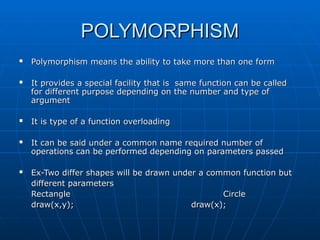
Polymorphism meansthe ability to take more than one form
Polymorphism means the ability to take more than one form
It provides a special facility that is same function can be called
It provides a special facility that is same function can be called
for different purpose depending on the number and type of
for different purpose depending on the number and type of
argument
argument
It is type of a function overloading
It is type of a function overloading
It can be said under a common name required number of
It can be said under a common name required number of
operations can be performed depending on parameters passed
operations can be performed depending on parameters passed
Ex-Two differ shapes will be drawn under a common function but
Ex-Two differ shapes will be drawn under a common function but
different parameters
different parameters
Rectangle
Rectangle Circle
Circle
draw(x,y);
draw(x,y); draw(x);
draw(x);
6.
INHERITANCE
INHERITANCE
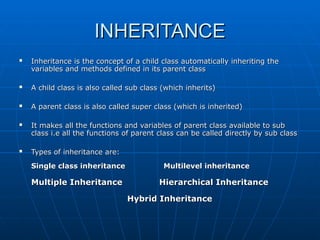
Inheritance isthe concept of a child class automatically inheriting the
Inheritance is the concept of a child class automatically inheriting the
variables and methods defined in its parent class
variables and methods defined in its parent class
A child class is also called sub class (which inherits)
A child class is also called sub class (which inherits)
A parent class is also called super class (which is inherited)
A parent class is also called super class (which is inherited)
It makes all the functions and variables of parent class available to sub
It makes all the functions and variables of parent class available to sub
class i.e all the functions of parent class can be called directly by sub class
class i.e all the functions of parent class can be called directly by sub class
Types of inheritance are:
Types of inheritance are:
Single class inheritance
Single class inheritance Multilevel inheritance
Multilevel inheritance
Multiple Inheritance
Multiple Inheritance Hierarchical Inheritance
Hierarchical Inheritance
Hybrid Inheritance
Hybrid Inheritance
7.
Application of OOP
Applicationof OOP
Real-time systems
Real-time systems
Stimulation and modeling
Stimulation and modeling
Object-oriented databases
Object-oriented databases
Hypertext, hypermedia and expertext
Hypertext, hypermedia and expertext
AI and expert systems
AI and expert systems
Neutral networks and parallel programming
Neutral networks and parallel programming
Decision support and office automation systems
Decision support and office automation systems
CIM/CAD/CAD system
CIM/CAD/CAD system
8.
Conclusion
Conclusion
This report onObject oriented programming has let me
This report on Object oriented programming has let me
conclude that Object oriented is one of the most important
conclude that Object oriented is one of the most important
concept in the programming which helps the programmer to
concept in the programming which helps the programmer to
program more effectively and efficiently. The main feature is
program more effectively and efficiently. The main feature is
the flexibility of classes and objects which saves programmer’s
the flexibility of classes and objects which saves programmer’s
time. It provides some of the features like data abstraction,
time. It provides some of the features like data abstraction,
encapsulation, polymorphism, inheritance which has made it
encapsulation, polymorphism, inheritance which has made it
possible for the object oriented programming concept to be
possible for the object oriented programming concept to be
used in the real world situations.
used in the real world situations.
So to be an effective programmer one must go through the
So to be an effective programmer one must go through the
concept of Object oriented programming thoroughly.
concept of Object oriented programming thoroughly.


![[DSC Europe 25] Slobodan Dolinic - Smart and Intelligent Green Region.pptx](https://cdn.slidesharecdn.com/ss_thumbnails/0bribinjsp6ghwtvsvor-2-sigre-slobodan-dolinic-260115093812-c9c10e90-thumbnail.jpg?width=640&height=640&fit=bounds)


![[DSC Europe 25] Ivan Lukovic & Marija Djukic - From Data to Value: Why Maturi...](https://cdn.slidesharecdn.com/ss_thumbnails/ahrfps8xr6knowwhacxh-1-ivan-marija-dsc-2025-ld-v1-presentation-260115093812-be21adfc-thumbnail.jpg?width=640&height=640&fit=bounds)


