Core Java Training
Collections - Maps
Page 1Classification: Restricted
3-February-
2003
cse403-10-Collections © 2003 University of Washington 1
Agenda
• Collections – Maps
• Map Interface
• Map methods
• Mapuse
• Hashmap
• Treemap
• Utilities
Page 2Classification: Restricted
3-February-
2003
cse403-10-Collections © 2003 University of Washington 2
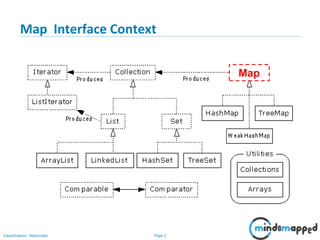
Map Interface Context
Map
Page 3Classification: Restricted
3-February-
2003
cse403-10-Collections © 2003 University of Washington 3
Map Interface
• Stores key/value pairs
• Maps from the key to the value
• Keys are unique
• a single key only appears once in the Map
• a key can map to only one value
• Values do not have to be unique
Page 4Classification: Restricted
3-February-
2003
cse403-10-Collections © 2003 University of Washington 4
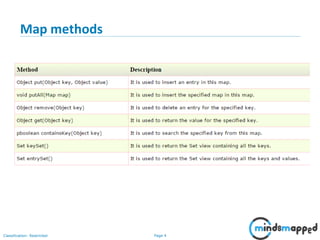
Map methods
Page 5Classification: Restricted
3-February-
2003
cse403-10-Collections © 2003 University of Washington 5
Map views
• A means of iterating over the keys and values in a Map
• Set keySet()
• returns the Set of keys contained in the Map
• Collection values()
• returns the Collection of values contained in the Map. This Collection
is not a Set, as multiple keys can map to the same value.
• Set entrySet()
• returns the Set of key-value pairs contained in the Map. The Map
interface provides a small nested interface called Map.Entry that is
the type of the elements in this Set.
Page 6Classification: Restricted
Map.Entry interface Example
import java.util.*;
class MapInterfaceExample{
public static void main(String args[]){
Map<Integer,String> map=new HashMap<Integer,String>();
map.put(100,"Amit");
map.put(101,"Vijay");
map.put(102,"Rahul");
for(Map.Entry m:map.entrySet()){
System.out.println(m.getKey()+" "+m.getValue());
}
}
}
Page 7Classification: Restricted
Exercise..
• Create a Map with 5 values…
• Iterate through and print
• the keys,
• the values,
• both the keys and the values of the Map
Page 8Classification: Restricted
3-February-
2003
cse403-10-Collections © 2003 University of Washington 8
HashMap and TreeMap Context
HashMap TreeMap
Map
Page 9Classification: Restricted
HashMap and TreeMap
• HashMap
• The keys are a set - unique, unordered
• Fast
• TreeMap
• The keys are a set - unique, ordered
• Same options for ordering as a TreeSet
• Natural order (Comparable, compareTo(Object))
• Special order (Comparator, compare(Object, Object))
Page 10Classification: Restricted
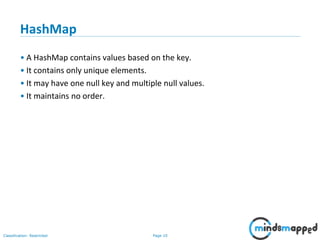
HashMap
• A HashMap contains values based on the key.
• It contains only unique elements.
• It may have one null key and multiple null values.
• It maintains no order.
Page 11Classification: Restricted
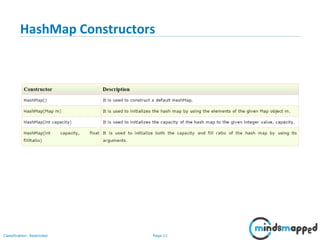
HashMap Constructors
Page 12Classification: Restricted
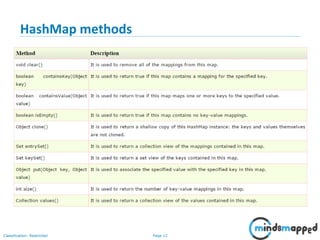
HashMap methods
Page 13Classification: Restricted
HashMap Example: remove()
import java.util.*;
public class HashMapExample {
public static void main(String args[]) {
// create and populate hash map
HashMap<Integer, String> map = new HashMap<Integer, String>();
map.put(101,"Let us C");
map.put(102, "Operating System");
map.put(103, "Data Communication and Networking");
System.out.println("Values before remove: "+ map);
// Remove value for key 102
map.remove(102);
System.out.println("Values after remove: "+ map);
}
}
Page 14Classification: Restricted
Difference between HashSet and HashMap
• Think…
Page 15Classification: Restricted
HashMap Example: Book
import java.util.*;
class Book {
int id;
String name,author,publisher;
int quantity;
public Book(int id, String name, String author,
String publisher, int quantity) {
this.id = id;
this.name = name;
this.author = author;
this.publisher = publisher;
this.quantity = quantity;
}
}
public class MapExample {
public static void main(String[] args) {
//Creating map of Books
Map<Integer,Book> map=new HashMap<Integer,Book>();
//Creating Books
Book b1=new Book(101,"Let us C","Yashwant Kanetkar","BPB",8);
Book b2=new Book(102,"Data Communications &
Networking","Forouzan","Mc Graw Hill",4);
Book b3=new Book(103,"Operating System","Galvin","Wiley",6);
//Adding Books to map
map.put(1,b1);
map.put(2,b2);
map.put(3,b3);
//Traversing map
for(Map.Entry<Integer, Book> entry:map.entrySet()){
int key=entry.getKey();
Book b=entry.getValue();
System.out.println(key+" Details:");
System.out.println(b.id+" "+b.name+" "+b.author+" "+b.publisher+
"+b.quantity);
}
}
}
Page 16Classification: Restricted
Exercise..
• What is a TreeMap? Implement the book example for TreeMap.
• What is a LinkedHashMap?
• What is a HashTable? How is it different from a HashMap?
• What is Comparable and Comparator interfaces in Java? How are they
different? Write programs utilizing both to test their usage.
Page 17Classification: Restricted
3-February-
2003
cse403-10-Collections © 2003 University of Washington 17
Bulk Operations
• In addition to the basic operations, a Collection may provide “bulk” operations
boolean containsAll(Collection c);
boolean addAll(Collection c); // Optional
boolean removeAll(Collection c); // Optional
boolean retainAll(Collection c); // Optional
void clear(); // Optional
Object[] toArray();
Object[] toArray(Object a[]);
A = {1,2,3,4} B={2,3,4,5}
addAll() -> A U B = {1,2,3,4,5} UNION
A = STUDENTS LEARNING JAVA; B = STUDENTS LEARNING .NET
A U B = ALL STUDENTS LEARNING EITHER JAVA OR .NET OR BOTH
A INTERSECTION B = ALL STUDENTS LEARNING BOTH JAVA AND .NET
removeAll() -> A-B = {1}, B-A={5}..
A IS ALL EMPLOYEES, B IS EMPLOYEES SERVING NOTICE PERIOD
A-B = EMPLOYEES NOT SERVING NOTICE PERIOD
retainAll() -> A INTERSECTION B = {2,3,4}
Page 18Classification: Restricted
HashMap vs TreeMap
• HashMap can contain one null key. TreeMap cannot contain a null key.
• HashMap does not maintain any order, whereas TreeMap maintains
ascending order.
Page 19Classification: Restricted
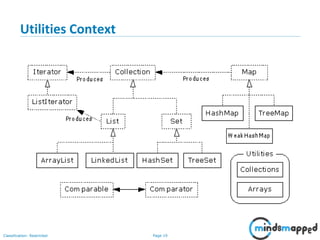
Utilities Context
Page 20Classification: Restricted
3-February-
2003
cse403-10-Collections © 2003 University of Washington 20
Utilities
• The Collections class provides a number of static methods for fundamental
algorithms
• Most operate on Lists, some on all Collections
• Sort, Search, Shuffle
• Reverse, fill, copy
• Min, max
• Wrappers
• synchronized Collections, Lists, Sets, etc
• unmodifiable Collections, Lists, Sets, etc
Page 21Classification: Restricted
3-February-
2003
cse403-10-Collections © 2003 University of Washington 21
Properties class
• Located in java.util package
• Special case of Hashtable
• Keys and values are Strings
• Tables can be saved to/loaded from file
Page 22Classification: Restricted
3-February-
2003
cse403-10-Collections © 2003 University of Washington 22
Topics to be covered in next session
• Inner Classes
• Method-local Inner Class
• Anonymous Inner Class
• Static Nested Inner Class
Page 23Classification: Restricted
3-February-
2003
cse403-10-Collections © 2003 University of Washington 23
Thank you!

Collections - Maps

  • 1.
  • 2.
    Page 1Classification: Restricted 3-February- 2003 cse403-10-Collections© 2003 University of Washington 1 Agenda • Collections – Maps • Map Interface • Map methods • Mapuse • Hashmap • Treemap • Utilities
  • 3.
    Page 2Classification: Restricted 3-February- 2003 cse403-10-Collections© 2003 University of Washington 2 Map Interface Context Map
  • 4.
    Page 3Classification: Restricted 3-February- 2003 cse403-10-Collections© 2003 University of Washington 3 Map Interface • Stores key/value pairs • Maps from the key to the value • Keys are unique • a single key only appears once in the Map • a key can map to only one value • Values do not have to be unique
  • 5.
  • 6.
    Page 5Classification: Restricted 3-February- 2003 cse403-10-Collections© 2003 University of Washington 5 Map views • A means of iterating over the keys and values in a Map • Set keySet() • returns the Set of keys contained in the Map • Collection values() • returns the Collection of values contained in the Map. This Collection is not a Set, as multiple keys can map to the same value. • Set entrySet() • returns the Set of key-value pairs contained in the Map. The Map interface provides a small nested interface called Map.Entry that is the type of the elements in this Set.
  • 7.
    Page 6Classification: Restricted Map.Entryinterface Example import java.util.*; class MapInterfaceExample{ public static void main(String args[]){ Map<Integer,String> map=new HashMap<Integer,String>(); map.put(100,"Amit"); map.put(101,"Vijay"); map.put(102,"Rahul"); for(Map.Entry m:map.entrySet()){ System.out.println(m.getKey()+" "+m.getValue()); } } }
  • 8.
    Page 7Classification: Restricted Exercise.. •Create a Map with 5 values… • Iterate through and print • the keys, • the values, • both the keys and the values of the Map
  • 9.
    Page 8Classification: Restricted 3-February- 2003 cse403-10-Collections© 2003 University of Washington 8 HashMap and TreeMap Context HashMap TreeMap Map
  • 10.
    Page 9Classification: Restricted HashMapand TreeMap • HashMap • The keys are a set - unique, unordered • Fast • TreeMap • The keys are a set - unique, ordered • Same options for ordering as a TreeSet • Natural order (Comparable, compareTo(Object)) • Special order (Comparator, compare(Object, Object))
  • 11.
    Page 10Classification: Restricted HashMap •A HashMap contains values based on the key. • It contains only unique elements. • It may have one null key and multiple null values. • It maintains no order.
  • 12.
  • 13.
  • 14.
    Page 13Classification: Restricted HashMapExample: remove() import java.util.*; public class HashMapExample { public static void main(String args[]) { // create and populate hash map HashMap<Integer, String> map = new HashMap<Integer, String>(); map.put(101,"Let us C"); map.put(102, "Operating System"); map.put(103, "Data Communication and Networking"); System.out.println("Values before remove: "+ map); // Remove value for key 102 map.remove(102); System.out.println("Values after remove: "+ map); } }
  • 15.
    Page 14Classification: Restricted Differencebetween HashSet and HashMap • Think…
  • 16.
    Page 15Classification: Restricted HashMapExample: Book import java.util.*; class Book { int id; String name,author,publisher; int quantity; public Book(int id, String name, String author, String publisher, int quantity) { this.id = id; this.name = name; this.author = author; this.publisher = publisher; this.quantity = quantity; } } public class MapExample { public static void main(String[] args) { //Creating map of Books Map<Integer,Book> map=new HashMap<Integer,Book>(); //Creating Books Book b1=new Book(101,"Let us C","Yashwant Kanetkar","BPB",8); Book b2=new Book(102,"Data Communications & Networking","Forouzan","Mc Graw Hill",4); Book b3=new Book(103,"Operating System","Galvin","Wiley",6); //Adding Books to map map.put(1,b1); map.put(2,b2); map.put(3,b3); //Traversing map for(Map.Entry<Integer, Book> entry:map.entrySet()){ int key=entry.getKey(); Book b=entry.getValue(); System.out.println(key+" Details:"); System.out.println(b.id+" "+b.name+" "+b.author+" "+b.publisher+ "+b.quantity); } } }
  • 17.
    Page 16Classification: Restricted Exercise.. •What is a TreeMap? Implement the book example for TreeMap. • What is a LinkedHashMap? • What is a HashTable? How is it different from a HashMap? • What is Comparable and Comparator interfaces in Java? How are they different? Write programs utilizing both to test their usage.
  • 18.
    Page 17Classification: Restricted 3-February- 2003 cse403-10-Collections© 2003 University of Washington 17 Bulk Operations • In addition to the basic operations, a Collection may provide “bulk” operations boolean containsAll(Collection c); boolean addAll(Collection c); // Optional boolean removeAll(Collection c); // Optional boolean retainAll(Collection c); // Optional void clear(); // Optional Object[] toArray(); Object[] toArray(Object a[]); A = {1,2,3,4} B={2,3,4,5} addAll() -> A U B = {1,2,3,4,5} UNION A = STUDENTS LEARNING JAVA; B = STUDENTS LEARNING .NET A U B = ALL STUDENTS LEARNING EITHER JAVA OR .NET OR BOTH A INTERSECTION B = ALL STUDENTS LEARNING BOTH JAVA AND .NET removeAll() -> A-B = {1}, B-A={5}.. A IS ALL EMPLOYEES, B IS EMPLOYEES SERVING NOTICE PERIOD A-B = EMPLOYEES NOT SERVING NOTICE PERIOD retainAll() -> A INTERSECTION B = {2,3,4}
  • 19.
    Page 18Classification: Restricted HashMapvs TreeMap • HashMap can contain one null key. TreeMap cannot contain a null key. • HashMap does not maintain any order, whereas TreeMap maintains ascending order.
  • 20.
  • 21.
    Page 20Classification: Restricted 3-February- 2003 cse403-10-Collections© 2003 University of Washington 20 Utilities • The Collections class provides a number of static methods for fundamental algorithms • Most operate on Lists, some on all Collections • Sort, Search, Shuffle • Reverse, fill, copy • Min, max • Wrappers • synchronized Collections, Lists, Sets, etc • unmodifiable Collections, Lists, Sets, etc
  • 22.
    Page 21Classification: Restricted 3-February- 2003 cse403-10-Collections© 2003 University of Washington 21 Properties class • Located in java.util package • Special case of Hashtable • Keys and values are Strings • Tables can be saved to/loaded from file
  • 23.
    Page 22Classification: Restricted 3-February- 2003 cse403-10-Collections© 2003 University of Washington 22 Topics to be covered in next session • Inner Classes • Method-local Inner Class • Anonymous Inner Class • Static Nested Inner Class
  • 24.