Object	Calisthenics
9	steps	to	better	OO	code
Agenda
Learn	how	to	make	our	code	more:
readable
reusable
testable
maintainable
Calisthenics
Cal	•	is	•	then	•	ics	-	/ˌkaləsˈTHeniks/
"Calisthenics	are	exercises	consisting	of	a
variety	of	gross	motor	movements;	often
rhythmical	and	generally	without	equipment
or	apparatus."
Wikipedia
Object	Calisthenics
Jeff	Bay
Written	for	Java
Why	bother?
Code	is	read	more
than	it's	written
Rule	#1
Only	one	level	of
indentation	per	method
class	Board	{
				public	function	__construct(array	$data)	{
								$buf	=	'';
								
								//	0
								for	($i=0;	$i<10;	$i++)	{
												//	1
												for	($j=0;	$j<10;	$j++)	{
																//	2
																$buf	.=	$data[$i][$j]
												}
								}
								return	$buf;
				}
}
class	Board	{
				public	function	__construct(array	$data)	{
								$buf	=	'';
								collectRows($buf);
								return	$buf;
				}
				private	function	collectRows($buf)	{
								for	($i=0;	$i<10;	$i++)	{
												collectRow($buf,	$i);
								}
				}
				private	function	collectRow($buf,	$row)	{
								for	($i=0;	$i<10;	$i++)	{
												$buf	.=	$data[$row][$i];
								}
				}
}
Benefits
Single	responsibility
Better	naming
Shorter	methods
Reusable	methods
Rule	#2
Do	not	use	else	keyword
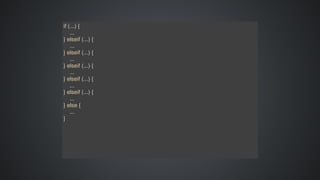
if	(...)	{
				...
}	elseif	(...)	{
				...
}	elseif	(...)	{
				...
}	elseif	(...)	{
				...
}	elseif	(...)	{
				...
}	elseif	(...)	{
				...
}	else	{
				...
}
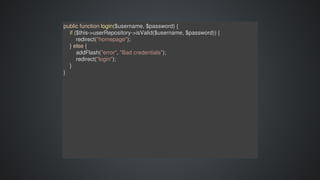
public	function	login($username,	$password)	{
				if	($this->userRepository->isValid($username,	$password))	{
								redirect("homepage");
				}	else	{
								addFlash("error",	"Bad	credentials");
								redirect("login");
				}
}
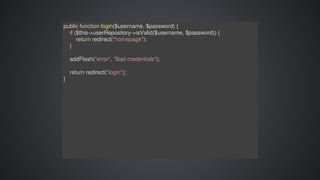
public	function	login($username,	$password)	{
				if	($this->userRepository->isValid($username,	$password))	{
								return	redirect("homepage");
				}
				addFlash("error",	"Bad	credentials");
				return	redirect("login");
}
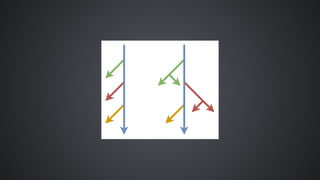
Extract	code
Default	value
Polymorphism
Strategy	pattern
State	pattern
Benefits
Avoids	code	duplication
Lower	complexity
Readability
Rule	#3
Wrap	primitive	types	if	it
has	behaviour
Value	Object	in	DDD
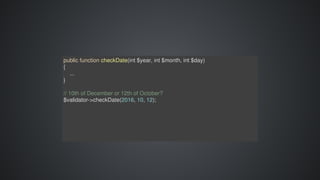
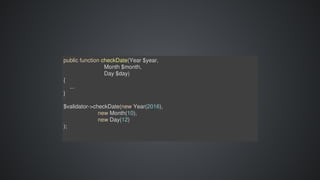
public	function	checkDate(int	$year,	int	$month,	int	$day)	
{
				...
}
//	10th	of	December	or	12th	of	October?
$validator->checkDate(2016,	10,	12);
public	function	checkDate(Year	$year,	
																										Month	$month,	
																										Day	$day)
{
				...
}
$validator->checkDate(new	Year(2016),	
																						new	Month(10),	
																						new	Day(12)
);
Benefits
Encapsulation
Type	hinting
Attracts	similar	behaviour
Rule	#4
Only	one	->	per	line
OK:	Fluent	interface
$validator->addFilter(new	EmailFilter())
										->addFilter(new	NotEmptyFilter());
Not	OK:	getter	chain
$token	=	$this->getService(Service::AUTH)
														->authUser($user,	$password)
														->getResult()
														->getToken();
//	1.	What	if	non	object	is	returned?
//	2.	How	about	exceptions	handling?
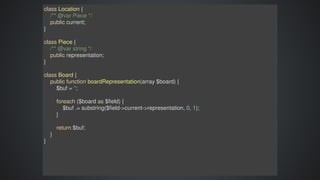
class	Location	{
				/**	@var	Piece	*/
				public	current;
}
class	Piece	{
				/**	@var	string	*/
				public	representation;
}
class	Board	{
				public	function	boardRepresentation(array	$board)	{
								$buf	=	'';
								foreach	($board	as	$field)	{
												$buf	.=	substring($field->current->representation,	0,	1);
								}
								return	$buf;
				}
}
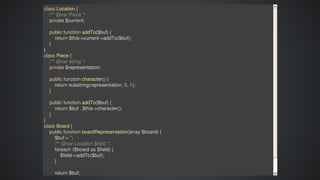
class	Location	{
				/**	@var	Piece	*/
				private	$current;
				public	function	addTo($buf)	{
								return	$this->current->addTo($buf);
				}
}
class	Piece	{
				/**	@var	string	*/
				private	$representation;
				public	function	character()	{
								return	substring(representation,	0,	1);
				}
				public	function	addTo($buf)	{
								return	$buf	.	$this->character();
				}
}
class	Board	{
				public	function	boardRepresentation(array	$board)	{
								$buf	=	'';
								/**	@var	Location	$field	*/
								foreach	($board	as	$field)	{
												$field->addTo($buf);
								}
								return	$buf;
Benefits
Encapsulation
Demeter's	law
Open/Closed	Principle
Rule	#5
Do	not	abbreviate
Why	abbreviate?
Name	too	long?
Too	many	responsibilities
Split	&	extract
Duplicated	code?
Refactor!
Benefits
Clear	intentions
Indicate	underlying	problems
Rule	#6
Keep	your	classes	small
What	is	small	class?
15-20	lines	per	method
50	lines	per	class
10	classes	per	module
200	lines	per	class
10	methods	per	class
15	classes	per	namespace
Benefits
Single	Responsibility
Smaller	namespaces
Rule	#7
No	more	than	2	5	instance
	variable	per	class
Class	should	handle	single
variable	state
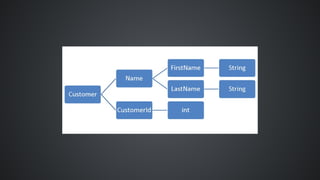
In	some	cases	it	might	be
two	variables
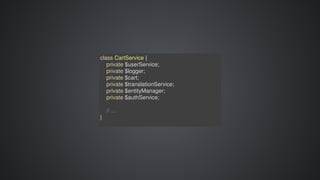
class	CartService	{
				private	$userService;
				private	$logger;
				private	$cart;
				private	$translationService;
				private	$entityManager;
				private	$authService;
				//	...
}
Benefits
High	cohesion
Encapsulation
Fewer	dependencies
Rule	#8
First	class	collections
Doctrine's	ArrayCollection
Benefits
Single	Responsibility
Rule	#9
Do	not	use	setters/getters
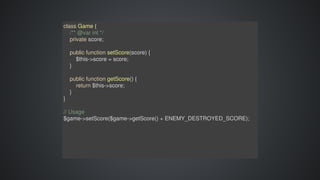
Accessors	are	fine
Don't	make	decisions
outside	of	class
Let	class	do	it's	job
Tell,	don't	ask
class	Game	{
				/**	@var	int	*/
				private	score;
				public	function	setScore(score)	{
								$this->score	=	score;
				}
				
				public	function	getScore()	{
								return	$this->score;
				}
}
//	Usage
$game->setScore($game->getScore()	+	ENEMY_DESTROYED_SCORE);
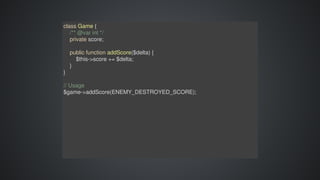
class	Game	{
				/**	@var	int	*/
				private	score;
				public	function	addScore($delta)	{
								$this->score	+=	$delta;
				}
}
//	Usage
$game->addScore(ENEMY_DESTROYED_SCORE);
Benefits
Open/Closed	Principle
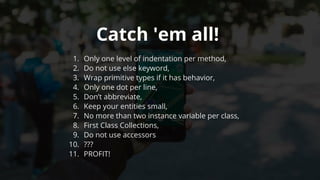
Catch	'em	all!	
1.	 Only	one	level	of	indentation	per	method,
2.	 Do	not	use	else	keyword,
3.	 Wrap	primitive	types	if	it	has	behavior,
4.	 Only	one	dot	per	line,
5.	 Don’t	abbreviate,
6.	 Keep	your	entities	small,
7.	 No	more	than	two	instance	variable	per	class,
8.	 First	Class	Collections,
9.	 Do	not	use	accessors
10.	 ???
11.	 PROFIT!
Homework
Create	new	project	up	to
1000	lines	long
Apply	presented	rules	as
strictly	as	possible
Draw	conculsions
Customize	these	rules
Final	thoughts
These	are	not	best	practices
These	are	just	guidelines
Use	with	caution!
Thank	you!

Object calisthenics (PHPCon Poland 2016)