CONFERENCE OF EUROPEAN UNIVERSITY CHAPLAINS
June 8-12, 2015
Kontakt der Kontinenten, Conference Centre,
Utrechtse Heuvelrug National Park.
WORKSHOP
Emerging Directions in Chaplaincy in the Secular,
Pluralist, Internationalised Higher Education Sector
Part 2: Oasis
Geoff Boyce, Flinders University of South Australia
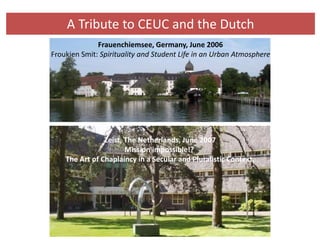
A Tribute to CEUC and the Dutch
Frauenchiemsee, Germany, June 2006
Froukien Smit: Spirituality and Student Life in an Urban Atmosphere
Zeist, The Netherlands, June 2007
Mission impossible!?
The Art of Chaplaincy in a Secular and Pluralistic Context.
‘Jesus did not die to
make you a Christian,
but that the world
could be made whole.’
Prof. Hans Rookmaaker,
Professor of the History of Fine
Arts,
Free University of Amsterdam,
1974
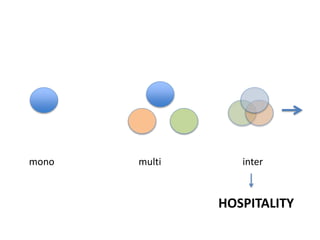
mono multi inter
mono multi inter
HOSPITALITY
Hospitality
... means the creation
of a free space where the stranger can
enter and become a friend instead of an
enemy…
…where strangers can enter
and discover themselves as created free;
free to sing their own songs,
speak their own languages,
dance their own dances;
free also to leave and follow their own
vocations.
Henri Nouwen. Reaching Out: The Three Movements in the Spiritual Life. (1975 Doubleday. New York)
FLINDERS UNVERSITY
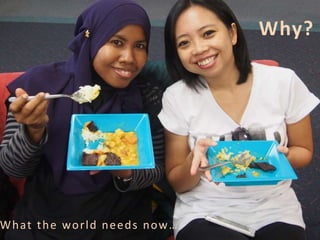
Why?
What the world needs now…
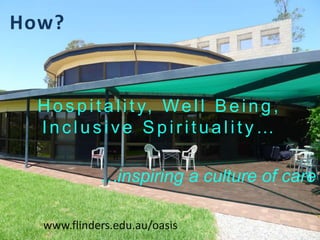
Hospitality, Well Being,
Inc lus iv e Spirituality …
…inspiring a culture of care
www.flinders.edu.au/oasis
How?
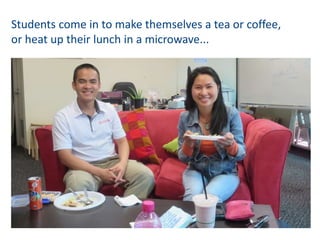
Students come in to make themselves a tea or coffee,
or heat up their lunch in a microwave...
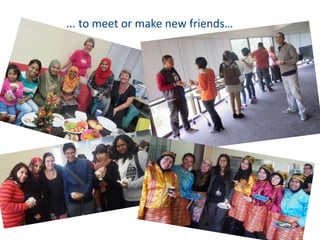
... to meet or make new friends…
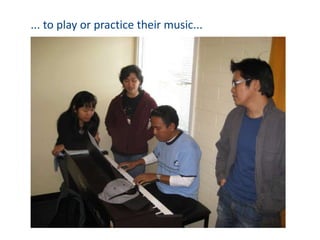
... to play or practice their music...
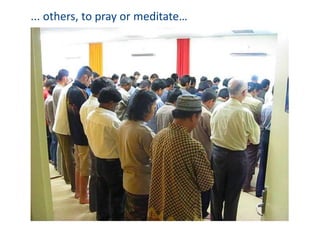
... others, to pray or meditate…
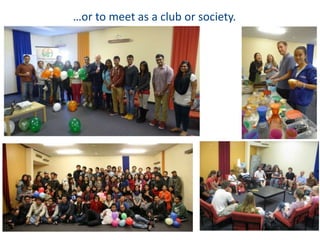
…or to meet as a club or society.
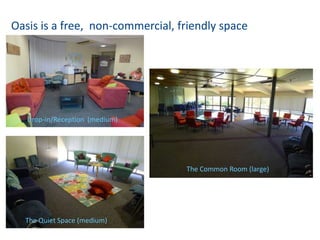
Oasis is a free, non-commercial, friendly space
open to all!
The Quiet Space (medium)
The Common Room (large)
Drop-in/Reception (medium)
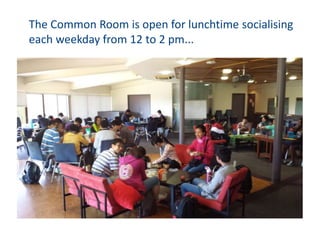
The Common Room is open for lunchtime socialising
each weekday from 12 to 2 pm...
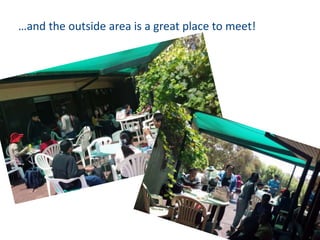
…and the outside area is a great place to meet!
Oasis is a Place of Hospitality
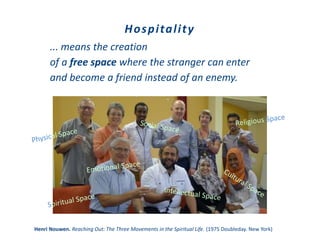
... means the creation
of a free space where the stranger can enter
and become a friend instead of an enemy.
Hospitality
Henri Nouwen. Reaching Out: The Three Movements in the Spiritual Life. (1975 Doubleday. New York)
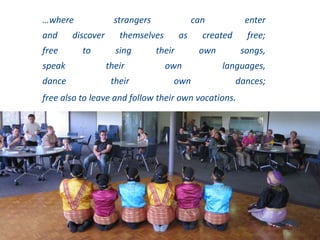
…where strangers can enter
and discover themselves as created free;
free to sing their own songs,
speak their own languages,
dance their own dances;
free also to leave and follow their own vocations.
Henri Nouwen. Reaching Out: The Three Movements in the Spiritual Life. (1975 Doubleday. New York)
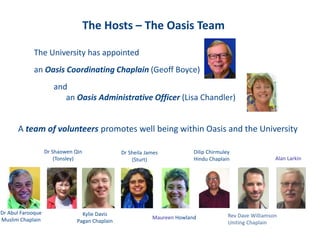
The Hosts – The Oasis Team
The University has appointed
an Oasis Coordinating Chaplain (Geoff Boyce)
and
an Oasis Administrative Officer (Lisa Chandler)
A team of volunteers promotes well being within Oasis and the University
Dr Abul Farooque
Muslim Chaplain
Dr Shaowen Qin
(Tonsley)
Kylie Davis
Pagan Chaplain
Dr Sheila James
(Sturt)
Maureen Howland
Dilip Chirmuley
Hindu Chaplain
Rev Dave Williamson
Uniting Chaplain
Alan Larkin
The Oasis Team give support to students
and respond to their various needs...
English Conversation for spouses of
international students
in partnership with International
Students Services
Relaxation!
Maureen giving
knitting lessons!
... and share their experiences with the wider local, national
and international community
Human Rights Symposium
Interfaith Program, Woodville High School
Sheffield Conference, “ Multifaith Chaplaincy in the UK Public
Sector”, from left, Geoff Boyce, Christopher Chester CA, Chief
Executive, South Yorkshire Workplace Chaplaincy and conference
host, Rev Debbie Hodge, Chief Officer Multi Faith Group for
Healthcare Chaplaincy in the National Health Service and Andrew
Cropley, Executive Director for Strategic Planning and Business
Development at The Sheffield College, which provided the
conference venue.
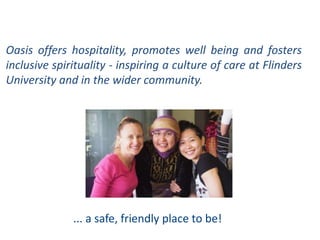
Oasis offers hospitality, promotes well being and fosters
inclusive spirituality - inspiring a culture of care at Flinders
University and in the wider community.
... a safe, friendly place to be!
FLINDERS UNVERSITY

Oasis ceuc powerpoint june 2015

  • 1.
    CONFERENCE OF EUROPEANUNIVERSITY CHAPLAINS June 8-12, 2015 Kontakt der Kontinenten, Conference Centre, Utrechtse Heuvelrug National Park. WORKSHOP Emerging Directions in Chaplaincy in the Secular, Pluralist, Internationalised Higher Education Sector Part 2: Oasis Geoff Boyce, Flinders University of South Australia
  • 2.
    A Tribute toCEUC and the Dutch Frauenchiemsee, Germany, June 2006 Froukien Smit: Spirituality and Student Life in an Urban Atmosphere Zeist, The Netherlands, June 2007 Mission impossible!? The Art of Chaplaincy in a Secular and Pluralistic Context.
  • 3.
    ‘Jesus did notdie to make you a Christian, but that the world could be made whole.’ Prof. Hans Rookmaaker, Professor of the History of Fine Arts, Free University of Amsterdam, 1974
  • 4.
  • 5.
  • 6.
    Hospitality ... means thecreation of a free space where the stranger can enter and become a friend instead of an enemy… …where strangers can enter and discover themselves as created free; free to sing their own songs, speak their own languages, dance their own dances; free also to leave and follow their own vocations. Henri Nouwen. Reaching Out: The Three Movements in the Spiritual Life. (1975 Doubleday. New York)
  • 7.
  • 8.
    Why? What the worldneeds now…
  • 9.
    Hospitality, Well Being, Inclus iv e Spirituality … …inspiring a culture of care www.flinders.edu.au/oasis How?
  • 10.
    Students come into make themselves a tea or coffee, or heat up their lunch in a microwave...
  • 11.
    ... to meetor make new friends…
  • 12.
    ... to playor practice their music...
  • 13.
    ... others, topray or meditate…
  • 14.
    …or to meetas a club or society.
  • 15.
    Oasis is afree, non-commercial, friendly space open to all! The Quiet Space (medium) The Common Room (large) Drop-in/Reception (medium)
  • 16.
    The Common Roomis open for lunchtime socialising each weekday from 12 to 2 pm...
  • 17.
    …and the outsidearea is a great place to meet!
  • 18.
    Oasis is aPlace of Hospitality
  • 19.
    ... means thecreation of a free space where the stranger can enter and become a friend instead of an enemy. Hospitality Henri Nouwen. Reaching Out: The Three Movements in the Spiritual Life. (1975 Doubleday. New York)
  • 20.
    …where strangers canenter and discover themselves as created free; free to sing their own songs, speak their own languages, dance their own dances; free also to leave and follow their own vocations. Henri Nouwen. Reaching Out: The Three Movements in the Spiritual Life. (1975 Doubleday. New York)
  • 21.
    The Hosts –The Oasis Team The University has appointed an Oasis Coordinating Chaplain (Geoff Boyce) and an Oasis Administrative Officer (Lisa Chandler) A team of volunteers promotes well being within Oasis and the University Dr Abul Farooque Muslim Chaplain Dr Shaowen Qin (Tonsley) Kylie Davis Pagan Chaplain Dr Sheila James (Sturt) Maureen Howland Dilip Chirmuley Hindu Chaplain Rev Dave Williamson Uniting Chaplain Alan Larkin
  • 22.
    The Oasis Teamgive support to students and respond to their various needs... English Conversation for spouses of international students in partnership with International Students Services Relaxation! Maureen giving knitting lessons!
  • 23.
    ... and sharetheir experiences with the wider local, national and international community Human Rights Symposium Interfaith Program, Woodville High School Sheffield Conference, “ Multifaith Chaplaincy in the UK Public Sector”, from left, Geoff Boyce, Christopher Chester CA, Chief Executive, South Yorkshire Workplace Chaplaincy and conference host, Rev Debbie Hodge, Chief Officer Multi Faith Group for Healthcare Chaplaincy in the National Health Service and Andrew Cropley, Executive Director for Strategic Planning and Business Development at The Sheffield College, which provided the conference venue.
  • 24.
    Oasis offers hospitality,promotes well being and fosters inclusive spirituality - inspiring a culture of care at Flinders University and in the wider community. ... a safe, friendly place to be!
  • 25.

Editor's Notes

  • #2 Introduction: In this workshop, two progressive and innovative chaplaincies, MoTiv at Delft Technical University in the Netherlands and Oasis at Flinders University in South Australia will each present and compare their emerging directions. Both seek to serve the university community as a whole, and not only their own interests. Each will present their own organisations, starting with the ‘why’, their visions, beliefs, core values and motivations and proceed with the ‘how’ and the ‘what’ that flow from the ‘why’.
  • #3 In the CEUC of 2006, Froukien Smit delivered a short paper, Spirituality and Student Life in an Urban Atmosphere, in which she sketched out some of the issues facing chaplaincy in the Netherlands. http://www.ceuc.org/2006-frauenchiemsee-germany.html She identified individualism, ‘what’s in it for me?’, hectic lifestyle, pressure to succeed, making choices constantly, mobility, introspection about life’s big questions, unlikeliness of finding community in institutions, tendency to make personal rather than institutional commitments to specific social justice issues. She went on to analyse characteristics of various religious groups: Open minded and committed (students with a church background; practising Christians of a more liberal kind); the interested (students, who are interested in religion or spirituality, without being affiliated to any church or faith); the ‘non-believers’; the conservative and evangelical Christian students and Muslims and students of other faiths. This short paper opened a discussion about the future of church-funded chaplaincy. In fact, the progressive cutting back of support for university chaplaincy was already underway, the churches failing to value a chaplaincy broader than their own ecclesial-centred interests. This latter theme would be taken up by the Dutch organisers of the next CEUC in Zeist. This was where I first met MoTiv from Delft and was introduced to the importance of developing new sustainable models for university chaplaincy, pre-empting the growing decline of the churches. I found encouragement to keep developing the multifaith approach evolving at Flinders. The Zeist impetus was important in imagining Oasis and in writing my book, An Improbable Feast, that documented its formation. Now here we are again in Holland, being challenged and stretched in our imaginations!
  • #4 But my debt to the Dutch goes back at least to 1974, when I first met Prof Hans Rookmaaker, patron of the Arts Centre Group in London, at a gathering in a packed upstairs lounge full of Christian artists. How might the resurrection be represented? Would Rembrandt have been a pinnacle of western art if he had been born in Brazil? A fascinating discussion! And in the conversation, this statement, which opened a whole new world for me. This is an important foundation for my ‘why?’ I had been brought up in my Christian life to believe that Jesus died so that I could become a Christian and live with God forever. But now a professor of the history of art was giving me a much bigger perspective. I am a collaborator with God in God’s mission for wholeness in God’s world. I am not here to make anyone Christian but to encourage wholeness at every level in the world. This theology was given more substance in a paper at the Zeist CEUC, ‘Responsive Mission’, by Erik Borgman. http://www.ceuc.org/2007-zeist-the-netherlands.html Borgman argued that the church has positioned itself to be the mediator of God to the world. But the Biblical picture is that God engages directly with the world. The function of the church is to resource and give language to resource the interaction of God with the world. Chaplaincy is therefore at the forefront of God’s mission and has a radical theological mandate. So, ‘the why?” – the evolution of new structures, like Motiv and Oasis, are provisional frameworks responding to what we perceive God is doing in the world – responding, if you like, to those kind of observations made by Froukien Smit. The Christians among us are enlightened by the values of Jesus and directed toward supporting human wholeness. My non-Christian colleagues may have other reference points, but we are collegiate to the extent that we are both heading in the same direction toward human wholeness and human flourishing.
  • #5 Christian ministry was a lot simpler when there was, in the West, a Christian consensus – even though the split between east and west, Protestant and Catholic and multiple further splits might suggest that there was hardly ‘consensus’! But when I was growing up, one could assume that we lived in a ‘Christian country’ and chaplaincy was definitely a Christian profession. But as global mobility began to grow, Australia in the 1970’s began to think of itself as a multi-cultural country – a country of many immigrant cultures. As time went by, the everyday world of work and leisure encouraged mixing of the different cultural groups, even though some had settled in distinct districts and these suburbs and streets of shops still retain these identities today. But the mixing brought inter-relationships – ‘mixed marriages’, for example. Even some restaurants began talking about food ‘fusion’. By analogy, we can identify mono-faith (one faith influencing the whole culture), multifaith (the recognition of different faith groups and the concomitant task of building respect and understanding among them) and interfaith ( faith identities inter-relate and contribute cooperatively to a working whole).
  • #6 At Flinders, chaplaincy was historically Christian (Mono), but as internationalisation increased in the 1990’s, and other faiths grew in size on campus, chaplains of other faiths than Christian were appointed and a multifaith chaplaincy emerged. As time went by and the chaplains began to get to know each other better, they started to meet weekly for lunch and began to undertake projects together in service to the whole university. Oasis became the metaphor for this; an open interfaith approach had emerged; the practice of hospitality was identified as the primary factor for its emergence and the basis for its chaplaincy practice; hospitality would inform its function as a centre on the campus. This approach was formally affirmed by the University in late 2012.
  • #7 Hospitality… means primarily the creation of a free space where the stranger can enter and become a friend instead of an enemy. Hospitality is not to change people, but to offer them space where change can take place. It is not to bring men and women over to our side, but to offer freedom not disturbed by dividing lines. It is not to lead our neighbour into a corner where there are no alternatives left, but to open a wide spectrum of options for choice and commitment. It is not an educated intimidation with good books, good stories and good works, but the liberation of fearful hearts so that words can find roots and bear ample fruit. It is not a method of making our God and our way into the criteria of happiness, but the opportunity to others to find their God and their way. The paradox of hospitality is that it wants to create emptiness, but a friendly emptiness where strangers can enter and discover themselves as created free; free to sing their own songs, speak their own languages, dance their own dances; free also to leave and follow their own vocations. Hospitality is not a subtle invitation to adopt a life style of the host, but the gift of a chance for the guest to find their own. (p 68)
  • #8 When I picture an oasis in my mind, I see a pool of clear, refreshing water and the shade of some palm trees. Travellers gather, looking for a cool, safe and friendly place to pause and refresh on their journeys to a thousand destinations. They come because they have heard about the hospitality of Oasis, a place to relax from the journey and make new friends among other journeyers on their way. As they gather by the waters and experience its refreshment, they feel at ease. They begin to swap stories over cups of tea and coffee and shared meals – the stories of their lives - their cultures, values and beliefs. They share survival tips that have helped them endure the harsh conditions of the desert. Then they move on, more motivated and wiser as a result of their sojourn, some inspired to share such hospitality with others when they reach their various destinations and settle down. Such is the transforming power of hospitality offered by Oasis at Flinders – relief from a world of ‘telling’, to experiencing a world of freely-given sharing and mutual support, regardless of difference.
  • #9 Why do we offer this unconditional space, this open-ended hospitality, this haven from demands and competition? For the same reason that in times past, monks offered safe lodging and refreshment to pilgrims passing through. For the same reason that St Martin-of-Tours offered unconditional, sacrificial hospitality to all, becoming the father of chaplaincy. And because universities are international communities that provide a golden opportunity to model what world peace may look like.
  • #10 When the University embraced Oasis into its administrative structures at the end of 2012, a plan was also underway to completely remodel the heart of the Flinders campus with a new Student Hub. In the course of the planning, Oasis was offered an alternative venue – the former Staff Club and Function Centre – the bottom level of the building pictured. At the end of 2013, Oasis moved into these premises and in 2015 planning began for a $1m refurbishment of the new Oasis, to be opened at the beginning of 2016. This repositioning gave cause to re-articulate the purpose of Oasis – as inspiring hospitality to all, directed toward well being.
  • #11 Everyone who comes into Oasis is greeted, and introduced to others as necessary. And the students are encouraged to see Oasis as their own home-away-from-home.
  • #12 Top left: Students from the Maldives wanted to show their appreciation of Oasis as their ‘home’ before returning to their country after graduation. So they prepared a Maldivian Feast for the Oasis team. Bottom left, the International Office use Oasis regularly to welcome students and provide social occasions. Bottom right, the Indonesian dance group rehearse in Oasis. Top right, new international Social Work students get out of the assigned lecture theatre to use the space to mingle and get to know each other.
  • #13 Students drop in to practice their music or to relax or meditate over the piano. In this photo, Nus from Indonesia is having a sing-along. During his time at Flinders he formed an Indonesian choir that would perform in local churches by invitation.
  • #14 Oasis provides a large flat space for Friday Prayer for the Muslim students and staff. It is linked to male and female Muslim daily prayer rooms. Oasis also provides a meditation space, open to all.
  • #15 Top left: Indian students gather to celebrate India’s Independence Day; bottom left: Vietnamese Students Association, bottom right: Bible Study; top right: Focus meal for international students.
  • #20 Omar from Saudi Arabia came to Adelaide to help settle his daughter, Safa (on his left in the front row) in a new flat. Safa had recently gone through a difficult divorce - Lisa and Maureen (back row) had been listening ears throughout her crisis; and Oasis became a home-away-from-home for Safa and her friends. Safa has a talent for design and her redesign of the architect’s drawings for our new Muslim Prayer rooms were accepted as superior! So the morning before Omar was to fly home to Saudi Arabia we arranged a morning tea for Omar, Safa and her friends. Two members of the International Student Services team, with whom we collaborate, also came. Omar left for home relieved in the knowledge that he was leaving his daughter in good care. Hospitality can take many forms!
  • #22 The team comprises two university appointed staff, chaplains appointed by religious bodies, and voluntary members of staff and volunteers from the wider community. Each works autonomously within the culture of Oasis and its methodologies to achieve agreed Oasis goals. A weekly shared meal provides a regular meeting point for sharing and decision-making.
  • #25 Oasis does this by providing a safe, inclusive drop-in centre, facilitated by a team of volunteers who enable inter-personal, intercultural and interfaith respect and understanding. In this friendly, informal environment students can meet, make connections and find friendship and support.   Oasis supports initiatives by staff and students advancing the Oasis ethos, extending to the wider, local, national and international community.