An t-Albannach had
a Q & A with
Gaelic singers, Gille-
brìde MacMillan, who
stars as Gwyllyn the
Bard on the television
series, Outlander, and
the up-and-coming
Kyle Carey, who re-
cently performed to-
gether here in New York
on July 2nd
, 2015.
An t-Albannach: Are you a native Gaelic speaker or how did you
come to speak Gaelic?
Gillebrìde: I am a native Gaelic speaker. I learned English
when I went to school. Gaelic is the language of my family
and I speak Gaelic to my children.
Kyle: I’m not a native speaker, but started studying Gaelic
when I lived in Cape Breton, Nova Scotia for a year on a
Fulbright Fellowship. It was in Cape Breton that I first
learned about Sabhal Mòr Ostaig—the Gaelic College on
the Isle of Skye. I then traveled there for a year to study
Gaelic intensively and become fluent. Since then, I return
to Scotland periodically, usual after tours of Europe to re-
fresh my speaking skills
An t-Albannach: Did you learn it from someone in your family or
did you learn it in school or both? If not a native speaker, how did
you maintain the Gaelic?
Gillebrìde: Gaelic is my first language. I live in Glasgow
though, so I am surrounded by English. However, I listen
to the radio, read in Gaelic, speak it to my work colleagues
and friends and my siblings and own children.
Kyle: I learned my Gaelic at Sabhal Mòr Ostaig, and in
particular from two fantastic teachers I had there—Mur-
chadh MacLeòid and Christine Primrose. Both are from
the Isle of Lewis and very generous in their knowledge and
expertise.
Q&A Interview with Gaelic Singers,
Outlander’s Bard, Gillebrìde MacMillan, and Kyle Carey
An t-Albannach
The Newsletter of the New York Caledonian Club
August 2015
Continued on page 5
NYCC SUMMER/FALL
2015
See inside for upcoming events!
Scottish Gaelic Classes Begin
September 15th
An t-Albannach: How do you utilize your Gaelic – for example, teach-
ing, writing, acting singing, recitation, drama, etc.?
Gillebrìde: I do all of these. I am a Gaelic teacher at Glasgow
University and I teach the language and the literature to stu-
dents. I write short stories and poetry in the language as well
as writing songs. I regularly use the language in my everyday
life – with family, work and music.
Kyle: I utilize my Gaelic both with my teaching and perform-
ing. I call my music ‘Gaelic Americana’ as it’s a mix of songs
in Scottish Gaelic and own self-penned Appalachian-inspired
originals. Every time I perform, I have the opportunity to sing
in Gaelic, and every time I teach, I have the opportunity to
speak it.
An t-Albannach: What do you think is the best way to promote Scottish
Gaelic that makes it relevant in 2015?
Gillebrìde: By showing that you can get jobs and opportuni-
ties through speaking and using Gaelic. If I as a Gaelic speaker
can get to travel and do what I enjoy because I speak and use
the language, that is the best way to promote the language.
Kyle: I think it’s important to view Gaelic as a living and vi-
brant language, therefore we need to be open to the fact that
it’s going to change and evolve like any other. I think making
the language appealing to youth is a good place to start, and if
you’re a fluent speaker yourself—to be generous with your
knowledge.
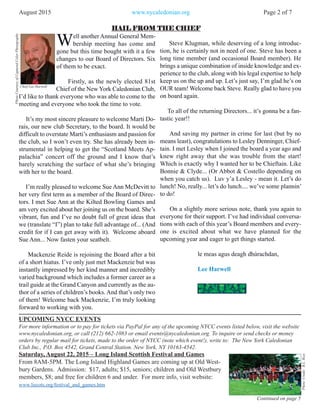
Kyle Carey
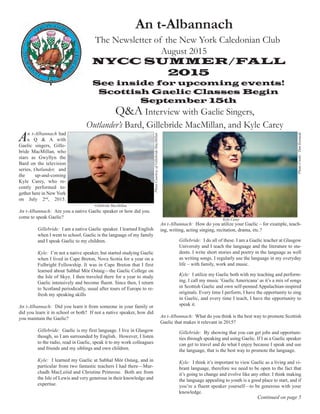
Gillebrìde MacMillan
PhotoCredit:DanKennedy
PhotoCourtesyofGillebrìdeMacMillan
Well anotherAnnual General Mem-
bership meeting has come and
gone but this time bought with it a few
changes to our Board of Directors. Six
of them to be exact.
Firstly, as the newly elected 81st
Chief of the New York Caledonian Club,
I’d like to thank everyone who was able to come to the
meeting and everyone who took the time to vote.
It’s my most sincere pleasure to welcome Marti Do-
rais, our new club Secretary, to the board. It would be
difficult to overstate Marti’s enthusiasm and passion for
the club, so I won’t even try. She has already been in-
strumental in helping to get the “Scotland Meets Ap-
palachia” concert off the ground and I know that’s
barely scratching the surface of what she’s bringing
with her to the board.
I’m really pleased to welcome Sue Ann McDevitt to
her very first term as a member of the Board of Direc-
tors. I met Sue Ann at the Kilted Bowling Games and
am very excited about her joining us on the board. She’s
vibrant, fun and I’ve no doubt full of great ideas that
we (translate “I”) plan to take full advantage of... (And
credit for if I can get away with it). Welcome aboard
Sue Ann... Now fasten your seatbelt.
Mackenzie Reide is rejoining the Board after a bit
of a short hiatus. I’ve only just met Mackenzie but was
instantly impressed by her kind manner and incredibly
varied background which includes a former career as a
trail guide at the Grand Canyon and currently as the au-
thor of a series of children’s books. And that’s only two
of them! Welcome back Mackenzie, I’m truly looking
forward to working with you.
Steve Klugman, while deserving of a long introduc-
tion, he is certainly not in need of one. Steve has been a
long time member (and occasional Board member). He
brings a unique combination of inside knowledge and ex-
perience to the club, along with his legal expertise to help
keep us on the up and up. Let’s just say, I’m glad he’s on
OUR team! Welcome back Steve. Really glad to have you
on board again.
To all of the returning Directors... it’s gonna be a fan-
tastic year!!
And saving my partner in crime for last (but by no
means least), congratulations to Lesley Denninger, Chief-
tain. I met Lesley when I joined the board a year ago and
knew right away that she was trouble from the start!
Which is exactly why I wanted her to be Chieftain. Like
Bonnie & Clyde... (Or Abbot & Costello depending on
when you catch us). Luv y’a Lesley - mean it. Let’s do
lunch! No, really... let’s do lunch.... we’ve some plannin’
to do!
On a slightly more serious note, thank you again to
everyone for their support. I’ve had individual conversa-
tions with each of this year’s Board members and every-
one is excited about what we have planned for the
upcoming year and eager to get things started.
le meas agus deagh dhùrachdan,
Lee Harwell
August 2015 www.nycaledonian.org Page 2 of 7
HAIL FROM THE CHIEF
Chief Lee Harwell
PhotoCourtesyofCapturedColorPhotography
Continued on page 5
UPCOMING NYCC EVENTS
For more information or to pay for tickets via PayPal for any of the upcoming NYCC events listed below, visit the website
www.nycaledonian.org, or call (212) 662-1083 or email events@nycaledonian.org. To inquire or send checks or money
orders by regular mail for tickets, made to the order of NYCC (note which event!), write to: The New York Caledonian
Club Inc., P.O. Box 4542, Grand Central Station. New York, NY 10163-4542.
Saturday, August 22, 2015 – Long Island Scottish Festival and Games
From 8AM-5PM. The Long Island Highland Games are coming up at Old West-
bury Gardens. Admission: $17, adults; $15, seniors; children and Old Westbury
members, $8; and free for children 6 and under. For more info, visit website:
www.liscots.org/festival_and_games.htm
PhotoCredit:B.L.Rice
For centuries, Holy
Isle has been sa-
cred and revered: first
to the Druids, then the
Christians and now
the Buddhists. Even
the occasional Viking
has set foot on the isle,
as evidenced by runic
carvings found in
caves.
One person who
found the tiny island
particularly special
was St Molaise (pro-
nounced Mo-lash-eh.)
As the son of a 6th
century Irish king and
a Scottish princess, he
was offered the throne
of Ulster but chose in-
stead to live a spiritual
life in one of the is-
land’s caves.
In the 19th century, there was a different type of
“spirits” on Holy Isle. A remote cave was used to store
smuggled whisky as part of a boot legging operation.
Today, Holy Isle houses the Centre for World Peace
and Health under the directorship of Lama Yeshe Losal
Rinpoche. The island is open to the public and the
Centre contains accommodations for guests coming for
retreats, courses or just to soak up the peace and natural
beauty.
Visitors can take an easy pleasant walk along the
two-mile western coastline. (The eastern half of the
island is a nature preserve and off limits.)
The walk starts at the northern end near the jetty
where one can examine the eight monuments known
as Stupas which represent different stages of The Bud-
dha’s life.
August 2015 www.nycaledonian.org Page 3 of 7
Travelogue: Holy Isle
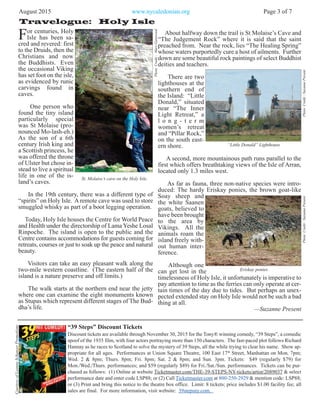
PhotoCredit:MaryGatewood
PhotoCredit:SuzannePresentPhotoCredit:SuzannePresent
About halfway down the trail is St Molaise’s Cave and
“The Judgement Rock” where it is said that the saint
preached from. Near the rock, lies “The Healing Spring”
whose waters purportedly cure a host of ailments. Further
down are some beautiful rock paintings of select Buddhist
deities and teachers.
There are two
lighthouses at the
southern end of
the Island: “Little
Donald,” situated
near “The Inner
Light Retreat,” a
l o n g - t e r m
women’s retreat
and “Pillar Rock,”
on the south east-
ern shore.
A second, more mountainous path runs parallel to the
first which offers breathtaking views of the Isle of Arran,
located only 1.3 miles west.
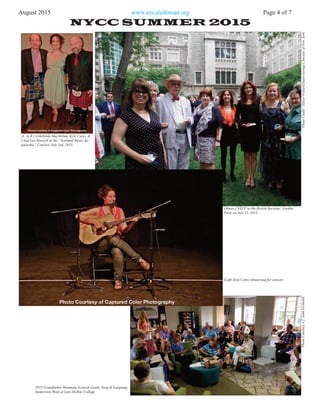
As far as fauna, three non-native species were intro-
duced: The hardy Eriskay ponies, the brown goat-like
Soay sheep and
the white Saanen
goats, believed to
have been brought
to the area by
Vikings. All the
animals roam the
island freely with-
out human inter-
ference.
Although one
can get lost in the
timelessness of Holy Isle, it unfortunately is imperative to
pay attention to time as the ferries can only operate at cer-
tain times of the day due to tides. But perhaps an unex-
pected extended stay on Holy Isle would not be such a bad
thing at all.
—Suzanne Present
St. Molaise’s cave on the Holy Isle.
“Little Donald” Lighthouse
Eriskay ponies
“39 Steps” Discount Tickets
Discount tickets are available through November 30, 2015 for the Tony® winning comedy, “39 Steps”, a comedic
spoof of the 1935 film, with four actors portraying more than 150 characters. The fast-paced plot follows Richard
Hannay as he races to Scotland to solve the mystery of 39 Steps, all the while trying to clear his name. Show ap-
propriate for all ages. Performances at Union Square Theatre, 100 East 17th
Street, Manhattan on Mon. 7pm;
Wed. 2 & 8pm; Thurs. 8pm; Fri. 8pm; Sat. 2 & 8pm; and Sun. 3pm. Tickets: $49 (regularly $79) for
Mon./Wed./Thurs. performances; and $59 (regularly $89) for Fri./Sat./Sun. performances. Tickets can be pur-
chased as follows: (1) Online at website Ticketmaster.com/THE-39-STEPS-NY-tickets/artist/2089037 & select
performance date and enter code LSP88; or (2) Call Ticketmaster.com at 800-250-2929 & mention code: LSP88;
or (3) Print and bring this notice to the theatre box office. Limit: 8 tickets; price includes $1.00 facility fee; all
sales are final. For more information, visit website: 39stepsny.com.
CourtesyofLeanneSchanzerPromotions
August 2015 www.nycaledonian.org Page 4 of 7
NYCC SUMMER 2015
PhotoCredit:EloisePollard/SaintGeorge’sSocietyofNewYork
(Above.) NYCC at the British Societies’Garden
Party on July 15, 2015.
(L. to R.) Gillebrìde MacMillan, Kyle Carey, &
Chief Lee Harwell at the “Scotland Meets Ap-
palachia” Concert, July 2nd, 2015.
(Left) Kyle Carey rehearsing for concert.
2015 Grandfather Mountain Scottish Gaelic Song & Language
Immersion Week at Lees-McRae College
PhotoCourtesyofJohnGrimaldi
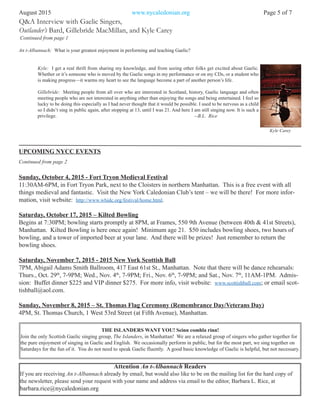
An t-Albannach: What is your greatest enjoyment in performing and teaching Gaelic?
Kyle: I get a real thrill from sharing my knowledge, and from seeing other folks get excited about Gaelic.
Whether or it’s someone who is moved by the Gaelic songs in my performance or on my CDs, or a student who
is making progress—it warms my heart to see the language become a part of another person’s life.
Gillebrìde: Meeting people from all over who are interested in Scotland, history, Gaelic language and often
meeting people who are not interested in anything other than enjoying the songs and being entertained. I feel so
lucky to be doing this especially as I had never thought that it would be possible. I used to be nervous as a child
so I didn’t sing in public again, after stopping at 13, until I was 21. And here I am still singing now. It is such a
privilege. --B.L. Rice
August 2015 www.nycaledonian.org Page 5 of 7
Attention An t-Albannach Readers
If you are receiving An t-Albannach already by email, but would also like to be on the mailing list for the hard copy of
the newsletter, please send your request with your name and address via email to the editor, Barbara L. Rice, at
barbara.rice@nycaledonian.org
THE ISLANDERS WANT YOU! Seinn comhla rinn!
Join the only Scottish Gaelic singing group, The Islanders, in Manhattan! We are a relaxed group of singers who gather together for
the pure enjoyment of singing in Gaelic and English. We occasionally perform in public, but for the most part, we sing together on
Saturdays for the fun of it. You do not need to speak Gaelic fluently. A good basic knowledge of Gaelic is helpful, but not necessary.
Q&A Interview with Gaelic Singers,
Outlander’s Bard, Gillebrìde MacMillan, and Kyle Carey
Continued from page 1
Continued from page 2
Kyle Carey
UPCOMING NYCC EVENTS
Sunday, October 4, 2015 - Fort Tryon Medieval Festival
11:30AM-6PM, in Fort Tryon Park, next to the Cloisters in northern Manhattan. This is a free event with all
things medieval and fantastic. Visit the New York Caledonian Club’s tent – we will be there! For more infor-
mation, visit website: http://www.whidc.org/festival/home.html.
Saturday, October 17, 2015 – Kilted Bowling
Begins at 7:30PM; bowling starts promptly at 8PM, at Frames, 550 9th Avenue (between 40th & 41st Streets),
Manhattan. Kilted Bowling is here once again! Minimum age 21. $50 includes bowling shoes, two hours of
bowling, and a tower of imported beer at your lane. And there will be prizes! Just remember to return the
bowling shoes.
Saturday, November 7, 2015 - 2015 New York Scottish Ball
7PM, Abigail Adams Smith Ballroom, 417 East 61st St., Manhattan. Note that there will be dance rehearsals:
Thurs., Oct. 29th
, 7-9PM; Wed., Nov. 4th
, 7-9PM; Fri., Nov. 6th
, 7-9PM; and Sat., Nov. 7th
, 11AM-1PM. Admis-
sion: Buffet dinner $225 and VIP dinner $275. For more info, visit website: www.scottishball.com; or email scot-
tishball@aol.com.
Sunday, November 8, 2015 – St. Thomas Flag Ceremony (Remembrance Day/Veterans Day)
4PM, St. Thomas Church, 1 West 53rd Street (at Fifth Avenue), Manhattan.
August 2015 www.nycaledonian.org Page 6 of 7
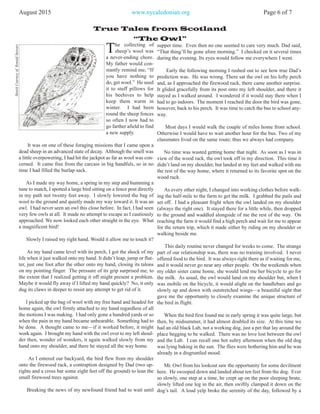
The collecting of
sheep’s wool was
a never-ending chore.
My father would con-
stantly remind me, “If
you have nothing to
do, get wool.” He used
it to stuff pillows for
his beehives to help
keep them warm in
winter. I had been
round the sheep fences
so often I now had to
go farther afield to find
a new supply.
It was on one of these foraging missions that I came upon a
dead sheep in an advanced state of decay. Although the smell was
a little overpowering, I had hit the jackpot as far as wool was con-
cerned. It came free from the carcass in big handfuls, so in no
time I had filled the burlap sack.
As I made my way home, a spring in my step and humming a
tune to match, I spotted a large bird sitting on a fence post directly
in my path not twenty feet away. I slowly lowered the bag of
wool to the ground and quietly made my way toward it. It was an
owl. I had never seen an owl this close before. In fact, I had seen
very few owls at all. It made no attempt to escape as I cautiously
approached. We now looked each other straight in the eye. What
a magnificent bird!
Slowly I raised my right hand. Would it allow me to touch it?
As my hand came level with its perch, I got the shock of my
life when it just walked onto my hand. It didn’t leap, jump or flut-
ter, just one foot after the other onto my hand, closing its talons
on my pointing finger. The pressure of its grip surprised me, to
the extent that I realized getting it off might present a problem.
Maybe it would fly away if I lifted my hand quickly? No, it only
dug its claws in deeper to resist any attempt to get rid of it.
I picked up the bag of wool with my free hand and headed for
home again, the owl firmly attached to my hand regardless of all
the motions I was making. I had only gone a hundred yards or so
when the pain in my hand became unbearable. Something had to
be done. A thought came to me—if it worked before, it might
work again. I brought my hand with the owl over to my left shoul-
der then, wonder of wonders, it again walked slowly from my
hand onto my shoulder, and there he stayed all the way home.
As I entered our backyard, the bird flew from my shoulder
onto the firewood rack, a contraption designed by Dad (two up-
rights and a cross bar some eight feet off the ground) to lean the
small firewood trees against.
Breaking the news of my newfound friend had to wait until
supper time. Even then no one seemed to care very much. Dad said,
“That thing’ll be gone afore morning.” I checked on it several times
during the evening. Its eyes would follow me everywhere I went.
Early the following morning I rushed out to see how true Dad’s
prediction was. He was wrong. There sat the owl on his lofty perch
and, as I approached the firewood rack, there came another surprise.
It glided gracefully from its post onto my left shoulder, and there it
stayed as I walked around. I wondered if it would stay there when I
had to go indoors. The moment I reached the door the bird was gone,
however, back to his perch. It was time to catch the bus to school any-
way.
Most days I would walk the couple of miles home from school.
Otherwise I would have to wait another hour for the bus. Two of my
classmates lived on the same route; thus we always had company.
No time was wasted getting home that night. As soon as I was in
view of the wood rack, the owl took off in my direction. This time it
didn’t land on my shoulder, but landed at my feet and walked with me
the rest of the way home, where it returned to its favorite spot on the
wood rack.
As every other night, I changed into working clothes before walk-
ing the half-mile to the farm to get the milk. I grabbed the pails and
set off. I had a pleasant fright when the owl landed on my shoulder
(always the right one). It stayed there for a little while, then dropped
to the ground and waddled alongside of me the rest of the way. On
reaching the farm it would find a high perch and wait for me to appear
for the return trip, which it made either by riding on my shoulder or
walking beside me.
This daily routine never changed for weeks to come. The strange
part of our relationship was, there was no training involved. I never
offered food to the bird. It was always right there as if waiting for me,
and it would never go near any other people. On the weekends when
my older sister came home, she would lend me her bicycle to go for
the milk. As usual, the owl would land on my shoulder but, when I
was mobile on the bicycle, it would alight on the handlebars and go
slowly up and down with outstretched wings—a beautiful sight that
gave me the opportunity to closely examine the unique structure of
the bird in flight.
When the bird first found me in early spring it was quite large, but
then, by midsummer, it had almost doubled its size. At this time we
had an old black Lab, not a working dog, just a pet that lay around the
place begging to be walked. There was no love lost between the owl
and the Lab. I can recall one hot sultry afternoon when the old dog
was lying baking in the sun. The flies were bothering him and he was
already in a disgruntled mood.
Mr. Owl from his lookout saw the opportunity for some devilment
here. He swooped down and landed about ten feet from the dog. Ever
so slowly, one step at a time, he crept up on the poor sleeping brute,
slowly lifted one leg in the air, then swiftly clamped it down on the
dog’s tail. A loud yelp broke the serenity of the day, followed by a
True Tales from Scotland
“The Owl”
SketchCourtesyofRonaldStewart
An t-Albannach, the newsletter of the New York Caledonian Club,
is published several times a year. ISSN#1520-076.
Editor-in-Chief: Barbara Lynn Rice, with contributions from many.
The New York Caledonian Club, Inc. (Est. 1856), is a
501(c)3 nonprofit, charitable, educational and literary organi-
zation and is open to anyone interested in Scotland and
Scottish-Americans.
IN MEMORIAM
large cloud of dust as the Lab gained traction in hot pursuit of the fleeing bird.
From where I stood, I could see this owl was no dummy. It headed for the woods at ground level, fluttering its wings as if it was
wounded, weaving in and out of the trees only a few feet ahead of the dog’s snapping jaws. When the owl thought the dog had had
enough, he soared back to the safety of the woodpile.
This was just one such incident I witnessed. There were others, too, and always instigated by the owl.
One hot sunny afternoon my parents had visitors—some aunt and uncle and two or three of their offspring. I can’t recall exactly who
they were. I do remember they were all very fat. The big fat lady was seated in a chair next to the open window with her arm resting on
the windowsill, when I saw my owl land on the sill outside not inches from her hand.
The flight of an owl is so quiet. I had read this, but it was not until I had met my owl that I could fully grasp how quiet they really
are. The owl had been there for a good five minutes before it was noticed by the fat lady, who gave out this ear-piercing scream, fright-
ening the wits out of my owl and everyone else in the room. It took some time to console the party. Mam rushed to make a cup of tea,
while Dad tried to reassure them with the promise that that very night it would fall before his twelve-gauge.
My father never did carry out that threat, of course.
That evening, after the guests had all left, he was helping Mam clean up. “Fit a fleg yer owl gied that wifie,” he said, as he retreated
laughing into the kitchen with a handful of dishes. I could fill a book with the other stories of my owl, but we must move on.
Come the time of year when the trees lose their leaves and we see the first snowflakes, my owl spent less and less time at our house.
I remember going out one morning—no owl. He was there when I came home from school, but from then on his absences became more
frequent until one day he never did return.
Right up until the end, he never showed any less affection for me.
My father was right.
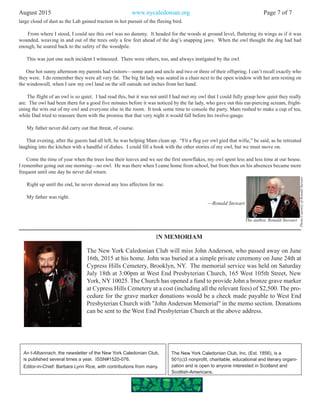
—Ronald Stewart
August 2015 www.nycaledonian.org Page 7 of 7
The author, Ronald Stewart
PhotoCourtesyofRonaldStewart
The New York Caledonian Club will miss John Anderson, who passed away on June
16th, 2015 at his home. John was buried at a simple private ceremony on June 24th at
Cypress Hills Cemetery, Brooklyn, NY. The memorial service was held on Saturday
July 18th at 3:00pm at West End Presbyterian Church, 165 West 105th Street, New
York, NY 10025. The Church has opened a fund to provide John a bronze grave marker
at Cypress Hills Cemetery at a cost (including all the relevant fees) of $2,500. The pro-
cedure for the grave marker donations would be a check made payable to West End
Presbyterian Church with "John Anderson Memorial" in the memo section. Donations
can be sent to the West End Presbyterian Church at the above address.
The New York Caledonian Club, Inc.
P.O. Box 4542, Grand Central Station
New York, NY 10163-4542
www.nycaledonian.org
(212) 662-1083
NEW YORK CALEDONIAN CLUB
2015-2016 BOARD OF OFFICERS & DIRECTORS
Officers
81st Chief
Lee Harwell
Chieftain
Lesley MacLennan Denninger
Secretary
Marti Dorais
Treasurer
Kyle Dawson
Directors
Daphne Jay Bell
Gilbert Green, Jr.
Katherine Hendry
Steve Klugman
Sue Ann McDevitt
Suzanne Present
Mackenzie Reid
Barbara Lynn Rice

NYCC.August.,2015.Newsletter

  • 1.
    An t-Albannach had aQ & A with Gaelic singers, Gille- brìde MacMillan, who stars as Gwyllyn the Bard on the television series, Outlander, and the up-and-coming Kyle Carey, who re- cently performed to- gether here in New York on July 2nd , 2015. An t-Albannach: Are you a native Gaelic speaker or how did you come to speak Gaelic? Gillebrìde: I am a native Gaelic speaker. I learned English when I went to school. Gaelic is the language of my family and I speak Gaelic to my children. Kyle: I’m not a native speaker, but started studying Gaelic when I lived in Cape Breton, Nova Scotia for a year on a Fulbright Fellowship. It was in Cape Breton that I first learned about Sabhal Mòr Ostaig—the Gaelic College on the Isle of Skye. I then traveled there for a year to study Gaelic intensively and become fluent. Since then, I return to Scotland periodically, usual after tours of Europe to re- fresh my speaking skills An t-Albannach: Did you learn it from someone in your family or did you learn it in school or both? If not a native speaker, how did you maintain the Gaelic? Gillebrìde: Gaelic is my first language. I live in Glasgow though, so I am surrounded by English. However, I listen to the radio, read in Gaelic, speak it to my work colleagues and friends and my siblings and own children. Kyle: I learned my Gaelic at Sabhal Mòr Ostaig, and in particular from two fantastic teachers I had there—Mur- chadh MacLeòid and Christine Primrose. Both are from the Isle of Lewis and very generous in their knowledge and expertise. Q&A Interview with Gaelic Singers, Outlander’s Bard, Gillebrìde MacMillan, and Kyle Carey An t-Albannach The Newsletter of the New York Caledonian Club August 2015 Continued on page 5 NYCC SUMMER/FALL 2015 See inside for upcoming events! Scottish Gaelic Classes Begin September 15th An t-Albannach: How do you utilize your Gaelic – for example, teach- ing, writing, acting singing, recitation, drama, etc.? Gillebrìde: I do all of these. I am a Gaelic teacher at Glasgow University and I teach the language and the literature to stu- dents. I write short stories and poetry in the language as well as writing songs. I regularly use the language in my everyday life – with family, work and music. Kyle: I utilize my Gaelic both with my teaching and perform- ing. I call my music ‘Gaelic Americana’ as it’s a mix of songs in Scottish Gaelic and own self-penned Appalachian-inspired originals. Every time I perform, I have the opportunity to sing in Gaelic, and every time I teach, I have the opportunity to speak it. An t-Albannach: What do you think is the best way to promote Scottish Gaelic that makes it relevant in 2015? Gillebrìde: By showing that you can get jobs and opportuni- ties through speaking and using Gaelic. If I as a Gaelic speaker can get to travel and do what I enjoy because I speak and use the language, that is the best way to promote the language. Kyle: I think it’s important to view Gaelic as a living and vi- brant language, therefore we need to be open to the fact that it’s going to change and evolve like any other. I think making the language appealing to youth is a good place to start, and if you’re a fluent speaker yourself—to be generous with your knowledge. Kyle Carey Gillebrìde MacMillan PhotoCredit:DanKennedy PhotoCourtesyofGillebrìdeMacMillan
  • 2.
    Well anotherAnnual GeneralMem- bership meeting has come and gone but this time bought with it a few changes to our Board of Directors. Six of them to be exact. Firstly, as the newly elected 81st Chief of the New York Caledonian Club, I’d like to thank everyone who was able to come to the meeting and everyone who took the time to vote. It’s my most sincere pleasure to welcome Marti Do- rais, our new club Secretary, to the board. It would be difficult to overstate Marti’s enthusiasm and passion for the club, so I won’t even try. She has already been in- strumental in helping to get the “Scotland Meets Ap- palachia” concert off the ground and I know that’s barely scratching the surface of what she’s bringing with her to the board. I’m really pleased to welcome Sue Ann McDevitt to her very first term as a member of the Board of Direc- tors. I met Sue Ann at the Kilted Bowling Games and am very excited about her joining us on the board. She’s vibrant, fun and I’ve no doubt full of great ideas that we (translate “I”) plan to take full advantage of... (And credit for if I can get away with it). Welcome aboard Sue Ann... Now fasten your seatbelt. Mackenzie Reide is rejoining the Board after a bit of a short hiatus. I’ve only just met Mackenzie but was instantly impressed by her kind manner and incredibly varied background which includes a former career as a trail guide at the Grand Canyon and currently as the au- thor of a series of children’s books. And that’s only two of them! Welcome back Mackenzie, I’m truly looking forward to working with you. Steve Klugman, while deserving of a long introduc- tion, he is certainly not in need of one. Steve has been a long time member (and occasional Board member). He brings a unique combination of inside knowledge and ex- perience to the club, along with his legal expertise to help keep us on the up and up. Let’s just say, I’m glad he’s on OUR team! Welcome back Steve. Really glad to have you on board again. To all of the returning Directors... it’s gonna be a fan- tastic year!! And saving my partner in crime for last (but by no means least), congratulations to Lesley Denninger, Chief- tain. I met Lesley when I joined the board a year ago and knew right away that she was trouble from the start! Which is exactly why I wanted her to be Chieftain. Like Bonnie & Clyde... (Or Abbot & Costello depending on when you catch us). Luv y’a Lesley - mean it. Let’s do lunch! No, really... let’s do lunch.... we’ve some plannin’ to do! On a slightly more serious note, thank you again to everyone for their support. I’ve had individual conversa- tions with each of this year’s Board members and every- one is excited about what we have planned for the upcoming year and eager to get things started. le meas agus deagh dhùrachdan, Lee Harwell August 2015 www.nycaledonian.org Page 2 of 7 HAIL FROM THE CHIEF Chief Lee Harwell PhotoCourtesyofCapturedColorPhotography Continued on page 5 UPCOMING NYCC EVENTS For more information or to pay for tickets via PayPal for any of the upcoming NYCC events listed below, visit the website www.nycaledonian.org, or call (212) 662-1083 or email events@nycaledonian.org. To inquire or send checks or money orders by regular mail for tickets, made to the order of NYCC (note which event!), write to: The New York Caledonian Club Inc., P.O. Box 4542, Grand Central Station. New York, NY 10163-4542. Saturday, August 22, 2015 – Long Island Scottish Festival and Games From 8AM-5PM. The Long Island Highland Games are coming up at Old West- bury Gardens. Admission: $17, adults; $15, seniors; children and Old Westbury members, $8; and free for children 6 and under. For more info, visit website: www.liscots.org/festival_and_games.htm PhotoCredit:B.L.Rice
  • 3.
    For centuries, Holy Islehas been sa- cred and revered: first to the Druids, then the Christians and now the Buddhists. Even the occasional Viking has set foot on the isle, as evidenced by runic carvings found in caves. One person who found the tiny island particularly special was St Molaise (pro- nounced Mo-lash-eh.) As the son of a 6th century Irish king and a Scottish princess, he was offered the throne of Ulster but chose in- stead to live a spiritual life in one of the is- land’s caves. In the 19th century, there was a different type of “spirits” on Holy Isle. A remote cave was used to store smuggled whisky as part of a boot legging operation. Today, Holy Isle houses the Centre for World Peace and Health under the directorship of Lama Yeshe Losal Rinpoche. The island is open to the public and the Centre contains accommodations for guests coming for retreats, courses or just to soak up the peace and natural beauty. Visitors can take an easy pleasant walk along the two-mile western coastline. (The eastern half of the island is a nature preserve and off limits.) The walk starts at the northern end near the jetty where one can examine the eight monuments known as Stupas which represent different stages of The Bud- dha’s life. August 2015 www.nycaledonian.org Page 3 of 7 Travelogue: Holy Isle PhotoCredit:MaryGatewood PhotoCredit:SuzannePresentPhotoCredit:SuzannePresent About halfway down the trail is St Molaise’s Cave and “The Judgement Rock” where it is said that the saint preached from. Near the rock, lies “The Healing Spring” whose waters purportedly cure a host of ailments. Further down are some beautiful rock paintings of select Buddhist deities and teachers. There are two lighthouses at the southern end of the Island: “Little Donald,” situated near “The Inner Light Retreat,” a l o n g - t e r m women’s retreat and “Pillar Rock,” on the south east- ern shore. A second, more mountainous path runs parallel to the first which offers breathtaking views of the Isle of Arran, located only 1.3 miles west. As far as fauna, three non-native species were intro- duced: The hardy Eriskay ponies, the brown goat-like Soay sheep and the white Saanen goats, believed to have been brought to the area by Vikings. All the animals roam the island freely with- out human inter- ference. Although one can get lost in the timelessness of Holy Isle, it unfortunately is imperative to pay attention to time as the ferries can only operate at cer- tain times of the day due to tides. But perhaps an unex- pected extended stay on Holy Isle would not be such a bad thing at all. —Suzanne Present St. Molaise’s cave on the Holy Isle. “Little Donald” Lighthouse Eriskay ponies “39 Steps” Discount Tickets Discount tickets are available through November 30, 2015 for the Tony® winning comedy, “39 Steps”, a comedic spoof of the 1935 film, with four actors portraying more than 150 characters. The fast-paced plot follows Richard Hannay as he races to Scotland to solve the mystery of 39 Steps, all the while trying to clear his name. Show ap- propriate for all ages. Performances at Union Square Theatre, 100 East 17th Street, Manhattan on Mon. 7pm; Wed. 2 & 8pm; Thurs. 8pm; Fri. 8pm; Sat. 2 & 8pm; and Sun. 3pm. Tickets: $49 (regularly $79) for Mon./Wed./Thurs. performances; and $59 (regularly $89) for Fri./Sat./Sun. performances. Tickets can be pur- chased as follows: (1) Online at website Ticketmaster.com/THE-39-STEPS-NY-tickets/artist/2089037 & select performance date and enter code LSP88; or (2) Call Ticketmaster.com at 800-250-2929 & mention code: LSP88; or (3) Print and bring this notice to the theatre box office. Limit: 8 tickets; price includes $1.00 facility fee; all sales are final. For more information, visit website: 39stepsny.com. CourtesyofLeanneSchanzerPromotions
  • 4.
    August 2015 www.nycaledonian.orgPage 4 of 7 NYCC SUMMER 2015 PhotoCredit:EloisePollard/SaintGeorge’sSocietyofNewYork (Above.) NYCC at the British Societies’Garden Party on July 15, 2015. (L. to R.) Gillebrìde MacMillan, Kyle Carey, & Chief Lee Harwell at the “Scotland Meets Ap- palachia” Concert, July 2nd, 2015. (Left) Kyle Carey rehearsing for concert. 2015 Grandfather Mountain Scottish Gaelic Song & Language Immersion Week at Lees-McRae College PhotoCourtesyofJohnGrimaldi
  • 5.
    An t-Albannach: Whatis your greatest enjoyment in performing and teaching Gaelic? Kyle: I get a real thrill from sharing my knowledge, and from seeing other folks get excited about Gaelic. Whether or it’s someone who is moved by the Gaelic songs in my performance or on my CDs, or a student who is making progress—it warms my heart to see the language become a part of another person’s life. Gillebrìde: Meeting people from all over who are interested in Scotland, history, Gaelic language and often meeting people who are not interested in anything other than enjoying the songs and being entertained. I feel so lucky to be doing this especially as I had never thought that it would be possible. I used to be nervous as a child so I didn’t sing in public again, after stopping at 13, until I was 21. And here I am still singing now. It is such a privilege. --B.L. Rice August 2015 www.nycaledonian.org Page 5 of 7 Attention An t-Albannach Readers If you are receiving An t-Albannach already by email, but would also like to be on the mailing list for the hard copy of the newsletter, please send your request with your name and address via email to the editor, Barbara L. Rice, at barbara.rice@nycaledonian.org THE ISLANDERS WANT YOU! Seinn comhla rinn! Join the only Scottish Gaelic singing group, The Islanders, in Manhattan! We are a relaxed group of singers who gather together for the pure enjoyment of singing in Gaelic and English. We occasionally perform in public, but for the most part, we sing together on Saturdays for the fun of it. You do not need to speak Gaelic fluently. A good basic knowledge of Gaelic is helpful, but not necessary. Q&A Interview with Gaelic Singers, Outlander’s Bard, Gillebrìde MacMillan, and Kyle Carey Continued from page 1 Continued from page 2 Kyle Carey UPCOMING NYCC EVENTS Sunday, October 4, 2015 - Fort Tryon Medieval Festival 11:30AM-6PM, in Fort Tryon Park, next to the Cloisters in northern Manhattan. This is a free event with all things medieval and fantastic. Visit the New York Caledonian Club’s tent – we will be there! For more infor- mation, visit website: http://www.whidc.org/festival/home.html. Saturday, October 17, 2015 – Kilted Bowling Begins at 7:30PM; bowling starts promptly at 8PM, at Frames, 550 9th Avenue (between 40th & 41st Streets), Manhattan. Kilted Bowling is here once again! Minimum age 21. $50 includes bowling shoes, two hours of bowling, and a tower of imported beer at your lane. And there will be prizes! Just remember to return the bowling shoes. Saturday, November 7, 2015 - 2015 New York Scottish Ball 7PM, Abigail Adams Smith Ballroom, 417 East 61st St., Manhattan. Note that there will be dance rehearsals: Thurs., Oct. 29th , 7-9PM; Wed., Nov. 4th , 7-9PM; Fri., Nov. 6th , 7-9PM; and Sat., Nov. 7th , 11AM-1PM. Admis- sion: Buffet dinner $225 and VIP dinner $275. For more info, visit website: www.scottishball.com; or email scot- tishball@aol.com. Sunday, November 8, 2015 – St. Thomas Flag Ceremony (Remembrance Day/Veterans Day) 4PM, St. Thomas Church, 1 West 53rd Street (at Fifth Avenue), Manhattan.
  • 6.
    August 2015 www.nycaledonian.orgPage 6 of 7 The collecting of sheep’s wool was a never-ending chore. My father would con- stantly remind me, “If you have nothing to do, get wool.” He used it to stuff pillows for his beehives to help keep them warm in winter. I had been round the sheep fences so often I now had to go farther afield to find a new supply. It was on one of these foraging missions that I came upon a dead sheep in an advanced state of decay. Although the smell was a little overpowering, I had hit the jackpot as far as wool was con- cerned. It came free from the carcass in big handfuls, so in no time I had filled the burlap sack. As I made my way home, a spring in my step and humming a tune to match, I spotted a large bird sitting on a fence post directly in my path not twenty feet away. I slowly lowered the bag of wool to the ground and quietly made my way toward it. It was an owl. I had never seen an owl this close before. In fact, I had seen very few owls at all. It made no attempt to escape as I cautiously approached. We now looked each other straight in the eye. What a magnificent bird! Slowly I raised my right hand. Would it allow me to touch it? As my hand came level with its perch, I got the shock of my life when it just walked onto my hand. It didn’t leap, jump or flut- ter, just one foot after the other onto my hand, closing its talons on my pointing finger. The pressure of its grip surprised me, to the extent that I realized getting it off might present a problem. Maybe it would fly away if I lifted my hand quickly? No, it only dug its claws in deeper to resist any attempt to get rid of it. I picked up the bag of wool with my free hand and headed for home again, the owl firmly attached to my hand regardless of all the motions I was making. I had only gone a hundred yards or so when the pain in my hand became unbearable. Something had to be done. A thought came to me—if it worked before, it might work again. I brought my hand with the owl over to my left shoul- der then, wonder of wonders, it again walked slowly from my hand onto my shoulder, and there he stayed all the way home. As I entered our backyard, the bird flew from my shoulder onto the firewood rack, a contraption designed by Dad (two up- rights and a cross bar some eight feet off the ground) to lean the small firewood trees against. Breaking the news of my newfound friend had to wait until supper time. Even then no one seemed to care very much. Dad said, “That thing’ll be gone afore morning.” I checked on it several times during the evening. Its eyes would follow me everywhere I went. Early the following morning I rushed out to see how true Dad’s prediction was. He was wrong. There sat the owl on his lofty perch and, as I approached the firewood rack, there came another surprise. It glided gracefully from its post onto my left shoulder, and there it stayed as I walked around. I wondered if it would stay there when I had to go indoors. The moment I reached the door the bird was gone, however, back to his perch. It was time to catch the bus to school any- way. Most days I would walk the couple of miles home from school. Otherwise I would have to wait another hour for the bus. Two of my classmates lived on the same route; thus we always had company. No time was wasted getting home that night. As soon as I was in view of the wood rack, the owl took off in my direction. This time it didn’t land on my shoulder, but landed at my feet and walked with me the rest of the way home, where it returned to its favorite spot on the wood rack. As every other night, I changed into working clothes before walk- ing the half-mile to the farm to get the milk. I grabbed the pails and set off. I had a pleasant fright when the owl landed on my shoulder (always the right one). It stayed there for a little while, then dropped to the ground and waddled alongside of me the rest of the way. On reaching the farm it would find a high perch and wait for me to appear for the return trip, which it made either by riding on my shoulder or walking beside me. This daily routine never changed for weeks to come. The strange part of our relationship was, there was no training involved. I never offered food to the bird. It was always right there as if waiting for me, and it would never go near any other people. On the weekends when my older sister came home, she would lend me her bicycle to go for the milk. As usual, the owl would land on my shoulder but, when I was mobile on the bicycle, it would alight on the handlebars and go slowly up and down with outstretched wings—a beautiful sight that gave me the opportunity to closely examine the unique structure of the bird in flight. When the bird first found me in early spring it was quite large, but then, by midsummer, it had almost doubled its size. At this time we had an old black Lab, not a working dog, just a pet that lay around the place begging to be walked. There was no love lost between the owl and the Lab. I can recall one hot sultry afternoon when the old dog was lying baking in the sun. The flies were bothering him and he was already in a disgruntled mood. Mr. Owl from his lookout saw the opportunity for some devilment here. He swooped down and landed about ten feet from the dog. Ever so slowly, one step at a time, he crept up on the poor sleeping brute, slowly lifted one leg in the air, then swiftly clamped it down on the dog’s tail. A loud yelp broke the serenity of the day, followed by a True Tales from Scotland “The Owl” SketchCourtesyofRonaldStewart
  • 7.
    An t-Albannach, thenewsletter of the New York Caledonian Club, is published several times a year. ISSN#1520-076. Editor-in-Chief: Barbara Lynn Rice, with contributions from many. The New York Caledonian Club, Inc. (Est. 1856), is a 501(c)3 nonprofit, charitable, educational and literary organi- zation and is open to anyone interested in Scotland and Scottish-Americans. IN MEMORIAM large cloud of dust as the Lab gained traction in hot pursuit of the fleeing bird. From where I stood, I could see this owl was no dummy. It headed for the woods at ground level, fluttering its wings as if it was wounded, weaving in and out of the trees only a few feet ahead of the dog’s snapping jaws. When the owl thought the dog had had enough, he soared back to the safety of the woodpile. This was just one such incident I witnessed. There were others, too, and always instigated by the owl. One hot sunny afternoon my parents had visitors—some aunt and uncle and two or three of their offspring. I can’t recall exactly who they were. I do remember they were all very fat. The big fat lady was seated in a chair next to the open window with her arm resting on the windowsill, when I saw my owl land on the sill outside not inches from her hand. The flight of an owl is so quiet. I had read this, but it was not until I had met my owl that I could fully grasp how quiet they really are. The owl had been there for a good five minutes before it was noticed by the fat lady, who gave out this ear-piercing scream, fright- ening the wits out of my owl and everyone else in the room. It took some time to console the party. Mam rushed to make a cup of tea, while Dad tried to reassure them with the promise that that very night it would fall before his twelve-gauge. My father never did carry out that threat, of course. That evening, after the guests had all left, he was helping Mam clean up. “Fit a fleg yer owl gied that wifie,” he said, as he retreated laughing into the kitchen with a handful of dishes. I could fill a book with the other stories of my owl, but we must move on. Come the time of year when the trees lose their leaves and we see the first snowflakes, my owl spent less and less time at our house. I remember going out one morning—no owl. He was there when I came home from school, but from then on his absences became more frequent until one day he never did return. Right up until the end, he never showed any less affection for me. My father was right. —Ronald Stewart August 2015 www.nycaledonian.org Page 7 of 7 The author, Ronald Stewart PhotoCourtesyofRonaldStewart The New York Caledonian Club will miss John Anderson, who passed away on June 16th, 2015 at his home. John was buried at a simple private ceremony on June 24th at Cypress Hills Cemetery, Brooklyn, NY. The memorial service was held on Saturday July 18th at 3:00pm at West End Presbyterian Church, 165 West 105th Street, New York, NY 10025. The Church has opened a fund to provide John a bronze grave marker at Cypress Hills Cemetery at a cost (including all the relevant fees) of $2,500. The pro- cedure for the grave marker donations would be a check made payable to West End Presbyterian Church with "John Anderson Memorial" in the memo section. Donations can be sent to the West End Presbyterian Church at the above address.
  • 8.
    The New YorkCaledonian Club, Inc. P.O. Box 4542, Grand Central Station New York, NY 10163-4542 www.nycaledonian.org (212) 662-1083 NEW YORK CALEDONIAN CLUB 2015-2016 BOARD OF OFFICERS & DIRECTORS Officers 81st Chief Lee Harwell Chieftain Lesley MacLennan Denninger Secretary Marti Dorais Treasurer Kyle Dawson Directors Daphne Jay Bell Gilbert Green, Jr. Katherine Hendry Steve Klugman Sue Ann McDevitt Suzanne Present Mackenzie Reid Barbara Lynn Rice