Nurses’ Competencies in
Heart Failure
ABIJA V S RN,DCN
STAFF NURSE B -HFICU
INTRODUCTION
Competence
Competencies
Indicators
Knowledge, Skills, and Abilities
(KSAs)
A Guiding Frame
Work
“Competence of a nurse is a complex combination
of knowledge, function, skills, attitudes, and
values”.
Definition of Heart Failure
▪“Heart failure is the pathophysiologic state
in which the heart is unable to pump blood
at a rate to commensurate with the
requirements of the metabolising tissues or
can do so only from an elevated filling
pressure”
…..Eugene Braunwald
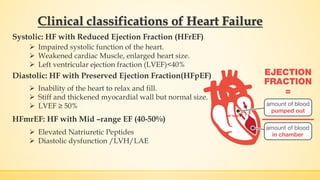
Clinical classifications of Heart Failure
Systolic: HF with Reduced Ejection Fraction (HFrEF)
 Impaired systolic function of the heart.
 Weakened cardiac Muscle, enlarged heart size.
 Left ventricular ejection fraction (LVEF)<40%
Diastolic: HF with Preserved Ejection Fraction(HFpEF)
 Inability of the heart to relax and fill.
 Stiff and thickened myocardial wall but normal size.
 LVEF ≥ 50%
HFmrEF: HF with Mid –range EF (40-50%)
 Elevated Natriuretic Peptides
 Diastolic dysfunction /LVH/LAE
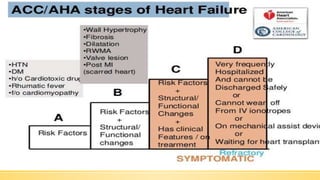
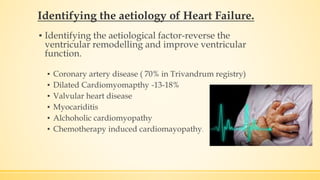
Identifying the aetiology of Heart Failure.
▪ Identifying the aetiological factor-reverse the
ventricular remodelling and improve ventricular
function.
▪ Coronary artery disease ( 70% in Trivandrum registry)
▪ Dilated Cardiomyomapthy -13-18%
▪ Valvular heart disease
▪ Myocariditis
▪ Alchoholic cardiomyopathy
▪ Chemotherapy induced cardiomayopathy.
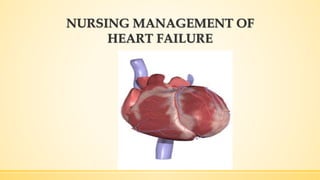
NURSING MANAGEMENT OF
HEART FAILURE
The nurse should be able to
conceptualize the clinical care needs for
a patient with heart failure.
Design and implement a care plan with
the interventions, which help to
moderate the disease process and
maintain the hemodynamics for the
patient.
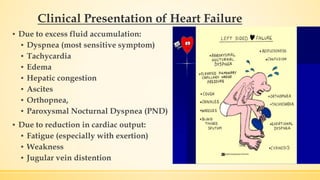
▪ Due to excess fluid accumulation:
▪ Dyspnea (most sensitive symptom)
▪ Tachycardia
▪ Edema
▪ Hepatic congestion
▪ Ascites
▪ Orthopnea,
▪ Paroxysmal Nocturnal Dyspnea (PND)
▪ Due to reduction in cardiac output:
▪ Fatigue (especially with exertion)
▪ Weakness
▪ Jugular vein distention
Clinical Presentation of Heart Failure
▪ Dyspnea/Tachypnea
▪ S3
▪ Jugular venous distention
▪ Hepatojugular reflux
▪ Edema of legs and /or feet
▪ Abdominal ascites
▪ Enlarged Pulsatile liver
▪ Tenderness to palapation in right upper quadrant
▪ Rales (Can be absent)
▪ Anxiety/apprehension
Acute decompensated HF(ADHF)- CLINICAL
FEATURES
Acute decompensated HF(ADHF)
▪ Goals of the initial management of ADHF are
1. Hemodynamic stabilization
2. Normalising the fluid status
3. Improving the oxygenation and ventilation,
4. Improve the cardiac output
▪ All aiming at symptom relief and improved outcomes.
Hemodynamic monitoring in Acute
decompensated HF(ADHF)
▪ Patients with ADHF are at risk for hemodynamic instability and
arrhythmias, so close monitoring is necessary.
▪ The client is received in the ICCU
▪ Immediately connected to the telemetry to continuously monitor
▪ -ECG, SPO2 ,BP and RR (Continues for at least 24 to 48 hours.)
▪ Clinical parameters monitored
a) Heart Rate
b) Blood Pressure(Including Orthostatic BP)
c) Jugular venous pressure
d) Body Weight
e) Fluid intake and output
f) Abdominal girth if there is evidence of ascites.
Heart Rate
 The Heart rate is likely to be high, (Tachycardia) as
a compensatory mechanism to low cardiac output
and hypoxia.
 The volume (pressure of the pulse) is likely to be
shallow, of course due to low cardiac output.
 Furthermore, the patient presents with arrhythmia,
indicating uncoordinated cardiac output by poor
performing heart.
Blood Pressure
The blood pressure is likely to be subnormal.
 While the systolic pressure is designated to be lower than
normal, the diastolic pressure may be disproportionately
elevated or low – thus signifying circulatory congestion.
Respiration:
 The respiration may be fast to compensate for hypoxia,
yet it is shallow because of lack of energy in the body
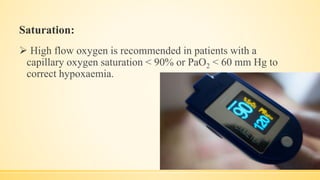
Saturation:
 High flow oxygen is recommended in patients with a
capillary oxygen saturation < 90% or PaO2 < 60 mm Hg to
correct hypoxaemia.
Diagnostic Tests and Biomarkers.
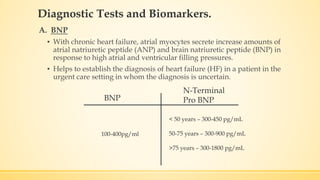
A. BNP
▪ With chronic heart failure, atrial myocytes secrete increase amounts of
atrial natriuretic peptide (ANP) and brain natriuretic peptide (BNP) in
response to high atrial and ventricular filling pressures.
▪ Helps to establish the diagnosis of heart failure (HF) in a patient in the
urgent care setting in whom the diagnosis is uncertain.
BNP
N-Terminal
Pro BNP
100-400pg/ml
< 50 years – 300-450 pg/mL
50-75 years – 300-900 pg/mL
>75 years – 300-1800 pg/mL
B. Serum Electrolytes
• Serum Sodium, Potassium and Magnesium- May require more
frequent monitoring in the initial stage when diuresis is rapid
C. Blood urea nitrogen and Serum Creatinine
D.Hb and complete blood count - Since anemia can exacerbate
heart failure.
E. INR if OAC is used or there is congestive hepatitis.
F. Urinalysis –albumin
G.Arterial Blood Gas evaluation is advisable when the patient is
drowsy or there is desaturation as monitored by pulse ox meter
H.LFT – Liver Enzymes and bilirubin
Diagnostic Tests and Biomarkers.
I.
▪ A 12 lead ECG should be performed initially on all patients
presenting with HF.
ECG MONITORING AND INTERPRETATION
A competent nurse is able to
1.Correctly prepare patient, equipment and environment for
recording of ECG
2.Describe the basic cardiac anatomy, the conduction system
and the normal PQRST complex.
3.Recognizes basic cardiac arrhythmias,
4. To distinguish abnormal from normal ECG trace and refer to
another member of the Heart failure team
5. Critically analyses the appropriateness of varying interventions on
the ECG.
6. To initiate treatment in response to ECG analysis e.g. Pacing,
atropine, defibrillation, cardioversion,
7. Evaluate the impact of intervention on the ECG and suggests
alternatives
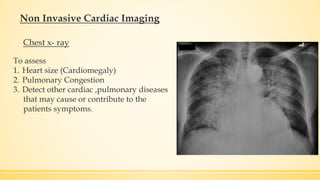
To assess
1. Heart size (Cardiomegaly)
2. Pulmonary Congestion
3. Detect other cardiac ,pulmonary diseases
that may cause or contribute to the
patients symptoms.
Non Invasive Cardiac Imaging
Chest x- ray
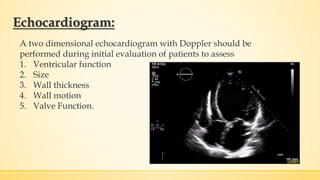
Echocardiogram:
A two dimensional echocardiogram with Doppler should be
performed during initial evaluation of patients to assess
1. Ventricular function
2. Size
3. Wall thickness
4. Wall motion
5. Valve Function.
Medical Management and Nursing
considerations
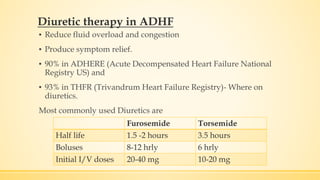
Diuretic therapy in ADHF
▪ Reduce fluid overload and congestion
▪ Produce symptom relief.
▪ 90% in ADHERE (Acute Decompensated Heart Failure National
Registry US) and
▪ 93% in THFR (Trivandrum Heart Failure Registry)- Where on
diuretics.
Most commonly used Diuretics are
Furosemide Torsemide
Half life 1.5 -2 hours 3.5 hours
Boluses 8-12 hrly 6 hrly
Initial I/V doses 20-40 mg 10-20 mg
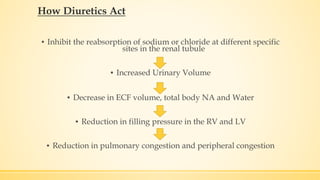
How Diuretics Act
▪ Inhibit the reabsorption of sodium or chloride at different specific
sites in the renal tubule
▪ Increased Urinary Volume
▪ Decrease in ECF volume, total body NA and Water
▪ Reduction in filling pressure in the RV and LV
▪ Reduction in pulmonary congestion and peripheral congestion
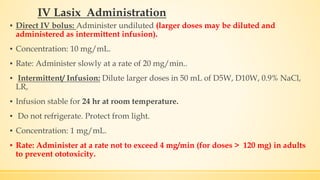
IV Lasix Administration
▪ Direct IV bolus: Administer undiluted (larger doses may be diluted and
administered as intermittent infusion).
▪ Concentration: 10 mg/mL.
▪ Rate: Administer slowly at a rate of 20 mg/min..
▪ Intermittent/ Infusion: Dilute larger doses in 50 mL of D5W, D10W, 0.9% NaCl,
LR,
▪ Infusion stable for 24 hr at room temperature.
▪ Do not refrigerate. Protect from light.
▪ Concentration: 1 mg/mL.
▪ Rate: Administer at a rate not to exceed 4 mg/min (for doses > 120 mg) in adults
to prevent ototoxicity.
Inotropes in ADHF
▪ Patients with refractory hypotension should receive
temporary intravenous inotropic support to maintain
systemic perfusion and preserve end organ performance.
▪ Long term therapy with inotropes –Not effective and
may harm
▪ Dobutamine as first line agent if SBP between 70 and 100
mm Hg in the absence of signs and symptoms of shock.
▪ Dopamine is recommended in patients who have the
same systolic blood pressure in the presence of
symptoms of shock.
▪ When response to a medium dose of dopamine or
Dopamine/dobutamine in combination is inadequate, or
the patient’s presenting systolic blood pressure is <70
mmHg, the use of Norepinephrine has been
recommended.
Inotropes in ADHF
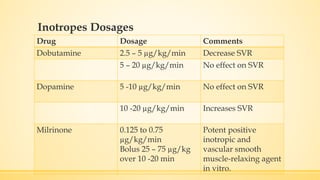
Drug Dosage Comments
Dobutamine 2.5 – 5 µg/kg/min Decrease SVR
5 – 20 µg/kg/min No effect on SVR
Dopamine 5 -10 µg/kg/min No effect on SVR
10 -20 µg/kg/min Increases SVR
Milrinone 0.125 to 0.75
µg/kg/min
Bolus 25 – 75 µg/kg
over 10 -20 min
Potent positive
inotropic and
vascular smooth
muscle-relaxing agent
in vitro.
Inotropes Dosages
Levosimendan: A New Dual-Acting, Non-Arrhythmogenic
Drug in Decompensated Congestive Heart Failure
▪ levosimendan enhances myocardial contractility without
increasing oxygen requirements, and causes coronary
and systemic vasodilation.
▪ IV levosimendan appears to offer therapeutic benefits
without risk of arrhythmogenesis and/or uncertain
impacts on survival.
▪ Levosimendan was given as 10-minute loading dose (6
or 12 µg/kg) followed by a 24-hour infusion (0.1 or 0.2
µg/kg/min)
Chronic Heart Failure
Risk Factor Modification
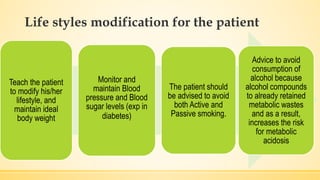
Life styles modification for the patient
Teach the patient
to modify his/her
lifestyle, and
maintain ideal
body weight
Monitor and
maintain Blood
pressure and Blood
sugar levels (exp in
diabetes)
The patient should
be advised to avoid
both Active and
Passive smoking.
Advice to avoid
consumption of
alcohol because
alcohol compounds
to already retained
metabolic wastes
and as a result,
increases the risk
for metabolic
acidosis
Diet modification for the patient
Client needs to comply with the
golden rule of low salt Diet
Sodium intake 2g per day
While at the hospital, the patient is
provided with meals that are salt
free and fat free.
Salt free diet minimizes the risk of
fluid retention which places a load on
the ailing heart and fat free diet
minimizes the risk for ischemic heart
diseases.
Diet modification for the patient
The food should be soft
In a patient with a compromised body metabolism. Small
servings of meals are recommended.
Large meals place pressure on the heart, thus increases the
workload.
The patient should be advised to maintain a Semi-Fowler
position after every meal in order to alleviate pressure on the
heart.
Caloric food should be provided to supplement the energy.
Vitamin rich food should be offered to improve the patient’s
immunity because the patient’s immunity is low owing to the
low body metabolism
Fluid Intake
Fluid restriction of 1.5-2 l/day may be
considered in patients with severe symptoms
of Heart failure especially with Hyponatremia.
Routine fluid restriction in all
patients with mild to
moderate symptoms does not
appear to confer clinical
benefit.
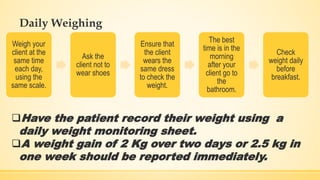
Daily Weighing
Weigh your
client at the
same time
each day,
using the
same scale.
Ask the
client not to
wear shoes
Ensure that
the client
wears the
same dress
to check the
weight.
The best
time is in the
morning
after your
client go to
the
bathroom.
Check
weight daily
before
breakfast.
Have the patient record their weight using a
daily weight monitoring sheet.
A weight gain of 2 Kg over two days or 2.5 kg in
one week should be reported immediately.
PHYSICAL ACTIVITY AND EXERCISE TRAINING
 Regular, moderate daily activity is recommended for all patients
with heart failure.
 Exercise training is recommended, if available, to all stable
chronic HF patients.
 Regular aerobic exercise is encouraged in patients with heart
failure to improve functional capacity and symptoms
MEDICATIONS
The nurse’s task is to administer the medications
according to the prescription.
However, the nurse is expected to have the
knowledge of the therapeutic and side effects of
medications, in order to ensure progress of the
patient and to prevent treatment related setbacks.
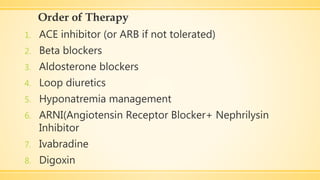
Order of Therapy
1. ACE inhibitor (or ARB if not tolerated)
2. Beta blockers
3. Aldosterone blockers
4. Loop diuretics
5. Hyponatremia management
6. ARNI(Angiotensin Receptor Blocker+ Nephrilysin
Inhibitor
7. Ivabradine
8. Digoxin
Applications of ethical principles in caring
for the patient with heart failure
Patients are human beings with personal values, beliefs and
cultural principles.
Therefore, a patient with heart failure as an individual should
be provided professional care which is appropriate to his/her
needs for care, ethically guided and relevant to his or her
context.
Provision of counseling and health education to the
patient and the family
 Patients with heart failure should be counselled to accept and adapt
to their health status.
 Acceptance helps the patient to make use of the potential he/she is
left with,
 Make a constructive adaptation and therefore to live positively with
the illness
Health education for a patient with heart failure should
be organized around the issues of:
▪ Self-monitoring,
▪ Lifestyle modification,
▪ Diet,
▪ Medication self-administration
▪ And follow-up treatment,
Home Maintenance Plan :- Patient family education
about the following
 Sodium restriction
 Fluid limitation
 Medication schedule and effects
 Exercise prescription
 When to call health care provider for problems.
 Clinic appointment within 7 to 14 days
Nurses competencies in heart failure

Nurses competencies in heart failure

  • 1.
    Nurses’ Competencies in HeartFailure ABIJA V S RN,DCN STAFF NURSE B -HFICU
  • 2.
  • 3.
    “Competence of anurse is a complex combination of knowledge, function, skills, attitudes, and values”.
  • 4.
    Definition of HeartFailure ▪“Heart failure is the pathophysiologic state in which the heart is unable to pump blood at a rate to commensurate with the requirements of the metabolising tissues or can do so only from an elevated filling pressure” …..Eugene Braunwald
  • 5.
    Clinical classifications ofHeart Failure Systolic: HF with Reduced Ejection Fraction (HFrEF)  Impaired systolic function of the heart.  Weakened cardiac Muscle, enlarged heart size.  Left ventricular ejection fraction (LVEF)<40% Diastolic: HF with Preserved Ejection Fraction(HFpEF)  Inability of the heart to relax and fill.  Stiff and thickened myocardial wall but normal size.  LVEF ≥ 50% HFmrEF: HF with Mid –range EF (40-50%)  Elevated Natriuretic Peptides  Diastolic dysfunction /LVH/LAE
  • 8.
    Identifying the aetiologyof Heart Failure. ▪ Identifying the aetiological factor-reverse the ventricular remodelling and improve ventricular function. ▪ Coronary artery disease ( 70% in Trivandrum registry) ▪ Dilated Cardiomyomapthy -13-18% ▪ Valvular heart disease ▪ Myocariditis ▪ Alchoholic cardiomyopathy ▪ Chemotherapy induced cardiomayopathy.
  • 9.
  • 10.
    The nurse shouldbe able to conceptualize the clinical care needs for a patient with heart failure. Design and implement a care plan with the interventions, which help to moderate the disease process and maintain the hemodynamics for the patient.
  • 11.
    ▪ Due toexcess fluid accumulation: ▪ Dyspnea (most sensitive symptom) ▪ Tachycardia ▪ Edema ▪ Hepatic congestion ▪ Ascites ▪ Orthopnea, ▪ Paroxysmal Nocturnal Dyspnea (PND) ▪ Due to reduction in cardiac output: ▪ Fatigue (especially with exertion) ▪ Weakness ▪ Jugular vein distention Clinical Presentation of Heart Failure
  • 12.
    ▪ Dyspnea/Tachypnea ▪ S3 ▪Jugular venous distention ▪ Hepatojugular reflux ▪ Edema of legs and /or feet ▪ Abdominal ascites ▪ Enlarged Pulsatile liver ▪ Tenderness to palapation in right upper quadrant ▪ Rales (Can be absent) ▪ Anxiety/apprehension Acute decompensated HF(ADHF)- CLINICAL FEATURES
  • 13.
    Acute decompensated HF(ADHF) ▪Goals of the initial management of ADHF are 1. Hemodynamic stabilization 2. Normalising the fluid status 3. Improving the oxygenation and ventilation, 4. Improve the cardiac output ▪ All aiming at symptom relief and improved outcomes.
  • 14.
    Hemodynamic monitoring inAcute decompensated HF(ADHF) ▪ Patients with ADHF are at risk for hemodynamic instability and arrhythmias, so close monitoring is necessary. ▪ The client is received in the ICCU ▪ Immediately connected to the telemetry to continuously monitor ▪ -ECG, SPO2 ,BP and RR (Continues for at least 24 to 48 hours.) ▪ Clinical parameters monitored a) Heart Rate b) Blood Pressure(Including Orthostatic BP) c) Jugular venous pressure d) Body Weight e) Fluid intake and output f) Abdominal girth if there is evidence of ascites.
  • 15.
    Heart Rate  TheHeart rate is likely to be high, (Tachycardia) as a compensatory mechanism to low cardiac output and hypoxia.  The volume (pressure of the pulse) is likely to be shallow, of course due to low cardiac output.  Furthermore, the patient presents with arrhythmia, indicating uncoordinated cardiac output by poor performing heart.
  • 16.
    Blood Pressure The bloodpressure is likely to be subnormal.  While the systolic pressure is designated to be lower than normal, the diastolic pressure may be disproportionately elevated or low – thus signifying circulatory congestion. Respiration:  The respiration may be fast to compensate for hypoxia, yet it is shallow because of lack of energy in the body
  • 17.
    Saturation:  High flowoxygen is recommended in patients with a capillary oxygen saturation < 90% or PaO2 < 60 mm Hg to correct hypoxaemia.
  • 18.
    Diagnostic Tests andBiomarkers. A. BNP ▪ With chronic heart failure, atrial myocytes secrete increase amounts of atrial natriuretic peptide (ANP) and brain natriuretic peptide (BNP) in response to high atrial and ventricular filling pressures. ▪ Helps to establish the diagnosis of heart failure (HF) in a patient in the urgent care setting in whom the diagnosis is uncertain. BNP N-Terminal Pro BNP 100-400pg/ml < 50 years – 300-450 pg/mL 50-75 years – 300-900 pg/mL >75 years – 300-1800 pg/mL
  • 19.
    B. Serum Electrolytes •Serum Sodium, Potassium and Magnesium- May require more frequent monitoring in the initial stage when diuresis is rapid C. Blood urea nitrogen and Serum Creatinine D.Hb and complete blood count - Since anemia can exacerbate heart failure. E. INR if OAC is used or there is congestive hepatitis. F. Urinalysis –albumin G.Arterial Blood Gas evaluation is advisable when the patient is drowsy or there is desaturation as monitored by pulse ox meter H.LFT – Liver Enzymes and bilirubin Diagnostic Tests and Biomarkers.
  • 20.
    I. ▪ A 12lead ECG should be performed initially on all patients presenting with HF. ECG MONITORING AND INTERPRETATION A competent nurse is able to 1.Correctly prepare patient, equipment and environment for recording of ECG 2.Describe the basic cardiac anatomy, the conduction system and the normal PQRST complex. 3.Recognizes basic cardiac arrhythmias,
  • 21.
    4. To distinguishabnormal from normal ECG trace and refer to another member of the Heart failure team 5. Critically analyses the appropriateness of varying interventions on the ECG. 6. To initiate treatment in response to ECG analysis e.g. Pacing, atropine, defibrillation, cardioversion, 7. Evaluate the impact of intervention on the ECG and suggests alternatives
  • 22.
    To assess 1. Heartsize (Cardiomegaly) 2. Pulmonary Congestion 3. Detect other cardiac ,pulmonary diseases that may cause or contribute to the patients symptoms. Non Invasive Cardiac Imaging Chest x- ray
  • 23.
    Echocardiogram: A two dimensionalechocardiogram with Doppler should be performed during initial evaluation of patients to assess 1. Ventricular function 2. Size 3. Wall thickness 4. Wall motion 5. Valve Function.
  • 24.
    Medical Management andNursing considerations
  • 25.
    Diuretic therapy inADHF ▪ Reduce fluid overload and congestion ▪ Produce symptom relief. ▪ 90% in ADHERE (Acute Decompensated Heart Failure National Registry US) and ▪ 93% in THFR (Trivandrum Heart Failure Registry)- Where on diuretics. Most commonly used Diuretics are Furosemide Torsemide Half life 1.5 -2 hours 3.5 hours Boluses 8-12 hrly 6 hrly Initial I/V doses 20-40 mg 10-20 mg
  • 26.
    How Diuretics Act ▪Inhibit the reabsorption of sodium or chloride at different specific sites in the renal tubule ▪ Increased Urinary Volume ▪ Decrease in ECF volume, total body NA and Water ▪ Reduction in filling pressure in the RV and LV ▪ Reduction in pulmonary congestion and peripheral congestion
  • 27.
    IV Lasix Administration ▪Direct IV bolus: Administer undiluted (larger doses may be diluted and administered as intermittent infusion). ▪ Concentration: 10 mg/mL. ▪ Rate: Administer slowly at a rate of 20 mg/min.. ▪ Intermittent/ Infusion: Dilute larger doses in 50 mL of D5W, D10W, 0.9% NaCl, LR, ▪ Infusion stable for 24 hr at room temperature. ▪ Do not refrigerate. Protect from light. ▪ Concentration: 1 mg/mL. ▪ Rate: Administer at a rate not to exceed 4 mg/min (for doses > 120 mg) in adults to prevent ototoxicity.
  • 28.
    Inotropes in ADHF ▪Patients with refractory hypotension should receive temporary intravenous inotropic support to maintain systemic perfusion and preserve end organ performance. ▪ Long term therapy with inotropes –Not effective and may harm
  • 29.
    ▪ Dobutamine asfirst line agent if SBP between 70 and 100 mm Hg in the absence of signs and symptoms of shock. ▪ Dopamine is recommended in patients who have the same systolic blood pressure in the presence of symptoms of shock. ▪ When response to a medium dose of dopamine or Dopamine/dobutamine in combination is inadequate, or the patient’s presenting systolic blood pressure is <70 mmHg, the use of Norepinephrine has been recommended. Inotropes in ADHF
  • 30.
    Drug Dosage Comments Dobutamine2.5 – 5 µg/kg/min Decrease SVR 5 – 20 µg/kg/min No effect on SVR Dopamine 5 -10 µg/kg/min No effect on SVR 10 -20 µg/kg/min Increases SVR Milrinone 0.125 to 0.75 µg/kg/min Bolus 25 – 75 µg/kg over 10 -20 min Potent positive inotropic and vascular smooth muscle-relaxing agent in vitro. Inotropes Dosages
  • 31.
    Levosimendan: A NewDual-Acting, Non-Arrhythmogenic Drug in Decompensated Congestive Heart Failure ▪ levosimendan enhances myocardial contractility without increasing oxygen requirements, and causes coronary and systemic vasodilation. ▪ IV levosimendan appears to offer therapeutic benefits without risk of arrhythmogenesis and/or uncertain impacts on survival. ▪ Levosimendan was given as 10-minute loading dose (6 or 12 µg/kg) followed by a 24-hour infusion (0.1 or 0.2 µg/kg/min)
  • 32.
    Chronic Heart Failure RiskFactor Modification
  • 33.
    Life styles modificationfor the patient Teach the patient to modify his/her lifestyle, and maintain ideal body weight Monitor and maintain Blood pressure and Blood sugar levels (exp in diabetes) The patient should be advised to avoid both Active and Passive smoking. Advice to avoid consumption of alcohol because alcohol compounds to already retained metabolic wastes and as a result, increases the risk for metabolic acidosis
  • 34.
    Diet modification forthe patient Client needs to comply with the golden rule of low salt Diet Sodium intake 2g per day While at the hospital, the patient is provided with meals that are salt free and fat free. Salt free diet minimizes the risk of fluid retention which places a load on the ailing heart and fat free diet minimizes the risk for ischemic heart diseases.
  • 35.
    Diet modification forthe patient The food should be soft In a patient with a compromised body metabolism. Small servings of meals are recommended. Large meals place pressure on the heart, thus increases the workload. The patient should be advised to maintain a Semi-Fowler position after every meal in order to alleviate pressure on the heart. Caloric food should be provided to supplement the energy. Vitamin rich food should be offered to improve the patient’s immunity because the patient’s immunity is low owing to the low body metabolism
  • 36.
    Fluid Intake Fluid restrictionof 1.5-2 l/day may be considered in patients with severe symptoms of Heart failure especially with Hyponatremia. Routine fluid restriction in all patients with mild to moderate symptoms does not appear to confer clinical benefit.
  • 37.
    Daily Weighing Weigh your clientat the same time each day, using the same scale. Ask the client not to wear shoes Ensure that the client wears the same dress to check the weight. The best time is in the morning after your client go to the bathroom. Check weight daily before breakfast. Have the patient record their weight using a daily weight monitoring sheet. A weight gain of 2 Kg over two days or 2.5 kg in one week should be reported immediately.
  • 38.
    PHYSICAL ACTIVITY ANDEXERCISE TRAINING  Regular, moderate daily activity is recommended for all patients with heart failure.  Exercise training is recommended, if available, to all stable chronic HF patients.  Regular aerobic exercise is encouraged in patients with heart failure to improve functional capacity and symptoms
  • 39.
    MEDICATIONS The nurse’s taskis to administer the medications according to the prescription. However, the nurse is expected to have the knowledge of the therapeutic and side effects of medications, in order to ensure progress of the patient and to prevent treatment related setbacks.
  • 40.
    Order of Therapy 1.ACE inhibitor (or ARB if not tolerated) 2. Beta blockers 3. Aldosterone blockers 4. Loop diuretics 5. Hyponatremia management 6. ARNI(Angiotensin Receptor Blocker+ Nephrilysin Inhibitor 7. Ivabradine 8. Digoxin
  • 41.
    Applications of ethicalprinciples in caring for the patient with heart failure Patients are human beings with personal values, beliefs and cultural principles. Therefore, a patient with heart failure as an individual should be provided professional care which is appropriate to his/her needs for care, ethically guided and relevant to his or her context.
  • 42.
    Provision of counselingand health education to the patient and the family  Patients with heart failure should be counselled to accept and adapt to their health status.  Acceptance helps the patient to make use of the potential he/she is left with,  Make a constructive adaptation and therefore to live positively with the illness
  • 43.
    Health education fora patient with heart failure should be organized around the issues of: ▪ Self-monitoring, ▪ Lifestyle modification, ▪ Diet, ▪ Medication self-administration ▪ And follow-up treatment,
  • 44.
    Home Maintenance Plan:- Patient family education about the following  Sodium restriction  Fluid limitation  Medication schedule and effects  Exercise prescription  When to call health care provider for problems.  Clinic appointment within 7 to 14 days